Upgrade to Pro — share decks privately, control downloads, hide ads and more …

Keynote at Games for Change 2019 - Let's Not Ki...

Keynote at Games for Change 2019 - Let's Not Kill the Golden Goose by Dr. Anantha Duraiappah, Director UNESCO MGIEP

Research evidence from the science of learning reflects that games are a great way to learn. Leveraging the power of technology allows for deeply engaged, fun, interactive, multisensory, experiential and personalized learning to occur. There is no doubt that with our future generations being digital natives, digital pedagogies and games will become increasingly adopted to teach social-emotional skills, 21st-century skills and even core disciplines such as maths, sciences and even language in the classrooms of the future. But here comes the challenge. If there is not some form of quality control just as we have in textbooks, the golden goose that we have can very easily kill itself. It is in this spirit that UNESCO MGIEP organized a High-level policy Forum in November 2018, in the city of Vishakhapatnam (Vizag.) to draft the first call for the need of some form of guidance that will serve to support the golden goose to nurture and be sustainable. The outcome was the Vizag Declaration.

The Vizag Declaration calls for the need for guidelines that set some boundary conditions without infringing on creativity and guidelines that identify characteristics and parameters important for delivering active and engaging learning. These guidelines are meant to steer the industry and content developers in education technology and games for learning to align their products with principles and core values that help in building 21st-century skills to foster sustainable and peaceful societies. These guidelines can help teachers, parents, school administrators, policymakers to make informed decisions about age-appropriate, culturally meaningful digital learning solutions that mitigate any negative impact of such a deck of choices. …. Without such guidelines, the opportunity provided by games for learning to transform education may fritter away. The golden goose must thrive.

Avatar for UNESCO MGIEP

UNESCO MGIEP

June 19, 2019

Other Decks in Education

Transcript

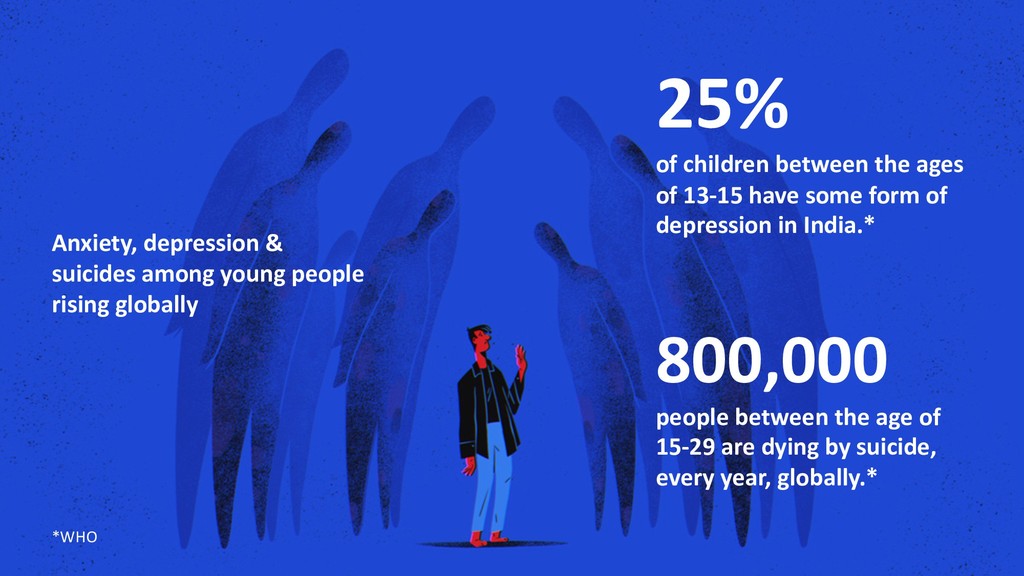
  1. Anxiety, depression & suicides among young people rising globally 25%

    of children between the ages of 13-15 have some form of depression in India.* 800,000 people between the age of 15-29 are dying by suicide, every year, globally.* *WHO
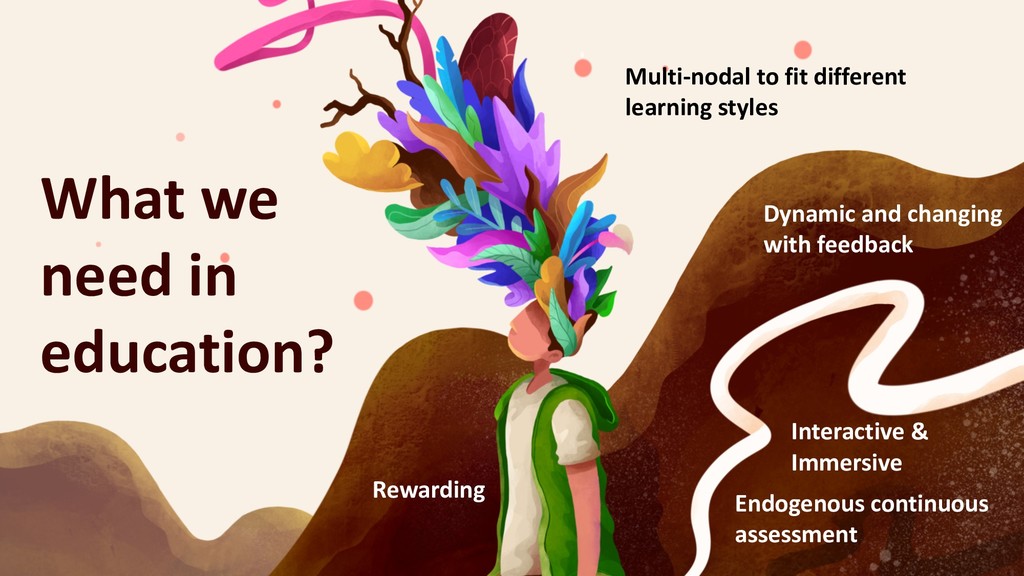
  2. What we need in education? Multi-nodal to fit different learning

    styles Dynamic and changing with feedback Interactive & Immersive Rewarding Endogenous continuous assessment
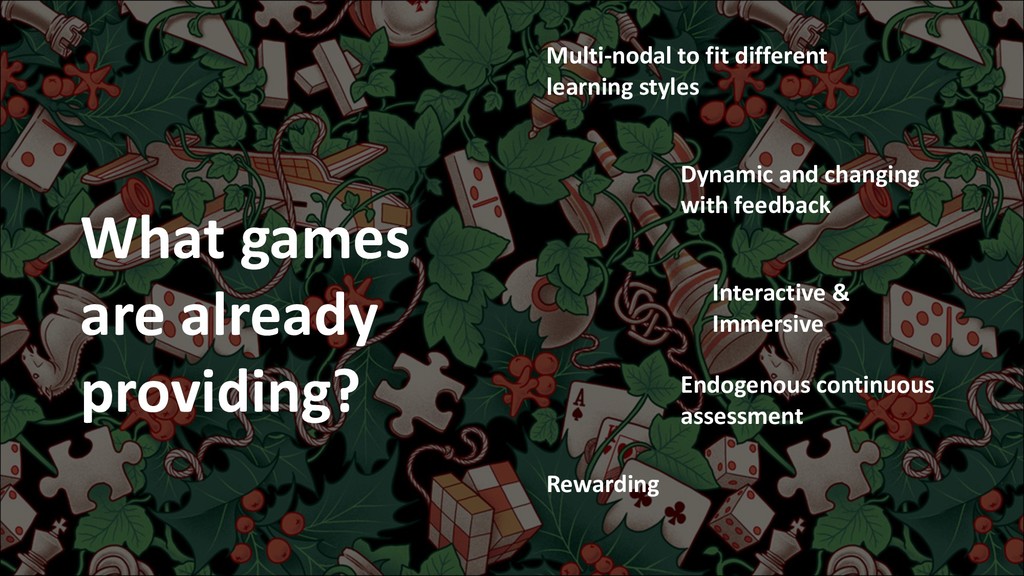
  3. What games are already providing? Multi-nodal to fit different learning

    styles Dynamic and changing with feedback Interactive & Immersive Rewarding Endogenous continuous assessment
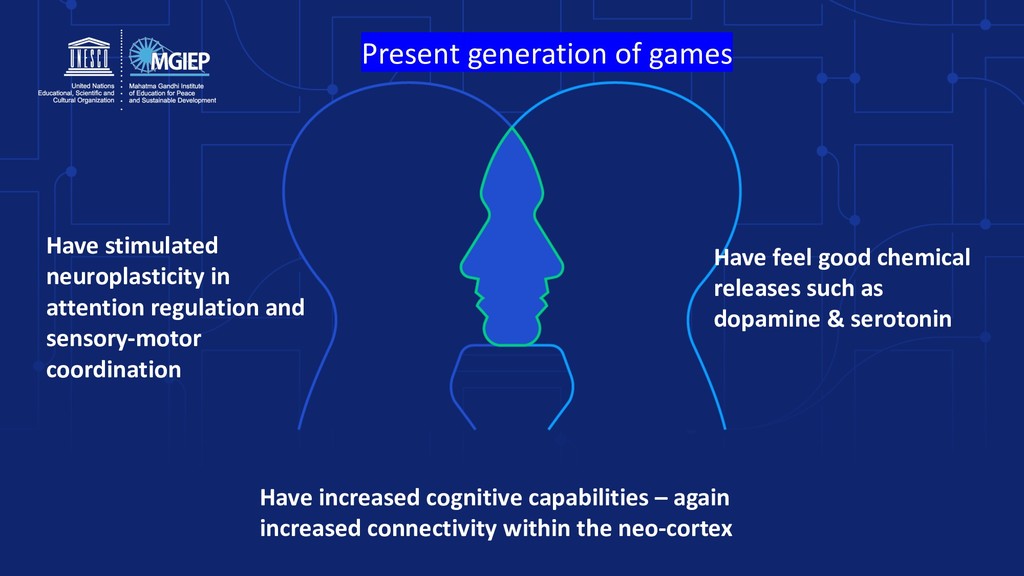
  4. Present generation of games Have stimulated neuroplasticity in attention regulation

    and sensory-motor coordination Have feel good chemical releases such as dopamine & serotonin Have increased cognitive capabilities – again increased connectivity within the neo-cortex
  5. What we need from games? The creation of new neural

    networks that will provide strong links across the thinking brain & the emotional brain – the Gandhi Neural Network
  6. The negative aspects of games Gaming disorder listed as a

    mental health condition for the first time by the World Health Organization in the 11th Revision of the International Classification of Diseases (Source: WHO, 2019)
  7. PURPOSE: To provide developers, artists, teachers, educators, parents and students

    a set of universally accepted principles to be followed when developing digital content for learning Guidelines for Digital learning
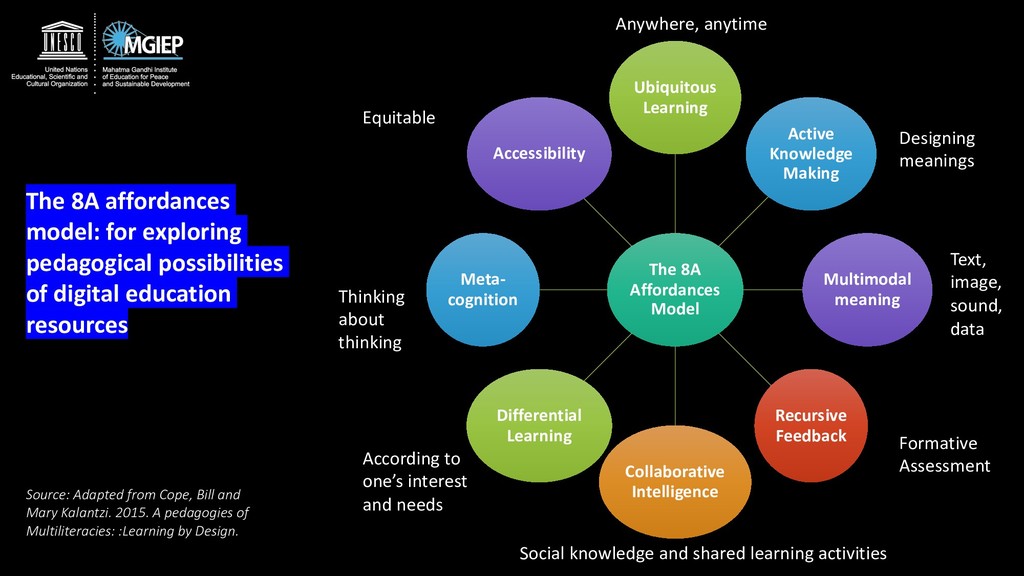
  8. The 8A Affordances Model Ubiquitous Learning Active Knowledge Making Multimodal

    meaning Recursive Feedback Collaborative Intelligence Differential Learning Meta- cognition Accessibility Designing meanings Anywhere, anytime Text, image, sound, data Formative Assessment Equitable Thinking about thinking According to one’s interest and needs Social knowledge and shared learning activities The 8A affordances model: for exploring pedagogical possibilities of digital education resources Source: Adapted from Cope, Bill and Mary Kalantzi. 2015. A pedagogies of Multiliteracies: :Learning by Design.
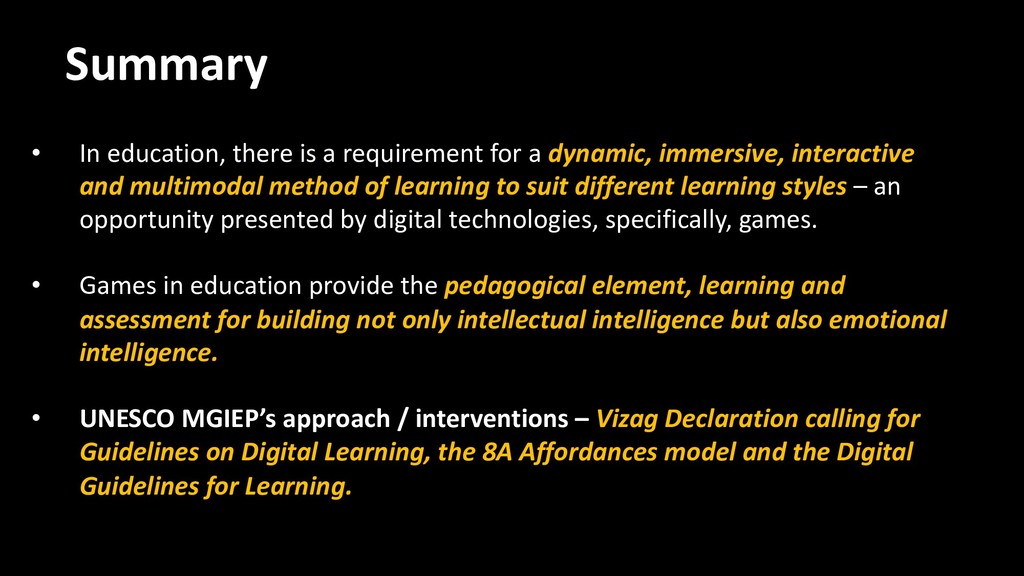
  9. • In education, there is a requirement for a dynamic,

    immersive, interactive and multimodal method of learning to suit different learning styles – an opportunity presented by digital technologies, specifically, games. • Games in education provide the pedagogical element, learning and assessment for building not only intellectual intelligence but also emotional intelligence. • UNESCO MGIEP’s approach / interventions – Vizag Declaration calling for Guidelines on Digital Learning, the 8A Affordances model and the Digital Guidelines for Learning. Summary
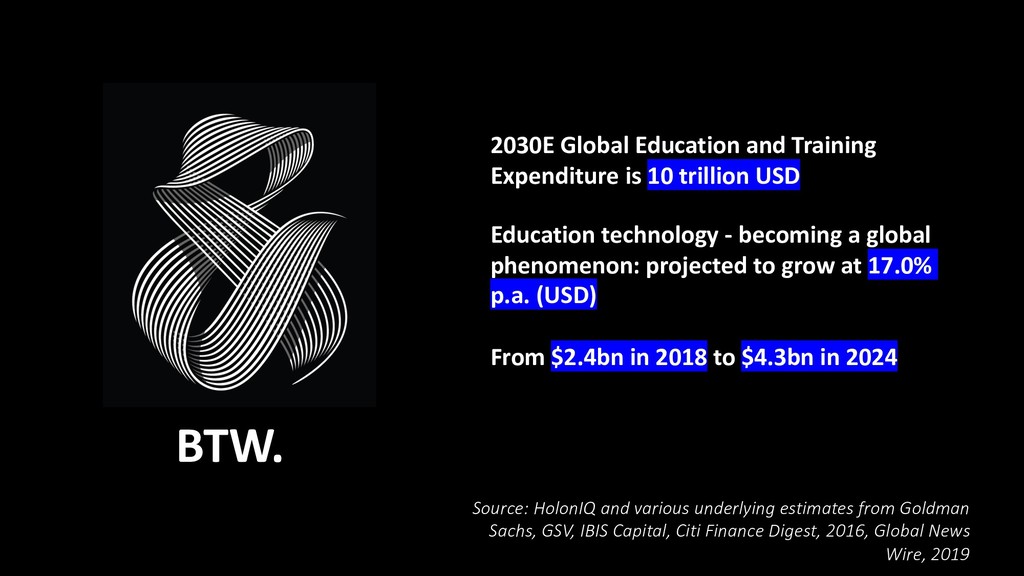
  10. 2030E Global Education and Training Expenditure is 10 trillion USD

    Education technology - becoming a global phenomenon: projected to grow at 17.0% p.a. (USD) From $2.4bn in 2018 to $4.3bn in 2024 Source: HolonIQ and various underlying estimates from Goldman Sachs, GSV, IBIS Capital, Citi Finance Digest, 2016, Global News Wire, 2019 BTW.
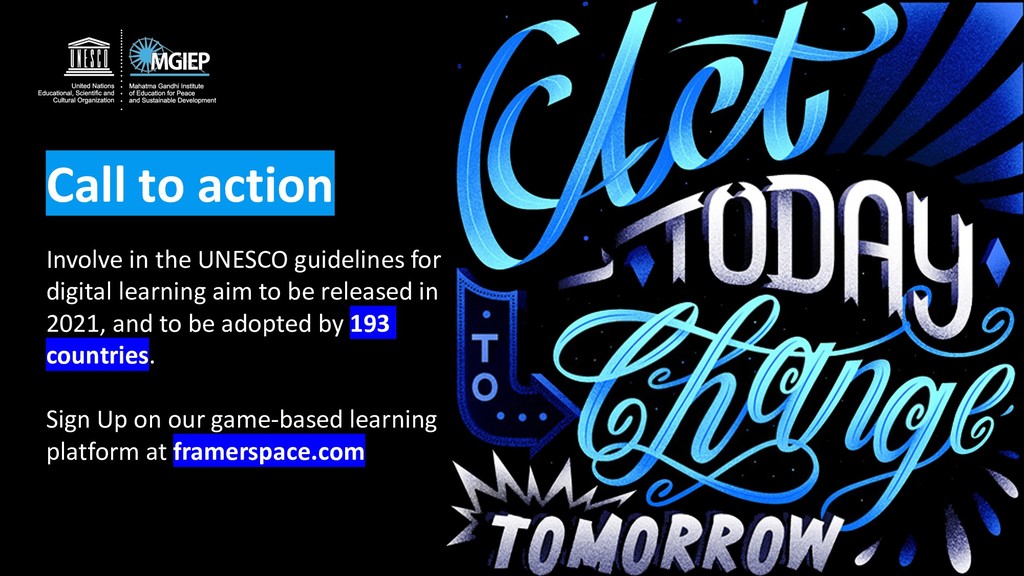
  11. Call to action Involve in the UNESCO guidelines for digital

    learning aim to be released in 2021, and to be adopted by 193 countries. Sign Up on our game-based learning platform at framerspace.com
  12. SEE YOU @ TECH 2019 IN VIZAG, INDIA DEC 10

    – 12, 2019 mgiep.unesco.org/tech2019 unesco_mgiep @unesco_mgiep /mgiep