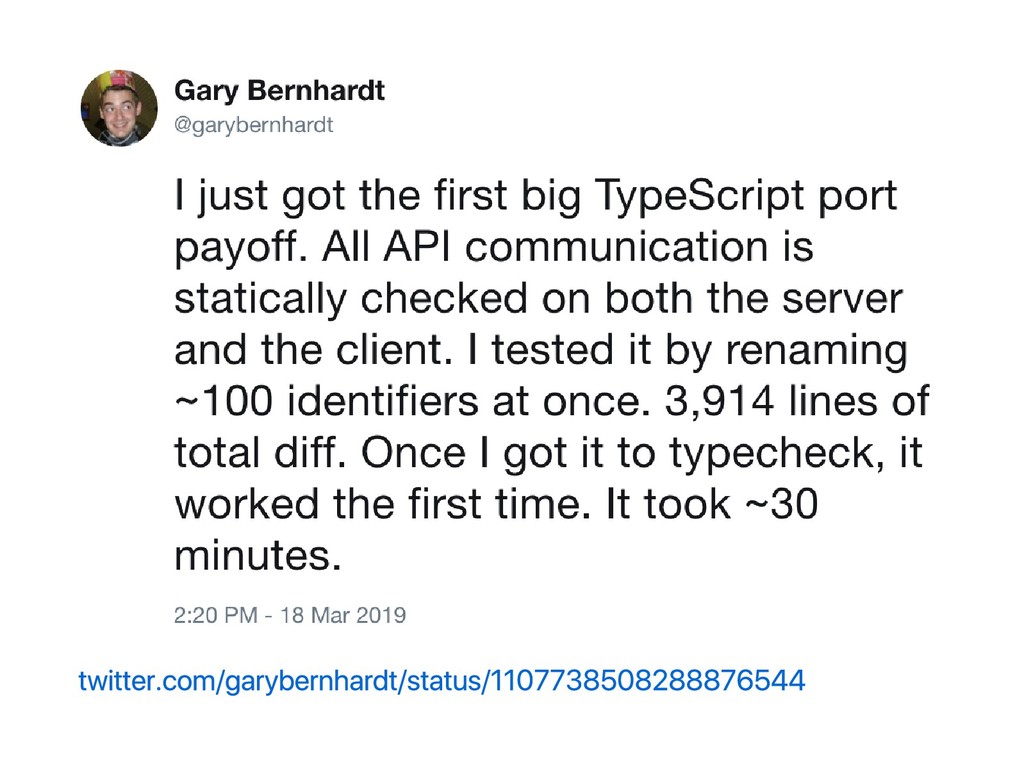
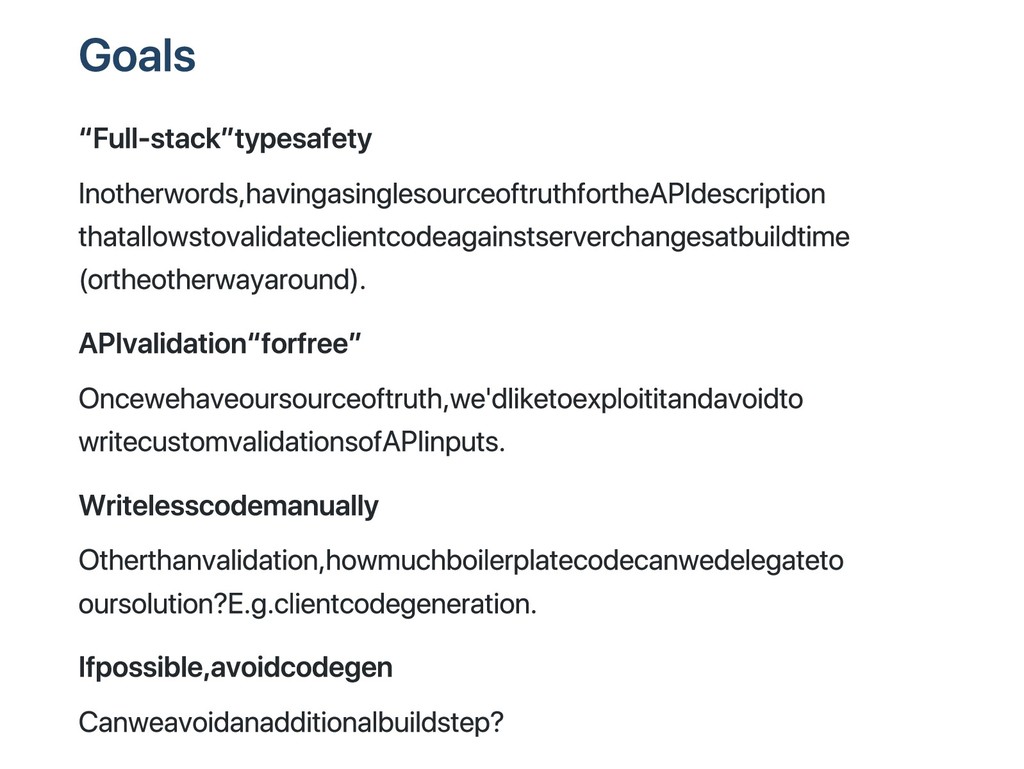
of truth for the API description that allows to validate client code against server changes at build time (or the other way around). API validation “for free” Once we have our source of truth, we'd like to exploit it and avoid to write custom validations of API inputs. Write less code manually Other than validation, how much boilerplate code can we delegate to our solution? E.g. client code generation. If possible, avoid codegen Can we avoid an additional build step?
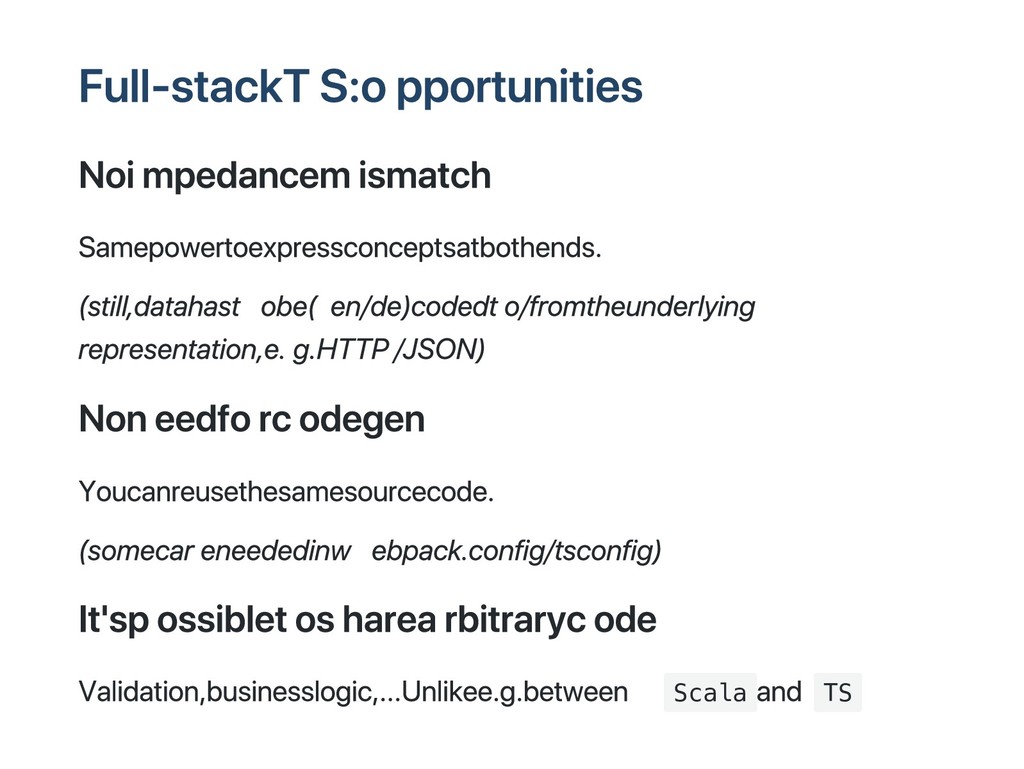
concepts at both ends. (still, data has to be (en/de)coded to/from the underlying representation, e.g. HTTP/JSON) No need for codegen You can reuse the same source code. (some care needed in webpack.config/tsconfig) It's possible to share arbitrary code Validation, business logic,... Unlike e.g. between Scala and TS
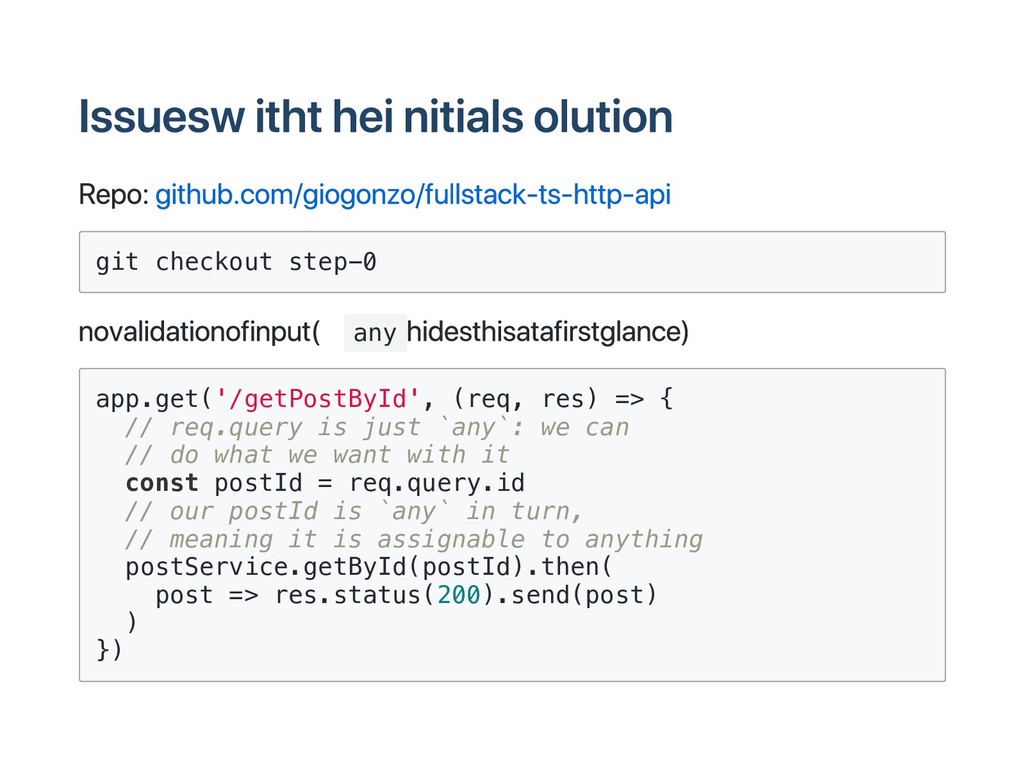
no validation of input ( any hides this at a first glance) app.get('/getPostById', (req, res) => { // req.query is just `any`: we can // do what we want with it const postId = req.query.id // our postId is `any` in turn, // meaning it is assignable to anything postService.getById(postId).then( post => res.status(200).send(post) ) })
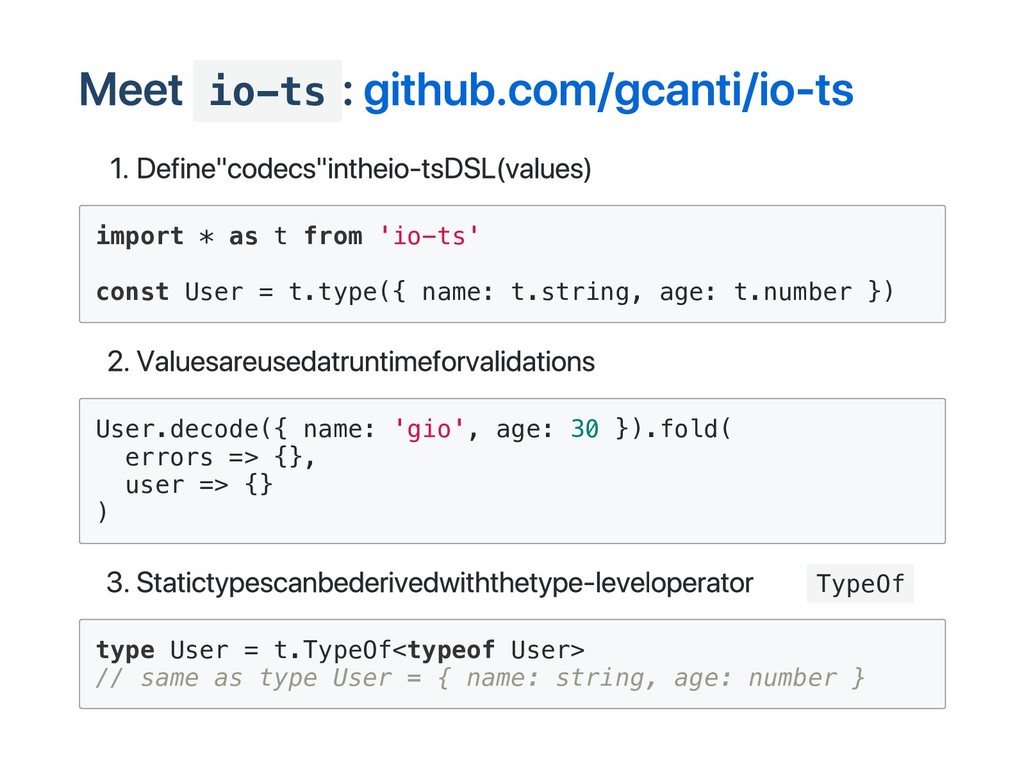
DSL (values) import * as t from 'io-ts' const User = t.type({ name: t.string, age: t.number }) 2. Values are used at runtime for validations User.decode({ name: 'gio', age: 30 }).fold( errors => {}, user => {} ) 3. Static types can be derived with the type‑level operator TypeOf type User = t.TypeOf<typeof User> // same as type User = { name: string, age: number }
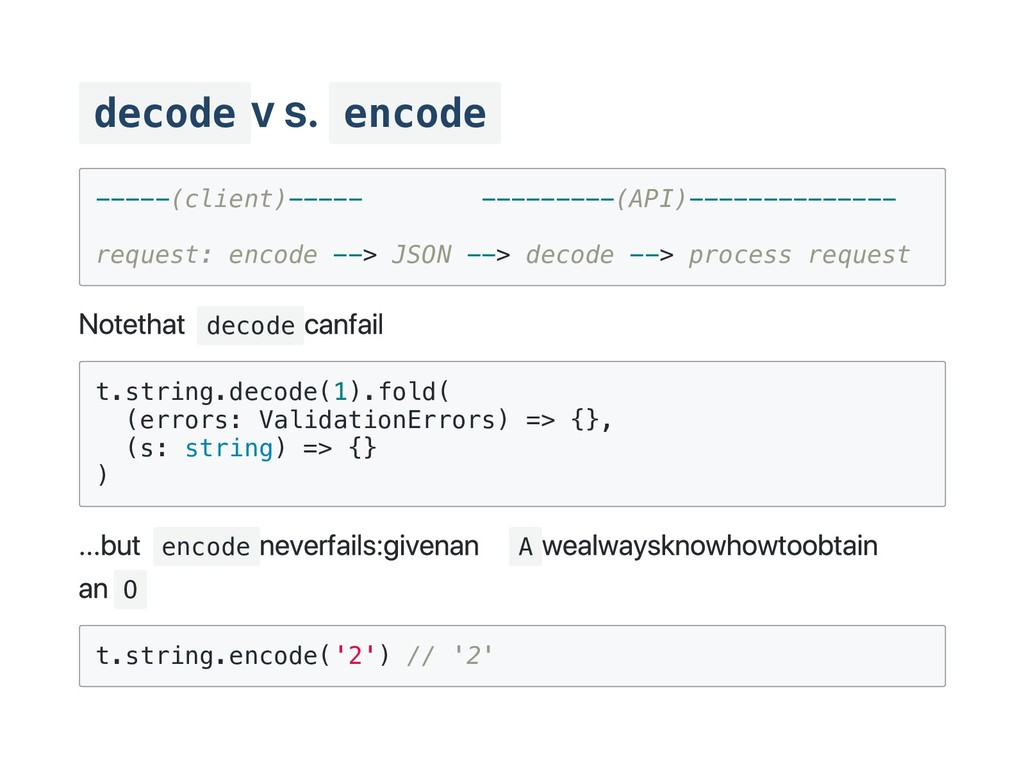
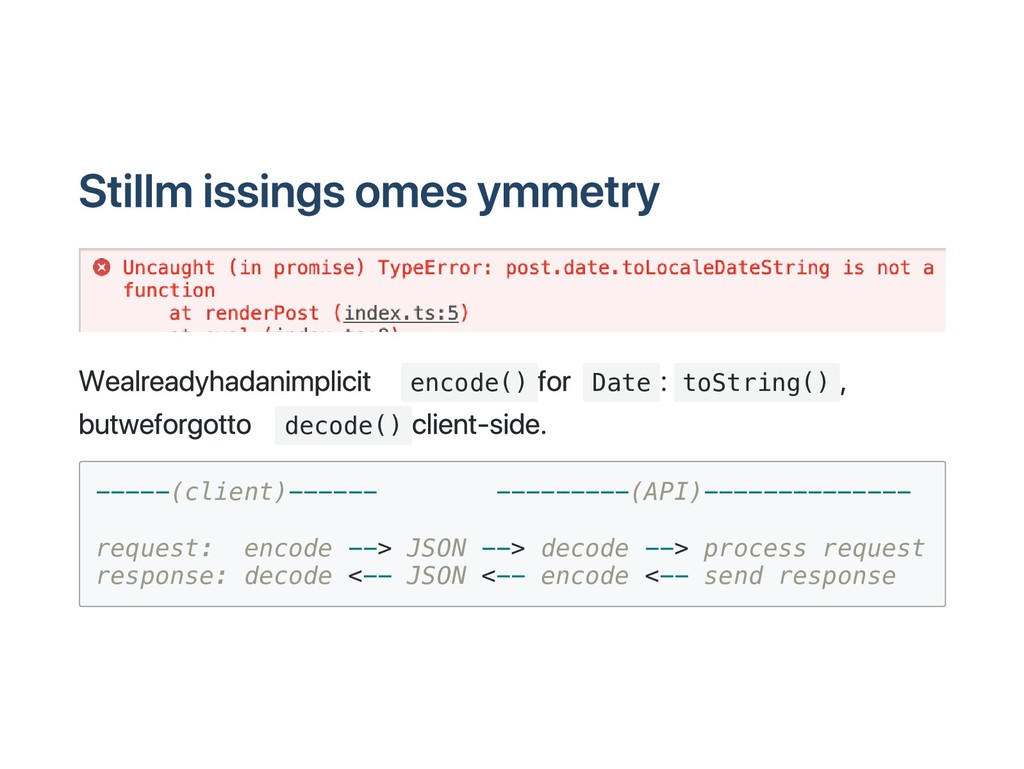
decode --> process request Note that decode can fail t.string.decode(1).fold( (errors: ValidationErrors) => {}, (s: string) => {} ) ... but encode never fails: given an A we always know how to obtain an O t.string.encode('2') // '2'
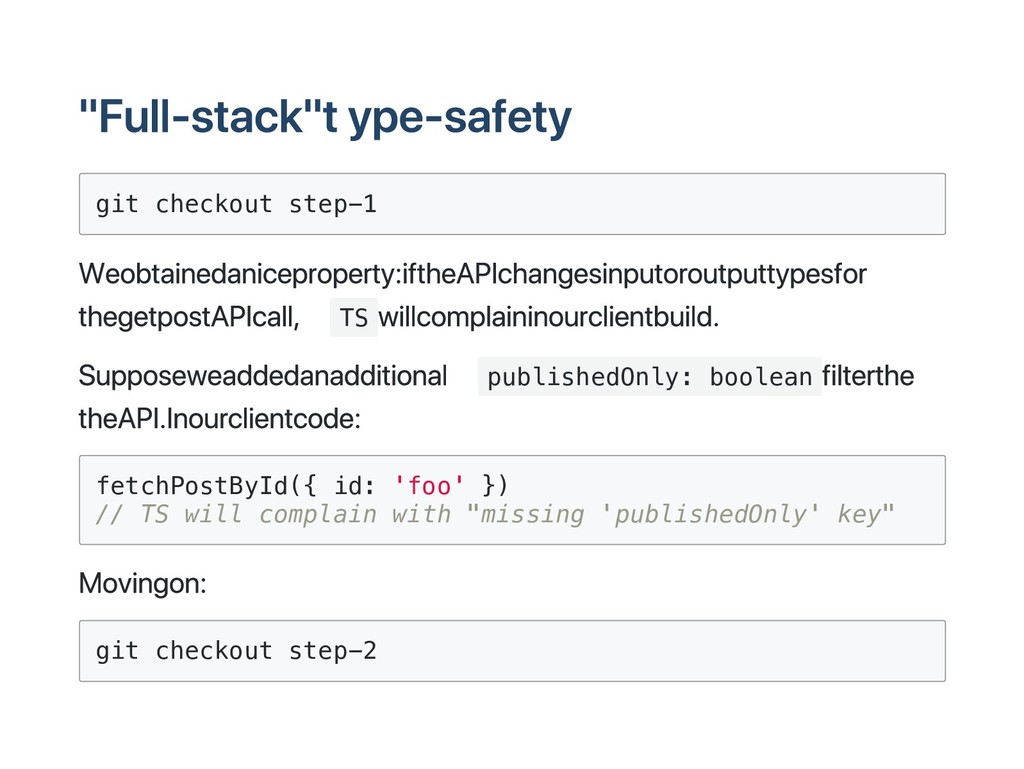
if the API changes input or output types for the get post API call, TS will complain in our client build. Suppose we added an additional publishedOnly: boolean filter the the API. In our client code: fetchPostById({ id: 'foo' }) // TS will complain with "missing 'publishedOnly' key" Moving on: git checkout step-2
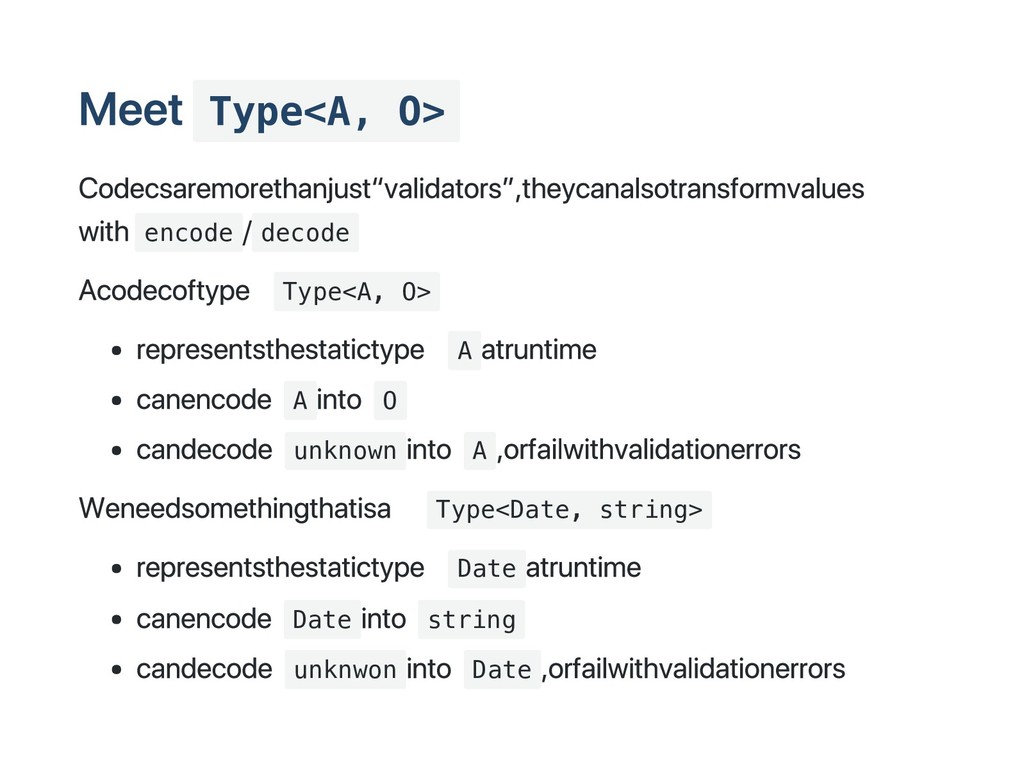
can also transform values with encode / decode A codec of type Type<A, O> represents the static type A at runtime can encode A into O can decode unknown into A , or fail with validation errors We need something that is a Type<Date, string> represents the static type Date at runtime can encode Date into string can decode unknwon into Date , or fail with validation errors
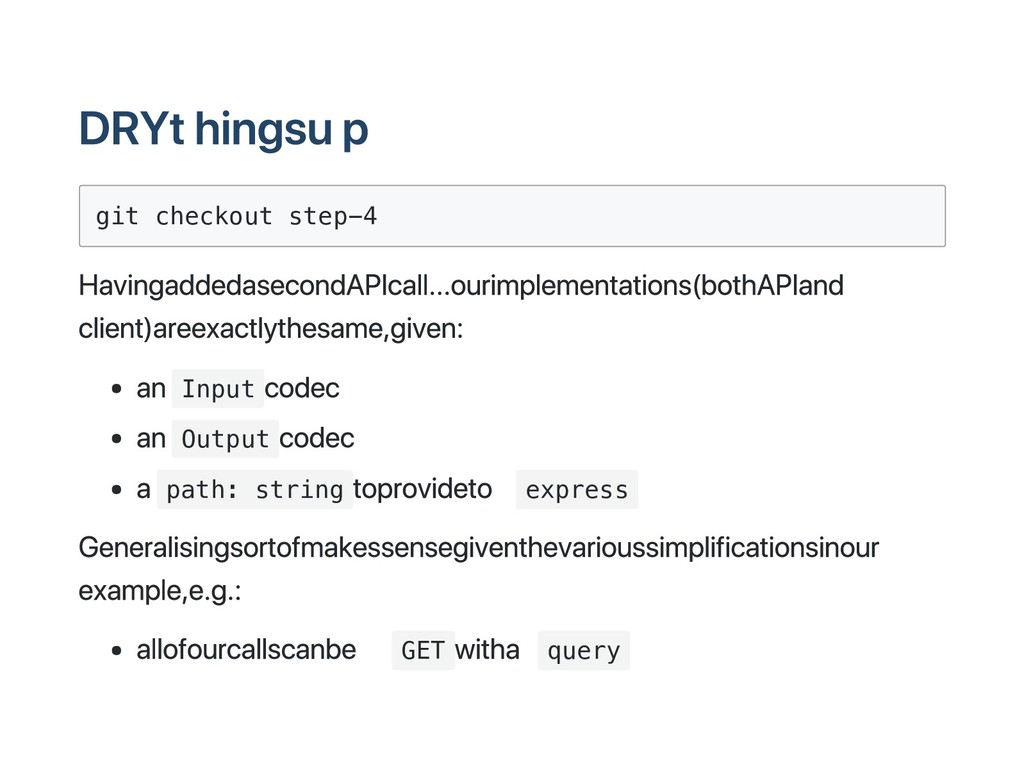
API call... our implementations (both API and client) are exactly the same, given: an Input codec an Output codec a path: string to provide to express Generalising sort of makes sense given the various simplifications in our example, e.g.: all of our calls can be GET with a query
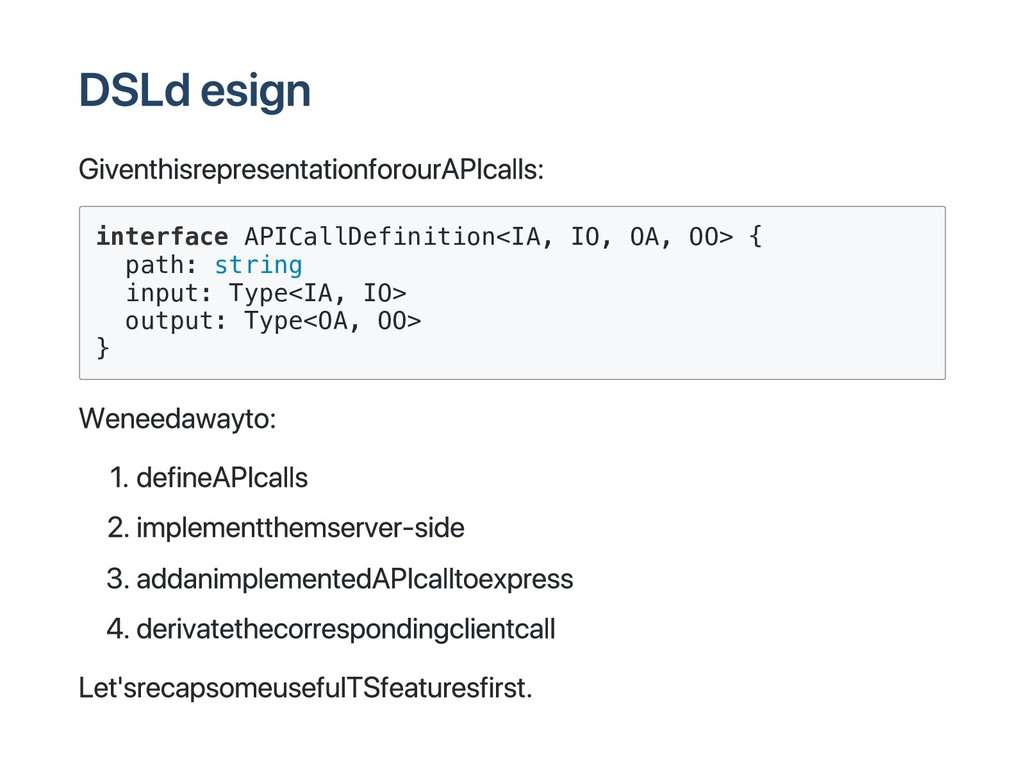
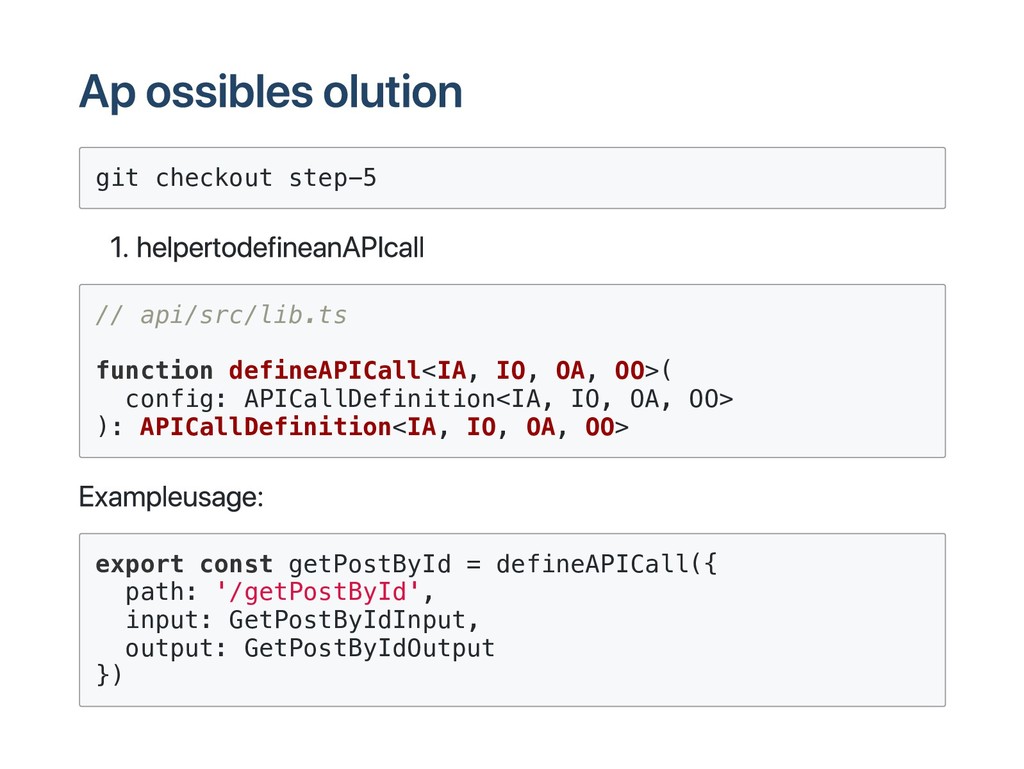
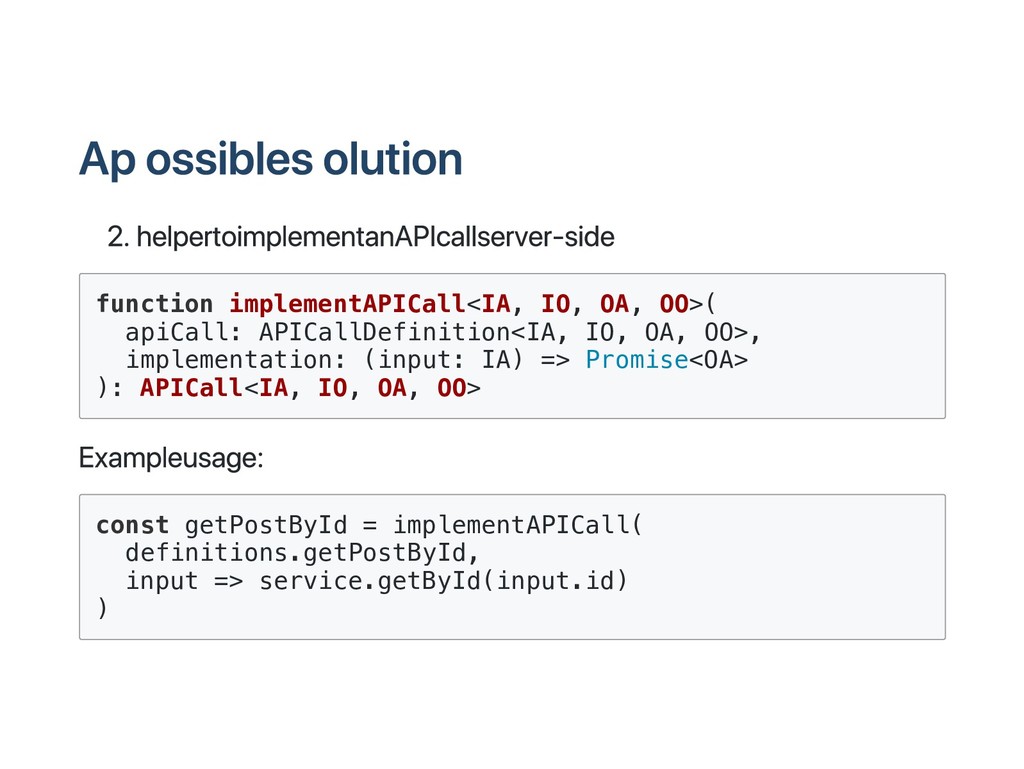
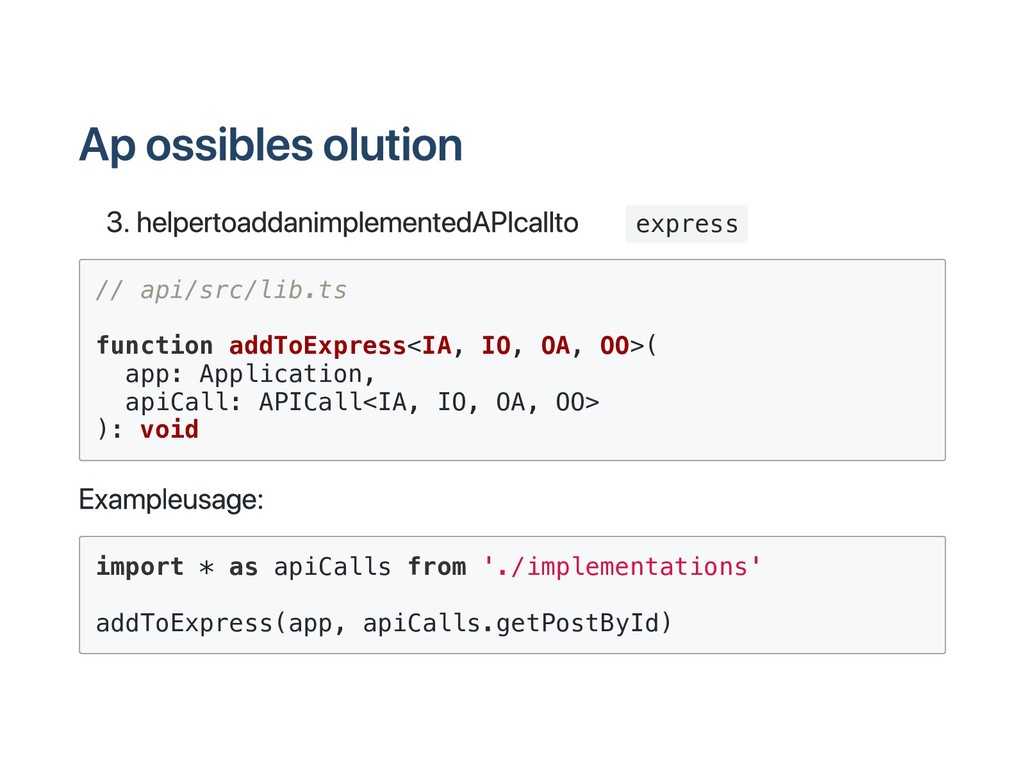
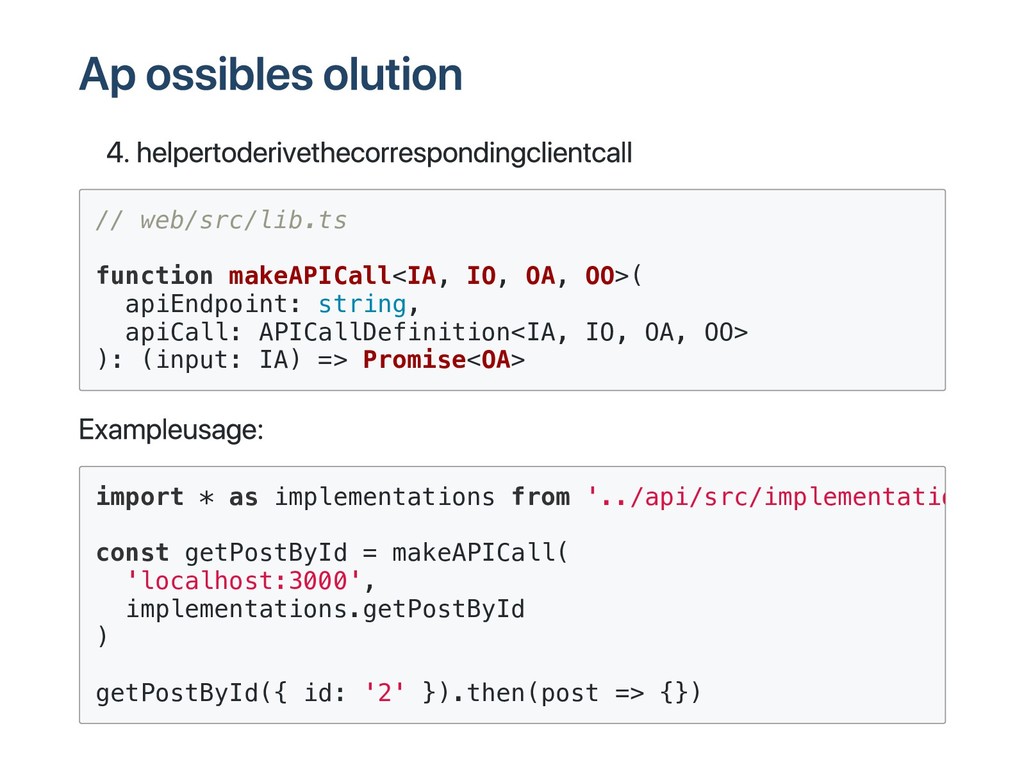
APICallDefinition<IA, IO, OA, OO> { path: string input: Type<IA, IO> output: Type<OA, OO> } We need a way to: 1. define API calls 2. implement them server‑side 3. add an implemented API call to express 4. derivate the corresponding client call Let's recap some useful TS features first.
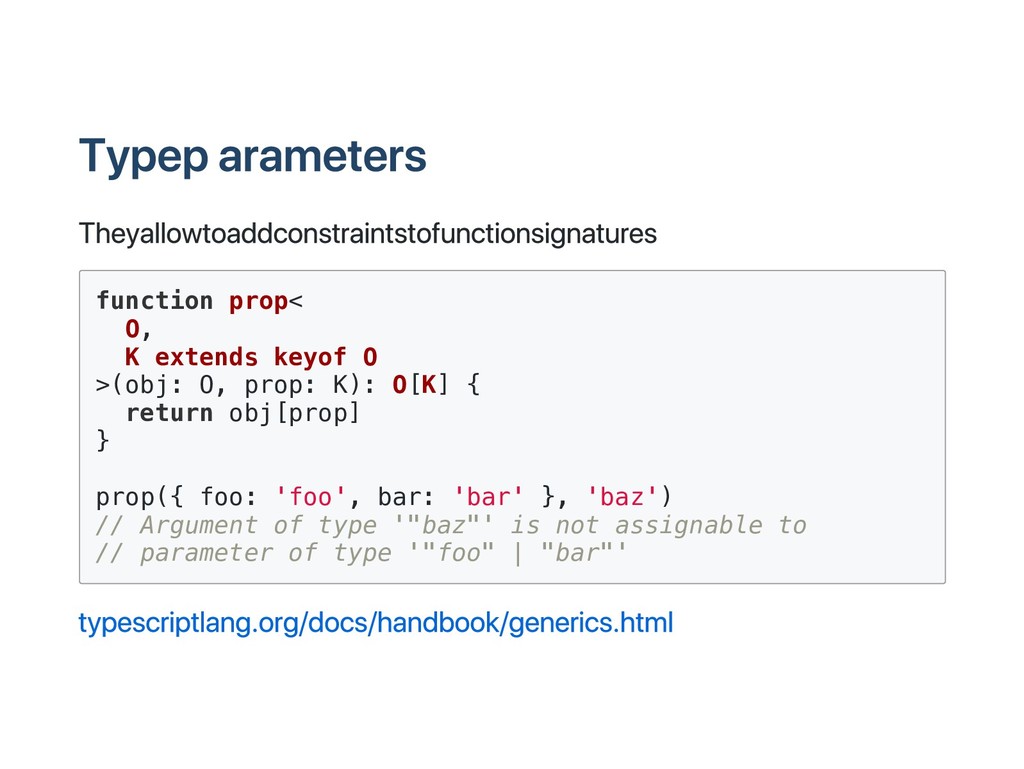
function prop< O, K extends keyof O >(obj: O, prop: K): O[K] { return obj[prop] } prop({ foo: 'foo', bar: 'bar' }, 'baz') // Argument of type '"baz"' is not assignable to // parameter of type '"foo" | "bar"' typescriptlang.org/docs/handbook/generics.html
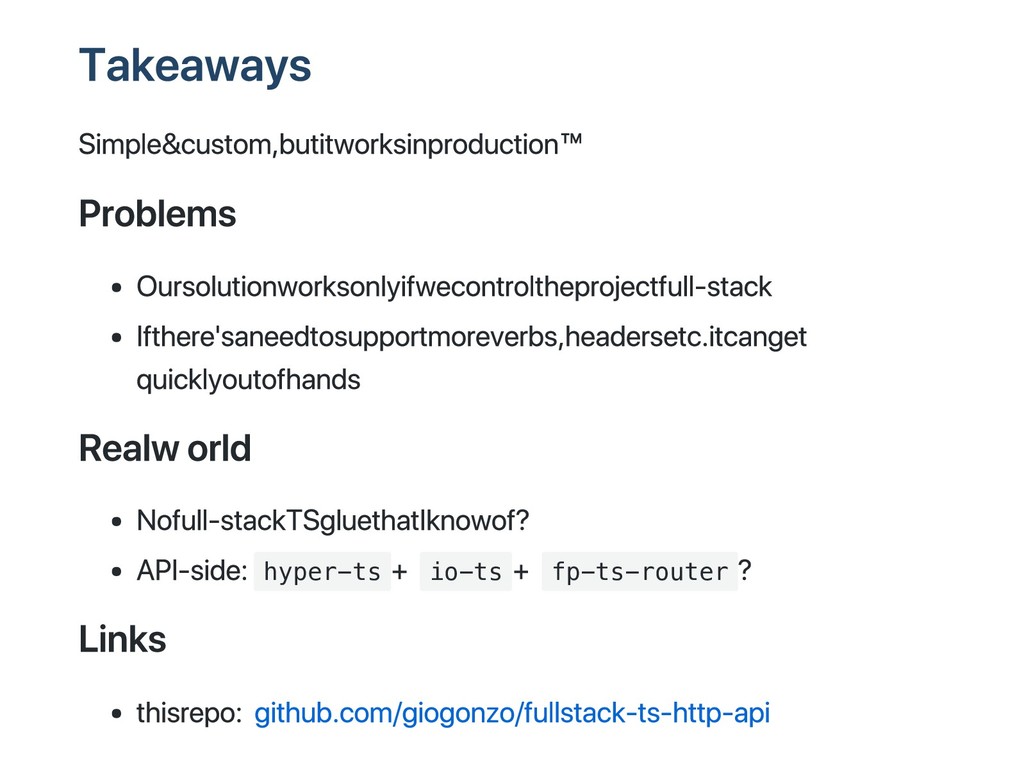
Problems Our solution works only if we control the project full‑stack If there's a need to support more verbs, headers etc. it can get quickly out of hands Real world No full‑stack TS glue that I know of? API‑side: hyper-ts + io-ts + fp-ts-router ? Links this repo: github.com/giogonzo/fullstack‑ts‑http‑api
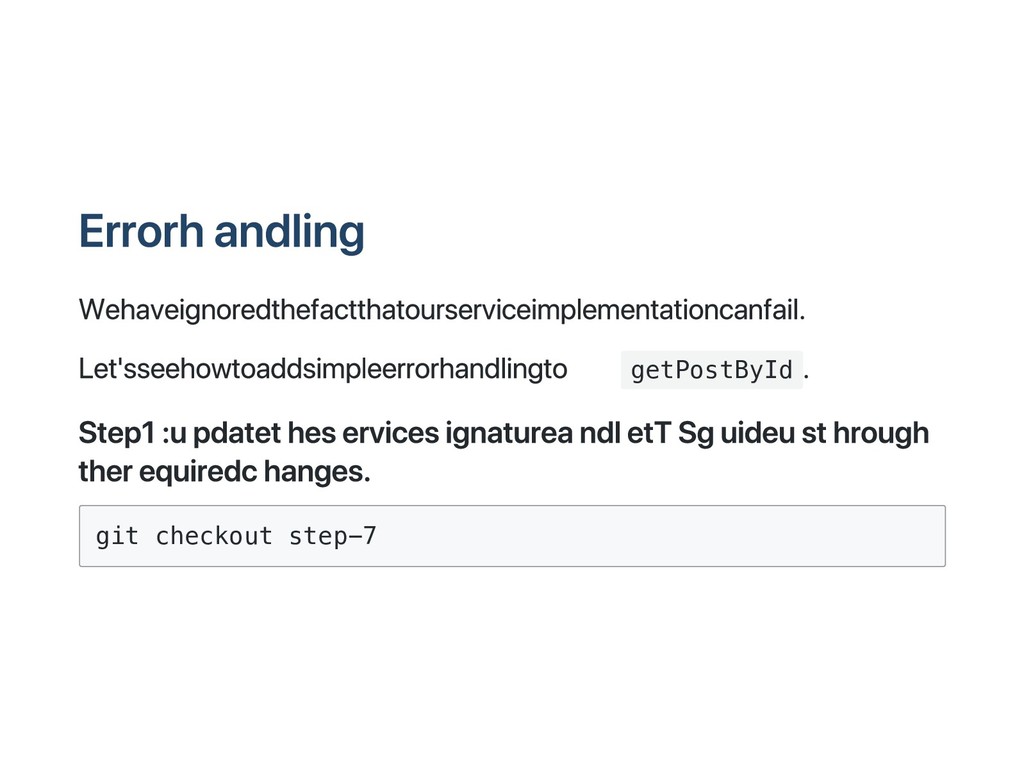
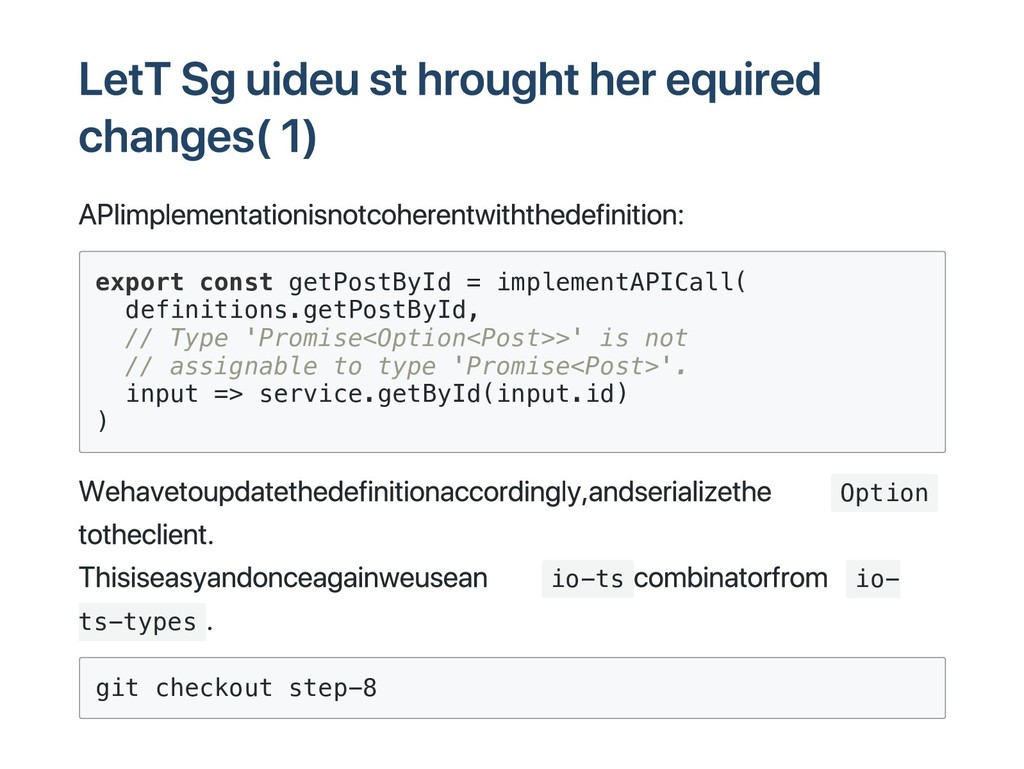
implementation can fail. Let's see how to add simple error handling to getPostById . Step 1: update the service signature and let TS guide us through the required changes. git checkout step-7
implementation is not coherent with the definition: export const getPostById = implementAPICall( definitions.getPostById, // Type 'Promise<Option<Post>>' is not // assignable to type 'Promise<Post>'. input => service.getById(input.id) ) We have to update the definition accordingly, and serialize the Option to the client. This is easy and once again we use an io-ts combinator from io- ts-types . git checkout step-8
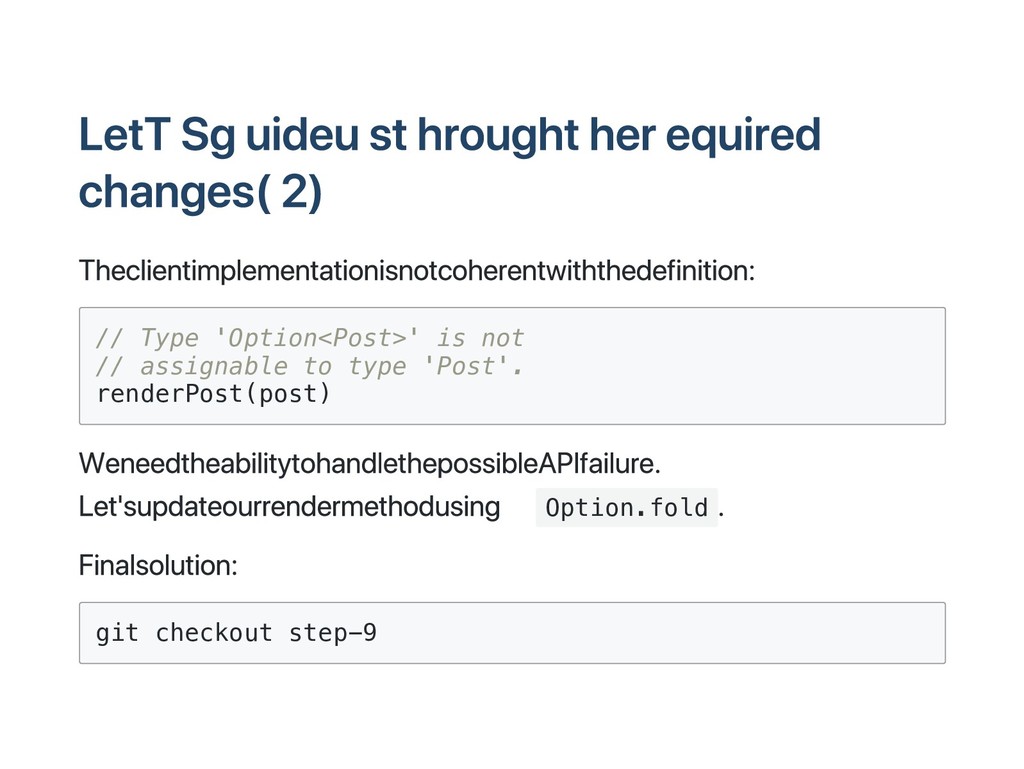
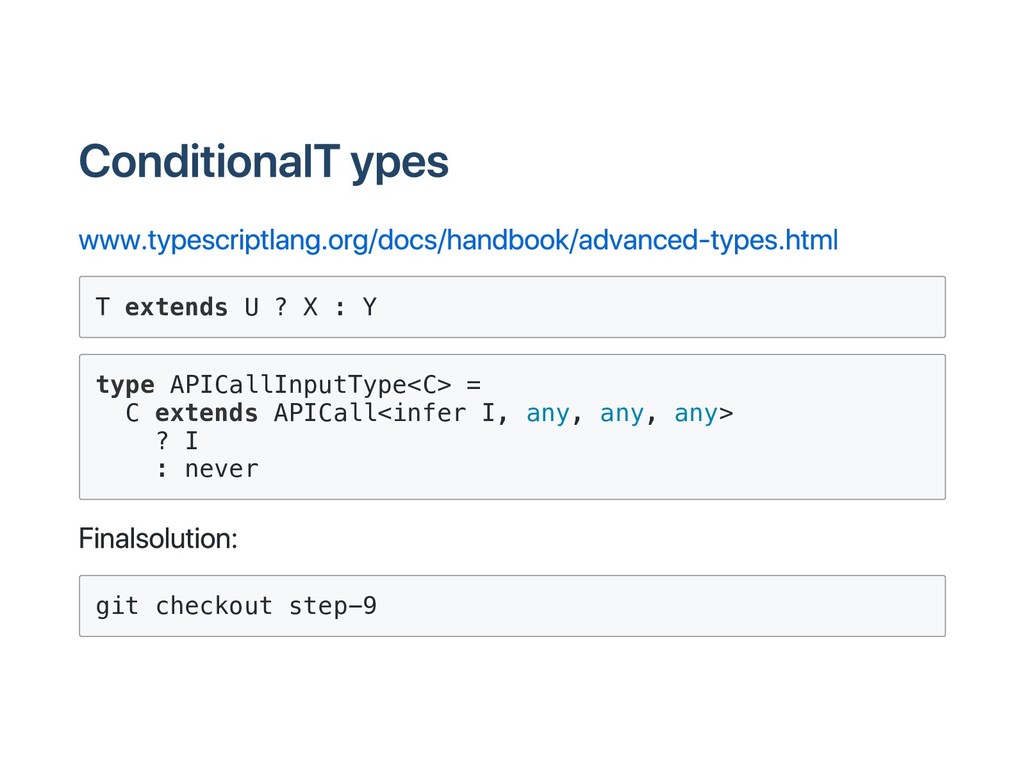
client implementation is not coherent with the definition: // Type 'Option<Post>' is not // assignable to type 'Post'. renderPost(post) We need the ability to handle the possible API failure. Let's update our render method using Option.fold . Final solution: git checkout step-9
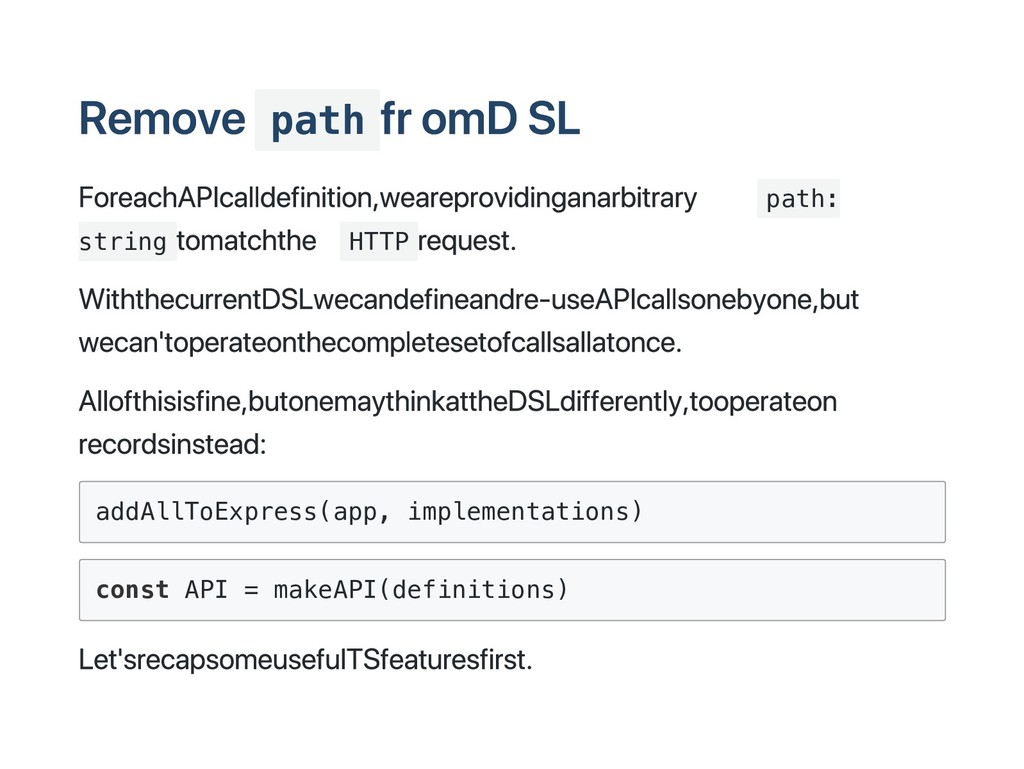
are providing an arbitrary path: string to match the HTTP request. With the current DSL we can define and re‑use API calls one by one, but we can't operate on the complete set of calls all at once. All of this is fine, but one may think at the DSL differently, to operate on records instead: addAllToExpress(app, implementations) const API = makeAPI(definitions) Let's recap some useful TS features first.
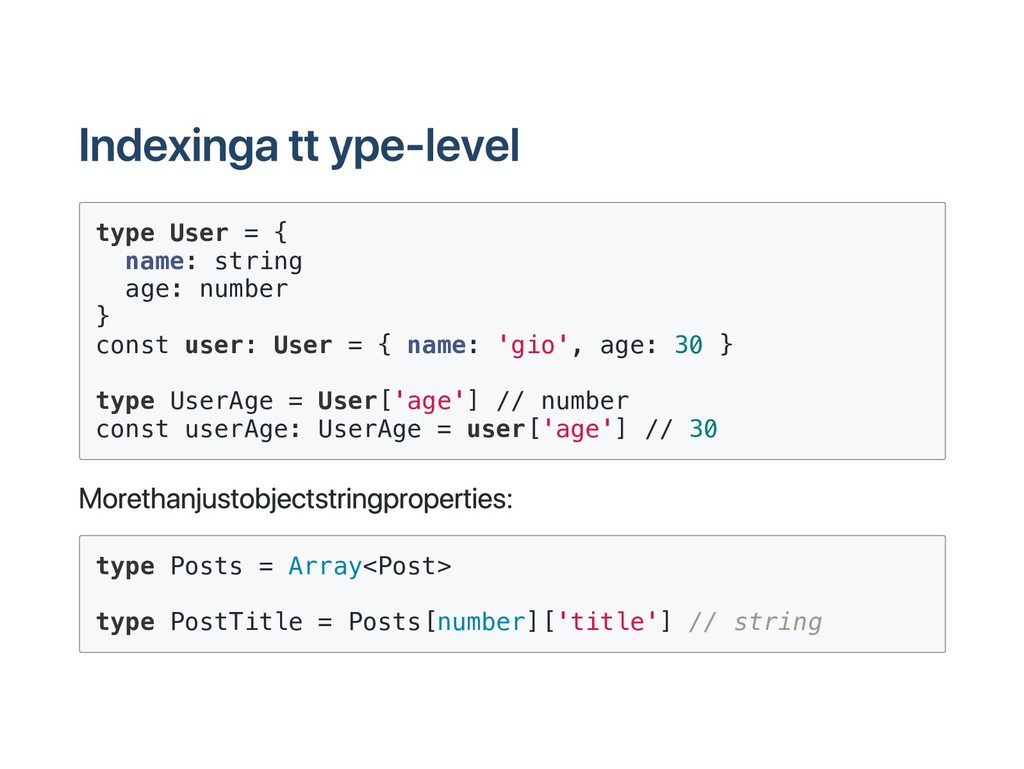
number } const user: User = { name: 'gio', age: 30 } type UserAge = User['age'] // number const userAge: UserAge = user['age'] // 30 More than just object string properties: type Posts = Array<Post> type PostTitle = Posts[number]['title'] // string
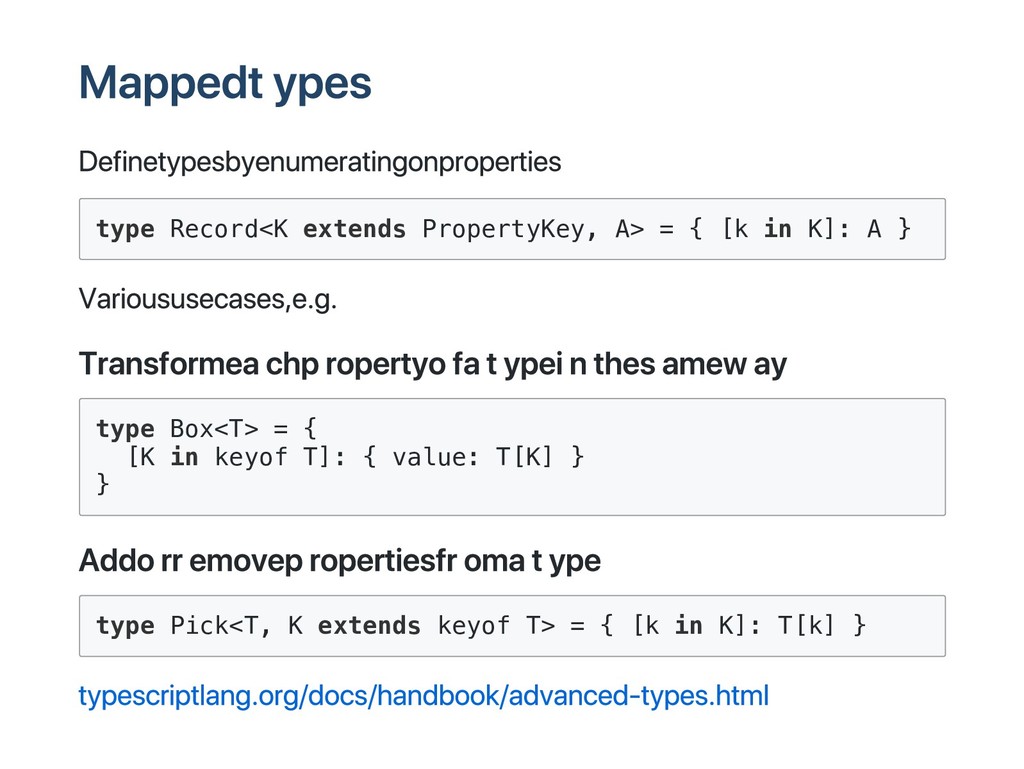
extends PropertyKey, A> = { [k in K]: A } Various use cases, e.g. Transform each property of a type in the same way type Box<T> = { [K in keyof T]: { value: T[K] } } Add or remove properties from a type type Pick<T, K extends keyof T> = { [k in K]: T[k] } typescriptlang.org/docs/handbook/advanced‑types.html


 milanots
 palkan
 s_shimotori
 seike460
 yub0n
yub0n
 headius
 texmeijin
 satotakeshi
 yuukiw00w
 panda728
 ivargrimstad
 hamayokokuririn
 oniak3ibm
 bluesmoon
 stephaniewalter
 sachag
 tmiket
 iamctodd
 katiecoart
 jonoalderson
 marketingsoph
 takai
takai
 leimatthew05
 cassininazir
 aleyda




![Available Solutions GraphQL apollo client:codegen [options] graphql-codegen Swagger, gRPC, ...](https://files.speakerdeck.com/presentations/e12f60e9d60a466dae52c150c2c4ab00/slide_6.jpg)