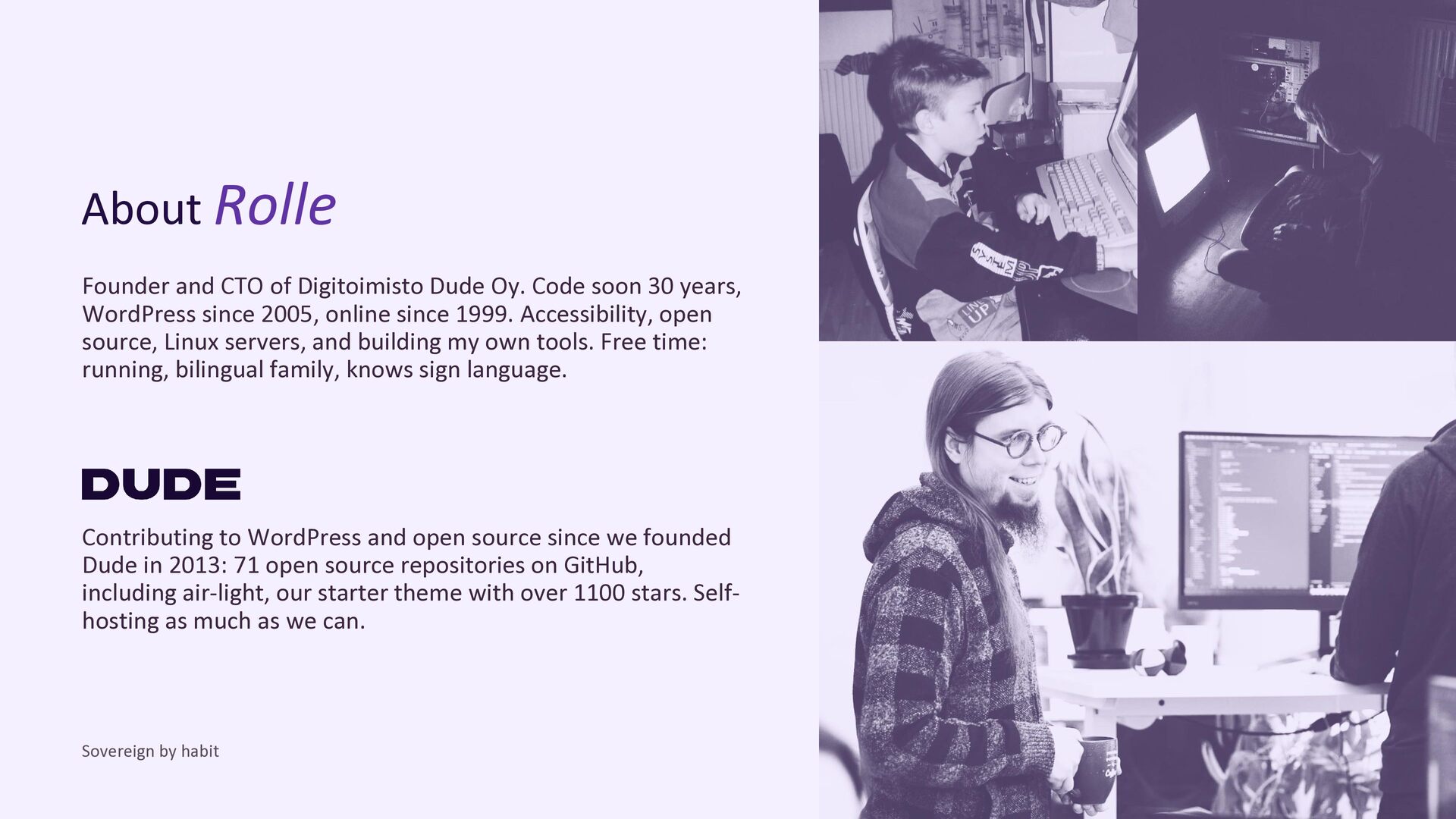
soon 30 years, WordPress since 2005, online since 1999. Accessibility, open source, Linux servers, and building my own tools. Free time: running, bilingual family, knows sign language. Contributing to WordPress and open source since we founded Dude in 2013: 71 open source repositories on GitHub, including air-light, our starter theme with over 1100 stars. Selfhosting as much as we can. Sovereign by habit
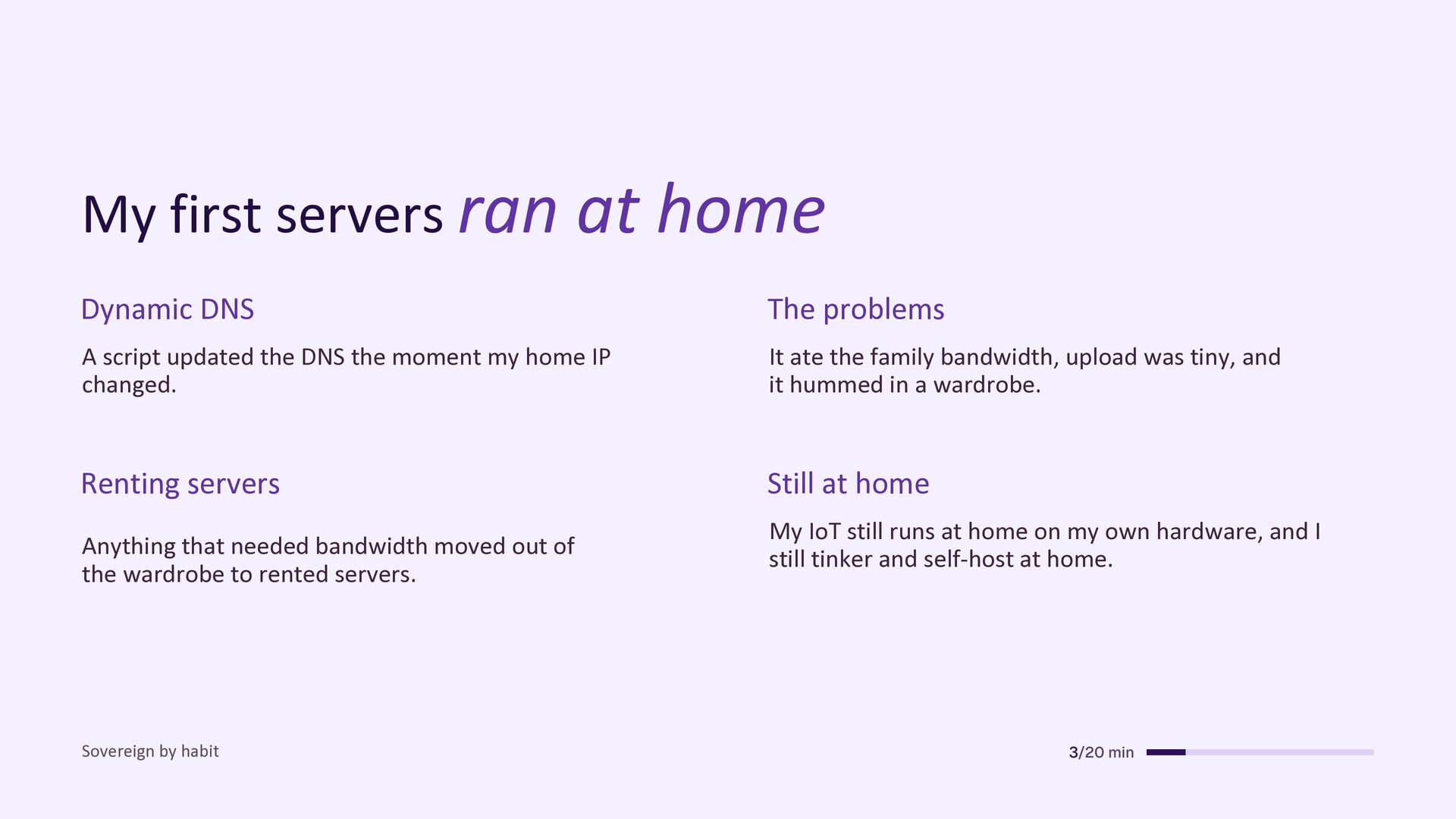
A script updated the DNS the moment my home IP changed. It ate the family bandwidth, upload was tiny, and it hummed in a wardrobe. Renting servers Still at home Anything that needed bandwidth moved out of the wardrobe to rented servers. Sovereign by habit My IoT still runs at home on my own hardware, and I still tinker and self-host at home.
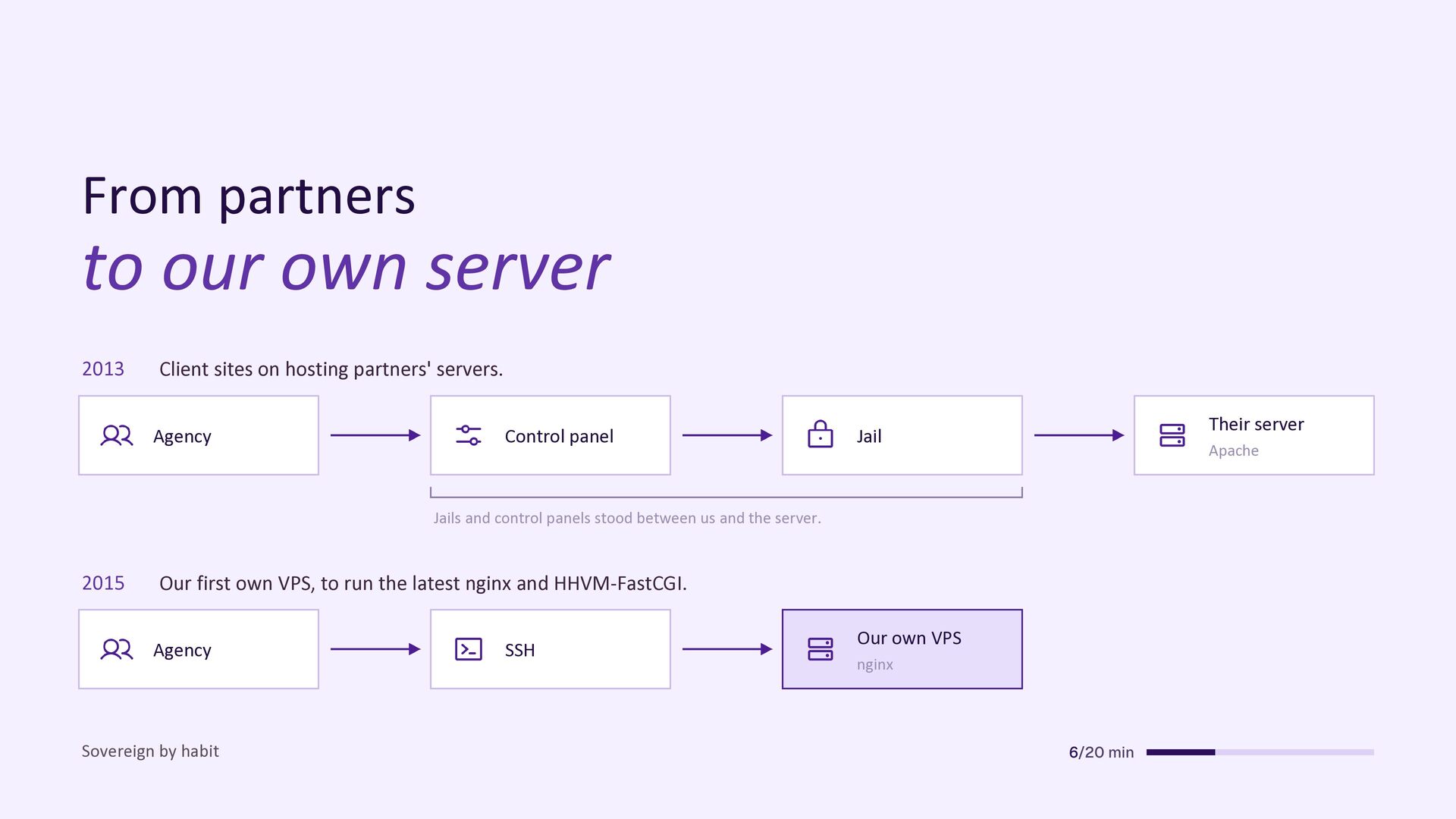
hosting partners' servers. Agency Control panel Jail Jails and control panels stood between us and the server. 2015 Our first own VPS, to run the latest nginx and HHVM-FastCGI. Agency Sovereign by habit SSH Our own VPS nginx Their server Apache
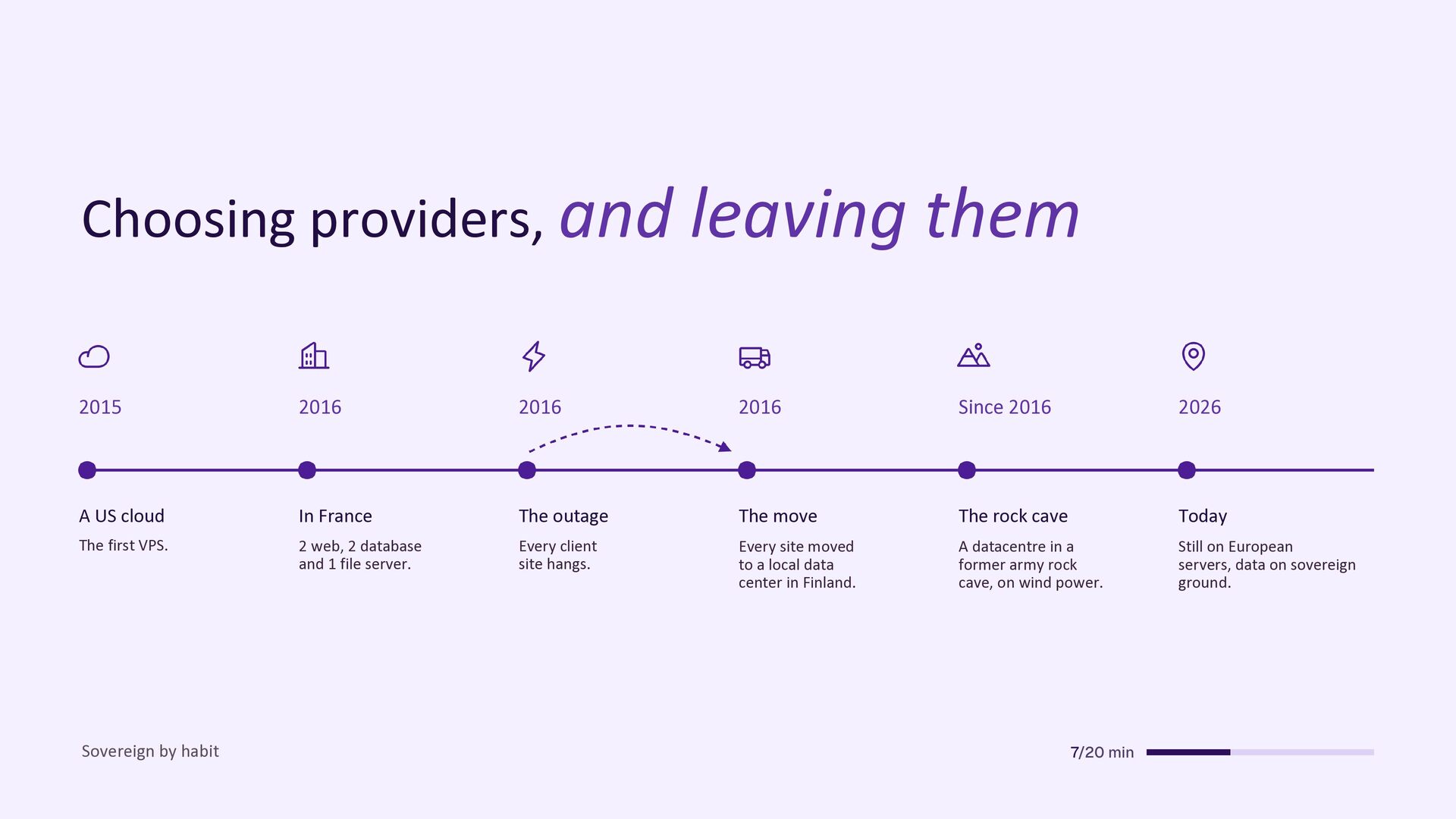
2016 2026 A US cloud In France The outage The move The rock cave Today The first VPS. 2 web, 2 database and 1 file server. Every client site hangs. Every site moved to a local data center in Finland. A datacentre in a former army rock cave, on wind power. Still on European servers, data on sovereign ground. Sovereign by habit
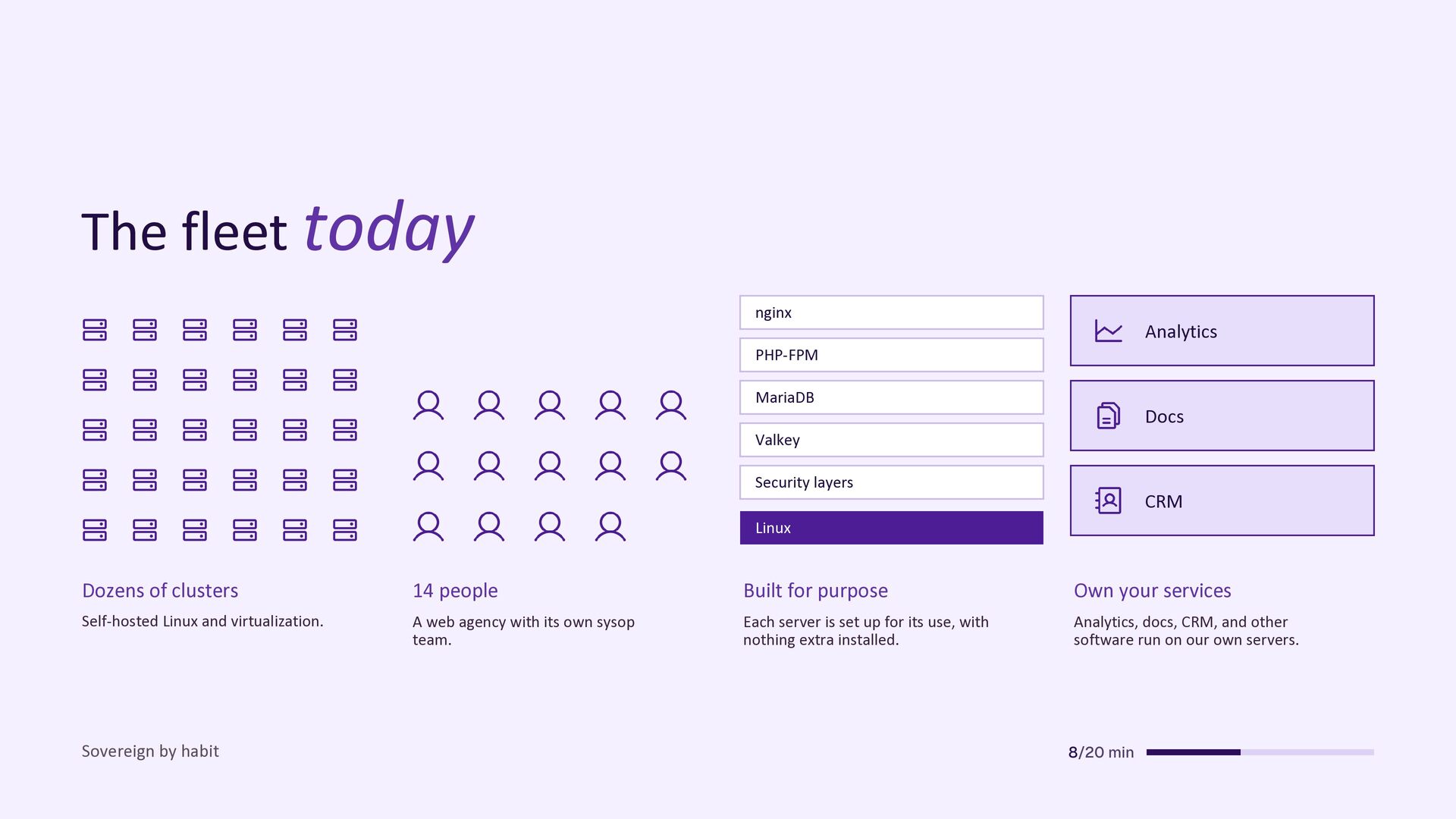
layers CRM Linux Dozens of clusters 14 people Built for purpose Own your services Self-hosted Linux and virtualization. A web agency with its own sysop team. Each server is set up for its use, with nothing extra installed. Analytics, docs, CRM, and other software run on our own servers. Sovereign by habit
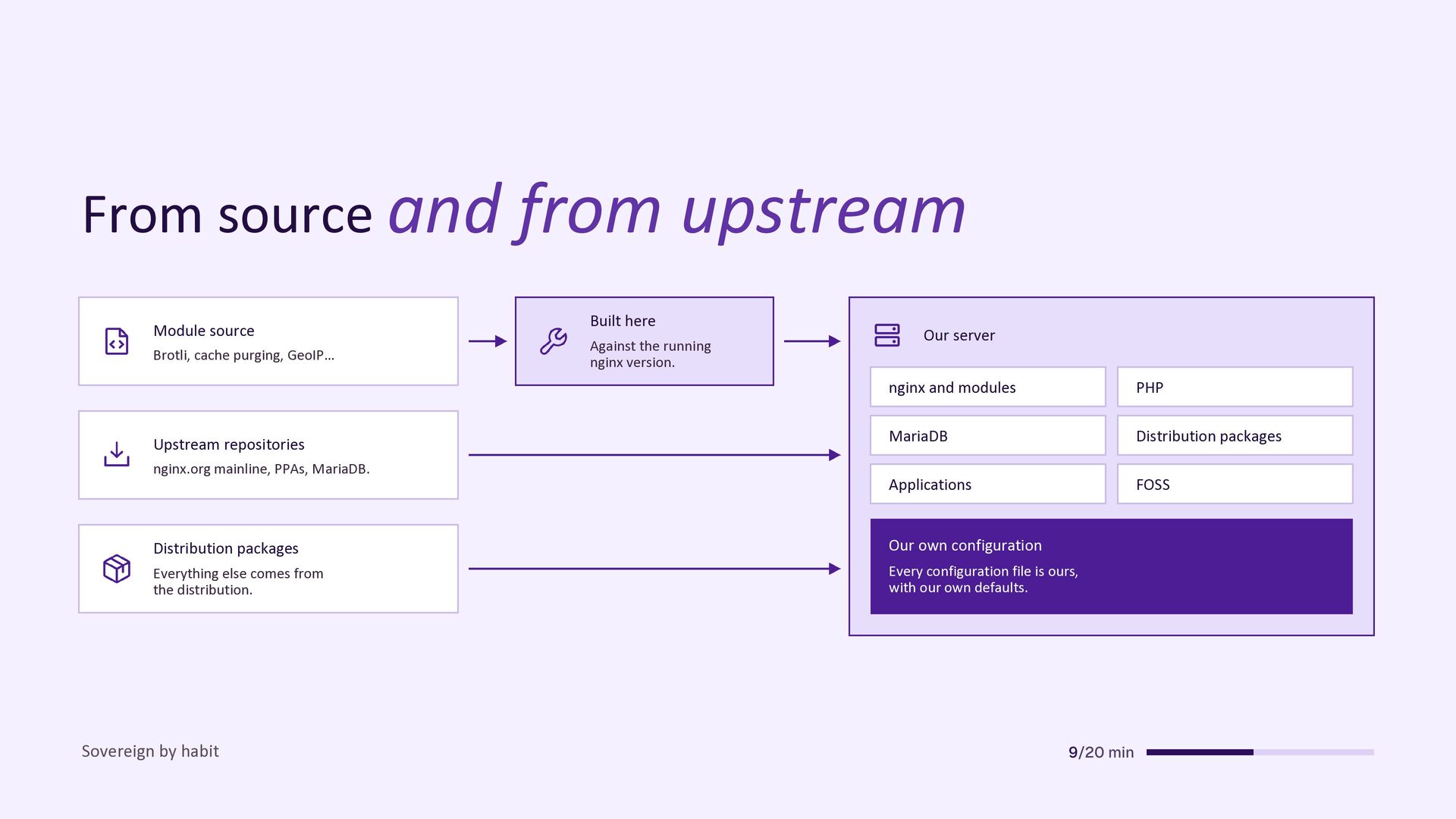
GeoIP… Upstream repositories Built here Against the running nginx version. Our server nginx and modules PHP MariaDB Distribution packages Applications FOSS nginx.org mainline, PPAs, MariaDB. Distribution packages Our own configuration Everything else comes from the distribution. Every configuration file is ours, with our own defaults. Sovereign by habit
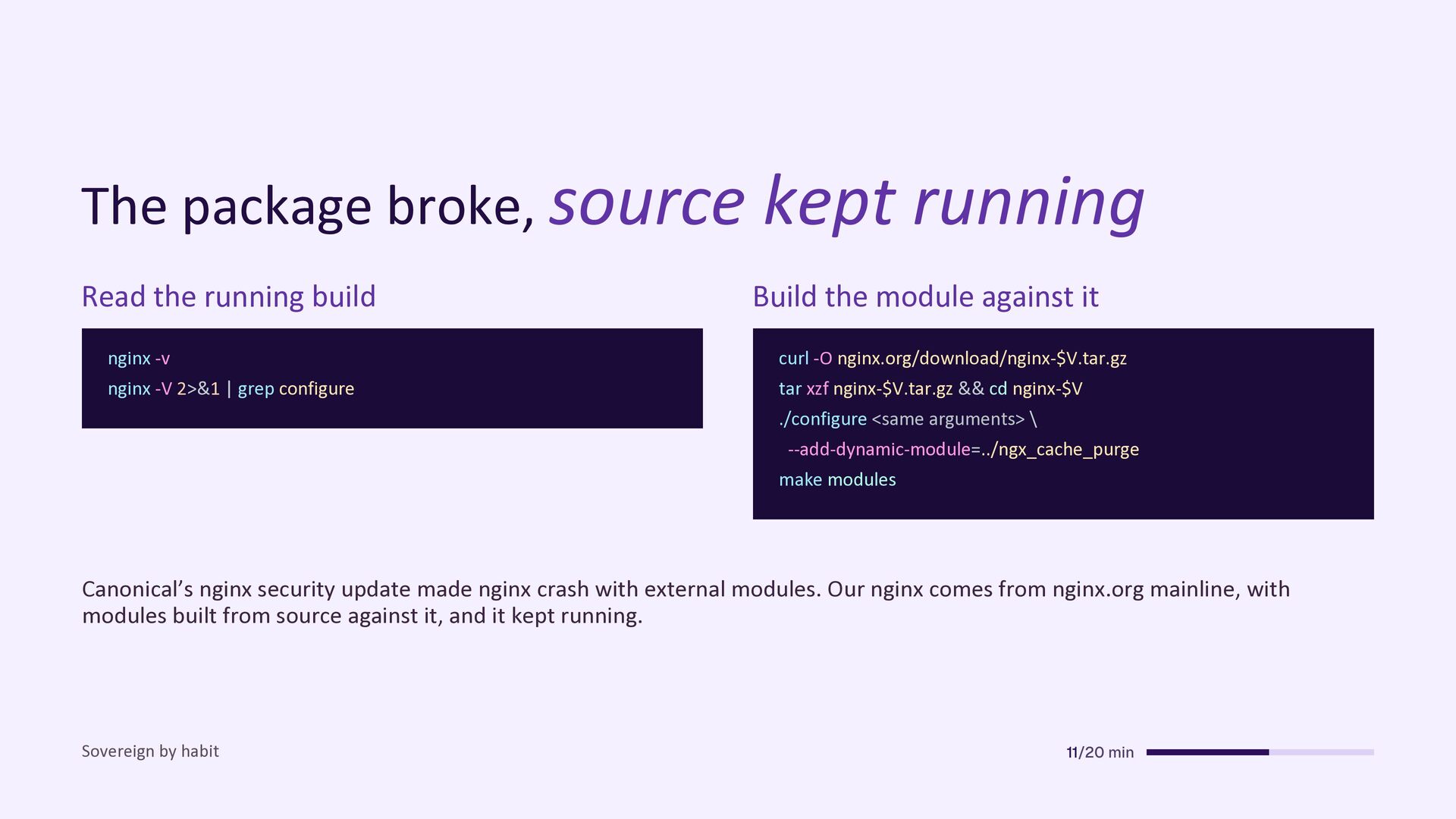
Build the module against it nginx -v curl -O nginx.org/download/nginx-$V.tar.gz nginx -V 2>&1 | grep configure tar xzf nginx-$V.tar.gz && cd nginx-$V ./configure <same arguments> \ --add-dynamic-module=../ngx_cache_purge make modules Canonical’s nginx security update made nginx crash with external modules. Our nginx comes from nginx.org mainline, with modules built from source against it, and it kept running. Sovereign by habit
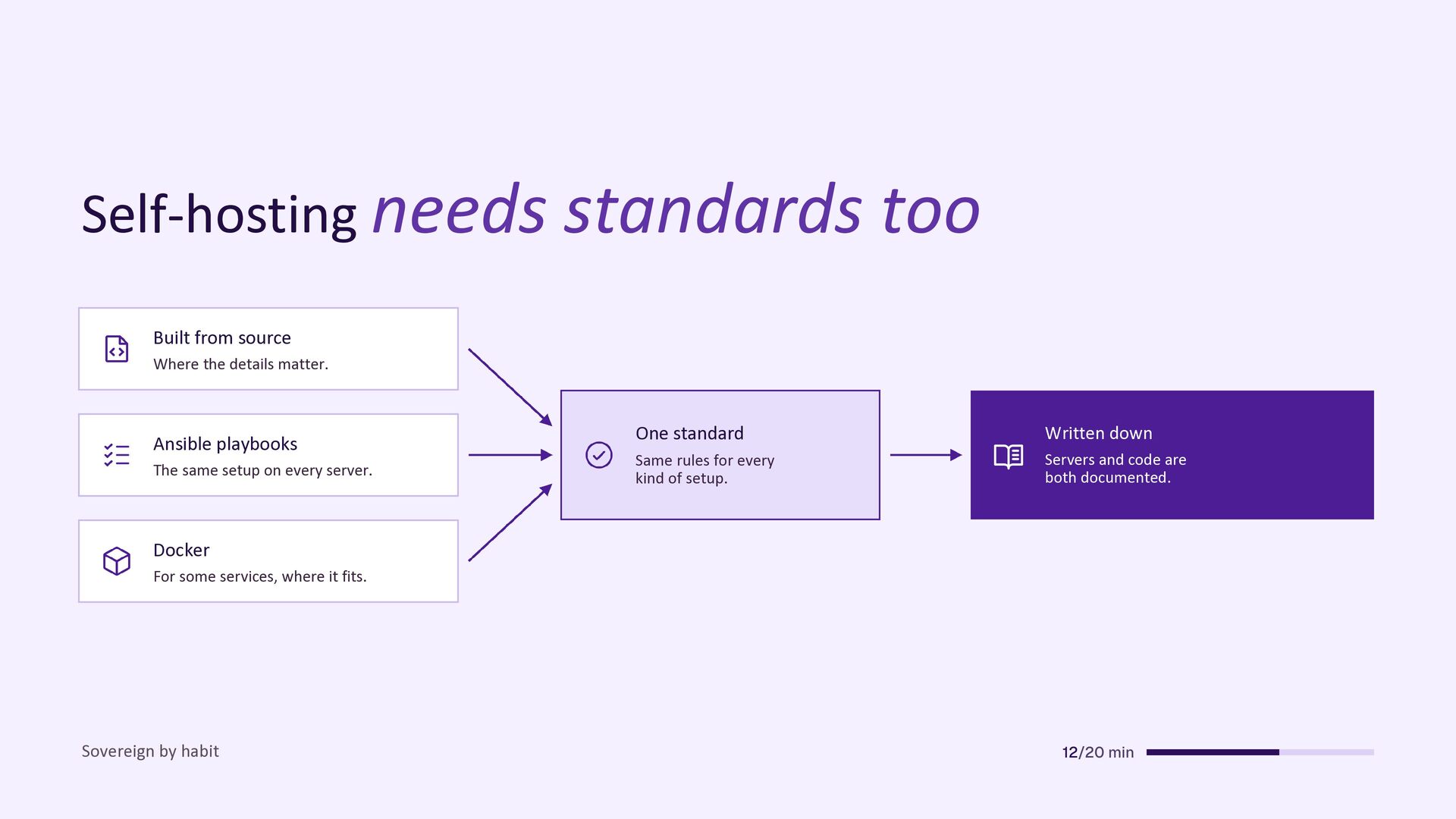
matter. Ansible playbooks The same setup on every server. Docker For some services, where it fits. Sovereign by habit One standard Written down Same rules for every kind of setup. Servers and code are both documented.
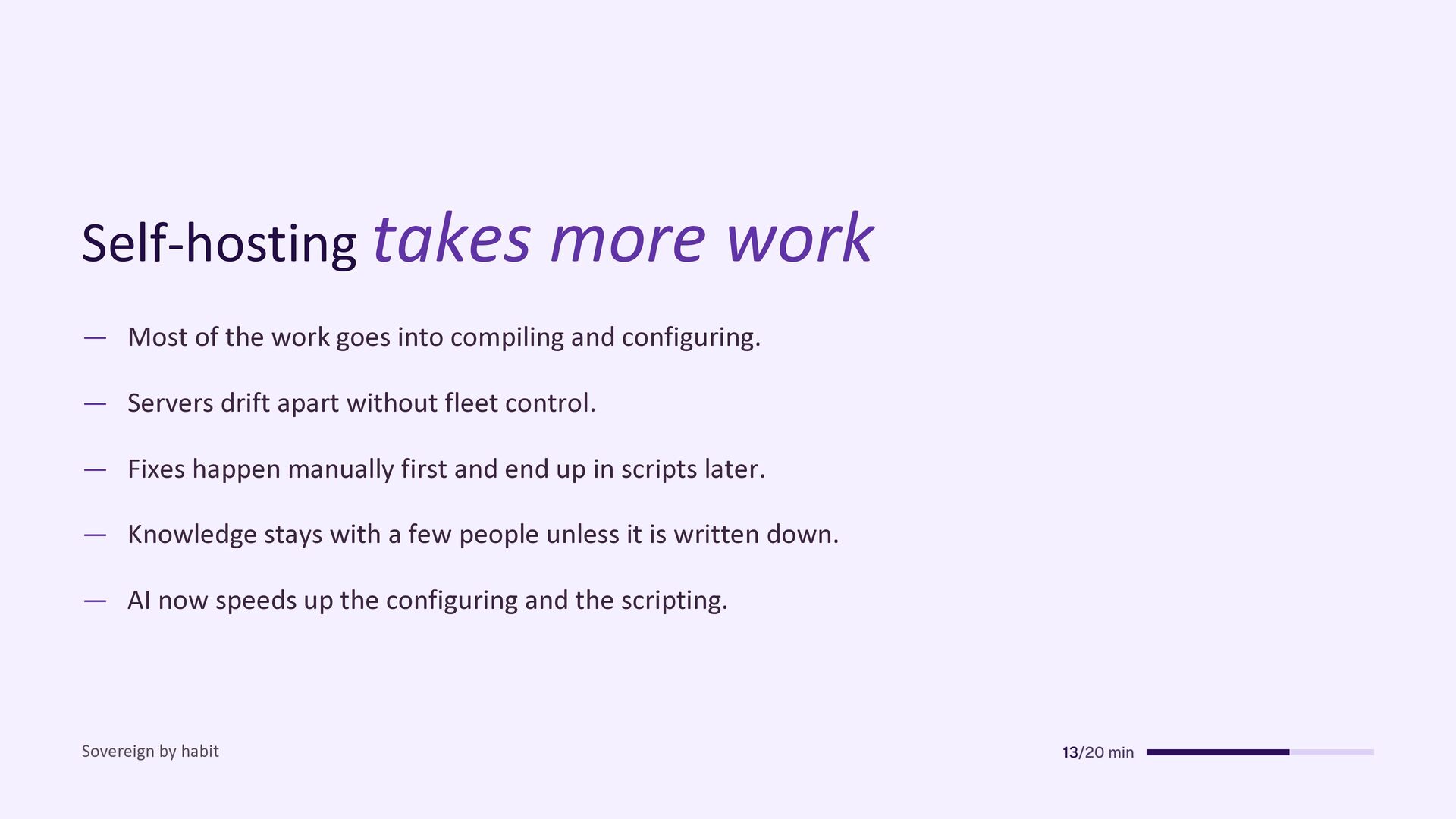
into compiling and configuring. — Servers drift apart without fleet control. — Fixes happen manually first and end up in scripts later. — Knowledge stays with a few people unless it is written down. — AI now speeds up the configuring and the scripting. Sovereign by habit
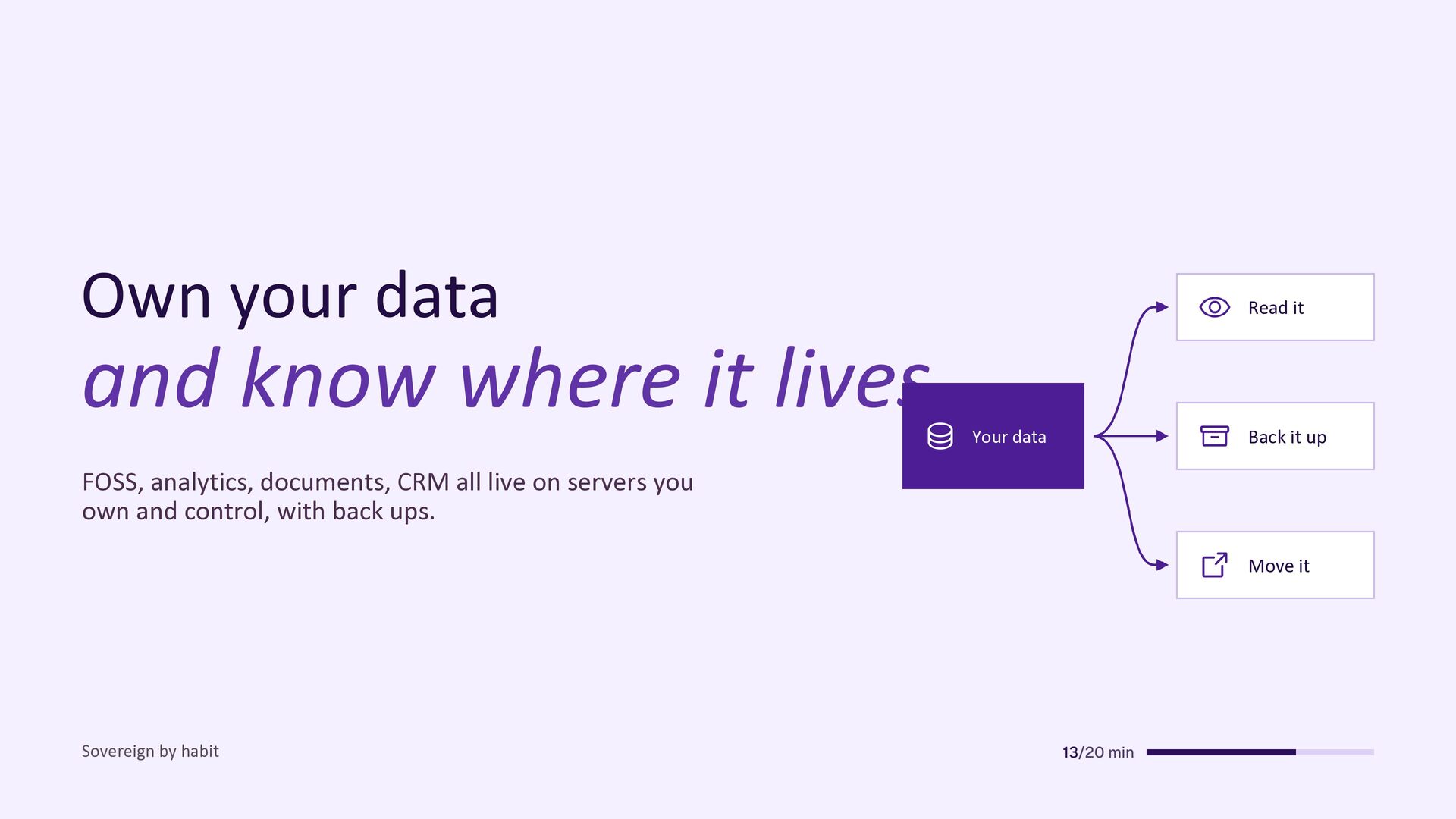
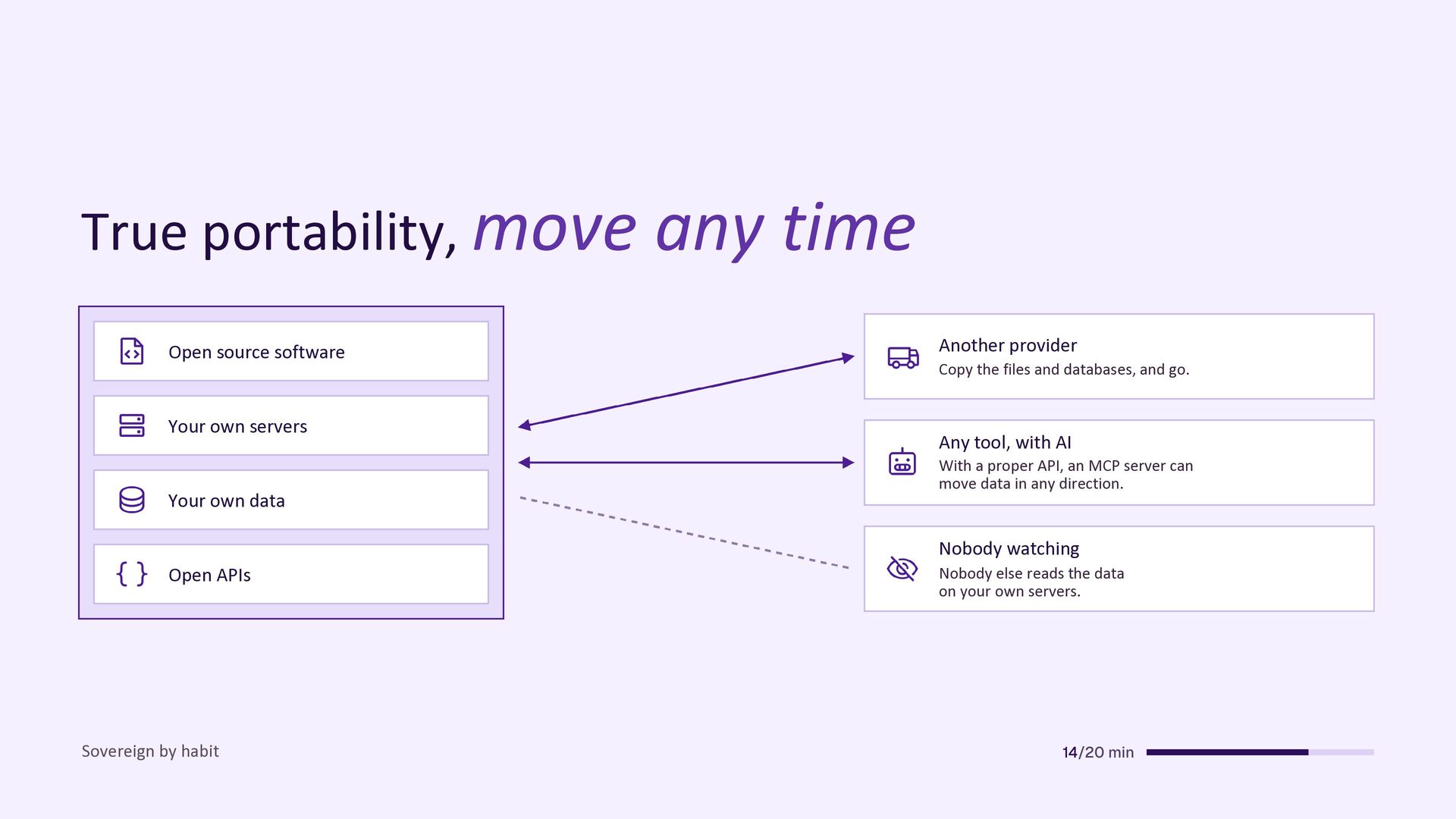
servers Your own data Another provider Copy the files and databases, and go. Any tool, with AI With a proper API, an MCP server can move data in any direction. Nobody watching Open APIs Sovereign by habit Nobody else reads the data on your own servers.
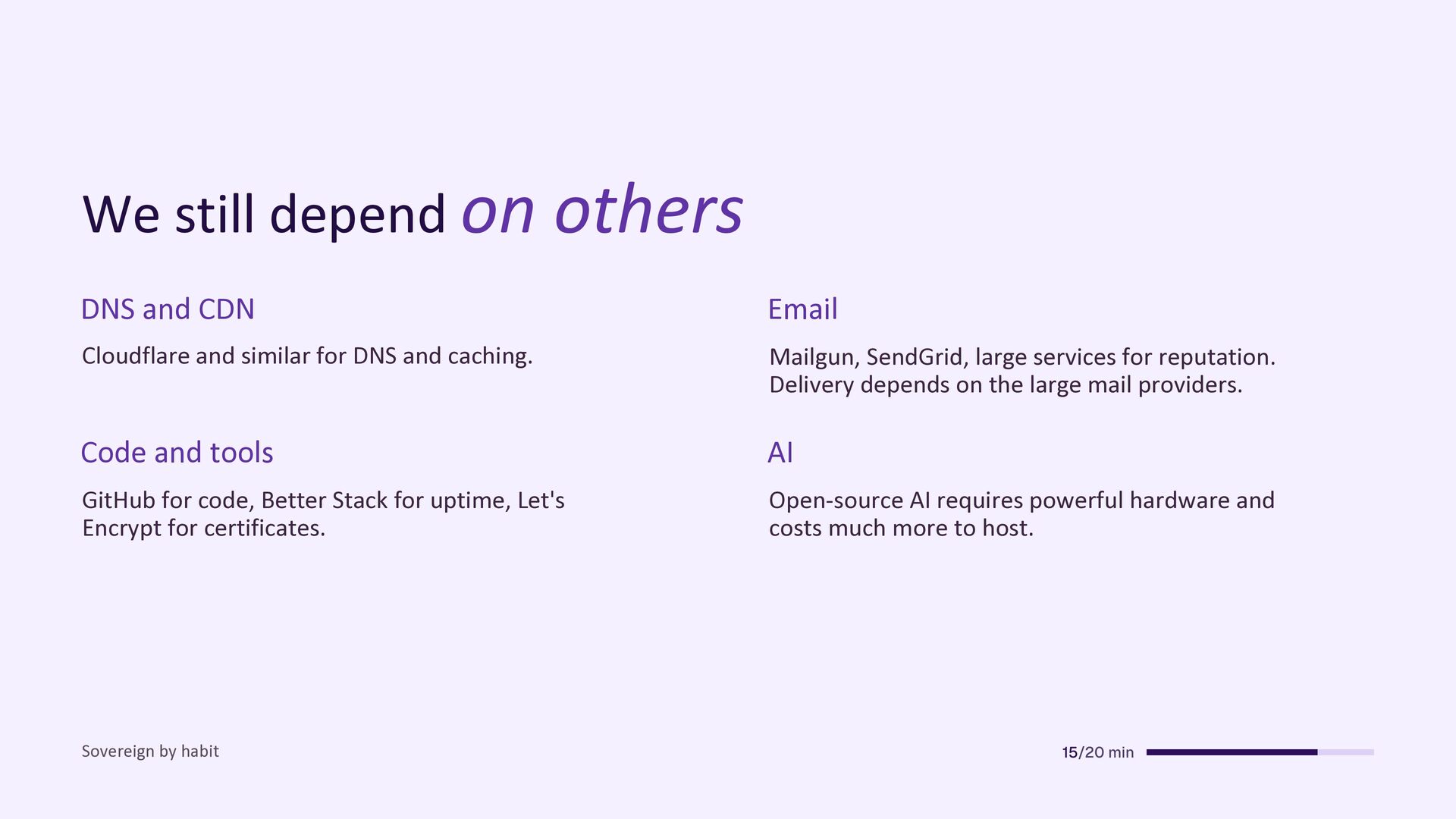
and similar for DNS and caching. Mailgun, SendGrid, large services for reputation. Delivery depends on the large mail providers. Code and tools AI GitHub for code, Better Stack for uptime, Let's Encrypt for certificates. Open-source AI requires powerful hardware and costs much more to host. Sovereign by habit
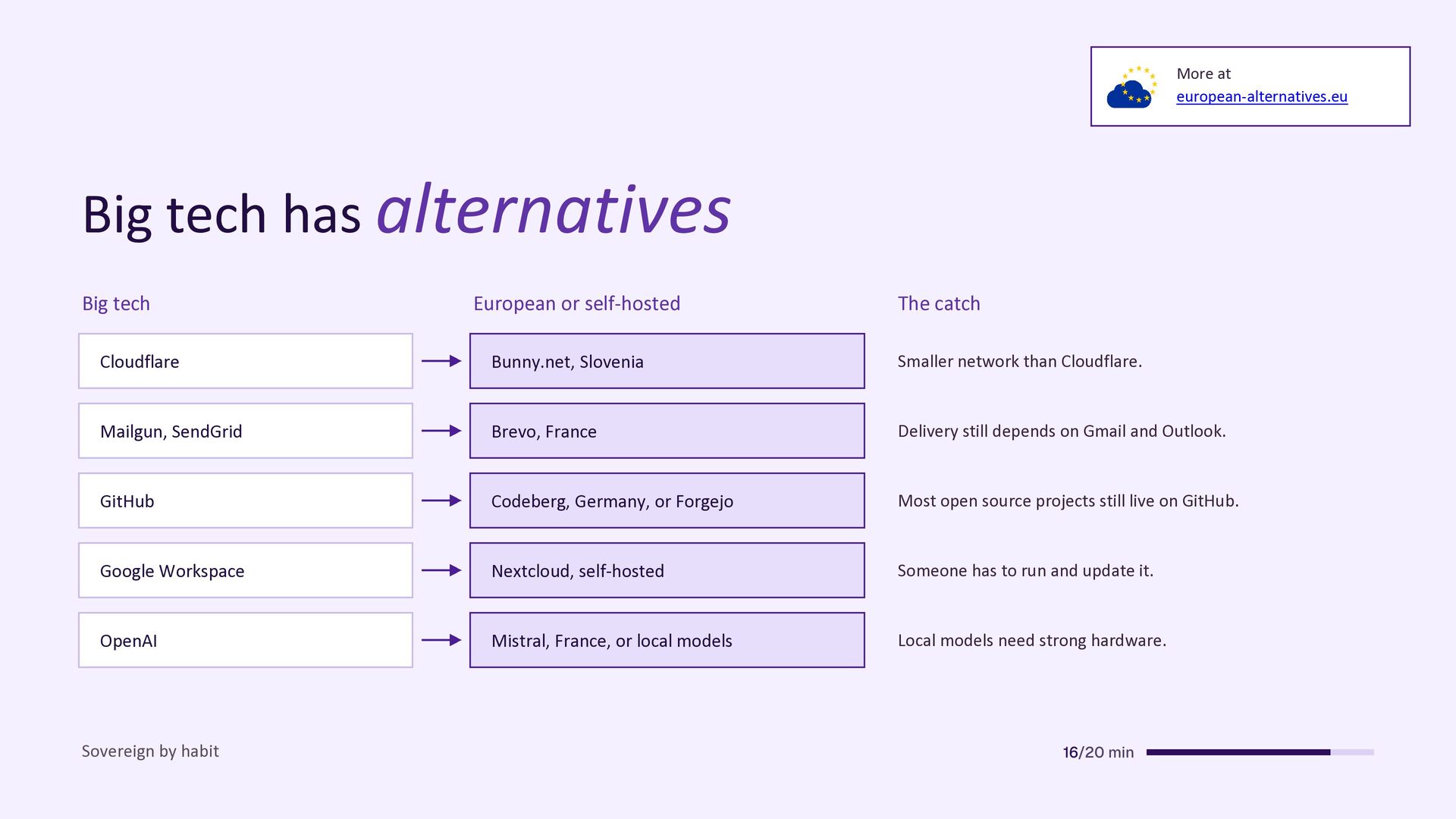
or self-hosted The catch Cloudflare Bunny.net, Slovenia Smaller network than Cloudflare. Mailgun, SendGrid Brevo, France Delivery still depends on Gmail and Outlook. GitHub Codeberg, Germany, or Forgejo Most open source projects still live on GitHub. Google Workspace Nextcloud, self-hosted Someone has to run and update it. OpenAI Mistral, France, or local models Local models need strong hardware. Sovereign by habit
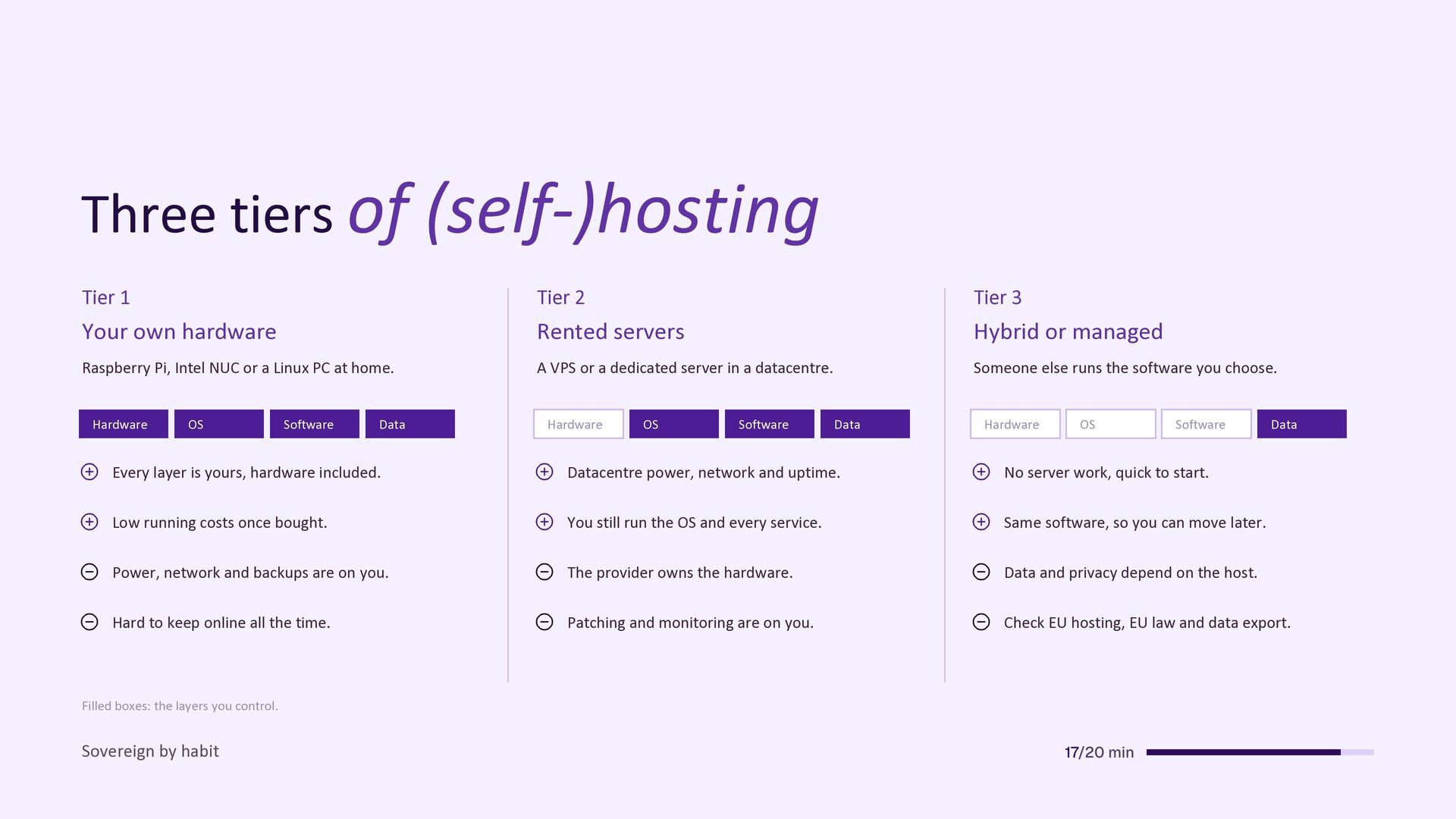
Your own hardware Rented servers Hybrid or managed Raspberry Pi, Intel NUC or a Linux PC at home. A VPS or a dedicated server in a datacentre. Someone else runs the software you choose. Hardware OS Software Data Hardware OS Software Data Hardware OS Software Data Every layer is yours, hardware included. Datacentre power, network and uptime. No server work, quick to start. Low running costs once bought. You still run the OS and every service. Same software, so you can move later. Power, network and backups are on you. The provider owns the hardware. Data and privacy depend on the host. Hard to keep online all the time. Patching and monitoring are on you. Check EU hosting, EU law and data export. Filled boxes: the layers you control. Sovereign by habit
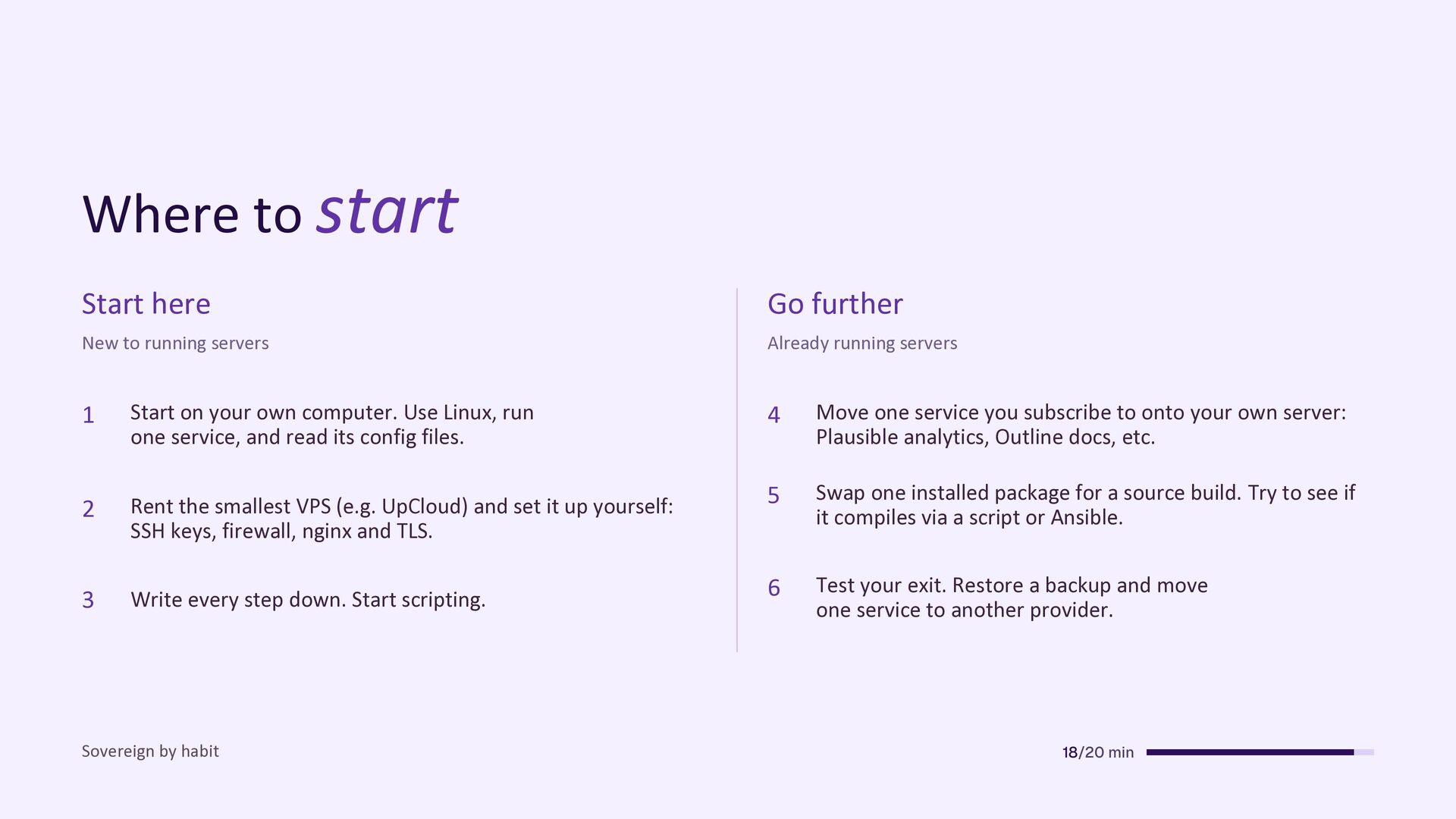
servers Already running servers 1 2 3 Start on your own computer. Use Linux, run one service, and read its config files. Rent the smallest VPS (e.g. UpCloud) and set it up yourself: SSH keys, firewall, nginx and TLS. Write every step down. Start scripting. Sovereign by habit 4 Move one service you subscribe to onto your own server: Plausible analytics, Outline docs, etc. 5 Swap one installed package for a source build. Try to see if it compiles via a script or Ansible. 6 Test your exit. Restore a backup and move one service to another provider.


 mindtrekconference
 emiki
 prog893
 yama3133
 orgachem
 minorun365
 kentapapa
 takuroabe
 nyankotaro
 freee
 onk
 kentarofujii
 masakiokuda
 destraynor
 mfonobong
 honzajavorek
 maggiecrowley
 sergeychernyshev
 ryanjones
 reverentgeek
 samtorres
 lara
 bethany
 morganepeng
 katiecoart