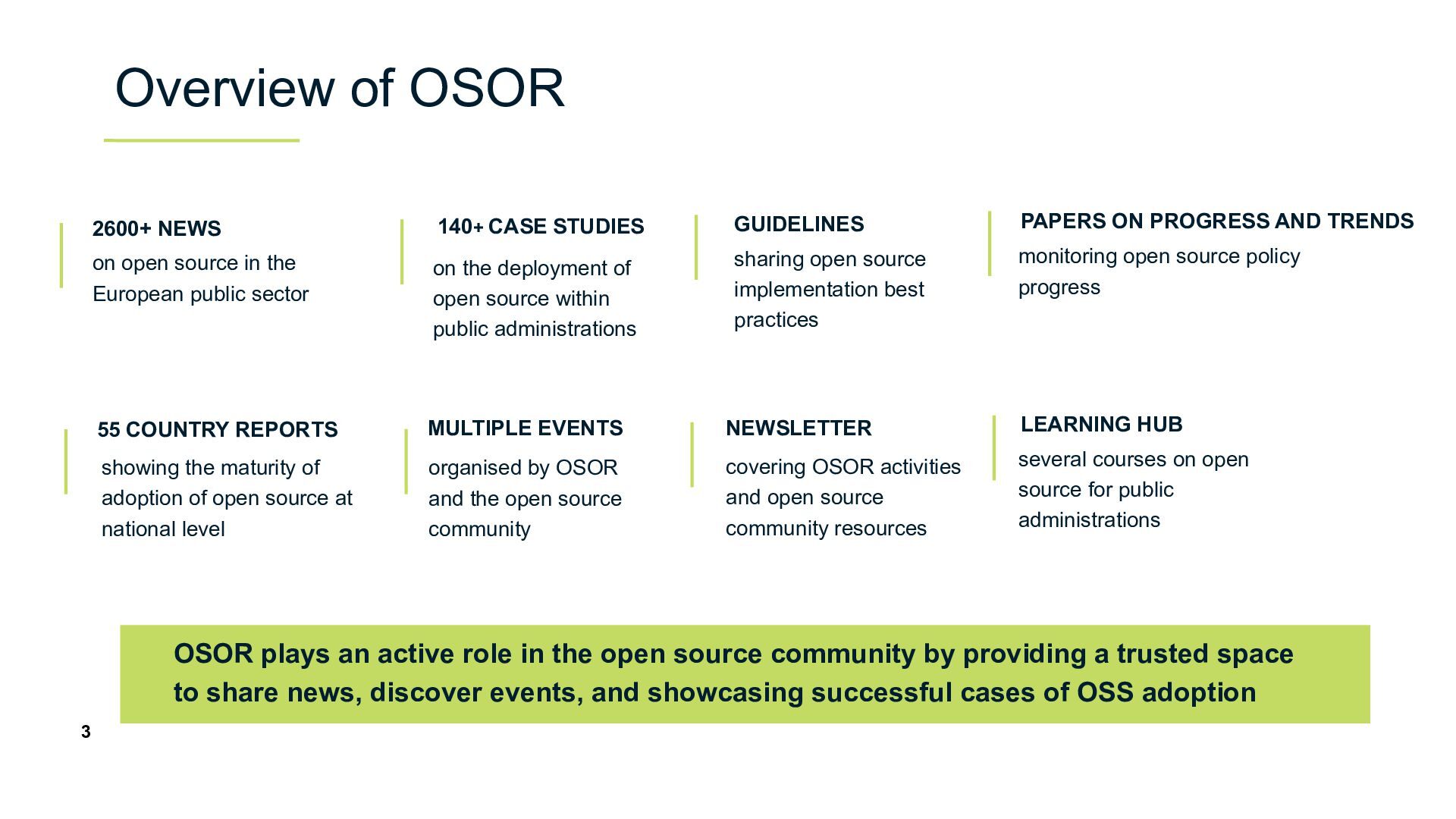
ON PROGRESS AND TRENDS on open source in the European public sector on the deployment of open source within public administrations sharing open source implementation best practices monitoring open source policy progress 55 COUNTRY REPORTS MULTIPLE EVENTS NEWSLETTER LEARNING HUB showing the maturity of adoption of open source at national level organised by OSOR and the open source community covering OSOR activities and open source community resources several courses on open source for public administrations OSOR plays an active role in the open source community by providing a trusted space to share news, discover events, and showcasing successful cases of OSS adoption 3
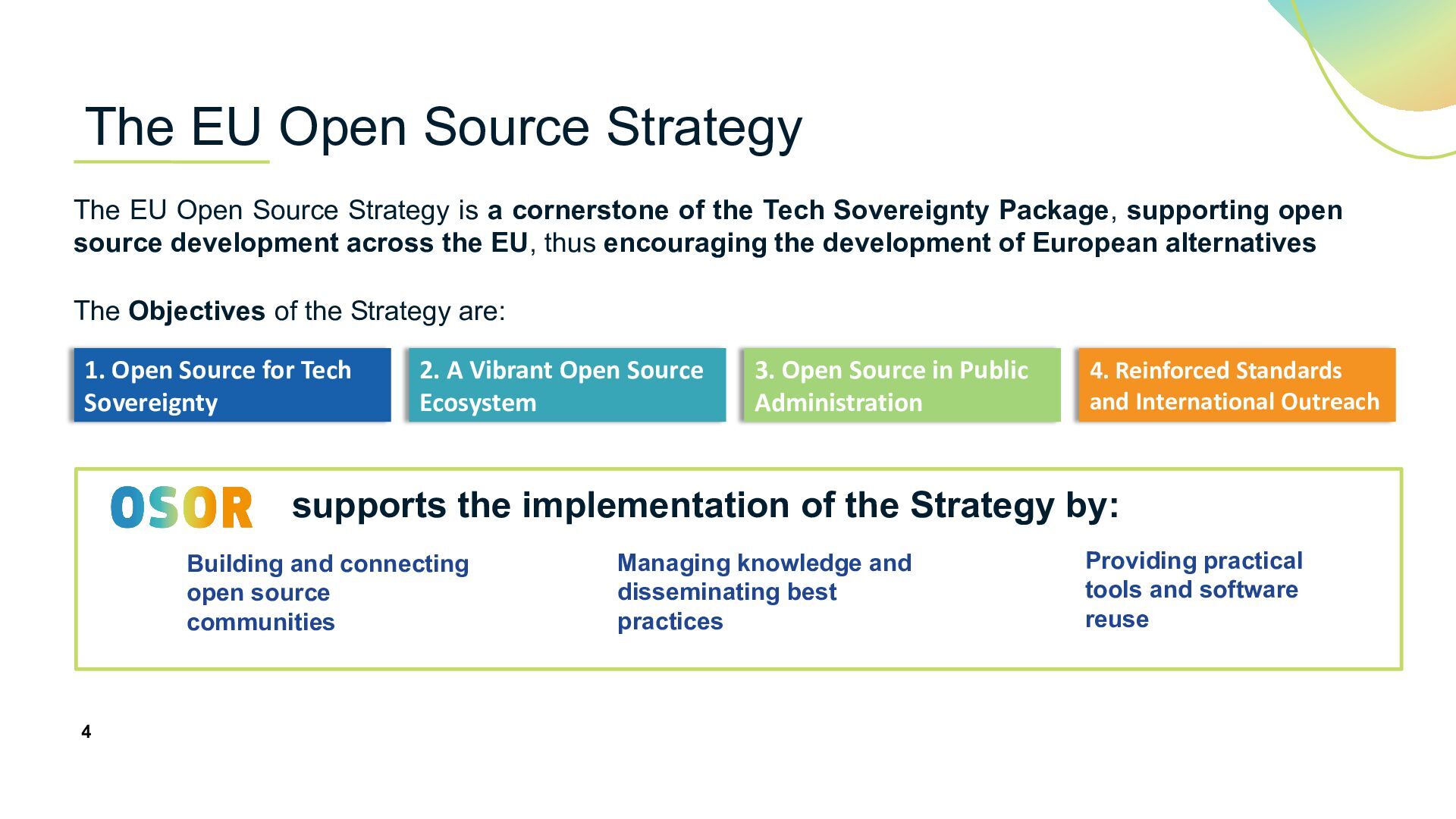
is a cornerstone of the Tech Sovereignty Package, supporting open source development across the EU, thus encouraging the development of European alternatives The Objectives of the Strategy are: 1. Open Source for Tech Sovereignty 2. A Vibrant Open Source Ecosystem 3. Open Source in Public Administration 4. Reinforced Standards and International Outreach supports the implementation of the Strategy by: Building and connecting open source communities 4 Managing knowledge and disseminating best practices Providing practical tools and software reuse
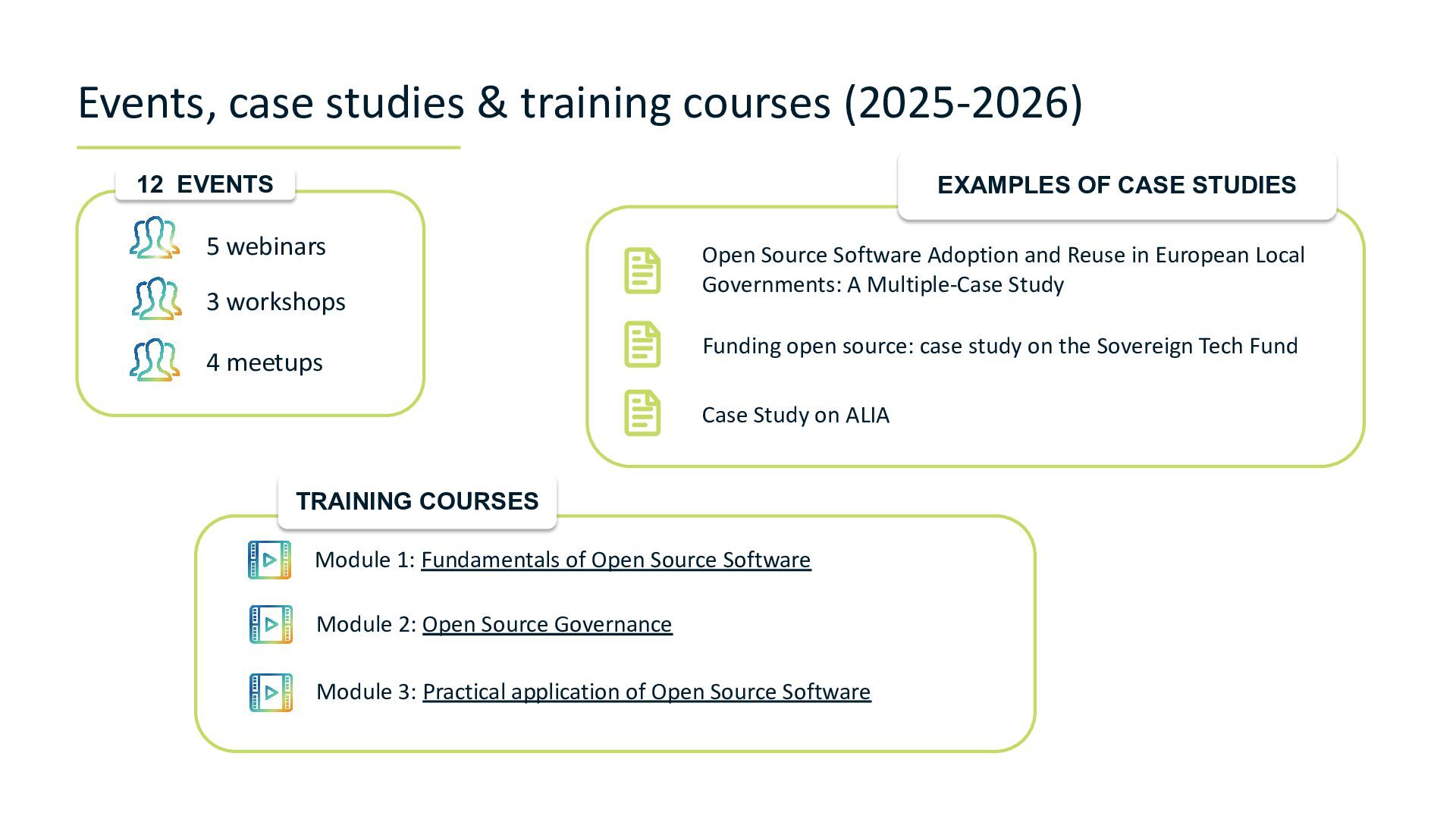
OF CASE STUDIES 5 webinars 3 workshops 4 meetups Open Source Software Adoption and Reuse in European Local Governments: A Multiple-Case Study Funding open source: case study on the Sovereign Tech Fund Case Study on ALIA TRAINING COURSES Module 1: Fundamentals of Open Source Software Module 2: Open Source Governance Module 3: Practical application of Open Source Software
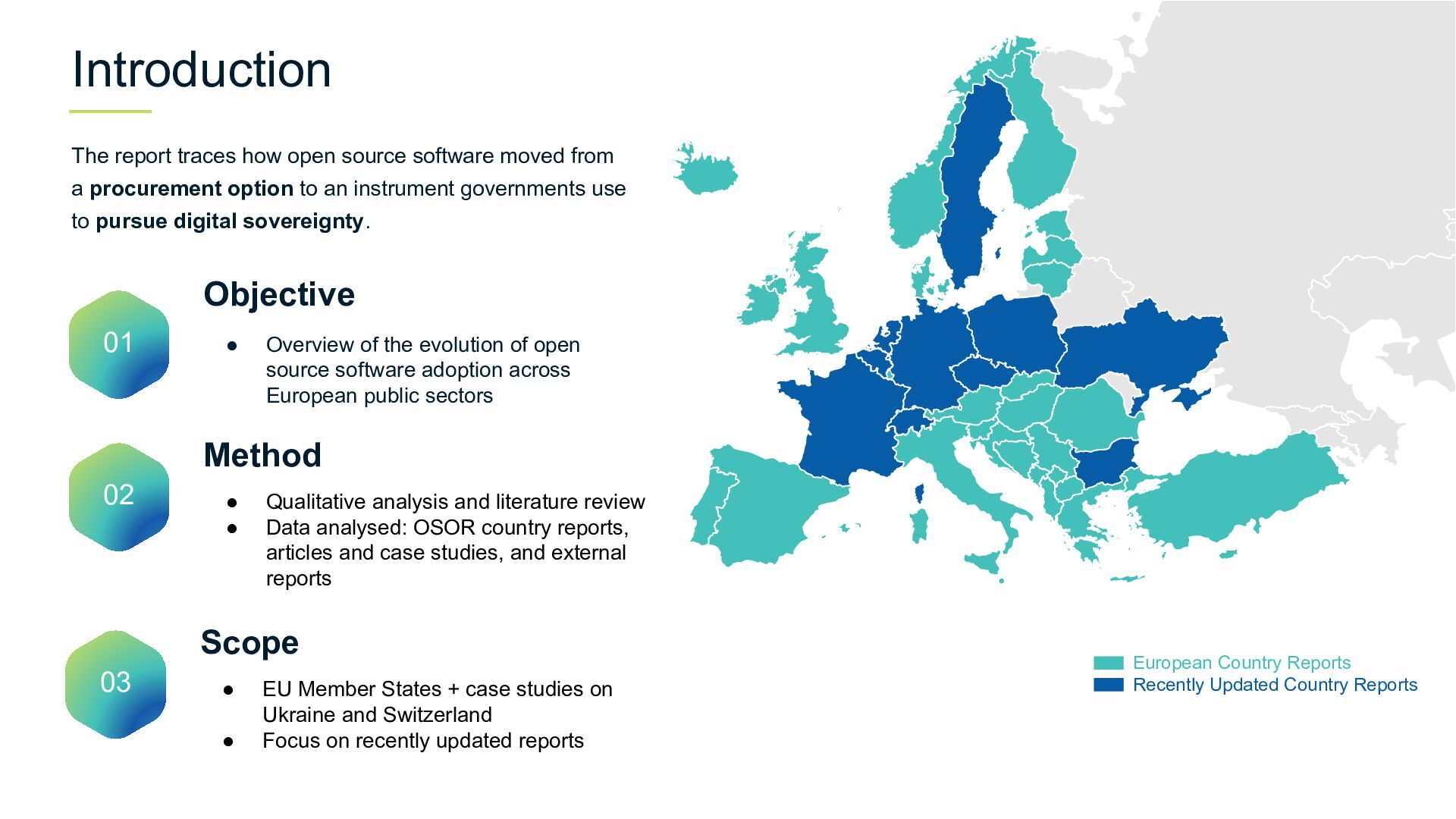
a procurement option to an instrument governments use to pursue digital sovereignty. Objective 01 • Overview of the evolution of open source software adoption across European public sectors Method 02 • • Qualitative analysis and literature review Data analysed: OSOR country reports, articles and case studies, and external reports Scope 03 • • EU Member States + case studies on Ukraine and Switzerland Focus on recently updated reports European Country Reports Recently Updated Country Reports
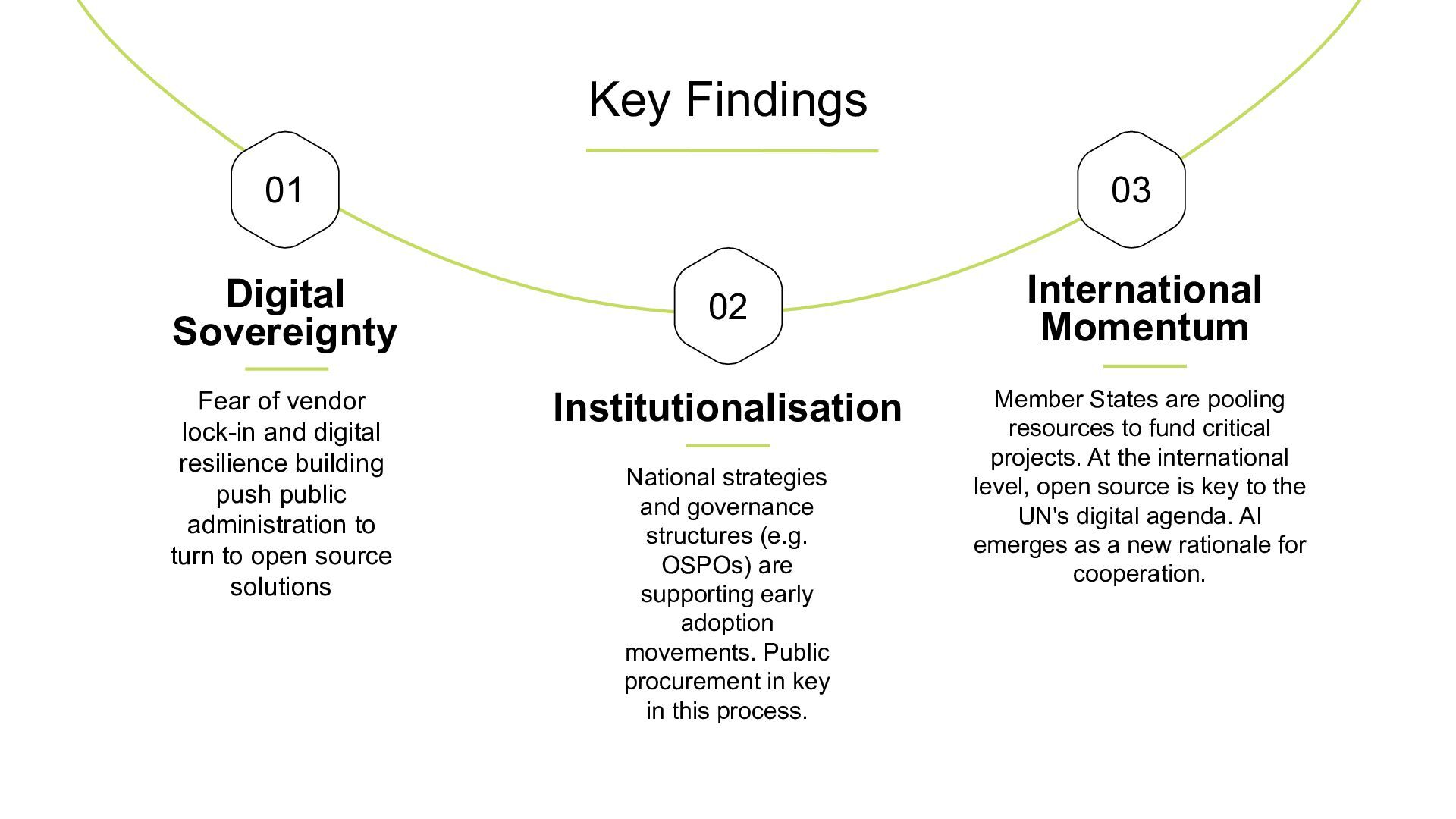
digital resilience building push public administration to turn to open source solutions 03 02 Institutionalisation National strategies and governance structures (e.g. OSPOs) are supporting early adoption movements. Public procurement in key in this process. International Momentum Member States are pooling resources to fund critical projects. At the international level, open source is key to the UN's digital agenda. AI emerges as a new rationale for cooperation.
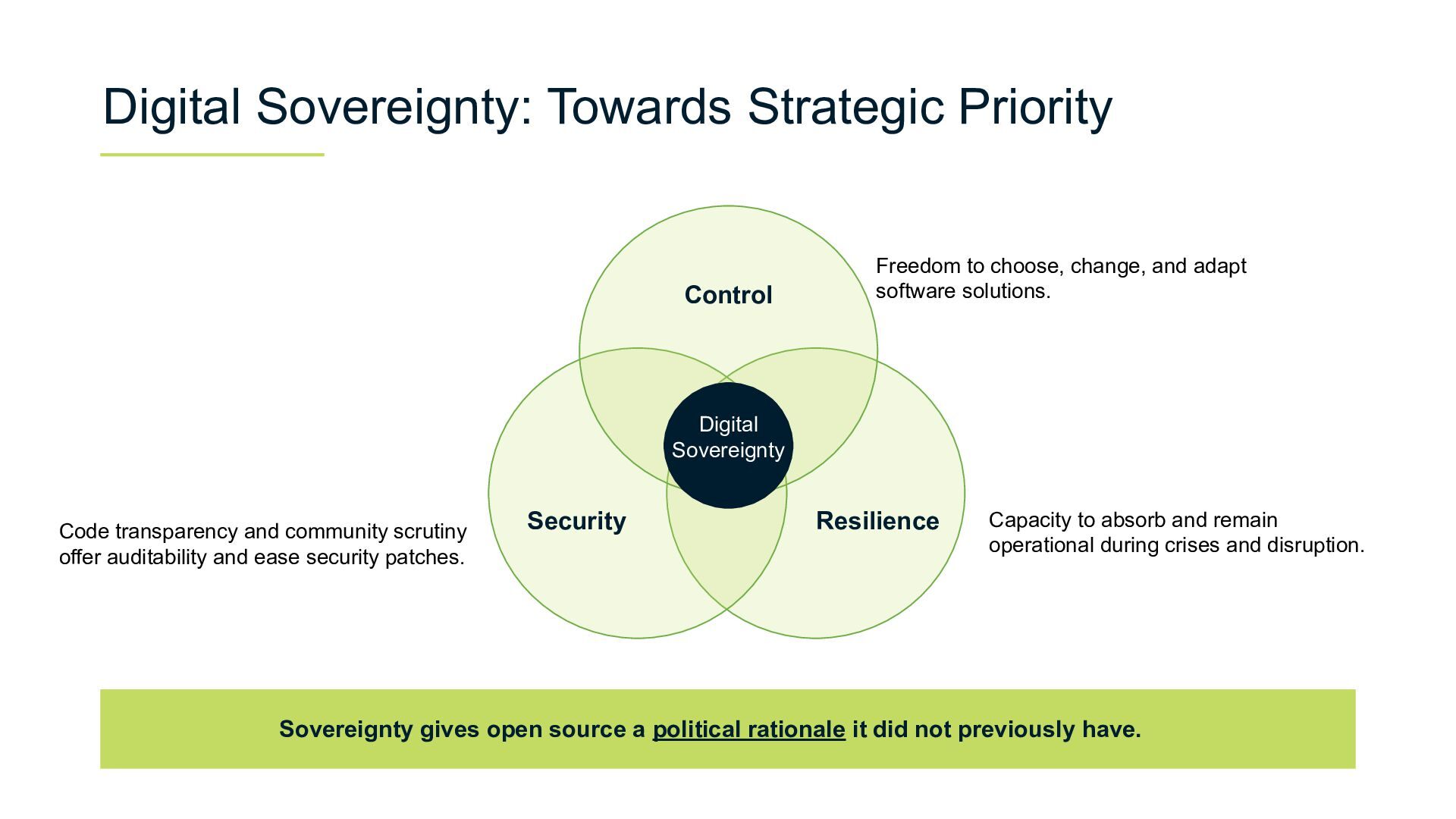
and adapt software solutions. Digital Sovereignty Code transparency and community scrutiny offer auditability and ease security patches. Security Resilience Capacity to absorb and remain operational during crises and disruption. Sovereignty gives open source a political rationale it did not previously have.
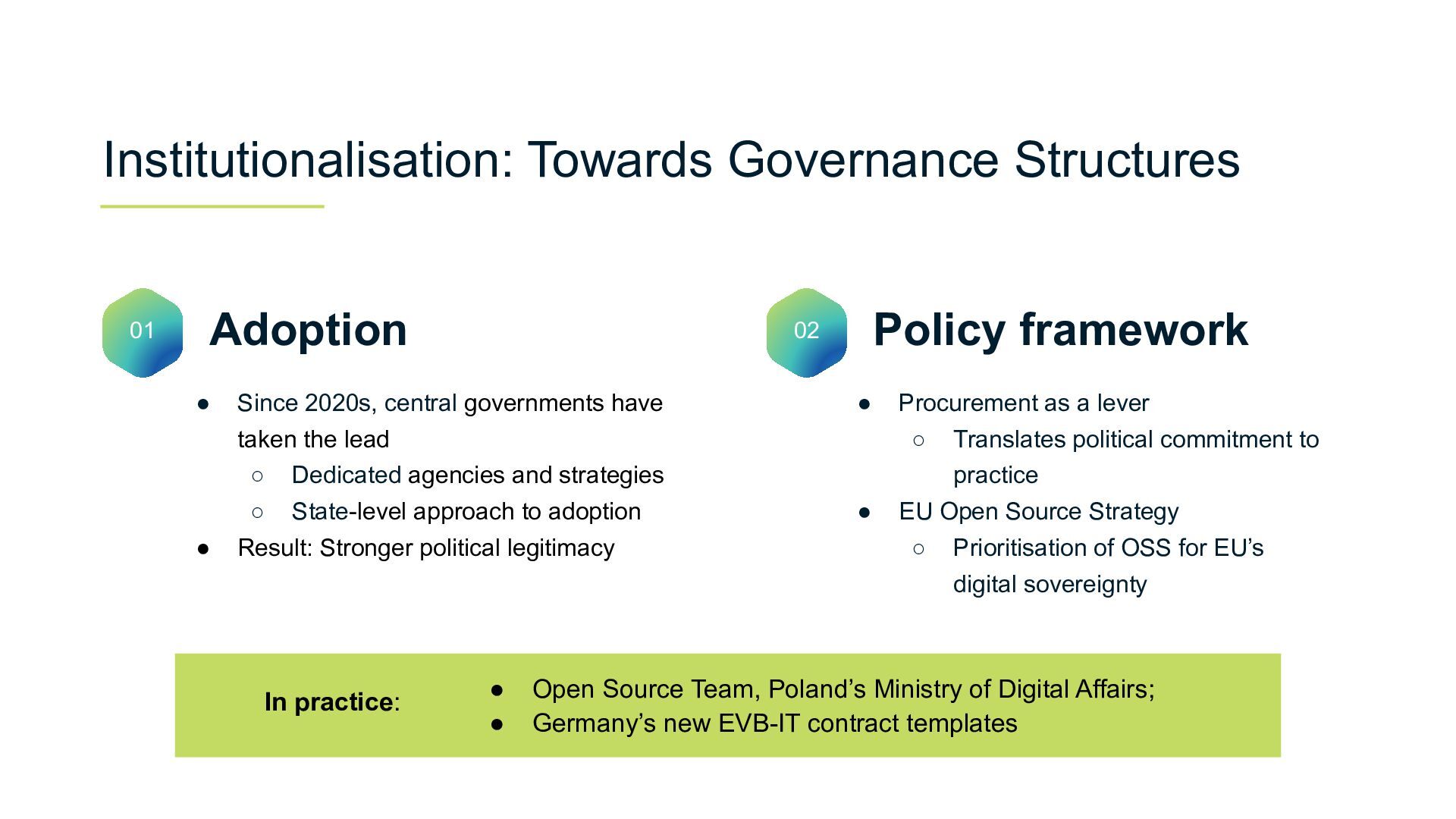
central governments have taken the lead ◦ Dedicated agencies and strategies ◦ State-level approach to adoption Result: Stronger political legitimacy In practice: Policy framework 02 • • • • Procurement as a lever ◦ Translates political commitment to practice EU Open Source Strategy ◦ Prioritisation of OSS for EU’s digital sovereignty Open Source Team, Poland’s Ministry of Digital Affairs; Germany’s new EVB-IT contract templates
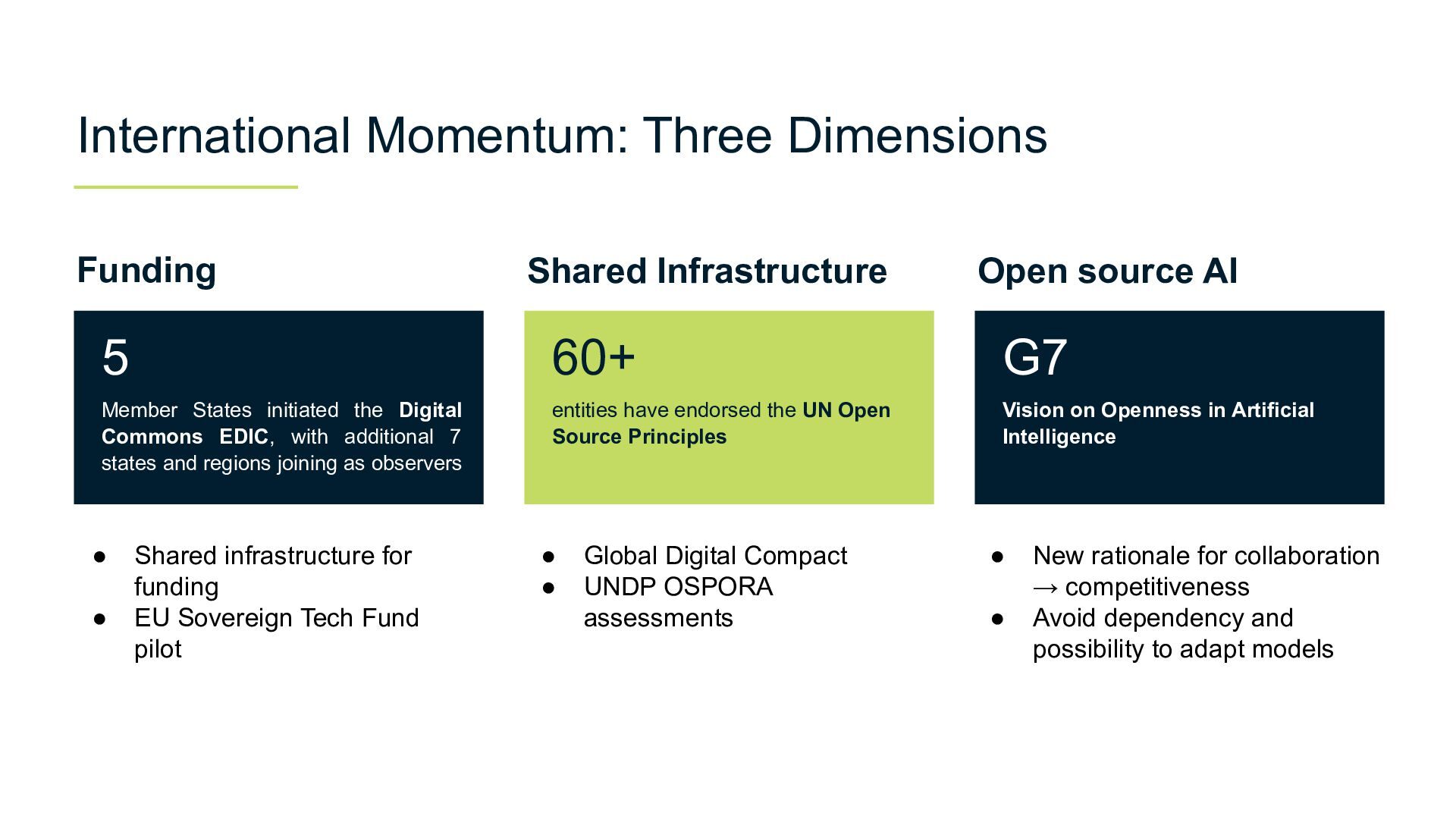
5 60+ G7 Member States initiated the Digital Commons EDIC, with additional 7 states and regions joining as observers entities have endorsed the UN Open Source Principles Vision on Openness in Artificial Intelligence • • • • • Shared infrastructure for funding EU Sovereign Tech Fund pilot Global Digital Compact UNDP OSPORA assessments • New rationale for collaboration → competitiveness Avoid dependency and possibility to adapt models
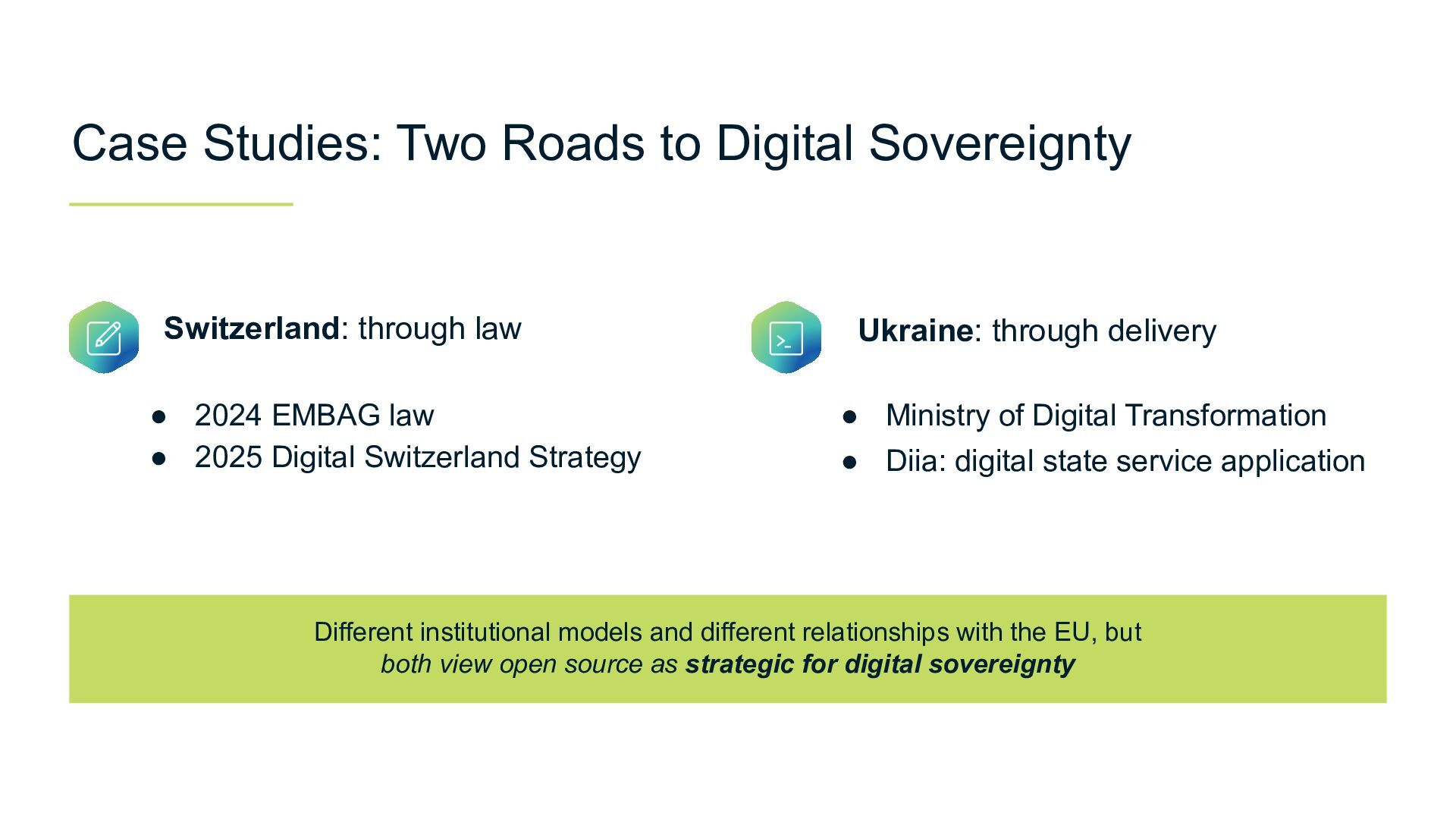
Ukraine: through delivery • 2024 EMBAG law • 2025 Digital Switzerland Strategy • Ministry of Digital Transformation • Diia: digital state service application Different institutional models and different relationships with the EU, but both view open source as strategic for digital sovereignty
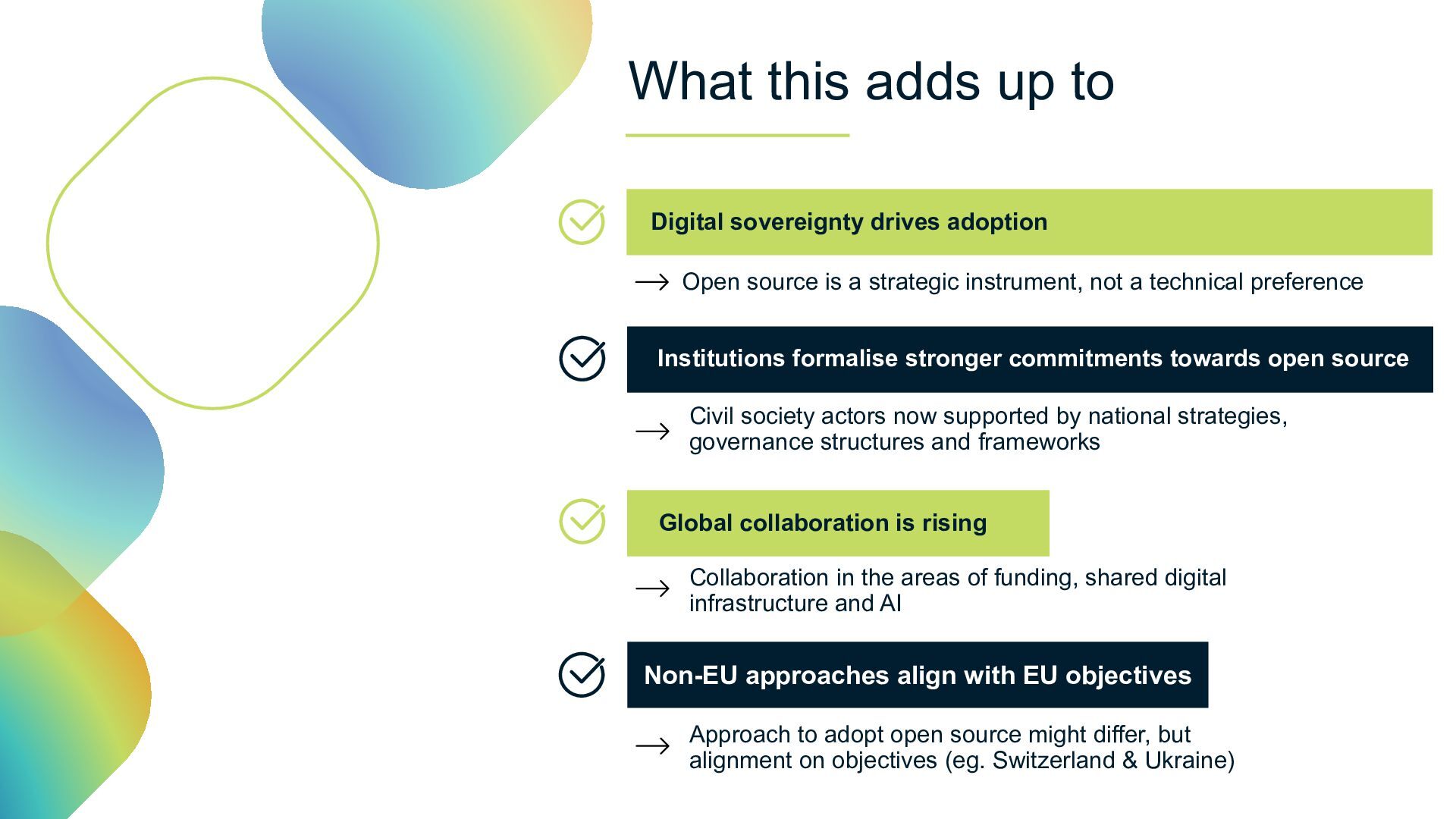
source is a strategic instrument, not a technical preference Institutions formalise stronger commitments towards open source Civil society actors now supported by national strategies, governance structures and frameworks Global collaboration is rising Collaboration in the areas of funding, shared digital infrastructure and AI Non-EU approaches align with EU objectives Approach to adopt open source might differ, but alignment on objectives (eg. Switzerland & Ukraine)
to be published on the Interoperable Europe Portal in October Country Intelligence Reports Further updates across the OSOR country collection News articles and events Register for the Interoperable Europe Newsletter to stay informed Stay in touch! [email protected] https://interoperable-europe.ec.europa.eu/c ollection/open-source-observatory-osor Interoperable Europe Newsletter Subscription


 mindtrekconference
 occhi
 mhlyc
 takmin
 akizhou
 hamadakoji
 greenmidori
 lamaglama39
 bbrbbq
 masa_my
 colopl
 usanchuu
 oasis1994liveforever
 codingconduct
 thirion
 leimatthew05
 signer
 aleyda
 bryan
 zakiyama
 tamaranovitovic
 greggifford
 lynnandtonic
 jacobtomlinson