Share
Embed
Event-driven network automation and orchestration
London Network Automation Meetup
September 2017
Mircea Ulinic
September 21, 2017
Transcript
43 slides
-
Event-driven network automation and orchestration Mircea Ulinic Cloudflare, London London
Network Automation Meetup September 2017 1 -
2 Mircea Ulinic • Network engineer at Cloudflare • Prev
research and teaching assistant at EPFL, Switzerland • Member and maintainer at NAPALM Automation • Integrated NAPALM in Salt • OpenConfig representative • https://mirceaulinic.net/ @mirceaulinic mirceaulinic -
3 Cloudflare • How big? ◦ Four+ million zones/domains ◦
Authoritative for ~40% of Alexa top 1 million ◦ 43+ billion DNS queries/day ▪ Second only to Verisign • 100+ anycast locations globally ◦ 50 countries (and growing) ◦ Many hundreds of network devices -
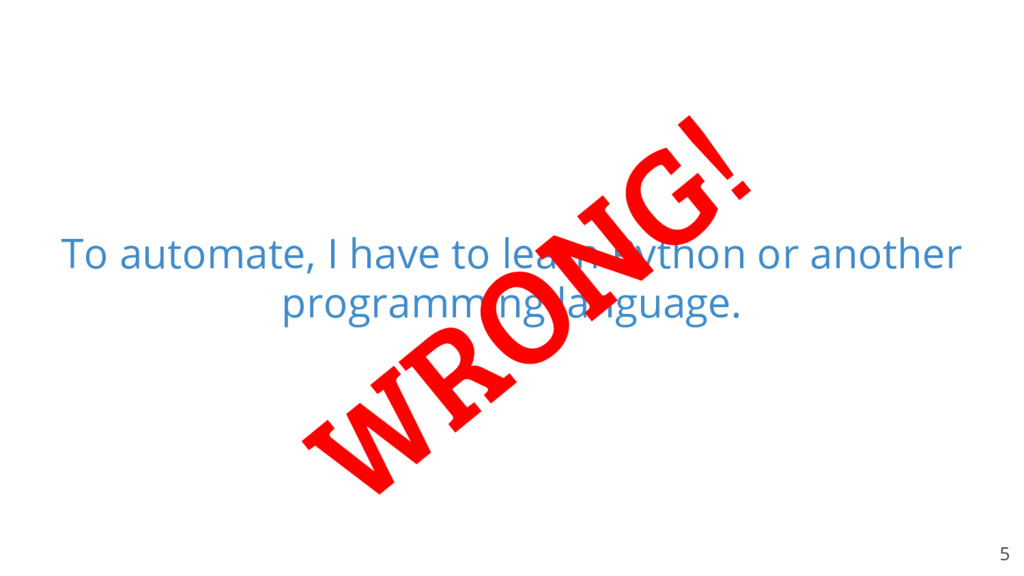
To automate, I have to learn Python or another programming
language. 5 W RONG! -
What’s the best tool for my network? • How large
is your network? • How many platforms / operating systems? • How dynamic? • External sources of truth? e.g. IPAM • Do you need native caching? REST API? • Event-driven automation? • Community 10 -
• Very scalable • Concurrency • Event-driven automation • Easily
configurable & customizable • Native caching and drivers for useful tools • One of the friendliest communities • Great documentation 11 Why Salt -
Why Salt “ In SaltStack, speed isn’t a byproduct, it
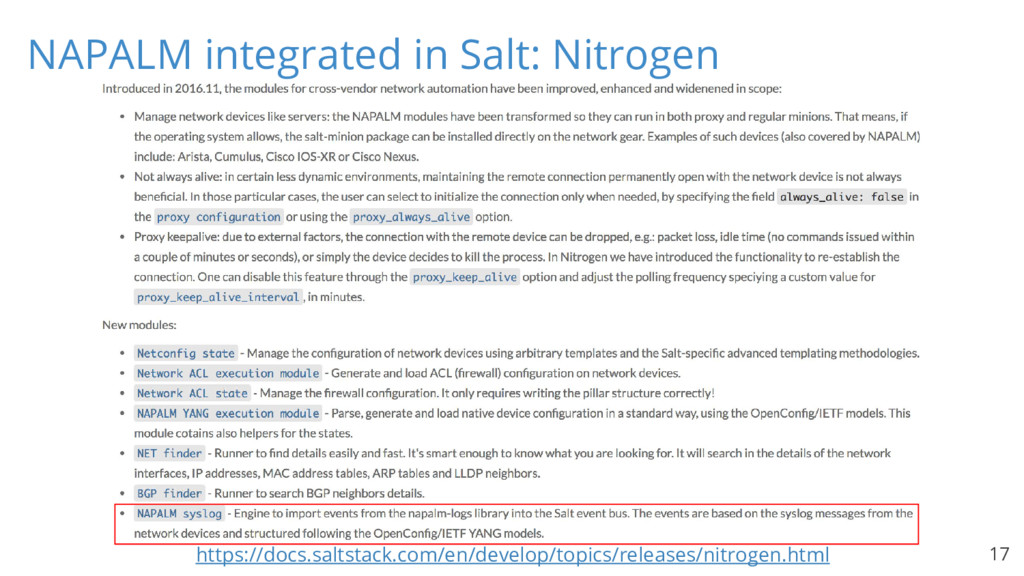
is a design goal. SaltStack was created as an extremely fast, lightweight communication bus to provide the foundation for a remote execution engine. SaltStack now provides orchestration, configuration management, event reactors, cloud provisioning, and more, all built around the SaltStack high-speed communication bus. ” 13 https://docs.saltstack.com/en/getstarted/speed.html … + cross-vendor network automation from 2016.11 (Carbon) -
Vendor-agnostic API: NAPALM 15 NAPALM (Network Automation and Programmability Abstraction
Layer with Multivendor support) https://github.com/napalm-automation -
Vendor-agnostic automation (1) 18 $ sudo salt iosxr-router net.arp iosxr-router:
---------- out: |_ ---------- age: 1620.0 interface: Bundle-Ether4 ip: 10.0.0.2 mac: 00:25:90:20:46:B5 |_ ---------- age: 8570.0 $ sudo salt junos-router net.arp junos-router: ---------- out: |_ ---------- age: 129.0 interface: ae2.100 ip: 10.0.0.1 mac: 84:B5:9C:CD:09:73 |_ ---------- age: 1101.0 -
Vendor-agnostic automation (2) 19 $ sudo salt junos-router state.sls ntp
junos-router: ---------- ID: oc_ntp_netconfig Function: netconfig.managed Result: True Comment: Configuration changed! Started: 10:53:25.624396 Duration: 3494.153 ms Changes: ---------- diff: [edit system ntp] - peer 172.17.17.2; [edit system ntp] + server 10.10.10.1 prefer; + server 10.10.10.2; - server 172.17.17.1 version 2 prefer; $ sudo salt iosxr-router state.sls ntp iosxr-router: ---------- ID: oc_ntp_netconfig Function: netconfig.managed Result: True Comment: Configuration changed! Started: 11:02:39.162423 Duration: 3478.683 ms Changes: ---------- diff: --- +++ @@ -1,4 +1,10 @@ +ntp + server 10.10.10.1 prefer + server 10.10.10.2 ! -
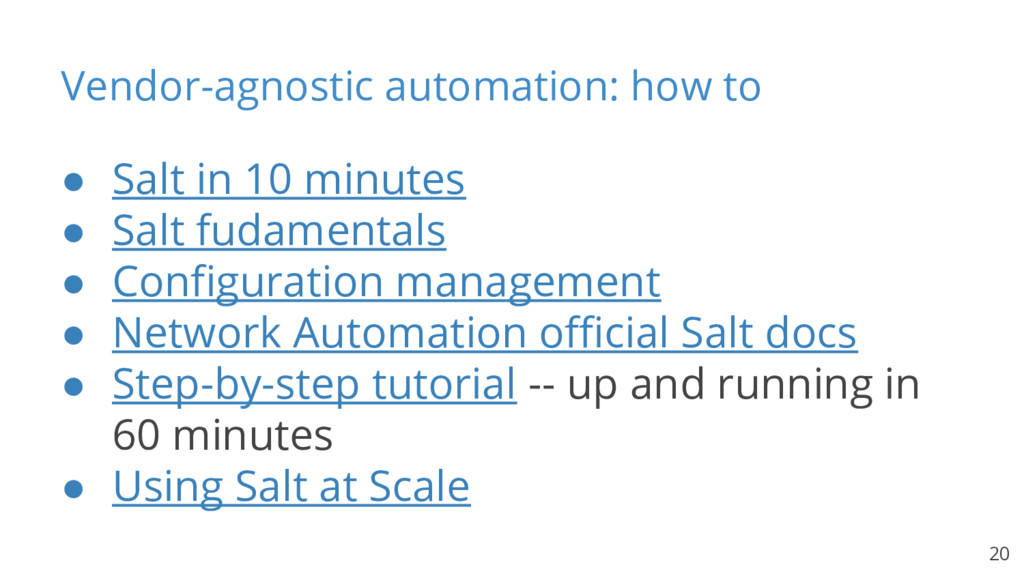
Vendor-agnostic automation: how to 20 • Salt in 10 minutes
• Salt fudamentals • Configuration management • Network Automation official Salt docs • Step-by-step tutorial -- up and running in 60 minutes • Using Salt at Scale -
Event-driven network automation (2) 24 • Several of ways your
network is trying to communicate with you • Millions of messages -
Event-driven network automation (3) 25 • SNMP traps • Syslog
messages • Streaming telemetry -
Streaming Telemetry 27 • Push notifications ◦ Vs. pull (SNMP)
• Structured data ◦ Structured objects, using the YANG standards ▪ OpenConfig ▪ IETF • Supported on very new operating systems ◦ IOS-XR >= 6.1.1 ◦ Junos >= 15.1 (depending on the platform) -
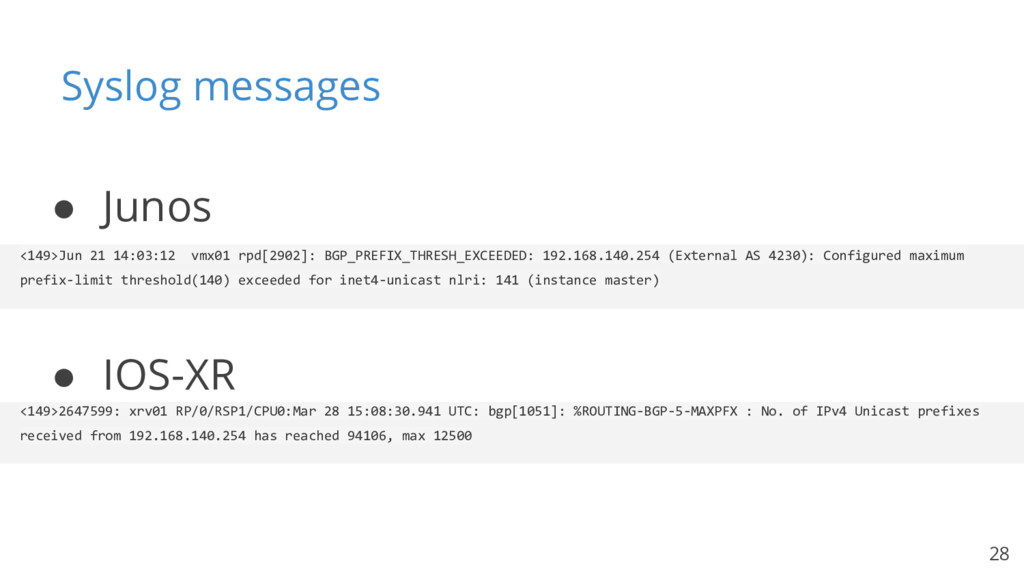
Syslog messages 28 <149>Jun 21 14:03:12 vmx01 rpd[2902]: BGP_PREFIX_THRESH_EXCEEDED: 192.168.140.254
(External AS 4230): Configured maximum prefix-limit threshold(140) exceeded for inet4-unicast nlri: 141 (instance master) <149>2647599: xrv01 RP/0/RSP1/CPU0:Mar 28 15:08:30.941 UTC: bgp[1051]: %ROUTING-BGP-5-MAXPFX : No. of IPv4 Unicast prefixes received from 192.168.140.254 has reached 94106, max 12500 • Junos • IOS-XR -
Syslog messages: napalm-logs (1) 29 • Listen for syslog messages
◦ Directly from the network devices, via UDP or TCP ◦ Other systems: Apache Kafka, ZeroMQ, etc. • Publish encrypted messages ◦ Structured documents, using the YANG standards ▪ OpenConfig ▪ IETF ◦ Over various channels: ZeroMQ, Kafka, etc. https://napalm-automation.net/napalm-logs-released/ -
Syslog messages: napalm-logs (2) 30 https://napalm-automation.net/napalm-logs-released/ napalm-logs Network device Network
device Network device Kafka Client Client Client Kafka ZMQ Client -
Syslog messages: napalm-logs startup 31 $ napalm-logs --listener udp --address
172.17.17.1 --port 5514 --publish-address 172.17.17.2 --publish-port 49017 --publisher zmq --disable-security More configuration options: https://napalm-logs.readthedocs.io/en/latest/options/index.html -
Syslog messages: napalm-logs clients 32 More complete example: https://github.com/napalm-automation/napalm-logs/blob/master/examples/client_auth.py import
zmq # when using the ZeroMQ publisher import napalm_logs.utils server_address = '127.0.0.1' # IP server_port = 49017 # Port for the napalm-logs publisher interface context = zmq.Context() socket = context.socket(zmq.SUB) socket.connect('tcp://{address}:{port}'.format(address=server_address, port=server_port)) socket.setsockopt(zmq.SUBSCRIBE, '') # subscribe to the napalm-logs publisher while True: raw_object = socket.recv() # binary object print(napalm_logs.utils.unserialize(raw_object)) # deserialize -
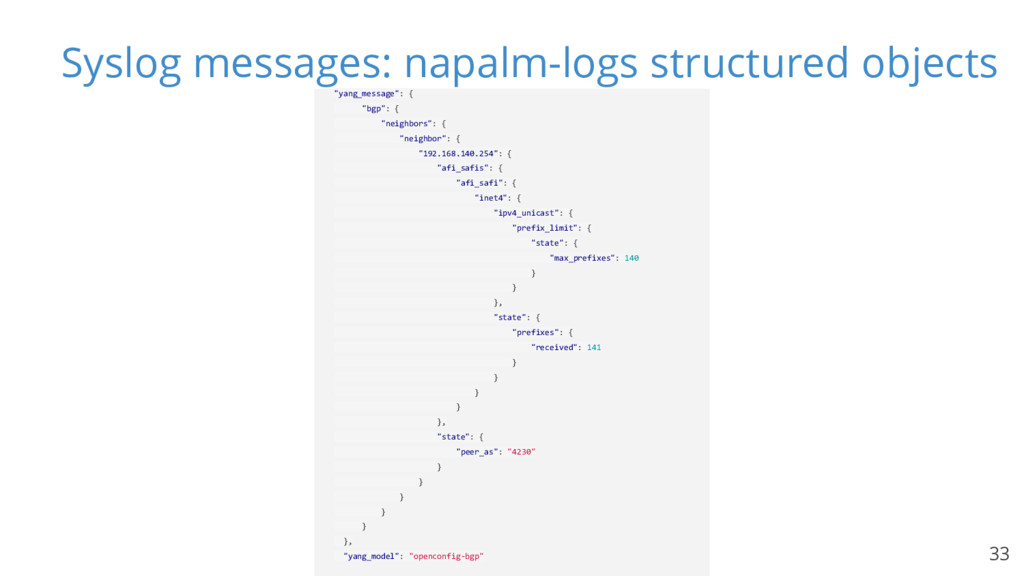
Syslog messages: napalm-logs structured objects 33 "yang_message": { "bgp": {
"neighbors": { "neighbor": { "192.168.140.254": { "afi_safis": { "afi_safi": { "inet4": { "ipv4_unicast": { "prefix_limit": { "state": { "max_prefixes": 140 } } }, "state": { "prefixes": { "received": 141 } } } } }, "state": { "peer_as": "4230" } } } } } }, "yang_model": "openconfig-bgp" -
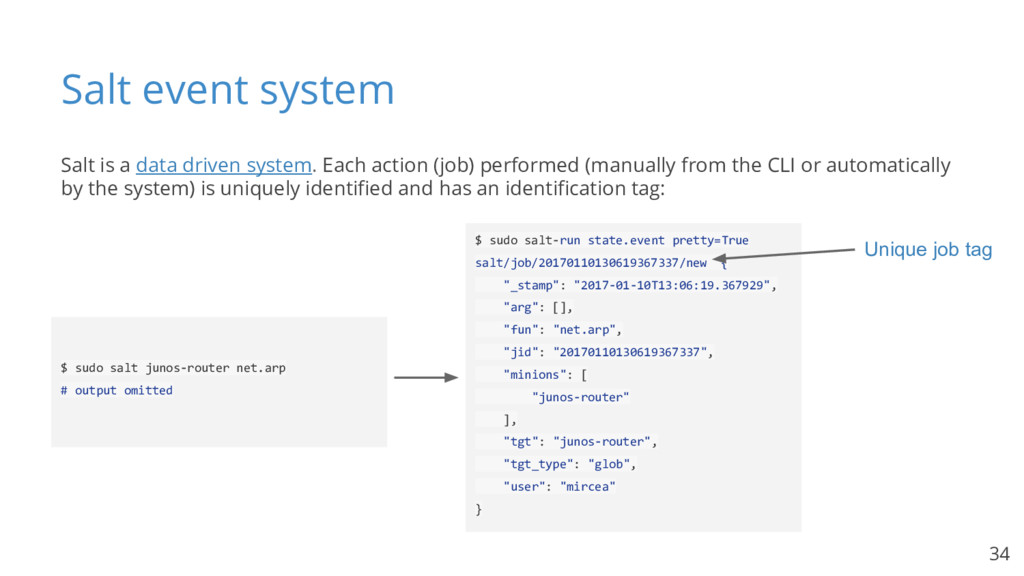
Salt event system 34 Salt is a data driven system.
Each action (job) performed (manually from the CLI or automatically by the system) is uniquely identified and has an identification tag: $ sudo salt-run state.event pretty=True salt/job/20170110130619367337/new { "_stamp": "2017-01-10T13:06:19.367929", "arg": [], "fun": "net.arp", "jid": "20170110130619367337", "minions": [ "junos-router" ], "tgt": "junos-router", "tgt_type": "glob", "user": "mircea" } Unique job tag $ sudo salt junos-router net.arp # output omitted -
Syslog messages: napalm-syslog Salt engine (1) 35 https://docs.saltstack.com/en/latest/ref/engines/all/salt.engines.napalm_syslog.html engines: -
napalm_syslog: transport: zmq address: 172.17.17.2 port: 49017 auth_address: 172.17.17.3 auth_port: 49018 Imports messages from napalm-logs into the Salt event bus /etc/salt/master -
Syslog messages: Napalm-syslog Salt engine (2) 36 Salt event bus:
napalm/syslog/junos/NTP_SERVER_UNREACHABLE/edge01.bjm01 { "error": "NTP_SERVER_UNREACHABLE", "host": "edge01.bjm01", "ip": "10.10.0.1", "os": "junos", "timestamp": 1499986394, "yang_message": { "system": { "ntp": { "servers": { "server": { "172.17.17.1": { "state": { "stratum": 16, "association-type": "SERVER" } } } } } } }, "yang_model": "openconfig-system" } -
37 reactor: - 'napalm/syslog/*/NTP_SERVER_UNREACHABLE/*': - salt://reactor/exec_ntp_state.sls /etc/salt/reactor/exec_ntp_state.sls triggered NTP state:
cmd.state.sls: - tgt: {{ data.host }} - arg: - ntp /etc/salt/master Matches the event tag napalm/syslog/junos/NTP_SERVER_UNREACHABLE/edge01.bjm01 $ sudo salt edge01.bjm01 state.sls ntp CLI Equivalent: Fully automated configuration changes -
More advanced topics 38 • Orchestration: define complex workflows https://docs.saltstack.com/en/latest/topics/orchestrate/index.html
See also: https://docs.saltstack.com/en/develop/ref/states/requisites.html • Publish events to external services (e.g.: logstash, hipchat) https://docs.saltstack.com/en/develop/ref/engines/all/index.html • Pillar: load data from external services, not just static https://docs.saltstack.com/en/develop/ref/pillar/all/ • Custom authentication methods for the minions https://docs.saltstack.com/en/develop/ref/auth/all/index.html • Forward outputs in external data systems on runtime https://docs.saltstack.com/en/develop/ref/returners/all/index.html -
How can you contribute? • NAPALM Automation: https://github.com/napalm-automation • SaltStack:
https://github.com/saltstack/salt 39 -
References Arista Software download Authentication system Beacons Engines Event System
Grains Jinja load_template documentation Master config file, default Master config file, example Master configuration options Master systemd file Mine NAPALM NAPALM BGP execution module functions NAPALM Grains NAPALM Installation NAPALM network execution module functions NAPALM NTP execution module functions 42 NAPALM Proxy NAPALM route execution module functions NAPALM SNMP execution module functions NAPALM users execution module functions Nested outputter NETAPI Modules Netconfig state Node Groups NTP state Orchestration Output modules Pillar Pillar modules Proxy config file, default Proxy config file, example Proxy Minion Proxy systemd file Reactor REST CherryPy -
References Returners Runners Salt 2016.11 (Carbon) release notes Salt Get
Started Salt Installation Salt Walkthrough Salt-key SaltStack Package Repo SNMP state States Targeting minions The Top file Users state Vagrant boxes, HashiCorp Vagrant Installation Vagrantfile example 1 Vagrantfile example 2 VirtualBox Installation YAML 43