Share
Embed
FOSDEM'16: Sulong: Fast LLVM IR Execution on the JVM with Truffle and Graal
Talk at FOSDEM 2016
Manuel Rigger
January 31, 2016
Transcript
21 slides
-
Sulong: Fast LLVM IR Execution on the JVM with Truffle
and Graal FOSDEM 2016: 31. January 2016 Manuel Rigger @RiggerManuel PhD student at Johannes Kepler University Linz, Austria -
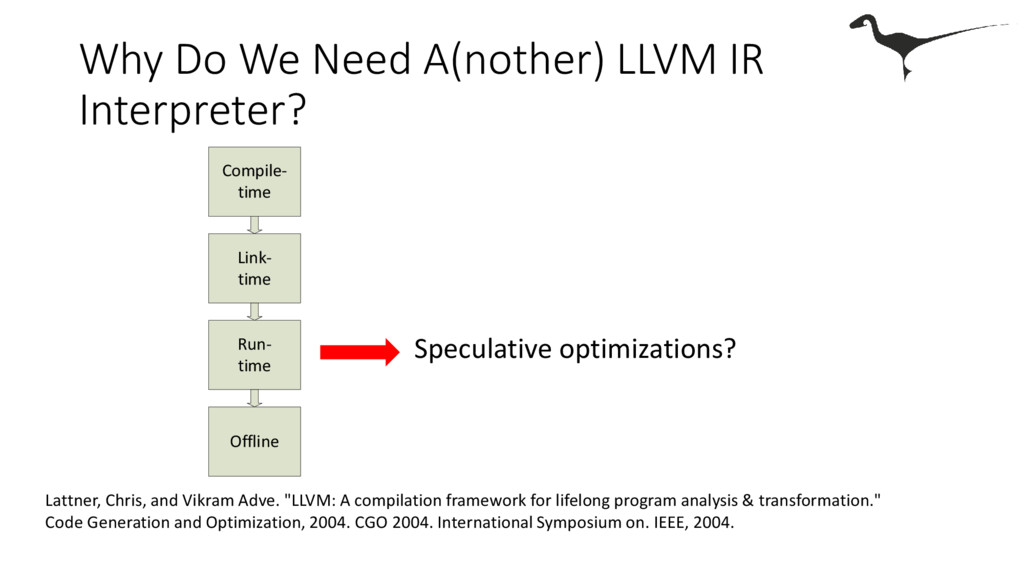
Why Do We Need A(nother) LLVM IR Interpreter? Speculative optimizations?
Compile- time Link- time Run- time Offline Lattner, Chris, and Vikram Adve. "LLVM: A compilation framework for lifelong program analysis & transformation." Code Generation and Optimization, 2004. CGO 2004. International Symposium on. IEEE, 2004. -
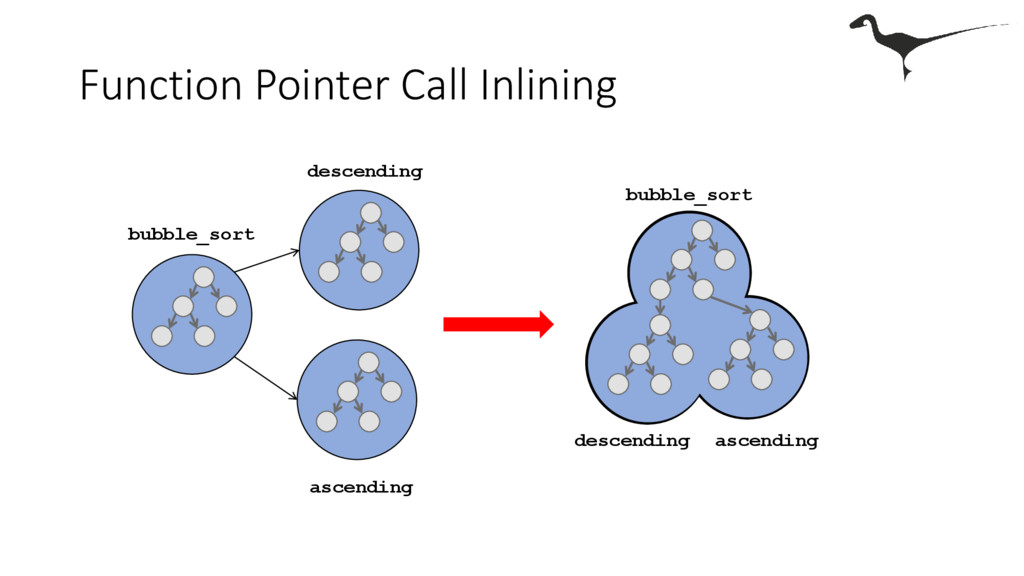
Motivation Example: Function Pointer Calls void bubble_sort(int *numbers, int count,
(*compare)(int a, int b)) { for (int i = 0; i < count; i++) { for (int j = 0; j < count - 1; j++) { if (compare(numbers[j], numbers[j+1]) > 0) { swap(&numbers[j], &numbers[j+1]); } } } } int ascending(int a, int b){ return a - b; } int descending(int a, int b){ return b - a; } -
Sulong • LLVM IR interpreter running on the JVM •
With dynamic optimizations and JIT compilation! • Available under a BSD 3-Clause License • https://github.com/graalvm/sulong • Contributions are welcome! • Sulong: Chinese for velocisaurus • 速: fast, rapid • 龙: dragon -
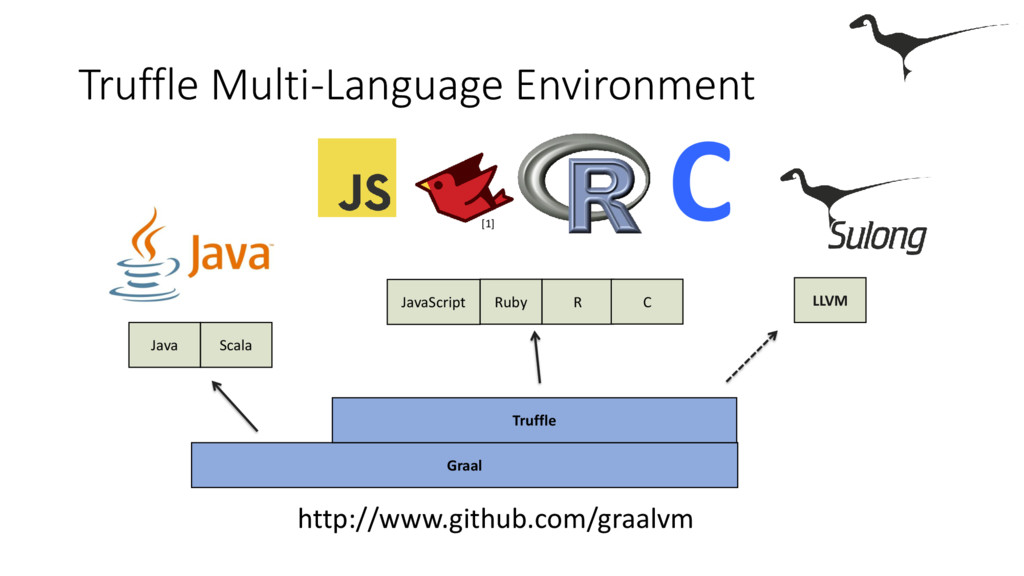
Truffle Multi-Language Environment Graal Truffle R Ruby Java Scala C
JavaScript C LLVM http://www.github.com/graalvm [1] -
AST Interpreter define i32 @ascending(i32 %a, i32 %b) { %1
= sub nsw i32 %a, %b ret i32 %1 } Function Node WriteI32 Node %1 SubI32 Node ReadI32 Node %a ReadI32 Node %b ReadI32 Node %1 ReturnI32 Node -
Truffle and Graal U U U U U I I
I G G I I I G G Node Rewriting for Profiling Feedback AST Interpreter Rewritten Nodes AST Interpreter Uninitialized Nodes Compilation using Partial Evaluation Compiled Code Node Transitions S U I D G Uninitialized Integer Generic Double String -
Truffle and Graal I I I G G I I
I G G Deoptimization to AST Interpreter D I D G G D I D G G Node Rewriting to Update Profiling Feedback Recompilation using Partial Evaluation -
Example 1: Value Profiling expectedValue = memory[ptr]; deoptimizeAndRewrite(); Uninitialized MemoryRead
Node Profiling MemoryRead Node MemoryRead Node currentValue = memory[ptr]; if (currentValue == expectedValue) { return expectedValue; } else { deoptimizeAndRewrite(); } return memory[ptr]; -
Example 2: Polymorphic Function Pointer Inline Caches No call 2
calls if (compare == &ascending) { return ascending(a, b); } else if (compare == &descending) { return descending(a, b); } else { deoptimizeAndRewrite(); } Direct CallNode Direct CallNode Uninitialized CallNode Indirect CallNode Direct CallNode Uninitialized CallNode Uninitialized CallNode compare(a, b); >2 calls 1 call compare(a, b) > 0 -
Getting started • Download the mx build tool • Clone
the repo and build the project • Compile and run a program $ hg clone https://bitbucket.org/allr/mx $ export PATH=$PWD/mx:$PATH $ git clone https://github.com/graalvm/sulong $ cd sulong $ mx build $ mx su-clang -S -emit-llvm -o test.ll test.c $ mx su-run test.ll -
Developing with mx • Generate Eclipse project files (also available
for other IDEs) • Quality tools • run Sulong tests • Eclipse remote debugging (port 5005) $ mx eclipseinit $ mx checkstyle/findbugs/pylint/... $ mx su-tests $ mx su-debug test.ll -
Compilation • Textual information about which LLVM functions are compiled
• View Truffle and Graal graphs $ mx su-run test.ll -Dgraal.TraceTruffleCompilation=true $ mx igv $ mx su-run test.ll -Dgraal.Dump=Truffle -
Implementation of Memory • Unmanaged mode • Heap allocation: by
native standard libraries • Stack allocation: Java Unsafe API • Graal Native Function Interface for library interoperability Graal Foreign Function Interface malloc -
Current State • Performance: room for improvement on most benchmarks
• Completeness: mostly focused on C so far • Missing: longjmp/setjmp, inline assembly, full support of 80 bit floats • Can execute most of the gcc.c-torture/execute benchmarks -
Outlook • Low overhead security-related instrumentations Graal is specialized
to perform optimizations for operations like bounds or type checks • Memory safety via allocating on the Java heap • Tracking of integer overflows • Full Truffle integration • Debugger with source code highlighting • Language interoperability -
Attributions • [1] The JRuby logo is copyright (c) Tony
Price 2011, licensed under the terms of Creative Commons Attribution-NoDerivs 3.0 Unported (CC BY-ND 3.0)