社内勉強会_SuperMimic: Scaling Humanoid Whole-Body Control with One Differentiable World Model
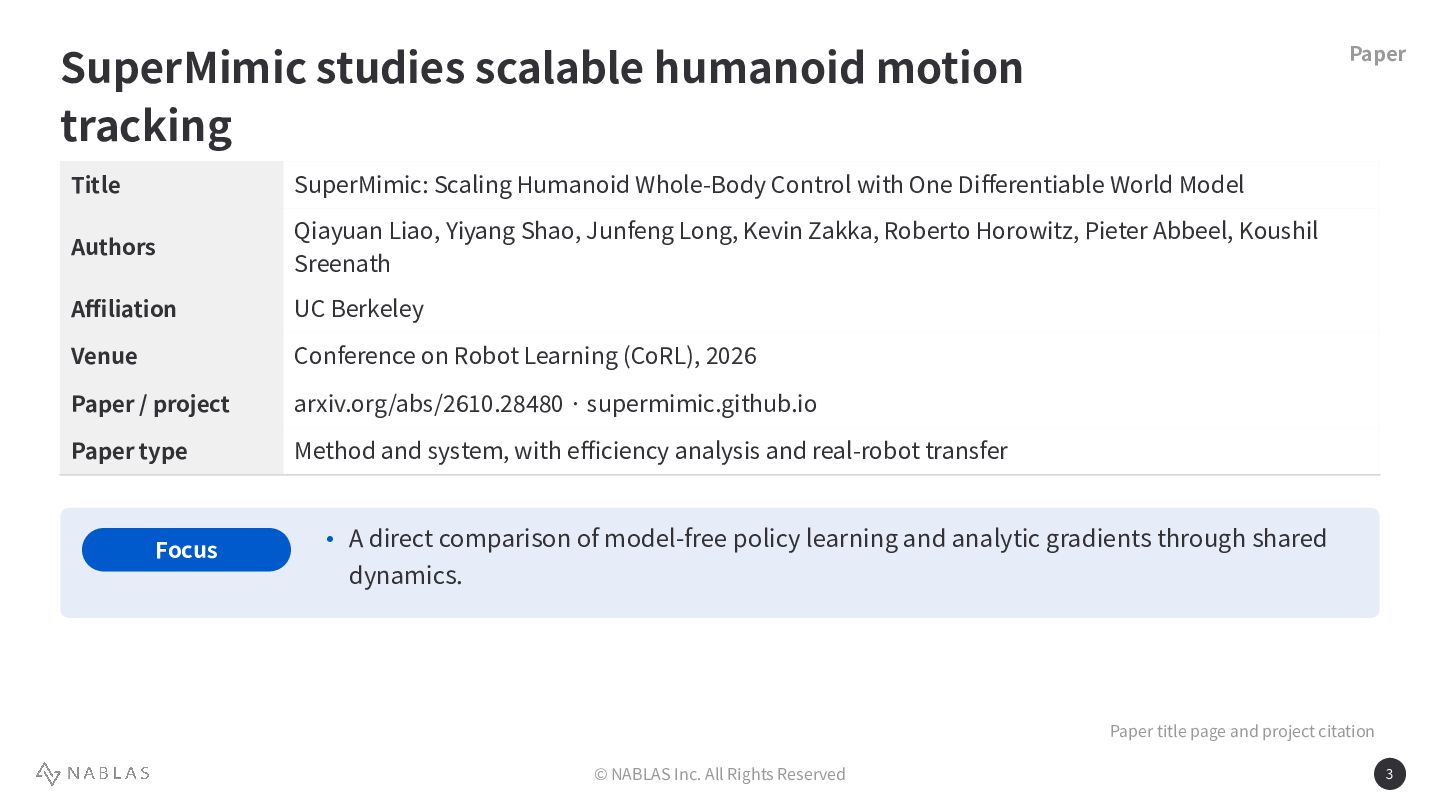
本スライドでは、人型ロボットの全身トラッキングにおいて、クラスタ規模の強化学習を単一GPU規模へと劇的に効率化した「SuperMimic」の論文を解説しています。
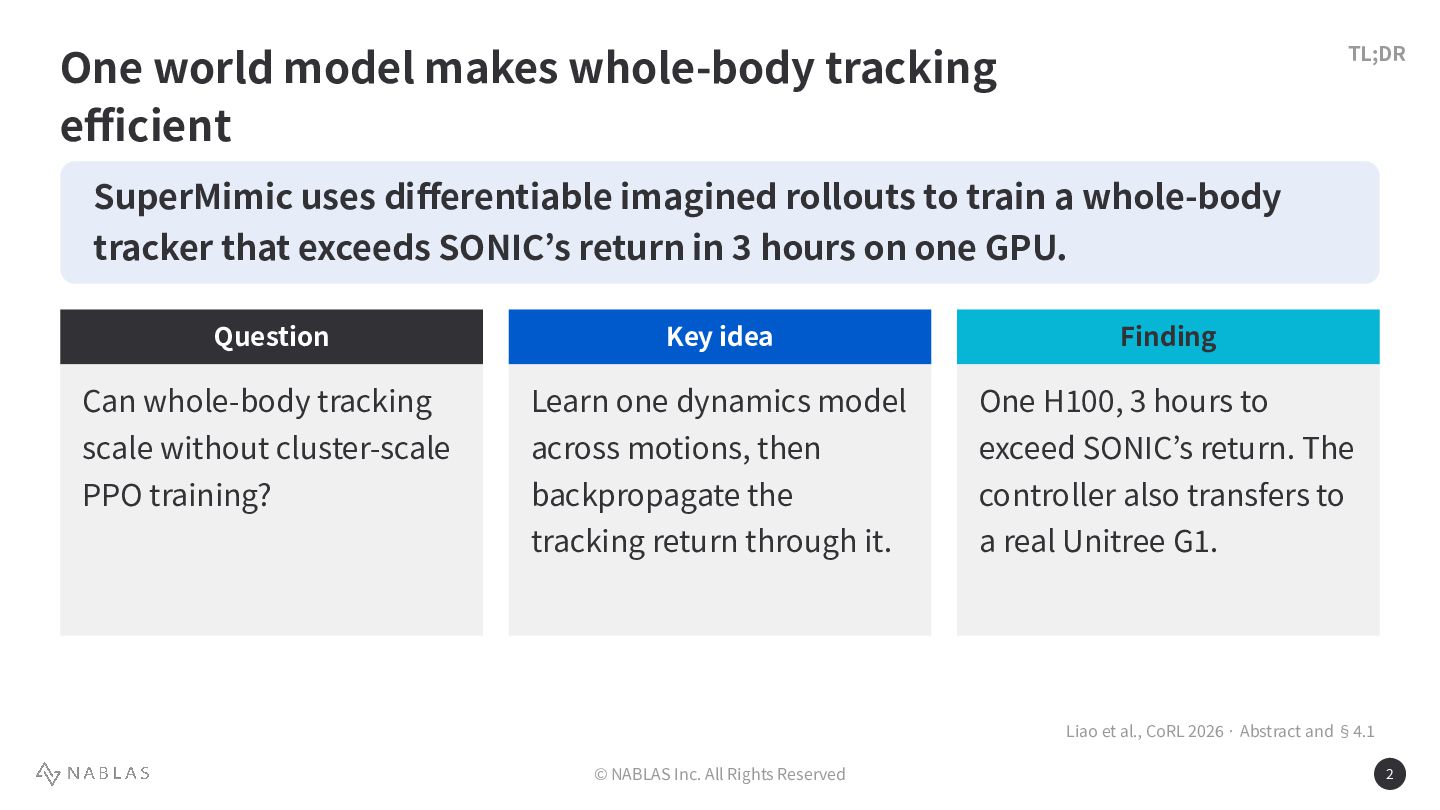
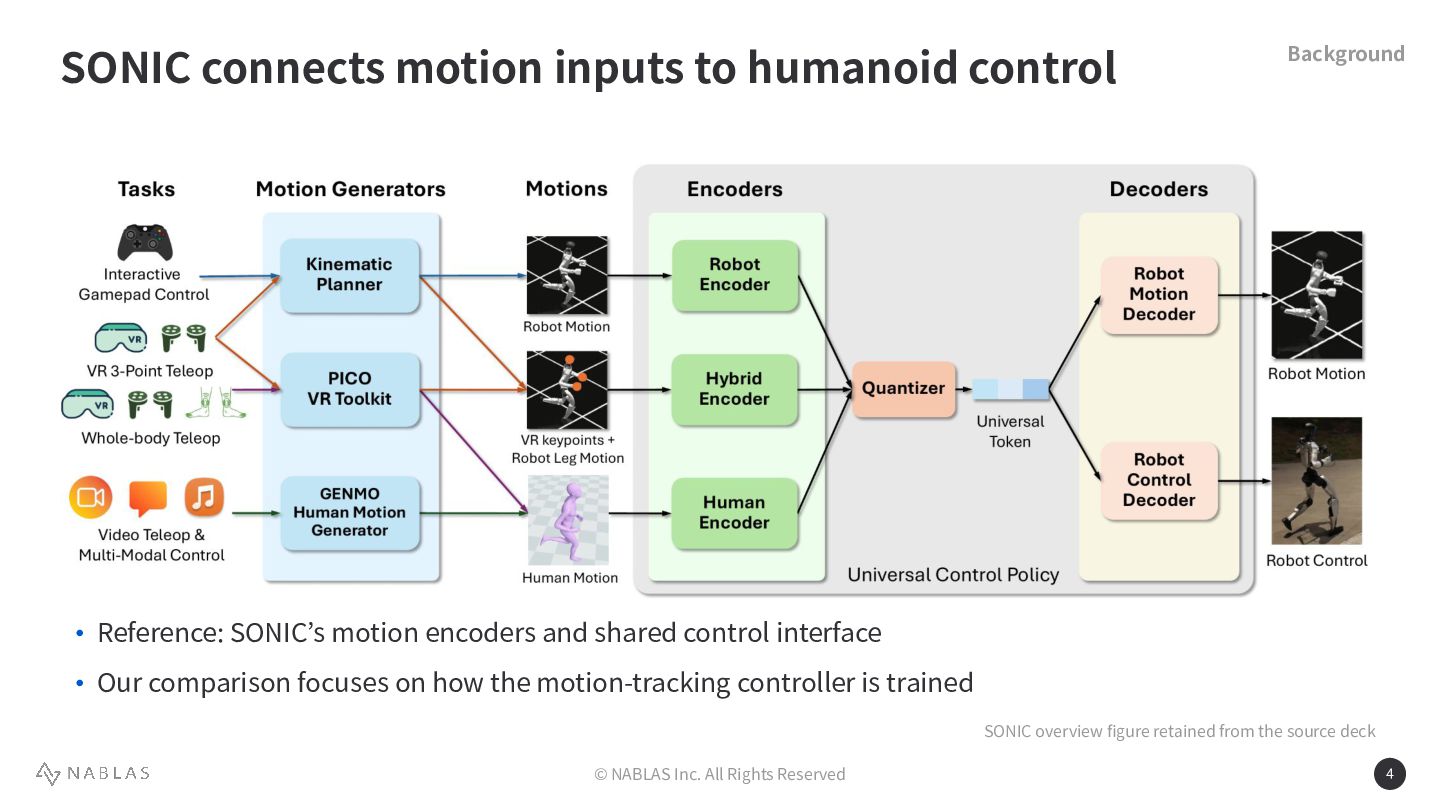
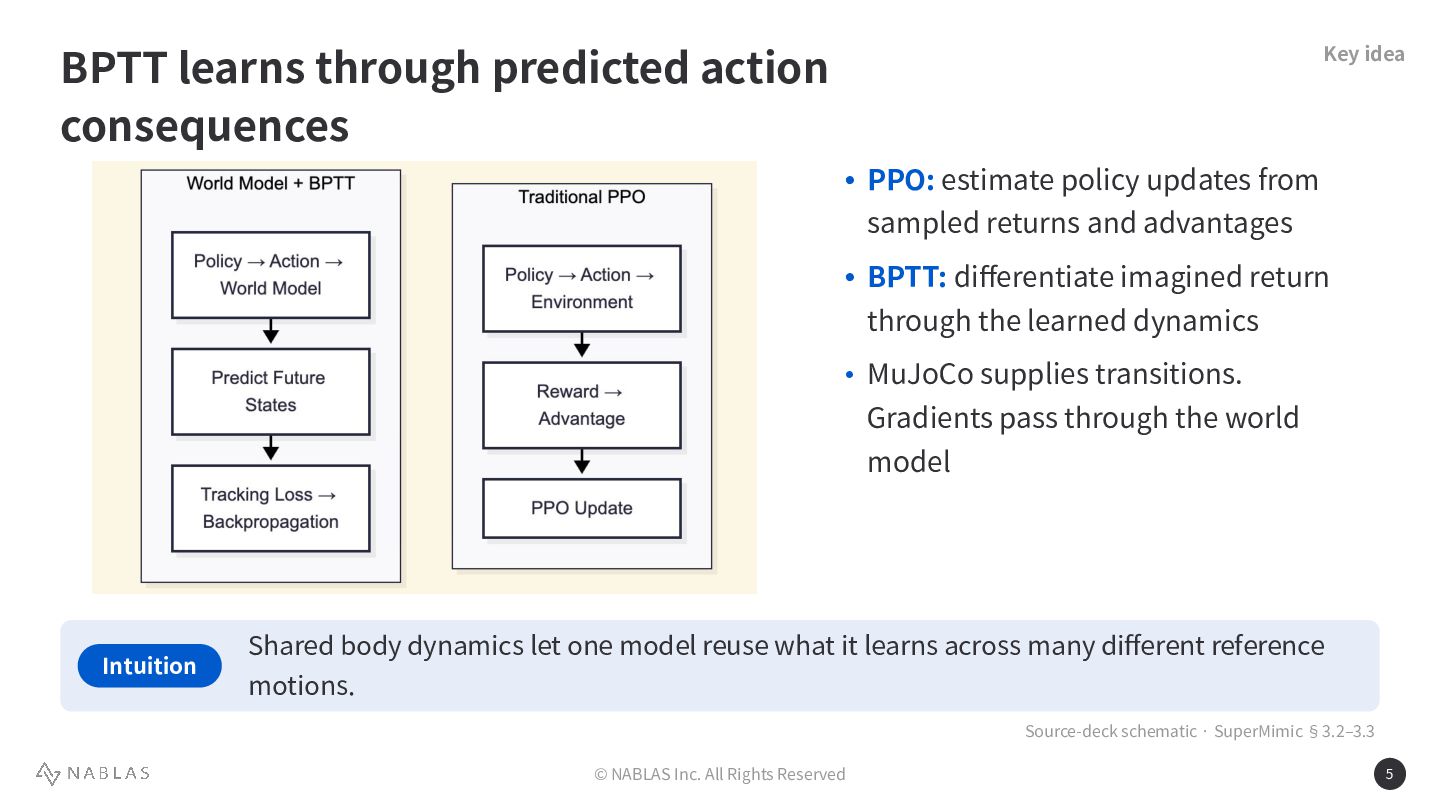
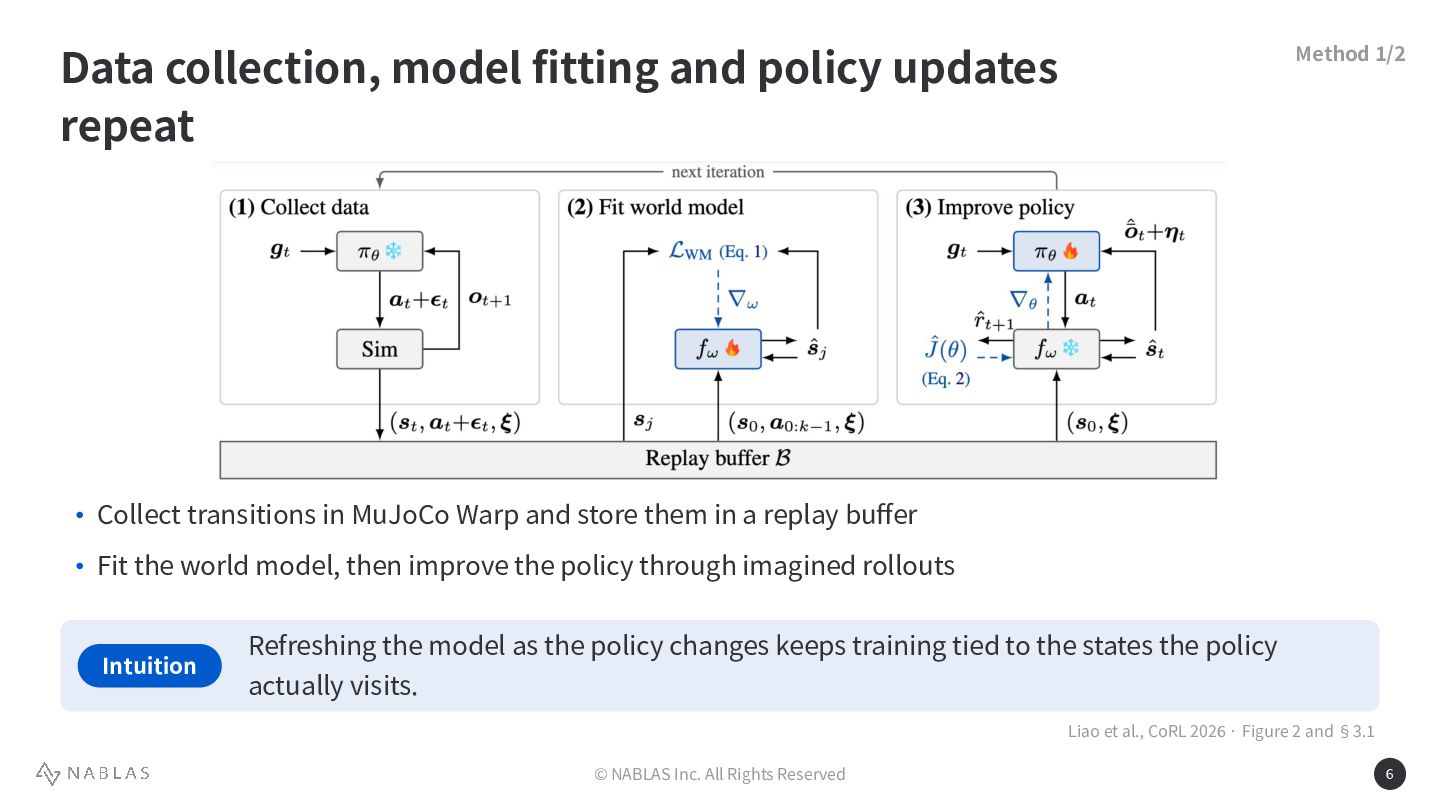
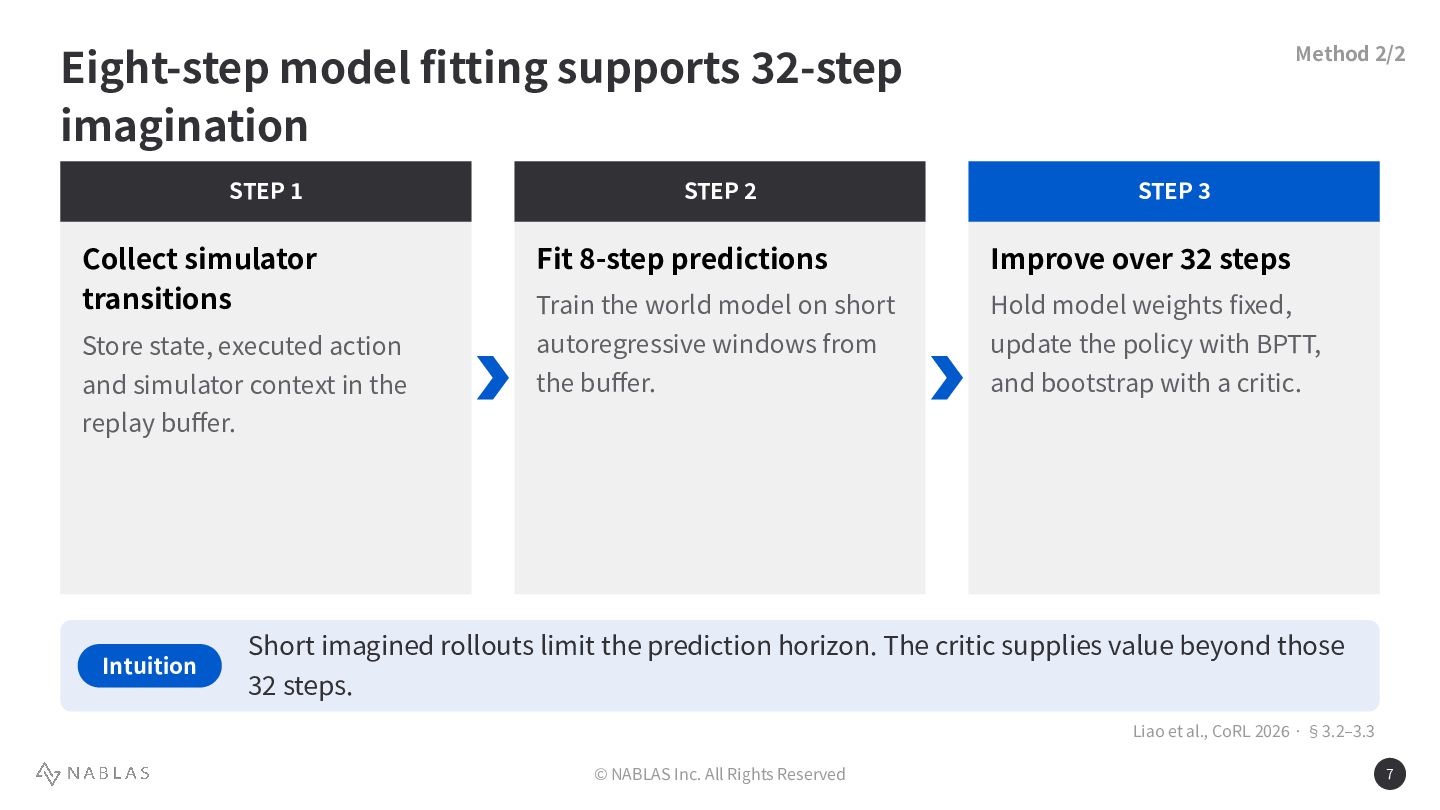
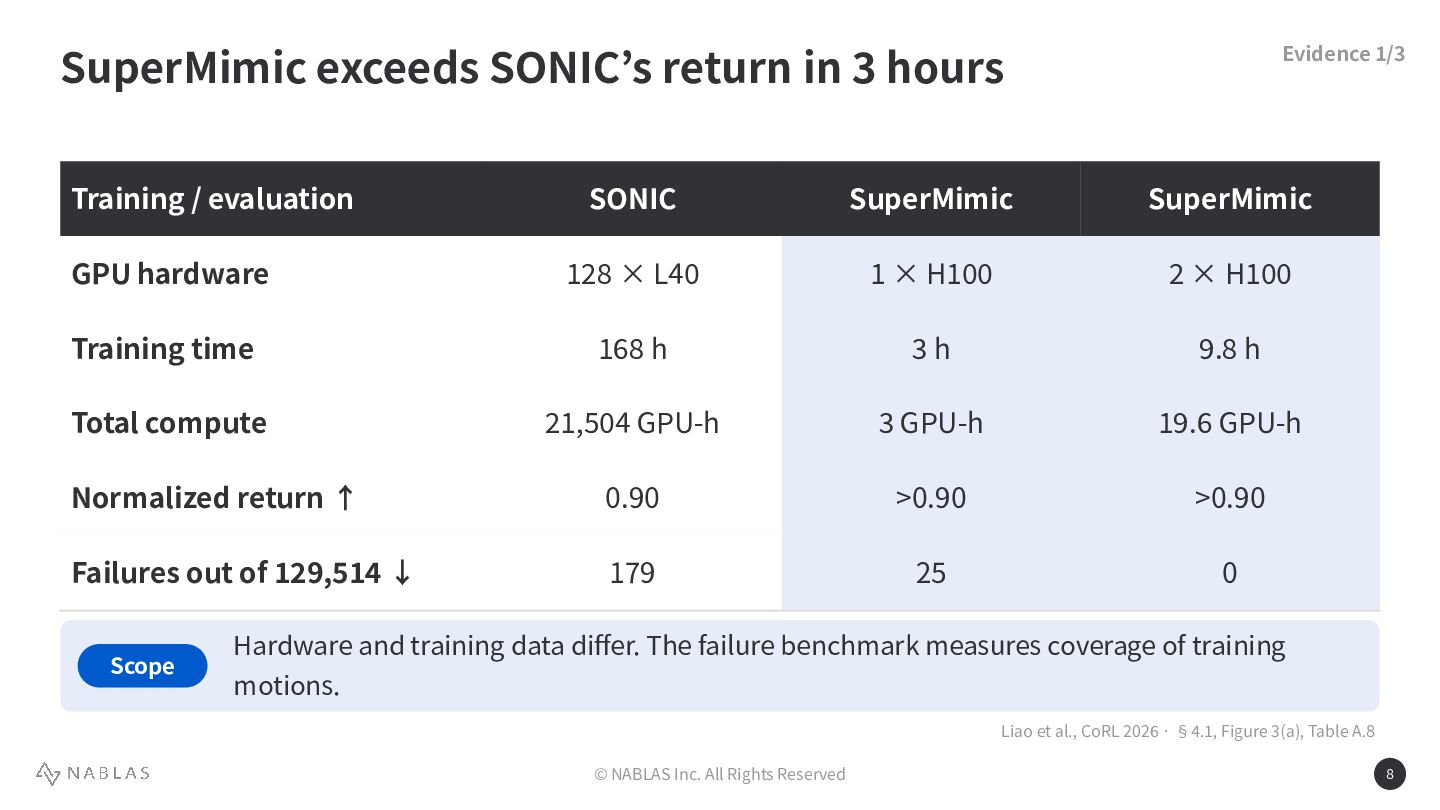
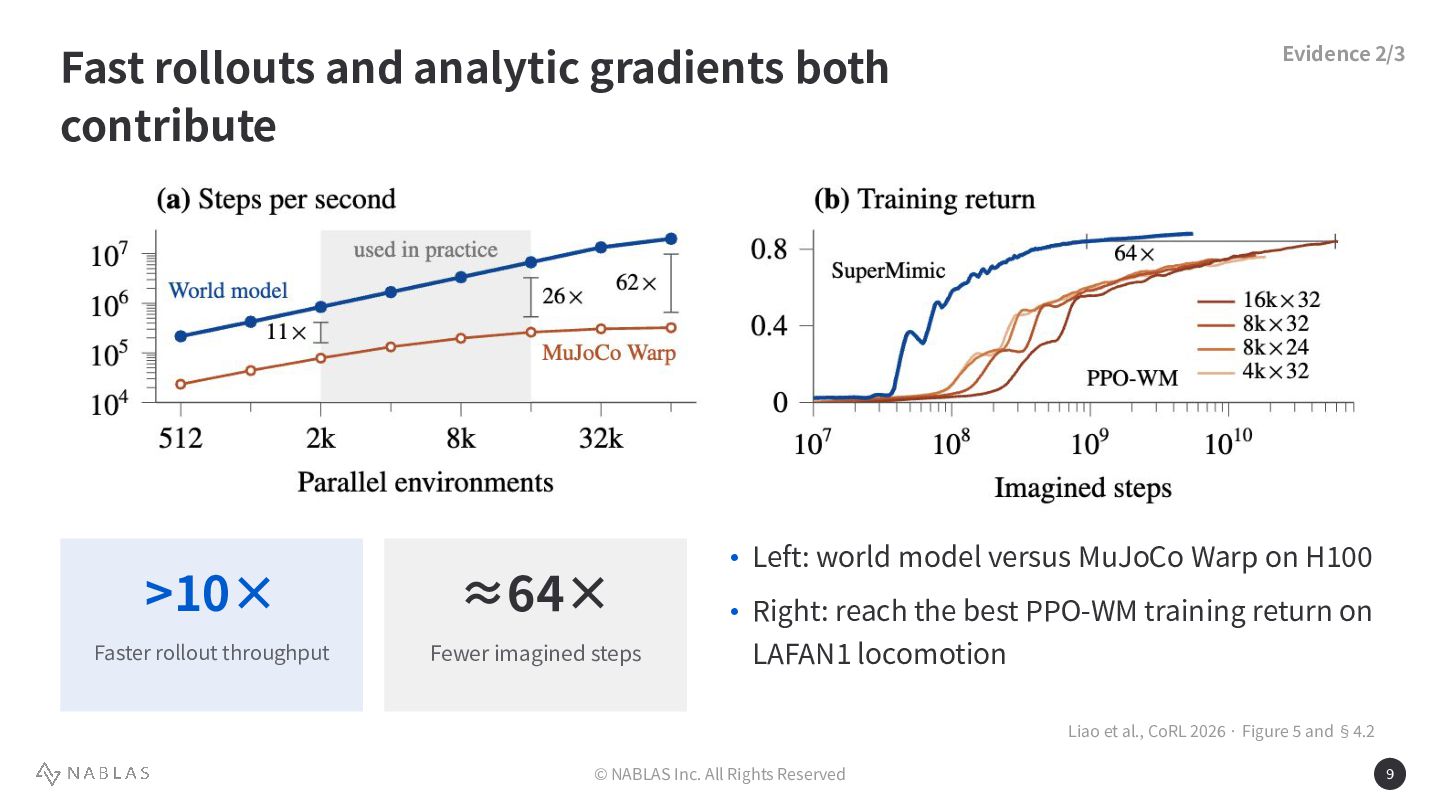
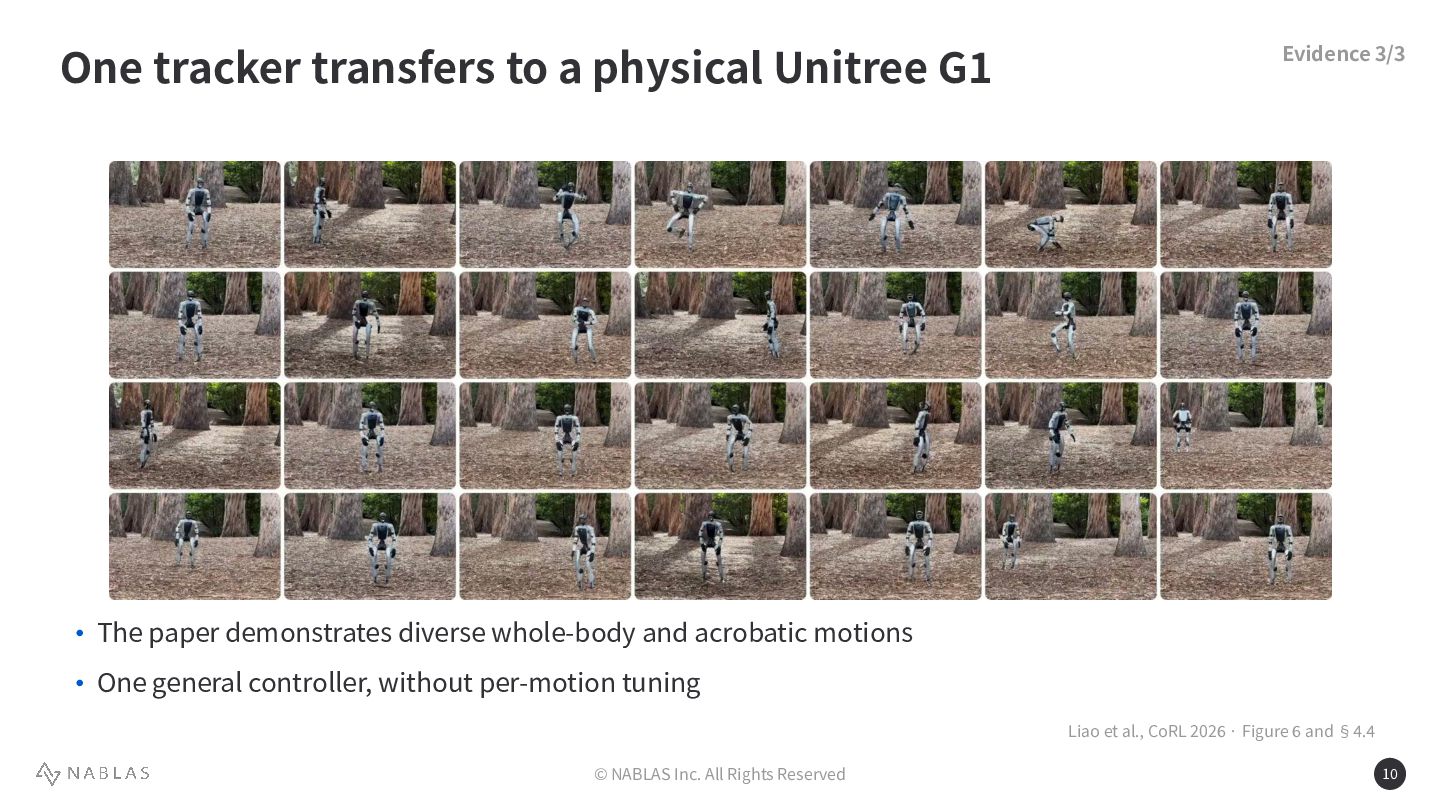
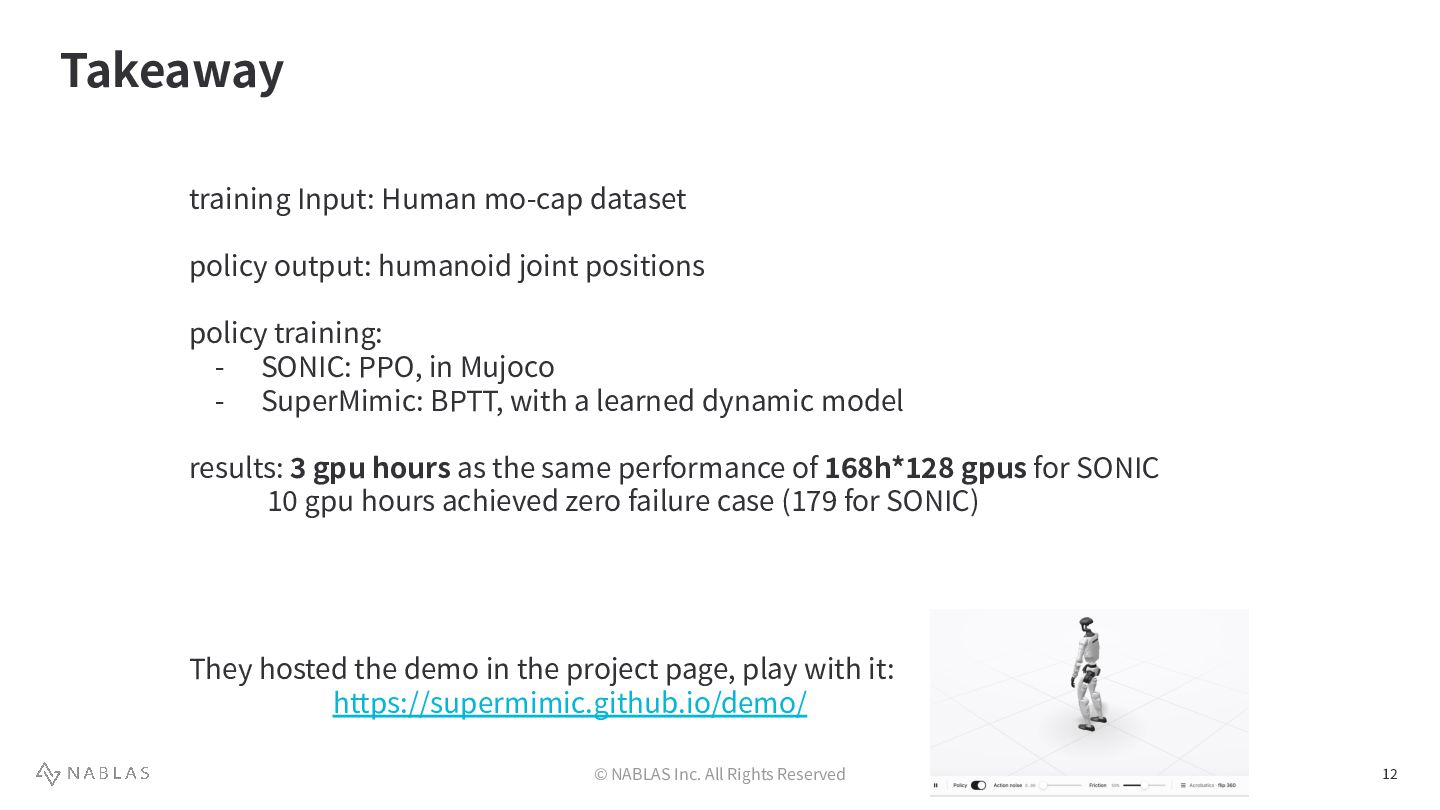
従来、ヒューマノイドの多様な全身動作追従には膨大な計算資源(SONIC: 128×L40で7日間=計21,504 GPU時間)を要するPPOが主流でした。本研究では、単一の微分可能な世界モデル(Differentiable World Model)を学習し、BPTT(時間逆伝播)を通じて解析的勾配を活用することで、わずか「1×H100・3時間」でSONIC同等以上のリターンを達成。さらに約10時間の学習でベンチマーク上の失敗ケース0件(SONICは179件)を達成し、実機Unitree G1へのゼロショット転移にも成功しています。
In this presentation, we explore "SuperMimic," a paper that drastically compresses cluster-scale reinforcement learning down to a single GPU for humanoid whole-body motion tracking.
While cluster-scale model-free PPO pipelines (such as SONIC, requiring 128× L40 GPUs for 7 days / 21,504 GPU-hours) have long dominated humanoid whole-body control, computational demand has remained a critical bottleneck to scaling. SuperMimic overcomes this barrier by learning a single differentiable world model and leveraging analytic gradients via Backpropagation-Through-Time (BPTT). It surpasses the return of SONIC in just 3 hours on a single H100 GPU (>1000× compute reduction). Furthermore, after ~10 GPU-hours of training, it achieves zero failures across 129,514 benchmark motions (compared to 179 failures for SONIC) and successfully transfers to a physical Unitree G1 humanoid robot.

 nablas_inc
 hagino3000
 110y
 maguroalternative
 vivion
 oidfj
 dynamis
 minorun365
 nealle
 carta_engineering
 uhyo
 bengo4com
 chmikata
 sarafernandez
 danielanewman
 inesmontani
 katiecoart
 mfonobong
 jeffersonlam
 bkeepers
 lemiorhan
 yeseniaperezcruz
 addyosmani
 jonyablonski
 tonyrice