Upgrade to Pro — share decks privately, control downloads, hide ads and more …

Ahead of the Curve 4-hour

Ahead of the Curve 4-hour

On April 22-23, 2014, the Reilly Center for Science, Technology, and Values held a conferenced titled "Ahead of the Curve: Anticipating Ethical, Legal, and Societal Issues Posed by Emerging Weapons Technologies." The conference provided a forum to discuss the "action-oriented" chapters of the National Academy of Science's report, "Emerging and Readily Available Technologies and National Security." The report was commissioned by the Defense Advanced Research Projects Agency (DARPA) in order to begin a discussion about the conduct and applications of research on military technology as well as their unforseen and inadvertant consequences. The primary goal of the conference was to help government agencies, institutions, and researchers grow the expertise necessary for early and continuing engagement with the ethical, legal, and societal implications of new weapons technologies as they are planned and developed.

Following the conference, Don Howard and Maj. Gen. Robert Latiff (Ret.) generated materials in conjunction with the report, including PowerPoint presentations of varying lengths, a briefing book, a companion bibliography, and video. All of these materials are free to the public (so long as no credits are removed).

http://reilly.nd.edu/research/initiatives/darpa-nrc/

Avatar for Notre Dame Reilly Center

Notre Dame Reilly Center

July 13, 2015

More Decks by Notre Dame Reilly Center

Other Decks in Technology

Transcript

  1. Ethical, Legal, and Societal Implications of New Weapons Technologies Maj

    Gen (Ret) Robert Latiff, Ph.D. Reilly Center for Science, Technology, and Values University of Notre Dame Don Howard, Ph.D. Professor of Philosophy and Reilly Center for Science, Technology, and Values University of Notre Dame
  2. This work was done under contract to the National Academy

    of Sciences. Copyright © 2015 National Academy of Sciences All rights reserved Contact information: Maj Gen (Ret) Robert H. Latiff [email protected] Don Howard [email protected]
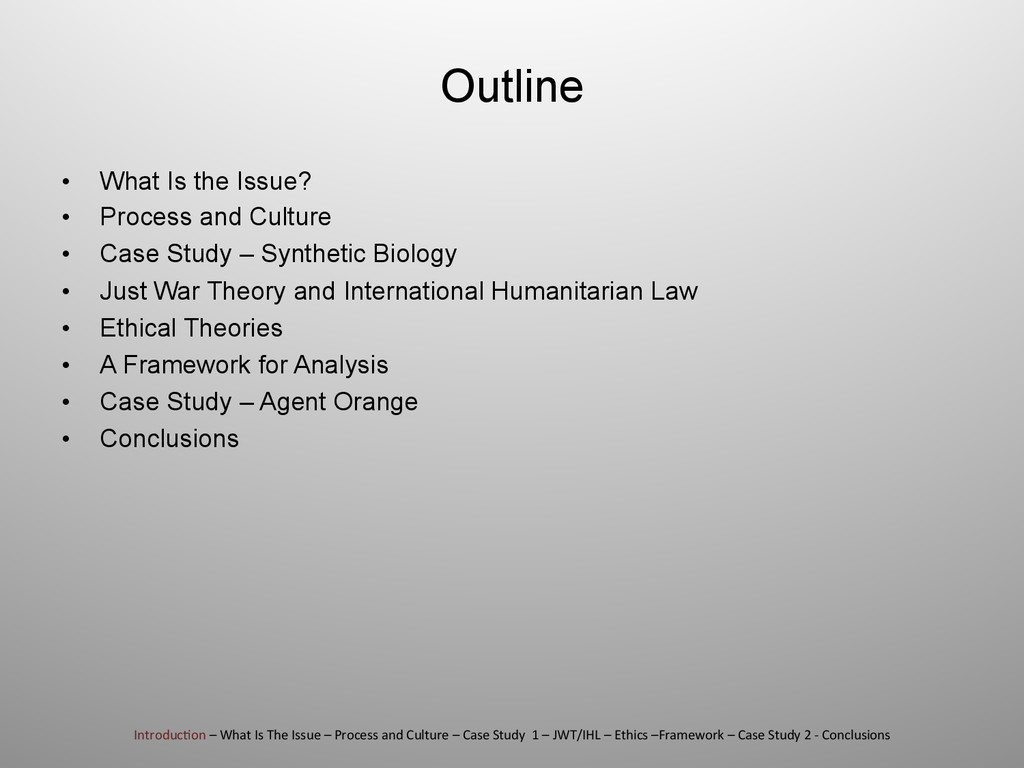
  3. Outline •  What Is the Issue? •  Process and Culture

    •  Case Study – Synthetic Biology •  Just War Theory and International Humanitarian Law •  Ethical Theories •  A Framework for Analysis •  Case Study – Agent Orange •  Conclusions Introduc)on  –  What  Is  The  Issue  –  Process  and  Culture  –  Case  Study    1  –  JWT/IHL  –  Ethics  –Framework  –  Case  Study  2  -­‐  Conclusions  
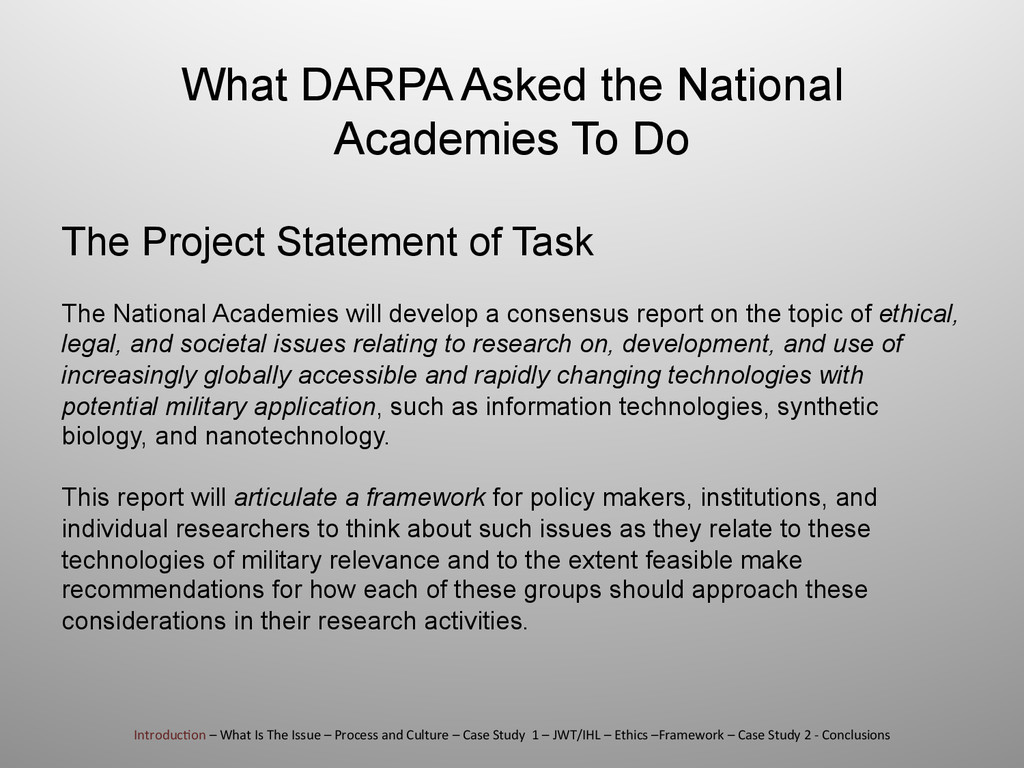
  4. What DARPA Asked the National Academies To Do The Project

    Statement of Task The National Academies will develop a consensus report on the topic of ethical, legal, and societal issues relating to research on, development, and use of increasingly globally accessible and rapidly changing technologies with potential military application, such as information technologies, synthetic biology, and nanotechnology. This report will articulate a framework for policy makers, institutions, and individual researchers to think about such issues as they relate to these technologies of military relevance and to the extent feasible make recommendations for how each of these groups should approach these considerations in their research activities. Introduc)on  –  What  Is  The  Issue  –  Process  and  Culture  –  Case  Study    1  –  JWT/IHL  –  Ethics  –Framework  –  Case  Study  2  -­‐  Conclusions  
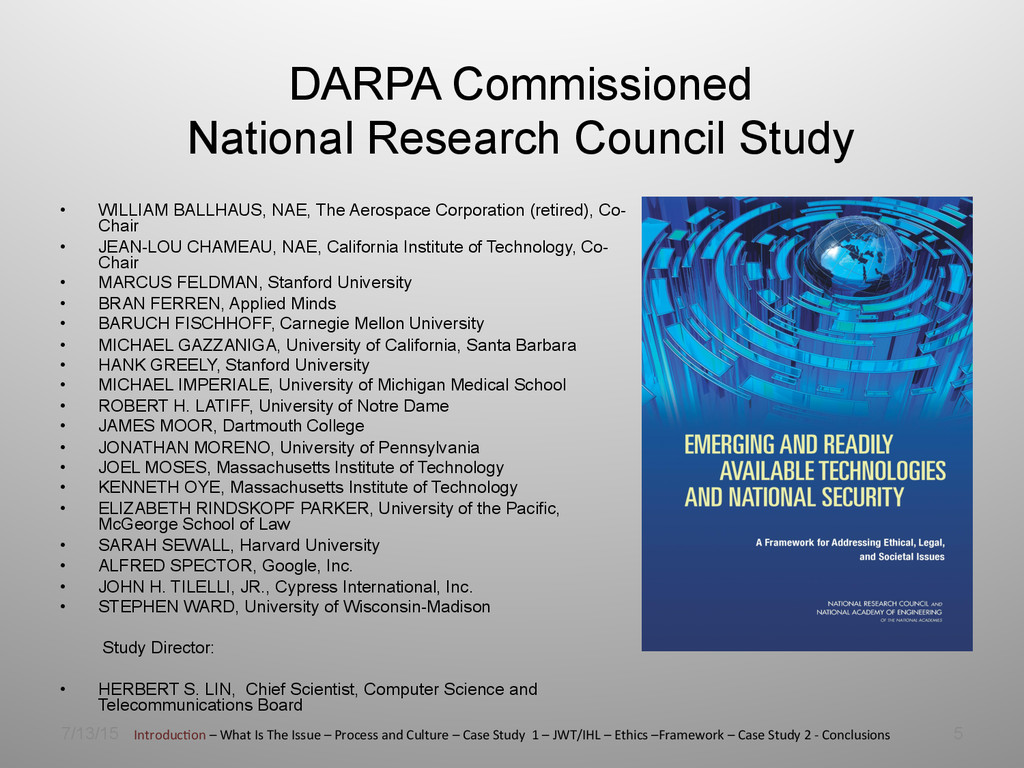
  5. DARPA Commissioned National Research Council Study •  WILLIAM BALLHAUS, NAE,

    The Aerospace Corporation (retired), Co- Chair •  JEAN-LOU CHAMEAU, NAE, California Institute of Technology, Co- Chair •  MARCUS FELDMAN, Stanford University •  BRAN FERREN, Applied Minds •  BARUCH FISCHHOFF, Carnegie Mellon University •  MICHAEL GAZZANIGA, University of California, Santa Barbara •  HANK GREELY, Stanford University •  MICHAEL IMPERIALE, University of Michigan Medical School •  ROBERT H. LATIFF, University of Notre Dame •  JAMES MOOR, Dartmouth College •  JONATHAN MORENO, University of Pennsylvania •  JOEL MOSES, Massachusetts Institute of Technology •  KENNETH OYE, Massachusetts Institute of Technology •  ELIZABETH RINDSKOPF PARKER, University of the Pacific, McGeorge School of Law •  SARAH SEWALL, Harvard University •  ALFRED SPECTOR, Google, Inc. •  JOHN H. TILELLI, JR., Cypress International, Inc. •  STEPHEN WARD, University of Wisconsin-Madison Study Director: •  HERBERT S. LIN, Chief Scientist, Computer Science and Telecommunications Board 7/13/15 5 Introduc)on  –  What  Is  The  Issue  –  Process  and  Culture  –  Case  Study    1  –  JWT/IHL  –  Ethics  –Framework  –  Case  Study  2  -­‐  Conclusions  
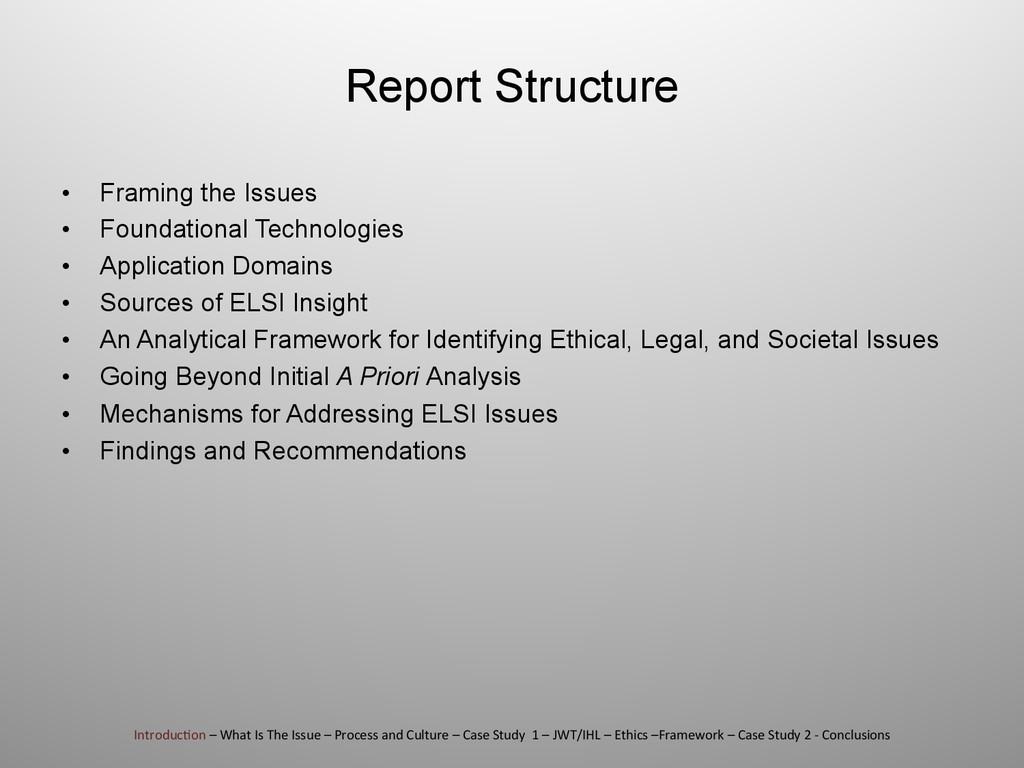
  6. Report Structure •  Framing the Issues •  Foundational Technologies • 

    Application Domains •  Sources of ELSI Insight •  An Analytical Framework for Identifying Ethical, Legal, and Societal Issues •  Going Beyond Initial A Priori Analysis •  Mechanisms for Addressing ELSI Issues •  Findings and Recommendations Introduc)on  –  What  Is  The  Issue  –  Process  and  Culture  –  Case  Study    1  –  JWT/IHL  –  Ethics  –Framework  –  Case  Study  2  -­‐  Conclusions  
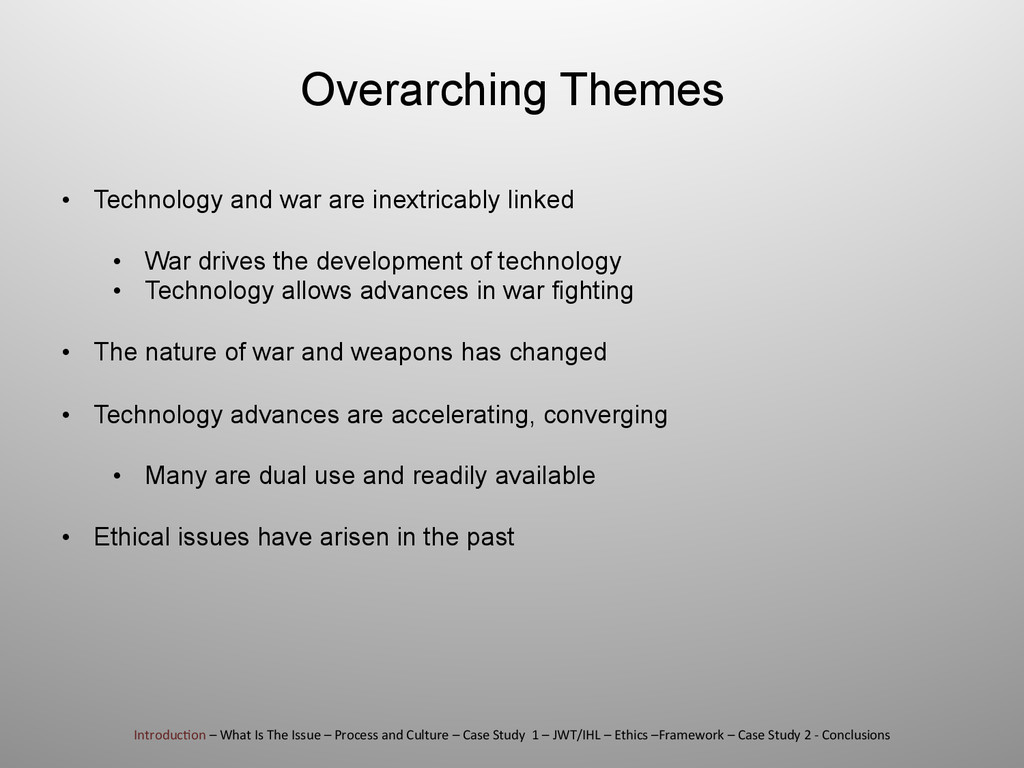
  7. Overarching Themes •  Technology and war are inextricably linked • 

    War drives the development of technology •  Technology allows advances in war fighting •  The nature of war and weapons has changed •  Technology advances are accelerating, converging •  Many are dual use and readily available •  Ethical issues have arisen in the past Introduc)on  –  What  Is  The  Issue  –  Process  and  Culture  –  Case  Study    1  –  JWT/IHL  –  Ethics  –Framework  –  Case  Study  2  -­‐  Conclusions  
  8. What Is the Issue? Introduc)on  –  What  Is  The  Issue

     –  Process  and  Culture  –  Case  Study    1  –  JWT/IHL  –  Ethics  –Framework  –  Case  Study  2  -­‐  Conclusions  
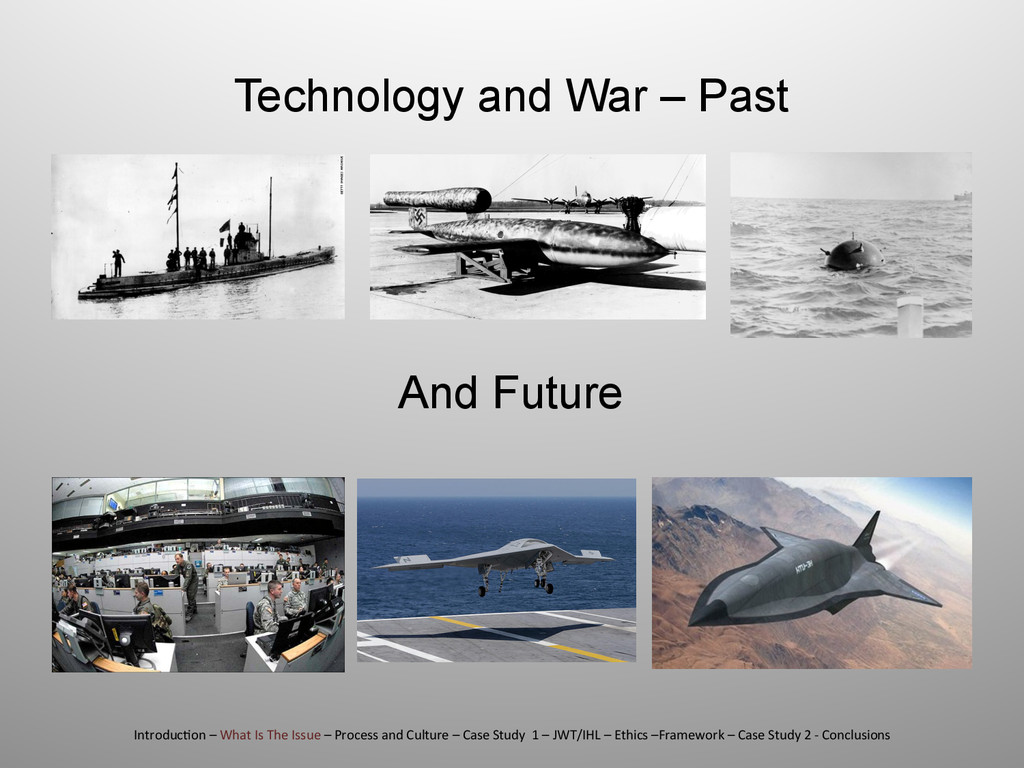
  9. Technology and War – Past And Future Introduc)on  –  What

     Is  The  Issue  –  Process  and  Culture  –  Case  Study    1  –  JWT/IHL  –  Ethics  –Framework  –  Case  Study  2  -­‐  Conclusions  
  10. While the development of weapons technologies has sometimes been accompanied

    by ethical reflection, too often the ethical perspectives are naïve. Introduc)on  –  What  Is  The  Issue  –  Process  and  Culture  –  Case  Study    1  –  JWT/IHL  –  Ethics  –Framework  –  Case  Study  2  -­‐  Conclusions  
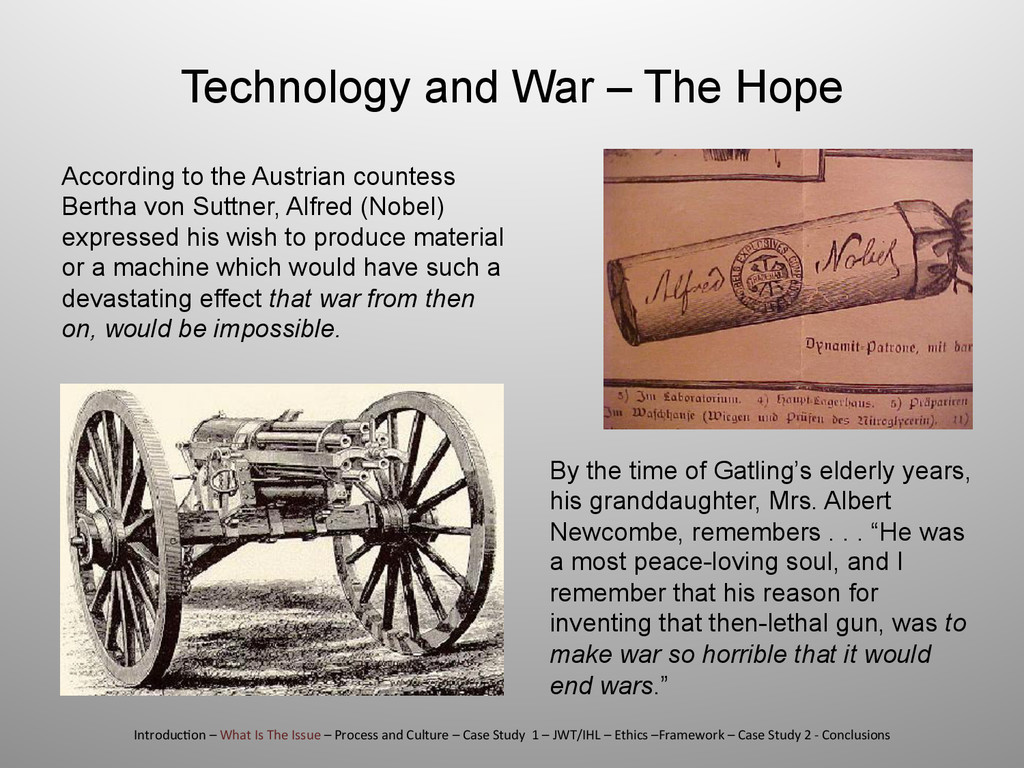
  11. Technology and War – The Hope According to the Austrian

    countess Bertha von Suttner, Alfred (Nobel) expressed his wish to produce material or a machine which would have such a devastating effect that war from then on, would be impossible. By the time of Gatling’s elderly years, his granddaughter, Mrs. Albert Newcombe, remembers . . . “He was a most peace-loving soul, and I remember that his reason for inventing that then-lethal gun, was to make war so horrible that it would end wars.” Introduc)on  –  What  Is  The  Issue  –  Process  and  Culture  –  Case  Study    1  –  JWT/IHL  –  Ethics  –Framework  –  Case  Study  2  -­‐  Conclusions  
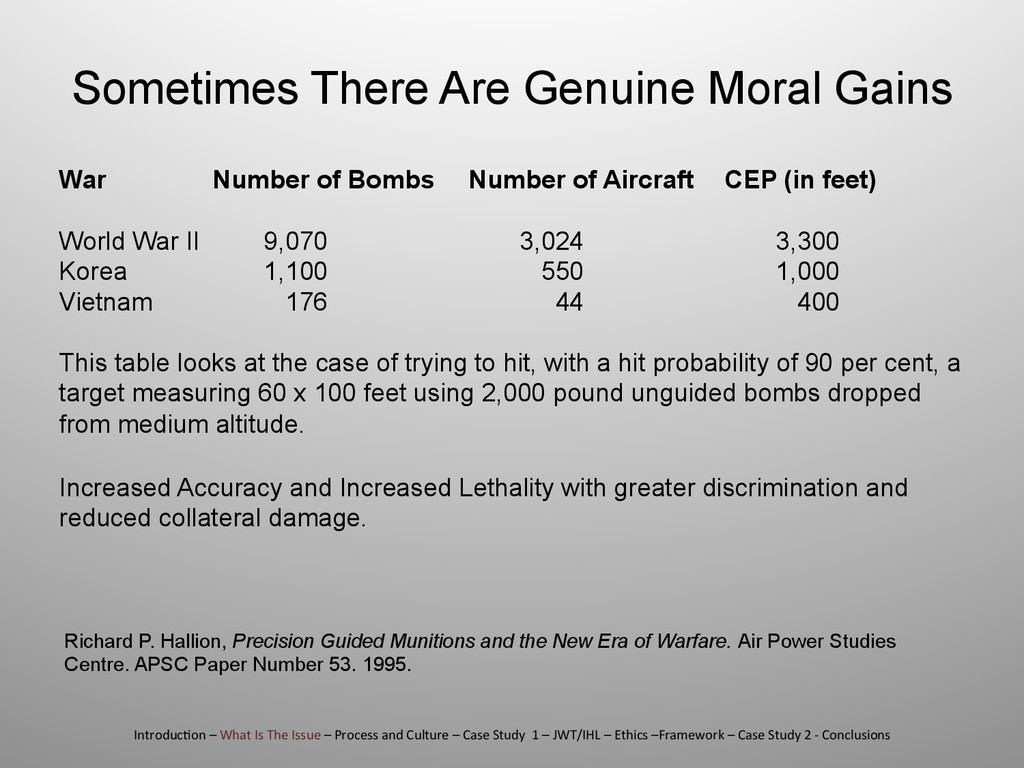
  12. Sometimes There Are Genuine Moral Gains War Number of Bombs

    Number of Aircraft CEP (in feet) World War II 9,070 3,024 3,300 Korea 1,100 550 1,000 Vietnam 176 44 400 Richard P. Hallion, Precision Guided Munitions and the New Era of Warfare. Air Power Studies Centre. APSC Paper Number 53. 1995. Increased Accuracy and Increased Lethality with greater discrimination and reduced collateral damage. This table looks at the case of trying to hit, with a hit probability of 90 per cent, a target measuring 60 x 100 feet using 2,000 pound unguided bombs dropped from medium altitude. Introduc)on  –  What  Is  The  Issue  –  Process  and  Culture  –  Case  Study    1  –  JWT/IHL  –  Ethics  –Framework  –  Case  Study  2  -­‐  Conclusions  
  13. Our aim is to provide more sophisticated tools for ethical

    analysis and reflection. Introduc)on  –  What  Is  The  Issue  –  Process  and  Culture  –  Case  Study    1  –  JWT/IHL  –  Ethics  –Framework  –  Case  Study  2  -­‐  Conclusions  
  14. Rapid technology growth poses, by itself, an ethical challenge. Introduc)on

     –  What  Is  The  Issue  –  Process  and  Culture  –  Case  Study    1  –  JWT/IHL  –  Ethics  –Framework  –  Case  Study  2  -­‐  Conclusions  
  15. Change that is too rapid can be deeply divisive; if

    only an elite can keep up, the rest of us will grow increasingly mystified about how the world works. We can understand natural biology, subtle as it is, because it holds still. But how will we ever be able to understand quantum computing or nanotechnology [or synthetic biology] if its subtlety keeps accelerating away from us? Constant technological revolution makes planning difficult, and a society that stops planning for the future is likely to become a brittle society. Stewart Brand. “Is Technology Moving Too Fast?” Time. June 19, 2000. Keeping Up With the Pace of Change Introduc)on  –  What  Is  The  Issue  –  Process  and  Culture  –  Case  Study    1  –  JWT/IHL  –  Ethics  –Framework  –  Case  Study  2  -­‐  Conclusions  
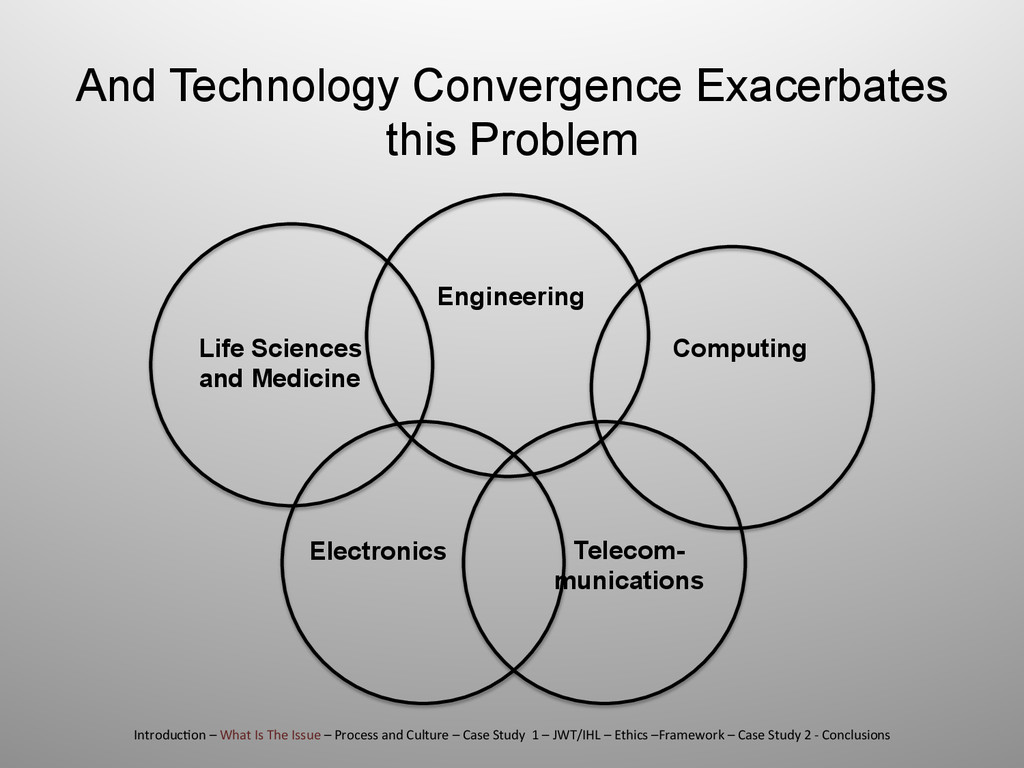
  16. Life Sciences and Medicine Engineering Computing Electronics Telecom- munications And

    Technology Convergence Exacerbates this Problem Introduc)on  –  What  Is  The  Issue  –  Process  and  Culture  –  Case  Study    1  –  JWT/IHL  –  Ethics  –Framework  –  Case  Study  2  -­‐  Conclusions  
  17. Regulators having to regulate emerging technologies face a double-blind problem:

    the effects of technology can’t be predicted until the technology is extensively deployed. Yet once deployed, they become entrenched and are difficult to change. David Collingridge. The Social Control of Technology. New York: St. Martin’s Press, 1980. Predicting the Arc of Technology Adoption Is Fraught 17 Introduc)on  –  What  Is  The  Issue  –  Process  and  Culture  –  Case  Study    1  –  JWT/IHL  –  Ethics  –Framework  –  Case  Study  2  -­‐  Conclusions  
  18. We Tend to Be Seduced by Technology 7/13/15 18 • 

    The Allure •  It is exciting and promises something good •  Instant gratification •  It is about immediate benefit •  The illusion of objectivity •  Solving technical problems seems not to require subjective judgment •  The Dangers •  Addicting •  Tendency to overlook negatives •  Long term consequences largely ignored •  Downsides are an annoyance to be explained away •  Unknown consequences Introduc)on  –  What  Is  The  Issue  –  Process  and  Culture  –  Case  Study    1  –  JWT/IHL  –  Ethics  –Framework  –  Case  Study  2  -­‐  Conclusions  
  19. Technological Momentum •  New technology develops an inertia of its

    own •  The technology evolves to be a primary actor •  Outside forces often force continuation of a project, once begun •  Fallacy of “sunk cost” •  Self-preservation of institutions •  Political interest •  Commercial interest Introduc)on  –  What  Is  The  Issue  –  Process  and  Culture  –  Case  Study    1  –  JWT/IHL  –  Ethics  –Framework  –  Case  Study  2  -­‐  Conclusions  
  20. It was a misinterpretation of the lopsided military victory in

    the 1991 Gulf war that gave rise to what would become the orthodoxy of the Revolution in Military Affairs, the belief that American military technological advantages would shift war fundamentally from the realm of uncertainty to the realm of certainty. The language was hubristic. The U.S. military would shock and awe opponents in the conduct of rapid decisive operations. War would be fast, cheap, and efficient. The warrior ethos is at risk because some continue to advocate simple, mainly technologically based solutions to the problem of future war, ignoring war’s very nature as a human and political activity that is fundamentally a contest of wills. Janine Davidson. “The Warrior Ethos at Risk: H.R. McMaster’s Remarkable Veterans Day Speech.” Defense in Depth. Council on Foreign Relations, November 18, 2014. Technology Hubris Introduc)on  –  What  Is  The  Issue  –  Process  and  Culture  –  Case  Study    1  –  JWT/IHL  –  Ethics  –Framework  –  Case  Study  2  -­‐  Conclusions  
  21. Some New Technologies of Concern Highlighted in the Report • 

    Information Technology •  Synthetic Biology •  Neuroscience •  Robotics and Autonomous Systems •  Soldier Enhancements •  Cyber Weapons •  Non-Lethal Weapons Introduc)on  –  What  Is  The  Issue  –  Process  and  Culture  –  Case  Study    1  –  JWT/IHL  –  Ethics  –Framework  –  Case  Study  2  -­‐  Conclusions  
  22. Advantages of New Technologies •  Information Technology •  Better security,

    consumer choice and access •  Synthetic Biology •  Potential for new functions and improved performance •  Neuroscience •  Promise of new therapies for brain injury •  Robots and Autonomous Systems •  Reduced risk to our warfighters •  Soldier Enhancements •  Provide tactical advantage, reduce our risk •  Cyber Warfare •  Potentially reduce harm, physical damage •  Non-Lethal Weapons •  Offer viable options in appropriate scenarios Introduc)on  –  What  Is  The  Issue  –  Process  and  Culture  –  Case  Study    1  –  JWT/IHL  –  Ethics  –Framework  –  Case  Study  2  -­‐  Conclusions  
  23. Potential Issues of Information Technology •  Insecurity of now-secure communications

    •  Temptations to go beyond limits of software safety and reliability •  Inappropriate use of data mining by government and private industry •  Significant possibilities for loss of personal privacy and all the attendant consequences •  Information theft and nefarious use •  Frequently occurs •  Medical/genetic information Introduc)on  –  What  Is  The  Issue  –  Process  and  Culture  –  Case  Study    1  –  JWT/IHL  –  Ethics  –Framework  –  Case  Study  2  -­‐  Conclusions  
  24. Potential Issues of Synthetic Biology 7/13/15 24 •  Environmental and

    safety risks •  Escape into environment •  Displacement of natural microbes •  Need for feedstock for production of biofuels may crowd out food production •  New adversary threats •  Production of neurotoxins •  Infectious virus resistant to vaccines and antiviral medications •  Humanity and the sanctity of life •  Ability to create life may lead to diminished respect for existing life •  More people able to engage in synthetic biology work •  Prediction of behavior is very hard •  Biological complexity is not well-understood •  Fundamental llawsz not fully or completely understood Introduc)on  –  What  Is  The  Issue  –  Process  and  Culture  –  Case  Study    1  –  JWT/IHL  –  Ethics  –Framework  –  Case  Study  2  -­‐  Conclusions  
  25. Potential Issues of Neuroscience •  Consent for use - military

    or civilian rules •  Use by civilians - cost, access, self-incrimination, unreasonable search •  Use on adversaries - interrogation, brainwashing, calming •  Military to civilian transition •  Promotion based on enhanced capabilities •  Manipulation/Intervention - Effect on “human essence” •  Privacy of neuroscience data •  Cultural Effects - Danger of misuse of information •  Research Ethics - Consent, data, phenotypes, incidental findings •  Enhancement – effects of pharmaceuticals, implants Introduc)on  –  What  Is  The  Issue  –  Process  and  Culture  –  Case  Study    1  –  JWT/IHL  –  Ethics  –Framework  –  Case  Study  2  -­‐  Conclusions  
  26. Potential Issues of Robotics and Autonomous Weapons •  Raise or

    lower the barrier for violence •  More or less humane than humans •  Complexity, unpredictability •  Legal, criminal responsibility •  Better or worse discrimination •  Uncertainty and risk of using autonomous systems (autonomous lethal force a major issue) •  Cost of Entry/Proliferation •  Moral agency •  Attribution, Accountability •  Human/robot team? Effect on squad cohesion •  Serious malfunction. Robots gone wild •  Possibility of capture, hacking, use against us Introduc)on  –  What  Is  The  Issue  –  Process  and  Culture  –  Case  Study    1  –  JWT/IHL  –  Ethics  –Framework  –  Case  Study  2  -­‐  Conclusions  
  27. Potential Issues of Soldier Enhancements •  Effect on unit cohesion

    •  Effect on service commitment •  Enhanced soldiers status under international conventions •  Effect on society after soldier return •  Effect on human essence •  Safety of an enhancement prior to deployment •  Ability of soldiers meaningfully to object •  Risk to the individual against the military advantage accrued •  Reversibility •  Altered levels of fear and aggression •  Enhancement in absence of effort Introduc)on  –  What  Is  The  Issue  –  Process  and  Culture  –  Case  Study    1  –  JWT/IHL  –  Ethics  –Framework  –  Case  Study  2  -­‐  Conclusions  
  28. Potential Issues of Cyber Warfare * •  New kinds of

    harm (nonphysical harms) from new weapons •  Economic, Digital, Informational •  Degree of certainty in attribution needed for response •  Responsibility of victim to take precautions to limit damage •  Possible loss of control for weapons that escape and cause harm on wider scale than intended •  Difficulty distinguishing between exploitation and attack •  Great opportunity for misperception Introduc)on  –  What  Is  The  Issue  –  Process  and  Culture  –  Case  Study    1  –  JWT/IHL  –  Ethics  –Framework  –  Case  Study  2  -­‐  Conclusions  
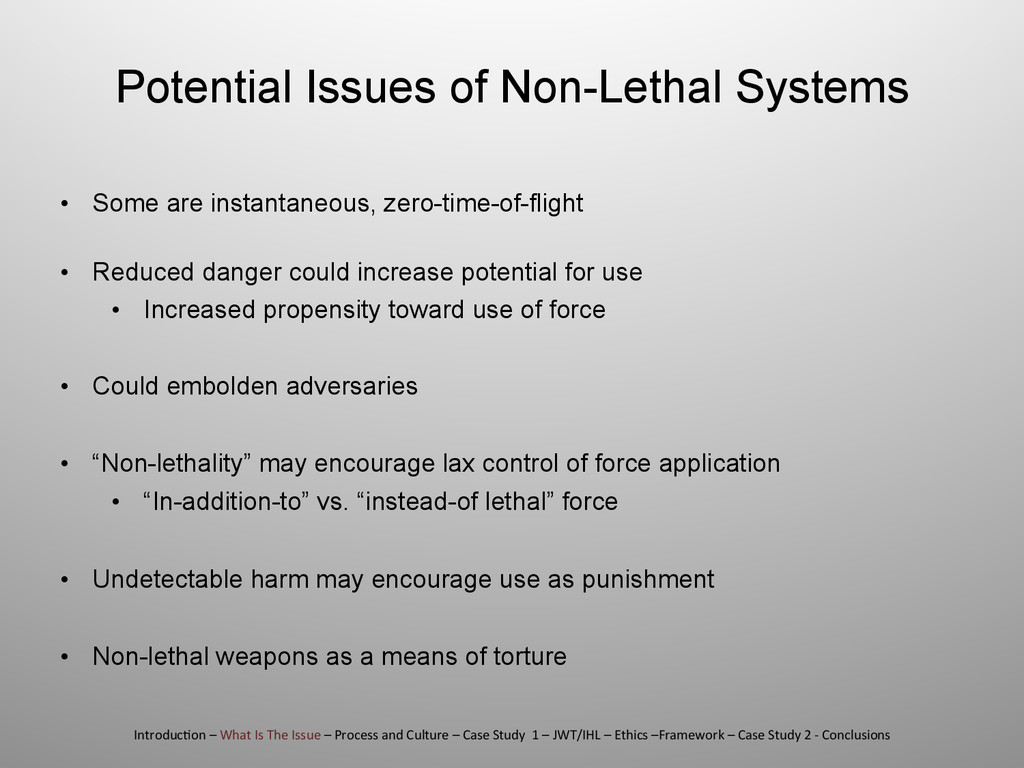
  29. Potential Issues of Non-Lethal Systems •  Some are instantaneous, zero-time-of-flight

    •  Reduced danger could increase potential for use •  Increased propensity toward use of force •  Could embolden adversaries •  “Non-lethality” may encourage lax control of force application •  “In-addition-to” vs. “instead-of lethal” force •  Undetectable harm may encourage use as punishment •  Non-lethal weapons as a means of torture Introduc)on  –  What  Is  The  Issue  –  Process  and  Culture  –  Case  Study    1  –  JWT/IHL  –  Ethics  –Framework  –  Case  Study  2  -­‐  Conclusions  
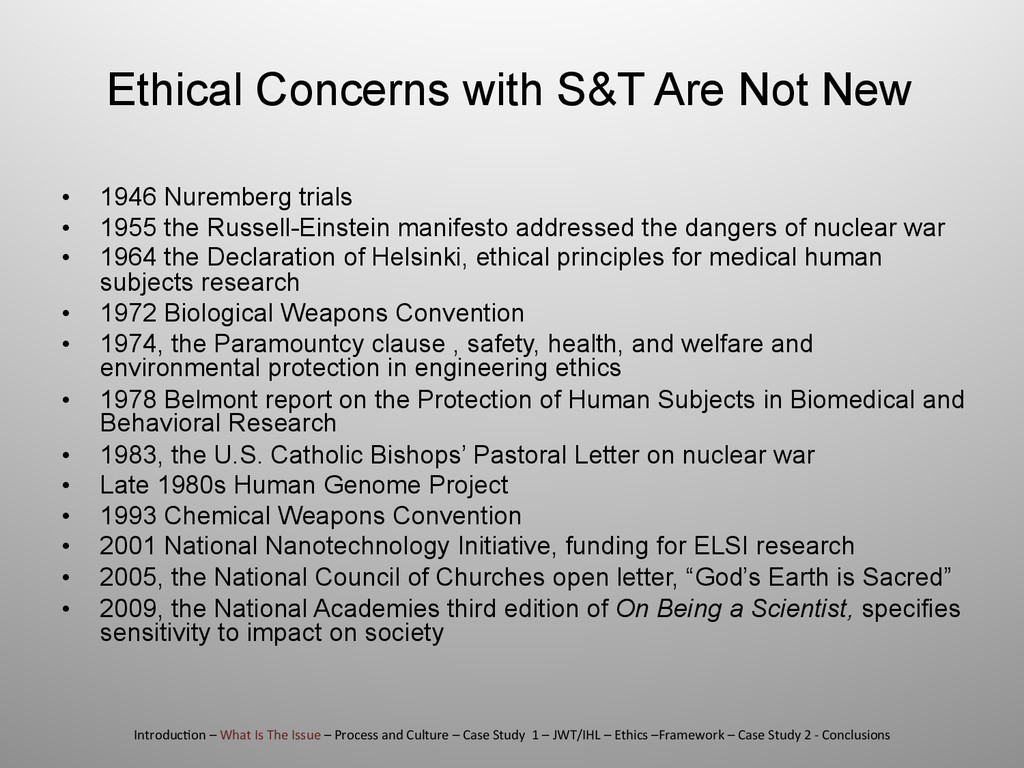
  30. Ethical Concerns with S&T Are Not New •  1946 Nuremberg

    trials •  1955 the Russell-Einstein manifesto addressed the dangers of nuclear war •  1964 the Declaration of Helsinki, ethical principles for medical human subjects research •  1972 Biological Weapons Convention •  1974, the Paramountcy clause , safety, health, and welfare and environmental protection in engineering ethics •  1978 Belmont report on the Protection of Human Subjects in Biomedical and Behavioral Research •  1983, the U.S. Catholic Bishops’ Pastoral Letter on nuclear war •  Late 1980s Human Genome Project •  1993 Chemical Weapons Convention •  2001 National Nanotechnology Initiative, funding for ELSI research •  2005, the National Council of Churches open letter, “God’s Earth is Sacred” •  2009, the National Academies third edition of On Being a Scientist, specifies sensitivity to impact on society Introduc)on  –  What  Is  The  Issue  –  Process  and  Culture  –  Case  Study    1  –  JWT/IHL  –  Ethics  –Framework  –  Case  Study  2  -­‐  Conclusions  
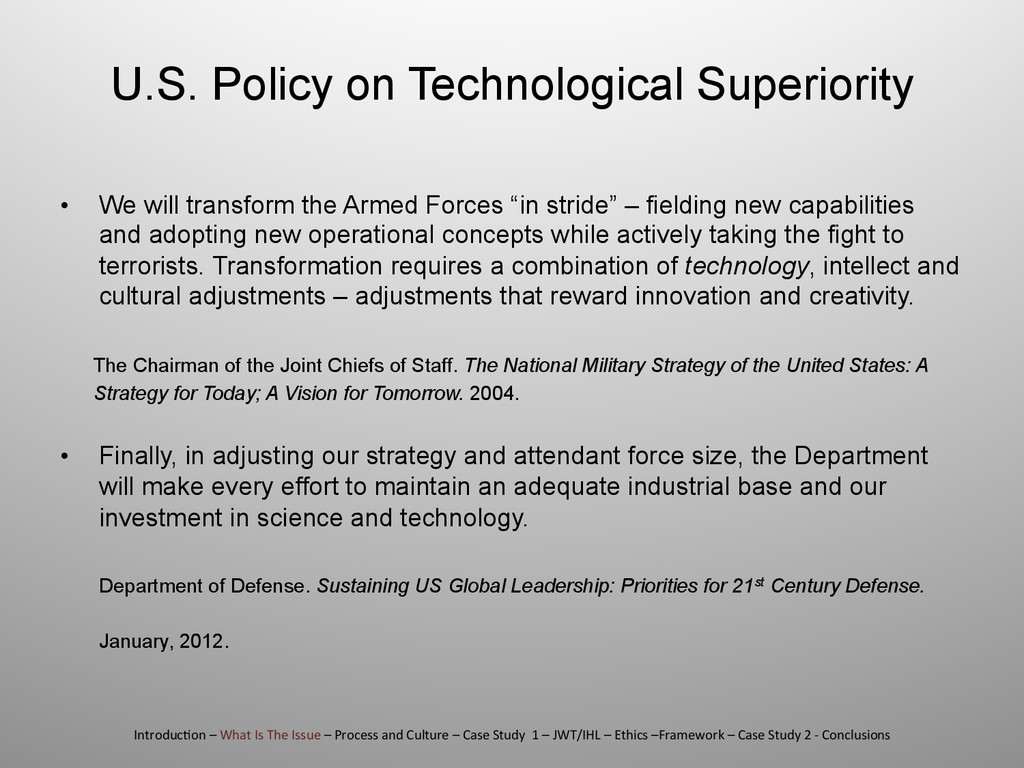
  31. U.S. Policy on Technological Superiority •  We will transform the

    Armed Forces “in stride” – fielding new capabilities and adopting new operational concepts while actively taking the fight to terrorists. Transformation requires a combination of technology, intellect and cultural adjustments – adjustments that reward innovation and creativity. The Chairman of the Joint Chiefs of Staff. The National Military Strategy of the United States: A Strategy for Today; A Vision for Tomorrow. 2004. •  Finally, in adjusting our strategy and attendant force size, the Department will make every effort to maintain an adequate industrial base and our investment in science and technology. Department of Defense. Sustaining US Global Leadership: Priorities for 21st Century Defense. January, 2012. Introduc)on  –  What  Is  The  Issue  –  Process  and  Culture  –  Case  Study    1  –  JWT/IHL  –  Ethics  –Framework  –  Case  Study  2  -­‐  Conclusions  
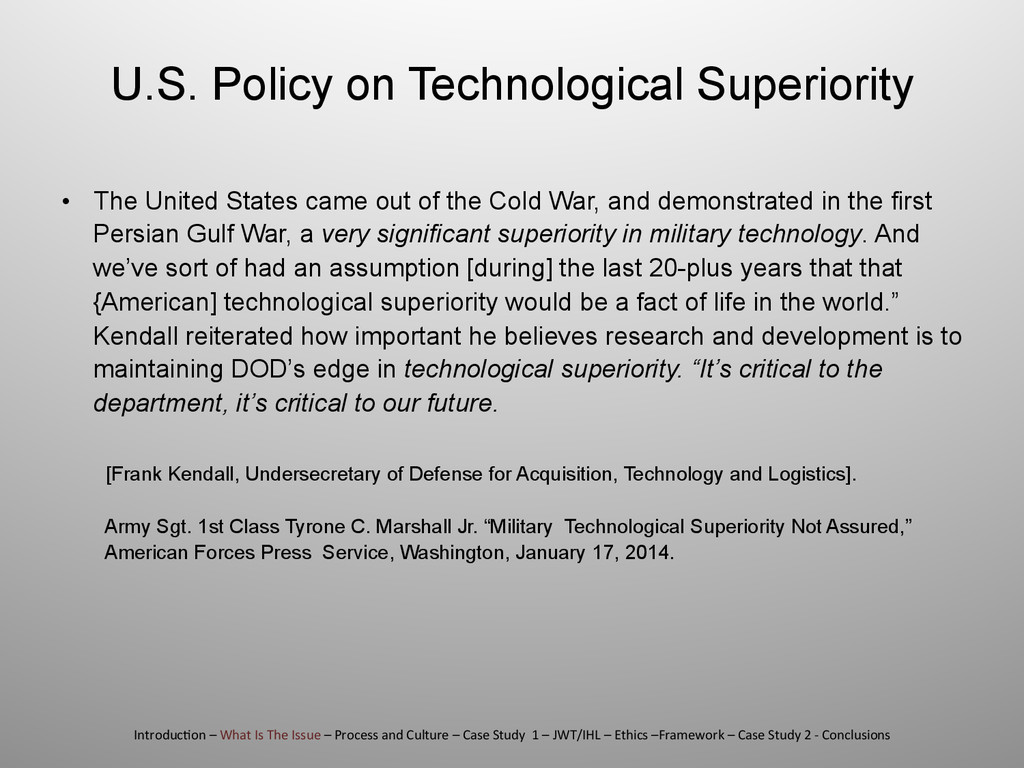
  32. U.S. Policy on Technological Superiority •  The United States came

    out of the Cold War, and demonstrated in the first Persian Gulf War, a very significant superiority in military technology. And we’ve sort of had an assumption [during] the last 20-plus years that that {American] technological superiority would be a fact of life in the world.” Kendall reiterated how important he believes research and development is to maintaining DOD’s edge in technological superiority. “It’s critical to the department, it’s critical to our future. [Frank Kendall, Undersecretary of Defense for Acquisition, Technology and Logistics]. Army Sgt. 1st Class Tyrone C. Marshall Jr. “Military Technological Superiority Not Assured,” American Forces Press Service, Washington, January 17, 2014. Introduc)on  –  What  Is  The  Issue  –  Process  and  Culture  –  Case  Study    1  –  JWT/IHL  –  Ethics  –Framework  –  Case  Study  2  -­‐  Conclusions  
  33. Ethical Implications of Policy of Technology Superiority •  The policy

    of seeking technological military superiority may have ethical implications including •  Weapons must conform to the laws of war, but since technology often outstrips the laws of war, they may not be much of a constraint •  Technological superiority may provide transient rather than long-lasting advantage as adversaries learn to counter them •  Adversaries, both real and potential, react to introduction of new U.S. military technologies •  Use of technologies may deter adversaries from taking hostile actions against U.S. interests •  May cause adversaries to seek the technologies for their own use •  May cause them to seek to counter the advantages conferred by U.S. use Introduc)on  –  What  Is  The  Issue  –  Process  and  Culture  –  Case  Study    1  –  JWT/IHL  –  Ethics  –Framework  –  Case  Study  2  -­‐  Conclusions  
  34. Ethical Implications of Policy of Technology Superiority •  Enduring advantages

    can be secured only by committing to constant re- investment in technology •  The first user of a weapon or technology often sets precedents that other nations follow •  Such precedents may be the initial seeds out of which international law and rules governing such use can grow •  Presumptions of technological superiority may deflect attention from consideration of ethical, legal, and moral issues •  The prospect of reciprocal use has historically been a spur for reflection on the ethical implications of military technologies •  Asymmetric advantage has historically had the effect of deferring and diffusing ethical deliberation Introduc)on  –  What  Is  The  Issue  –  Process  and  Culture  –  Case  Study    1  –  JWT/IHL  –  Ethics  –Framework  –  Case  Study  2  -­‐  Conclusions  
  35. Frequently Heard Arguments against Engaging with Ethics •  Adversaries are

    unethical, so ethics should not be a constraint in using advanced weaponry against them •  Adversaries will pursue all technological opportunities that serve their interests. If the we don’t do likewise we’ll be at a military disadvantage •  We don’t know the significance of a technology,, so we must work on it to understand its implications, and we would be unwise to give up on it too soon •  Consideration of ethical, legal, and societal issues will slow the innovation process to an unacceptable degree •  Research on and development of defensive technologies and applications is morally justified, whereas work on offensive technologies is morally suspect Introduc)on  –  What  Is  The  Issue  –  Process  and  Culture  –  Case  Study    1  –  JWT/IHL  –  Ethics  –Framework  –  Case  Study  2  -­‐  Conclusions  
  36. Changing Nature of Conflict •  From •  Set-piece battles • 

    Army versus army •  To •  Guerilla warfare •  Insurgency •  Humanitarian intervention •  Civil war •  Terror •  Asymmetric conflict Introduc)on  –  What  Is  The  Issue  –  Process  and  Culture  –  Case  Study    1  –  JWT/IHL  –  Ethics  –Framework  –  Case  Study  2  -­‐  Conclusions  
  37. 7/13/15 37 Changing Nature of Conflict •  Law of armed

    conflict (LOAC) based on “nation states” as primary actors •  Non-state actors and failed states pose major security threats today •  But, recent resurgence of more classic adversaries •  Rapid technology evolution outpaces rate of change in LOAC, or any •  legal regime •  Asymmetrical warfare •  Inherent advantage in technology •  Adversaries may take advantage of constraints imposed by our adherence to LOAC •  Feel justified in using any means necessary •  Volunteer service in the armed forces •  Civilians have little basis for making ethical judgments in a military context •  Voluntary service may be ethically different from conscripted service Introduc)on  –  What  Is  The  Issue  –  Process  and  Culture  –  Case  Study    1  –  JWT/IHL  –  Ethics  –Framework  –  Case  Study  2  -­‐  Conclusions  
  38. Process and Culture Introduc)on  –  What  Is  The  Issue  –

     Process  and  Culture  –  Case  Study    1  –  JWT/IHL  –  Ethics  –Framework  –  Case  Study  2  -­‐  Conclusions  
  39. What We Do, and Why Do We Do It? • 

    Advance the state of science and technology •  Make the nation safe and secure •  Develop tools necessary to insure warfighter success •  High priorities, especially in time of war Introduc)on  –  What  Is  The  Issue  –  Process  and  Culture  –  Case  Study    1  –  JWT/IHL  –  Ethics  –Framework  –  Case  Study  2  -­‐  Conclusions  
  40. There is a moral impulse at work here. Introduc)on  –

     What  Is  The  Issue  –  Process  and  Culture  –  Case  Study    1  –  JWT/IHL  –  Ethics  –Framework  –  Case  Study  2  -­‐  Conclusions  
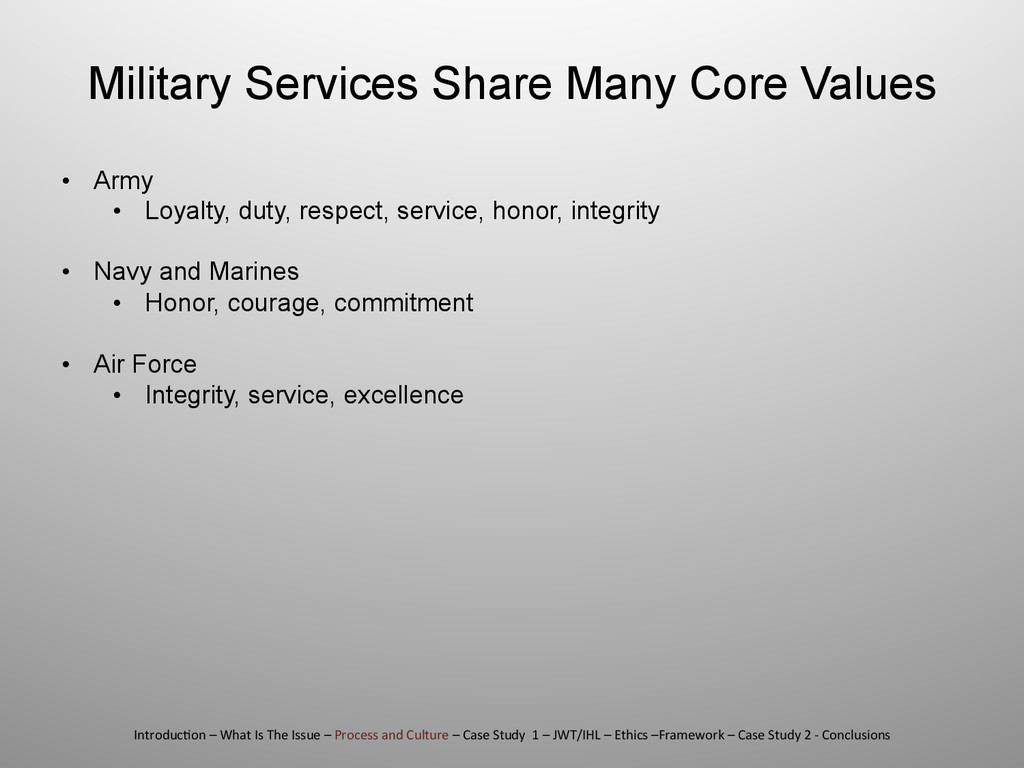
  41. Military Services Share Many Core Values •  Army •  Loyalty,

    duty, respect, service, honor, integrity •  Navy and Marines •  Honor, courage, commitment •  Air Force •  Integrity, service, excellence Introduc)on  –  What  Is  The  Issue  –  Process  and  Culture  –  Case  Study    1  –  JWT/IHL  –  Ethics  –Framework  –  Case  Study  2  -­‐  Conclusions  
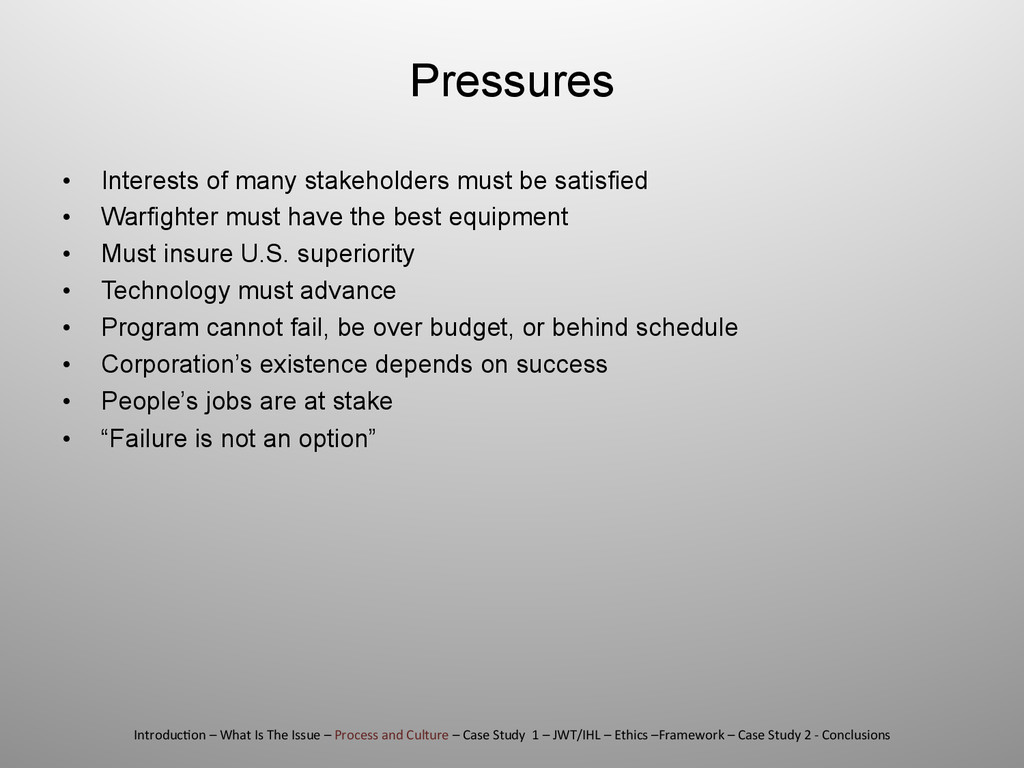
  42. Pressures •  Interests of many stakeholders must be satisfied • 

    Warfighter must have the best equipment •  Must insure U.S. superiority •  Technology must advance •  Program cannot fail, be over budget, or behind schedule •  Corporation’s existence depends on success •  People’s jobs are at stake •  “Failure is not an option” Introduc)on  –  What  Is  The  Issue  –  Process  and  Culture  –  Case  Study    1  –  JWT/IHL  –  Ethics  –Framework  –  Case  Study  2  -­‐  Conclusions  
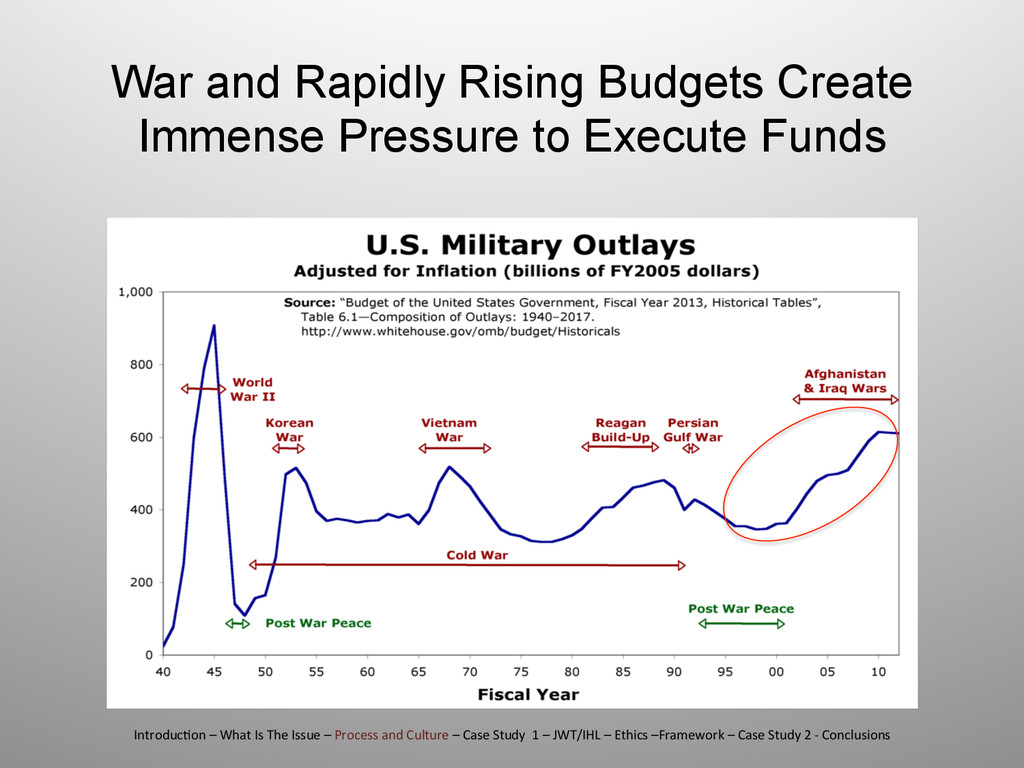
  43. War and Rapidly Rising Budgets Create Immense Pressure to Execute

    Funds Introduc)on  –  What  Is  The  Issue  –  Process  and  Culture  –  Case  Study    1  –  JWT/IHL  –  Ethics  –Framework  –  Case  Study  2  -­‐  Conclusions  
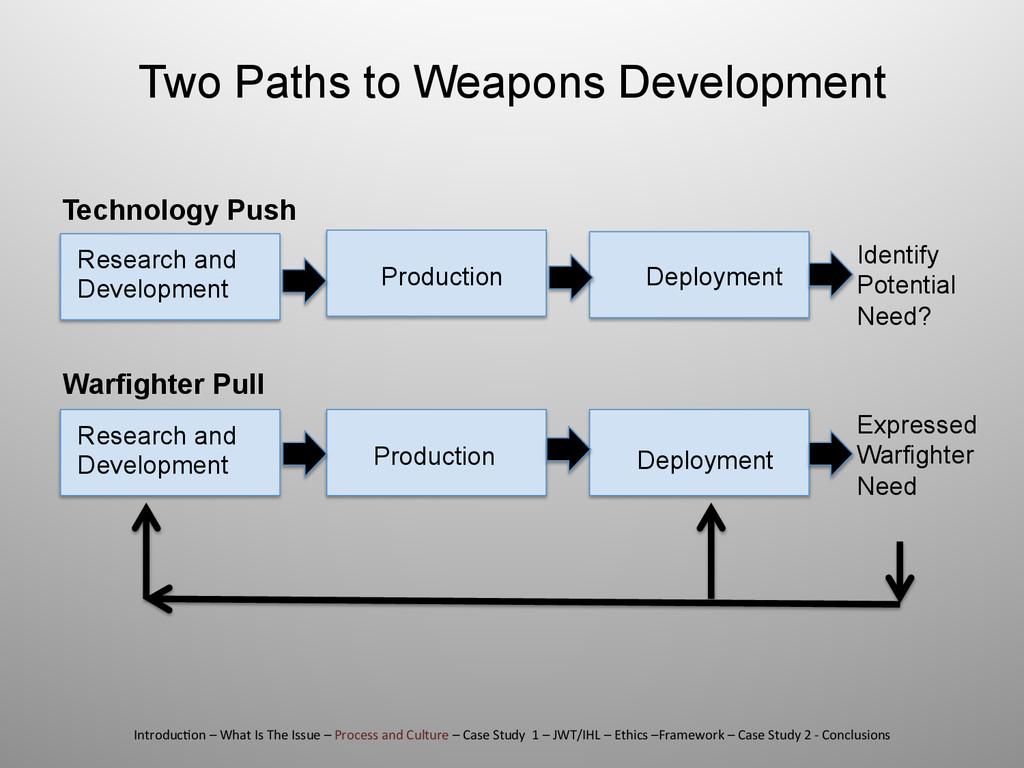
  44. Research and Development Production Deployment Research and Development Production Deployment

    Technology Push Warfighter Pull Identify Potential Need? Expressed Warfighter Need Two Paths to Weapons Development Introduc)on  –  What  Is  The  Issue  –  Process  and  Culture  –  Case  Study    1  –  JWT/IHL  –  Ethics  –Framework  –  Case  Study  2  -­‐  Conclusions  
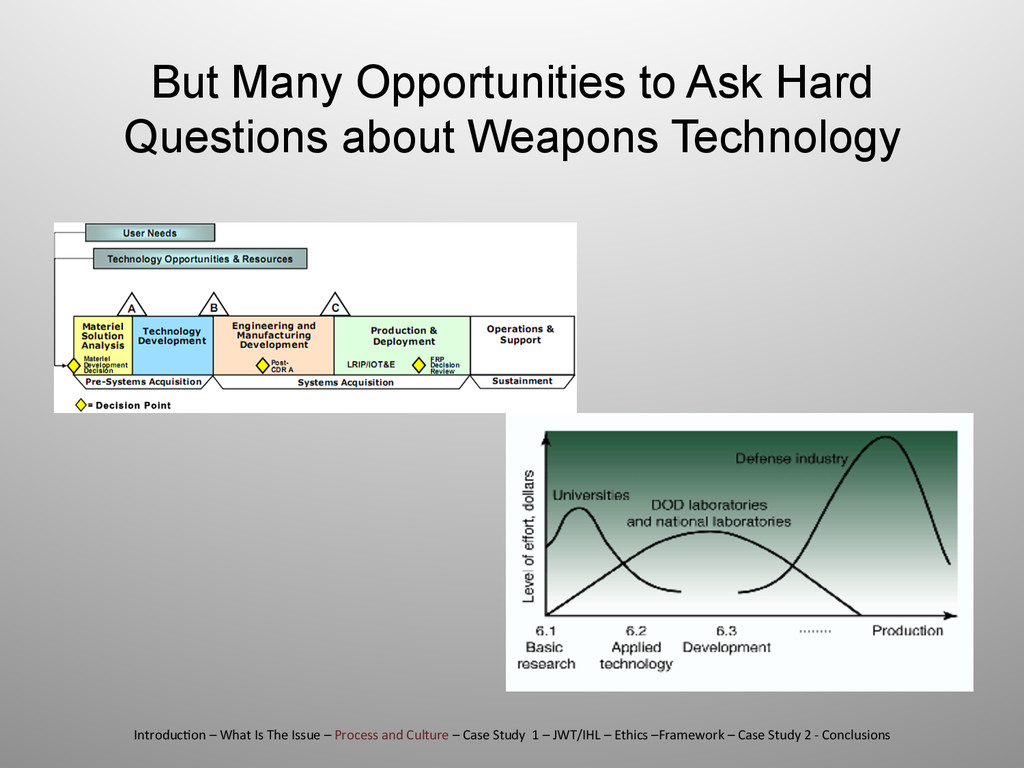
  45. But Many Opportunities to Ask Hard Questions about Weapons Technology

    Introduc)on  –  What  Is  The  Issue  –  Process  and  Culture  –  Case  Study    1  –  JWT/IHL  –  Ethics  –Framework  –  Case  Study  2  -­‐  Conclusions  
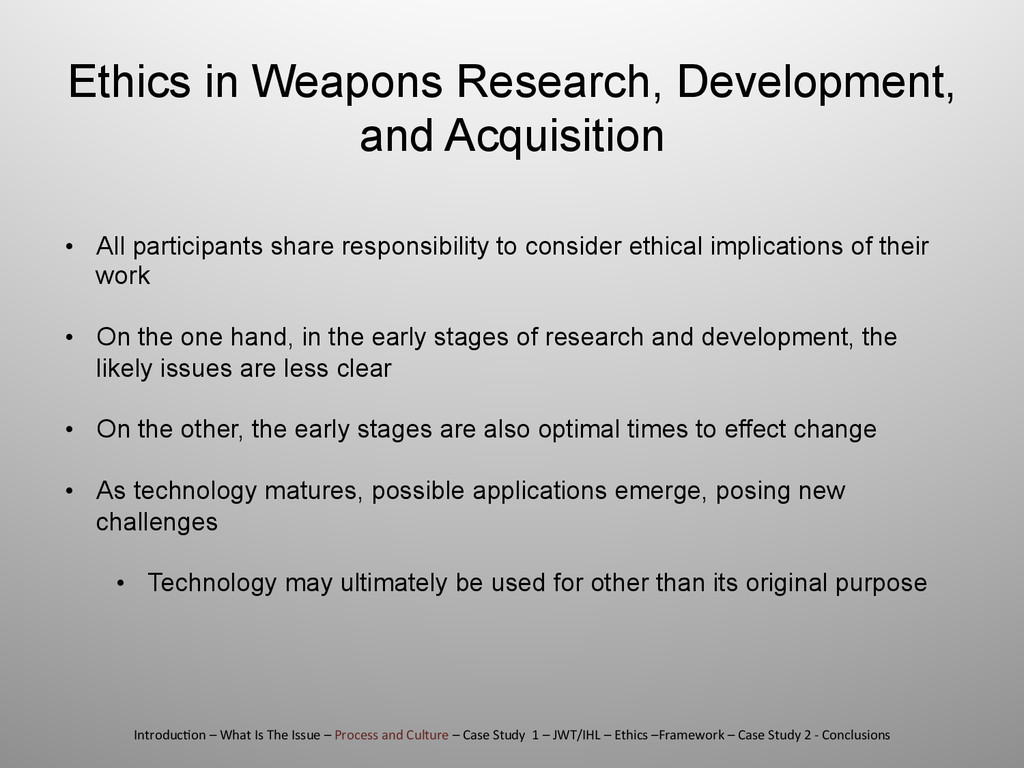
  46. Ethics in Weapons Research, Development, and Acquisition •  All participants

    share responsibility to consider ethical implications of their work •  On the one hand, in the early stages of research and development, the likely issues are less clear •  On the other, the early stages are also optimal times to effect change •  As technology matures, possible applications emerge, posing new challenges •  Technology may ultimately be used for other than its original purpose Introduc)on  –  What  Is  The  Issue  –  Process  and  Culture  –  Case  Study    1  –  JWT/IHL  –  Ethics  –Framework  –  Case  Study  2  -­‐  Conclusions  
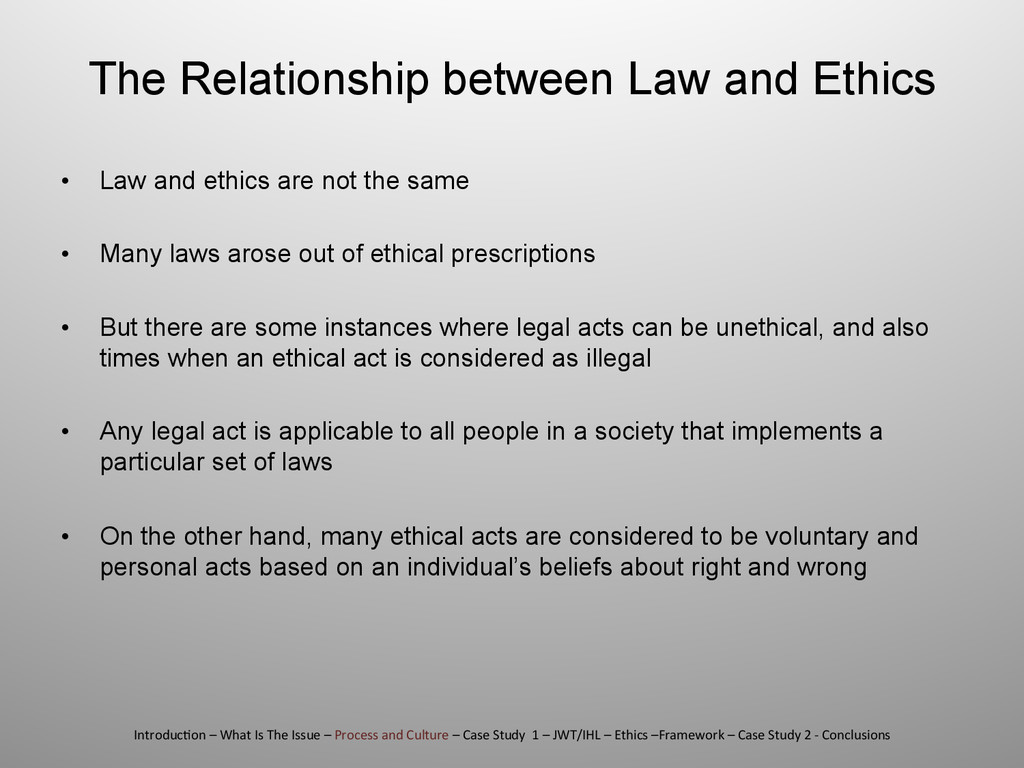
  47. •  Law and ethics are not the same •  Many

    laws arose out of ethical prescriptions •  But there are some instances where legal acts can be unethical, and also times when an ethical act is considered as illegal •  Any legal act is applicable to all people in a society that implements a particular set of laws •  On the other hand, many ethical acts are considered to be voluntary and personal acts based on an individual’s beliefs about right and wrong The Relationship between Law and Ethics Introduc)on  –  What  Is  The  Issue  –  Process  and  Culture  –  Case  Study    1  –  JWT/IHL  –  Ethics  –Framework  –  Case  Study  2  -­‐  Conclusions  
  48. The Relationship between Risk Analysis and Ethics •  Often substitute

    purely monetary cost/benefit analysis •  Risk and cost/benefit analysis are not the same •  Ethics is relevant to risk analysis with respect to •  Which impacts should be considered (e.g., Does the environment have standing?) •  How each impact should be measured •  How different outcomes should be weighted •  Consider also the precautionary principle, simple prudence, or pragmatism •  The precautionary principle asserts: If there is a chance of harmful, unintended consequences, do not act Introduc)on  –  What  Is  The  Issue  –  Process  and  Culture  –  Case  Study    1  –  JWT/IHL  –  Ethics  –Framework  –  Case  Study  2  -­‐  Conclusions  
  49. Why Should We Care About Ethics? •  Because It’s Right

    Thing to Do •  Public Perception •  To Keep Us out of Trouble •  Enhances the research agenda •  Makes Our Jobs Easier But . . . Introduc)on  –  What  Is  The  Issue  –  Process  and  Culture  –  Case  Study    1  –  JWT/IHL  –  Ethics  –Framework  –  Case  Study  2  -­‐  Conclusions  
  50. 7/13/15 50 Many scientists and engineers (not to mention military

    personnel) tend to view the wider public’s concern with ‘ethics’ as misplaced, and regard the invocation of ‘ethics’ in these contexts as little more than a pretext for technologically and scientifically illiterate, fear-mongering, nay-saying Luddites who simply wish to impede the progress of science and technology. George R. Lucas. “Legal and Ethical Precepts Governing Emerging Military Technologies: Research and Use.” Amsterdam Law Forum 6:1 (2014), 24. We’re not doing ourselves any favors by this approach . . . Introduc)on  –  What  Is  The  Issue  –  Process  and  Culture  –  Case  Study    1  –  JWT/IHL  –  Ethics  –Framework  –  Case  Study  2  -­‐  Conclusions  
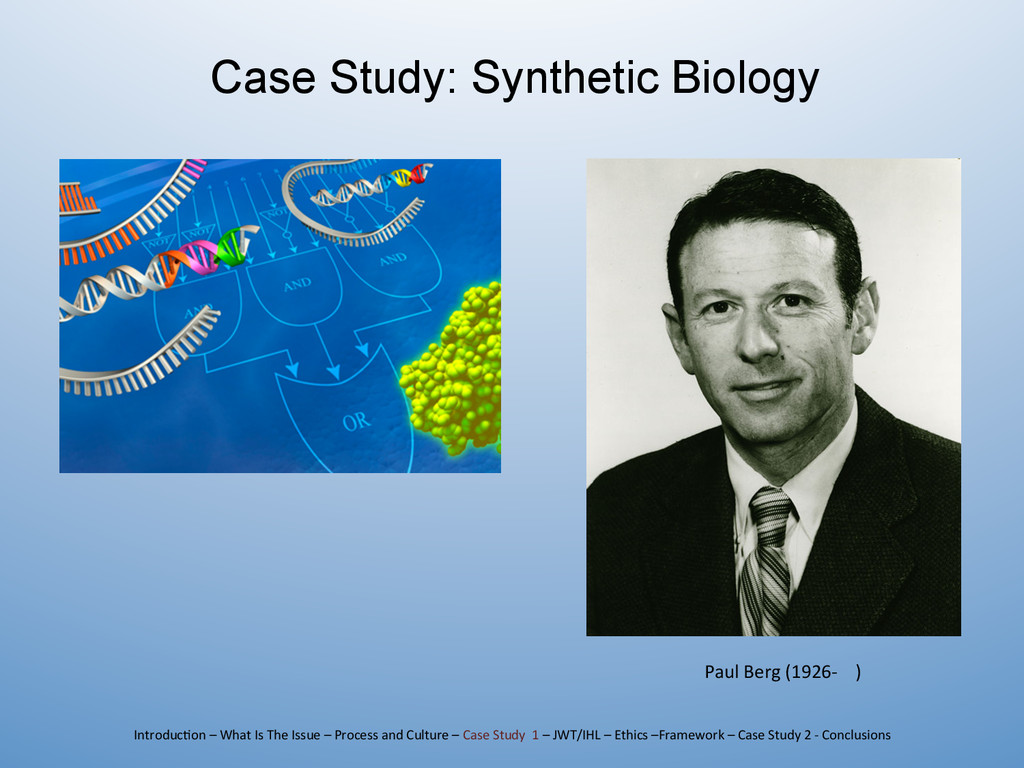
  51. Case Study: Synthetic Biology Paul  Berg  (1926-­‐      

     )   Introduc)on  –  What  Is  The  Issue  –  Process  and  Culture  –  Case  Study    1  –  JWT/IHL  –  Ethics  –Framework  –  Case  Study  2  -­‐  Conclusions  
  52. •  In 1974, Stanford biochemist, Paul Berg, developed a technique

    for inserting bits of SV40 monkey virus DNA into a bacteriophage, which would then be inserted into an E. coli host. •  But worries about the carcinogenic potential of SV40 and the viability of the lab strain of E. coli in human intestines led Berg to defer the final insertion into the E. coli host and many other labs imposed voluntary moratoria on such research. •  In February 1975, a conference of leading recombinant DNA researchers was held at Asilomar to weigh the risks. Basic  Facts   Introduc)on  –  What  Is  The  Issue  –  Process  and  Culture  –  Case  Study    1  –  JWT/IHL  –  Ethics  –Framework  –  Case  Study  2  -­‐  Conclusions  
  53. •  The Asilomar conference participants promulgated guidelines for future recombinant

    DNA research that included principles such as: •  Containment is necessary and the level of containment should match the risk. •  Biological barriers should be employed, such as host organisms that are not viable outside the lab and vectors viable only in the designated hosts. •  Education of personnel and strict adherence to best practice standards. •  Asilomar example guides practice today well beyond the original area of research. Basic  Facts   Introduc)on  –  What  Is  The  Issue  –  Process  and  Culture  –  Case  Study    1  –  JWT/IHL  –  Ethics  –Framework  –  Case  Study  2  -­‐  Conclusions  
  54. •  So-called “gain-of-function” (GoF) experiments have recently raised new concerns

    about the balance between risk and new knowledge in microbiological research, as with debates about engineering mammalian transmissibility in the H5N1 virus. •  Proponents point to benefits for both public health and national security from the understanding of either natural mutation or deliberate manipulation producing new functional capabilities in viral hosts. •  Critics point to the risk of infection, including even epidemics in populations without immunity, from possible failures in containment. •  US government has paused all funding for GoF experiments with influenza, SARS, and MERS viruses pending a thorough review of procedures. Basic  Facts   Introduc)on  –  What  Is  The  Issue  –  Process  and  Culture  –  Case  Study    1  –  JWT/IHL  –  Ethics  –Framework  –  Case  Study  2  -­‐  Conclusions  
  55. •  Under what circumstances are moratoria on research warranted? • 

    How do we balance the value of new knowledge against the risks posed by the research? •  Are alternative research paths available? •  Should decisions to pause research be made by the individual researchers, the research community, or by the government? •  If the latter, should such decisions be left to relevant individual agencies or should there be congressional, judicial, or executive involvement? Ques)ons   Introduc)on  –  What  Is  The  Issue  –  Process  and  Culture  –  Case  Study    1  –  JWT/IHL  –  Ethics  –Framework  –  Case  Study  2  -­‐  Conclusions  
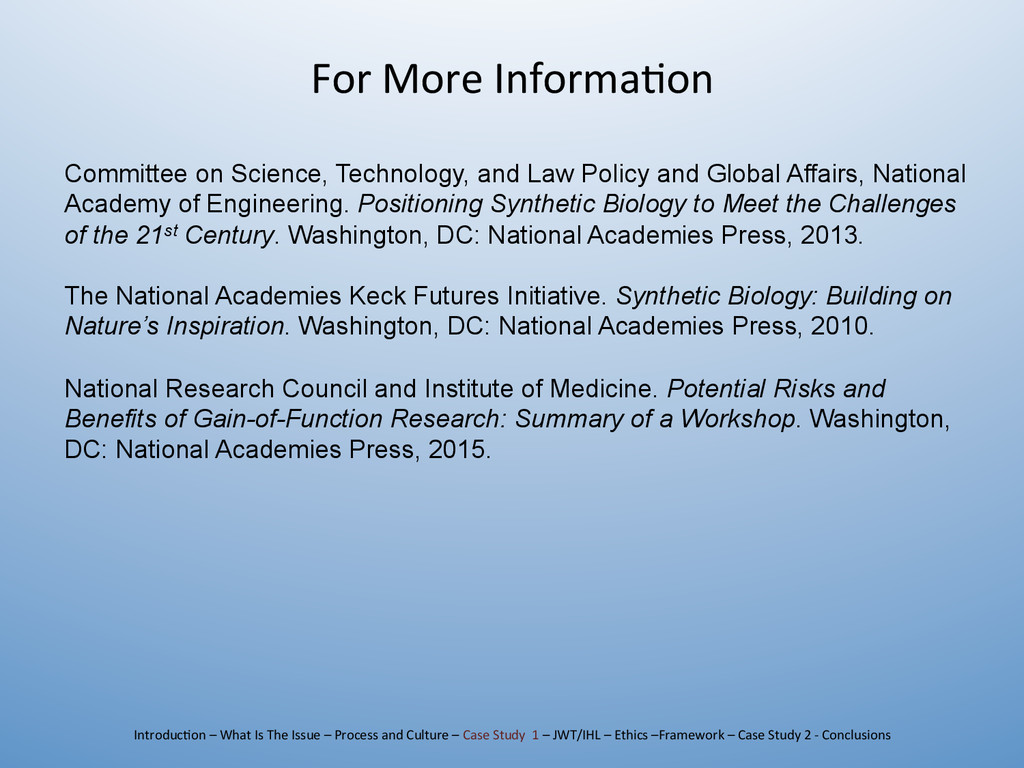
  56. Committee on Science, Technology, and Law Policy and Global Affairs,

    National Academy of Engineering. Positioning Synthetic Biology to Meet the Challenges of the 21st Century. Washington, DC: National Academies Press, 2013. The National Academies Keck Futures Initiative. Synthetic Biology: Building on Nature’s Inspiration. Washington, DC: National Academies Press, 2010. National Research Council and Institute of Medicine. Potential Risks and Benefits of Gain-of-Function Research: Summary of a Workshop. Washington, DC: National Academies Press, 2015. For  More  Informa)on   Introduc)on  –  What  Is  The  Issue  –  Process  and  Culture  –  Case  Study    1  –  JWT/IHL  –  Ethics  –Framework  –  Case  Study  2  -­‐  Conclusions  
  57. Just War Theory and International Humanitarian Law Introduc)on  –  What

     Is  The  Issue  –  Process  and  Culture  –  Case  Study    1  –  JWT/IHL  –  Ethics  –Framework  –  Case  Study  2  -­‐  Conclusions  
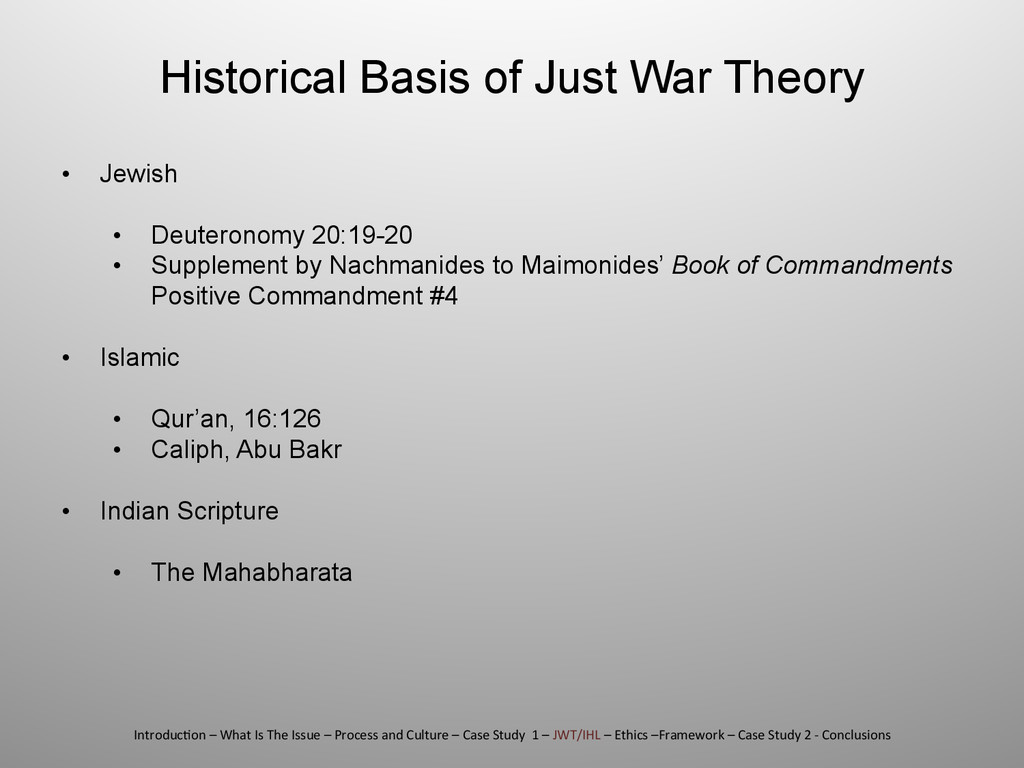
  58. Historical Basis of Just War Theory •  Jewish •  Deuteronomy

    20:19-20 •  Supplement by Nachmanides to Maimonides’ Book of Commandments Positive Commandment #4 •  Islamic •  Qur’an, 16:126 •  Caliph, Abu Bakr •  Indian Scripture •  The Mahabharata Introduc)on  –  What  Is  The  Issue  –  Process  and  Culture  –  Case  Study    1  –  JWT/IHL  –  Ethics  –Framework  –  Case  Study  2  -­‐  Conclusions  
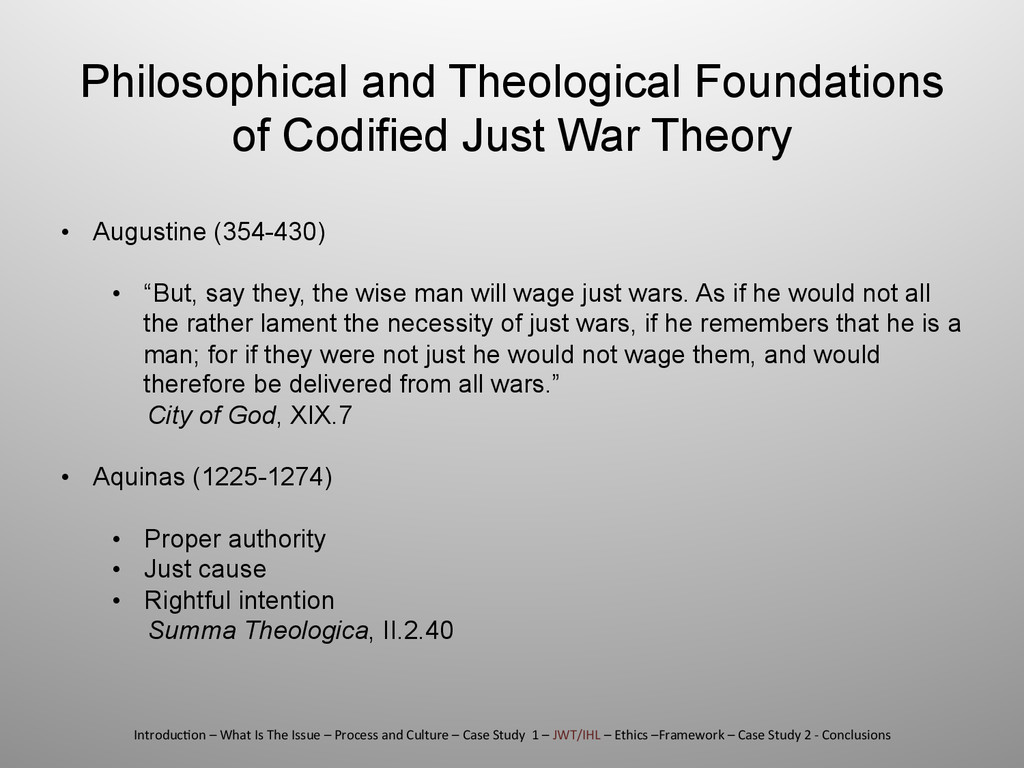
  59. Philosophical and Theological Foundations of Codified Just War Theory • 

    Augustine (354-430) •  “But, say they, the wise man will wage just wars. As if he would not all the rather lament the necessity of just wars, if he remembers that he is a man; for if they were not just he would not wage them, and would therefore be delivered from all wars.” City of God, XIX.7 •  Aquinas (1225-1274) •  Proper authority •  Just cause •  Rightful intention Summa Theologica, II.2.40 Introduc)on  –  What  Is  The  Issue  –  Process  and  Culture  –  Case  Study    1  –  JWT/IHL  –  Ethics  –Framework  –  Case  Study  2  -­‐  Conclusions  
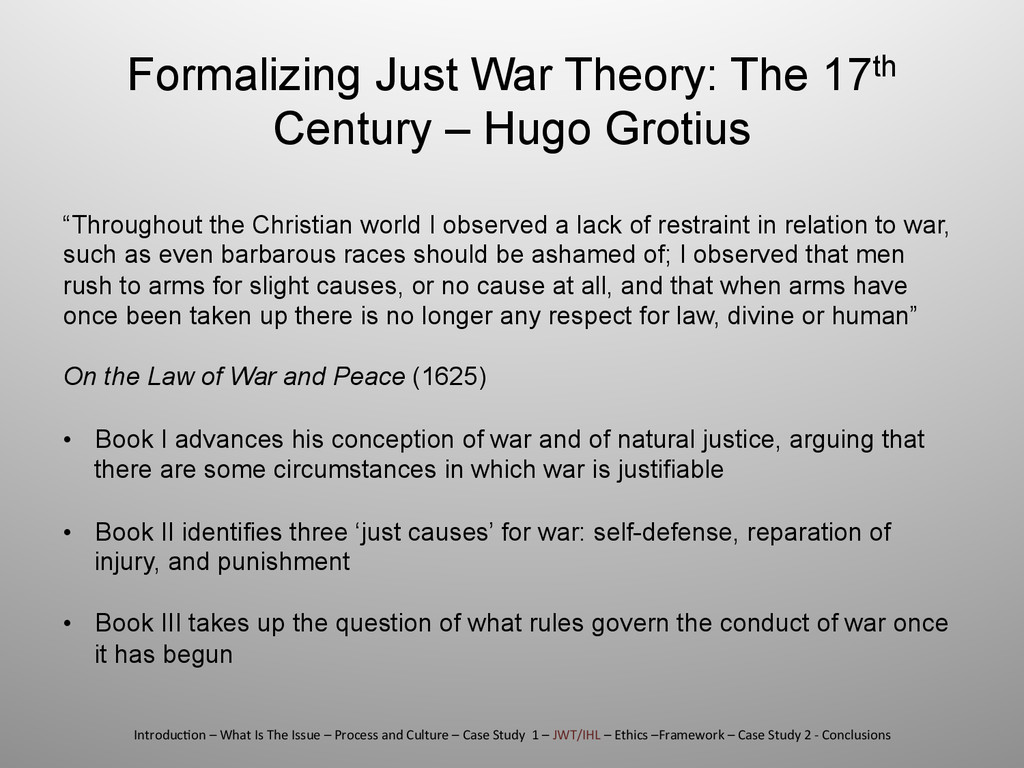
  60. Formalizing Just War Theory: The 17th Century – Hugo Grotius

    “Throughout the Christian world I observed a lack of restraint in relation to war, such as even barbarous races should be ashamed of; I observed that men rush to arms for slight causes, or no cause at all, and that when arms have once been taken up there is no longer any respect for law, divine or human” On the Law of War and Peace (1625) •  Book I advances his conception of war and of natural justice, arguing that there are some circumstances in which war is justifiable •  Book II identifies three ‘just causes’ for war: self-defense, reparation of injury, and punishment •  Book III takes up the question of what rules govern the conduct of war once it has begun Introduc)on  –  What  Is  The  Issue  –  Process  and  Culture  –  Case  Study    1  –  JWT/IHL  –  Ethics  –Framework  –  Case  Study  2  -­‐  Conclusions  
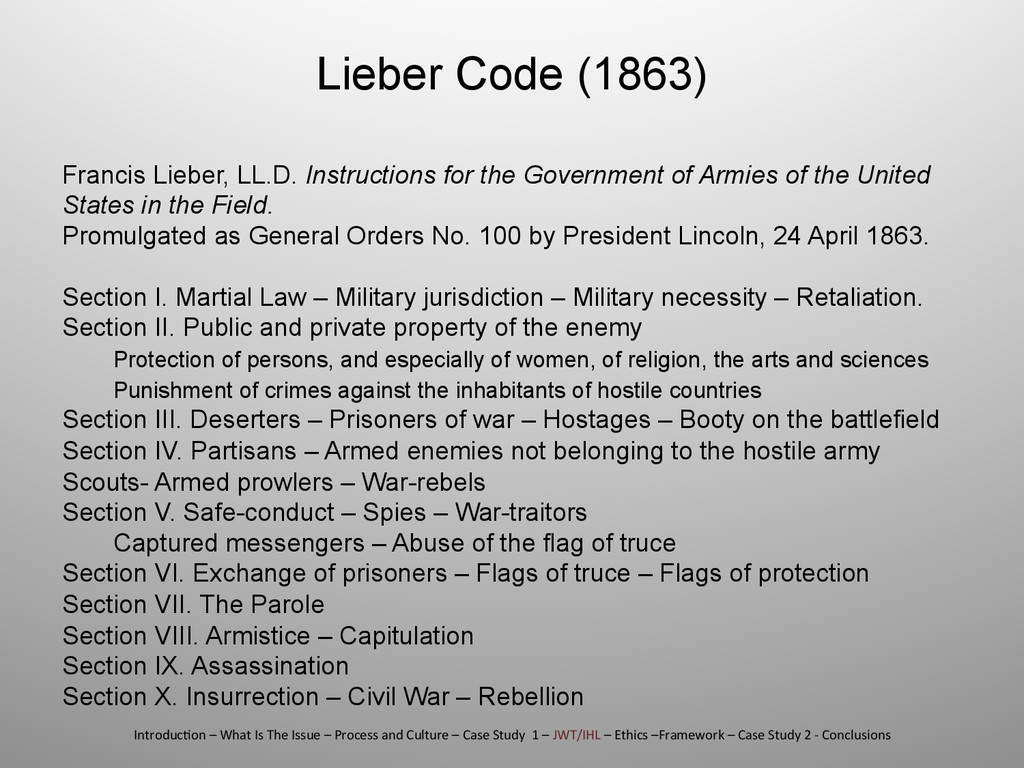
  61. Lieber Code (1863) Francis Lieber, LL.D. Instructions for the Government

    of Armies of the United States in the Field. Promulgated as General Orders No. 100 by President Lincoln, 24 April 1863. Section I. Martial Law – Military jurisdiction – Military necessity – Retaliation. Section II. Public and private property of the enemy Protection of persons, and especially of women, of religion, the arts and sciences Punishment of crimes against the inhabitants of hostile countries Section III. Deserters – Prisoners of war – Hostages – Booty on the battlefield Section IV. Partisans – Armed enemies not belonging to the hostile army Scouts- Armed prowlers – War-rebels Section V. Safe-conduct – Spies – War-traitors Captured messengers – Abuse of the flag of truce Section VI. Exchange of prisoners – Flags of truce – Flags of protection Section VII. The Parole Section VIII. Armistice – Capitulation Section IX. Assassination Section X. Insurrection – Civil War – Rebellion   Introduc)on  –  What  Is  The  Issue  –  Process  and  Culture  –  Case  Study    1  –  JWT/IHL  –  Ethics  –Framework  –  Case  Study  2  -­‐  Conclusions  
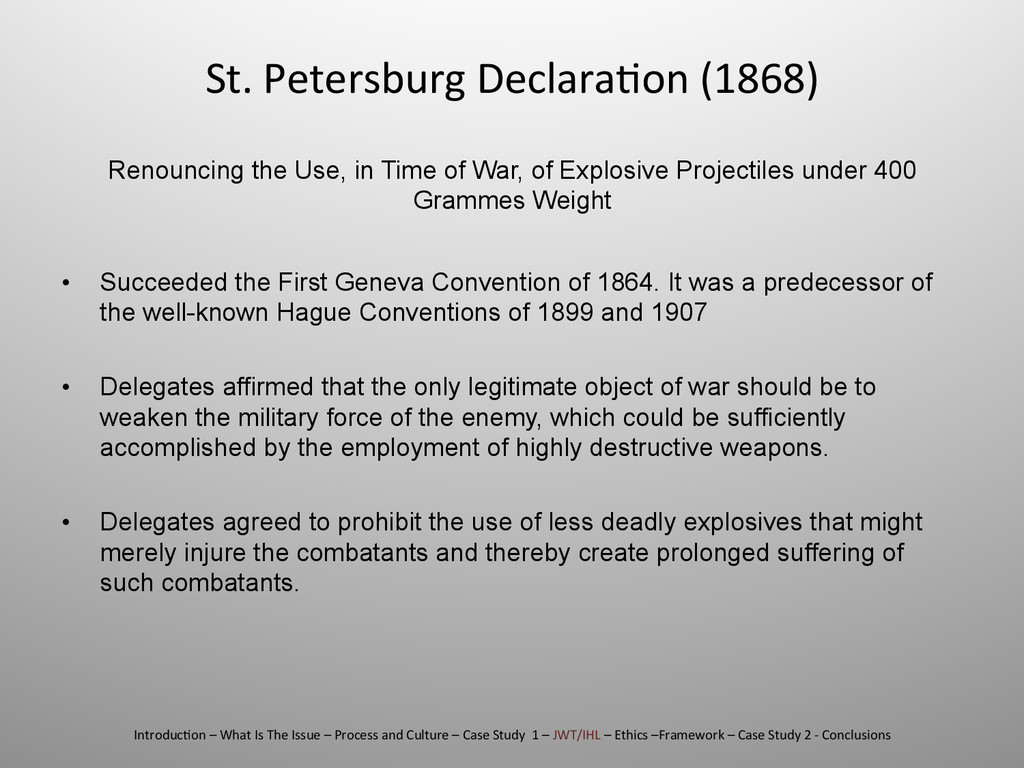
  62. Renouncing the Use, in Time of War, of Explosive Projectiles

    under 400 Grammes Weight •  Succeeded the First Geneva Convention of 1864. It was a predecessor of the well-known Hague Conventions of 1899 and 1907 •  Delegates affirmed that the only legitimate object of war should be to weaken the military force of the enemy, which could be sufficiently accomplished by the employment of highly destructive weapons. •  Delegates agreed to prohibit the use of less deadly explosives that might merely injure the combatants and thereby create prolonged suffering of such combatants. St.  Petersburg  Declara)on  (1868)   Introduc)on  –  What  Is  The  Issue  –  Process  and  Culture  –  Case  Study    1  –  JWT/IHL  –  Ethics  –Framework  –  Case  Study  2  -­‐  Conclusions  
  63. International Laws •  Hague Convention •  Geneva Conventions •  Chemical

    Weapon Convention •  Biological Weapon Convention •  Land Mines, Blinding Lasers •  Autonomous Weapons? Introduc)on  –  What  Is  The  Issue  –  Process  and  Culture  –  Case  Study    1  –  JWT/IHL  –  Ethics  –Framework  –  Case  Study  2  -­‐  Conclusions  
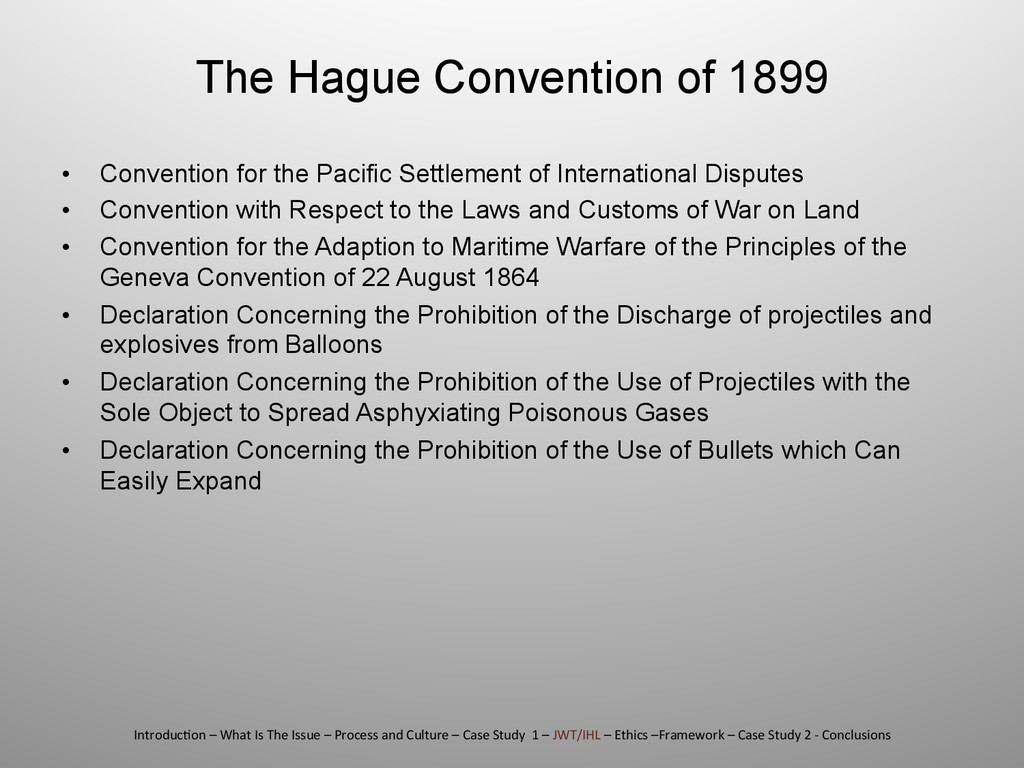
  64. The Hague Convention of 1899 •  Convention for the Pacific

    Settlement of International Disputes •  Convention with Respect to the Laws and Customs of War on Land •  Convention for the Adaption to Maritime Warfare of the Principles of the Geneva Convention of 22 August 1864 •  Declaration Concerning the Prohibition of the Discharge of projectiles and explosives from Balloons •  Declaration Concerning the Prohibition of the Use of Projectiles with the Sole Object to Spread Asphyxiating Poisonous Gases •  Declaration Concerning the Prohibition of the Use of Bullets which Can Easily Expand Introduc)on  –  What  Is  The  Issue  –  Process  and  Culture  –  Case  Study    1  –  JWT/IHL  –  Ethics  –Framework  –  Case  Study  2  -­‐  Conclusions  
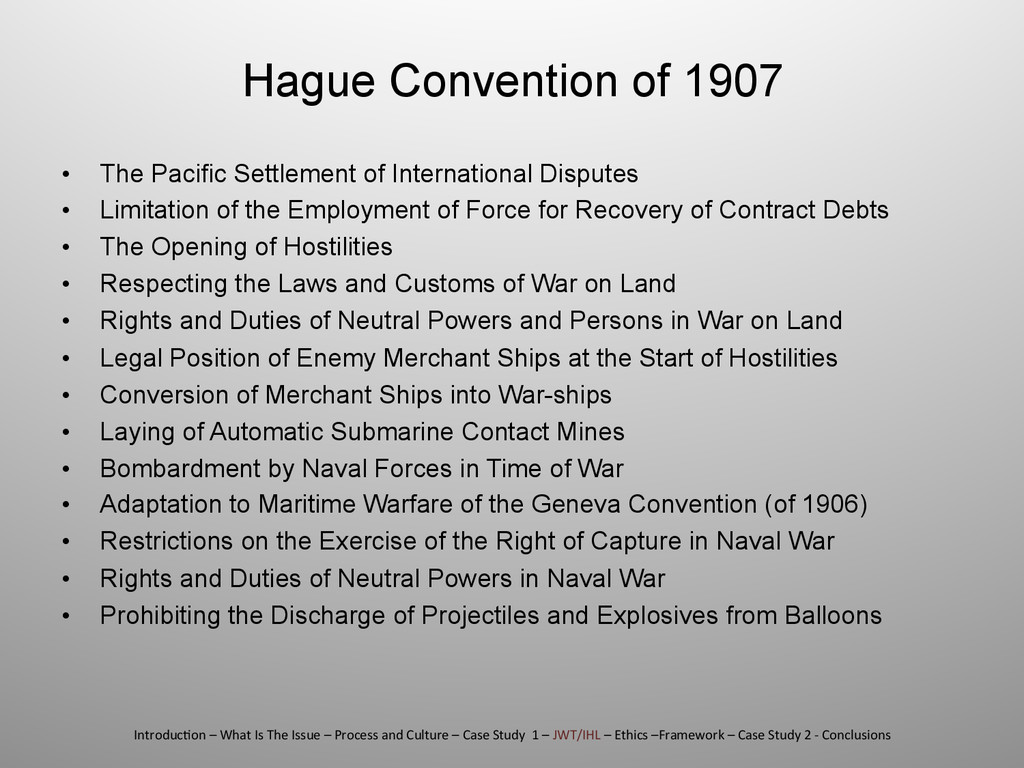
  65. Hague Convention of 1907 •  The Pacific Settlement of International

    Disputes •  Limitation of the Employment of Force for Recovery of Contract Debts •  The Opening of Hostilities •  Respecting the Laws and Customs of War on Land •  Rights and Duties of Neutral Powers and Persons in War on Land •  Legal Position of Enemy Merchant Ships at the Start of Hostilities •  Conversion of Merchant Ships into War-ships •  Laying of Automatic Submarine Contact Mines •  Bombardment by Naval Forces in Time of War •  Adaptation to Maritime Warfare of the Geneva Convention (of 1906) •  Restrictions on the Exercise of the Right of Capture in Naval War •  Rights and Duties of Neutral Powers in Naval War •  Prohibiting the Discharge of Projectiles and Explosives from Balloons Introduc)on  –  What  Is  The  Issue  –  Process  and  Culture  –  Case  Study    1  –  JWT/IHL  –  Ethics  –Framework  –  Case  Study  2  -­‐  Conclusions  
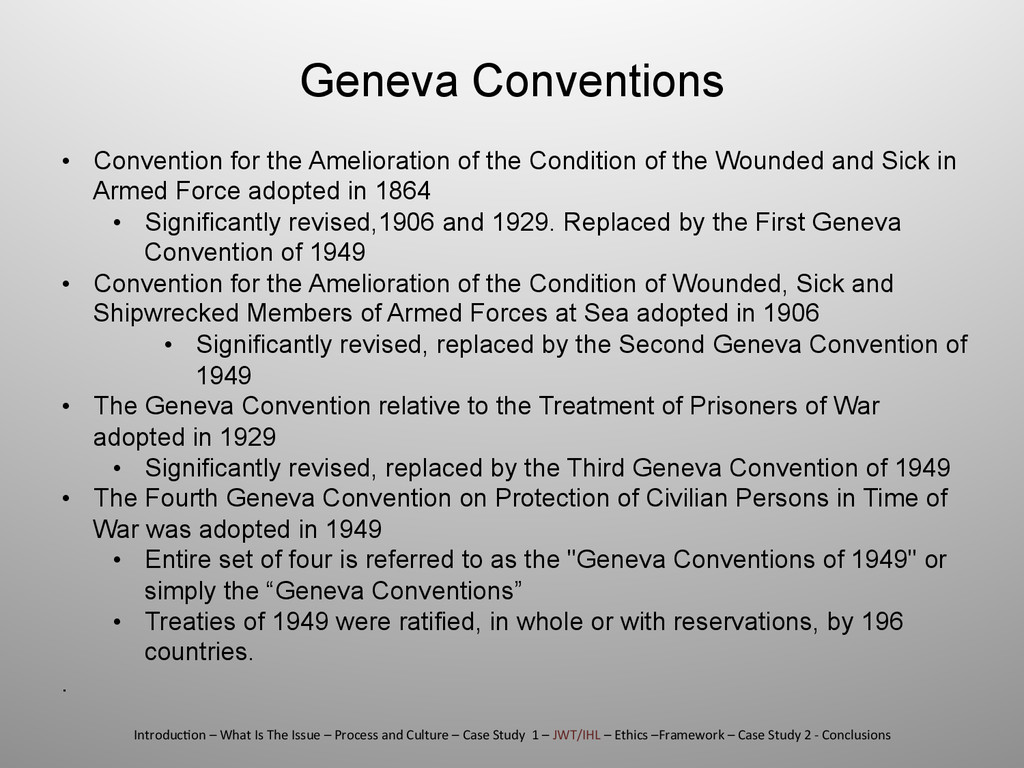
  66. Geneva Conventions •  Convention for the Amelioration of the Condition

    of the Wounded and Sick in Armed Force adopted in 1864 •  Significantly revised,1906 and 1929. Replaced by the First Geneva Convention of 1949 •  Convention for the Amelioration of the Condition of Wounded, Sick and Shipwrecked Members of Armed Forces at Sea adopted in 1906 •  Significantly revised, replaced by the Second Geneva Convention of 1949 •  The Geneva Convention relative to the Treatment of Prisoners of War adopted in 1929 •  Significantly revised, replaced by the Third Geneva Convention of 1949 •  The Fourth Geneva Convention on Protection of Civilian Persons in Time of War was adopted in 1949 •  Entire set of four is referred to as the "Geneva Conventions of 1949" or simply the “Geneva Conventions” •  Treaties of 1949 were ratified, in whole or with reservations, by 196 countries. . Introduc)on  –  What  Is  The  Issue  –  Process  and  Culture  –  Case  Study    1  –  JWT/IHL  –  Ethics  –Framework  –  Case  Study  2  -­‐  Conclusions  
  67. Geneva Conventions •  Convention for the Amelioration of the Condition

    of the Wounded and Sick in Armed Force adopted in 1864 •  Significantly revised,1906 and 1929. Replaced by the First Geneva Convention of 1949 •  Convention for the Amelioration of the Condition of Wounded, Sick and Shipwrecked Members of Armed Forces at Sea adopted in 1906 •  Significantly revised, replaced by the Second Geneva Convention of 1949 •  The Geneva Convention relative to the Treatment of Prisoners of War adopted in 1929 •  Significantly revised, replaced by the Third Geneva Convention of 1949 •  The Fourth Geneva Convention on Protection of Civilian Persons in Time of War was adopted in 1949 •  Entire set of four is referred to as the "Geneva Conventions of 1949" or simply the “Geneva Conventions” •  Treaties of 1949 were ratified, in whole or with reservations, by 196 countries. . Introduc)on  –  What  Is  The  Issue  –  Process  and  Culture  –  Case  Study    1  –  JWT/IHL  –  Ethics  –Framework  –  Case  Study  2  -­‐  Conclusions  
  68. Geneva Conventions •  Additional Protocols •  Protocol I (1977) Relating

    to the Protection of Victims of International Armed Conflicts •  Protocol II (1977) Relating to the Protection of Victims of Non- International Armed Conflicts •  Protocol III (2005) Relating to the Adoption of an Additional Distinctive Emblem   Introduc)on  –  What  Is  The  Issue  –  Process  and  Culture  –  Case  Study    1  –  JWT/IHL  –  Ethics  –Framework  –  Case  Study  2  -­‐  Conclusions  
  69. Geneva Conventions •  Additional Protocols •  Protocol I (1977) Relating

    to the Protection of Victims of International Armed Conflicts •  Protocol II (1977) Relating to the Protection of Victims of Non- International Armed Conflicts •  Protocol III (2005) Relating to the Adoption of an Additional Distinctive Emblem   Introduc)on  –  What  Is  The  Issue  –  Process  and  Culture  –  Case  Study    1  –  JWT/IHL  –  Ethics  –Framework  –  Case  Study  2  -­‐  Conclusions  
  70. Continuing Evolution of Laws of Armed Conflict •  Protocol I:

    Non-Detectable Fragments •  Protocol II: Mines, Booby Traps, and Other Devices •  Protocol III: Incendiary Weapons •  Protocol IV: Blinding Laser Weapons •  Protocol V: Explosive Remnants of War Convention on Prohibitions or Restrictions on Use of Certain Conventional Weapons Which May Be Deemed to Be Excessively Injurious or to Have Indiscriminate Effects (2001) Also known as the Inhumane Weapons Convention Introduc)on  –  What  Is  The  Issue  –  Process  and  Culture  –  Case  Study    1  –  JWT/IHL  –  Ethics  –Framework  –  Case  Study  2  -­‐  Conclusions  
  71. Concepts of Just War Theory •  Jus Ad Bellum • 

    Just cause •  Comparative justice •  Competent authority •  Right intention •  Probability of success •  Last resort •  Proportionality Introduc)on  –  What  Is  The  Issue  –  Process  and  Culture  –  Case  Study    1  –  JWT/IHL  –  Ethics  –Framework  –  Case  Study  2  -­‐  Conclusions  
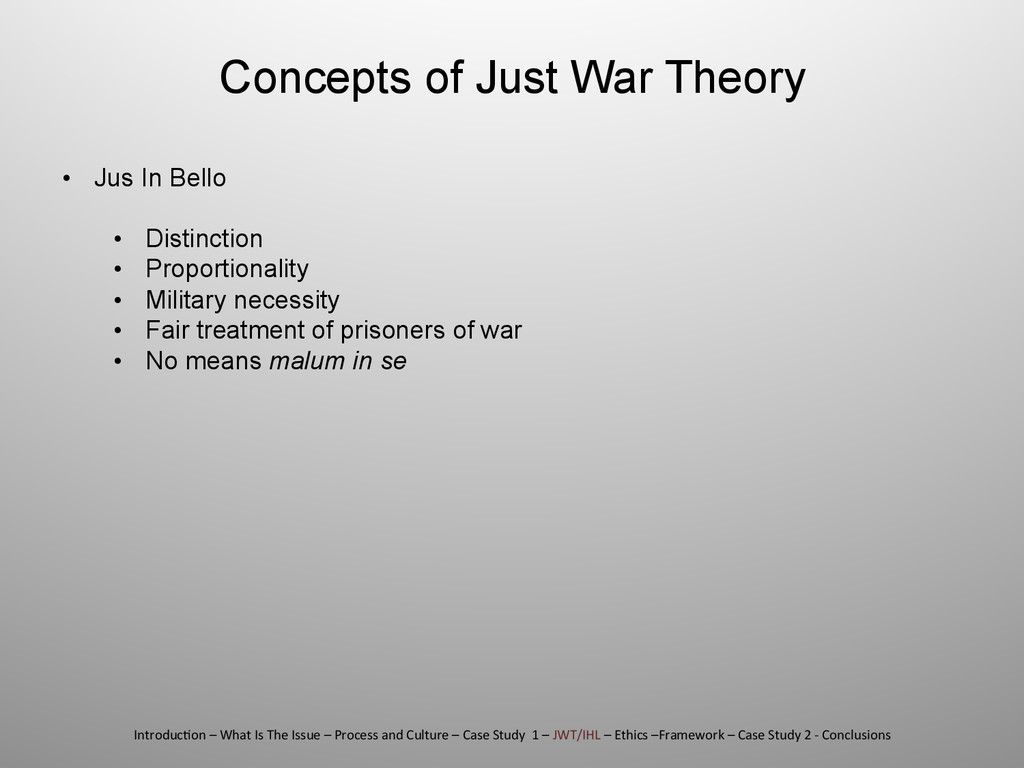
  72. Concepts of Just War Theory •  Jus In Bello • 

    Distinction •  Proportionality •  Military necessity •  Fair treatment of prisoners of war •  No means malum in se Introduc)on  –  What  Is  The  Issue  –  Process  and  Culture  –  Case  Study    1  –  JWT/IHL  –  Ethics  –Framework  –  Case  Study  2  -­‐  Conclusions  
  73. Frameworks for Ethical Reflection Introduc)on  –  What  Is  The  Issue

     –  Process  and  Culture  –  Case  Study    1  –  JWT/IHL  –  Ethics  –Framework  –  Case  Study  2  -­‐  Conclusions  
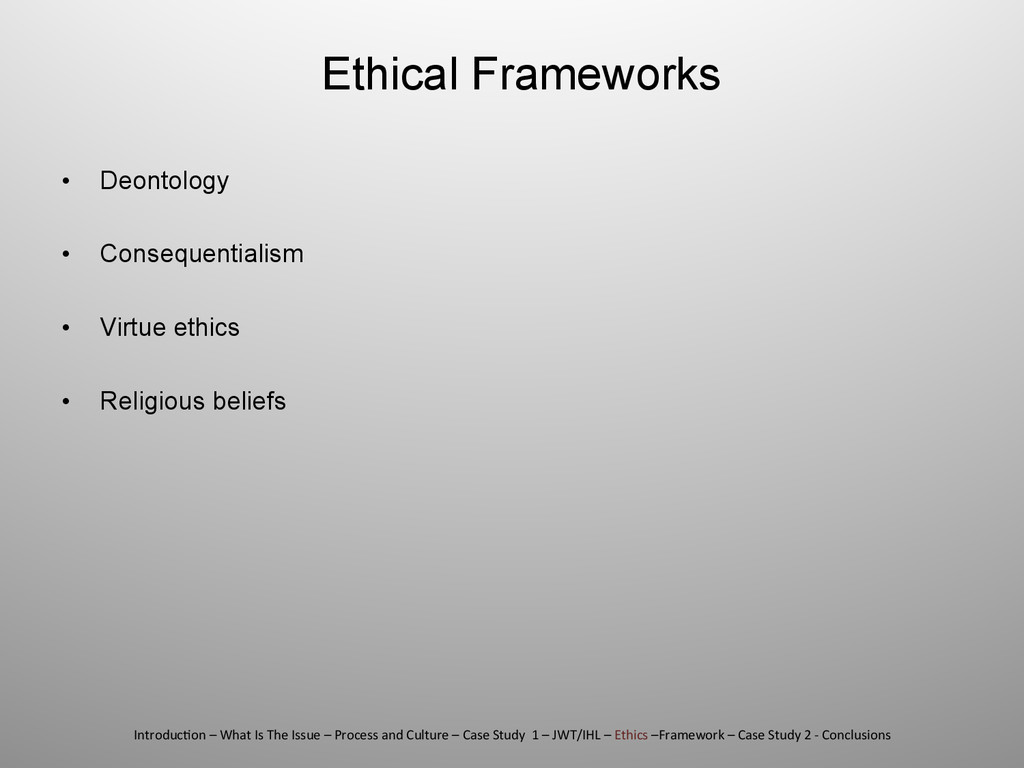
  74. Ethical Frameworks •  Deontology •  Consequentialism •  Virtue ethics • 

    Religious beliefs Introduc)on  –  What  Is  The  Issue  –  Process  and  Culture  –  Case  Study    1  –  JWT/IHL  –  Ethics  –Framework  –  Case  Study  2  -­‐  Conclusions  
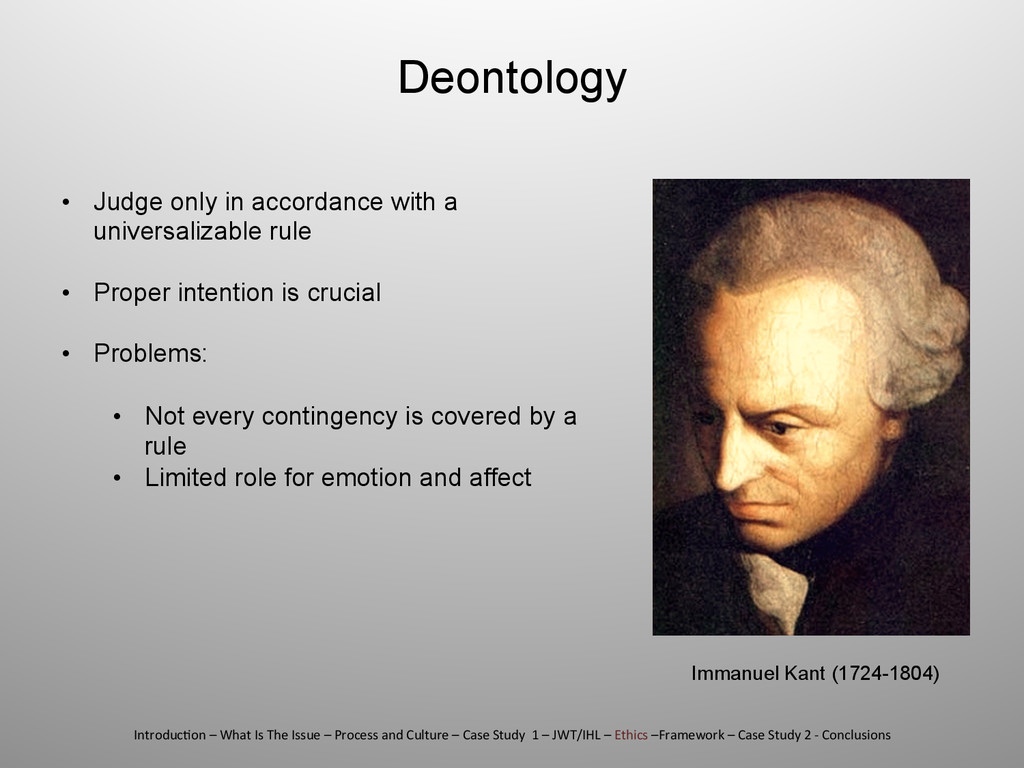
  75. Deontology •  Judge only in accordance with a universalizable rule

    •  Proper intention is crucial •  Problems: •  Not every contingency is covered by a rule •  Limited role for emotion and affect Immanuel Kant (1724-1804) Introduc)on  –  What  Is  The  Issue  –  Process  and  Culture  –  Case  Study    1  –  JWT/IHL  –  Ethics  –Framework  –  Case  Study  2  -­‐  Conclusions  
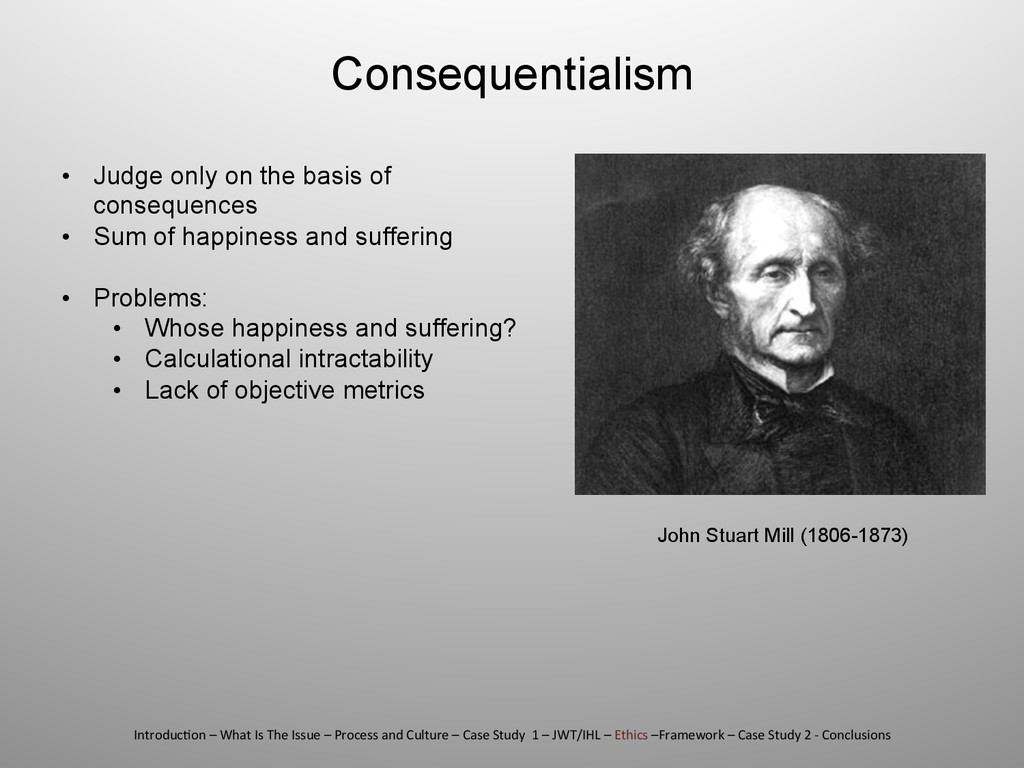
  76. Consequentialism •  Judge only on the basis of consequences • 

    Sum of happiness and suffering •  Problems: •  Whose happiness and suffering? •  Calculational intractability •  Lack of objective metrics John Stuart Mill (1806-1873) Introduc)on  –  What  Is  The  Issue  –  Process  and  Culture  –  Case  Study    1  –  JWT/IHL  –  Ethics  –Framework  –  Case  Study  2  -­‐  Conclusions  
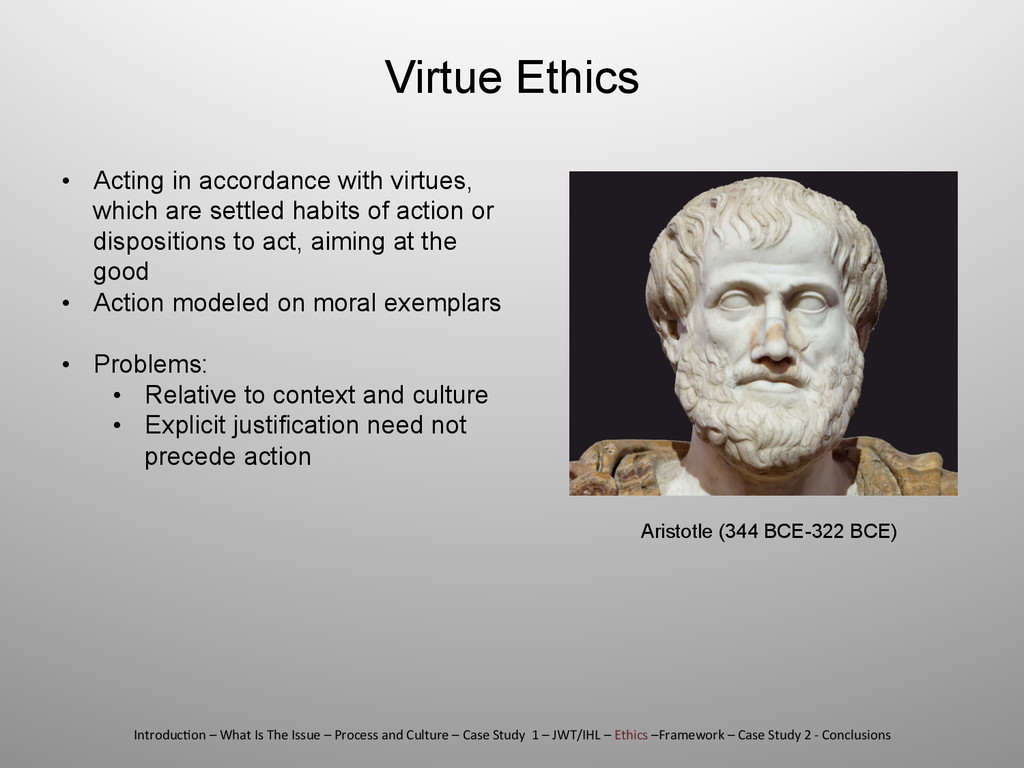
  77. Virtue Ethics •  Acting in accordance with virtues, which are

    settled habits of action or dispositions to act, aiming at the good •  Action modeled on moral exemplars •  Problems: •  Relative to context and culture •  Explicit justification need not precede action Aristotle (344 BCE-322 BCE) Introduc)on  –  What  Is  The  Issue  –  Process  and  Culture  –  Case  Study    1  –  JWT/IHL  –  Ethics  –Framework  –  Case  Study  2  -­‐  Conclusions  
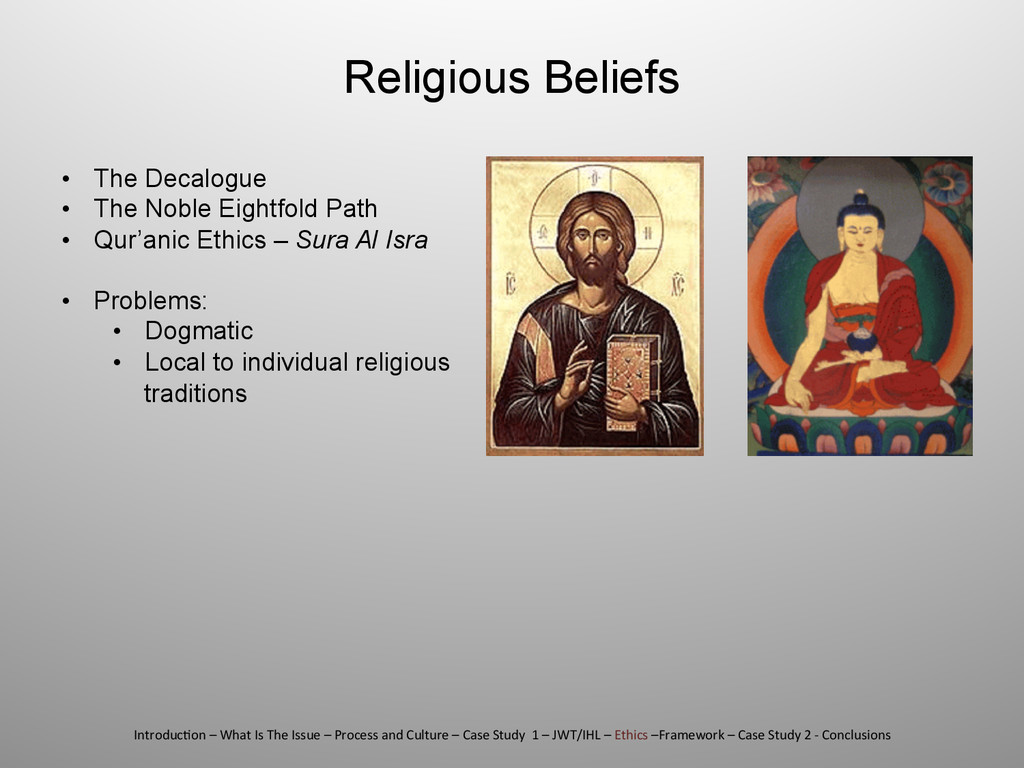
  78. Religious Beliefs •  The Decalogue •  The Noble Eightfold Path

    •  Qur’anic Ethics – Sura Al Isra •  Problems: •  Dogmatic •  Local to individual religious traditions Introduc)on  –  What  Is  The  Issue  –  Process  and  Culture  –  Case  Study    1  –  JWT/IHL  –  Ethics  –Framework  –  Case  Study  2  -­‐  Conclusions  
  79. The ethicist should critically appraise the claims on the desirability

    of the technology. Rather than using those claims on benefit as a starting point for passing ethical judgment, the ethicist should assess the assumptions on which they seem plausible. Such claims presuppose an allegedly shared morality; the ethicist’s task now is to look for potential controversies on the desirability of the technology at hand. By making explicit which values and moral justifications are embedded in expectations and analyzing which values are implied by the current practices and ideals of different stakeholders, the ethicist can discover some not-yet-expressed ethical controversies. Federica Lucivero, Tsjalling Swierstra, and Marianne Boenink. “Assessing Expectations: Towards a Toolbox for an Ethics of Emerging Technologies.” Nanoethics (2011) 5:129–141. Introduc)on  –  What  Is  The  Issue  –  Process  and  Culture  –  Case  Study    1  –  JWT/IHL  –  Ethics  –Framework  –  Case  Study  2  -­‐  Conclusions  
  80. A Framework for Analysis Introduc)on  –  What  Is  The  Issue

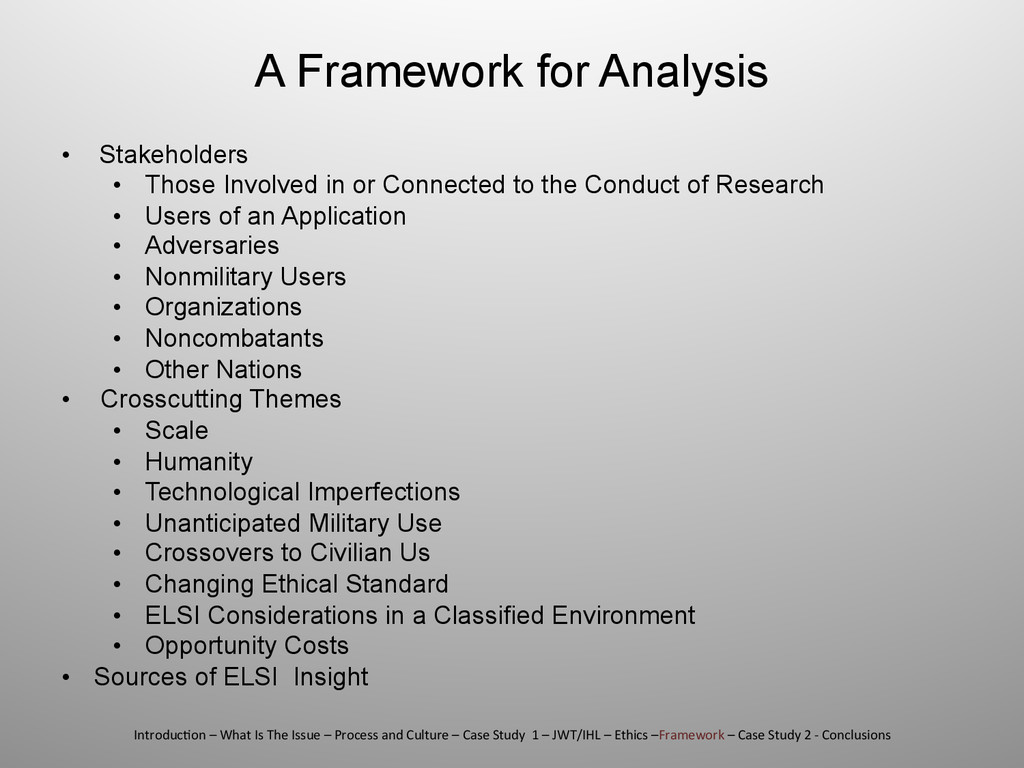
     –  Process  and  Culture  –  Case  Study    1  –  JWT/IHL  –  Ethics  –Framework  –  Case  Study  2  -­‐  Conclusions  
  81. A Framework for Analysis •   Stakeholders •  Those Involved in

    or Connected to the Conduct of Research •  Users of an Application •  Adversaries •  Nonmilitary Users •  Organizations •  Noncombatants •  Other Nations •  Crosscutting Themes •  Scale •  Humanity •  Technological Imperfections •  Unanticipated Military Use •  Crossovers to Civilian Us •  Changing Ethical Standard •  ELSI Considerations in a Classified Environment •  Opportunity Costs •  Sources of ELSI Insight Introduc)on  –  What  Is  The  Issue  –  Process  and  Culture  –  Case  Study    1  –  JWT/IHL  –  Ethics  –Framework  –  Case  Study  2  -­‐  Conclusions  
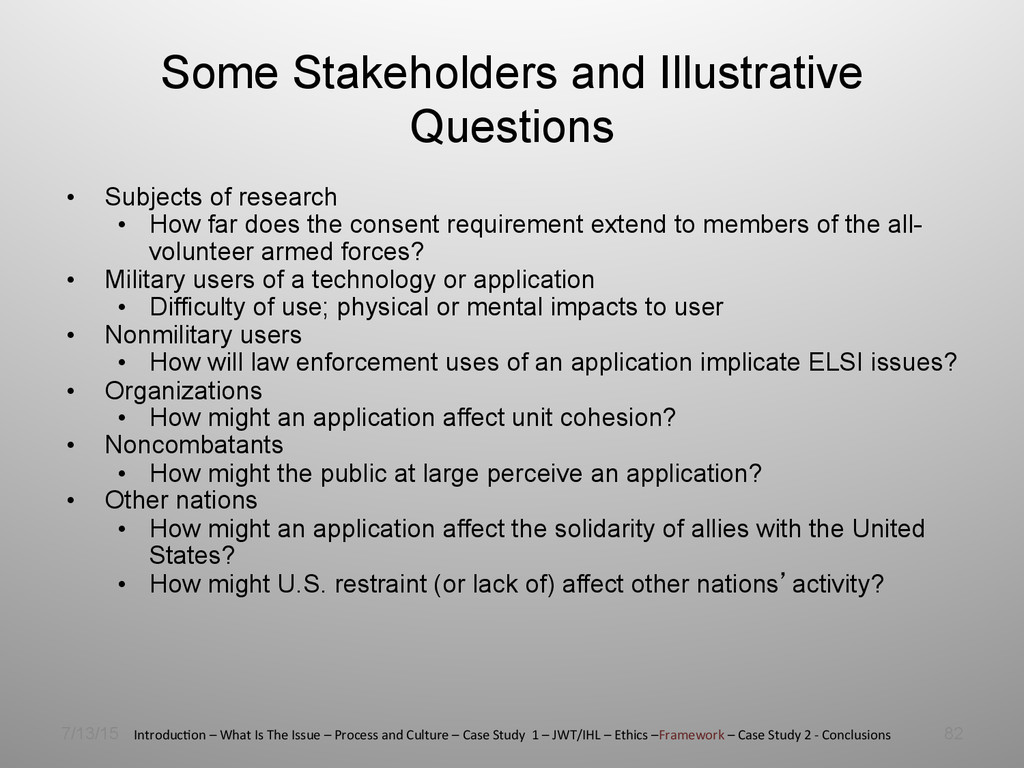
  82. Some Stakeholders and Illustrative Questions 7/13/15 82 •  Subjects of

    research •  How far does the consent requirement extend to members of the all- volunteer armed forces? •  Military users of a technology or application •  Difficulty of use; physical or mental impacts to user •  Nonmilitary users •  How will law enforcement uses of an application implicate ELSI issues? •  Organizations •  How might an application affect unit cohesion? •  Noncombatants •  How might the public at large perceive an application? •  Other nations •  How might an application affect the solidarity of allies with the United States? •  How might U.S. restraint (or lack of) affect other nations`activity? Introduc)on  –  What  Is  The  Issue  –  Process  and  Culture  –  Case  Study    1  –  JWT/IHL  –  Ethics  –Framework  –  Case  Study  2  -­‐  Conclusions  
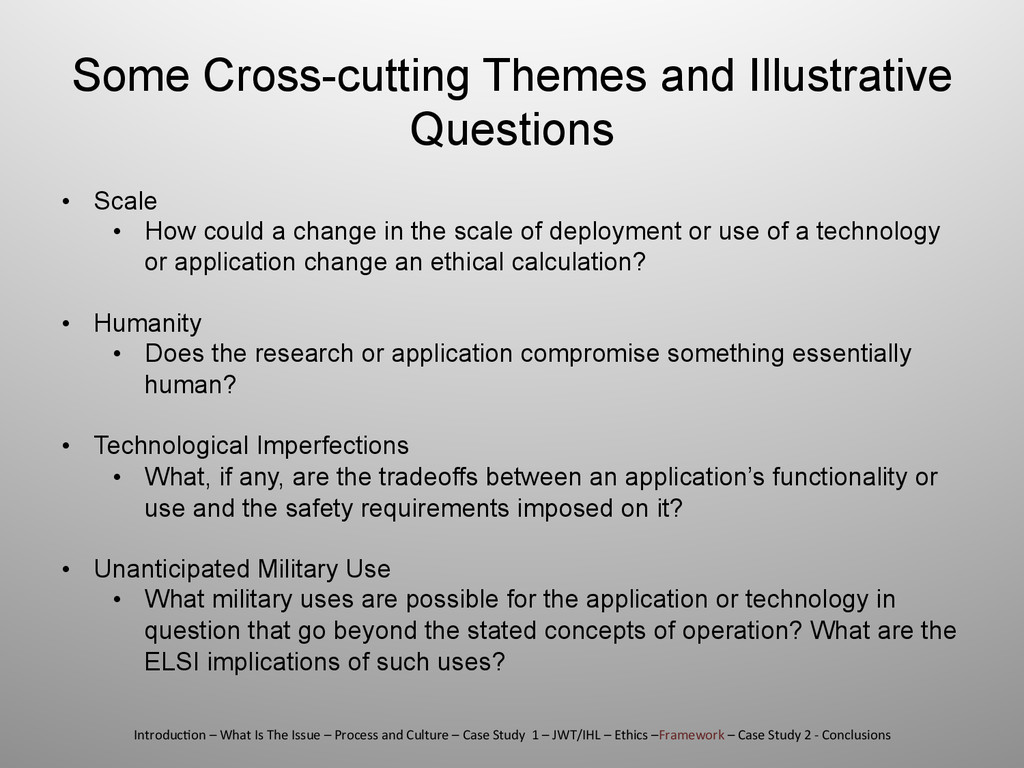
  83. Some Cross-cutting Themes and Illustrative Questions •  Scale •  How

    could a change in the scale of deployment or use of a technology or application change an ethical calculation? •  Humanity •  Does the research or application compromise something essentially human? •  Technological Imperfections •  What, if any, are the tradeoffs between an application’s functionality or use and the safety requirements imposed on it? •  Unanticipated Military Use •  What military uses are possible for the application or technology in question that go beyond the stated concepts of operation? What are the ELSI implications of such uses? Introduc)on  –  What  Is  The  Issue  –  Process  and  Culture  –  Case  Study    1  –  JWT/IHL  –  Ethics  –Framework  –  Case  Study  2  -­‐  Conclusions  
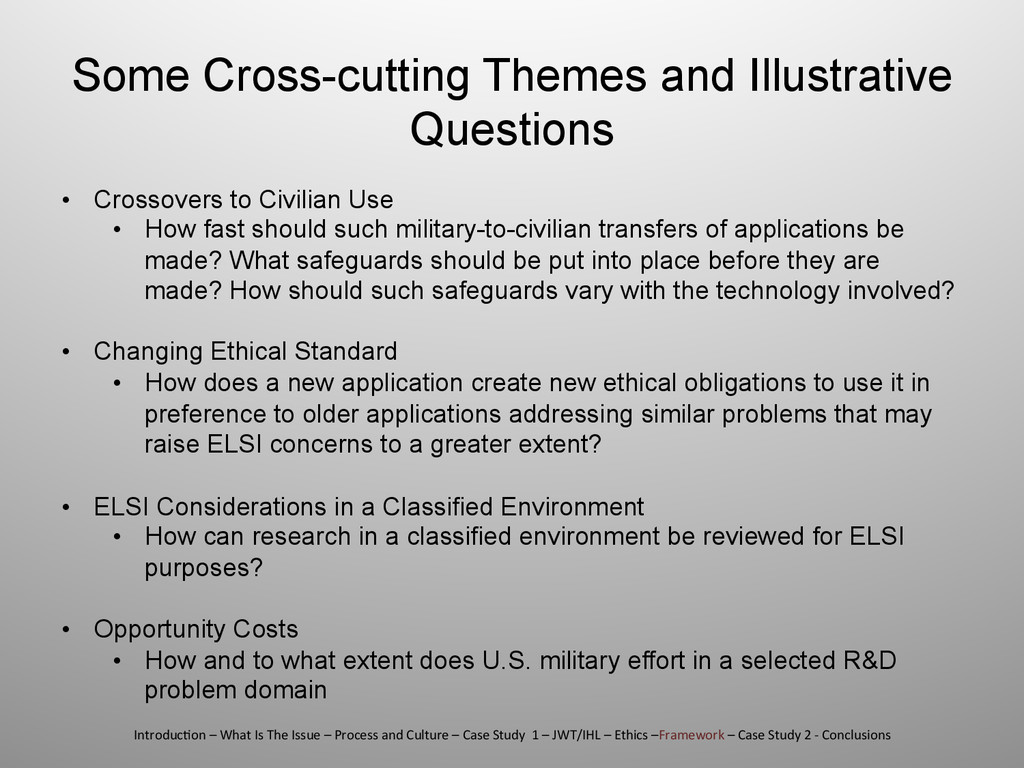
  84. Some Cross-cutting Themes and Illustrative Questions •  Crossovers to Civilian

    Use •  How fast should such military-to-civilian transfers of applications be made? What safeguards should be put into place before they are made? How should such safeguards vary with the technology involved? •  Changing Ethical Standard •  How does a new application create new ethical obligations to use it in preference to older applications addressing similar problems that may raise ELSI concerns to a greater extent? •  ELSI Considerations in a Classified Environment •  How can research in a classified environment be reviewed for ELSI purposes? •  Opportunity Costs •  How and to what extent does U.S. military effort in a selected R&D problem domain Introduc)on  –  What  Is  The  Issue  –  Process  and  Culture  –  Case  Study    1  –  JWT/IHL  –  Ethics  –Framework  –  Case  Study  2  -­‐  Conclusions  
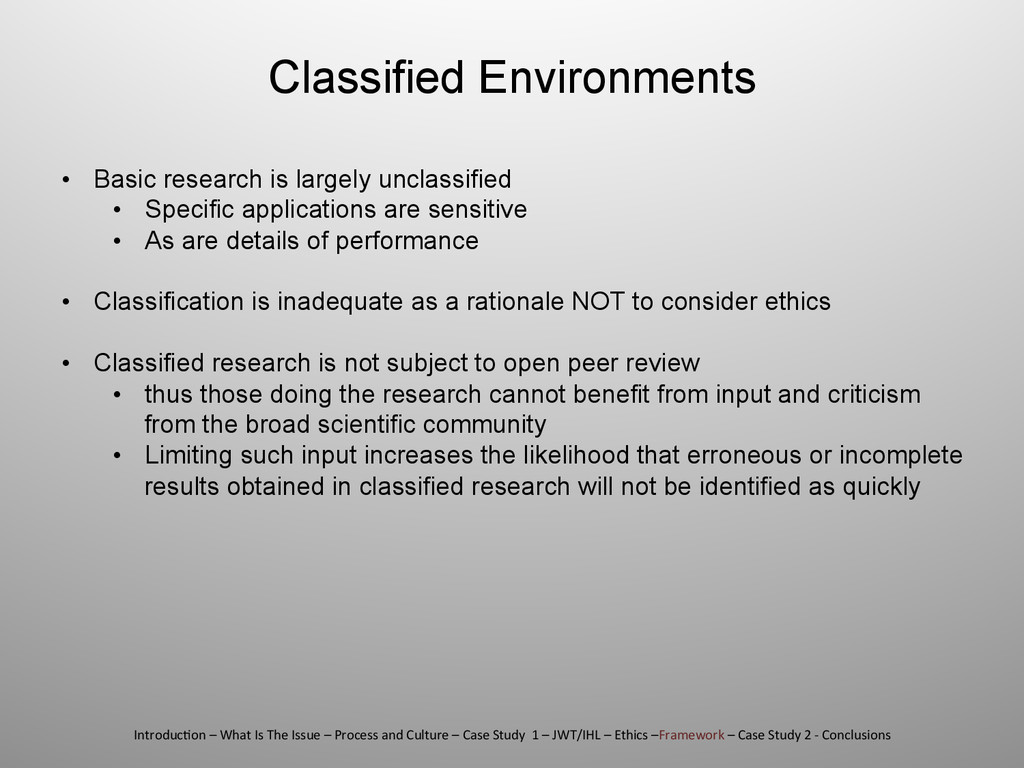
  85. Classified Environments •  Basic research is largely unclassified •  Specific

    applications are sensitive •  As are details of performance •  Classification is inadequate as a rationale NOT to consider ethics •  Classified research is not subject to open peer review •  thus those doing the research cannot benefit from input and criticism from the broad scientific community •  Limiting such input increases the likelihood that erroneous or incomplete results obtained in classified research will not be identified as quickly Introduc)on  –  What  Is  The  Issue  –  Process  and  Culture  –  Case  Study    1  –  JWT/IHL  –  Ethics  –Framework  –  Case  Study  2  -­‐  Conclusions  
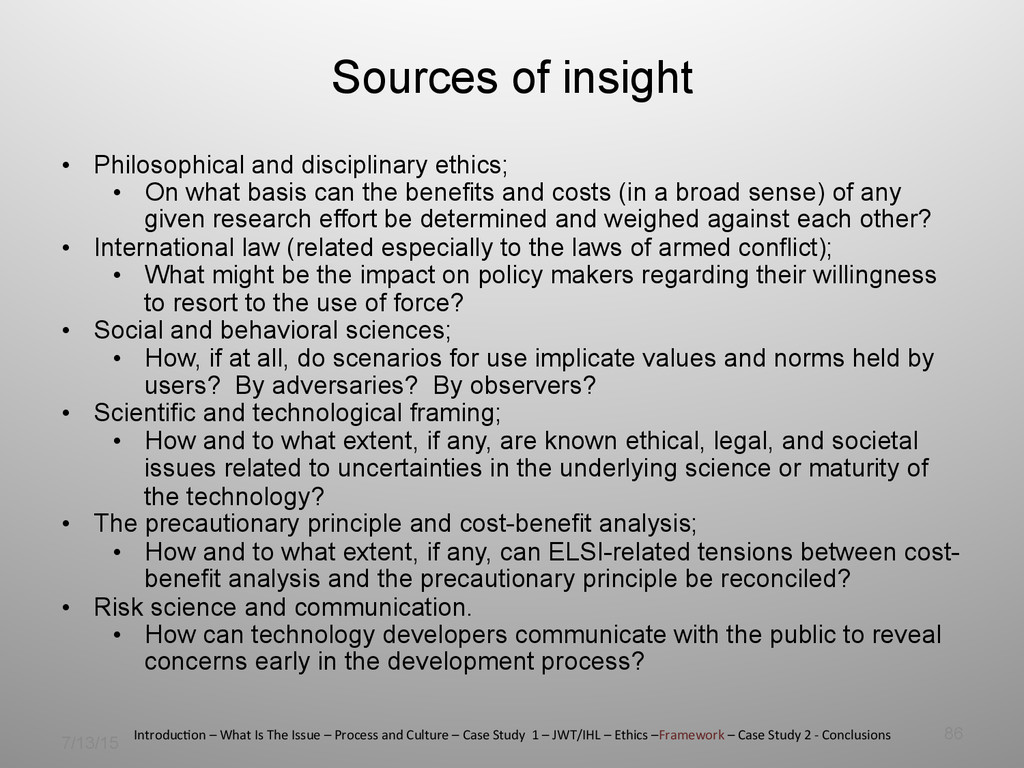
  86. Sources of insight 7/13/15 86 •  Philosophical and disciplinary ethics;

    •  On what basis can the benefits and costs (in a broad sense) of any given research effort be determined and weighed against each other? •  International law (related especially to the laws of armed conflict); •  What might be the impact on policy makers regarding their willingness to resort to the use of force? •  Social and behavioral sciences; •  How, if at all, do scenarios for use implicate values and norms held by users? By adversaries? By observers? •  Scientific and technological framing; •  How and to what extent, if any, are known ethical, legal, and societal issues related to uncertainties in the underlying science or maturity of the technology? •  The precautionary principle and cost-benefit analysis; •  How and to what extent, if any, can ELSI-related tensions between cost- benefit analysis and the precautionary principle be reconciled? •  Risk science and communication. •  How can technology developers communicate with the public to reveal concerns early in the development process? Introduc)on  –  What  Is  The  Issue  –  Process  and  Culture  –  Case  Study    1  –  JWT/IHL  –  Ethics  –Framework  –  Case  Study  2  -­‐  Conclusions  
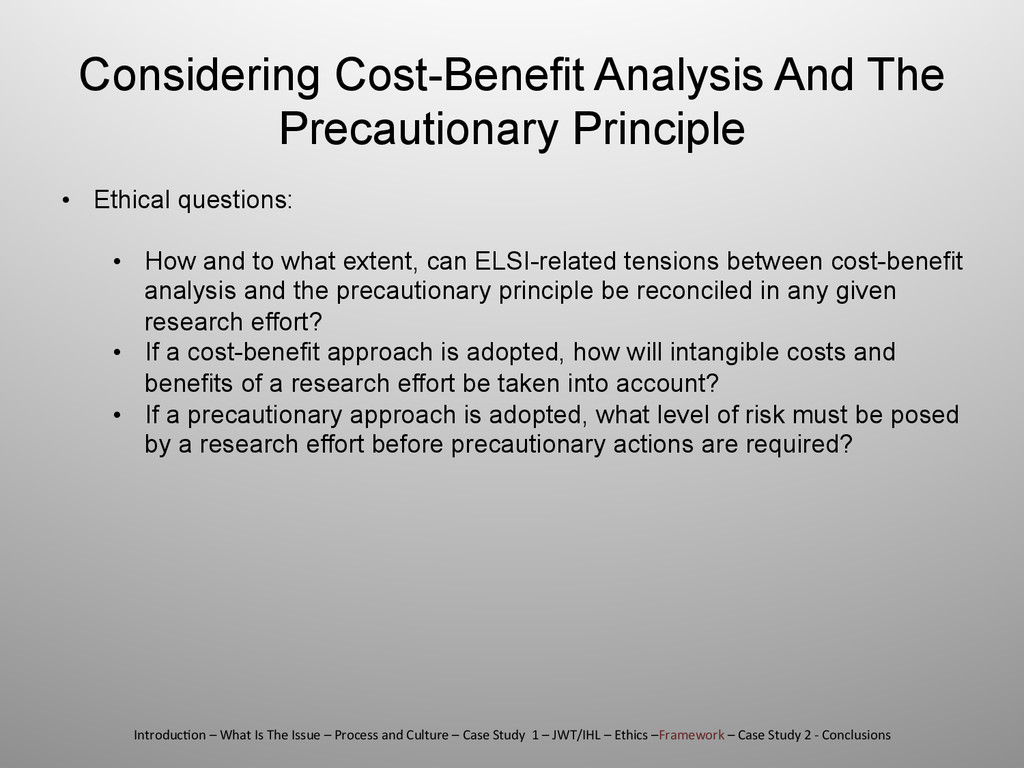
  87. Considering Cost-Benefit Analysis And The Precautionary Principle •  Ethical questions:

    •  How and to what extent, can ELSI-related tensions between cost-benefit analysis and the precautionary principle be reconciled in any given research effort? •  If a cost-benefit approach is adopted, how will intangible costs and benefits of a research effort be taken into account? •  If a precautionary approach is adopted, what level of risk must be posed by a research effort before precautionary actions are required? Introduc)on  –  What  Is  The  Issue  –  Process  and  Culture  –  Case  Study    1  –  JWT/IHL  –  Ethics  –Framework  –  Case  Study  2  -­‐  Conclusions  
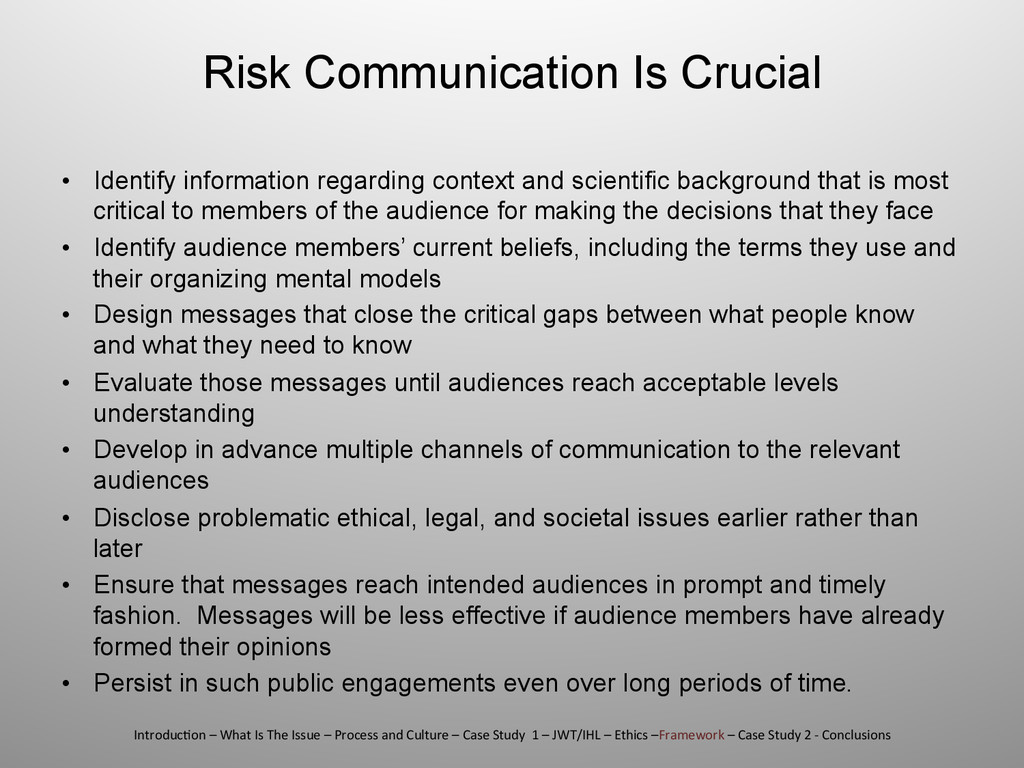
  88. Risk Communication Is Crucial •  Identify information regarding context and

    scientific background that is most critical to members of the audience for making the decisions that they face •  Identify audience members’ current beliefs, including the terms they use and their organizing mental models •  Design messages that close the critical gaps between what people know and what they need to know •  Evaluate those messages until audiences reach acceptable levels understanding •  Develop in advance multiple channels of communication to the relevant audiences •  Disclose problematic ethical, legal, and societal issues earlier rather than later •  Ensure that messages reach intended audiences in prompt and timely fashion. Messages will be less effective if audience members have already formed their opinions •  Persist in such public engagements even over long periods of time. Introduc)on  –  What  Is  The  Issue  –  Process  and  Culture  –  Case  Study    1  –  JWT/IHL  –  Ethics  –Framework  –  Case  Study  2  -­‐  Conclusions  
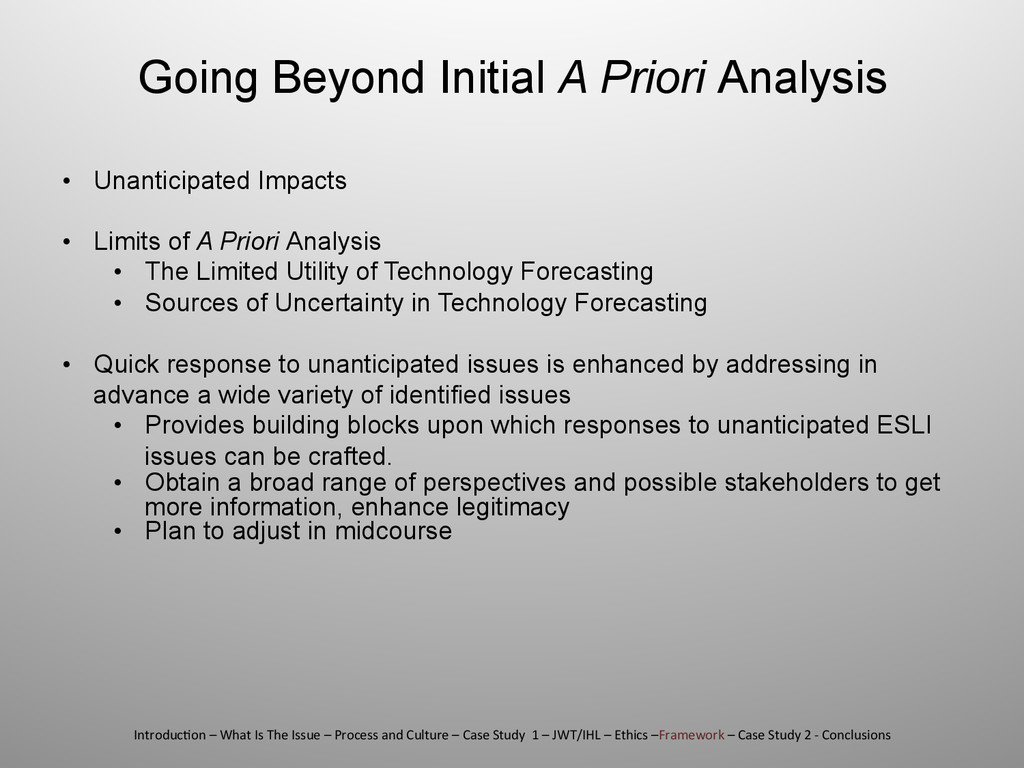
  89. Going Beyond Initial A Priori Analysis •  Unanticipated Impacts • 

    Limits of A Priori Analysis •  The Limited Utility of Technology Forecasting •  Sources of Uncertainty in Technology Forecasting •  Quick response to unanticipated issues is enhanced by addressing in advance a wide variety of identified issues •  Provides building blocks upon which responses to unanticipated ESLI issues can be crafted. •  Obtain a broad range of perspectives and possible stakeholders to get more information, enhance legitimacy •  Plan to adjust in midcourse Introduc)on  –  What  Is  The  Issue  –  Process  and  Culture  –  Case  Study    1  –  JWT/IHL  –  Ethics  –Framework  –  Case  Study  2  -­‐  Conclusions  
  90. What To Do? •  Broadening Predictive Analysis of Ethical, Legal,

    and Societal Issues •  Use of Deliberative Processes •  Anticipatory Governance •  Adaptive Planning Introduc)on  –  What  Is  The  Issue  –  Process  and  Culture  –  Case  Study    1  –  JWT/IHL  –  Ethics  –Framework  –  Case  Study  2  -­‐  Conclusions  
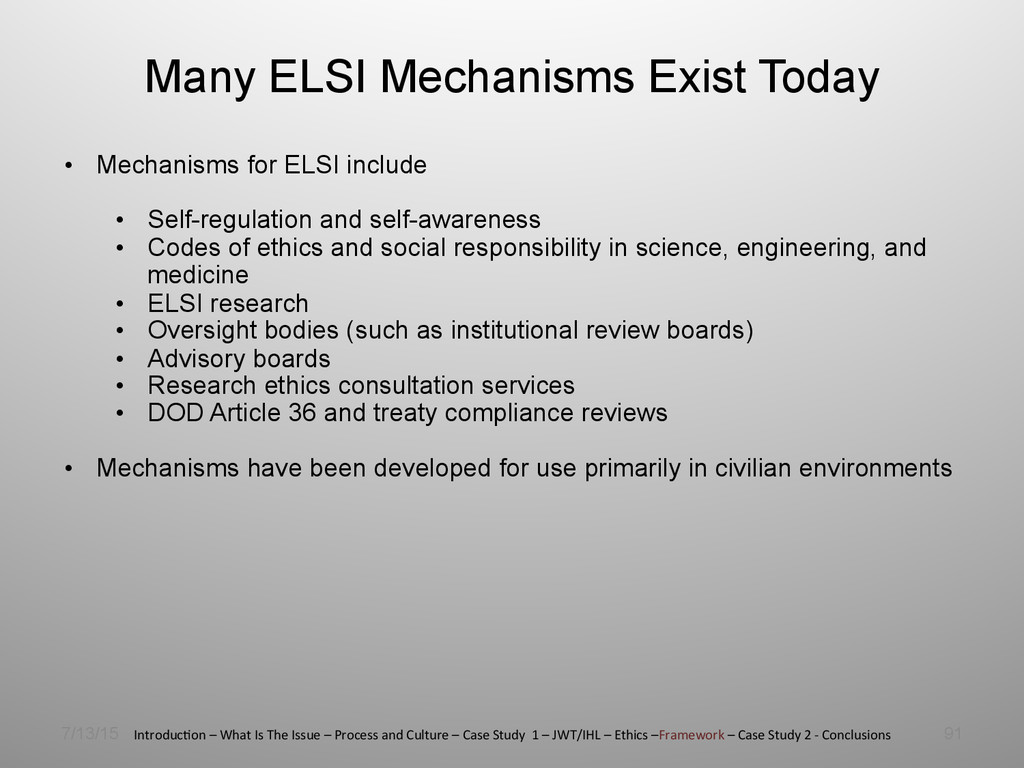
  91. Many ELSI Mechanisms Exist Today 7/13/15 91 •  Mechanisms for

    ELSI include •  Self-regulation and self-awareness •  Codes of ethics and social responsibility in science, engineering, and medicine •  ELSI research •  Oversight bodies (such as institutional review boards) •  Advisory boards •  Research ethics consultation services •  DOD Article 36 and treaty compliance reviews •  Mechanisms have been developed for use primarily in civilian environments Introduc)on  –  What  Is  The  Issue  –  Process  and  Culture  –  Case  Study    1  –  JWT/IHL  –  Ethics  –Framework  –  Case  Study  2  -­‐  Conclusions  
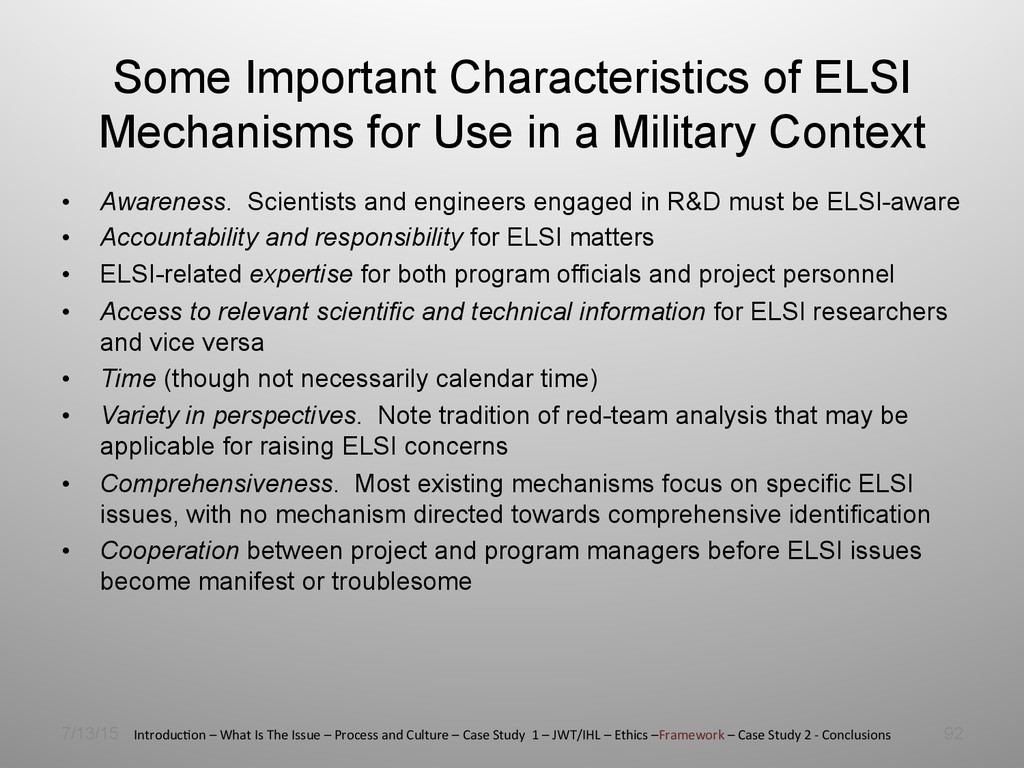
  92. Some Important Characteristics of ELSI Mechanisms for Use in a

    Military Context •  Awareness. Scientists and engineers engaged in R&D must be ELSI-aware •  Accountability and responsibility for ELSI matters •  ELSI-related expertise for both program officials and project personnel •  Access to relevant scientific and technical information for ELSI researchers and vice versa •  Time (though not necessarily calendar time) •  Variety in perspectives. Note tradition of red-team analysis that may be applicable for raising ELSI concerns •  Comprehensiveness. Most existing mechanisms focus on specific ELSI issues, with no mechanism directed towards comprehensive identification •  Cooperation between project and program managers before ELSI issues become manifest or troublesome 7/13/15 92 Introduc)on  –  What  Is  The  Issue  –  Process  and  Culture  –  Case  Study    1  –  JWT/IHL  –  Ethics  –Framework  –  Case  Study  2  -­‐  Conclusions  
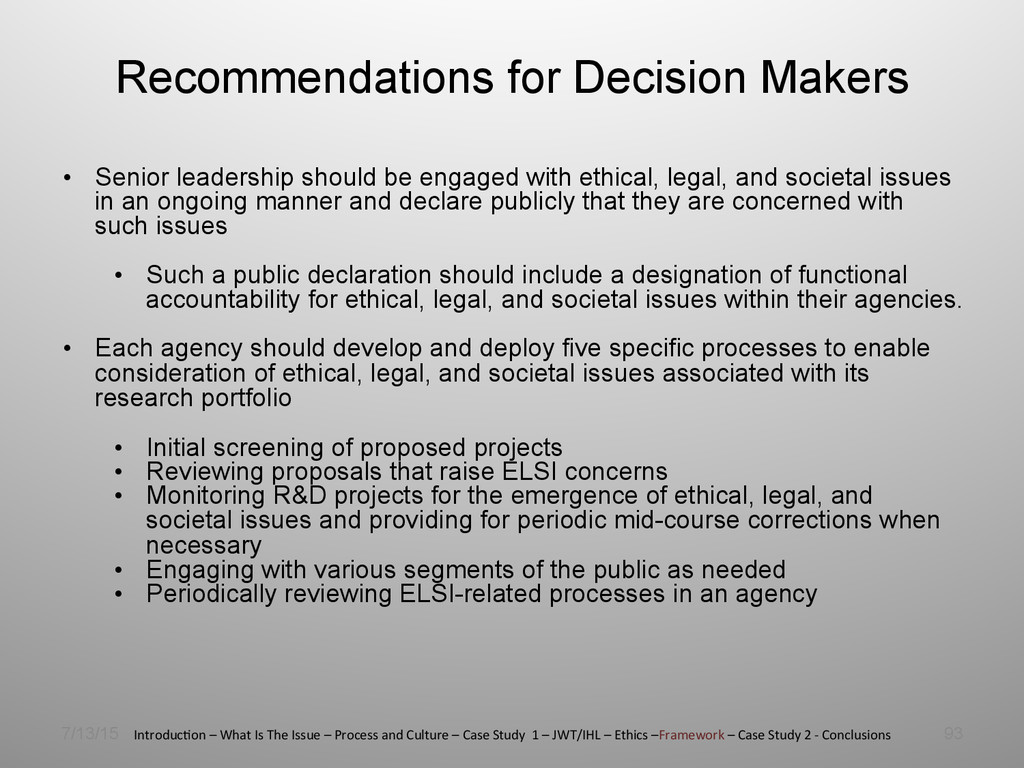
  93. 7/13/15 93 •  Senior leadership should be engaged with ethical,

    legal, and societal issues in an ongoing manner and declare publicly that they are concerned with such issues •  Such a public declaration should include a designation of functional accountability for ethical, legal, and societal issues within their agencies. •  Each agency should develop and deploy five specific processes to enable consideration of ethical, legal, and societal issues associated with its research portfolio •  Initial screening of proposed projects •  Reviewing proposals that raise ELSI concerns •  Monitoring R&D projects for the emergence of ethical, legal, and societal issues and providing for periodic mid-course corrections when necessary •  Engaging with various segments of the public as needed •  Periodically reviewing ELSI-related processes in an agency Recommendations for Decision Makers Introduc)on  –  What  Is  The  Issue  –  Process  and  Culture  –  Case  Study    1  –  JWT/IHL  –  Ethics  –Framework  –  Case  Study  2  -­‐  Conclusions  
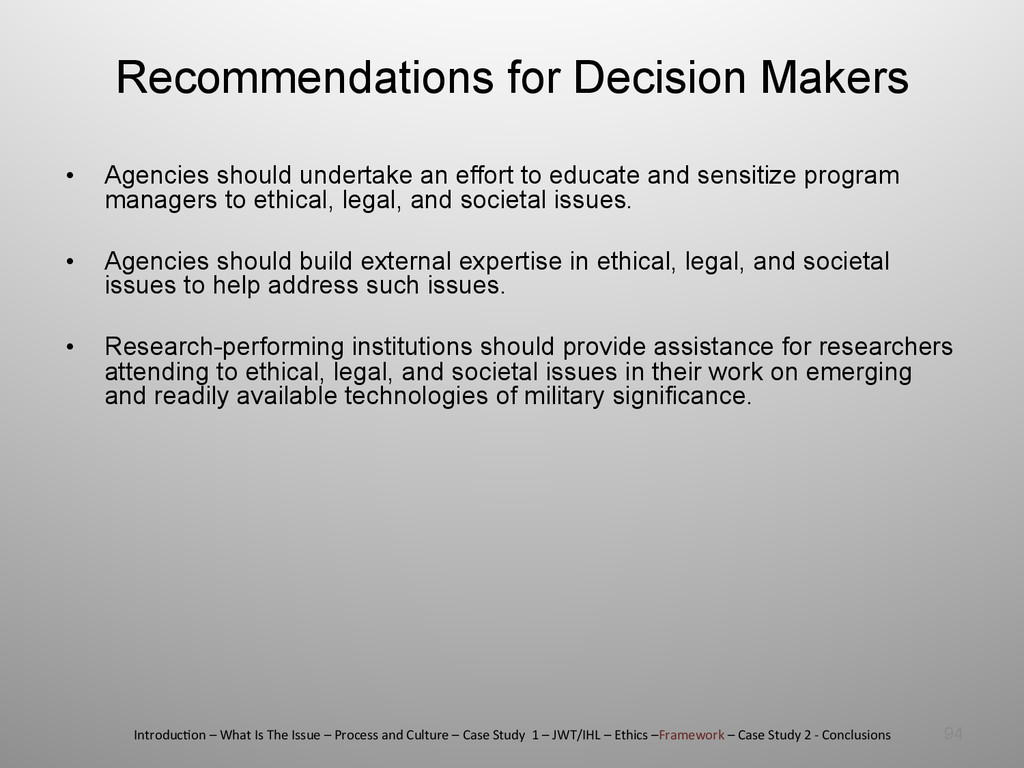
  94. Recommendations for Decision Makers •  Agencies should undertake an effort

    to educate and sensitize program managers to ethical, legal, and societal issues. •  Agencies should build external expertise in ethical, legal, and societal issues to help address such issues. •  Research-performing institutions should provide assistance for researchers attending to ethical, legal, and societal issues in their work on emerging and readily available technologies of military significance. 94 Introduc)on  –  What  Is  The  Issue  –  Process  and  Culture  –  Case  Study    1  –  JWT/IHL  –  Ethics  –Framework  –  Case  Study  2  -­‐  Conclusions  
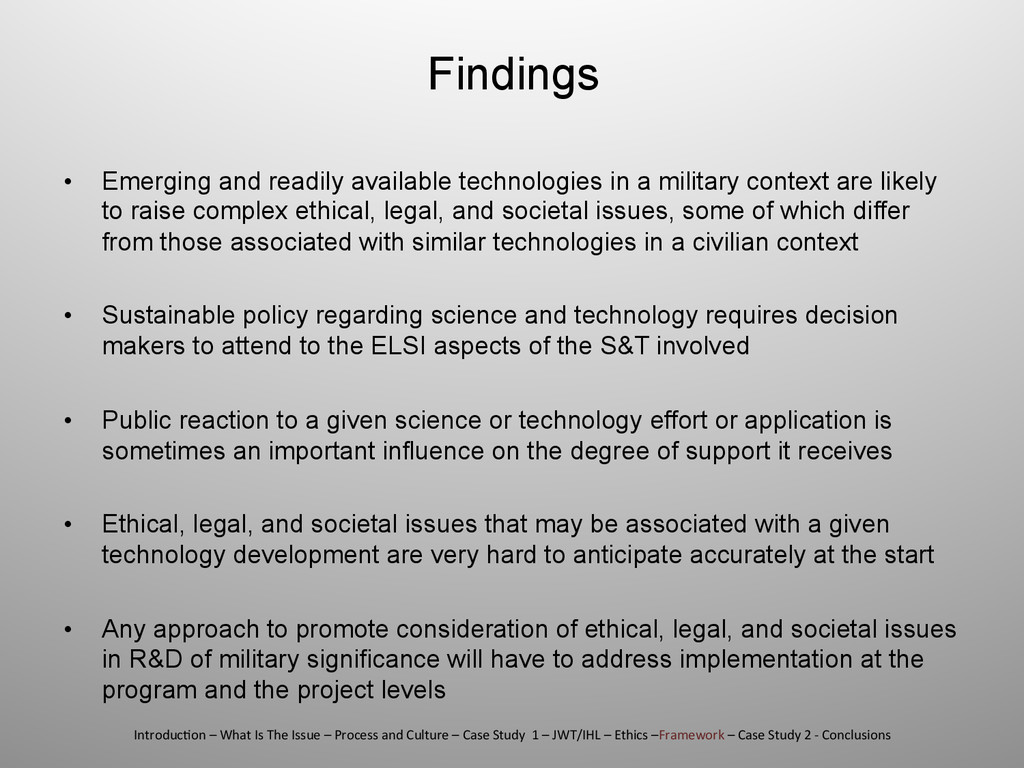
  95. Findings •  Emerging and readily available technologies in a military

    context are likely to raise complex ethical, legal, and societal issues, some of which differ from those associated with similar technologies in a civilian context •  Sustainable policy regarding science and technology requires decision makers to attend to the ELSI aspects of the S&T involved •  Public reaction to a given science or technology effort or application is sometimes an important influence on the degree of support it receives •  Ethical, legal, and societal issues that may be associated with a given technology development are very hard to anticipate accurately at the start •  Any approach to promote consideration of ethical, legal, and societal issues in R&D of military significance will have to address implementation at the program and the project levels Introduc)on  –  What  Is  The  Issue  –  Process  and  Culture  –  Case  Study    1  –  JWT/IHL  –  Ethics  –Framework  –  Case  Study  2  -­‐  Conclusions  
  96. Observations on the Findings •  Approaches to addressing ELSI concerns

    can be both systematic and pose minimal additional burdens on agencies and on researchers •  Addressing such issues may well be necessary for sustaining support for projects •  Consideration of ethical issues may also improve the quality of the research by pointing to other overlooked problems in the research or opportunities for improvement in the science or technology to be pursued Introduc)on  –  What  Is  The  Issue  –  Process  and  Culture  –  Case  Study    1  –  JWT/IHL  –  Ethics  –Framework  –  Case  Study  2  -­‐  Conclusions  
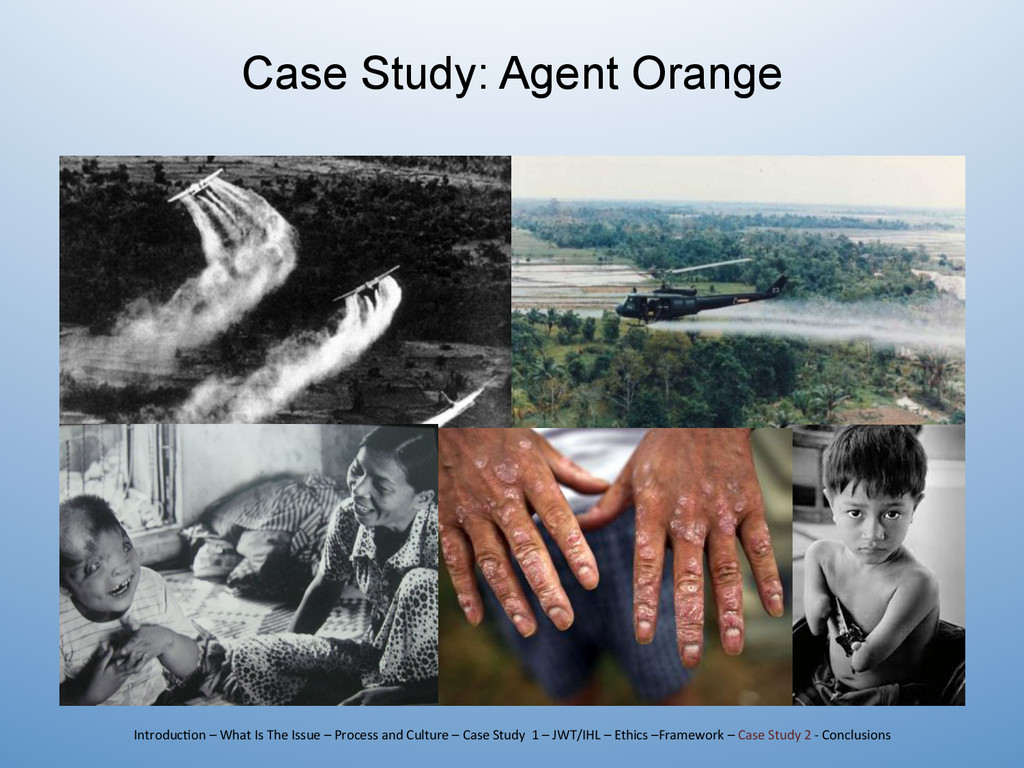
  97. Case Study: Agent Orange Introduc)on  –  What  Is  The  Issue

     –  Process  and  Culture  –  Case  Study    1  –  JWT/IHL  –  Ethics  –Framework  –  Case  Study  2  -­‐  Conclusions  
  98. Introduc)on  –  What  Is  The  Issue  –  Process  and  Culture

     –  Case  Study    1  –  JWT/IHL  –  Ethics  –Framework  –  Case  Study  2  -­‐  Conclusions  
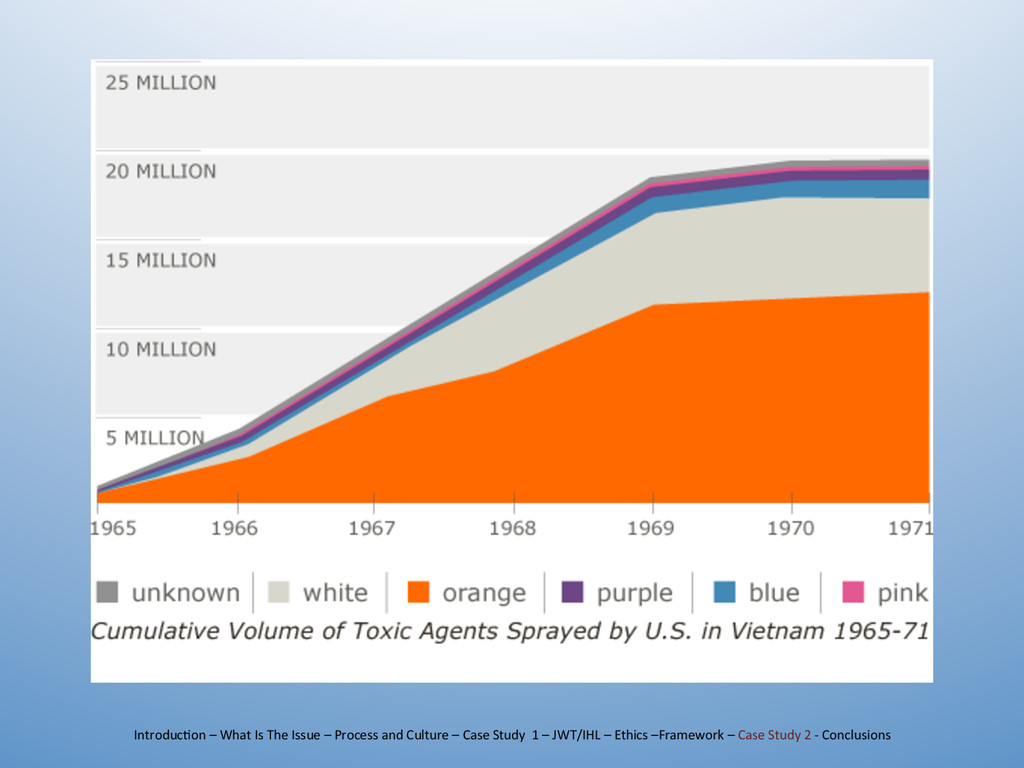
  99. •  In 1961, South Vietnamese government requests US assistance with

    defoliants for use in perimeter defense and exposure of Viet Cong camps and trails. •  Brief, early debates about ethics and policy of environmental gas weapons. •  Operation “Ranch Hand” runs from 1961 to 1971 with the release of 20M gallons of chemical herbicides. •  Most common form is “Agent Orange,” a mixture of 2,4- dichlorophenoxyacetic acid (2,4-D) and 2,4,5-trichlorophenoxyacetic acid (2,4,5-T). •  Manufactured mainly by Monsanto and Dow, plus a few smaller firms. •  Frequent contamination with highly toxic 2,3,7,8-tetrachlorodibenzodioxin (TCDD), the chief suspected cause of health effects. Basic Facts Introduc)on  –  What  Is  The  Issue  –  Process  and  Culture  –  Case  Study    1  –  JWT/IHL  –  Ethics  –Framework  –  Case  Study  2  -­‐  Conclusions  
  100. Basic Facts •  Research to find the optimal mixture, balancing

    effect with applicability under a wide range of conditions. •  Lax rules and oversight for handling and application. •  No serious studies at the time of near-term or long-term health effects from either high-dose or prolonged, low-dose direct exposure. •  Early estimates of health effects based mainly on industry data about health consequences of worker exposure. •  No serious studies at the time of residual effects on crops grown on affected lands. •  No serious studies at the time of long-term environmental impacts. •  No scientifically rigorous study after the fact of health effects on civilians or military personnel. Introduc)on  –  What  Is  The  Issue  –  Process  and  Culture  –  Case  Study    1  –  JWT/IHL  –  Ethics  –Framework  –  Case  Study  2  -­‐  Conclusions  
  101. •  Long list of illnesses now associated with exposure, including

    cancers, birth defects, liver disease, and chloracne. •  Hundreds of thousands killed or made ill by direct exposure. •  Possibly 500K children born with birth defects, continuing today. •  Possibly 2M total cases of illness. Consequences Introduc)on  –  What  Is  The  Issue  –  Process  and  Culture  –  Case  Study    1  –  JWT/IHL  –  Ethics  –Framework  –  Case  Study  2  -­‐  Conclusions  
  102. •  What was the operational imperative? •  Was there a

    temporal urgency? •  What type of (risk) analysis, or cost/benefit analysis was conducted, if any? •  What would have been the appropriate opportunities for raising questions about the technology and its use? •  Where does responsibility lie for monitoring? Questions Introduc)on  –  What  Is  The  Issue  –  Process  and  Culture  –  Case  Study    1  –  JWT/IHL  –  Ethics  –Framework  –  Case  Study  2  -­‐  Conclusions  
  103. Le Cao Dai. Agent Orange in the Vietnam War: History

    and Consequences. Vietnam Red Cross Society, 2000. Institute of Medicine, Committee on the Disposition of the Air Force Health Study Board on Population Health and Public Health Practice. Disposition of the Air Force Health Study. Washington, DC: National Academies Press, 2006. Institute of Medicine. Veterans and Agent Orange: Update 2010. Washington, DC: The National Academies Press, 2011. Edwin A. Martini. Agent Orange: History, Science and the Politics of Uncertainty. Amherst, MA: University of Massachusetts Press, 2012. Peter Sills. Toxic War: The Story of Agent Orange. Nashville, TN: Vanderbilt University Press, 2014. Fred A. Wilcox. Scorched Earth: Legacies of Chemical Warfare in Vietnam. New York: Seven Stories Press, 2011. For More Information Introduc)on  –  What  Is  The  Issue  –  Process  and  Culture  –  Case  Study    1  –  JWT/IHL  –  Ethics  –Framework  –  Case  Study  2  -­‐  Conclusions  
  104. Conclusion Introduc)on  –  What  Is  The  Issue  –  Process  and

     Culture  –  Case  Study    1  –  JWT/IHL  –  Ethics  –Framework  –  Case  Study  2  -­‐  Conclusions  
  105. Concluding Considerations •  Intense mission focus is correct and appropriate

    •  Research is important to our national security •  Weapons technologies might have important ethical, legal and societal implications •  Legal obligations have always been of great importance •  Research has potentially significant impact on others •  Deliberate analysis extremely important •  Sources of ethical insight and a framework for analysis are now available •  Decision makers now have a reasonable process by which to consider such questions Introduc)on  –  What  Is  The  Issue  –  Process  and  Culture  –  Case  Study    1  –  JWT/IHL  –  Ethics  –Framework  –  Case  Study  2  -­‐  Conclusions