Share
Embed
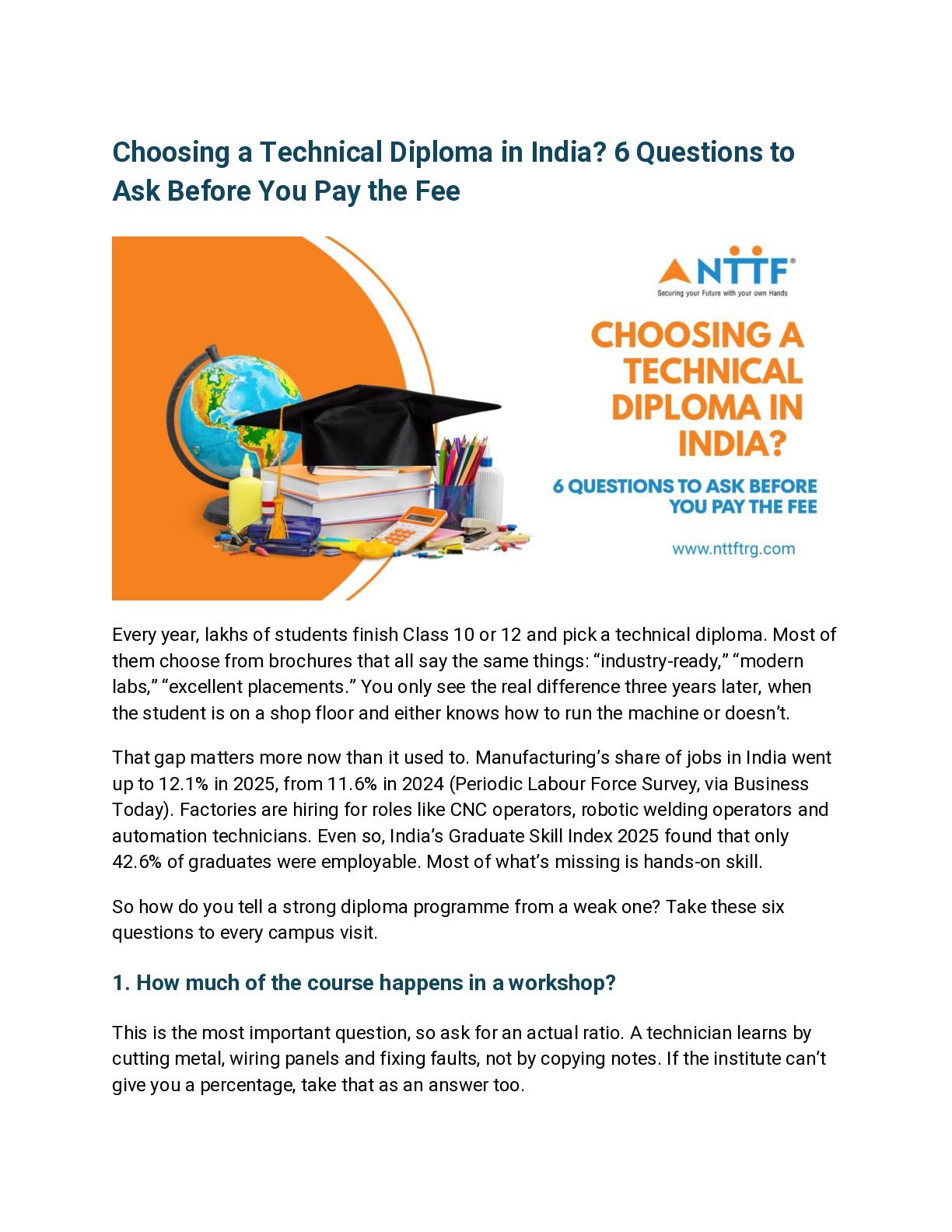
Choosing a Technical Diploma in India? 6 Questions to Ask Before You Pay the Fee
Every year, lakhs of students finish Class 10 or 12 and pick a technical diploma. Most of them choose from brochures that all say the same things: “industry-ready,” “modern labs,” “excellent placements.
netturtech
November 16, 2026
Transcript
3 slides
-
Choosing a Technical Diploma in India? 6 Questions to Ask
Before You Pay the Fee Every year, lakhs of students finish Class 10 or 12 and pick a technical diploma. Most of them choose from brochures that all say the same things: “industry-ready,” “modern labs,” “excellent placements.” You only see the real difference three years later, when the student is on a shop floor and either knows how to run the machine or doesn’t. That gap matters more now than it used to. Manufacturing’s share of jobs in India went up to 12.1% in 2025, from 11.6% in 2024 (Periodic Labour Force Survey, via Business Today). Factories are hiring for roles like CNC operators, robotic welding operators and automation technicians. Even so, India’s Graduate Skill Index 2025 found that only 42.6% of graduates were employable. Most of what’s missing is hands-on skill. So how do you tell a strong diploma programme from a weak one? Take these six questions to every campus visit. 1. How much of the course happens in a workshop? This is the most important question, so ask for an actual ratio. A technician learns by cutting metal, wiring panels and fixing faults, not by copying notes. If the institute can’t give you a percentage, take that as an answer too. -
Strong programmes are mostly practical. Nettur Technical Training Foundation (NTTF),
for example, runs its diplomas at about 70% practical, 30% theory. Use a split like that as your benchmark when you compare other institutes. 2. Is the placement figure for this programme, or the whole institute? “100% placement” on a hoarding tells you very little. Ask for: • • • The placement rate for the specific programme you’re considering, for the most recent batch The average package, not just the highest one Names of companies that hired from that programme last year An honest institute will have these numbers ready. A vague answer usually means the headline figure is doing a lot of work. 3. Who teaches on the machines? A good instructor has spent time in industry, not only in classrooms. Ask how many trainers have worked in a factory or tool room, and how recently. Someone who has dealt with a breakdown on a production line teaches differently from someone who has only read about one. 4. Does the curriculum match what factories use today? Industry moves faster than syllabus committees. Ask for the subject list year by year, then check it against the job ads in the field you’re interested in. For automation roles, look for PLC programming, SCADA, industrial robotics and pneumatics and hydraulics. For design roles, look for CAD/CAM and tool design software. For a reference point, NTTF’s Post Diploma in Industrial Automation covers nine subjects across two semesters. They run from pneumatics and hydraulics through PLC, SCADA and industrial robotics to a DCS project. If a programme only has generic “engineering basics,” the student will end up learning the rest on the job, often for lower pay. 5. What can the student do after the diploma? A diploma should lead somewhere: straight into a job, on to a post-diploma specialisation, or into a degree through lateral entry. Diploma holders can also sit -
government recruitment exams such as SSC JE and RRB JE.
Ask the institute which of these paths its students actually take, and whether it offers advanced programmes for later upskilling. 6. How long has the institute been doing this, and who hires from it? Track record matters in technical education because employers hire based on reputation. Ask how many years the institute has been training technicians and where its alumni work today. NTTF, for example, started in 1959 in Nettur, Kerala, as a collaboration between Swiss development agency HEKS and the Church of South India. NTTF’s placement record lists more than 500 recruiting companies. Six decades of employers coming back counts for more than a well-designed brochure. A quick checklist for campus visits Question A good answer sounds like Practical vs theory? A clear ratio, with most of the time in workshops Placement figures? Programme-level, latest batch, average package Who teaches? Trainers with real industry experience Curriculum? Subjects that match current job ads After the diploma? Clear routes to jobs, specialisation or a degree Track record? Decades of training and named recruiters The right diploma can take a student from Class 10 to a skilled job in three years. Spend a few hours asking these questions before you spend the fee.