Upgrade to Pro — share decks privately, control downloads, hide ads and more …

How to Build a Career in EV Battery Manufacturi...

Sponsored · Your Podcast. Everywhere. Effortlessly. Share. Educate. Inspire. Entertain. You do you. We'll handle the rest. →
Avatar for netturtech netturtech
October 14, 2026

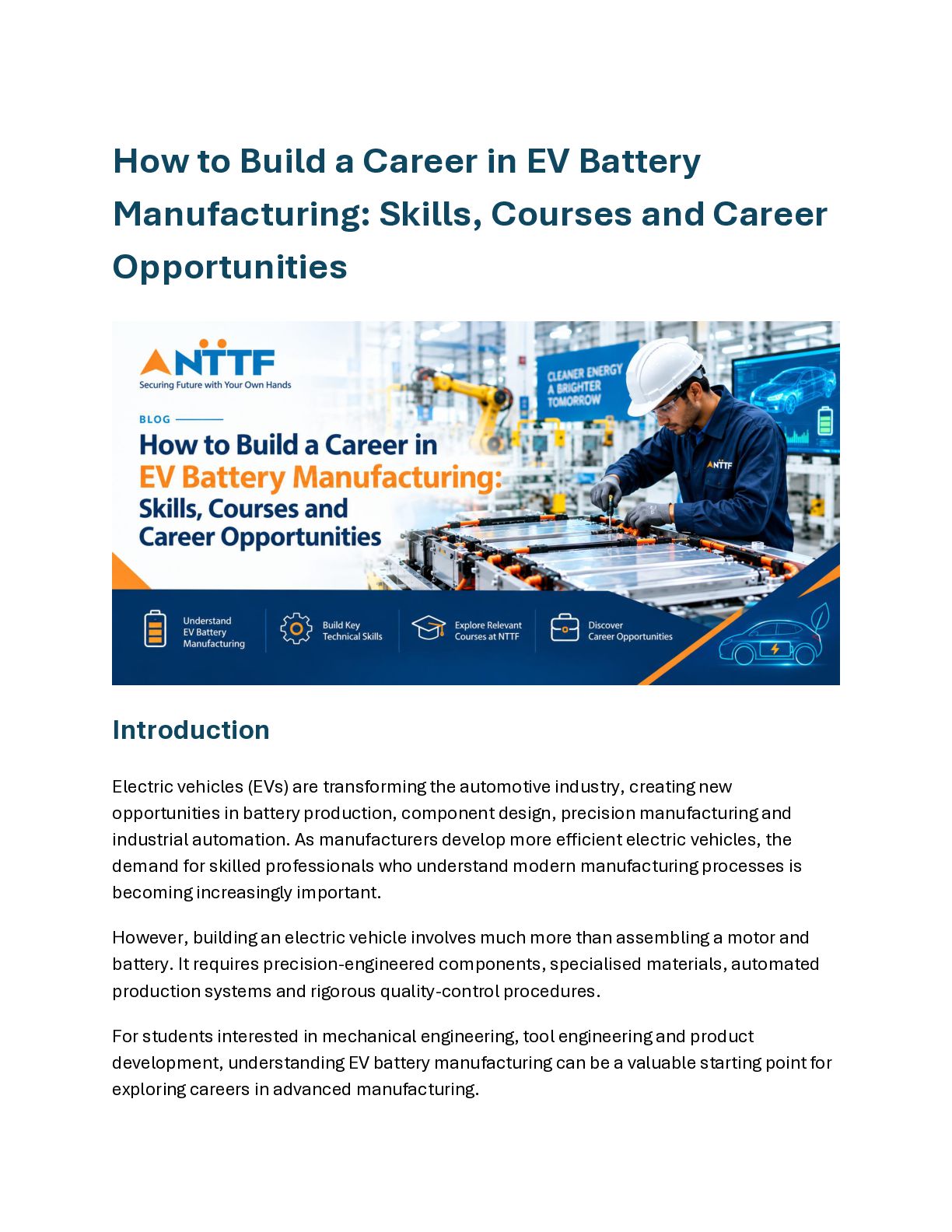
How to Build a Career in EV Battery Manufacturing: Skills, Courses and Career Opportunities

Electric vehicles (EVs) are transforming the automotive industry, creating new opportunities in battery production, component design, precision manufacturing and industrial automation. As manufacturers develop more efficient electric vehicles, the demand for skilled professionals who understand modern manufacturing processes is becoming increasingly important.

Avatar for netturtech

netturtech

October 14, 2026

Other Decks in Research

Transcript

  1. How to Build a Career in EV Battery Manufacturing: Skills,

    Courses and Career Opportunities Introduction Electric vehicles (EVs) are transforming the automotive industry, creating new opportunities in battery production, component design, precision manufacturing and industrial automation. As manufacturers develop more efficient electric vehicles, the demand for skilled professionals who understand modern manufacturing processes is becoming increasingly important. However, building an electric vehicle involves much more than assembling a motor and battery. It requires precision-engineered components, specialised materials, automated production systems and rigorous quality-control procedures. For students interested in mechanical engineering, tool engineering and product development, understanding EV battery manufacturing can be a valuable starting point for exploring careers in advanced manufacturing.
  2. Students can also explore NTTF's Postgraduate Engineering Programmes to understand

    how specialised technical education can support their interests in product development, tooling and manufacturing. What Is EV Battery Manufacturing? EV battery manufacturing is the process of producing battery cells, modules and packs that store and supply electrical energy to electric vehicles. The manufacturing process involves several stages, including electrode preparation, cell assembly, battery testing, module integration and battery pack production. Each stage requires specialised equipment, carefully controlled production environments and qualityinspection procedures. Manufacturers also depend on engineers and technicians who understand materials, mechanical components, electrical systems, automation and production efficiency. This creates opportunities for professionals across multiple technical disciplines, including mechanical engineering, electrical engineering, tool design, product development and industrial automation. 5 Essential Skills for a Career in EV Battery Manufacturing 1. Mechanical Design and Product Development Battery packs require carefully designed enclosures, mounting systems and protective structures. Mechanical design professionals help ensure that these components meet requirements for strength, durability, packaging and thermal performance. Students can develop relevant foundations through computer-aided design (CAD), engineering drawing, material selection, 3D modelling and product development. NTTF's Postgraduate Degree in Product Design & Engineering is relevant for engineering graduates interested in product development, CAD/CAE, prototyping and design for manufacturing.
  3. 2. Precision Manufacturing and Tool Design Battery manufacturing depends on

    components that meet precise dimensional and quality requirements. Tooling, fixtures, dies and specialised production equipment help manufacturers produce components accurately and consistently. Knowledge of CNC machining, CAD/CAM, engineering tolerances, tool design and manufacturing processes can be useful for students interested in automotive and batterycomponent manufacturing. Students looking to specialise in this area can explore NTTF's Postgraduate Degree in Tool Engineering and learn about areas such as advanced tooling, jigs and fixtures, tool design and manufacturing engineering. For a more focused specialisation, NTTF also offers a Postgraduate Diploma in Tool Design, which covers areas including mould design, press tools, CAD and manufacturingrelated processes. 3. Industrial Automation and Robotics Modern battery manufacturing facilities use automated equipment to handle materials, assemble components and maintain consistent production quality. Industrial automation can improve repeatability, productivity and process monitoring. As a result, knowledge of sensors, programmable logic controllers (PLCs), robotics and automated production systems can be valuable in advanced manufacturing environments. Students interested in this area should explore relevant training in mechatronics, electrical systems and industrial automation, depending on their qualifications and career goals. 4. Quality Control and Inspection Battery safety and performance depend on reliable manufacturing processes. Quality teams inspect components, monitor production parameters and identify defects before products move to the next manufacturing stage. Important skills include engineering measurement, metrology, dimensional inspection, tolerance analysis and quality-control procedures.
  4. These capabilities are relevant not only to EV battery manufacturing

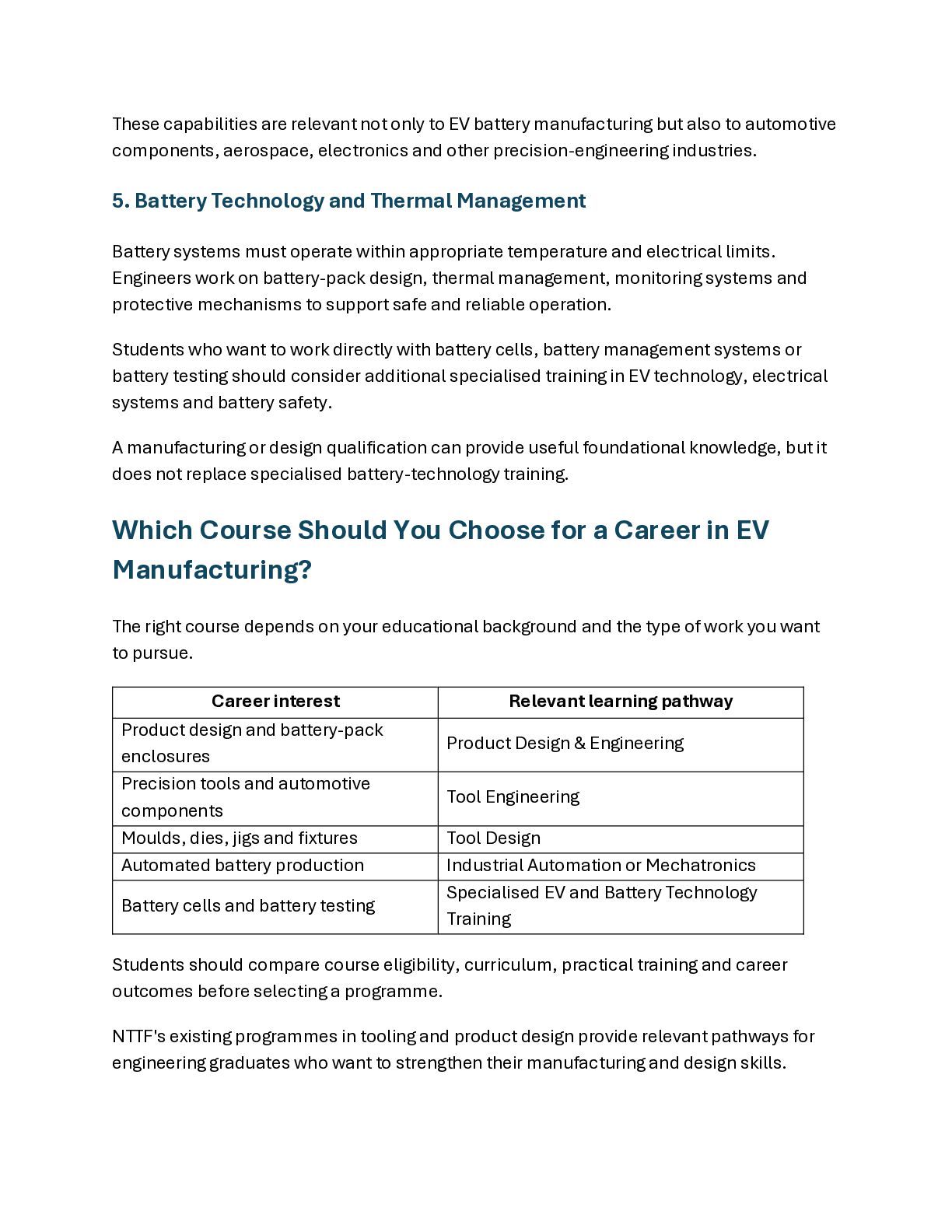
    but also to automotive components, aerospace, electronics and other precision-engineering industries. 5. Battery Technology and Thermal Management Battery systems must operate within appropriate temperature and electrical limits. Engineers work on battery-pack design, thermal management, monitoring systems and protective mechanisms to support safe and reliable operation. Students who want to work directly with battery cells, battery management systems or battery testing should consider additional specialised training in EV technology, electrical systems and battery safety. A manufacturing or design qualification can provide useful foundational knowledge, but it does not replace specialised battery-technology training. Which Course Should You Choose for a Career in EV Manufacturing? The right course depends on your educational background and the type of work you want to pursue. Career interest Product design and battery-pack enclosures Precision tools and automotive components Moulds, dies, jigs and fixtures Automated battery production Battery cells and battery testing Relevant learning pathway Product Design & Engineering Tool Engineering Tool Design Industrial Automation or Mechatronics Specialised EV and Battery Technology Training Students should compare course eligibility, curriculum, practical training and career outcomes before selecting a programme. NTTF's existing programmes in tooling and product design provide relevant pathways for engineering graduates who want to strengthen their manufacturing and design skills.
  5. Students can review the NTTF postgraduate course options to identify

    a programme aligned with their interests. Career Opportunities in EV and Battery Manufacturing Depending on qualifications, practical experience and specialised training, students can explore opportunities in roles such as: • • • • • • • Manufacturing or production technician CNC machining or programming professional Tool design or CAD/CAM technician Quality inspection technician Mechanical design technician Industrial automation technician Battery assembly or testing technician, with appropriate specialised training Some roles require specific diplomas or engineering degrees, while others require additional industry experience or specialised certifications. Students should review individual job requirements when planning their career paths. How NTTF Can Help Students Prepare for Emerging Manufacturing Technologies As manufacturing technologies evolve, students need a combination of engineering fundamentals, practical exposure and specialised technical skills. NTTF's programmes in Tool Engineering, Product Design & Engineering and Tool Design address relevant areas of design, tooling, manufacturing and product development. For example, students interested in the design and manufacture of battery-pack components can explore product development, CAD/CAE and design-for-manufacturing concepts. Those interested in precision-engineered components can investigate tool design, moulds, fixtures and manufacturing processes. Students can also read NTTF's related article, From Concept to Market: How a Postgraduate Degree in Product Design Enhances Your Career, to understand the relationship between product design education and industrial applications.
  6. Choosing a programme that matches your qualifications and career interests

    can help you build a foundation for further specialisation in advanced manufacturing. Conclusion EV battery manufacturing is an emerging area that connects multiple engineering disciplines, from mechanical design and precision tooling to automation, testing and quality assurance. Students who want to prepare for these industries should identify the technical skills required for their preferred roles and choose training that aligns with those requirements. By exploring relevant engineering and design programmes, students can develop transferable skills applicable to automotive manufacturing and other technology-driven industries. Explore NTTF's postgraduate programmes to learn more about Tool Engineering, Product Design & Engineering and Tool Design, and identify a suitable next step in your engineering career. Further Reading: Electric Vehicles: A New Career Opportunity for Diploma Engineers