Upgrade to Pro — share decks privately, control downloads, hide ads and more …

Playtime Project Guest Volunteer Orientation

Playtime Project Guest Volunteer Orientation

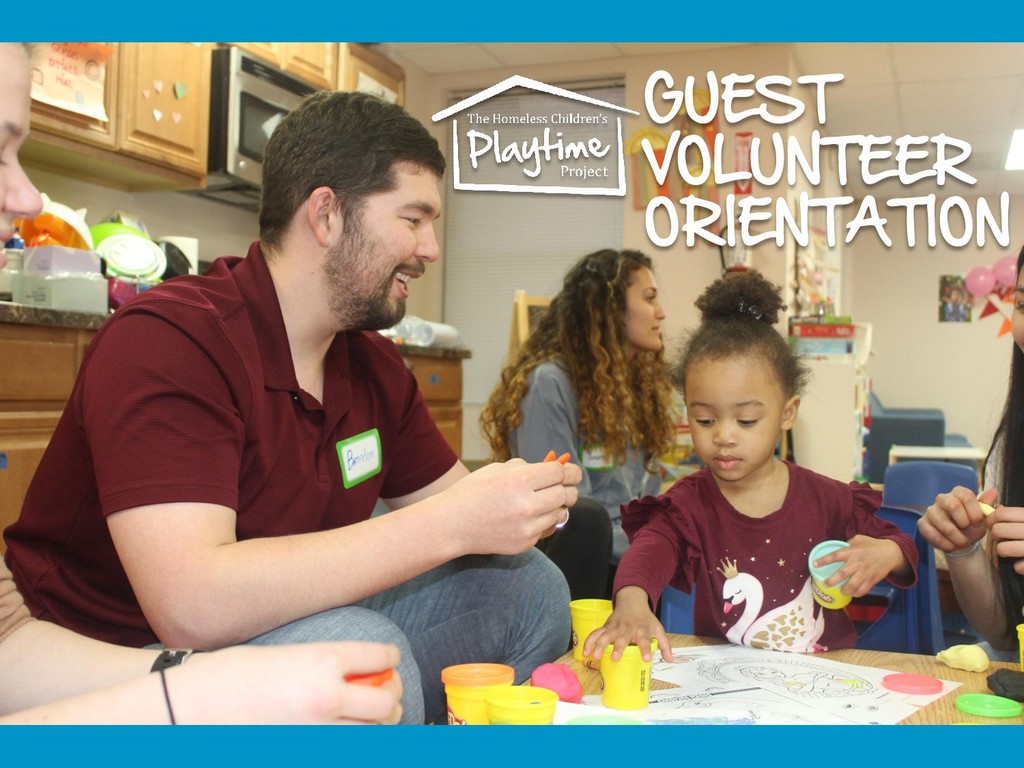
Getting ready for your one-time or group volunteer opportunity with the Homeless Children's Playtime Project? This brief orientation will give you context about the organization, the population we work with, and what you can expect from your volunteer experience with us. Thank you for your support!

Avatar for nicobuholzer

nicobuholzer

May 28, 2019

Other Decks in Education

Transcript

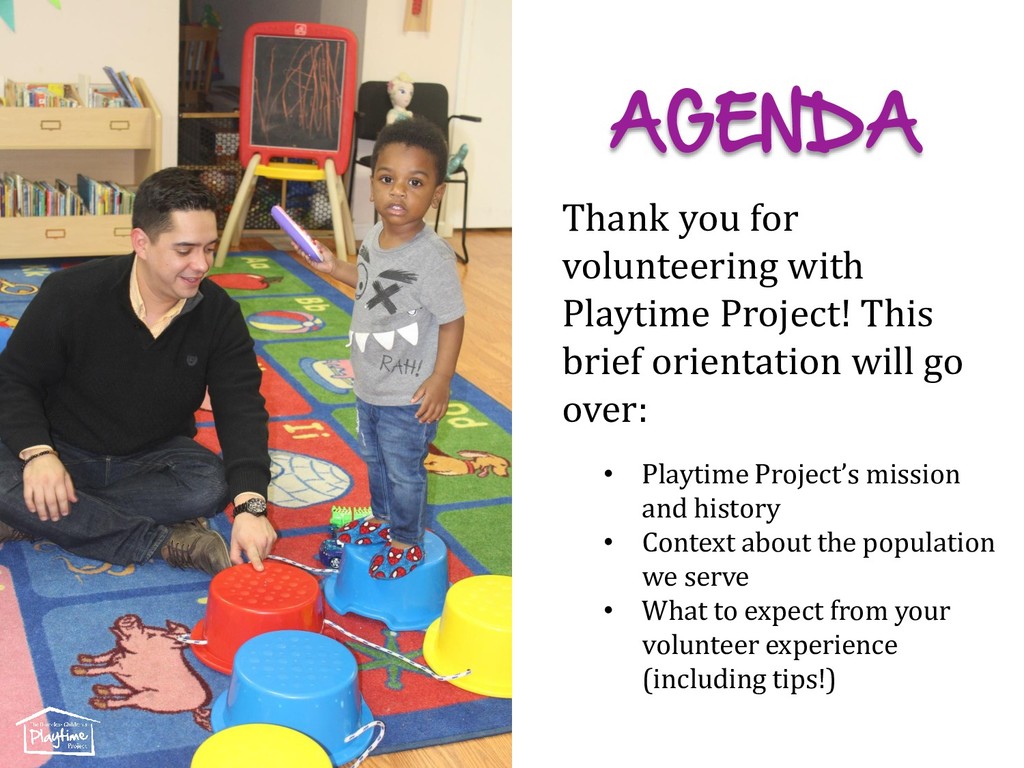
  1. AGENDA • Playtime Project’s mission and history • Context about

    the population we serve • What to expect from your volunteer experience (including tips!) Thank you for volunteering with Playtime Project! This brief orientation will go over:
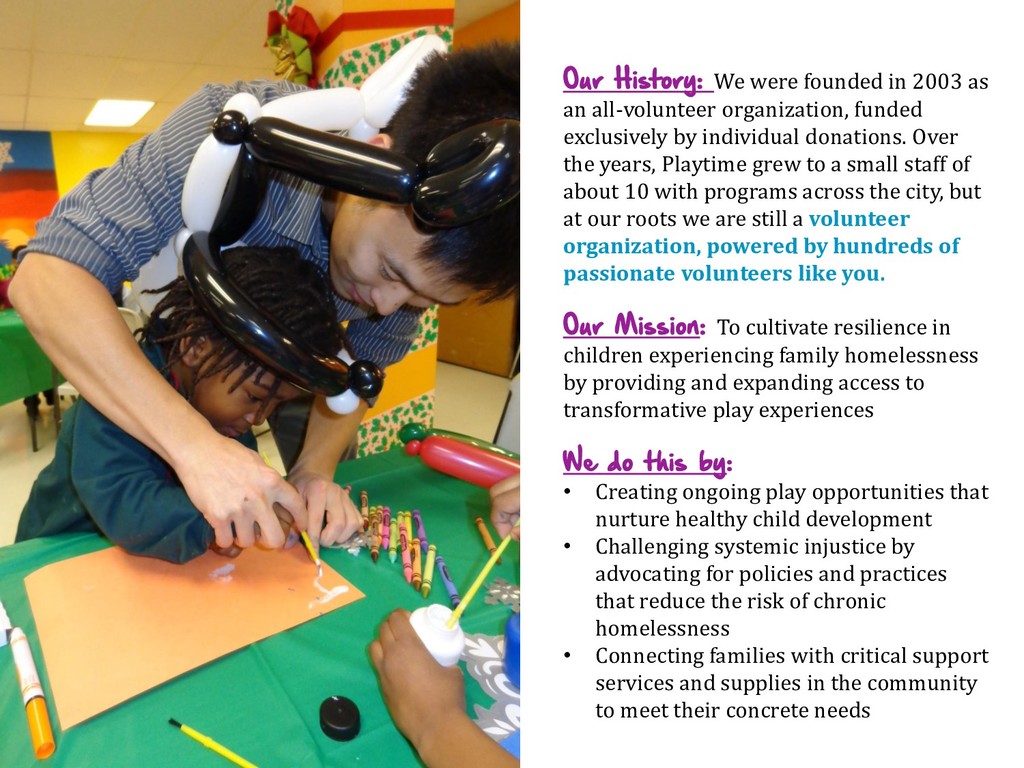
  2. Our History: We were founded in 2003 as an all-volunteer

    organization, funded exclusively by individual donations. Over the years, Playtime grew to a small staff of about 10 with programs across the city, but at our roots we are still a volunteer organization, powered by hundreds of passionate volunteers like you. Our Mission: To cultivate resilience in children experiencing family homelessness by providing and expanding access to transformative play experiences We do this by: • Creating ongoing play opportunities that nurture healthy child development • Challenging systemic injustice by advocating for policies and practices that reduce the risk of chronic homelessness • Connecting families with critical support services and supplies in the community to meet their concrete needs
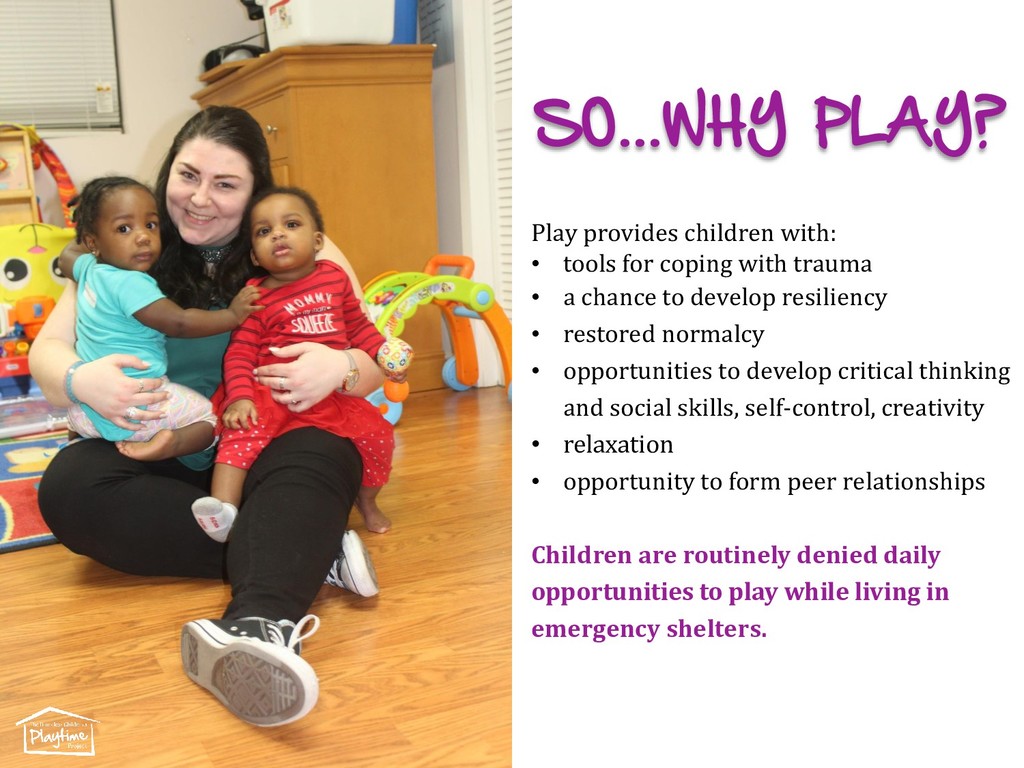
  3. Play provides children with: • tools for coping with trauma

    • a chance to develop resiliency • restored normalcy • opportunities to develop critical thinking and social skills, self-control, creativity • relaxation • opportunity to form peer relationships Children are routinely denied daily opportunities to play while living in emergency shelters. SO...WHY PLAY?
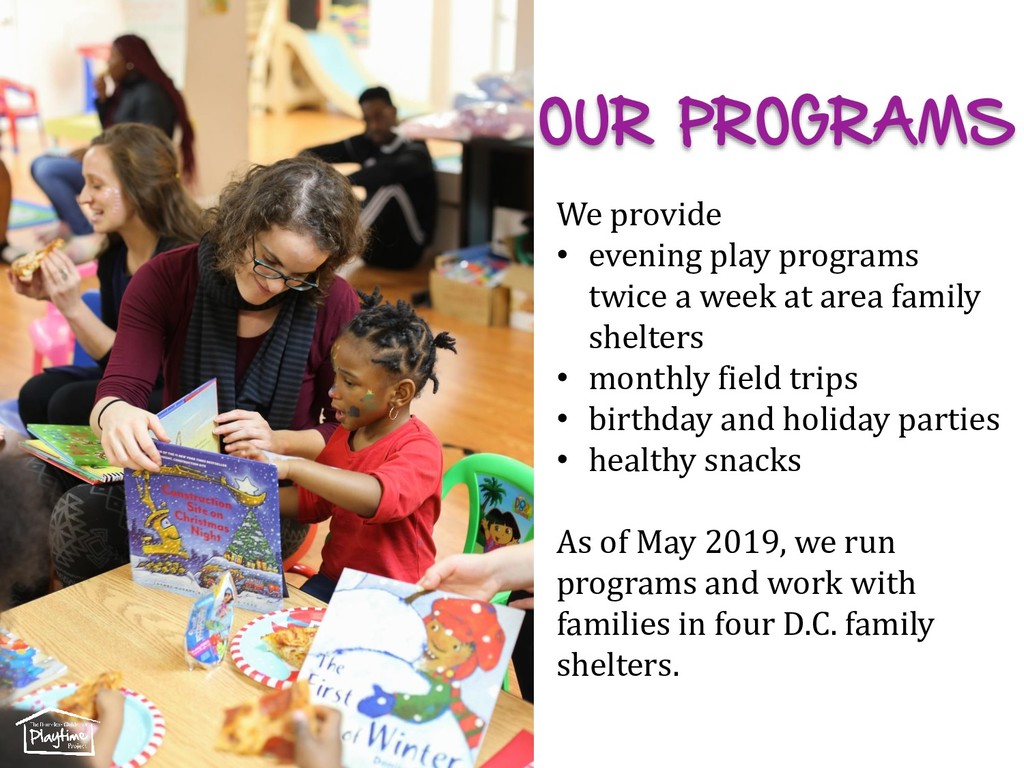
  4. OUR PROGRAMS We provide • evening play programs twice a

    week at area family shelters • monthly field trips • birthday and holiday parties • healthy snacks As of May 2019, we run programs and work with families in four D.C. family shelters.
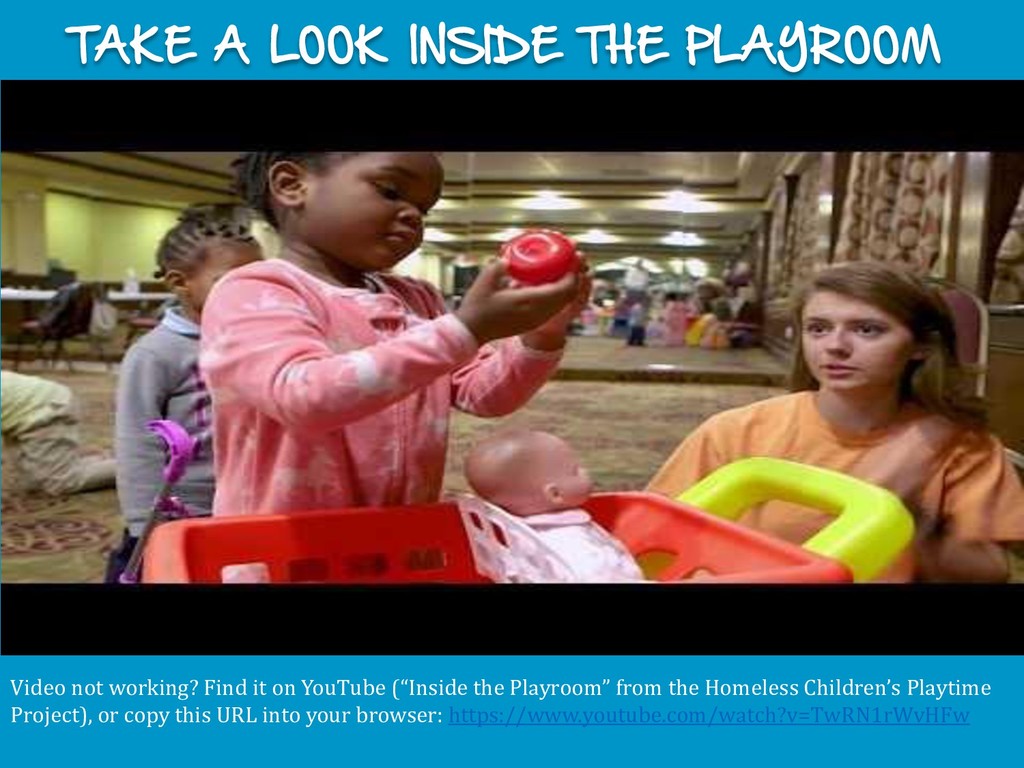
  5. TAKE A LOOK INSIDE THE PLAYROOM Video not working? Find

    it on YouTube (“Inside the Playroom” from the Homeless Children’s Playtime Project), or copy this URL into your browser: https://www.youtube.com/watch?v=TwRN1rWvHFw
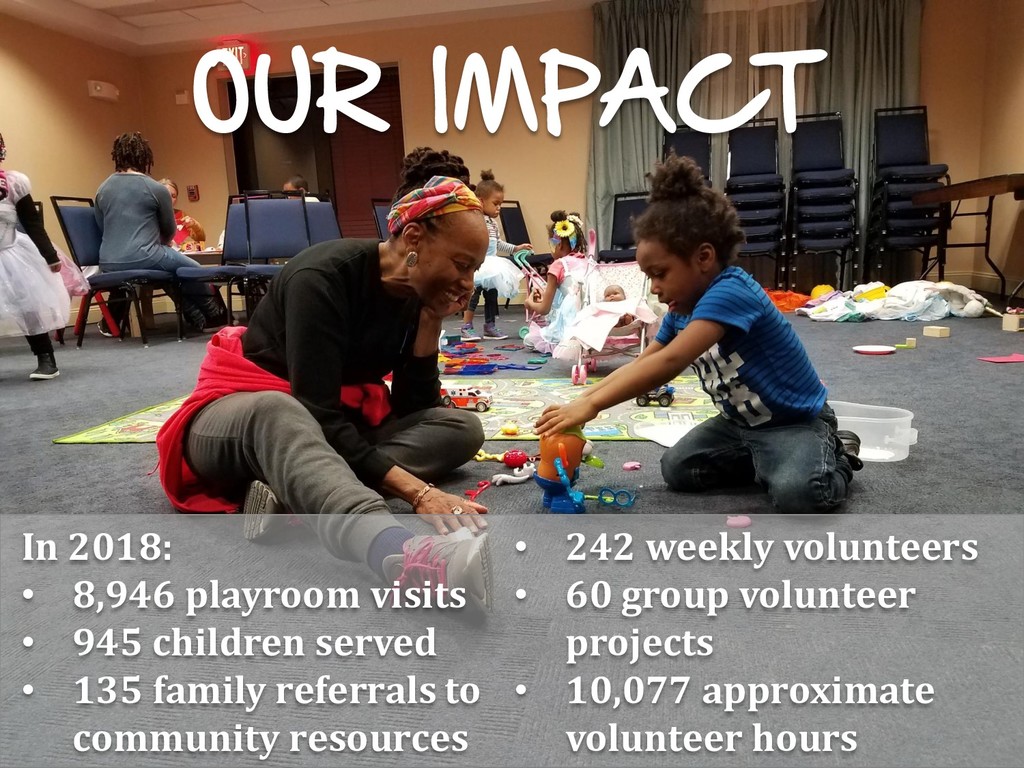
  6. OUR IMPACT In 2018: • 8,946 playroom visits • 945

    children served • 135 family referrals to community resources • 242 weekly volunteers • 60 group volunteer projects • 10,077 approximate volunteer hours
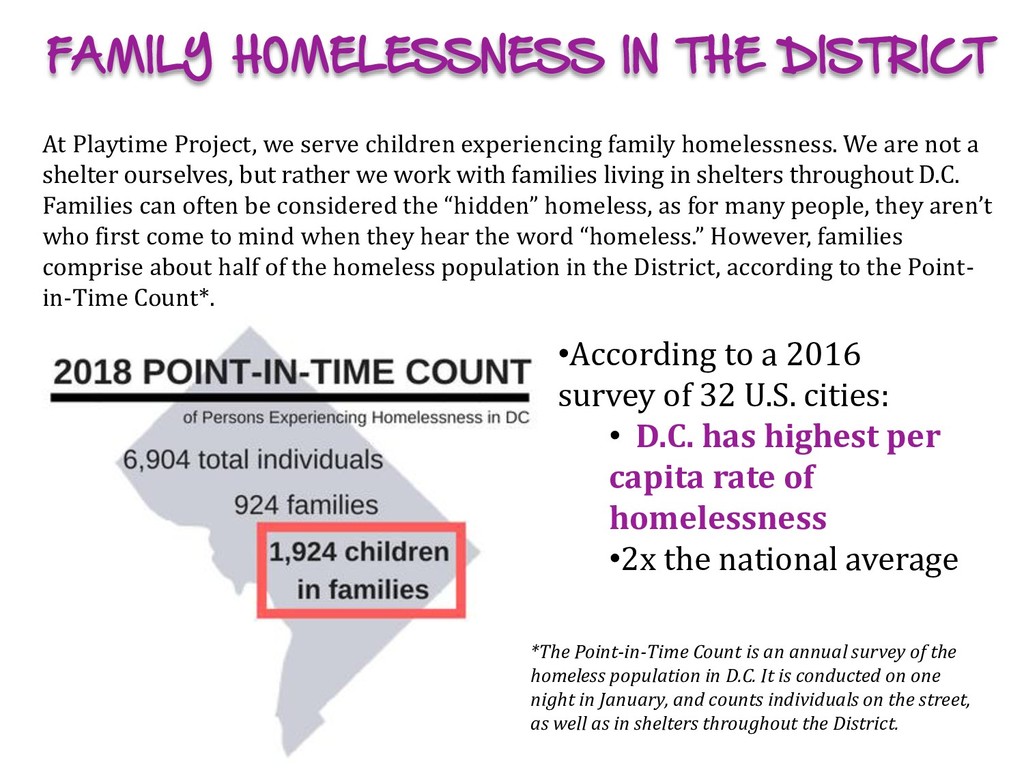
  7. At Playtime Project, we serve children experiencing family homelessness. We

    are not a shelter ourselves, but rather we work with families living in shelters throughout D.C. Families can often be considered the “hidden” homeless, as for many people, they aren’t who first come to mind when they hear the word “homeless.” However, families comprise about half of the homeless population in the District, according to the Point- in-Time Count*. FAMILY HOMELESSNESS IN THE DISTRICT *The Point-in-Time Count is an annual survey of the homeless population in D.C. It is conducted on one night in January, and counts individuals on the street, as well as in shelters throughout the District. •According to a 2016 survey of 32 U.S. cities: • D.C. has highest per capita rate of homelessness •2x the national average
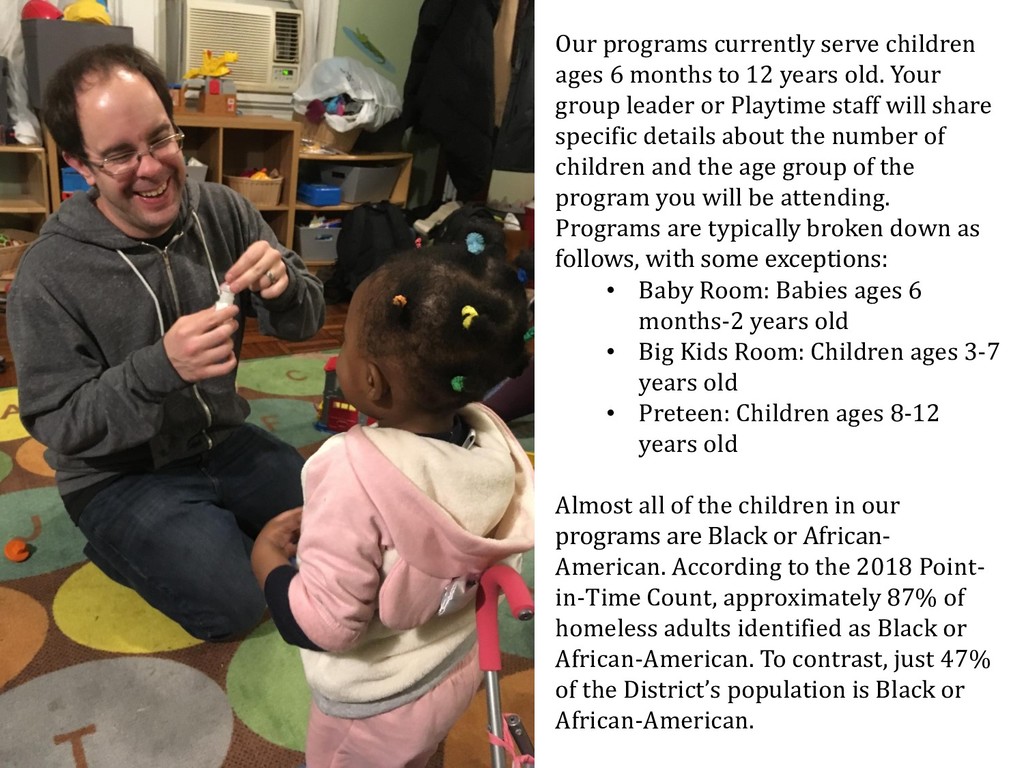
  8. Our programs currently serve children ages 6 months to 12

    years old. Your group leader or Playtime staff will share specific details about the number of children and the age group of the program you will be attending. Programs are typically broken down as follows, with some exceptions: • Baby Room: Babies ages 6 months-2 years old • Big Kids Room: Children ages 3-7 years old • Preteen: Children ages 8-12 years old Almost all of the children in our programs are Black or African- American. According to the 2018 Point- in-Time Count, approximately 87% of homeless adults identified as Black or African-American. To contrast, just 47% of the District’s population is Black or African-American.
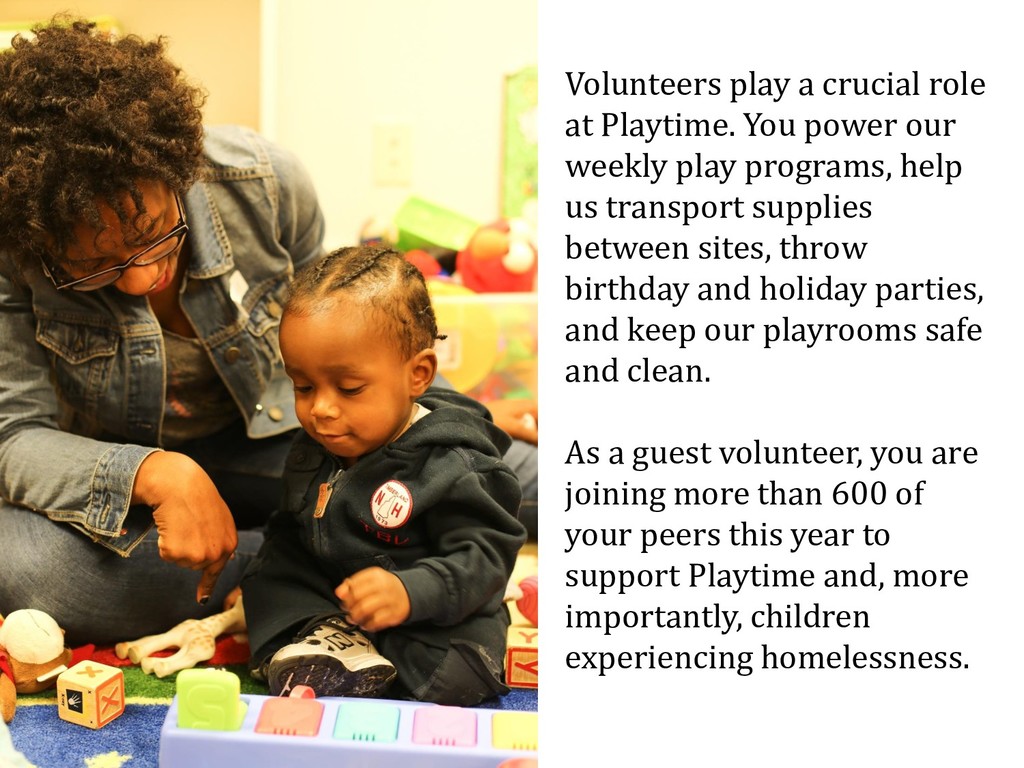
  9. Volunteers play a crucial role at Playtime. You power our

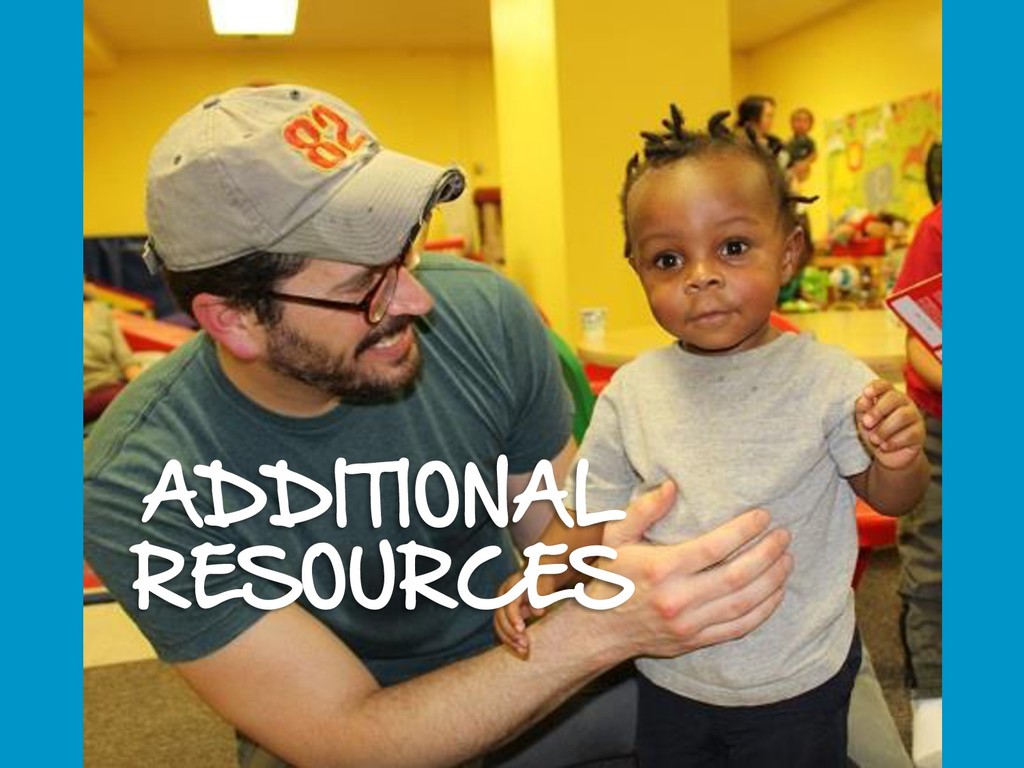
    weekly play programs, help us transport supplies between sites, throw birthday and holiday parties, and keep our playrooms safe and clean. As a guest volunteer, you are joining more than 600 of your peers this year to support Playtime and, more importantly, children experiencing homelessness.
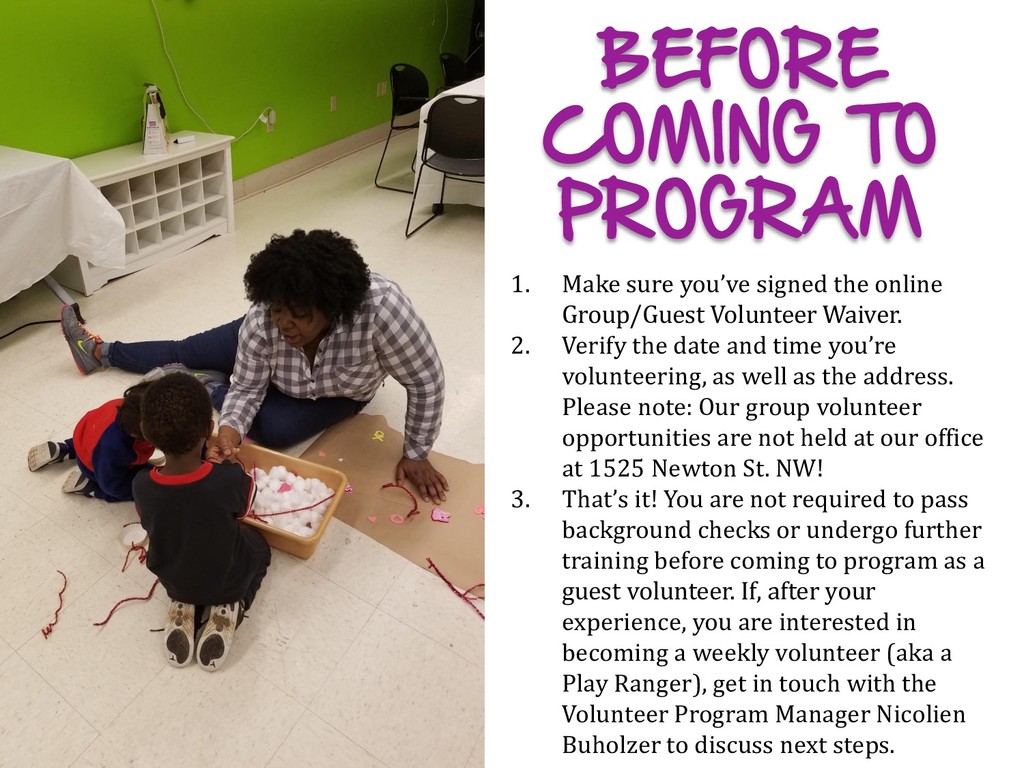
  10. BEFORE COMING TO PROGRAM 1. Make sure you’ve signed the

    online Group/Guest Volunteer Waiver. 2. Verify the date and time you’re volunteering, as well as the address. Please note: Our group volunteer opportunities are not held at our office at 1525 Newton St. NW! 3. That’s it! You are not required to pass background checks or undergo further training before coming to program as a guest volunteer. If, after your experience, you are interested in becoming a weekly volunteer (aka a Play Ranger), get in touch with the Volunteer Program Manager Nicolien Buholzer to discuss next steps.
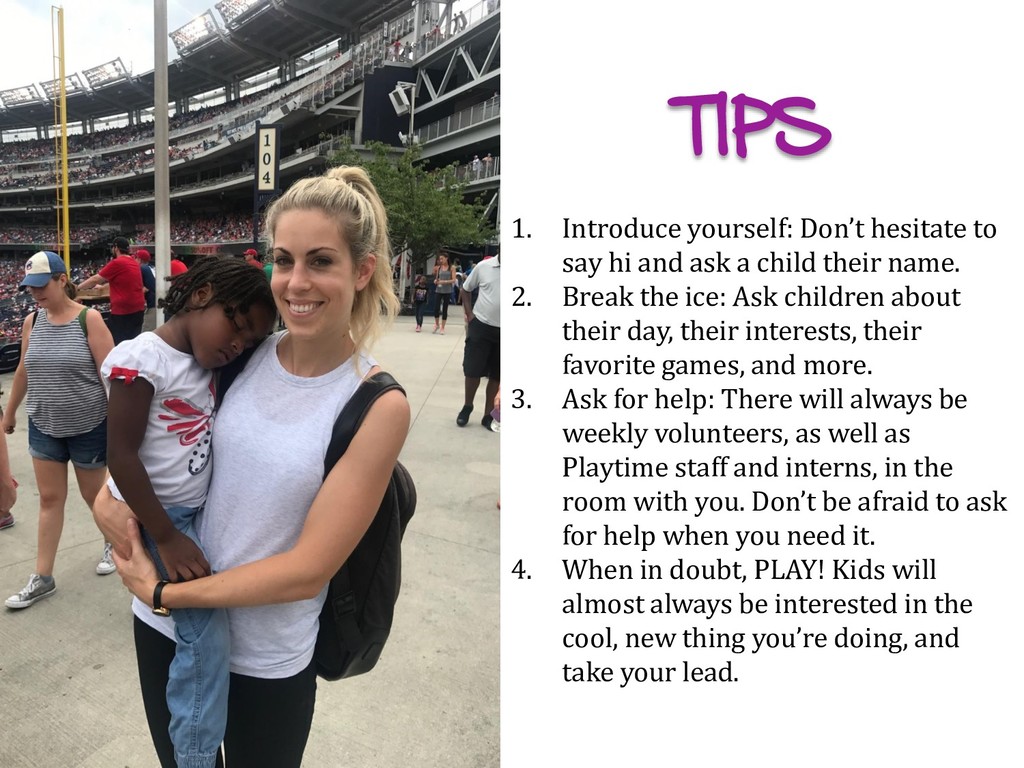
  11. TIPS 1. Introduce yourself: Don’t hesitate to say hi and

    ask a child their name. 2. Break the ice: Ask children about their day, their interests, their favorite games, and more. 3. Ask for help: There will always be weekly volunteers, as well as Playtime staff and interns, in the room with you. Don’t be afraid to ask for help when you need it. 4. When in doubt, PLAY! Kids will almost always be interested in the cool, new thing you’re doing, and take your lead.
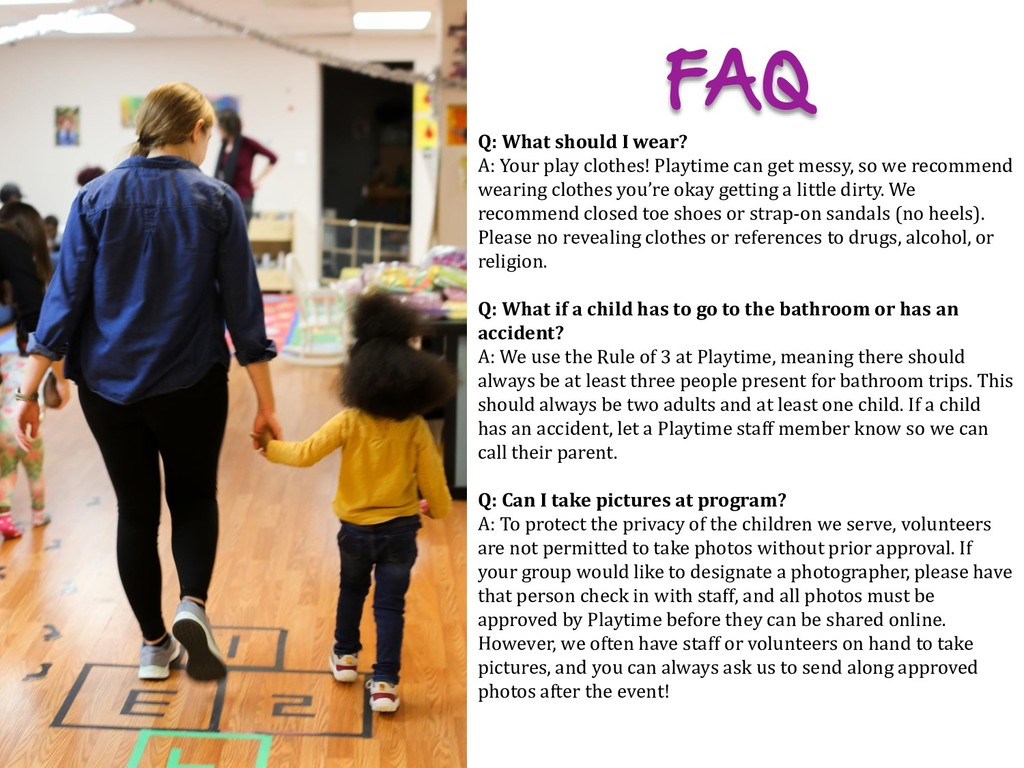
  12. FAQ Q: What should I wear? A: Your play clothes!

    Playtime can get messy, so we recommend wearing clothes you’re okay getting a little dirty. We recommend closed toe shoes or strap-on sandals (no heels). Please no revealing clothes or references to drugs, alcohol, or religion. Q: What if a child has to go to the bathroom or has an accident? A: We use the Rule of 3 at Playtime, meaning there should always be at least three people present for bathroom trips. This should always be two adults and at least one child. If a child has an accident, let a Playtime staff member know so we can call their parent. Q: Can I take pictures at program? A: To protect the privacy of the children we serve, volunteers are not permitted to take photos without prior approval. If your group would like to designate a photographer, please have that person check in with staff, and all photos must be approved by Playtime before they can be shared online. However, we often have staff or volunteers on hand to take pictures, and you can always ask us to send along approved photos after the event!
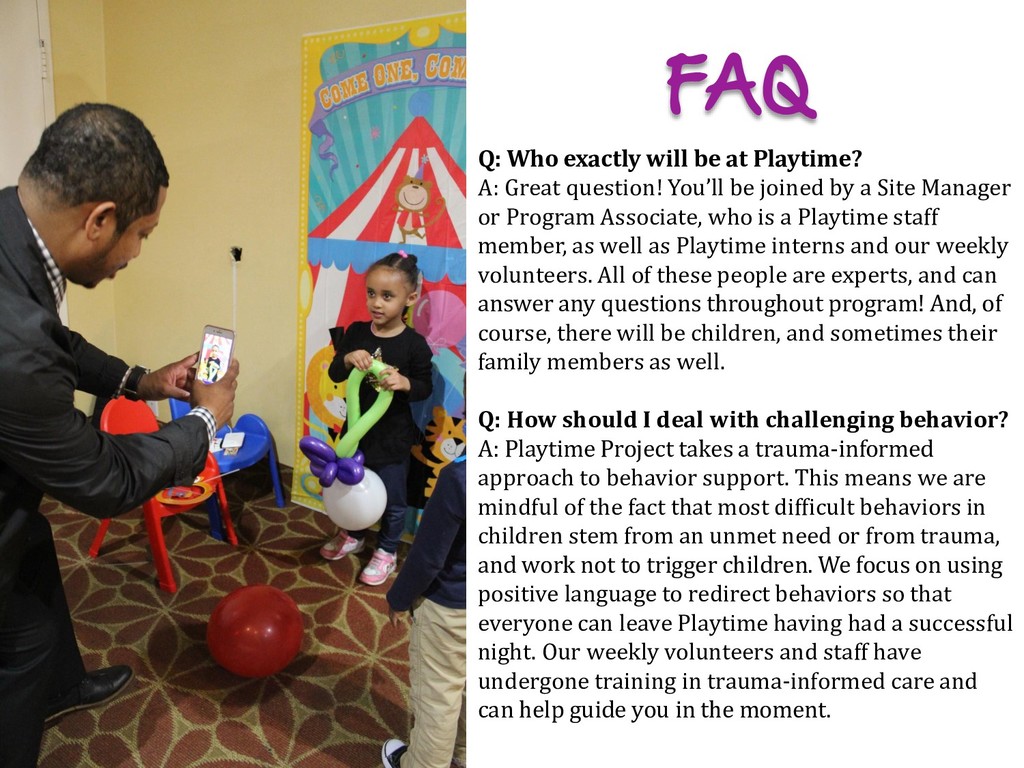
  13. FAQ Q: Who exactly will be at Playtime? A: Great

    question! You’ll be joined by a Site Manager or Program Associate, who is a Playtime staff member, as well as Playtime interns and our weekly volunteers. All of these people are experts, and can answer any questions throughout program! And, of course, there will be children, and sometimes their family members as well. Q: How should I deal with challenging behavior? A: Playtime Project takes a trauma-informed approach to behavior support. This means we are mindful of the fact that most difficult behaviors in children stem from an unmet need or from trauma, and work not to trigger children. We focus on using positive language to redirect behaviors so that everyone can leave Playtime having had a successful night. Our weekly volunteers and staff have undergone training in trauma-informed care and can help guide you in the moment.
  14. To learn more about childhood trauma and trauma-informed care: The

    National Child Traumatic Stress Network “The How and Why of Trauma Informed Teaching,” from edutopia.org Includes links to many other articles on the site regarding working with traumatized youth. Although through the lens of teaching, there are great takeaways for anyone working with youth. “Childhood Trauma and its Lifelong Health Effects More Prevalent Among Minorities,” from NPR To learn more about homelessness in the District: “D.C. Homeless Population Decreases for Second Year, But Advocates Worry Many are Still At Risk,” from WAMU “Life Inside D.C.’s Motel Homeless Shelters,” from Washington City Paper “’They say we can’t play’: What life is like for DC’s forgotten homeless kids,” from The Washington Post 2018 Point-in-Time Count, available on D.C. government website To learn more about the power of play: “Let Kids Play,” from The New York Times WANT TO LEARN MORE?
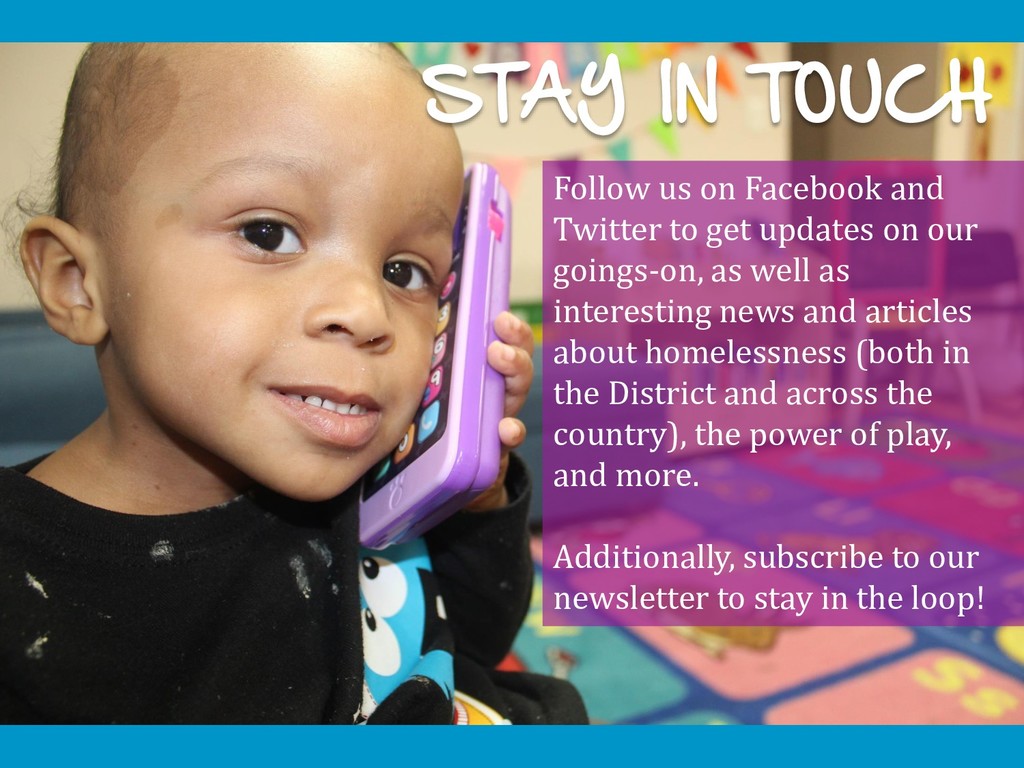
  15. Follow us on Facebook and Twitter to get updates on

    our goings-on, as well as interesting news and articles about homelessness (both in the District and across the country), the power of play, and more. Additionally, subscribe to our newsletter to stay in the loop! STAY IN TOUCH
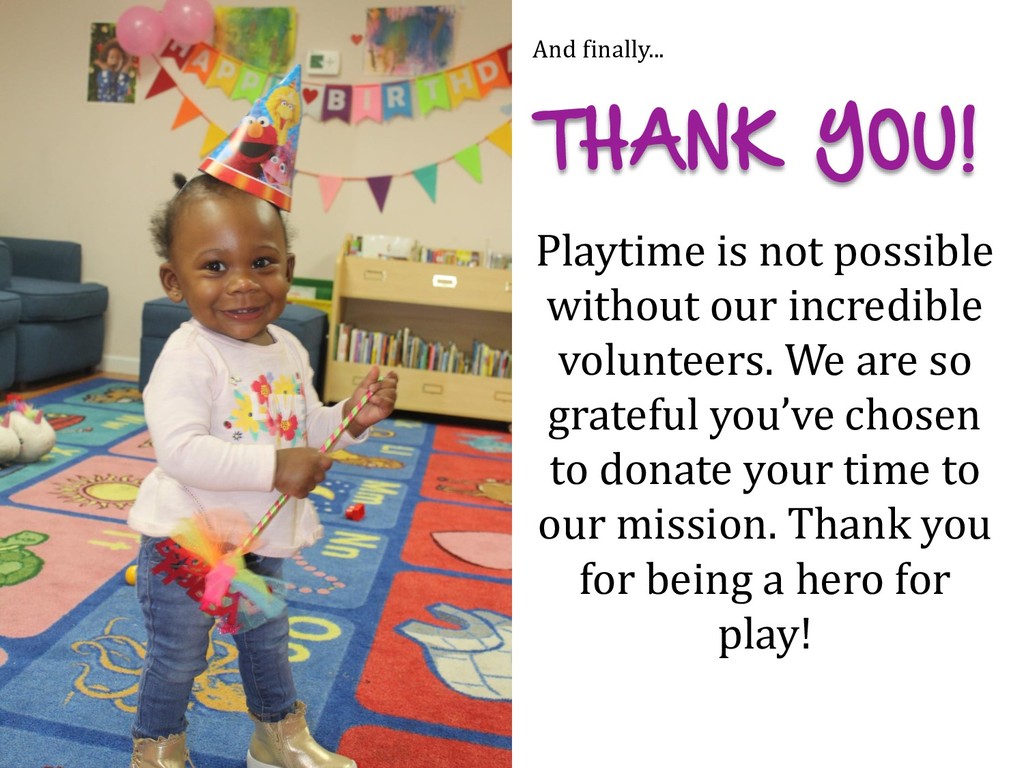
  16. THANK YOU! Playtime is not possible without our incredible volunteers.

    We are so grateful you’ve chosen to donate your time to our mission. Thank you for being a hero for play! And finally...