to Know Before You Search "STD Clinics Near Me" Published by NOVA Patient Care | Confidential STD & STI Testing Across Northern Virginia Let's just say it plainly: searching for STD testing feels uncomfortable. Even typing it into Google feels personal in a way that looking up a sore throat or a sprained ankle doesn't. And yet, millions of people do it every day — because they're responsible, because they had a scare, because they just want to know. If you're in Northern Virginia and you've found yourself searching for STD testing in Alexandria, STI testing near me, or HIV testing near me, you're doing the right thing. The fact that you're looking means you're taking your health seriously. That matters. This article is here to walk you through the basics: what to expect from STD and STI testing, which infections are commonly tested for, why certain ones like HIV and herpes require their
quickly, privately, and without judgment — across the region. First, a Note on Terminology: STD vs. STI You'll see both terms used — STD (sexually transmitted disease) and STI (sexually transmitted infection) and people sometimes wonder if there's a difference. Technically, yes. An infection becomes a disease when it causes noticeable symptoms or damage to the body. But in everyday healthcare settings, the two are used interchangeably. Some people prefer STI because it carries slightly less stigma and because many infections are caught before they ever become symptomatic. Either way, when you're searching for STI testing near me or std clinics near me, you're looking for the same thing: a provider who can test you, give you results, and help you figure out next steps. We'll use both terms throughout this article, so don't let that trip you up. Why So Many People Walk Around Not Knowing They Have an STI Here's something a lot of people don't realize: the majority of common STIs produce no obvious symptoms, at least not in the early stages. That's not rare or unusual - it's actually the norm. Chlamydia, for example, has been called the silent infection for a reason. Most people who have it feel completely fine. Same with gonorrhea, early-stage HIV, and even herpes in many cases. The absence of symptoms doesn't mean an absence of infection, and it doesn't mean there's no risk of transmission. Untreated bacterial infections like chlamydia and gonorrhea can cause serious long-term complications, pelvic inflammatory disease, infertility, chronic pelvic pain over time. And viral infections like HIV, if not caught early, become much harder to manage than they would have been with early treatment. The uncomfortable truth is that the most dangerous thing about most STIs isn't the infection itself, it's the time that passes before it's caught and treated. That's exactly why public health organizations and doctors recommend routine STI screening for anyone who is sexually active, not just when you have symptoms or a concern. If you've been putting off testing because you feel fine, that's actually the most common reason people delay and it's not a good reason.
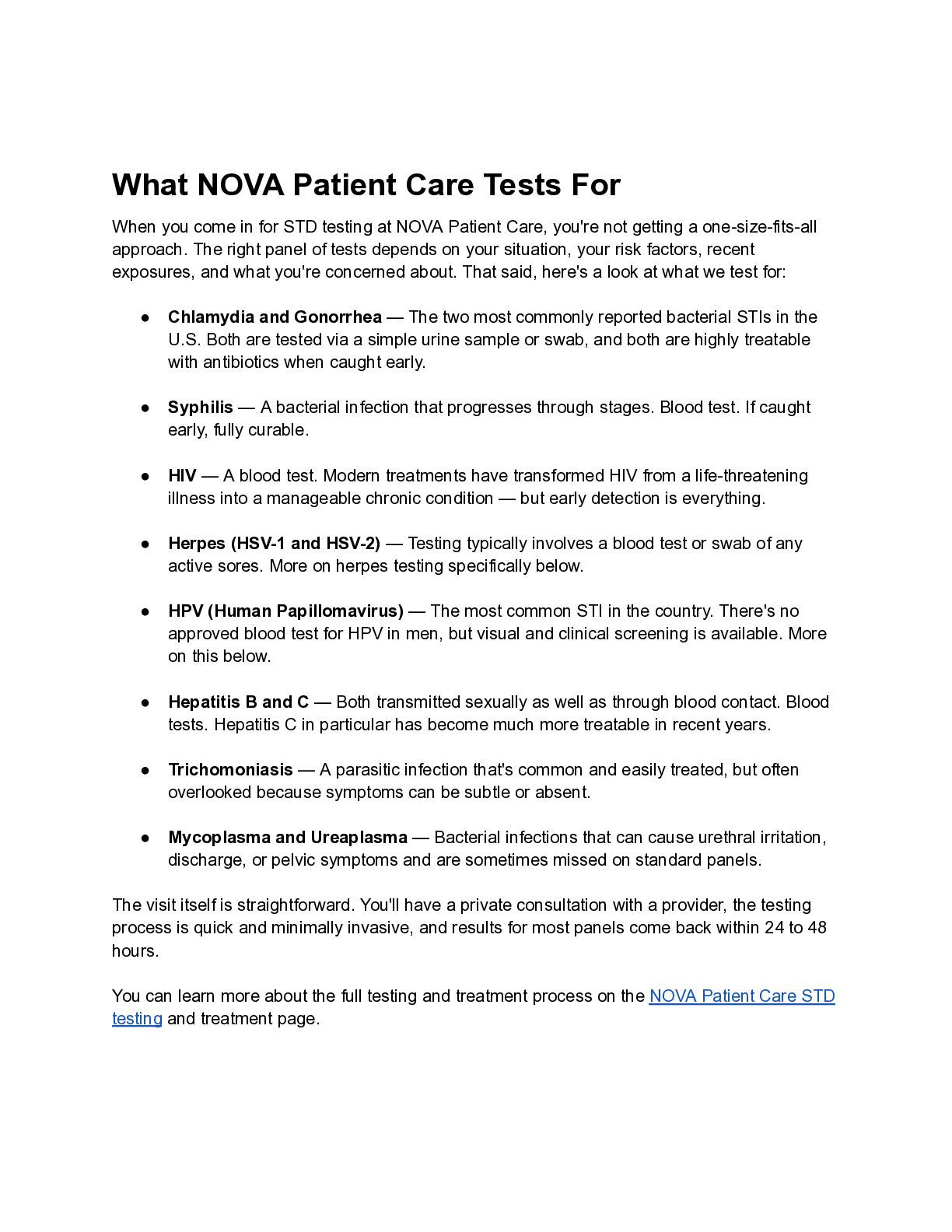
for STD testing at NOVA Patient Care, you're not getting a one-size-fits-all approach. The right panel of tests depends on your situation, your risk factors, recent exposures, and what you're concerned about. That said, here's a look at what we test for: • Chlamydia and Gonorrhea — The two most commonly reported bacterial STIs in the U.S. Both are tested via a simple urine sample or swab, and both are highly treatable with antibiotics when caught early. • Syphilis — A bacterial infection that progresses through stages. Blood test. If caught early, fully curable. • HIV — A blood test. Modern treatments have transformed HIV from a life-threatening illness into a manageable chronic condition — but early detection is everything. • Herpes (HSV-1 and HSV-2) — Testing typically involves a blood test or swab of any active sores. More on herpes testing specifically below. • HPV (Human Papillomavirus) — The most common STI in the country. There's no approved blood test for HPV in men, but visual and clinical screening is available. More on this below. • Hepatitis B and C — Both transmitted sexually as well as through blood contact. Blood tests. Hepatitis C in particular has become much more treatable in recent years. • Trichomoniasis — A parasitic infection that's common and easily treated, but often overlooked because symptoms can be subtle or absent. • Mycoplasma and Ureaplasma — Bacterial infections that can cause urethral irritation, discharge, or pelvic symptoms and are sometimes missed on standard panels. The visit itself is straightforward. You'll have a private consultation with a provider, the testing process is quick and minimally invasive, and results for most panels come back within 24 to 48 hours. You can learn more about the full testing and treatment process on the NOVA Patient Care STD testing and treatment page.
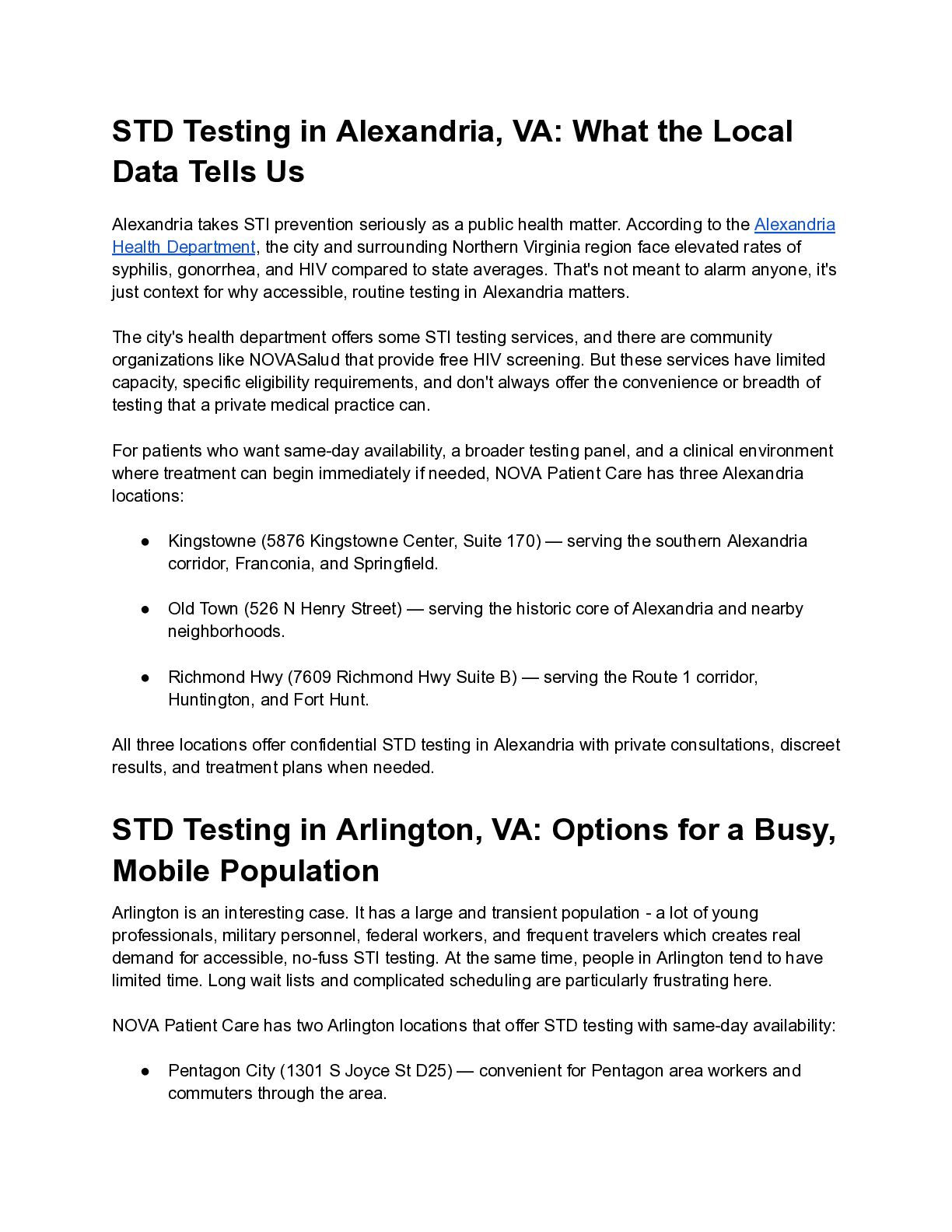
Us Alexandria takes STI prevention seriously as a public health matter. According to the Alexandria Health Department, the city and surrounding Northern Virginia region face elevated rates of syphilis, gonorrhea, and HIV compared to state averages. That's not meant to alarm anyone, it's just context for why accessible, routine testing in Alexandria matters. The city's health department offers some STI testing services, and there are community organizations like NOVASalud that provide free HIV screening. But these services have limited capacity, specific eligibility requirements, and don't always offer the convenience or breadth of testing that a private medical practice can. For patients who want same-day availability, a broader testing panel, and a clinical environment where treatment can begin immediately if needed, NOVA Patient Care has three Alexandria locations: • Kingstowne (5876 Kingstowne Center, Suite 170) — serving the southern Alexandria corridor, Franconia, and Springfield. • Old Town (526 N Henry Street) — serving the historic core of Alexandria and nearby neighborhoods. • Richmond Hwy (7609 Richmond Hwy Suite B) — serving the Route 1 corridor, Huntington, and Fort Hunt. All three locations offer confidential STD testing in Alexandria with private consultations, discreet results, and treatment plans when needed. STD Testing in Arlington, VA: Options for a Busy, Mobile Population Arlington is an interesting case. It has a large and transient population - a lot of young professionals, military personnel, federal workers, and frequent travelers which creates real demand for accessible, no-fuss STI testing. At the same time, people in Arlington tend to have limited time. Long wait lists and complicated scheduling are particularly frustrating here. NOVA Patient Care has two Arlington locations that offer STD testing with same-day availability: • Pentagon City (1301 S Joyce St D25) — convenient for Pentagon area workers and commuters through the area.
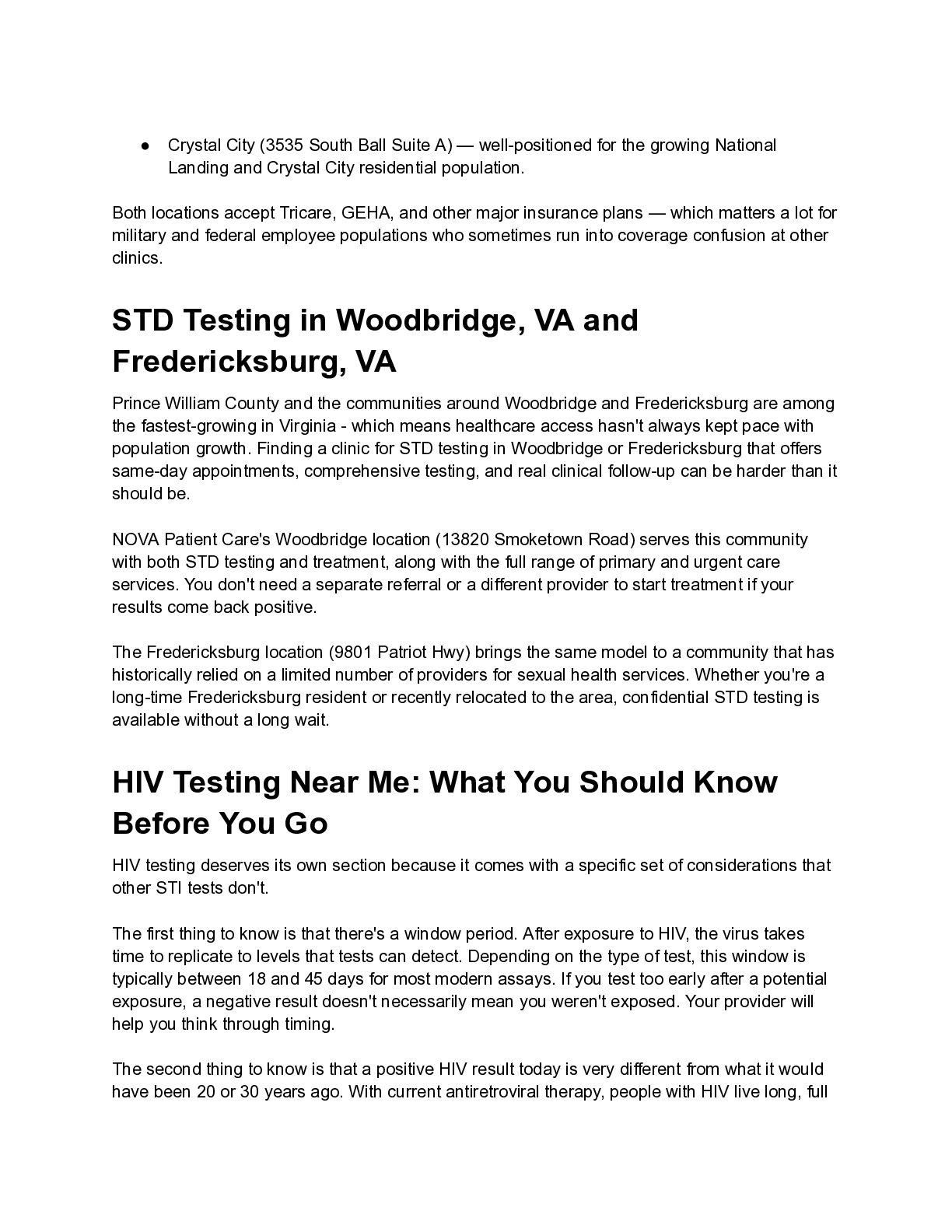
for the growing National Landing and Crystal City residential population. Both locations accept Tricare, GEHA, and other major insurance plans — which matters a lot for military and federal employee populations who sometimes run into coverage confusion at other clinics. STD Testing in Woodbridge, VA and Fredericksburg, VA Prince William County and the communities around Woodbridge and Fredericksburg are among the fastest-growing in Virginia - which means healthcare access hasn't always kept pace with population growth. Finding a clinic for STD testing in Woodbridge or Fredericksburg that offers same-day appointments, comprehensive testing, and real clinical follow-up can be harder than it should be. NOVA Patient Care's Woodbridge location (13820 Smoketown Road) serves this community with both STD testing and treatment, along with the full range of primary and urgent care services. You don't need a separate referral or a different provider to start treatment if your results come back positive. The Fredericksburg location (9801 Patriot Hwy) brings the same model to a community that has historically relied on a limited number of providers for sexual health services. Whether you're a long-time Fredericksburg resident or recently relocated to the area, confidential STD testing is available without a long wait. HIV Testing Near Me: What You Should Know Before You Go HIV testing deserves its own section because it comes with a specific set of considerations that other STI tests don't. The first thing to know is that there's a window period. After exposure to HIV, the virus takes time to replicate to levels that tests can detect. Depending on the type of test, this window is typically between 18 and 45 days for most modern assays. If you test too early after a potential exposure, a negative result doesn't necessarily mean you weren't exposed. Your provider will help you think through timing. The second thing to know is that a positive HIV result today is very different from what it would have been 20 or 30 years ago. With current antiretroviral therapy, people with HIV live long, full
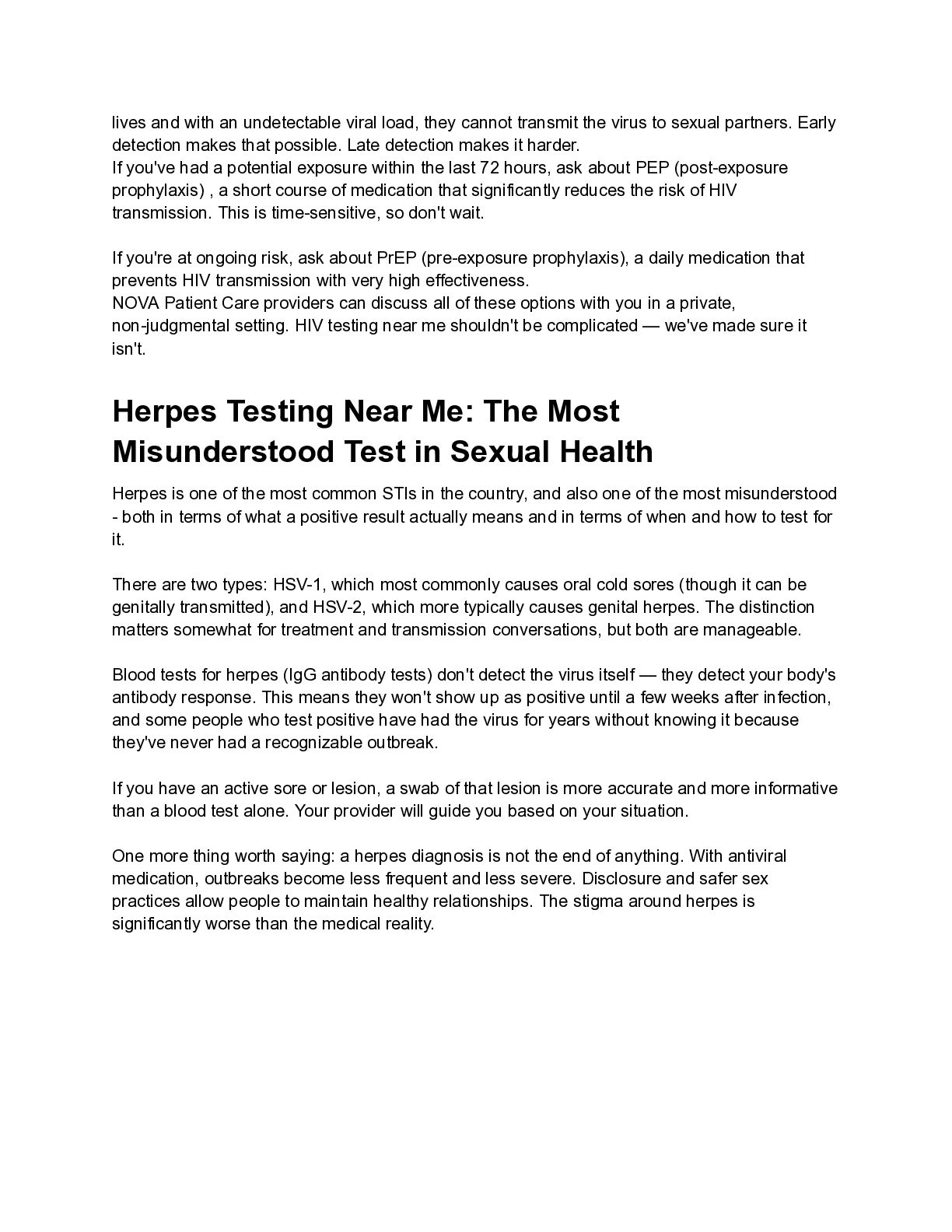
the virus to sexual partners. Early detection makes that possible. Late detection makes it harder. If you've had a potential exposure within the last 72 hours, ask about PEP (post-exposure prophylaxis) , a short course of medication that significantly reduces the risk of HIV transmission. This is time-sensitive, so don't wait. If you're at ongoing risk, ask about PrEP (pre-exposure prophylaxis), a daily medication that prevents HIV transmission with very high effectiveness. NOVA Patient Care providers can discuss all of these options with you in a private, non-judgmental setting. HIV testing near me shouldn't be complicated — we've made sure it isn't. Herpes Testing Near Me: The Most Misunderstood Test in Sexual Health Herpes is one of the most common STIs in the country, and also one of the most misunderstood - both in terms of what a positive result actually means and in terms of when and how to test for it. There are two types: HSV-1, which most commonly causes oral cold sores (though it can be genitally transmitted), and HSV-2, which more typically causes genital herpes. The distinction matters somewhat for treatment and transmission conversations, but both are manageable. Blood tests for herpes (IgG antibody tests) don't detect the virus itself — they detect your body's antibody response. This means they won't show up as positive until a few weeks after infection, and some people who test positive have had the virus for years without knowing it because they've never had a recognizable outbreak. If you have an active sore or lesion, a swab of that lesion is more accurate and more informative than a blood test alone. Your provider will guide you based on your situation. One more thing worth saying: a herpes diagnosis is not the end of anything. With antiviral medication, outbreaks become less frequent and less severe. Disclosure and safer sex practices allow people to maintain healthy relationships. The stigma around herpes is significantly worse than the medical reality.
What's Available Here's something a lot of men don't know: there is currently no FDA-approved HPV test for men. This surprises people, especially since HPV is the most common sexually transmitted infection in the United States and causes several cancers that affect men, including anal cancer, penile cancer, and oropharyngeal (throat) cancer. For women, Pap smears and HPV co-testing are part of routine gynecological care. For men, the situation is different. There's no standard blood test that tells you whether you currently have HPV. The virus is typically identified through visual inspection, swabbing of lesions (in the case of genital warts), or — in certain high-risk populations — anal Pap smears. What men can do proactively is get vaccinated. The HPV vaccine (Gardasil 9) is recommended for males up to age 26, and in some cases up to age 45 in consultation with a provider. It protects against the strains of HPV most associated with cancer and genital warts. If you have visible genital warts, penile sores, or are in a higher-risk group for anal HPV, a clinical exam at NOVA Patient Care is the appropriate starting point. Providers can also discuss the vaccine, screen for other STIs at the same visit, and — if relevant — address related concerns like erectile health, which can sometimes intersect with STI history and treatment. Same-Day STD Testing: Why It Matters More Than You Think When someone decides to get tested for an STI, there's usually a reason. Maybe they had an encounter they're unsure about. Maybe a partner disclosed something. Maybe they just haven't been tested in a while and want to check in. Whatever the reason, the window between 'I should get tested' and actually walking through a clinic door is where things fall apart for a lot of people. The longer the wait, the more room there is for second-guessing, anxiety, and ultimately not following through. That's just human nature. That's why same-day STD testing is such a meaningful option. NOVA Patient Care offers same-day appointments at our locations across Northern Virginia, which means if you decide today is the day, you don't have to wait a week for availability. You come in, you're seen by a provider, testing is done, and results are typically back within 24 to 48 hours. No awkward scheduling conversations. No sitting in a waiting room with a sign on the door. Just a clinical visit handled the same way any other health concern would be.
That's Actually a Good Thing A lot of people don't realize that urgent care clinics can and do handle STD testing. There's a mental image of urgent care as a place for sprained ankles and strep throat — not sexual health. But that's changed significantly. At NOVA Patient Care, urgent care STD testing is a real and available option. This is actually ideal for a lot of people, because: • You don't need a pre-established relationship with a provider. Walk-in availability means you can come in whenever you work • Hours are flexible. NOVA Patient Care locations are open Monday through Saturday, which means you're not trying to squeeze in a sensitive appointment during your workday. • Treatment can start the same day. If your results indicate a bacterial infection, antibiotics can be prescribed immediately. You're not waiting on a referral. • Everything is handled under one roof. Testing, results, treatment, and preventive counseling all happen at the same location with the same team. The only thing urgent care STD testing isn't right for is life-threatening emergencies. But for the vast majority of STI concerns — routine screening, a potential exposure, symptoms that need evaluation — urgent care is entirely appropriate. What to Expect When You Come In: Removing the Uncertainty One of the reasons people put off STD testing — beyond the emotional discomfort — is simply not knowing what to expect. So let's walk through it. When you arrive at a NOVA Patient Care location for STI testing, you'll have a private consultation with a provider. This is a real conversation, not a form to fill out in a waiting room. They'll ask about your situation — your concerns, any symptoms, recent exposures, your sexual history in broad terms — and use that to recommend the right testing panel. The tests themselves are quick and minimally uncomfortable. Depending on what's being tested, it might involve a urine sample, a blood draw, or a swab. Most people are surprised by how unremarkable the process actually is.
tests. Your provider will go over them with you and discuss next steps — which might be nothing at all, or might be a simple course of antibiotics, or might involve a more detailed conversation about ongoing management. If you're wondering about routine screening as part of your regular healthcare — not just in response to a specific concern — that's covered on our STD screening page. Annual or semi-annual screening is something we build into primary care for appropriate patients. A Word on Privacy and Confidentiality This comes up every time, so let's address it directly. STD testing at NOVA Patient Care is confidential. Your results are part of your medical record, subject to the same HIPAA protections as any other health information. They are not shared with employers, family members, or anyone else without your explicit authorization. If you test positive for certain reportable infections — HIV, syphilis, gonorrhea, chlamydia, and a few others are mandatorily reported to state and local health departments under Virginia law — that reporting is done without your name attached. The health department tracks these by demographics and location for public health surveillance purposes, not for individual identification. The people in the room are medical professionals. The conversation you have with your provider isn't going to be repeated at the front desk. If discretion matters to you — and it matters to most people — know that you're in a clinical environment where that's taken seriously. Conclusion Getting tested for STDs or STIs is not a sign that something is wrong with you. It's a sign that you understand how your health works and that you're willing to do something about it. That's genuinely worth respecting. Whether you're in Alexandria, Arlington, Woodbridge, Fredericksburg, or anywhere else in Northern Virginia, there's a NOVA Patient Care location close to you — with same-day availability, board-certified providers, comprehensive testing, and a clinical environment that treats you like an adult. Stop sitting on the search results page. Book online, call us, or walk in. The appointment is straightforward. The results are private. And whatever comes back, you'll be in better shape knowing than not knowing. That's really the whole point.
not constitute medical advice. Always consult a qualified healthcare provider for diagnosis and personalized treatment. In a medical emergency, call 911 or go to the nearest emergency room.


 novapatientcare
 signer
 matleenalaakso
 camel_404
 yasslab
 yatabe
 ainischool
 naochim2026
 robintux
 ichiroc
 madoxten
 kimpetersen
 axbom
 tammyeverts
 paigeccino
 aleyda
 kristinabergwall1
 oripsolob
 lemiorhan
 jonoalderson
 helenjbeal