Upgrade to Pro — share decks privately, control downloads, hide ads and more …

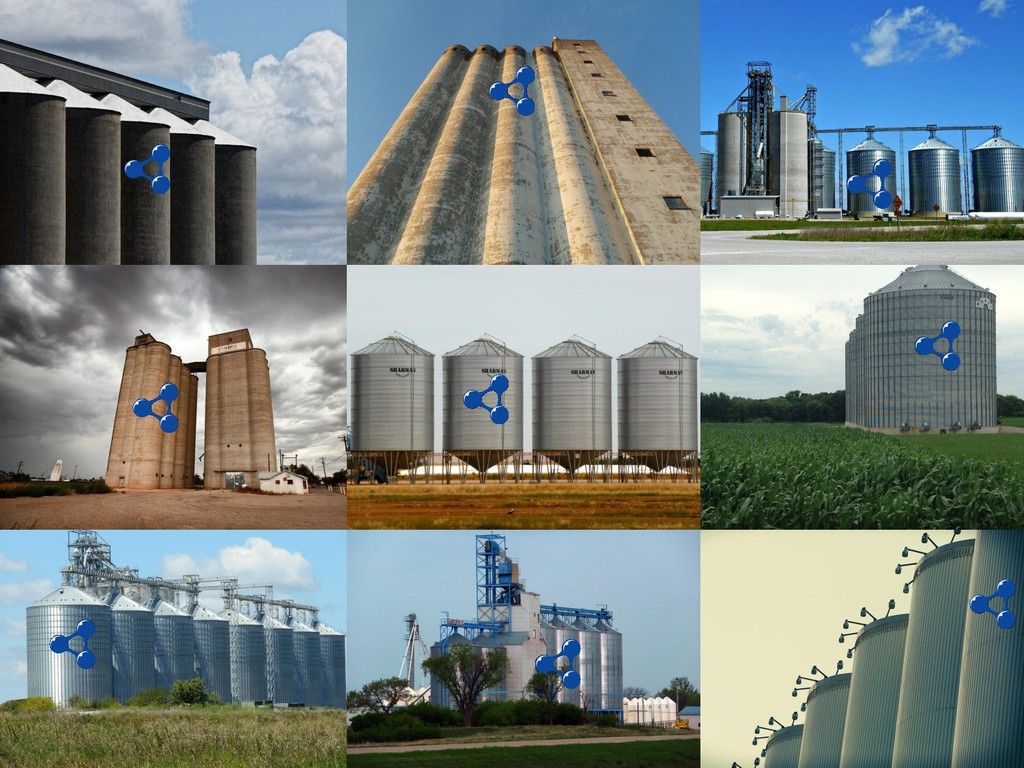
From MARC silos to Linked Data silos? (DCMI web...

From MARC silos to Linked Data silos? (DCMI webinar)

This is the slide deck for an hour-long DCMI webinar. It is an extended version of the SWIB16 talk with the same headline.

Subtitle: Data models for bibliographic Linked Data

Video recording: https://www.youtube.com/watch?v=oS1IwSKO3e8

Full abstract:

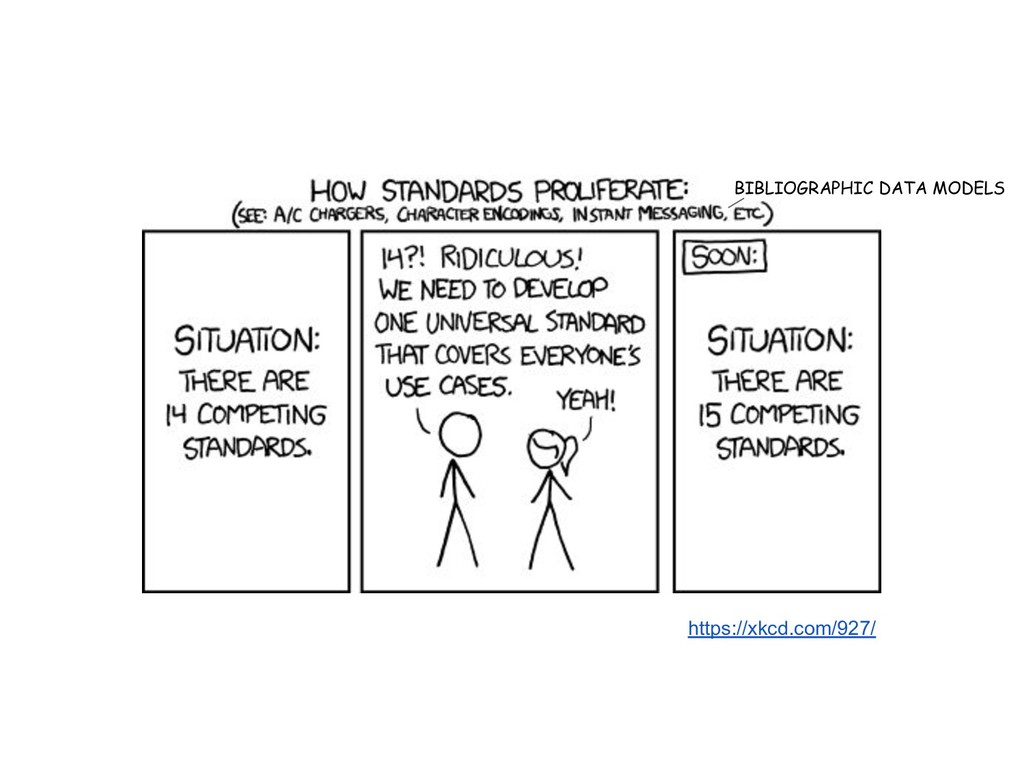
Many libraries are experimenting with publishing their metadata as Linked Data to open up bibliographic silos, usually based on MARC records, to the Web. The libraries who have published Linked Data have all used different data models for structuring their bibliographic data. Some are using a FRBR-based model where Works, Expressions and Manifestations are represented separately. Others have chosen basic Dublin Core, dumbing down their data into a lowest common denominator format. And still others are using variations of BIBFRAME. The proliferation of data models limits the reusability of bibliographic data. In effect, libraries have moved from MARC silos to Linked Data silos of incompatible data models. There is currently no universal model for how to represent bibliographic metadata as Linked Data, even though many attempts for such a model have been made.

In this webinar, by Osma Suominen of the National Library of Finland, will present: (1) a survey of published bibliographic Linked Data, the data models proposed for representing bibliographic data as RDF, and tools used for conversion from MARC records; (2) an analysis of different use cases for bibliographic Linked Data and how they affect the data model; and (3) recommendations for choosing a data model.

Google Slides: https://tinyurl.com/linked-silos-webinar

Avatar for Osma Suominen

Osma Suominen

February 28, 2017
Tweet

More Decks by Osma Suominen

Other Decks in Technology

Transcript

  1. From MARC silos to Linked Data silos? Data models for

    bibliographic Linked Data Osma Suominen DCMI webinar February 28, 2017
  2. About the National Library of Finland • The National Library

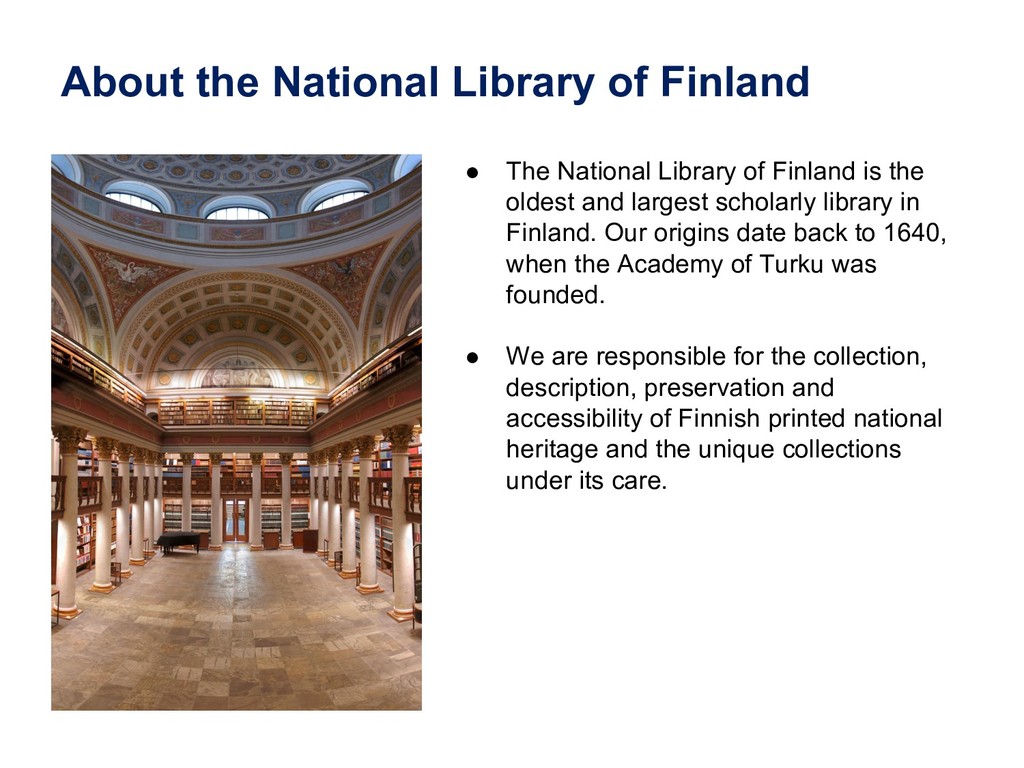
    of Finland is the oldest and largest scholarly library in Finland. Our origins date back to 1640, when the Academy of Turku was founded. • We are responsible for the collection, description, preservation and accessibility of Finnish printed national heritage and the unique collections under its care.
  3. About me Osma Suominen Information Systems Specialist at the National

    Library of Finland PhD thesis “Methods for Building Semantic Portals” from the Semantic Computing Research Group at Aalto University, 2013 Joined the National Library of Finland in 2013 to set up the Finto.fi thesaurus and ontology service Currently working on opening up Finnish bibliographic metadata as Linked Data Open source software projects e.g. Skosify - Validation and QA tool for SKOS vocabularies Skosmos - SKOS vocabulary publishing tool DCMI Governing Board member SWIB conference Programme Committee member Apache Jena project committer & PMC member Twitter: @OsmaSuominen LinkedIn: osmasuominen (I accept invites only from people I’ve met) GitHub: @osma
  4. Contents 1. Overview of current data models for bibliographic data

    2. Publishing Finnish bibliographic data as Linked Open Data
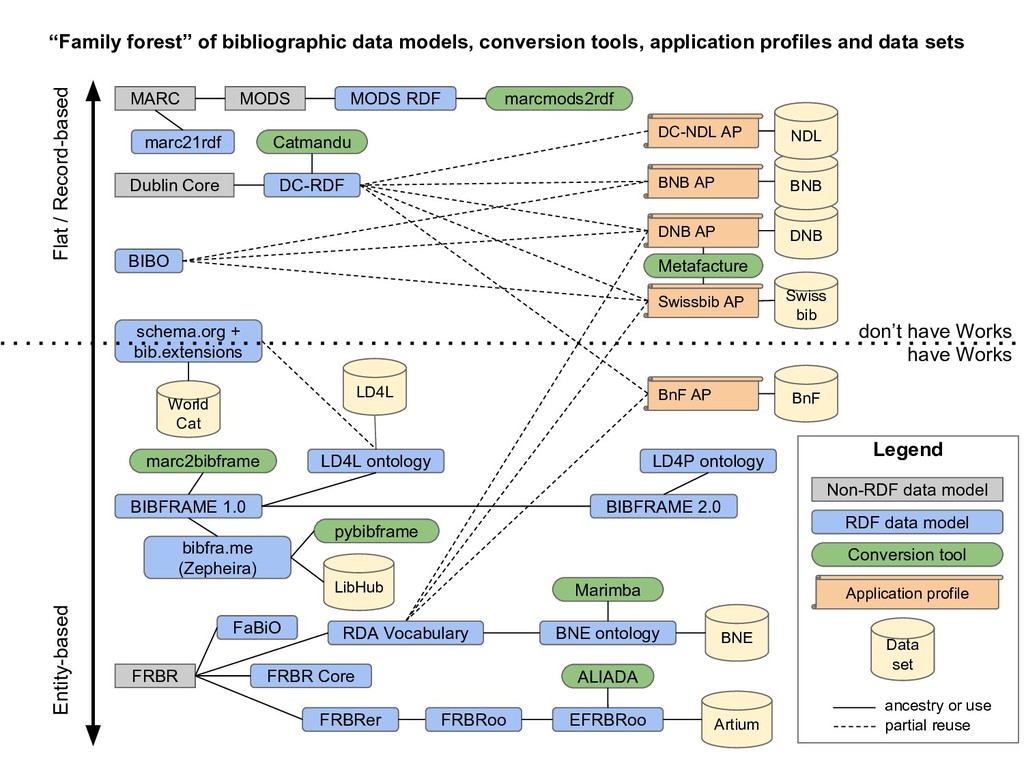
  5. DNB MARC MODS MODS RDF marcmods2rdf Dublin Core DC-RDF Catmandu

    BIBO FaBiO BIBFRAME 1.0 FRBR FRBRer EFRBRoo ALIADA RDA Vocabulary BNE ontology Marimba Flat / Record-based Entity-based marc2bibframe bibfra.me (Zepheira) pybibframe LD4L ontology BIBFRAME 2.0 LD4P ontology LD4L BNE schema.org + bib.extensions World Cat BNB AP BNB DNB AP LibHub BnF AP BnF “Family forest” of bibliographic data models, conversion tools, application profiles and data sets Legend Non-RDF data model RDF data model Conversion tool Application profile Data set Artium Swissbib AP Swiss bib Metafacture don’t have Works have Works DC-NDL AP NDL FRBRoo FRBR Core ancestry or use partial reuse marc21rdf
  6. Libraryish - used for producing and maintaining (meta)data - lossless

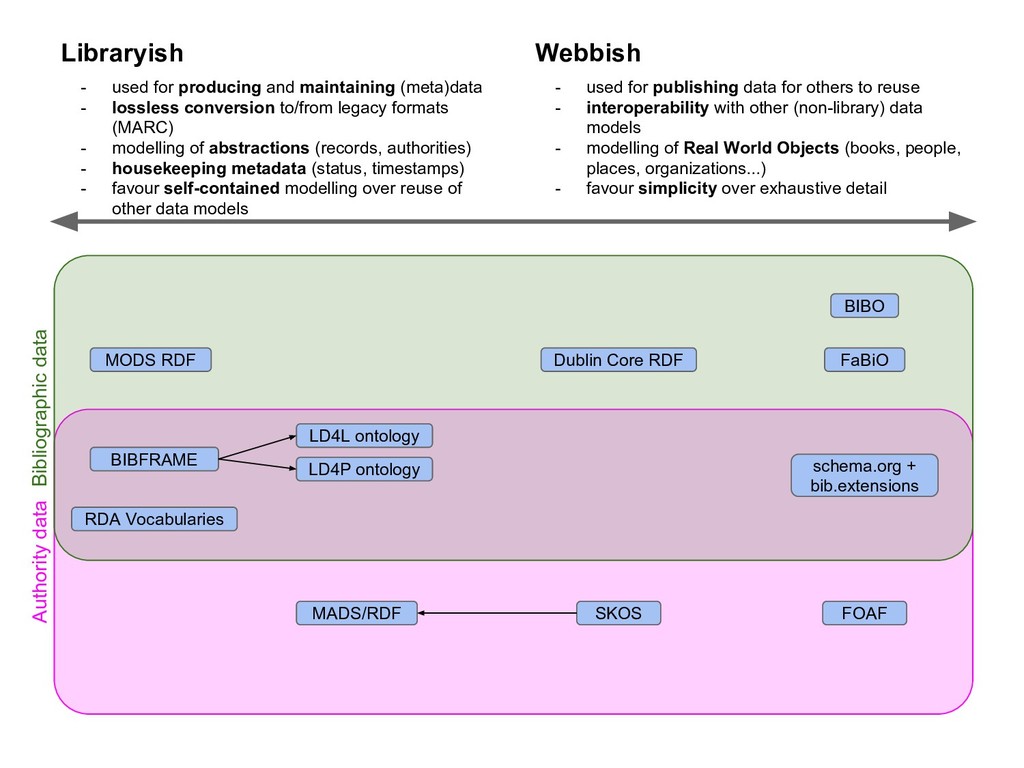
    conversion to/from legacy formats (MARC) - modelling of abstractions (records, authorities) - housekeeping metadata (status, timestamps) - favour self-contained modelling over reuse of other data models Webbish - used for publishing data for others to reuse - interoperability with other (non-library) data models - modelling of Real World Objects (books, people, places, organizations...) - favour simplicity over exhaustive detail Bibliographic data Authority data MODS RDF BIBFRAME RDA Vocabularies LD4L ontology LD4P ontology MADS/RDF Dublin Core RDF schema.org + bib.extensions SKOS FOAF BIBO FaBiO
  7. Reason 1 Reason 2 Reason 3 Reason 4 Different use

    cases require different kinds of data models. None of the existing models fits them all. But surely, for basic MARC records (e.g. a “regular” national library collection) a single model would be enough?
  8. Reason 1 Reason 2 Reason 3 Reason 4 Converting existing

    data (i.e. MARC) into a modern entity-based model is difficult and prevents adoption of such data models in practice for real data. All FRBR-based models require “FRBRization”, which is difficult to get right. BIBFRAME is somewhat easier because of its more relaxed view about Works.
  9. Reason 1 Reason 2 Reason 3 Reason 4 Libraries want

    to control their data - including data models. Defining your own ontology, or a custom application profile, allows maximum control. Issues like localization and language- or culture-specific requirements (e.g. Japanese dual representation of titles as hiragana and katakana) are not always adequately addressed in the general models.
  10. Reason 1 Reason 2 Reason 3 Reason 4 Once you’ve

    chosen a data model, you’re likely to stick to it.
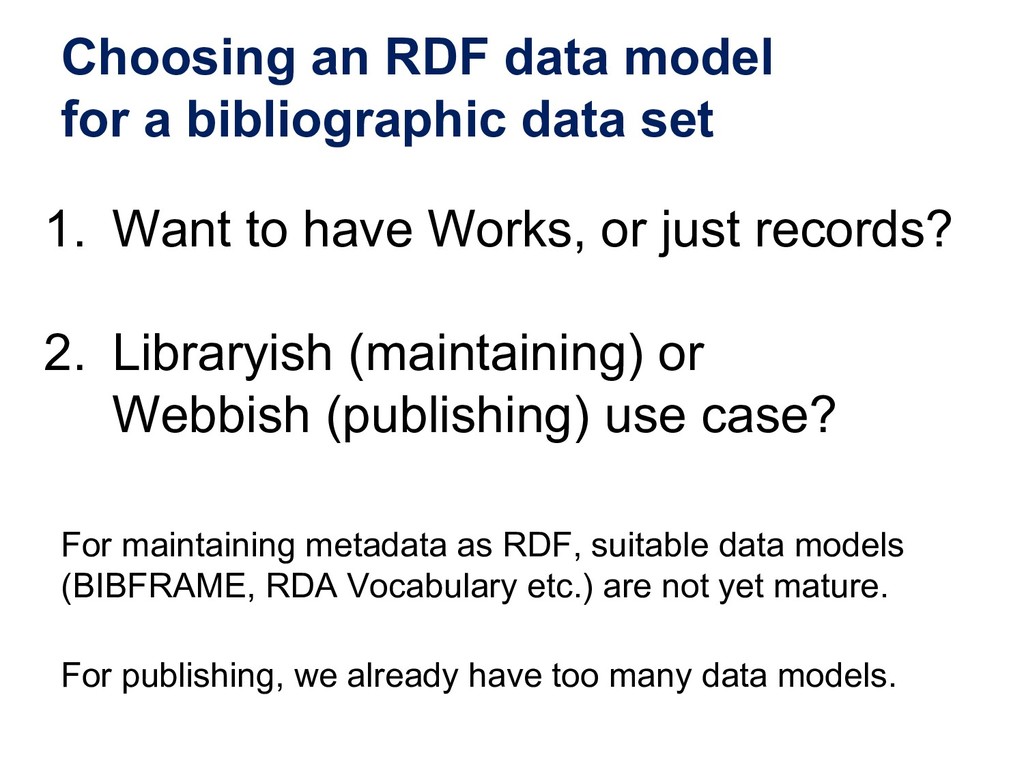
  11. Choosing an RDF data model for a bibliographic data set

    1. Want to have Works, or just records? 2. Libraryish (maintaining) or Webbish (publishing) use case? For maintaining metadata as RDF, suitable data models (BIBFRAME, RDA Vocabulary etc.) are not yet mature. For publishing, we already have too many data models.
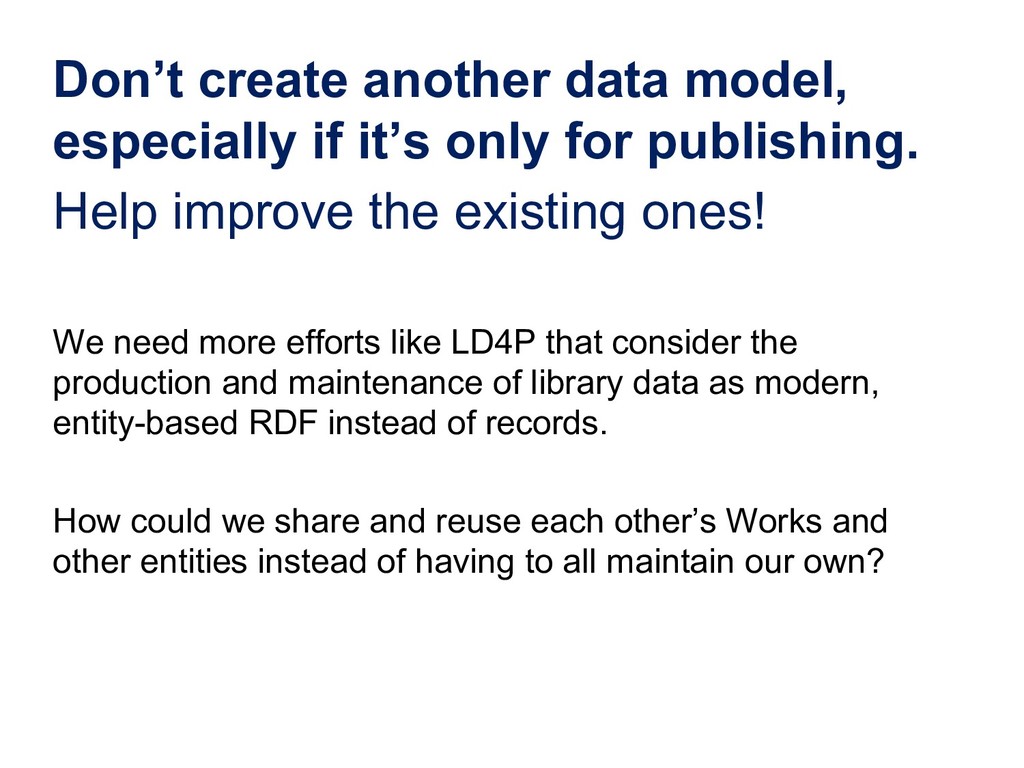
  12. Don’t create another data model, especially if it’s only for

    publishing. Help improve the existing ones! We need more efforts like LD4P that consider the production and maintenance of library data as modern, entity-based RDF instead of records. How could we share and reuse each other’s Works and other entities instead of having to all maintain our own?
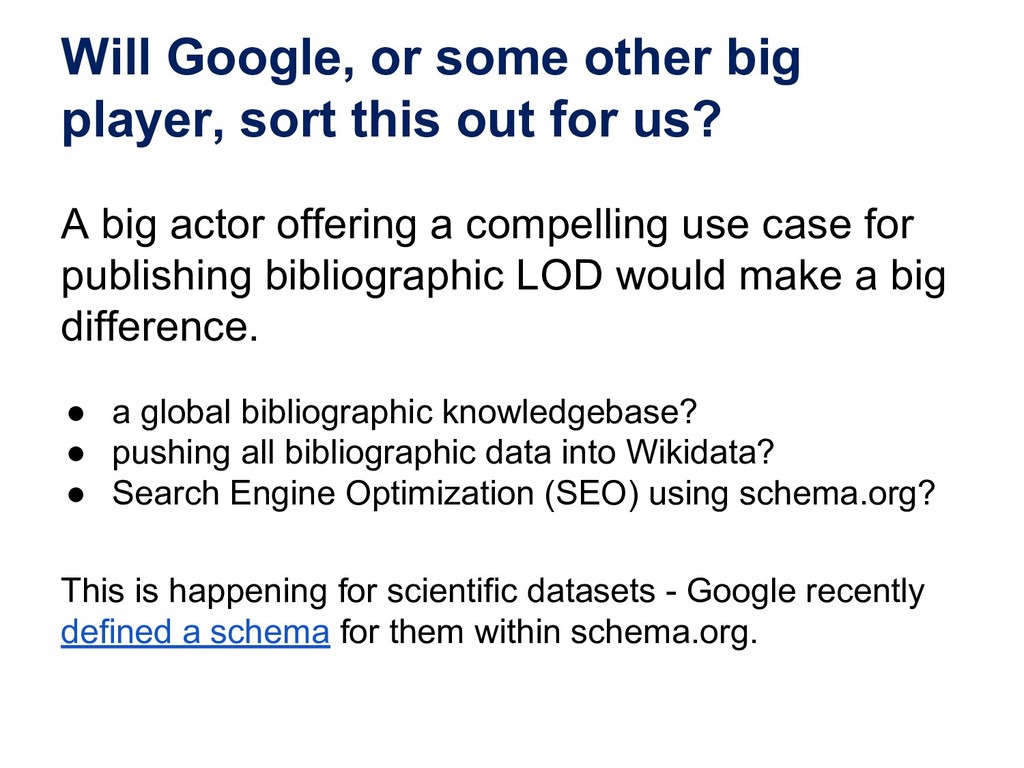
  13. Will Google, or some other big player, sort this out

    for us? A big actor offering a compelling use case for publishing bibliographic LOD would make a big difference. • a global bibliographic knowledgebase? • pushing all bibliographic data into Wikidata? • Search Engine Optimization (SEO) using schema.org? This is happening for scientific datasets - Google recently defined a schema for them within schema.org.
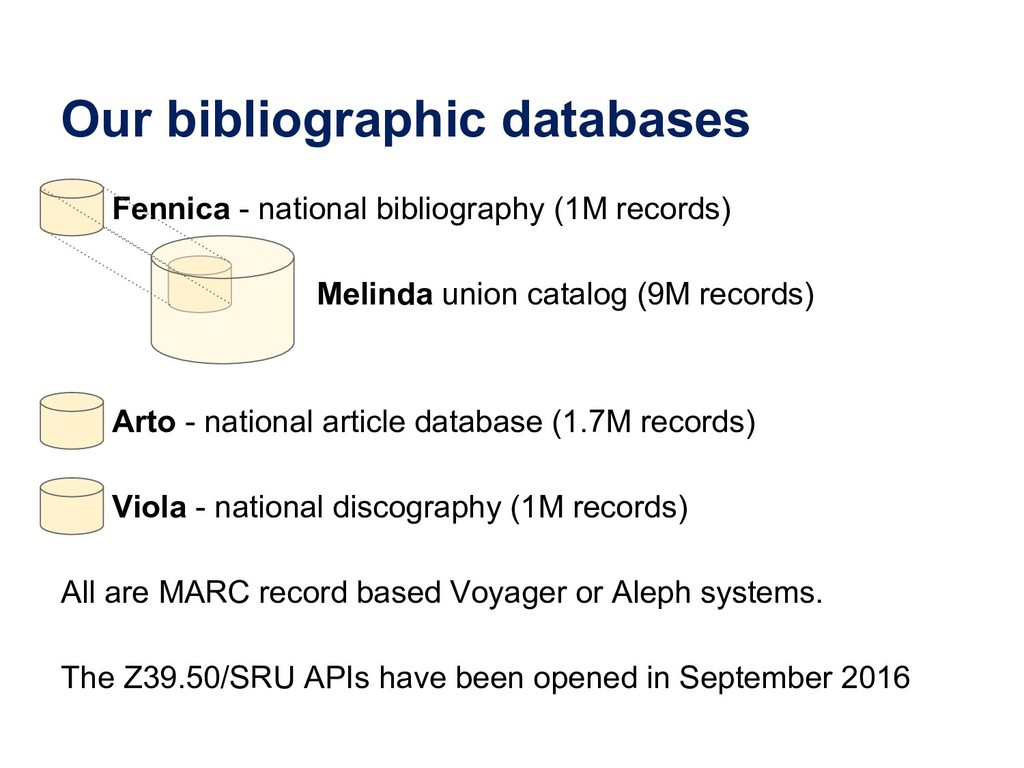
  14. 1. Fennica - national bibliography (1M records) Melinda union catalog

    (9M records) 2. Arto - national article database (1.7M records) 3. Viola - national discography (1M records) All are MARC record based Voyager or Aleph systems. The Z39.50/SRU APIs have been opened in September 2016 Our bibliographic databases
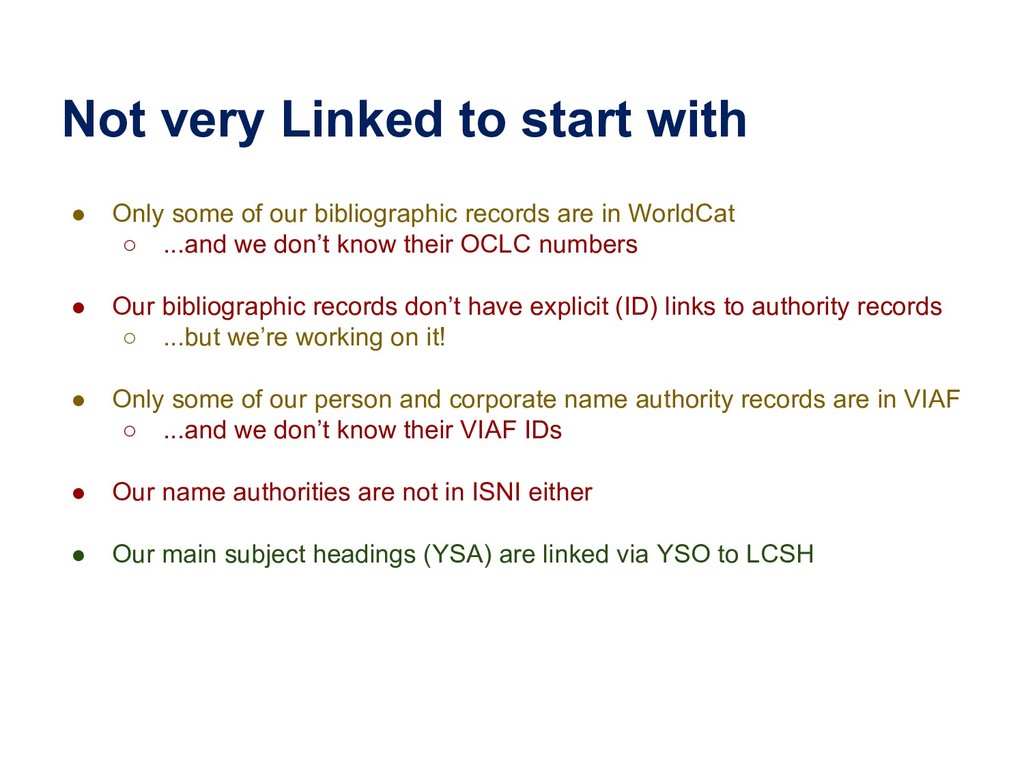
  15. Not very Linked to start with • Only some of

    our bibliographic records are in WorldCat ◦ ...and we don’t know their OCLC numbers • Our bibliographic records don’t have explicit (ID) links to authority records ◦ ...but we’re working on it! • Only some of our person and corporate name authority records are in VIAF ◦ ...and we don’t know their VIAF IDs • Our name authorities are not in ISNI either • Our main subject headings (YSA) are linked via YSO to LCSH
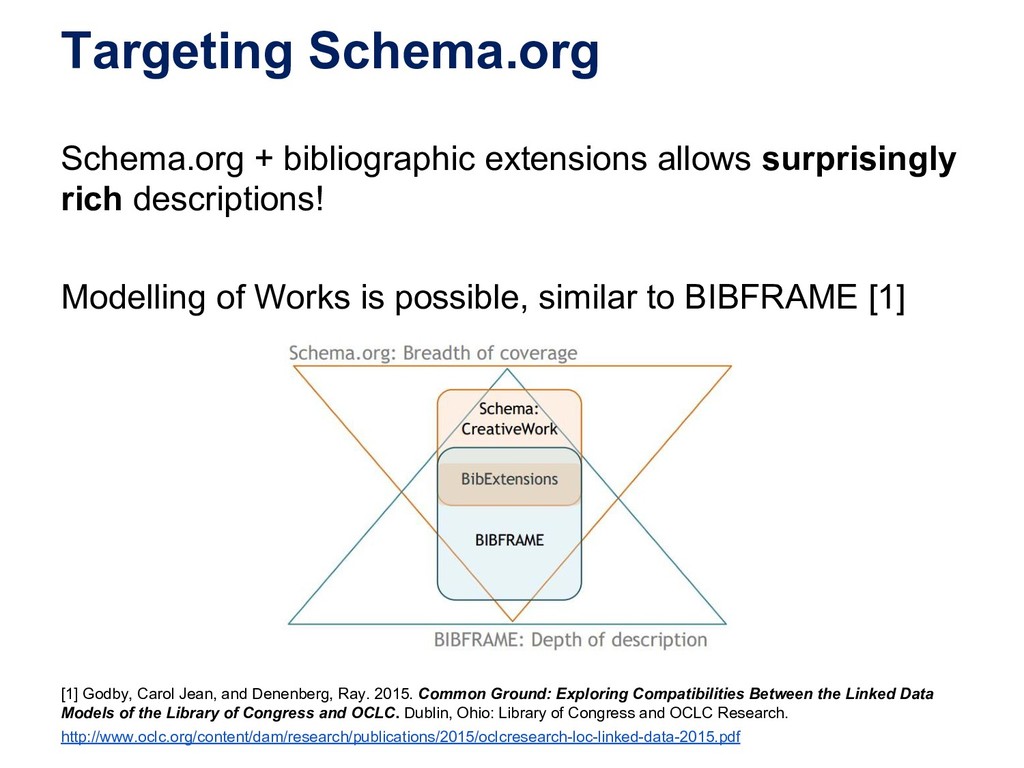
  16. Targeting Schema.org Schema.org + bibliographic extensions allows surprisingly rich descriptions!

    Modelling of Works is possible, similar to BIBFRAME [1] [1] Godby, Carol Jean, and Denenberg, Ray. 2015. Common Ground: Exploring Compatibilities Between the Linked Data Models of the Library of Congress and OCLC. Dublin, Ohio: Library of Congress and OCLC Research. http://www.oclc.org/content/dam/research/publications/2015/oclcresearch-loc-linked-data-2015.pdf
  17. Schema.org forces to think about data from a Web user’s

    point of view “We have these 1M bibliographic records”
  18. Schema.org forces to think about data from a Web user’s

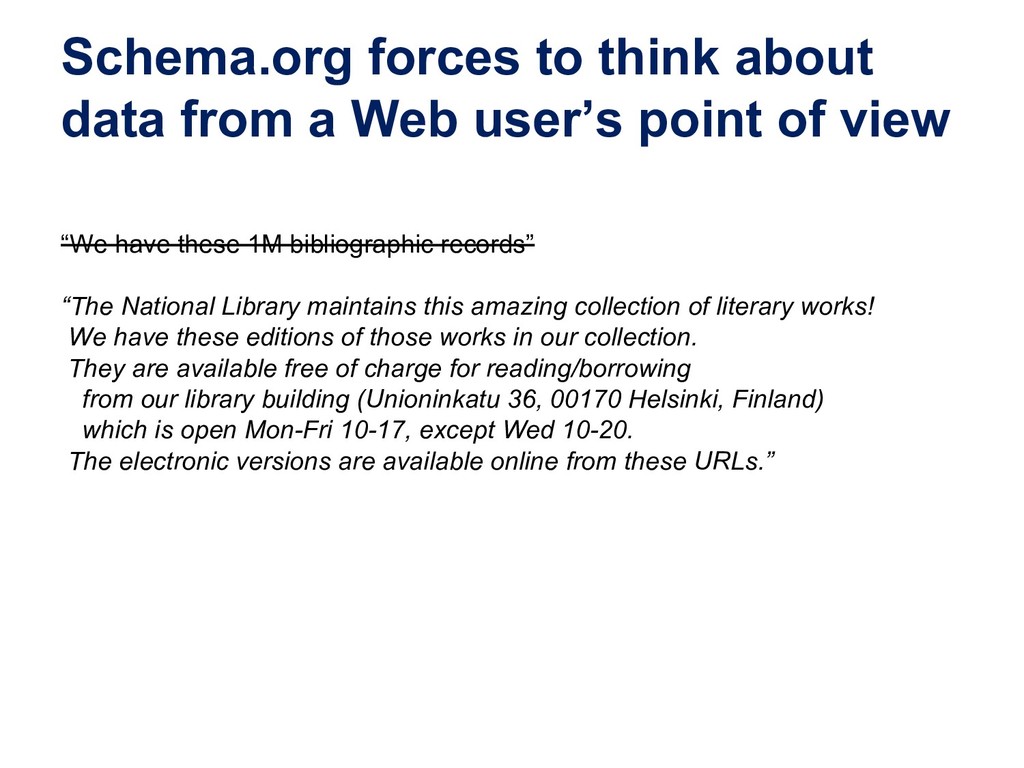
    point of view “We have these 1M bibliographic records” “The National Library maintains this amazing collection of literary works! We have these editions of those works in our collection. They are available free of charge for reading/borrowing from our library building (Unioninkatu 36, 00170 Helsinki, Finland) which is open Mon-Fri 10-17, except Wed 10-20. The electronic versions are available online from these URLs.”
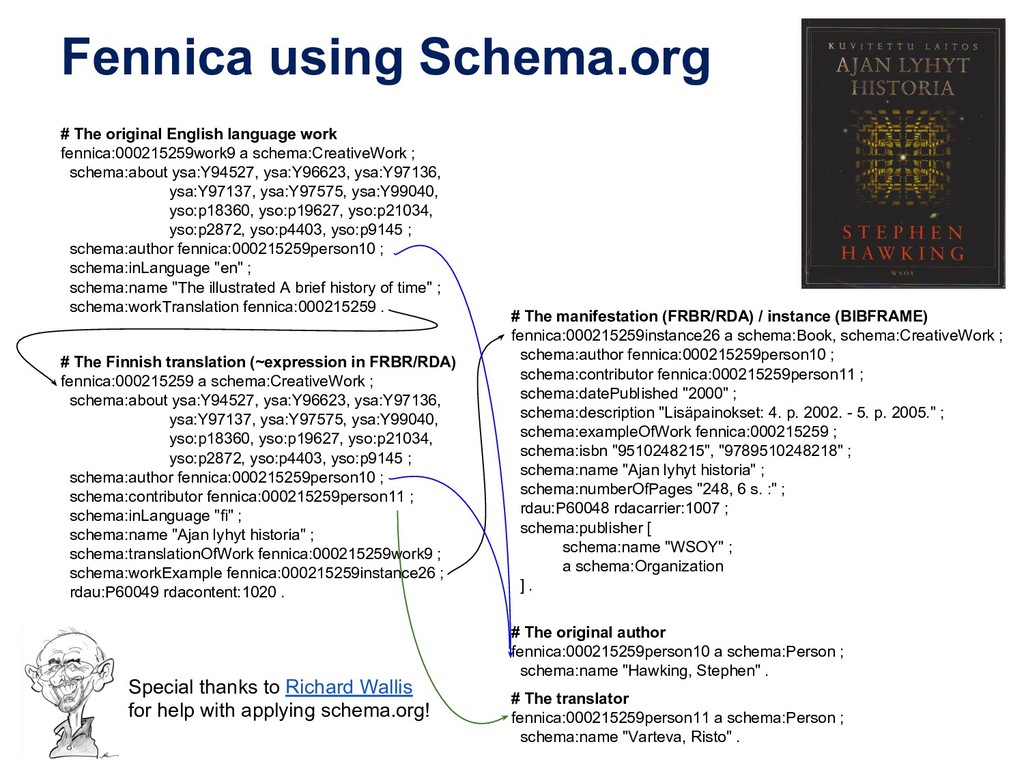
  19. Fennica using Schema.org # The original English language work fennica:000215259work9

    a schema:CreativeWork ; schema:about ysa:Y94527, ysa:Y96623, ysa:Y97136, ysa:Y97137, ysa:Y97575, ysa:Y99040, yso:p18360, yso:p19627, yso:p21034, yso:p2872, yso:p4403, yso:p9145 ; schema:author fennica:000215259person10 ; schema:inLanguage "en" ; schema:name "The illustrated A brief history of time" ; schema:workTranslation fennica:000215259 . # The Finnish translation (~expression in FRBR/RDA) fennica:000215259 a schema:CreativeWork ; schema:about ysa:Y94527, ysa:Y96623, ysa:Y97136, ysa:Y97137, ysa:Y97575, ysa:Y99040, yso:p18360, yso:p19627, yso:p21034, yso:p2872, yso:p4403, yso:p9145 ; schema:author fennica:000215259person10 ; schema:contributor fennica:000215259person11 ; schema:inLanguage "fi" ; schema:name "Ajan lyhyt historia" ; schema:translationOfWork fennica:000215259work9 ; schema:workExample fennica:000215259instance26 ; rdau:P60049 rdacontent:1020 . # The manifestation (FRBR/RDA) / instance (BIBFRAME) fennica:000215259instance26 a schema:Book, schema:CreativeWork ; schema:author fennica:000215259person10 ; schema:contributor fennica:000215259person11 ; schema:datePublished "2000" ; schema:description "Lisäpainokset: 4. p. 2002. - 5. p. 2005." ; schema:exampleOfWork fennica:000215259 ; schema:isbn "9510248215", "9789510248218" ; schema:name "Ajan lyhyt historia" ; schema:numberOfPages "248, 6 s. :" ; rdau:P60048 rdacarrier:1007 ; schema:publisher [ schema:name "WSOY" ; a schema:Organization ] . # The original author fennica:000215259person10 a schema:Person ; schema:name "Hawking, Stephen" . # The translator fennica:000215259person11 a schema:Person ; schema:name "Varteva, Risto" . Special thanks to Richard Wallis for help with applying schema.org!
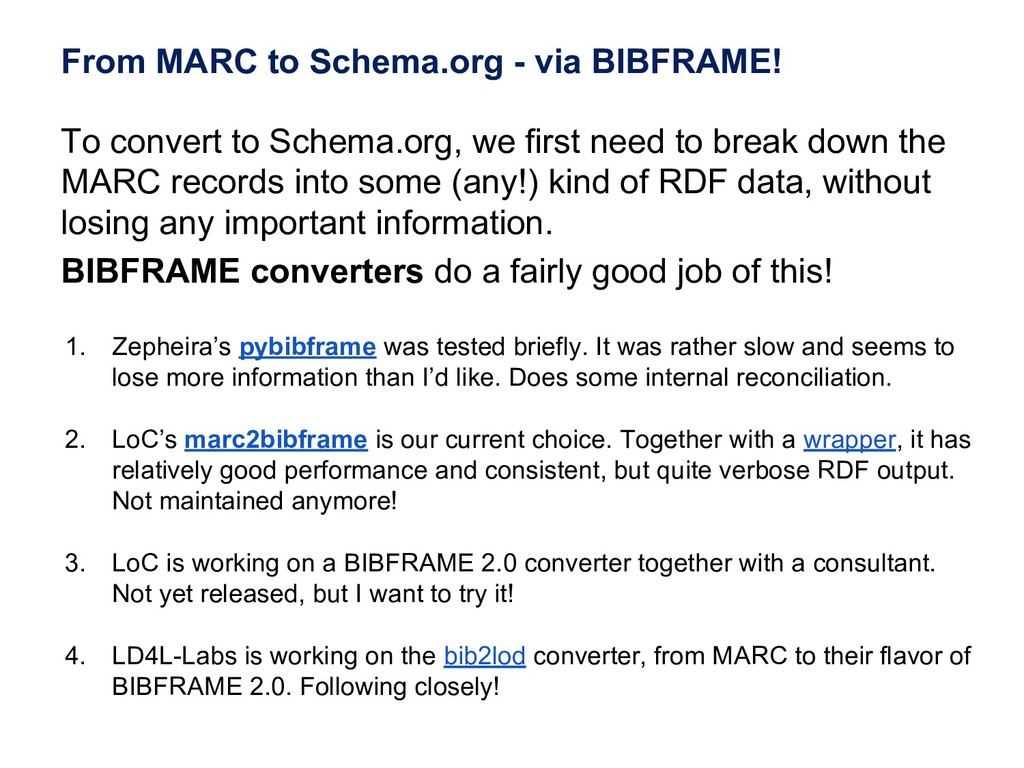
  20. From MARC to Schema.org - via BIBFRAME! To convert to

    Schema.org, we first need to break down the MARC records into some (any!) kind of RDF data, without losing any important information. BIBFRAME converters do a fairly good job of this! 1. Zepheira’s pybibframe was tested briefly. It was rather slow and seems to lose more information than I’d like. Does some internal reconciliation. 2. LoC’s marc2bibframe is our current choice. Together with a wrapper, it has relatively good performance and consistent, but quite verbose RDF output. Not maintained anymore! 3. LoC is working on a BIBFRAME 2.0 converter together with a consultant. Not yet released, but I want to try it! 4. LD4L-Labs is working on the bib2lod converter, from MARC to their flavor of BIBFRAME 2.0. Following closely!
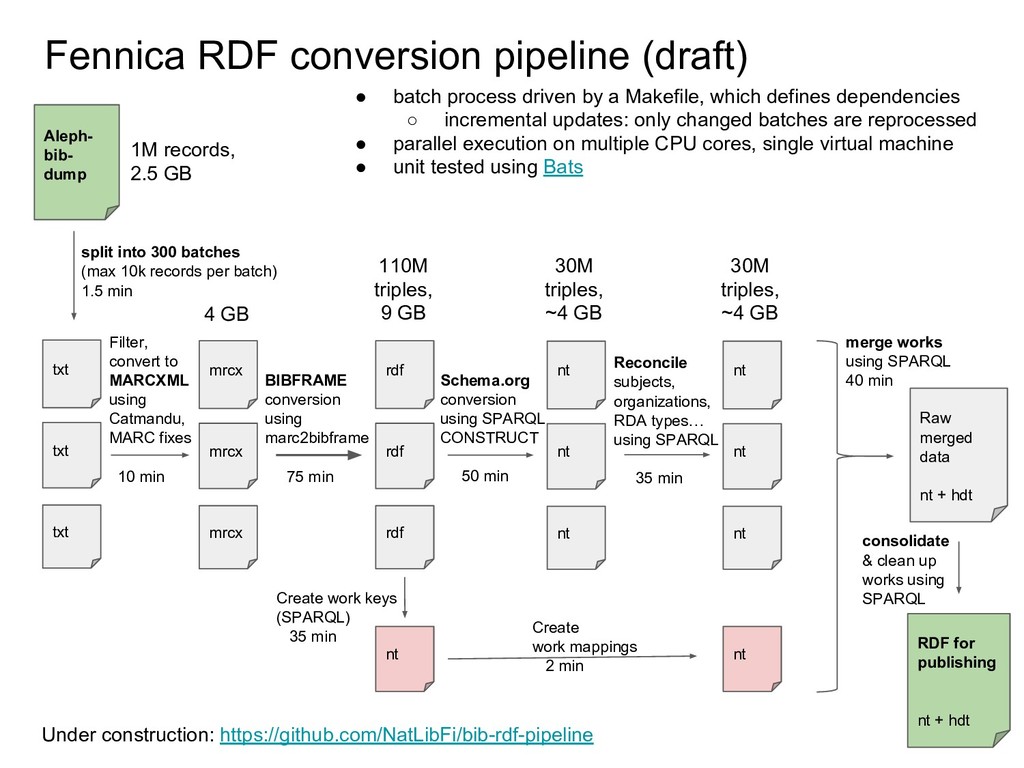
  21. Fennica RDF conversion pipeline (draft) Aleph- bib- dump txt txt

    txt split into 300 batches (max 10k records per batch) 1.5 min mrcx mrcx mrcx Filter, convert to MARCXML using Catmandu, MARC fixes 10 min rdf rdf rdf BIBFRAME conversion using marc2bibframe 75 min nt nt nt Schema.org conversion using SPARQL CONSTRUCT 50 min nt Create work keys (SPARQL) 35 min nt Create work mappings 2 min RDF for publishing nt + hdt consolidate & clean up works using SPARQL 30M triples, ~4 GB 1M records, 2.5 GB 4 GB 110M triples, 9 GB Under construction: https://github.com/NatLibFi/bib-rdf-pipeline Raw merged data nt + hdt merge works using SPARQL 40 min • batch process driven by a Makefile, which defines dependencies ◦ incremental updates: only changed batches are reprocessed • parallel execution on multiple CPU cores, single virtual machine • unit tested using Bats nt nt nt 30M triples, ~4 GB Reconcile subjects, organizations, RDA types… using SPARQL 35 min
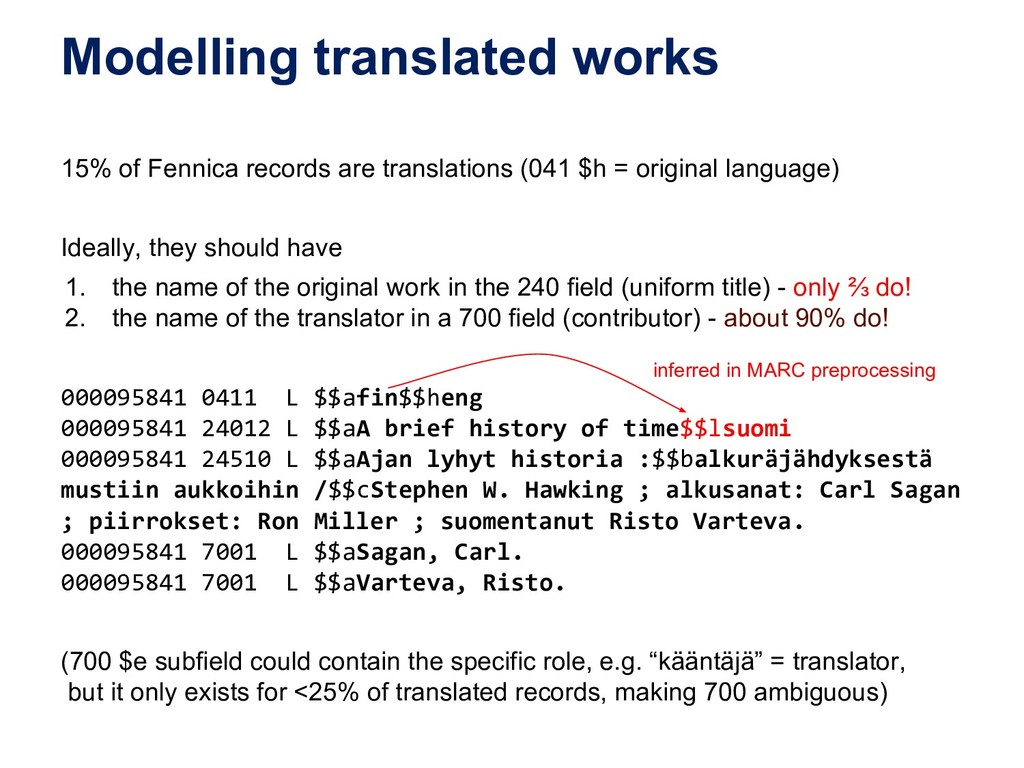
  22. Modelling translated works 15% of Fennica records are translations (041

    $h = original language) Ideally, they should have 1. the name of the original work in the 240 field (uniform title) - only ⅔ do! 2. the name of the translator in a 700 field (contributor) - about 90% do! 000095841 0411 L $$afin$$heng 000095841 24012 L $$aA brief history of time$$lsuomi 000095841 24510 L $$aAjan lyhyt historia :$$balkuräjähdyksestä mustiin aukkoihin /$$cStephen W. Hawking ; alkusanat: Carl Sagan ; piirrokset: Ron Miller ; suomentanut Risto Varteva. 000095841 7001 L $$aSagan, Carl. 000095841 7001 L $$aVarteva, Risto. (700 $e subfield could contain the specific role, e.g. “kääntäjä” = translator, but it only exists for <25% of translated records, making 700 ambiguous) inferred in MARC preprocessing
  23. Calculating work keys similar to OCLC’s FRBR Work-Set algorithm [1]

    but extracting the keys from BIBFRAME RDF using SPARQL queries Work titleValue: Kotona maailmankaikkeudessa language: fin classificationUdc: 11, 52.2, 524.85, 52:11 classification: 52 (NLM), 52 (YKL), 52.2 (YKL) subject: kosmologia (YSA) + muutama muu Instance instanceTitle: Kotona maailmankaikkeudessa providerStatement: Helsingissä : Tähtitieteellinen yhdistys Ursa, 2001 ISBN-10: 9525329151 ISBN-13: 9789525329155 extent: 333 s. ; dimensions: 20 cm nbn: (FI-MELINDA)005083536 Work workTitle: Kotona maailmankaikkeudessa language: swe classification: 52 (NLM), 52 (YKL), 52.2 (YKL) subject: kosmologia (YSA) + muutama muu Instance instanceTitle: Hemma i världsrymden providerStatement: Helsingfors : Söderström ; Stockholm : Atlantis, 2003. ISBN-10: 9515220963>, 9174867784 ISBN-13: 9789515220967, 9789174867787 extent: 327, 1 s. ; dimensions: 22 cm nbn: (FI-MELINDA)006458254 Work title: Kotona maailmankaikkeudessa instanceOf Person label: Valtaoja, Esko creator translationOf Person label: Valtaoja, Esko. creator Person label: Hildén, Philip contributor instanceOf Kotona maailmankaikkeudessa / Valtaoja, Esko Kotona maailmankaikkeudessa / ruotsi / Valtaoja, Esko work-key work-key work-key Person label: Valtaoja, Esko. creator [1] Hickey, Thomas and Toves, Jenny. FRBR Work-Set Algorithm. OCLC Research, 2009. http://www.oclc.org/content/dam/research/activities/frbralgorithm/2009-08.pdf Hemma i världsrymden / Valtaoja, Esko work-key
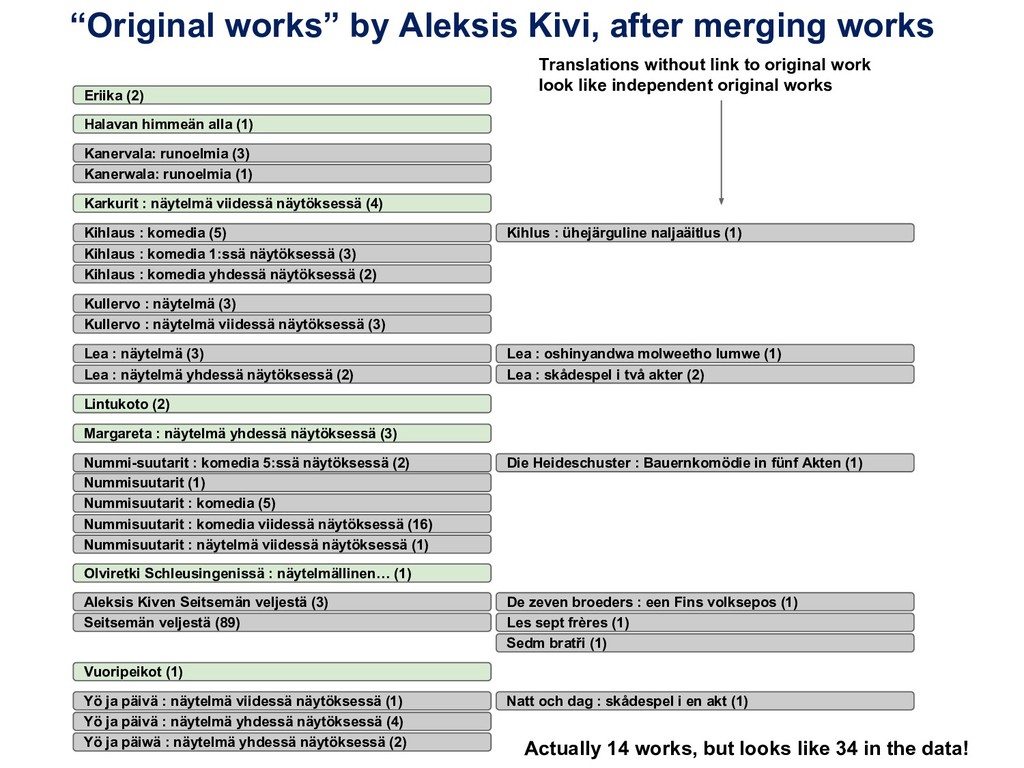
  24. Eriika (2) Kanervala: runoelmia (3) Kanerwala: runoelmia (1) Karkurit :

    näytelmä viidessä näytöksessä (4) Kihlaus : komedia (5) “Original works” by Aleksis Kivi, after merging works Kihlaus : komedia 1:ssä näytöksessä (3) Kihlaus : komedia yhdessä näytöksessä (2) Kihlus : ühejärguline naljaäitlus (1) Kullervo : näytelmä (3) Kullervo : näytelmä viidessä näytöksessä (3) Lea : näytelmä (3) Lea : näytelmä yhdessä näytöksessä (2) Lea : oshinyandwa molweetho lumwe (1) Lea : skådespel i två akter (2) Margareta : näytelmä yhdessä näytöksessä (3) Translations without link to original work look like independent original works Nummisuutarit (1) Nummisuutarit : komedia (5) Die Heideschuster : Bauernkomödie in fünf Akten (1) Nummisuutarit : komedia viidessä näytöksessä (16) Nummisuutarit : näytelmä viidessä näytöksessä (1) Nummi-suutarit : komedia 5:ssä näytöksessä (2) Olviretki Schleusingenissä : näytelmällinen… (1) Halavan himmeän alla (1) Aleksis Kiven Seitsemän veljestä (3) Seitsemän veljestä (89) De zeven broeders : een Fins volksepos (1) Les sept frères (1) Sedm bratři (1) Vuoripeikot (1) Yö ja päivä : näytelmä viidessä näytöksessä (1) Yö ja päivä : näytelmä yhdessä näytöksessä (4) Natt och dag : skådespel i en akt (1) Yö ja päiwä : näytelmä yhdessä näytöksessä (2) Lintukoto (2) Actually 14 works, but looks like 34 in the data!
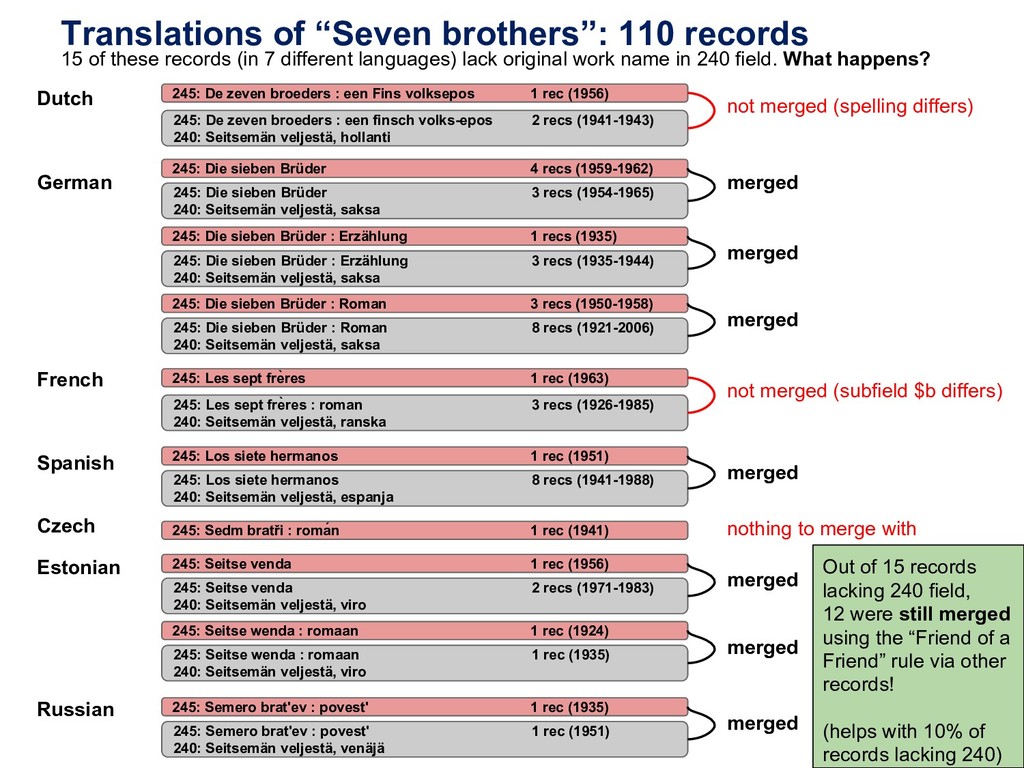
  25. Translations of “Seven brothers”: 110 records 15 of these records

    (in 7 different languages) lack original work name in 240 field. What happens? 245: De zeven broeders : een Fins volksepos 1 rec (1956) 245: De zeven broeders : een finsch volks-epos 2 recs (1941-1943) 240: Seitsemän veljestä, hollanti not merged (spelling differs) 245: Die sieben Bru ̈ der 4 recs (1959-1962) 245: Die sieben Brüder 3 recs (1954-1965) 240: Seitsemän veljestä, saksa 245: Die sieben Bru ̈ der : Erzählung 1 recs (1935) 245: Die sieben Brüder : Erzählung 3 recs (1935-1944) 240: Seitsemän veljestä, saksa merged merged 245: Die sieben Bru ̈ der : Roman 3 recs (1950-1958) 245: Die sieben Brüder : Roman 8 recs (1921-2006) 240: Seitsemän veljestä, saksa merged 245: Les sept frères 1 rec (1963) 245: Les sept frères : roman 3 recs (1926-1985) 240: Seitsemän veljestä, ranska not merged (subfield $b differs) 245: Los siete hermanos 1 rec (1951) 245: Los siete hermanos 8 recs (1941-1988) 240: Seitsemän veljestä, espanja merged 245: Sedm bratř i : román 1 rec (1941) nothing to merge with 245: Seitse venda 1 rec (1956) 245: Seitse venda 2 recs (1971-1983) 240: Seitsemän veljestä, viro merged 245: Seitse wenda : romaan 1 rec (1924) 245: Seitse wenda : romaan 1 rec (1935) 240: Seitsemän veljestä, viro merged 245: Semero brat'ev : povest' 1 rec (1935) 245: Semero brat'ev : povest' 1 rec (1951) 240: Seitsemän veljestä, venäjä merged Dutch German French Spanish Czech Estonian Russian Out of 15 records lacking 240 field, 12 were still merged using the “Friend of a Friend” rule via other records! (helps with 10% of records lacking 240)
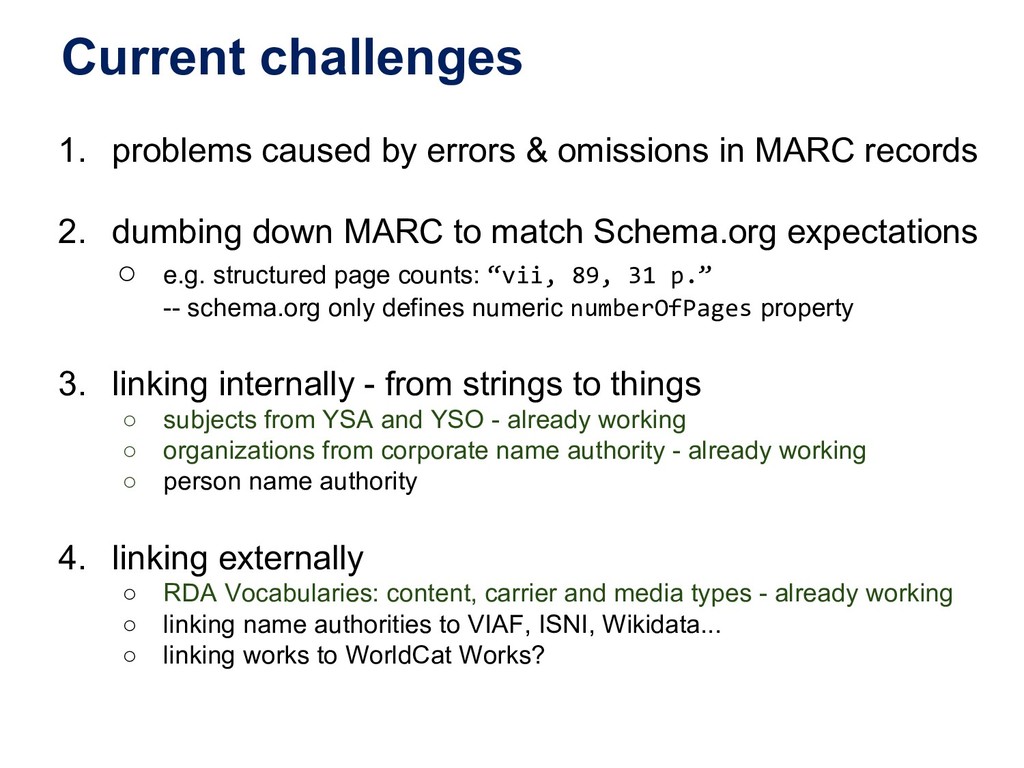
  26. Current challenges 1. problems caused by errors & omissions in

    MARC records 2. dumbing down MARC to match Schema.org expectations ◦ e.g. structured page counts: “vii, 89, 31 p.” -- schema.org only defines numeric numberOfPages property 3. linking internally - from strings to things ◦ subjects from YSA and YSO - already working ◦ organizations from corporate name authority - already working ◦ person name authority 4. linking externally ◦ RDA Vocabularies: content, carrier and media types - already working ◦ linking name authorities to VIAF, ISNI, Wikidata... ◦ linking works to WorldCat Works?
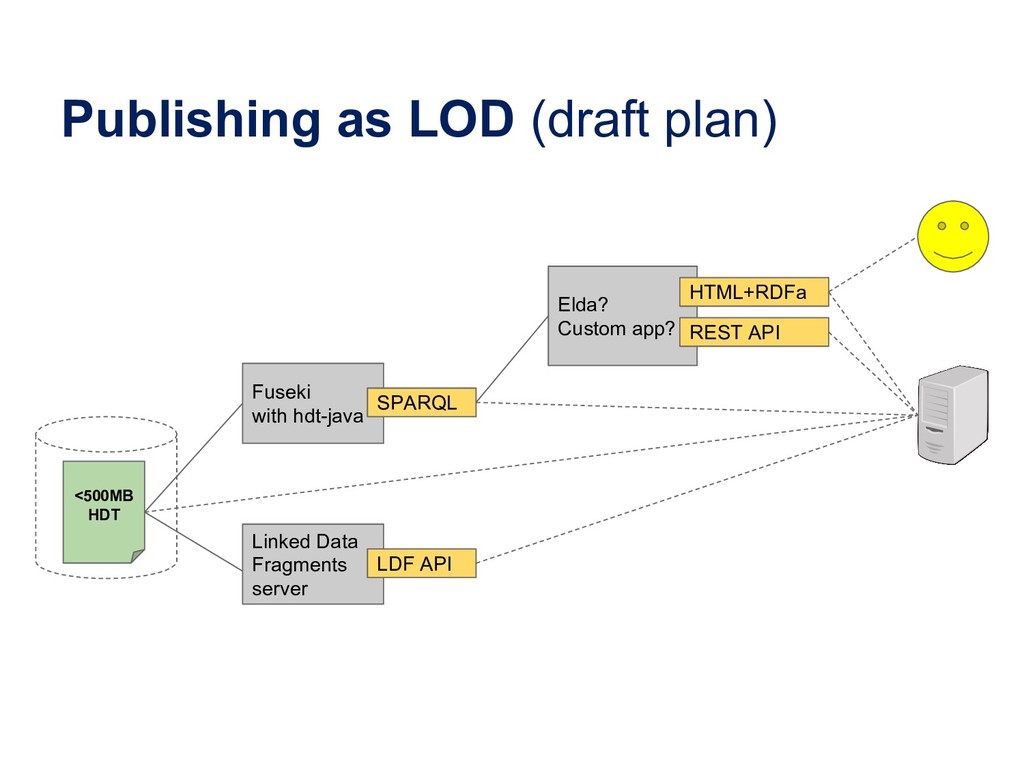
  27. Publishing as LOD (draft plan) <500MB HDT Linked Data Fragments

    server LDF API Fuseki with hdt-java SPARQL Elda? Custom app? HTML+RDFa REST API