Upgrade to Pro — share decks privately, control downloads, hide ads and more …

Annif: leveraging bibliographic metadata for au...

Annif: leveraging bibliographic metadata for automated subject indexing and classification

This presentation of the automated subject indexing tool Annif was prepared for the SWIB18 conference in Bonn, Germany.

Video recording: https://youtu.be/lSrFP3D-uTg

Full abstract:

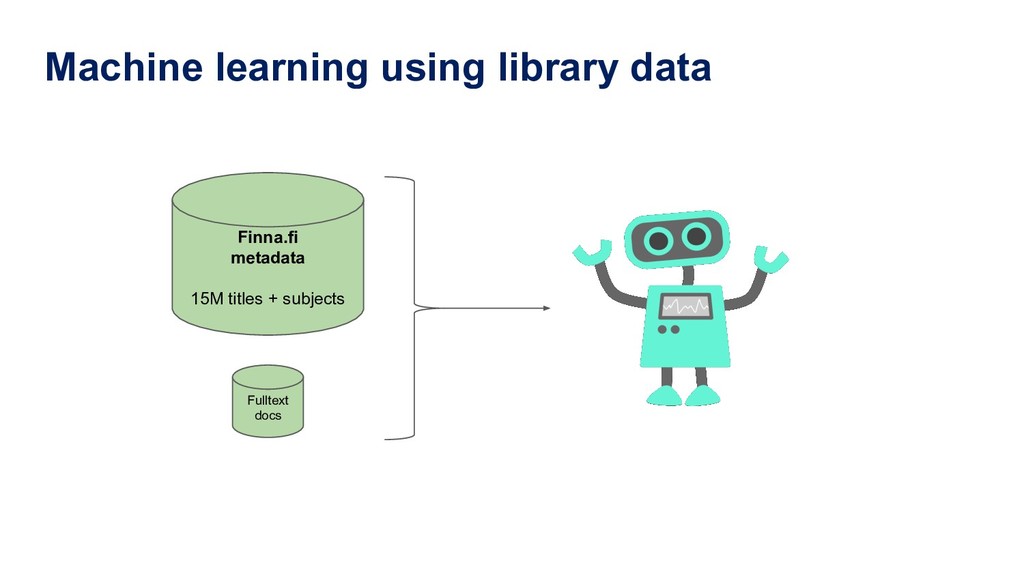
Manually indexing documents for subject-based access is a very labour-intensive intellectual process. A machine could perform similar subject indexing much faster. However, an algorithm needs to be trained and tested with examples of indexed documents. Libraries have a lot of training data in the form of bibliographic databases, but often only a title is available, not the full text. We propose to leverage both title-only metadata and, when available, already indexed full text documents to help indexing new documents. To do so, we are developing Annif, an open source tool for automated indexing and classification. After feeding it a SKOS vocabulary and existing metadata, Annif knows how to assign subject headings for new documents. It has a microservice-style REST API and a mobile web app that can analyse physical documents such as printed books. We have tested Annif with different document collections including scientific papers, old scanned books and current e-books, Q&A pairs from an “ask a librarian” service, Finnish Wikipedia, and the archives of a local newspaper. The results of analysing scientific papers and current books have been reassuring, while other types of documents have proved more challenging. The new version currently being developed is based on a combination of existing NLP and machine learning tools including Maui, fastText and Gensim. By combining multiple approaches, Annif can be adapted to different settings. The tool can be used with any vocabulary and with suitable training data, documents in many different languages may be analysed. With Annif, we expect to improve subject indexing and classification processes especially for electronic documents as well as collections that otherwise would not be indexed at all.

Google Slides: https://tinyurl.com/annif-swib

Avatar for Osma Suominen

Osma Suominen

November 28, 2018
Tweet

More Decks by Osma Suominen

Other Decks in Programming

Transcript

  1. .

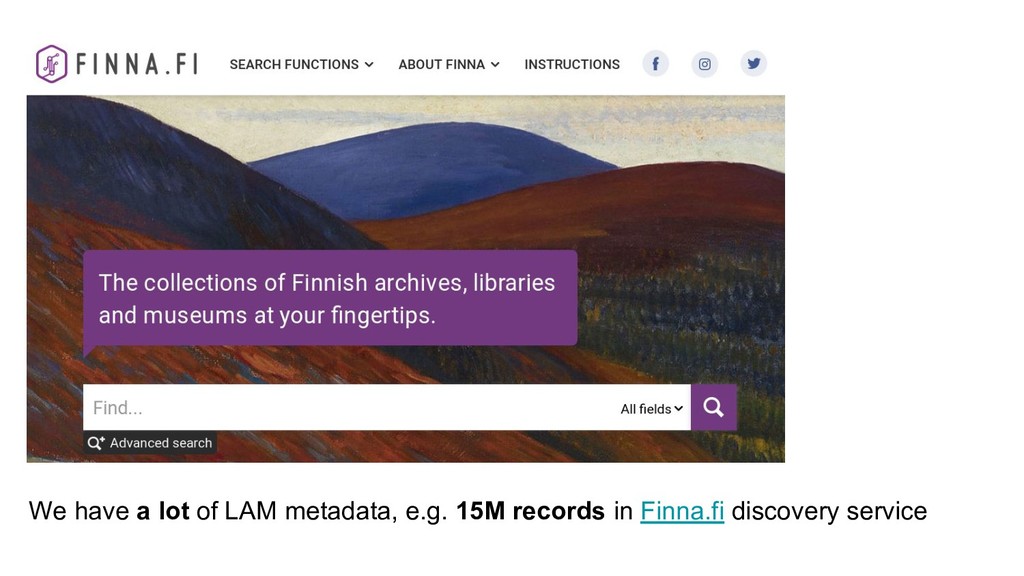
  2. . We have a lot of LAM metadata, e.g. 15M

    records in Finna.fi discovery service
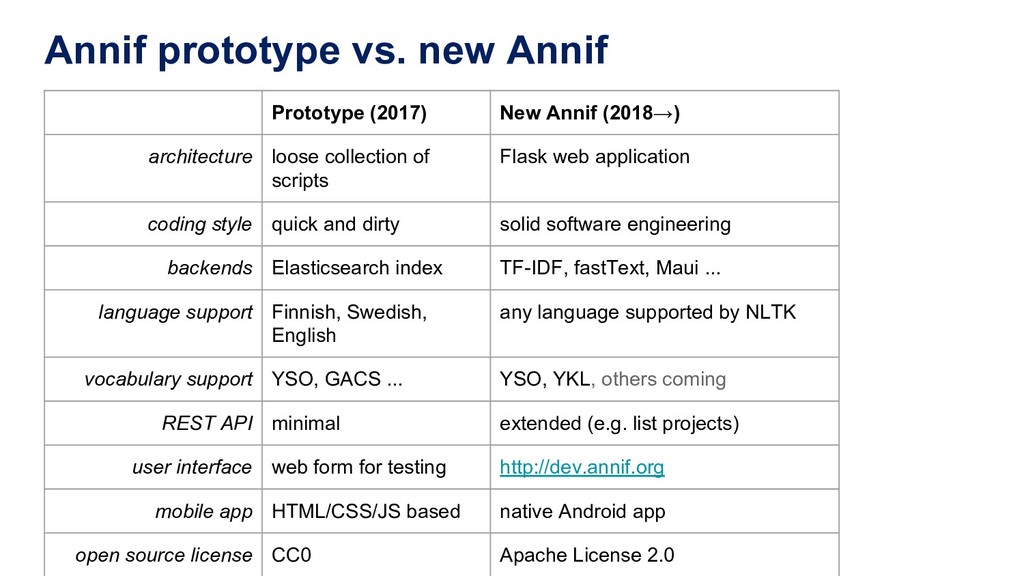
  3. Annif prototype vs. new Annif Prototype (2017) New Annif (2018→)

    architecture loose collection of scripts Flask web application coding style quick and dirty solid software engineering backends Elasticsearch index TF-IDF, fastText, Maui ... language support Finnish, Swedish, English any language supported by NLTK vocabulary support YSO, GACS ... YSO, YKL, others coming REST API minimal extended (e.g. list projects) user interface web form for testing http://dev.annif.org mobile app HTML/CSS/JS based native Android app open source license CC0 Apache License 2.0
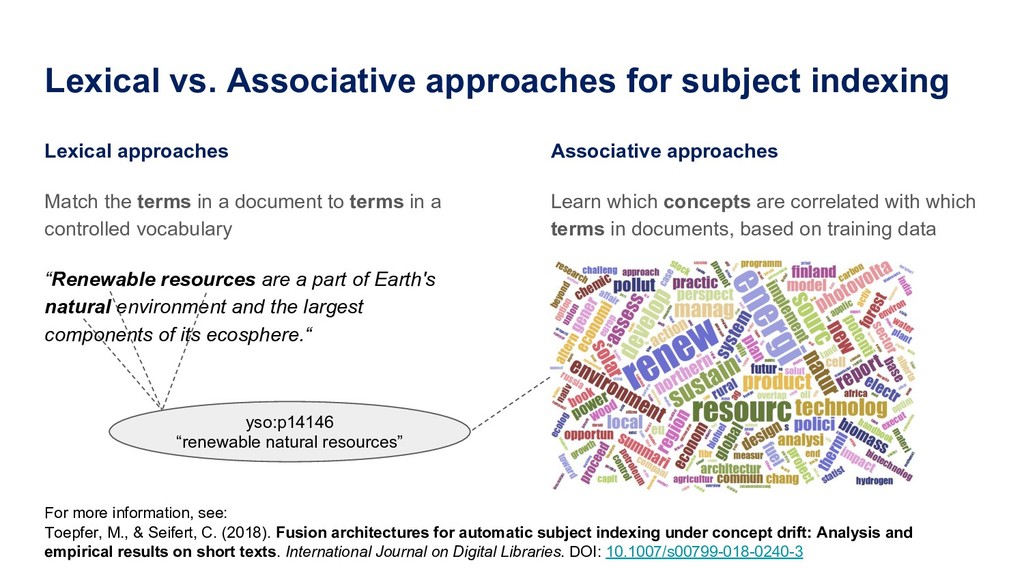
  4. Lexical vs. Associative approaches for subject indexing Lexical approaches Match

    the terms in a document to terms in a controlled vocabulary “Renewable resources are a part of Earth's natural environment and the largest components of its ecosphere.“ Associative approaches Learn which concepts are correlated with which terms in documents, based on training data For more information, see: Toepfer, M., & Seifert, C. (2018). Fusion architectures for automatic subject indexing under concept drift: Analysis and empirical results on short texts. International Journal on Digital Libraries. DOI: 10.1007/s00799-018-0240-3 yso:p14146 “renewable natural resources”
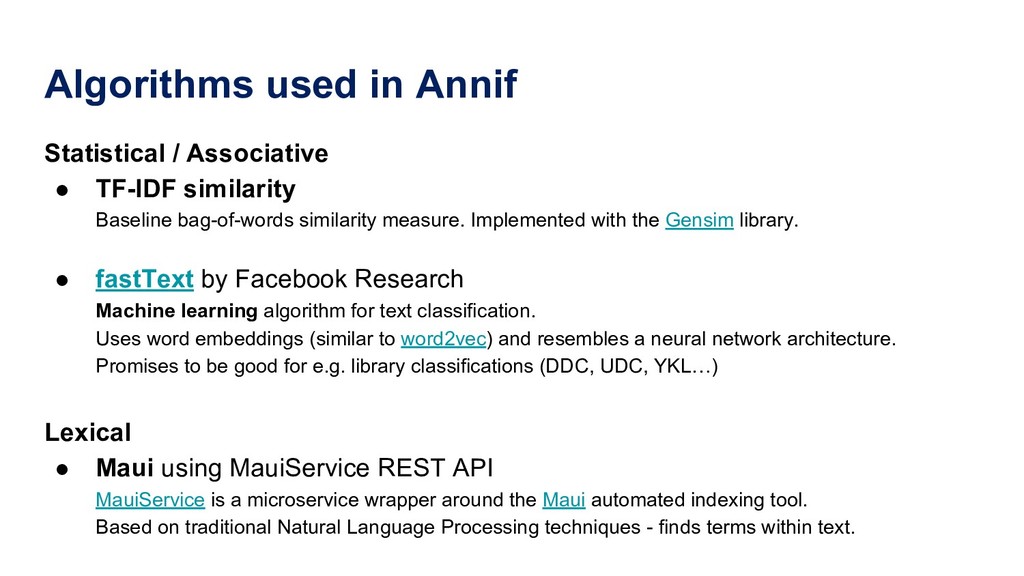
  5. Algorithms used in Annif Statistical / Associative • TF-IDF similarity

    Baseline bag-of-words similarity measure. Implemented with the Gensim library. • fastText by Facebook Research Machine learning algorithm for text classification. Uses word embeddings (similar to word2vec) and resembles a neural network architecture. Promises to be good for e.g. library classifications (DDC, UDC, YKL…) Lexical • Maui using MauiService REST API MauiService is a microservice wrapper around the Maui automated indexing tool. Based on traditional Natural Language Processing techniques - finds terms within text.
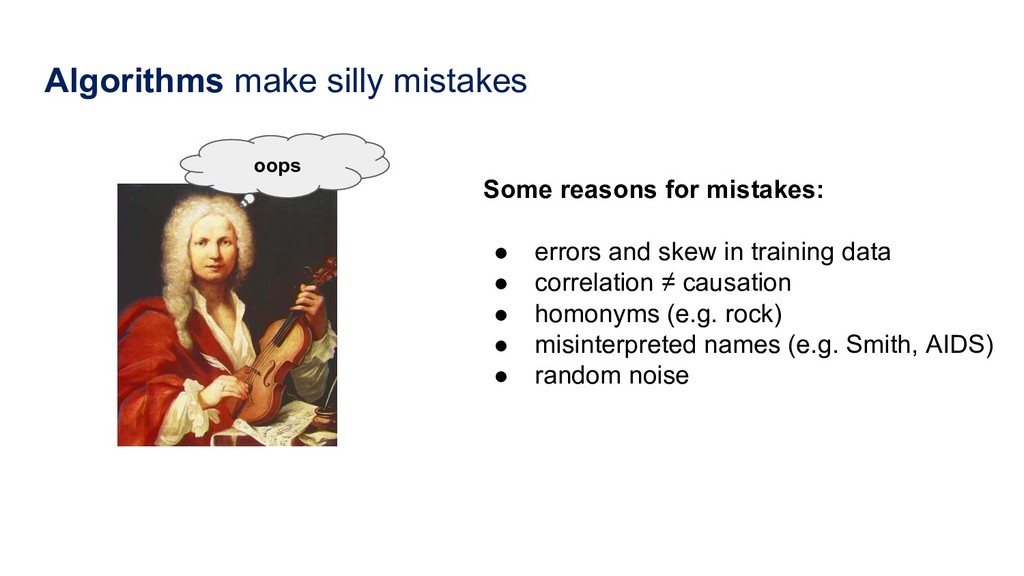
  6. Algorithms make silly mistakes oops Some reasons for mistakes: •

    errors and skew in training data • correlation ≠ causation • homonyms (e.g. rock) • misinterpreted names (e.g. Smith, AIDS) • random noise
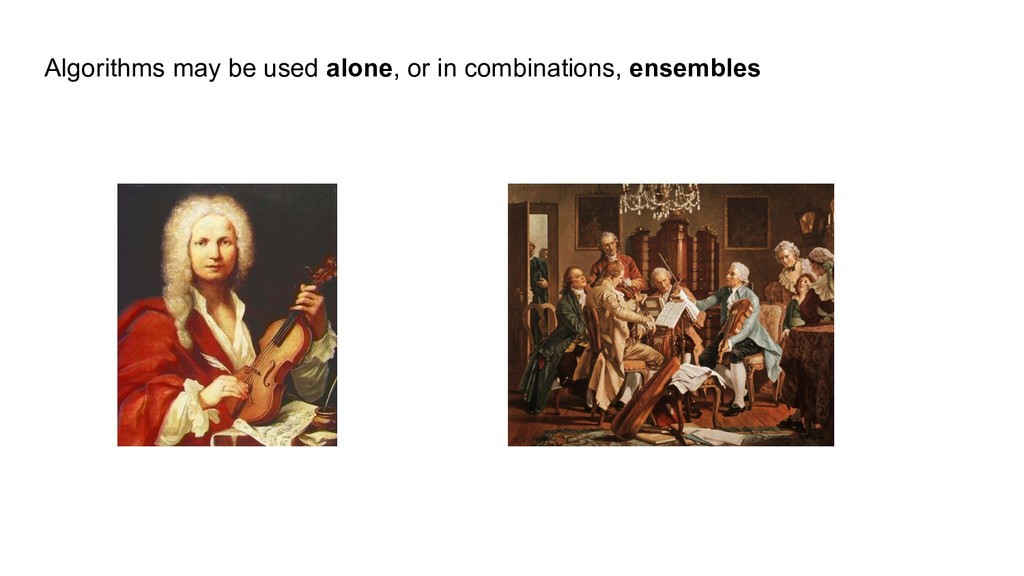
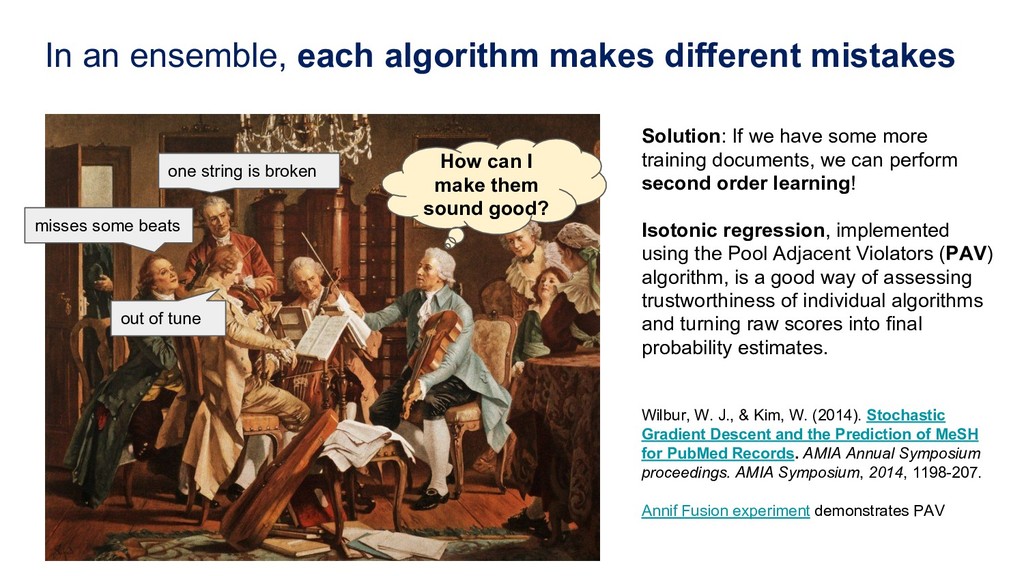
  7. In an ensemble, each algorithm makes different mistakes one string

    is broken misses some beats out of tune How can I make them sound good? Solution: If we have some more training documents, we can perform second order learning! Isotonic regression, implemented using the Pool Adjacent Violators (PAV) algorithm, is a good way of assessing trustworthiness of individual algorithms and turning raw scores into final probability estimates. Wilbur, W. J., & Kim, W. (2014). Stochastic Gradient Descent and the Prediction of MeSH for PubMed Records. AMIA Annual Symposium proceedings. AMIA Symposium, 2014, 1198-207. Annif Fusion experiment demonstrates PAV
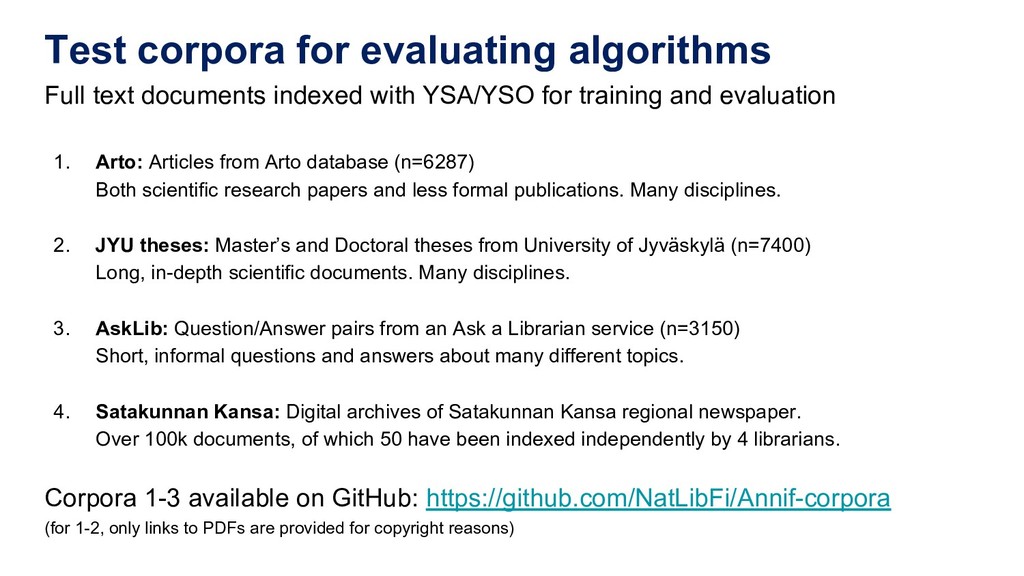
  8. Test corpora for evaluating algorithms Full text documents indexed with

    YSA/YSO for training and evaluation 1. Arto: Articles from Arto database (n=6287) Both scientific research papers and less formal publications. Many disciplines. 2. JYU theses: Master’s and Doctoral theses from University of Jyväskylä (n=7400) Long, in-depth scientific documents. Many disciplines. 3. AskLib: Question/Answer pairs from an Ask a Librarian service (n=3150) Short, informal questions and answers about many different topics. 4. Satakunnan Kansa: Digital archives of Satakunnan Kansa regional newspaper. Over 100k documents, of which 50 have been indexed independently by 4 librarians. Corpora 1-3 available on GitHub: https://github.com/NatLibFi/Annif-corpora (for 1-2, only links to PDFs are provided for copyright reasons)
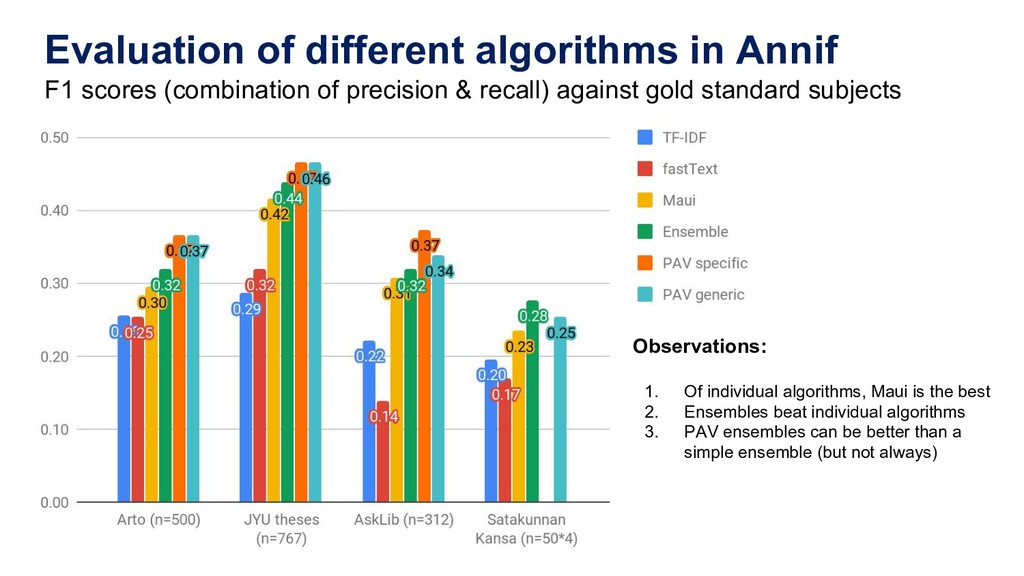
  9. Evaluation of different algorithms in Annif F1 scores (combination of

    precision & recall) against gold standard subjects Observations: 1. Of individual algorithms, Maui is the best 2. Ensembles beat individual algorithms 3. PAV ensembles can be better than a simple ensemble (but not always)
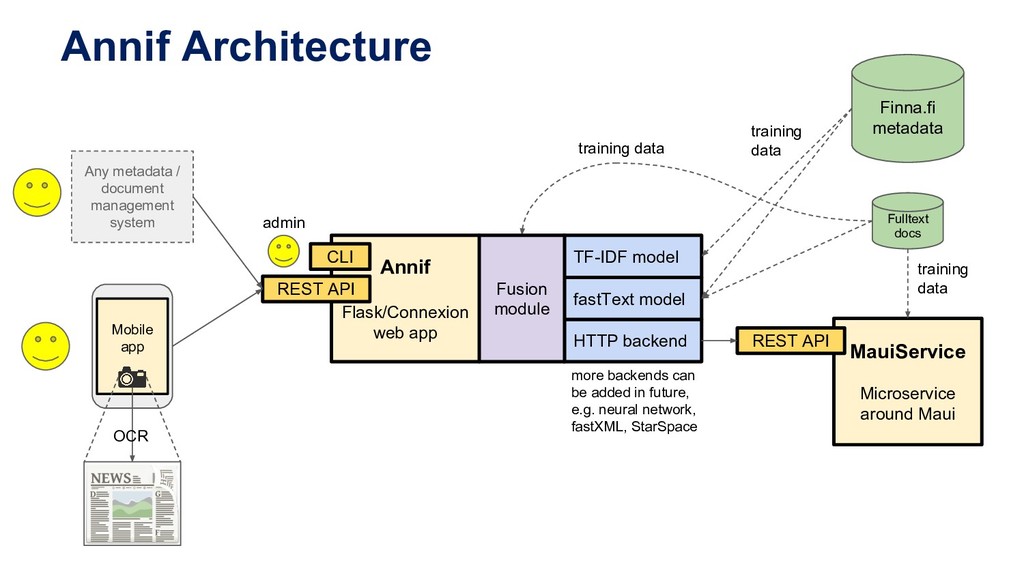
  10. Mobile app Annif Flask/Connexion web app REST API TF-IDF model

    fastText model HTTP backend MauiService Microservice around Maui REST API Annif Architecture Finna.fi metadata Fulltext docs training data training data Any metadata / document management system training data more backends can be added in future, e.g. neural network, fastXML, StarSpace OCR CLI Fusion module admin
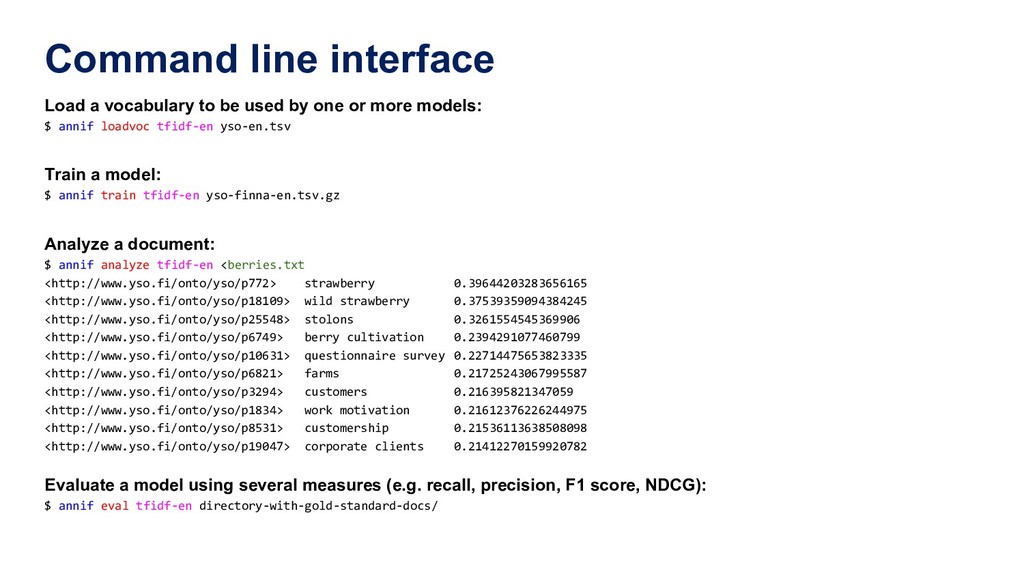
  11. Command line interface Load a vocabulary to be used by

    one or more models: $ annif loadvoc tfidf-en yso-en.tsv Train a model: $ annif train tfidf-en yso-finna-en.tsv.gz Analyze a document: $ annif analyze tfidf-en <berries.txt <http://www.yso.fi/onto/yso/p772> strawberry 0.39644203283656165 <http://www.yso.fi/onto/yso/p18109> wild strawberry 0.37539359094384245 <http://www.yso.fi/onto/yso/p25548> stolons 0.3261554545369906 <http://www.yso.fi/onto/yso/p6749> berry cultivation 0.2394291077460799 <http://www.yso.fi/onto/yso/p10631> questionnaire survey 0.22714475653823335 <http://www.yso.fi/onto/yso/p6821> farms 0.21725243067995587 <http://www.yso.fi/onto/yso/p3294> customers 0.216395821347059 <http://www.yso.fi/onto/yso/p1834> work motivation 0.21612376226244975 <http://www.yso.fi/onto/yso/p8531> customership 0.21536113638508098 <http://www.yso.fi/onto/yso/p19047> corporate clients 0.21412270159920782 Evaluate a model using several measures (e.g. recall, precision, F1 score, NDCG): $ annif eval tfidf-en directory-with-gold-standard-docs/
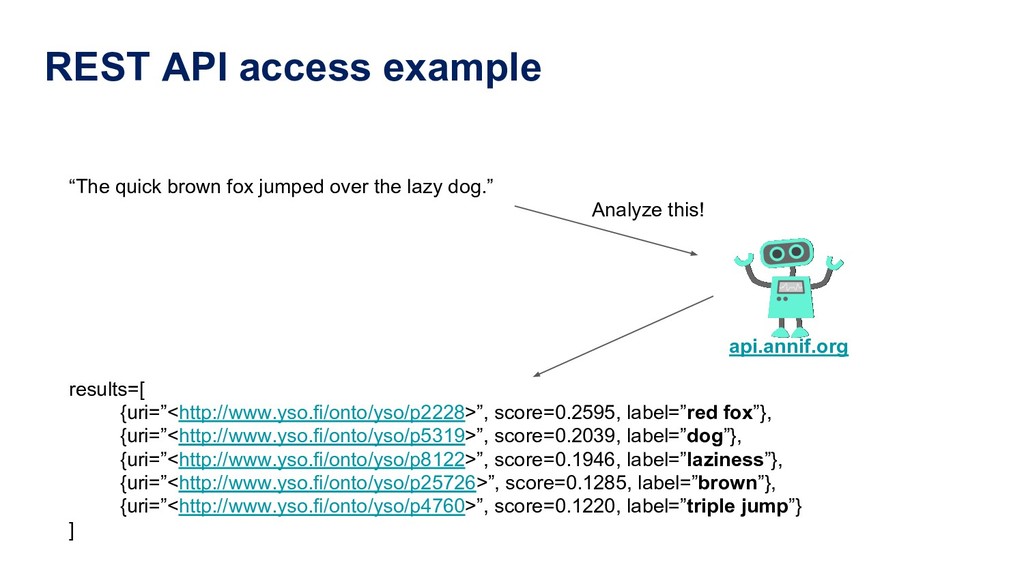
  12. REST API access example “The quick brown fox jumped over

    the lazy dog.” Analyze this! results=[ {uri=”<http://www.yso.fi/onto/yso/p2228>”, score=0.2595, label=”red fox”}, {uri=”<http://www.yso.fi/onto/yso/p5319>”, score=0.2039, label=”dog”}, {uri=”<http://www.yso.fi/onto/yso/p8122>”, score=0.1946, label=”laziness”}, {uri=”<http://www.yso.fi/onto/yso/p25726>”, score=0.1285, label=”brown”}, {uri=”<http://www.yso.fi/onto/yso/p4760>”, score=0.1220, label=”triple jump”} ] api.annif.org
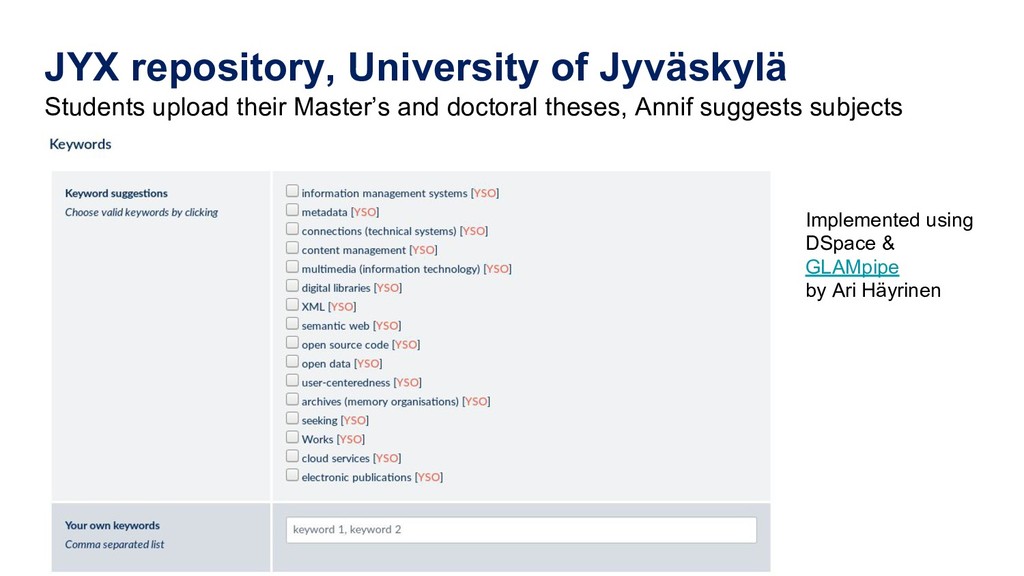
  13. JYX repository, University of Jyväskylä Students upload their Master’s and

    doctoral theses, Annif suggests subjects Implemented using DSpace & GLAMpipe by Ari Häyrinen
  14. Indexing Wikipedia by topics Finnish Wikipedia has 410 000 articles

    (620 MB as raw text) Automated subject indexing took 7 hours on a laptop, using the Annif prototype 1-3 topics per article (average ~2)
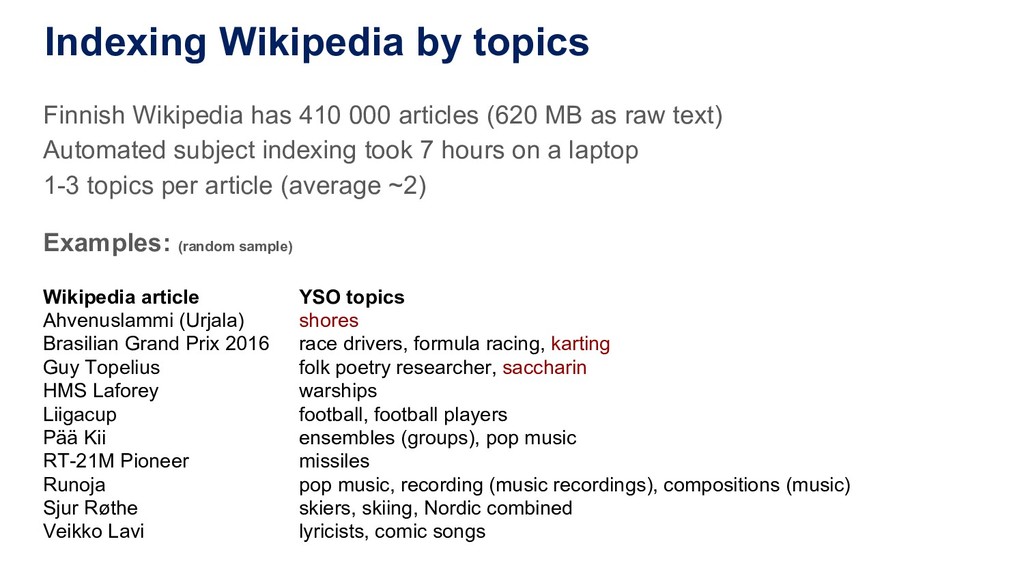
  15. Indexing Wikipedia by topics Finnish Wikipedia has 410 000 articles

    (620 MB as raw text) Automated subject indexing took 7 hours on a laptop 1-3 topics per article (average ~2) Examples: (random sample) Wikipedia article YSO topics Ahvenuslammi (Urjala) shores Brasilian Grand Prix 2016 race drivers, formula racing, karting Guy Topelius folk poetry researcher, saccharin HMS Laforey warships Liigacup football, football players Pää Kii ensembles (groups), pop music RT-21M Pioneer missiles Runoja pop music, recording (music recordings), compositions (music) Sjur Røthe skiers, skiing, Nordic combined Veikko Lavi lyricists, comic songs
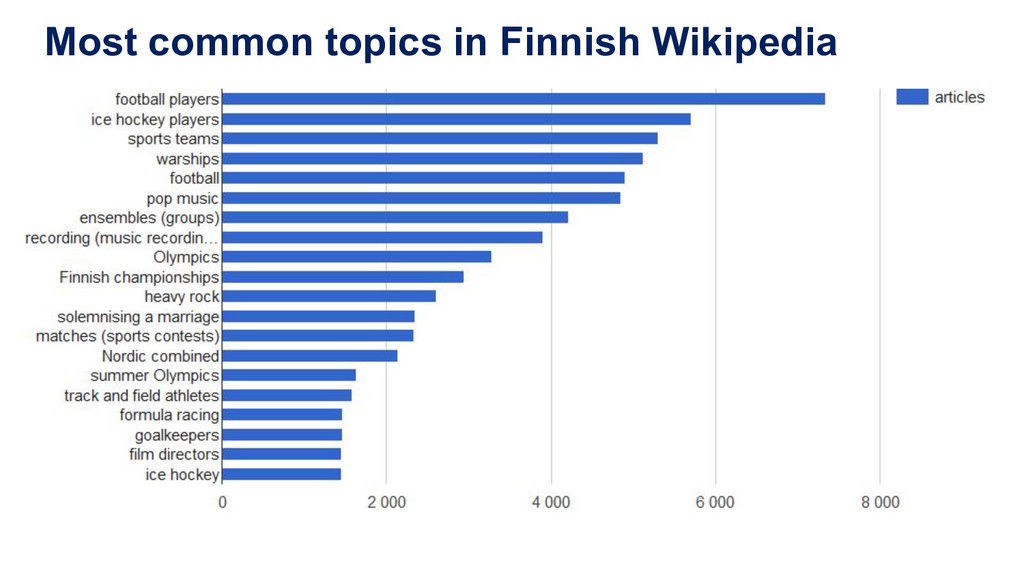
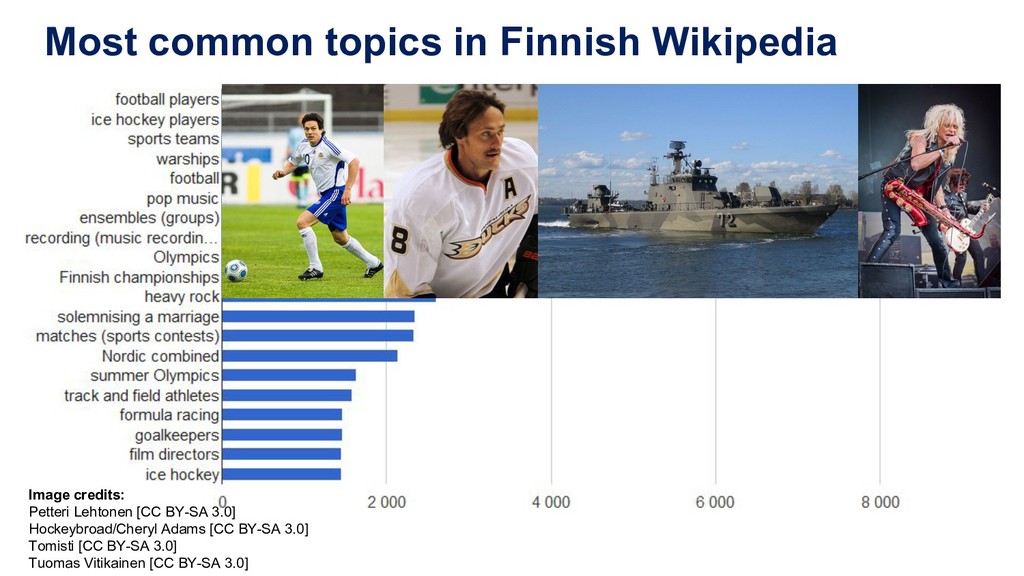
  16. Most common topics in Finnish Wikipedia Image credits: Petteri Lehtonen

    [CC BY-SA 3.0] Hockeybroad/Cheryl Adams [CC BY-SA 3.0] Tomisti [CC BY-SA 3.0] Tuomas Vitikainen [CC BY-SA 3.0]
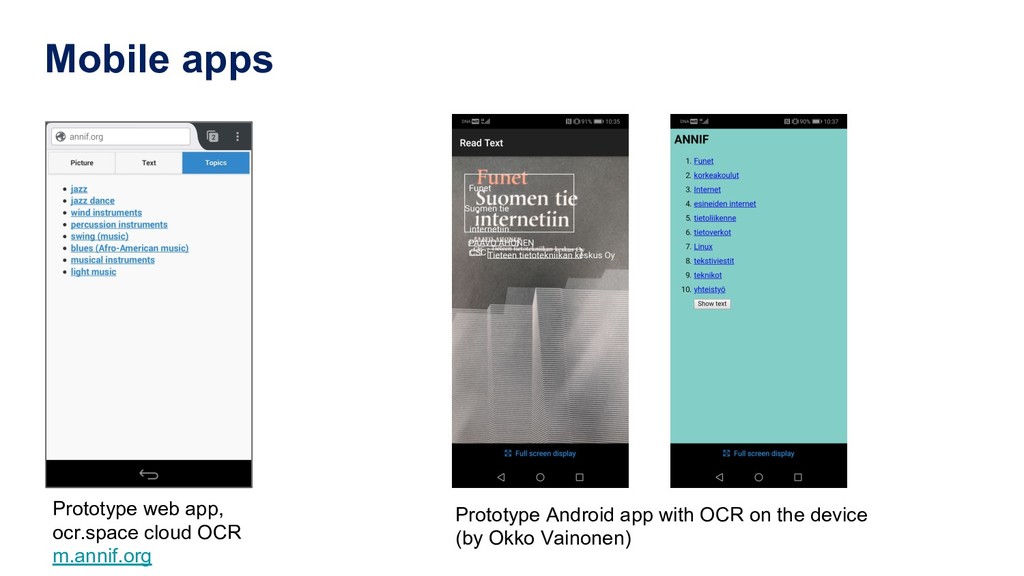
  17. Mobile apps Prototype web app, ocr.space cloud OCR m.annif.org Prototype

    Android app with OCR on the device (by Okko Vainonen)
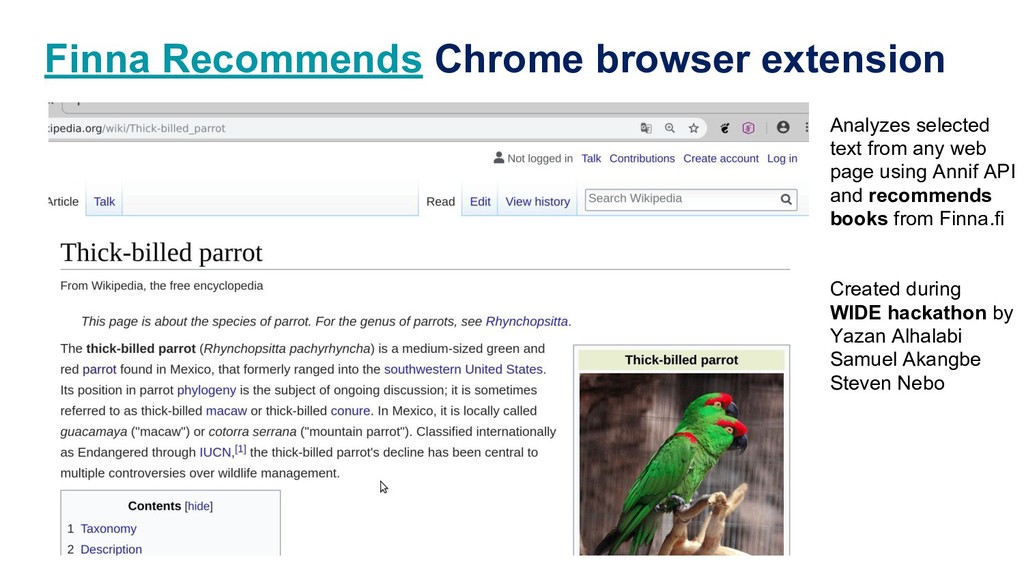
  18. Finna Recommends Chrome browser extension Analyzes selected text from any

    web page using Annif API and recommends books from Finna.fi Created during WIDE hackathon by Yazan Alhalabi Samuel Akangbe Steven Nebo
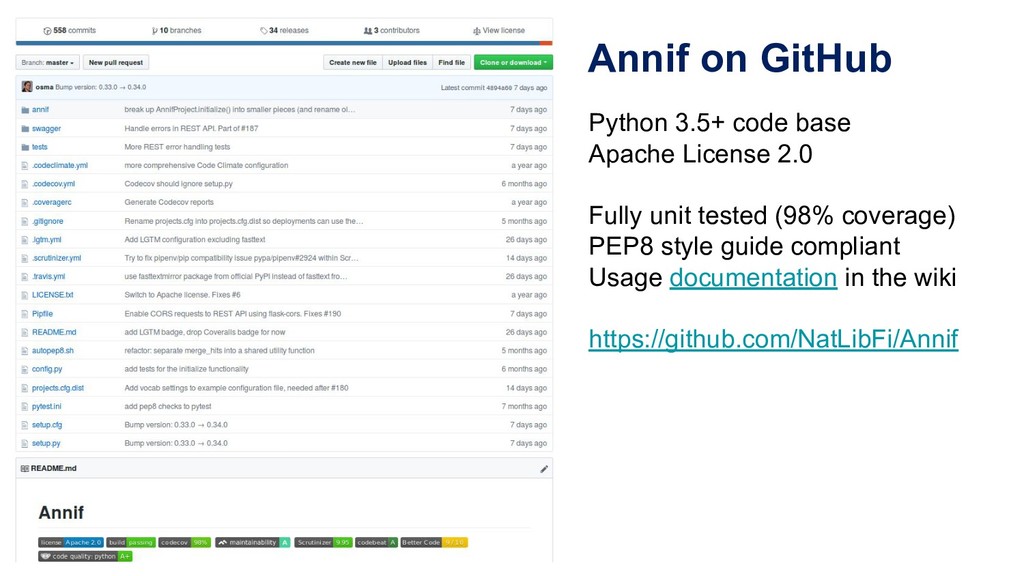
  19. Annif on GitHub Python 3.5+ code base Apache License 2.0

    Fully unit tested (98% coverage) PEP8 style guide compliant Usage documentation in the wiki https://github.com/NatLibFi/Annif
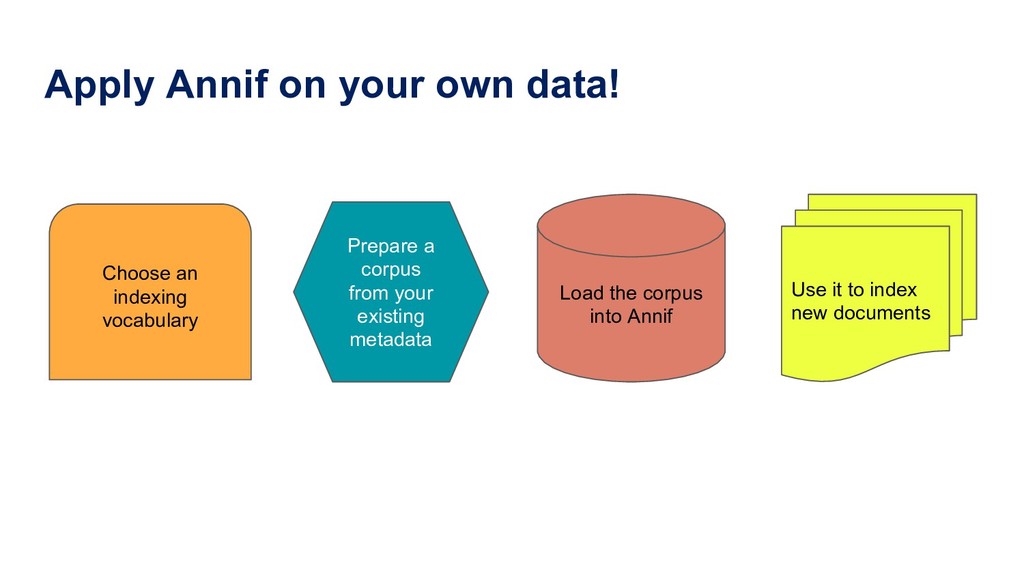
  20. Apply Annif on your own data! Choose an indexing vocabulary

    Load the corpus into Annif Prepare a corpus from your existing metadata Use it to index new documents
  21. Community group on DIY automated subject indexing? To discuss applications,

    algorithms, API standards, corpora, formats etc. Contact me if interested!