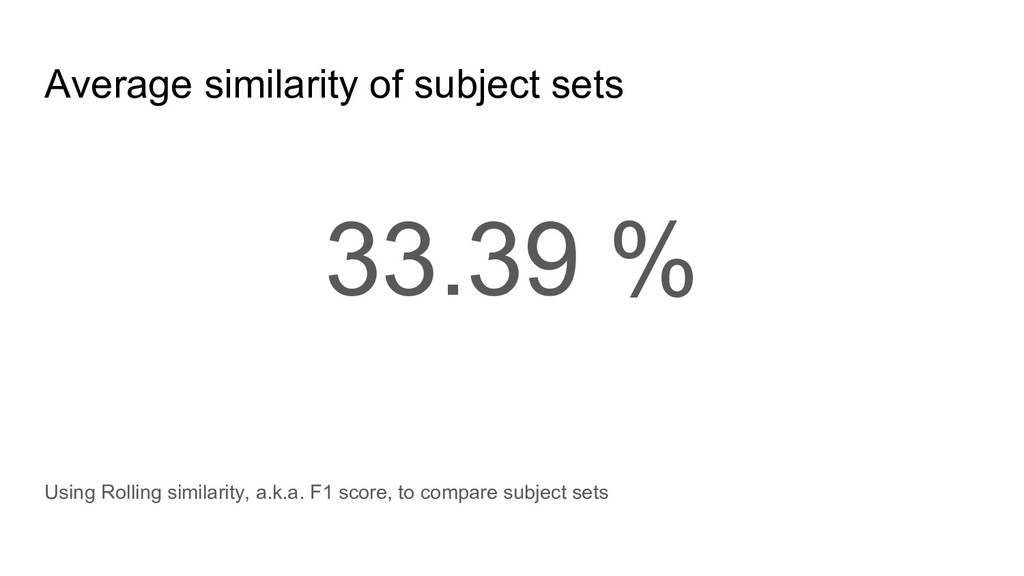
when two people index the same document, only ~⅓ of the subjects are the same • Many concepts: tens of thousands of concepts to pick from • Vocabulary changes: new concepts are added, existing ones are renamed and redefined for machines: • Long tail phenomenon: even with large amounts of training data, most subjects are only used a small number of times • Many concepts: requires complex models that are computationally intensive • Difficult to evaluate: hard to tell “somewhat bad” answers from really wrong ones without human evaluation • Vocabulary changes: models must be retrained long tail
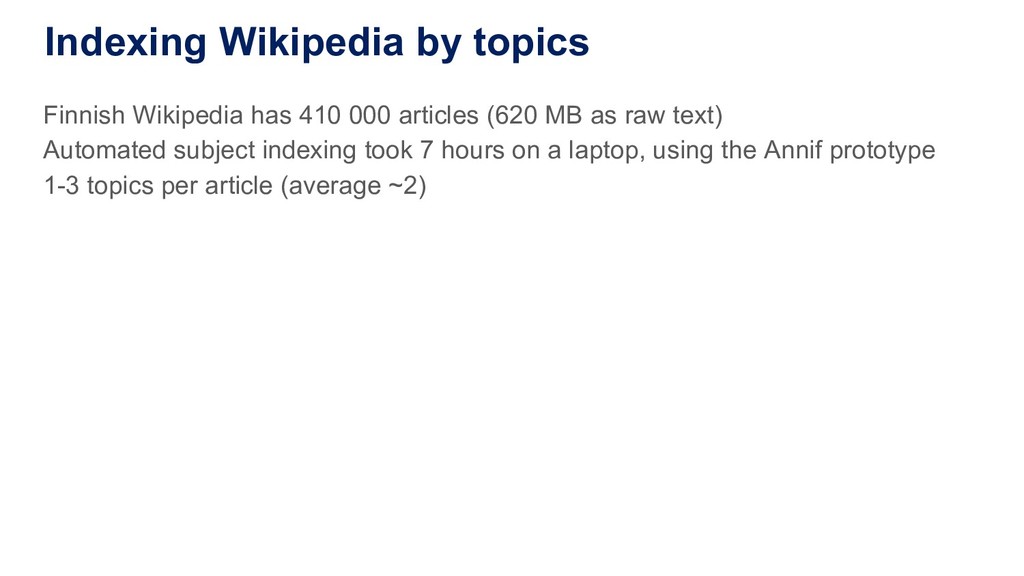
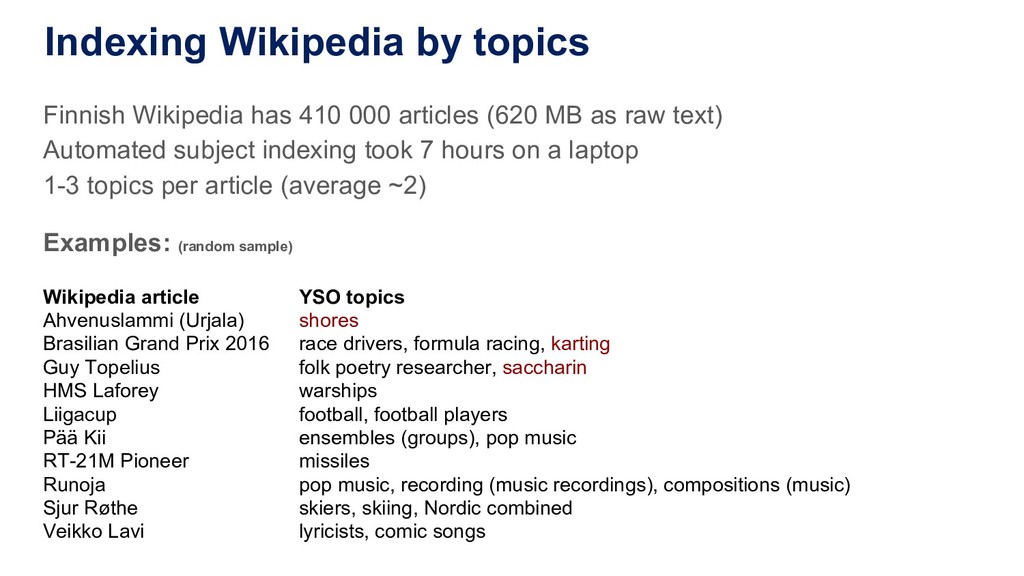
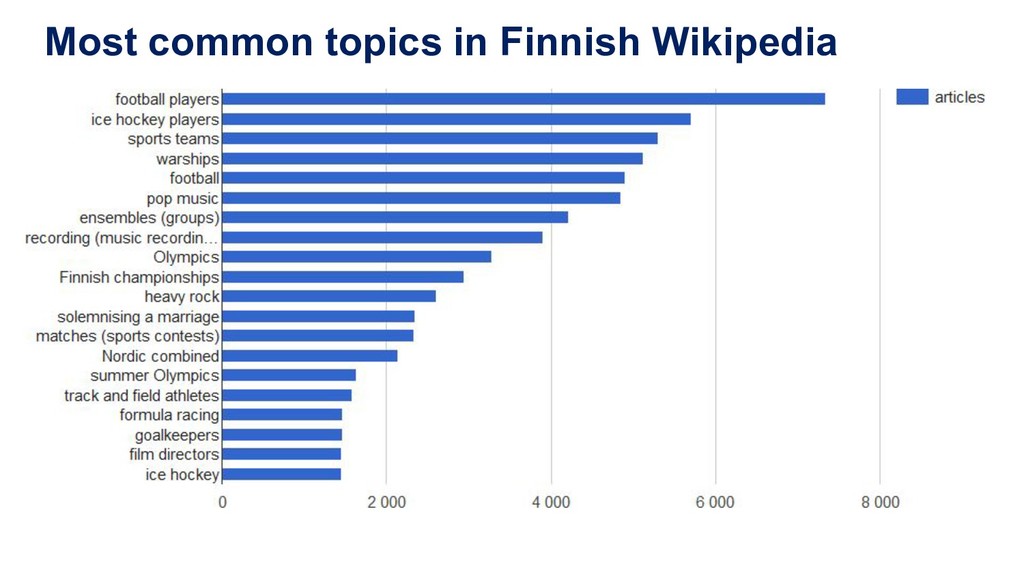
(620 MB as raw text) Automated subject indexing took 7 hours on a laptop 1-3 topics per article (average ~2) Examples: (random sample) Wikipedia article YSO topics Ahvenuslammi (Urjala) shores Brasilian Grand Prix 2016 race drivers, formula racing, karting Guy Topelius folk poetry researcher, saccharin HMS Laforey warships Liigacup football, football players Pää Kii ensembles (groups), pop music RT-21M Pioneer missiles Runoja pop music, recording (music recordings), compositions (music) Sjur Røthe skiers, skiing, Nordic combined Veikko Lavi lyricists, comic songs
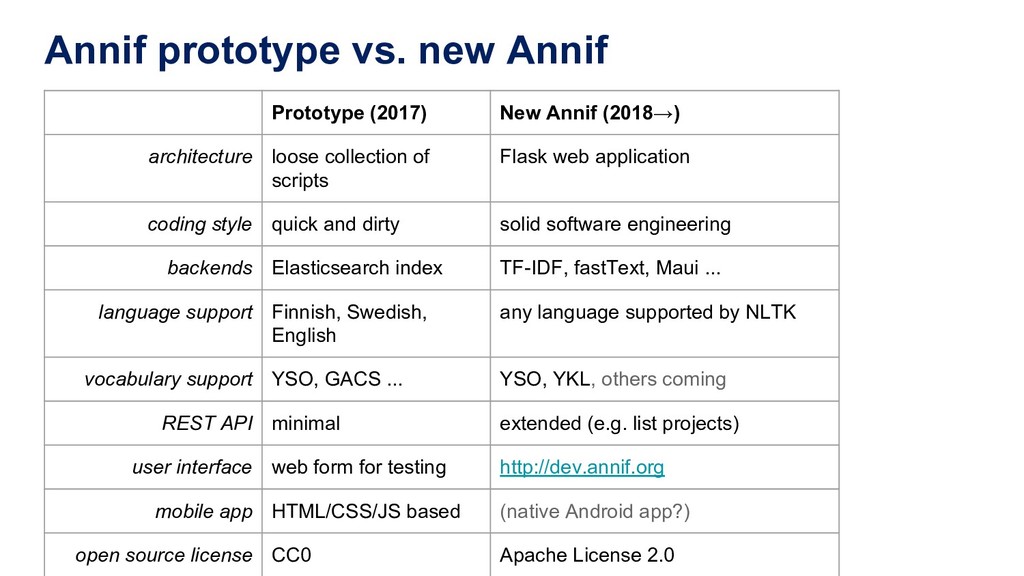
architecture loose collection of scripts Flask web application coding style quick and dirty solid software engineering backends Elasticsearch index TF-IDF, fastText, Maui ... language support Finnish, Swedish, English any language supported by NLTK vocabulary support YSO, GACS ... YSO, YKL, others coming REST API minimal extended (e.g. list projects) user interface web form for testing http://dev.annif.org mobile app HTML/CSS/JS based (native Android app?) open source license CC0 Apache License 2.0
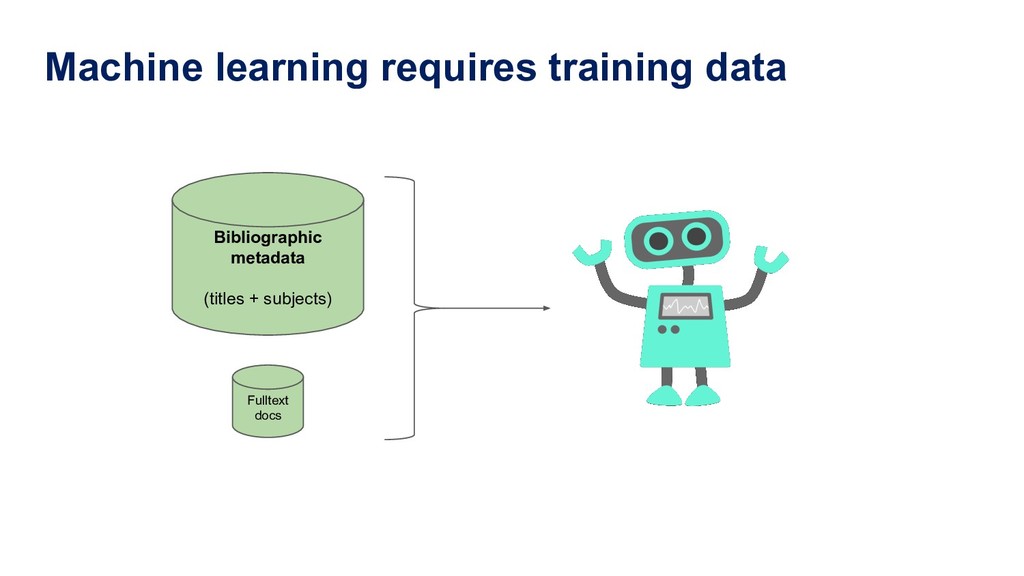
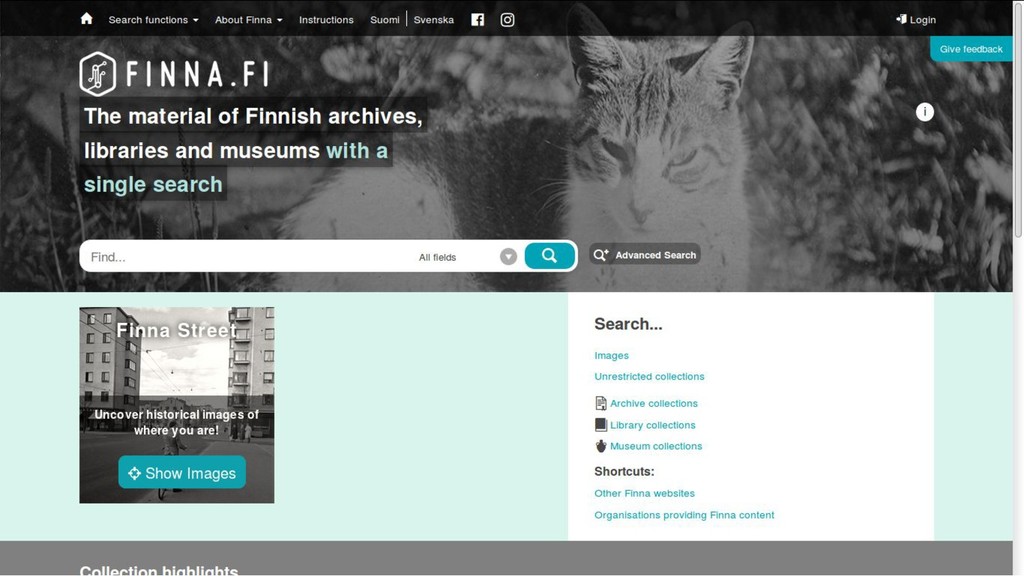
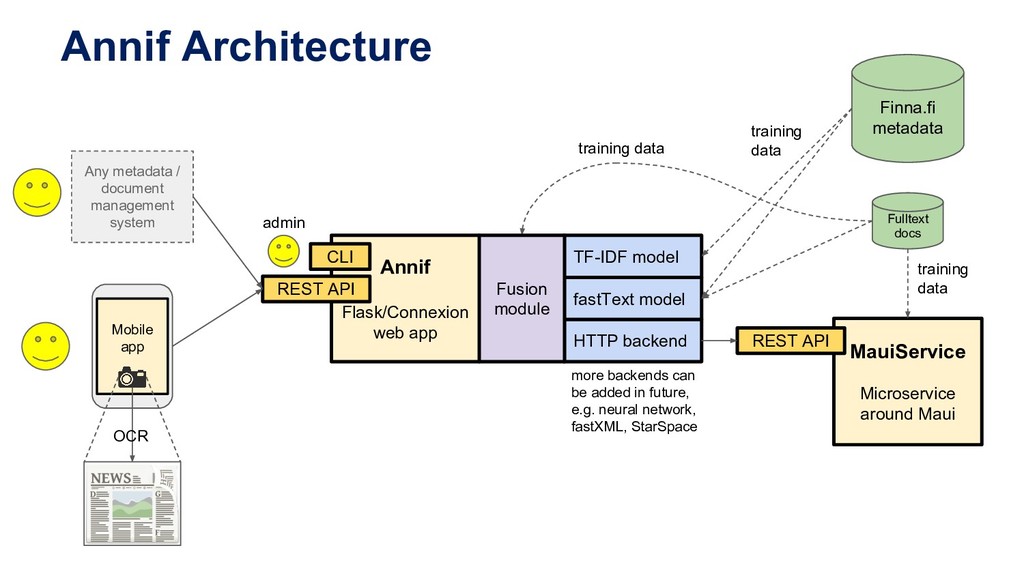
fastText model HTTP backend MauiService Microservice around Maui REST API Annif Architecture Finna.fi metadata Fulltext docs training data training data Any metadata / document management system training data more backends can be added in future, e.g. neural network, fastXML, StarSpace OCR CLI Fusion module admin
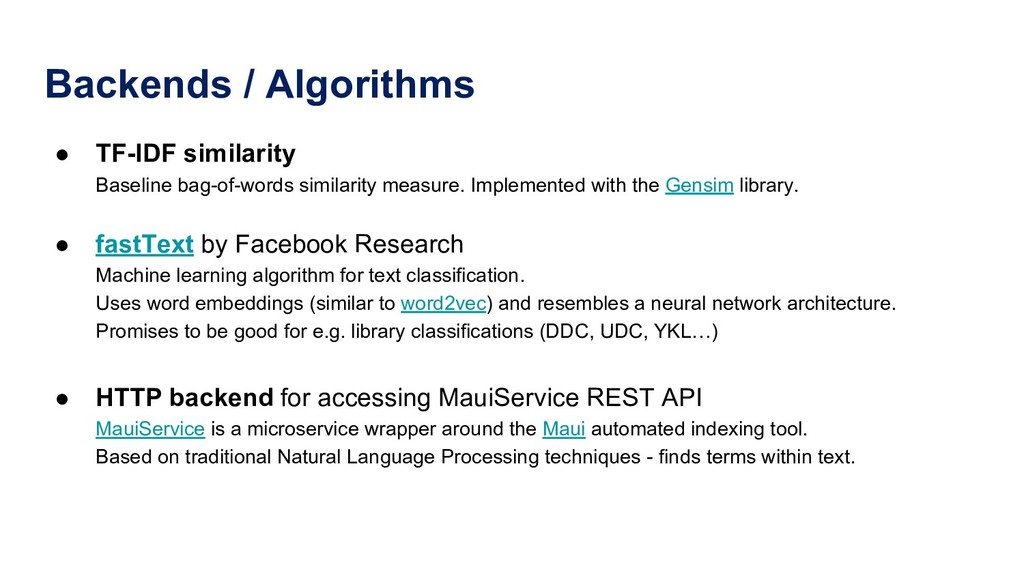
Implemented with the Gensim library. • fastText by Facebook Research Machine learning algorithm for text classification. Uses word embeddings (similar to word2vec) and resembles a neural network architecture. Promises to be good for e.g. library classifications (DDC, UDC, YKL…) • HTTP backend for accessing MauiService REST API MauiService is a microservice wrapper around the Maui automated indexing tool. Based on traditional Natural Language Processing techniques - finds terms within text.
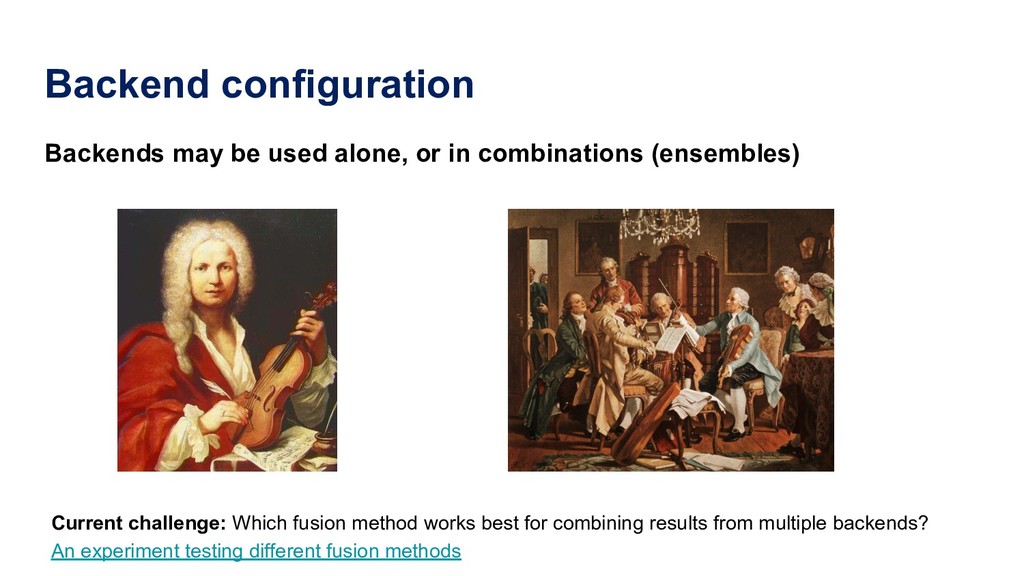
(ensembles) Current challenge: Which fusion method works best for combining results from multiple backends? An experiment testing different fusion methods
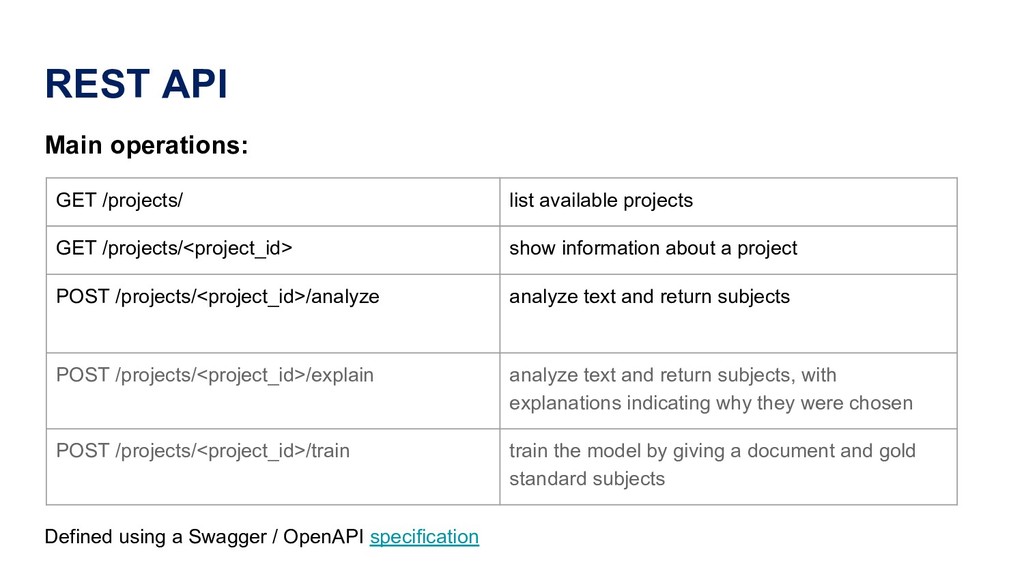
specification GET /projects/ list available projects GET /projects/<project_id> show information about a project POST /projects/<project_id>/analyze analyze text and return subjects POST /projects/<project_id>/explain analyze text and return subjects, with explanations indicating why they were chosen POST /projects/<project_id>/train train the model by giving a document and gold standard subjects
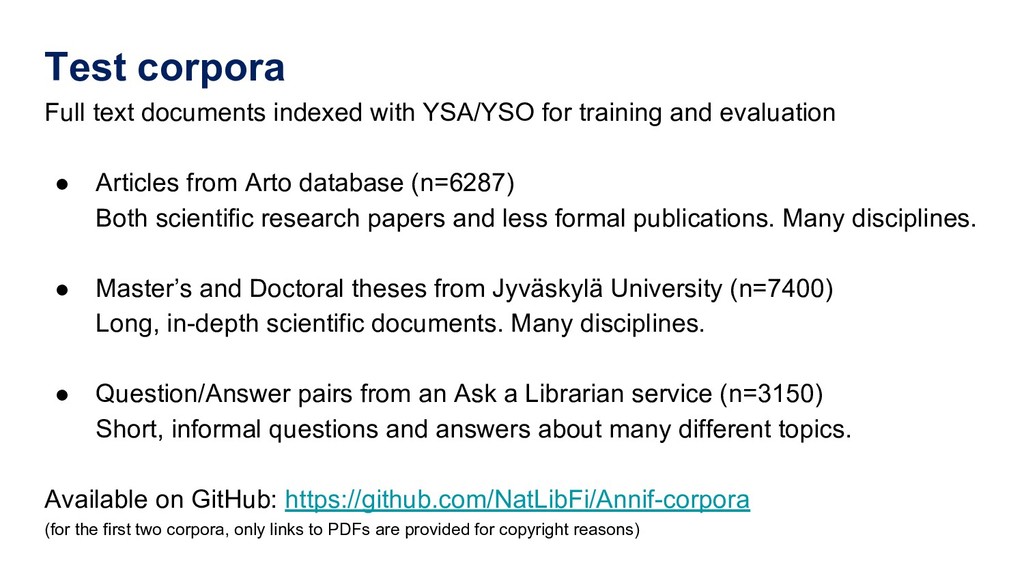
and evaluation • Articles from Arto database (n=6287) Both scientific research papers and less formal publications. Many disciplines. • Master’s and Doctoral theses from Jyväskylä University (n=7400) Long, in-depth scientific documents. Many disciplines. • Question/Answer pairs from an Ask a Librarian service (n=3150) Short, informal questions and answers about many different topics. Available on GitHub: https://github.com/NatLibFi/Annif-corpora (for the first two corpora, only links to PDFs are provided for copyright reasons)
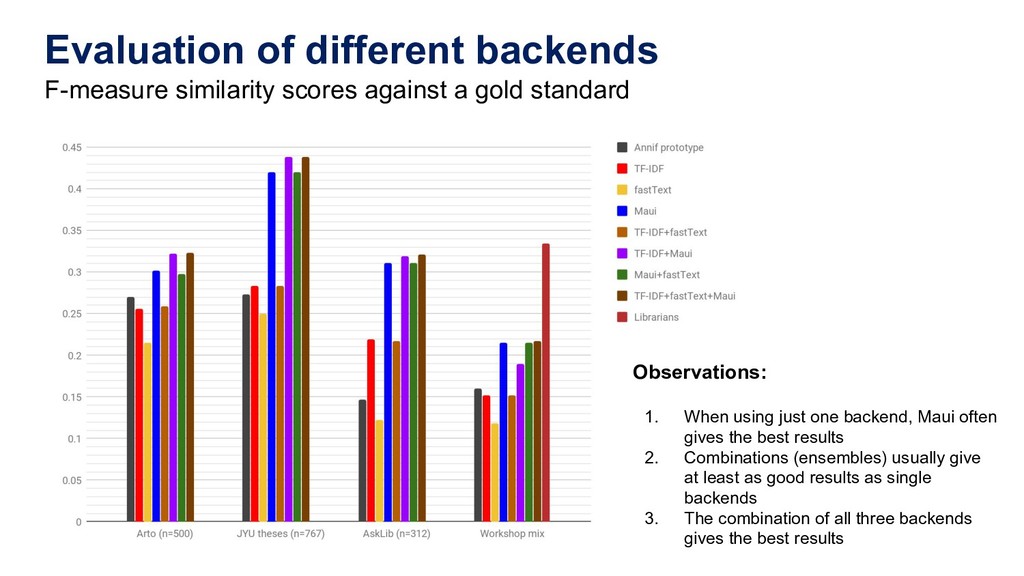
standard Observations: 1. When using just one backend, Maui often gives the best results 2. Combinations (ensembles) usually give at least as good results as single backends 3. The combination of all three backends gives the best results
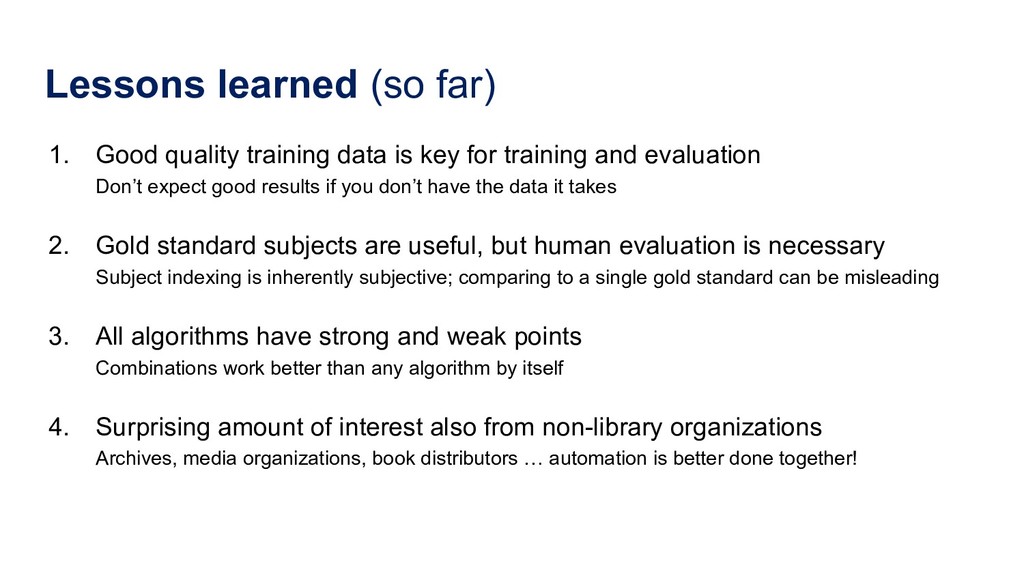
key for training and evaluation Don’t expect good results if you don’t have the data it takes 2. Gold standard subjects are useful, but human evaluation is necessary Subject indexing is inherently subjective; comparing to a single gold standard can be misleading 3. All algorithms have strong and weak points Combinations work better than any algorithm by itself 4. Surprising amount of interest also from non-library organizations Archives, media organizations, book distributors … automation is better done together!