Share
Embed

Transcript
30 slides
-
09. – 12.12.2019 Frankfurt am Main #ittage Entity Framework Core
Pawel Gerr Performance Optimization -
Entity Framework Core Performance Optimization Example for today – Products
DB Product group Products Prices Sellers Studio -
Entity Framework Core Performance Optimization My usual options for Entity
Framework performance optimization 2nd level cache Hardware upgrade Materialized views Stored procedures Triggers Database Features Server Raw SELECT * FROM … Raw SQL Bulk operations Indices Entity Framework Requests reduction Query restructure … and some other (minor) features we will see later Use 3rd party libs if available CPU, Memory, I/O -
Entity Framework Core Performance Optimization Did „the change“ anything good?
– My KPI Execution time (LINQ) SELECT * FROM … SELECT * FROM … SELECT * FROM … Number of requests Query statistics SELECT * FROM … “Shape” of SQL Execution plans Parse time Compile time Execution time (DB) Physical reads Logical reads Row count Round trip time SQL generation Execution time (DB) Materialization My key performance indicators -
Entity Framework Core Performance Optimization N+1 queries problem Execution of
hundreds of requests for one use case Caused by: unintentional execution of queries in loops Possible solutions: • Better code structure (software architecture) • Avoid overgeneralization (shared/core projects) • Help each other to improve (review/feedback) • Know the insights of Entity Framework • Lazy loading • Limitations Reducing database requests -
Simplified case of indirect execution of database requests in a
loop Library Main Entity Framework Core Performance Optimization Multiple requests in loops Reducing database requests var products = LoadProducts(); var prices = new List<Price>(); foreach (var product in products) { var price = GetPrice(product.Id); prices.Add(price); } public Price GetPrice(Guid productId) { MyDbContext ctx = …; return ctx.Prices.FirstOrDefault(p => p.ProductId == productId); } Executed N times -
Library Main Entity Framework Core Performance Optimization LINQ queries are
loops Reducing database requests var products = LoadProducts(); var prices = products.Select(product => GetPrice(product.Id)) .ToList(); public Price GetPrice(Guid productId) { MyDbContext ctx = …; return ctx.Prices.FirstOrDefault(p => p.ProductId == productId); } -
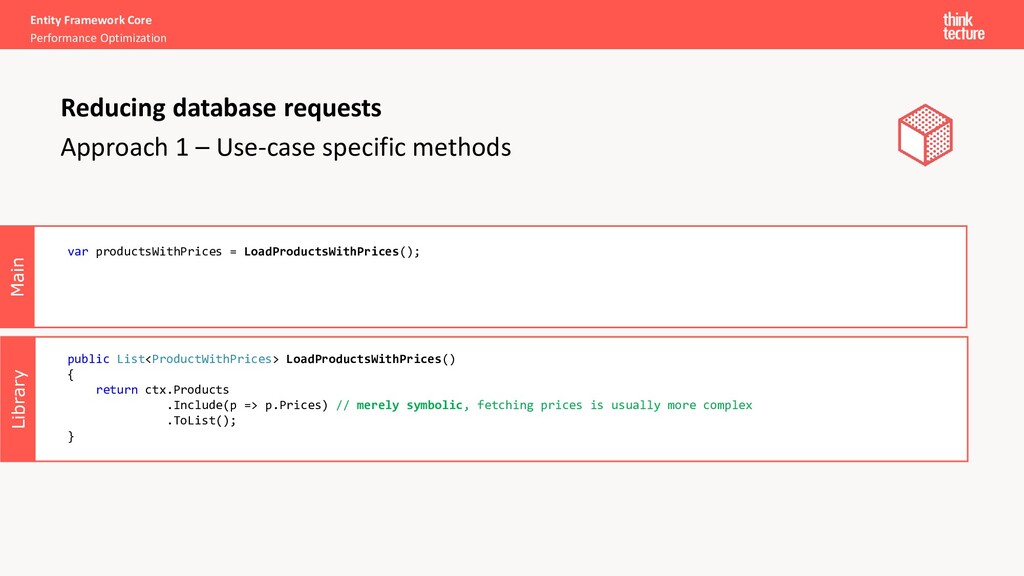
Library Main Entity Framework Core Performance Optimization Approach 1 –
Use-case specific methods Reducing database requests var productsWithPrices = LoadProductsWithPrices(); public List<ProductWithPrices> LoadProductsWithPrices() { return ctx.Products .Include(p => p.Prices) // merely symbolic, fetching prices is usually more complex .ToList(); } -
Library Main var products = LoadProducts(); var productIds = products.Select(p
=> p.Id); var prices = GetPrices(productIds); public List<Price> GetPrices(IEnumerable<Guid> productIds) { return ctx.Prices .Where(p => productIds.Contains(p.ProductId)) .ToList(); } Entity Framework Core Performance Optimization Approach 2 – load all required prices at once Reducing database requests -
Given: 100 products being in 5 studio Loading of all
products “in one go” leads to 1 + 5 queries Library Main var productsByStudio = ctx.Products .Include(p => p.Studio) .ToLookup(p => p.Studio.Name); Entity Framework Core Performance Optimization Lazy loading Reducing database requests public static ILookup<TKey, TSource> ToLookup<TSource, TKey>( this IEnumerable<TSource> source, Func<TSource, TKey> keySelector) { ... } Use eager loading to prevent unnecessary requests IEnumerable<T> always forces query execution -
LINQ Entity Framework Core Performance Optimization Limitations of Entity Framework
Core Access to navigational property in EF 2.2 leads to N+1 queries if query is not trivial • Loading of the first product of 5 studios leads to 1 + 5 queries • The issue has been fixed in EF 3.0 Reducing database requests var studios = ctx.Studios .Select(s => { Studio = s, FirstProduct = s.Products.FirstOrDefault() }) .ToList(); not trivial query -
Entity Framework Core Performance Optimization Finding the problem area Use
profiling tools In case of Microsoft SQL Server: XEvent Profiler in SQL Server Management Studio SQL Server Profiler (deprecated, resource intensive) Azure Data Studio Logs coming from EF with EnableSensitiveDataLogging Reducing database requests Logging DbContextOptionsBuilder builder = ...; builder.UseSqlServer("...") // or any other database .UseLoggerFactory(loggerFactory) .EnableSensitiveDataLogging(); In development only because possible security leak! -
Entity Framework Core Performance Optimization Finding the problem area Look
for repetitive lines and cycles Reducing database requests Repetive lines Cycles -
Entity Framework Core Performance Optimization Cartesian explosion problem Fetching a
lot of data from multiple tables at once • Increased memory consumption and execution time • High I/O load Caused by: loading of multiple navigational collection-properties Possible solutions: • Reduce Includes (eager loading) • Reduce access to navigational properties in projections (i.e. Select) Reducing query complexity Query splitting -
Entity Framework Core Performance Optimization Eager loading via Include EF
2.2 is loading collections separately EF 3.0 loads all data using 1 SQL statement • Bigger result sets: 100 products with 5 prices each and 3 sellers (100 * 5 * 3) rows > (100 + 500 + 3) records • EF-forced ORDER BY clause produces considerable load Reducing query complexity Product Id Price Id Seller Id 1 1 1 1 1 2 1 1 3 1 2 1 1 2 2 1 2 3 SQL LINQ var products = ctx.Products .Include(p => p.Studio) .Include(p => p.Prices) .Include(p => p.Sellers) .ToList(); SELECT * FROM Products INNER JOIN Studios ... LEFT JOIN Prices ON ... LEFT JOIN Sellers ON ... ... ORDER BY Products.Id, Prices.Id, Sellers.Id Cartesian explosion -
Before Entity Framework Core Performance Optimization Using collections in projections
Loading all data at once Statistics: • CPU: 31 • Duration: 75 • Reads: 5299 • Row Count: 12342 Reducing query complexity LINQ var studios = ctx.Studios .Select(s => new MyStudio { Id = s.Id, Name = s.Name, Infinity = s.Products.Where(p => p.Name.StartsWith("Infinity")), Endgame = s.Products.Where(p => p.Name.StartsWith("Endgame")) }) .ToList(); -
Before Usually, loading collection separately requires more code but less
resources on database Statistics: • CPU: 31 • Duration: 75 • Reads: 5299 • Row Count: 12342 After LINQ Entity Framework Core Performance Optimization Query splitting Reducing query complexity var studios = ctx.Studios.Select(p => new Studio() { Id = p.Id, Name = p.Name }).ToList(); var infinity = ctx.Products.Where(p => p.Name.StartsWith("Infinity")).ToList(); var endgame = ctx.Products.Where(p => p.Name.StartsWith("Endgame")).ToList(); var infinityLookup = infinity.ToLookup(p => p.StudioId); var endgameLookup = endgame.ToLookup(p => p.StudioId); foreach (var studio in studios) { studio.Infinity = infinityLookup[studio.Id]; sturio.Endgame = endgameLooup[studio.Id]; } Necessary, if change tracking is disabled 16 3 352 2322 -
LINQ 2 LINQ 1 Entity Framework Core Performance Optimization Which
one is better? Understanding Queries var groups = ctx.ProductGroups .Select(g => new { g.Products.FirstOrDefault().Id, g.Products.FirstOrDefault().Name }) .ToList(); var groups = ctx.ProductGroups .Select(g => g.Products .Select(p => new { p.Id, p.Name }) .FirstOrDefault()) .ToList(); 2x “FirstOrDefault()” before selecting properties Selection of properties before “FirstOrDefault()” -
SQL 2 SQL 1 Entity Framework Core Performance Optimization Lets
try with SQL … Understanding Queries SELECT ( SELECT TOP(1) p.Id FROM Products p WHERE g.Id = p.GroupId ) AS FirstProductId, ( SELECT TOP(1) p.Name FROM Products p WHERE g.Id = p.GroupId ) AS FirstProductName FROM ProductGroups g SELECT p.Id, p.Name FROM ProductGroups g LEFT JOIN ( SELECT Id, Name, GroupId FROM ( SELECT Id, Name, GroupId, ROW_NUMBER() OVER(PARTITION BY GroupId ORDER BY Id) AS row FROM Products ) p WHERE row <= 1 ) p ON g.Id = p.GroupId 2 sub-selects Window function “ROW_NUMBER” -
Entity Framework Core Performance Optimization Textual representation of all database
operations • Type and the order of operations (JOIN, filter, projection, ...) • Indexes being used • Amount of data flowing between two operations • Costs of an operation and a subtree Some tools have built-in support for displaying execution plans as a graph Execution plans -
Entity Framework Core Performance Optimization Another try … Execution plans
Execution plan 1 SQL 1 SELECT ( SELECT TOP(1) p.Id FROM Products p WHERE g.Id = p.GroupId ) AS FirstProductId, ( SELECT TOP(1) p.Name FROM Products p WHERE g.Id = p.GroupId ) AS FirstProductName FROM ProductGroups g -
Entity Framework Core Performance Optimization Execution plans Execution plan 2
SQL 2 SELECT p.Id, p.Name FROM ProductGroups g LEFT JOIN ( SELECT Id, Name, GroupId FROM ( SELECT Id, Name, GroupId, ROW_NUMBER() OVER(PARTITION BY GroupId ORDER BY Id) AS row FROM Products ) p WHERE row <= 1 ) p ON g.Id = p.GroupId -
Entity Framework Core Performance Optimization Comparing • Compare estimated subtree
costs • Deviance: estimated vs actual number of rows • Take statistics (like reads) into consideration Execution plans Query 1 wins! -
Entity Framework Core Performance Optimization Execution plans Crash course Table
scan Clustered index scan Non-clustered index scan Clustered index seek Non-clustered index seek Scan No clustered index Seek Missing index? Fuzzy search? Bad discriminator? Filter Filtering Filtering Filtering Key lookup Missing (include) columns? RID lookup If no clustered index Sort “Stop & Go” operator! Required? Missing index? Sorting in .NET cheaper? Parallelism Expensive High query complexity -
Entity Framework Core Performance Optimization JOINs Execution plans DB may
perform sort on its own • Resource-saving • Data sets must be ordered • The “default” • Kind-of 2 nested loops • Speed depends on: • Scan of data set A • Seek of data set B • Large and unsorted sets • 2 phases: • Builds hash table for set A • Matches hash values from B Should be looked at Merge join Nested loop join Hash match join -
Entity Framework Core Performance Optimization Learnings • Look for database
requests in “loops” • Split complex queries if necessary • Learn to read execution plans - optimize queries accordingly Resources • Entity Framework Core: https://docs.microsoft.com/en-us/ef/core/ • Execution Plans: https://docs.microsoft.com/en-us/sql/relational-databases/performance/execution-plans • My EF playground: https://github.com/PawelGerr/EntityFrameworkCore-Demos Ask me @pawelgerr [email protected]
 pawelgerr
 dalinaum
 yuzneri
 yosuke_furukawa
 fornewid
 ochtum
 ivargrimstad
 shogogg
 kinakomoti321
 inariku
 itsmedreamwalker
 kajitack
 marcoroth
 deanohume
 tammielis
 techseoconnect
 addyosmani
 geoffreycrofte
 chrisshort
 irinanazarova
 charlesmeaden
 axbom
 trishagee
 lemiorhan