Share
Embed
Introduction to DevOps for Engineering Teams
A practical introduction to DevOps for engineering teams, covering the silo problem between Dev and Ops, why DevOps matters for both career growth and business outcomes, and what DevOps culture actually means beyond just tooling. The deck walks through the history of the DevOps movement, the Three Ways (Flow, Feedback, Continuous Learning), core practices like loosely-coupled architecture, CI/CD, automated testing, and measurement, plus a tour of common DevOps tools and recommended reading. Originally developed in 2022 as training material for engineering teams, and used in several sessions for startup teams at the invitation of their founders.
Petra Novandi Barus
June 24, 2026
Transcript
55 slides
-
Perkenalan Nama: Petra Novandi Barus, ST MT Pendidikan: 1. S1
Teknik Informatika Institut Teknologi Bandung 2. S2 Magister Informatika Institut Teknologi Bandung Pengalaman Bekerja 1. Chief Technology Officer & Co-founder, UrbanIndo.com 2. Chief Technology Officer, 99.co Indonesia 3. Senior Developer Advocate, Amazon Web Services Indonesia 4. Chief Technology Officer, Kuncie.com -
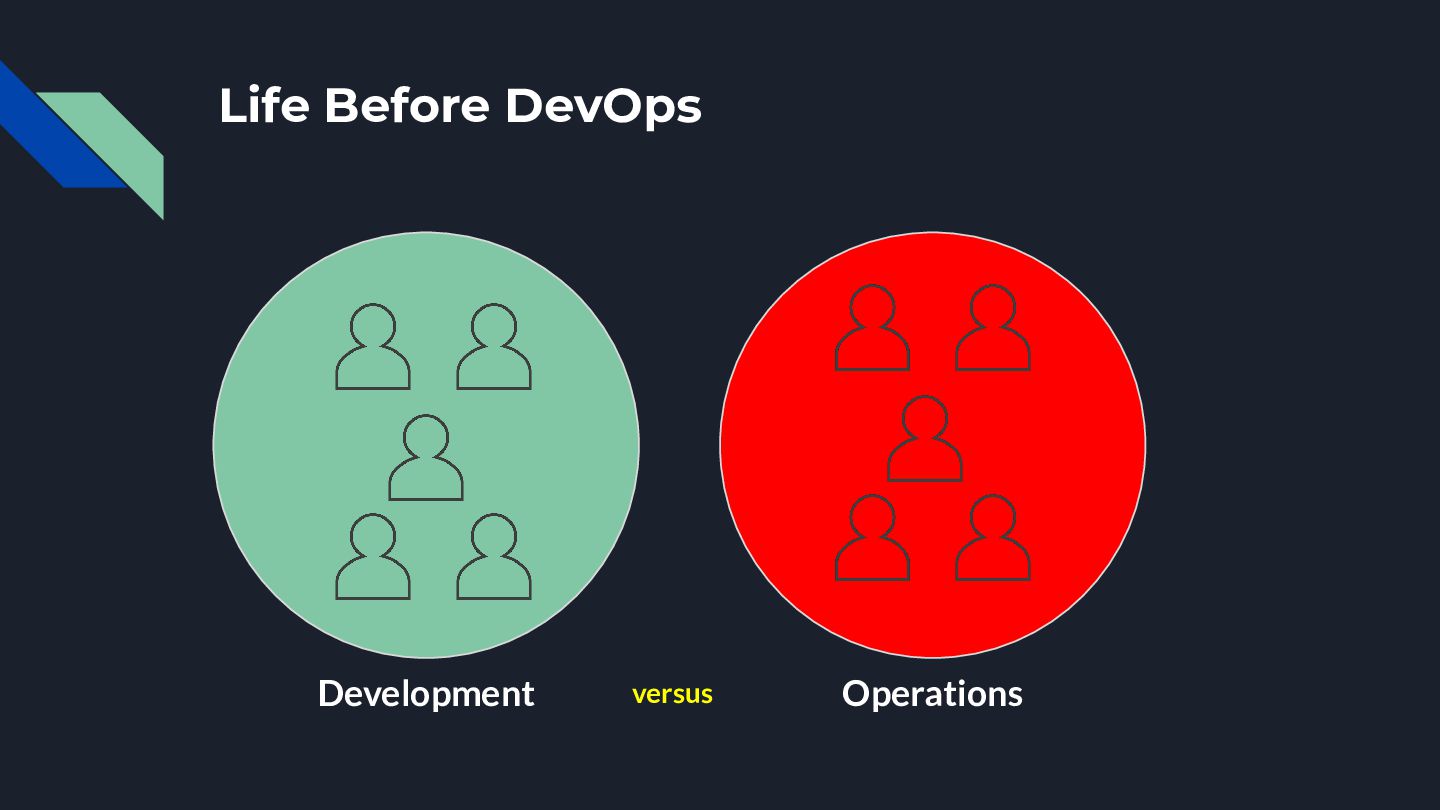
What we are going to discuss 1. Life before DevOps
2. Why you should learn DevOps? 3. What is DevOps 4. History of DevOps 5. DevOps Principles & Practices 6. DevOps Tools 7. Where To Learn More -
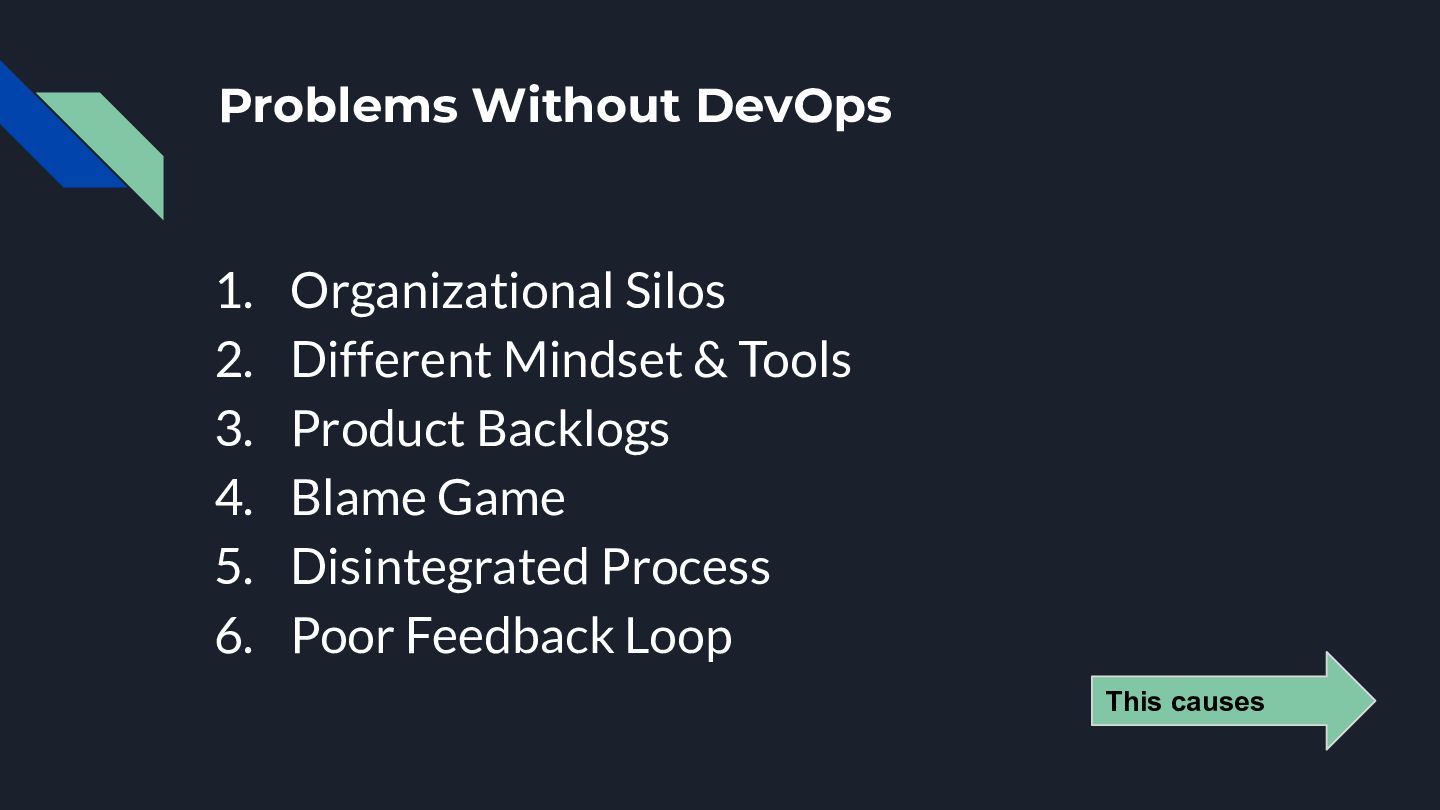
Problems Without DevOps 1. Organizational Silos 2. Different Mindset &
Tools 3. Product Backlogs 4. Blame Game 5. Disintegrated Process 6. Poor Feedback Loop This causes -
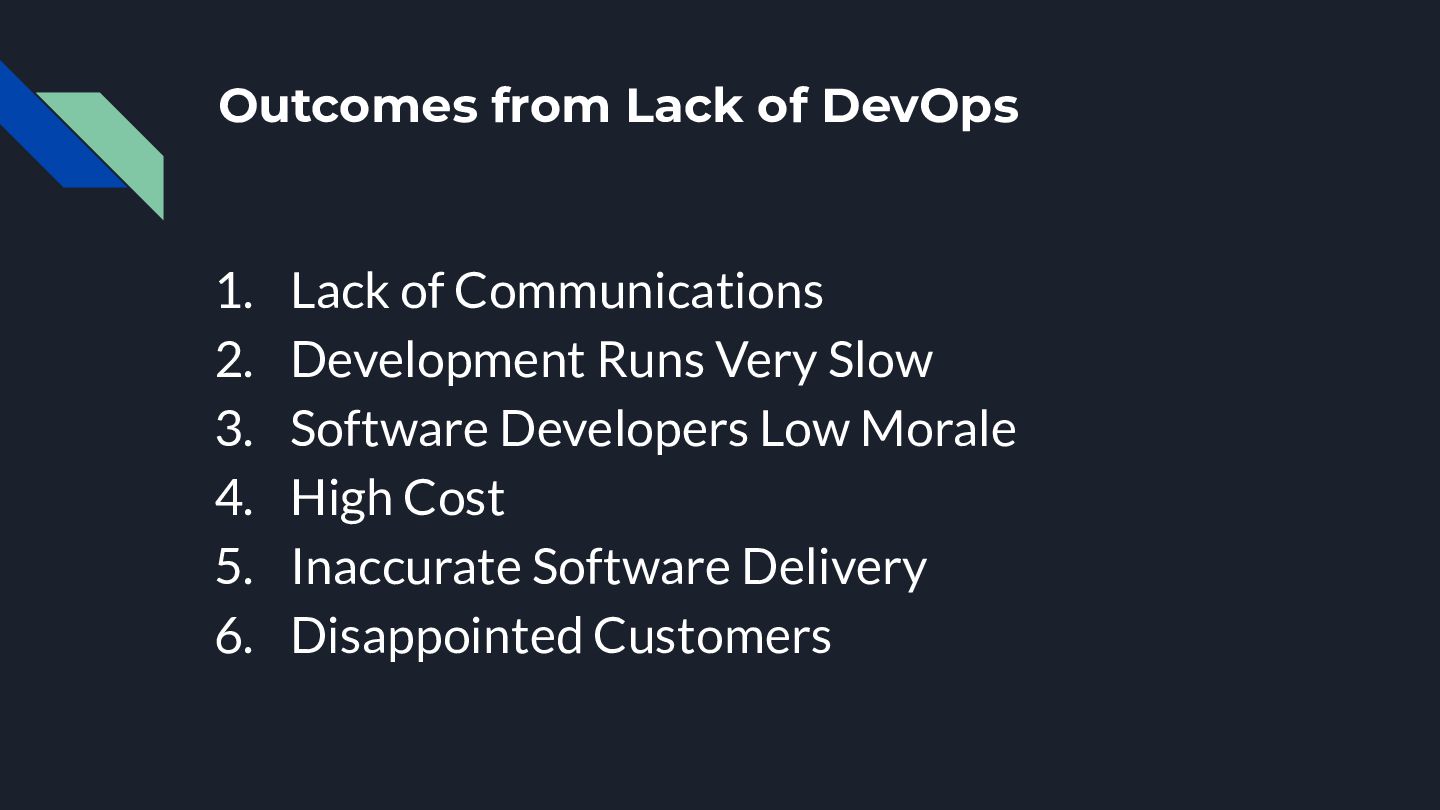
Outcomes from Lack of DevOps 1. Lack of Communications 2.
Development Runs Very Slow 3. Software Developers Low Morale 4. High Cost 5. Inaccurate Software Delivery 6. Disappointed Customers -
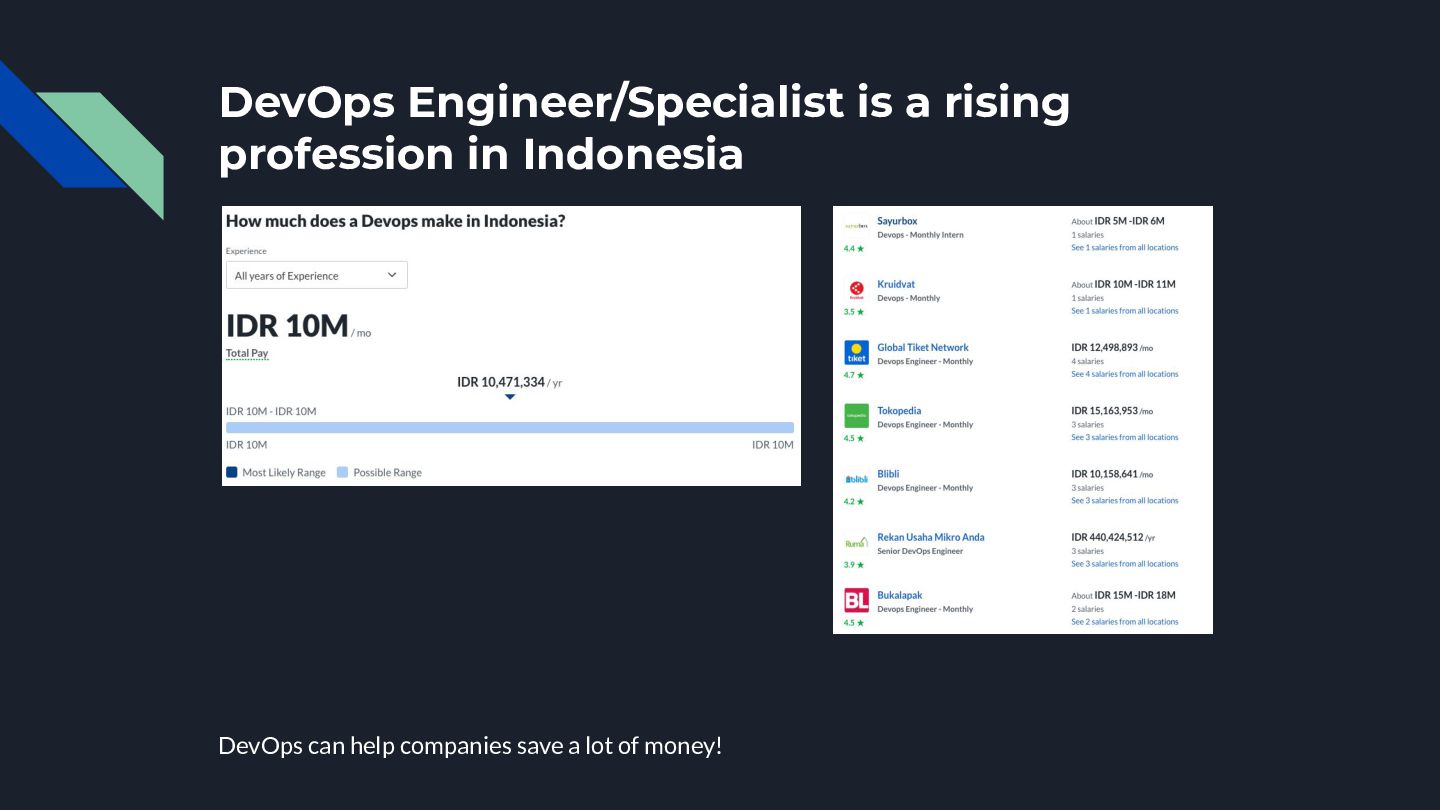
DevOps Engineer/Specialist is a rising profession in Indonesia DevOps can
help companies save a lot of money! -
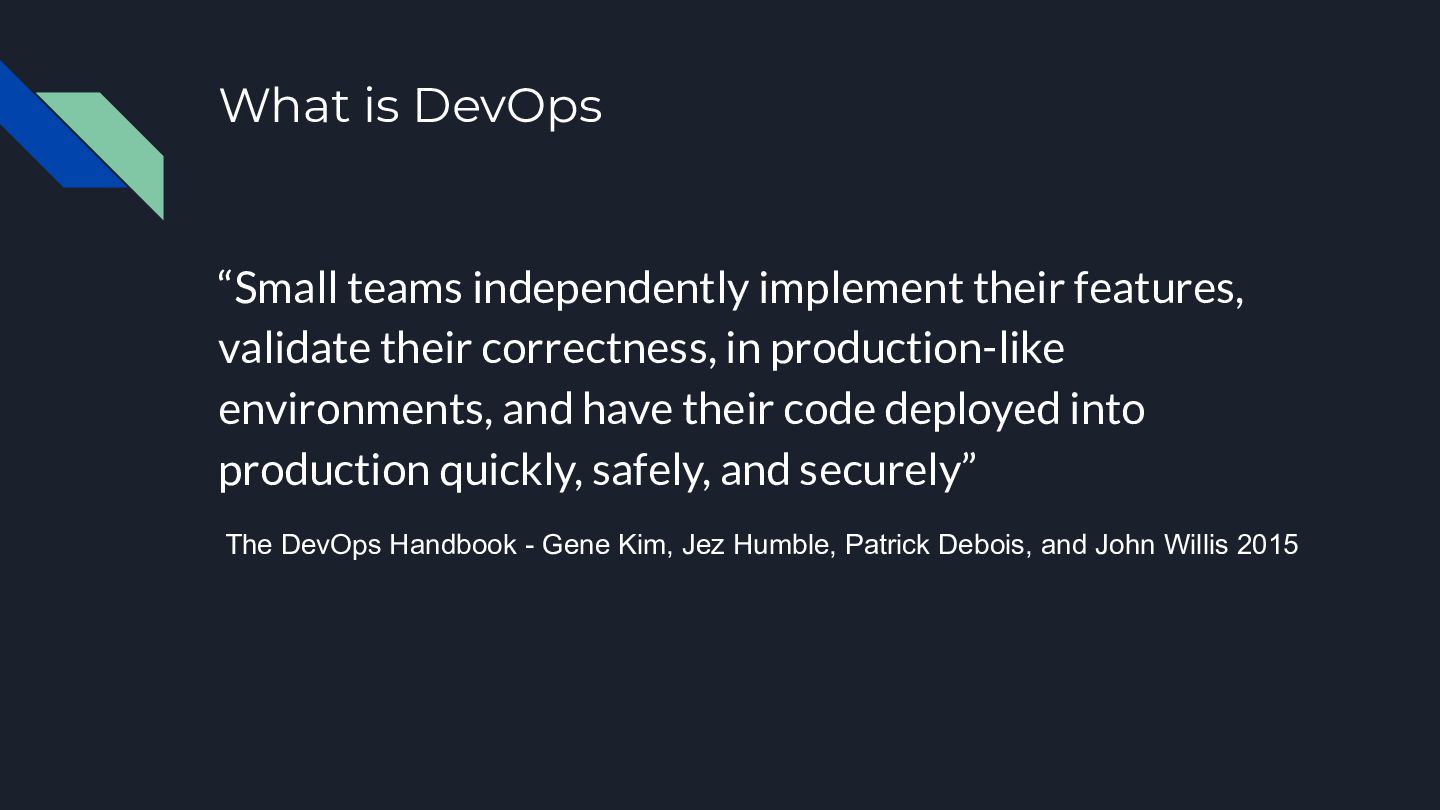
What is DevOps “Small teams independently implement their features, validate
their correctness, in production-like environments, and have their code deployed into production quickly, safely, and securely” The DevOps Handbook - Gene Kim, Jez Humble, Patrick Debois, and John Willis 2015 -
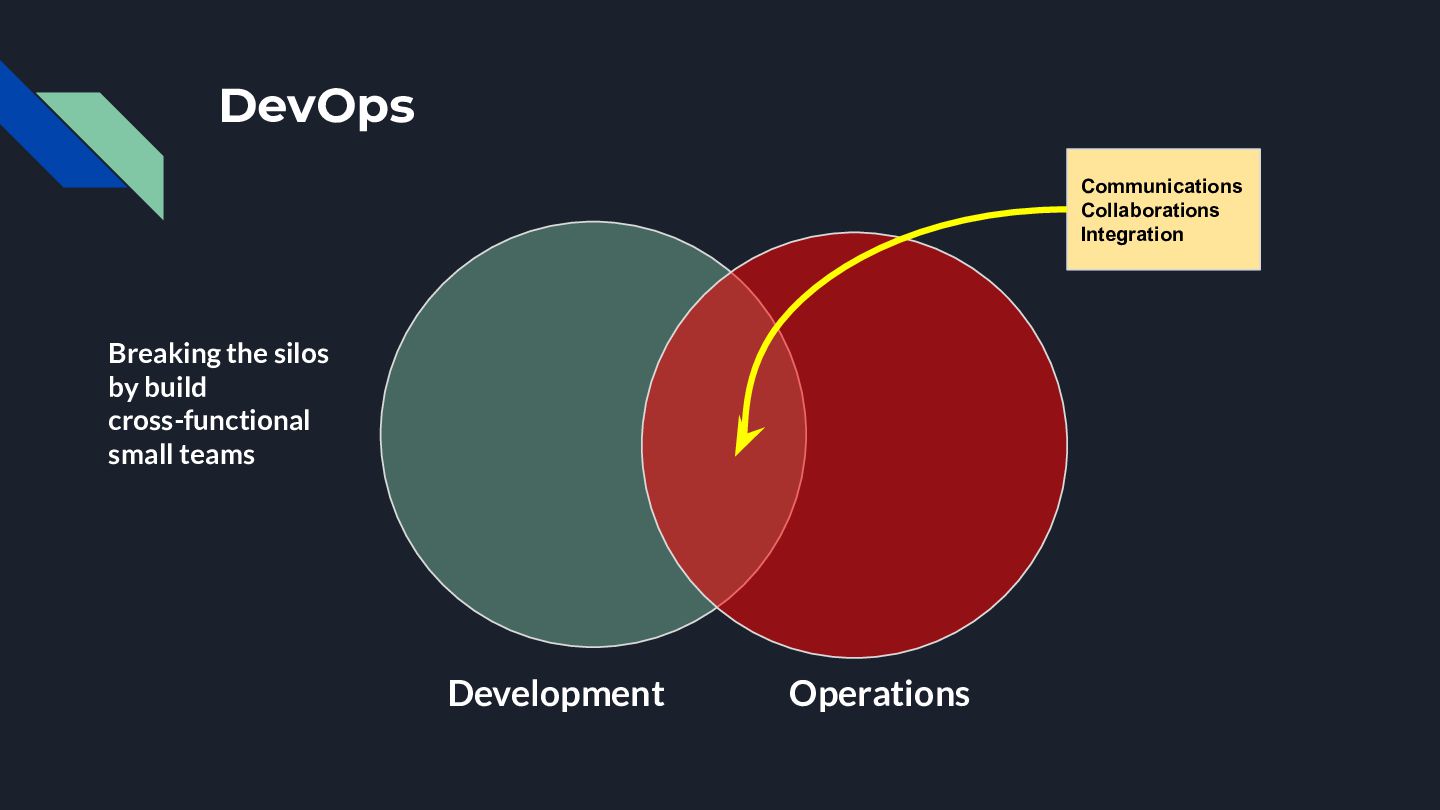
DevOps Development Operations Communications Collaborations Integration Breaking the silos by
build cross-functional small teams -
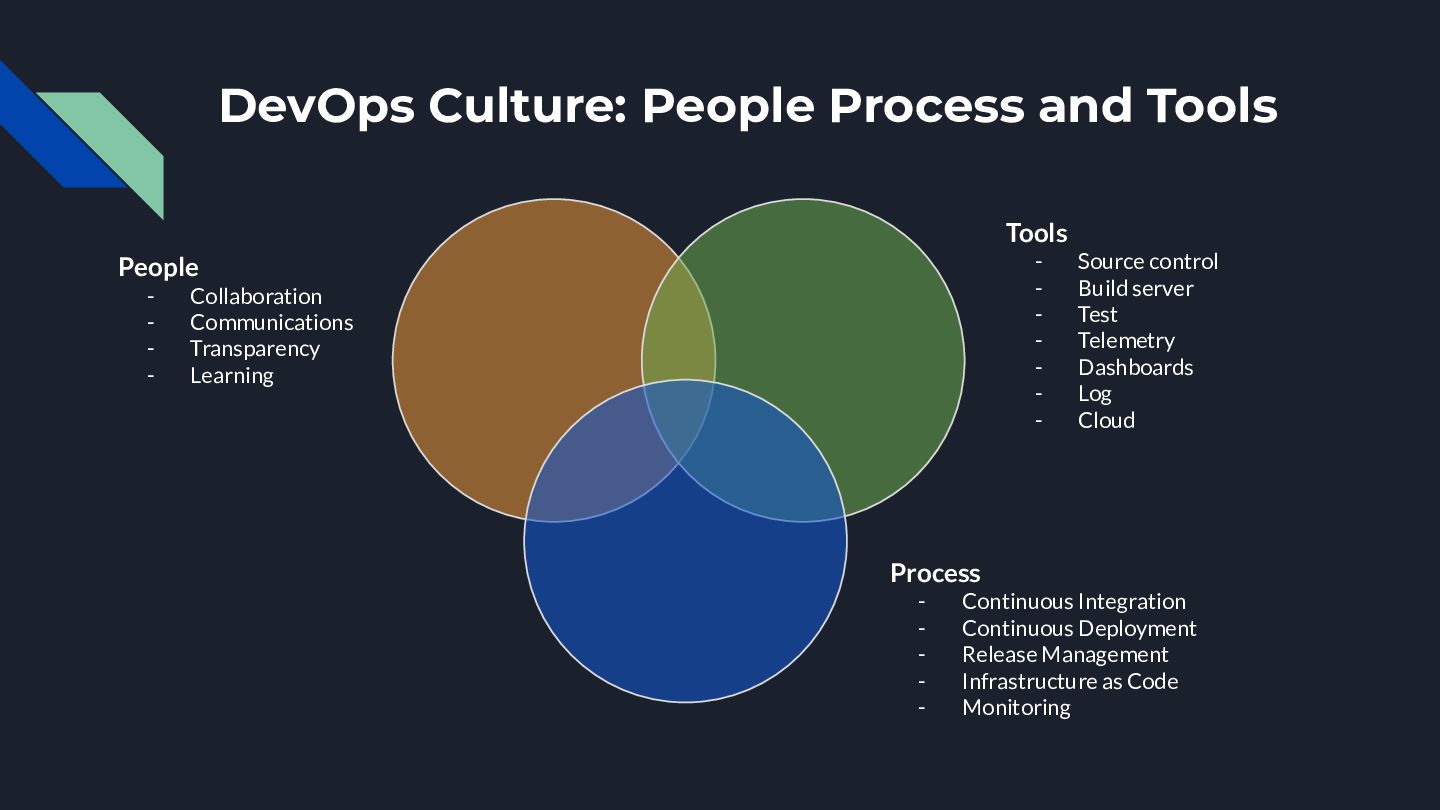
DevOps Culture: People Process and Tools Tools - Source control
- Build server - Test - Telemetry - Dashboards - Log - Cloud Process - Continuous Integration - Continuous Deployment - Release Management - Infrastructure as Code - Monitoring People - Collaboration - Communications - Transparency - Learning -
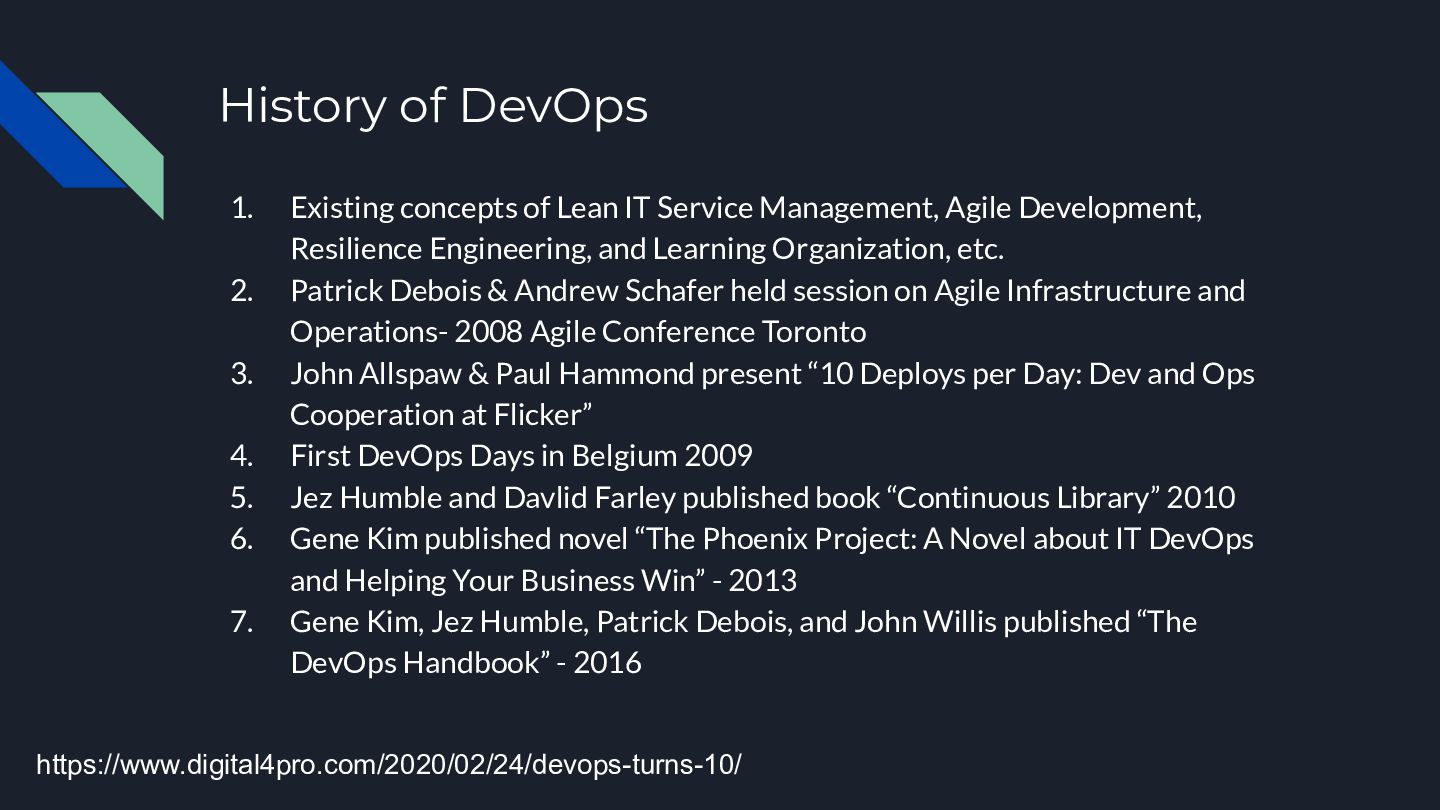
History of DevOps 1. Existing concepts of Lean IT Service
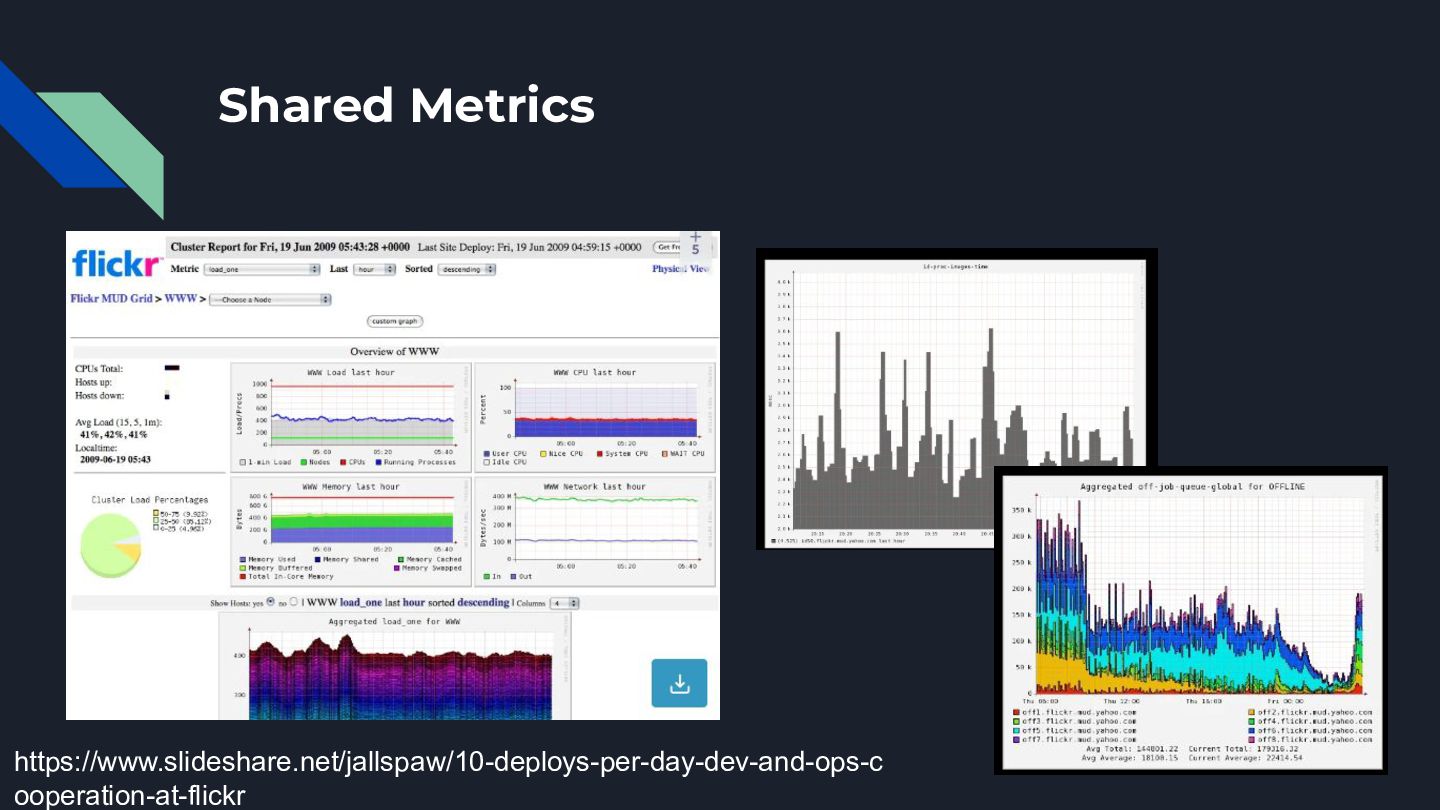
Management, Agile Development, Resilience Engineering, and Learning Organization, etc. 2. Patrick Debois & Andrew Schafer held session on Agile Infrastructure and Operations- 2008 Agile Conference Toronto 3. John Allspaw & Paul Hammond present “10 Deploys per Day: Dev and Ops Cooperation at Flicker” 4. First DevOps Days in Belgium 2009 5. Jez Humble and Davlid Farley published book “Continuous Library” 2010 6. Gene Kim published novel “The Phoenix Project: A Novel about IT DevOps and Helping Your Business Win” - 2013 7. Gene Kim, Jez Humble, Patrick Debois, and John Willis published “The DevOps Handbook” - 2016 https://www.digital4pro.com/2020/02/24/devops-turns-10/ -
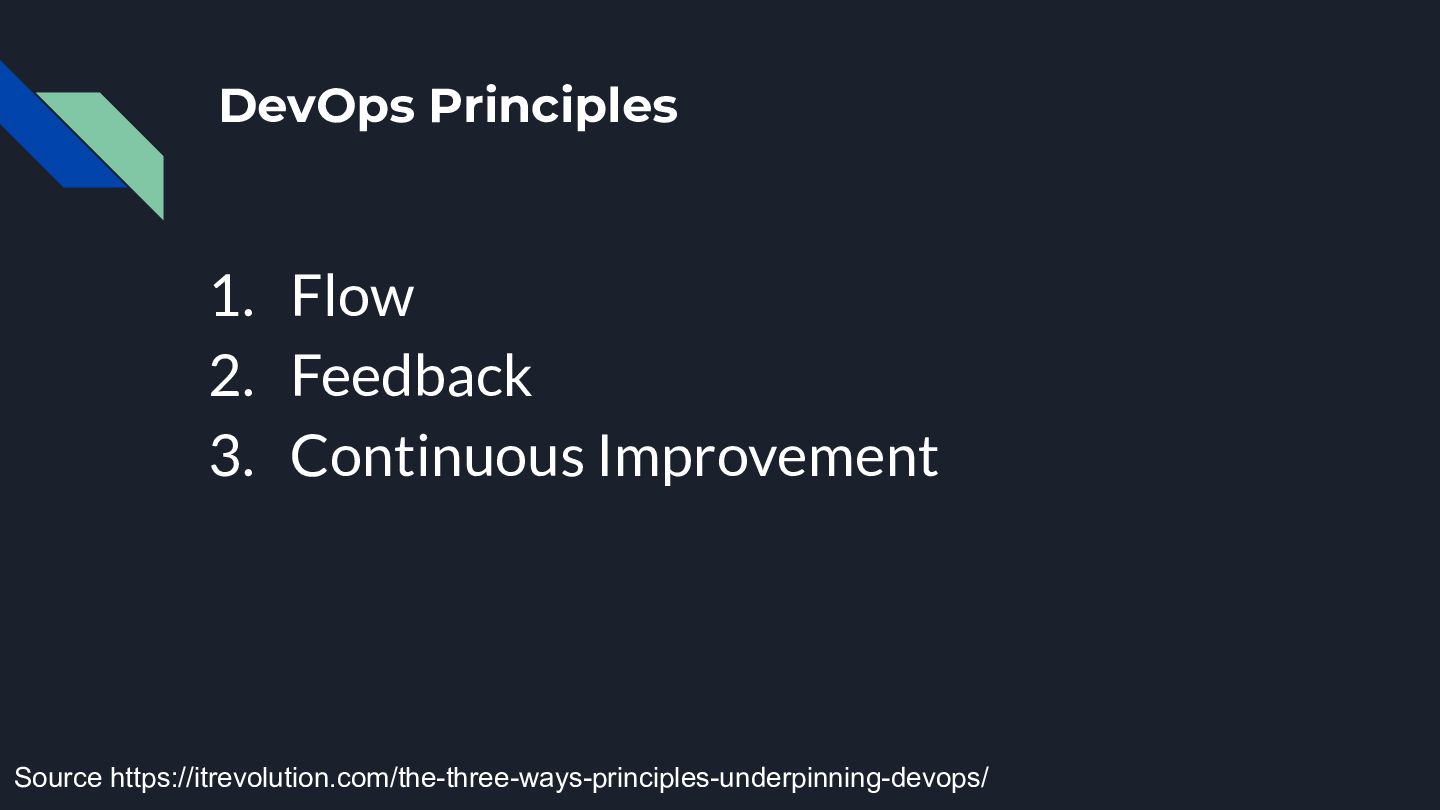
DevOps Principles 1. Flow 2. Feedback 3. Continuous Improvement Source
https://itrevolution.com/the-three-ways-principles-underpinning-devops/ -
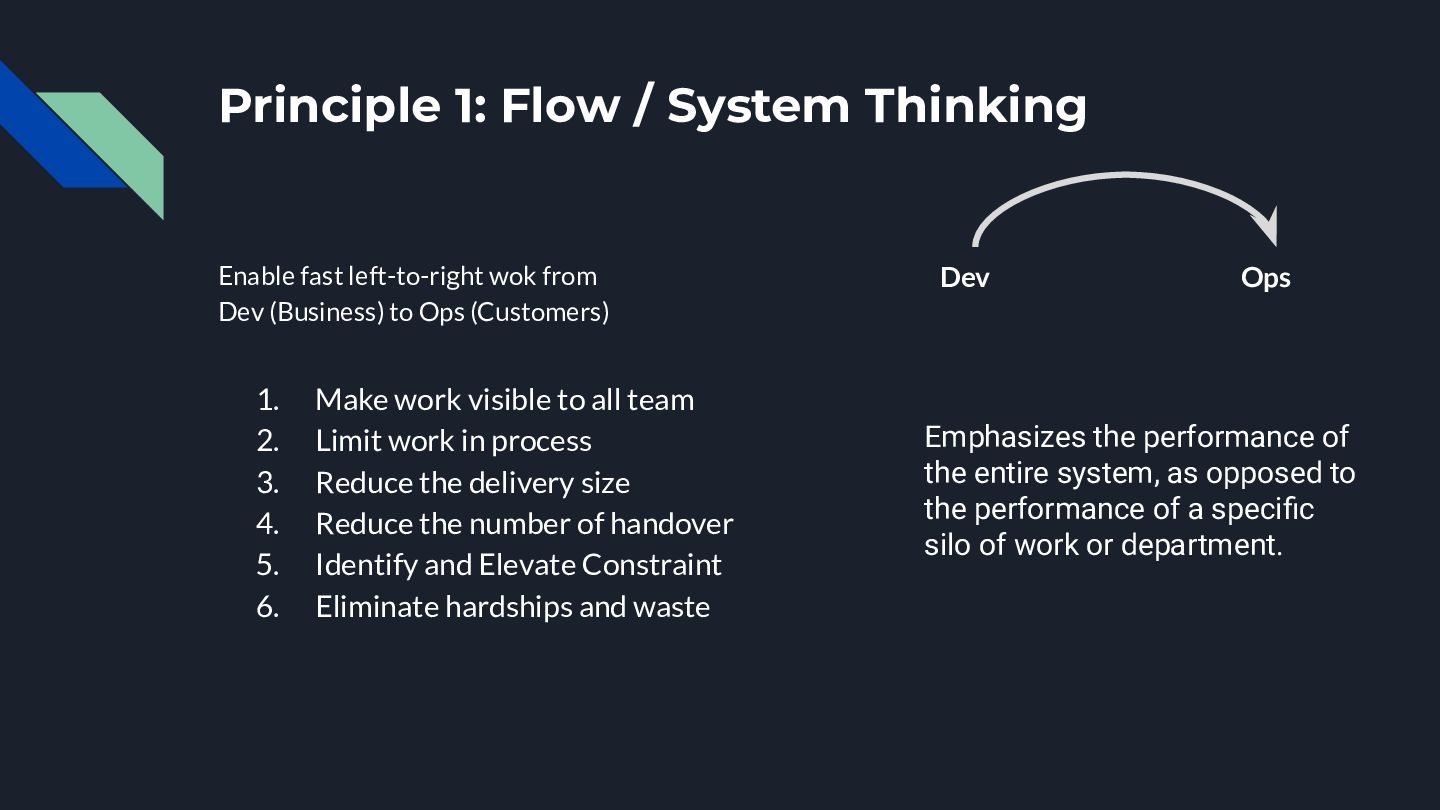
Principle 1: Flow / System Thinking Enable fast left-to-right wok
from Dev (Business) to Ops (Customers) Dev Ops 1. Make work visible to all team 2. Limit work in process 3. Reduce the delivery size 4. Reduce the number of handover 5. Identify and Elevate Constraint 6. Eliminate hardships and waste Emphasizes the performance of the entire system, as opposed to the performance of a specific silo of work or department. -
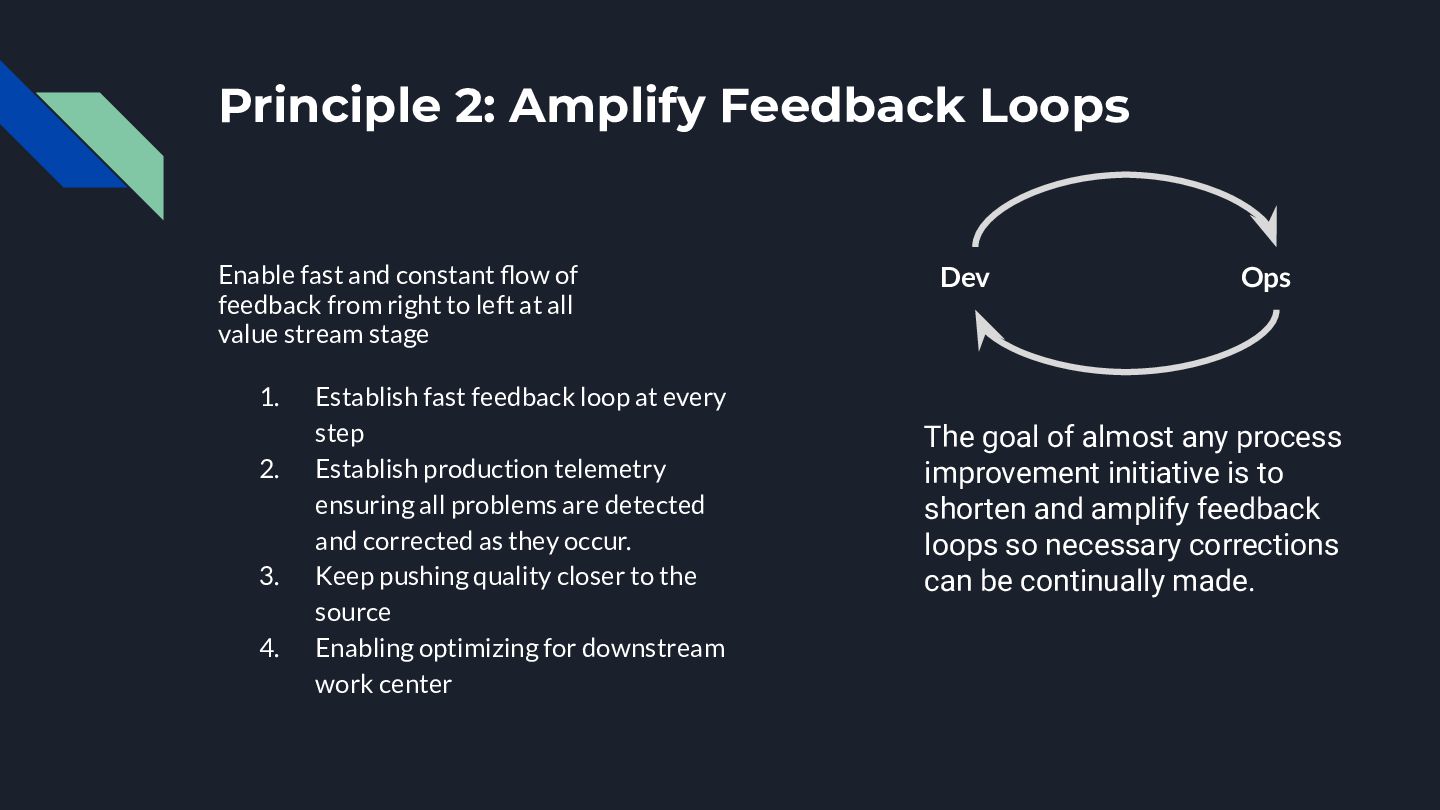
Principle 2: Amplify Feedback Loops Enable fast and constant flow
of feedback from right to left at all value stream stage Dev Ops 1. Establish fast feedback loop at every step 2. Establish production telemetry ensuring all problems are detected and corrected as they occur. 3. Keep pushing quality closer to the source 4. Enabling optimizing for downstream work center The goal of almost any process improvement initiative is to shorten and amplify feedback loops so necessary corrections can be continually made. -
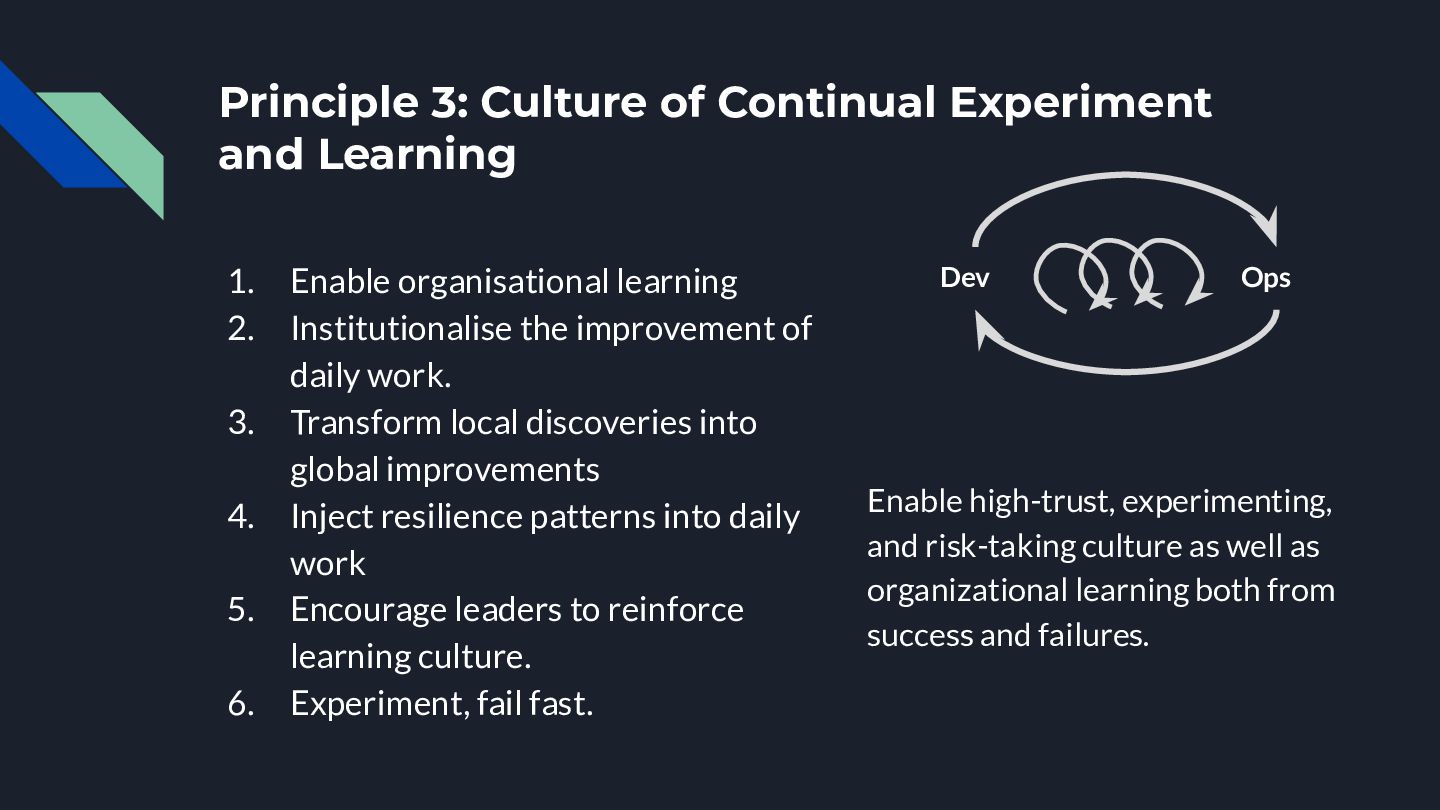
Principle 3: Culture of Continual Experiment and Learning Enable high-trust,
experimenting, and risk-taking culture as well as organizational learning both from success and failures. Dev Ops 1. Enable organisational learning 2. Institutionalise the improvement of daily work. 3. Transform local discoveries into global improvements 4. Inject resilience patterns into daily work 5. Encourage leaders to reinforce learning culture. 6. Experiment, fail fast. -
DevOps Practices 1. Loosely–coupled Architecture 2. Autonomous Team 3. Continuous
Integration 4. Fast and Reliable Automated Testing 5. Continuous and Automated Deployment/Provisioning 6. Measurement and Feedback -
DevOps Practices 1. Loosely–coupled Architecture 2. Autonomous Team 3. Continuous
Integration 4. Fast and Reliable Automated Testing 5. Continuous and Automated Deployment/Provisioning 6. Measurement and Feedback -
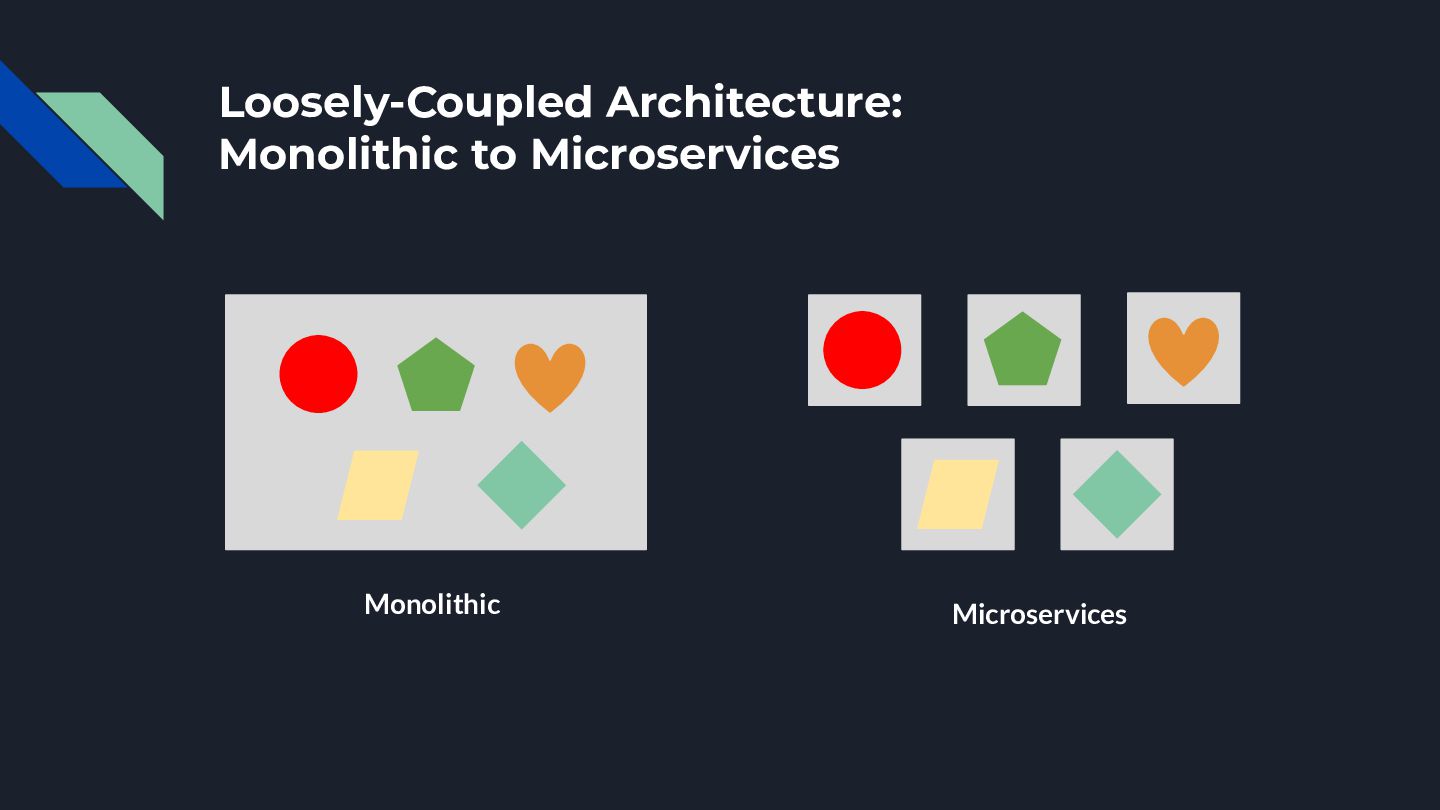
Practice 1: Loosely-Coupled Architecture 1. Software components should be independently
deployable and scalable 2. Components are accessible through service 3. Teams own the service: you build it, you run it. 4. Services can have different technologies 5. Service can fail anytime. The client should be able to respond gracefully. 6. Service has to be designed to be replaceable/upgradeable -
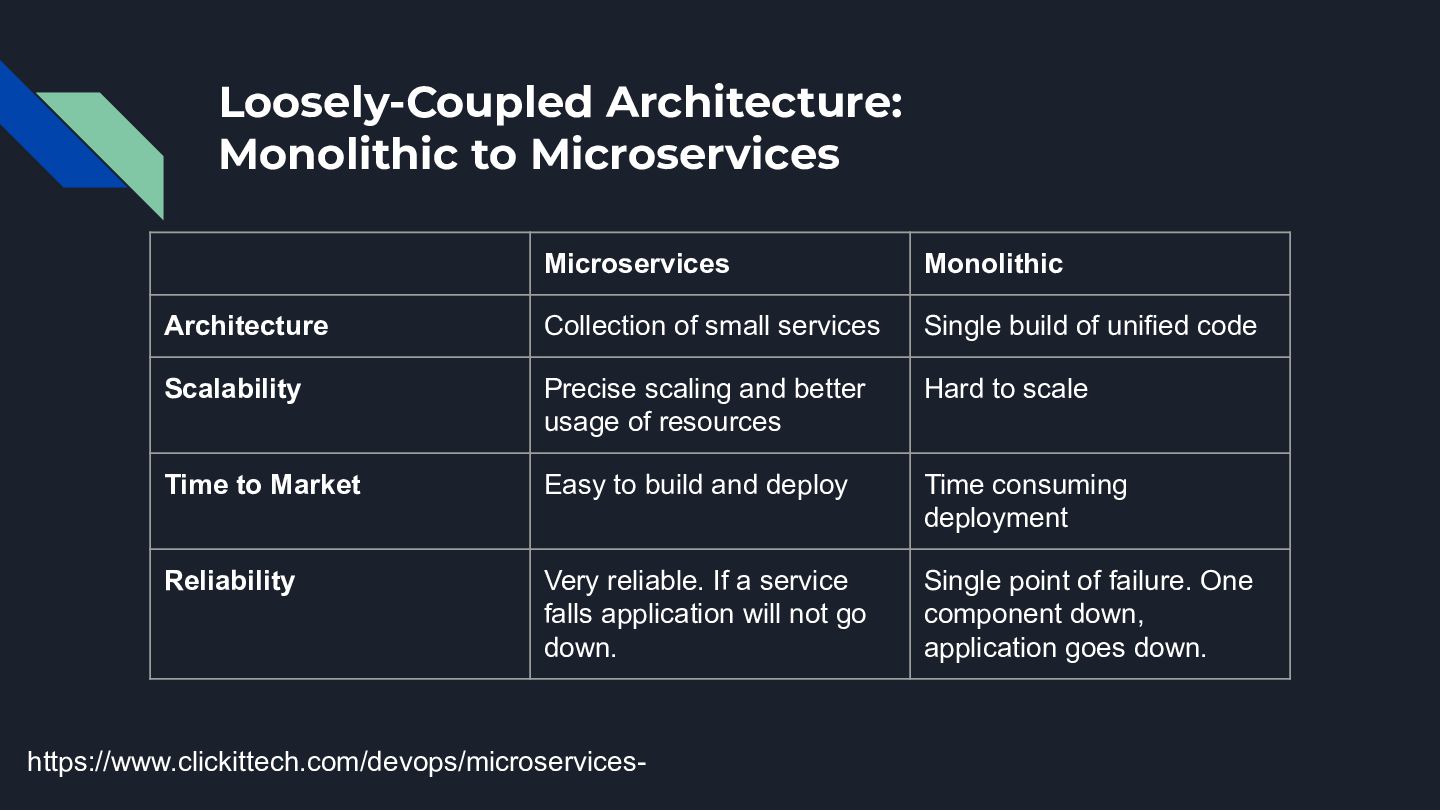
Loosely-Coupled Architecture: Monolithic to Microservices https://www.clickittech.com/devops/microservices- Microservices Monolithic Architecture Collection
of small services Single build of unified code Scalability Precise scaling and better usage of resources Hard to scale Time to Market Easy to build and deploy Time consuming deployment Reliability Very reliable. If a service falls application will not go down. Single point of failure. One component down, application goes down. -
DevOps Practices 1. Loosely–coupled Architecture 2. Autonomous Team 3. Continuous
Integration 4. Fast and Reliable Automated Testing 5. Continuous and Automated Deployment/Provisioning 6. Measurement and Feedback -
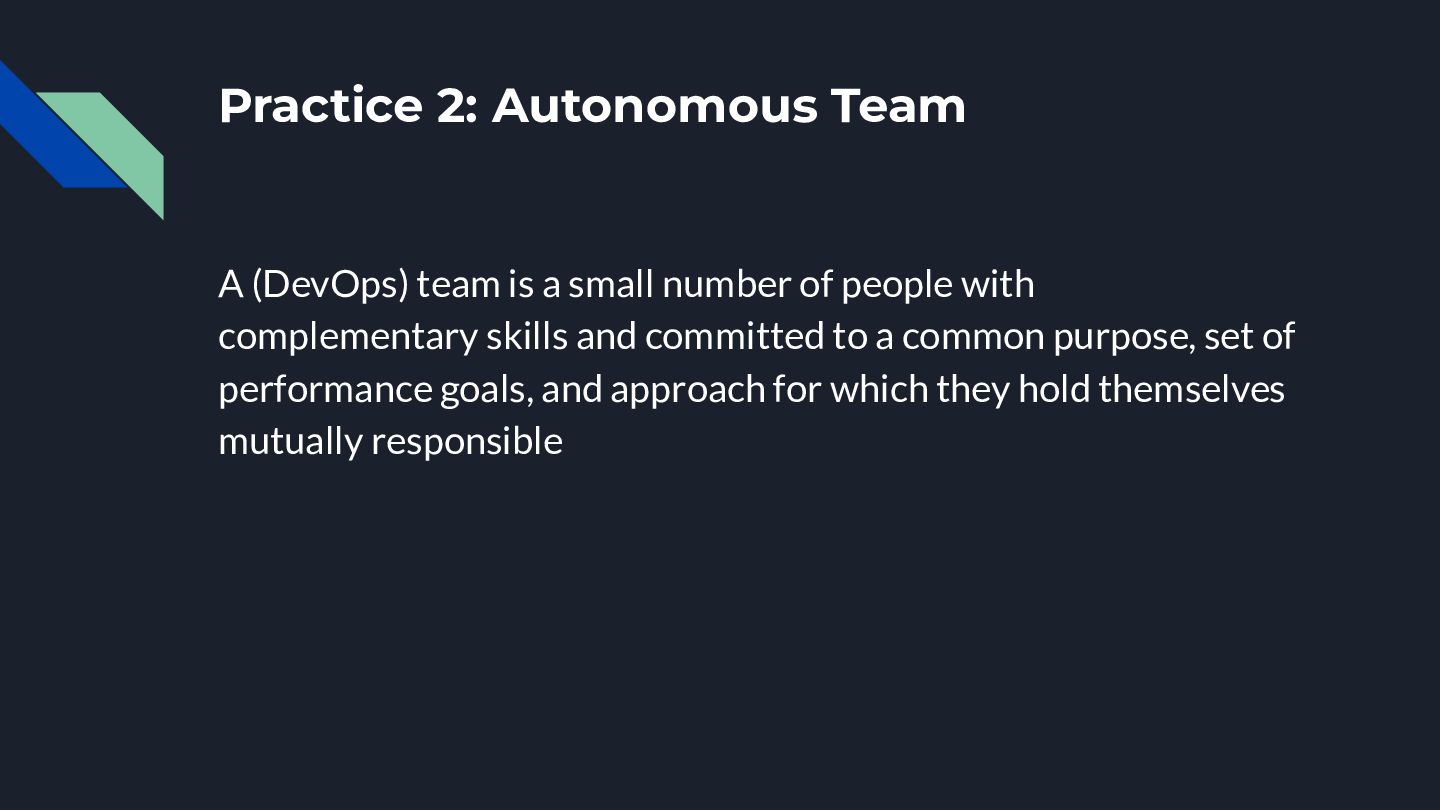
Practice 2: Autonomous Team A (DevOps) team is a small
number of people with complementary skills and committed to a common purpose, set of performance goals, and approach for which they hold themselves mutually responsible -
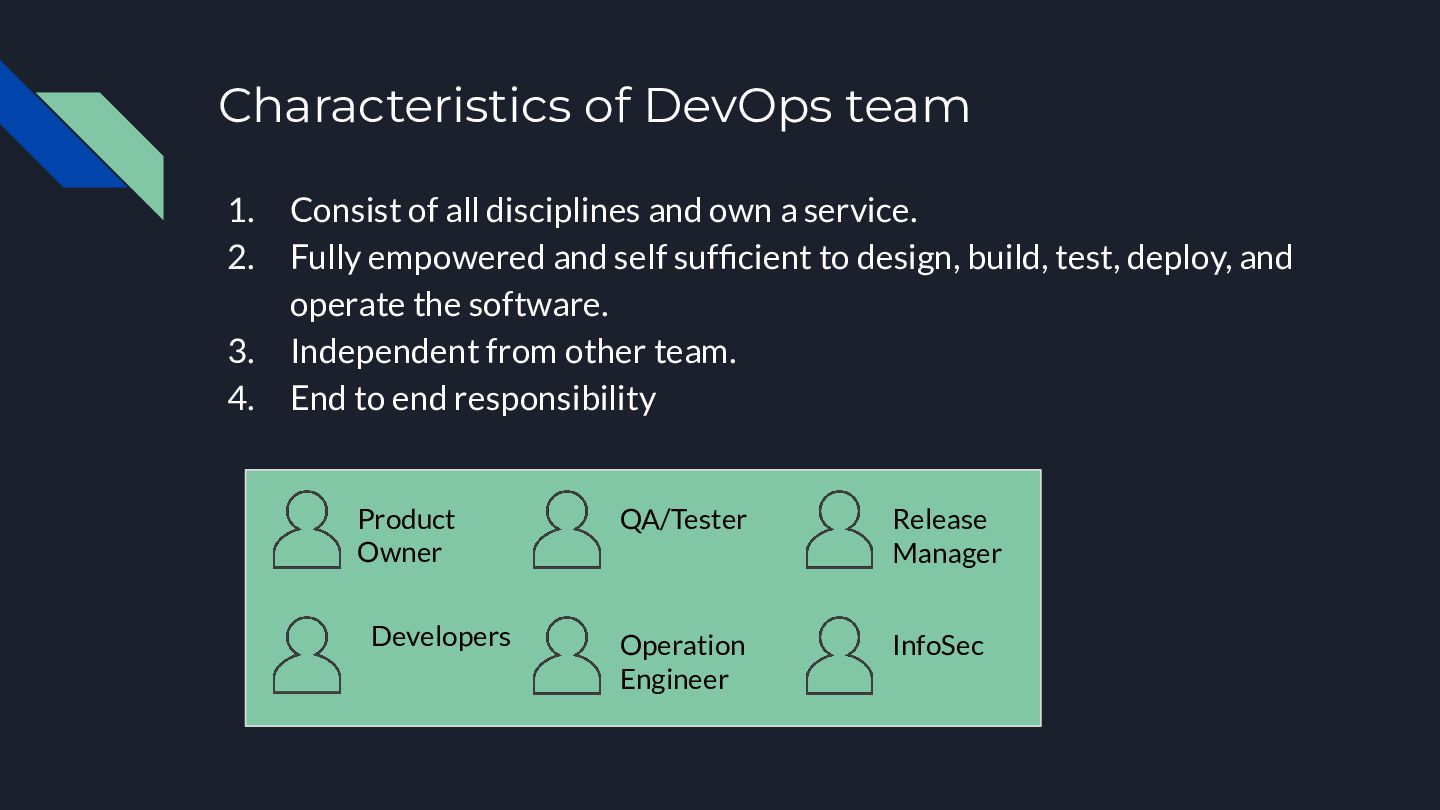
Characteristics of DevOps team 1. Consist of all disciplines and
own a service. 2. Fully empowered and self sufficient to design, build, test, deploy, and operate the software. 3. Independent from other team. 4. End to end responsibility Product Owner Developers QA/Tester Operation Engineer Release Manager InfoSec -
DevOps Practices 1. Loosely–coupled Architecture 2. Autonomous Team 3. Continuous
Integration 4. Fast and Reliable Automated Testing 5. Continuous and Automated Deployment/Provisioning 6. Measurement and Feedback -
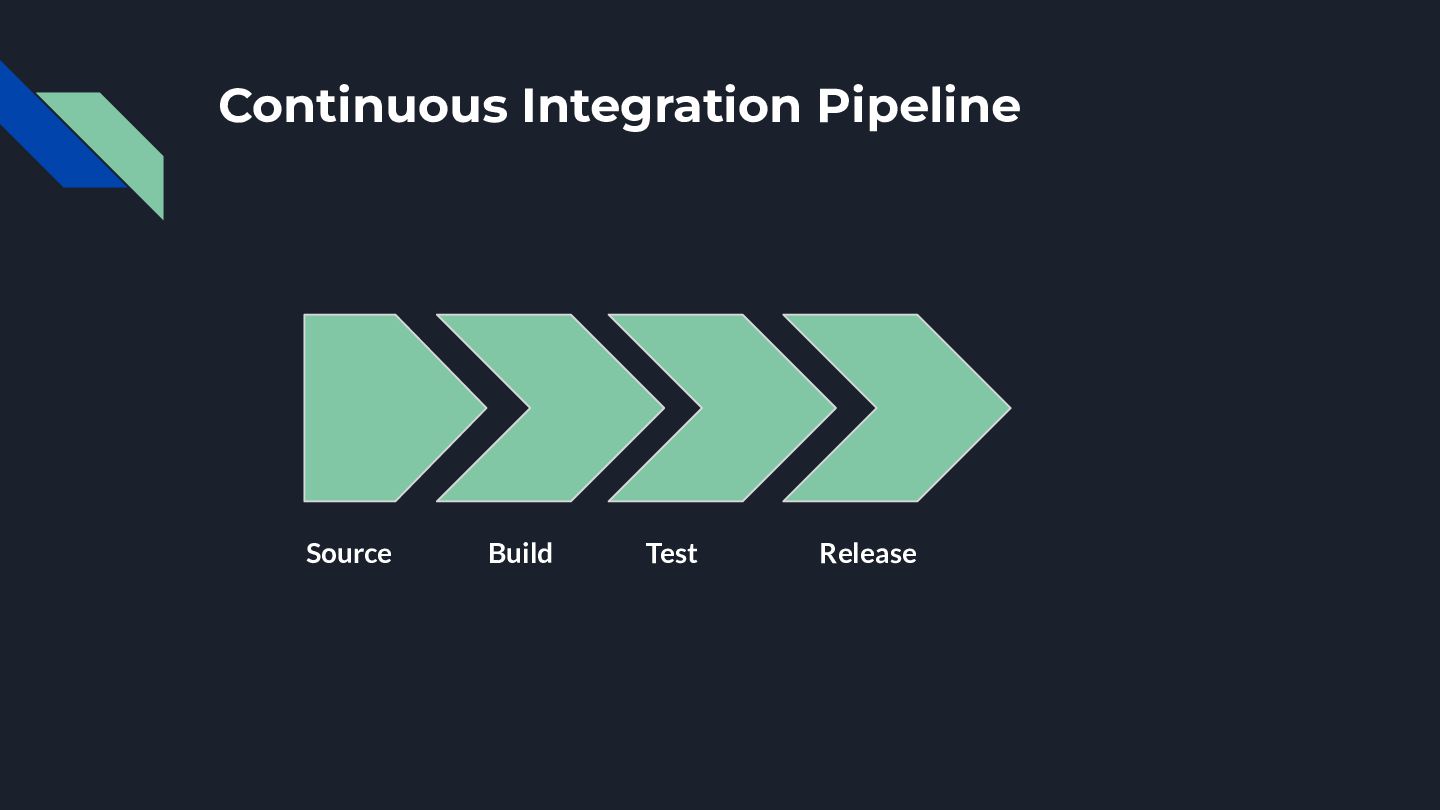
Practice 3: Continuous Integration Continuous integration is a DevOps software
development practice where developers regularly merge their code changes into a central repository, after which automated builds and tests are run. -
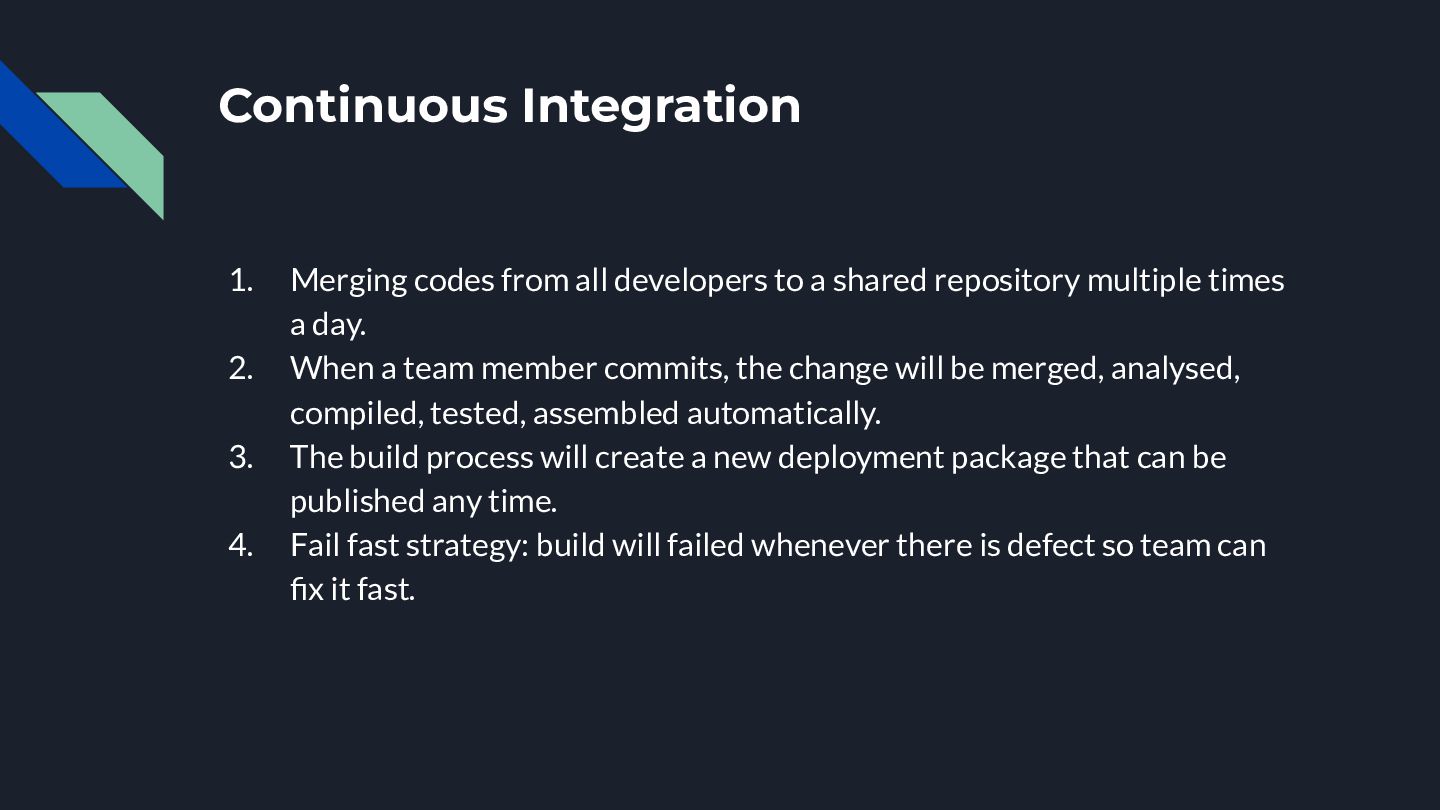
Continuous Integration 1. Merging codes from all developers to a
shared repository multiple times a day. 2. When a team member commits, the change will be merged, analysed, compiled, tested, assembled automatically. 3. The build process will create a new deployment package that can be published any time. 4. Fail fast strategy: build will failed whenever there is defect so team can fix it fast. -
DevOps Practices 1. Loosely–coupled Architecture 2. Autonomous Team 3. Continuous
Integration 4. Fast and Reliable Automated Testing 5. Continuous and Automated Deployment/Provisioning 6. Measurement and Feedback -
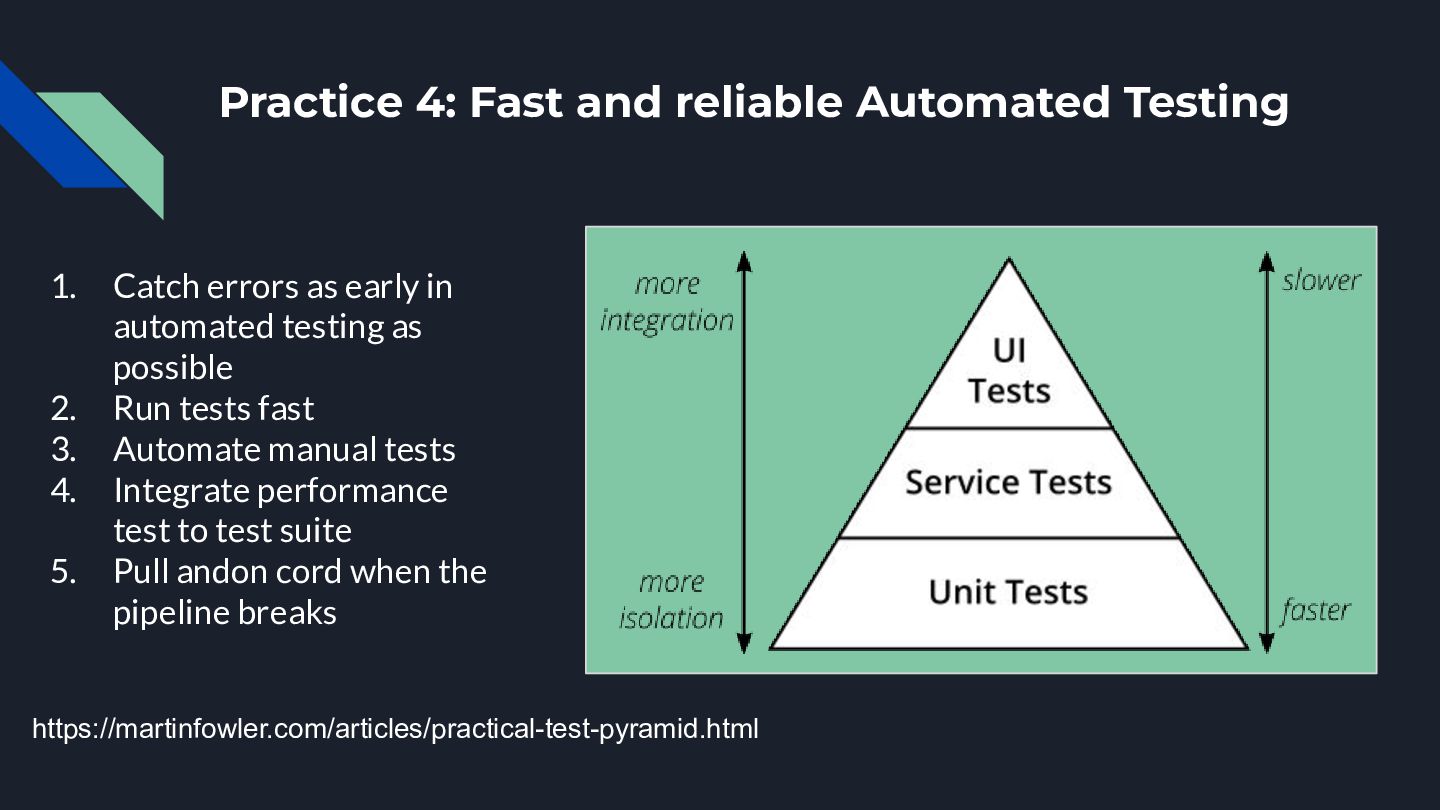
Practice 4: Fast and reliable Automated Testing https://martinfowler.com/articles/practical-test-pyramid.html 1. Catch
errors as early in automated testing as possible 2. Run tests fast 3. Automate manual tests 4. Integrate performance test to test suite 5. Pull andon cord when the pipeline breaks -
DevOps Practices 1. Loosely–coupled Architecture 2. Autonomous Team 3. Continuous
Integration 4. Fast and Reliable Automated Testing 5. Continuous and Automated Deployment/Provisioning 6. Measurement and Feedback -
Practice 5: Automated Continuous Deployment and Provisioning Automated continuous deployment
and provisioning means we deploy applications components as well as provisioning environment components. -
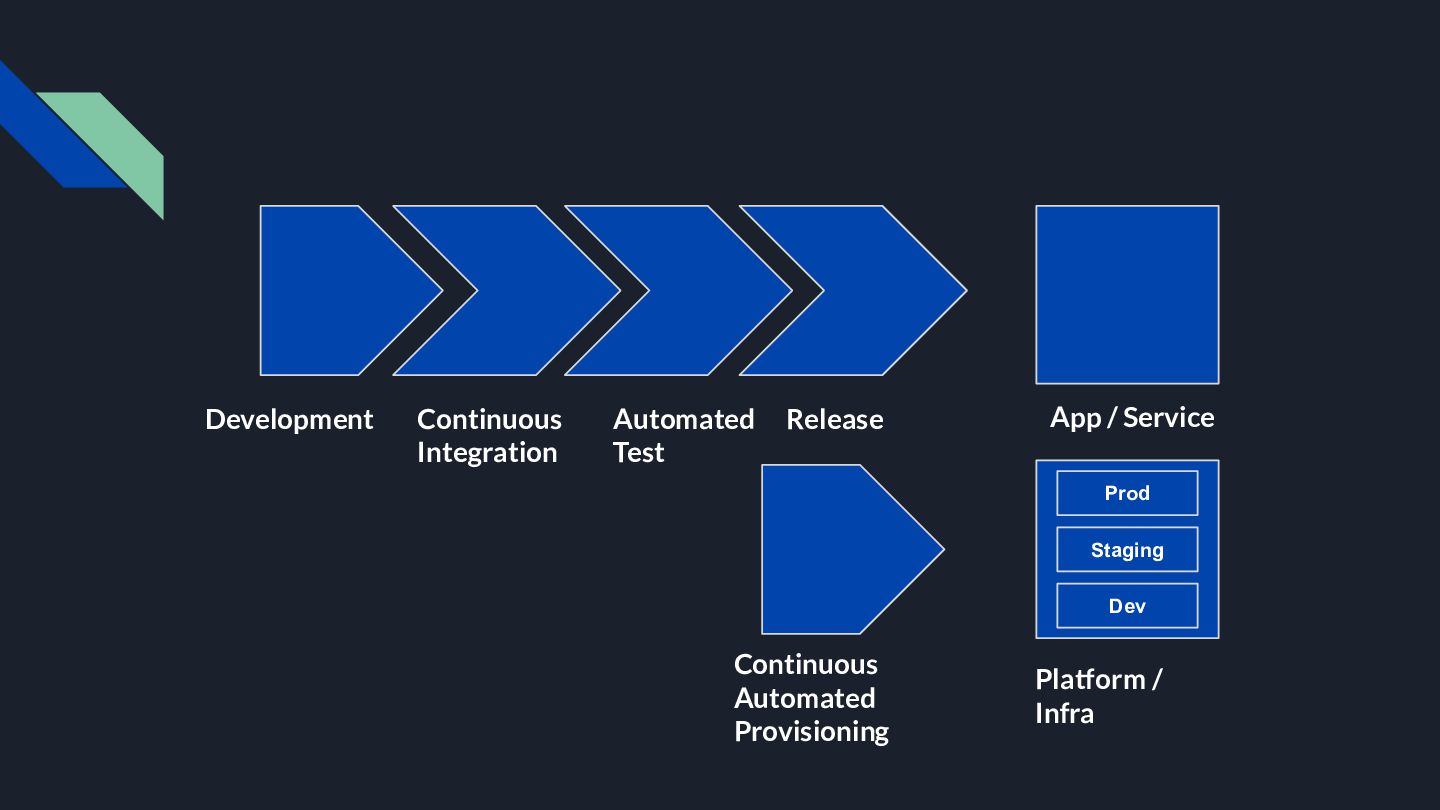
Development Continuous Integration Automated Test Release Continuous Automated Provisioning Prod
Staging Dev Platform / Infra App / Service -
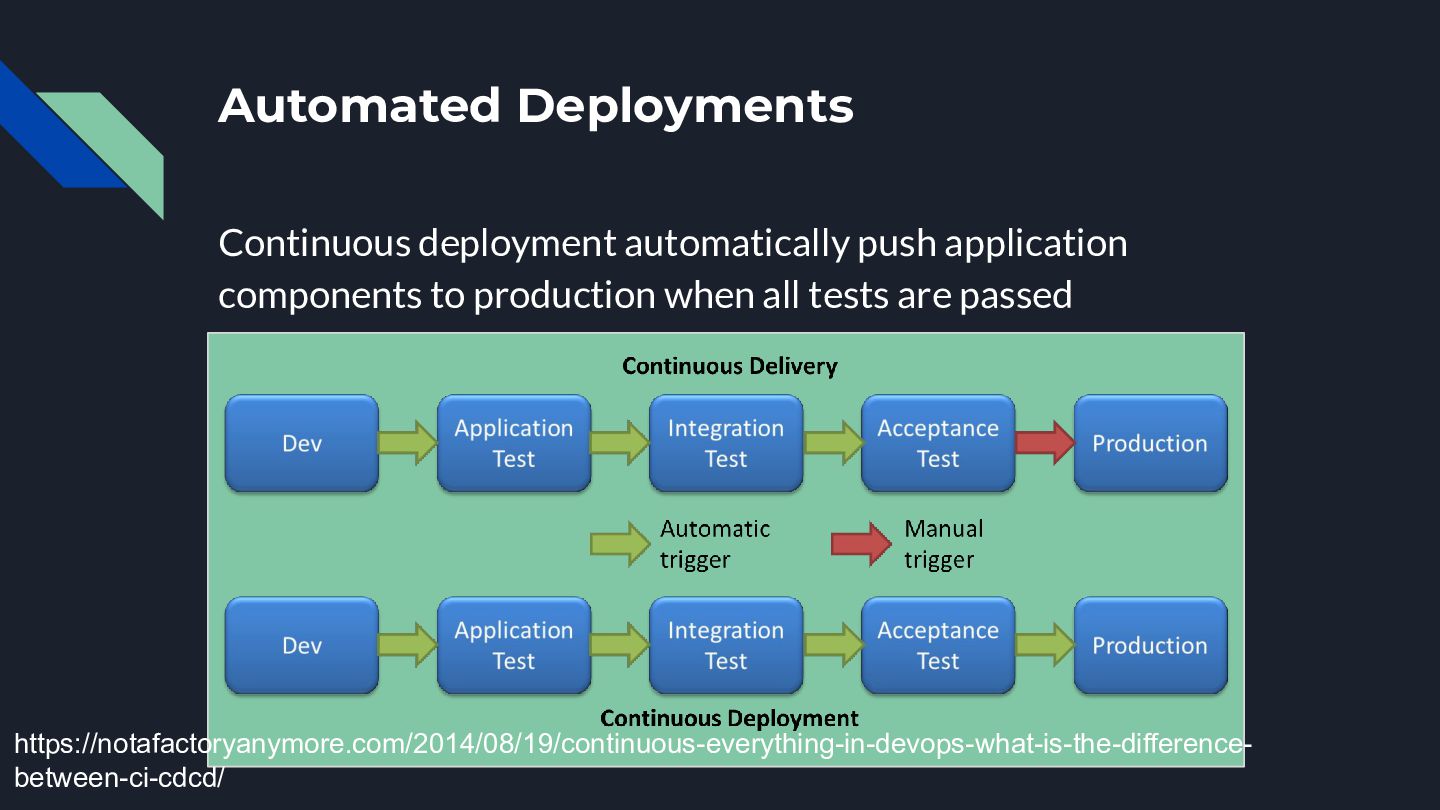
Automated Deployments Continuous deployment automatically push application components to production
when all tests are passed https://notafactoryanymore.com/2014/08/19/continuous-everything-in-devops-what-is-the-difference- between-ci-cdcd/ -
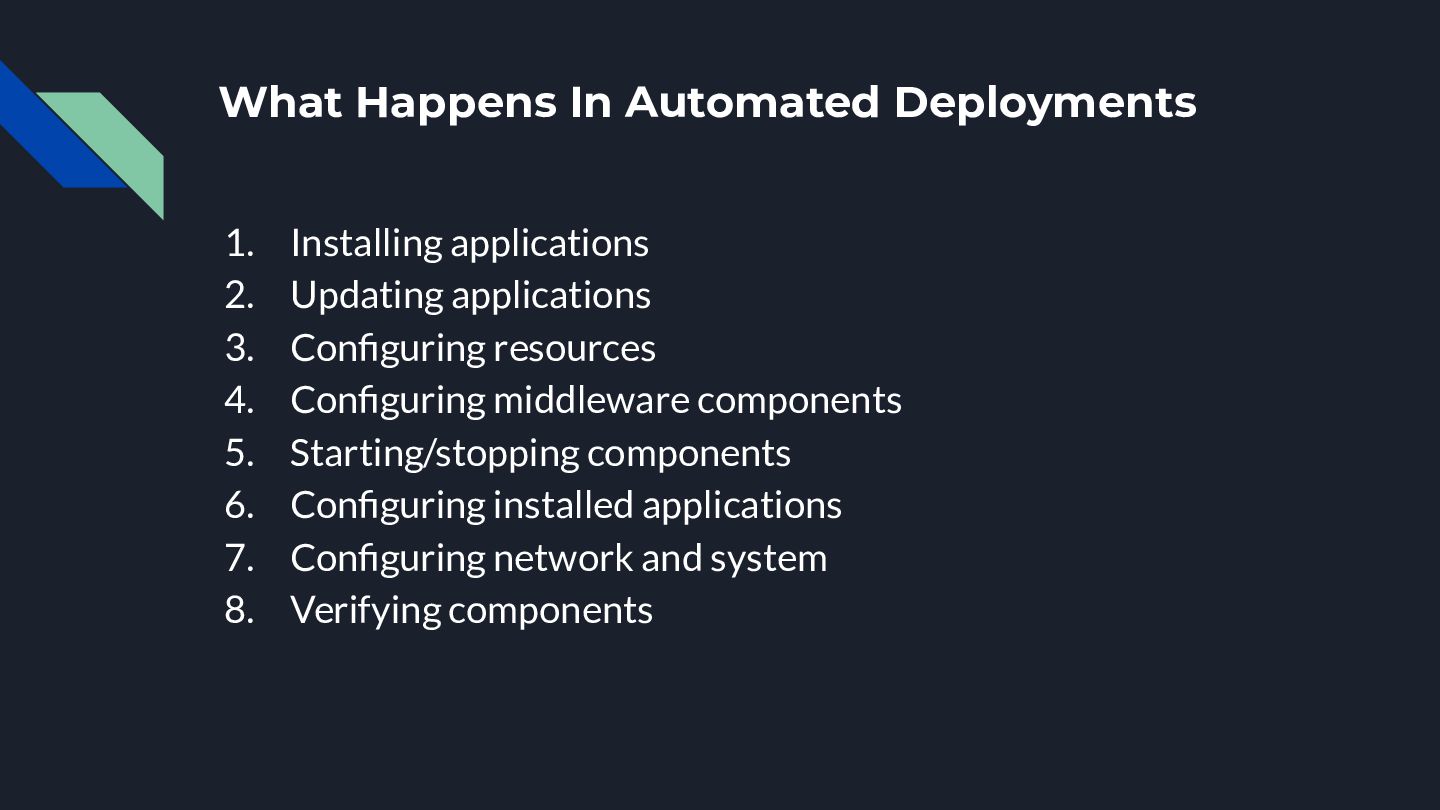
What Happens In Automated Deployments 1. Installing applications 2. Updating
applications 3. Configuring resources 4. Configuring middleware components 5. Starting/stopping components 6. Configuring installed applications 7. Configuring network and system 8. Verifying components -
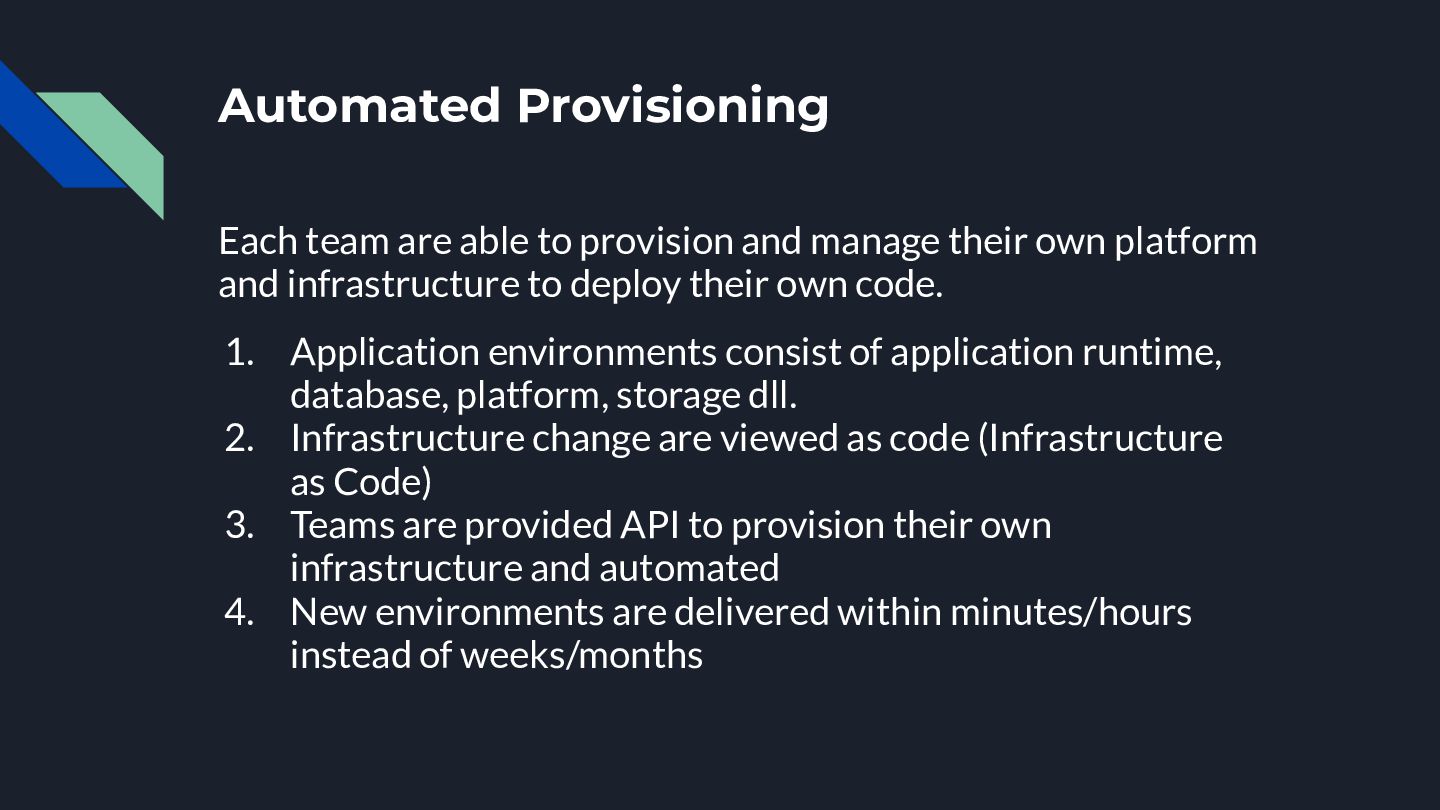
Automated Provisioning Each team are able to provision and manage
their own platform and infrastructure to deploy their own code. 1. Application environments consist of application runtime, database, platform, storage dll. 2. Infrastructure change are viewed as code (Infrastructure as Code) 3. Teams are provided API to provision their own infrastructure and automated 4. New environments are delivered within minutes/hours instead of weeks/months -
DevOps Practices 1. Loosely–coupled Architecture 2. Autonomous Team 3. Continuous
Integration 4. Fast and Reliable Automated Testing 5. Continuous and Automated Deployment/Provisioning 6. Measurement and Feedback -
Practice 6: Measurement and Feedback Telemetry is an automated communications
process by which measurements and other data are collected at remote points and subsequently transmitted to receiving equipment for monitoring. -
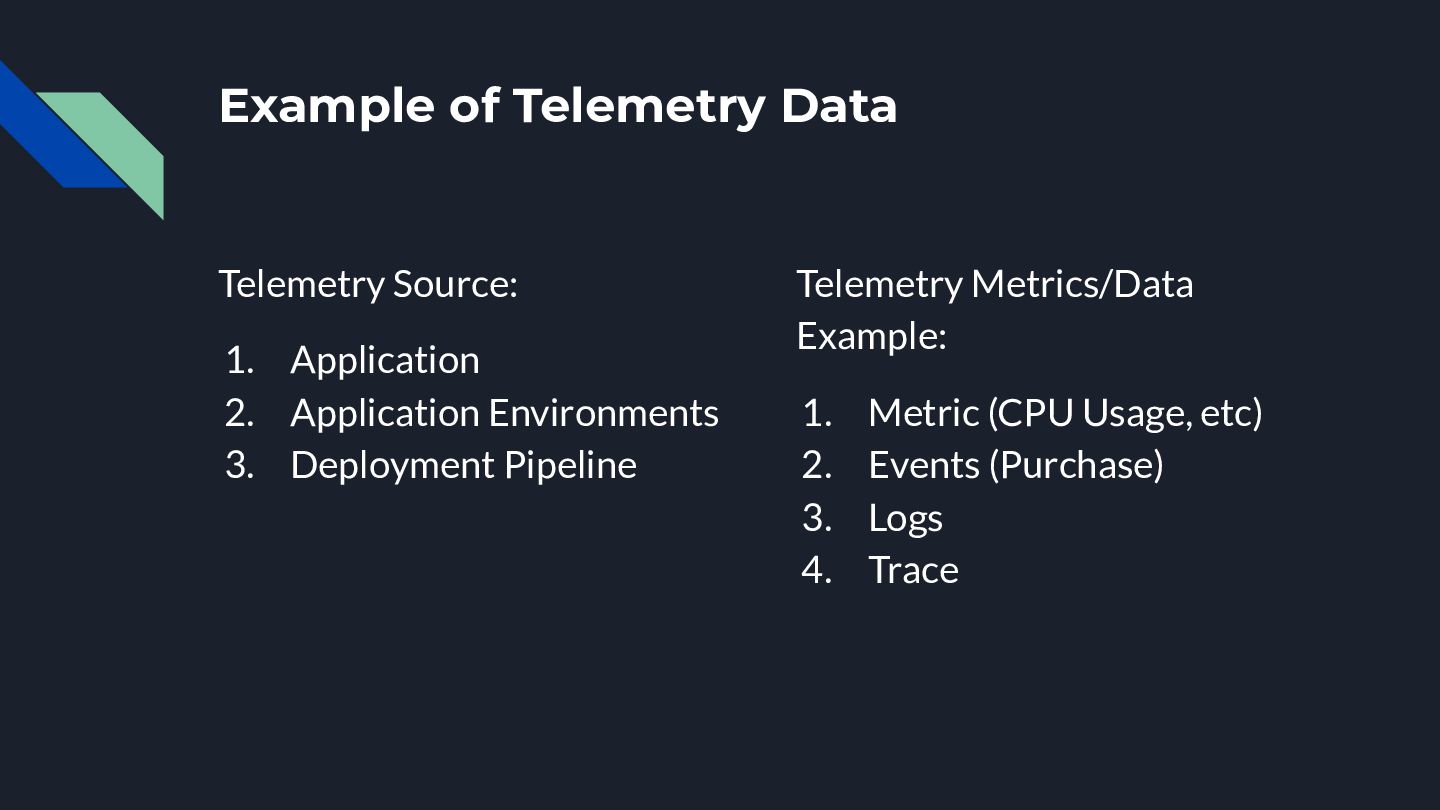
Example of Telemetry Data Telemetry Source: 1. Application 2. Application
Environments 3. Deployment Pipeline Telemetry Metrics/Data Example: 1. Metric (CPU Usage, etc) 2. Events (Purchase) 3. Logs 4. Trace -
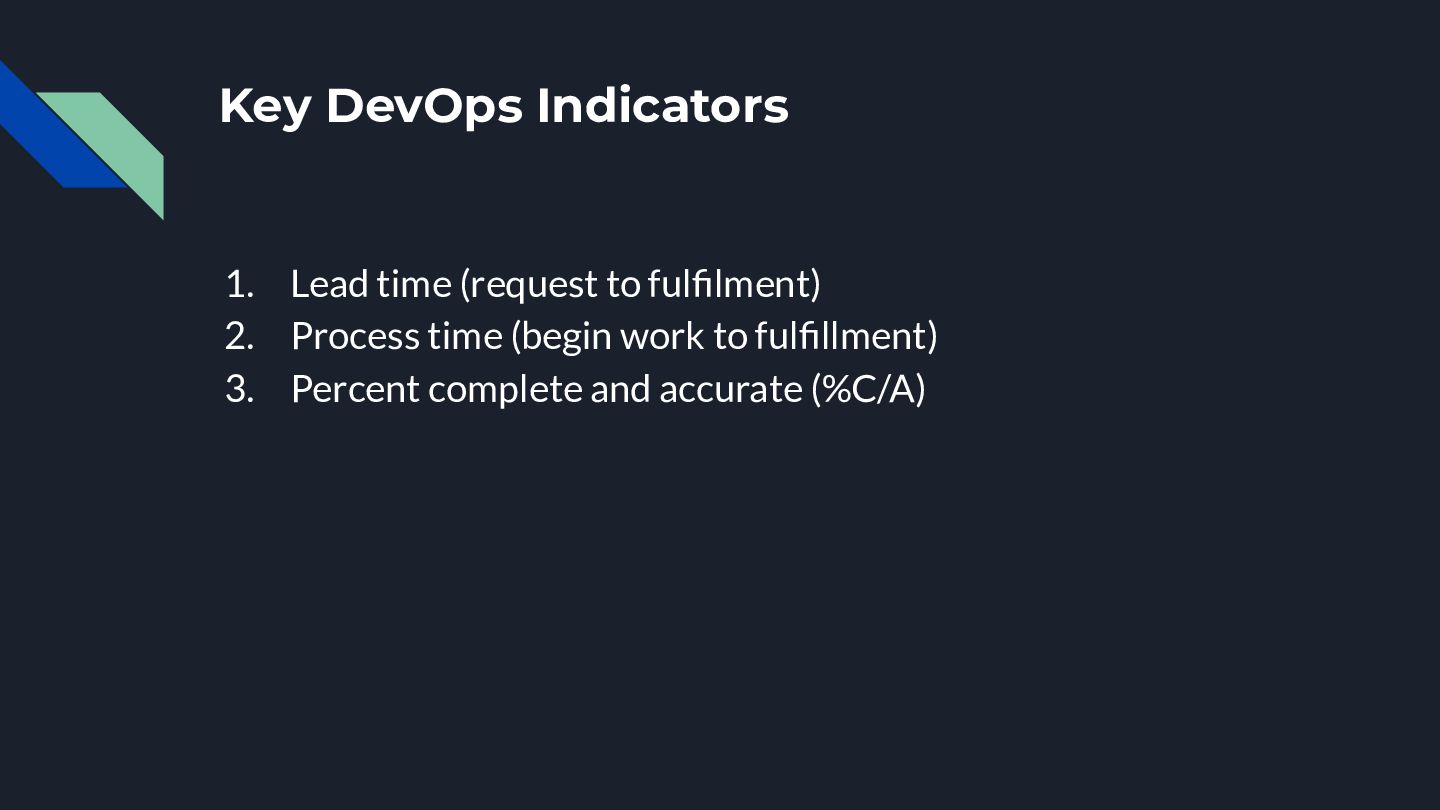
Key DevOps Indicators 1. Lead time (request to fulfilment) 2.
Process time (begin work to fulfillment) 3. Percent complete and accurate (%C/A) -
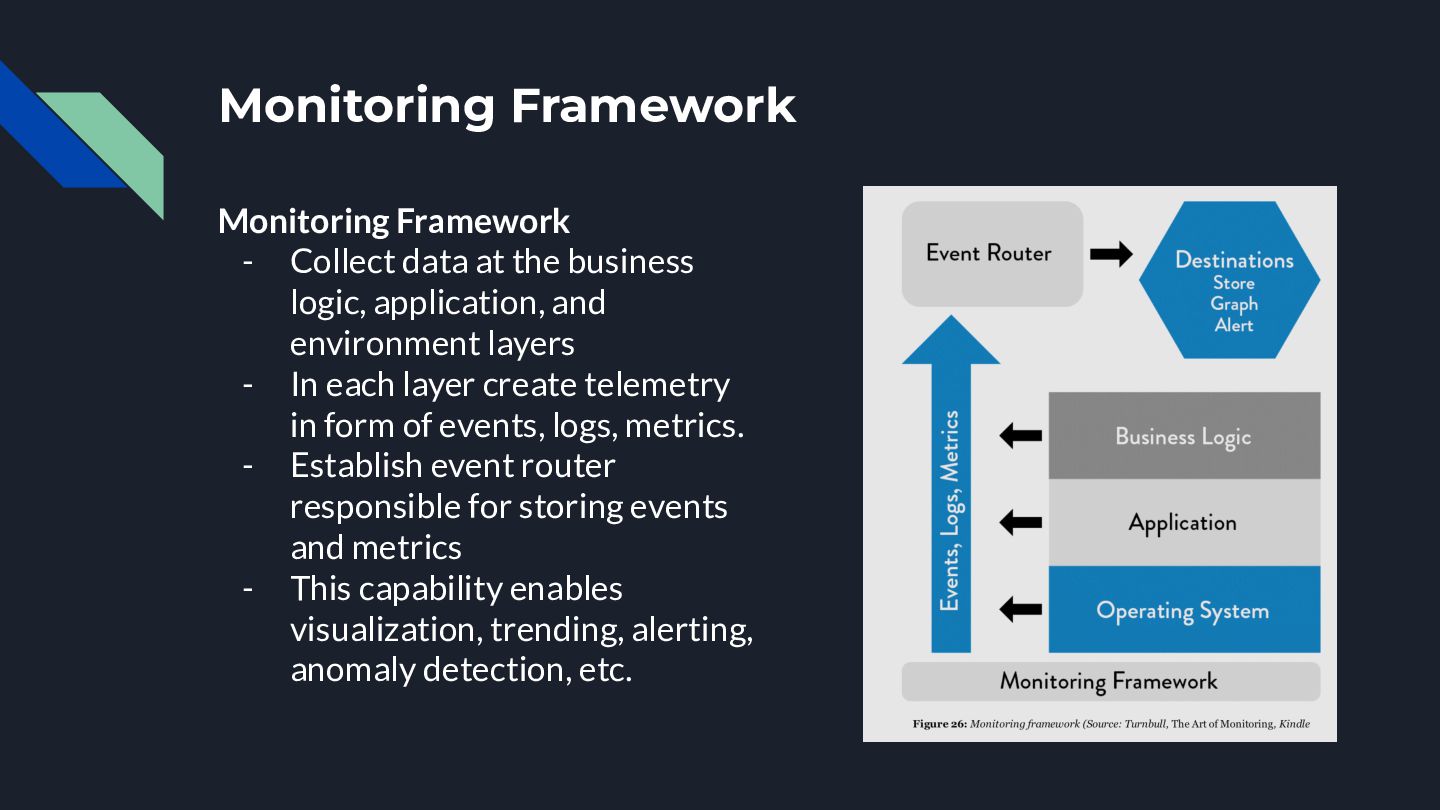
Monitoring Framework Monitoring Framework - Collect data at the business
logic, application, and environment layers - In each layer create telemetry in form of events, logs, metrics. - Establish event router responsible for storing events and metrics - This capability enables visualization, trending, alerting, anomaly detection, etc. -
Where To Learn More 1. The DevOps Handbook https://www.amazon.com/DevOps-Handbook-World-Class-Reliability-Organizations/dp /1942788002
2. The Phoenix Project https://www.amazon.com/Phoenix-Project-DevOps-Helping-Business/dp/09 88262592 3. Continuous Delivery https://www.amazon.com/Continuous-Delivery-Deployment-Automation-Addison-Wesl ey/dp/0321601912/ 4. Continuous Integration https://www.amazon.com/Continuous-Integration-Improving-Software-Reducing/dp/03 21336380/