Upgrade to Pro — share decks privately, control downloads, hide ads and more …

Test automation patterns - not only Page Object...

Sponsored · SiteGround - Reliable hosting with speed, security, and support you can count on. →

Test automation patterns - not only Page Object Pawel Maciejewski

Test automation patterns - not only Page Object by Pawel Maciejewski
Slides illustrating my speech at Selenium Camp 2017 at Kiev

Paweł Maciejewski

February 25, 2017

Transcript

40 slides
  1. Pawel Maciejewski + 5y of experience in test automation +

    Web based apps + C# windows native apps + Banking, fintech, online classifieds + Created automation in C#, PHP, Ruby + ISTQB Foundation + ISTQB Advanced Technical Test Analyst + I love cats - fb.com/azor.cat
  2. NUMBERS • 704 test runs triggered daily • 23000 tests

    executed daily • 2543 scenarios • Estimation - some tests are executed on demand
  3. Continuous Integration On the way to CD • We test

    each commit in master • We test each PR • Each test run have own docker-based env
  4. Jenkins • 8 machines (24CPUs, 128gb ram each), 3 executor

    each • Separate pipeline for each country and each suite • Results reported to github
  5. Agenda • Test data generation via API • Test entity

    assertion • Page Object Pattern extended
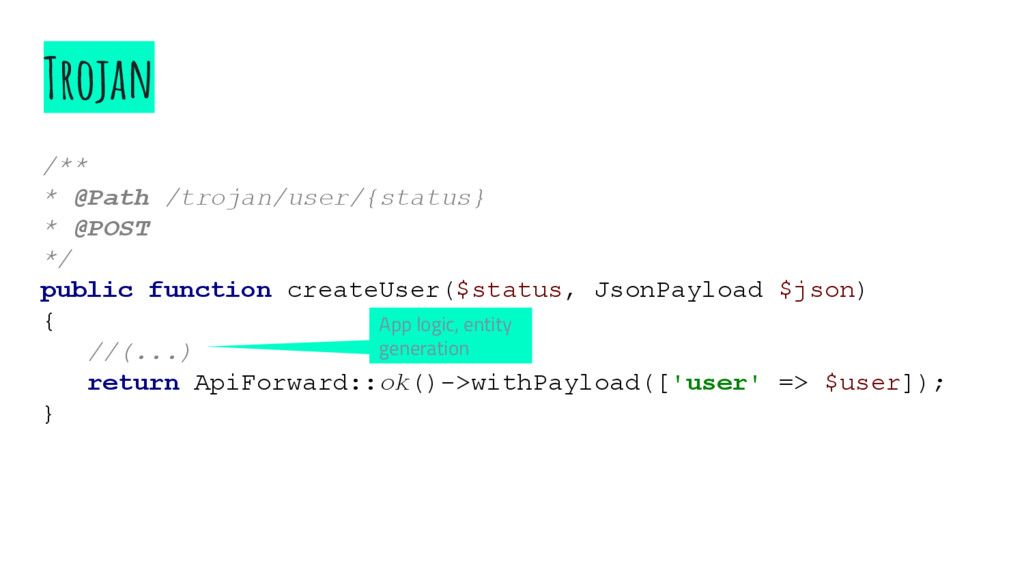
  6. Trojan /** * @Path /trojan/user/{status} * @POST */ public function

    createUser($status, JsonPayload $json) { //(...) return ApiForward::ok()->withPayload(['user' => $user]); } App logic, entity generation
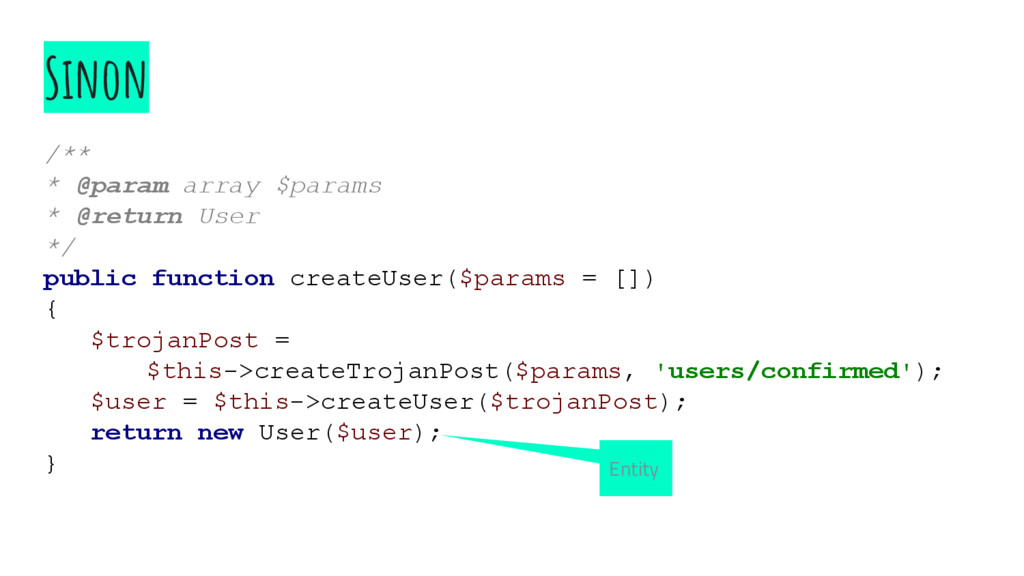
  7. Sinon /** * @param array $params * @return User */

    public function createUser($params = []) { $trojanPost = $this->createTrojanPost($params, 'users/confirmed'); $user = $this->createUser($trojanPost); return new User($user); } Entity
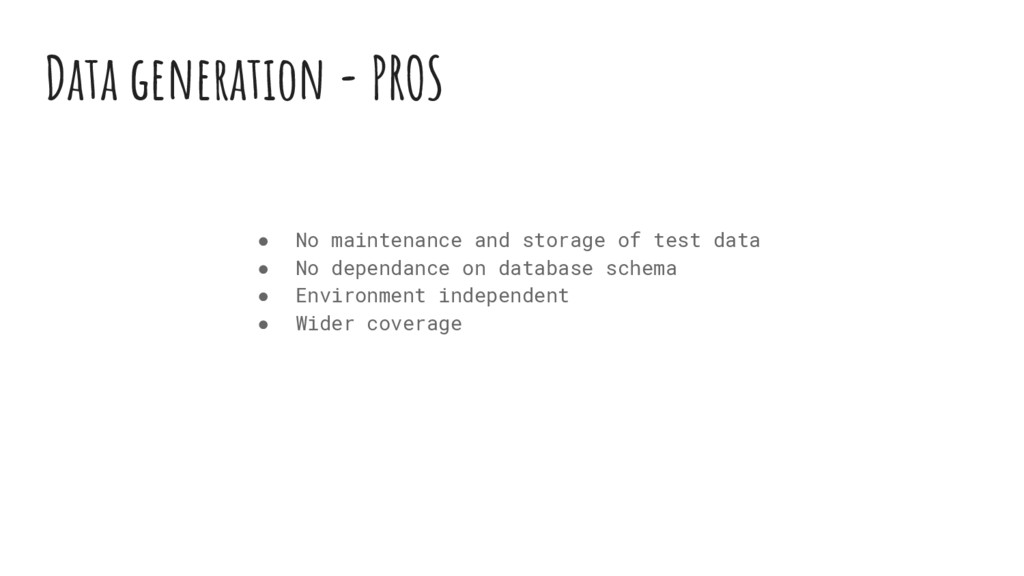
  8. Data generation - PROS • No maintenance and storage of

    test data • No dependance on database schema • Environment independent • Wider coverage
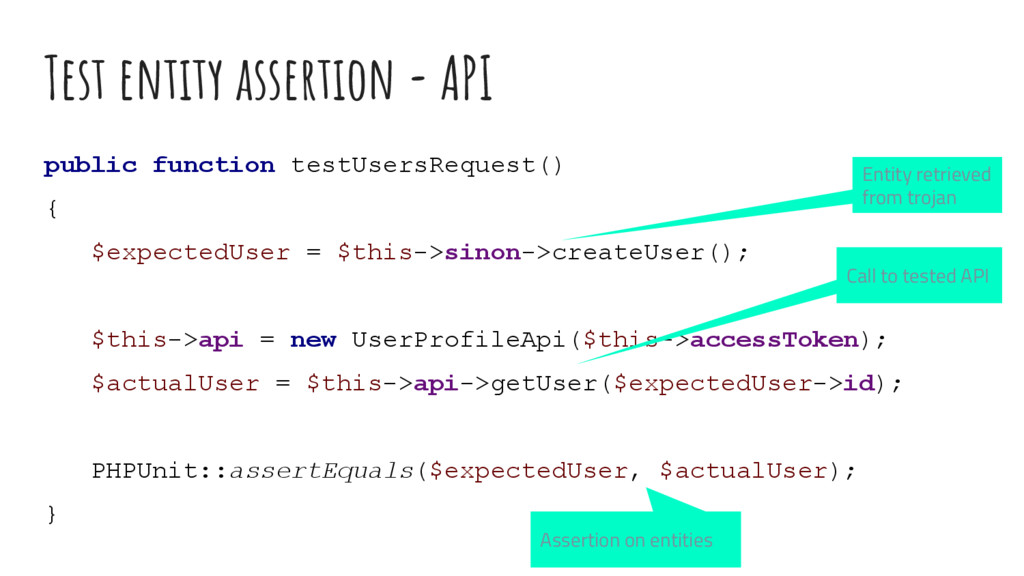
  9. Test entity assertion - API public function testUsersRequest() { $expectedUser

    = $this->sinon->createUser(); $this->api = new UserProfileApi($this->accessToken); $actualUser = $this->api->getUser($expectedUser->id); PHPUnit::assertEquals($expectedUser, $actualUser); } Entity retrieved from trojan Call to tested API Assertion on entities
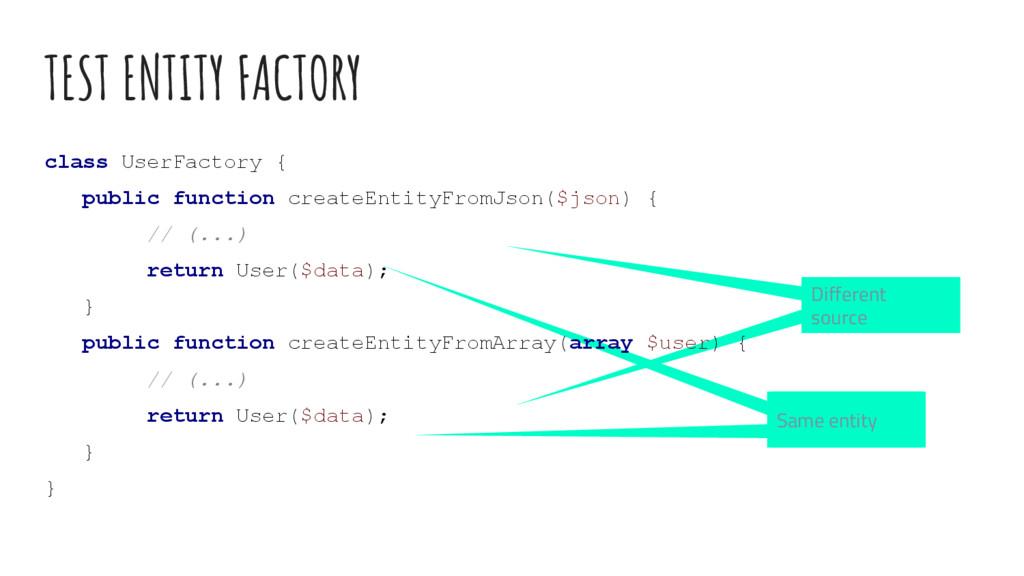
  10. TEST ENTITY FACTORY Build entity Same entity Build entity Different

    source class UserFactory { public function createEntityFromJson($json) { // (...) return User($data); } public function createEntityFromArray(array $user) { // (...) return User($data); } }
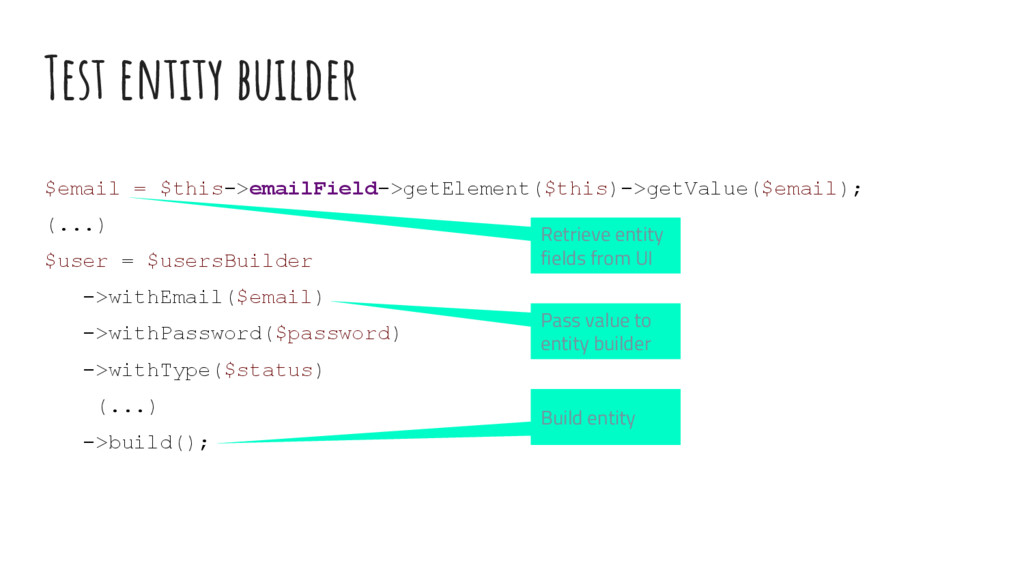
  11. Test entity builder $email = $this->emailField->getElement($this)->getValue($email); (...) $user = $usersBuilder

    ->withEmail($email) ->withPassword($password) ->withType($status) (...) ->build(); Retrieve entity fields from UI Pass value to entity builder Build entity
  12. Regular way public class LoginPage { public LoginPage typePassword(String password)

    { driver .findElement(By.id( "pass")) .sendKeys(password); return this; } } https://github.com/SeleniumHQ/selenium/wiki/PageObject s
  13. Page elements - page design class LoginPage extends OlxBasePage {

    // page elements as class vars public function __construct() { // init elements in constructor } // perform actions with usage of elements }
  14. Page elements - Class variables class LoginPage extends OlxBasePage {

    /** @var TextField */ private $emailField; /** @var TextField */ private $passwordField; /** @var Button */ private $submitButton; // rest of page } Each element have own type Elements are reusable
  15. Page elements - page Constructor class LoginPage extends OlxBasePage {

    // page elements as class vars public function __construct() { parent::__construct('login'); $this->emailField = new TextField(LocatorType:: ID, 'userEmail'); $this->passwordField = new TextField(LocatorType:: ID, 'userPass'); $this->submitButton = new Button(LocatorType:: ID, 'se_userLogin'); } // perform actions with usage of elements } Clear definition
  16. Page elements - Element usage class LoginPage extends OlxBasePage {

    // page elements as class vars public function __construct() { // init elements in constructor } public function fillLoginPassword( $password) { $this->passwordField->getElement($this)->setValue($password); } }
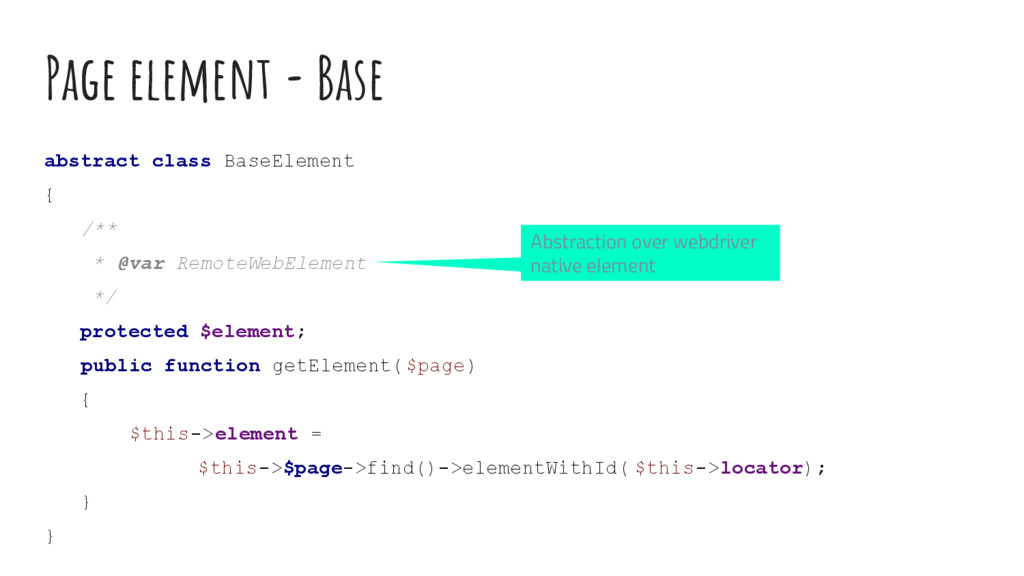
  17. Page element - Base abstract class BaseElement { /** *

    @var RemoteWebElement */ protected $element; public function getElement($page) { $this->element = $this->$page->find()->elementWithId( $this->locator); } } Abstraction over webdriver native element
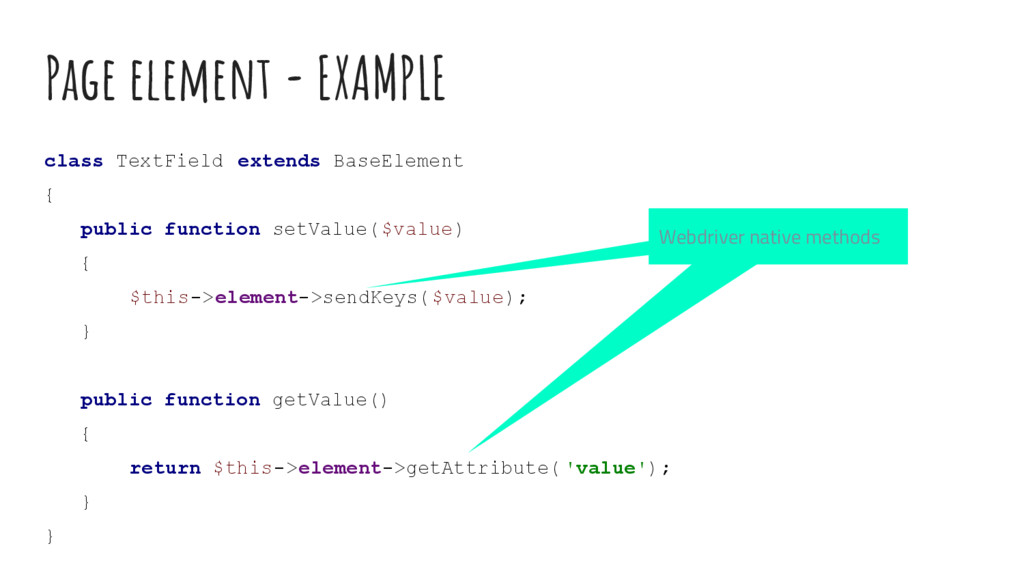
  18. Page element - EXAMPLE class TextField extends BaseElement { public

    function setValue($value) { $this->element->sendKeys($value); } public function getValue() { return $this->element->getAttribute( 'value'); } } Abstraction over webdriver native element Webdriver native methods
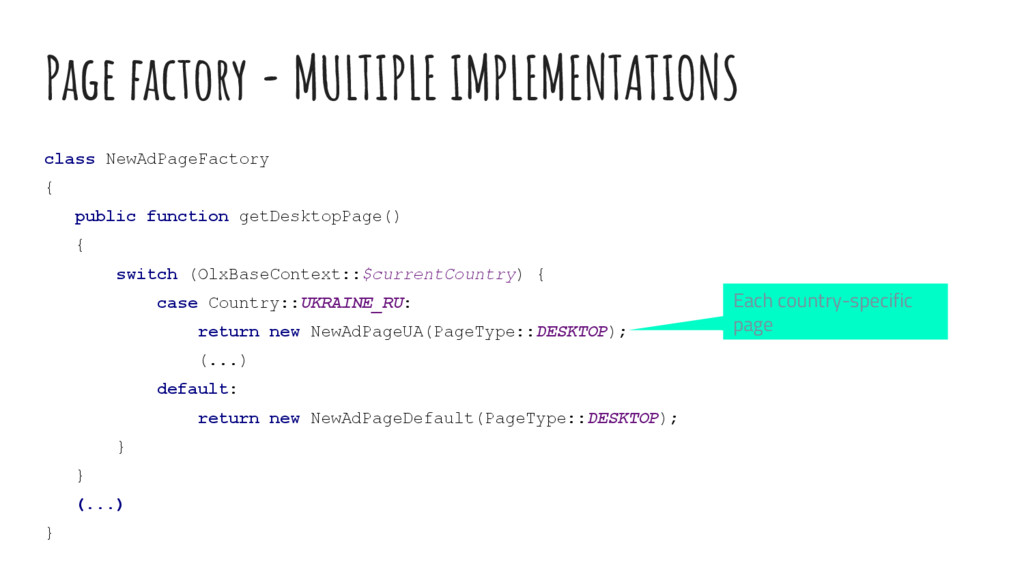
  19. Page factory - MULTIPLE IMPLEMENTATIONS class NewAdPageFactory { public function

    getDesktopPage() { switch (OlxBaseContext::$currentCountry) { case Country::UKRAINE_RU: return new NewAdPageUA(PageType::DESKTOP); (...) default: return new NewAdPageDefault(PageType::DESKTOP); } } (...) } Each country-specific page
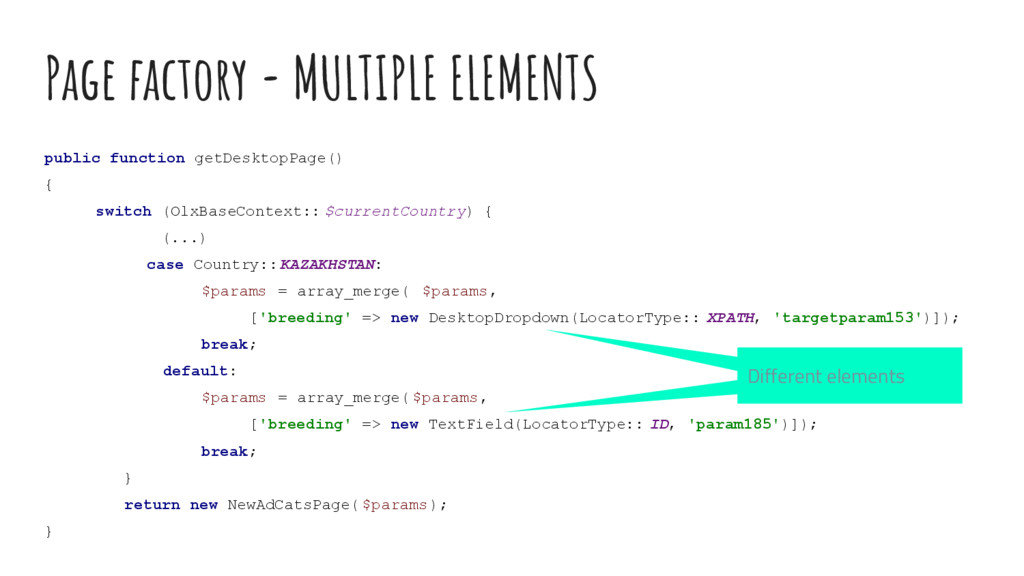
  20. Page factory - MULTIPLE ELEMENTS public function getDesktopPage() { switch

    (OlxBaseContext:: $currentCountry) { (...) case Country::KAZAKHSTAN: $params = array_merge( $params, ['breeding' => new DesktopDropdown(LocatorType:: XPATH, 'targetparam153')]); break; default: $params = array_merge( $params, ['breeding' => new TextField(LocatorType:: ID, 'param185')]); break; } return new NewAdCatsPage( $params); } Different elements
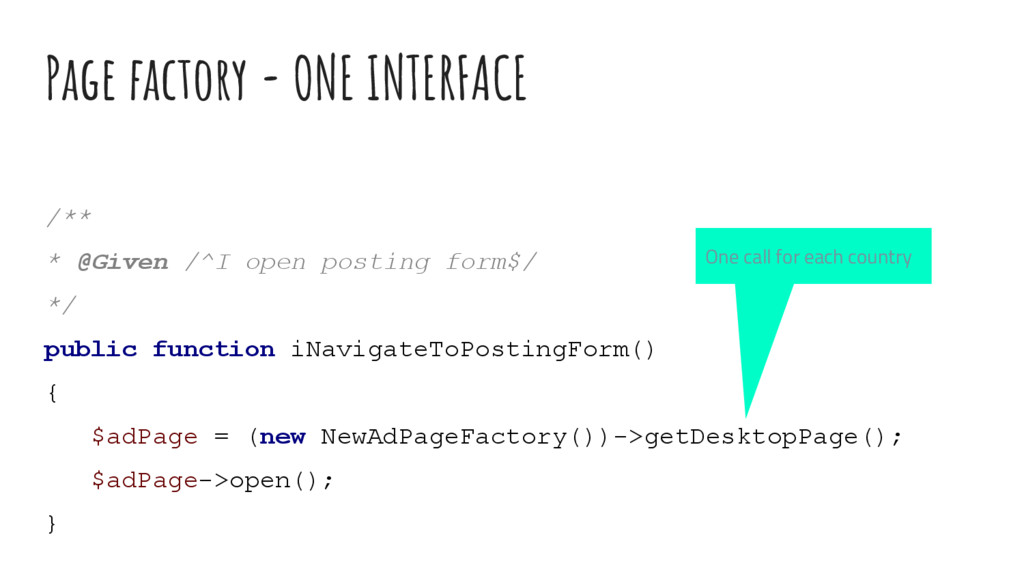
  21. Page factory - ONE INTERFACE /** * @Given /^I open

    posting form$/ */ public function iNavigateToPostingForm() { $adPage = (new NewAdPageFactory())->getDesktopPage(); $adPage->open(); } One call for each country

Other Decks in Technology