Goals forATM End-to-end ATM usage is desirable, across wide geographies and administrative domains Non end-to-end ATM is a fact of life forever - support it well Applications, end systems, people don’t want to know Except they want more performance in the end-to- end case Addressing ¯ Addressing and administration are all mixed up ¯ "Fixing" IP is an orthogonal problem ¯ Routers do a lot more than route - security, accounting, storm control, etc. ¯ MAC-level addressing model for ATM means separate routers are still needed ¯ Integrating ATM with multi-protocol addressing gets end-end performance with good control Header Avoidance ¯ For end-end ATM case, large parts of IP and TCP are redundant ¯ Avoid protocol/header overhead by terminating ATM connections at higher levels of protocol stacks ¯ Important to keep look, smell, and feel of TCP, but new protocol(s) required ¯ View connection as a cache of route/protocol decisions Addressing Requirements ¯ Type field in every address for multi-protocol addressing (OSI NSAP?) ¯ Sub-address hack for transiting E.164-only nets ¯ SAP/port addressing for identifying higher levels in protocol stack ¯ Address discovery- DHCP? ¯ Determination of end-to-end-ness Connectionless Connectionless semantics are important, performance needs work Certain things will always be better connectionless (service discovery, keep-alives) If switch understands network addressing, connectionless forwarding is small extra step Need signalling to discover and connect to connectionless service (router) 153
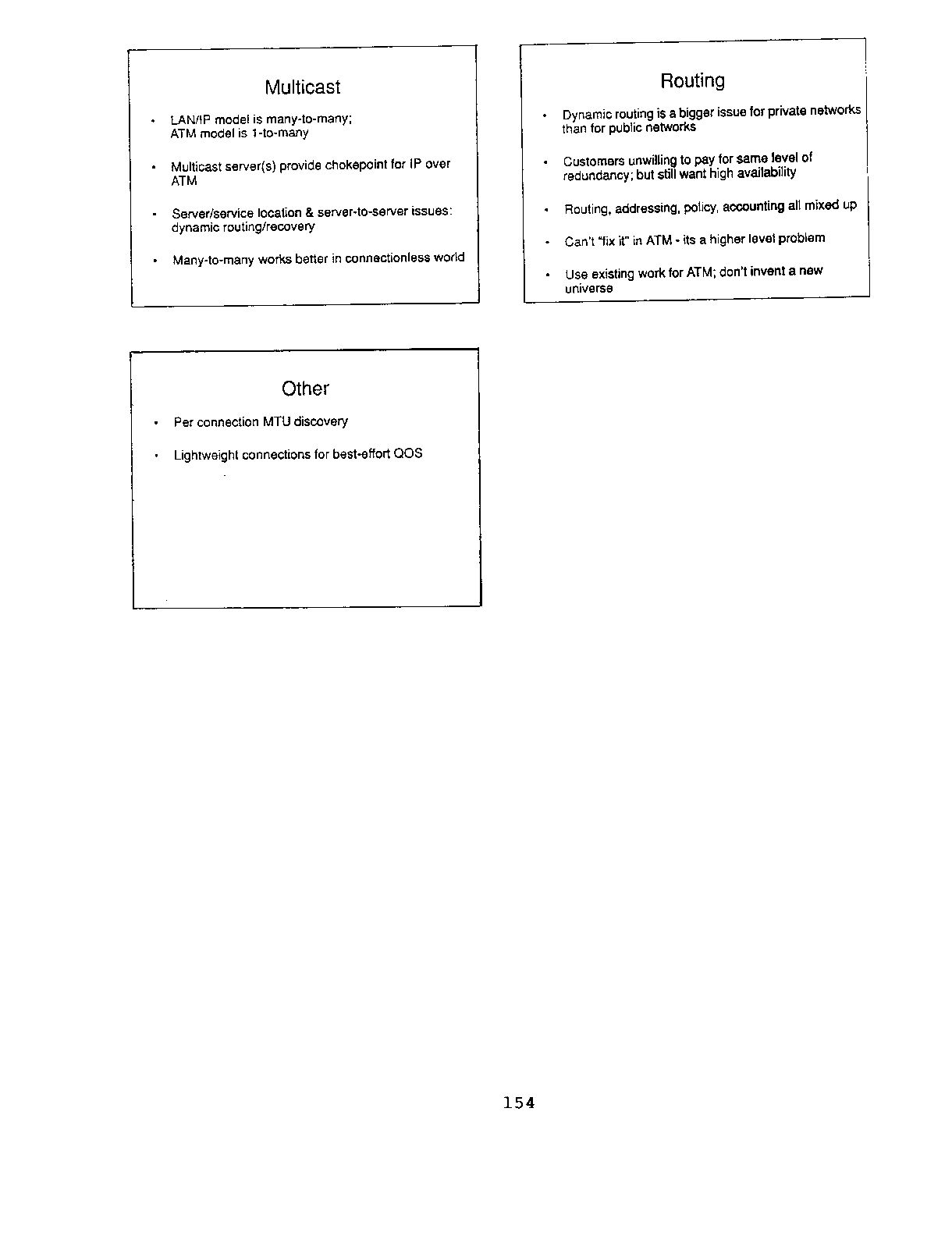
¯ Multicast server(s) provide chokepoint for IP over ATM Servedservice location & server-to-server issues: dynamic routing/recovery Many-to-many works better in connectionless world Routing Dynamic routing is a bigger issue for private networks than for public networks Customers unwilling to pay for same level of redundancy; but still want high availability Routing, addressing, policy, accounting all mixed up Can’t "fix it" in ATM - its a higher level problem Use existing work for ATM; don’t invent a new universe Other Per connection MTU discovery Lightweight connections for best-effort QOS 154


 pugs
pugs
 elmodev09
 kworkdev
 junkifurukawa
 kinunori
 kentapapa
 taka_aki
 tanakaseiya
 matsunobu
 foursue
 nasuvitz
 marceloancelmo
 trishagee
 eileencodes
 popppiees
 sugarenia
 aleyda
 inesmontani
 gr2m
gr2m
 mkilby
 pedronauck
 schroneko
 reverentgeek
 addyosmani
![Internet/ATM: Signalling Requirements Tom Lyon Sun Microsystems Computer Corporation [email protected]](https://files.speakerdeck.com/presentations/c8dba3f78a7248d4b44a2bca0f1baeba/slide_0.jpg)