is intended to outline our general product direction. It is intended for information purposes only, and may not be incorporated into any contract. It is not a commitment to deliver any material, code, or functionality, and should not be relied upon in making purchasing decisions. The development, release, and timing of any features or functionality described for Oracle’s products remains at the sole discretion of Oracle.
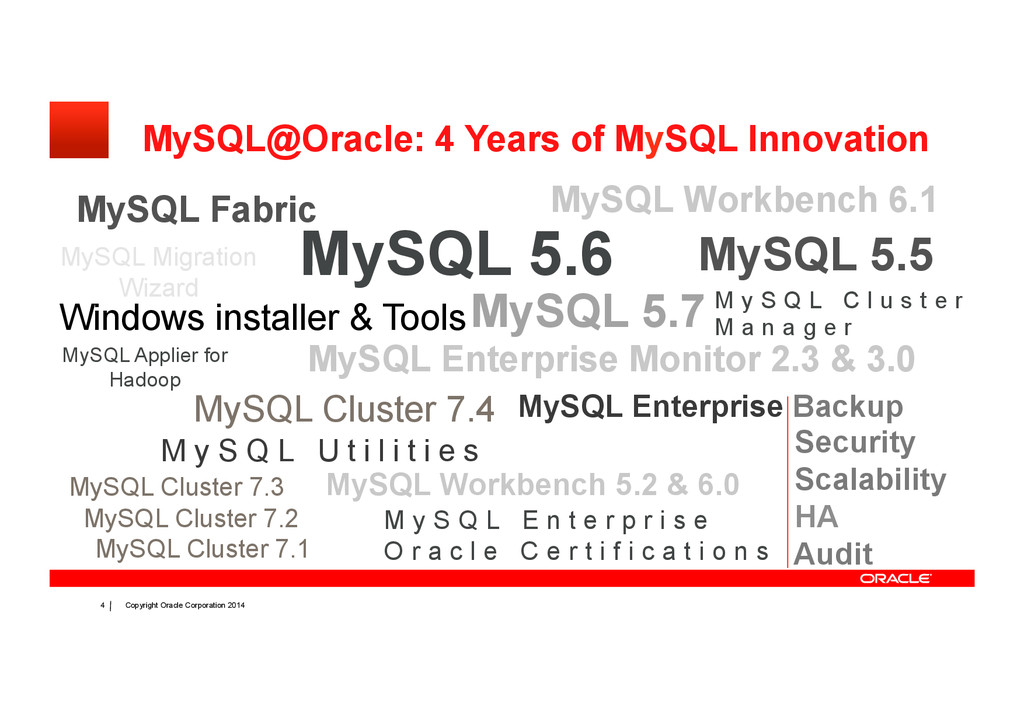
2.3 & 3.0 MySQL Enterprise Backup Security Scalability HA Audit MySQL 5.6 MySQL Workbench 6.1 M y S Q L U t i l i t i e s MySQL Applier for Hadoop MySQL Workbench 5.2 & 6.0 M y S Q L E n t e r p r i s e O r a c l e C e r t i f i c a t i o n s MySQL@Oracle: 4 Years of MySQL Innovation M y S Q L C l u s t e r M a n a g e r Windows installer & Tools MySQL Cluster 7.2 MySQL Cluster 7.1 MySQL Migration Wizard MySQL 5.7 MySQL Cluster 7.4 MySQL Fabric MySQL Cluster 7.3
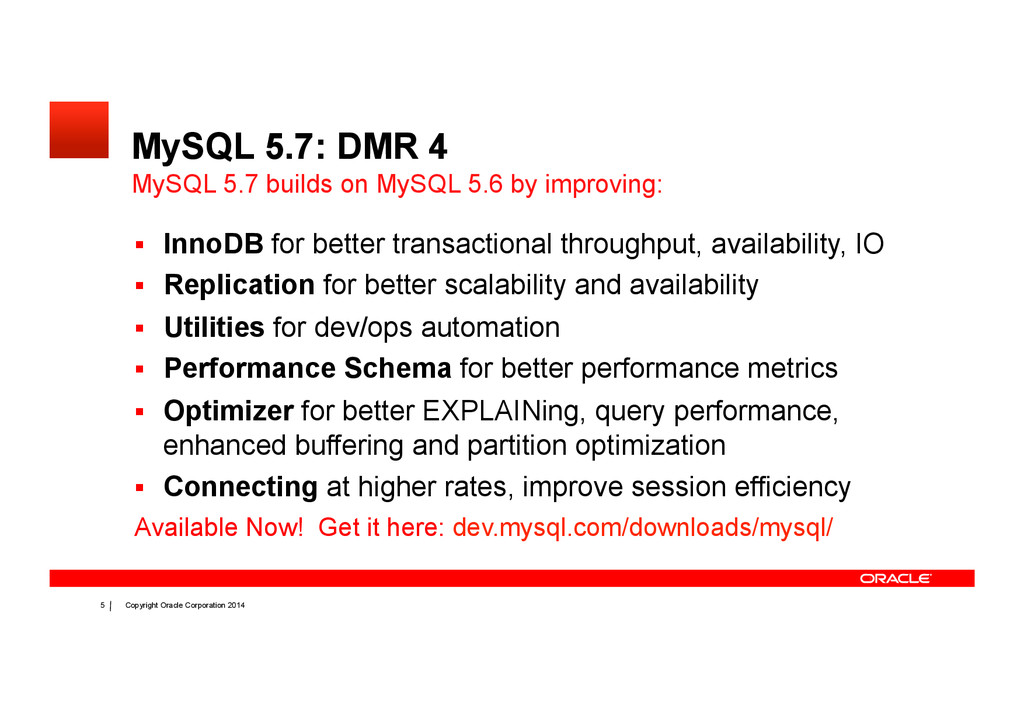
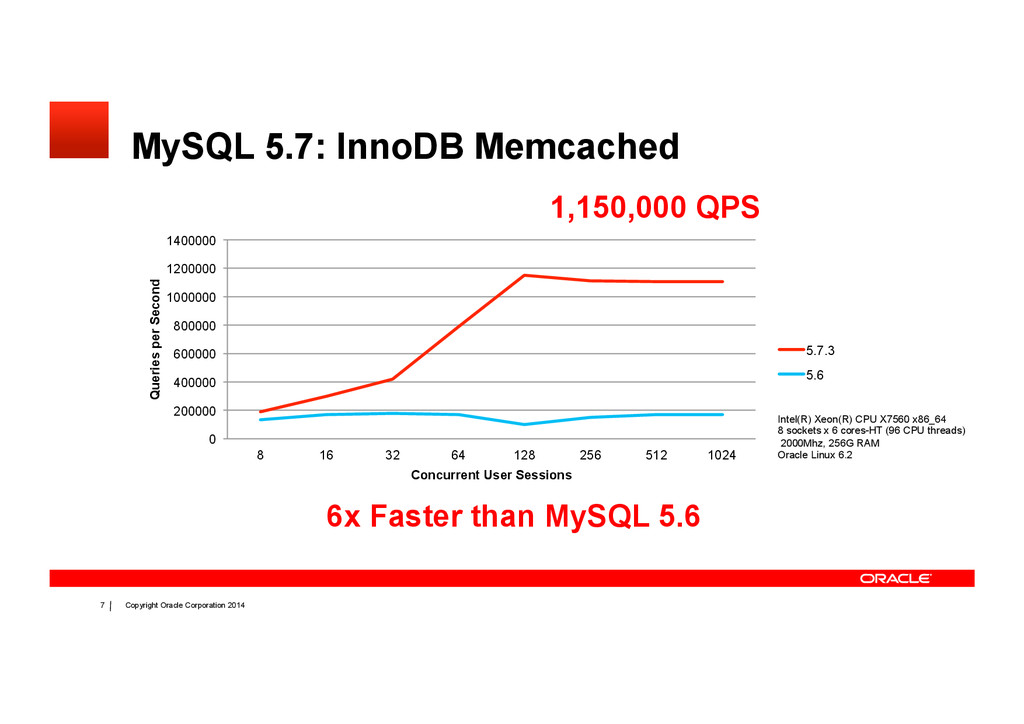
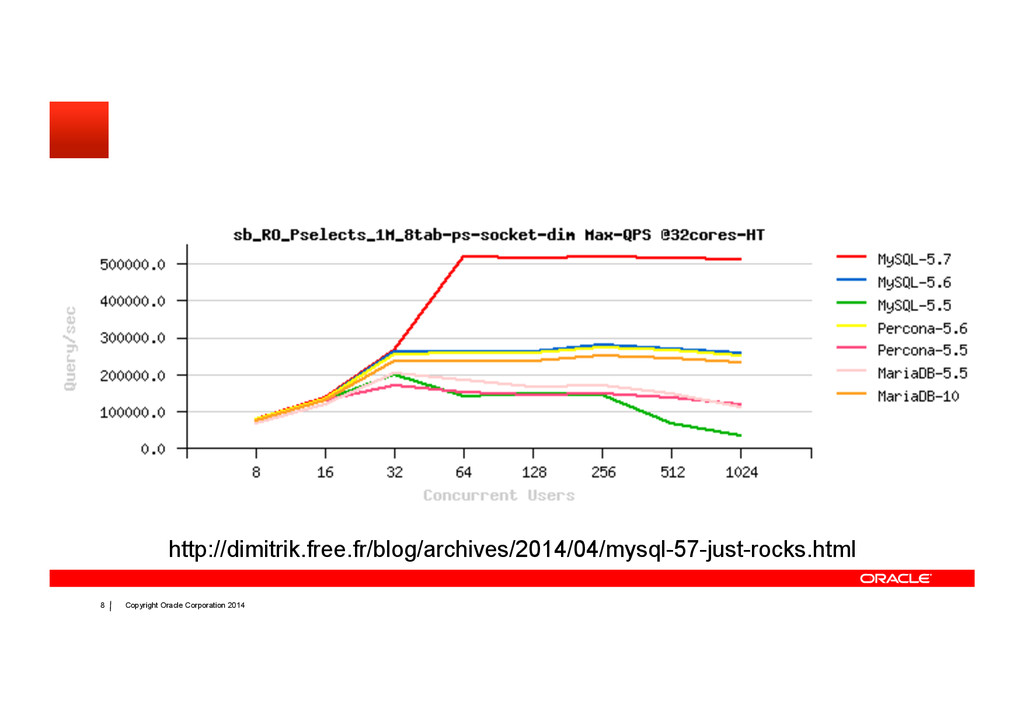
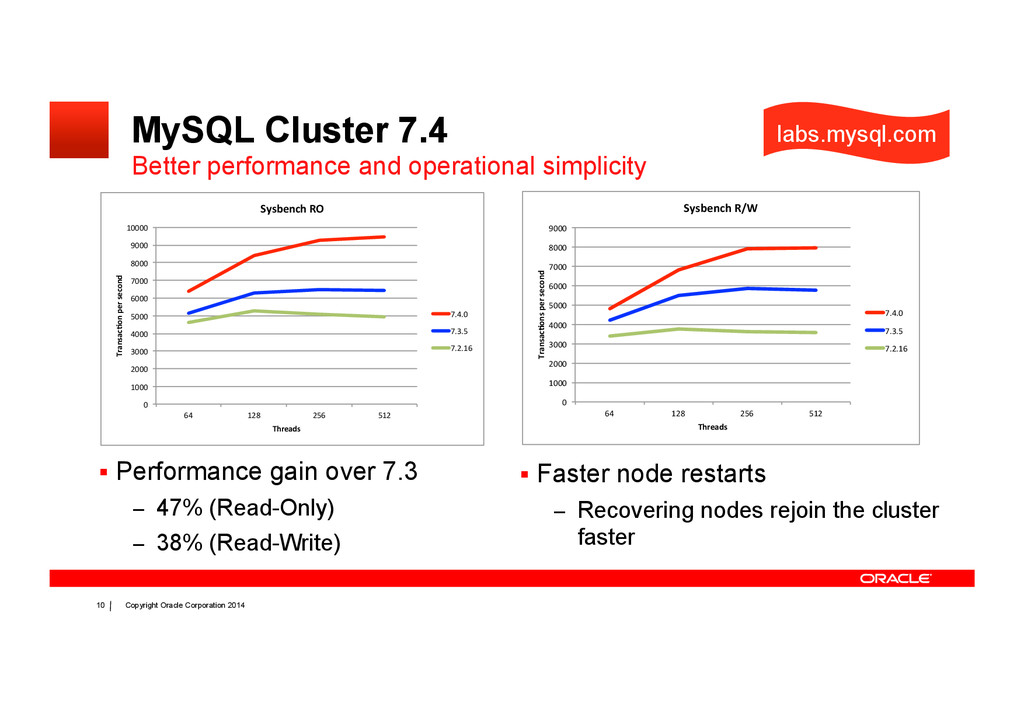
InnoDB for better transactional throughput, availability, IO § Replication for better scalability and availability § Utilities for dev/ops automation § Performance Schema for better performance metrics § Optimizer for better EXPLAINing, query performance, enhanced buffering and partition optimization § Connecting at higher rates, improve session efficiency Available Now! Get it here: dev.mysql.com/downloads/mysql/ MySQL 5.7 builds on MySQL 5.6 by improving:
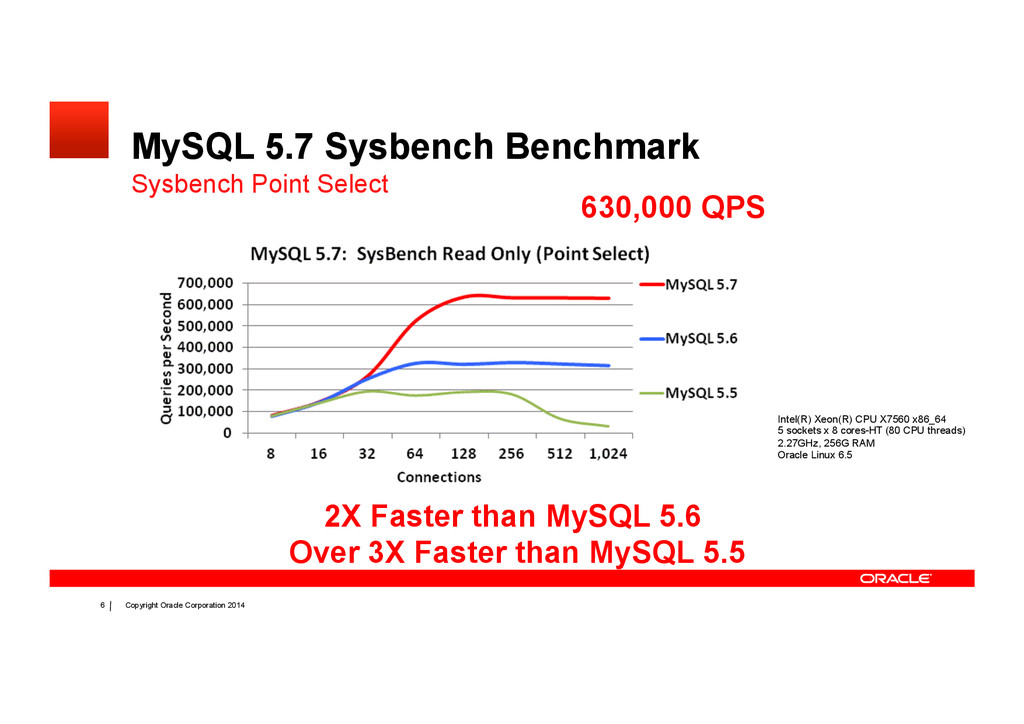
Point Select Intel(R) Xeon(R) CPU X7560 x86_64 5 sockets x 8 cores-HT (80 CPU threads) 2.27GHz, 256G RAM Oracle Linux 6.5 2X Faster than MySQL 5.6 Over 3X Faster than MySQL 5.5 630,000 QPS
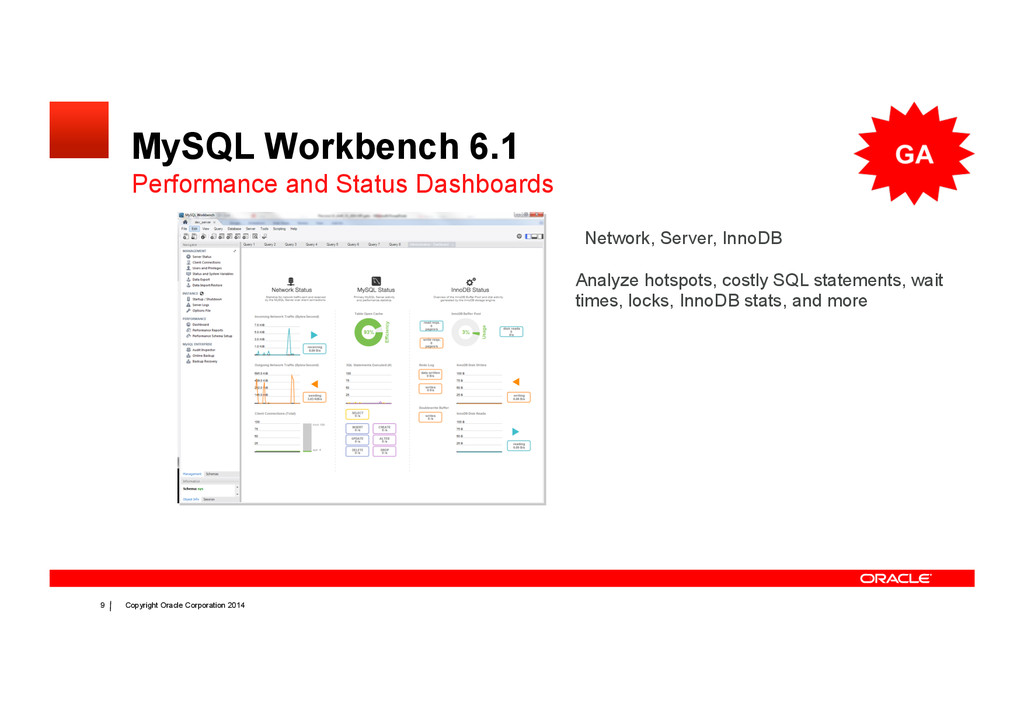
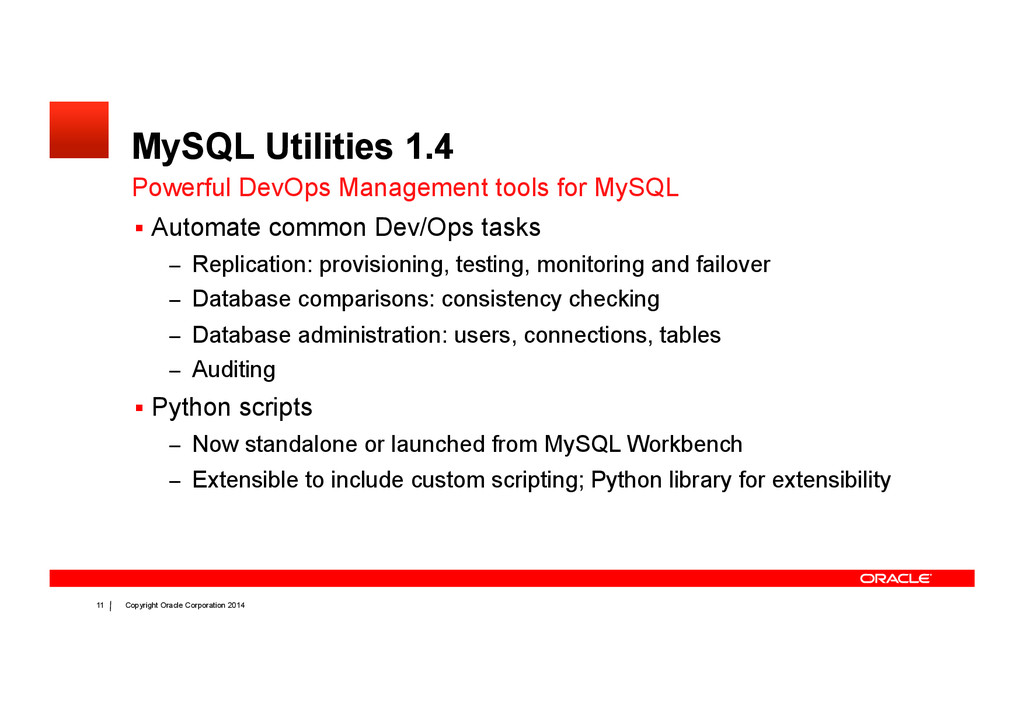
common Dev/Ops tasks – Replication: provisioning, testing, monitoring and failover – Database comparisons: consistency checking – Database administration: users, connections, tables – Auditing § Python scripts – Now standalone or launched from MySQL Workbench – Extensible to include custom scripting; Python library for extensibility Powerful DevOps Management tools for MySQL
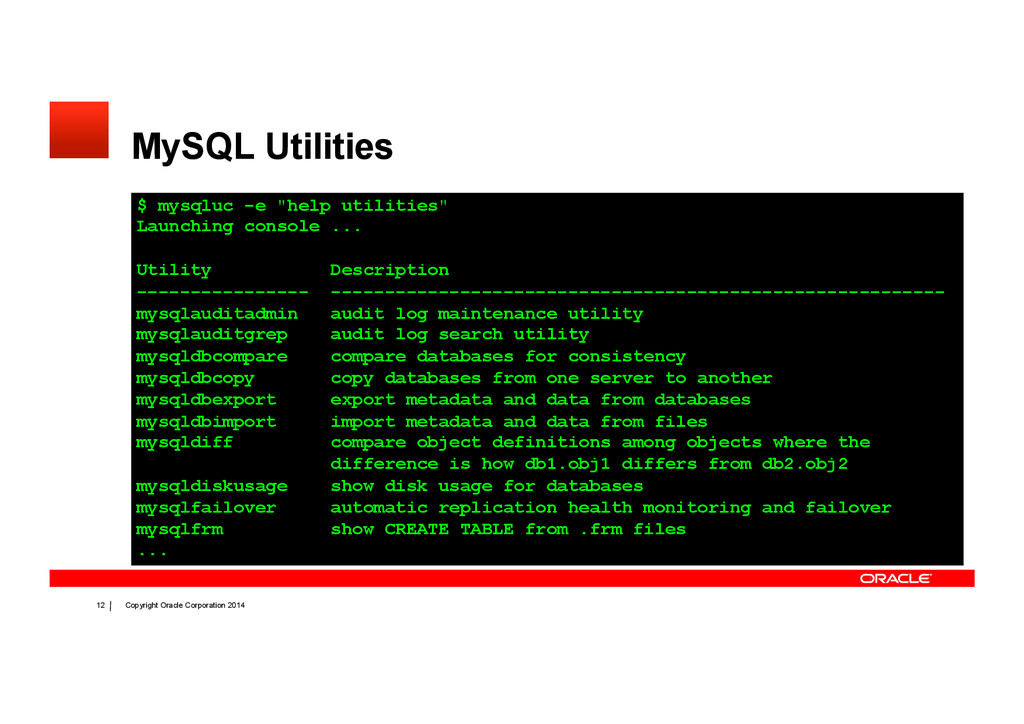
"help utilities" Launching console ... Utility Description ---------------- --------------------------------------------------------- mysqlauditadmin audit log maintenance utility mysqlauditgrep audit log search utility mysqldbcompare compare databases for consistency mysqldbcopy copy databases from one server to another mysqldbexport export metadata and data from databases mysqldbimport import metadata and data from files mysqldiff compare object definitions among objects where the difference is how db1.obj1 differs from db2.obj2 mysqldiskusage show disk usage for databases mysqlfailover automatic replication health monitoring and failover mysqlfrm show CREATE TABLE from .frm files ...
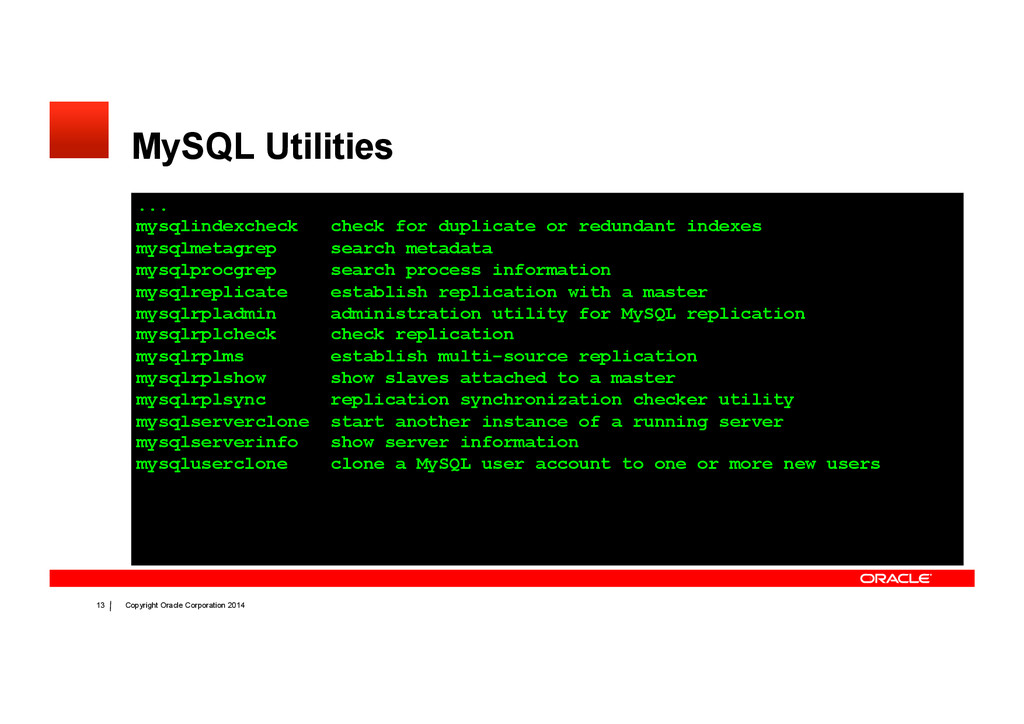
for duplicate or redundant indexes mysqlmetagrep search metadata mysqlprocgrep search process information mysqlreplicate establish replication with a master mysqlrpladmin administration utility for MySQL replication mysqlrplcheck check replication mysqlrplms establish multi-source replication mysqlrplshow show slaves attached to a master mysqlrplsync replication synchronization checker utility mysqlserverclone start another instance of a running server mysqlserverinfo show server information mysqluserclone clone a MySQL user account to one or more new users
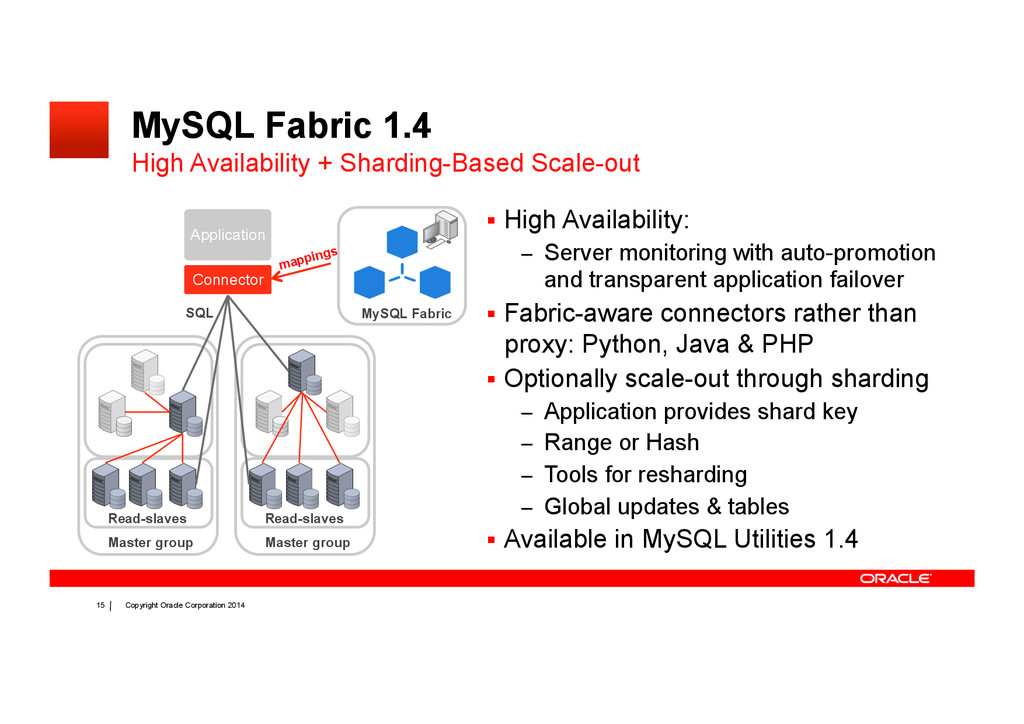
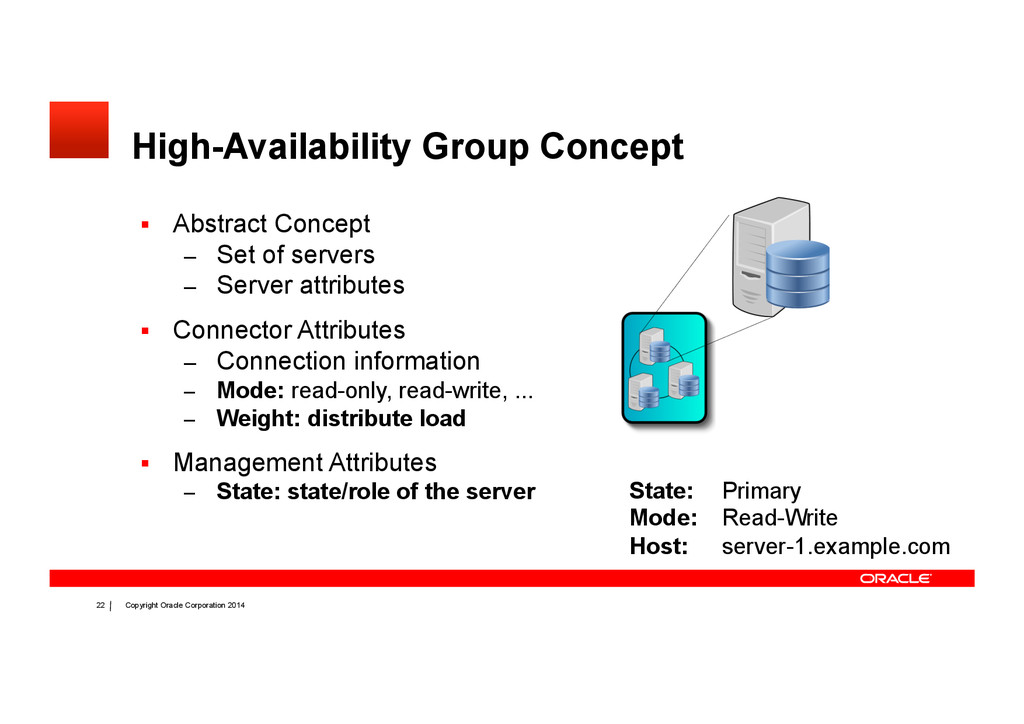
Availability: – Server monitoring with auto-promotion and transparent application failover § Fabric-aware connectors rather than proxy: Python, Java & PHP § Optionally scale-out through sharding – Application provides shard key – Range or Hash – Tools for resharding – Global updates & tables § Available in MySQL Utilities 1.4 High Availability + Sharding-Based Scale-out MySQL Fabric Connector Application Read-slaves mappings SQL Master group Read-slaves Master group
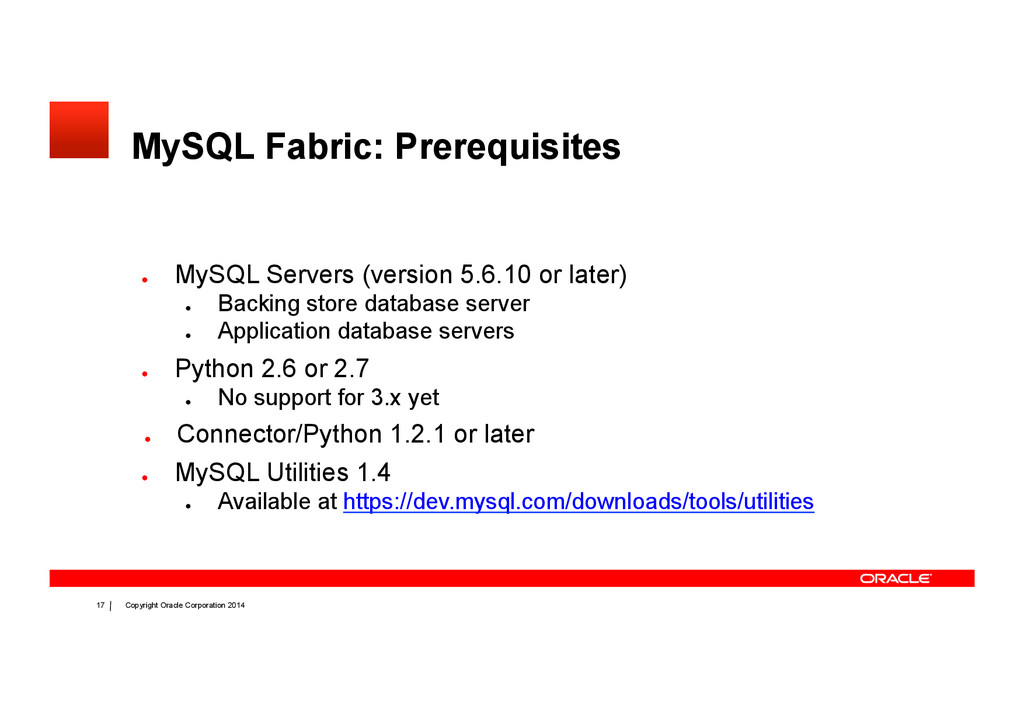
Servers (version 5.6.10 or later) • Backing store database server • Application database servers • Python 2.6 or 2.7 • No support for 3.x yet • Connector/Python 1.2.1 or later • MySQL Utilities 1.4 • Available at https://dev.mysql.com/downloads/tools/utilities
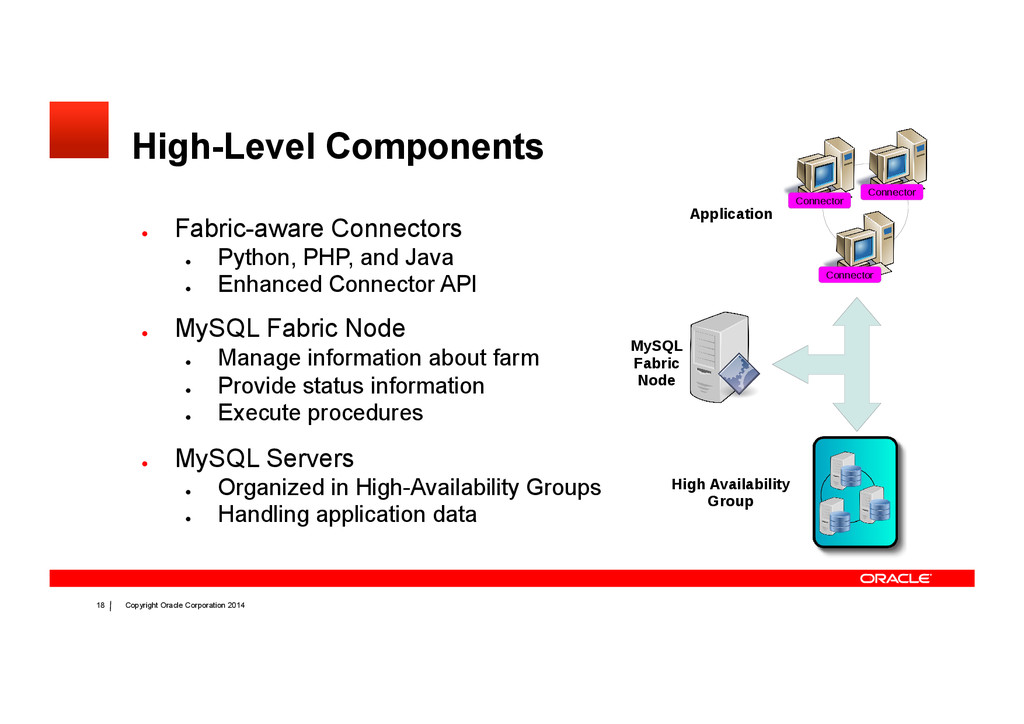
its affiliates. All rights reserved.| Percona Live | April 3, 2014 | 9 High-Level Components • Fabric-aware Connectors • Python, PHP, and Java • Enhanced Connector API • MySQL Fabric Node • Manage information about farm • Provide status information • Execute procedures • MySQL Servers • Organized in High-Availability Groups • Handling application data High Availability Group Application Connector Connector Connector MySQL Fabric Node High-Level Components • Fabric-aware Connectors • Python, PHP, and Java • Enhanced Connector API • MySQL Fabric Node • Manage information about farm • Provide status information • Execute procedures • MySQL Servers • Organized in High-Availability Groups • Handling application data
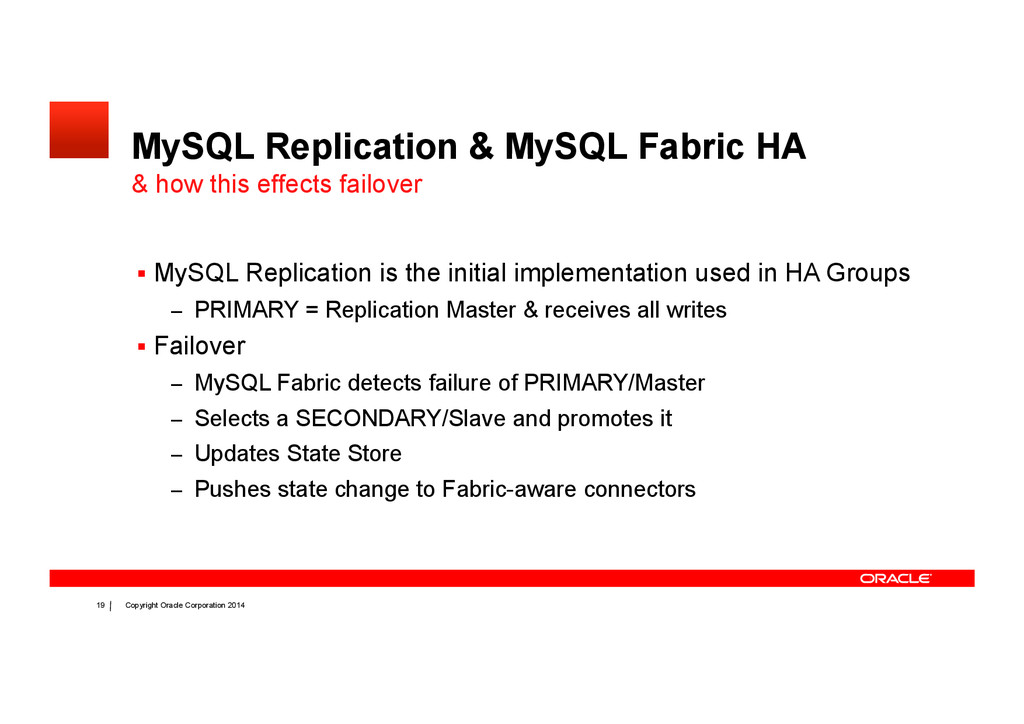
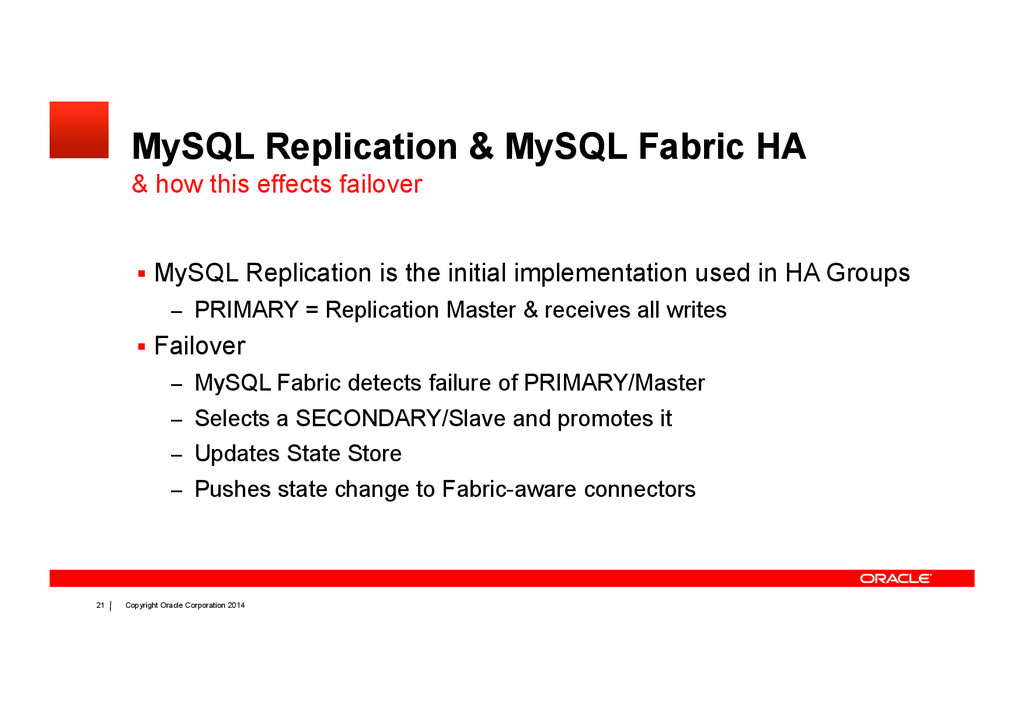
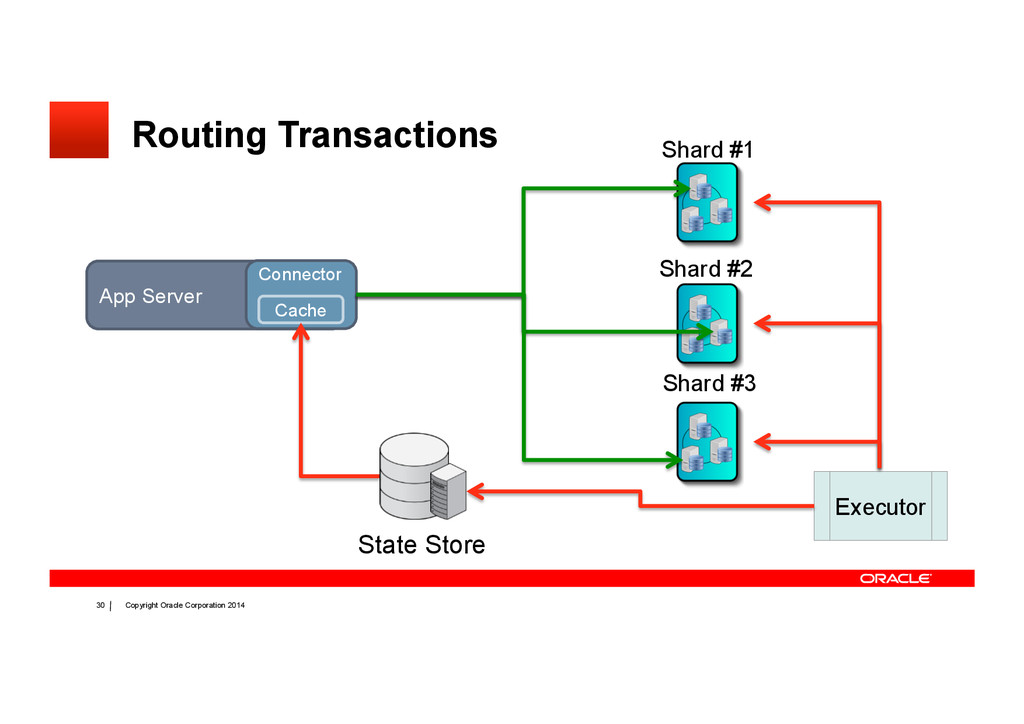
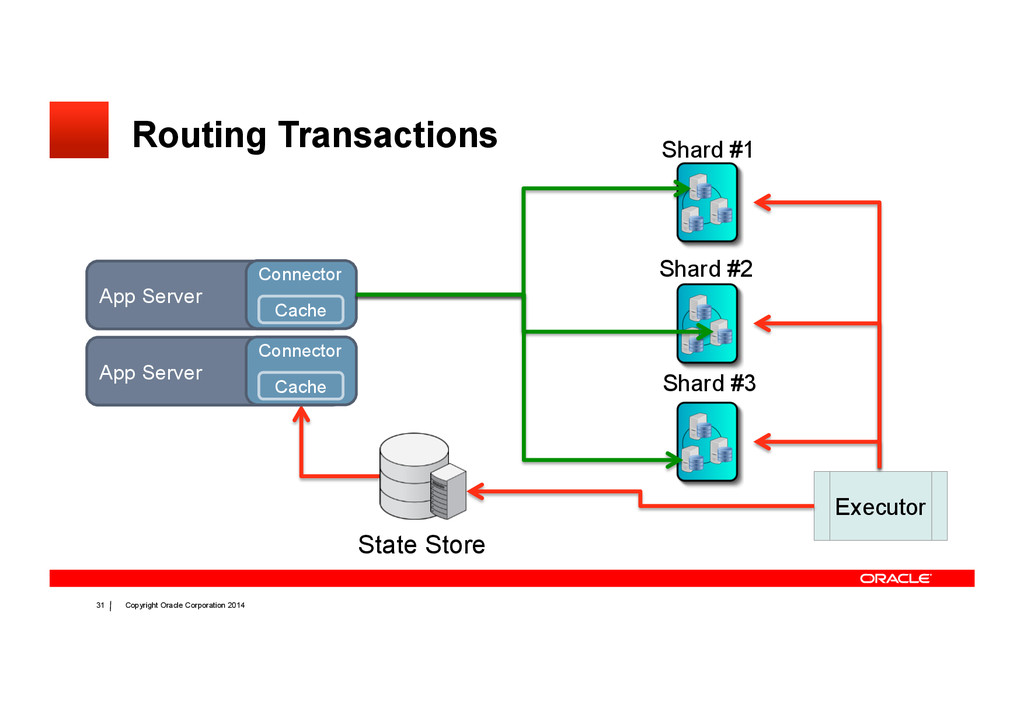
HA § MySQL Replication is the initial implementation used in HA Groups – PRIMARY = Replication Master & receives all writes § Failover – MySQL Fabric detects failure of PRIMARY/Master – Selects a SECONDARY/Slave and promotes it – Updates State Store – Pushes state change to Fabric-aware connectors & how this effects failover
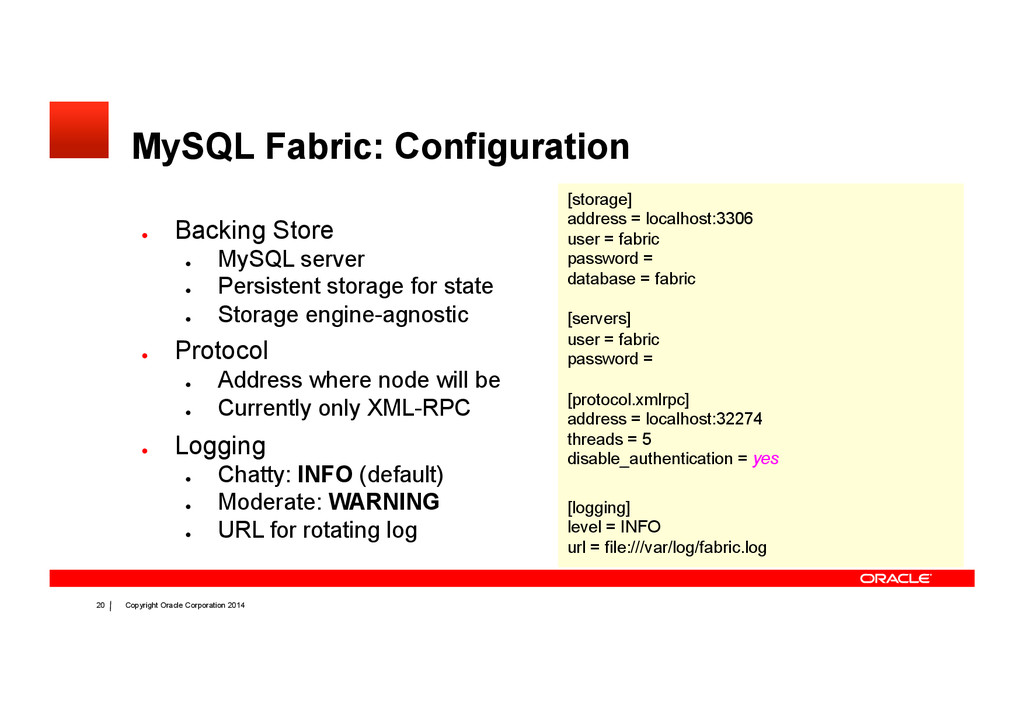
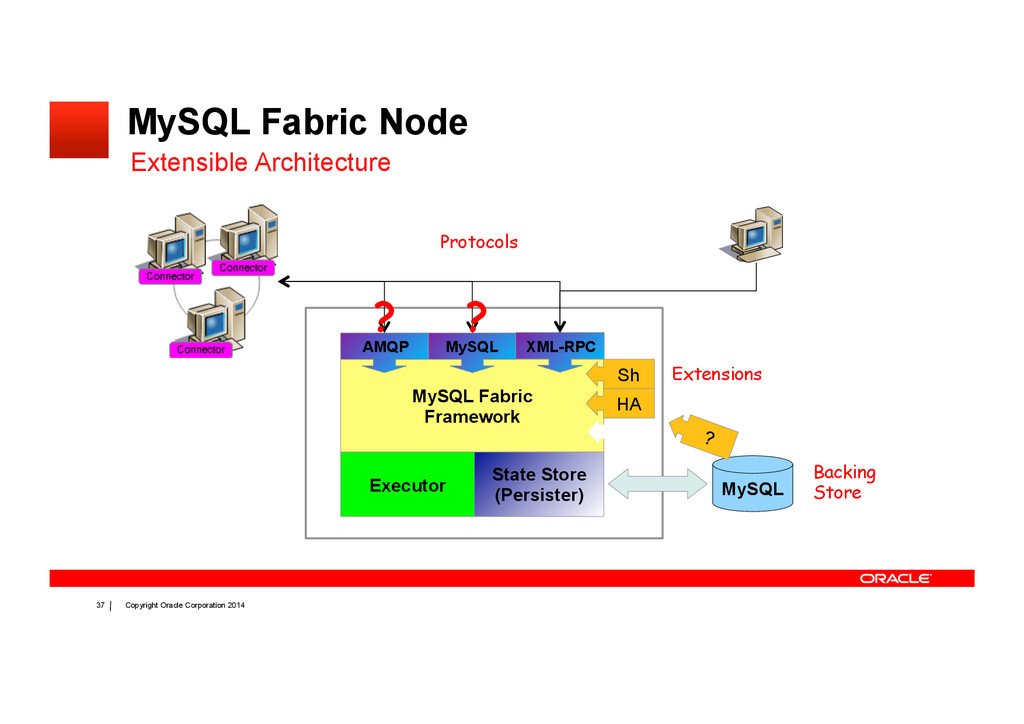
Store • MySQL server • Persistent storage for state • Storage engine-agnostic • Protocol • Address where node will be • Currently only XML-RPC • Logging • Chatty: INFO (default) • Moderate: WARNING • URL for rotating log [storage] address = localhost:3306 user = fabric password = database = fabric [servers] user = fabric password = [protocol.xmlrpc] address = localhost:32274 threads = 5 disable_authentication = yes [logging] level = INFO url = file:///var/log/fabric.log
HA § MySQL Replication is the initial implementation used in HA Groups – PRIMARY = Replication Master & receives all writes § Failover – MySQL Fabric detects failure of PRIMARY/Master – Selects a SECONDARY/Slave and promotes it – Updates State Store – Pushes state change to Fabric-aware connectors & how this effects failover
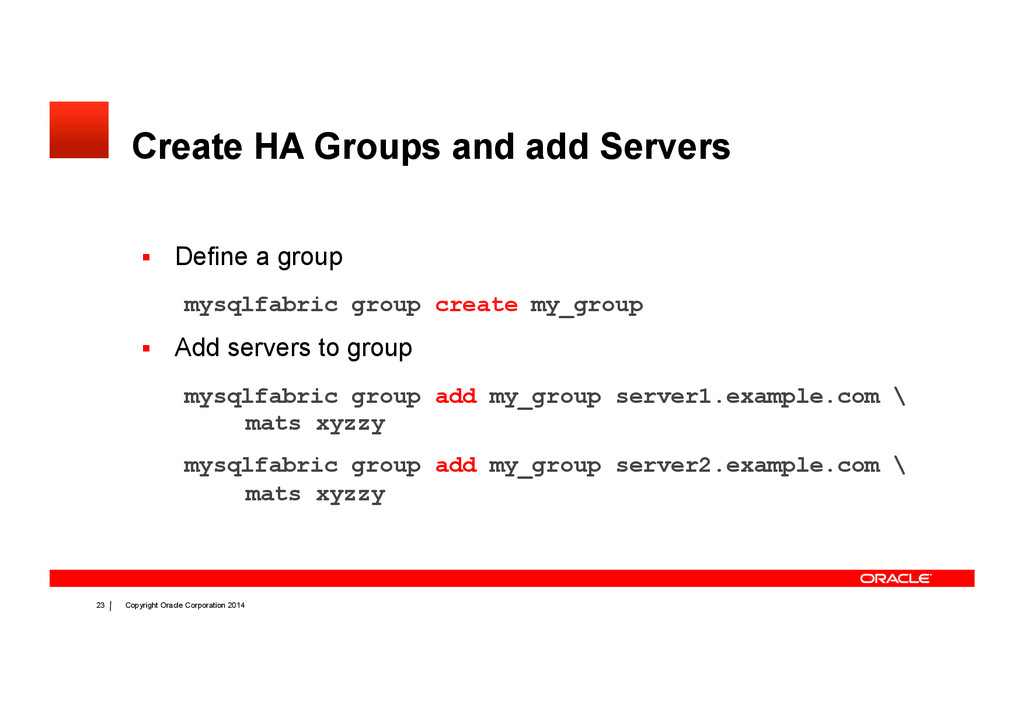
Servers § Define a group mysqlfabric group create my_group § Add servers to group mysqlfabric group add my_group server1.example.com \ mats xyzzy mysqlfabric group add my_group server2.example.com \ mats xyzzy
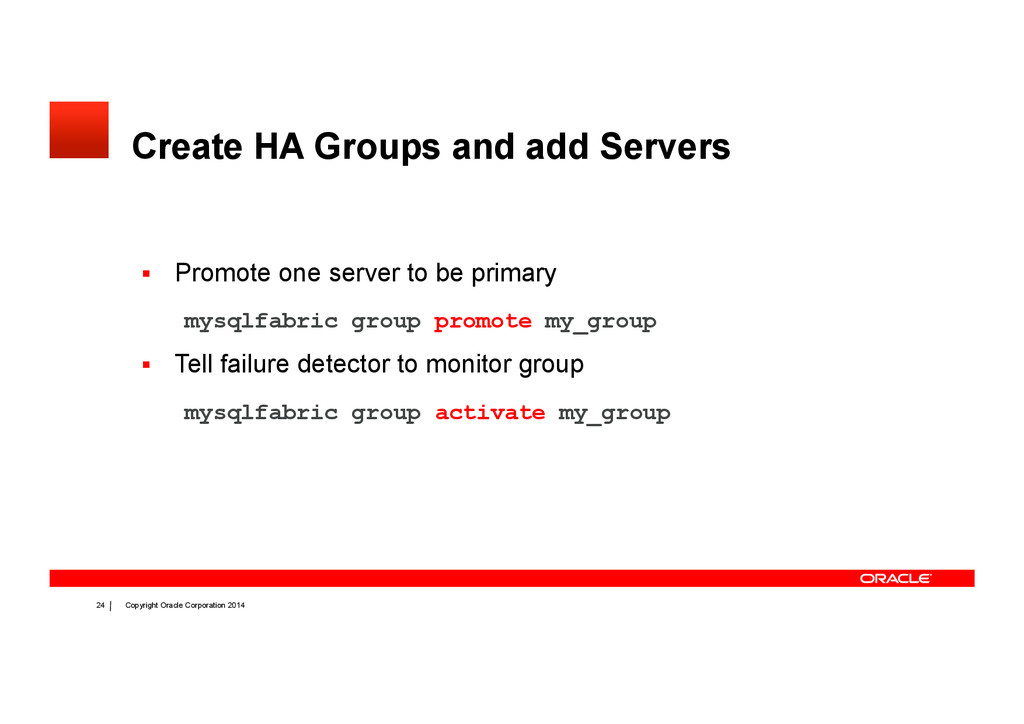
Servers § Promote one server to be primary mysqlfabric group promote my_group § Tell failure detector to monitor group mysqlfabric group activate my_group
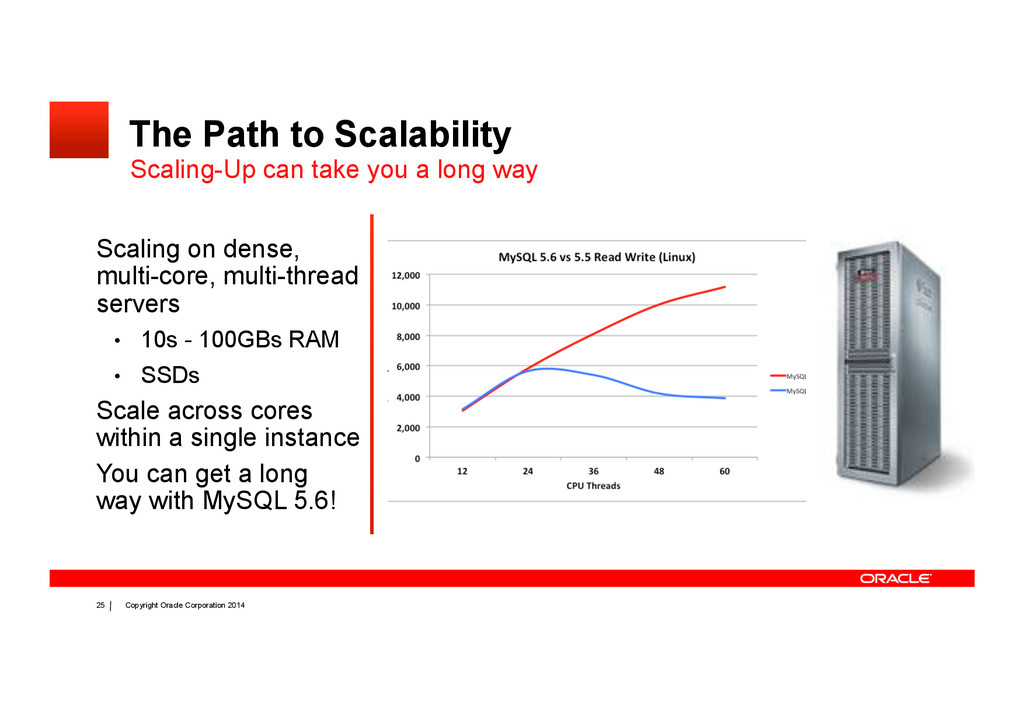
servers • 10s - 100GBs RAM • SSDs Scale across cores within a single instance You can get a long way with MySQL 5.6! The Path to Scalability Scaling-Up can take you a long way
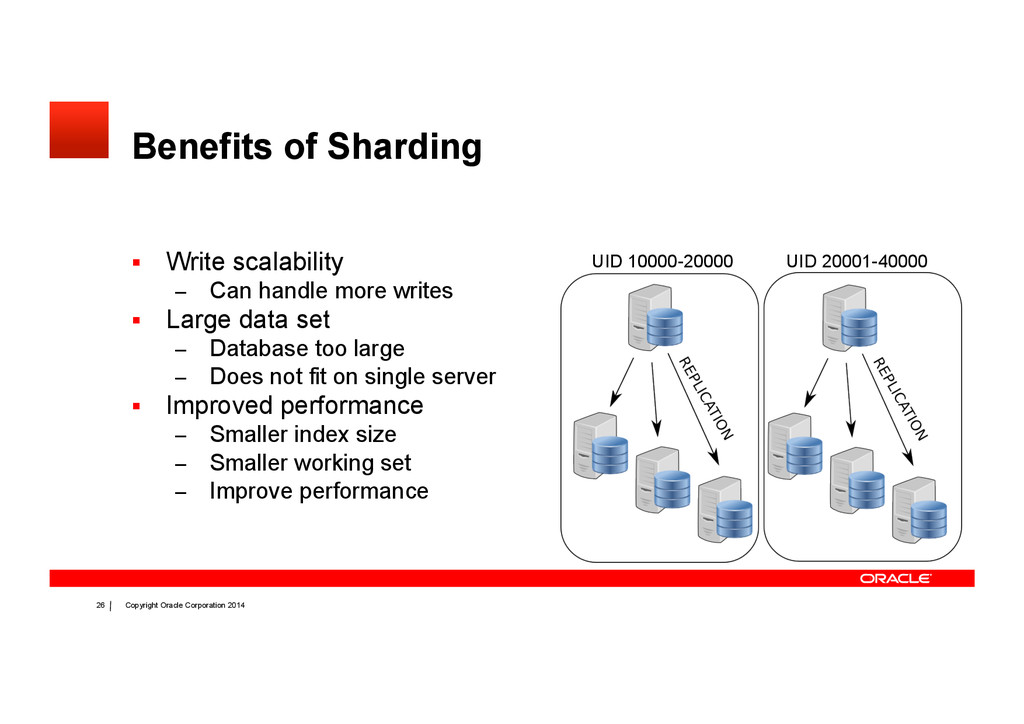
scalability – Can handle more writes § Large data set – Database too large – Does not fit on single server § Improved performance – Smaller index size – Smaller working set – Improve performance UID 10000-20000 UID 20001-40000
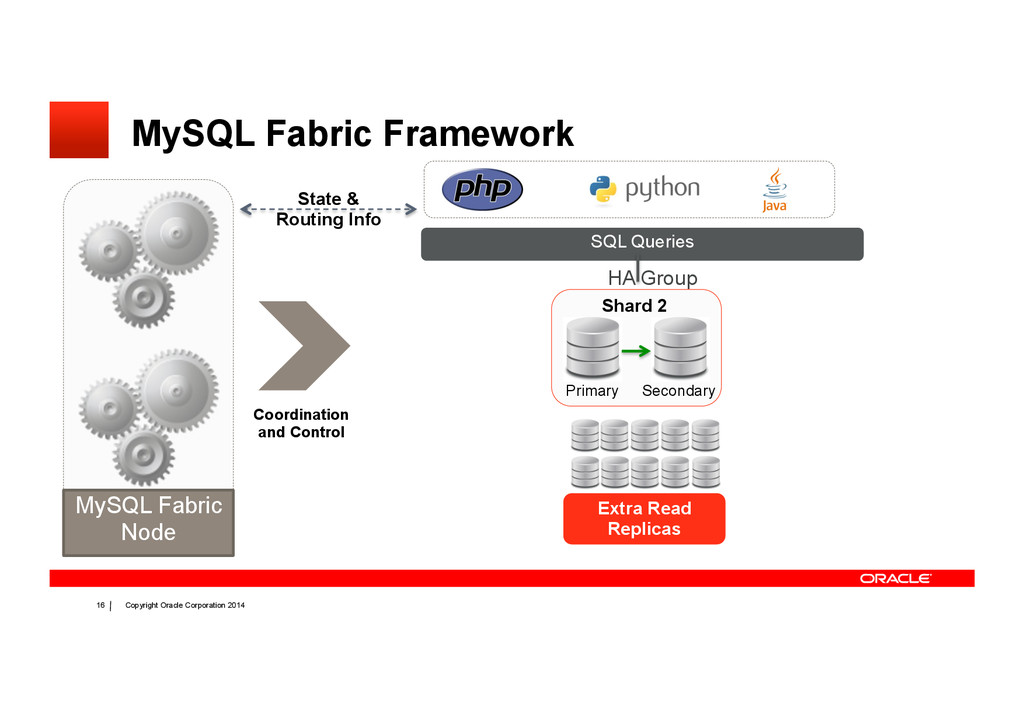
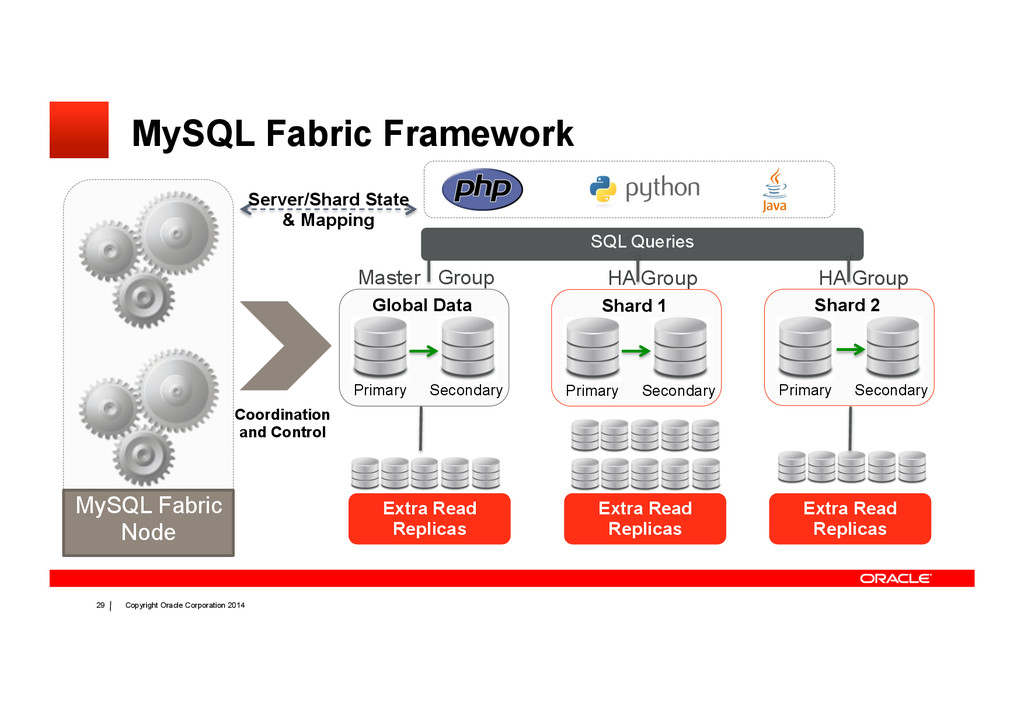
Primary Secondary Shard 1 Primary Secondary Shard 2 Primary Secondary MySQL Fabric Node SQL Queries Server/Shard State & Mapping Master Group HA Group Coordination and Control HA Group Extra Read Replicas Extra Read Replicas Extra Read Replicas
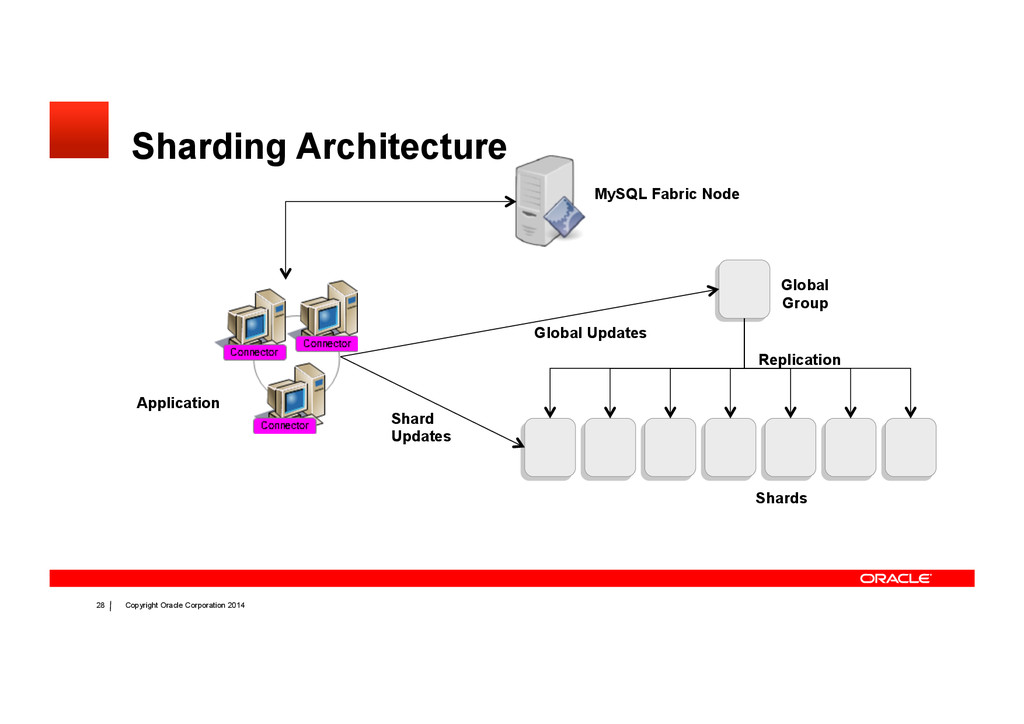
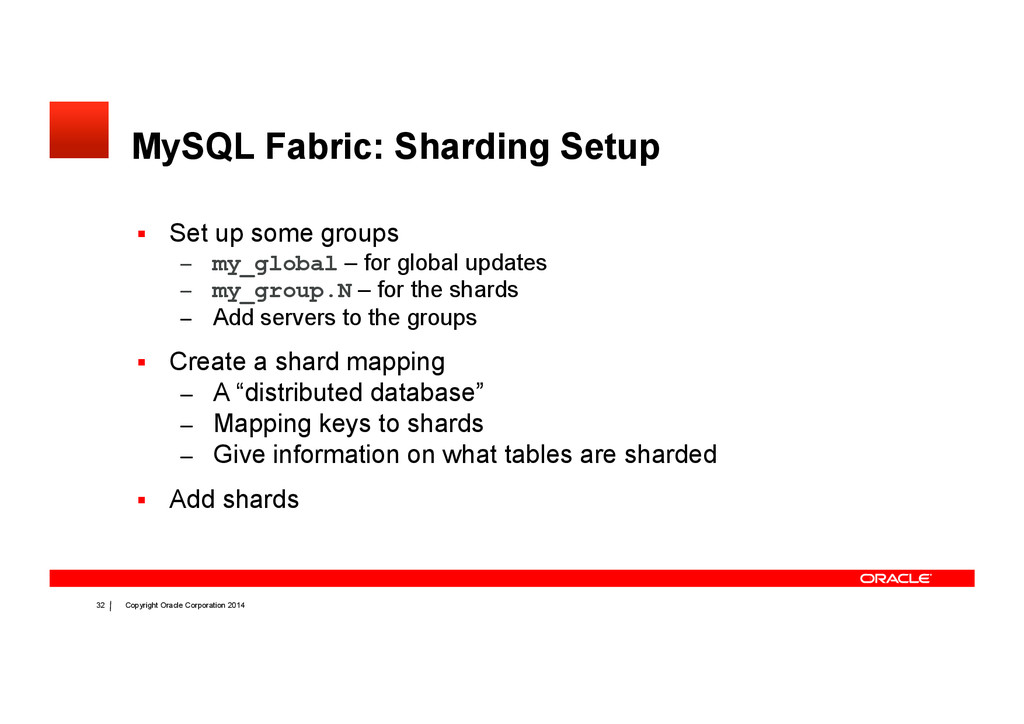
Set up some groups – my_global – for global updates – my_group.N – for the shards – Add servers to the groups § Create a shard mapping – A “distributed database” – Mapping keys to shards – Give information on what tables are sharded § Add shards
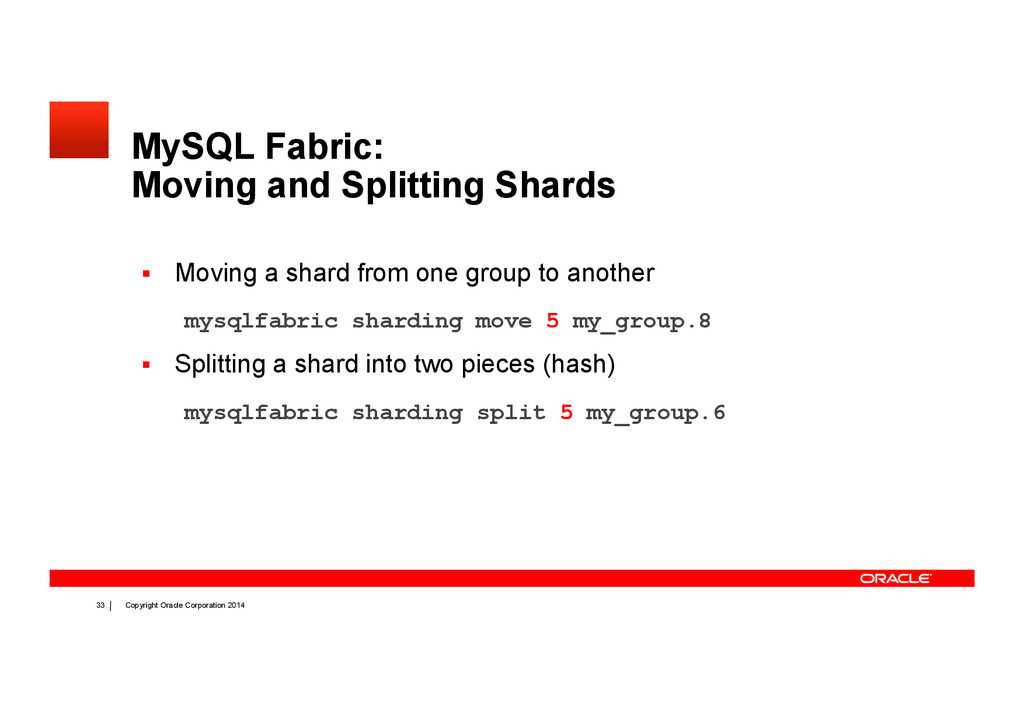
Shards § Moving a shard from one group to another mysqlfabric sharding move 5 my_group.8 § Splitting a shard into two pieces (hash) mysqlfabric sharding split 5 my_group.6
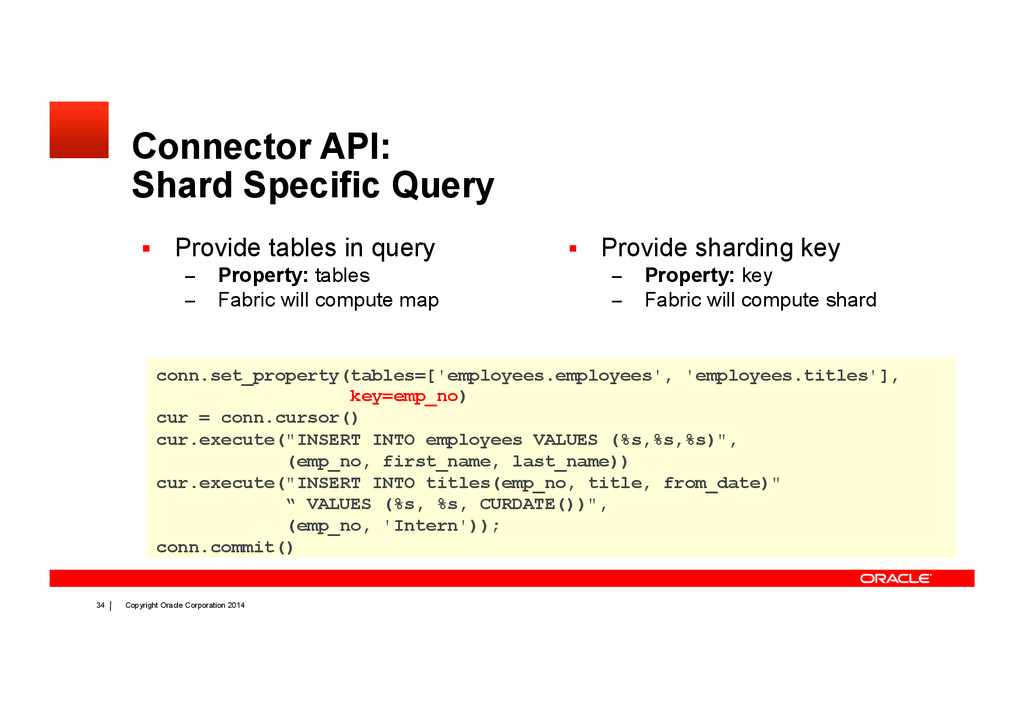
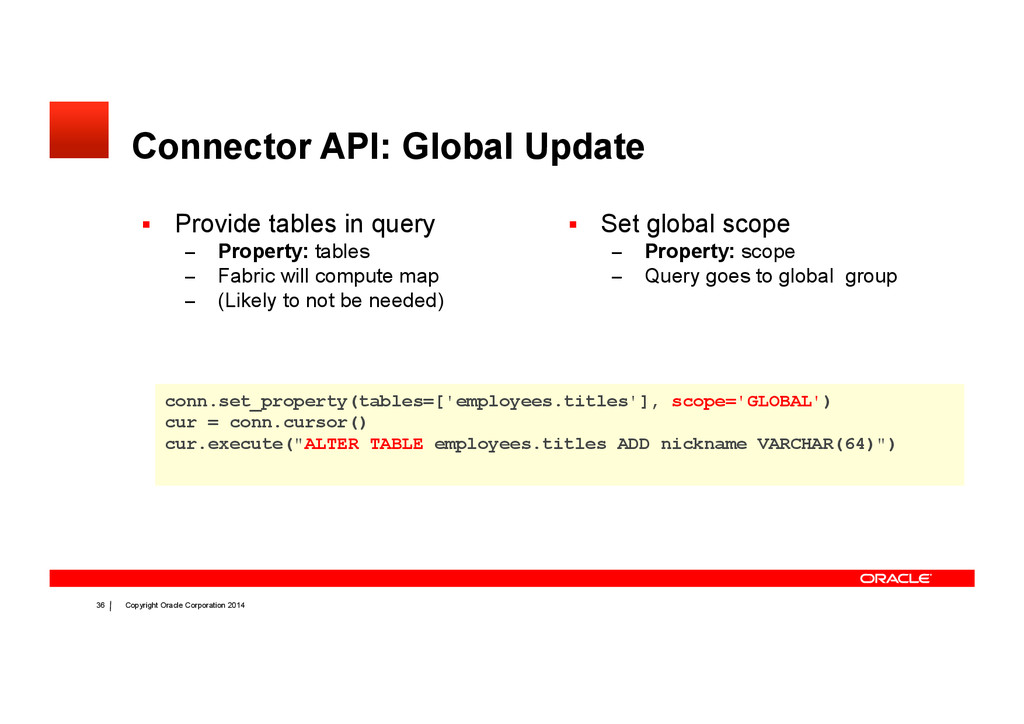
Provide tables in query – Property: tables – Fabric will compute map – (Likely to not be needed) conn.set_property(tables=['employees.titles'], scope='GLOBAL') cur = conn.cursor() cur.execute("ALTER TABLE employees.titles ADD nickname VARCHAR(64)") § Set global scope – Property: scope – Query goes to global group
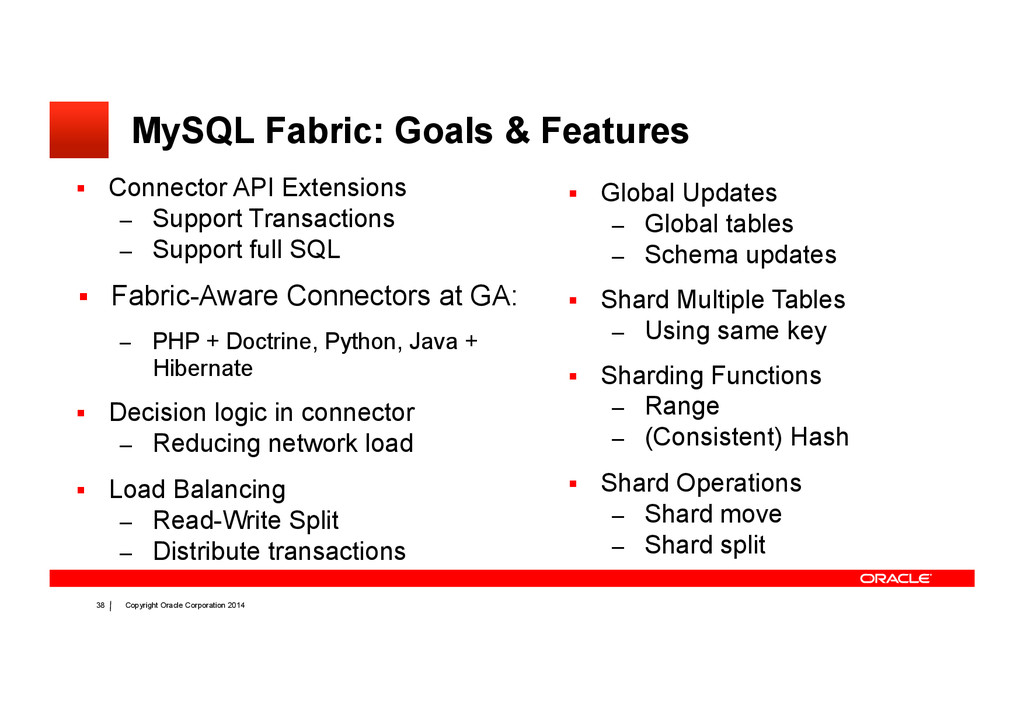
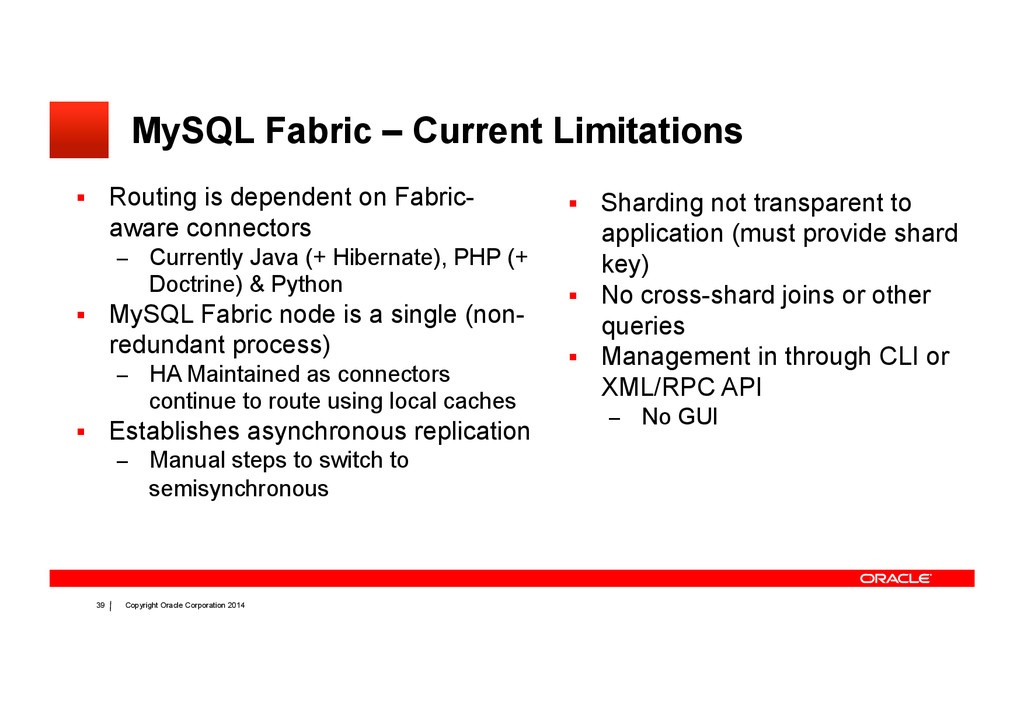
§ Routing is dependent on Fabric- aware connectors – Currently Java (+ Hibernate), PHP (+ Doctrine) & Python § MySQL Fabric node is a single (non- redundant process) – HA Maintained as connectors continue to route using local caches § Establishes asynchronous replication – Manual steps to switch to semisynchronous § Sharding not transparent to application (must provide shard key) § No cross-shard joins or other queries § Management in through CLI or XML/RPC API – No GUI
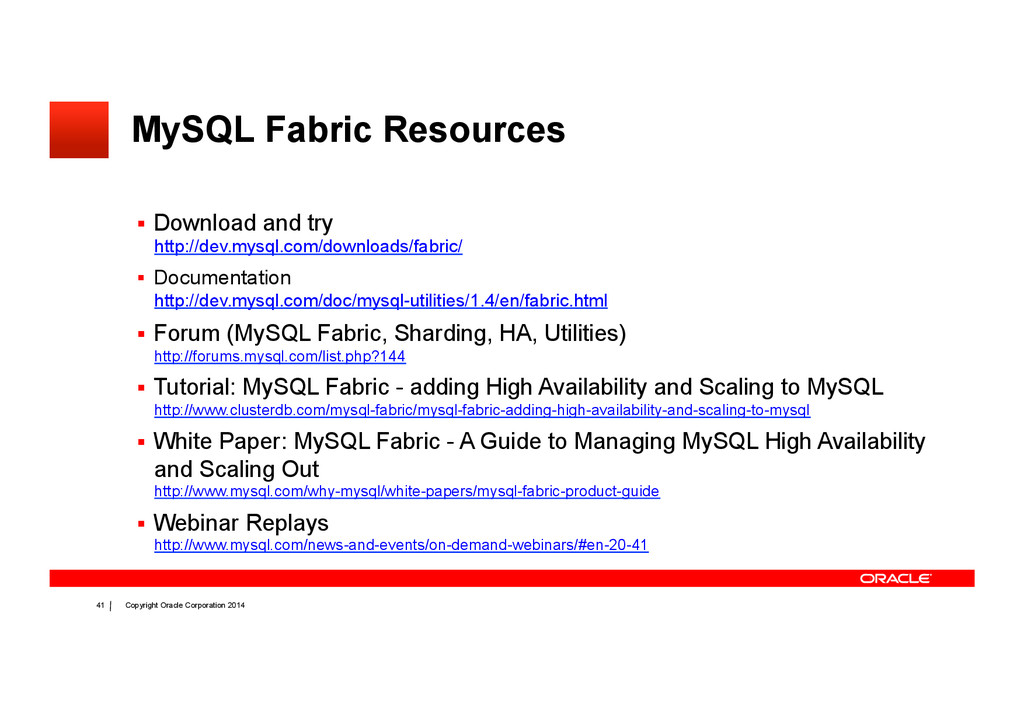
and try http://dev.mysql.com/downloads/fabric/ § Documentation http://dev.mysql.com/doc/mysql-utilities/1.4/en/fabric.html § Forum (MySQL Fabric, Sharding, HA, Utilities) http://forums.mysql.com/list.php?144 § Tutorial: MySQL Fabric - adding High Availability and Scaling to MySQL http://www.clusterdb.com/mysql-fabric/mysql-fabric-adding-high-availability-and-scaling-to-mysql § White Paper: MySQL Fabric - A Guide to Managing MySQL High Availability and Scaling Out http://www.mysql.com/why-mysql/white-papers/mysql-fabric-product-guide § Webinar Replays http://www.mysql.com/news-and-events/on-demand-webinars/#en-20-41


 pyconkr
 lynnswap
 tanahiro2010
 takai
takai
 kmars0605
 mixplace
 gam0022
 oniak3ibm
 falcon8823
 eed3si9n
 yuta_onishi_97
 rshindo
 akihisaikeda
 kevinliebholz
 axbom
axbom
 mlcsv
mlcsv
 malarkey
 destraynor
 codingconduct
 katiecoart
 nwiizo
 rasmusluckow
 maltzj
 lynnandtonic