Upgrade to Pro — share decks privately, control downloads, hide ads and more …

How Most AI Products Break After Launch (And Ho...

How Most AI Products Break After Launch (And How to Build Ones That Don’t)

Most AI products do not fail because of bad models.
They fail because of weak engineering decisions made early.

This short deck breaks down a practical approach to building AI-driven software systems that remain stable after launch. It focuses on architecture, separation of concerns, deployment discipline, and long-term maintainability rather than hype or tools.

Topics covered:

Why accuracy alone does not save AI products

Separating data, model, and application layers

Designing systems that can change without breaking

Simple patterns used in production environments

This deck is based on real-world engineering practices used while building scalable SaaS platforms and automation systems.

Qwegle Technologies
Website: https://www.qwegle.com

Engineering Repository: https://github.com/QwegleTechie/qwegle.github.io

Company Profile: https://www.crunchbase.com/organization/qwegle

Avatar for Qwegle Tech

Qwegle Tech

December 24, 2025

Other Decks in Technology

Transcript

  1. Why AI Products Fail And What Stable Ones Do Differently

    A grounded engineering perspective on building AI-driven products that last, from production experience and real-world deployment challenges.
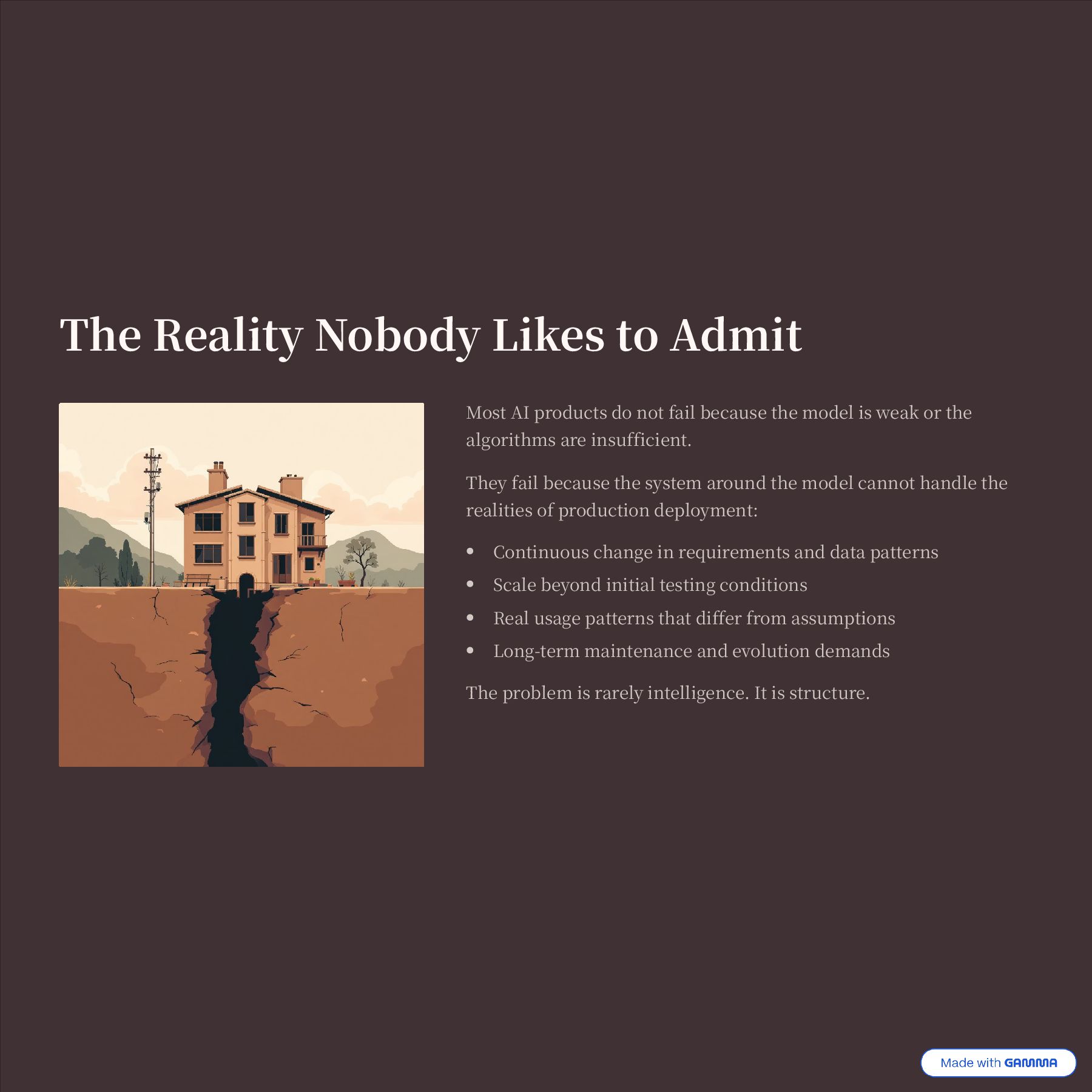
  2. The Reality Nobody Likes to Admit Most AI products do

    not fail because the model is weak or the algorithms are insufficient. They fail because the system around the model cannot handle the realities of production deployment: Continuous change in requirements and data patterns Scale beyond initial testing conditions Real usage patterns that differ from assumptions Long-term maintenance and evolution demands The problem is rarely intelligence. It is structure.
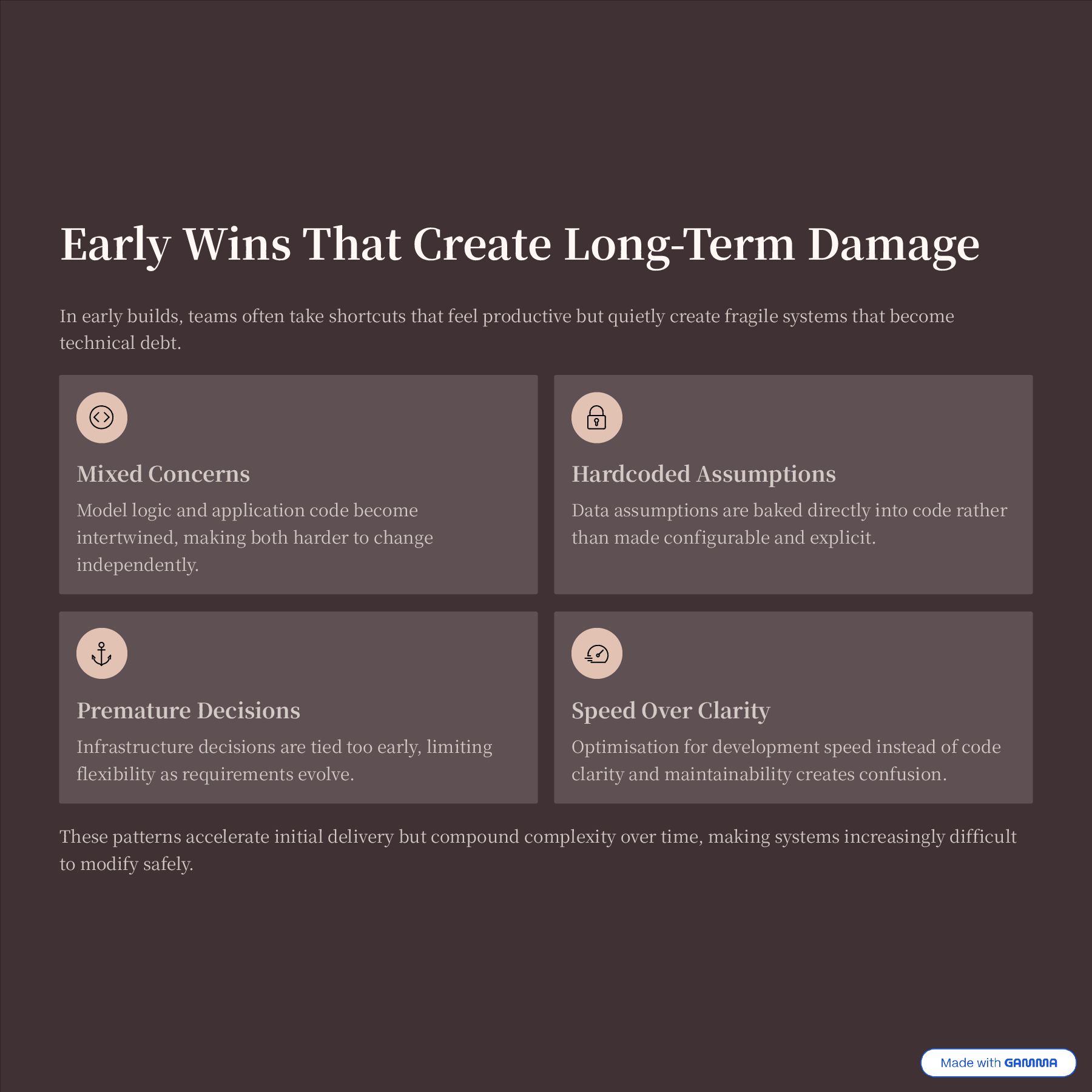
  3. Early Wins That Create Long-Term Damage In early builds, teams

    often take shortcuts that feel productive but quietly create fragile systems that become technical debt. Mixed Concerns Model logic and application code become intertwined, making both harder to change independently. Hardcoded Assumptions Data assumptions are baked directly into code rather than made configurable and explicit. Premature Decisions Infrastructure decisions are tied too early, limiting flexibility as requirements evolve. Speed Over Clarity Optimisation for development speed instead of code clarity and maintainability creates confusion. These patterns accelerate initial delivery but compound complexity over time, making systems increasingly difficult to modify safely.
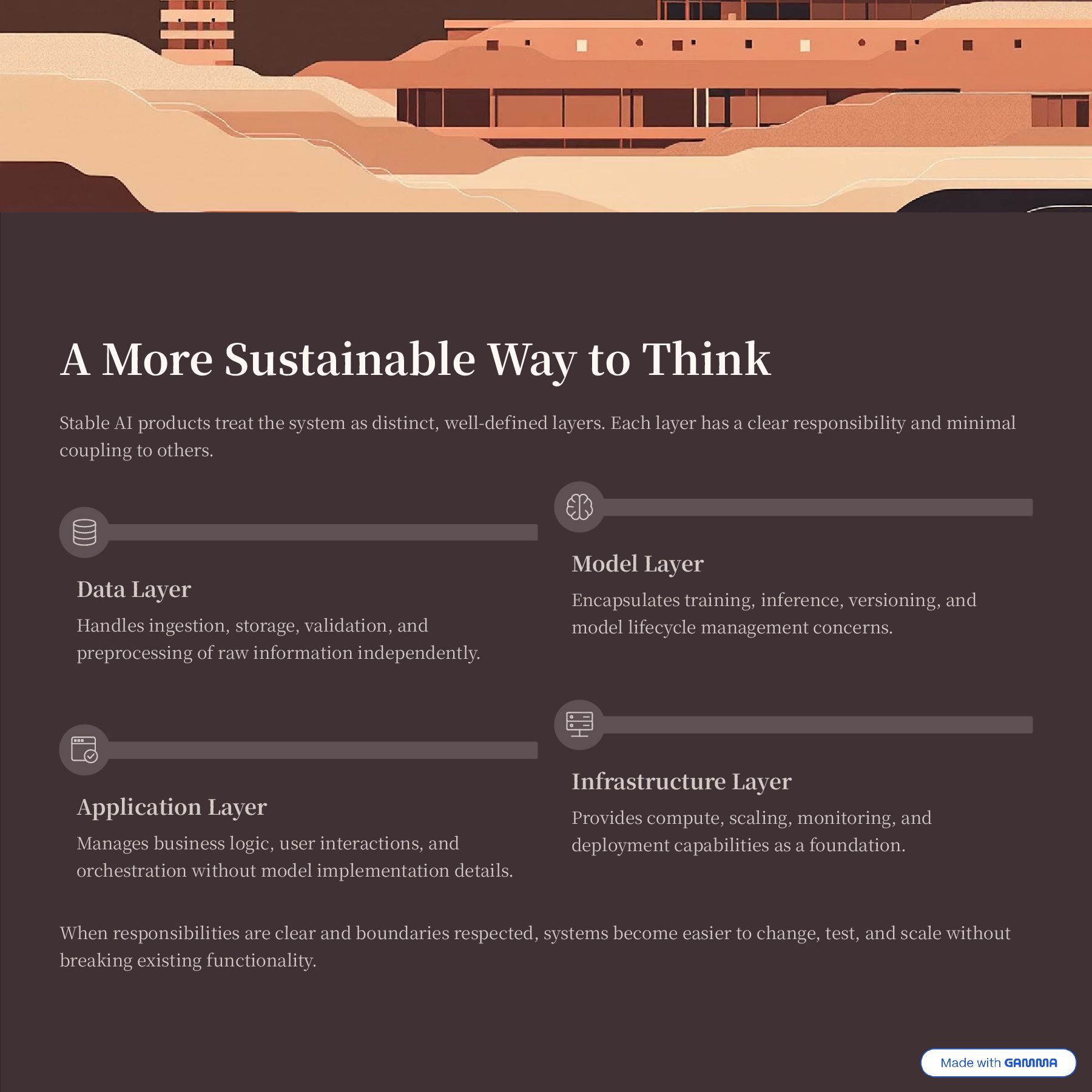
  4. A More Sustainable Way to Think Stable AI products treat

    the system as distinct, well-defined layers. Each layer has a clear responsibility and minimal coupling to others. Data Layer Handles ingestion, storage, validation, and preprocessing of raw information independently. Model Layer Encapsulates training, inference, versioning, and model lifecycle management concerns. Application Layer Manages business logic, user interactions, and orchestration without model implementation details. Infrastructure Layer Provides compute, scaling, monitoring, and deployment capabilities as a foundation. When responsibilities are clear and boundaries respected, systems become easier to change, test, and scale without breaking existing functionality.
  5. Why Separation Actually Works Practical Benefits Clear boundaries between layers

    allow engineering teams to work with confidence and velocity: Replace models without rewriting application code or changing user-facing behaviour Change data pipelines safely without affecting downstream model consumers Scale infrastructure independently based on actual bottlenecks rather than assumptions Debug problems faster by isolating failures to specific layers with clear interfaces Separation is not complexity. It is restraint. The discipline to resist coupling creates systems that adapt to change rather than resist it.
  6. Designing for Change Is Not Optional In production environments, change

    is the only constant. Systems that assume stability fail first when reality diverges from assumptions. Data Drifts Input distributions shift over time as user behaviour, market conditions, and external factors evolve continuously. Models Age Performance degrades as patterns change, requiring regular retraining, evaluation, and replacement cycles. Traffic Spikes Unpredictable load patterns emerge from business success, seasonal effects, or external events beyond control. Requirements Shift Business needs, regulatory demands, and competitive pressures drive continuous feature evolution and pivots. Systems designed for movement survive longer. Flexibility must be architected in from the beginning, not retrofitted later when change becomes painful.
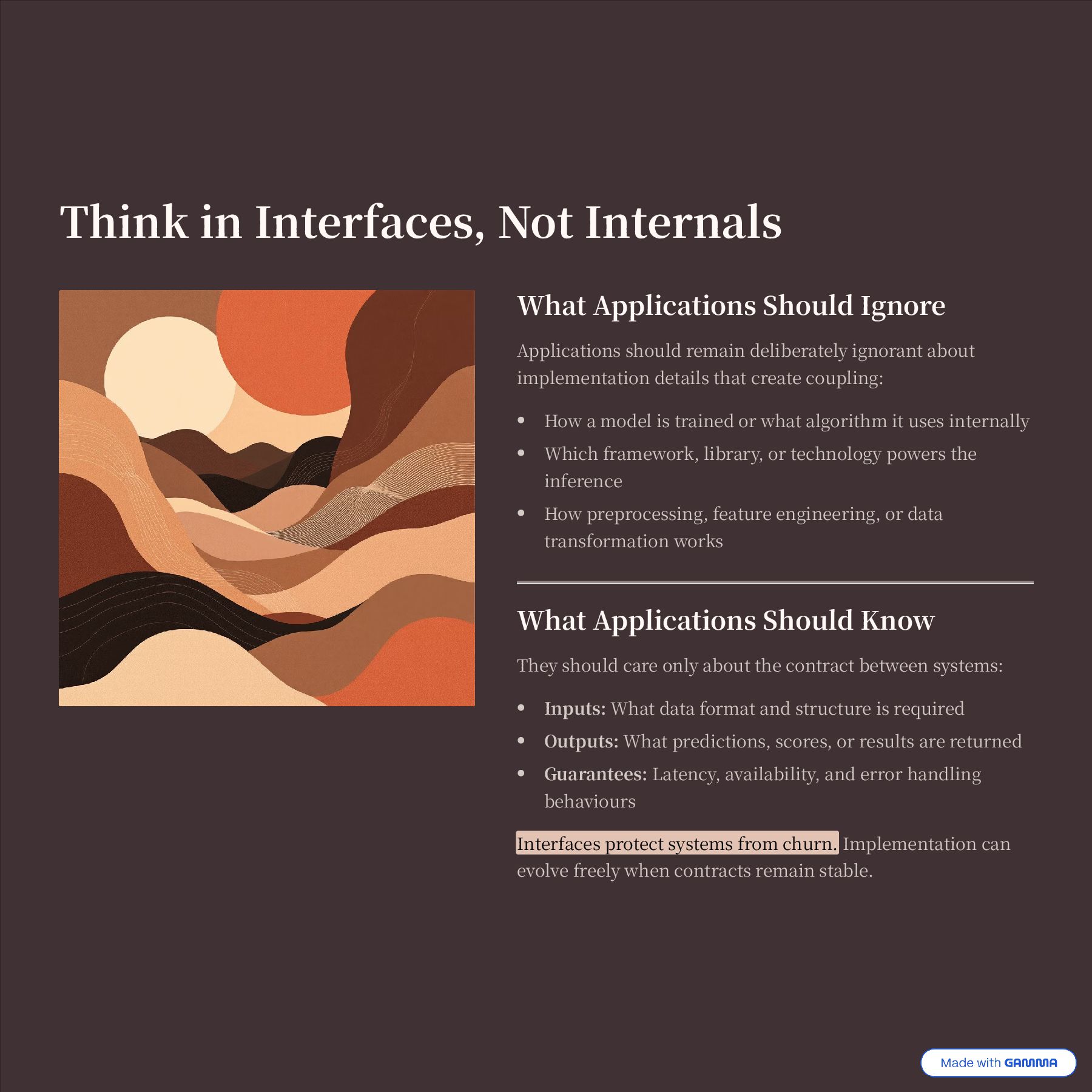
  7. Think in Interfaces, Not Internals What Applications Should Ignore Applications

    should remain deliberately ignorant about implementation details that create coupling: How a model is trained or what algorithm it uses internally Which framework, library, or technology powers the inference How preprocessing, feature engineering, or data transformation works What Applications Should Know They should care only about the contract between systems: Inputs: What data format and structure is required Outputs: What predictions, scores, or results are returned Guarantees: Latency, availability, and error handling behaviours Interfaces protect systems from churn. Implementation can evolve freely when contracts remain stable.
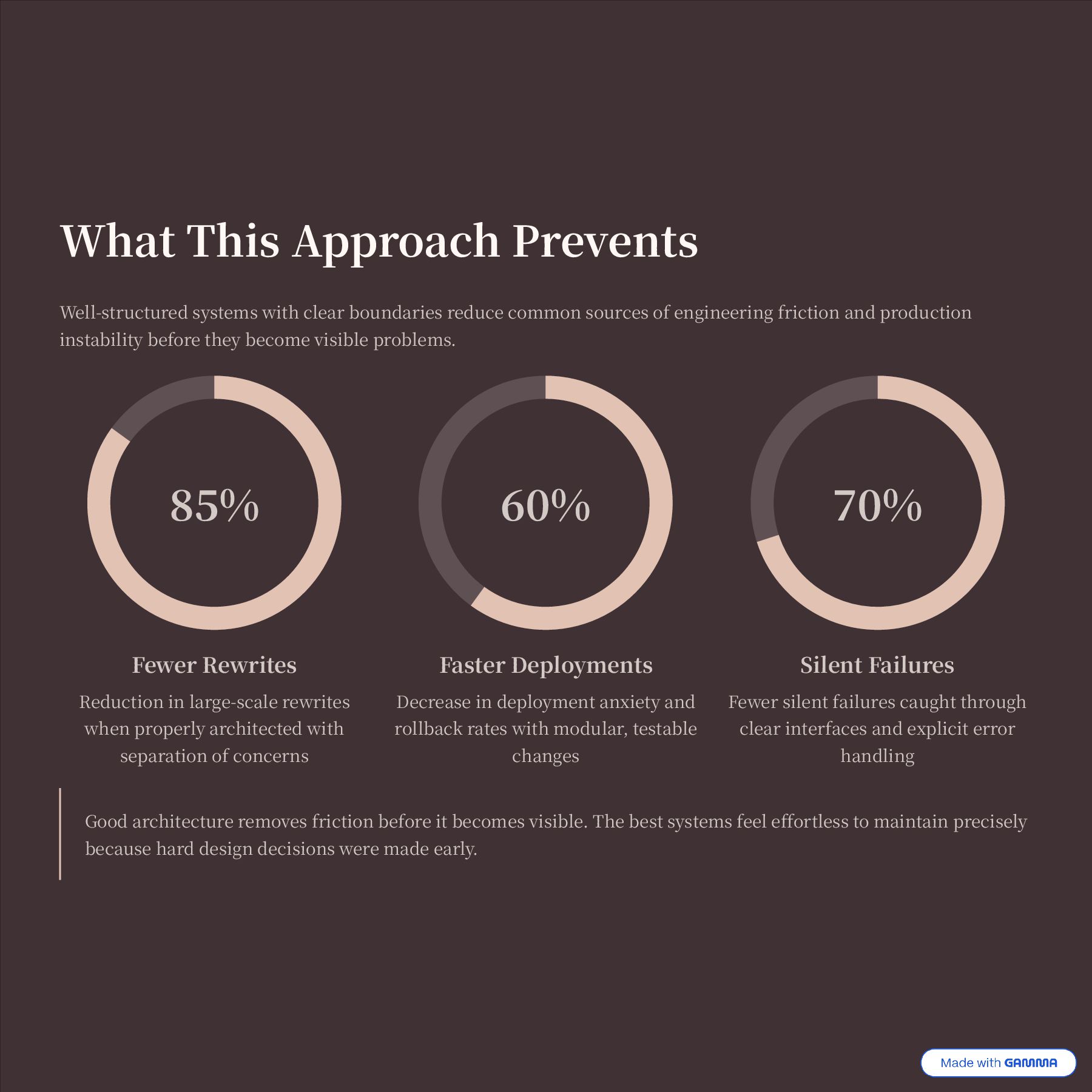
  8. What This Approach Prevents Well-structured systems with clear boundaries reduce

    common sources of engineering friction and production instability before they become visible problems. % Fewer Rewrites Reduction in large-scale rewrites when properly architected with separation of concerns % Faster Deployments Decrease in deployment anxiety and rollback rates with modular, testable changes % Silent Failures Fewer silent failures caught through clear interfaces and explicit error handling Good architecture removes friction before it becomes visible. The best systems feel effortless to maintain precisely because hard design decisions were made early.
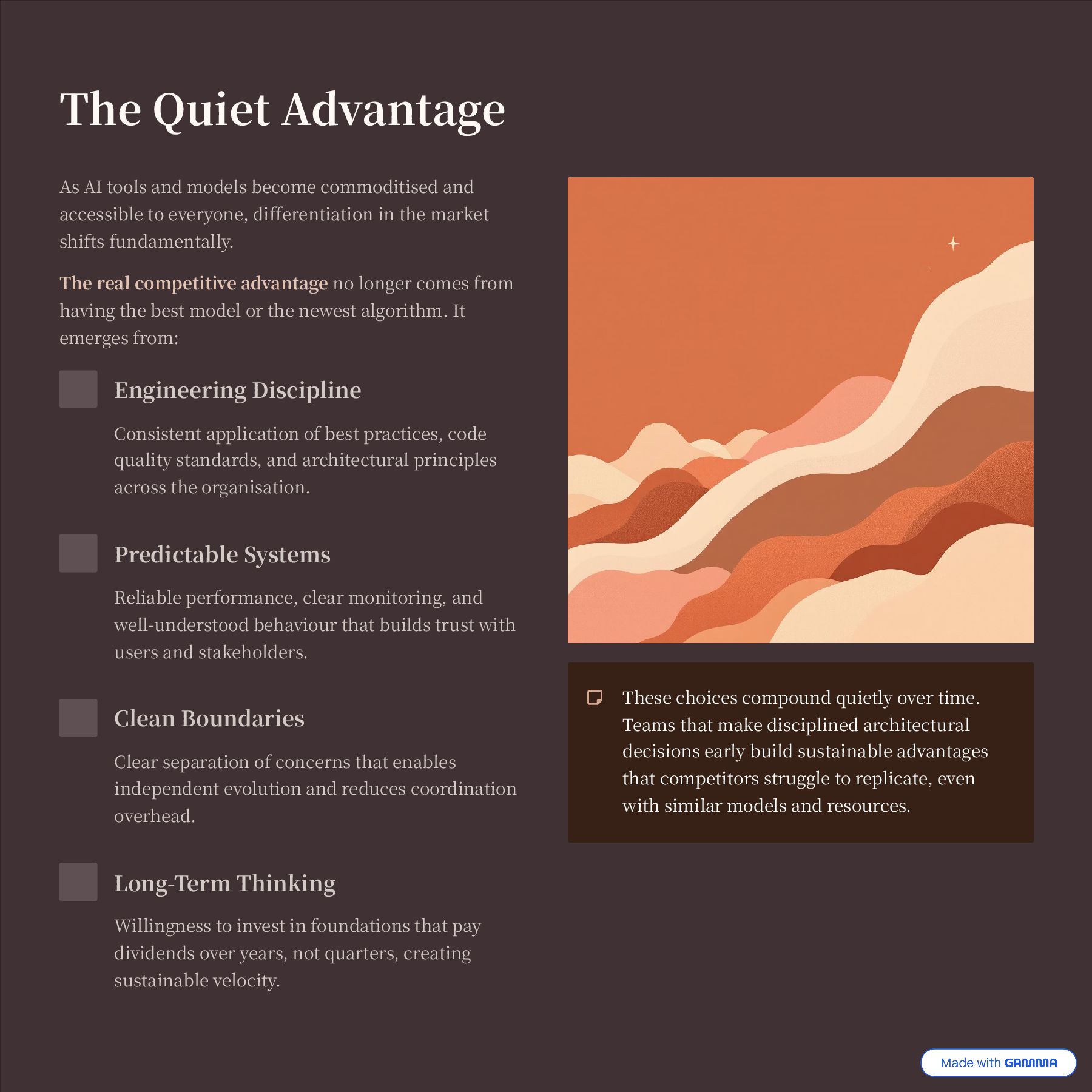
  9. The Quiet Advantage As AI tools and models become commoditised

    and accessible to everyone, differentiation in the market shifts fundamentally. The real competitive advantage no longer comes from having the best model or the newest algorithm. It emerges from: Engineering Discipline Consistent application of best practices, code quality standards, and architectural principles across the organisation. Predictable Systems Reliable performance, clear monitoring, and well-understood behaviour that builds trust with users and stakeholders. Clean Boundaries Clear separation of concerns that enables independent evolution and reduces coordination overhead. Long-Term Thinking Willingness to invest in foundations that pay dividends over years, not quarters, creating sustainable velocity. These choices compound quietly over time. Teams that make disciplined architectural decisions early build sustainable advantages that competitors struggle to replicate, even with similar models and resources.
  10. Building AI Products That Last AI products last when engineering

    decisions respect time, change, and reality. Strong foundations rarely look exciting in demos or pitch decks. They simply keep working when others break down. Qwegle Technologies Building scalable AI-driven software systems. We specialise in production-grade AI architectures that handle real-world complexity with engineering discipline and long-term thinking. Visit Website View on GitHub Crunchbase Profile