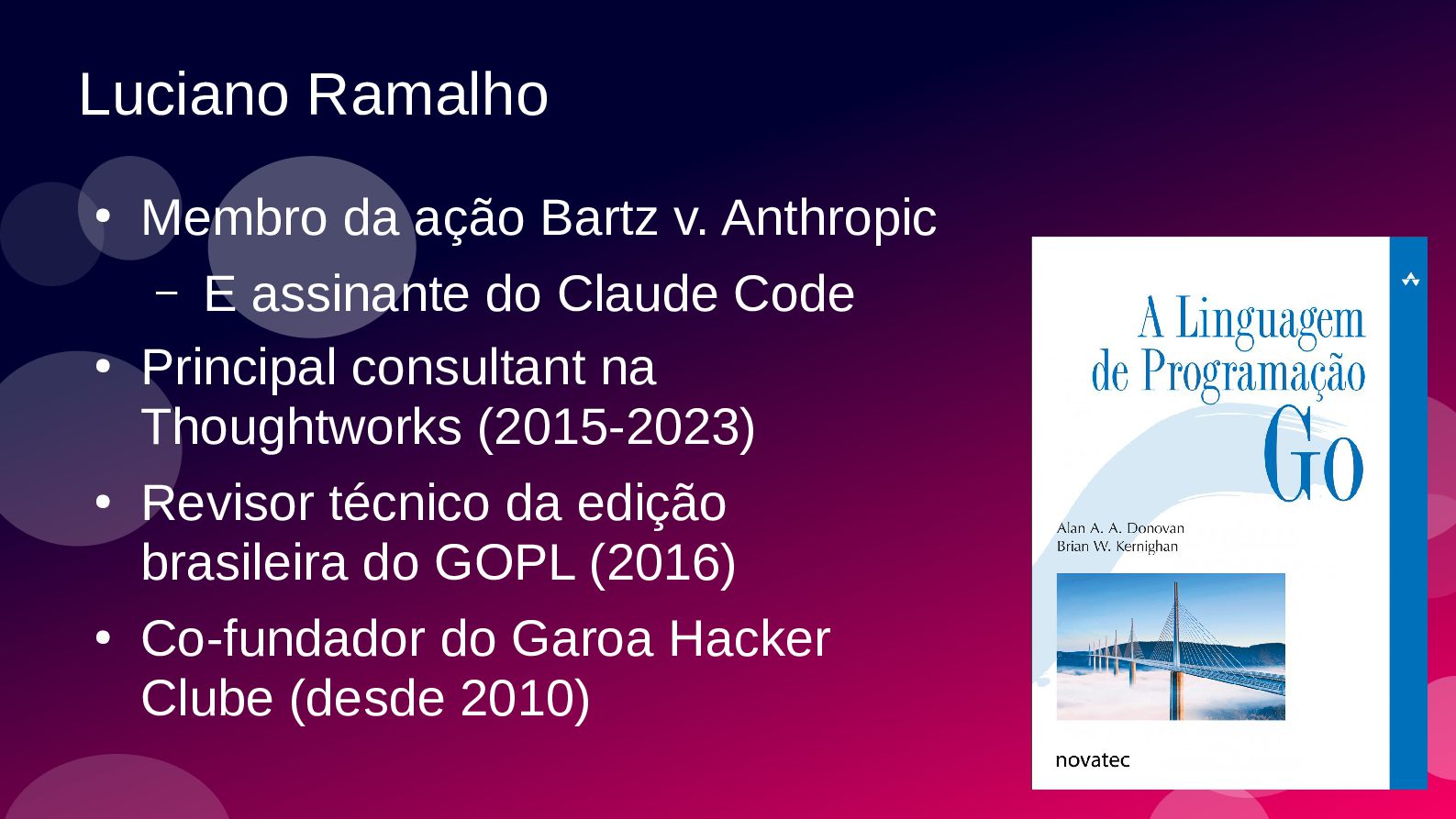
• • • E assinante do Claude Code Principal consultant na Thoughtworks (2015-2023) Revisor técnico da edição brasileira do GOPL (2016) Co-fundador do Garoa Hacker Clube (desde 2010)
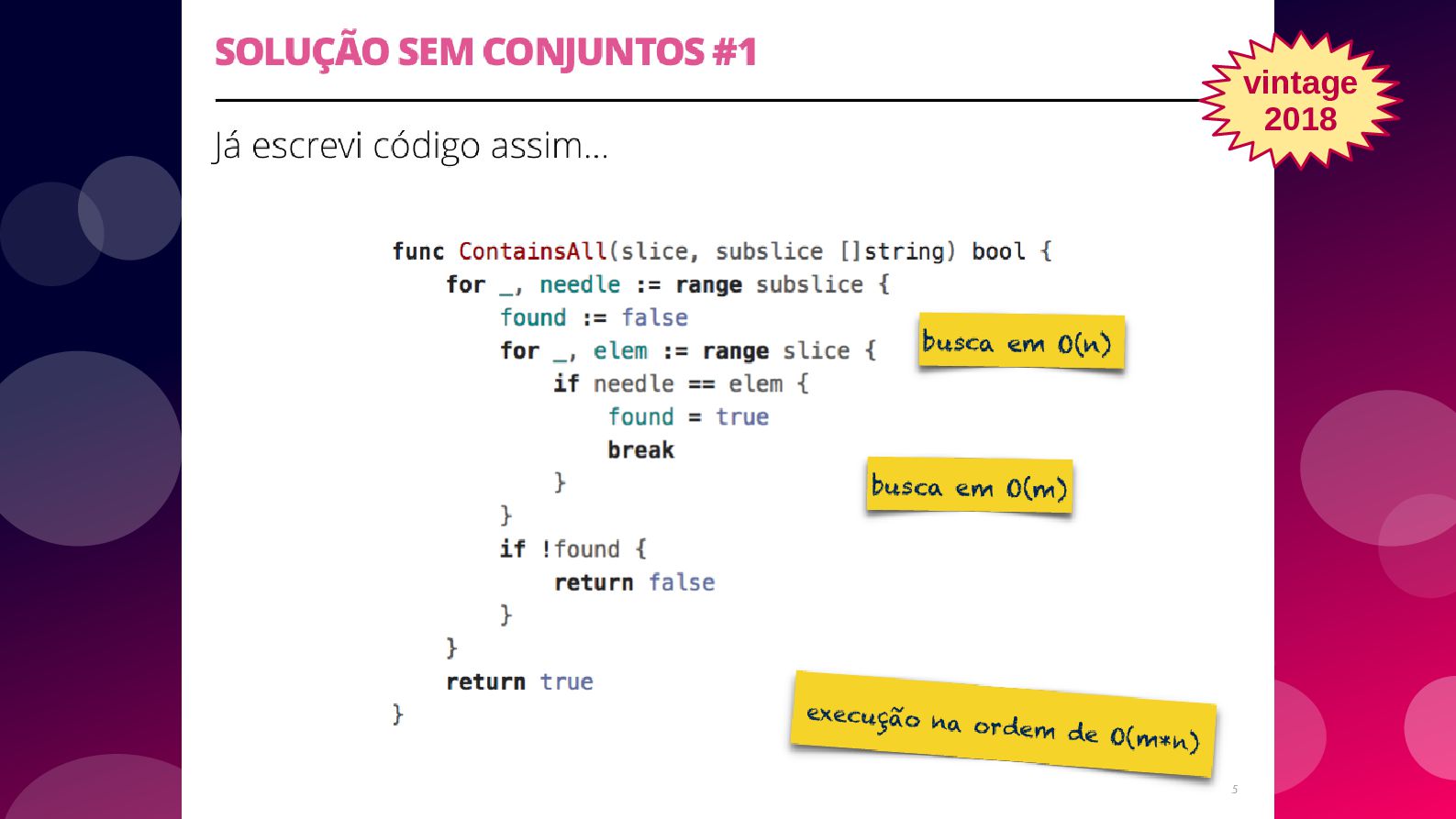
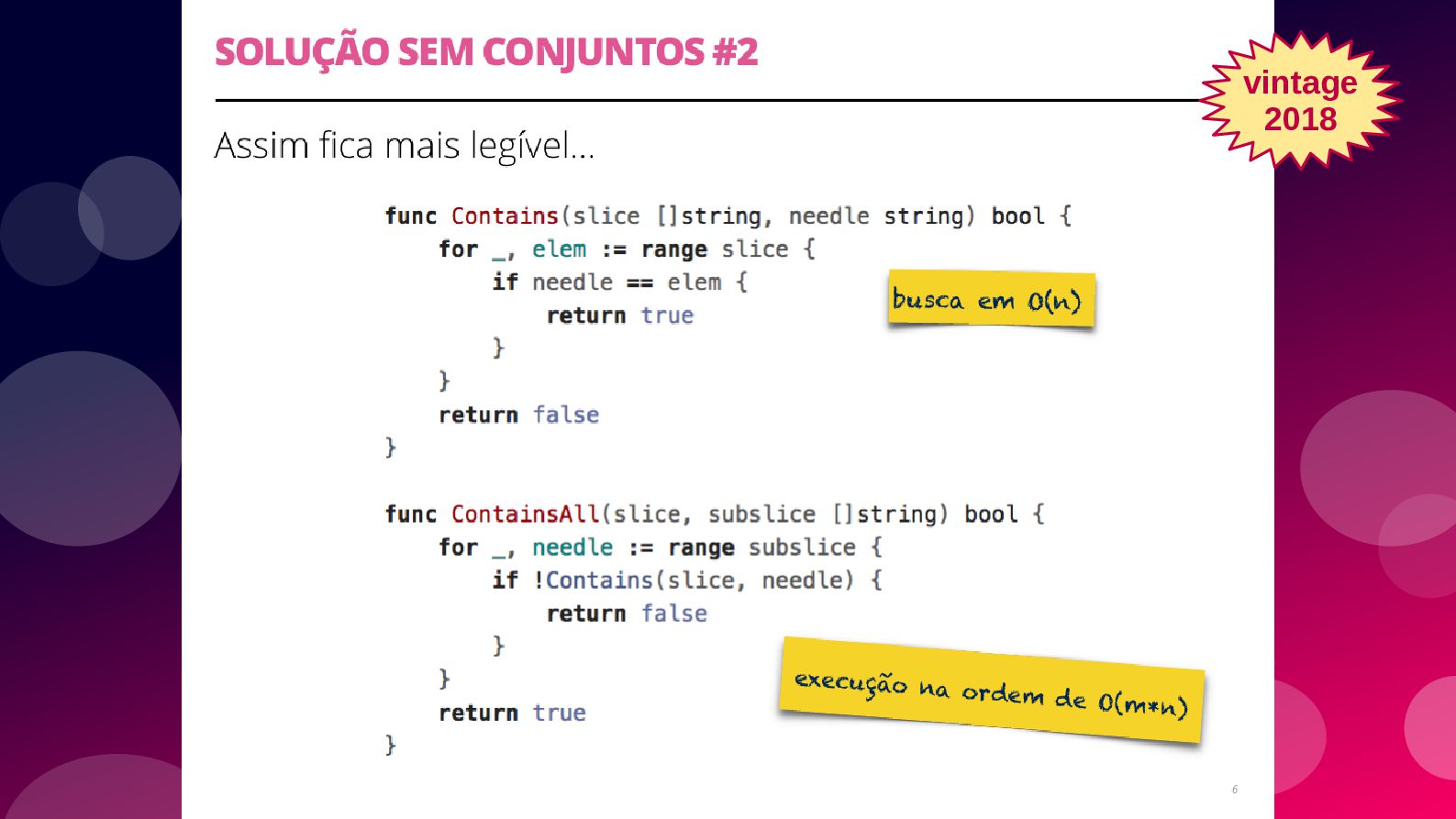
uniq, que elimina linhas duplicadas • Diferença importante: • – uniq só elimina duplicatas que ocorrem em linhas sucessivas (necessário fazer sort antes) – unigo elimina todas as linhas duplicadas e preserva a ordem relativa Usando uma busca linear, unigo é inviável: custo O(n²)
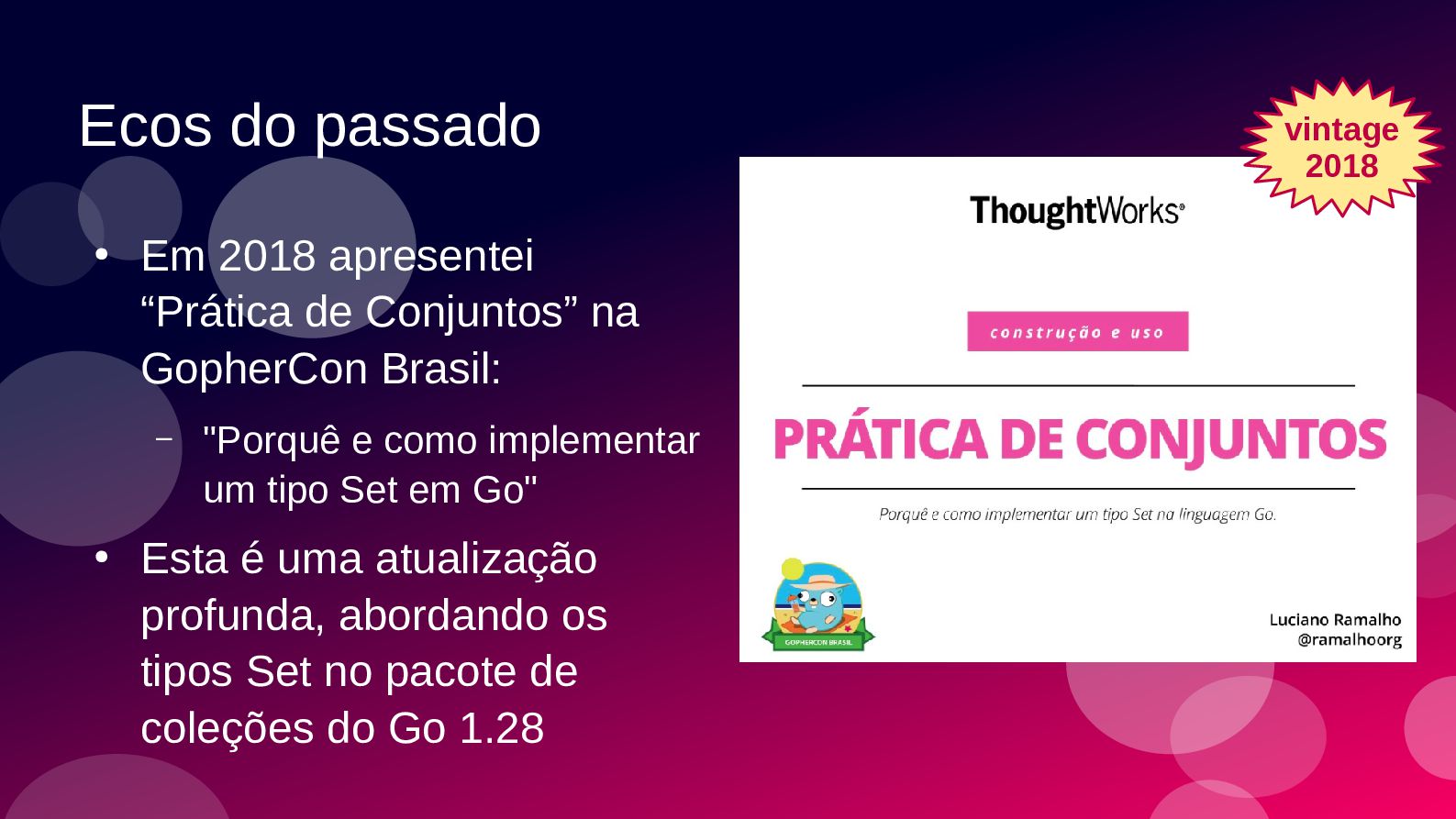
na GopherCon Brasil: – • "Porquê e como implementar um tipo Set em Go" Esta é uma atualização profunda, abordando os tipos Set no pacote de coleções do Go 1.28 vintage 2018
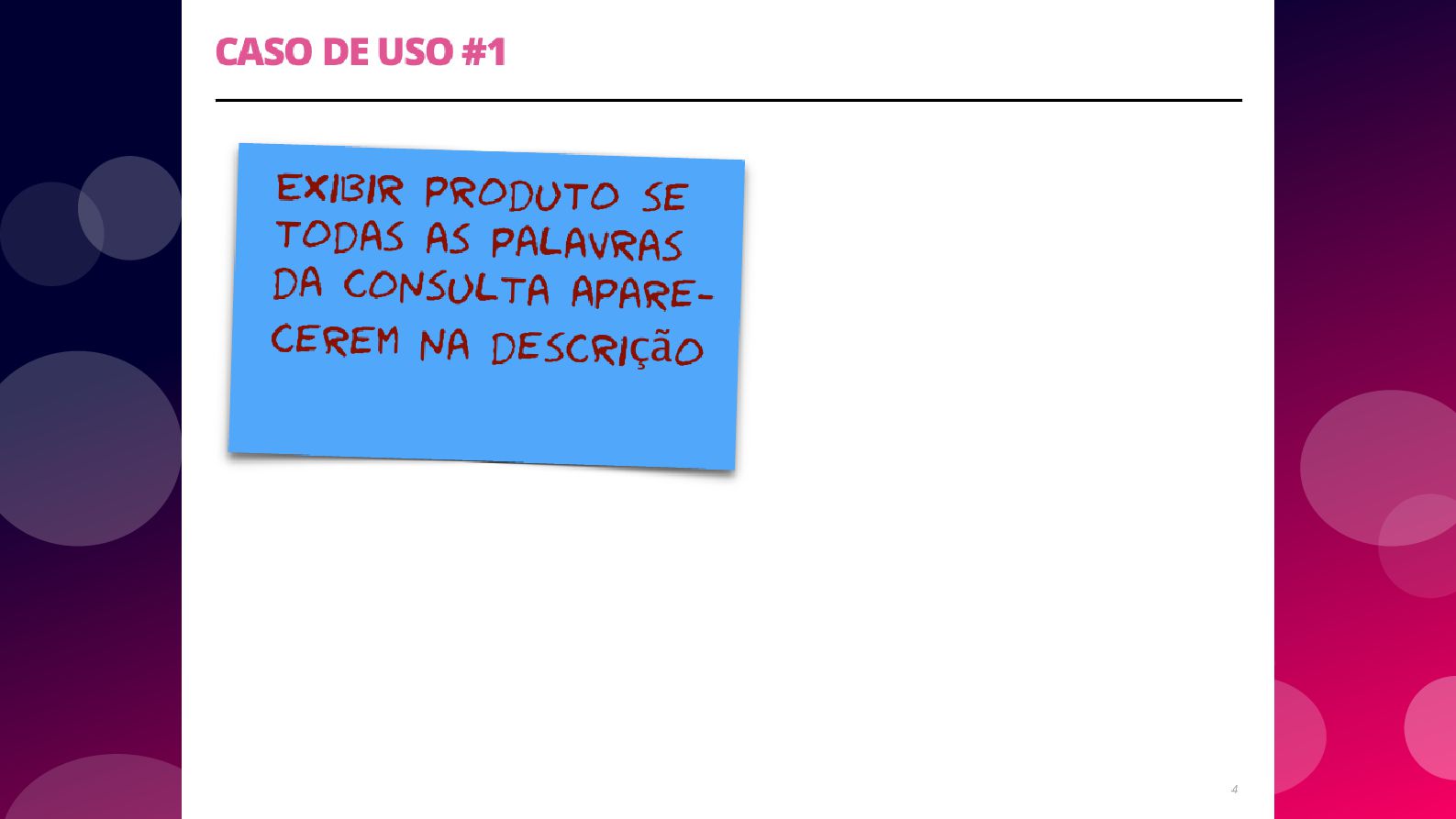
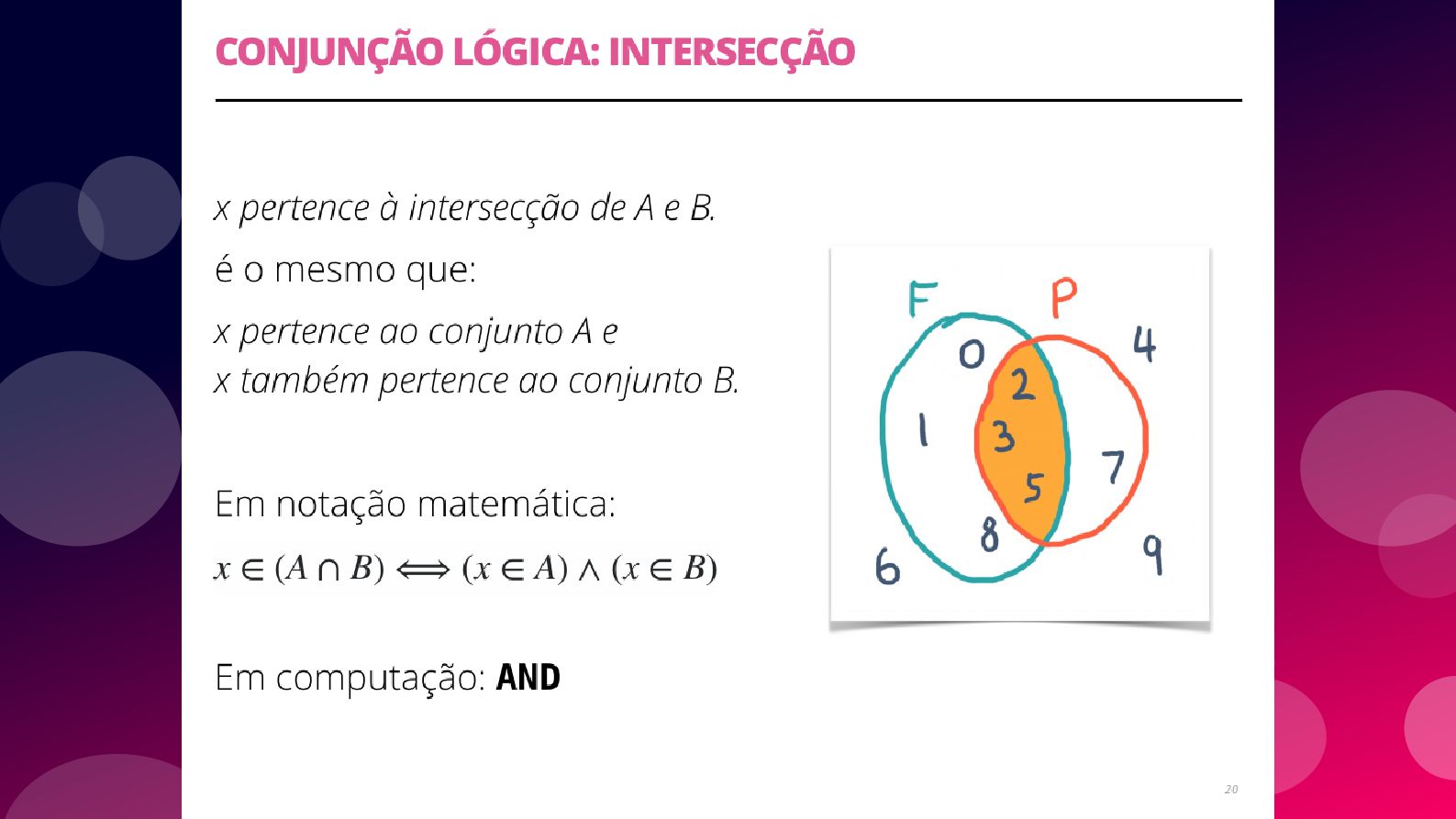
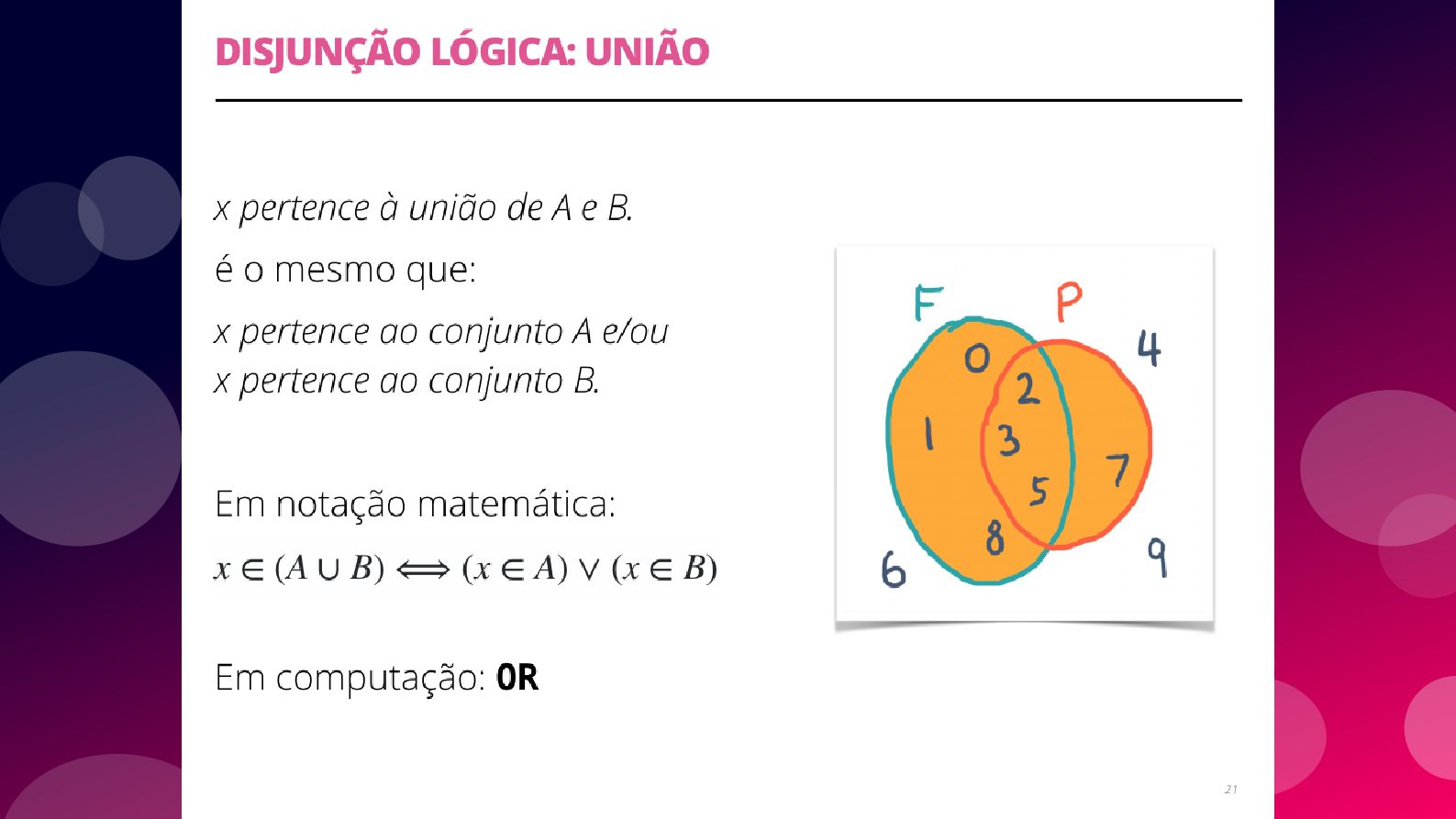
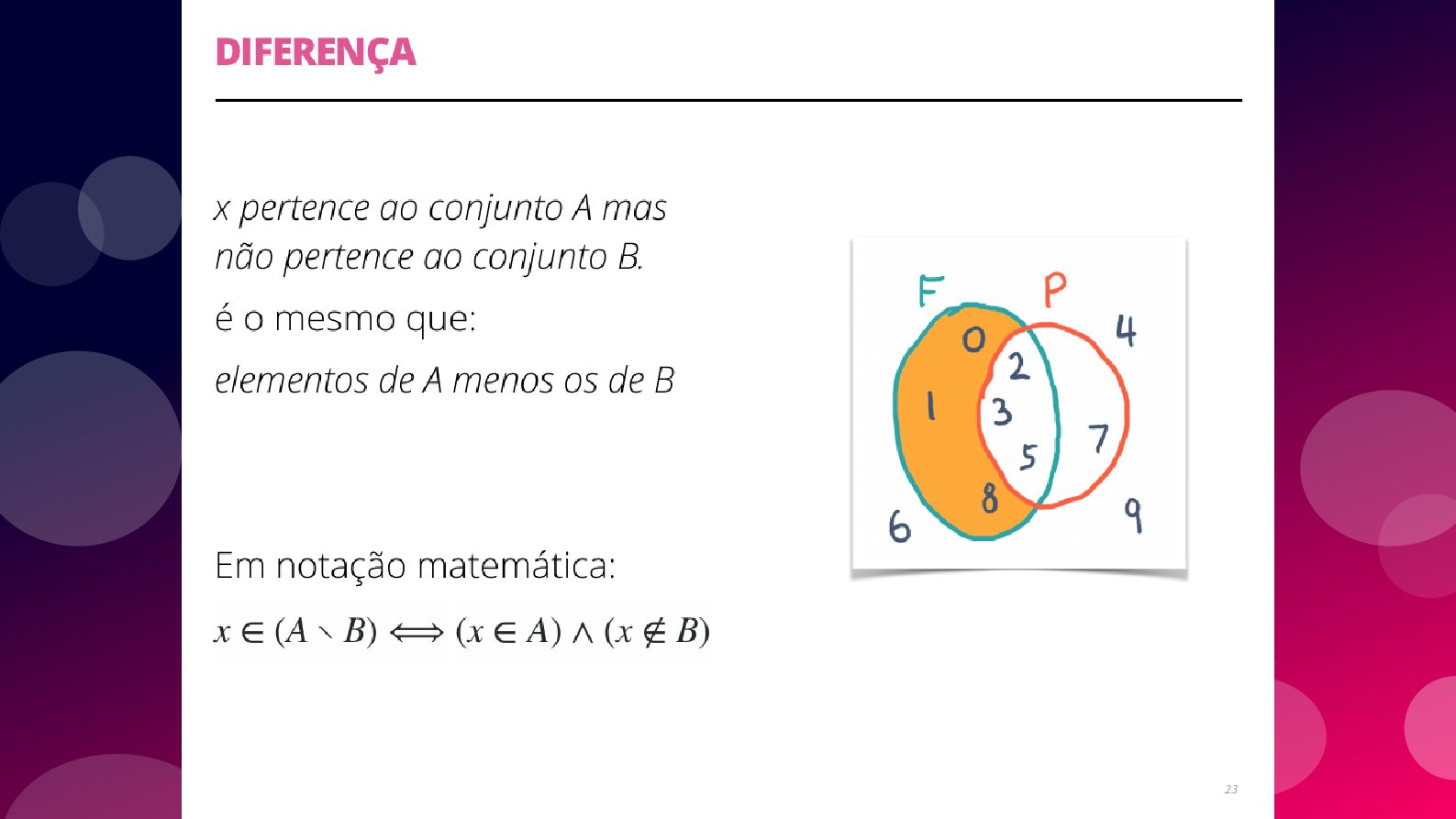
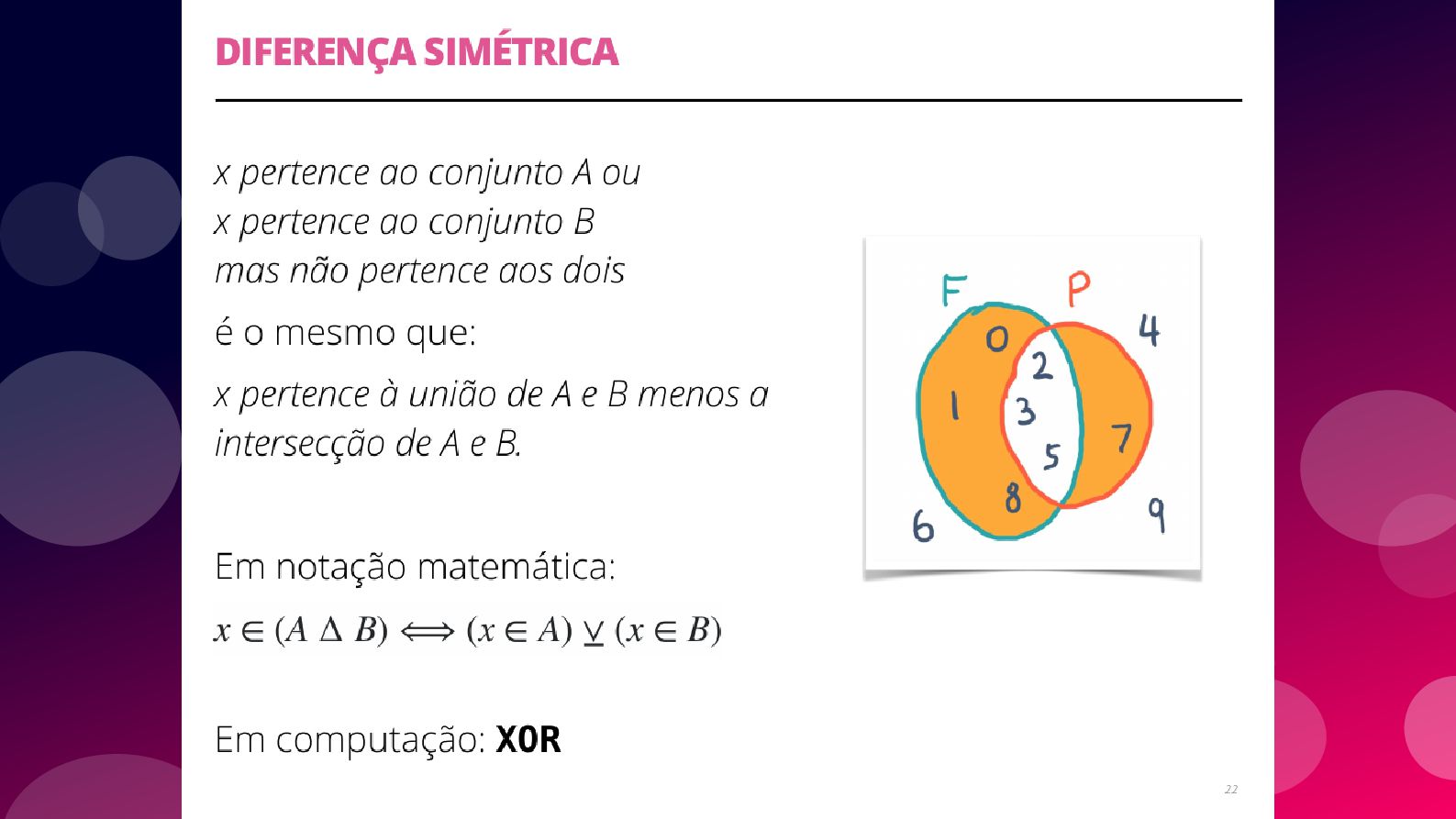
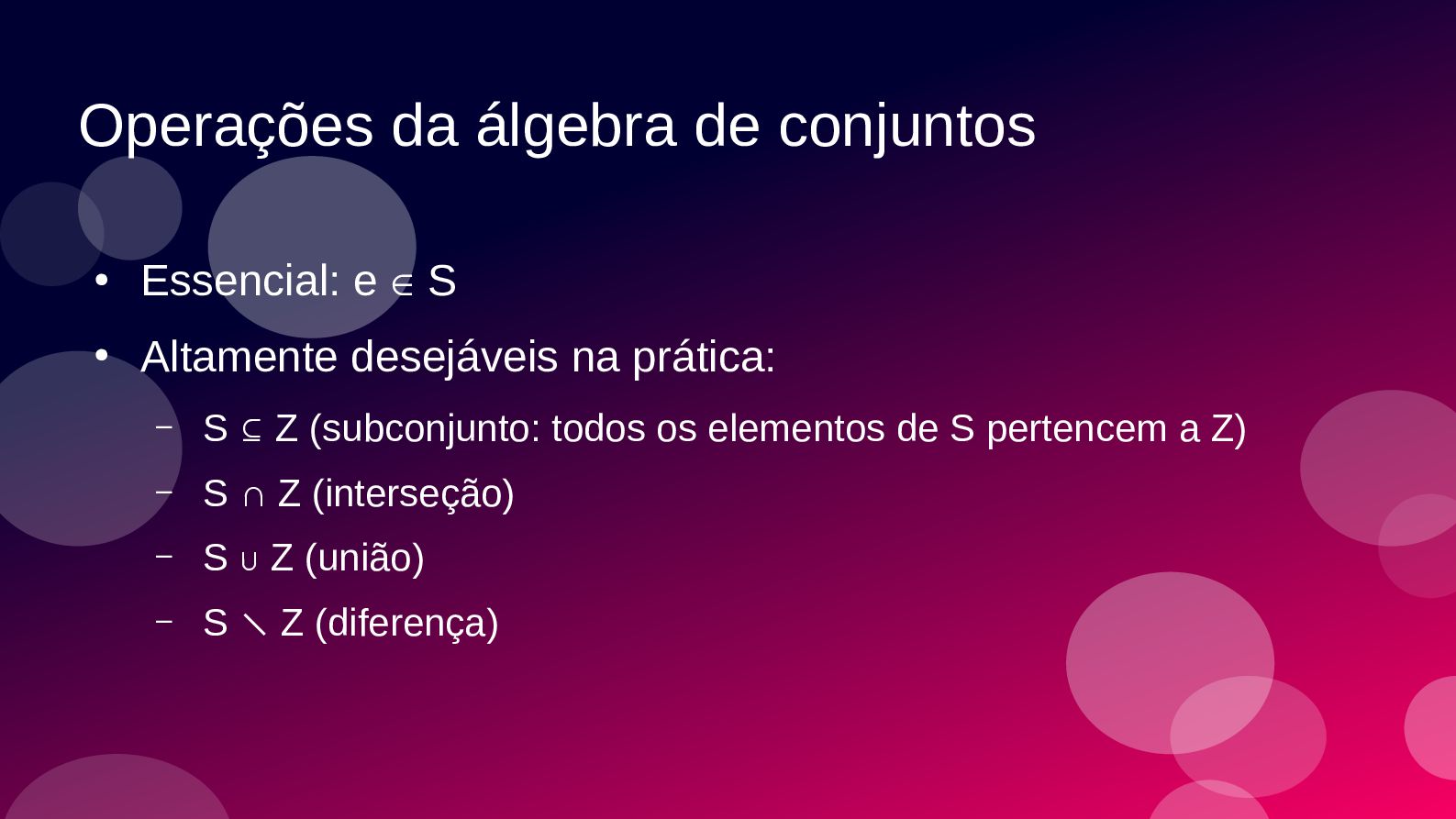
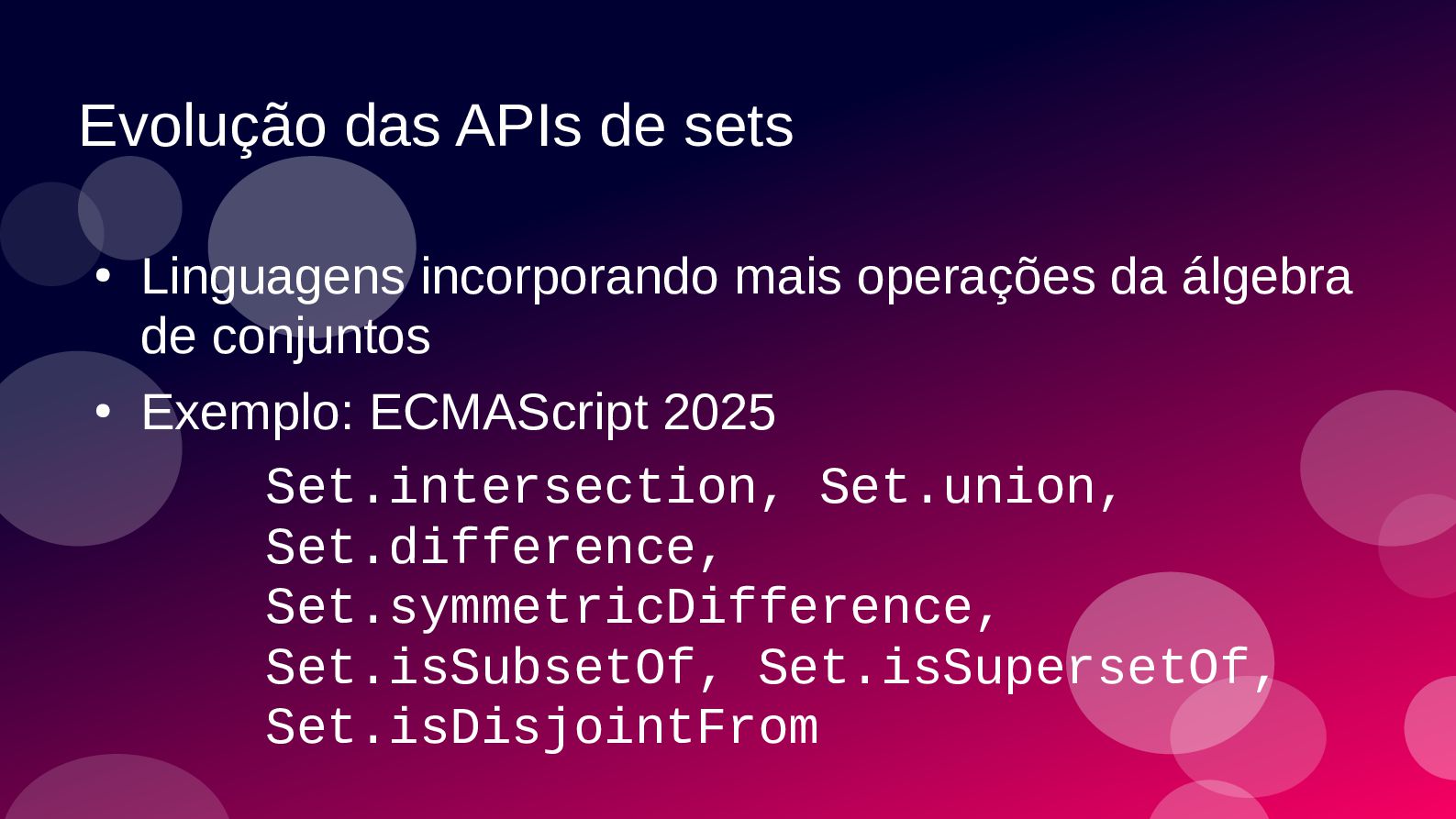
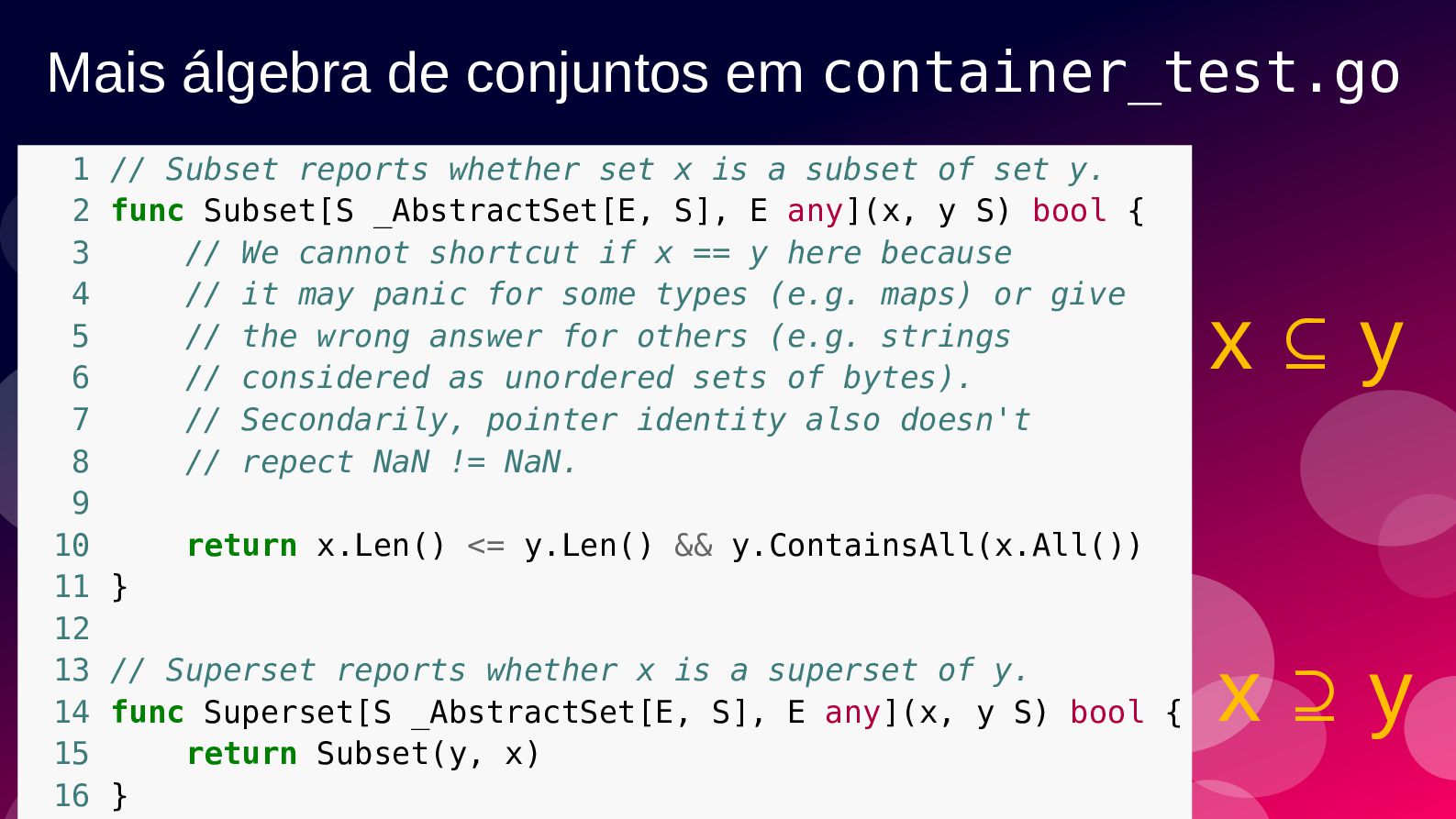
• Muito úteis na prática: – S ∩ Z (interseção) – S ∪ Z (união) – S ∖ Z (diferença) – S ⊆ Z (subconjunto) • Popular: ContainsAll (todos os elementos de S pertencem a Z)
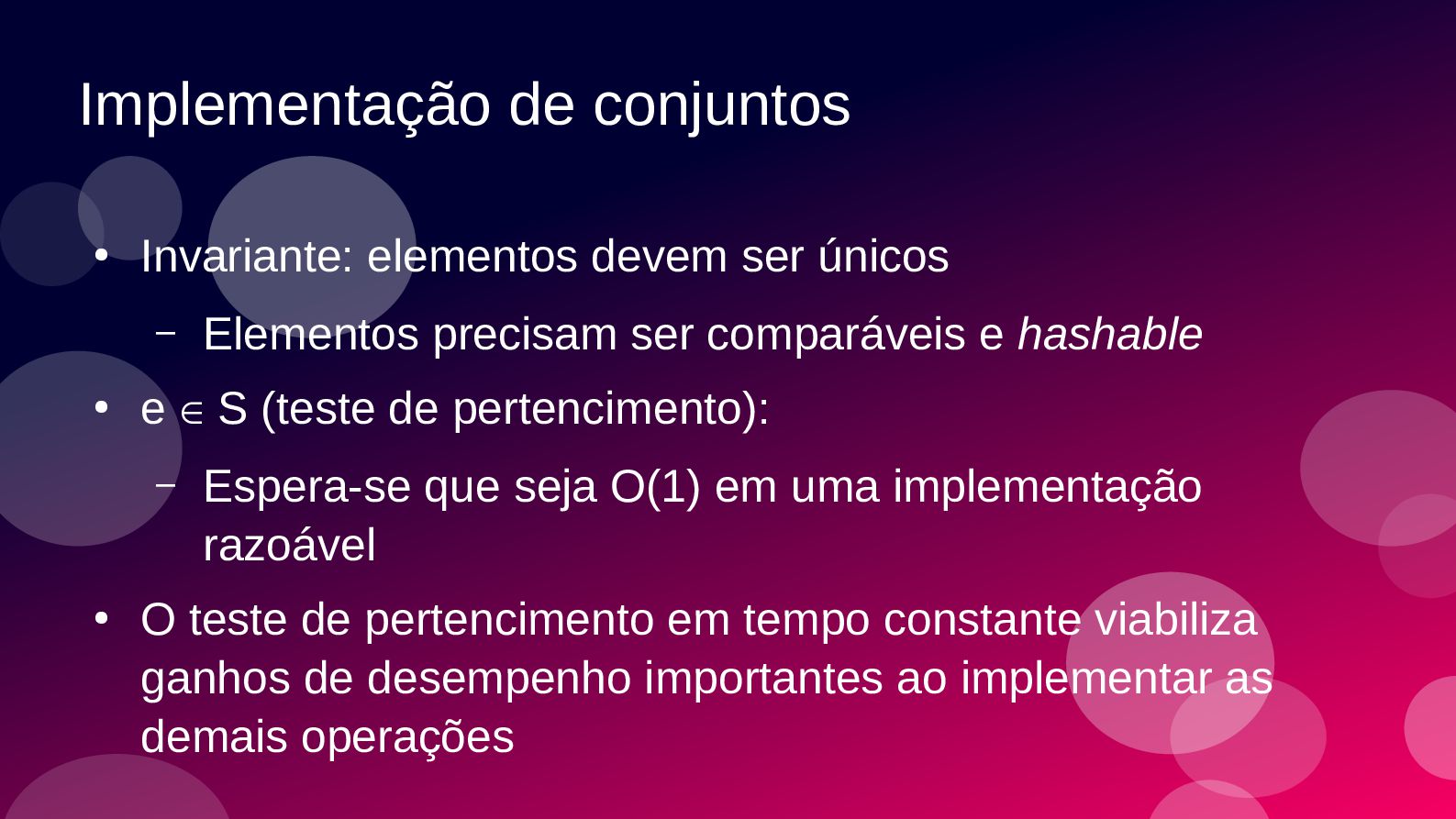
• e ∈ S (teste de pertencimento): – • Elementos precisam ser comparáveis e hashable Espera-se que seja O(1) em uma implementação razoável O teste de pertencimento em tempo constante viabiliza ganhos de desempenho importantes ao implementar as demais operações
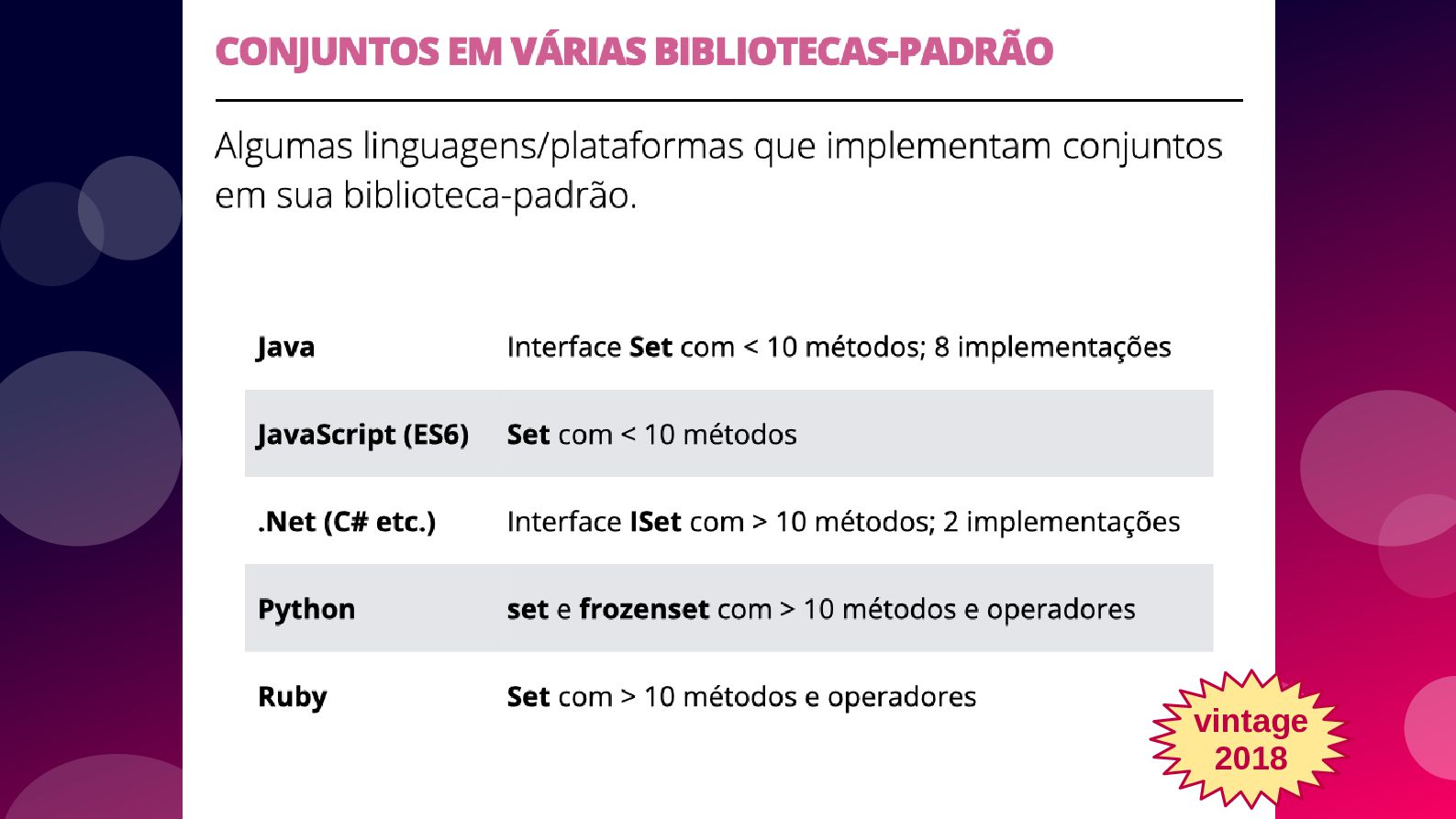
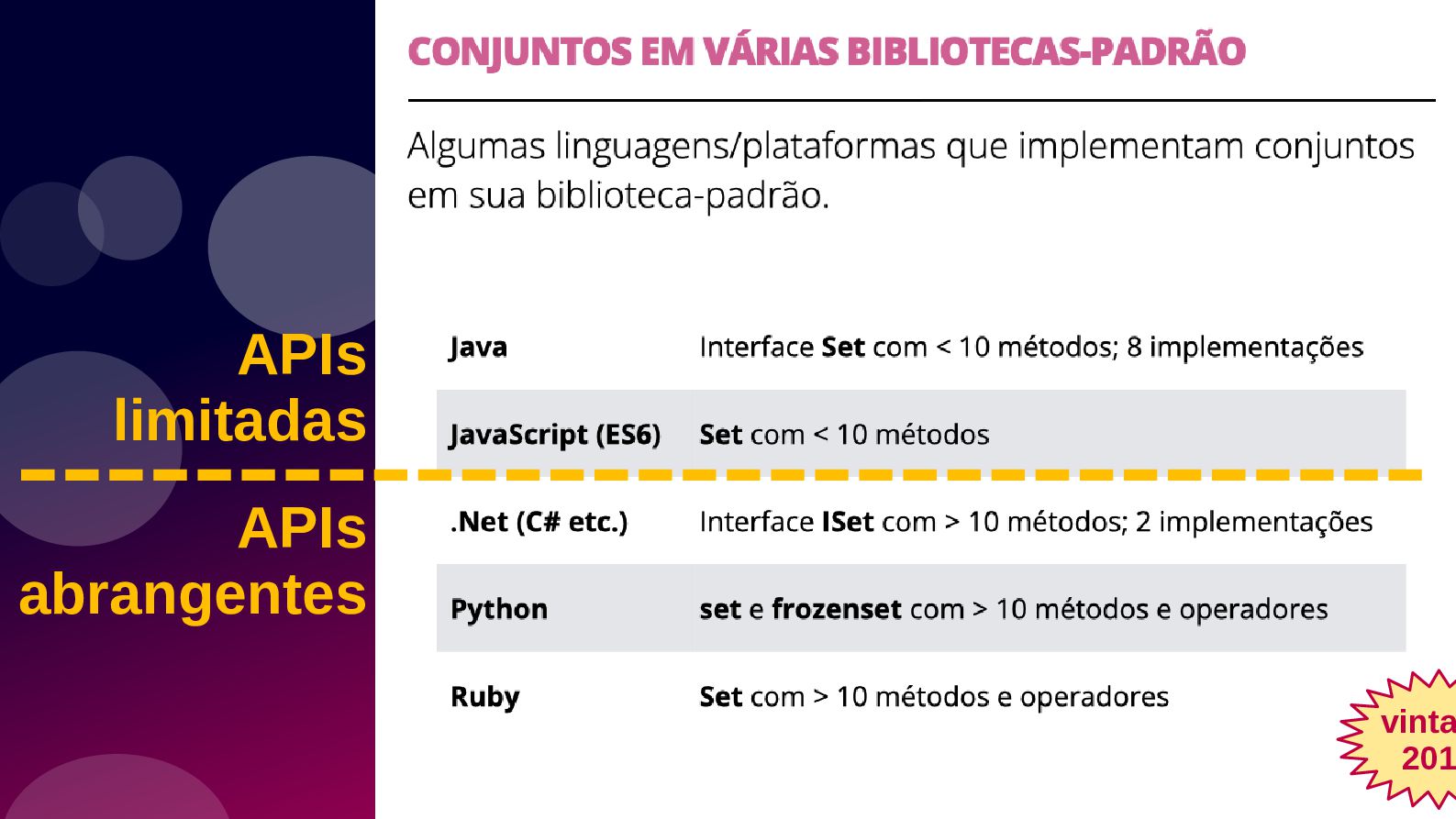
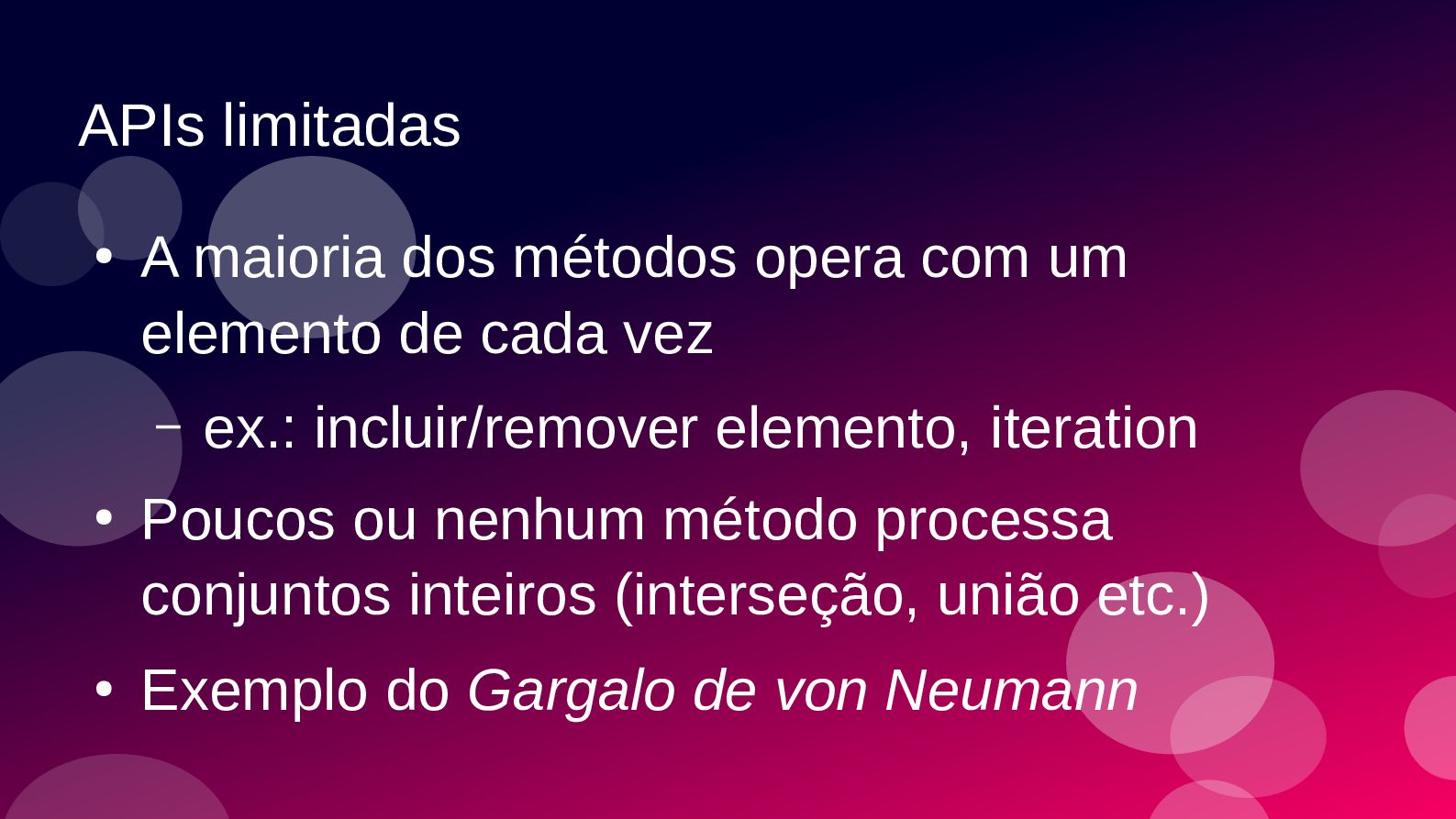
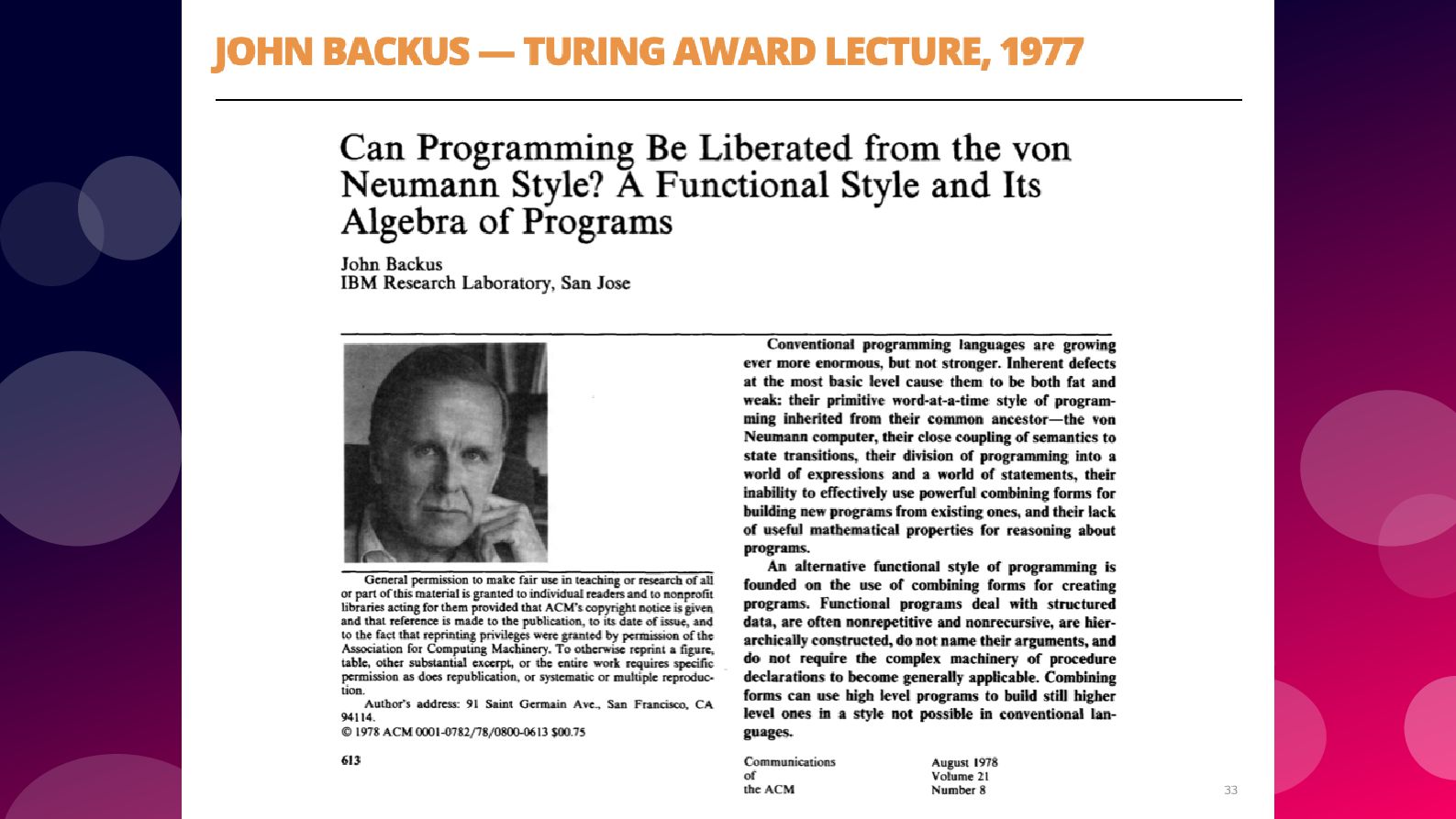
elemento de cada vez – ex.: incluir/remover elemento, iteração • • Poucos ou nenhum método processa conjuntos inteiros (interseção, união etc.) Exemplo do Gargalo de von Neumann
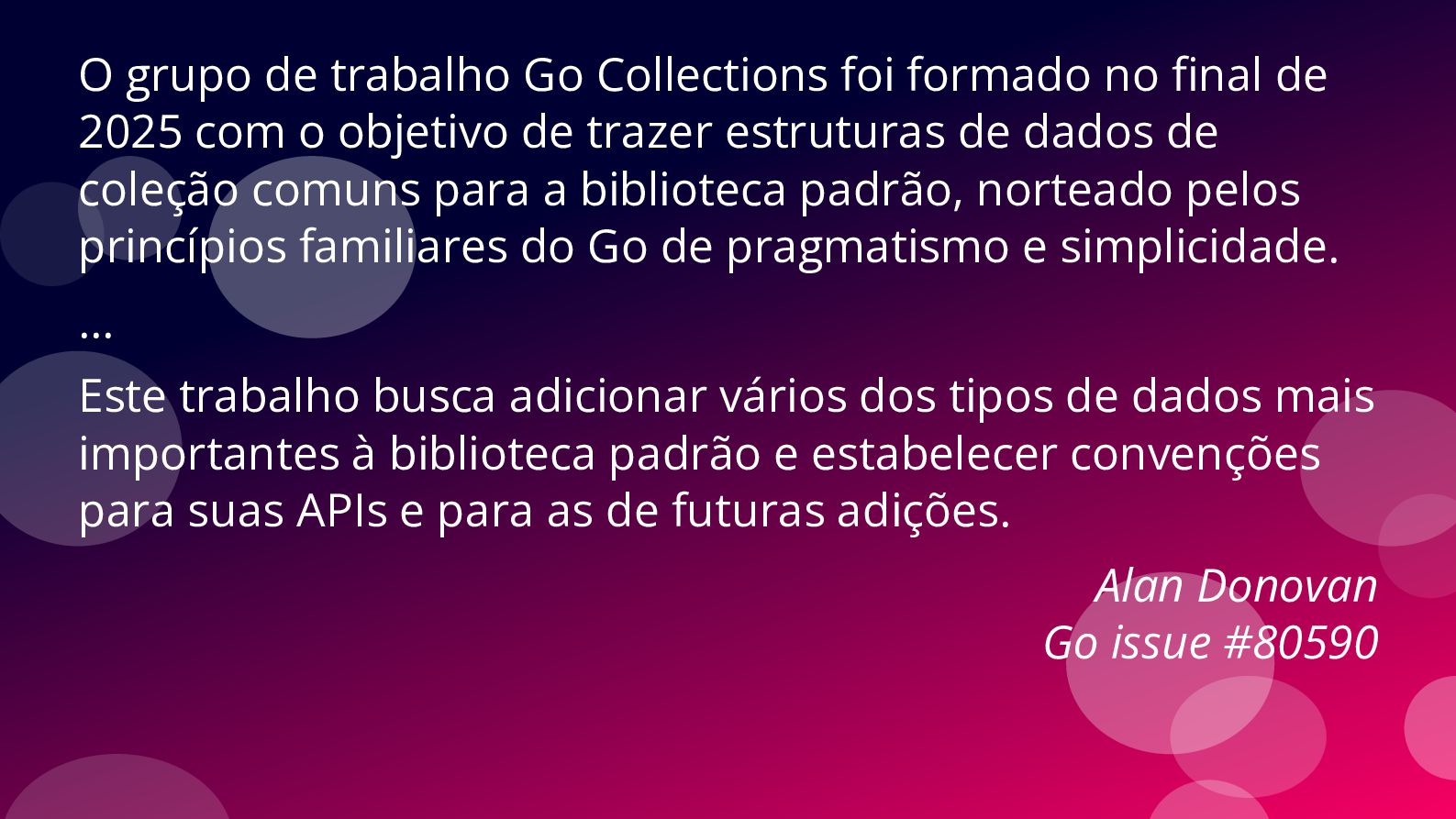
de 2025 com o objetivo de trazer estruturas de dados de coleção comuns para a biblioteca padrão, norteado pelos princípios familiares de pragmatismo e simplicidade do Go. … Este trabalho busca adicionar vários dos tipos de dados mais importantes à biblioteca padrão e estabelecer convenções para suas APIs e para as APIs de futuras adições. Alan Donovan Go issue #80590
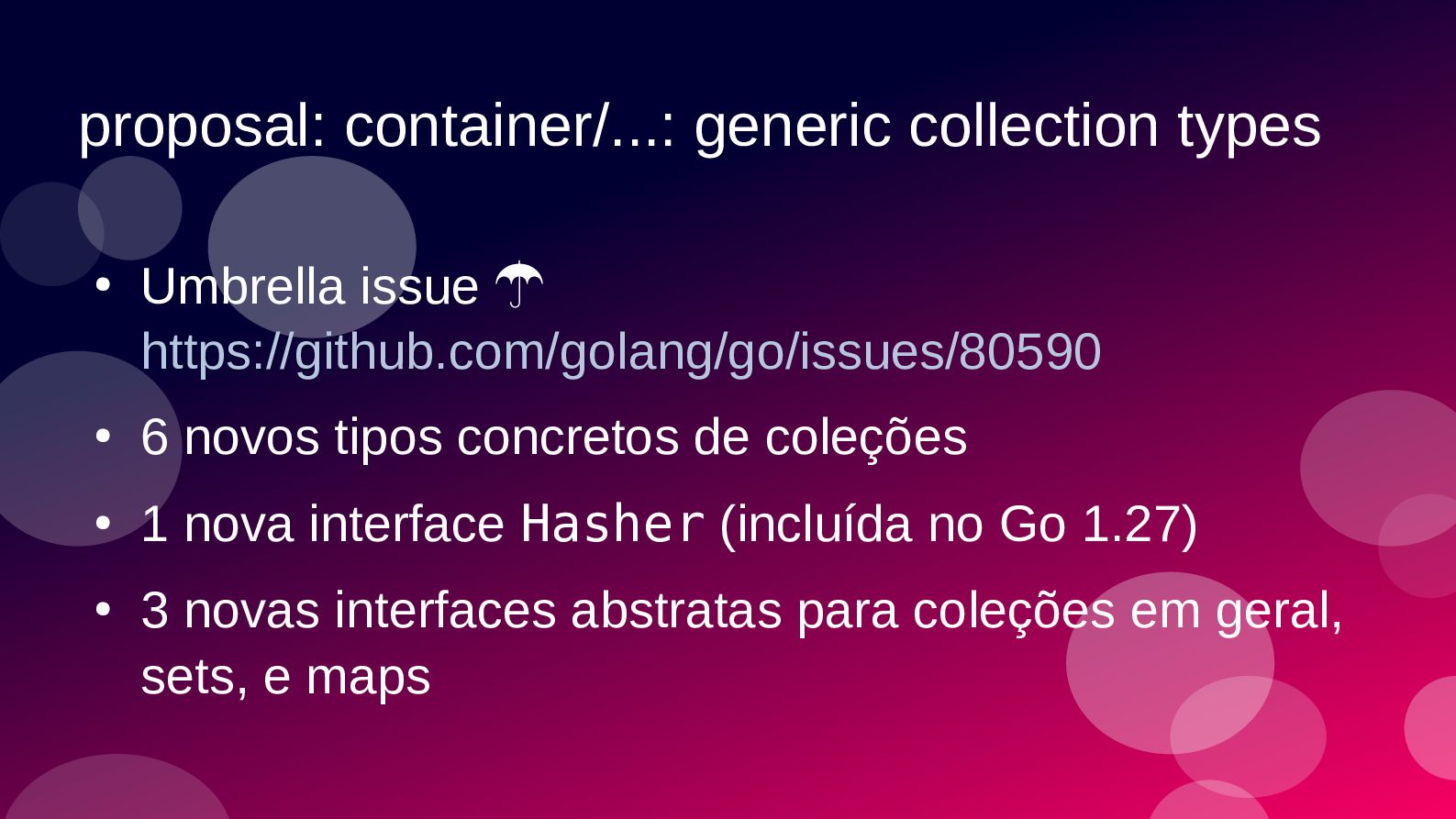
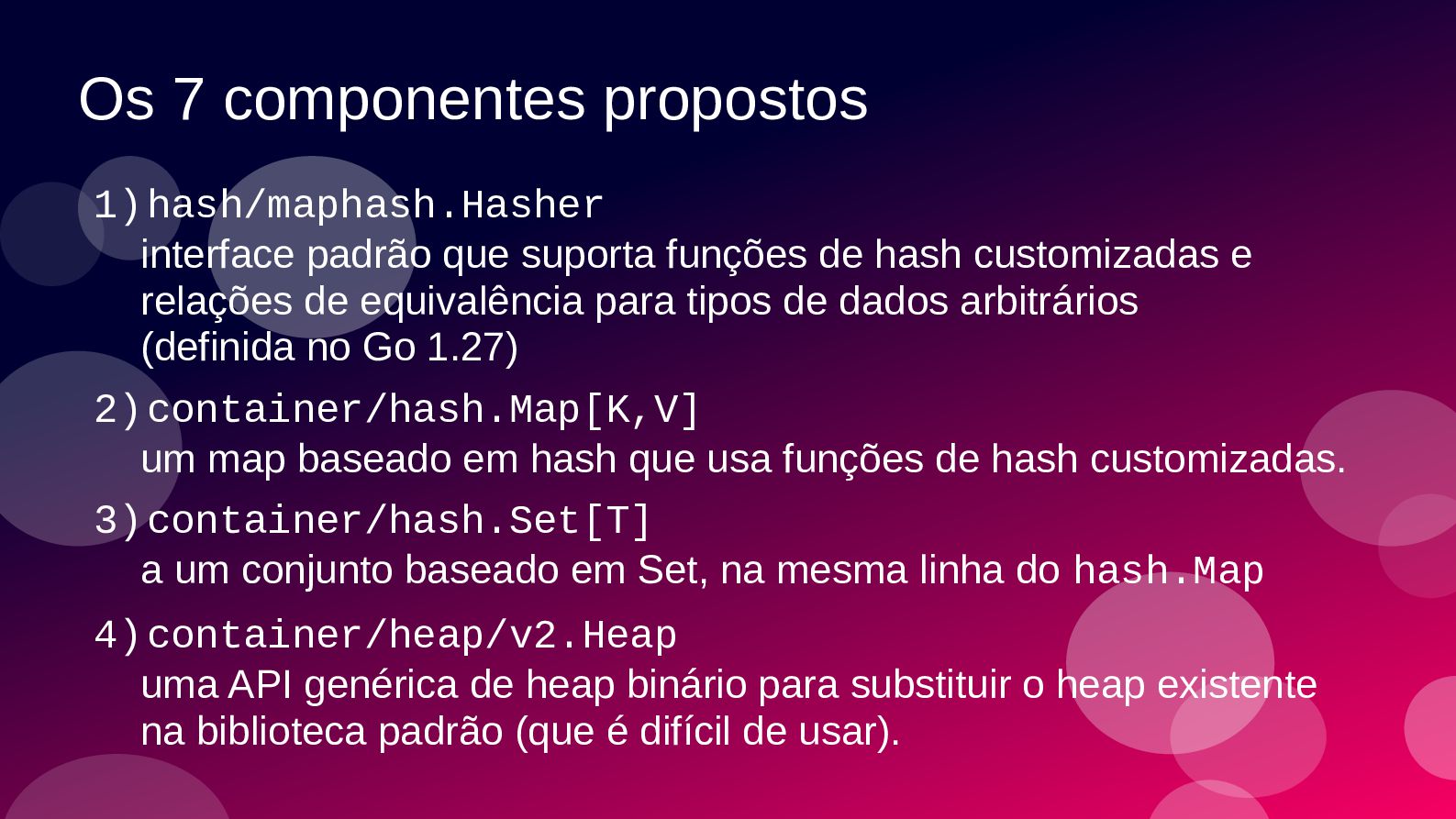
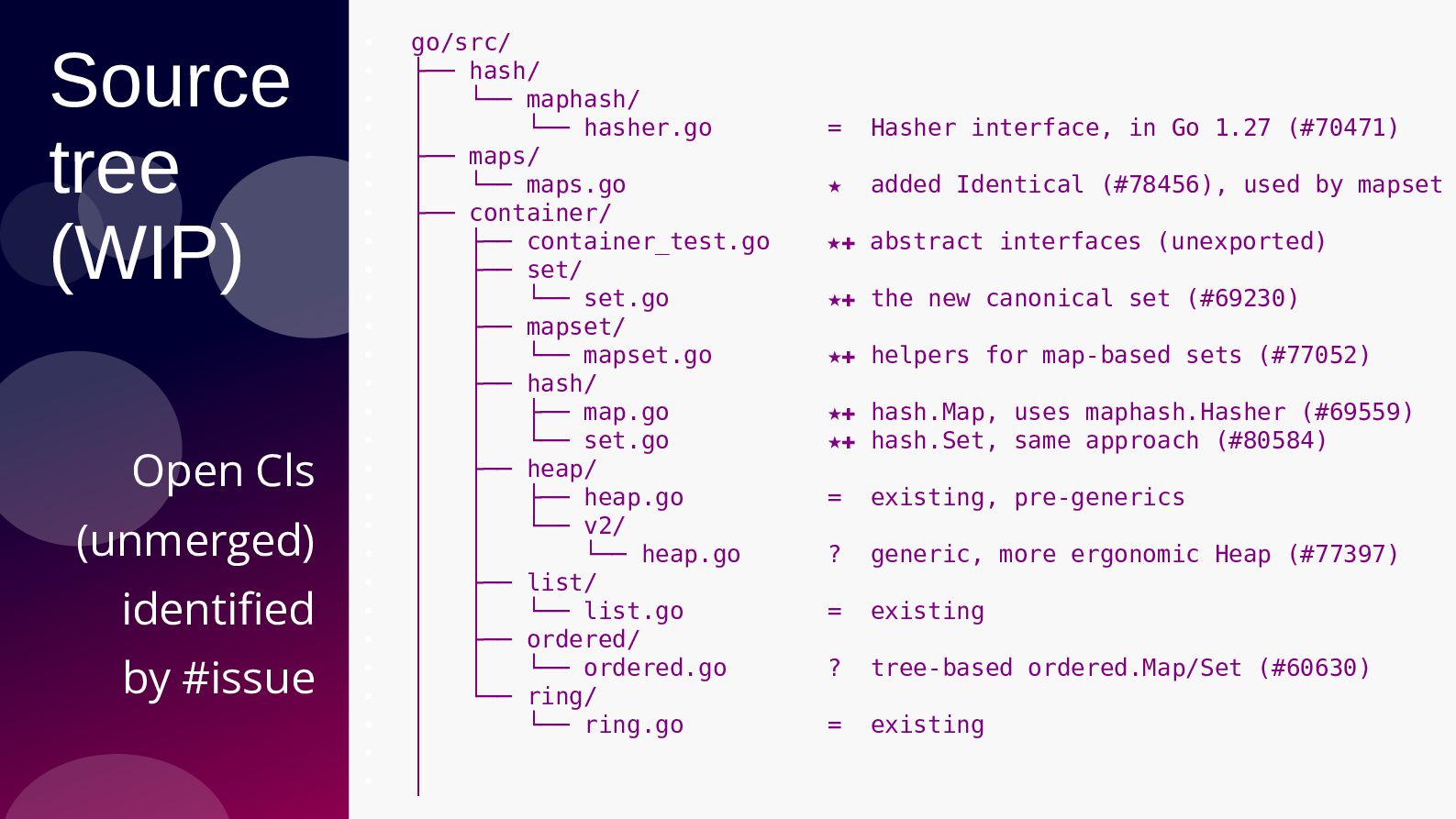
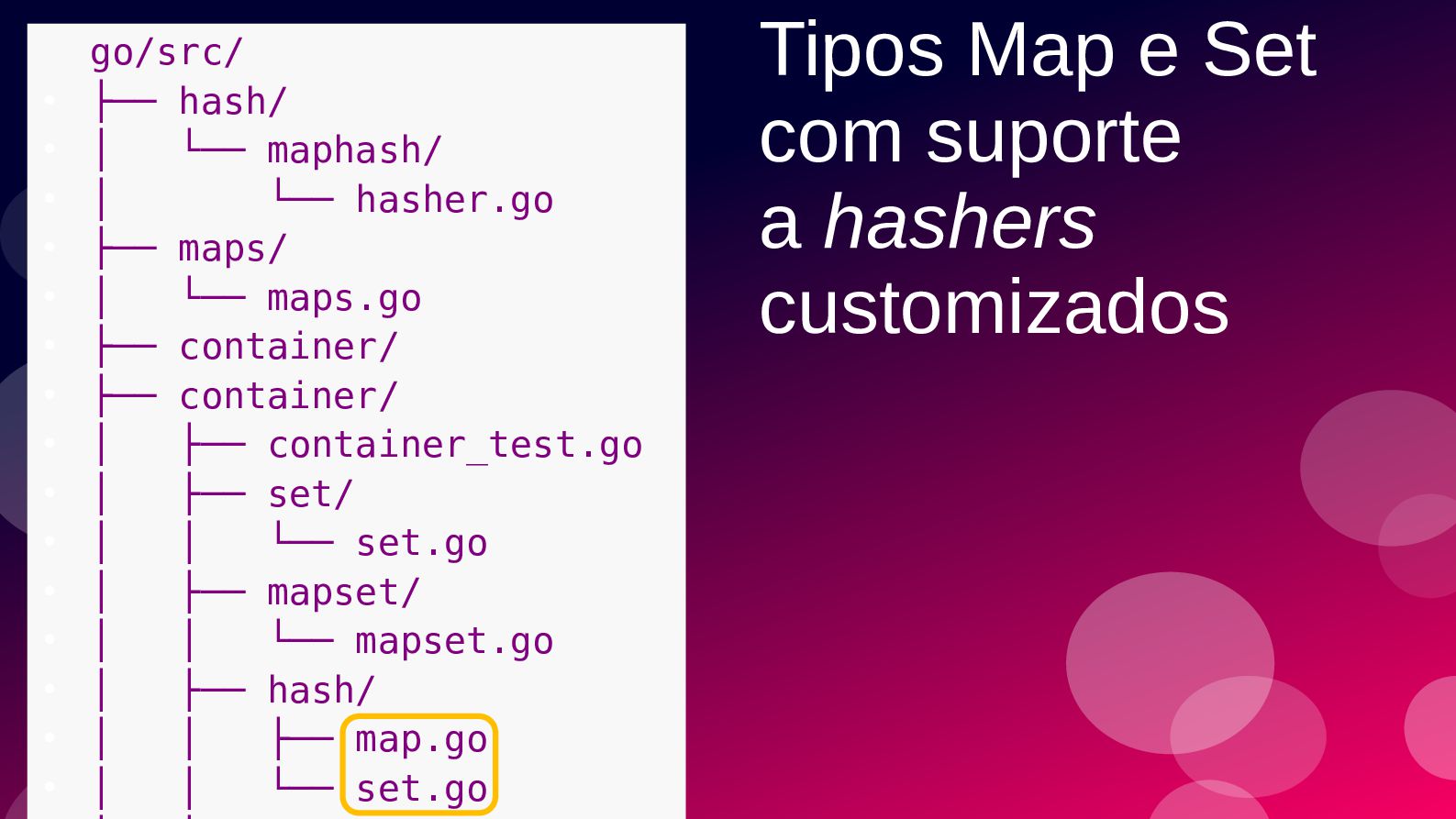
de hash customizadas e relações de equivalência para tipos de dados arbitrários (definida no Go 1.27) 2)container/hash.Map[K,V] um map baseado em hash que usa funções de hash customizadas. 3)container/hash.Set[T] a um conjunto baseado em Set, na mesma linha do hash.Map 4)container/heap/v2.Heap uma API genérica de heap binário para substituir o heap existente na biblioteca padrão (que é difícil de usar).
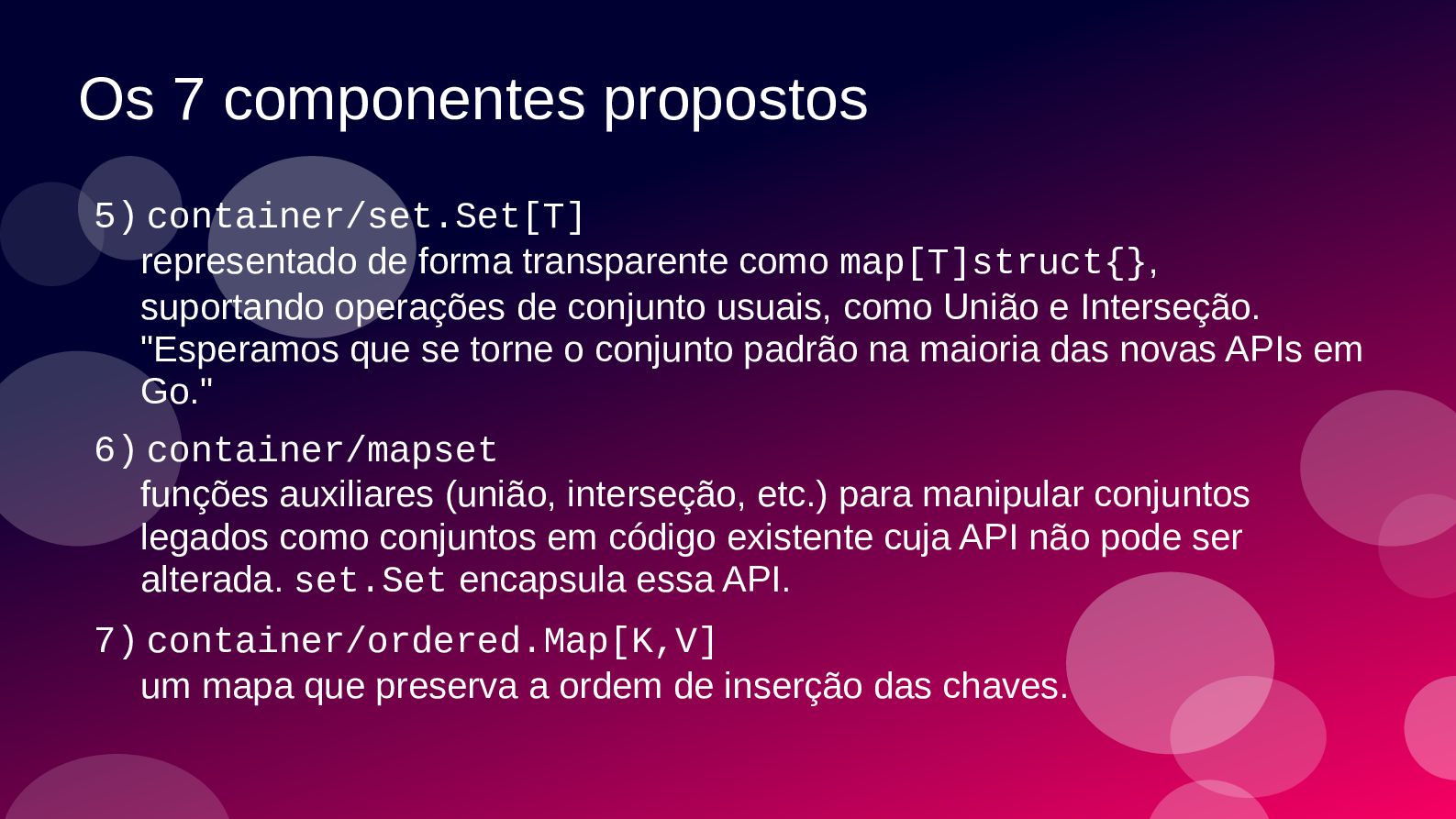
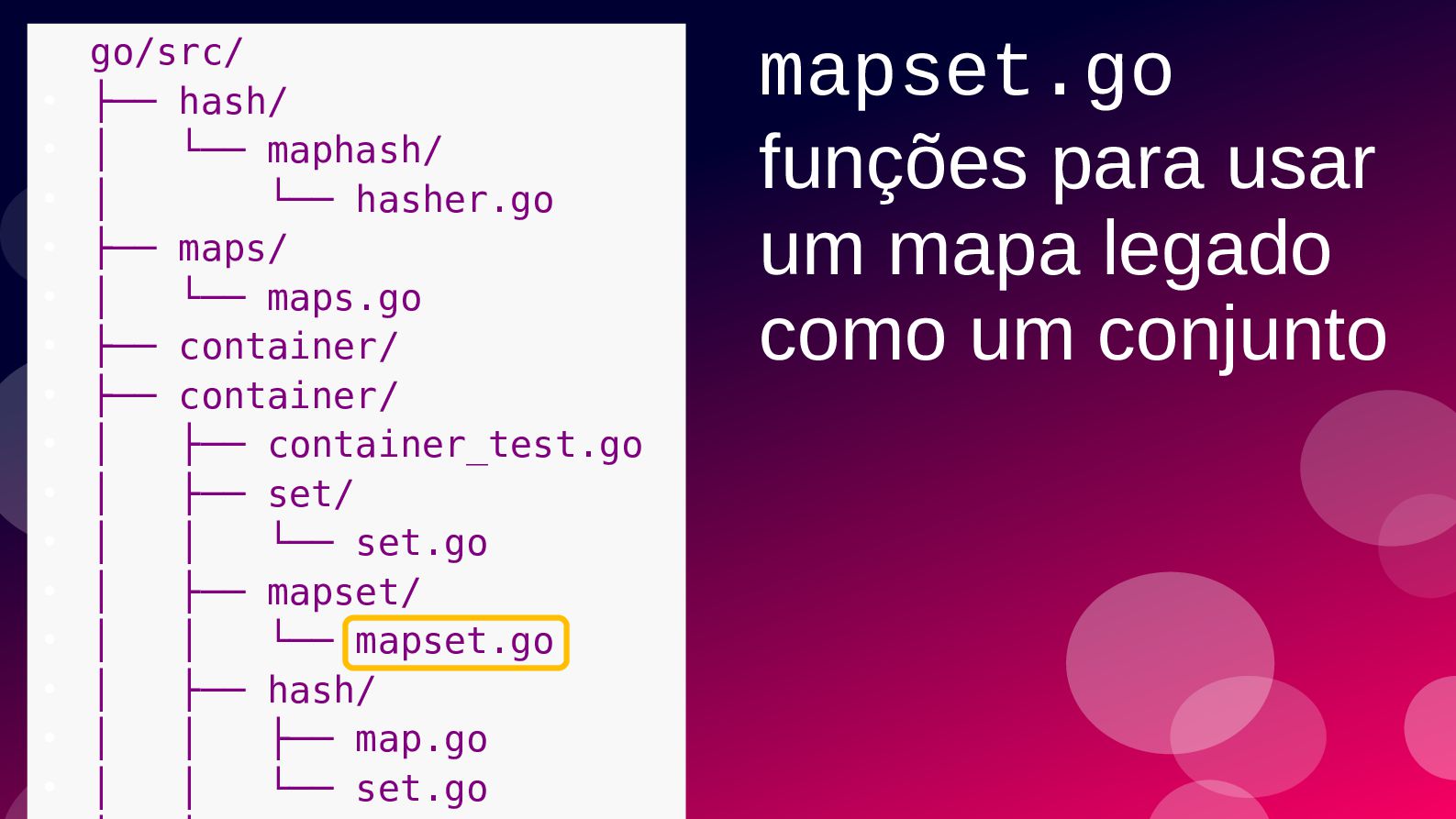
map[T]struct{}, suportando operações de conjunto usuais, como União e Interseção. "Esperamos que se torne o conjunto padrão na maioria das novas APIs em Go." 6)container/mapset funções auxiliares (união, interseção, etc.) para manipular conjuntos legados como conjuntos em código existente cuja API não pode ser alterada. set.Set encapsula essa API. 7)container/ordered.Map[K,V] um mapa que preserva a ordem de inserção das chaves.
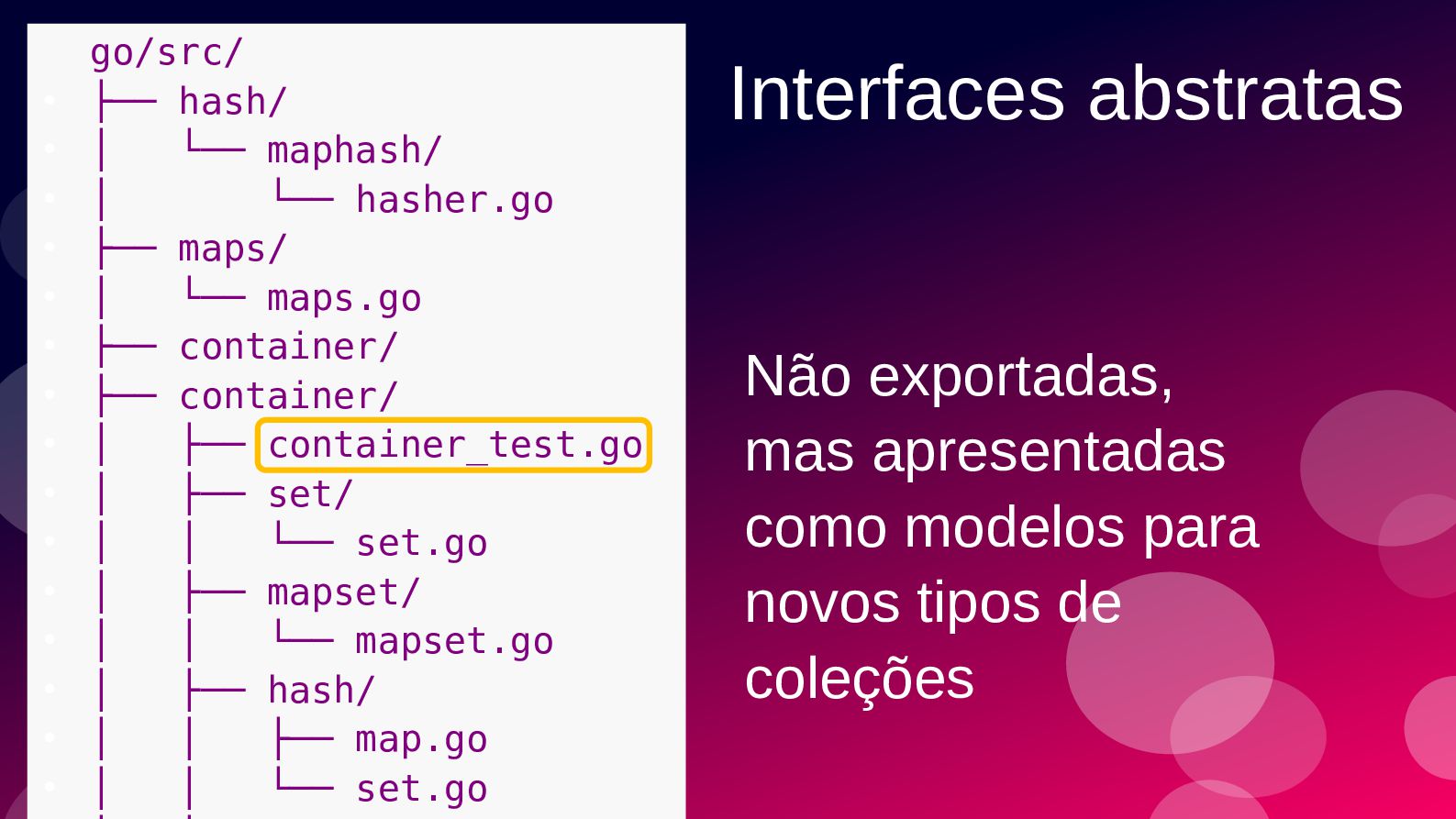
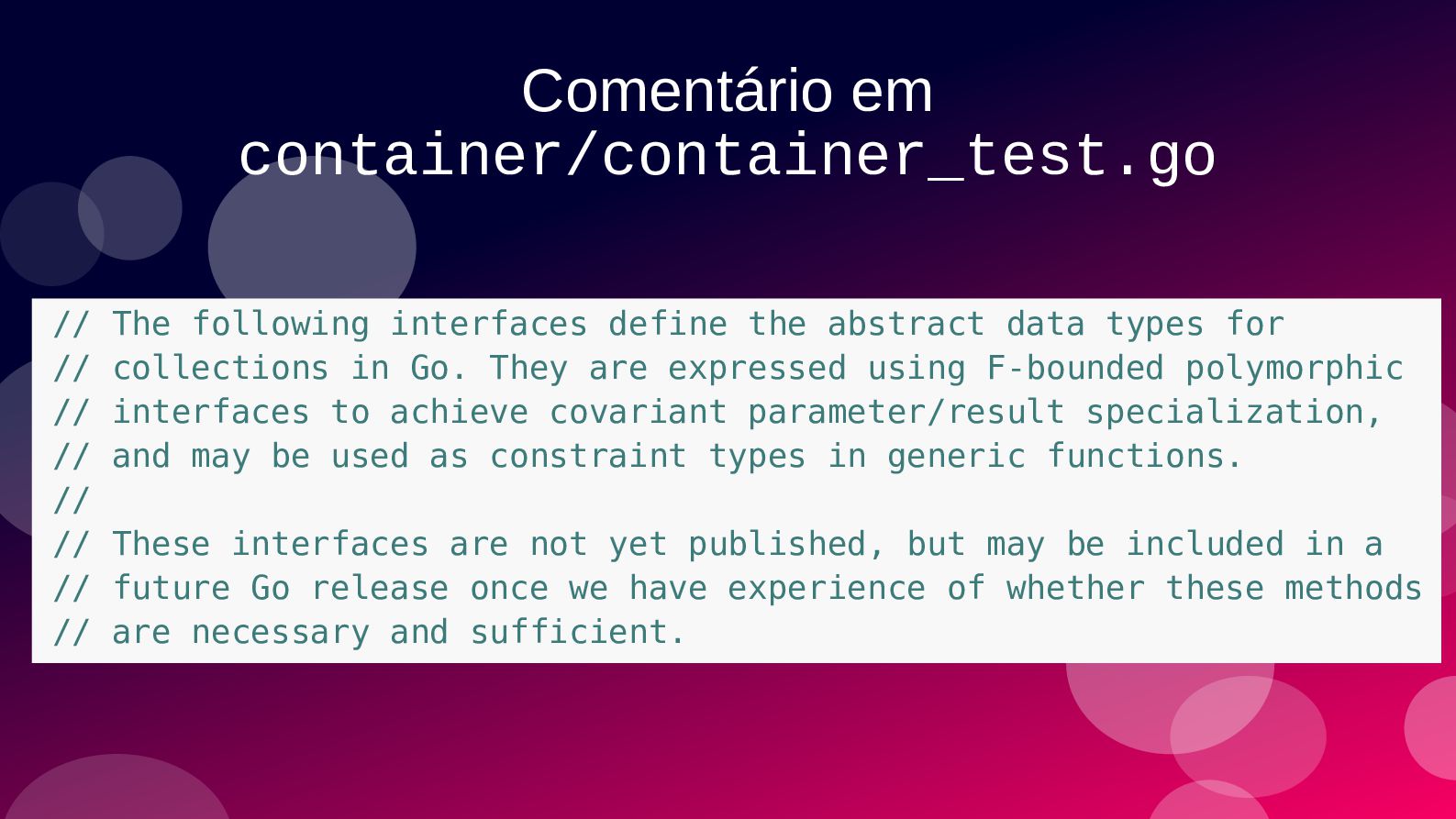
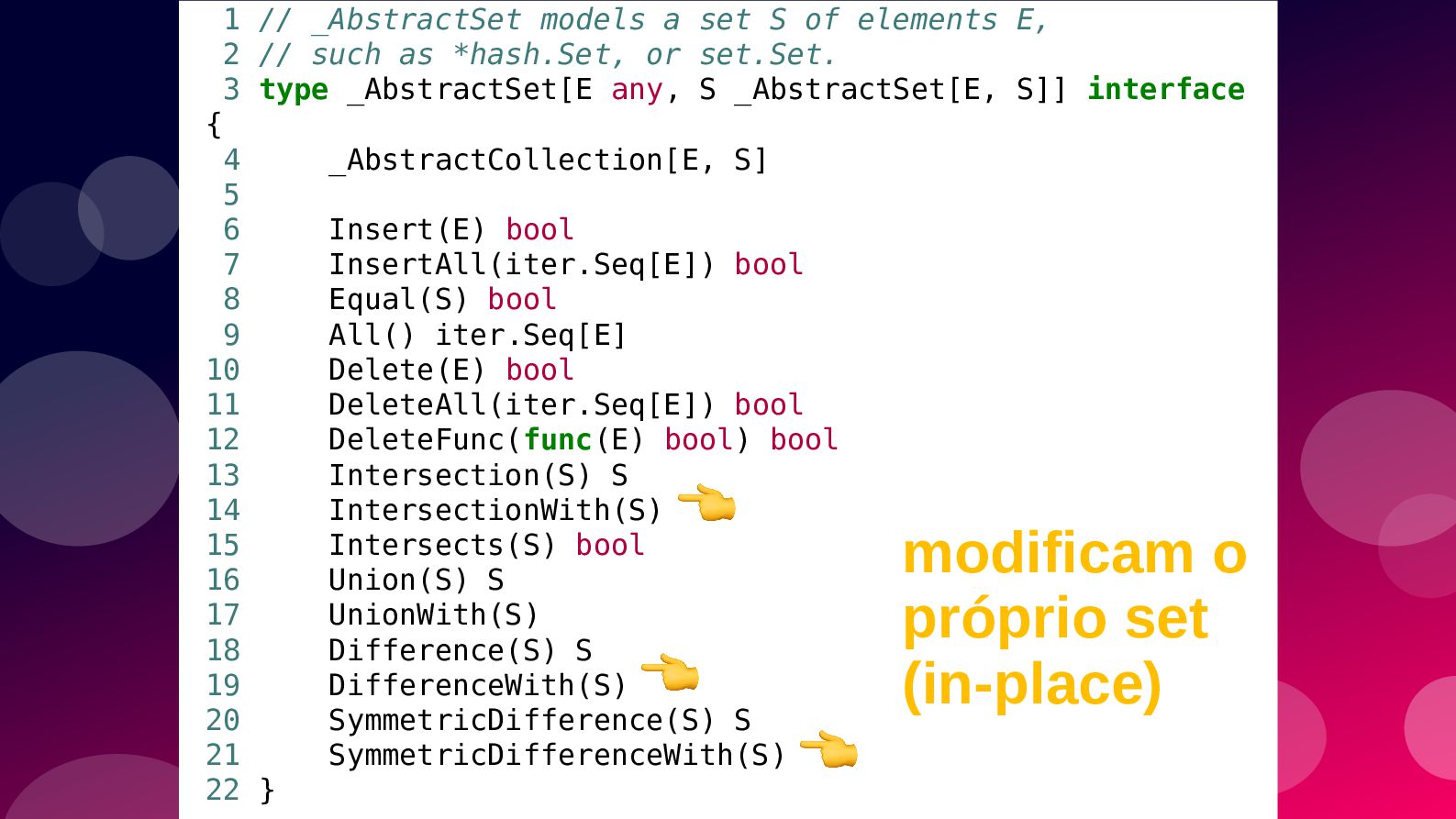
data types for // collections in Go. They are expressed using F-bounded polymorphic // interfaces to achieve covariant parameter/result specialization, // and may be used as constraint types in generic functions. // // These interfaces are not yet published, but may be included in a // future Go release once we have experience of whether these methods // are necessary and sufficient.
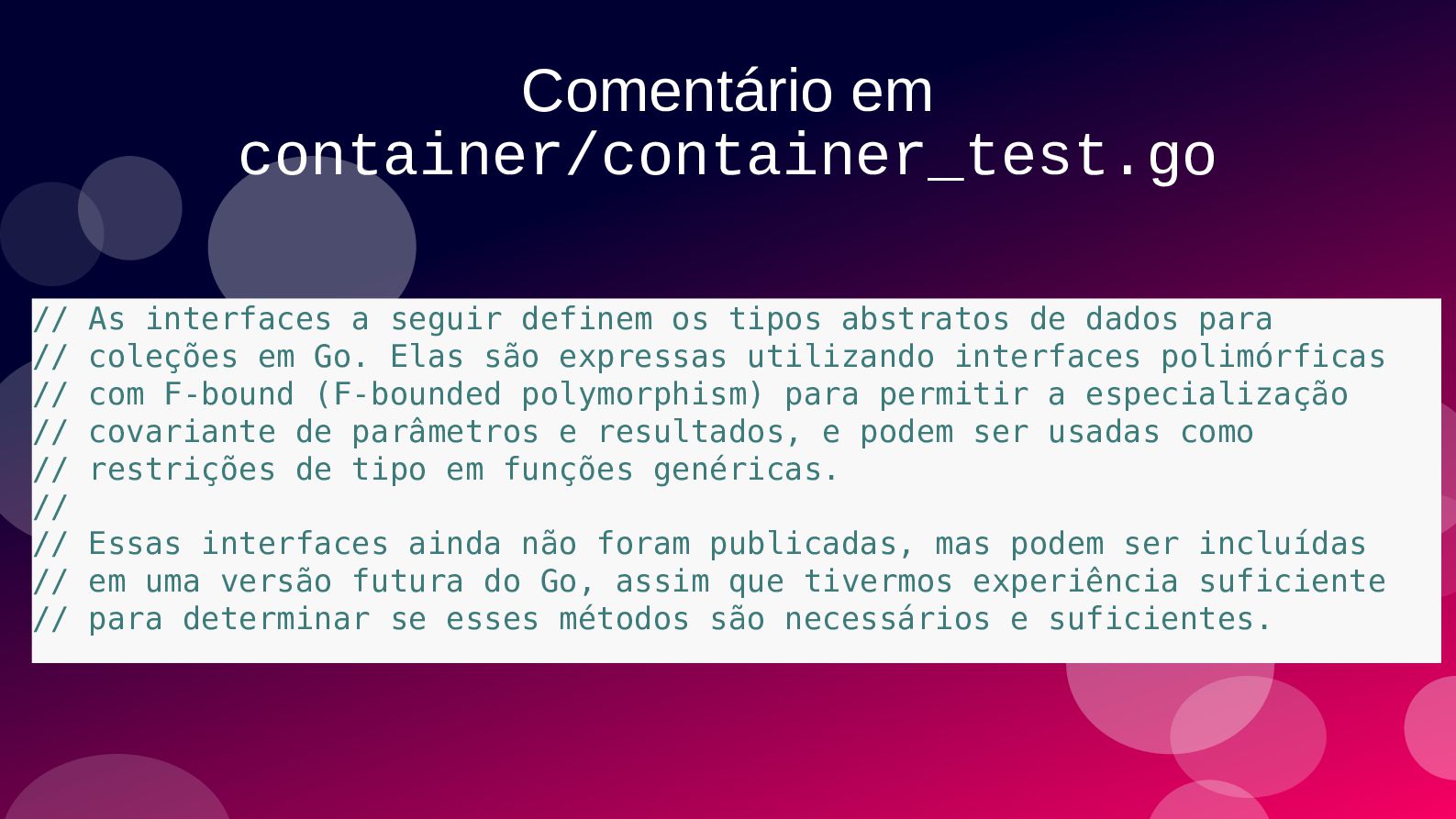
tipos abstratos de dados para // coleções em Go. Elas são expressas utilizando interfaces polimórficas // com F-bound (F-bounded polymorphism) para permitir a especialização // covariante de parâmetros e resultados, e podem ser usadas como // restrições de tipo em funções genéricas. // // Essas interfaces ainda não foram publicadas, mas podem ser incluídas // em uma versão futura do Go, assim que tivermos experiência suficiente // para determinar se esses métodos são necessários e suficientes.
como Enum<T extends Enum<T>>. Essa definição circular é, provavelmente, a definição de tipo genérico mais intrigante que você encontrará. Especialistas em teoria de tipos nos garantem que isso é perfeitamente válido e significativo — e que simplesmente não devemos pensar muito a respeito —, pelo que somos gratos. Ken Arnold, James Gosling, David Holmes The Java Programming Language, 4th Edition Citado em Generics Considered Harmful por Ken Arnold (https://tgo.li/25)
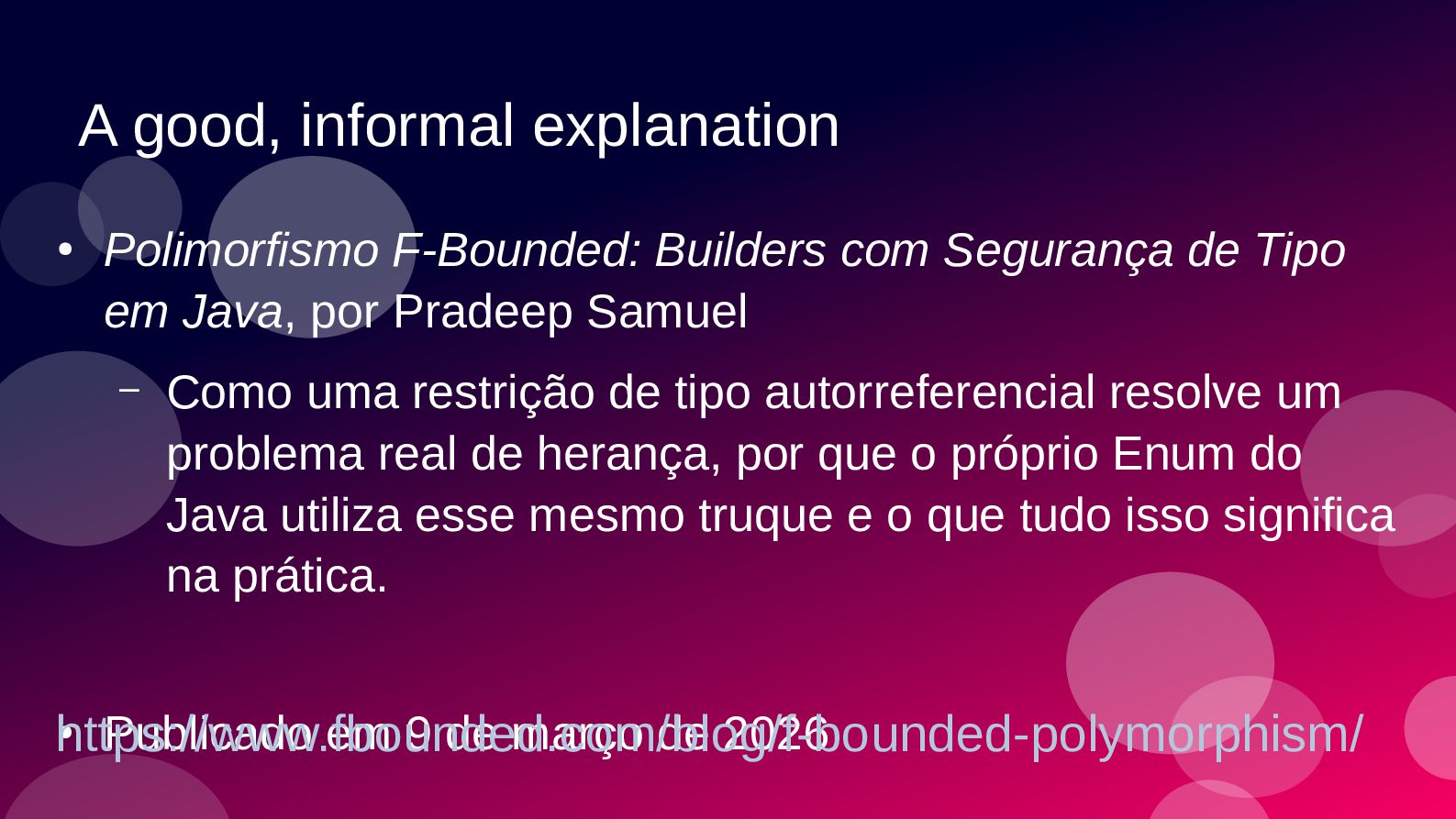
de Tipo em Java, por Pradeep Samuel (publicado em 9 de março de 2026) – Como uma restrição de tipo autorreferencial resolve um problema real de herança, por que o próprio Enum do Java utiliza esse mesmo truque e o que tudo isso significa na prática. https://www.fbounded.com/blog/f-bounded-polymorphism/
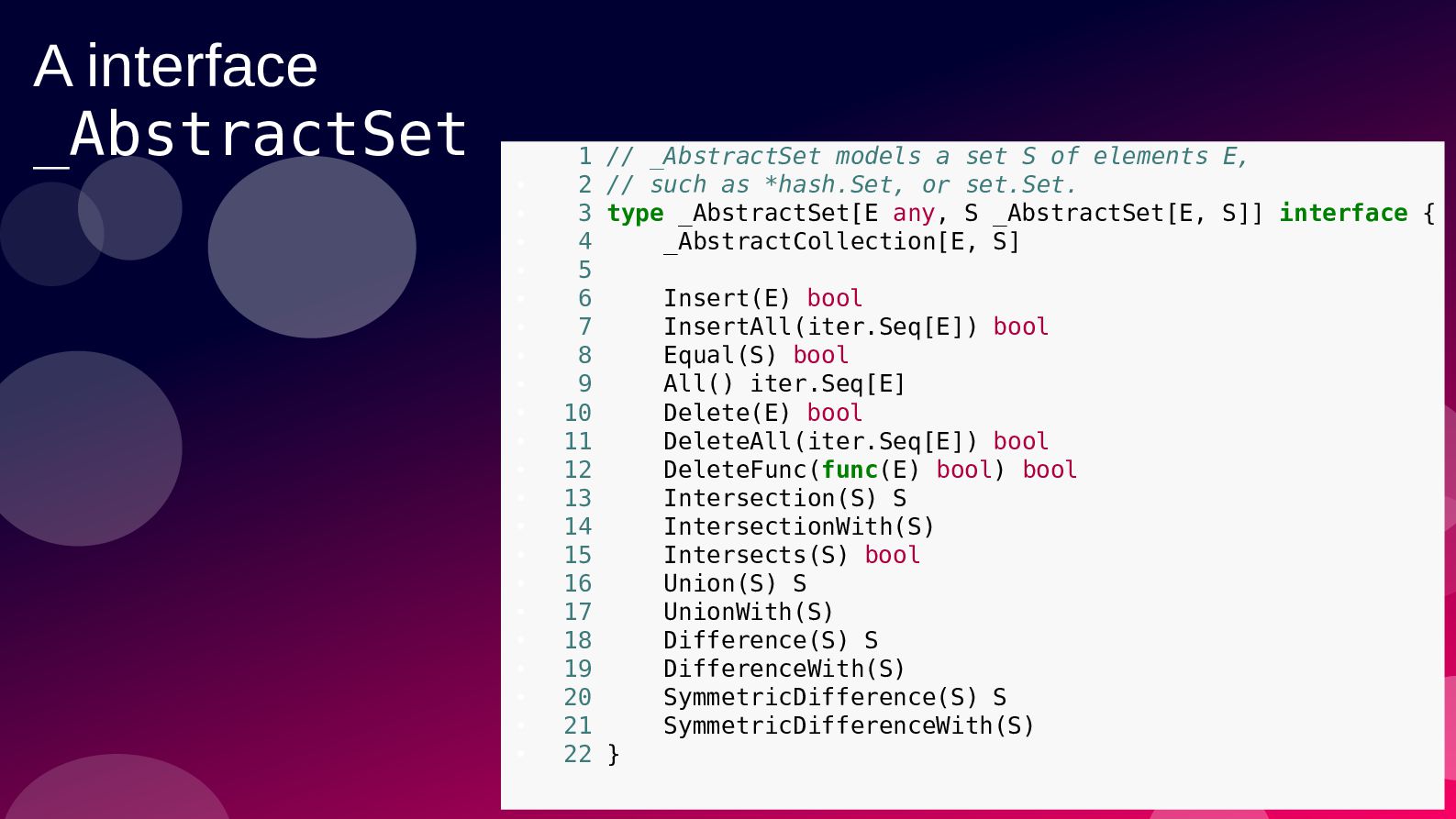
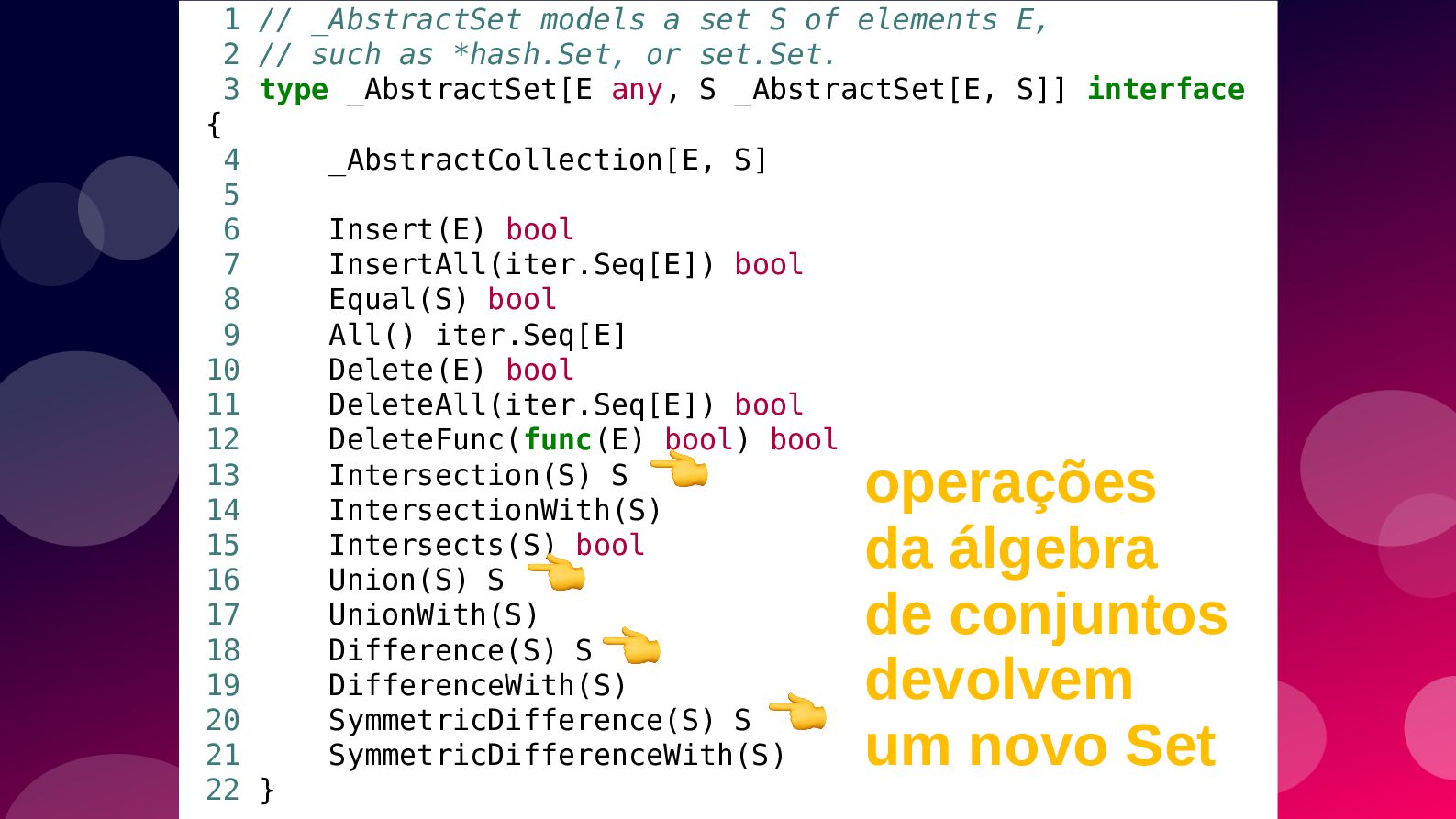
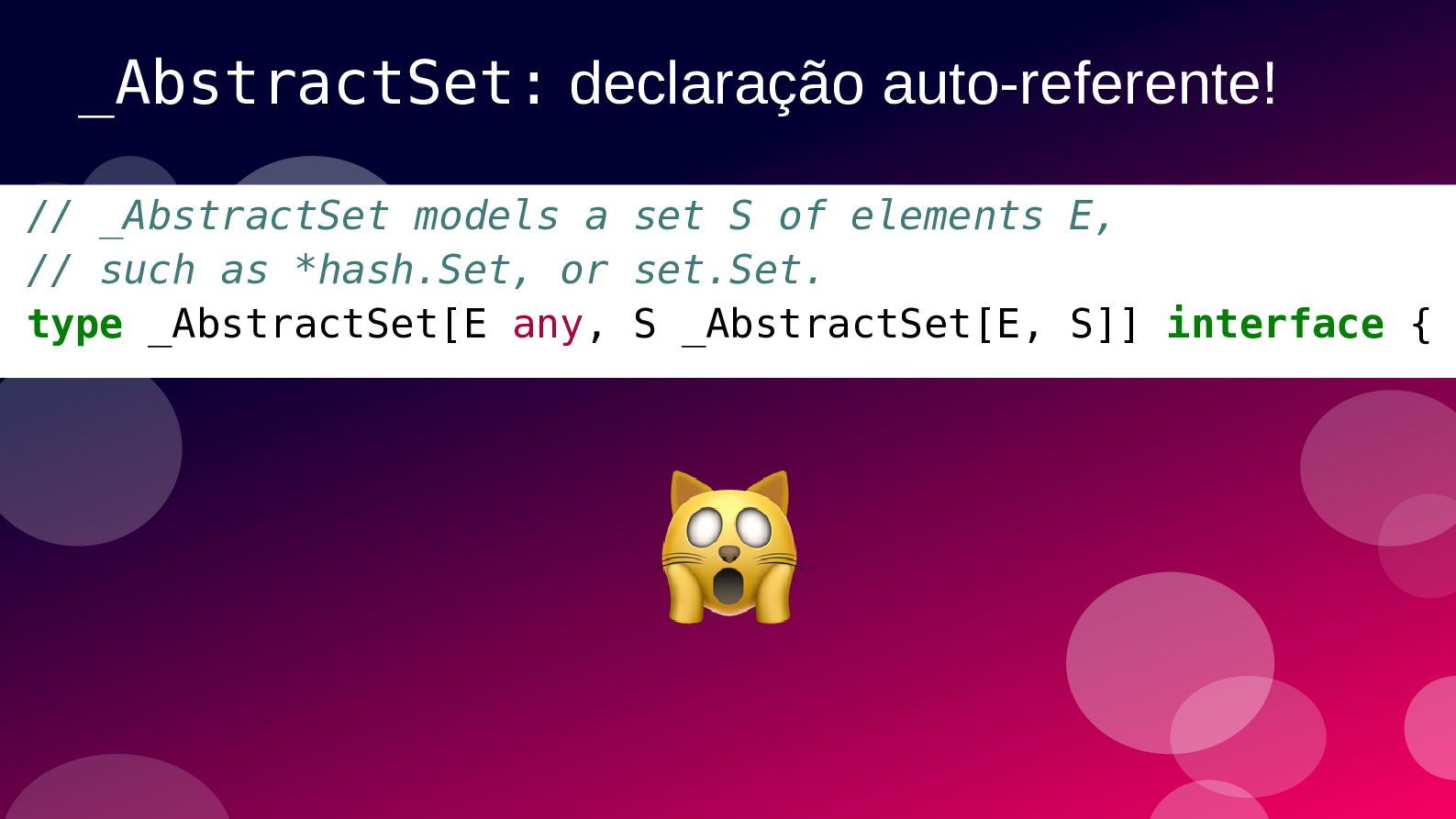
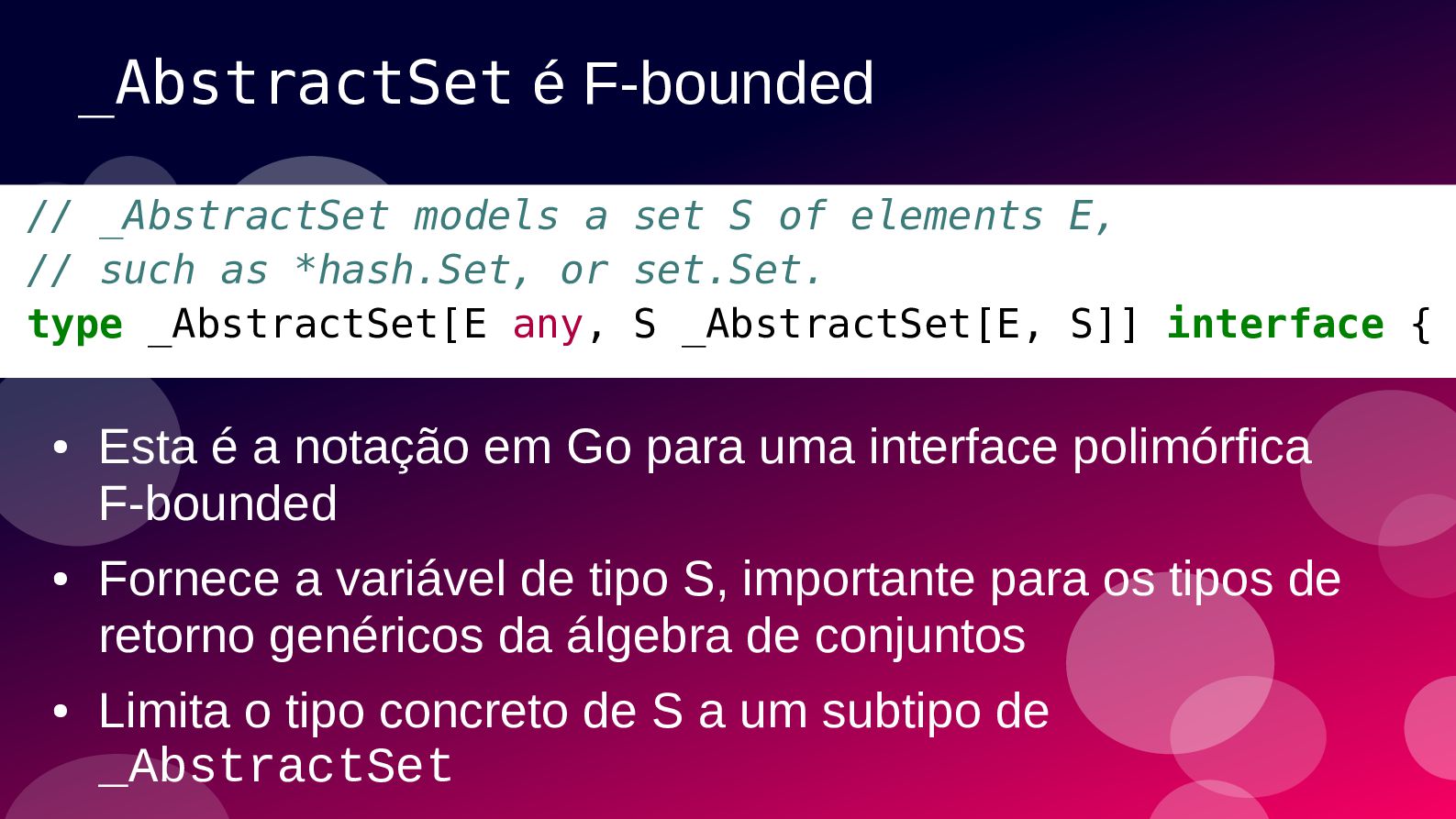
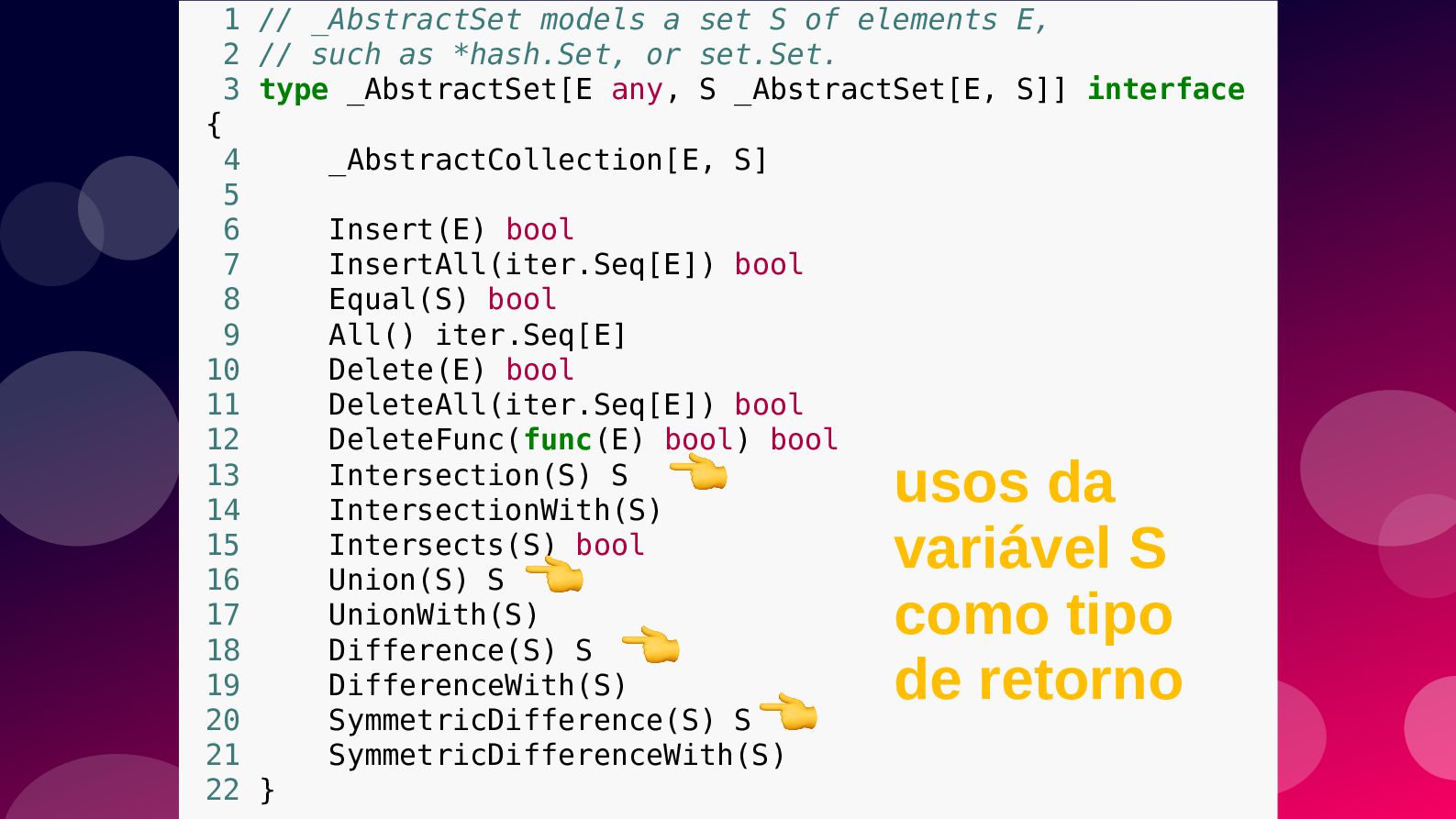
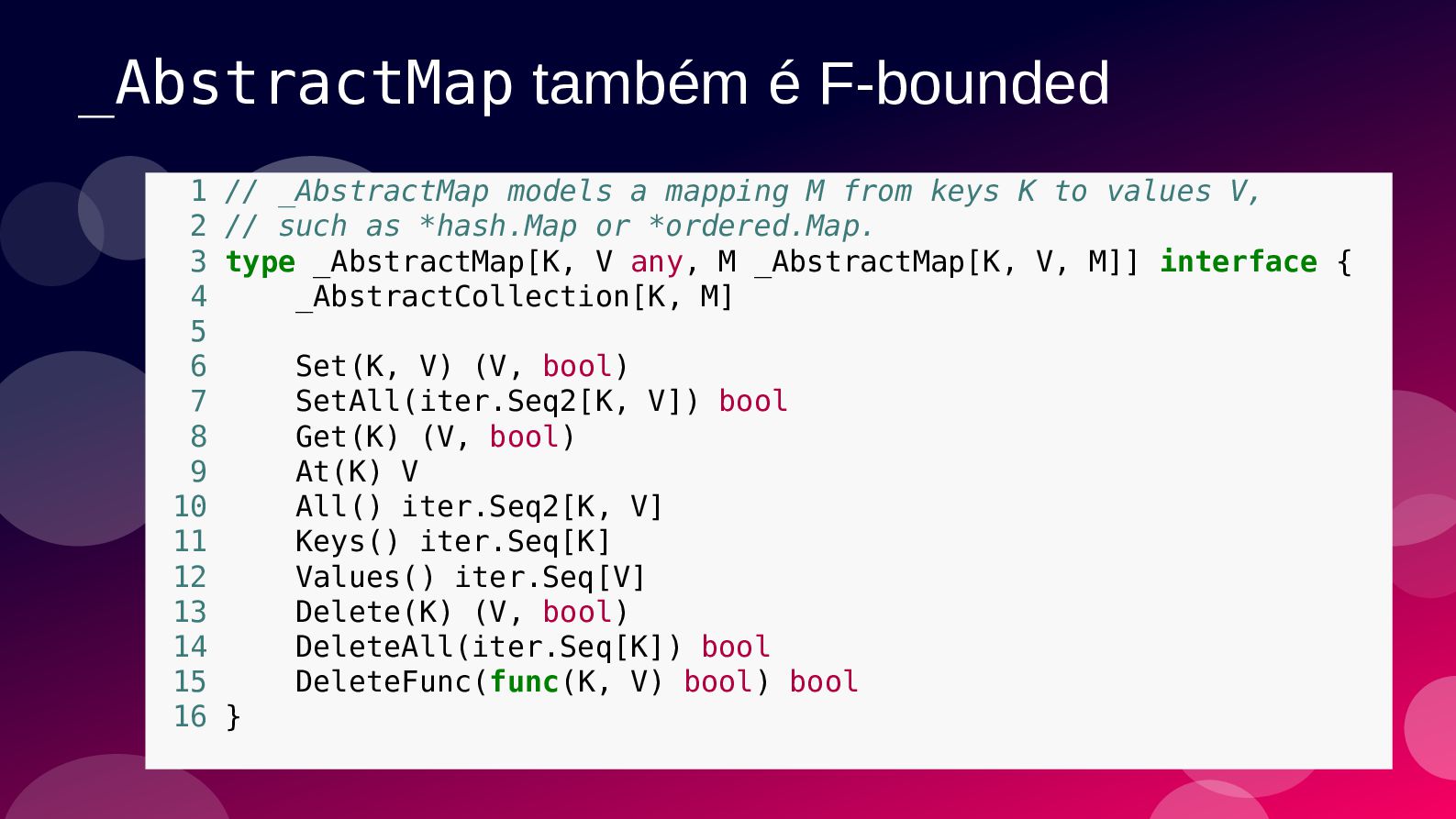
elements E, // such as *hash.Set, or set.Set. type _AbstractSet[E any, S _AbstractSet[E, S]] interface { • • • Esta é a notação em Go para uma interface polimórfica F-bounded Fornece a variável de tipo S para as assinaturas de operações genéricas da álgebra de conjuntos Limita o tipo concreto de S a um subtipo de _AbstractSet
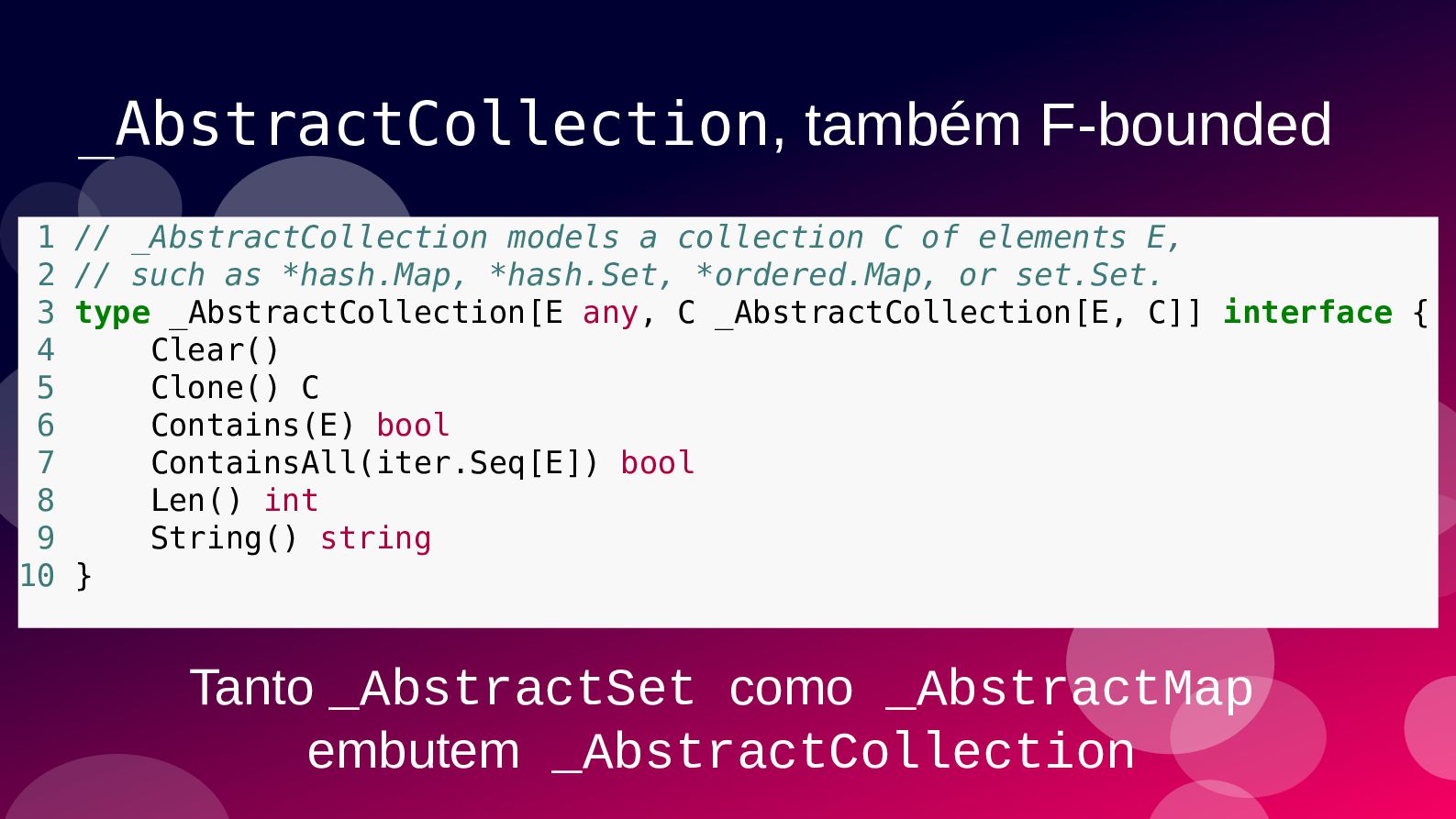
of elements E, 2 // such as *hash.Map, *hash.Set, *ordered.Map, or set.Set. 3 type _AbstractCollection[E any, C _AbstractCollection[E, C]] interface { 4 Clear() 5 Clone() C 6 Contains(E) bool 7 ContainsAll(iter.Seq[E]) bool 8 Len() int 9 String() string 10 } Tanto _AbstractSet como _AbstractMap embutem _AbstractCollection
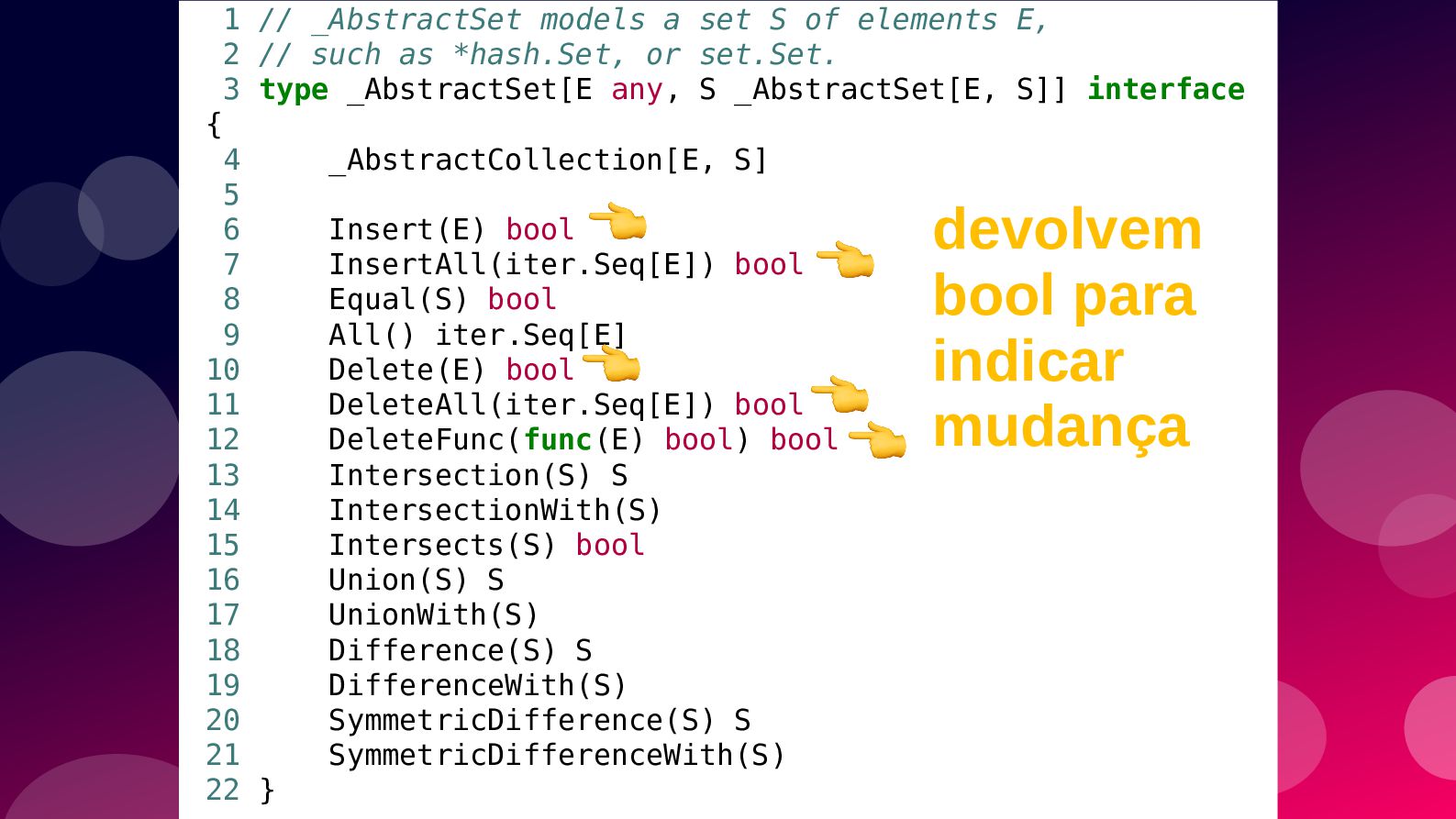
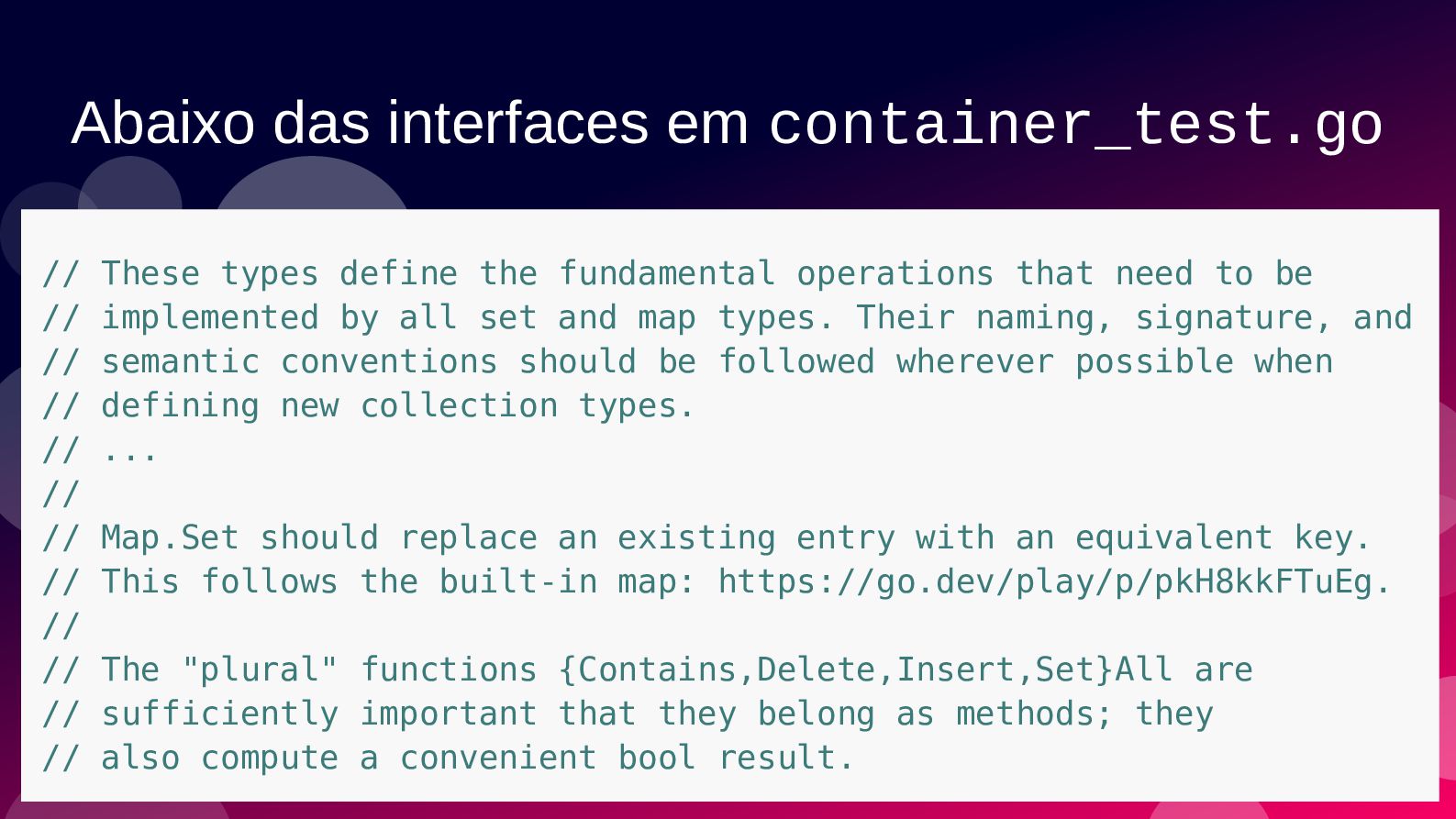
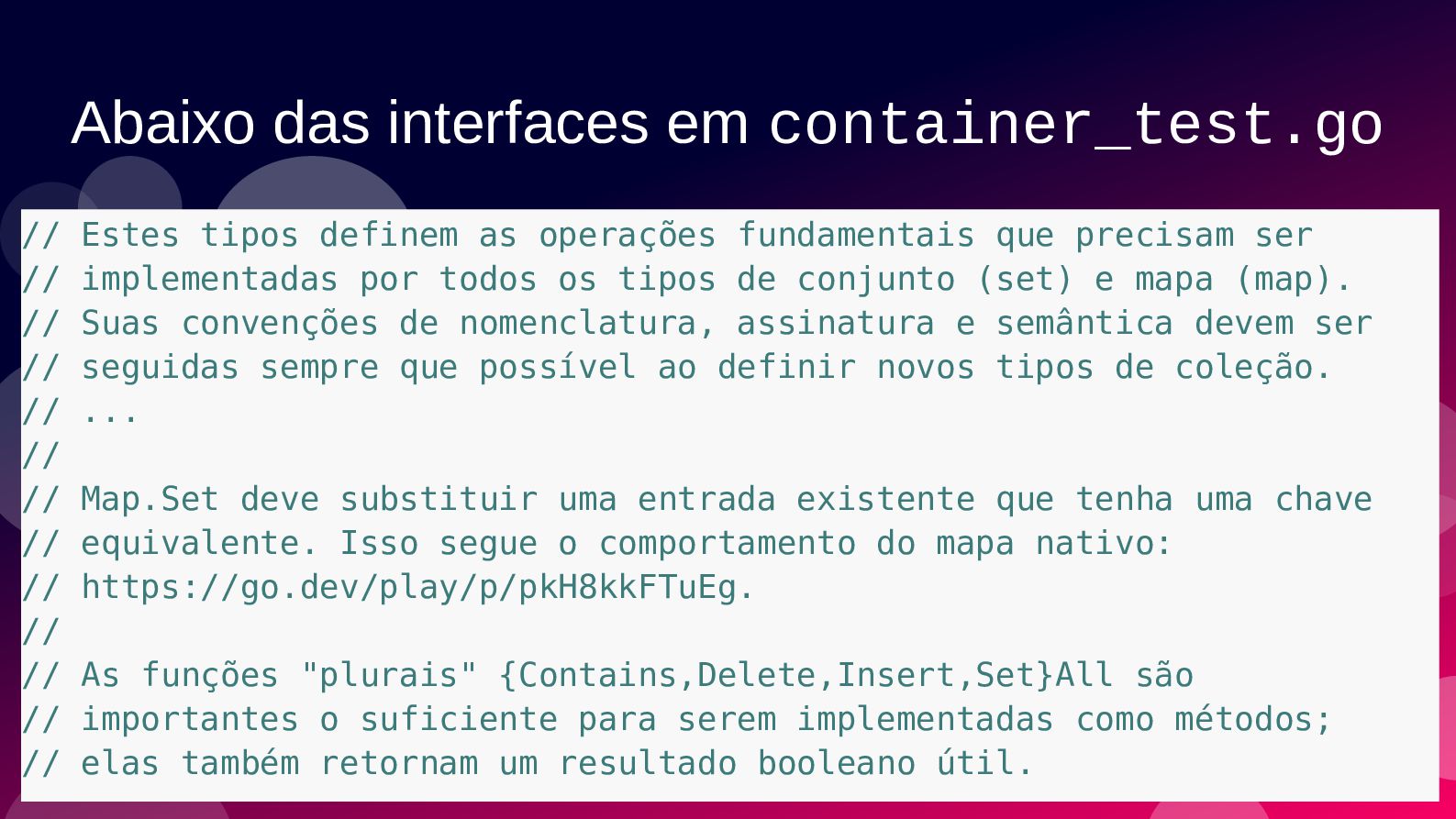
fundamental operations that need to be // implemented by all set and map types. Their naming, signature, and // semantic conventions should be followed wherever possible when // defining new collection types. // ... // // Map.Set should replace an existing entry with an equivalent key. // This follows the built-in map: https://go.dev/play/p/pkH8kkFTuEg. // // The "plural" functions {Contains,Delete,Insert,Set}All are // sufficiently important that they belong as methods; they // also compute a convenient bool result.
operações fundamentais que precisam ser // implementadas por todos os tipos de conjunto (set) e mapa (map). // Suas convenções de nomenclatura, assinatura e semântica devem ser // seguidas sempre que possível ao definir novos tipos de coleção. // ... // // Map.Set deve substituir uma entrada existente que tenha uma chave // equivalente. Isso segue o comportamento do mapa nativo: // https://go.dev/play/p/pkH8kkFTuEg. // // As funções "plurais" {Contains,Delete,Insert,Set}All são // importantes o suficiente para serem implementadas como métodos; // elas também retornam um resultado booleano útil.
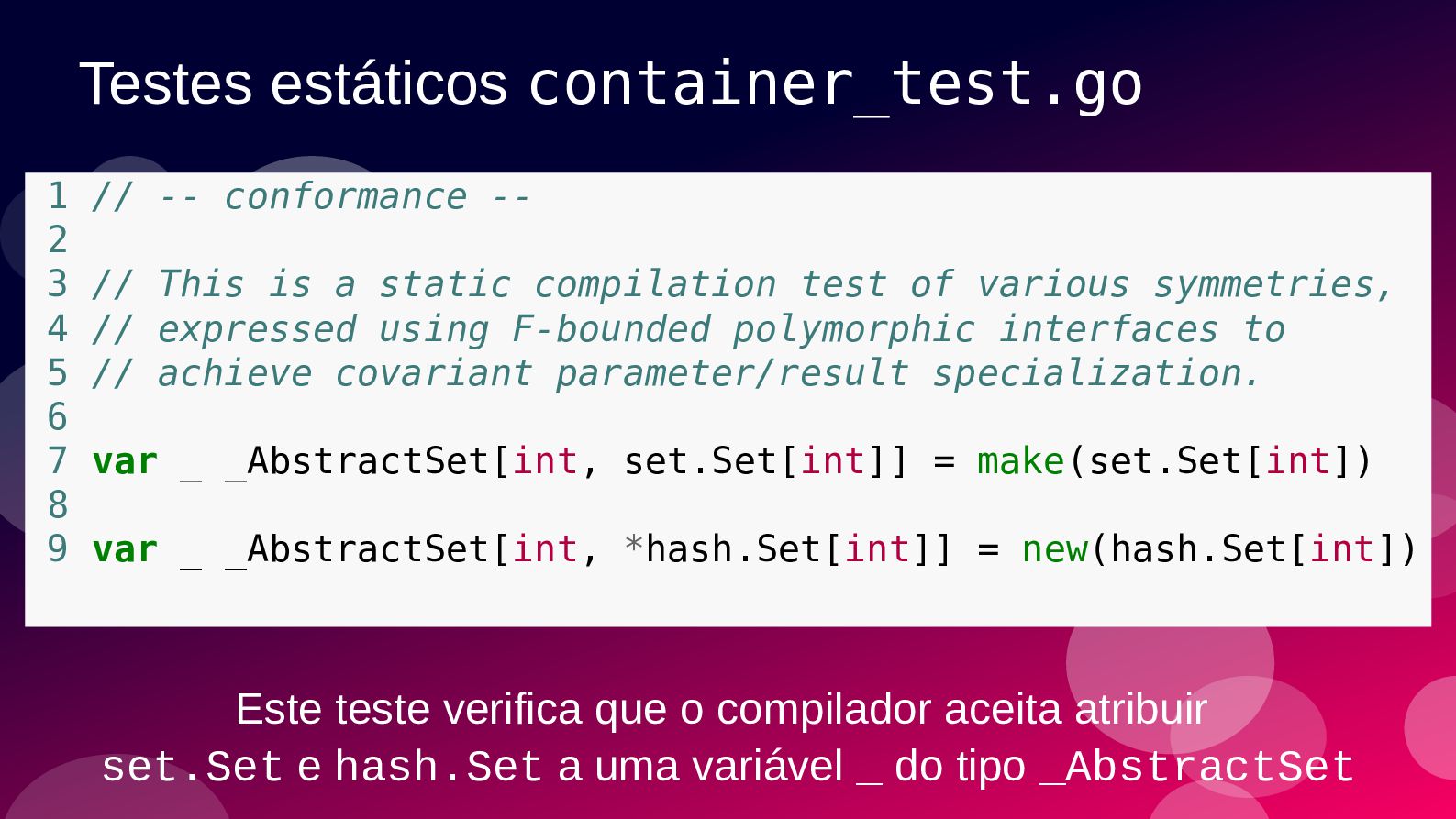
This is a static compilation test of various symmetries, 4 // expressed using F-bounded polymorphic interfaces to 5 // achieve covariant parameter/result specialization. 6 7 var _ _AbstractSet[int, set.Set[int]] = make(set.Set[int]) 8 9 var _ _AbstractSet[int, *hash.Set[int]] = new(hash.Set[int]) Este teste verifica que o compilador aceita atribuir set.Set e hash.Set a uma variável _ do tipo _AbstractSet
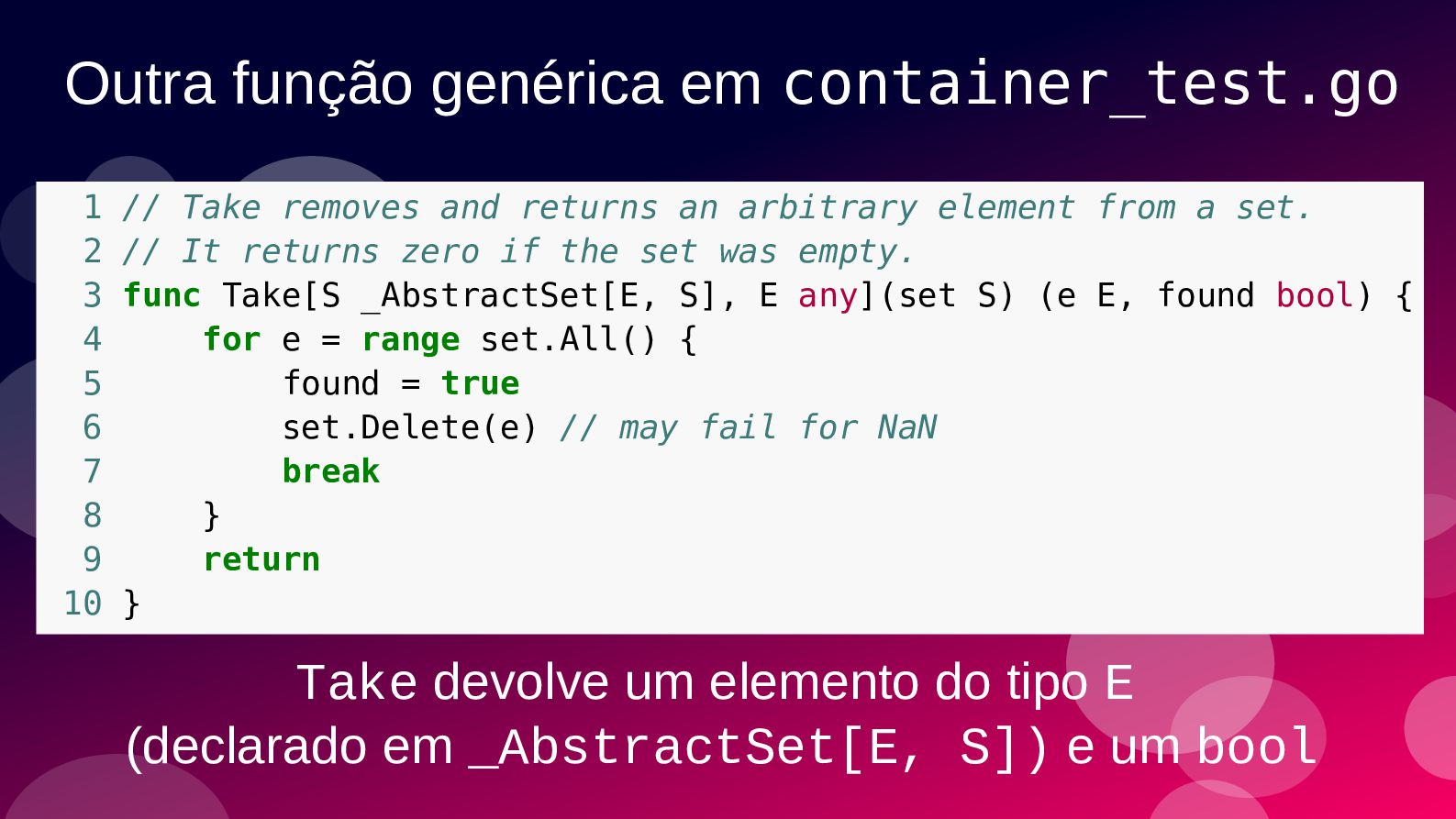
an arbitrary element from a set. 2 // It returns zero if the set was empty. 3 func Take[S _AbstractSet[E, S], E any](set S) (e E, found bool) { 4 for e = range set.All() { 5 found = true 6 set.Delete(e) // may fail for NaN 7 break 8 } 9 return 10 } Take devolve um elemento do tipo E (declarado em _AbstractSet[E, S]) e um bool
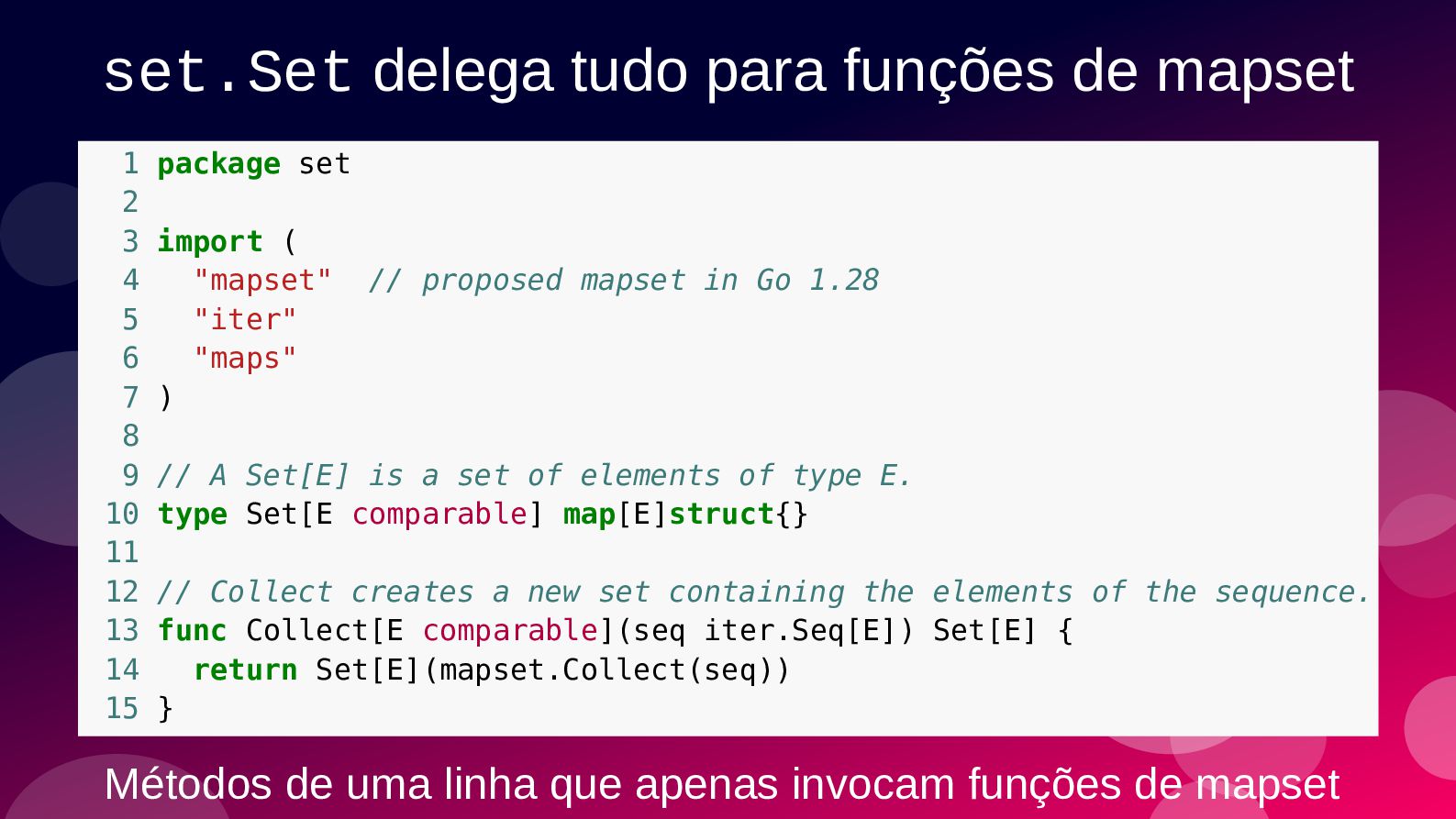
2 3 import ( 4 "mapset" // proposed mapset in Go 1.28 5 "iter" 6 "maps" 7 ) 8 9 // A Set[E] is a set of elements of type E. 10 type Set[E comparable] map[E]struct{} 11 12 // Collect creates a new set containing the elements of the sequence. 13 func Collect[E comparable](seq iter.Seq[E]) Set[E] { 14 return Set[E](mapset.Collect(seq)) 15 } Métodos de uma linha que apenas invocam funções de mapset
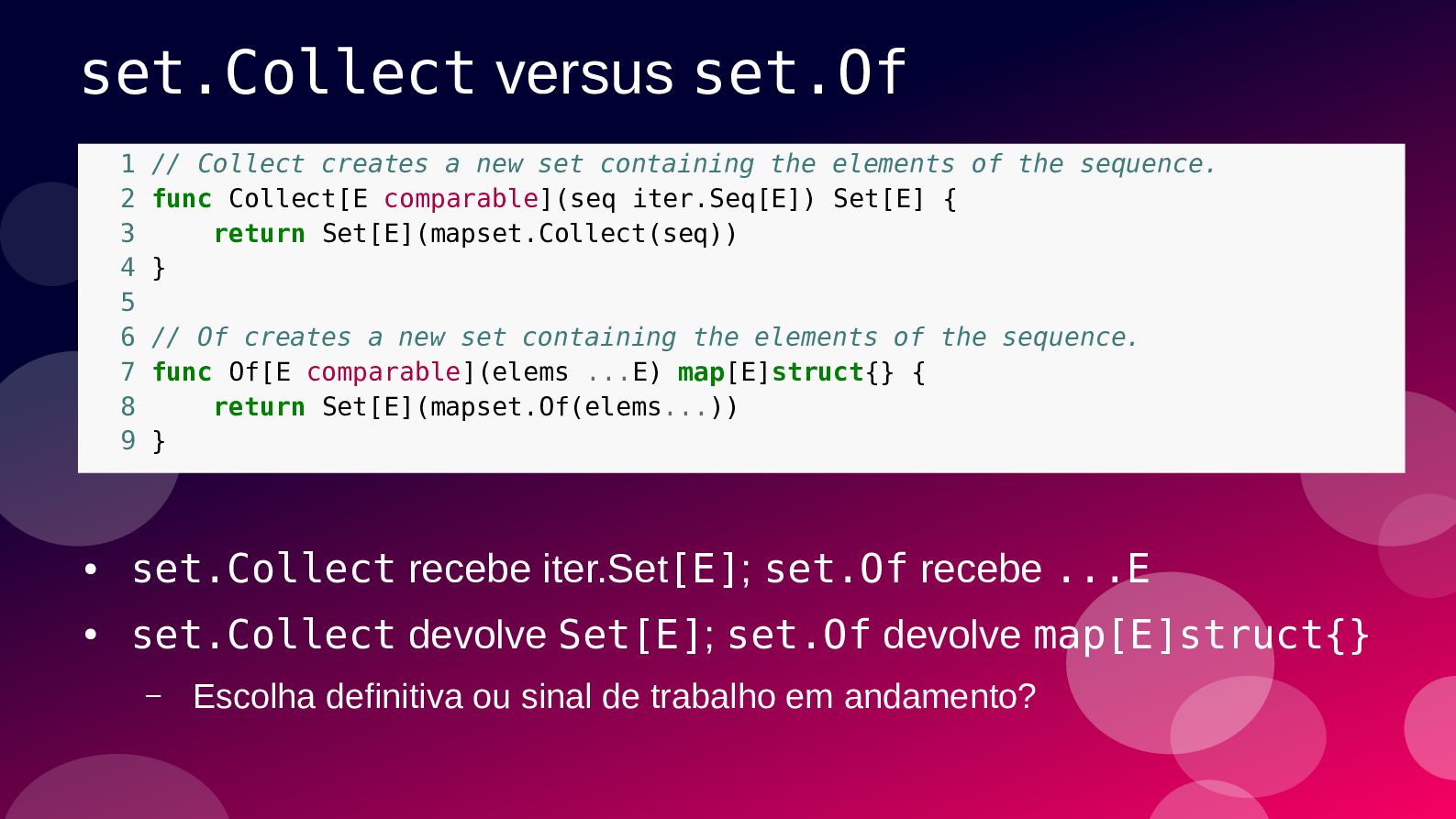
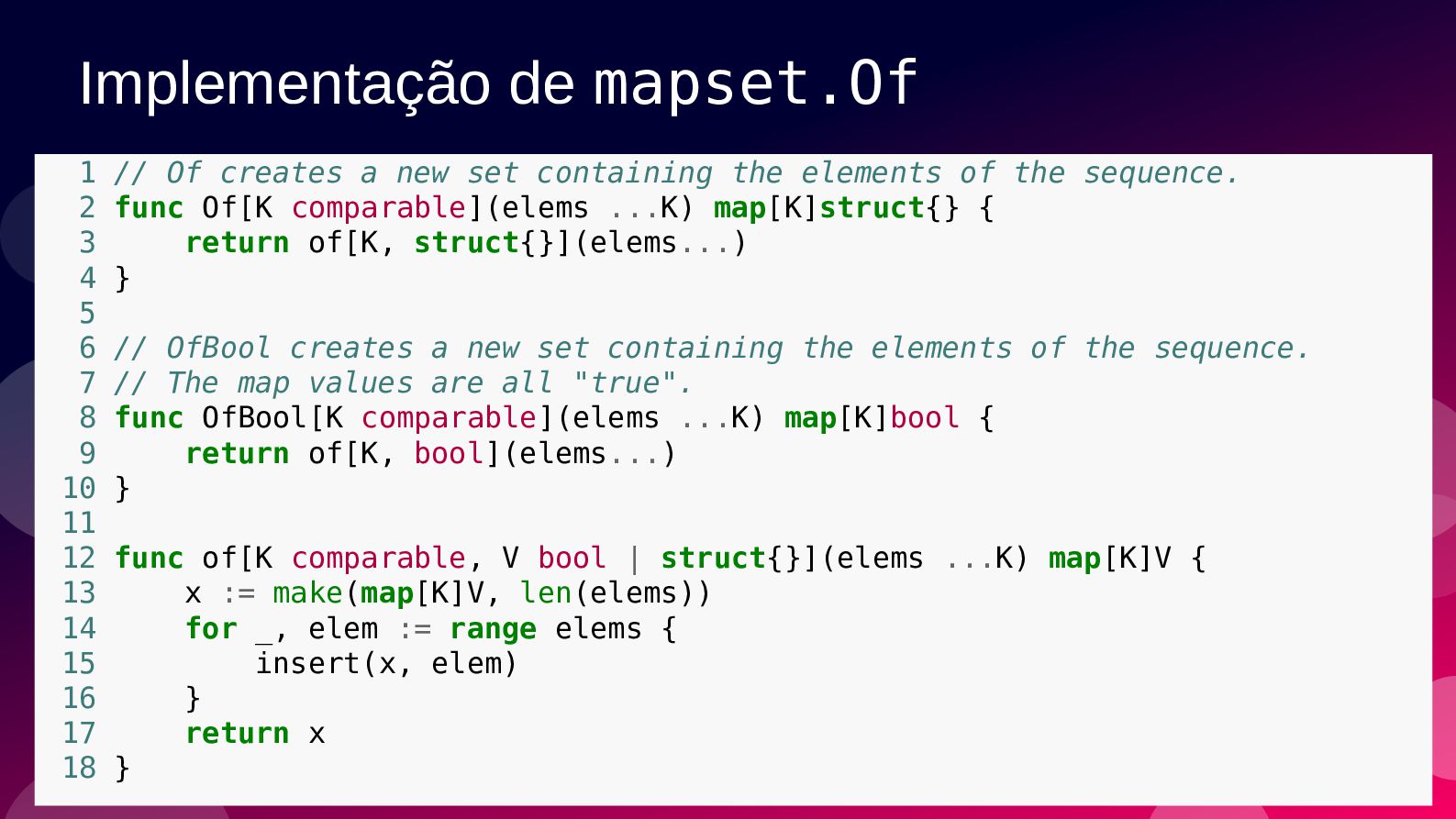
containing the elements of the sequence. 2 func Collect[E comparable](seq iter.Seq[E]) Set[E] { 3 return Set[E](mapset.Collect(seq)) 4 } 5 6 // Of creates a new set containing the elements of the sequence. 7 func Of[E comparable](elems ...E) map[E]struct{} { 8 return Set[E](mapset.Of(elems...)) 9 } • • set.Collect recebe iter.Set[E]; set.Of recebe ...E set.Collect devolve Set[E]; set.Of devolve map[E]struct{} – Sinal de WIP! (trabalho em andamento)
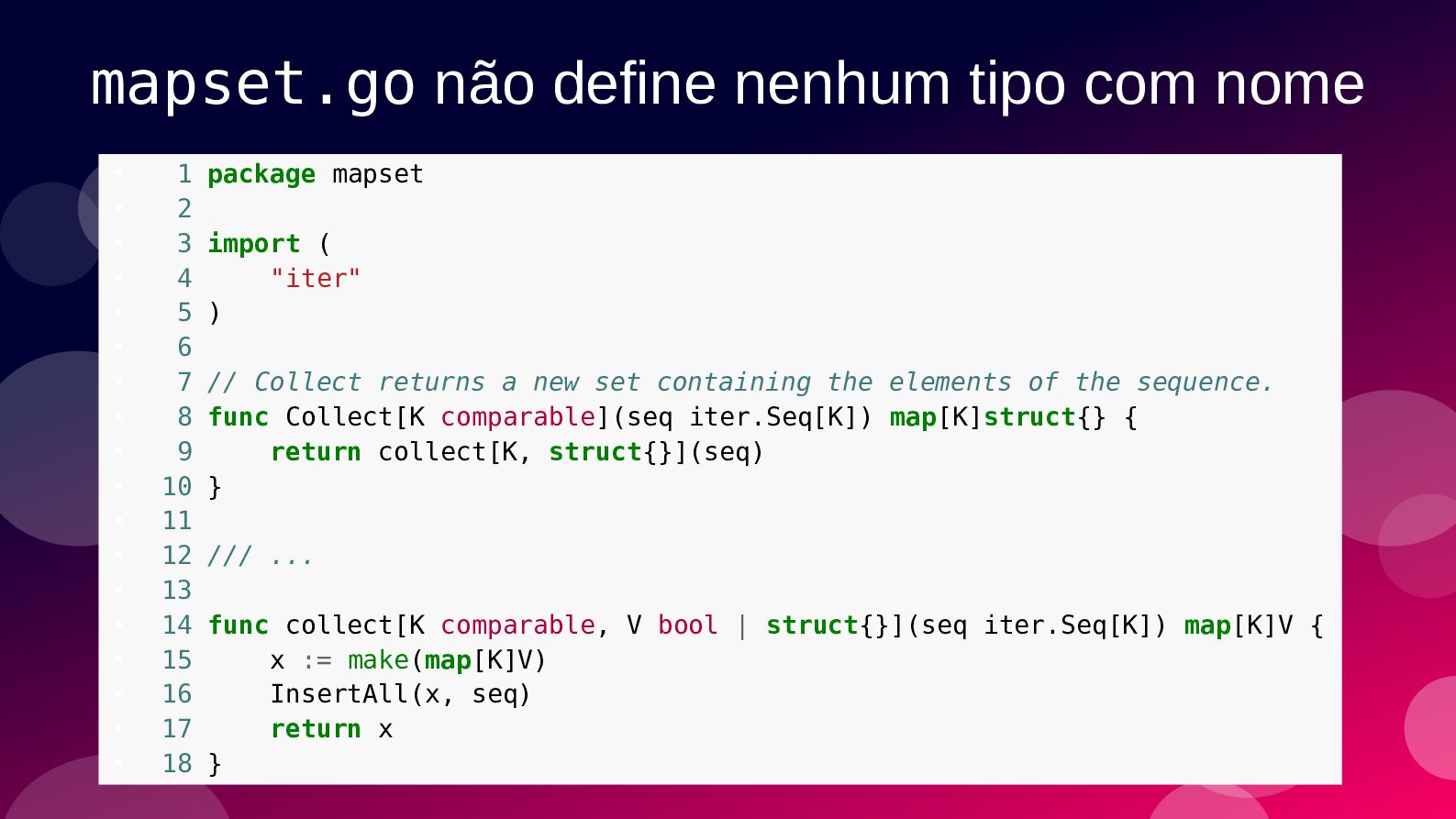
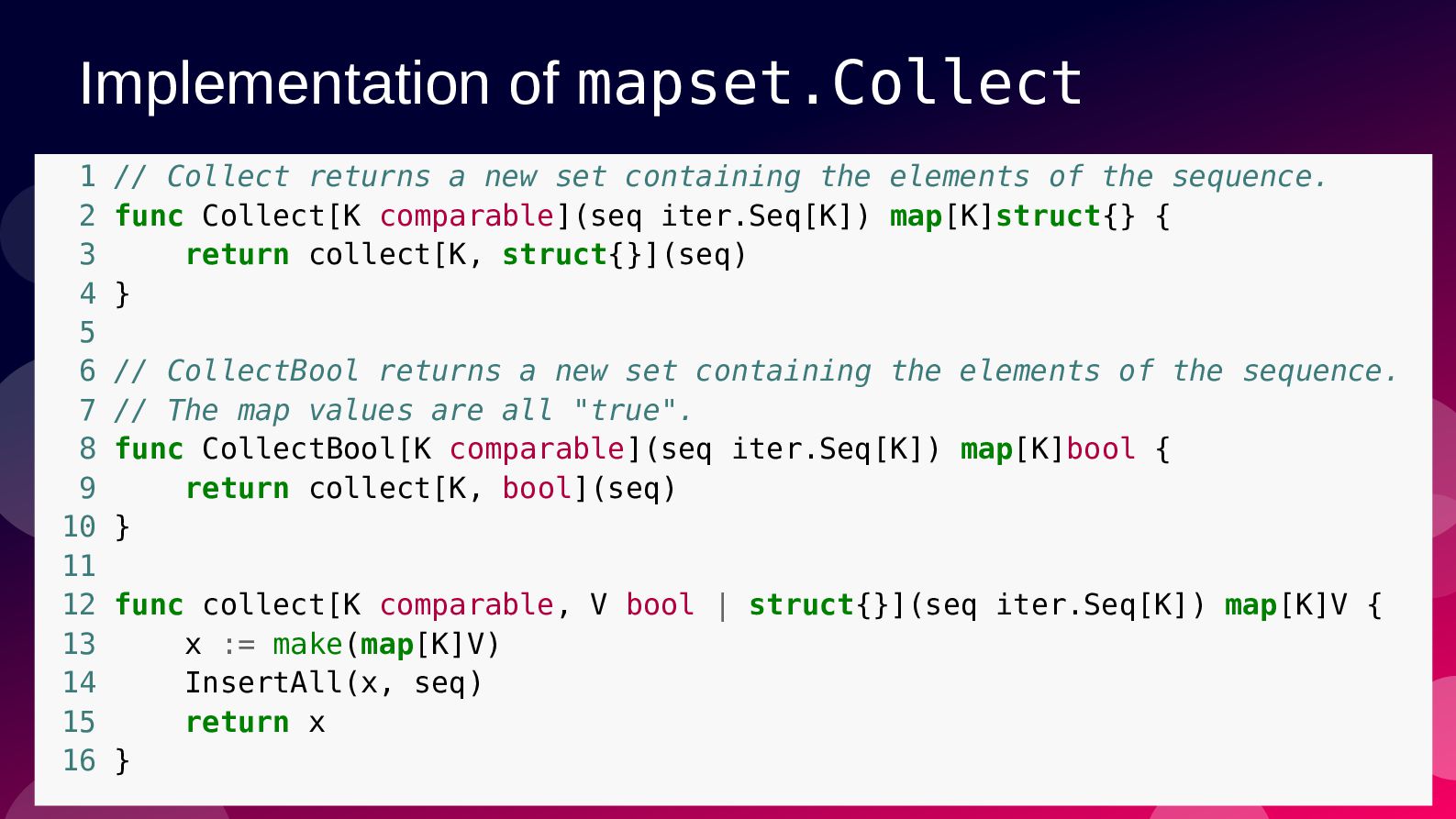
containing the elements of the sequence. 2 func Collect[K comparable](seq iter.Seq[K]) map[K]struct{} { 3 return collect[K, struct{}](seq) 4 } 5 6 // CollectBool returns a new set containing the elements of the sequence. 7 // The map values are all "true". 8 func CollectBool[K comparable](seq iter.Seq[K]) map[K]bool { 9 return collect[K, bool](seq) 10 } 11 12 func collect[K comparable, V bool | struct{}](seq iter.Seq[K]) map[K]V { 13 x := make(map[K]V) 14 InsertAll(x, seq) 15 return x 16 }
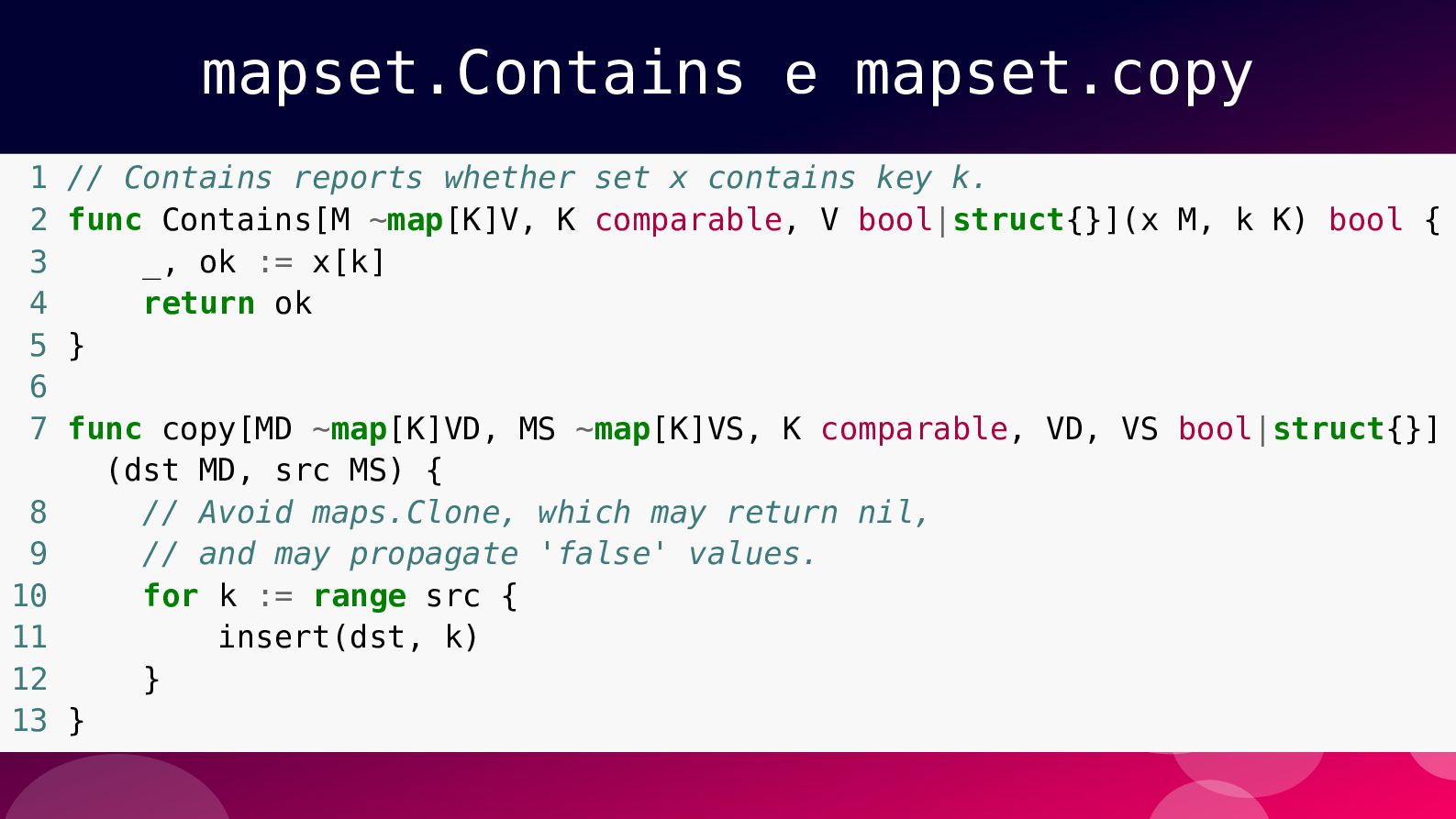
the set. 2 // If the set values are boolean, the value 'true' is used. 3 // It reports whether len(x) changed. 4 func Insert[M ~map[K]V, K comparable, V bool | struct{}](x M, elem K) bool { 5 pre := len(x) 6 insert(x, elem) 7 return len(x) != pre 8 } 9 10 // InsertAll adds each element of the addenda sequence to the set. 11 // If the set values are boolean, the value 'true' is used. 12 // It reports whether len(x) changed. 13 func InsertAll[M ~map[K]V, K comparable, V bool | struct{}](x M, addenda iter.Seq[K]) bool { 14 pre := len(x) 15 for k := range addenda { 16 insert(x, k) 17 } 18 return len(x) != pre 19 }
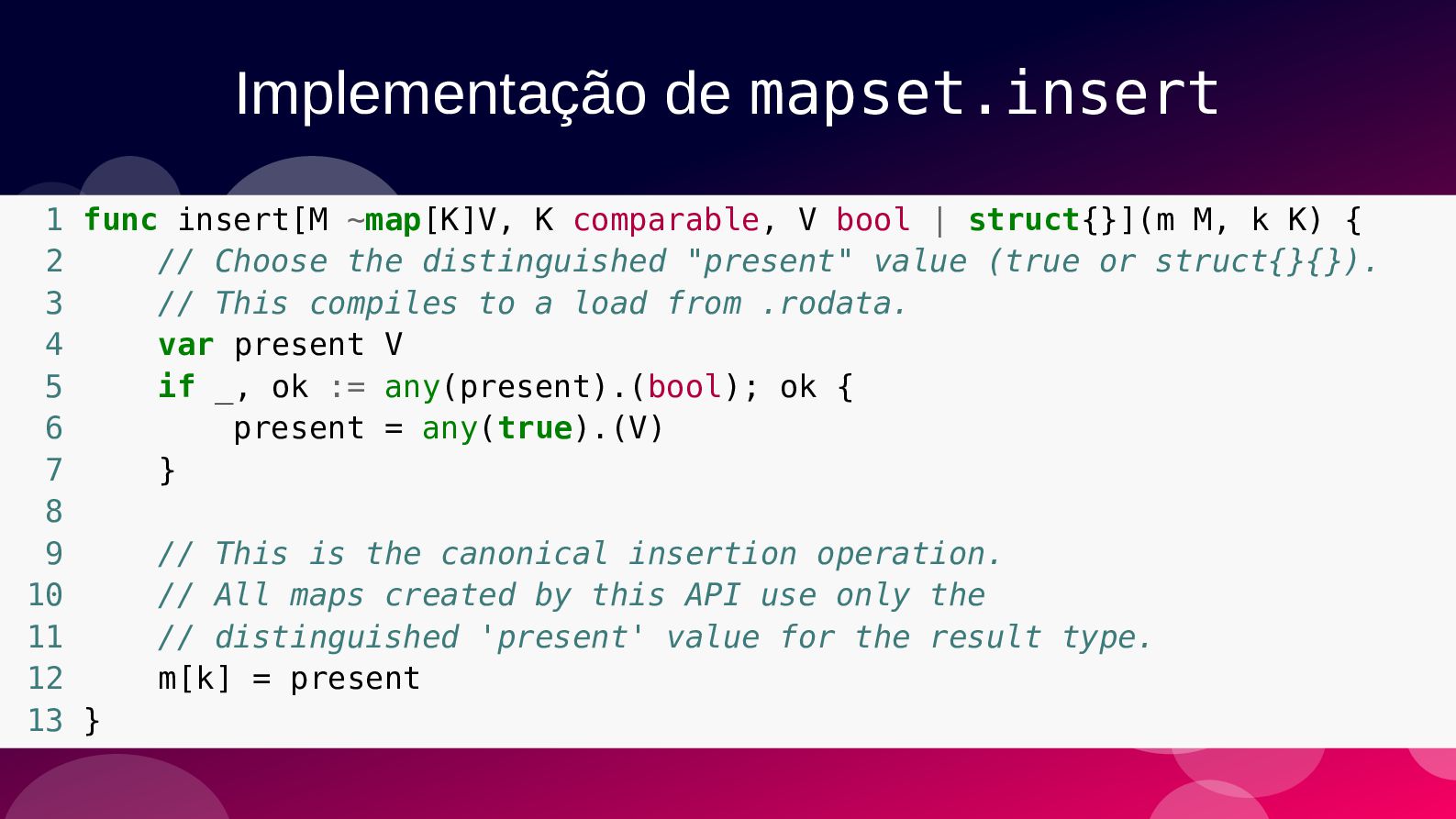
bool | struct{}](m M, k K) { 2 // Choose the distinguished "present" value (true or struct{}{}). 3 // This compiles to a load from .rodata. 4 var present V 5 if _, ok := any(present).(bool); ok { 6 present = any(true).(V) 7 } 8 9 // This is the canonical insertion operation. 10 // All maps created by this API use only the 11 // distinguished 'present' value for the result type. 12 m[k] = present 13 }
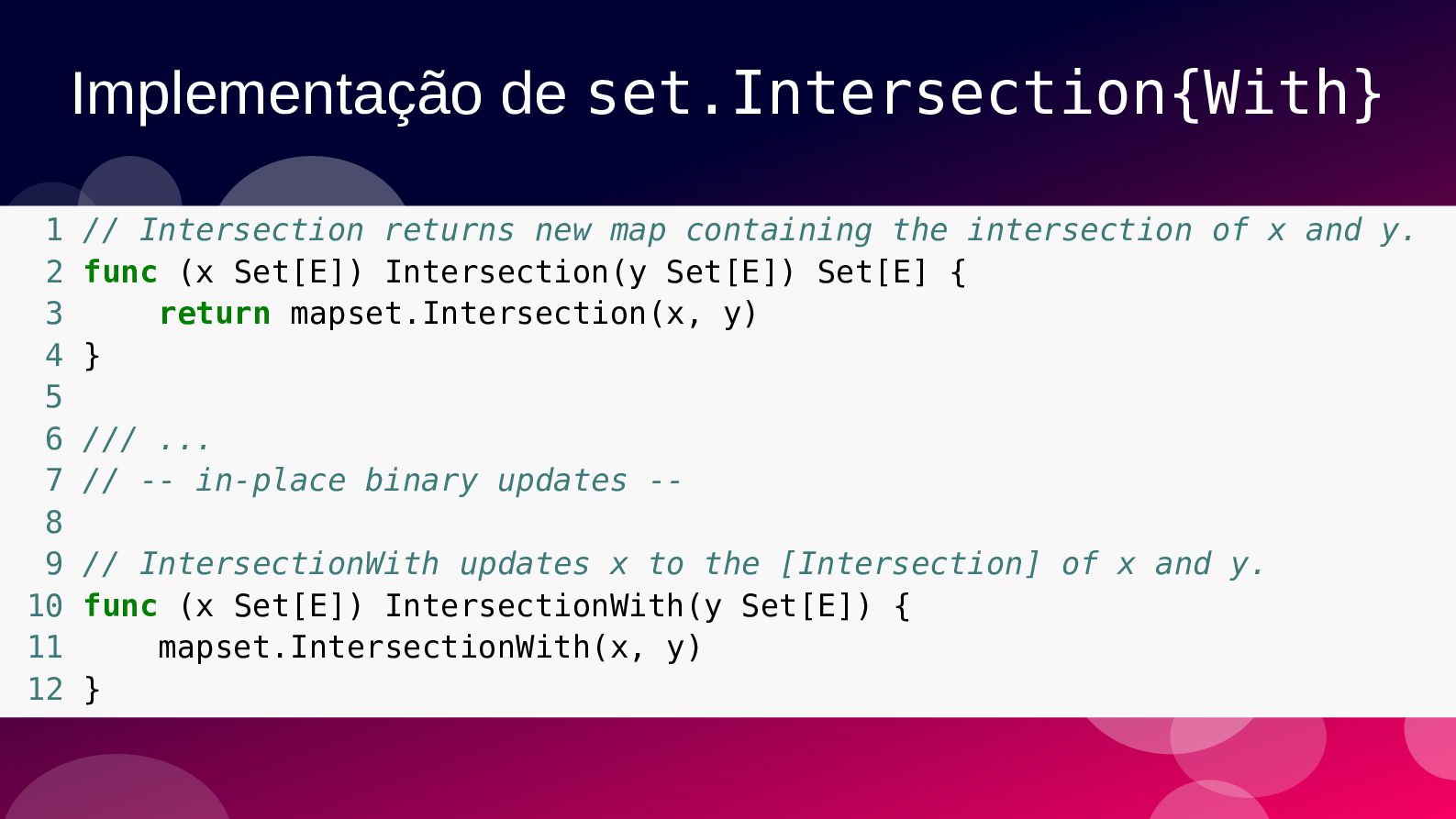
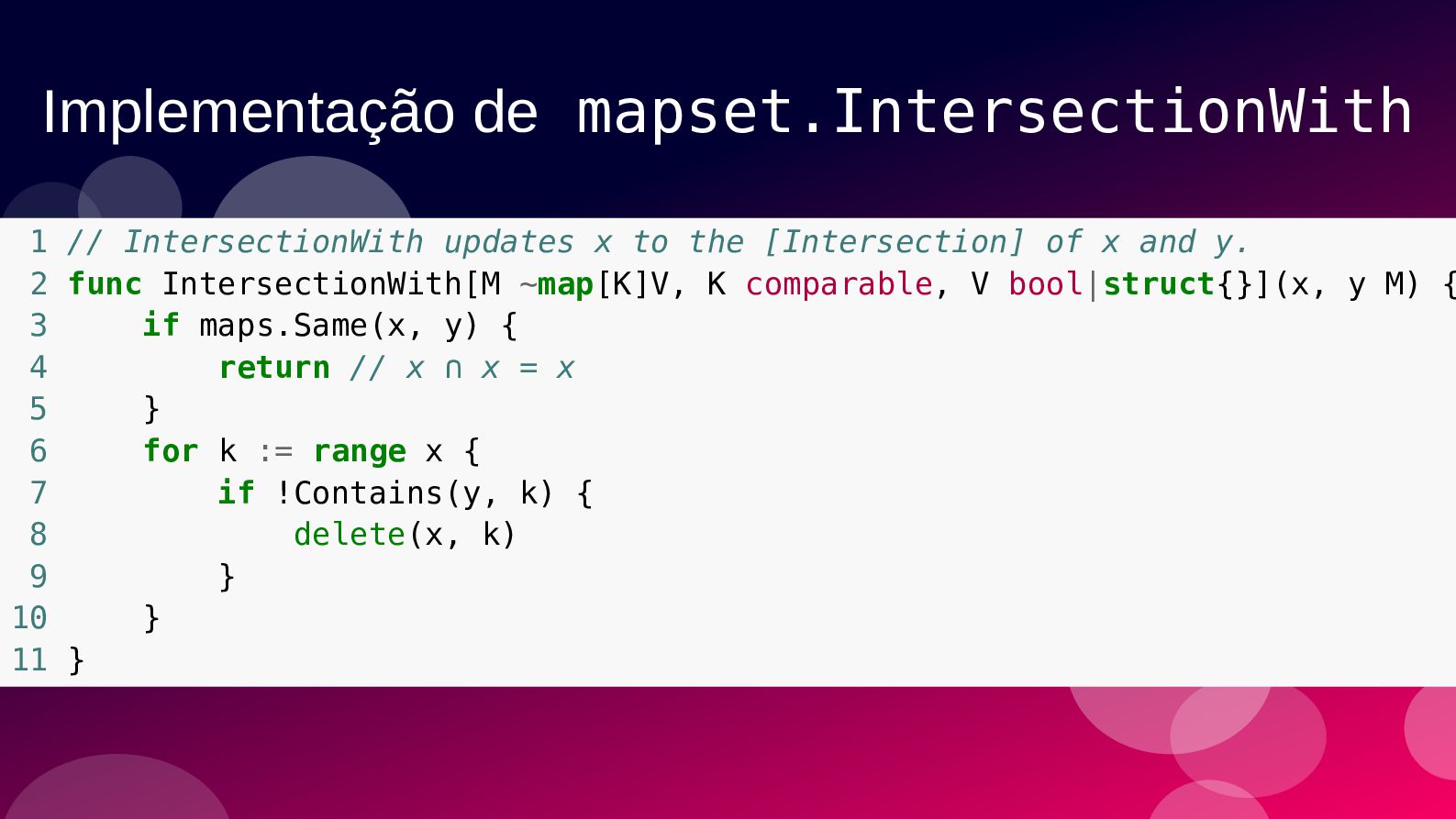
the intersection of x and y. 2 func (x Set[E]) Intersection(y Set[E]) Set[E] { 3 return mapset.Intersection(x, y) 4 } 5 6 /// ... 7 // -- in-place binary updates -8 9 // IntersectionWith updates x to the [Intersection] of x and y. 10 func (x Set[E]) IntersectionWith(y Set[E]) { 11 mapset.IntersectionWith(x, y) 12 }
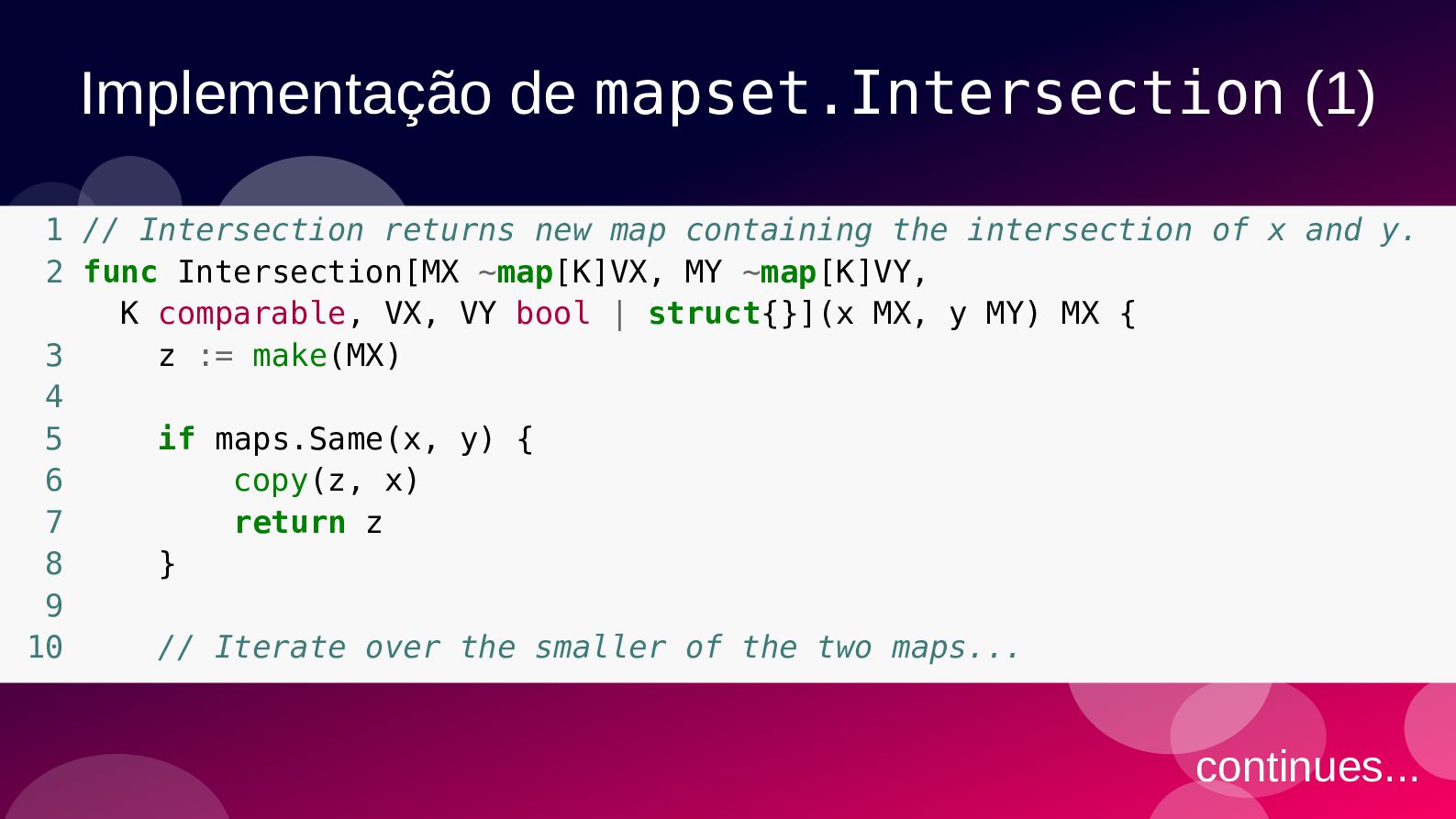
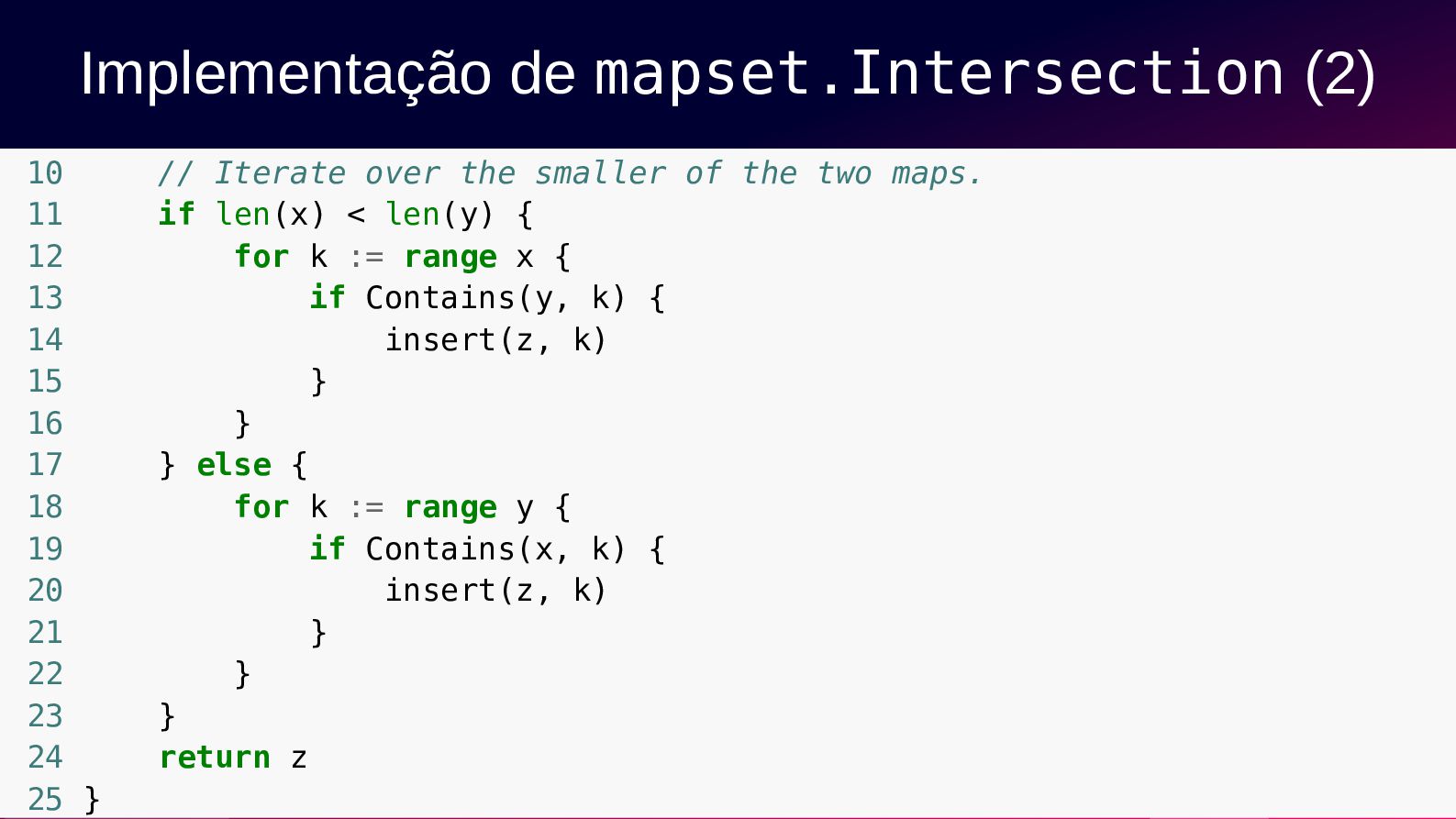
containing the intersection of x and y. 2 func Intersection[MX ~map[K]VX, MY ~map[K]VY, K comparable, VX, VY bool | struct{}](x MX, y MY) MX { 3 z := make(MX) 4 5 if maps.Same(x, y) { 6 copy(z, x) 7 return z 8 } 9 10 // Iterate over the smaller of the two maps... continues...
16 17 18 19 20 21 22 23 24 25 } // Iterate over the smaller of the two maps. if len(x) < len(y) { for k := range x { if Contains(y, k) { insert(z, k) } } } else { for k := range y { if Contains(x, k) { insert(z, k) } } } return z
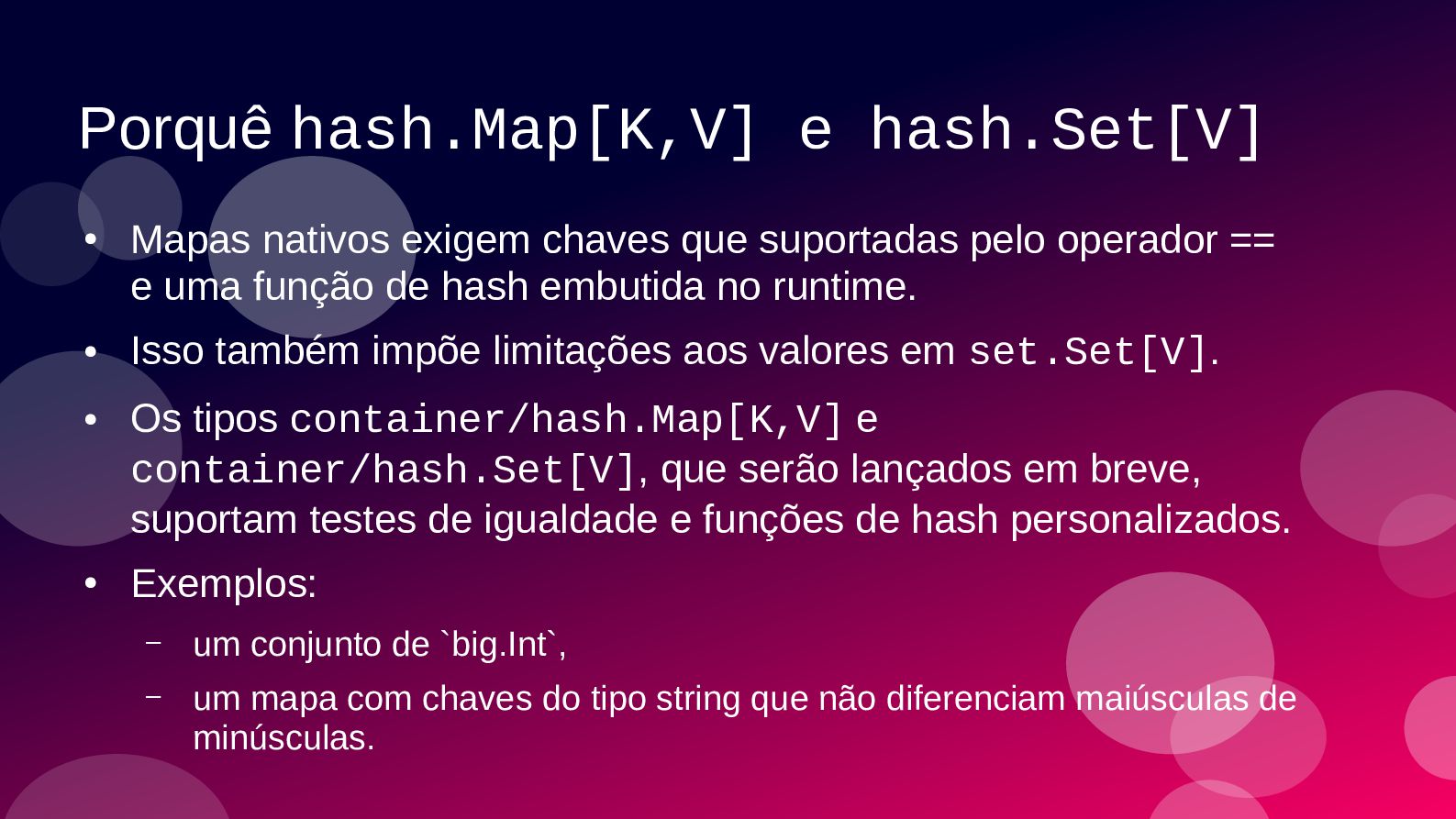
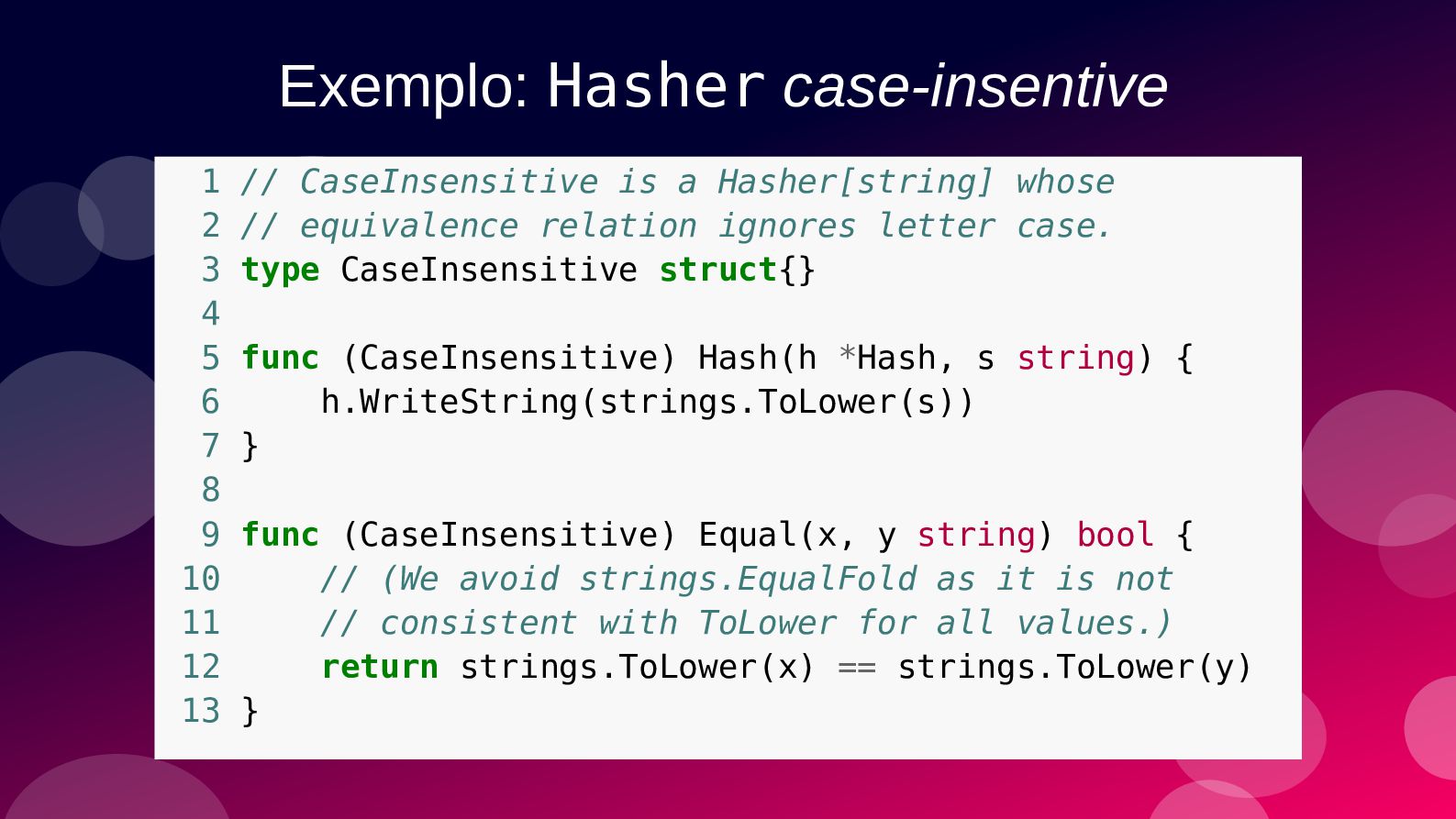
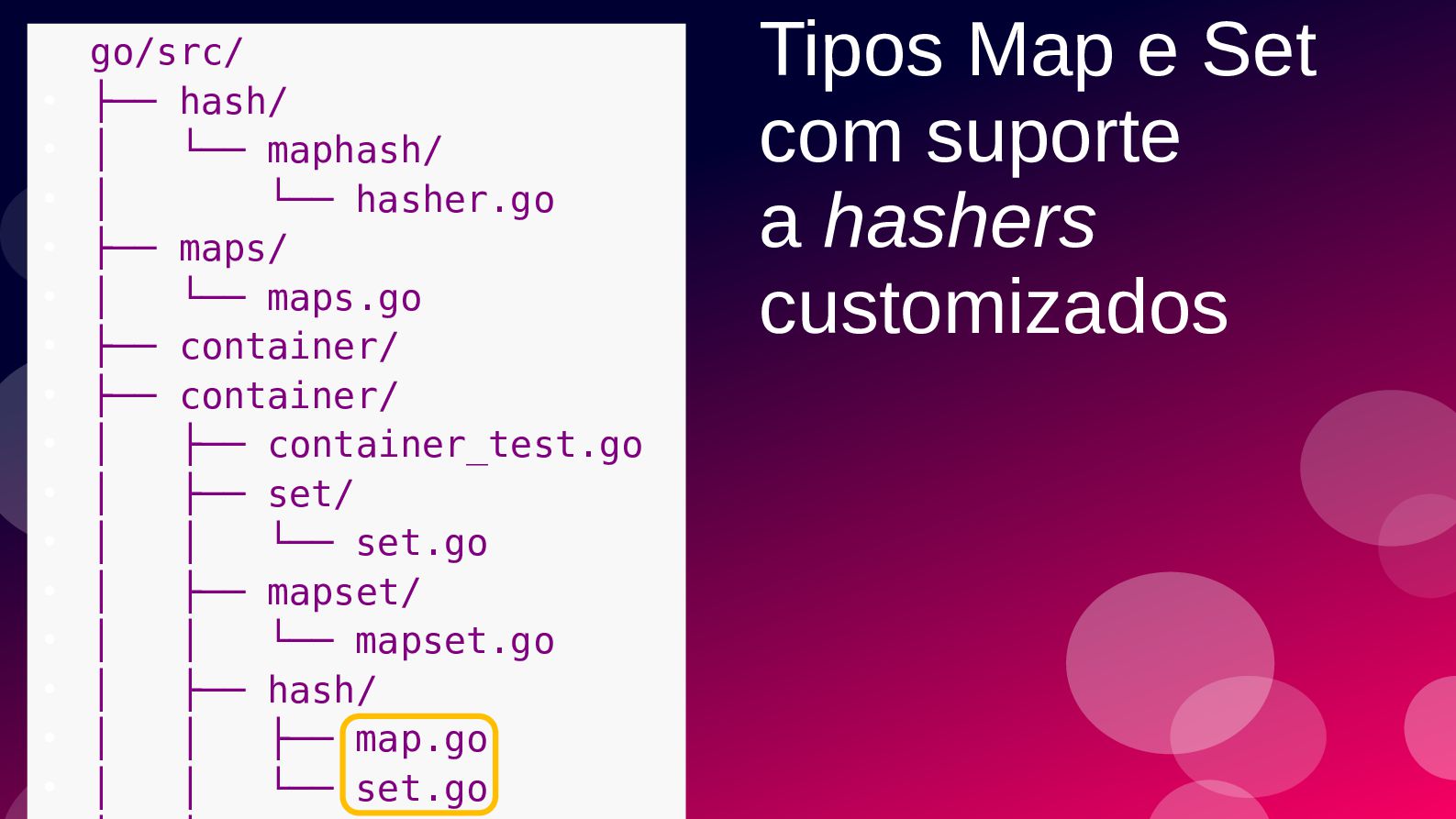
exigem chaves comparable (suportam operador ==) e uma função de hash embutida no runtime. Isso também impõe limitações aos valores em set.Set[V]. Os tipos container/hash.Map[K,V] e container/hash.Set[V] do Go 1.28 suportam testes de igualdade e funções de hash personalizados. Exemplos: – um conjunto de `big.Int`, – um mapa com chaves do tipo string que não diferenciam maiúsculas de minúsculas.
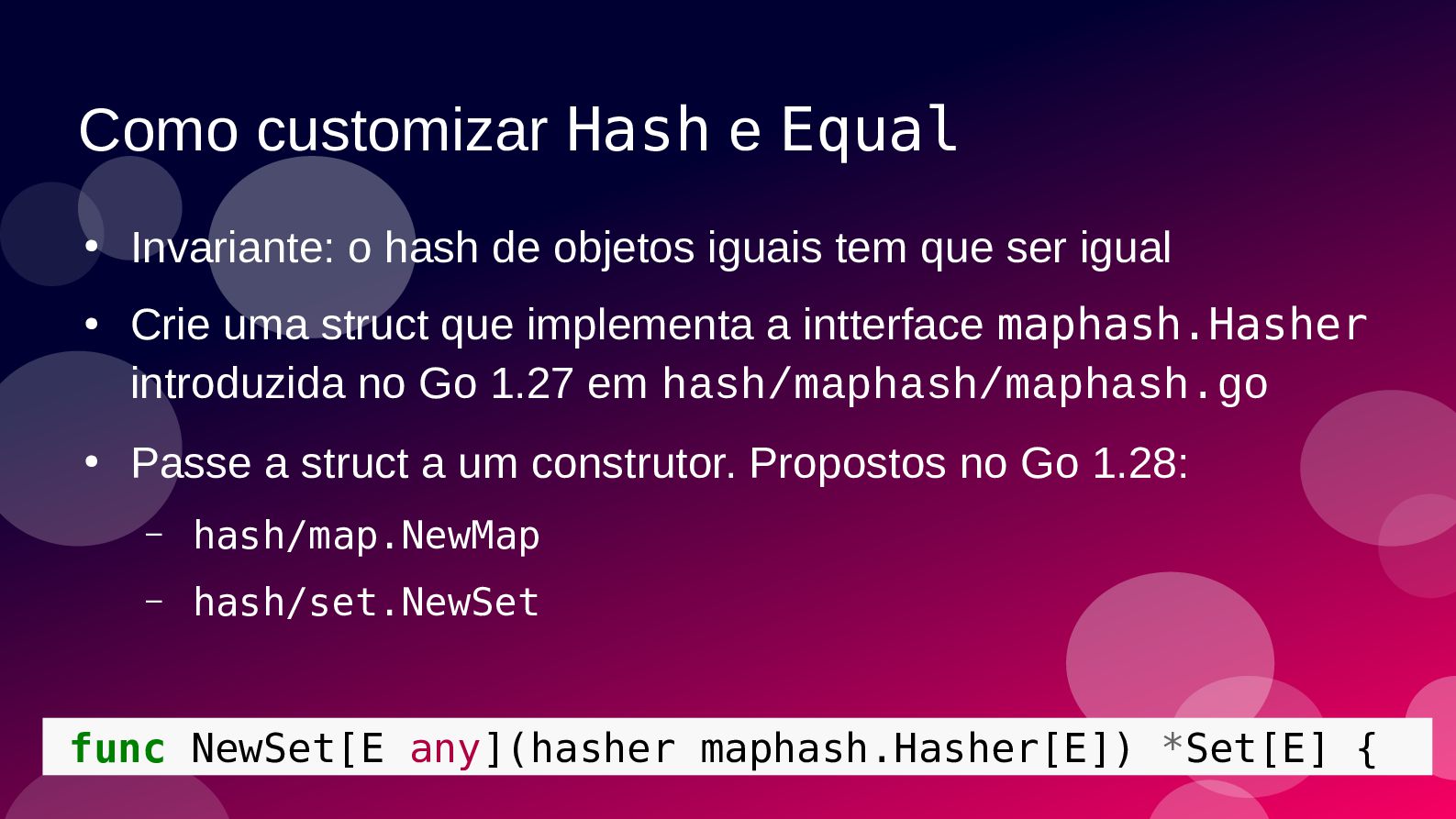
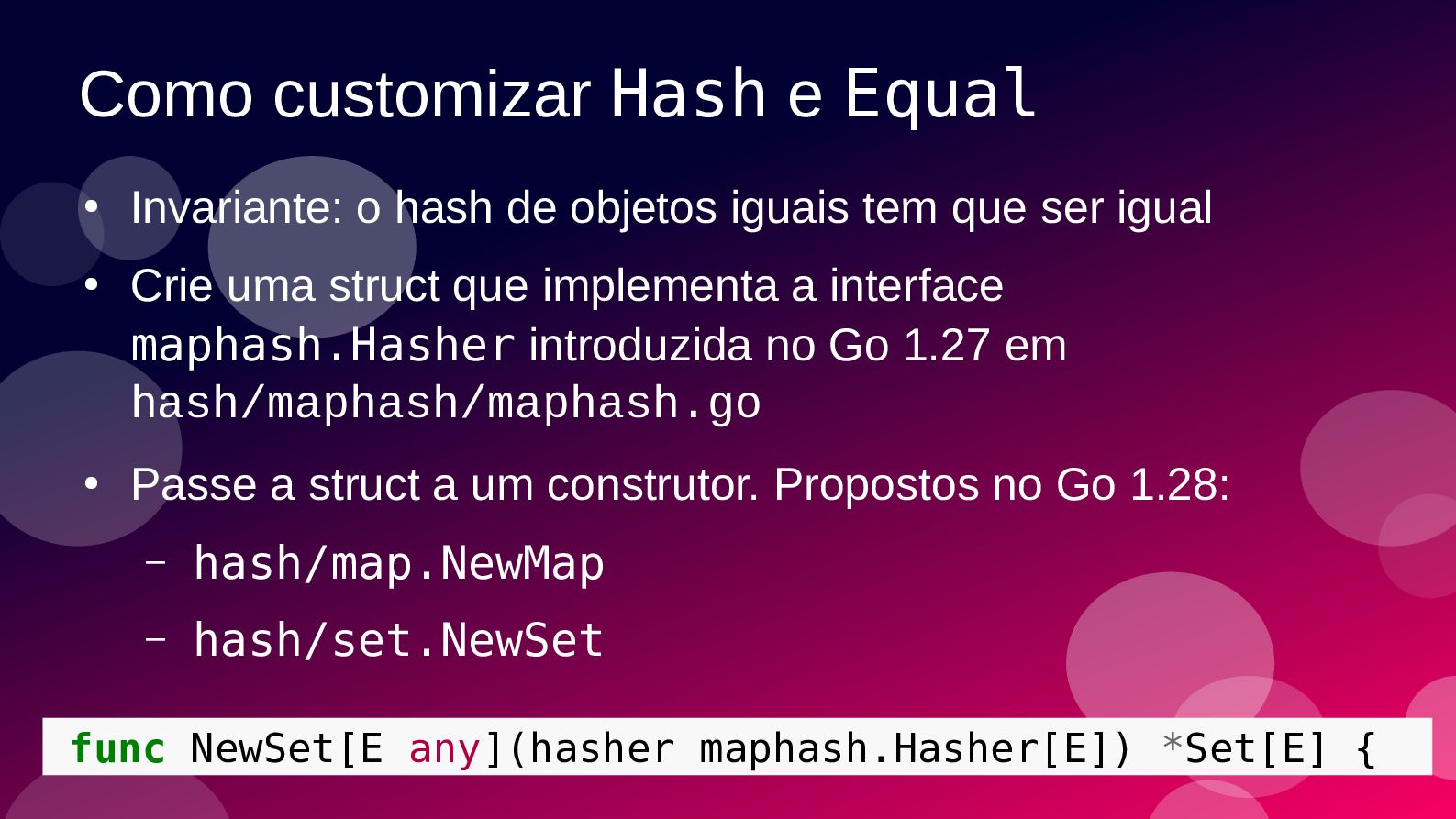
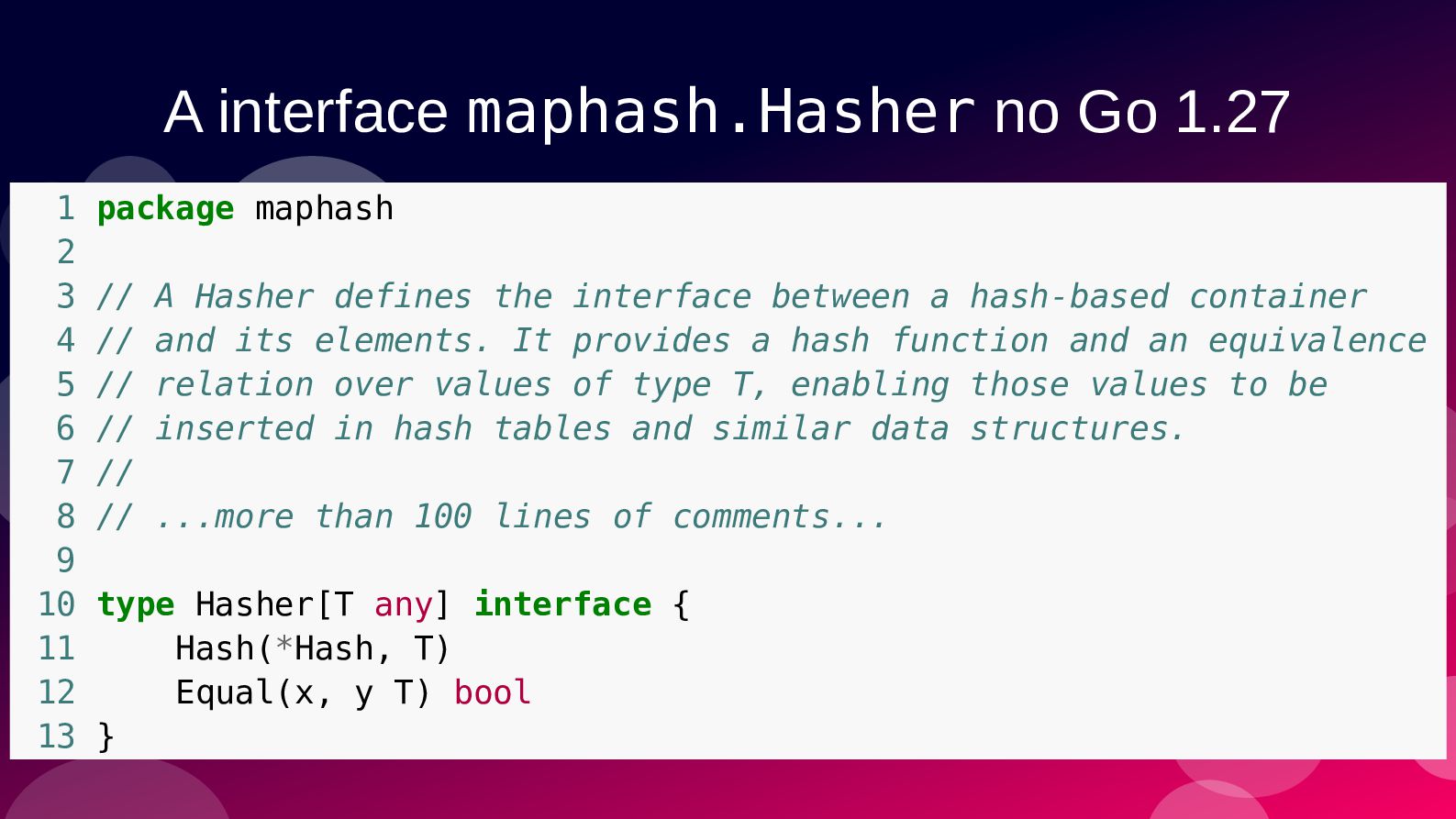
hash de objetos iguais tem que ser igual Crie uma struct que implementa a interface maphash.Hasher introduzida no Go 1.27 em hash/maphash/maphash.go Passe a struct a um construtor. Propostos no Go 1.28: – hash/map.NewMap – hash/set.NewSet func NewSet[E any](hasher maphash.Hasher[E]) *Set[E] {
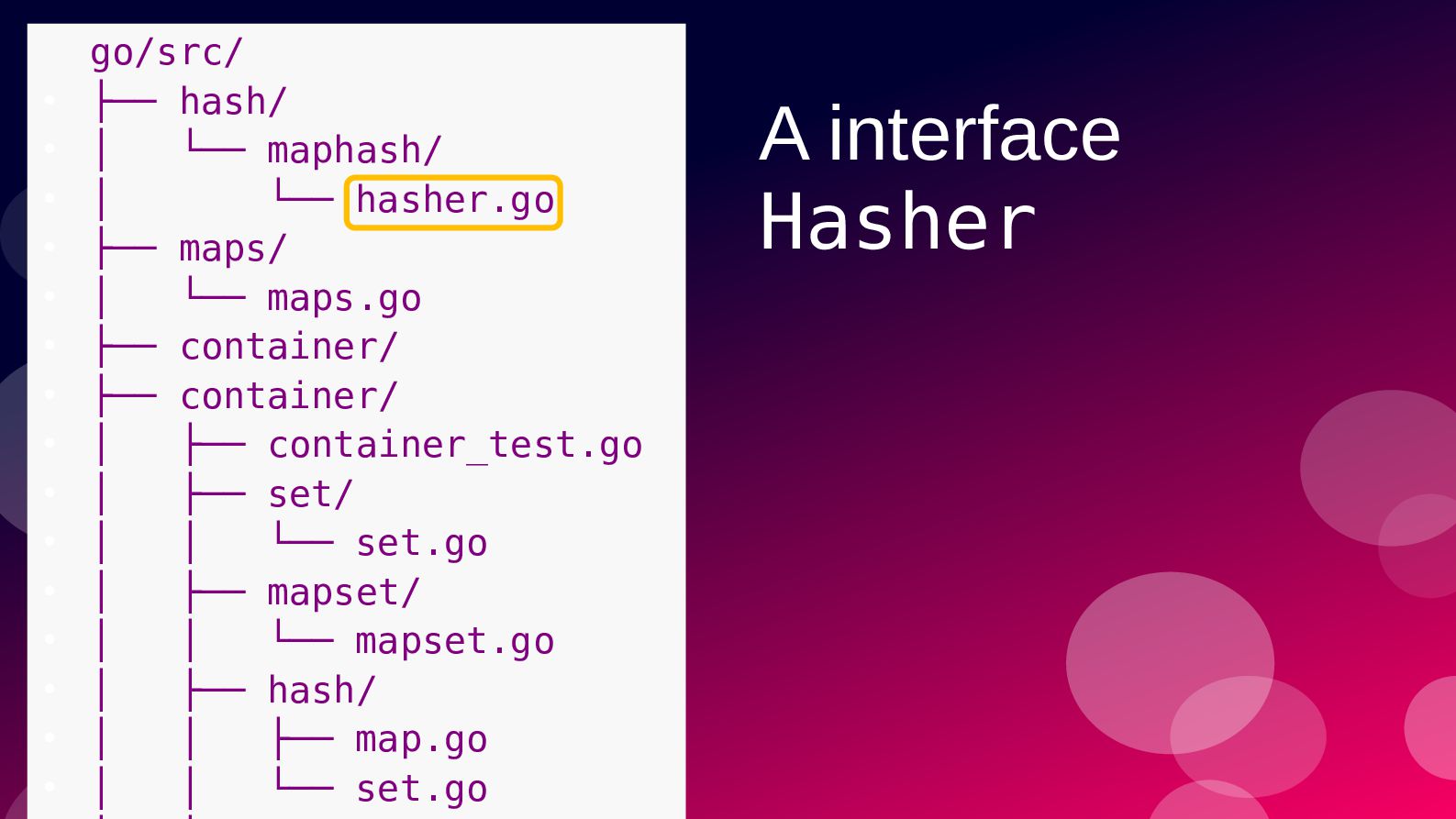
3 // A Hasher defines the interface between a hash-based container 4 // and its elements. It provides a hash function and an equivalence 5 // relation over values of type T, enabling those values to be 6 // inserted in hash tables and similar data structures. 7 // 8 // ...more than 100 lines of comments... 9 10 type Hasher[T any] interface { 11 Hash(*Hash, T) 12 Equal(x, y T) bool 13 }
utilizam agentes: O vocabulário preciso da álgebra de conjuntos é útil para instruir agentes, em qualquer linguagem de programação. Para programadores cidadãos: Aprender álgebra de conjuntos e o modelo relacional pode ser a melhor base para especificar sistemas para agentes Para todos: Exija seu tempo de volta. Tempo não é dinheiro; é o seu tempo de viver!
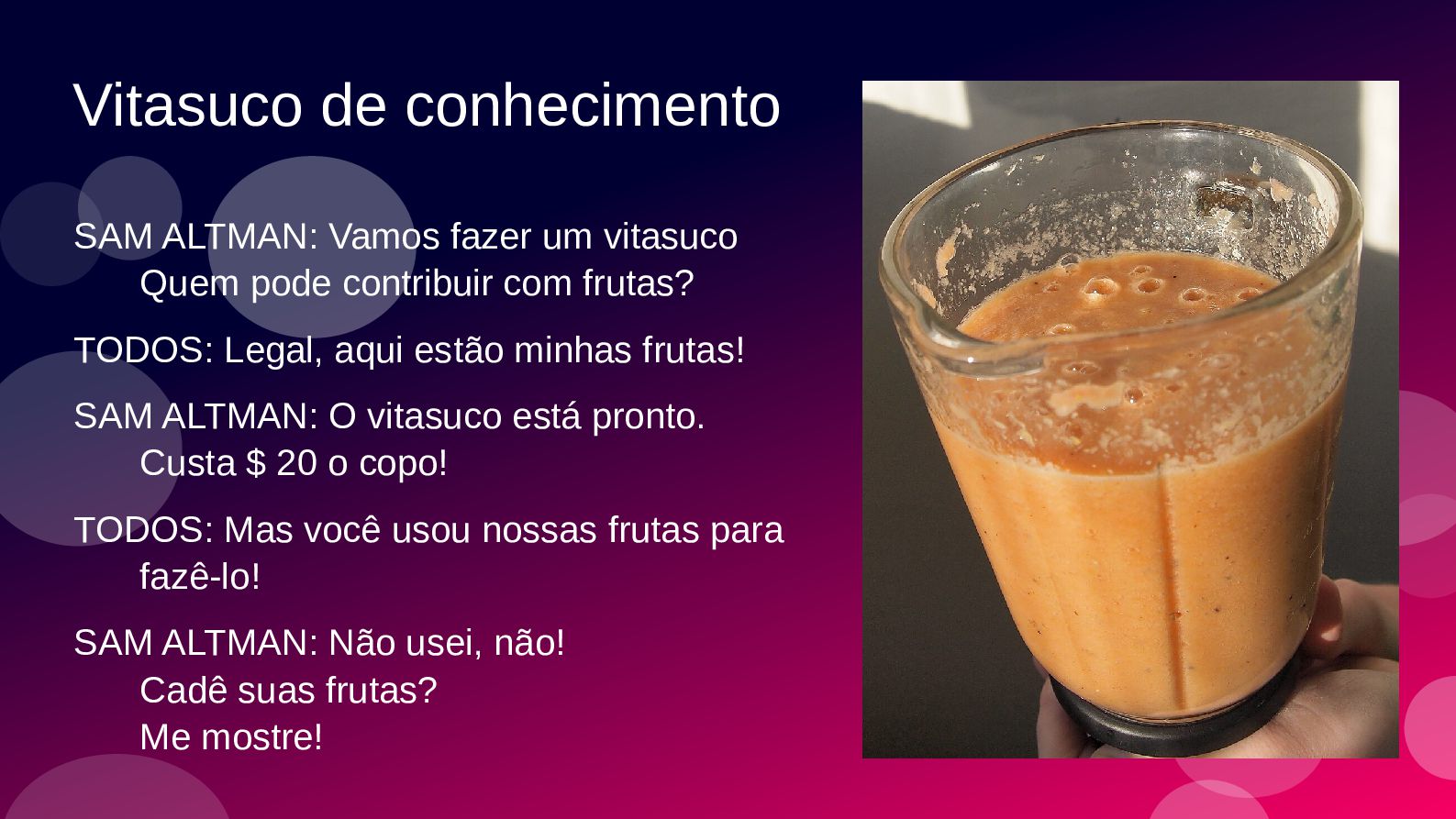
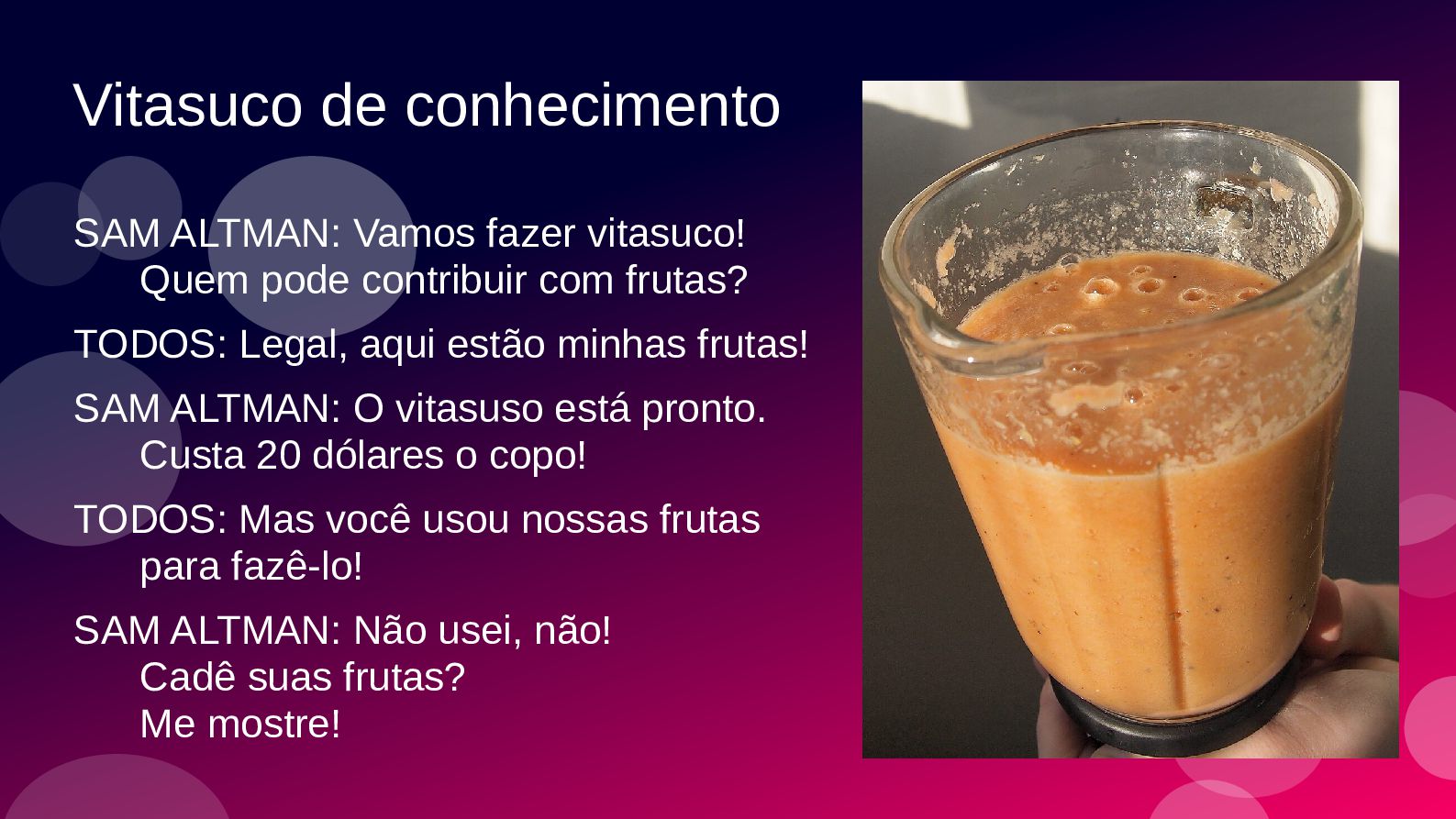
pode contribuir com frutas? TODOS: Legal, aqui estão minhas frutas! SAM ALTMAN: O vitasuco está pronto. Custa $ 20 o copo! TODOS: Mas você usou nossas frutas para fazê-lo! SAM ALTMAN: Não usei, não! Cadê suas frutas? Me mostre!
do Markdown • Co-fundador do Reddit • • • • Aaron foi preso em 2011 por baixar em massa artigos científicos do JSTOR Sua vida foi destruída pelo Departamento de Justiça dos EUA Ele não compartilhou os artigos com ninguém. O que iria fazer com eles? Talvez treinar um modelo?
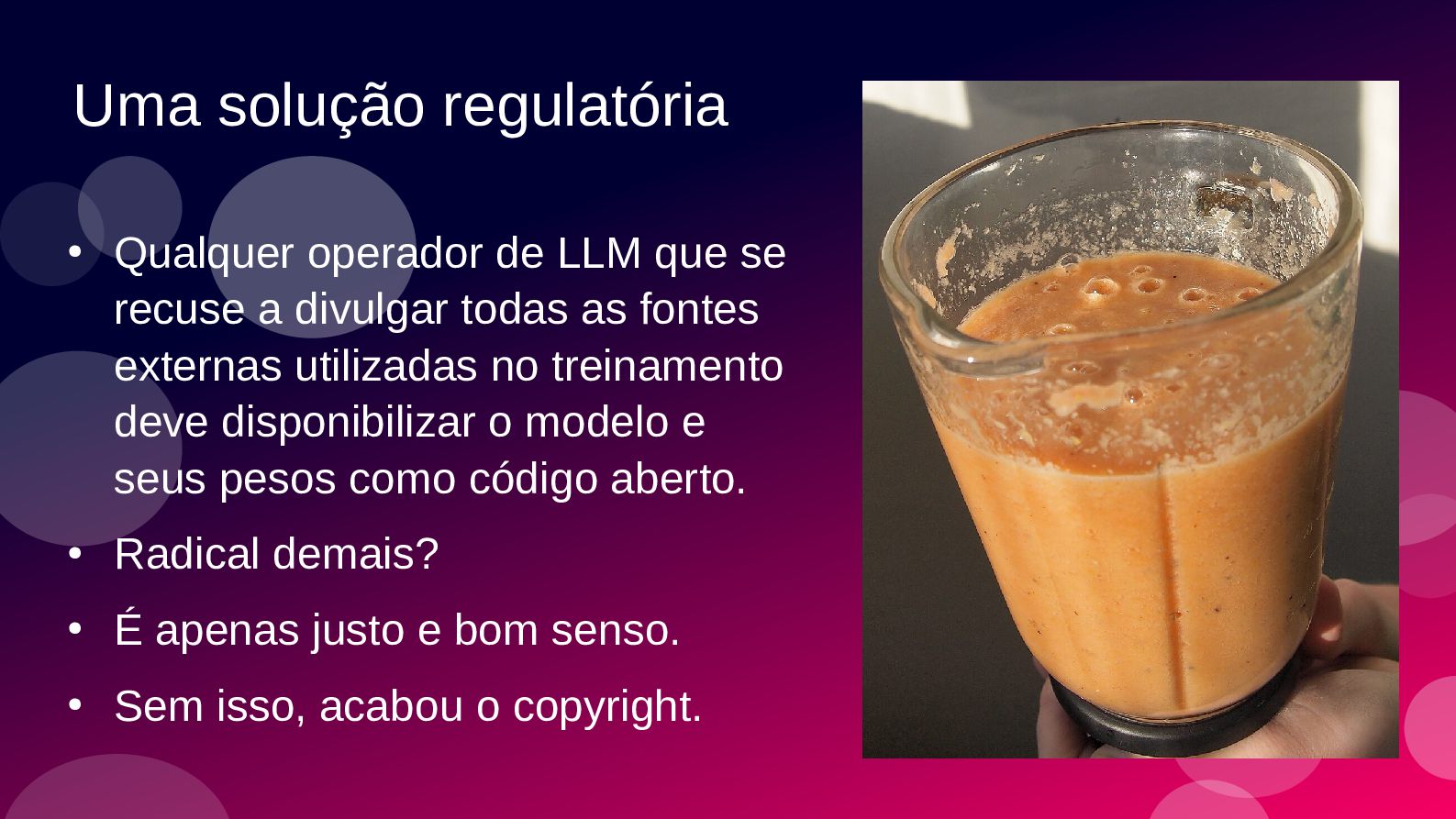
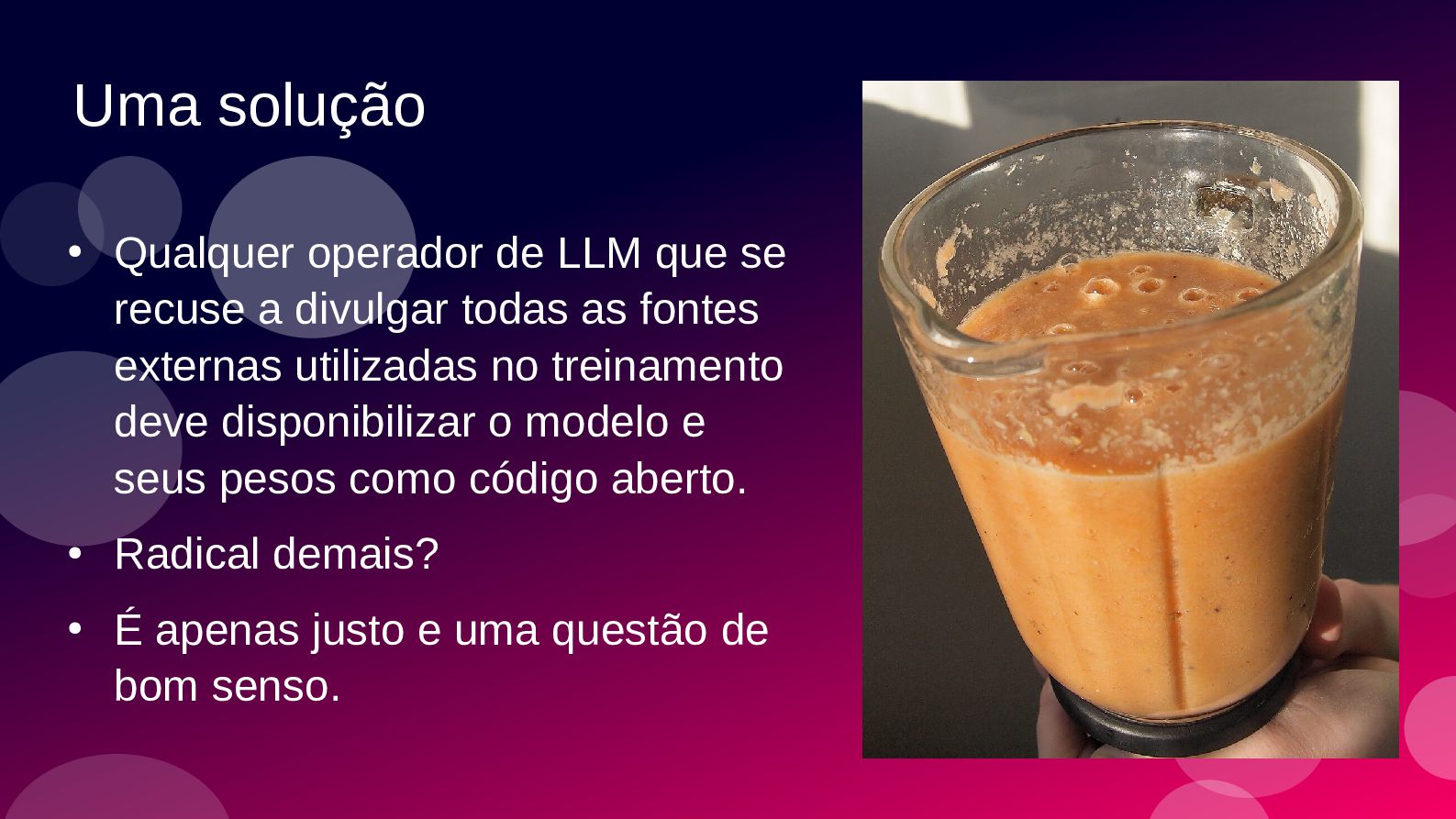
recuse a divulgar todas as fontes externas utilizadas no treinamento deve disponibilizar o modelo e seus pesos como código aberto. • Radical demais? • É apenas justo e bom senso. • Sem isso, acabou o copyright.
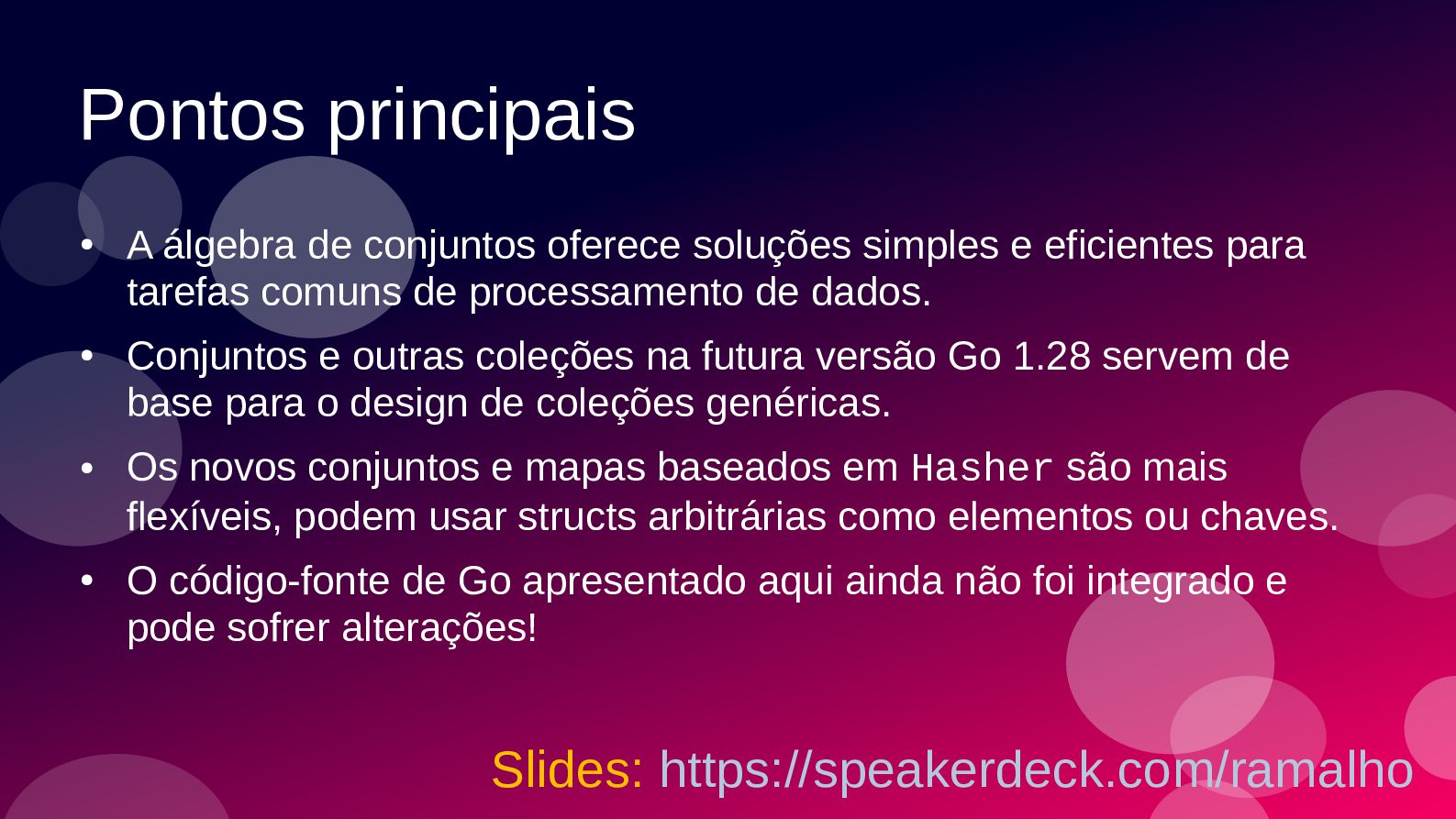
oferece soluções simples e eficientes para tarefas comuns de processamento de dados. Conjuntos e outras coleções na futura versão Go 1.28 servem de base para o design de coleções genéricas. Os novos conjuntos e mapas baseados em Hasher são mais flexíveis, podem usar types arbitrárias como elementos ou chaves. O código-fonte de Go apresentado aqui ainda não foi integrado e pode sofrer alterações! Slides: https://speakerdeck.com/ramalho

 SiteGround - Reliable hosting with speed, security, and support you can count on.


 ramalho
 gonta
gonta
 448jp
448jp
 y0hgi
y0hgi
 andpad
 koher
koher
 steliosf
 elmetal
 oku053
 gam0022
 satoshi256kbyte
 kanfab1
 skydoves
 addyosmani
 reverentgeek
 soudai
 mfonobong
 mkilby
 chriscoyier
 mojombo
 tanoku
 inesmontani
 jeffersonlam
![Conjuntos em Go 1.28 Luciano Ramalho [email protected] github/codeberg: @ramalho](https://files.speakerdeck.com/presentations/182603aa7d654492a973c5cc41d02337/slide_0.jpg)
![Padrão tradicional: map[string]struct{} 1 // writeUnique copies input to output,](https://files.speakerdeck.com/presentations/182603aa7d654492a973c5cc41d02337/slide_7.jpg)
![Outro padrão tradicional: map[string]bool 1 // writeUnique copies input to](https://files.speakerdeck.com/presentations/182603aa7d654492a973c5cc41d02337/slide_8.jpg)
![Futuro: set.Set[string] 1 // writeUnique copies input to output, 2](https://files.speakerdeck.com/presentations/182603aa7d654492a973c5cc41d02337/slide_9.jpg)
![// unigo-map seen := make(map[string]struct{}) for lines.Scan() { line :=](https://files.speakerdeck.com/presentations/182603aa7d654492a973c5cc41d02337/slide_10.jpg)



![Os 7 componentes propostos 5)container/set.Set[T] representado de forma transparente como](https://files.speakerdeck.com/presentations/182603aa7d654492a973c5cc41d02337/slide_41.jpg)
![Implementação de set.Set[T]](https://files.speakerdeck.com/presentations/182603aa7d654492a973c5cc41d02337/slide_61.jpg)
![Implementação de mapset.insert 1 func insert[M ~map[K]V, K comparable, V](https://files.speakerdeck.com/presentations/182603aa7d654492a973c5cc41d02337/slide_69.jpg)
![Um pouco sobre hash.Set[T]](https://files.speakerdeck.com/presentations/182603aa7d654492a973c5cc41d02337/slide_73.jpg)
![Porquê hash.Map[K,V] e hash.Set[V] • • • • Mapas nativos](https://files.speakerdeck.com/presentations/182603aa7d654492a973c5cc41d02337/slide_74.jpg)

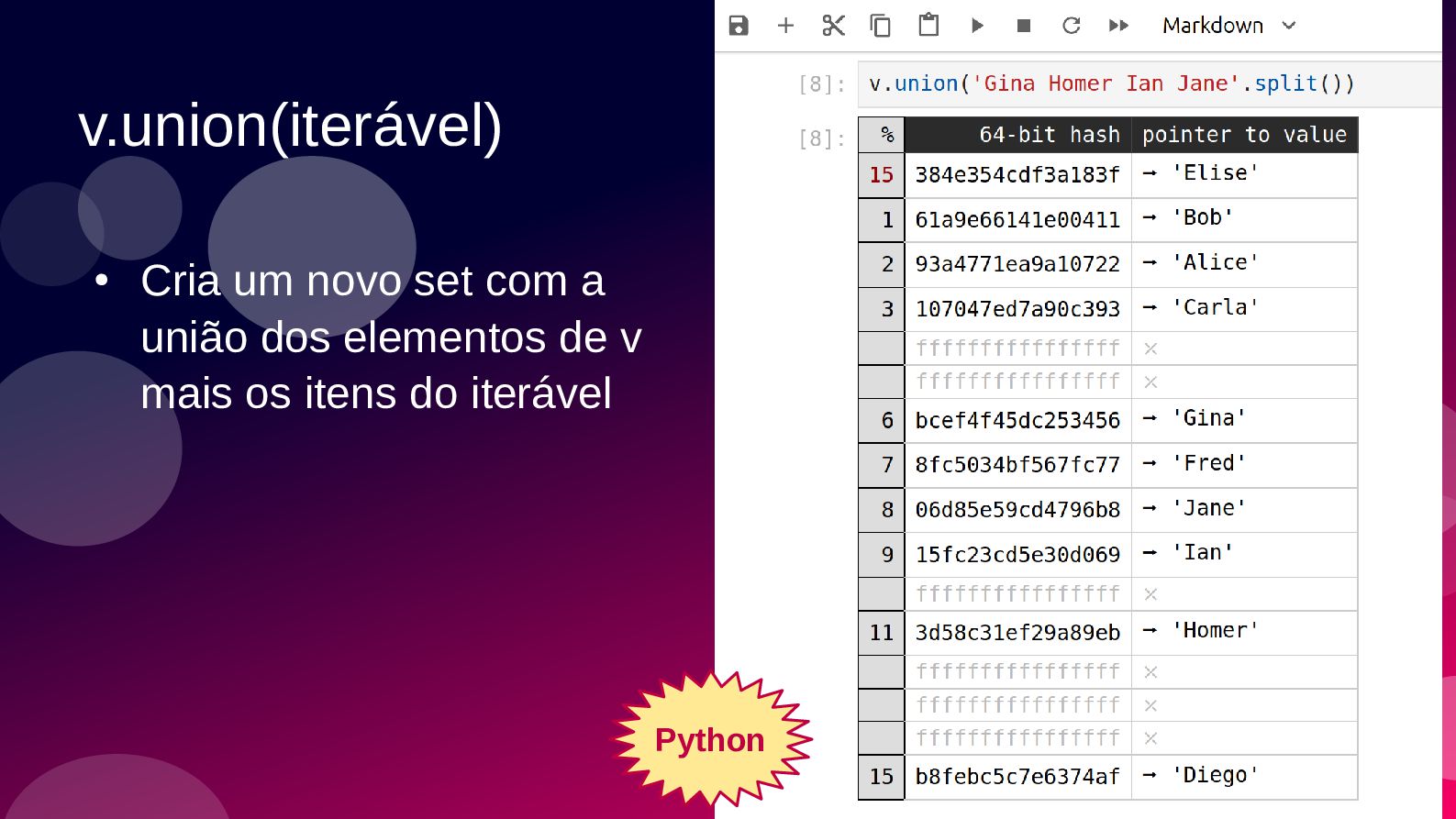
![Implementação proposta para hash.Set[T] no Go 1.28](https://files.speakerdeck.com/presentations/182603aa7d654492a973c5cc41d02337/slide_86.jpg)
![Exemplo: Hasher case-insentive 1 // CaseInsensitive is a Hasher[string] whose](https://files.speakerdeck.com/presentations/182603aa7d654492a973c5cc41d02337/slide_91.jpg)