Upgrade to Pro — share decks privately, control downloads, hide ads and more …

Common mistakes in large-scale site migration -...

Common mistakes in large-scale site migration - Brighton SEO Oct 2026 - Rebecca Yu

Talk: Common mistakes in large-scale site migration
Speaker: Rebecca Yu - SEO Manager in JAKALA

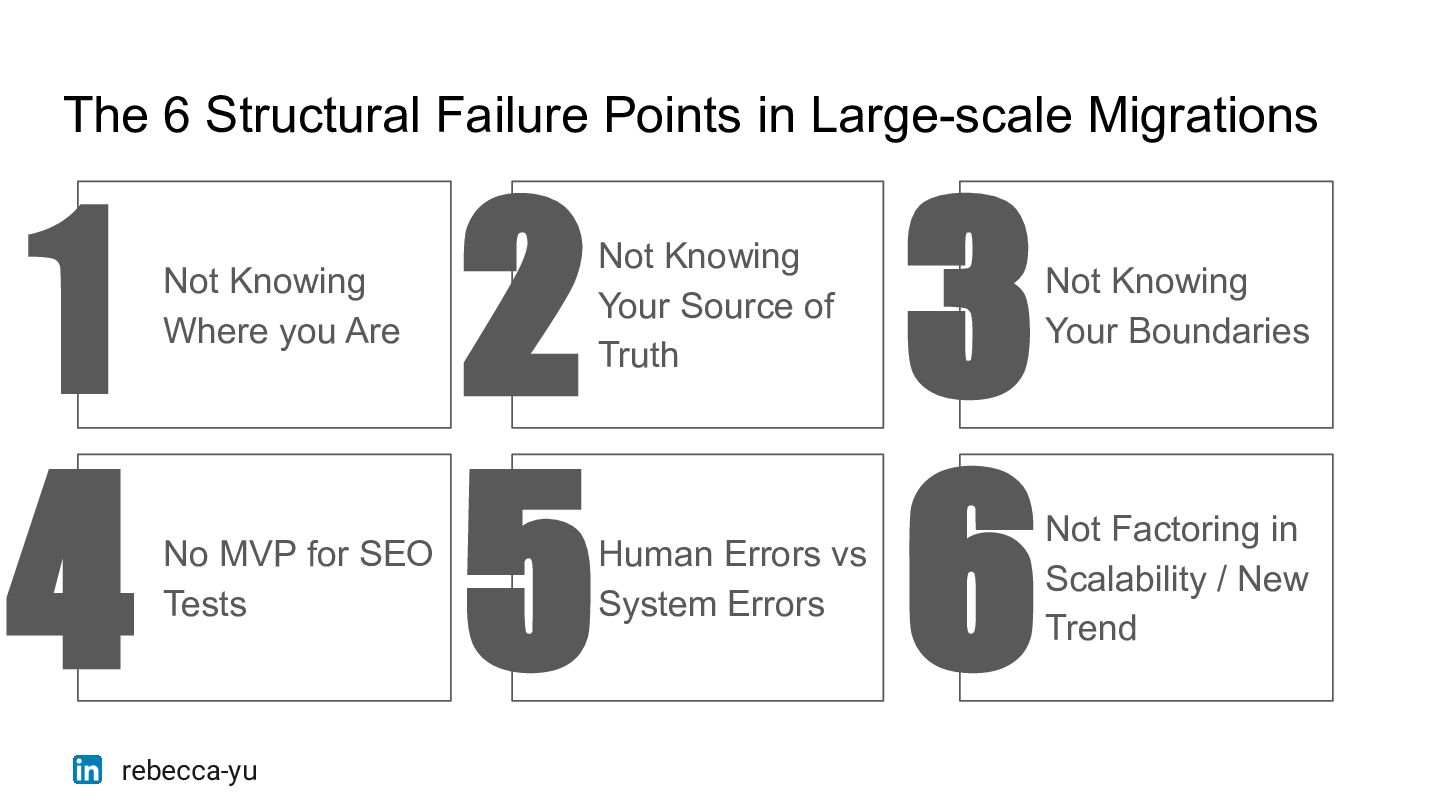
At enterprise scale, a migration isn’t just an SEO project – it’s a web development project involving dev, UX, content and analytics teams. The talk walks through six structural failure points:
      1.    Not knowing where you are – understanding the operational landscape: project timelines and dependencies, Agile vs waterfall, working in Jira (epics down to acceptance criteria), and the traps between staging and pre-production environments.
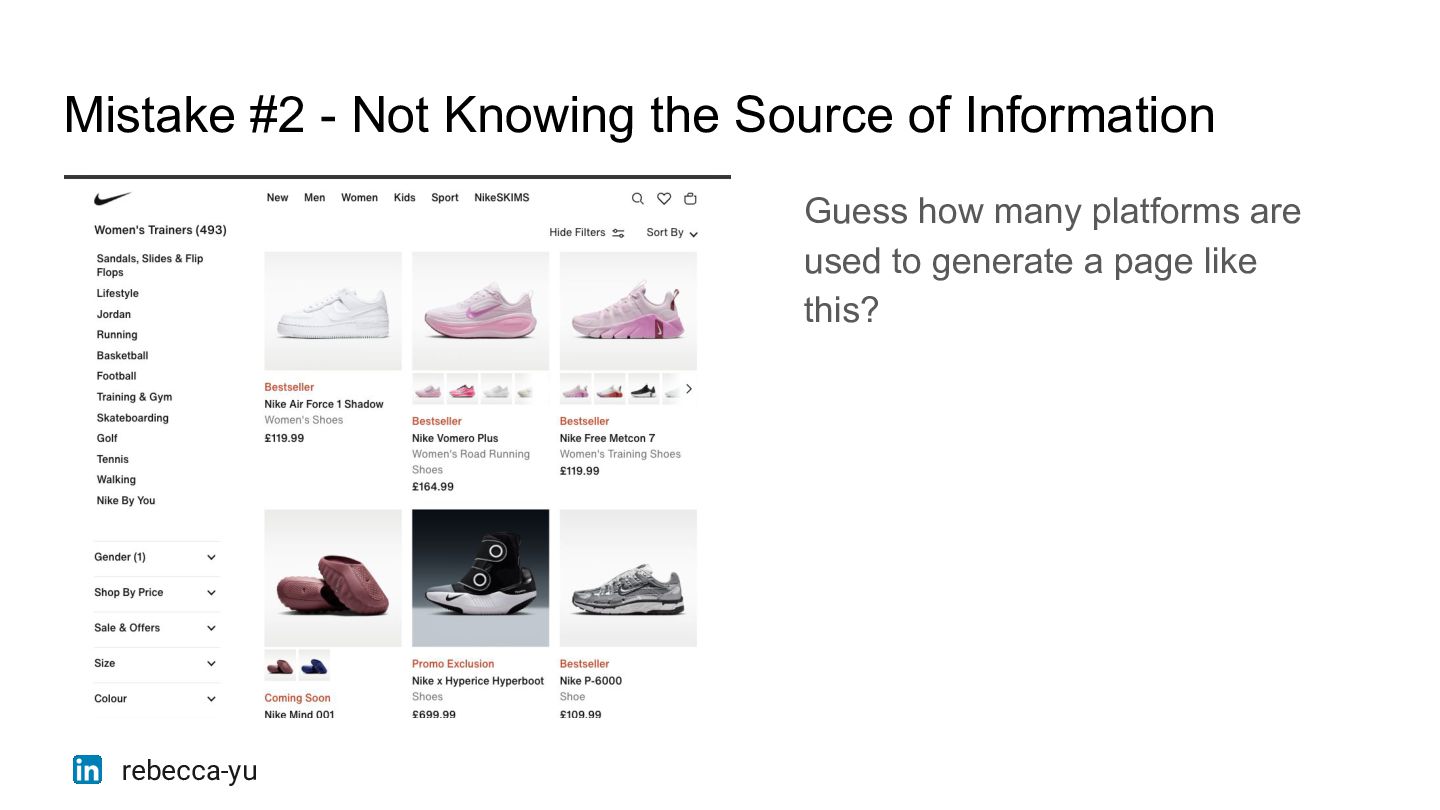
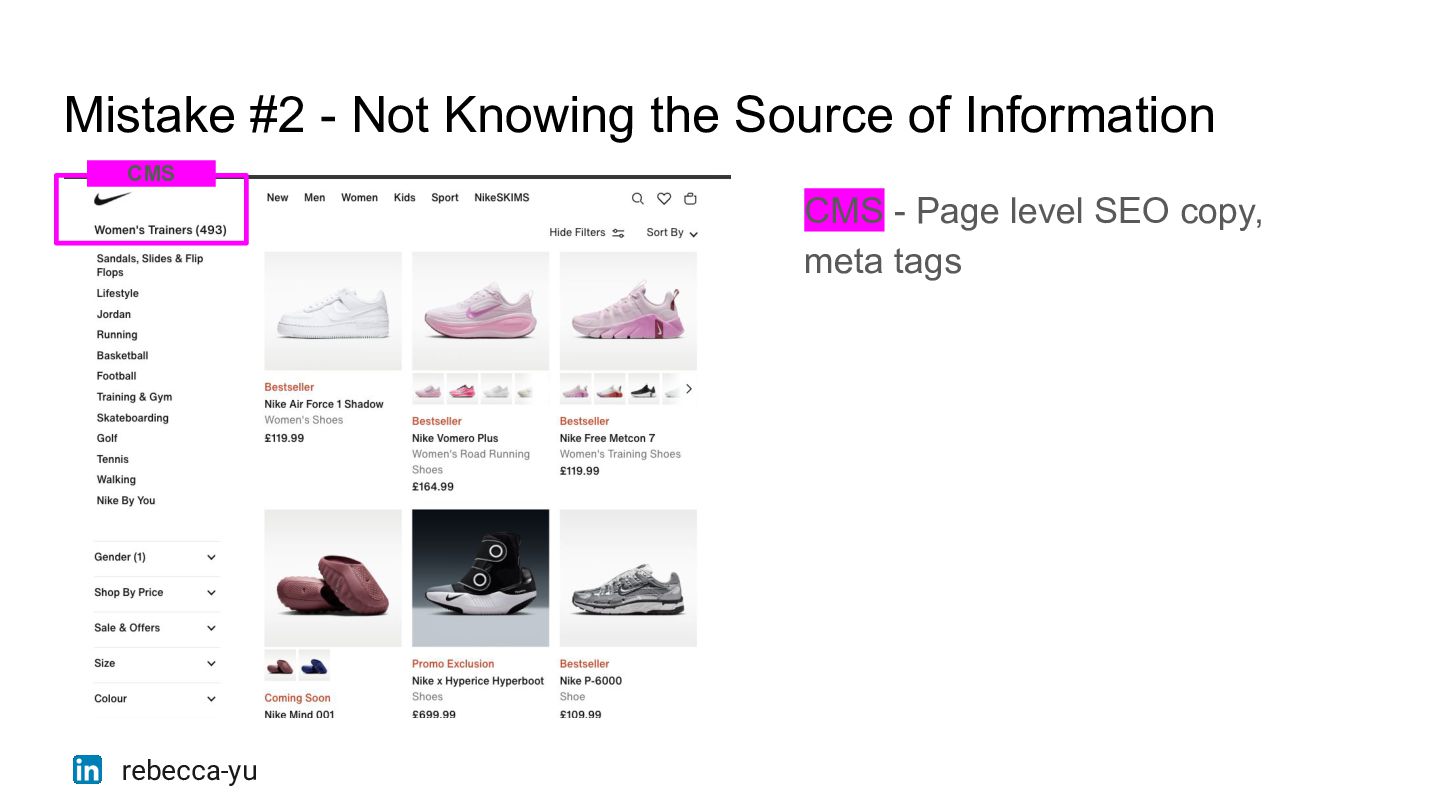
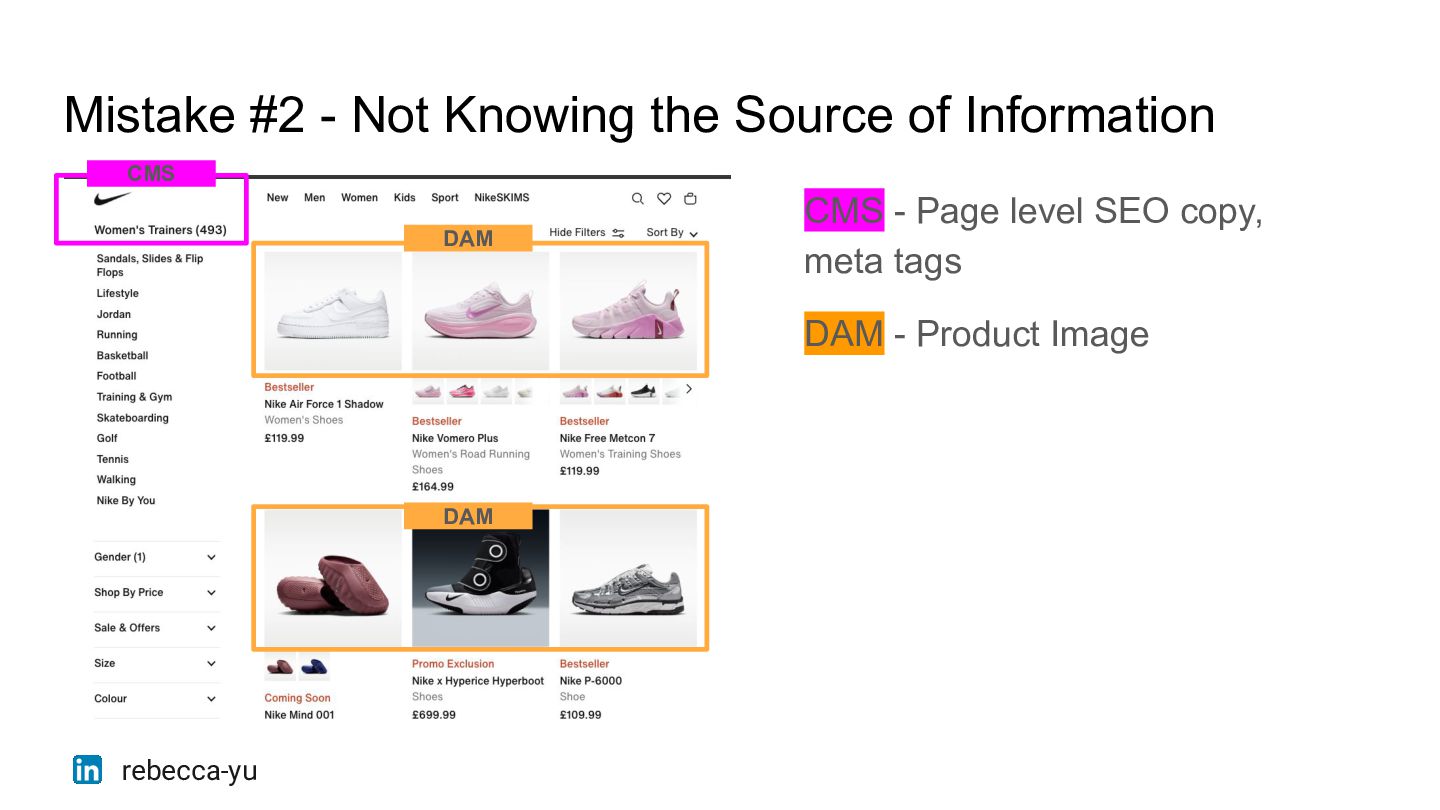
      2.    Not knowing your source of truth – how a single page is built from CMS, DAM and PIM, and why you need to map each data point before planning things like schema at scale.
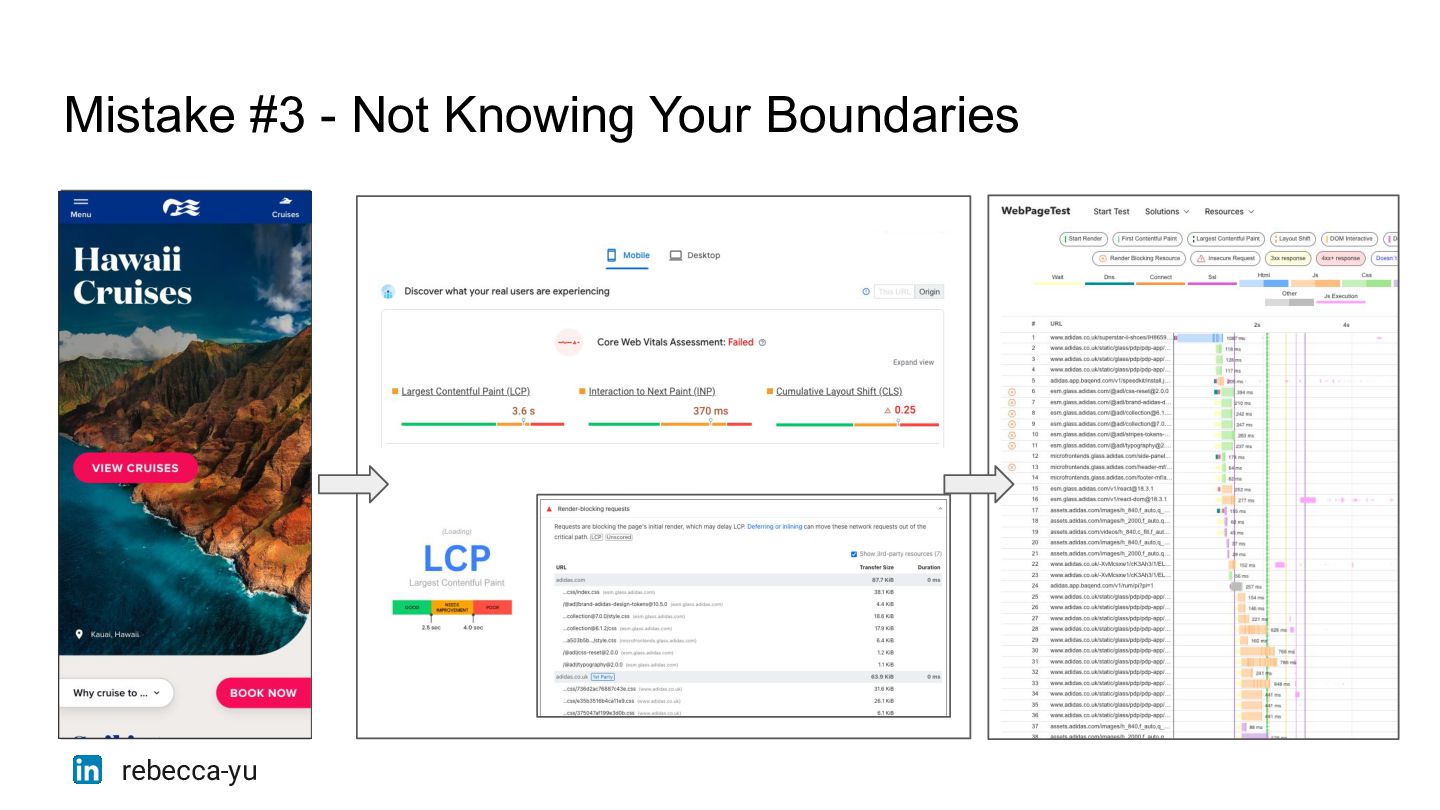
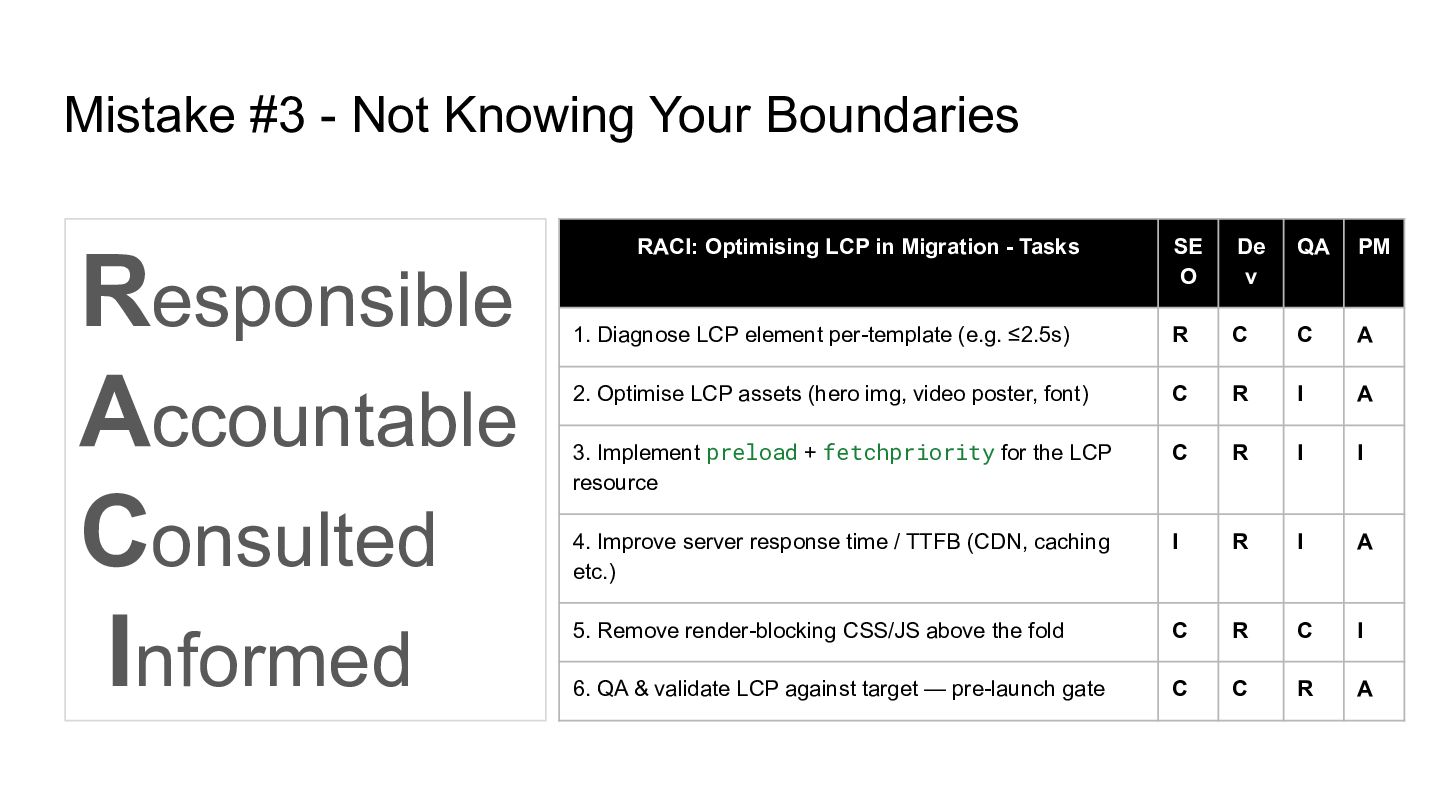
      3.    Not knowing your boundaries – separating SEO problems from dev, content or governance problems, using an LCP example and a RACI matrix to clarify who owns what.
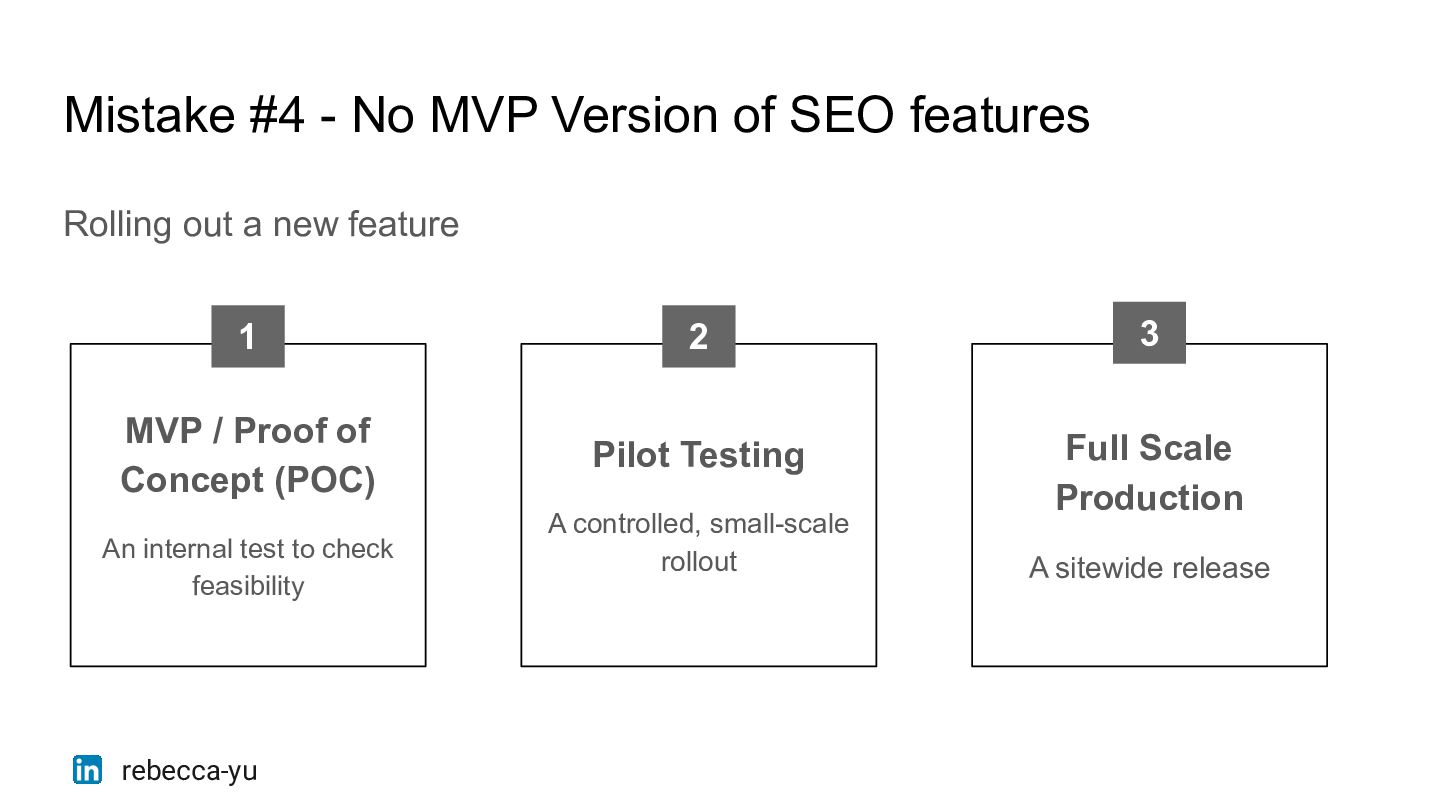
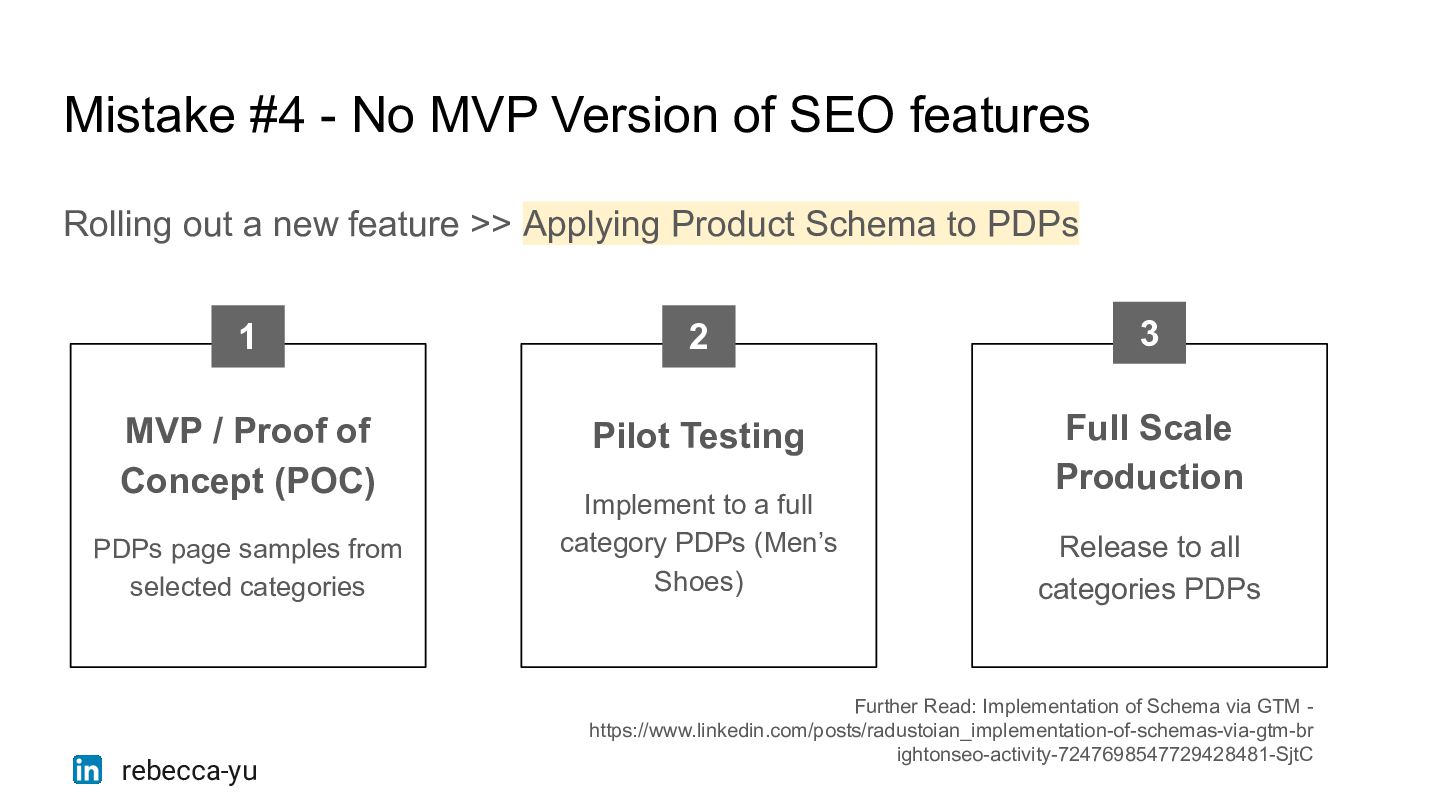
      4.    No MVP for SEO tests – defining must-haves for launch and rolling out new SEO features in phases: proof of concept, pilot, then full release.
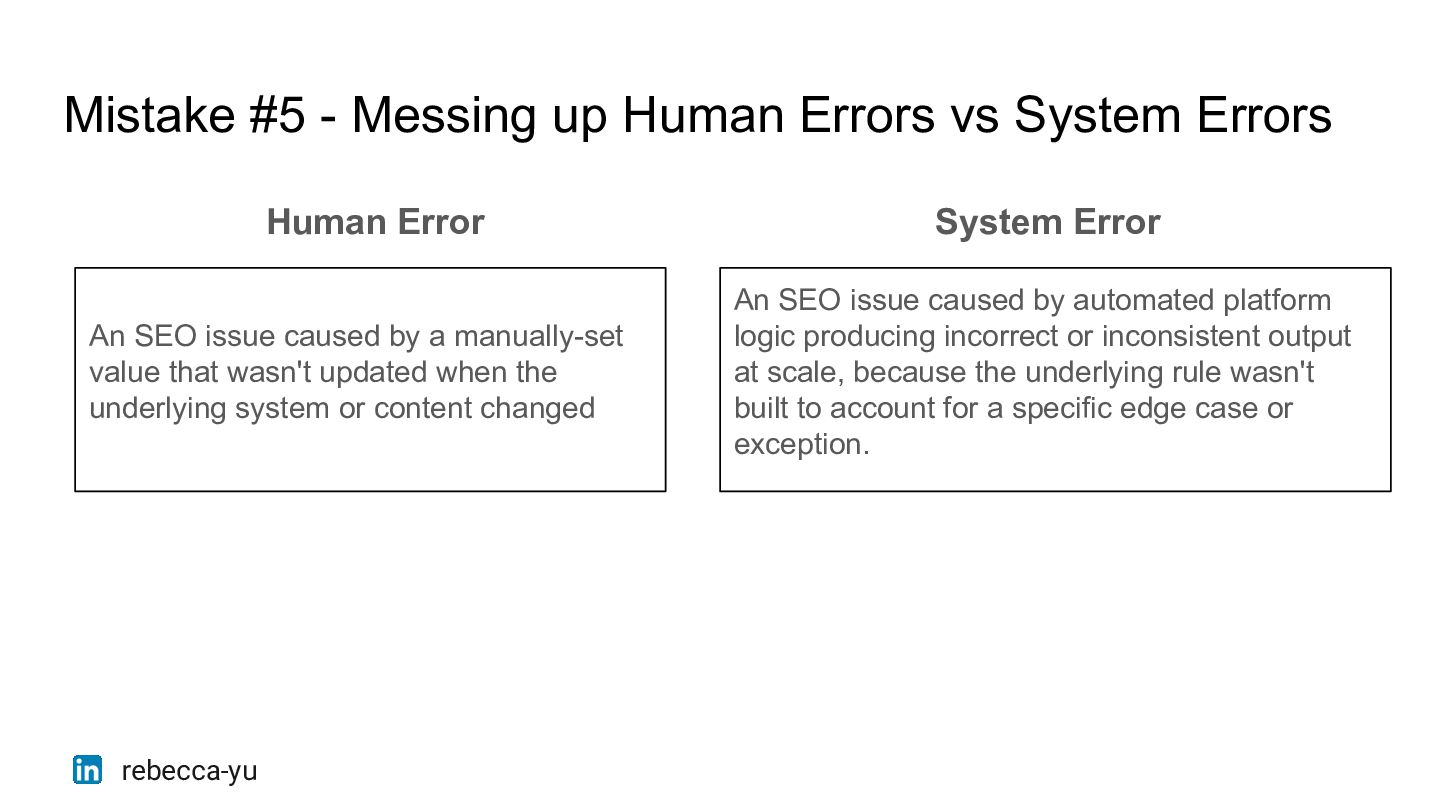
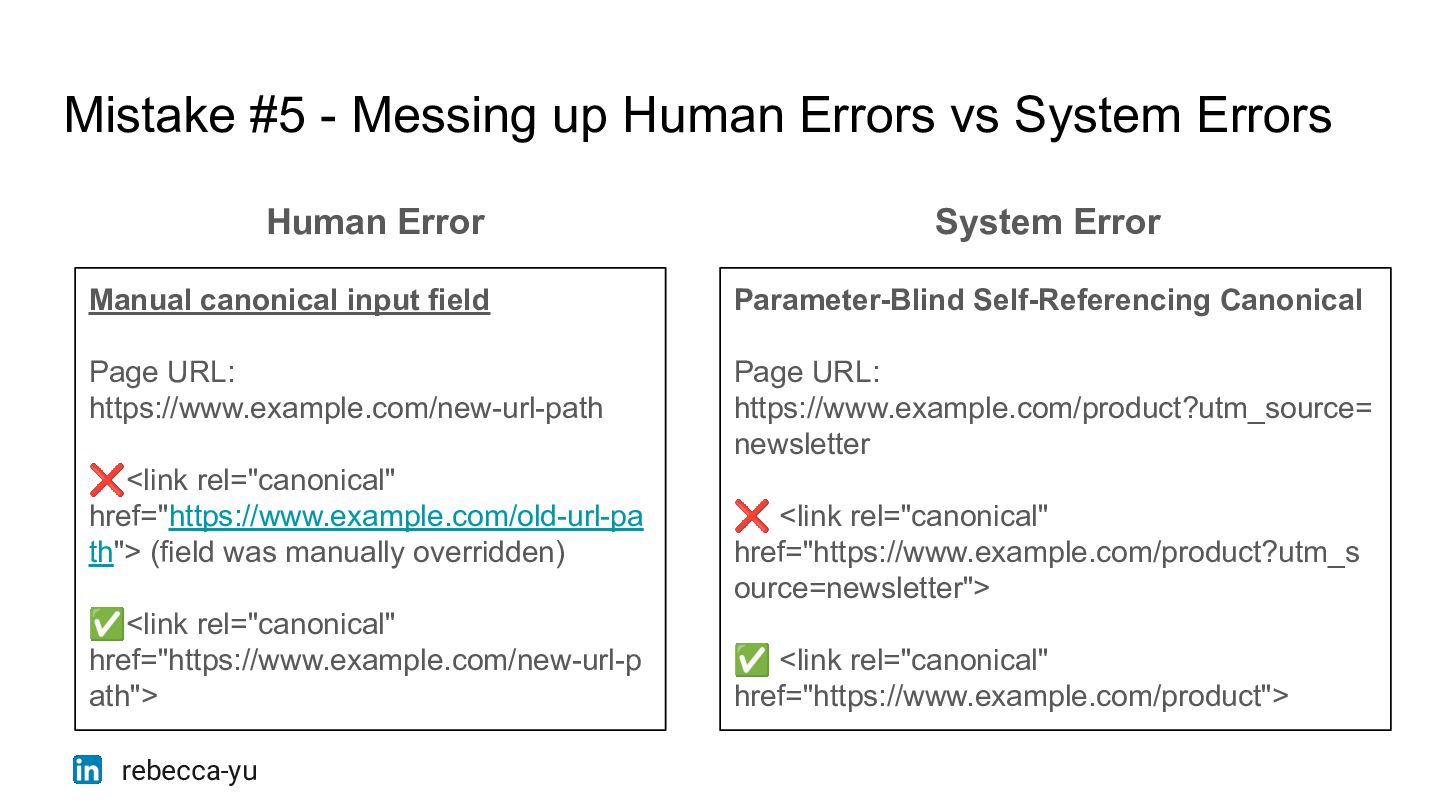
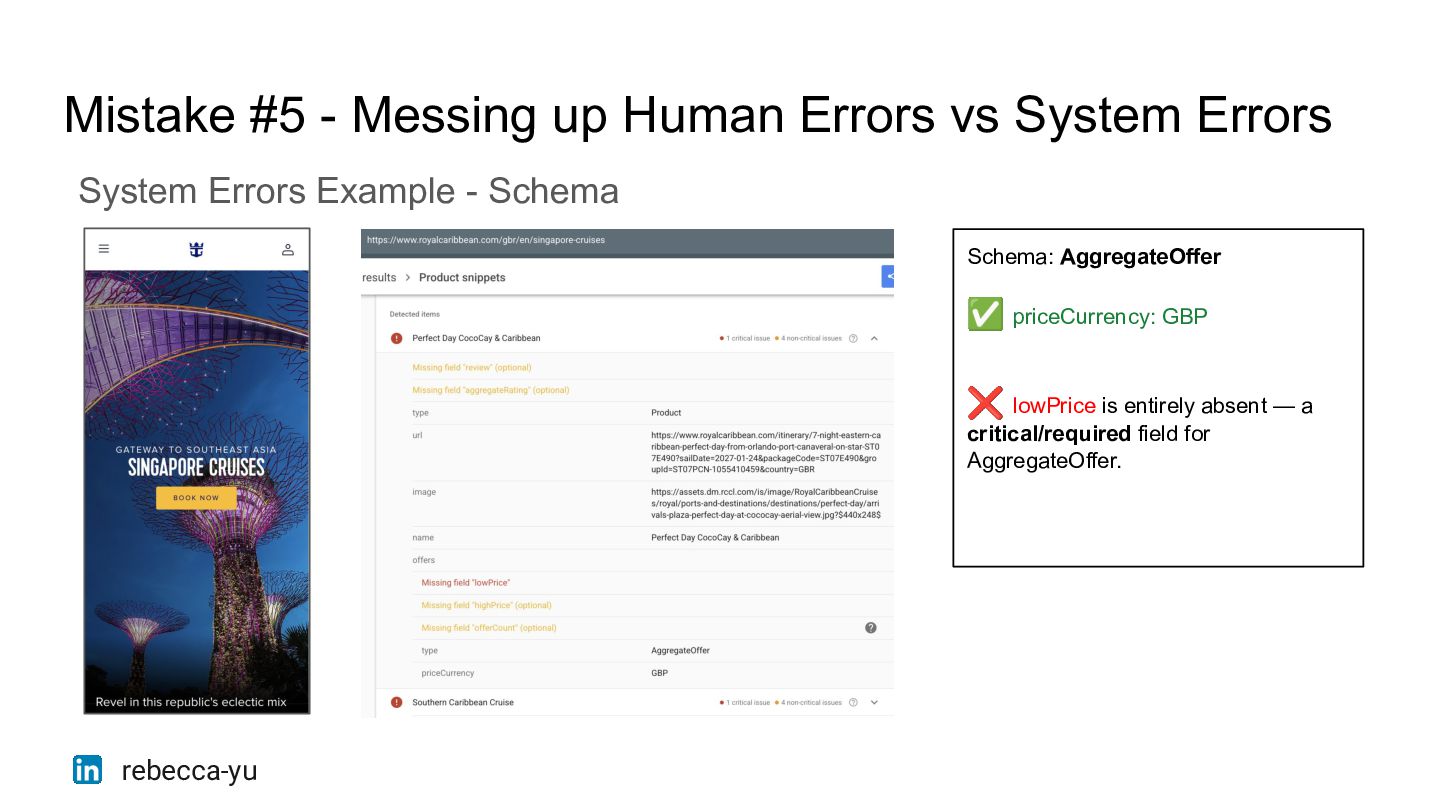
      5.    Confusing human errors with system errors – telling apart a manually set value that wasn’t updated from flawed automation logic, with canonical and schema examples.
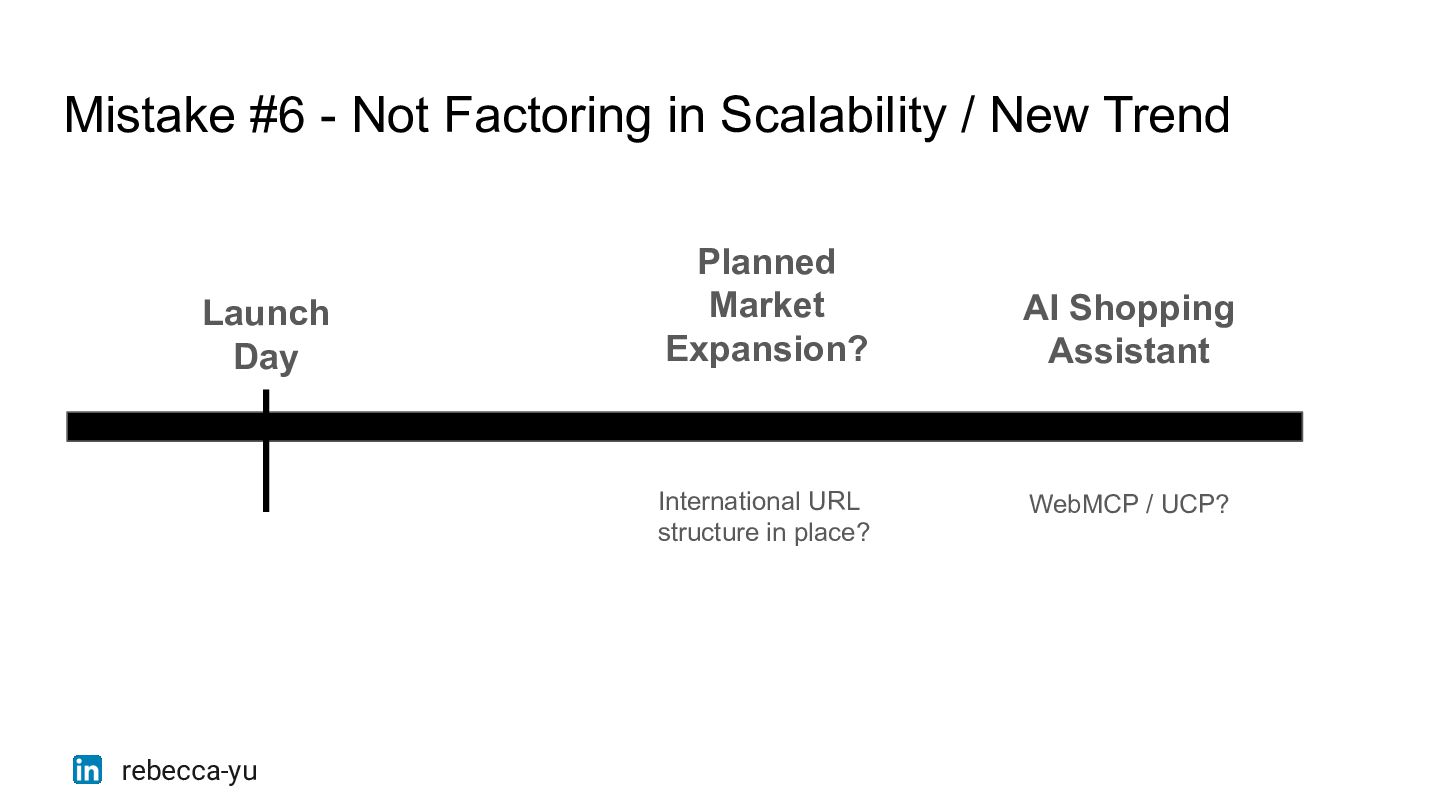
      6.    Not factoring in scalability and new trends – planning URL structures that leave room for new markets, and preparing sites for AI agents and agentic browsing.
Key takeaway: migrations succeed or fail on organisational understanding as much as technical SEO – know the landscape, your data sources and your role, and build in room to grow.
Possible Q&A angles: how to get SEO tickets prioritised, working with devs on ownership, and what “agent-ready” means for sites today.

Avatar for Rebecca Yu

Rebecca Yu

October 08, 2026

Other Decks in Marketing & SEO
Transcript

  1. About the Speaker • Hong Kong → newsroom → SEO

    • Travel, media, SaaS, ecommerce • Technical & international SEO rebecca-yu
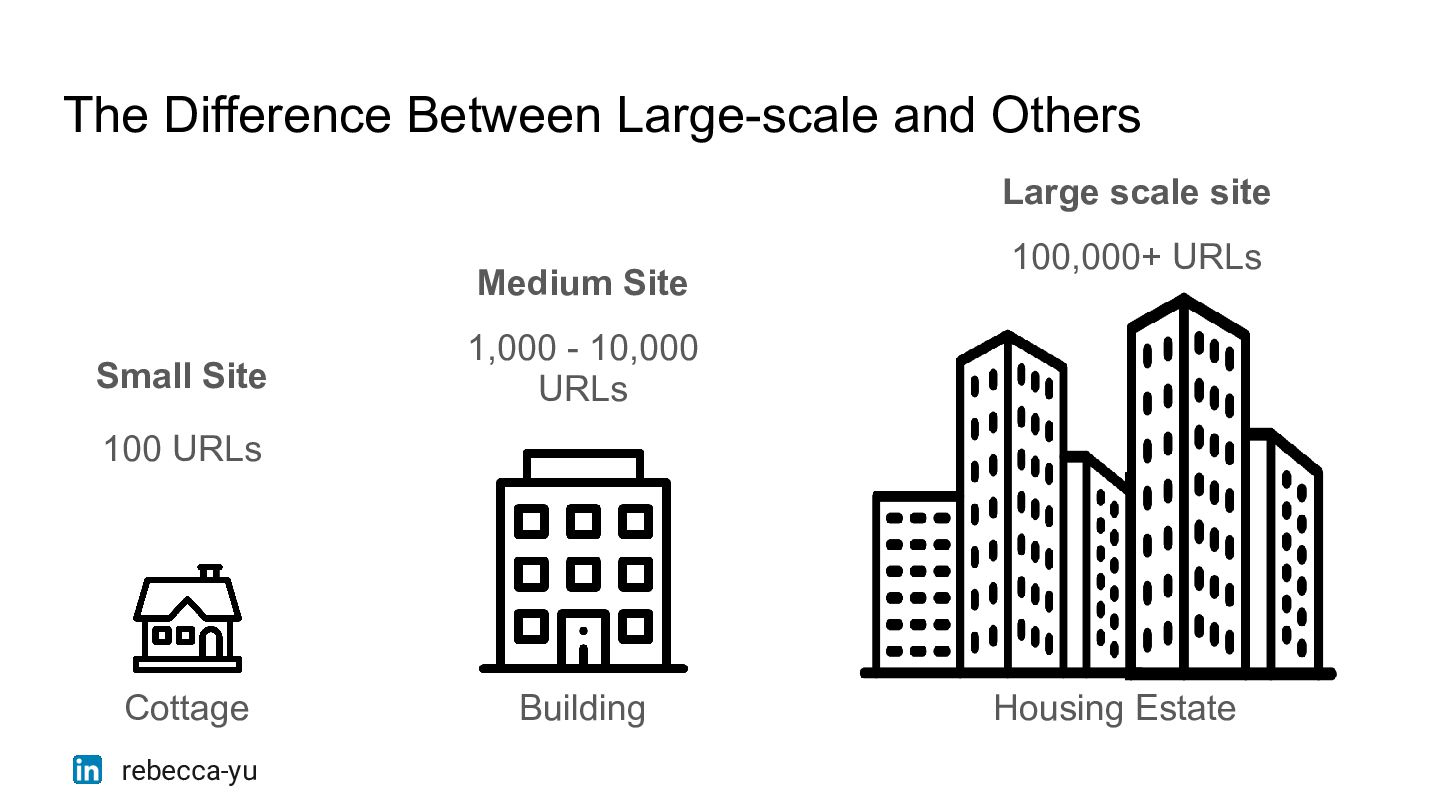
  2. The Difference Between Large-scale and Others Large scale site Medium

    Site Small Site 100,000+ URLs 1,000 - 10,000 URLs 100 URLs Cottage rebecca-yu Building Housing Estate
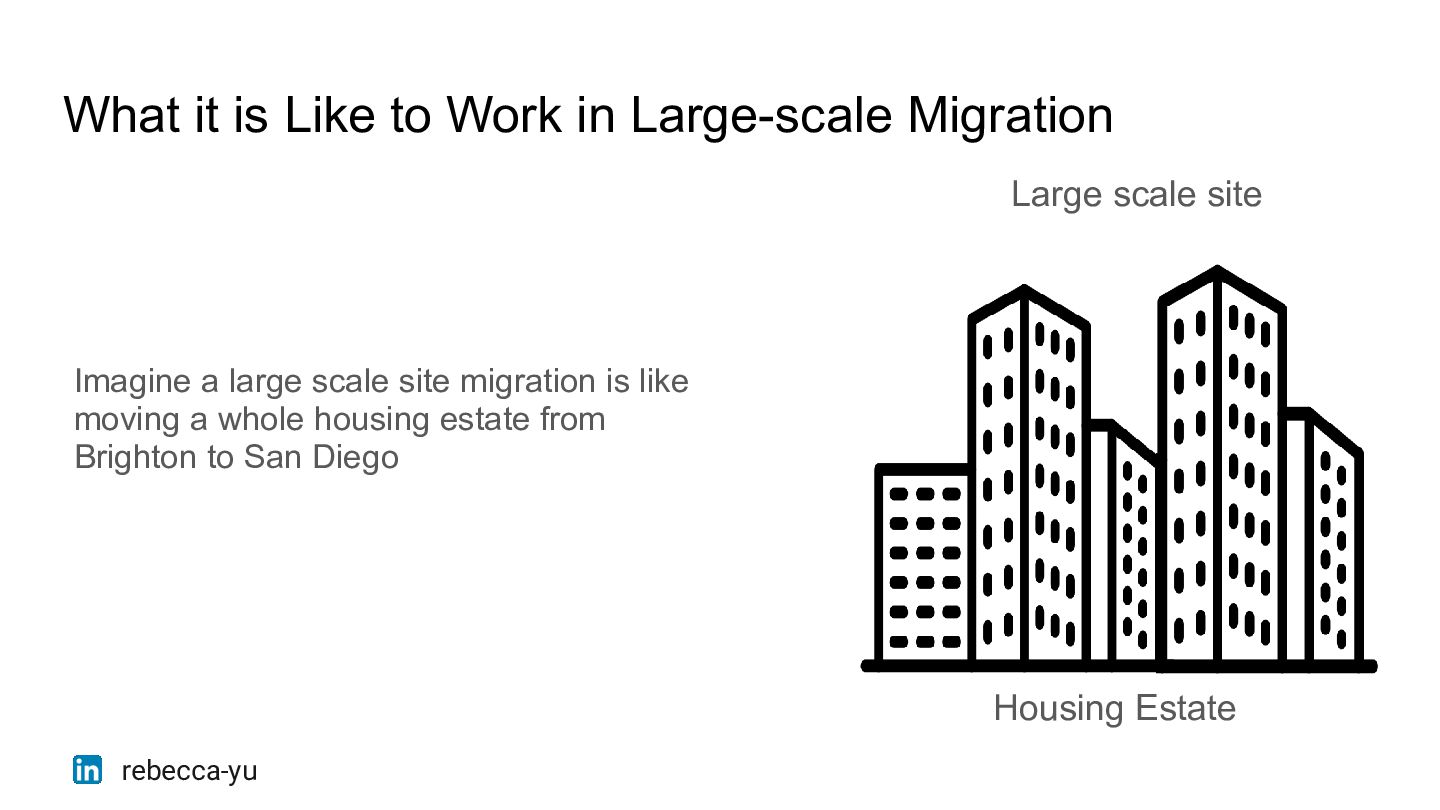
  3. What it is Like to Work in Large-scale Migration Large

    scale site Imagine a large scale site migration is like moving a whole housing estate from Brighton to San Diego Housing Estate rebecca-yu
  4. The 6 Structural Failure Points in Large-scale Migrations 1 4

    Not Knowing Where you Are No MVP for SEO Tests rebecca-yu 2 5 Not Knowing Your Source of Truth Human Errors vs System Errors 3 6 Not Knowing Your Boundaries Not Factoring in Scalability / New Trend
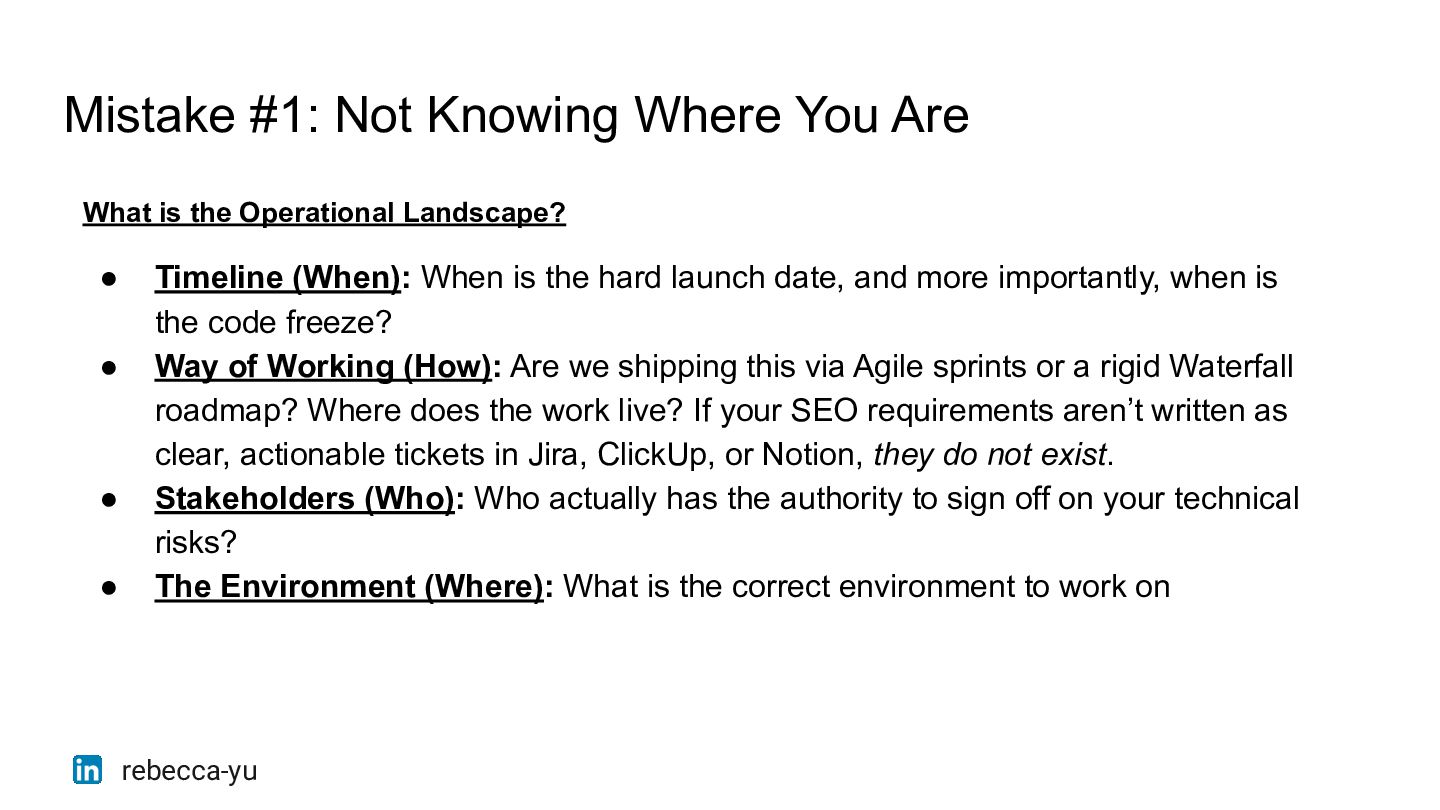
  5. Mistake #1: Not Knowing Where You Are What is the

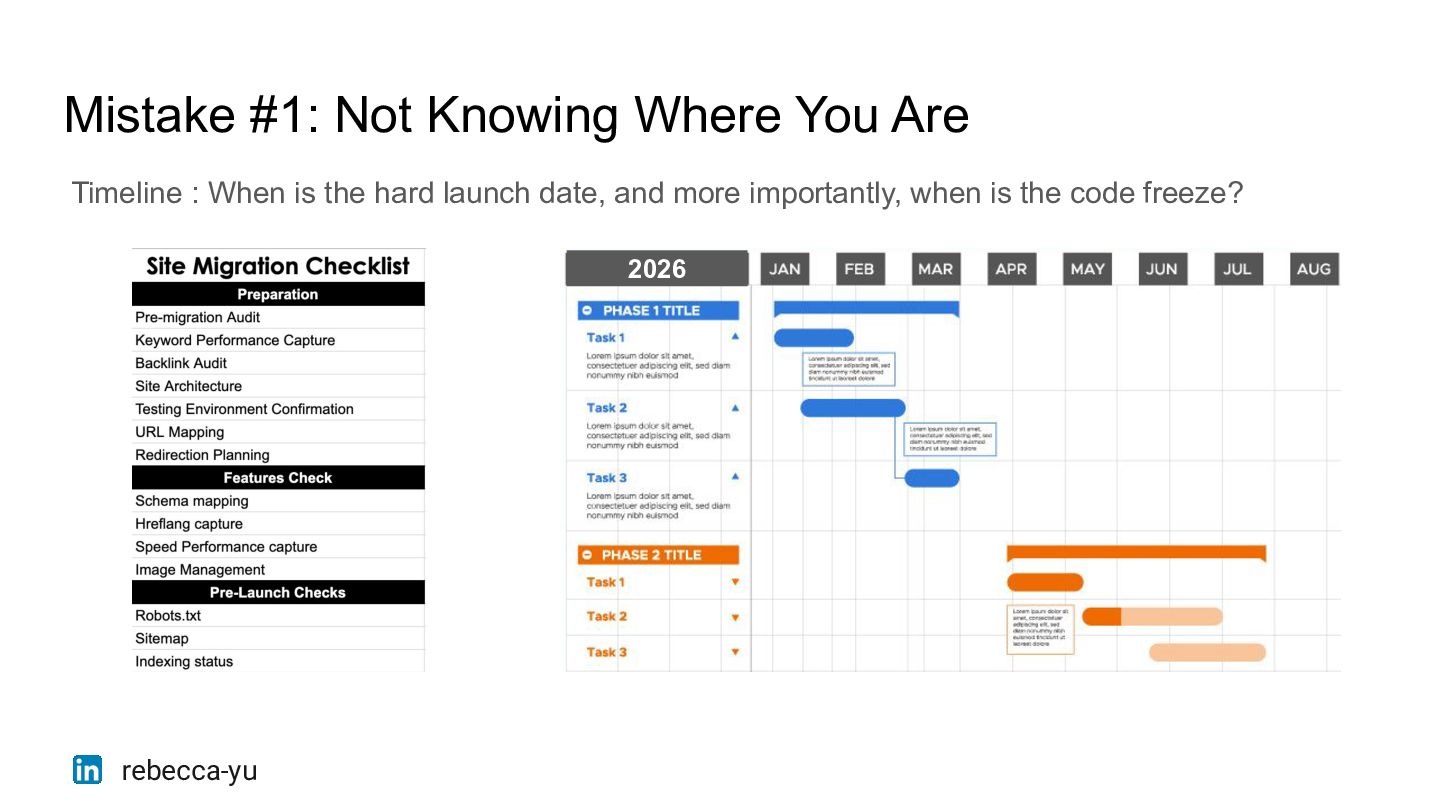
    Operational Landscape? • • • • Timeline (When): When is the hard launch date, and more importantly, when is the code freeze? Way of Working (How): Are we shipping this via Agile sprints or a rigid Waterfall roadmap? Where does the work live? If your SEO requirements aren’t written as clear, actionable tickets in Jira, ClickUp, or Notion, they do not exist. Stakeholders (Who): Who actually has the authority to sign off on your technical risks? The Environment (Where): What is the correct environment to work on rebecca-yu
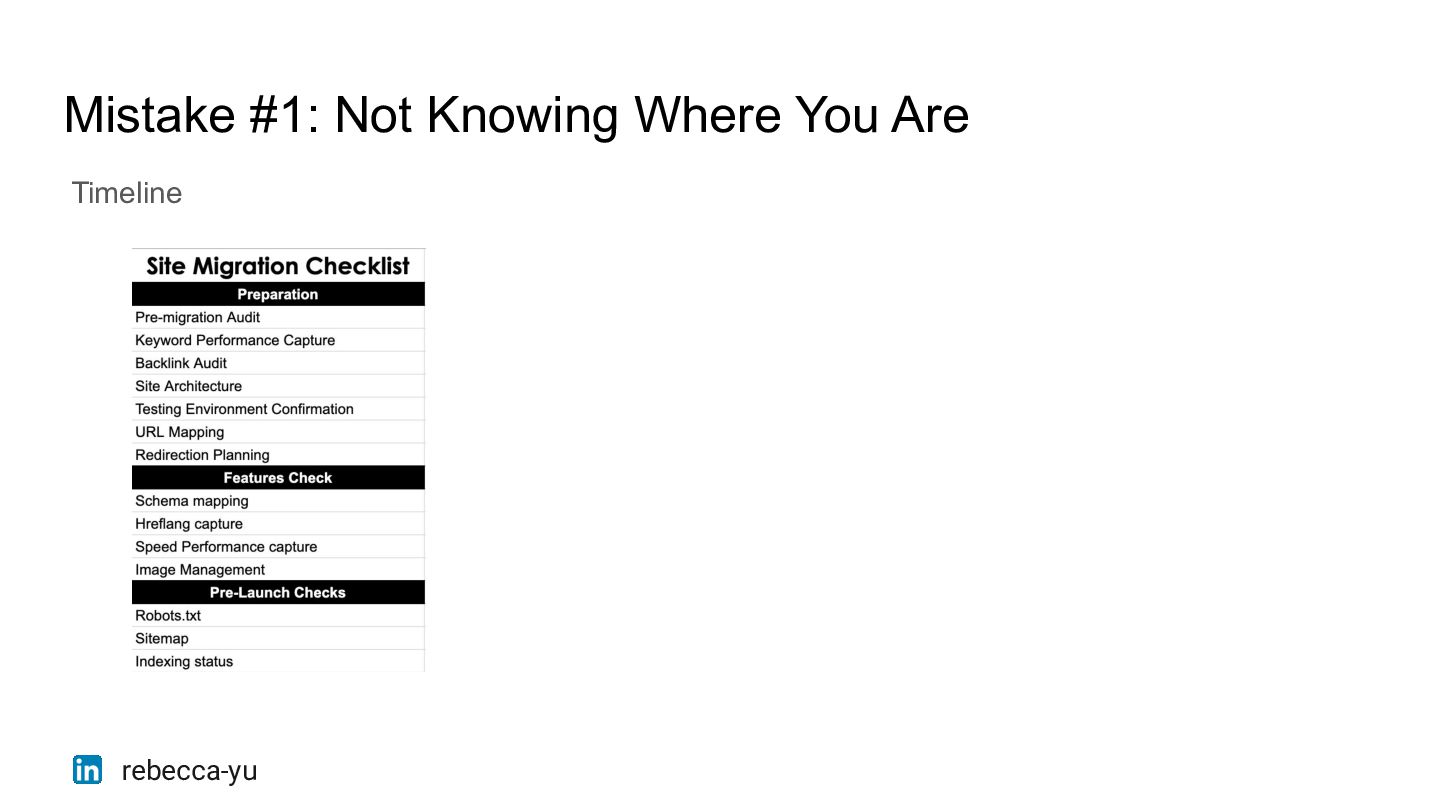
  6. Mistake #1: Not Knowing Where You Are Timeline : When

    is the hard launch date, and more importantly, when is the code freeze? 2026 rebecca-yu
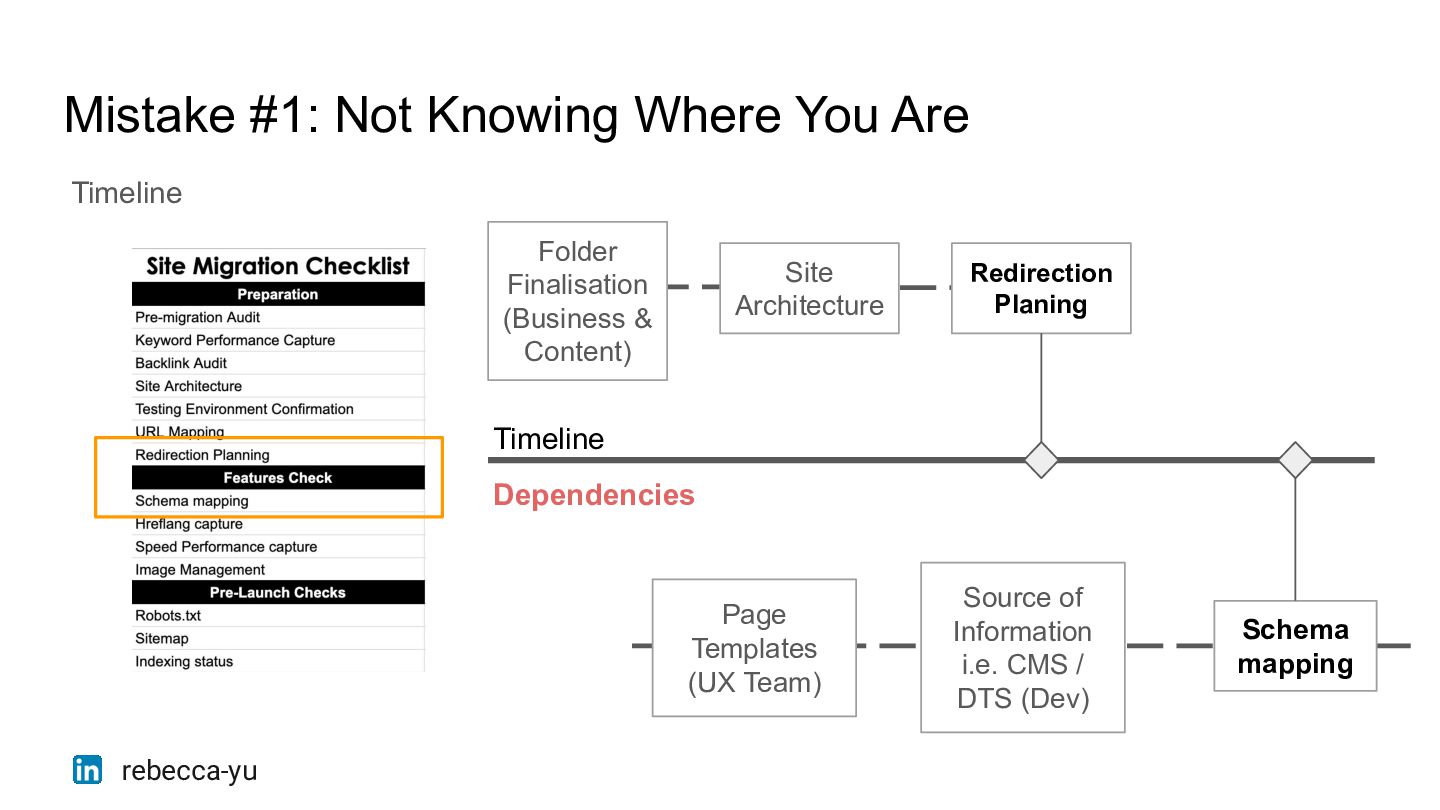
  7. Mistake #1: Not Knowing Where You Are Timeline Folder Finalisation

    (Business & Content) Site Architecture Redirection Planing Timeline Dependencies Page Templates (UX Team) rebecca-yu Source of Information i.e. CMS / DTS (Dev) Schema mapping
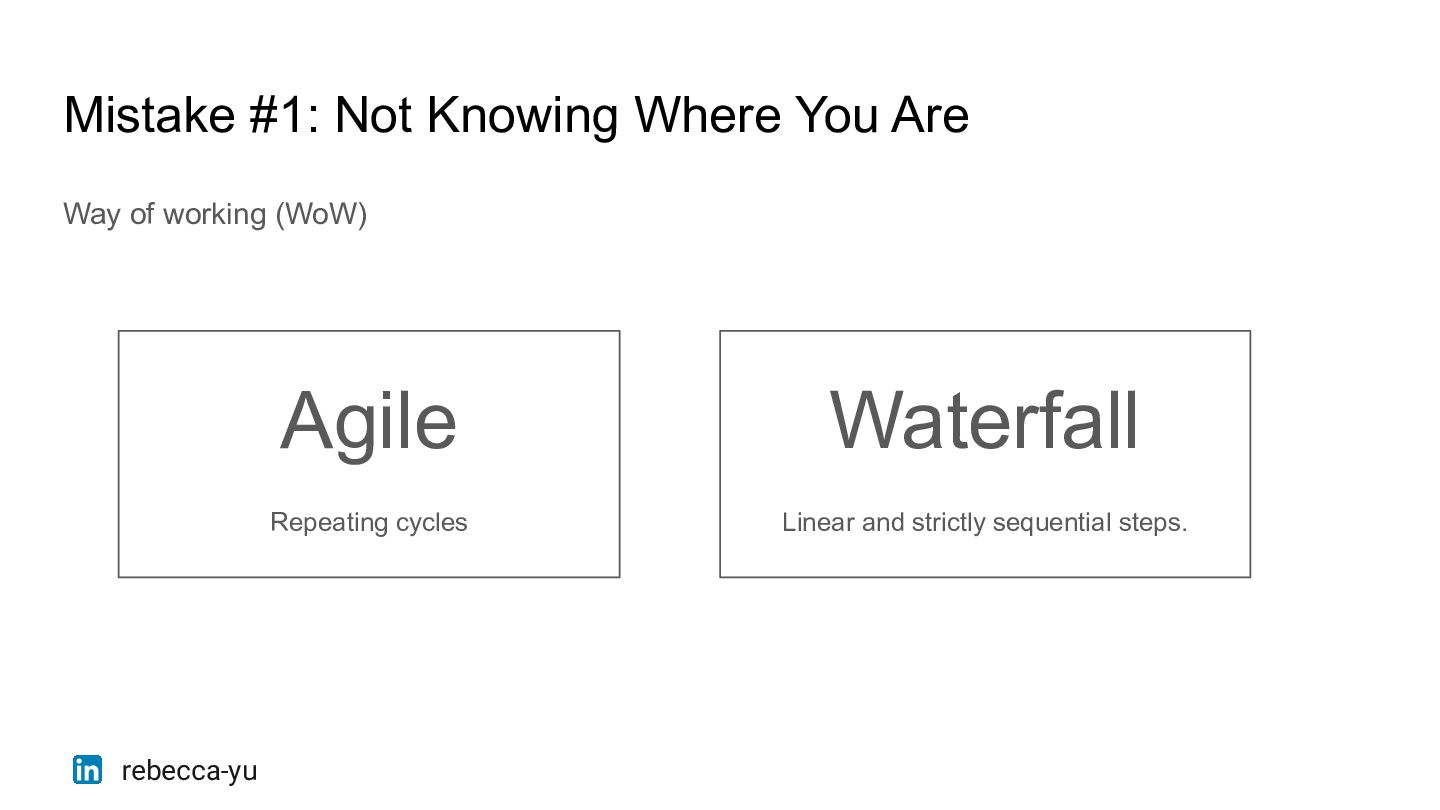
  8. Mistake #1: Not Knowing Where You Are Way of working

    (WoW) rebecca-yu Agile Waterfall Repeating cycles Linear and strictly sequential steps.
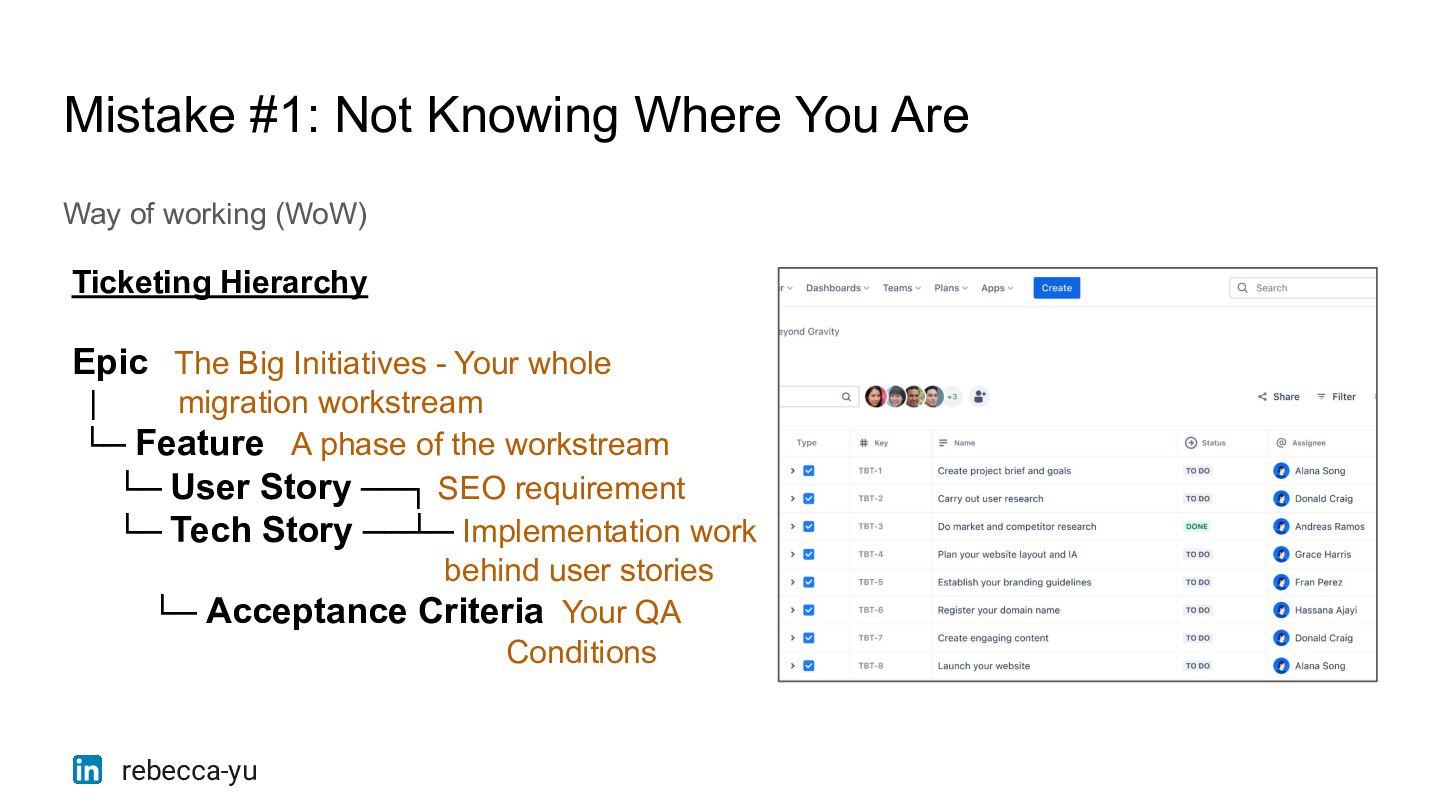
  9. Mistake #1: Not Knowing Where You Are Way of working

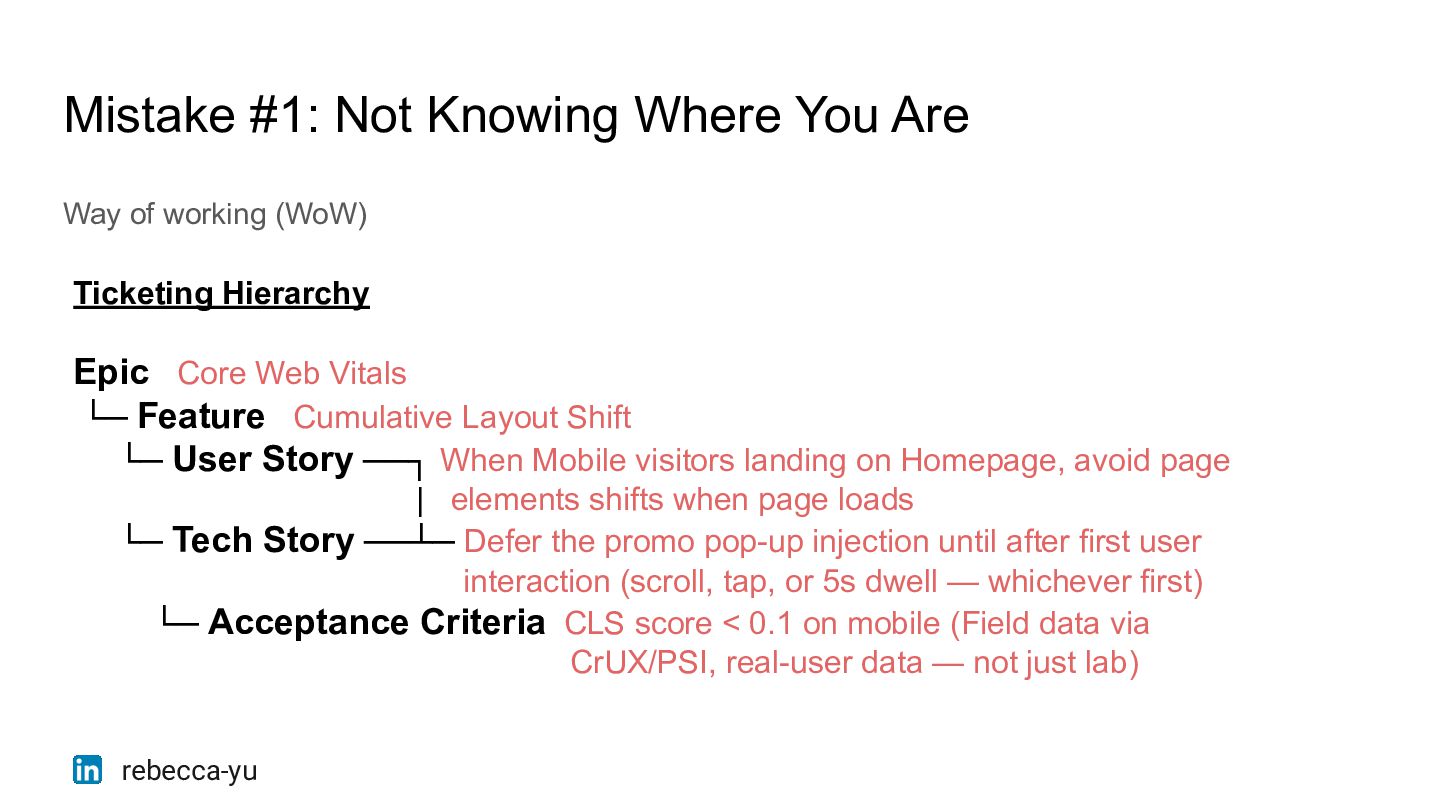
    (WoW) Ticketing Hierarchy Epic The Big Initiatives - Your whole | migration workstream └─ Feature A phase of the workstream └─ User Story ──┐ SEO requirement └─ Tech Story ──┴─ Implementation work behind user stories └─ Acceptance Criteria Your QA Conditions rebecca-yu
  10. Mistake #1: Not Knowing Where You Are Way of working

    (WoW) Ticketing Hierarchy Epic Core Web Vitals └─ Feature Cumulative Layout Shift └─ User Story ──┐ When Mobile visitors landing on Homepage, avoid page | elements shifts when page loads └─ Tech Story ──┴─ Defer the promo pop-up injection until after first user interaction (scroll, tap, or 5s dwell — whichever first) └─ Acceptance Criteria CLS score < 0.1 on mobile (Field data via CrUX/PSI, real-user data — not just lab) rebecca-yu
  11. Mistake #1: Not Knowing Where You Are Who - There

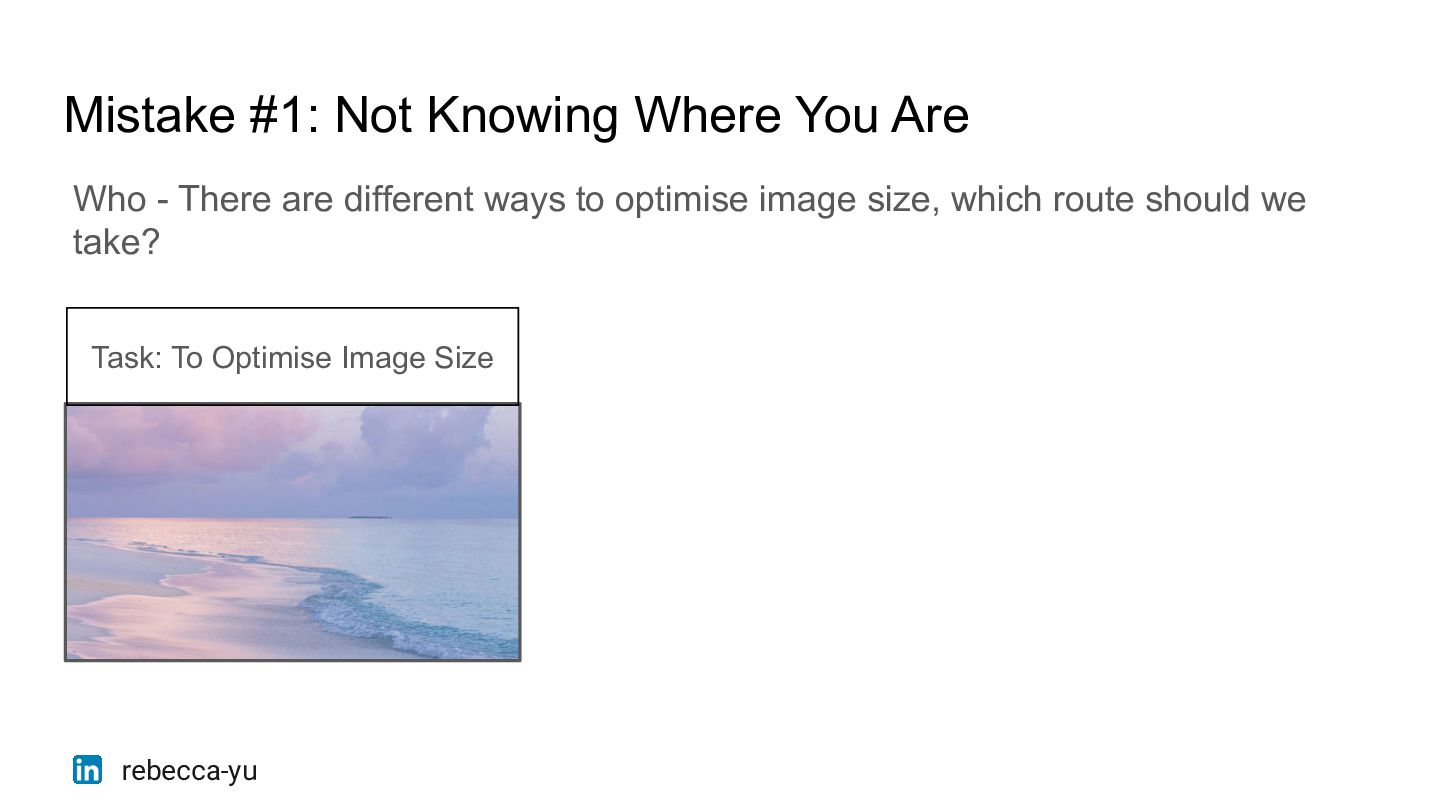
    are different ways to optimise image size, which route should we take? Task: To Optimise Image Size rebecca-yu
  12. Mistake #1: Not Knowing Where You Are Who - There

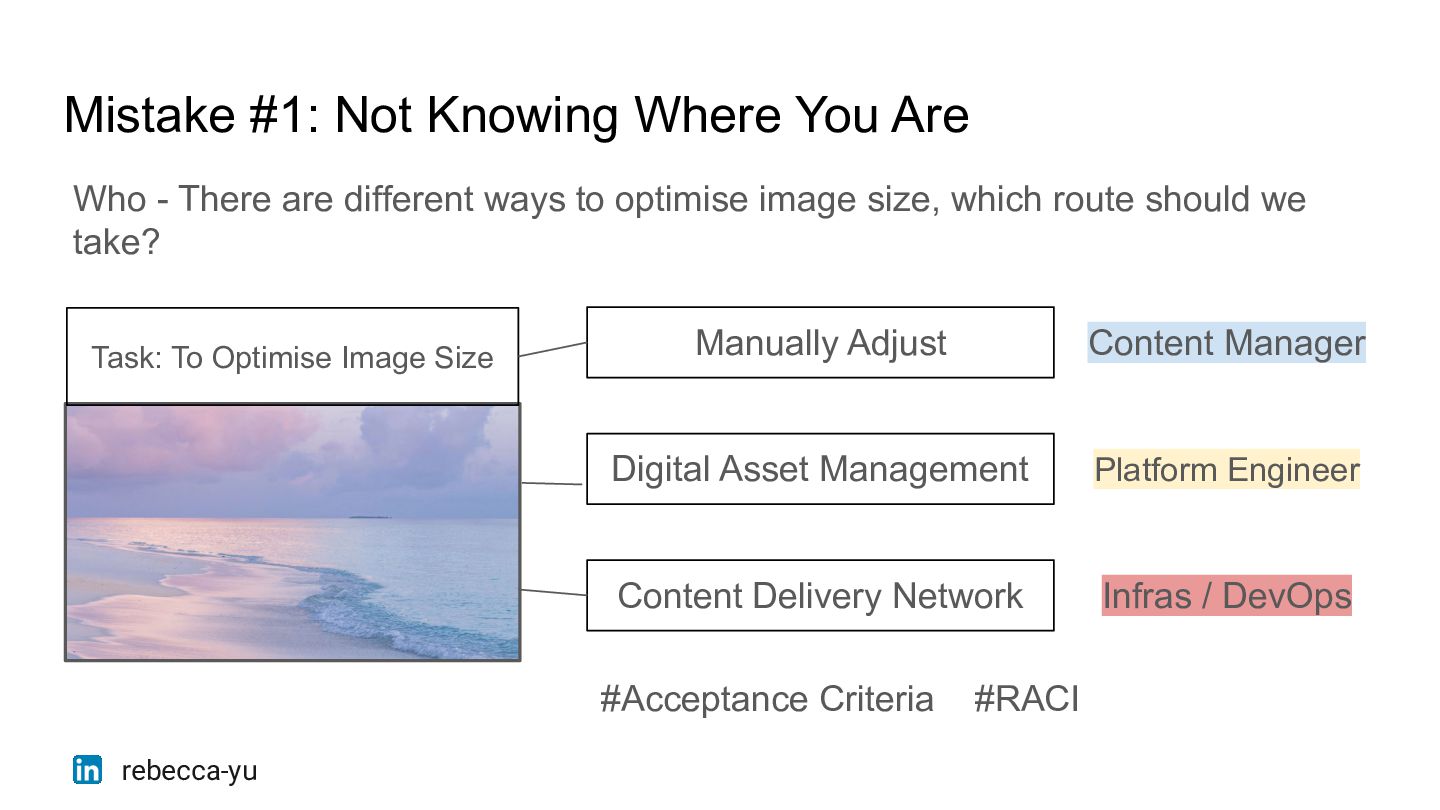
    are different ways to optimise image size, which route should we take? Task: To Optimise Image Size Manually Adjust Content Manager Digital Asset Management Platform Engineer Content Delivery Network Infras / DevOps #Acceptance Criteria rebecca-yu #RACI
  13. Mistake #1: Not Knowing Where You Are The environment Staging

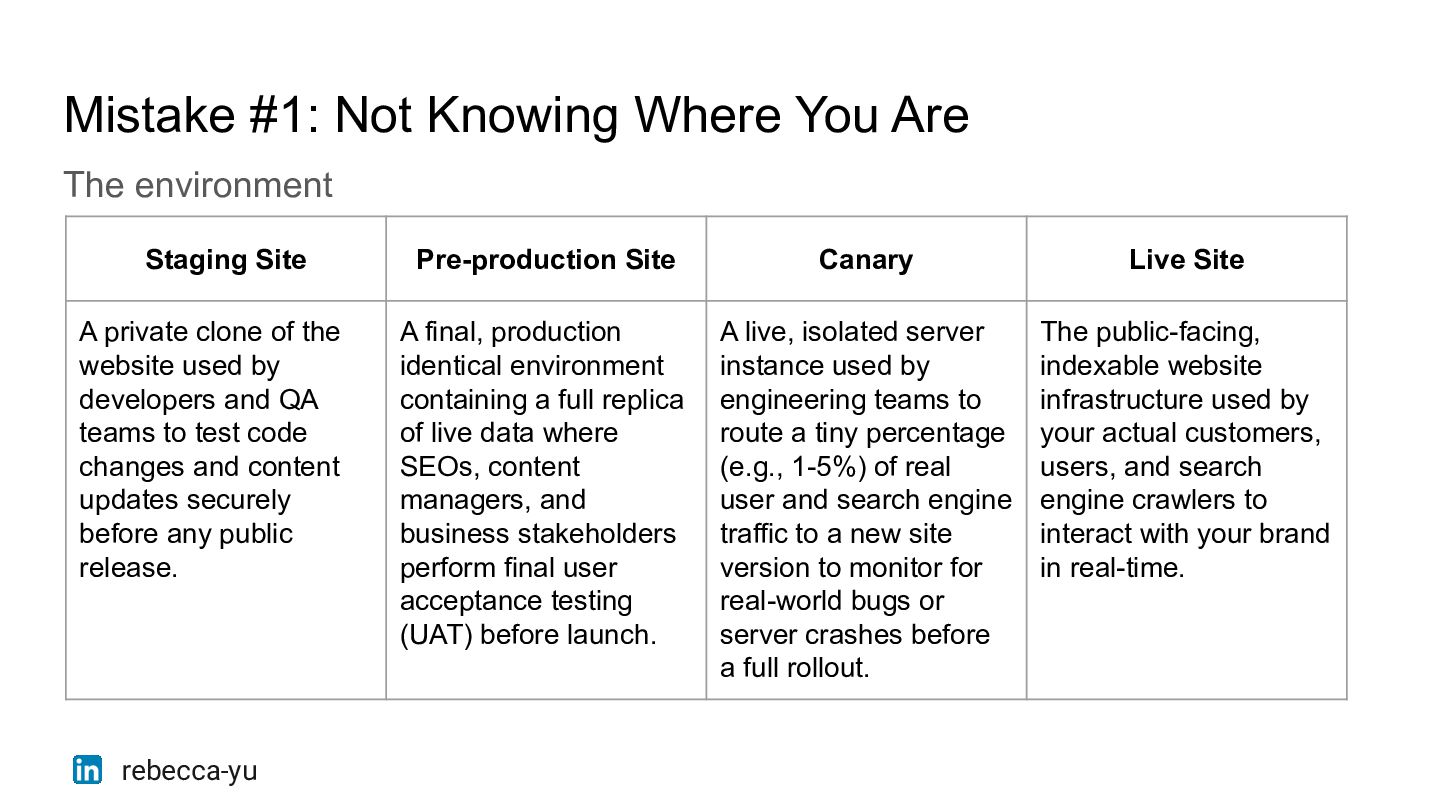
    Site Pre-production Site Canary Live Site A private clone of the website used by developers and QA teams to test code changes and content updates securely before any public release. A final, production identical environment containing a full replica of live data where SEOs, content managers, and business stakeholders perform final user acceptance testing (UAT) before launch. A live, isolated server instance used by engineering teams to route a tiny percentage (e.g., 1-5%) of real user and search engine traffic to a new site version to monitor for real-world bugs or server crashes before a full rollout. The public-facing, indexable website infrastructure used by your actual customers, users, and search engine crawlers to interact with your brand in real-time. rebecca-yu
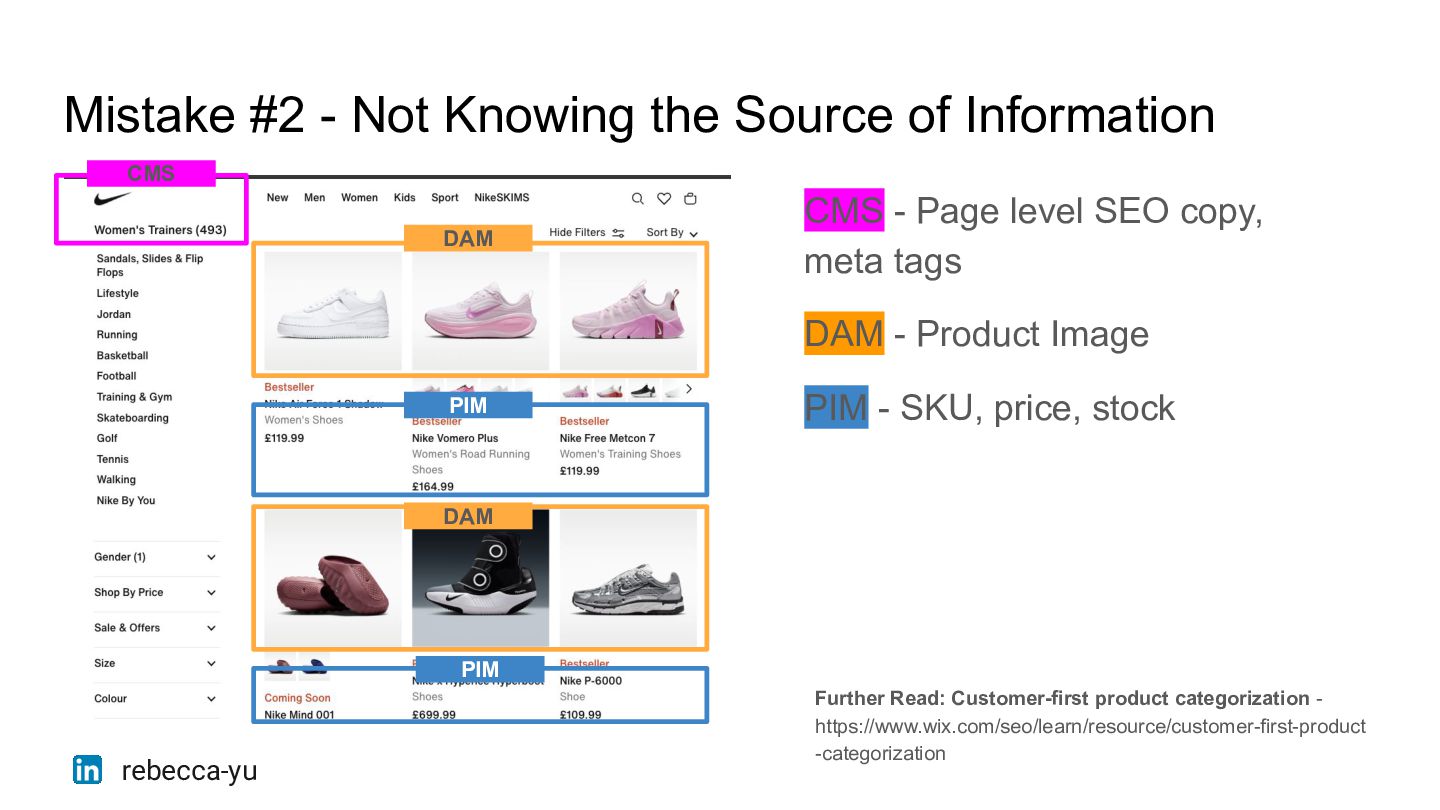
  14. Mistake #2 - Not Knowing the Source of Information Guess

    how many platforms are used to generate a page like this? rebecca-yu
  15. Mistake #2 - Not Knowing the Source of Information CMS

    CMS - Page level SEO copy, meta tags rebecca-yu
  16. Mistake #2 - Not Knowing the Source of Information CMS

    DAM CMS - Page level SEO copy, meta tags DAM - Product Image DAM rebecca-yu
  17. Mistake #2 - Not Knowing the Source of Information CMS

    DAM CMS - Page level SEO copy, meta tags DAM - Product Image PIM PIM - SKU, price, stock DAM PIM rebecca-yu Further Read: Customer-first product categorization https://www.wix.com/seo/learn/resource/customer-first-product -categorization
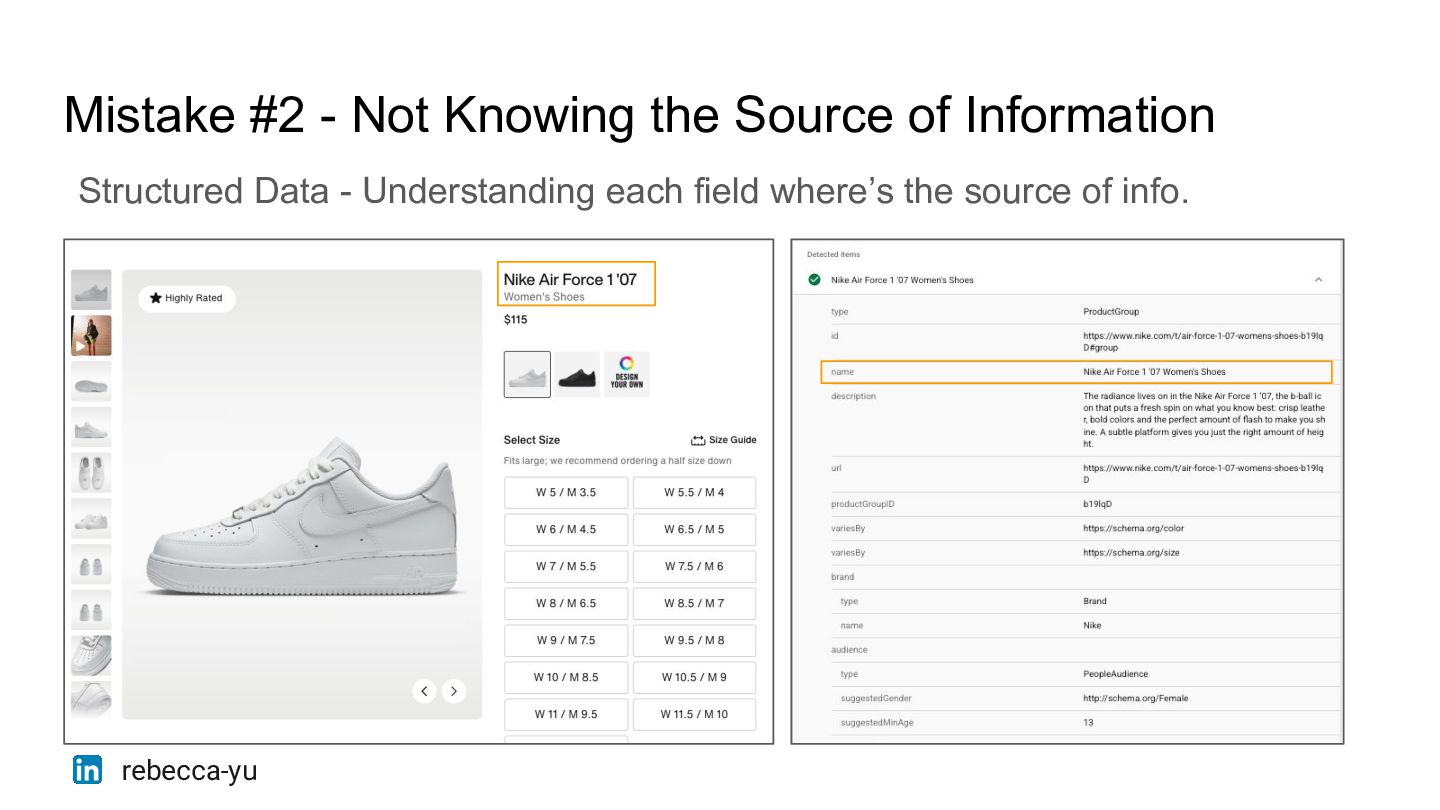
  18. Mistake #2 - Not Knowing the Source of Information Structured

    Data - Understanding each field where’s the source of info. rebecca-yu
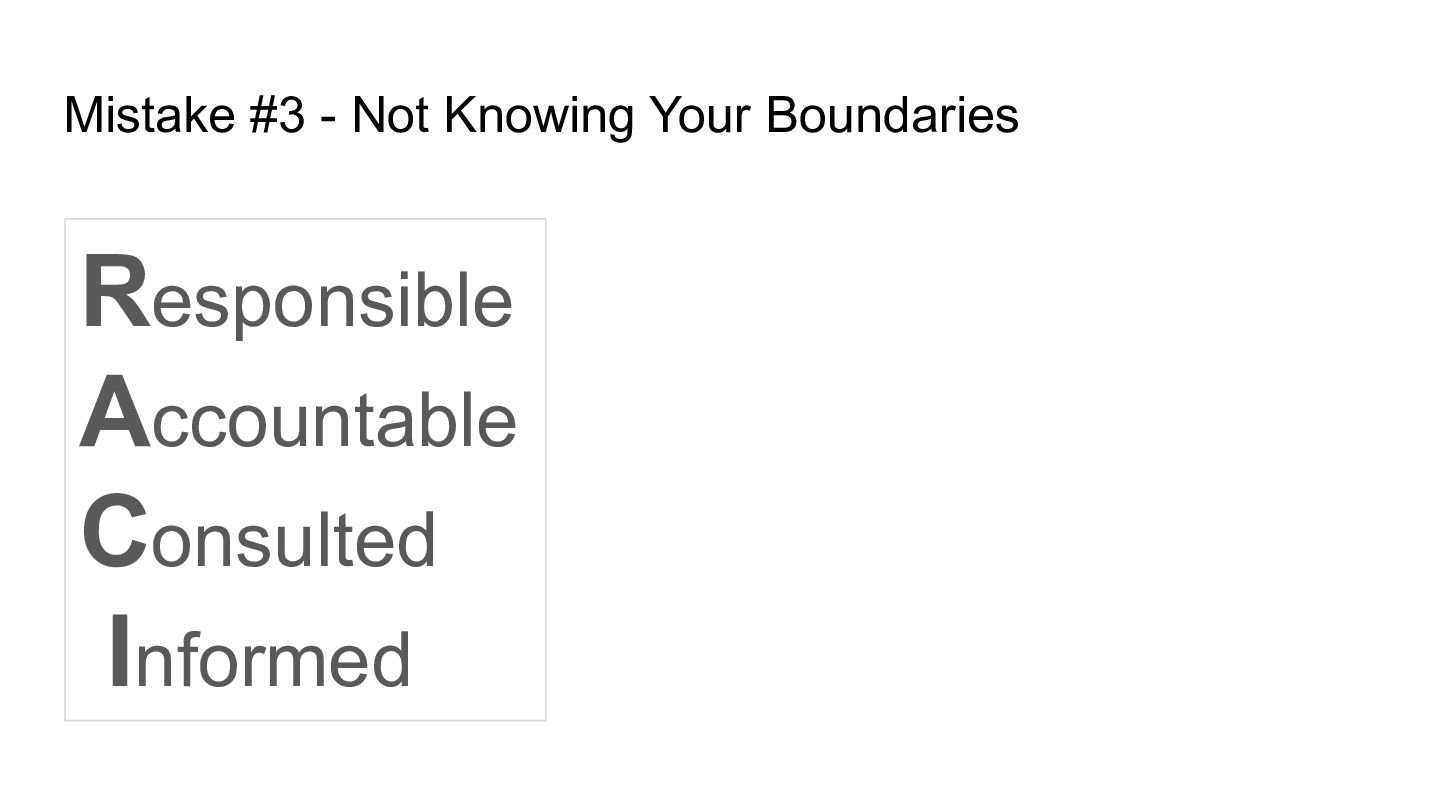
  19. Mistake #3 - Not Knowing Your Boundaries Responsible Accountable Consulted

    Informed RACI: Optimising LCP in Migration - Tasks SE O De v QA PM 1. Diagnose LCP element per-template (e.g. ≤2.5s) R C C A 2. Optimise LCP assets (hero img, video poster, font) C R I A 3. Implement preload + fetchpriority for the LCP resource C R I I 4. Improve server response time / TTFB (CDN, caching etc.) I R I A 5. Remove render-blocking CSS/JS above the fold C R C I 6. QA & validate LCP against target — pre-launch gate C C R A
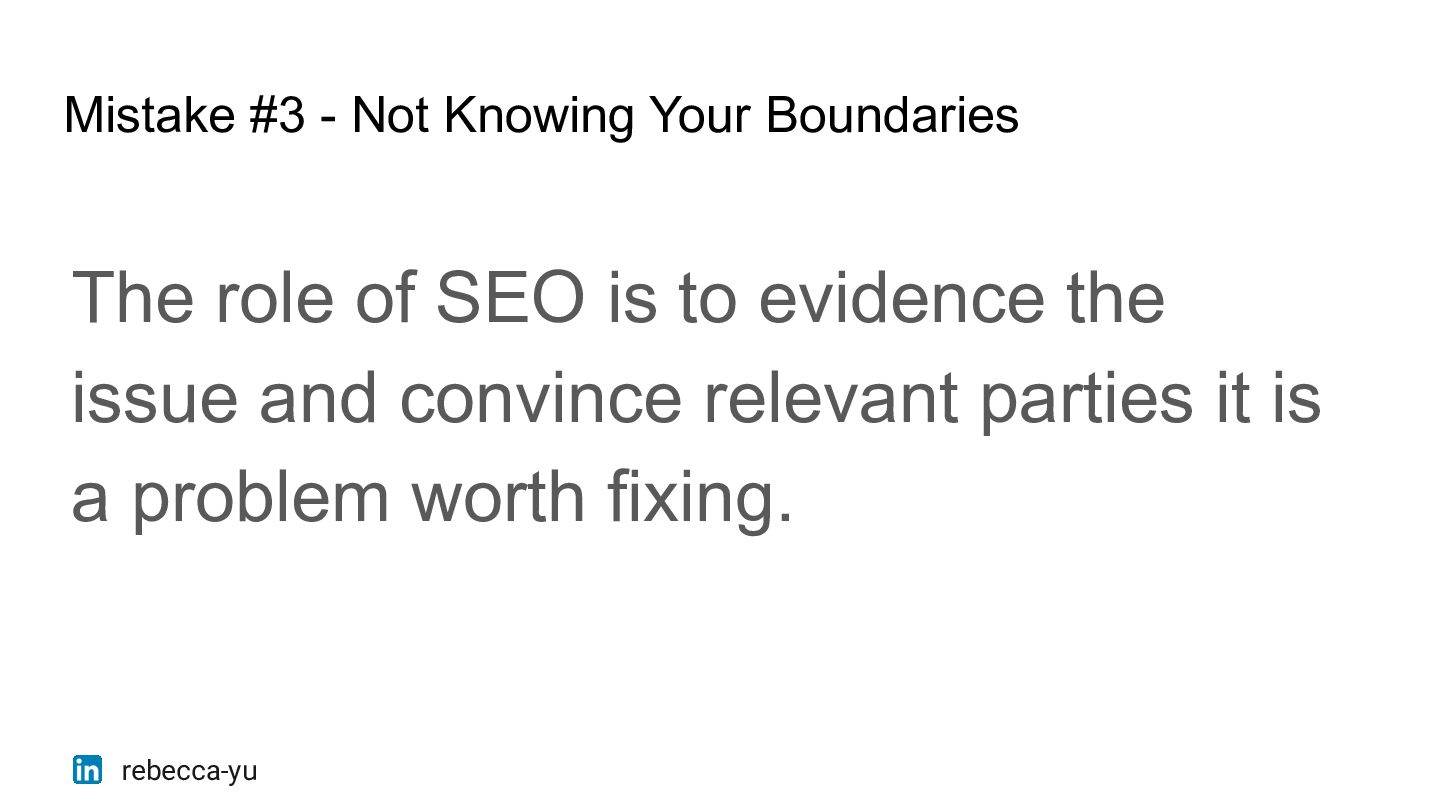
  20. Mistake #3 - Not Knowing Your Boundaries The role of

    SEO is to evidence the issue and convince relevant parties it is a problem worth fixing. rebecca-yu
  21. Mistake #4 - No MVP Version of SEO features Minimum

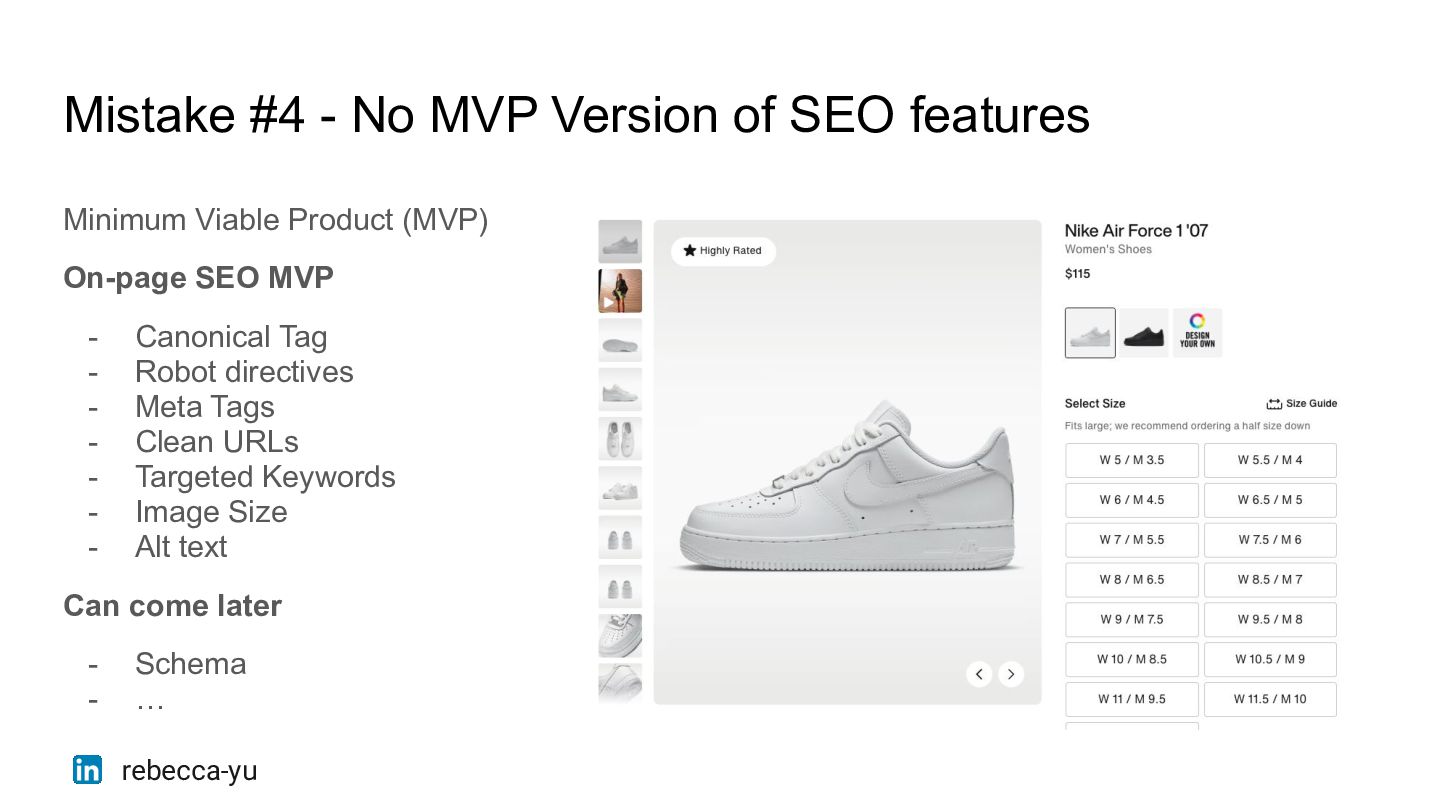
    Viable Product (MVP) On-page SEO MVP - Canonical Tag Robot directives Meta Tags Clean URLs Targeted Keywords Image Size Alt text Can come later - Schema … rebecca-yu
  22. Mistake #4 - No MVP Version of SEO features Rolling

    out a new feature 1 2 3 MVP / Proof of Concept (POC) Pilot Testing Full Scale Production An internal test to check feasibility rebecca-yu A controlled, small-scale rollout A sitewide release
  23. Mistake #4 - No MVP Version of SEO features Rolling

    out a new feature >> Applying Product Schema to PDPs 1 2 3 MVP / Proof of Concept (POC) Pilot Testing Full Scale Production PDPs page samples from selected categories rebecca-yu Implement to a full category PDPs (Men’s Shoes) Release to all categories PDPs Further Read: Implementation of Schema via GTM https://www.linkedin.com/posts/radustoian_implementation-of-schemas-via-gtm-br ightonseo-activity-7247698547729428481-SjtC
  24. Mistake #5 - Messing up Human Errors vs System Errors

    Human Error System Error An SEO issue caused by a manually-set value that wasn't updated when the underlying system or content changed An SEO issue caused by automated platform logic producing incorrect or inconsistent output at scale, because the underlying rule wasn't built to account for a specific edge case or exception. rebecca-yu
  25. Mistake #5 - Messing up Human Errors vs System Errors

    Human Error System Error Manual canonical input field Parameter-Blind Self-Referencing Canonical Page URL: https://www.example.com/new-url-path Page URL: https://www.example.com/product?utm_source= newsletter ❌<link rel="canonical" href="https://www.example.com/old-url-pa th"> (field was manually overridden) ✅<link rel="canonical" href="https://www.example.com/new-url-p ath"> rebecca-yu ❌ <link rel="canonical" href="https://www.example.com/product?utm_s ource=newsletter"> ✅ <link rel="canonical" href="https://www.example.com/product">
  26. Mistake #5 - Messing up Human Errors vs System Errors

    System Errors Example - Schema Schema: AggregateOffer ✅ priceCurrency: GBP ❌ lowPrice is entirely absent — a critical/required field for AggregateOffer. rebecca-yu
  27. Mistake #6 - Not Factoring in Scalability / New Trend

    Launch Day Planned Market Expansion? International URL structure in place? rebecca-yu AI Shopping Assistant WebMCP / UCP?
  28. Mistake #6 - Not Factoring in Scalability / New Trend

    Does the current structure reserve space for scaling? rebecca-yu
  29. Mistake #6 - Not Factoring in Scalability / New Trend

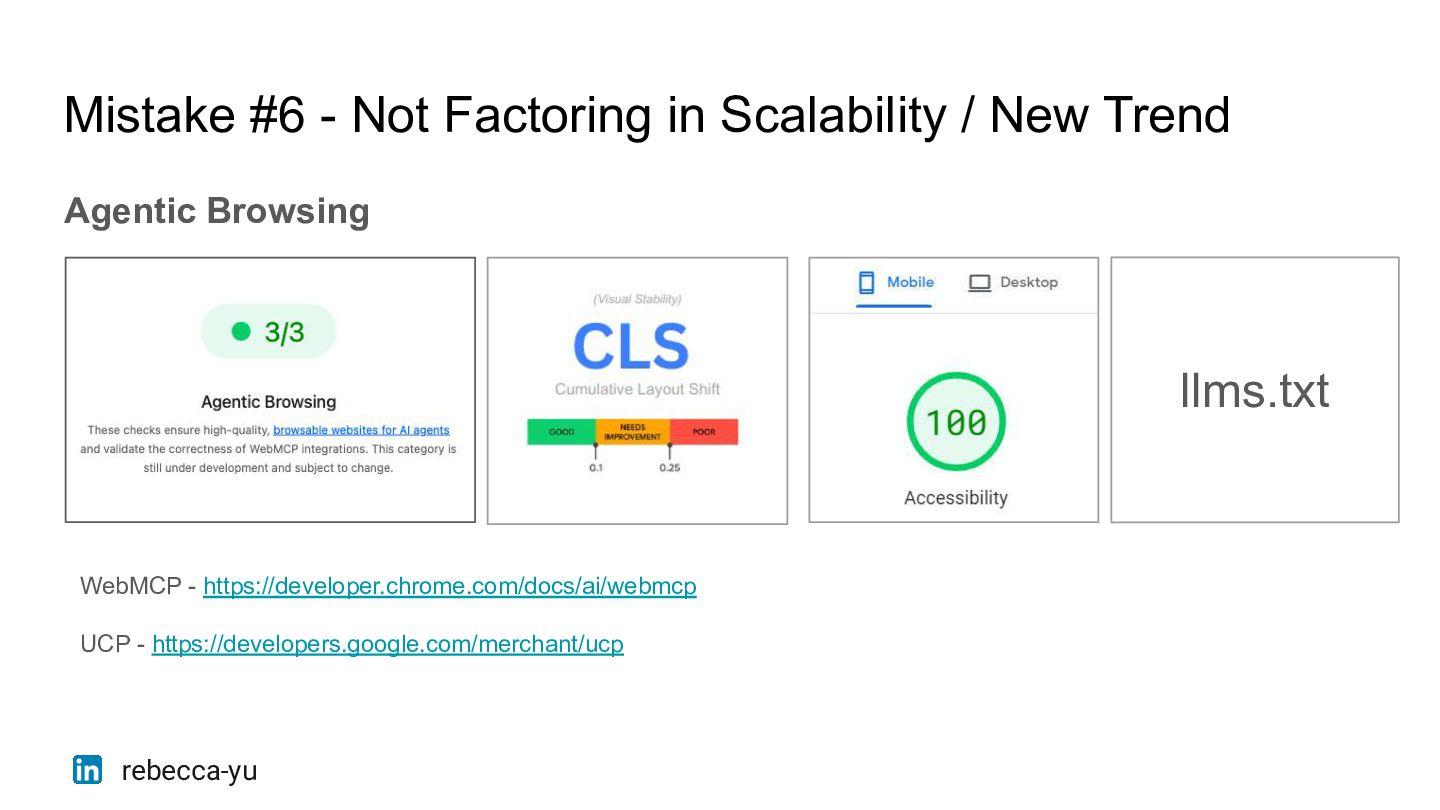
    Agentic Browsing llms.txt WebMCP - https://developer.chrome.com/docs/ai/webmcp UCP - https://developers.google.com/merchant/ucp rebecca-yu
  30. The 6 Important Points in Large-scale Migrations 1 4 Organisation

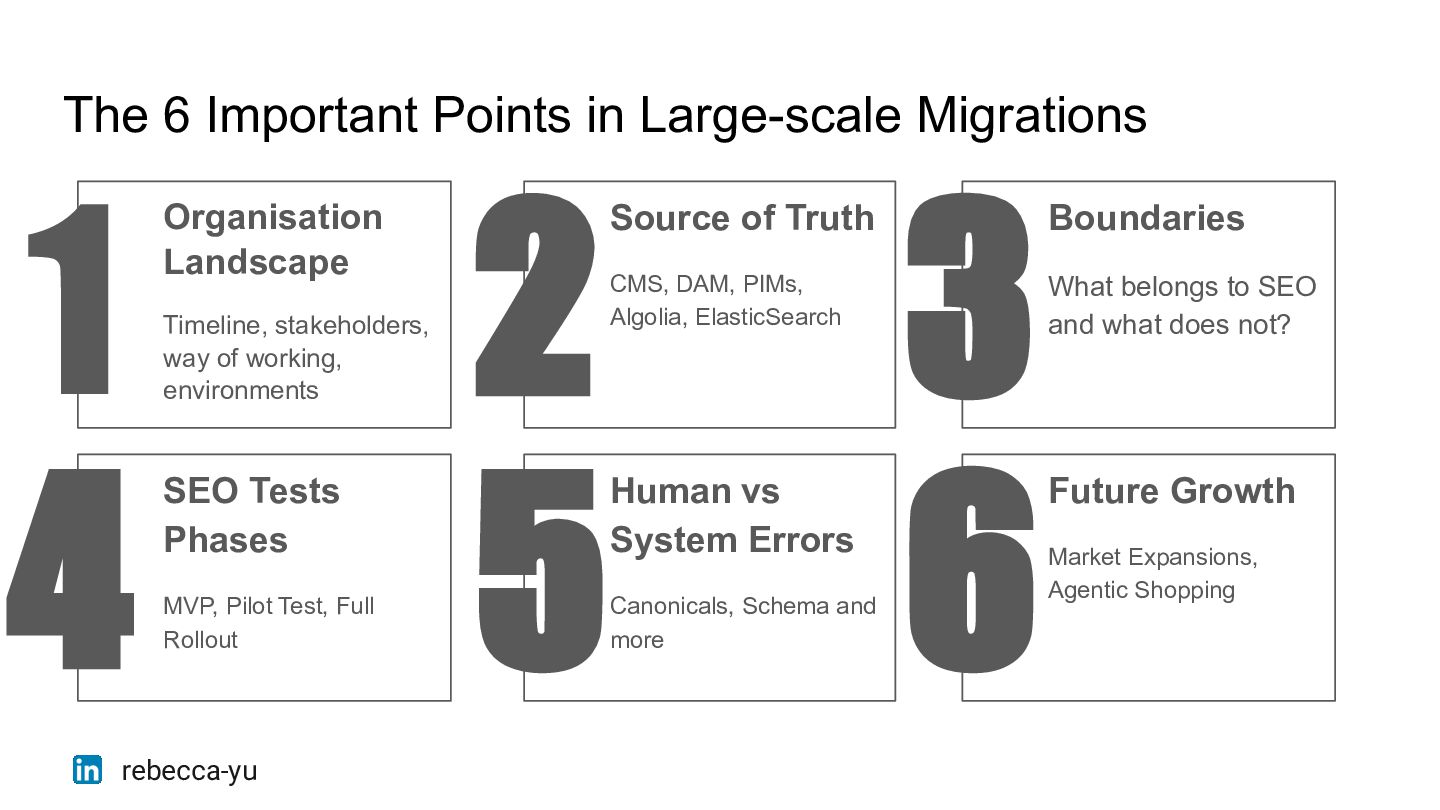
    Landscape Timeline, stakeholders, way of working, environments SEO Tests Phases MVP, Pilot Test, Full Rollout rebecca-yu 2 5 Source of Truth CMS, DAM, PIMs, Algolia, ElasticSearch Human vs System Errors Canonicals, Schema and more 3 6 Boundaries What belongs to SEO and what does not? Future Growth Market Expansions, Agentic Shopping