-based LiDAR Upsampling Reon Tabata*1*2, Kenji Koide*2, Shuji Oishi*2, Masashi Yokozuka *2, Taku Okawara *2, Aoki Takanose *2, Jun Miura*1 *1 Toyohashi University of Technology, Japan *2 National Institute of Advanced Industrial Science and Technology (AIST), Ja pan
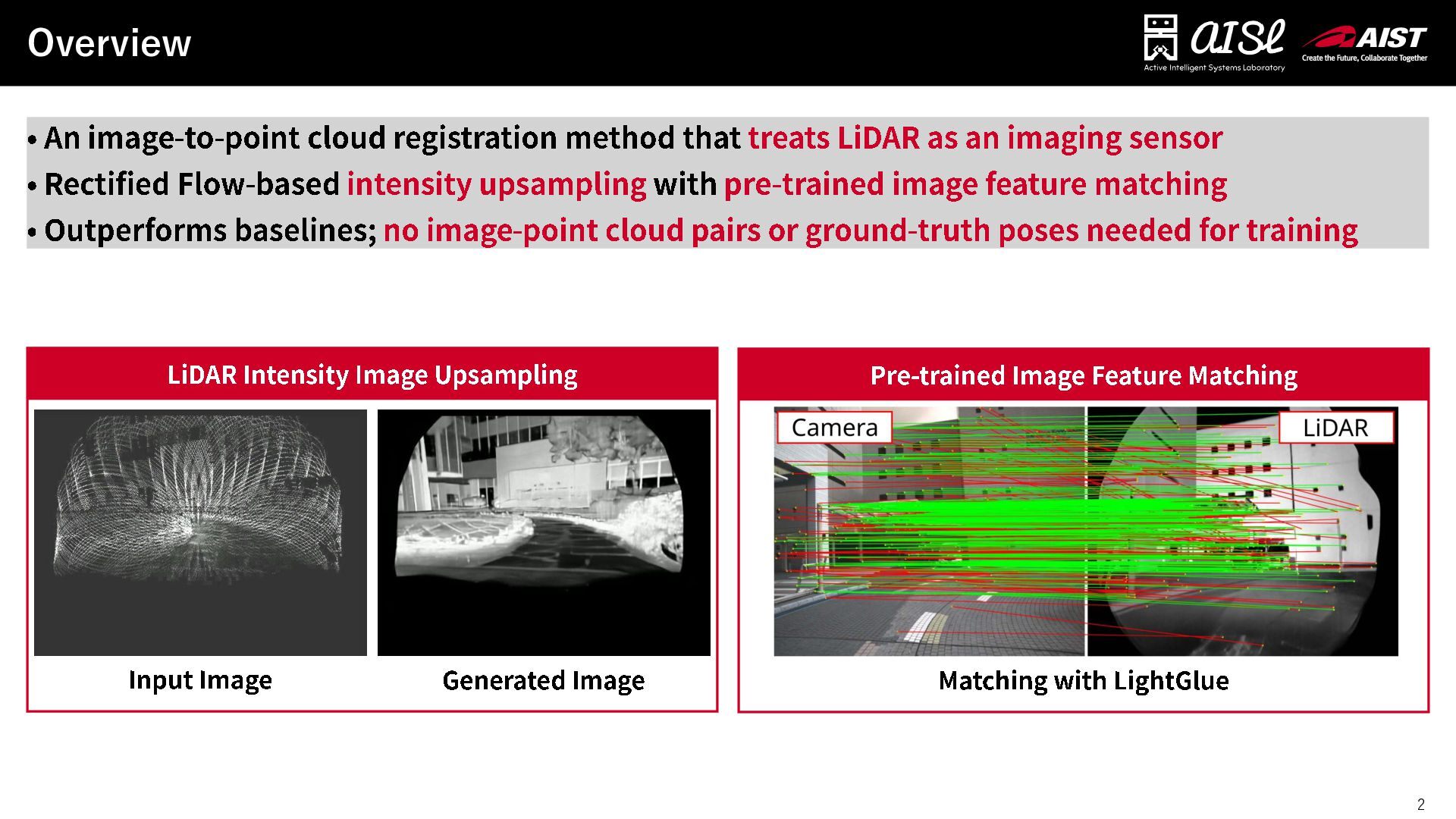
• Rectified Flow -based intensity upsampling • Outperforms baselines; with pre -trained image feature matching no image -point cloud pairs or ground LiDAR Intensity Image Upsampling Input Image treats LiDAR as an imaging sensor Generated Image -truth poses needed for training Pre -trained Image Feature Matching Matching with LightGlue 2
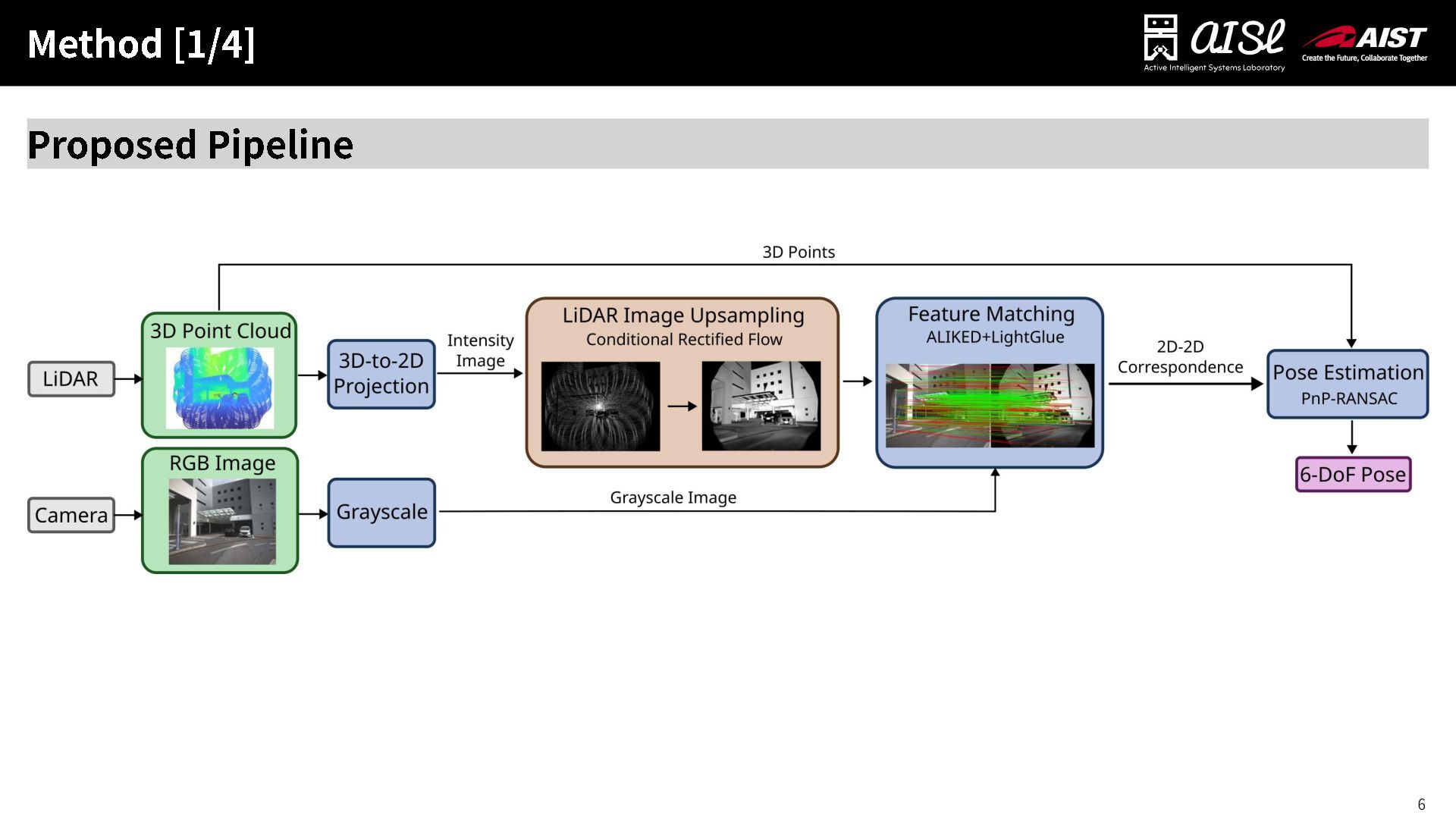
training data while achieving high accuracy and strong generalization Approach Image -to -image registration can leverage powerful pre -trained matchers, even across different modalities. 1 Treat LiDAR as an imaging sensor via intensity upsampling Estimate relative pose using image -to -image registration 2 Self -supervised pre -training on readily available images Fine -tuning with a small amount of LiDAR data 5
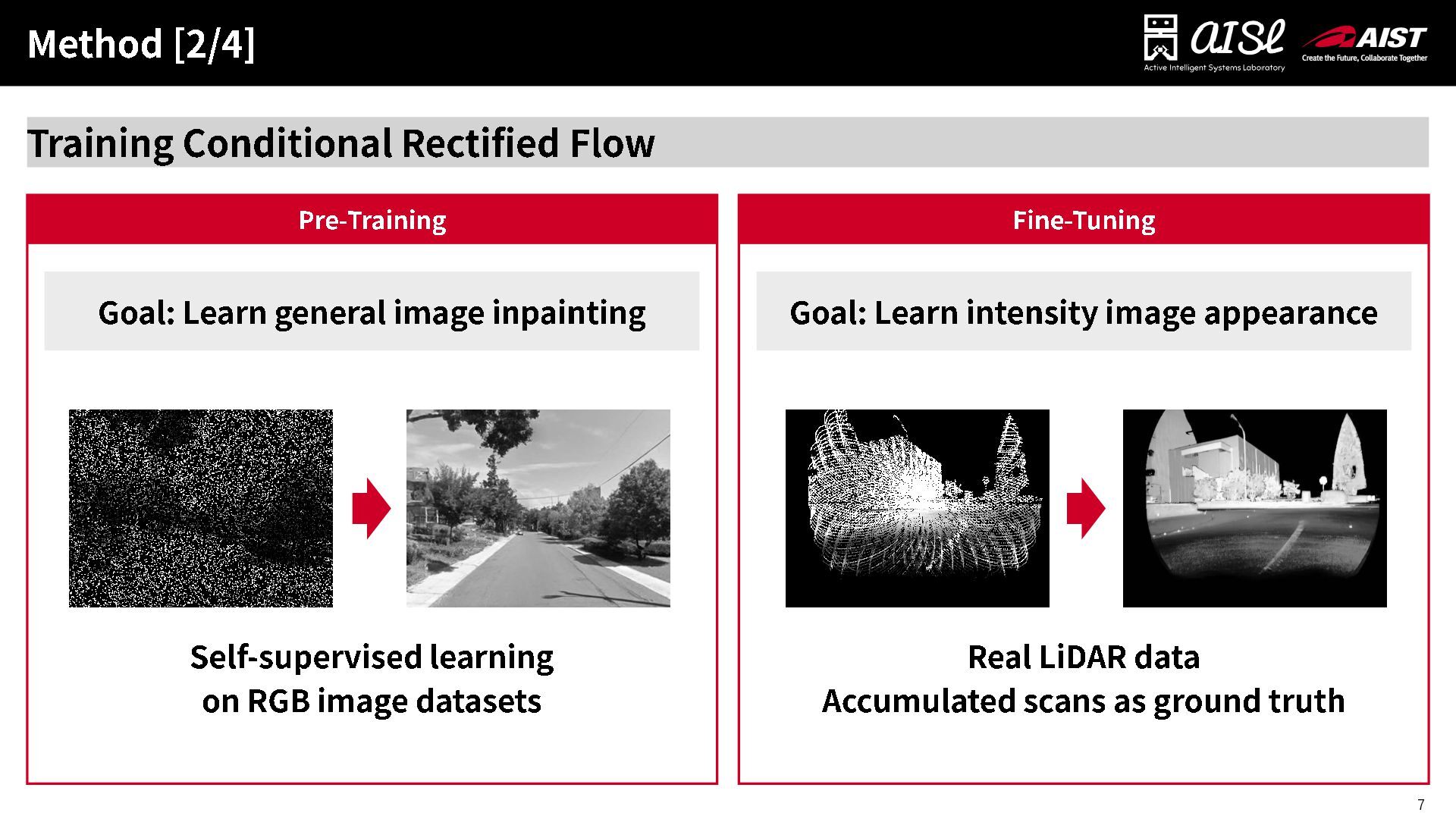
Goal: Learn general image inpainting Goal: Learn intensity image appearance Self -supervised learning on RGB image datasets Real LiDAR data Accumulated scans as ground truth 7
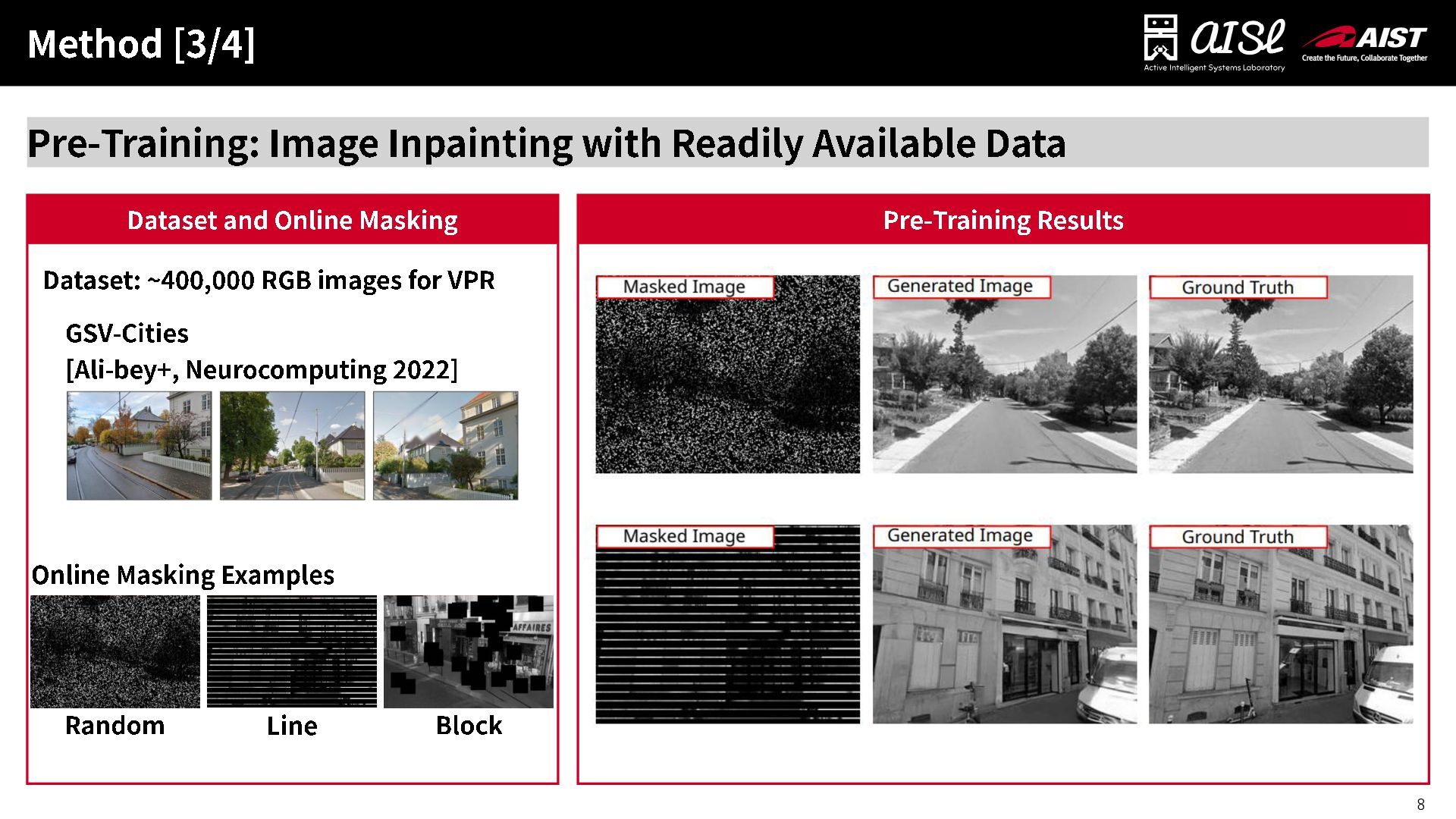
Dataset and Online Masking Pre -Training Results Dataset: ~400,000 RGB images for VPR GSV-Cities [Ali -bey+, Neurocomputing 2022] Online Masking Examples Random Line Block 8
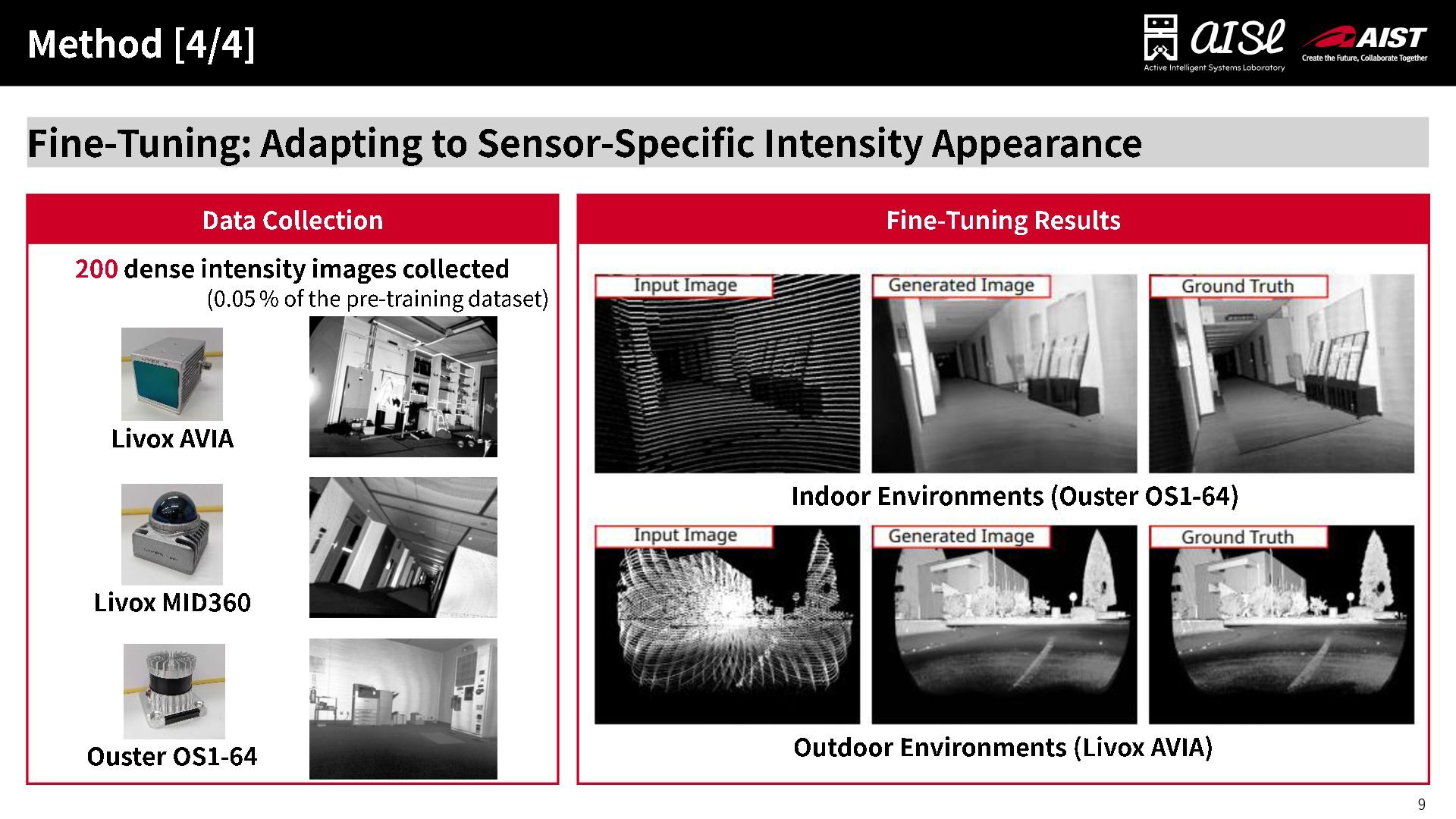
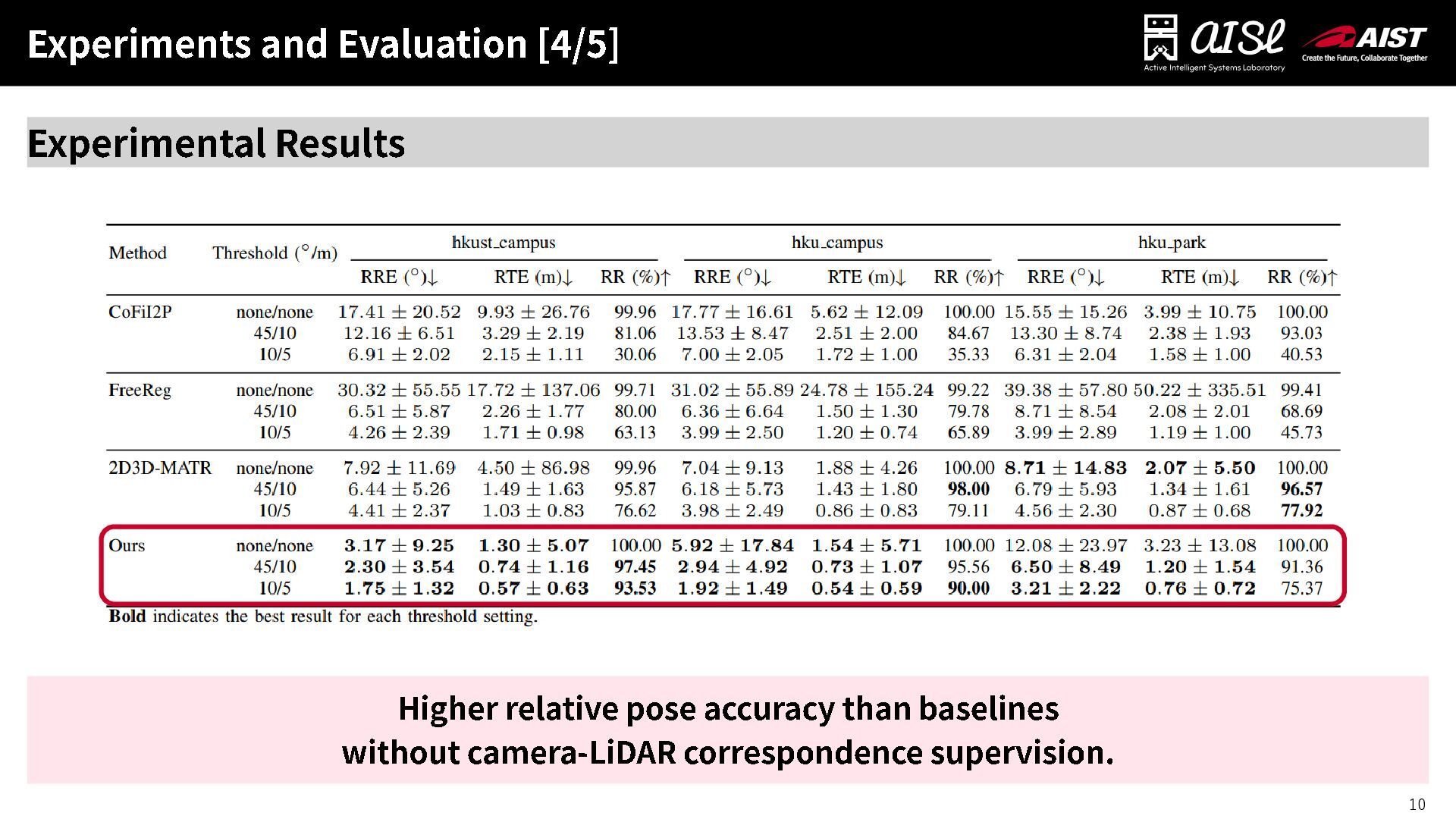
-tuning with limited LiDAR data via Rectified Flow -based LiDAR intensity upsampling ; no image -point cloud pairs or ground • Higher pose estimation accuracy than baselines -truth poses. in our evaluation. Future Work • More stable intensity generation in unstructured environments, such as trees and grass. • Integrate more advanced feature matchers, such as MASt3R. 11


 s_mizuki_nlp
 analokmaus
 ayatokanada
 sirmatrixpage
 satai
 ftakahashi
 kohlerjohannes
 hf149
 institutdelelevage
 takaomurakami
 auranightsky
 corochann
 baasie
 reverentgeek
 holman
 cassininazir
 quramy
 irinanazarova
 akademiya2063
 bluesmoon
 aleyda
 sabderemane
 brad_frost
 lemiorhan