Upgrade to Pro — share decks privately, control downloads, hide ads and more …

NACU Innovators: November 2013

Avatar for rheyden rheyden
November 02, 2013

NACU Innovators: November 2013

Avatar for rheyden

rheyden

November 02, 2013

Other Decks in Education

Transcript

  1. Part of the larger NAC&U Costs of Higher Education Project

    –  Interdisciplinary Team Examined Two Questions in the Spring 2013 Semester: •  What are the true costs of a college education? •  Why do costs keep rising at private, nonprofit institutions? •  Collaborative Team •  Dr. Loyd Bastin •  Coordinator of Undergraduate Research Office of Experiential Learning and International Programs •  Dr. Tim Sullivan •  (Education, SEICS) •  2 doctoral students •  Dr. Rick Goeke •  (Management, Business) •  MIS 370 – 6 undergraduate students •  Dr. Wes Leckrone •  (Political Science, A&S) •  POLS 288– 13 undergraduate students
  2. Why an Interdisciplinary Collaboration? •  Can address broader topics • 

    Breaking down academic silos •  Get to know faculty from other disciplines •  Exposure to other ways of thinking •  Student-Student learning (class visits) •  Faculty visiting lectures •  Future collaborations Assessment •  Student-led project was successful – highly motivated students •  Mixed results with content creation •  Special speakers = added insight •  Collaboration gave students a sense that they were part of something big & innovative
  3. Innovative International Initiatives for Graduate Education Meghan J. Pifer, PhD

    Assistant Professor of Higher Education School of Education, Innovation, & Continuing Studies Widener University  
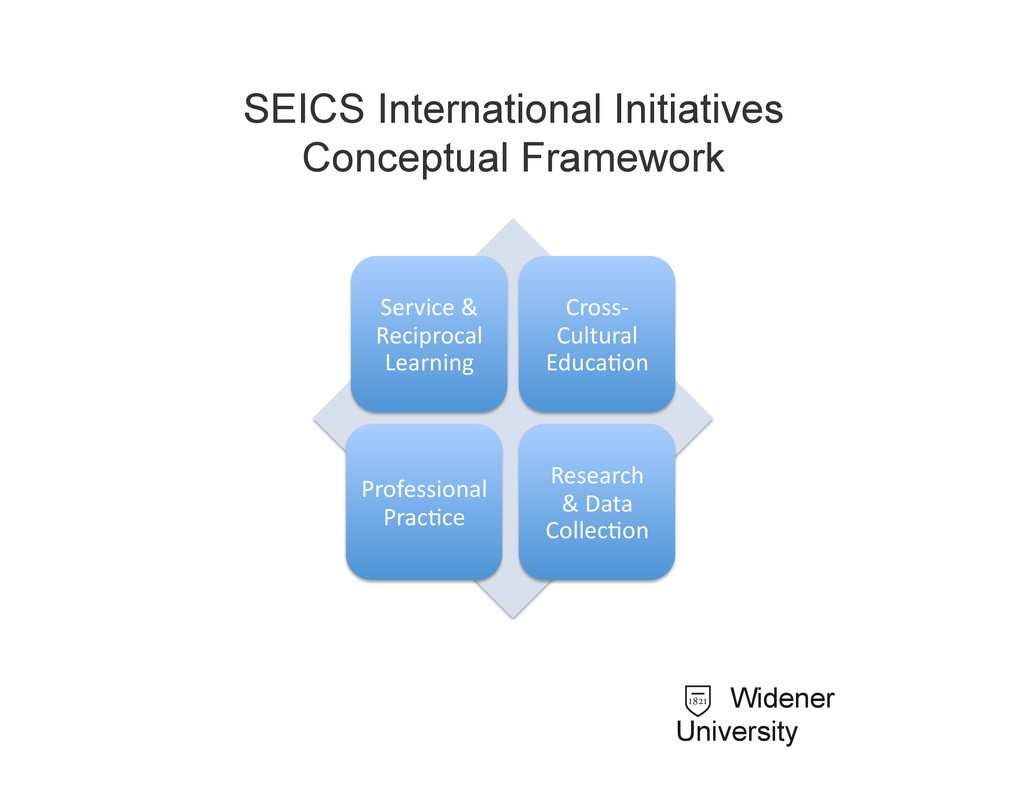
  4. Service  &   Reciprocal   Learning     Cross-­‐ Cultural

      Educa,on   Professional   Prac,ce   Research     &  Data   Collec,on     SEICS International Initiatives Conceptual Framework Widener University  
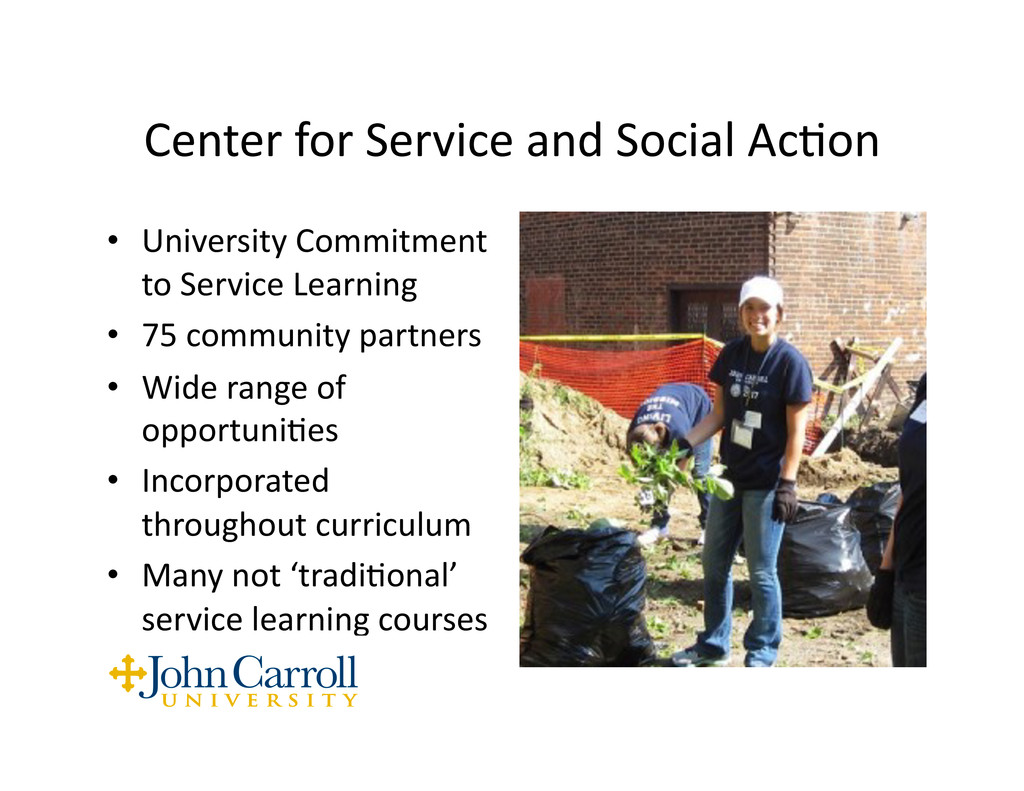
  5. Center  for  Service  and  Social  Ac,on   •  University  Commitment

      to  Service  Learning   •  75  community  partners   •  Wide  range  of   opportuni,es   •  Incorporated   throughout  curriculum   •  Many  not  ‘tradi,onal’   service  learning  courses  
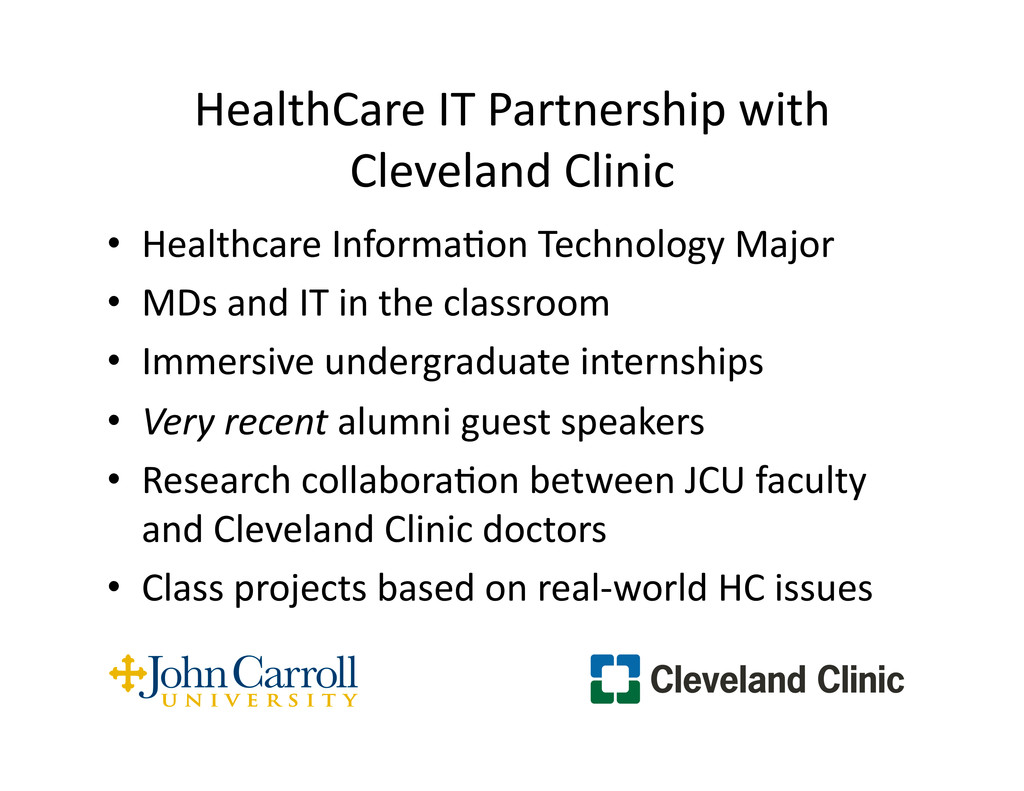
  6. HealthCare  IT  Partnership  with   Cleveland  Clinic   •  Healthcare

     Informa,on  Technology  Major   •  MDs  and  IT  in  the  classroom   •  Immersive  undergraduate  internships   •  Very  recent  alumni  guest  speakers   •  Research  collabora,on  between  JCU  faculty   and  Cleveland  Clinic  doctors   •  Class  projects  based  on  real-­‐world  HC  issues  
  7. Standards-­‐Based  Grading   •  Figure  out  what  you  want  students

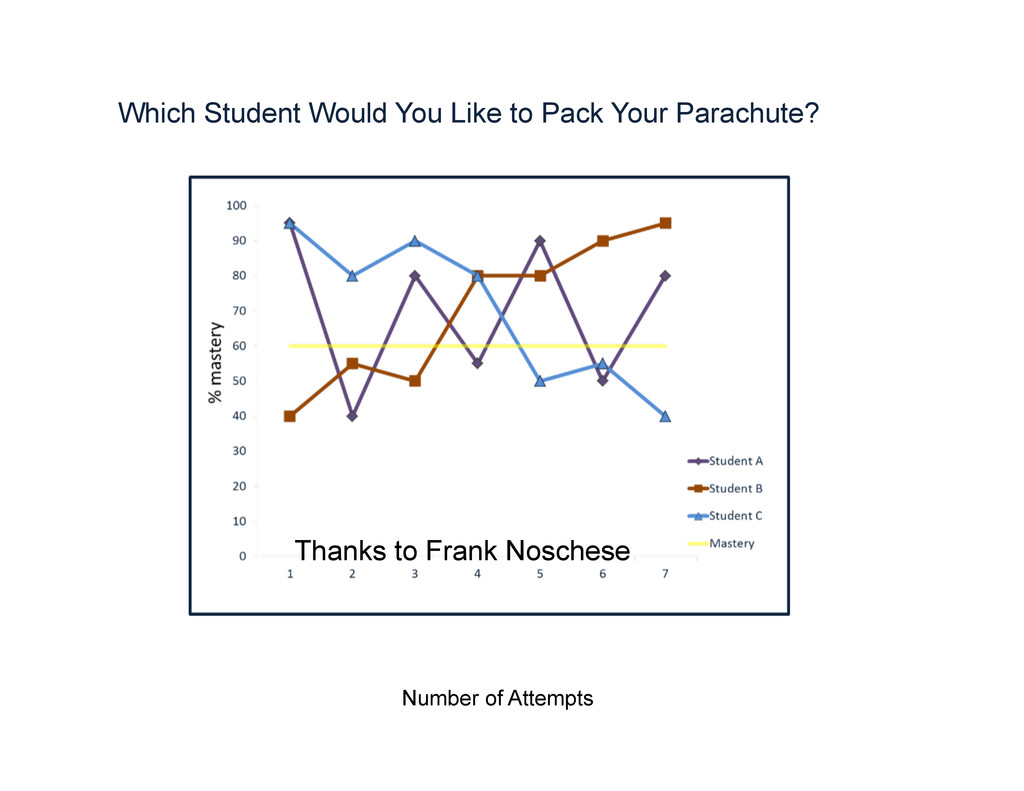
     to  learn   o  I  use  “I  can  .  .  .”  statements   •  Give  them  the  environment  where  they  can  learn  them   o  I  use  a  “flipped  class”  approach  for  this     Most  recently  I’ve  flipped  that  paradigm  so  that  we  tackle   ideas  in  class  first,  then  they  ask  for  certain  resources  to  be   made  available  a^erwards   •  Assess  their  knowledge  mul,ple  ,mes  (just  like  the  parachute   example)   •  Their  grade  should  reflect  their  current  understanding  of  each   standard.  
  8. .  .  .  with  voice   •  I  find  oral

     exams  to  be  the  most  authen,c  means  of  assessment   •  Lebng  students  add  their  voice  to  normal  assignments  approaches   that  level  of  authen,city   •  Students  use  screencas,ng  to  walk  me  through  their  work   o  This  is  physics,  so  it’s  o^en  solving  a  problem   o  But  it  can  be  a  deriva,on  -­‐  something  I  was  only  able  to  assess  in   the  past  on  exams  since  most  texts  have  the  full  deriva,on  in   them.  
  9. Hamline  University   Enhancing  crea,vity  through  digital   storytelling  

    Caroline  Hilk     Center  for  Teaching  and  Learning  
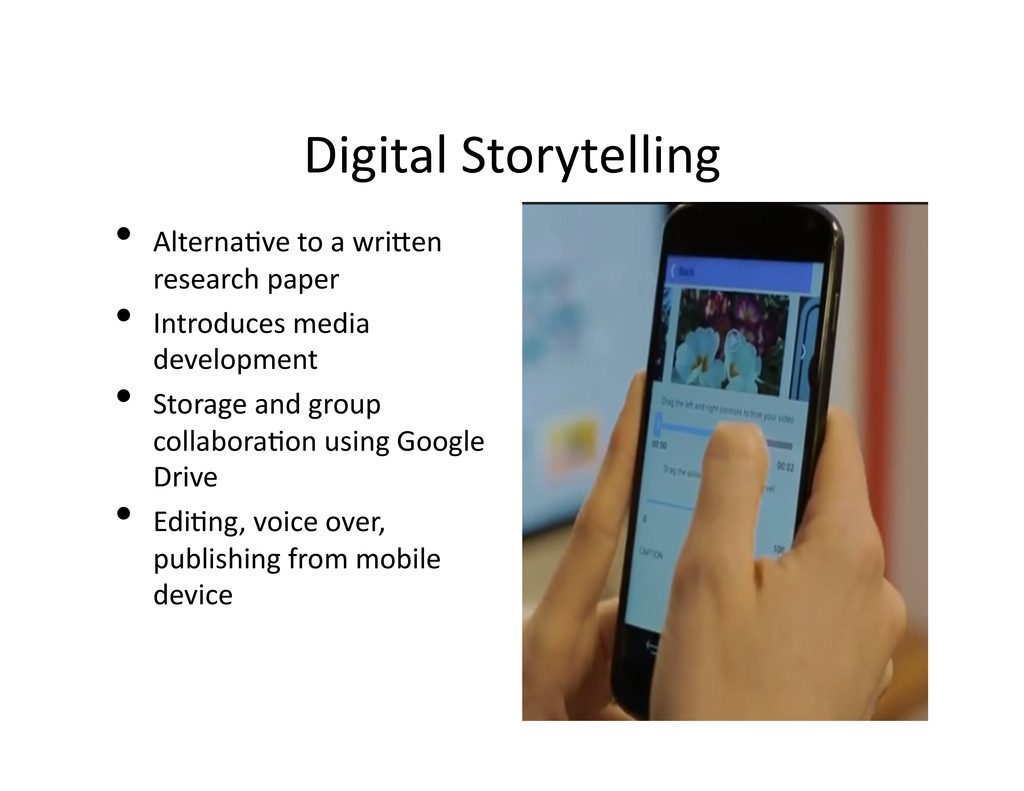
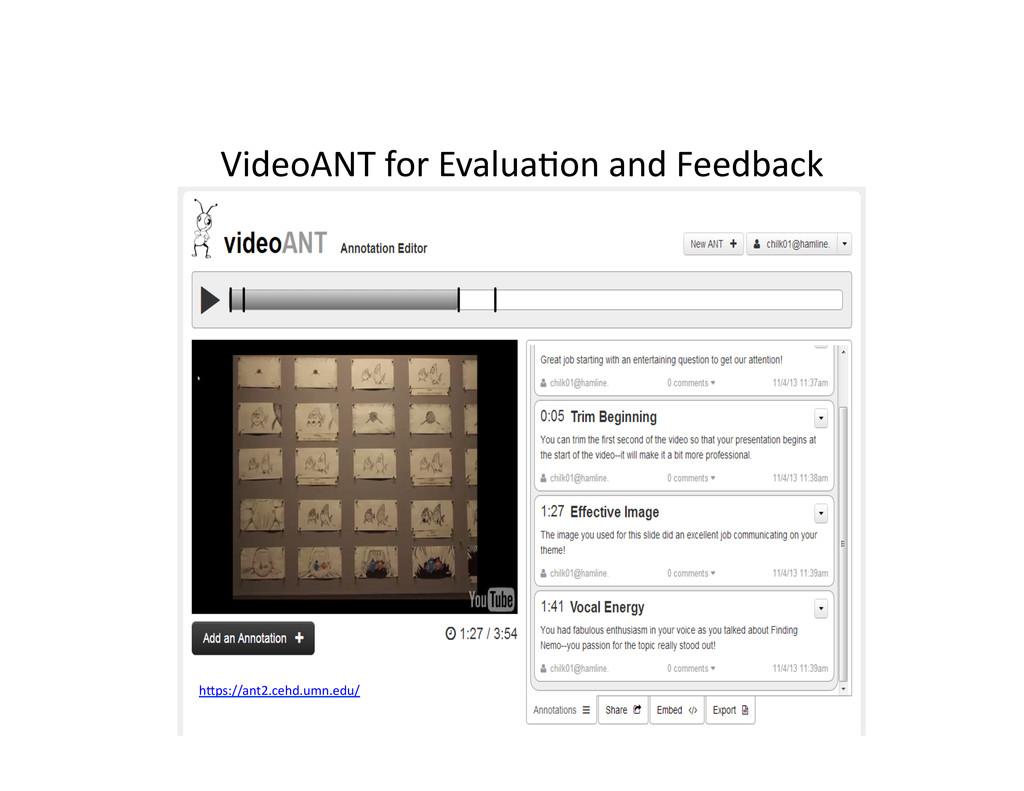
  10. Digital  Storytelling   •  Alterna,ve  to  a  wriHen   research

     paper   •  Introduces  media   development   •  Storage  and  group   collabora,on  using  Google   Drive   •  Edi,ng,  voice  over,   publishing  from  mobile   device  
  11. Undergraduate Research •  Original research is typically reserved for graduate

    students, usually at large universities. •  Research as a learning tool is a valuable experience for undergrads, so Valpo cherishes it. •  Last year, Valpo had over 50 faculty and 150 Valpo students involved in undergraduate research projects during the academic year. •  Valpo also runs multiple REUs and other summer research experiences for undergrads. •  Learn more at: www.valpo.edu/research/ •  Or talk to me: [email protected]
  12. Innova,on  at  Drury  University   Summit  Representa,ves:   Chris  Panza,

     Ph.D.  -­‐  Philosophy   Regina  Waters,  Ph.D.  -­‐  Communica,on  
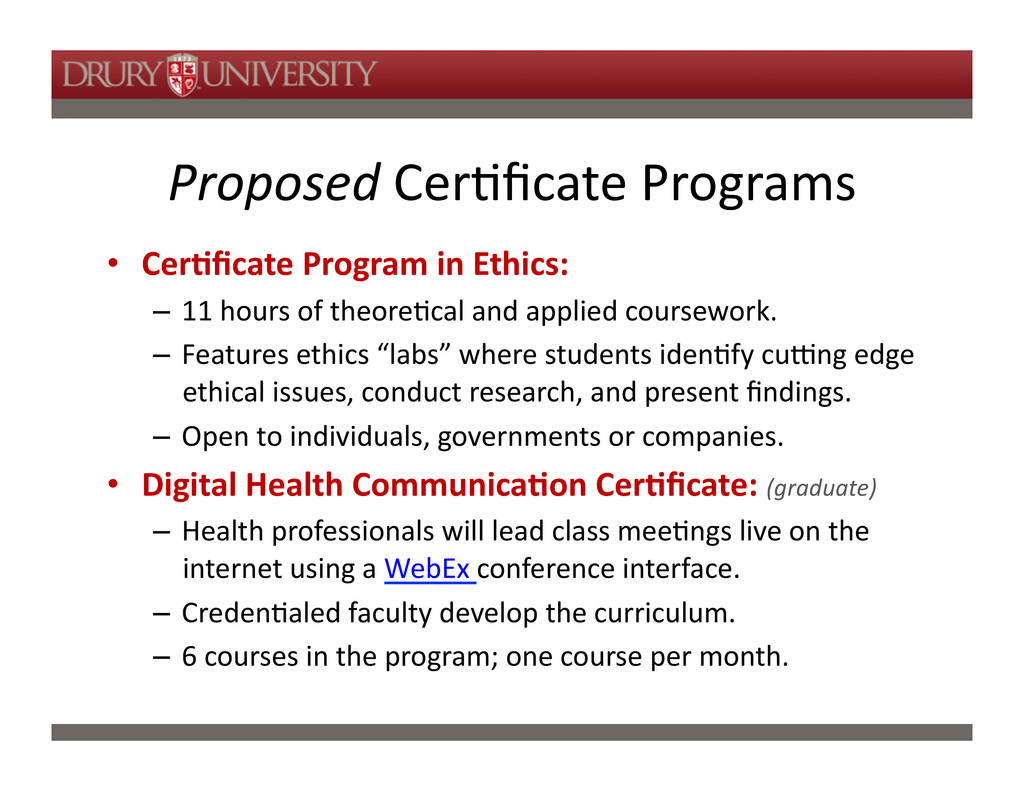
  13. Proposed  Cer,ficate  Programs   •  Cer$ficate  Program  in  Ethics:  

    –  11  hours  of  theore,cal  and  applied  coursework.     –  Features  ethics  “labs”  where  students  iden,fy  cubng  edge   ethical  issues,  conduct  research,  and  present  findings.     –  Open  to  individuals,  governments  or  companies.     •  Digital  Health  Communica$on  Cer$ficate:  (graduate)   –  Health  professionals  will  lead  class  mee,ngs  live  on  the   internet  using  a  WebEx  conference  interface.   –  Creden,aled  faculty  develop  the  curriculum.   –  6  courses  in  the  program;  one  course  per  month.    
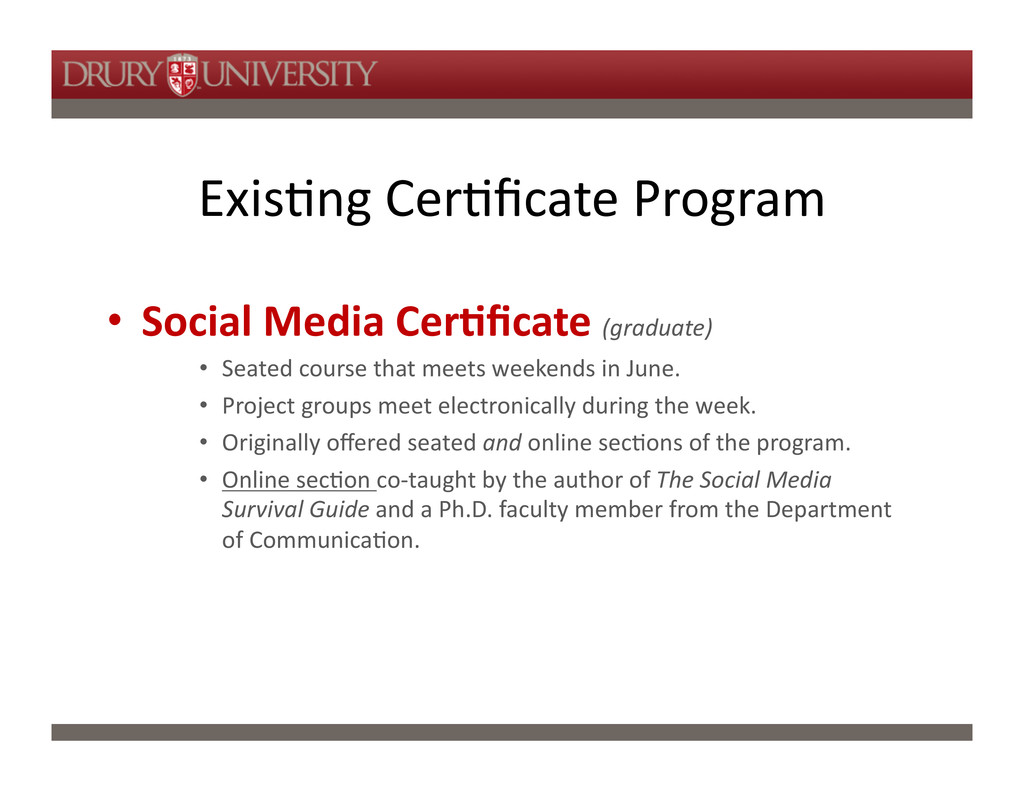
  14. Exis,ng  Cer,ficate  Program   •  Social  Media  Cer$ficate  (graduate)  

    •  Seated  course  that  meets  weekends  in  June.     •  Project  groups  meet  electronically  during  the  week.     •  Originally  offered  seated  and  online  sec,ons  of  the  program.   •  Online  sec,on  co-­‐taught  by  the  author  of  The  Social  Media   Survival  Guide  and  a  Ph.D.  faculty  member  from  the  Department   of  Communica,on.    
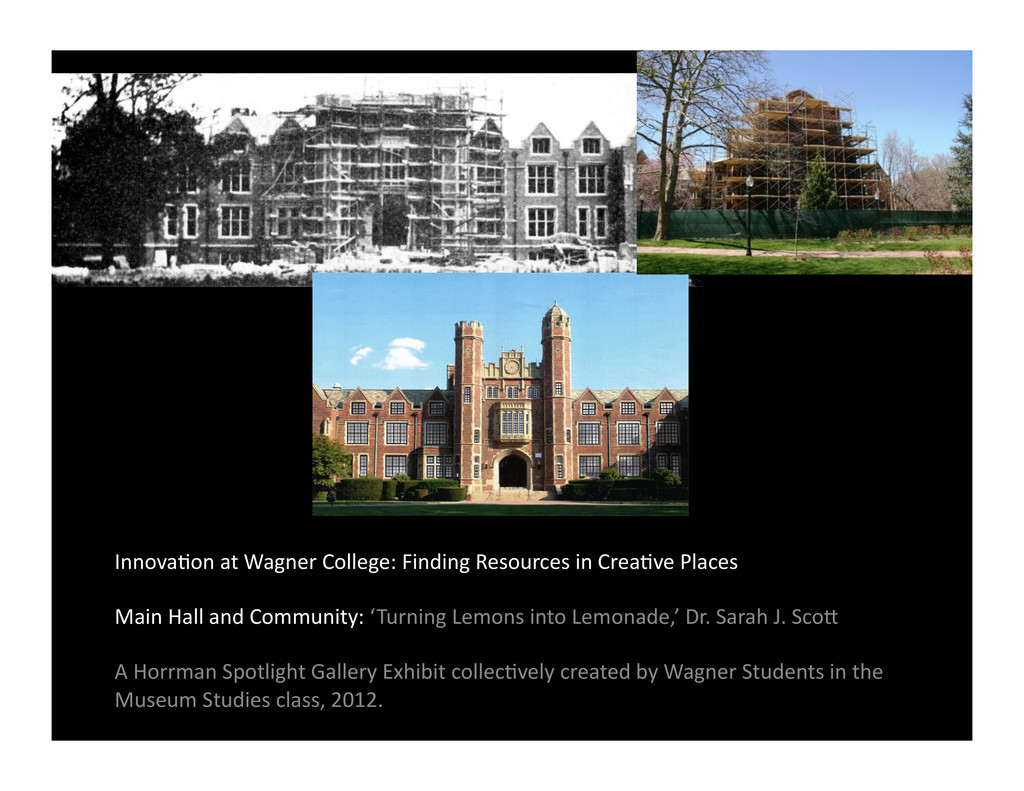
  15. Innova,on  at  Wagner  College:  Finding  Resources  in  Crea,ve  Places  

    Main  Hall  and  Community:  ‘Turning  Lemons  into  Lemonade,’  Dr.  Sarah  J.  ScoH   A  Horrman  Spotlight  Gallery  Exhibit  collec,vely  created  by  Wagner  Students  in  the   Museum  Studies  class,  2012.  
  16. Main  Hall  is  the  hallmark  building  at  Wagner  College.  

     It  houses  the   Fine  Arts  Departments,    the  Main  Stage  theatre,  and  over  20   classrooms.    It  was  closed  for  renova,ons  during  the  summer  of   2009.    Construc,on  went  over,me  and  over  budget,  and  the   building  was  closed  for  over  a  year.    Faculty  and  students  alike   were  disappointed  and  angry  about  the  inconvenience.    My   students  and  I  aHempted  to  put  a  posi,ve  spin  on  the  project   through  research  and  community  outreach.    Historic,  Architectural,   Economic,  and  Social  research  was  conducted  through  various   lenses  and  resulted  in  three  final  projects:  1.  a  student  led  exhibit,   2.  a  presenta,on  during  alumni  weekend,  and  3.  a  short   publica,on  in  the  Alumni  Magazine.    Ul,mately,  the  campus   community  was  much  more  op,mis,c  about  the  project  and  new   lines  of  thought  were  opened  regarding  the  importance  of   architecture  .    Finally,  dona,ons  increased  for  the  project  budget.   It  is  my  belief  this  was  an  innova,ve  project  in  that  we  were  able   to  use  what  was  perceived  as  burden  as  a  valuable  asset  for   research  and  learning  opportuni,es  for  our  community.      
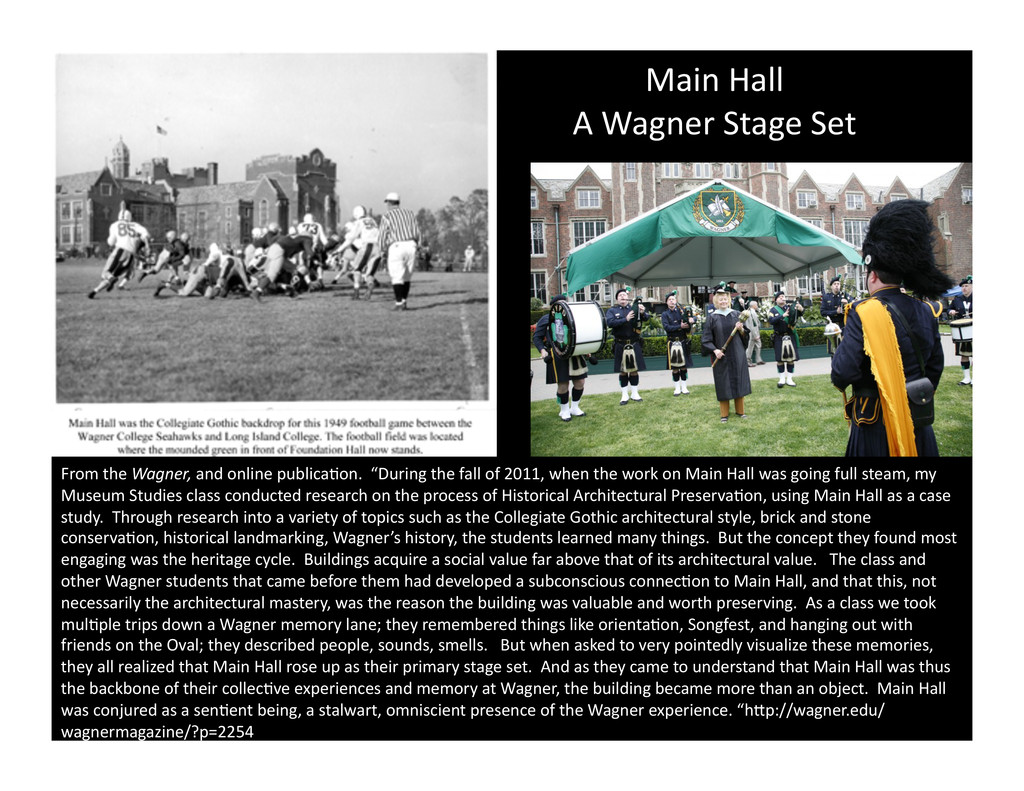
  17. Main  Hall     A  Wagner  Stage  Set   From

     the  Wagner,  and  online  publica,on.    “During  the  fall  of  2011,  when  the  work  on  Main  Hall  was  going  full  steam,  my   Museum  Studies  class  conducted  research  on  the  process  of  Historical  Architectural  Preserva,on,  using  Main  Hall  as  a  case   study.    Through  research  into  a  variety  of  topics  such  as  the  Collegiate  Gothic  architectural  style,  brick  and  stone   conserva,on,  historical  landmarking,  Wagner’s  history,  the  students  learned  many  things.    But  the  concept  they  found  most   engaging  was  the  heritage  cycle.    Buildings  acquire  a  social  value  far  above  that  of  its  architectural  value.      The  class  and   other  Wagner  students  that  came  before  them  had  developed  a  subconscious  connec,on  to  Main  Hall,  and  that  this,  not   necessarily  the  architectural  mastery,  was  the  reason  the  building  was  valuable  and  worth  preserving.    As  a  class  we  took   mul,ple  trips  down  a  Wagner  memory  lane;  they  remembered  things  like  orienta,on,  Songfest,  and  hanging  out  with   friends  on  the  Oval;  they  described  people,  sounds,  smells.      But  when  asked  to  very  pointedly  visualize  these  memories,   they  all  realized  that  Main  Hall  rose  up  as  their  primary  stage  set.    And  as  they  came  to  understand  that  Main  Hall  was  thus   the  backbone  of  their  collec,ve  experiences  and  memory  at  Wagner,  the  building  became  more  than  an  object.    Main  Hall   was  conjured  as  a  sen,ent  being,  a  stalwart,  omniscient  presence  of  the  Wagner  experience.  “hHp://wagner.edu/ wagnermagazine/?p=2254    
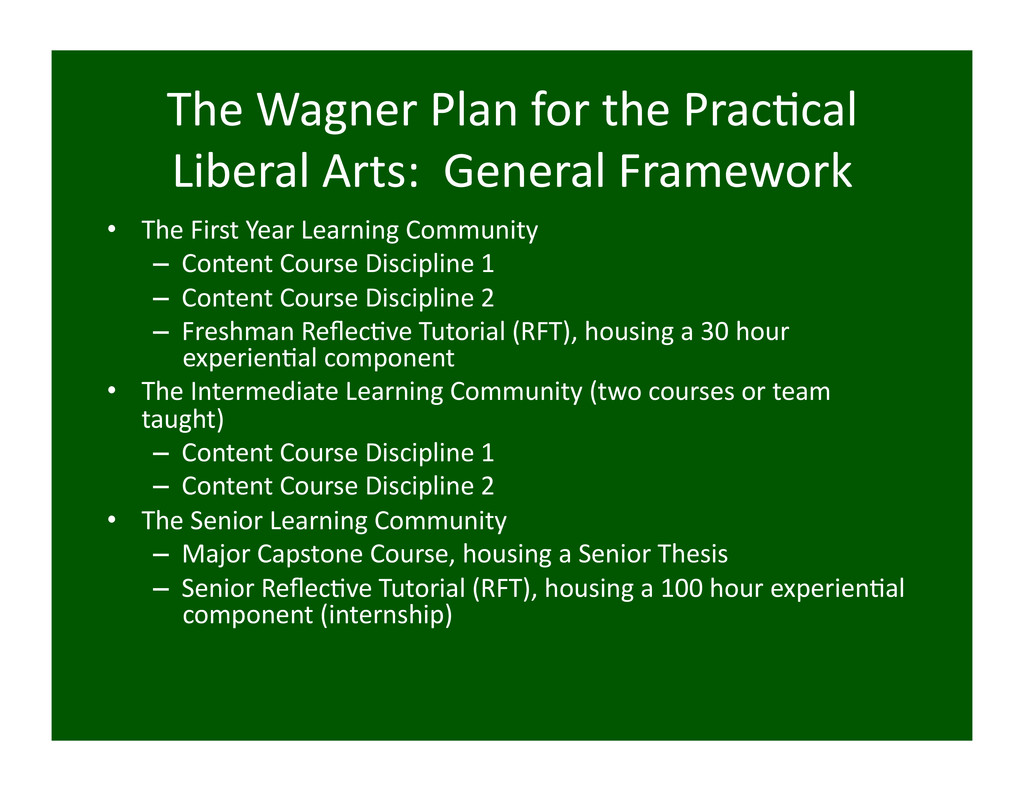
  18. The  Wagner  Plan  for  the  Prac,cal   Liberal  Arts:  

     General  Framework   •  The  First  Year  Learning  Community   –  Content  Course  Discipline  1   –  Content  Course  Discipline  2   –  Freshman  Reflec,ve  Tutorial  (RFT),  housing  a  30  hour   experien,al  component   •  The  Intermediate  Learning  Community  (two  courses  or  team   taught)   –  Content  Course  Discipline  1   –  Content  Course  Discipline  2   •  The  Senior  Learning  Community   –  Major  Capstone  Course,  housing  a  Senior  Thesis   –  Senior  Reflec,ve  Tutorial  (RFT),  housing  a  100  hour  experien,al   component  (internship)  
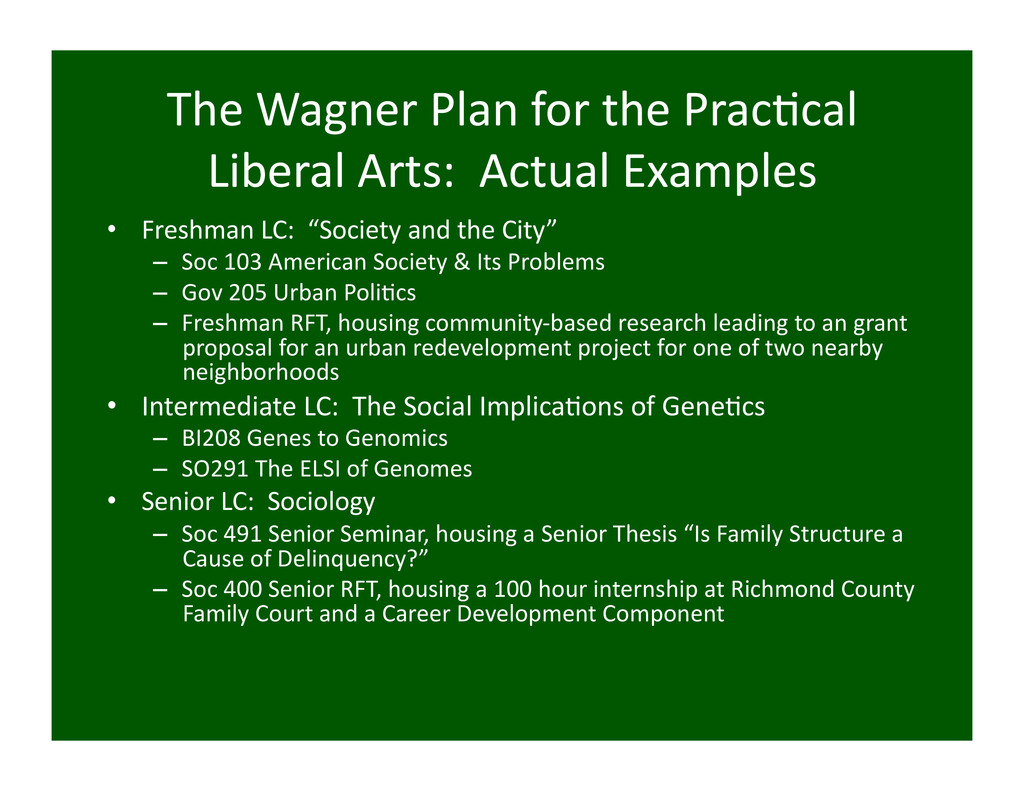
  19. The  Wagner  Plan  for  the  Prac,cal   Liberal  Arts:  

     Actual  Examples   •  Freshman  LC:    “Society  and  the  City”   –  Soc  103  American  Society  &  Its  Problems   –  Gov  205  Urban  Poli,cs   –  Freshman  RFT,  housing  community-­‐based  research  leading  to  an  grant   proposal  for  an  urban  redevelopment  project  for  one  of  two  nearby   neighborhoods   •  Intermediate  LC:    The  Social  Implica,ons  of  Gene,cs   –  BI208  Genes  to  Genomics     –  SO291  The  ELSI  of  Genomes   •  Senior  LC:    Sociology   –  Soc  491  Senior  Seminar,  housing  a  Senior  Thesis  “Is  Family  Structure  a   Cause  of  Delinquency?”   –  Soc  400  Senior  RFT,  housing  a  100  hour  internship  at  Richmond  County   Family  Court  and  a  Career  Development  Component  
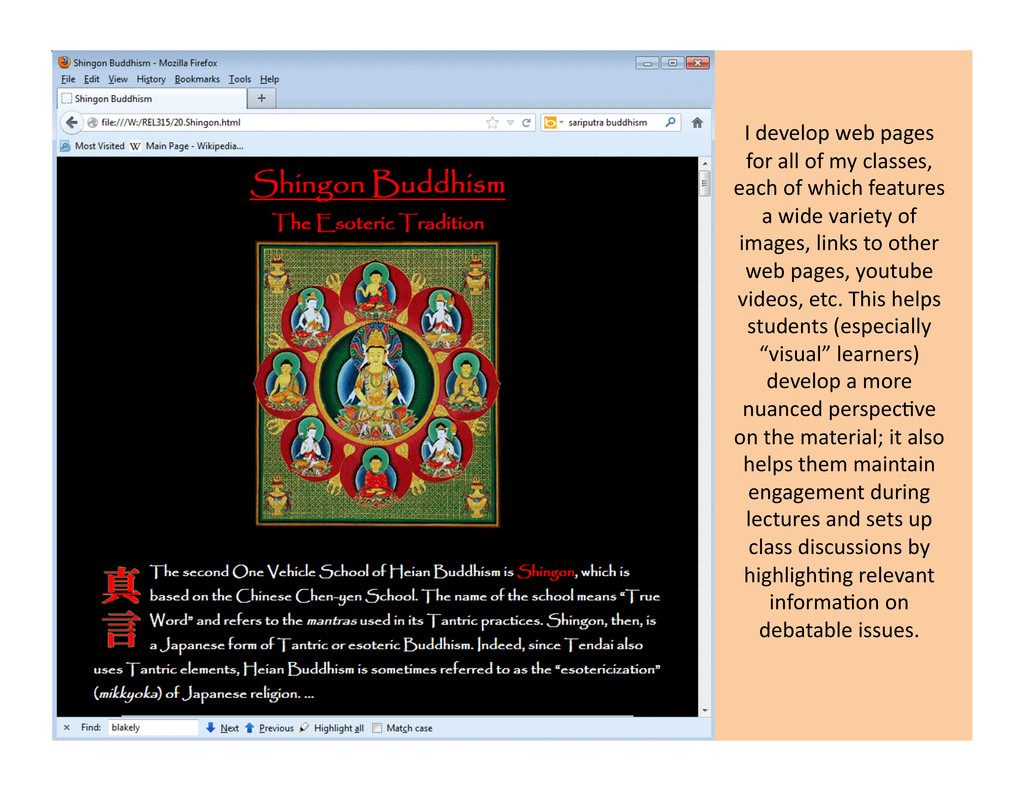
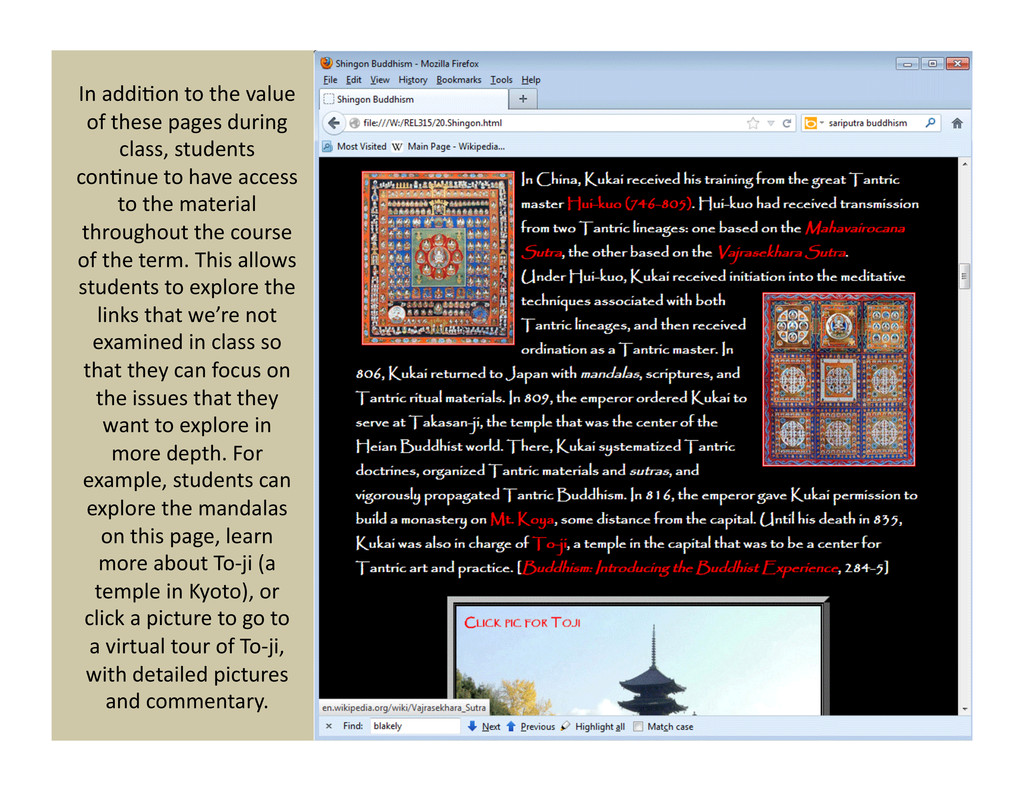
  20. I  develop  web  pages   for  all  of  my  classes,

      each  of  which  features   a  wide  variety  of   images,  links  to  other   web  pages,  youtube   videos,  etc.  This  helps   students  (especially   “visual”  learners)   develop  a  more   nuanced  perspec,ve   on  the  material;  it  also   helps  them  maintain   engagement  during   lectures  and  sets  up   class  discussions  by   highligh,ng  relevant   informa,on  on   debatable  issues.  
  21. In  addi,on  to  the  value   of  these  pages  during

      class,  students   con,nue  to  have  access   to  the  material   throughout  the  course   of  the  term.  This  allows   students  to  explore  the   links  that  we’re  not   examined  in  class  so   that  they  can  focus  on   the  issues  that  they   want  to  explore  in   more  depth.  For   example,  students  can   explore  the  mandalas   on  this  page,  learn   more  about  To-­‐ji  (a   temple  in  Kyoto),  or   click  a  picture  to  go  to   a  virtual  tour  of  To-­‐ji,   with  detailed  pictures   and  commentary.  
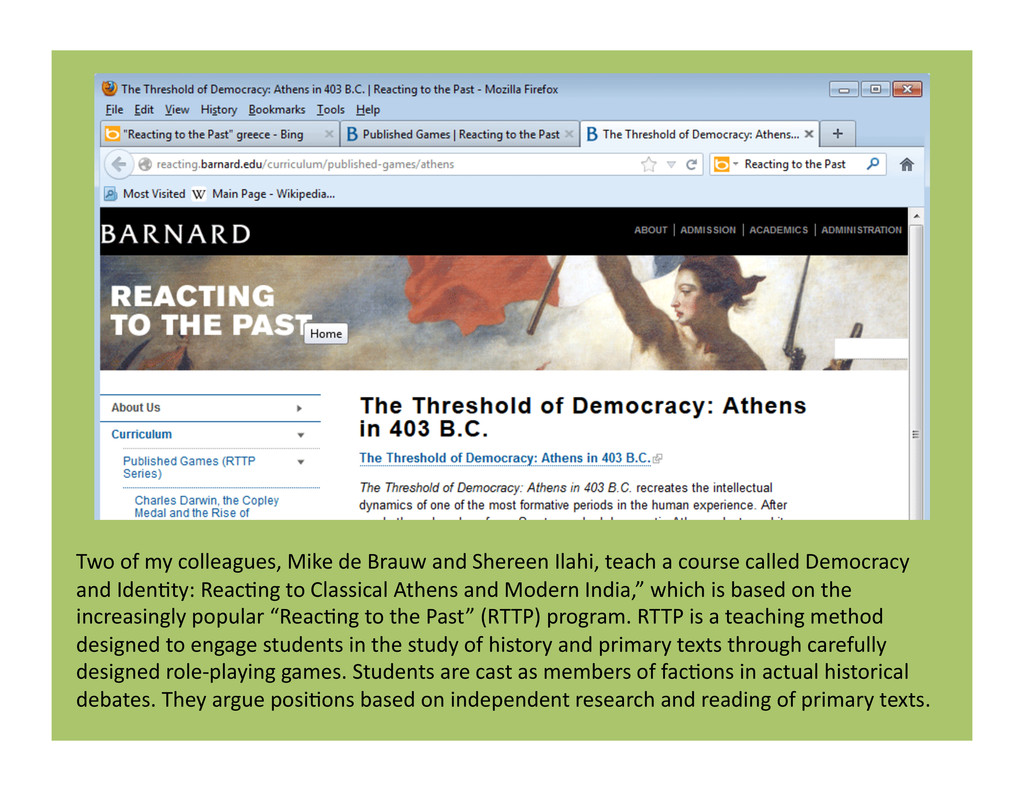
  22. Two  of  my  colleagues,  Mike  de  Brauw  and  Shereen  Ilahi,

     teach  a  course  called  Democracy   and  Iden,ty:  Reac,ng  to  Classical  Athens  and  Modern  India,”  which  is  based  on  the   increasingly  popular  “Reac,ng  to  the  Past”  (RTTP)  program.  RTTP  is  a  teaching  method   designed  to  engage  students  in  the  study  of  history  and  primary  texts  through  carefully   designed  role-­‐playing  games.  Students  are  cast  as  members  of  fac,ons  in  actual  historical   debates.  They  argue  posi,ons  based  on  independent  research  and  reading  of  primary  texts.  
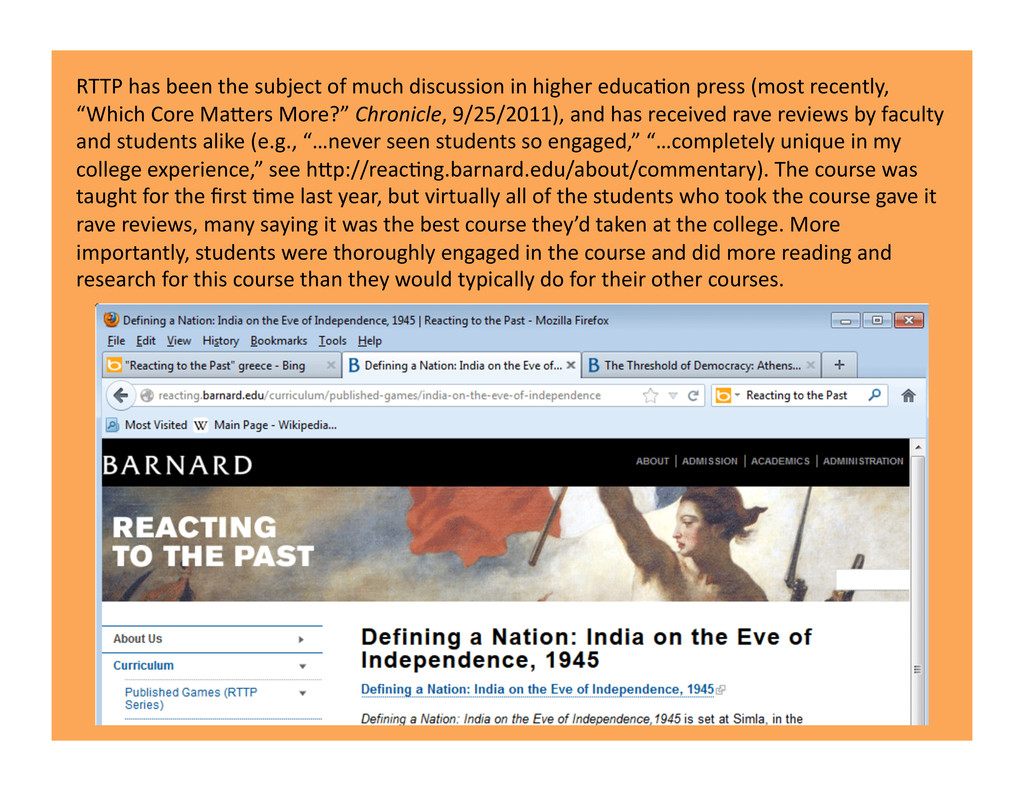
  23. RTTP  has  been  the  subject  of  much  discussion  in  higher
     educa,on  press  (most  recently,   “Which  Core  MaHers  More?”  Chronicle,  9/25/2011),  and  has  received  rave  reviews  by  faculty   and  students  alike  (e.g.,  “…never  seen  students  so  engaged,”  “…completely  unique  in  my   college  experience,”  see  hHp://reac,ng.barnard.edu/about/commentary).  The  course  was   taught  for  the  first  ,me  last  year,  but  virtually  all  of  the  students  who  took  the  course  gave  it   rave  reviews,  many  saying  it  was  the  best  course  they’d  taken  at  the  college.  More   importantly,  students  were  thoroughly  engaged  in  the  course  and  did  more  reading  and   research  for  this  course  than  they  would  typically  do  for  their  other  courses.    
  24. Use  of  Hybrid  (Blended)  Courses  at   North  Central  College

      Introduced  in  the  graduate  program  to   –   promote  independent  learning   –     extend  classroom  learning  experiences   –     allow  for  flexible  scheduling   Two  courses  currently  use  the  hybrid  approach:   –     CSC  460/560  Database  Systems   –   CSC  464/565  Data  Mining  
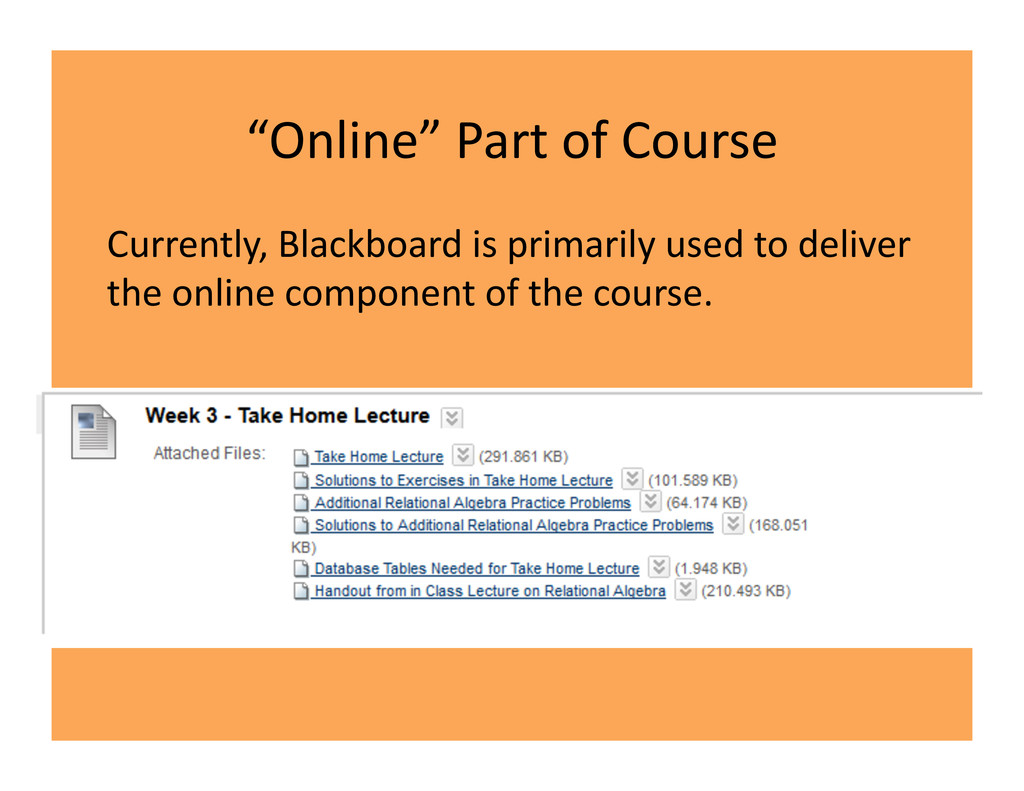
  25. “Online”  Part  of  Course   Currently,  Blackboard  is  primarily  used

     to  deliver   the  online  component  of  the  course.    
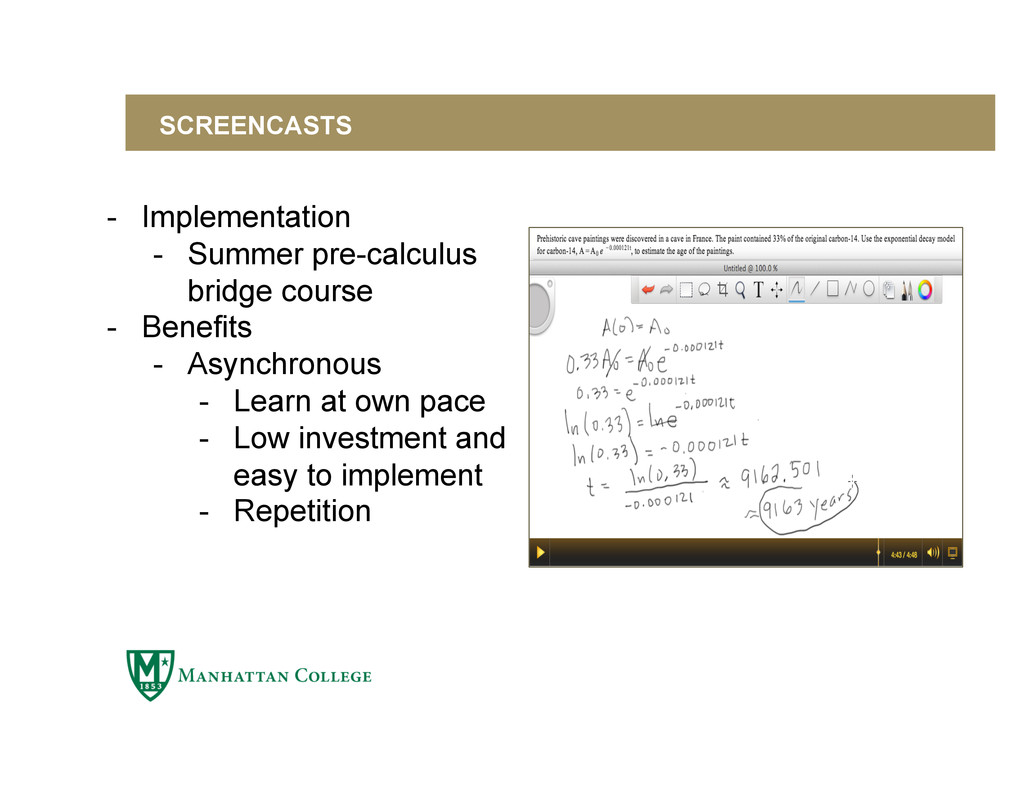
  26. SCREENCASTS -  Implementation -  Summer pre-calculus bridge course -  Benefits

    -  Asynchronous -  Learn at own pace -  Low investment and easy to implement -  Repetition
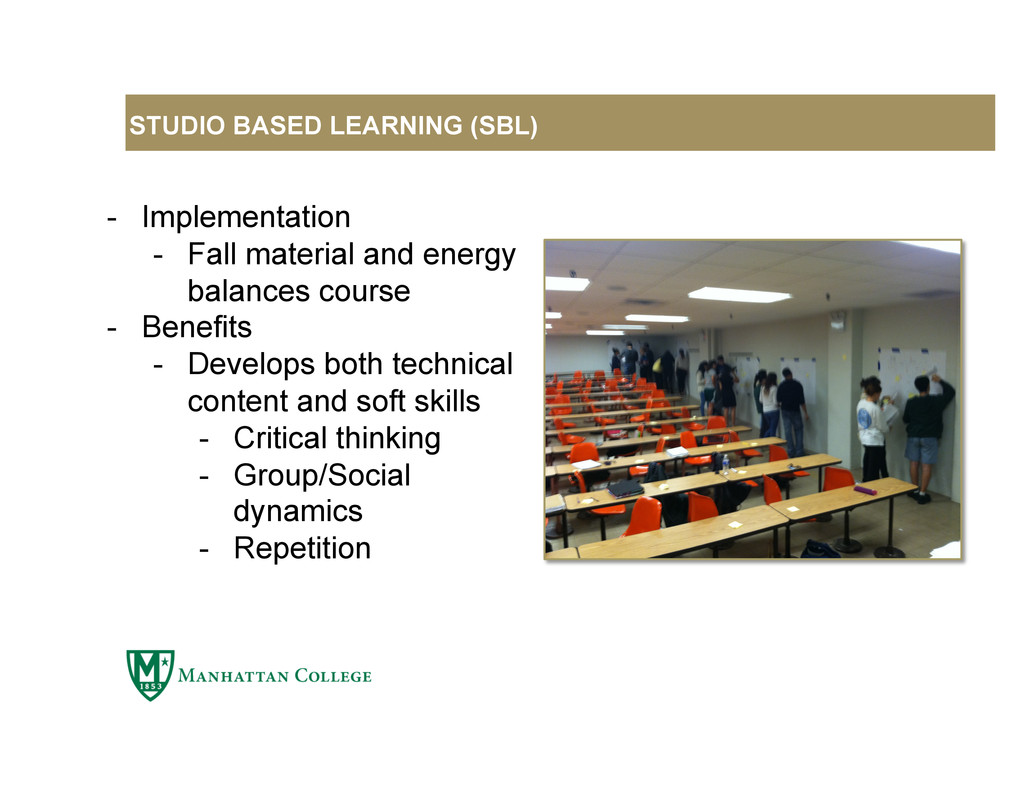
  27. STUDIO BASED LEARNING (SBL) -  Implementation -  Fall material and

    energy balances course -  Benefits -  Develops both technical content and soft skills -  Critical thinking -  Group/Social dynamics -  Repetition
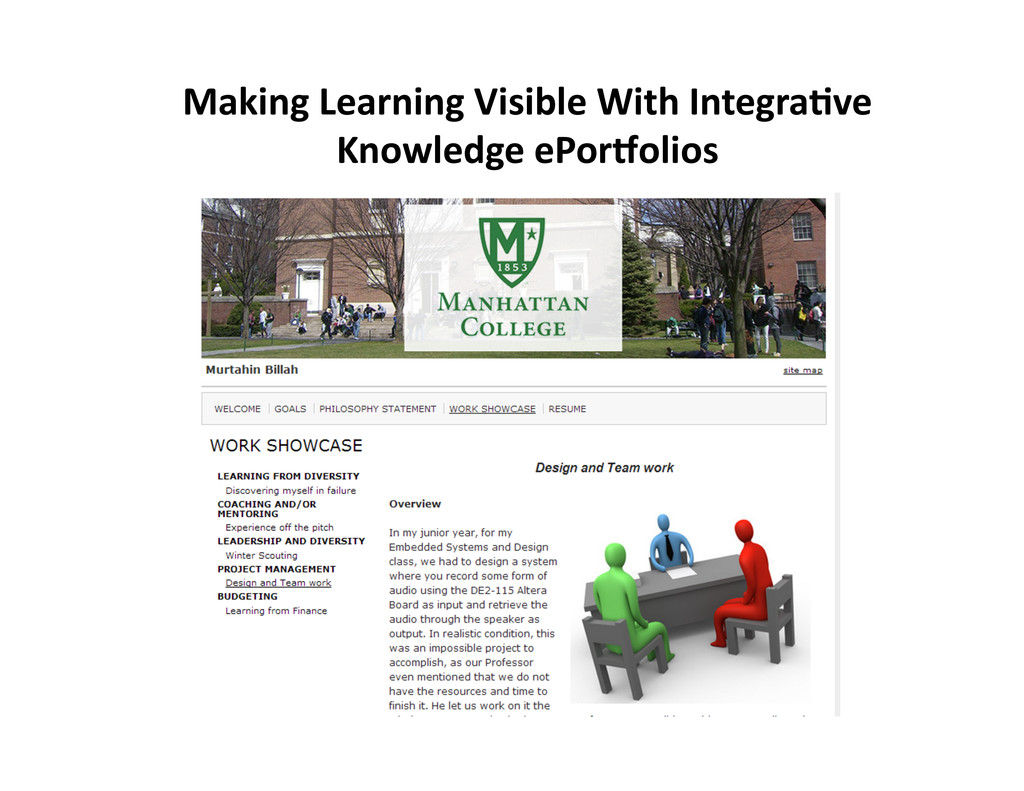
  28. Presenta$on  Outline   •  Integra,on  of  Learning   •  How

     does  integra,on  help  students?   •  Making  Learning  Visible  With  Integra,ve   Knowledge  ePortolios    
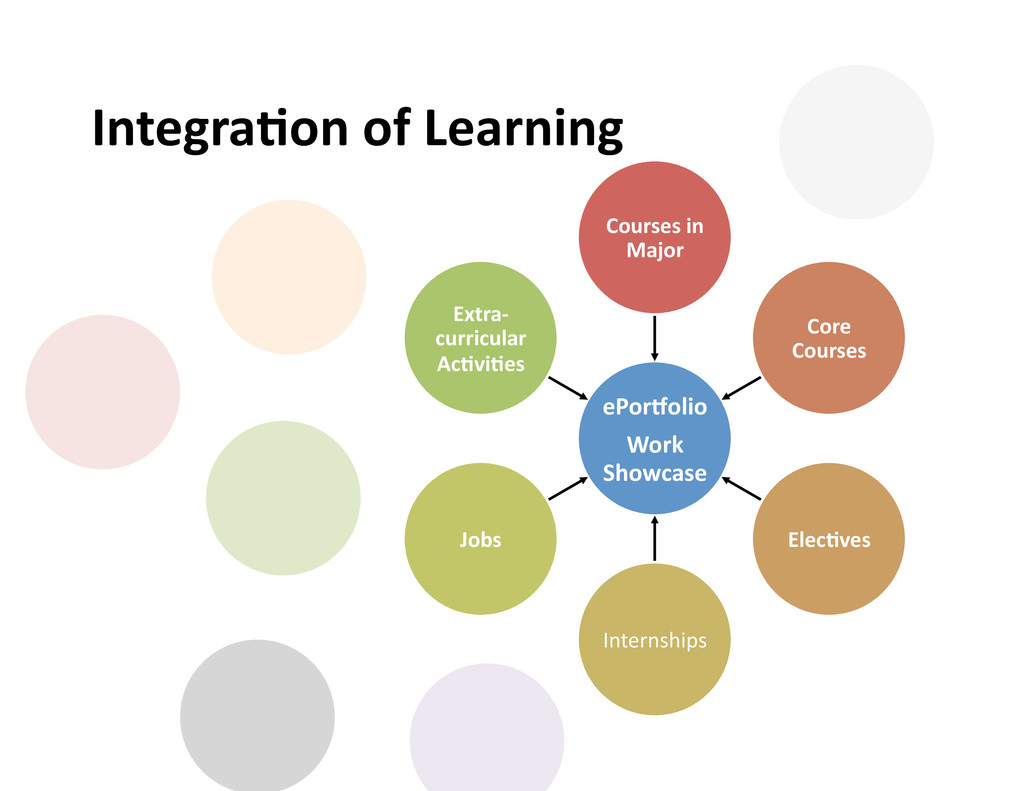
  29. Integra$on  of  Learning   ePor?olio   Work   Showcase  

    Courses  in   Major   Core   Courses   Elec$ves   Internships   Jobs   Extra-­‐ curricular   Ac$vi$es  
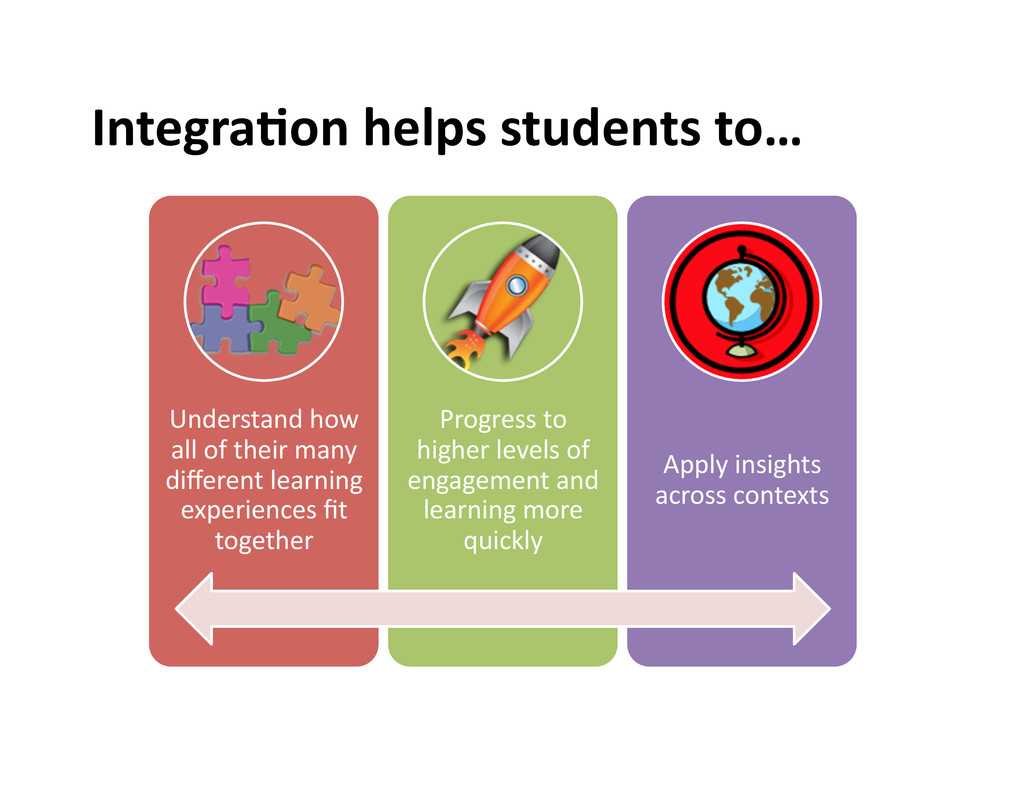
  30. Integra$on  helps  students  to…   Understand  how   all  of

     their  many   different  learning   experiences  fit   together   Progress  to   higher  levels  of   engagement  and   learning  more   quickly   Apply  insights   across  contexts  
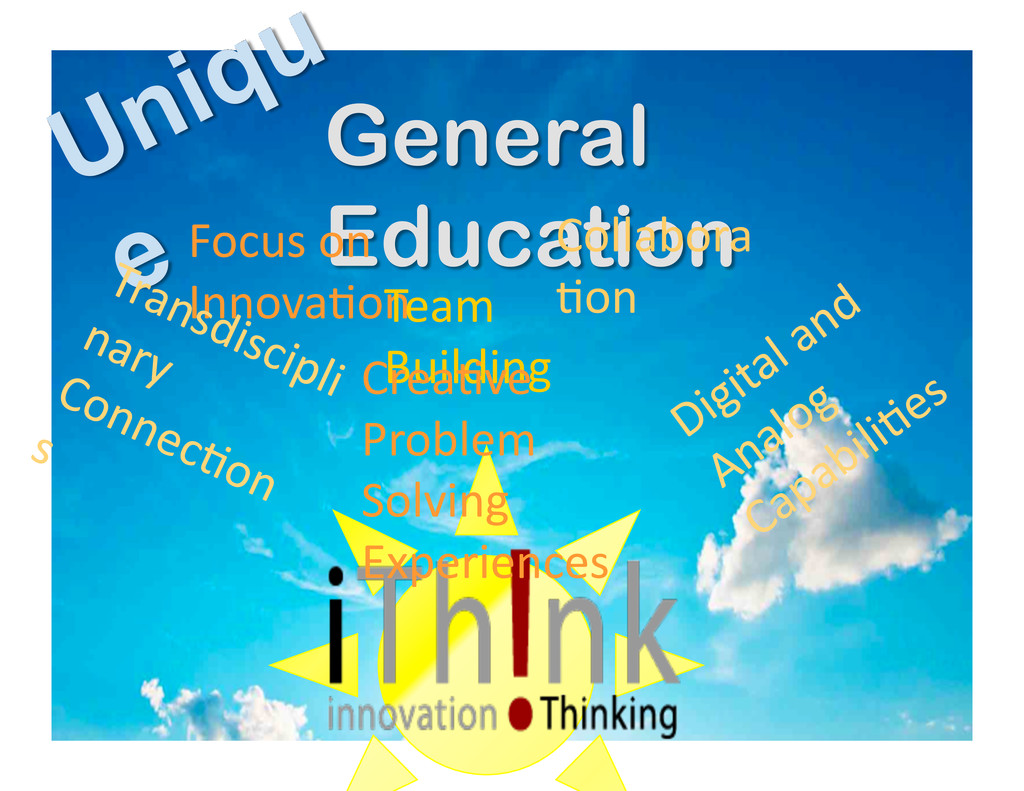
  31. Focus  on   Innova,on   Team   Building   Collabora

    ,on   Crea,ve   Problem   Solving   Experiences  
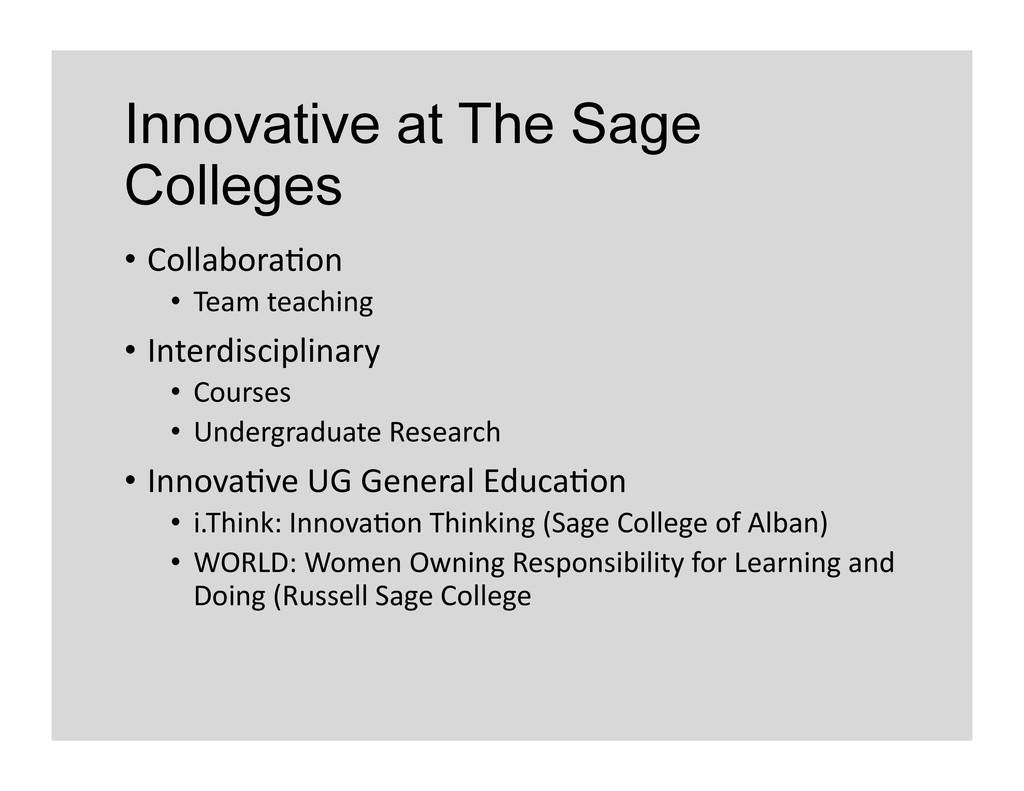
  32. Innovative at The Sage Colleges •  Collabora,on   •  Team

     teaching   •  Interdisciplinary   •  Courses   •  Undergraduate  Research   •  Innova,ve  UG  General  Educa,on   •  i.Think:  Innova,on  Thinking  (Sage  College  of  Alban)   •  WORLD:  Women  Owning  Responsibility  for  Learning  and   Doing  (Russell  Sage  College  
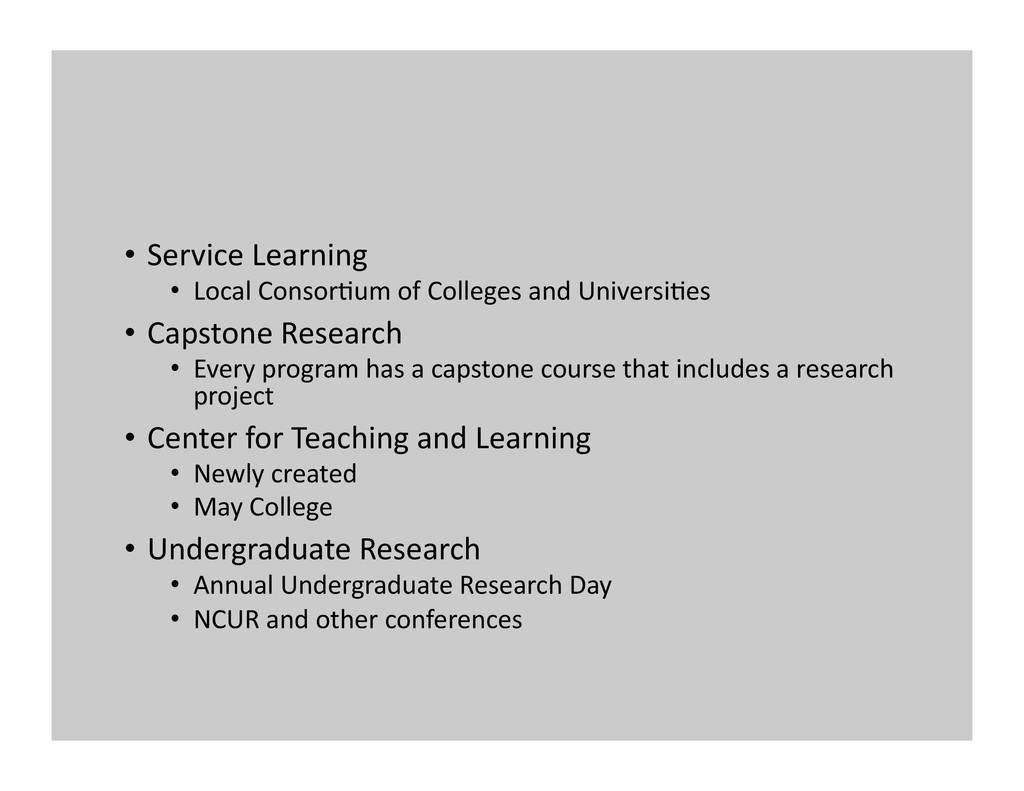
  33. •  Service  Learning   •  Local  Consor,um  of  Colleges  and

     Universi,es   •  Capstone  Research   •  Every  program  has  a  capstone  course  that  includes  a  research   project   •  Center  for  Teaching  and  Learning   •  Newly  created   •  May  College   •  Undergraduate  Research   •  Annual  Undergraduate  Research  Day   •  NCUR  and  other  conferences  
  34. University  Fellows:    Samford’s  Honors  College  Experience     • 

    The  program  offers  an  interdisciplinary  “great  ideas”   core  curriculum,  interna,onal  study  in  Italy,  and   funding  for  academic  enrichment.     •  Admission  to  the  program  is  highly-­‐compe,,ve.   •   Designed  for  intellectually  curious,  ambi,ous   students  who  want  to  make  connec,ons  across   disciplines.   •  Established  in  2008  as  a  result  of  the  QEP  for  SACS   reaccredita,on.   •  Currently  150  students  enrolled   For  more  informa$on      hHp://www.samford.edu/fellows/default.aspx  
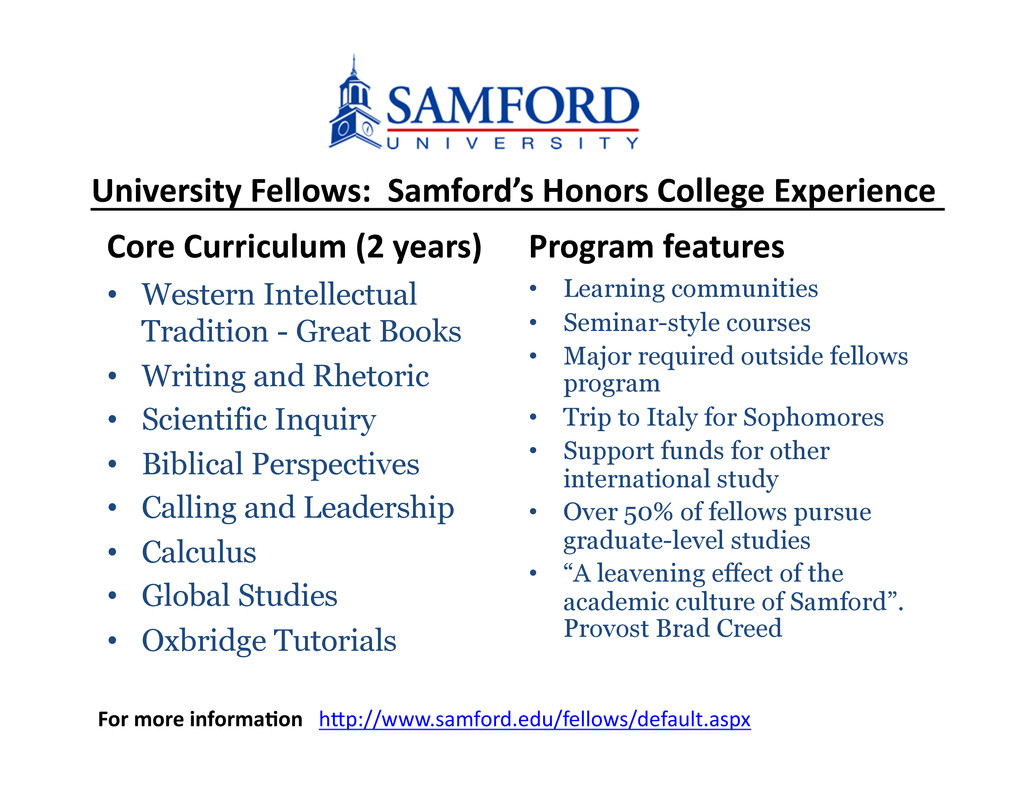
  35. University  Fellows:    Samford’s  Honors  College  Experience     Core

     Curriculum  (2  years)   •  Western Intellectual Tradition - Great Books •  Writing and Rhetoric •  Scientific Inquiry •  Biblical Perspectives •  Calling and Leadership •  Calculus •  Global Studies •  Oxbridge Tutorials Program  features   •  Learning communities •  Seminar-style courses •  Major required outside fellows program •  Trip to Italy for Sophomores •  Support funds for other international study •  Over 50% of fellows pursue graduate-level studies •  “A leavening effect of the academic culture of Samford”. Provost Brad Creed For  more  informa$on      hHp://www.samford.edu/fellows/default.aspx  
  36. Summer Science Research University of Redlands   Each summer between

    30-50 students participate in summer science and mathematics research.   The students work closely with Redlands faculty on active research projects both on and off campus.   The on-campus students attend weekly lectures where they listen to other students present their work.   Freshman and Sophomore students are encouraged to participate.
  37. Summer Science Research University of Redlands Advantages  Motivates students academically

    and enhances curiosity. Encourages participation in local and national scientific meetings.  Creates a community of scholars through experiential learning. New Directions  Collaborate more widely with NAC&U schools and the professional schools to increase opportunities.   Research with high school students or talented incoming students.
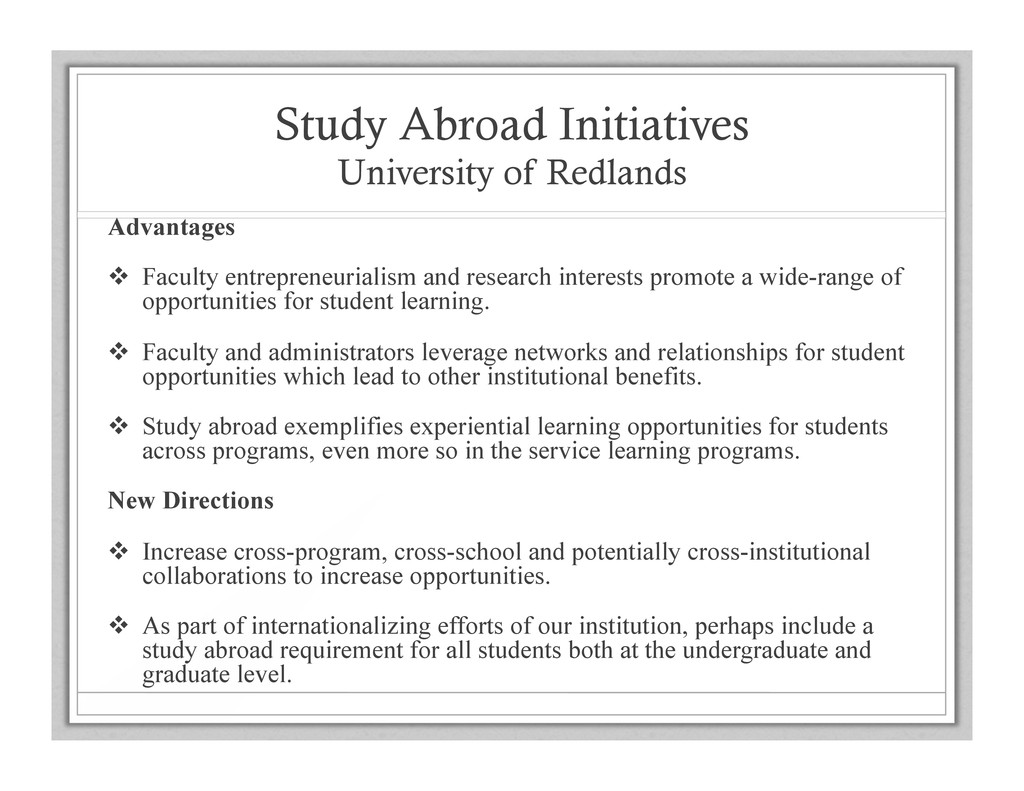
  38. Study Abroad Initiatives University of Redlands   Each year 40%

    of undergraduates and between 75-95 graduate students participate in study abroad opportunities.   Options for engagement include a variety of program types.   Internal programs range from semester long sojourns for undergraduates at our long-standing Salzburg program to two-week intensive trips to explore businesses and practices in India, China, and Cambridge for MBA students.   Undergraduate tuition covers international courses without further expense to enable students from lower SES backgrounds to attend.   Service learning engagement has increasingly become a large part of study abroad offerings as exemplified by a reoccurring trip to Cambodia, where students teach English in rural schools and volunteer at an elephant sanctuary in the jungle.
  39. Study Abroad Initiatives University of Redlands Advantages   Faculty entrepreneurialism

    and research interests promote a wide-range of opportunities for student learning.   Faculty and administrators leverage networks and relationships for student opportunities which lead to other institutional benefits.   Study abroad exemplifies experiential learning opportunities for students across programs, even more so in the service learning programs. New Directions   Increase cross-program, cross-school and potentially cross-institutional collaborations to increase opportunities.   As part of internationalizing efforts of our institution, perhaps include a study abroad requirement for all students both at the undergraduate and graduate level.
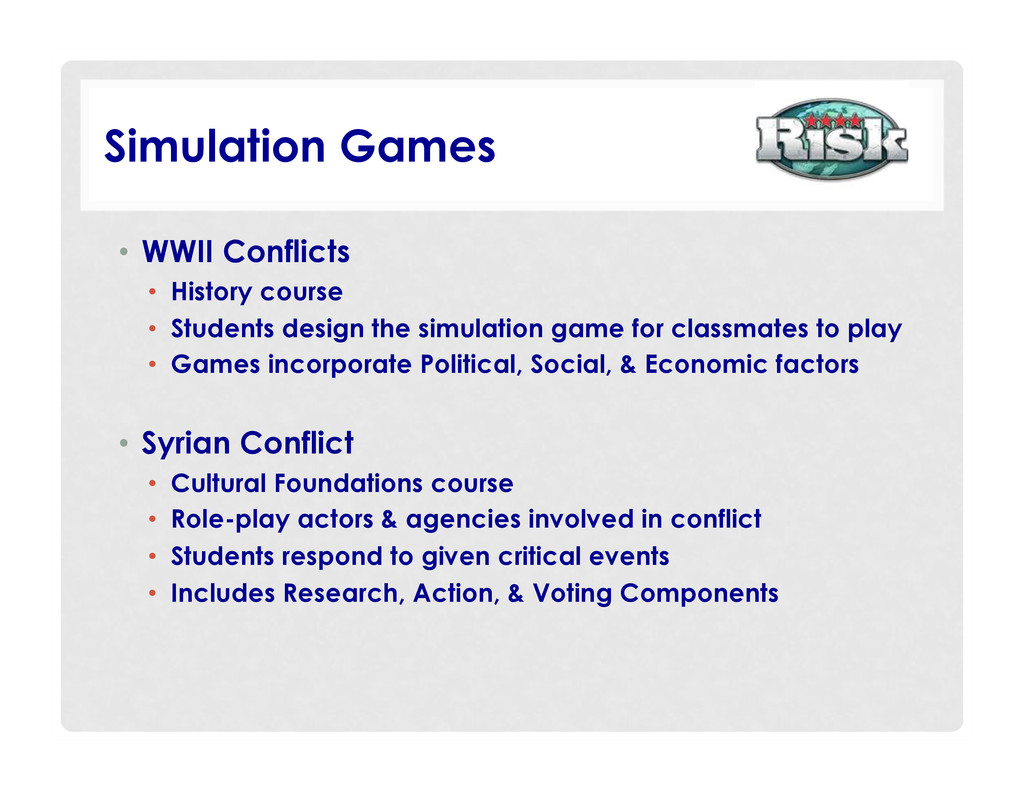
  40. Simulation Games •  WWII Conflicts •  History course •  Students

    design the simulation game for classmates to play •  Games incorporate Political, Social, & Economic factors •  Syrian Conflict •  Cultural Foundations course •  Role-play actors & agencies involved in conflict •  Students respond to given critical events •  Includes Research, Action, & Voting Components
  41. Interdisciplinary Scholars Program •  In School of Behavioral & Social

    Sciences •  Students select a program theme and complete 5 upper-division courses •  Across 3 distinct disciplines •  Including 3 Areas of Emphasis •  Global Understanding & Perspectives, Social Justice & Diversity, and Critical Thinking •  5th course is Interdisciplinary Research Methods •  Students complete a thesis and present their work at a symposium
  42. •  Context is in Marginal Value Theorem •  Well adapted

    foragers should optimize their nutrient uptake by abandoning a “patch” as its resources dwindle •  They will leave SOME available resources in the patch for the promise of more abundant resources in a distant patch •  Specific Activity •  Some students model avian foragers •  Most students model threatening predators •  Groups of different foragers compete to determine who can get the most resources while suffering the least predation
  43. •  Give us a thorough background in the theory under

    consideration •  Develop a well-organized activity with clear “rules” that mimic the real world •  Give us a reason to buy in •  Reflect, reflect and the reflect
  44. Early  Start     First  Year  Seminars   •  Passion-­‐based

     courses   •  Class  and  study  periods  integrated  into   orienta,on  schedule   •  Early  introduc,on  to  academic  support   services   •  Seminars  end  early,  spreading  out  finals    
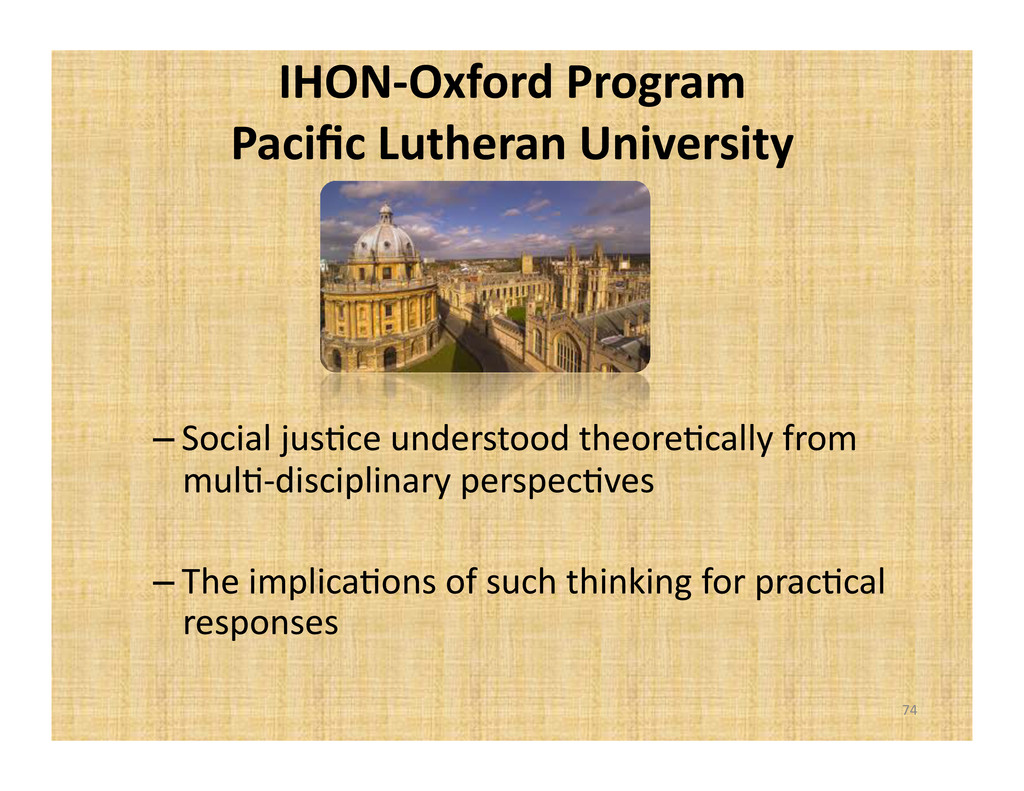
  45. IHON-­‐Oxford  Program   Pacific  Lutheran  University   – Social  jus,ce  understood

     theore,cally  from   mul,-­‐disciplinary  perspec,ves   – The  implica,ons  of  such  thinking  for  prac,cal   responses   74  
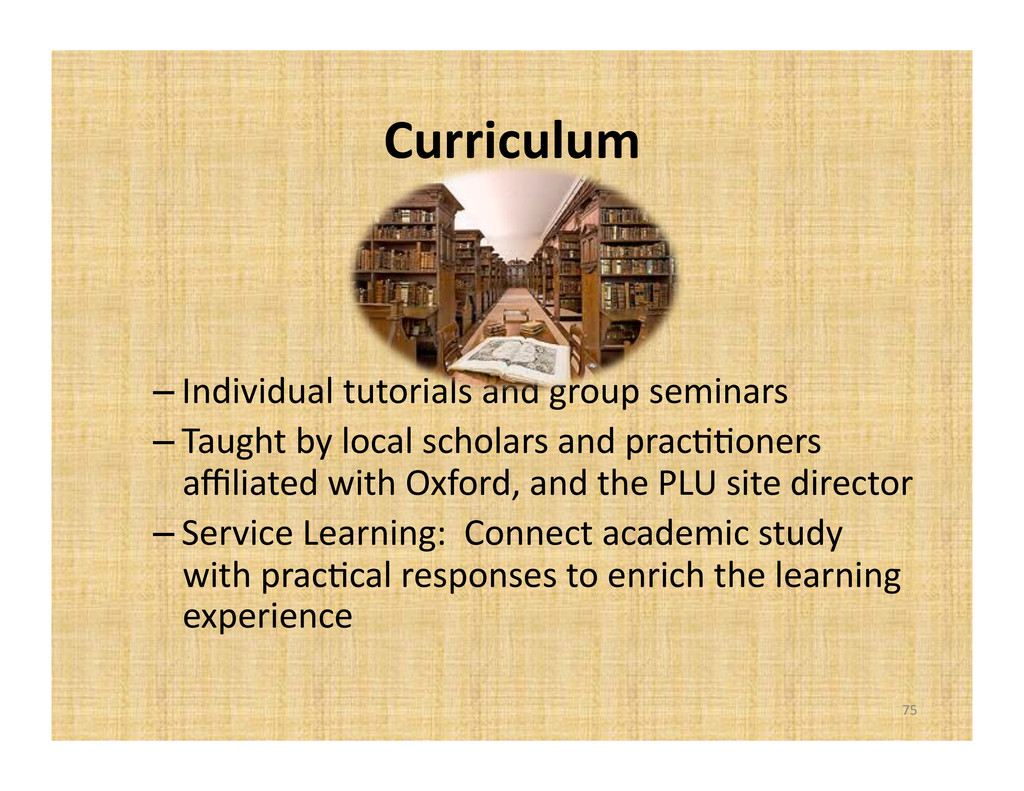
  46. Curriculum   – Individual  tutorials  and  group  seminars   – Taught  by

     local  scholars  and  prac,,oners   affiliated  with  Oxford,  and  the  PLU  site  director   – Service  Learning:    Connect  academic  study   with  prac,cal  responses  to  enrich  the  learning   experience   75  
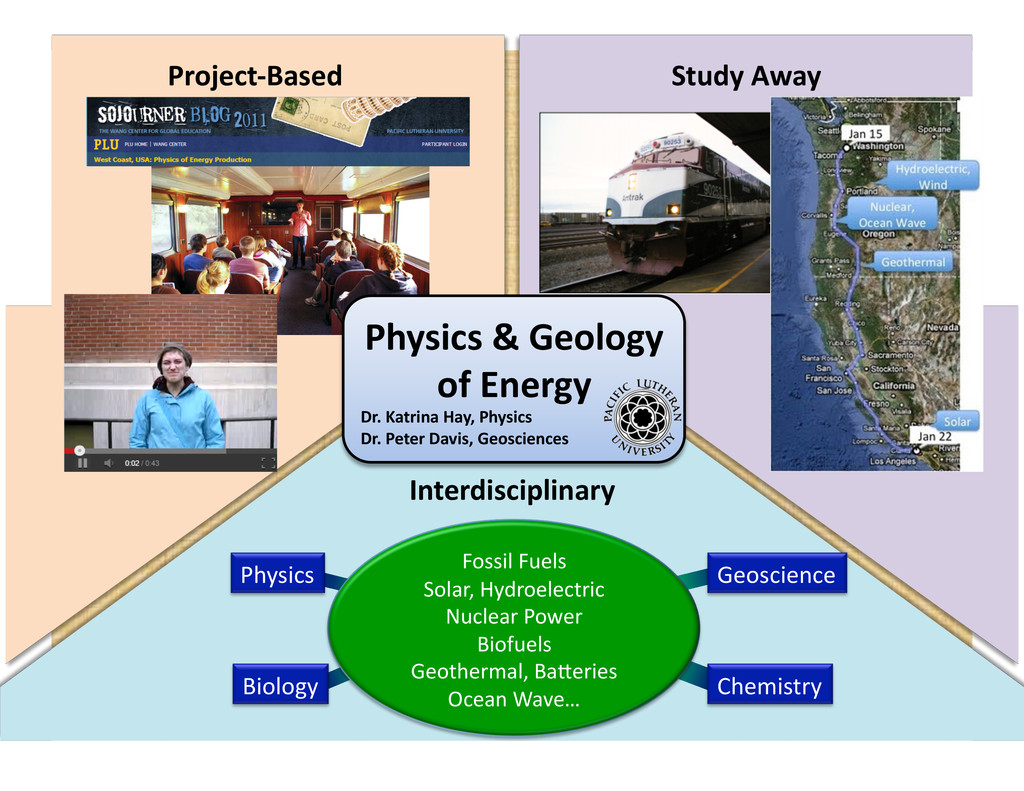
  47. Interdisciplinary   Project-­‐Based   Study  Away   Physics  &  Geology

      of  Energy   Dr.  Katrina  Hay,  Physics   Dr.  Peter  Davis,  Geosciences   Geoscience   Chemistry   Physics   Biology   Fossil  Fuels   Solar,  Hydroelectric   Nuclear  Power   Biofuels   Geothermal,  BaHeries   Ocean  Wave…  
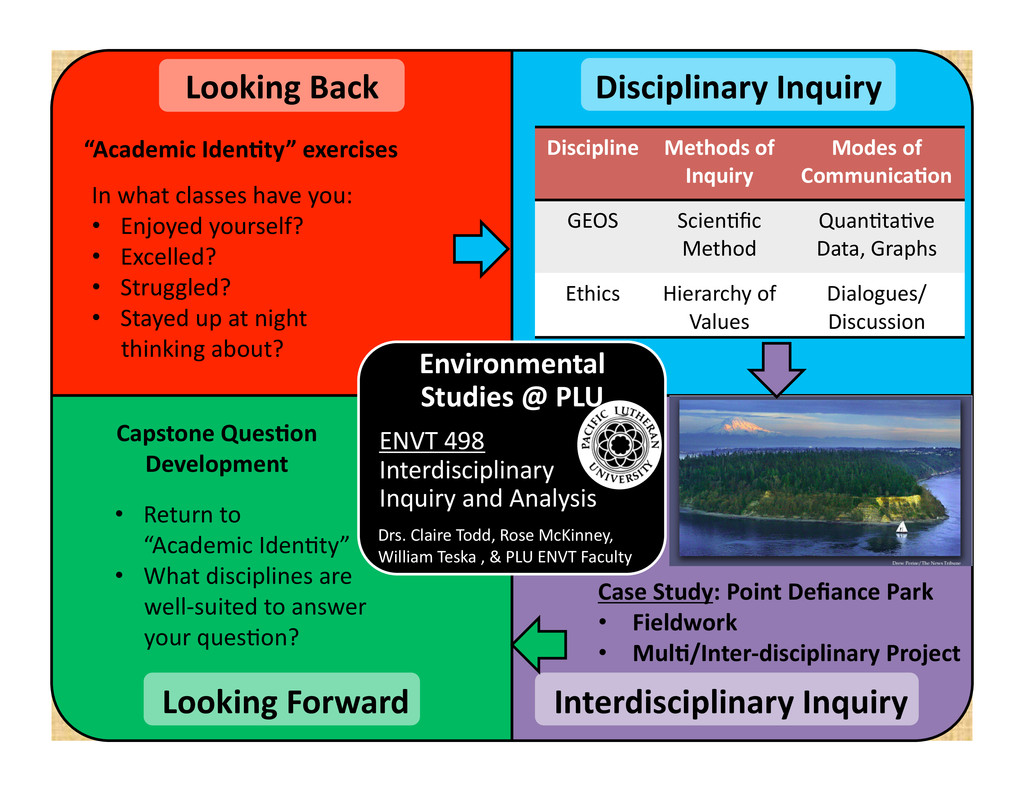
  48. Environmental   Studies  @  PLU   ENVT  498   Interdisciplinary

        Inquiry  and  Analysis   Looking  Back   Disciplinary  Inquiry   Interdisciplinary  Inquiry   Looking  Forward   Discipline   Methods  of   Inquiry   Modes  of   Communica$on   GEOS   Scien,fic   Method   Quan,ta,ve   Data,  Graphs   Ethics   Hierarchy  of   Values   Dialogues/   Discussion   “Academic  Iden$ty”  exercises   In  what  classes  have  you:   •  Enjoyed  yourself?   •  Excelled?   •  Struggled?   •  Stayed  up  at  night   thinking  about?   Case  Study:  Point  Defiance  Park   •  Fieldwork   •  Mul$/Inter-­‐disciplinary  Project   Capstone  Ques$on   Development   •  Return  to              “Academic  Iden,ty”   •  What  disciplines  are   well-­‐suited  to  answer   your  ques,on?   Drs.  Claire  Todd,  Rose  McKinney,   William  Teska  ,  &  PLU  ENVT  Faculty  
  49. Exit  Interviews     Maria  J.  Oreshkina   University  of

     Scranton     Educa,on  Department    
  50. What  is  Exit  Interview?     Exit  Interview  is  a

     face  to  face  conversa,on  among   three  student-­‐teachers  and  two  faculty  members   about  student-­‐teachers’  aHainment  of  the   Educa,on  Department  standards.     Prior  to  Interviews,  student-­‐teachers  submit  a   professional  portolio  that  includes  eight  ar,facts   demonstra,ng  aHainment  of  eight  standards.     Exit  Interviews  also  include  presenta,on  of  a  cri,cal   incident  and  students’  evalua,on  of  the  program.    
  51. Development  of  the  Ini,a,ve     Majority  of  faculty  expressed

     dissa,sfac,on  with   the  exis,ng  process  of  electronic  portolio   (February  2010).       Development  of  the  Exit  Interview  format  and   guidelines  for  Exit  Portolios  (spring  2010).     First  implementa,on  of  Exit  Interviews  and  further   modifica,on  of  the  guidelines  (spring  2010).     Each  set  of  Exit  Interviews  is  followed  by  a  debrief   to  fine  tune  the  process  (on-­‐going).    
  52. + Problem-Based Learning @ The University of Scranton •  Adapted

    from Medical School pedagogy (think House roundtable) •  Active-learning, small group, collaborative problem solving •  Students define discrete problems, engage diverse perspectives, brainstorm, prototype, and test solutions (Edutopia) PSYC 330: Research Methods in the Behavioral Sciences with Christie Karpiak, PhD* WRTG 224: Business Communication with Beth Sindaco, Esq. * For more information see: Karpiak, Christie. “Assessment of Problem-Based Learning in Undergraduate Statistics Course.” Teaching of Psychology 38.4 (2011): 251-54.
  53. John  S.  Gonas,  PhD   Associate  Professor  of  Finance  

    Sam  M.  Walton  Enactus  Fellow   Belmont  University  College  of  Business                           NAC&U                Innovation  Summit              November,  2013  
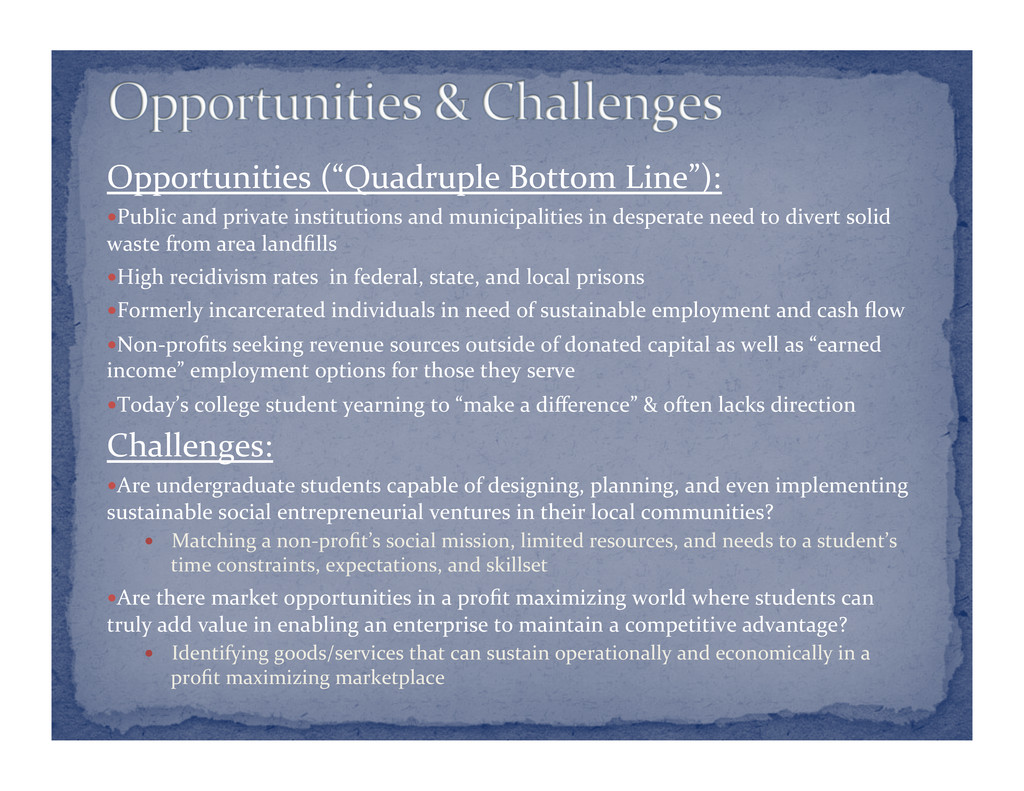
  54. Opportunities  (“Quadruple  Bottom  Line”):    Public  and  private  institutions  and

     municipalities  in  desperate  need  to  divert  solid   waste  from  area  landfills    High  recidivism  rates    in  federal,  state,  and  local  prisons    Formerly  incarcerated  individuals  in  need  of  sustainable  employment  and  cash  flow    Non-­‐profits  seeking  revenue  sources  outside  of  donated  capital  as  well  as  “earned   income”  employment  options  for  those  they  serve    Today’s  college  student  yearning  to  “make  a  difference”  &  often  lacks  direction   Challenges:    Are  undergraduate  students  capable  of  designing,  planning,  and  even  implementing   sustainable  social  entrepreneurial  ventures  in  their  local  communities?     Matching  a  non-­‐profit’s  social  mission,  limited  resources,  and  needs  to  a  student’s     time  constraints,  expectations,  and  skillset    Are  there  market  opportunities  in  a  profit  maximizing  world  where  students  can   truly  add  value  in  enabling  an  enterprise  to  maintain  a  competitive  advantage?     Identifying  goods/services  that  can  sustain  operationally  and  economically  in  a   profit  maximizing  marketplace  
  55.   Spring  2011  Belmont  University  students  from  5  different  schools/colleges

      (A&S,  Business,  Health  Sciences,  Law,  and  Religion)    develop  business  plan   and  retail  marketing  materials,  as  well  as  scraped  initial  100  mattresses;   concept  is  piloted  Summer  2011     Partnership  with  local  church’s  ministry  (Isaiah  58)  serving  formerly   incarcerated  men  &  Davidson  County  Sheriff’s  Office     Mission:     Support  sustainable  employment  &  small  business  training  for  formerly   incarcerated  men,  and  lowering  our  recidivism  rates       Keep  mattresses  from  area  landfills…recycling  and  repurposing  millions  of  pounds   of  metal,  wood,  foam,  and  cotton     Offer  Belmont  students  across  5  Schools/Colleges  to  integrate  their  skill  sets  in   building  a  sustainable  social  enterprise  from  scratch     February  2012:  Moved  operation  into  8,000  square  foot  facility,  purchased   capital  equipment,  structured  contracts,  created  marketing  and  promotion   collateral,  secured  retail  partnerships  enabling  inventory  of  500  mattresses/ week,  and  modeled  cash  flows,  operations,  and  safety  procedures.    
  56.   As  of  October  30,  2013:       Mattresses

     received  from  retailers  in  5  states,  waste   management  companies,  two  municipalities,  local   institutions,  and  local  citizens.     5  men  (on  rotation)  have  full  time  employment     48,200  mattresses  disassembled  to-­‐date;  tipping  fees  ranging  from  $4   institutional  to  $10  consumer  drop-­‐off.       More  than  2.4  million  pounds  of  metal,  foam,  cotton,  wool,  and  wood)   have  been  derailed  from  area  landfills  and  reconstituted  into  carpet   padding,  paper,  mulch,  and  scrap  metal.     Spring  Back  Recycling  granted  501(c)3  in  2013  to  license   its  operational  model  in  other  U.S.  cities     Spring  Back  Colorado  licensed  in  2012;  Spring  Back  Northwest  licensed   and  fully  operational  in  Summer  2013       Spring  Back  Charlotte  opening  in  November  2013    
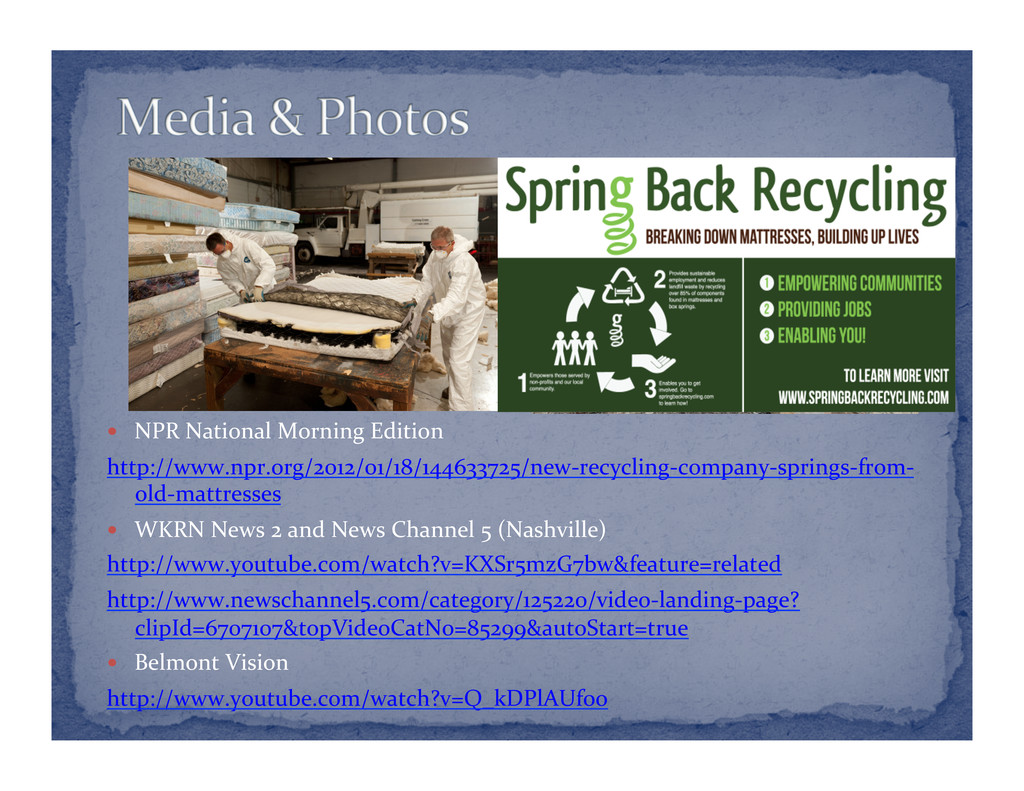
  57.   NPR  National  Morning  Edition   http://www.npr.org/2012/01/18/144633725/new-­‐recycling-­‐company-­‐springs-­‐from-­‐ old-­‐mattresses    

    WKRN  News  2  and  News  Channel  5  (Nashville)   http://www.youtube.com/watch?v=KXSr5mzG7bw&feature=related   http://www.newschannel5.com/category/125220/video-­‐landing-­‐page? clipId=6707107&topVideoCatNo=85299&autoStart=true     Belmont  Vision     http://www.youtube.com/watch?v=Q_kDPlAUf0o  
  58. (1) Our New Core A.  Engagement with Enduring Questions in

    introductory courses B.  Students develop their own question to explore in three upper-level courses and through an experiential learning requirement  Liberal or professional courses  Experiential Learning has common SLOs across ‘pathways’ and common rubric for reflective component  An ePortfolio reinforces integration and supports assessment of student development C.  Students integrate their learning in a Core Milestone Seminar
  59. The  inaugural  event—CARS  2012—involved  193  undergraduate  and  graduate   demonstra,ons

     and  displays  of  student  work,  including  performances,   presenta,ons,  artwork,  and  posters.    Forty-­‐two  faculty  sponsors   represented  twenty-­‐one  departments/programs.   The  college  has  also  commiHed  $500  per  year,  per  department  to  support   undergraduate  research.   These  ini,a,ves  are  now  in  their  third  year   A  campus-­‐wide  event  designed  to   showcase  the  crea$ve  and  scholarly  work   of  Nazareth  students.   (2)  
  60. (3) A Hybrid Math Course Teaching & Learning Math with

    Technology •  Online course •  Introduces students to a variety of technologies that can be used in a K-12 school setting to teach mathematics •  Hands-on investigation of appropriate uses of the technologies in a variety of mathematical subjects using problem sets
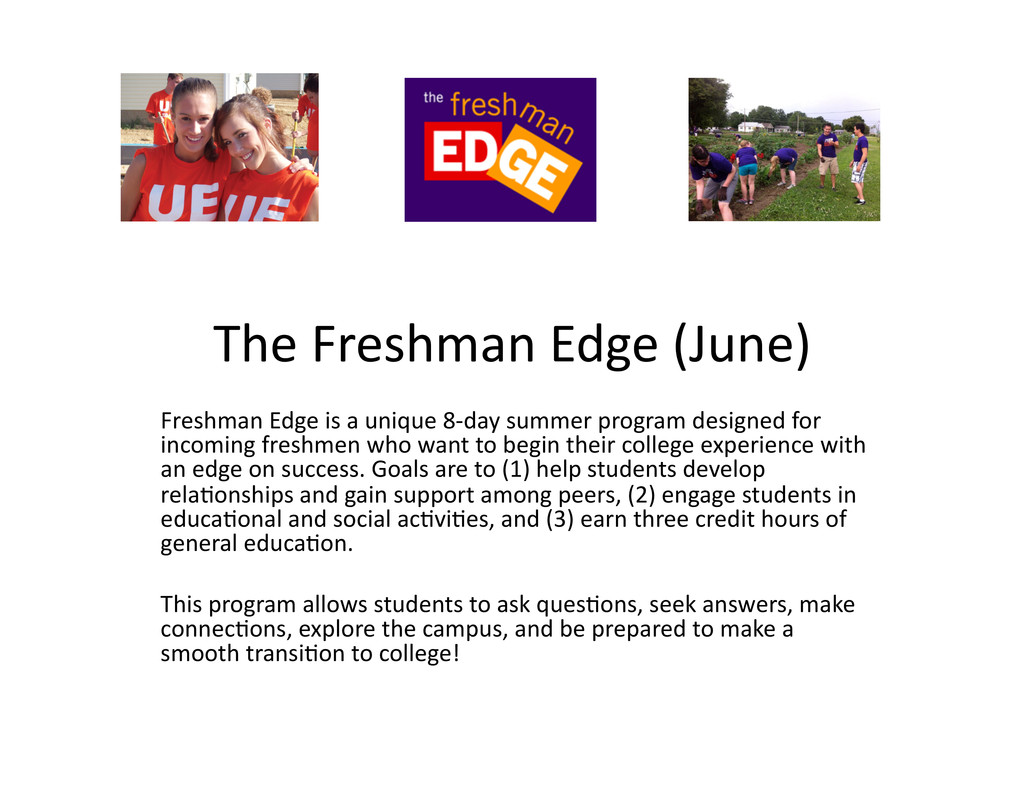
  61. The  Freshman  Edge  (June)   Freshman  Edge  is  a  unique

     8-­‐day  summer  program  designed  for   incoming  freshmen  who  want  to  begin  their  college  experience  with   an  edge  on  success.  Goals  are  to  (1)  help  students  develop   rela,onships  and  gain  support  among  peers,  (2)  engage  students  in   educa,onal  and  social  ac,vi,es,  and  (3)  earn  three  credit  hours  of   general  educa,on.     This  program  allows  students  to  ask  ques,ons,  seek  answers,  make   connec,ons,  explore  the  campus,  and  be  prepared  to  make  a   smooth  transi,on  to  college!  
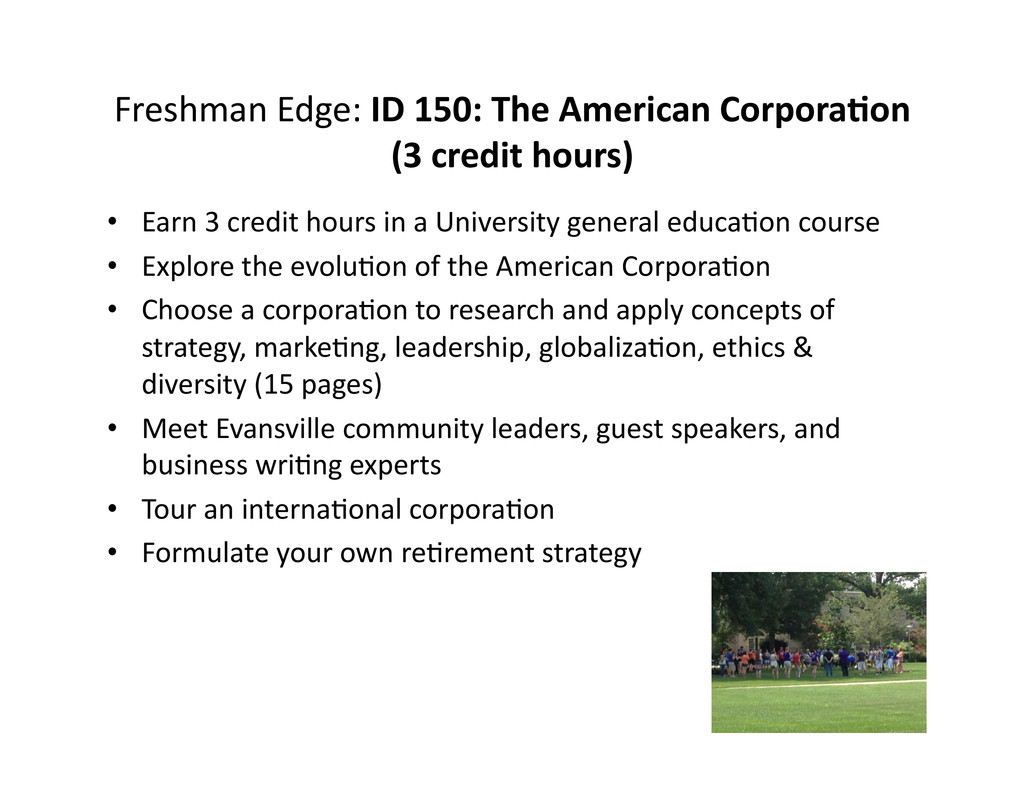
  62. Freshman  Edge:  ID  150:  The  American  Corpora$on   (3  credit

     hours)   •  Earn  3  credit  hours  in  a  University  general  educa,on  course   •  Explore  the  evolu,on  of  the  American  Corpora,on   •  Choose  a  corpora,on  to  research  and  apply  concepts  of   strategy,  marke,ng,  leadership,  globaliza,on,  ethics  &   diversity  (15  pages)     •  Meet  Evansville  community  leaders,  guest  speakers,  and   business  wri,ng  experts     •  Tour  an  interna,onal  corpora,on   •  Formulate  your  own  re,rement  strategy  
  63. GAP  Program   The  GAP  Program  is  a  hands-­‐on,  real-­‐world

      experience  for  students  of  all  majors   Staff  in  the  Ins$tute  of  Global  Enterprise  at  the   University  of  Evansville  seek  GAP  projects  from   for-­‐profit  and  non-­‐for-­‐profit  businesses   Once  a  project  is  iden$fied,  appropriate   faculty  and  students  engage  in  solving  real-­‐ world  business  problems   hhp://www.evansville.edu/globalenterprise/studentGAP.cfm     Innova$ve  &   Crea$ve   Experien$al   Learning   Teamwork  &   Collabora$on  
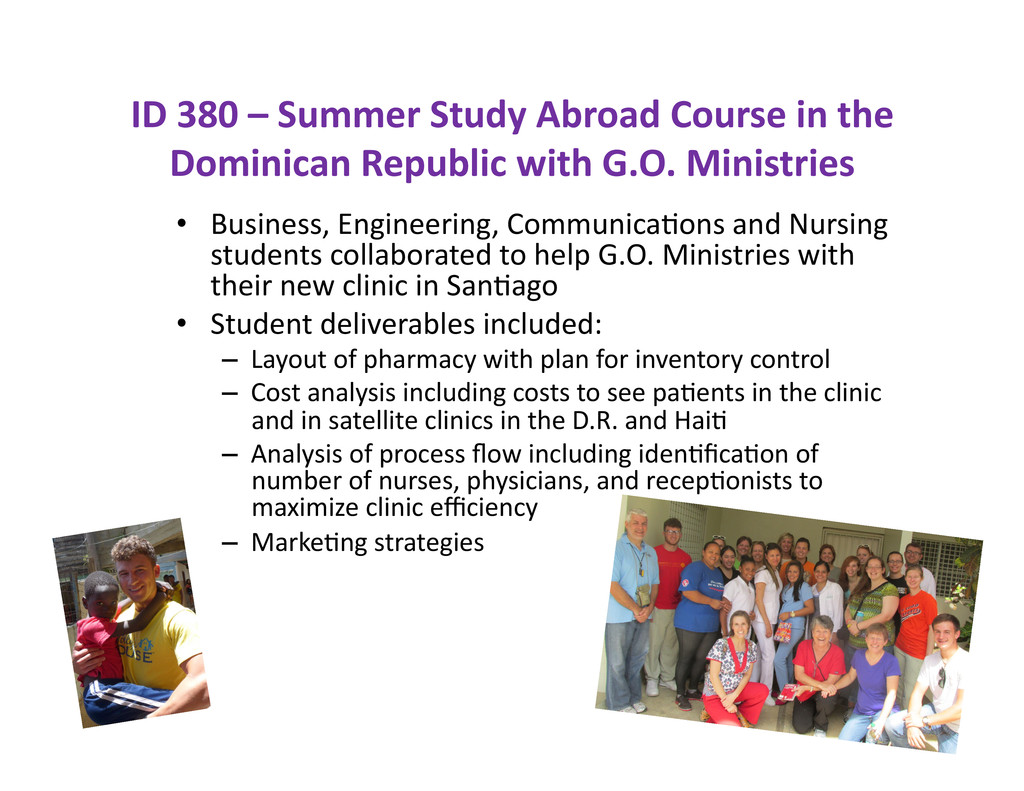
  64. ID  380  –  Summer  Study  Abroad  Course  in  the  

    Dominican  Republic  with  G.O.  Ministries   •  Business,  Engineering,  Communica,ons  and  Nursing   students  collaborated  to  help  G.O.  Ministries  with   their  new  clinic  in  San,ago   •  Student  deliverables  included:   –  Layout  of  pharmacy  with  plan  for  inventory  control   –  Cost  analysis  including  costs  to  see  pa,ents  in  the  clinic   and  in  satellite  clinics  in  the  D.R.  and  Hai,   –  Analysis  of  process  flow  including  iden,fica,on  of   number  of  nurses,  physicians,  and  recep,onists  to   maximize  clinic  efficiency   –  Marke,ng  strategies  
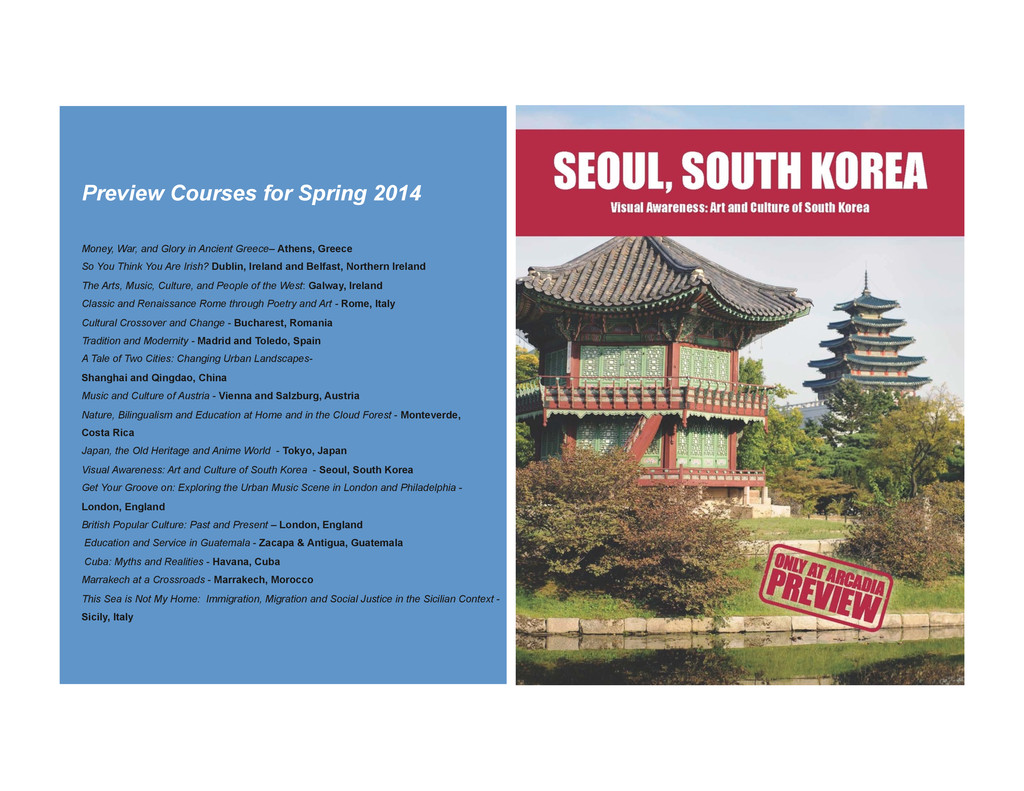
  65. Preview Courses for Spring 2014 Money, War, and Glory in

    Ancient Greece– Athens, Greece So You Think You Are Irish? Dublin, Ireland and Belfast, Northern Ireland The Arts, Music, Culture, and People of the West: Galway, Ireland Classic and Renaissance Rome through Poetry and Art - Rome, Italy Cultural Crossover and Change - Bucharest, Romania Tradition and Modernity - Madrid and Toledo, Spain A Tale of Two Cities: Changing Urban Landscapes- Shanghai and Qingdao, China Music and Culture of Austria - Vienna and Salzburg, Austria Nature, Bilingualism and Education at Home and in the Cloud Forest - Monteverde, Costa Rica Japan, the Old Heritage and Anime World - Tokyo, Japan Visual Awareness: Art and Culture of South Korea - Seoul, South Korea Get Your Groove on: Exploring the Urban Music Scene in London and Philadelphia - London, England British Popular Culture: Past and Present – London, England Education and Service in Guatemala - Zacapa & Antigua, Guatemala Cuba: Myths and Realities - Havana, Cuba Marrakech at a Crossroads - Marrakech, Morocco This Sea is Not My Home: Immigration, Migration and Social Justice in the Sicilian Context - Sicily, Italy
  66. Competency-­‐based  Learning  Programs   •  We  have  three  competency-­‐based  programs:

      – BBA  (bachelor  of  arts  in  business)   – MBA     – MSC  (master  of  strategic  communica,on)  
  67. What  are  our  constructs  for   competency-­‐based  learning?    

    •  Low  residency—Learners  come  to  campus  for  two  days  at   the  beginning  of  every  semester;  graduate  programs   include  an  interna,onal  service  trip   •  Faculty  coaches/mentors—Students  customize  their   programs  (within  certain  boundaries)  and  faculty  help  them   reach  goals   •  Alterna$ve  assessment—No  grades!  Students  are   evaluated  on  mee,ng  competencies;  they  cannot  move   forward  un,l  they  meet  or  exceed  required  competencies   •  “Backward”  curriculum  development—We  start  with   competencies  and  then  design  projects  to  help  students   master  those  skills