$30 off During Our Annual Pro Sale. View Details »
Fusion_Wire_Protocols - Thomas Rodgers - CppCon...

Fusion_Wire_Protocols - Thomas Rodgers - CppCon14.pdf

Slides from CppCon14 talk

Avatar for Thomas Rodgers

Thomas Rodgers

September 09, 2014
Tweet

Other Decks in Programming

Transcript

  1. © 2014 Thomas Rodgers - All rights reserved Implementing Type-Driven

    Wire Protocols using Boost Fusion Thomas Rodgers | Sr. Software Engineer DRW Trading Group
  2. © 2014 Thomas Rodgers - All rights reserved Why not

    ProtoBufs, Thrift, etc? • These solutions are great when you control both ends of the communication -Also when cross language compatibility is required • Many important use-cases where this is not the case -3rd party systems -Embedded devices -Legacy systems -Financial markets
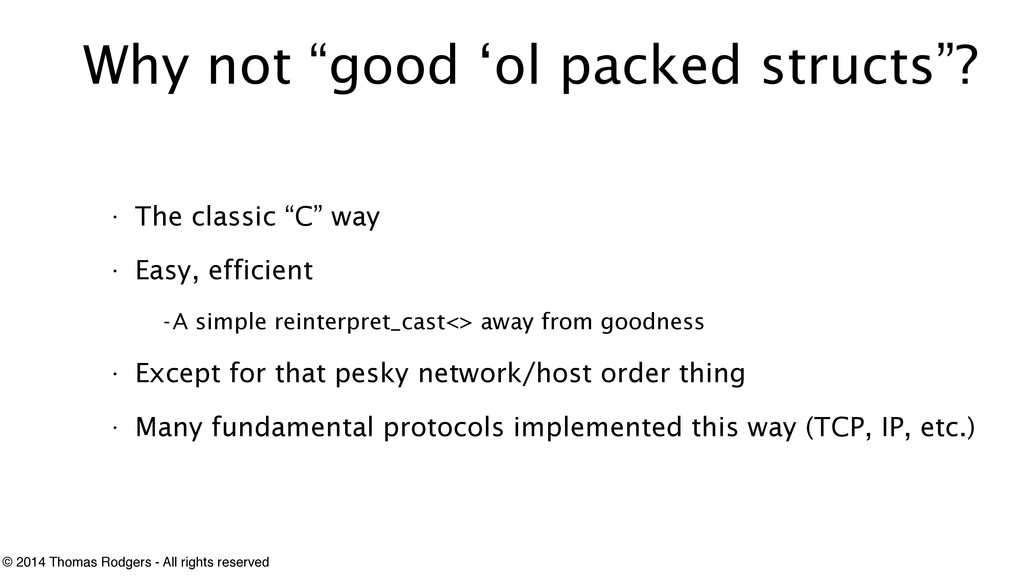
  3. © 2014 Thomas Rodgers - All rights reserved Why not

    “good ‘ol packed structs”? • The classic “C” way • Easy, efficient -A simple reinterpret_cast<> away from goodness • Except for that pesky network/host order thing • Many fundamental protocols implemented this way (TCP, IP, etc.)
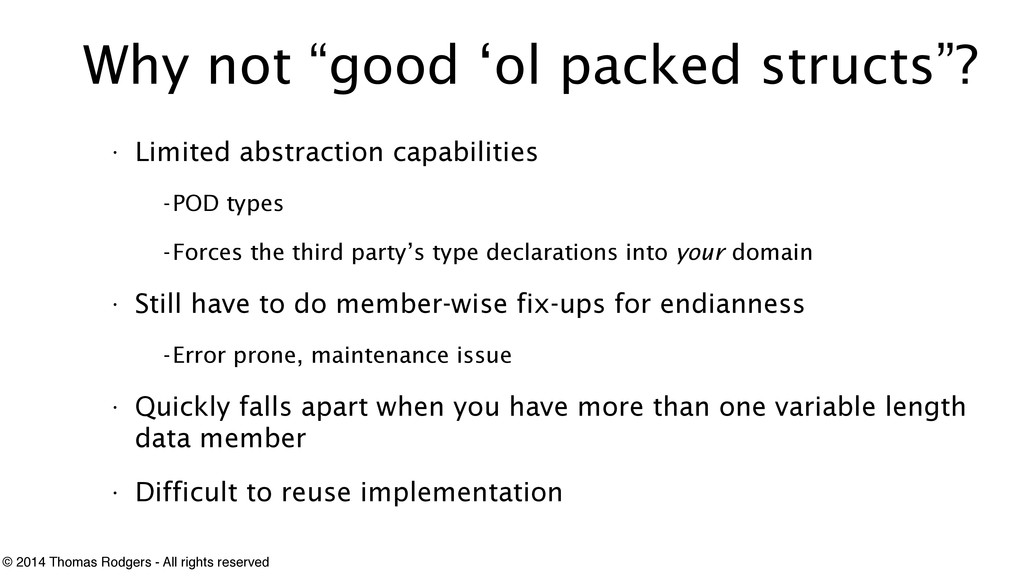
  4. © 2014 Thomas Rodgers - All rights reserved Why not

    “good ‘ol packed structs”? • Limited abstraction capabilities -POD types -Forces the third party’s type declarations into your domain • Still have to do member-wise fix-ups for endianness -Error prone, maintenance issue • Quickly falls apart when you have more than one variable length data member • Difficult to reuse implementation
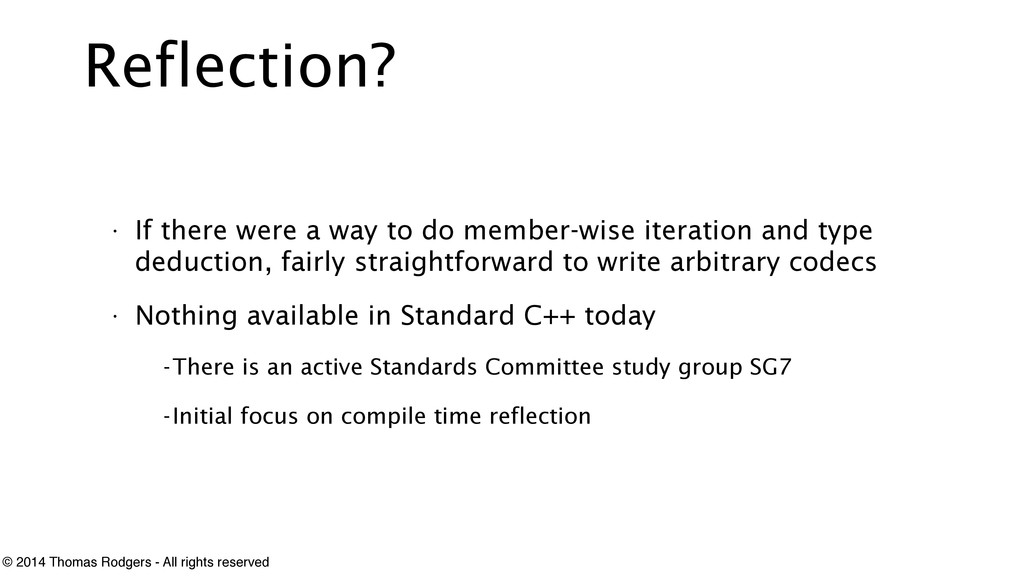
  5. © 2014 Thomas Rodgers - All rights reserved Reflection? •

    If there were a way to do member-wise iteration and type deduction, fairly straightforward to write arbitrary codecs • Nothing available in Standard C++ today -There is an active Standards Committee study group SG7 -Initial focus on compile time reflection
  6. © 2014 Thomas Rodgers - All rights reserved What about

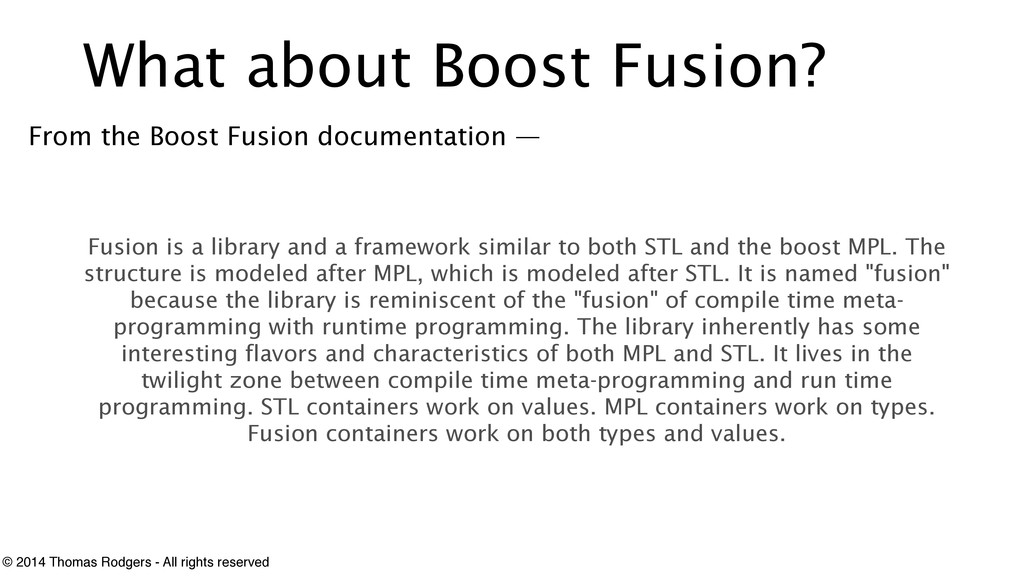
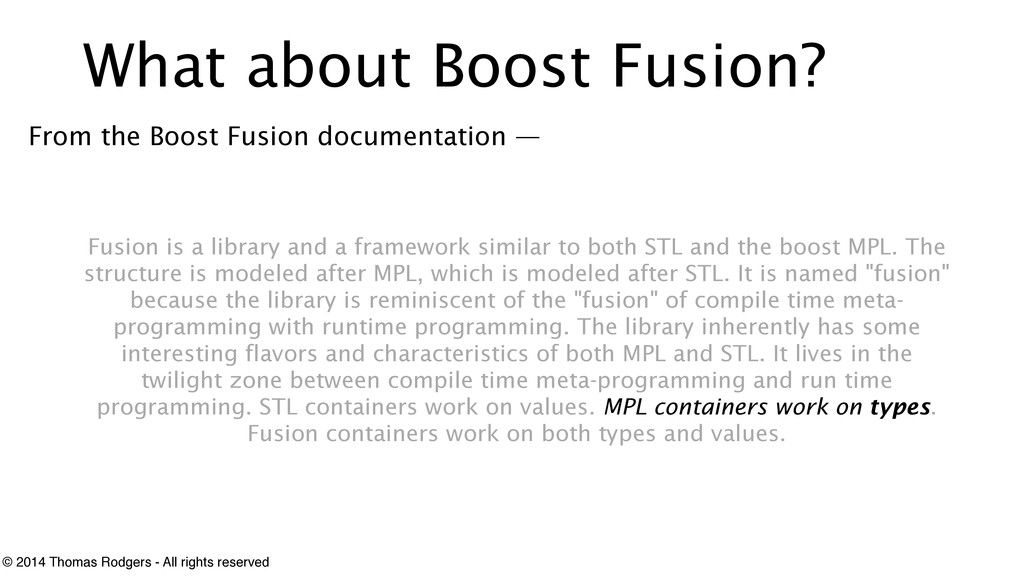
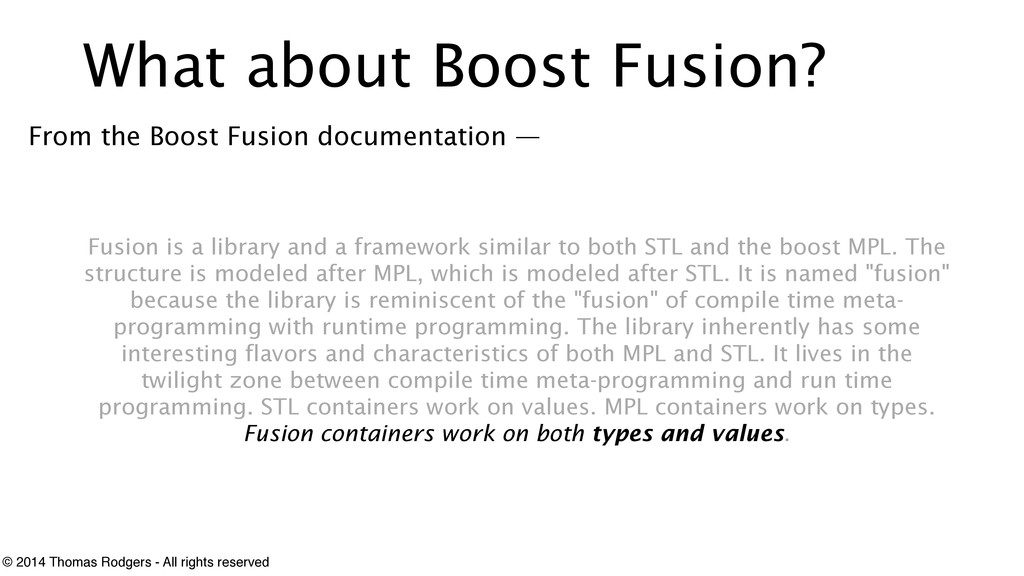
    Boost Fusion? From the Boost Fusion documentation — ! Fusion is a library and a framework similar to both STL and the boost MPL. The structure is modeled after MPL, which is modeled after STL. It is named "fusion" because the library is reminiscent of the "fusion" of compile time meta- programming with runtime programming. The library inherently has some interesting flavors and characteristics of both MPL and STL. It lives in the twilight zone between compile time meta-programming and run time programming. STL containers work on values. MPL containers work on types. Fusion containers work on both types and values.
  7. © 2014 Thomas Rodgers - All rights reserved What about

    Boost Fusion? From the Boost Fusion documentation — ! Fusion is a library and a framework similar to both STL and the boost MPL. The structure is modeled after MPL, which is modeled after STL. It is named "fusion" because the library is reminiscent of the "fusion" of compile time meta- programming with runtime programming. The library inherently has some interesting flavors and characteristics of both MPL and STL. It lives in the twilight zone between compile time meta-programming and run time programming. STL containers work on values. MPL containers work on types. Fusion containers work on both types and values.
  8. © 2014 Thomas Rodgers - All rights reserved What about

    Boost Fusion? From the Boost Fusion documentation — ! Fusion is a library and a framework similar to both STL and the boost MPL. The structure is modeled after MPL, which is modeled after STL. It is named "fusion" because the library is reminiscent of the "fusion" of compile time meta- programming with runtime programming. The library inherently has some interesting flavors and characteristics of both MPL and STL. It lives in the twilight zone between compile time meta-programming and run time programming. STL containers work on values. MPL containers work on types. Fusion containers work on both types and values.
  9. © 2014 Thomas Rodgers - All rights reserved What about

    Boost Fusion? From the Boost Fusion documentation — ! Fusion is a library and a framework similar to both STL and the boost MPL. The structure is modeled after MPL, which is modeled after STL. It is named "fusion" because the library is reminiscent of the "fusion" of compile time meta- programming with runtime programming. The library inherently has some interesting flavors and characteristics of both MPL and STL. It lives in the twilight zone between compile time meta-programming and run time programming. STL containers work on values. MPL containers work on types. Fusion containers work on both types and values.
  10. © 2014 Thomas Rodgers - All rights reserved What about

    Boost Fusion? From the Boost Fusion documentation — ! Fusion is a library and a framework similar to both STL and the boost MPL. The structure is modeled after MPL, which is modeled after STL. It is named "fusion" because the library is reminiscent of the "fusion" of compile time meta- programming with runtime programming. The library inherently has some interesting flavors and characteristics of both MPL and STL. It lives in the twilight zone between compile time meta-programming and run time programming. STL containers work on values. MPL containers work on types. Fusion containers work on both types and values.
  11. © 2014 Thomas Rodgers - All rights reserved What about

    Boost Fusion? From the Boost Fusion documentation — ! Fusion is a library and a framework similar to both STL and the boost MPL. The structure is modeled after MPL, which is modeled after STL. It is named "fusion" because the library is reminiscent of the "fusion" of compile time meta- programming with runtime programming. The library inherently has some interesting flavors and characteristics of both MPL and STL. It lives in the twilight zone between compile time meta-programming and run time programming. STL containers work on values. MPL containers work on types. Fusion containers work on both types and values.
  12. © 2014 Thomas Rodgers - All rights reserved A container

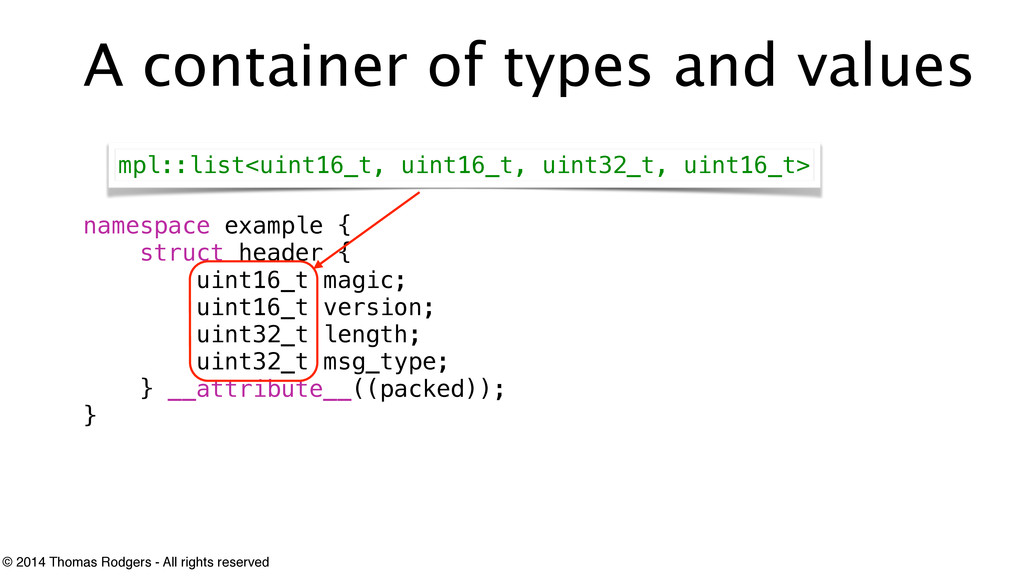
    of types and values namespace example { struct header { uint16_t magic; uint16_t version; uint32_t length; uint32_t msg_type; } __attribute__((packed)); }
  13. © 2014 Thomas Rodgers - All rights reserved A container

    of types and values namespace example { struct header { uint16_t magic; uint16_t version; uint32_t length; uint32_t msg_type; } __attribute__((packed)); } mpl::list<uint16_t, uint16_t, uint32_t, uint16_t>
  14. © 2014 Thomas Rodgers - All rights reserved A container

    of types and values namespace example { struct header { uint16_t magic; uint16_t version; uint32_t length; uint32_t msg_type; } __attribute__((packed)); } std::tuple<uint16_t&, uint16_t&, uint32_t&, uint16_t&>
  15. © 2014 Thomas Rodgers - All rights reserved From packed

    struct to Fusion struct #include <cstddef> ! namespace example { struct header { uint16_t magic; uint16_t version; uint32_t length; uint32_t msg_type; } __attribute__((packed)); }
  16. © 2014 Thomas Rodgers - All rights reserved From packed

    struct to Fusion struct #include <cstddef> #include <boost/fusion/include/define_struct.hpp> ! BOOST_FUSION_DEFINE_STRUCT( (example), header, (uint16_t, magic) (uint16_t, version) (uint32_t, length) (uint32_t, msg_type) )
  17. © 2014 Thomas Rodgers - All rights reserved Asio buffers

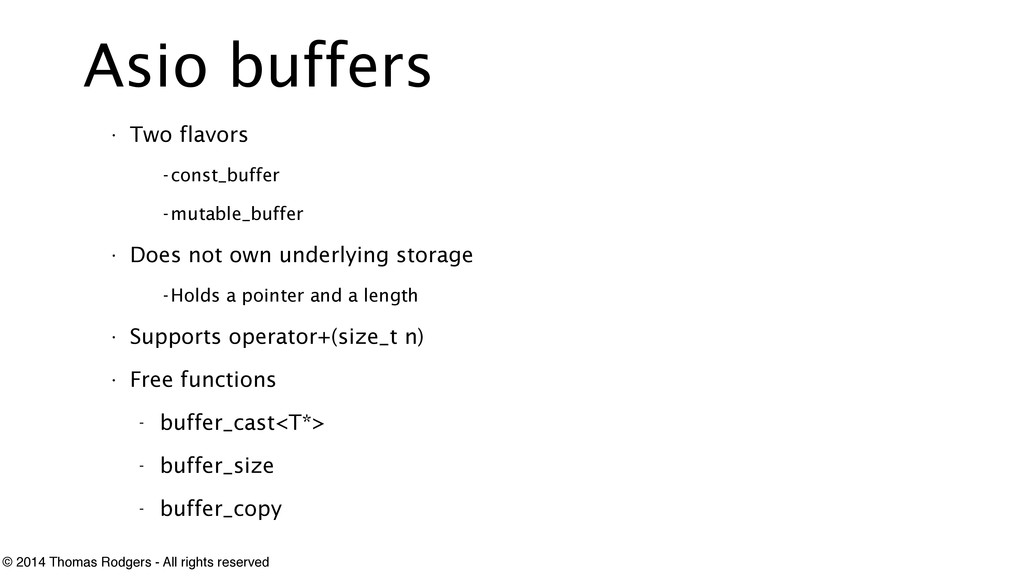
    • Two flavors -const_buffer -mutable_buffer • Does not own underlying storage -Holds a pointer and a length • Supports operator+(size_t n) • Free functions - buffer_cast<T*> - buffer_size - buffer_copy
  18. © 2014 Thomas Rodgers - All rights reserved Member-wise visitation

    #include <boost/fusion/include/for_each.hpp> #include <boost/asio/buffer.hpp> ! struct reader { // ... }; ! template<typename T> T read(asio::const_buffer b) { reader r(std::move(b)); T res; fusion::for_each(res, r); return res; } }
  19. © 2014 Thomas Rodgers - All rights reserved Member-wise visitation

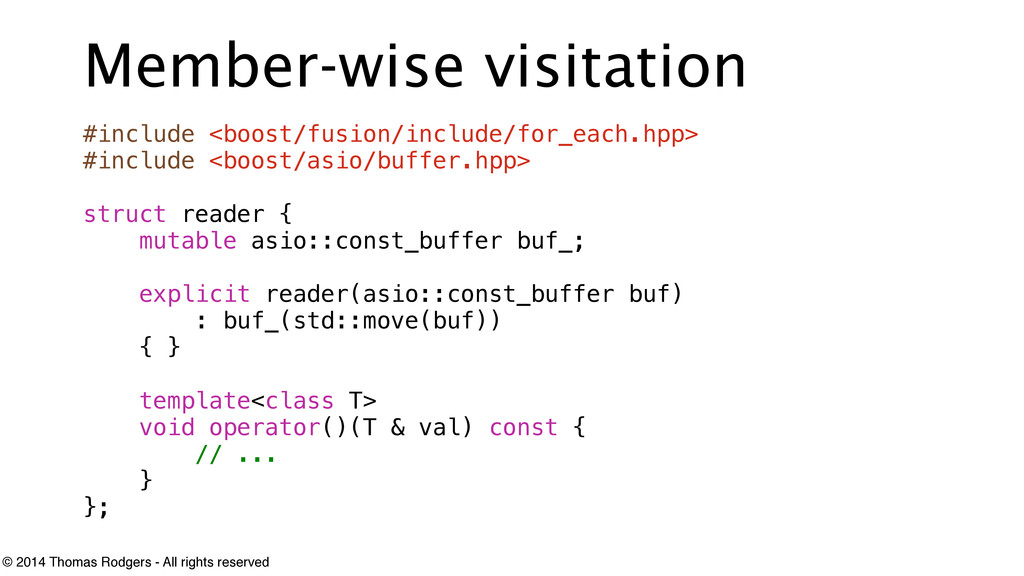
    #include <boost/fusion/include/for_each.hpp> #include <boost/asio/buffer.hpp> ! struct reader { asio::const_buffer buf_; explicit reader(asio::const_buffer buf) : buf_(std::move(buf)) { } template<class T> void operator()(T & val) { // ... } };
  20. © 2014 Thomas Rodgers - All rights reserved Member-wise visitation

    #include <boost/fusion/include/for_each.hpp> #include <boost/asio/buffer.hpp> ! struct reader { mutable asio::const_buffer buf_; explicit reader(asio::const_buffer buf) : buf_(std::move(buf)) { } template<class T> void operator()(T & val) const { // ... } };
  21. © 2014 Thomas Rodgers - All rights reserved Member-wise visitation

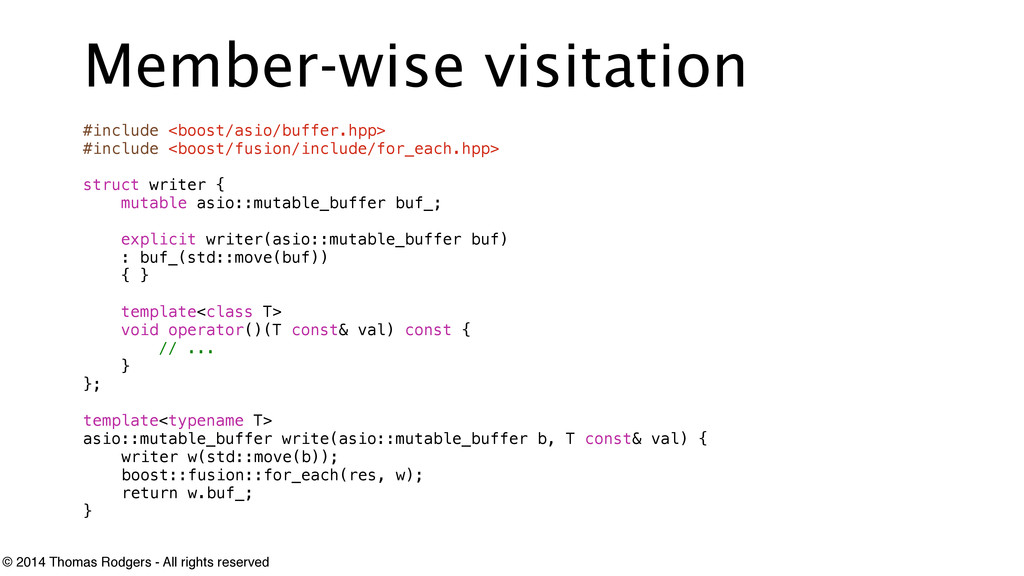
    #include <boost/asio/buffer.hpp> #include <boost/fusion/include/for_each.hpp> ! struct writer { mutable asio::mutable_buffer buf_; explicit writer(asio::mutable_buffer buf) : buf_(std::move(buf)) { } template<class T> void operator()(T const& val) const { // ... } }; ! template<typename T> asio::mutable_buffer write(asio::mutable_buffer b, T const& val) { writer w(std::move(b)); boost::fusion::for_each(res, w); return w.buf_; }
  22. © 2014 Thomas Rodgers - All rights reserved Fixing up

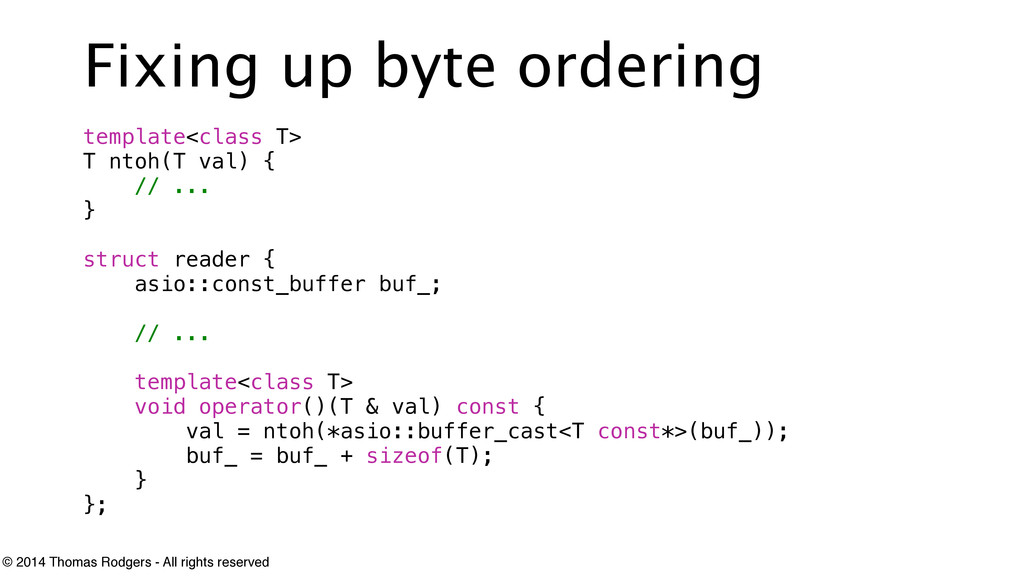
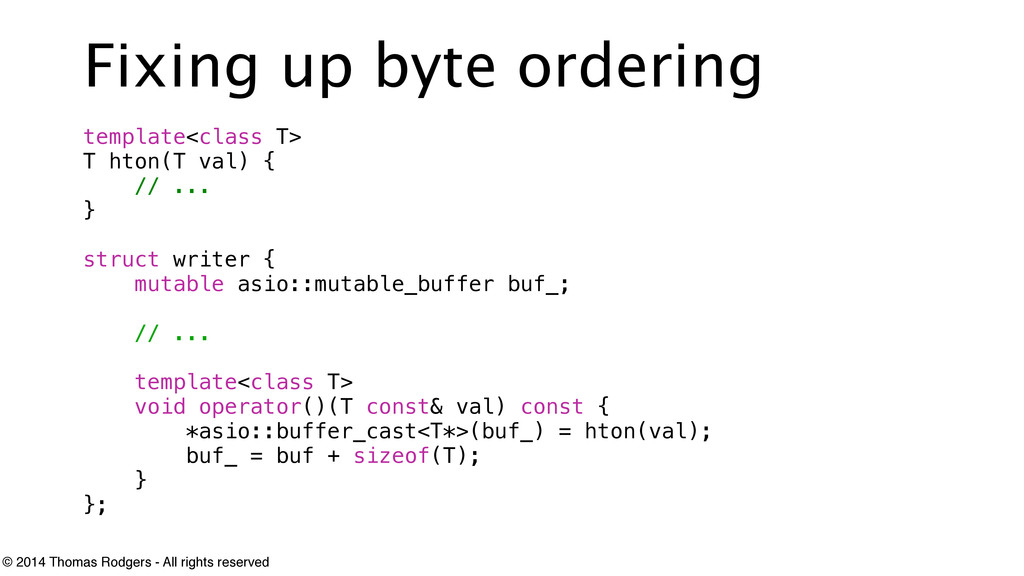
    byte ordering • Network protocols typically require member-wise fix-ups for endianness -ntohl, ntohs, htonl, htons, bswap etc. -proposal to add generic ntoh/hton for unsigned integral types to Standard C++ -Fairly easy to roll our own generic ntoh/hton
  23. © 2014 Thomas Rodgers - All rights reserved Fixing up

    byte ordering template<class T> T ntoh(T val) { // ... } ! struct reader { asio::const_buffer buf_; ! // ... template<class T> void operator()(T & val) const { val = ntoh(*asio::buffer_cast<T const*>(buf_)); buf_ = buf_ + sizeof(T); } };
  24. © 2014 Thomas Rodgers - All rights reserved Fixing up

    byte ordering template<class T> T hton(T val) { // ... } ! struct writer { mutable asio::mutable_buffer buf_; ! // ... ! template<class T> void operator()(T const& val) const { *asio::buffer_cast<T*>(buf_) = hton(val); buf_ = buf + sizeof(T); } };
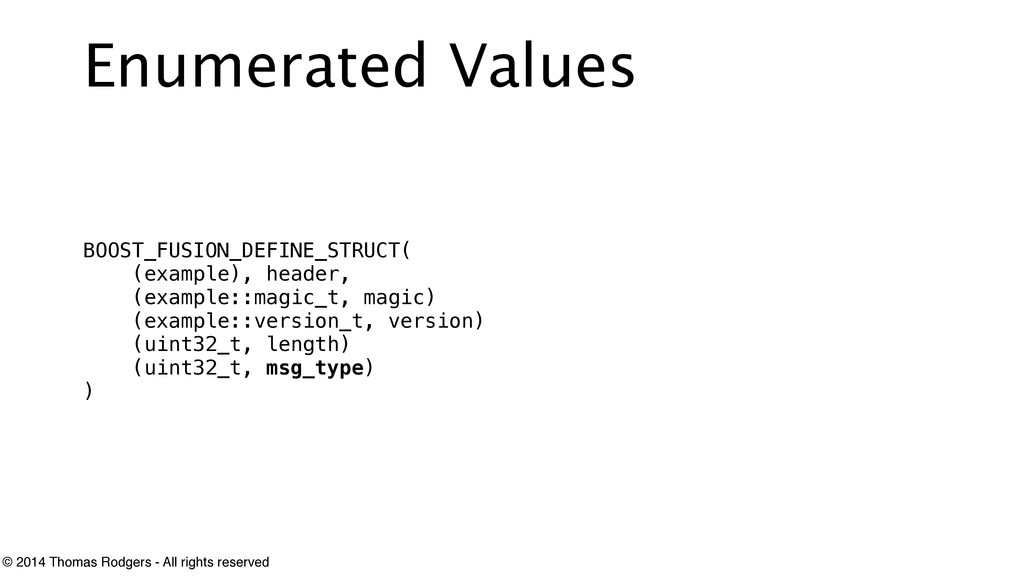
  25. © 2014 Thomas Rodgers - All rights reserved Enumerated Values

    BOOST_FUSION_DEFINE_STRUCT( (example), header, (example::magic_t, magic) (example::version_t, version) (uint32_t, length) (uint32_t, msg_type) )
  26. © 2014 Thomas Rodgers - All rights reserved Enumerated Values

    namespace example { enum class msg_type_t : uint32_t { // ... }; } ! BOOST_FUSION_DEFINE_STRUCT( (example), header, (example::magic_t, magic) (example::version_t, version) (uint32_t, length) (example::msg_type_t, msg_type) )
  27. © 2014 Thomas Rodgers - All rights reserved Enumerated Values

    struct reader { // ... template<class T> void operator()(T & val) const { val = ntoh(*asio::buffer_cast<T const*>(buf_)); buf_ = buf_ + sizeof(T); } };
  28. © 2014 Thomas Rodgers - All rights reserved Enumerated Values

    struct reader { // ... template<class T> auto operator()(T & val) const -> typename std::enable_if<std::is_integral<T>::value>::type { val = ntoh(*asio::buffer_cast<T const*>(buf_)); buf_ = buf_ + sizeof(T); } };
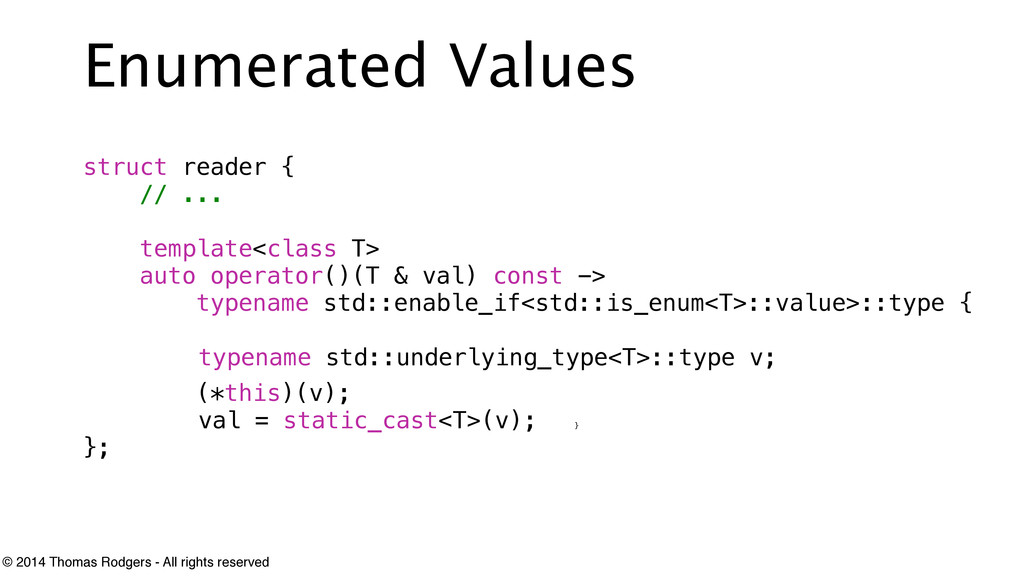
  29. © 2014 Thomas Rodgers - All rights reserved Enumerated Values

    struct reader { // ... template<class T> auto operator()(T & val) const -> typename std::enable_if<std::is_enum<T>::value>::type { typename std::underlying_type<T>::type v; ! (*this)(v); val = static_cast<T>(v); } };
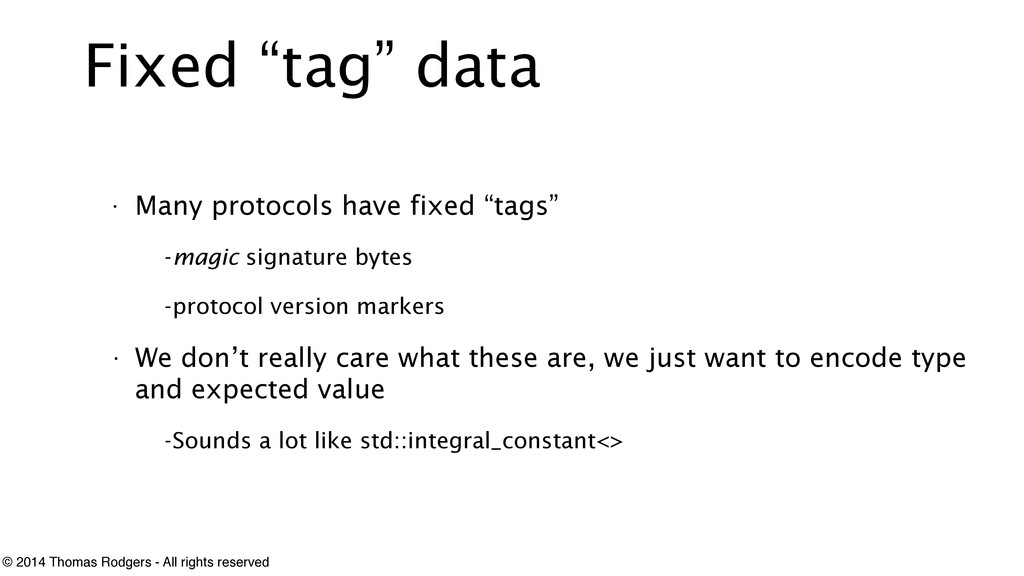
  30. © 2014 Thomas Rodgers - All rights reserved Fixed “tag”

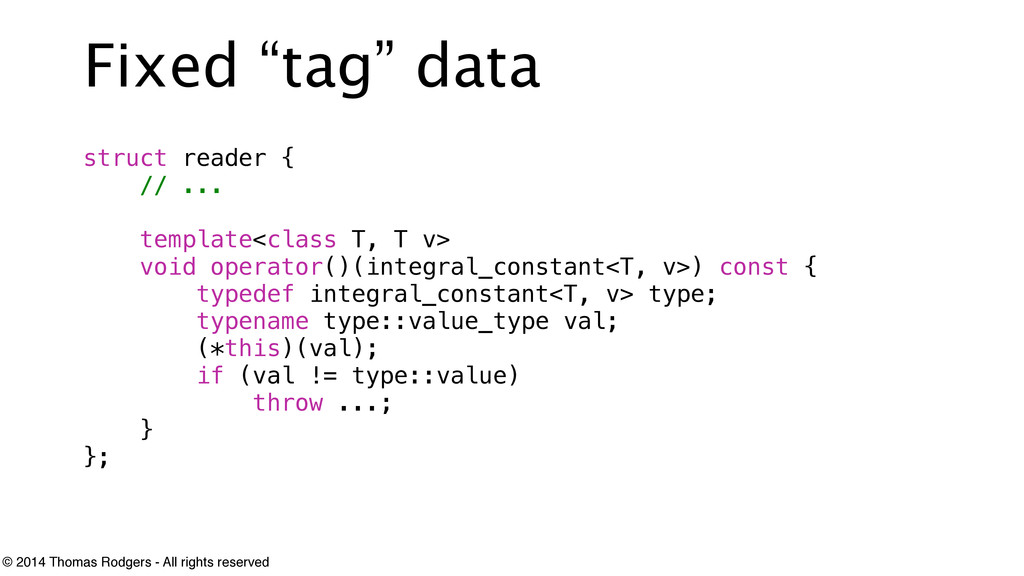
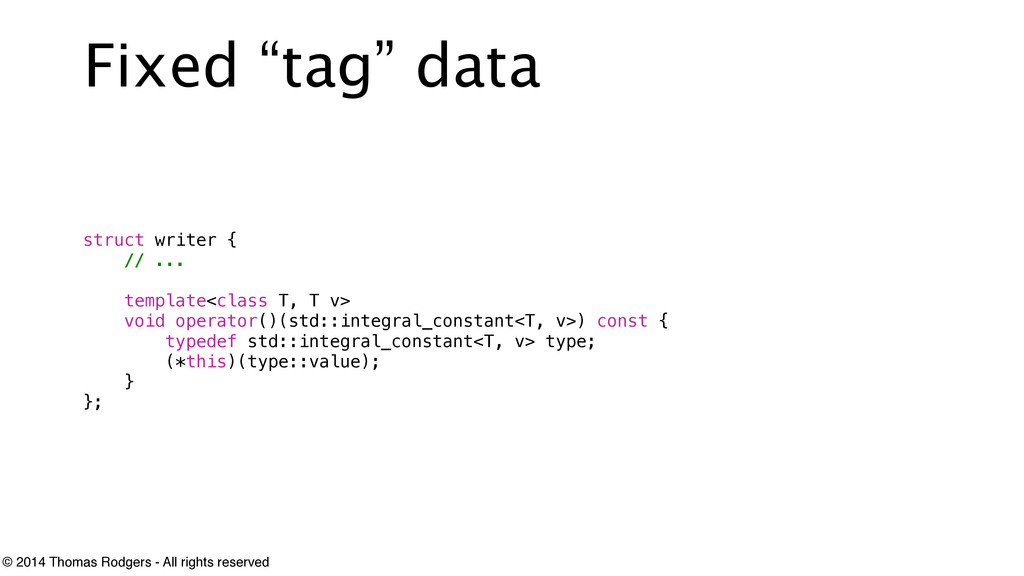
    data • Many protocols have fixed “tags” -magic signature bytes -protocol version markers • We don’t really care what these are, we just want to encode type and expected value -Sounds a lot like std::integral_constant<>
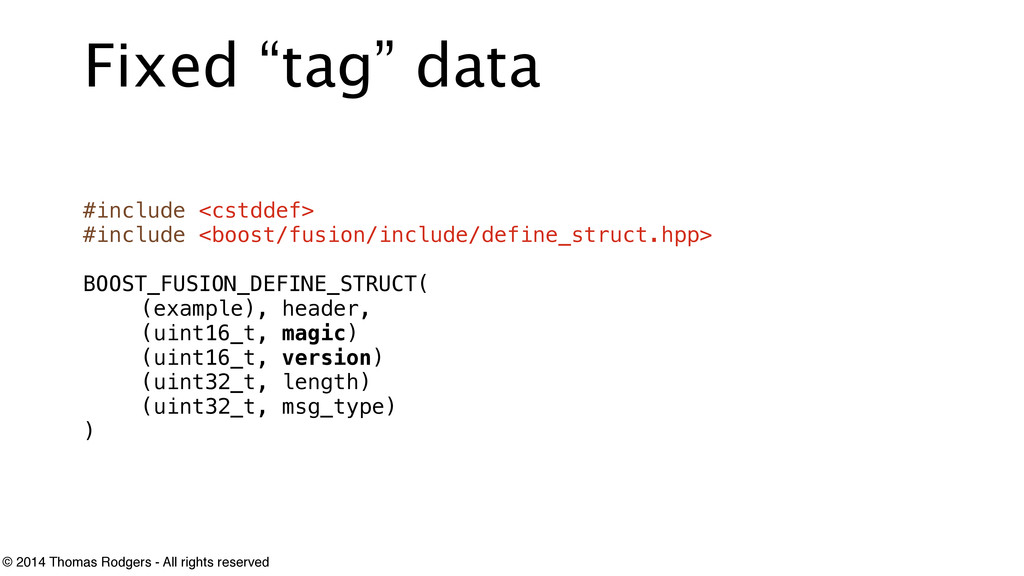
  31. © 2014 Thomas Rodgers - All rights reserved Fixed “tag”

    data #include <cstddef> #include <boost/fusion/include/define_struct.hpp> ! BOOST_FUSION_DEFINE_STRUCT( (example), header, (uint16_t, magic) (uint16_t, version) (uint32_t, length) (uint32_t, msg_type) )
  32. © 2014 Thomas Rodgers - All rights reserved Fixed “tag”

    data #include <cstddef> #include <type_traits> #include <boost/fusion/include/define_struct.hpp> ! namespace example { using magic_t = integral_constant<uint16_t, 0xf00d>; using version_t = integral_constant<uint16_t, 0xbeef>; } ! BOOST_FUSION_DEFINE_STRUCT( (example), header, (example::magic_t, magic) (example::version_t, version) (uint32_t, length) (uint32_t, msg_type) )
  33. © 2014 Thomas Rodgers - All rights reserved Fixed “tag”

    data struct reader { // ... template<class T, T v> void operator()(integral_constant<T, v>) const { typedef integral_constant<T, v> type; typename type::value_type val; (*this)(val); if (val != type::value) throw ...; } };
  34. © 2014 Thomas Rodgers - All rights reserved Fixed “tag”

    data struct writer { // ... template<class T, T v> void operator()(std::integral_constant<T, v>) const { typedef std::integral_constant<T, v> type; (*this)(type::value); } };
  35. © 2014 Thomas Rodgers - All rights reserved Simple variable

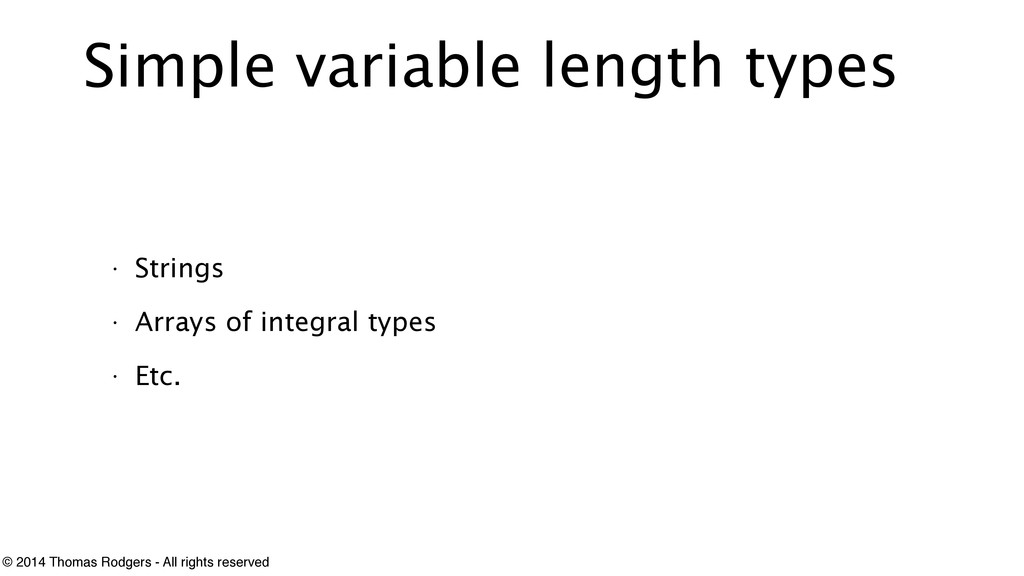
    length types • Strings • Arrays of integral types • Etc.
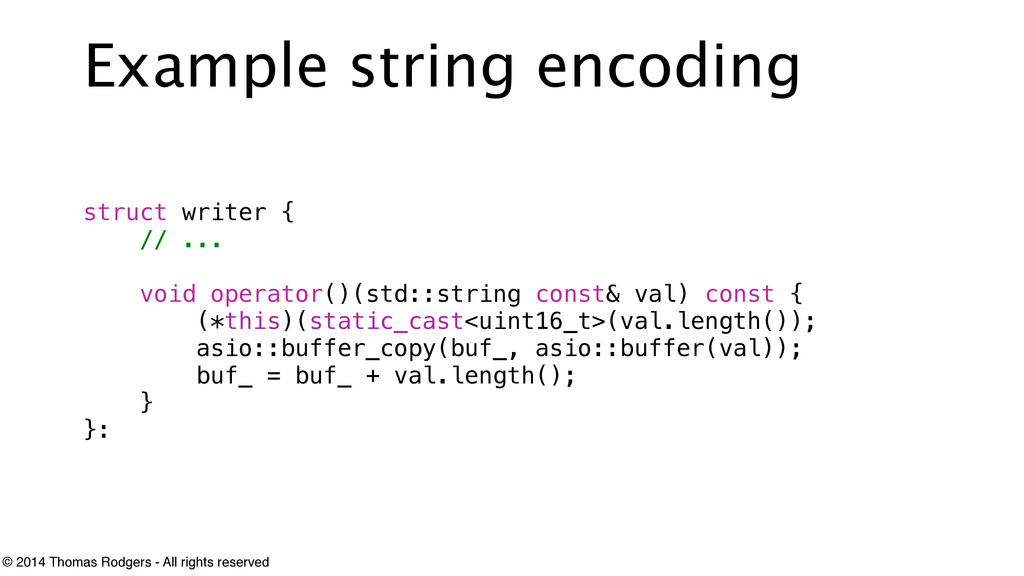
  36. © 2014 Thomas Rodgers - All rights reserved Example string

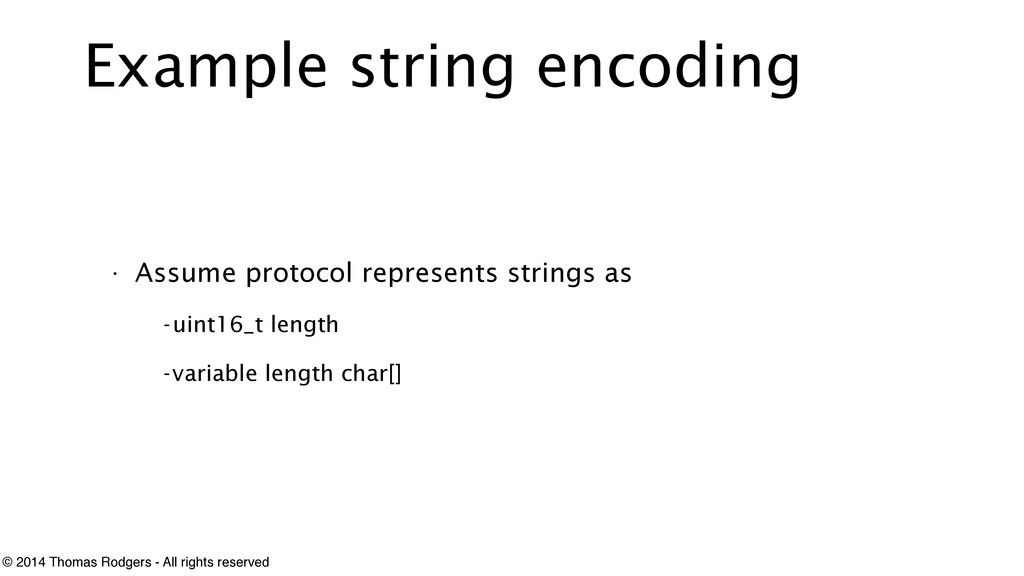
    encoding • Assume protocol represents strings as -uint16_t length -variable length char[]
  37. © 2014 Thomas Rodgers - All rights reserved Example string

    encoding struct reader { // ... void operator()(std::string& val) const { uint16_t length; (*this)(length); val = string(asio::buffer_cast<char const*>(buf_), length); buf_ = buf_ + length; } };
  38. © 2014 Thomas Rodgers - All rights reserved Example string

    encoding struct writer { // ... void operator()(std::string const& val) const { (*this)(static_cast<uint16_t>(val.length()); asio::buffer_copy(buf_, asio::buffer(val)); buf_ = buf_ + val.length(); } }:
  39. © 2014 Thomas Rodgers - All rights reserved Sequences of

    types struct reader { // ... template<class T> void operator()(std::vector<T> & vals) { uint16_t length; (*this)(length); for (; length; —-length) { T val; (*this)(val); vals.emplace_back(std::move(val)); } } };
  40. © 2014 Thomas Rodgers - All rights reserved Maps of

    types #include <unordered_map> ! struct reader { // ... template<class K, class V> void operator()(std::unordered_map<K,V> & kvs) { uint16_t length; (*this)(length); for (; length; —-length) { K key; (*this)(key); V val; (*this)(val); kvs.emplace(key, val); } } };
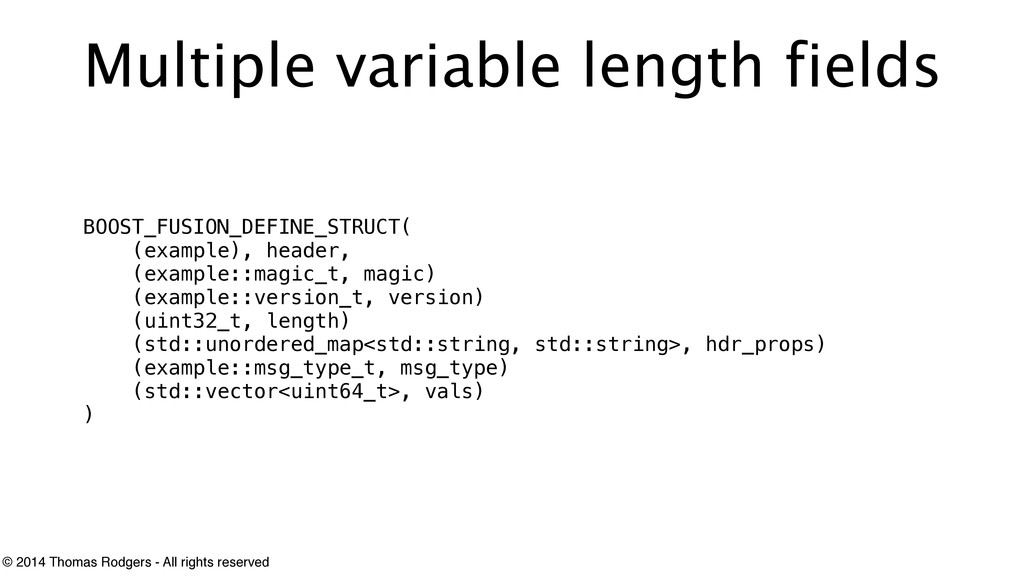
  41. © 2014 Thomas Rodgers - All rights reserved Multiple variable

    length fields BOOST_FUSION_DEFINE_STRUCT( (example), header, (example::magic_t, magic) (example::version_t, version) (uint32_t, length) (std::unordered_map<std::string, std::string>, hdr_props) (example::msg_type_t, msg_type) (std::vector<uint64_t>, vals) )
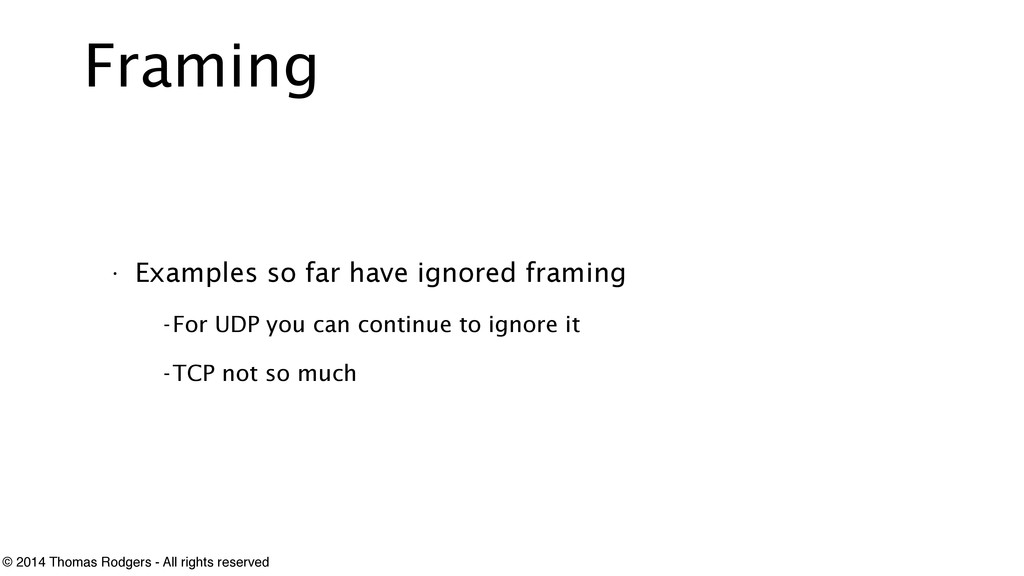
  42. © 2014 Thomas Rodgers - All rights reserved Framing •

    Examples so far have ignored framing -For UDP you can continue to ignore it -TCP not so much
  43. © 2014 Thomas Rodgers - All rights reserved Framing BOOST_FUSION_DEFINE_STRUCT(

    (example), header, (example::magic_t, magic) (example::version_t, version) (uint32_t, length) ) ! BOOST_FUSION_DEFINE_STRUCT( (example), header_rest, (std::map<std::string, std::string>, hdr_props) (example::msg_type_t, msg_type) )
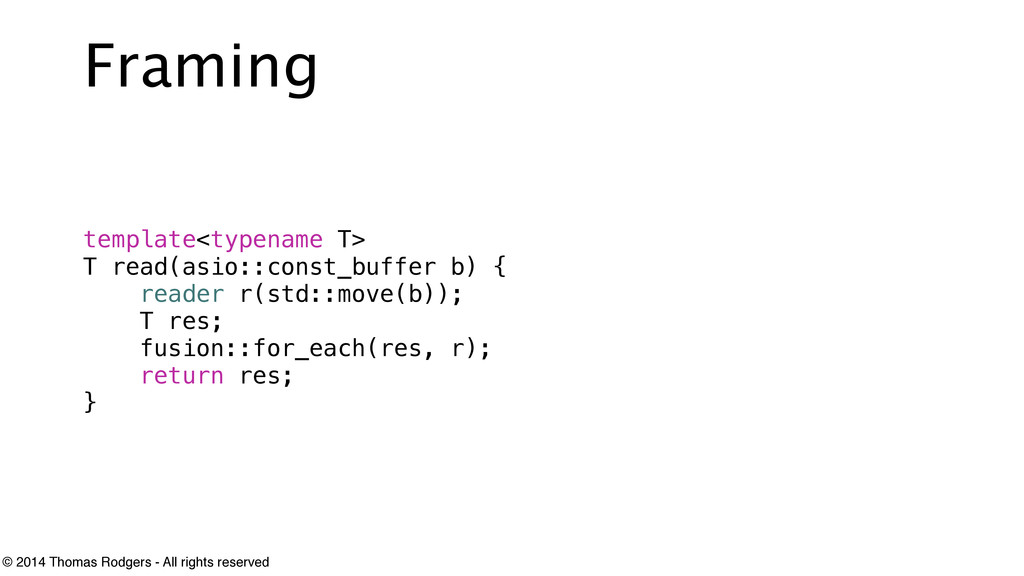
  44. © 2014 Thomas Rodgers - All rights reserved Framing template<typename

    T> T read(asio::const_buffer b) { reader r(std::move(b)); T res; fusion::for_each(res, r); return res; }
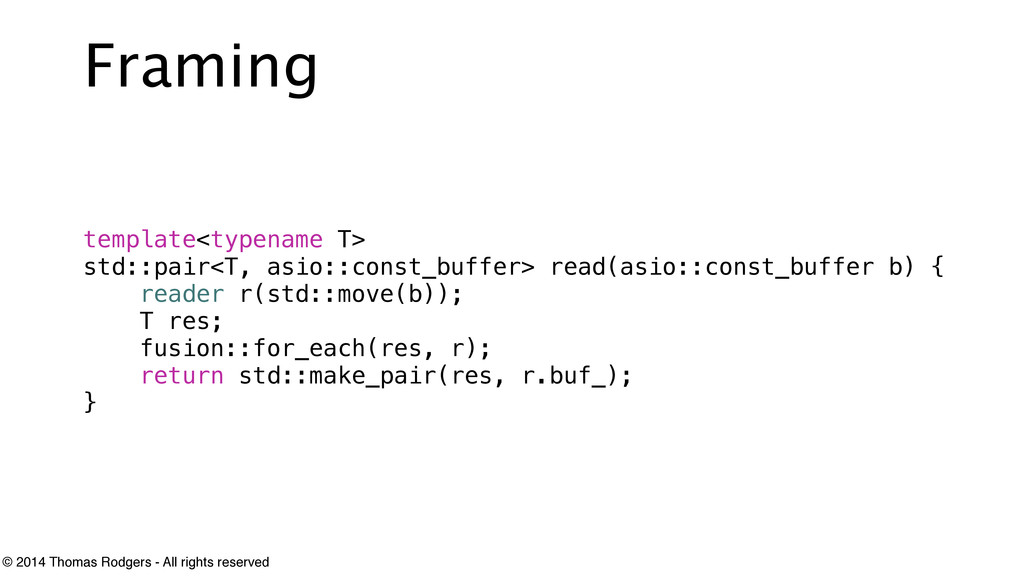
  45. © 2014 Thomas Rodgers - All rights reserved Framing template<typename

    T> std::pair<T, asio::const_buffer> read(asio::const_buffer b) { reader r(std::move(b)); T res; fusion::for_each(res, r); return std::make_pair(res, r.buf_); }
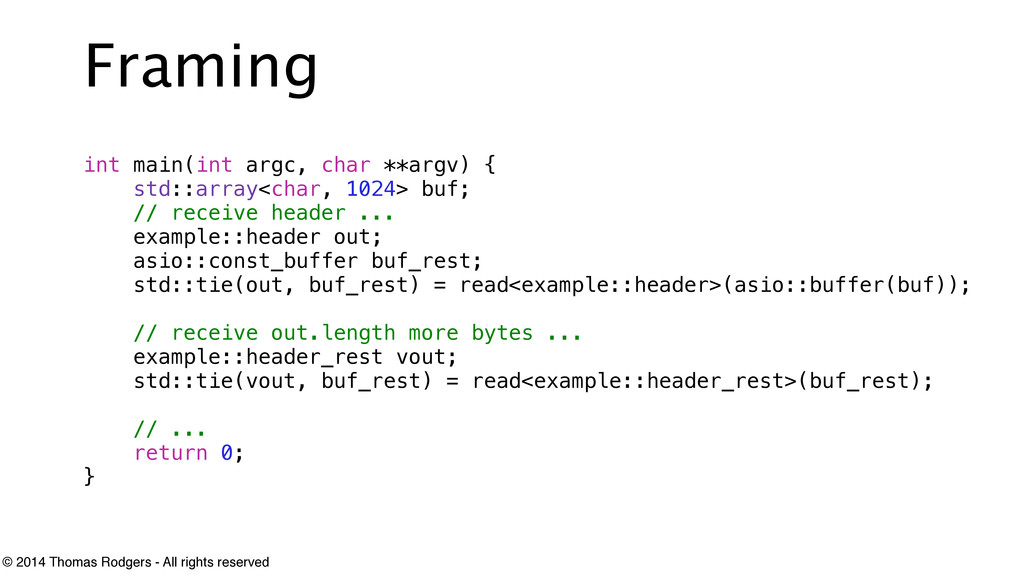
  46. © 2014 Thomas Rodgers - All rights reserved Framing int

    main(int argc, char **argv) { std::array<char, 1024> buf; // receive header ... example::header out; asio::const_buffer buf_rest; std::tie(out, buf_rest) = read<example::header>(asio::buffer(buf)); // receive out.length more bytes ... example::header_rest vout; std::tie(vout, buf_rest) = read<example::header_rest>(buf_rest); ! // ... return 0; }
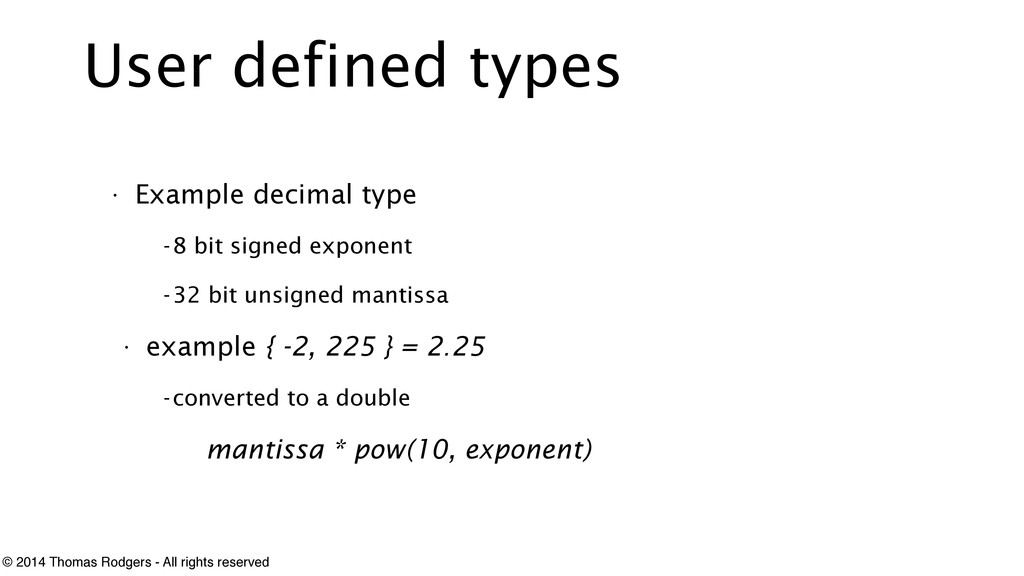
  47. © 2014 Thomas Rodgers - All rights reserved User defined

    types • Example decimal type -8 bit signed exponent -32 bit unsigned mantissa • example { -2, 225 } = 2.25 -converted to a double mantissa * pow(10, exponent)
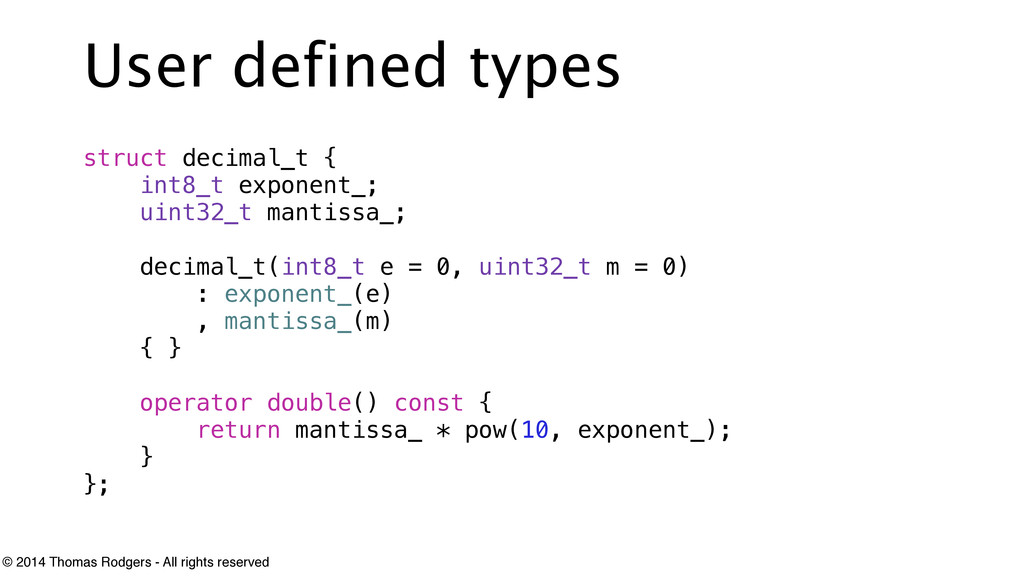
  48. © 2014 Thomas Rodgers - All rights reserved User defined

    types struct decimal_t { int8_t exponent_; uint32_t mantissa_; decimal_t(int8_t e = 0, uint32_t m = 0) : exponent_(e) , mantissa_(m) { } ! operator double() const { return mantissa_ * pow(10, exponent_); } };
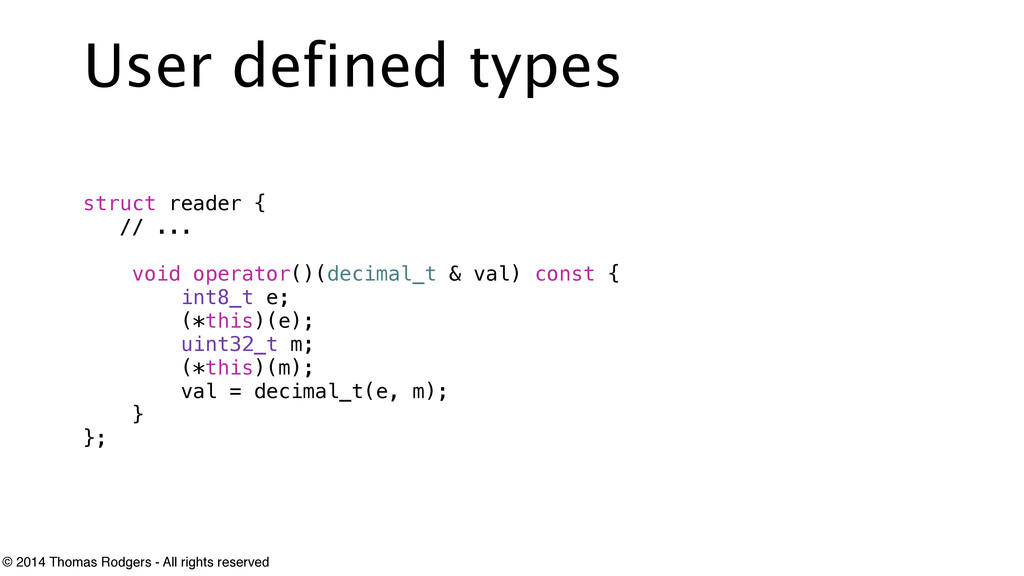
  49. © 2014 Thomas Rodgers - All rights reserved User defined

    types struct reader { // ... void operator()(decimal_t & val) const { int8_t e; (*this)(e); uint32_t m; (*this)(m); val = decimal_t(e, m); } };
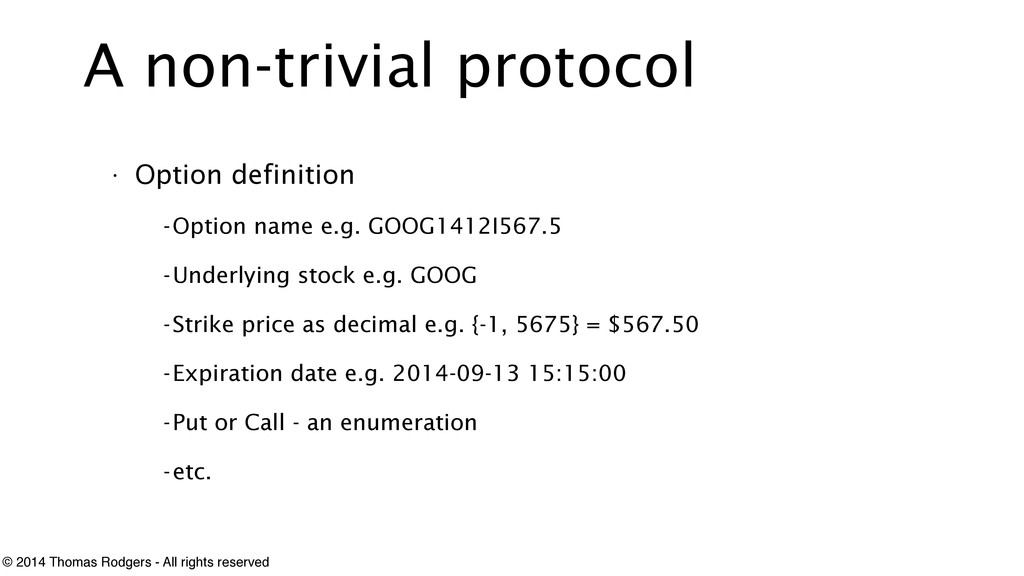
  50. © 2014 Thomas Rodgers - All rights reserved A non-trivial

    protocol • Option definition -Option name e.g. GOOG1412I567.5 -Underlying stock e.g. GOOG -Strike price as decimal e.g. {-1, 5675} = $567.50 -Expiration date e.g. 2014-09-13 15:15:00 -Put or Call - an enumeration -etc.
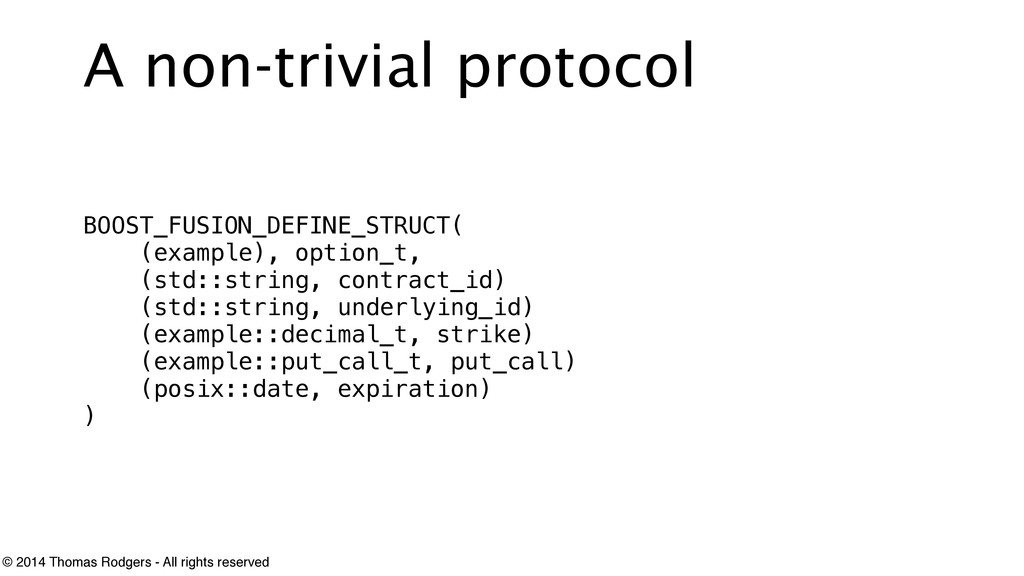
  51. © 2014 Thomas Rodgers - All rights reserved A non-trivial

    protocol BOOST_FUSION_DEFINE_STRUCT( (example), option_t, (std::string, contract_id) (std::string, underlying_id) (example::decimal_t, strike) (example::put_call_t, put_call) (posix::date, expiration) )
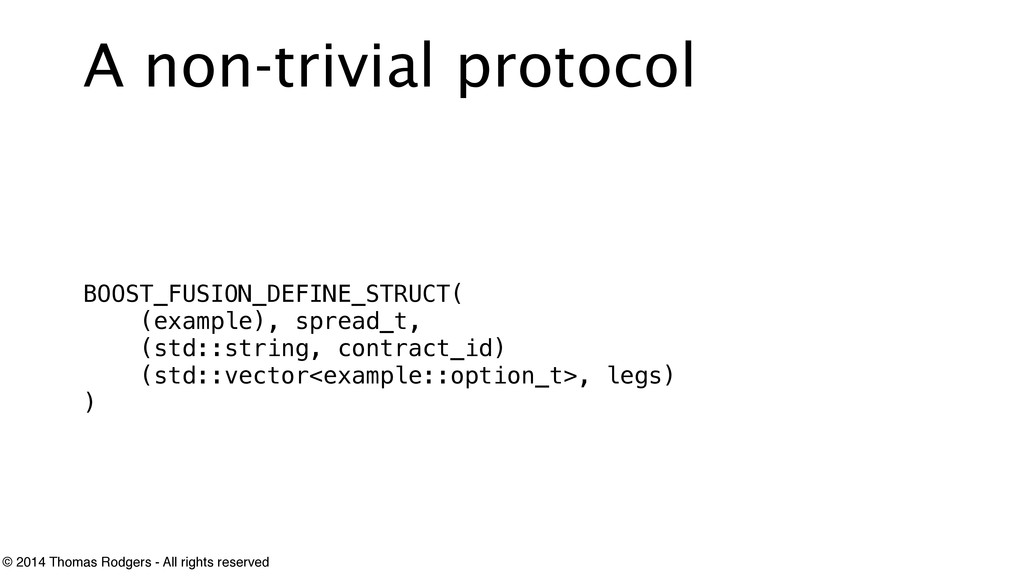
  52. © 2014 Thomas Rodgers - All rights reserved A non-trivial

    protocol • We also deal with things called “listed spreads” -The listed contract has an exchange assigned symbol/id -variable length collection of options contracts
  53. © 2014 Thomas Rodgers - All rights reserved A non-trivial

    protocol ! ! BOOST_FUSION_DEFINE_STRUCT( (example), spread_t, (std::string, contract_id) (std::vector<example::option_t>, legs) )
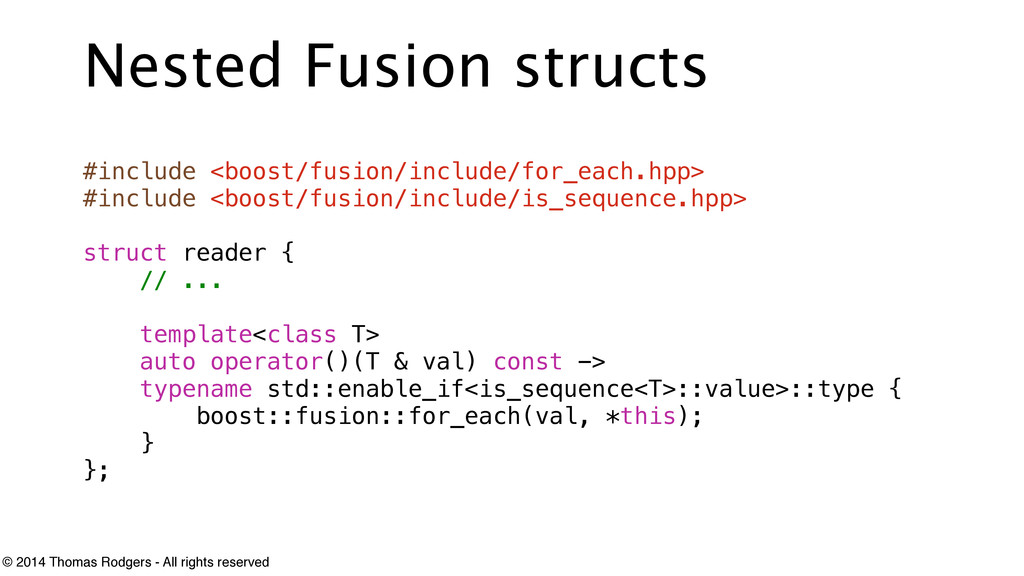
  54. © 2014 Thomas Rodgers - All rights reserved Nested Fusion

    structs #include <boost/fusion/include/for_each.hpp> #include <boost/fusion/include/is_sequence.hpp> ! struct reader { // ... ! template<class T> auto operator()(T & val) const -> typename std::enable_if<is_sequence<T>::value>::type { boost::fusion::for_each(val, *this); } };
  55. © 2014 Thomas Rodgers - All rights reserved Nested Fusion

    structs #include <boost/fusion/include/for_each.hpp> #include <boost/fusion/include/is_sequence.hpp> ! struct writer { // ... ! template<class T> auto operator()(T const& val) const -> typename std::enable_if<is_sequence<T>::value>::type { boost::fusion::for_each(val, *this); } };
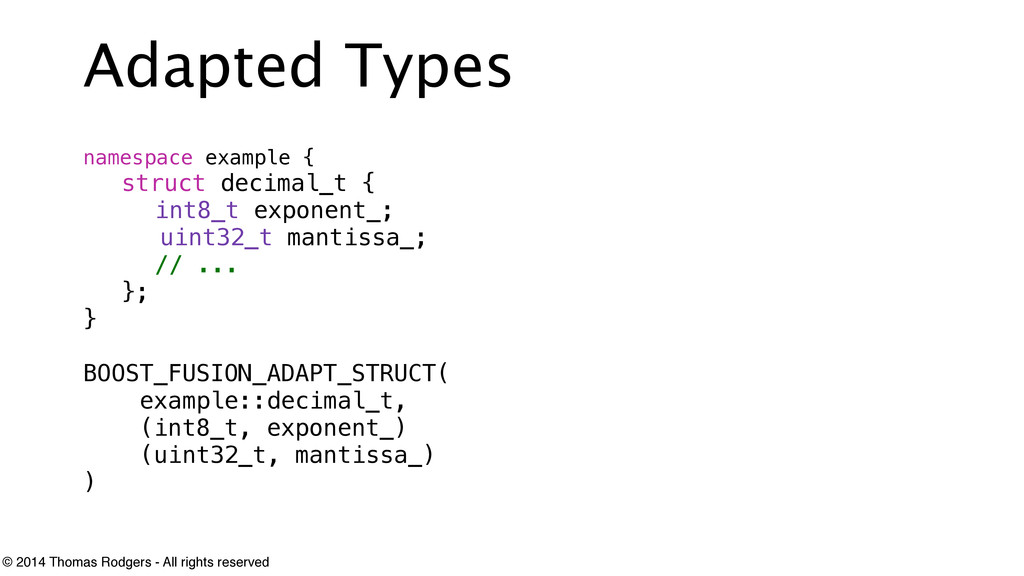
  56. © 2014 Thomas Rodgers - All rights reserved Adapted Types

    namespace example { struct decimal_t { int8_t exponent_; uint32_t mantissa_; // ... }; } ! BOOST_FUSION_ADAPT_STRUCT( example::decimal_t, (int8_t, exponent_) (uint32_t, mantissa_) )
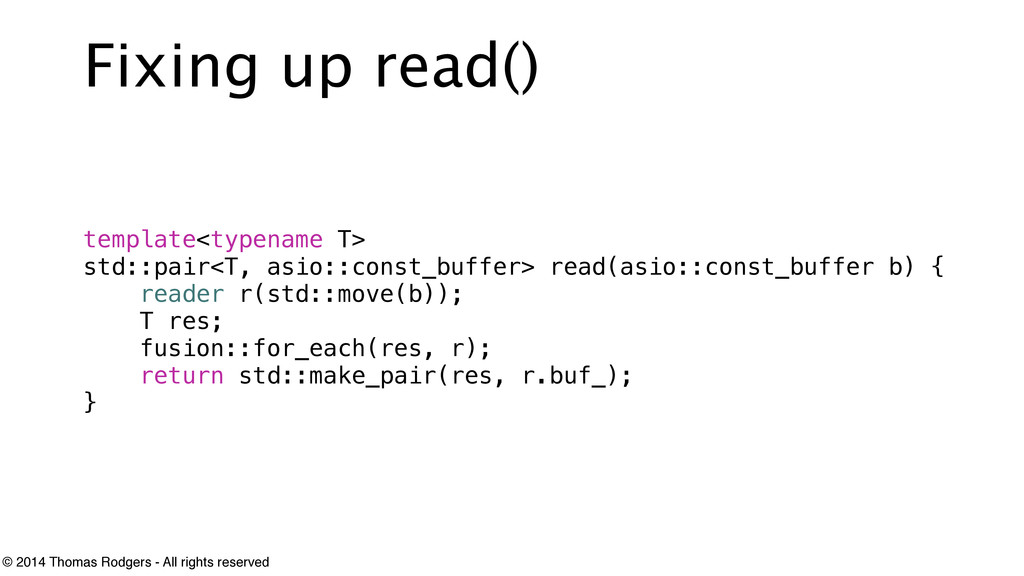
  57. © 2014 Thomas Rodgers - All rights reserved Fixing up

    read() template<typename T> std::pair<T, asio::const_buffer> read(asio::const_buffer b) { reader r(std::move(b)); T res; fusion::for_each(res, r); return std::make_pair(res, r.buf_); }
  58. © 2014 Thomas Rodgers - All rights reserved Fixing up

    read() template<typename T> std::pair<T, asio::const_buffer> read(asio::const_buffer b) { reader r(std::move(b)); T res; r(res); return std::make_pair(res, r.buf_); }
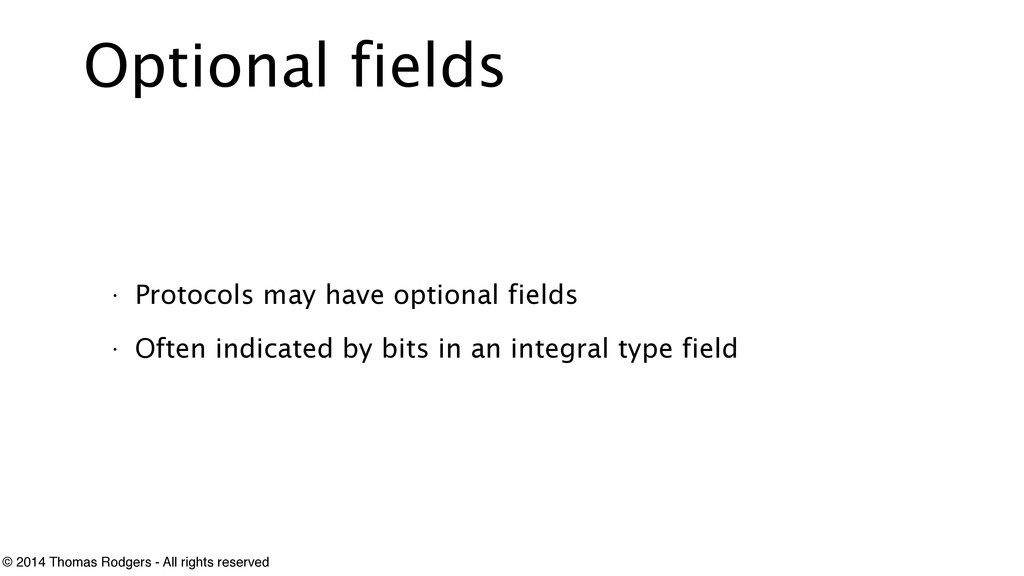
  59. © 2014 Thomas Rodgers - All rights reserved Optional fields

    • Protocols may have optional fields • Often indicated by bits in an integral type field
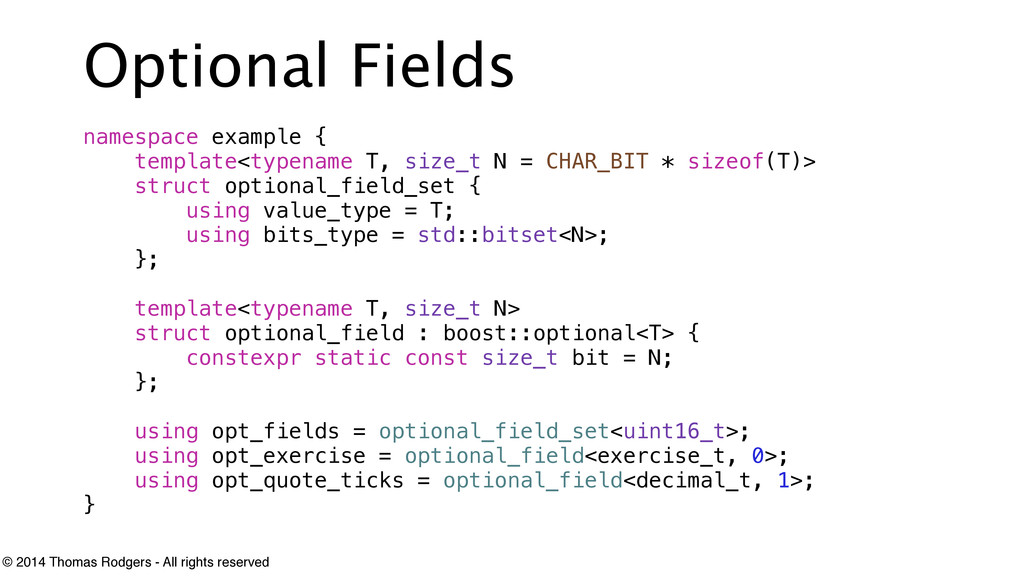
  60. © 2014 Thomas Rodgers - All rights reserved Optional Fields

    namespace example { template<typename T, size_t N = CHAR_BIT * sizeof(T)> struct optional_field_set { using value_type = T; using bits_type = std::bitset<N>; }; template<typename T, size_t N> struct optional_field : boost::optional<T> { constexpr static const size_t bit = N; }; using opt_fields = optional_field_set<uint16_t>; using opt_exercise = optional_field<exercise_t, 0>; using opt_quote_ticks = optional_field<decimal_t, 1>; }
  61. © 2014 Thomas Rodgers - All rights reserved Optional Fields

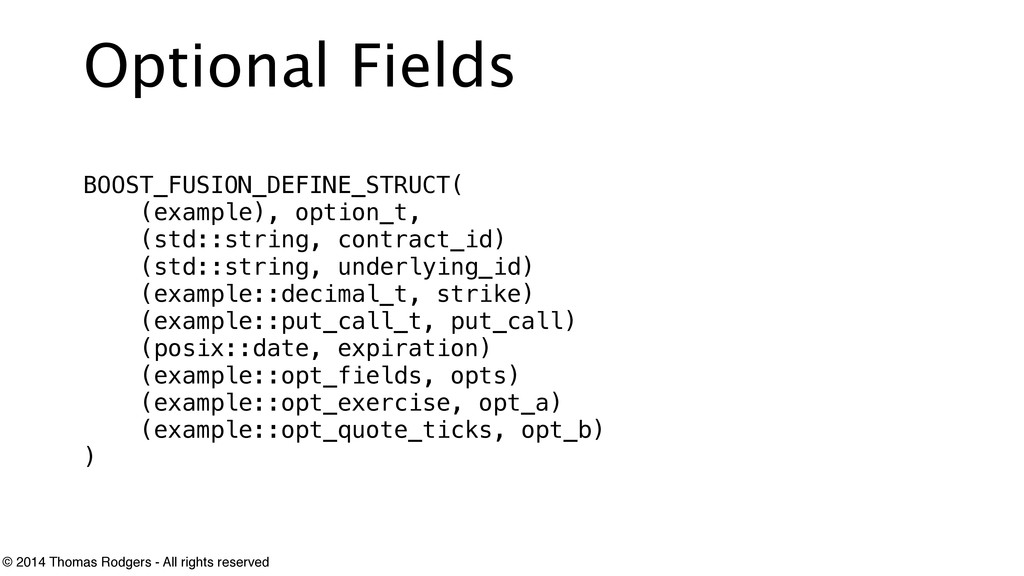
    BOOST_FUSION_DEFINE_STRUCT( (example), option_t, (std::string, contract_id) (std::string, underlying_id) (example::decimal_t, strike) (example::put_call_t, put_call) (posix::date, expiration) (example::opt_fields, opts) (example::opt_exercise, opt_a) (example::opt_quote_ticks, opt_b) )
  62. © 2014 Thomas Rodgers - All rights reserved Optional Fields

    struct reader { mutable optional<opt_fields::bits_type> opts_; // ... template<class T, size_t N> void operator()(opt_fields) const { opt_fields::value_type val; (*this)(val); opts_ = opt_fields::bits_type(val); } };
  63. © 2014 Thomas Rodgers - All rights reserved Optional Fields

    struct reader { mutable optional<opt_fields::bits_type> opts_; // ... template<class T, size_t N> void operator()(optional_field<T, N> & val) const { if (!opts_) throw bad_message(); ! if ((*opts_)[N]) { T v; (*this)(v); val = v; } } };
  64. © 2014 Thomas Rodgers - All rights reserved Optional Fields

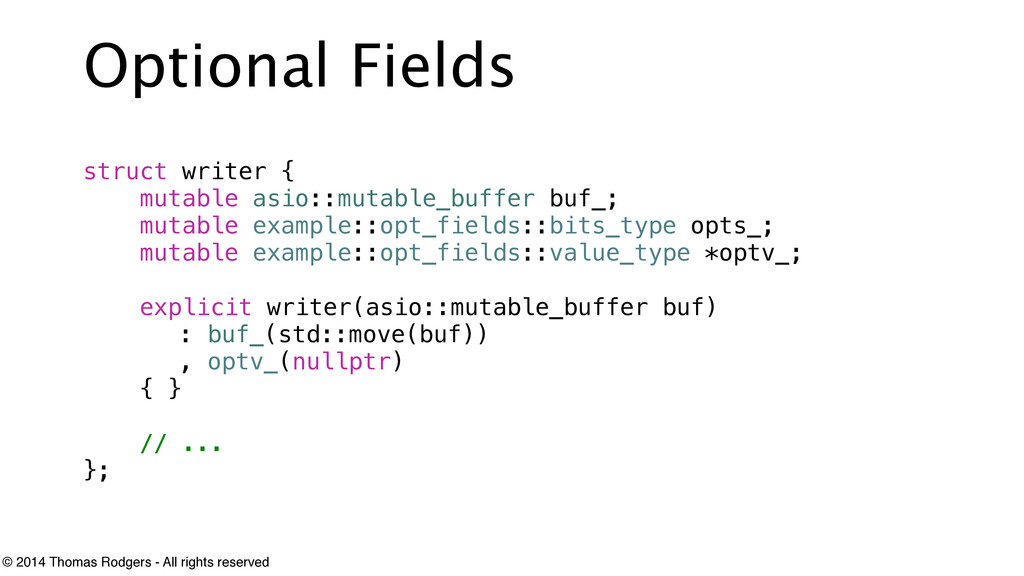
    struct writer { mutable asio::mutable_buffer buf_; mutable example::opt_fields::bits_type opts_; mutable example::opt_fields::value_type *optv_; explicit writer(asio::mutable_buffer buf) : buf_(std::move(buf)) , optv_(nullptr) { } // ... };
  65. © 2014 Thomas Rodgers - All rights reserved Optional Fields

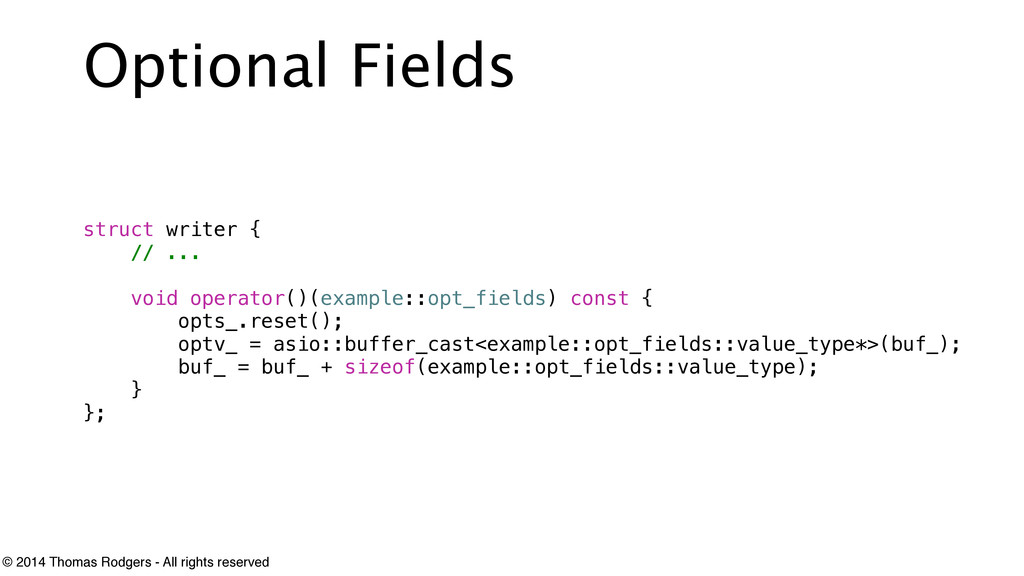
    struct writer { // ... void operator()(example::opt_fields) const { opts_.reset(); optv_ = asio::buffer_cast<example::opt_fields::value_type*>(buf_); buf_ = buf_ + sizeof(example::opt_fields::value_type); } };
  66. © 2014 Thomas Rodgers - All rights reserved Optional Fields

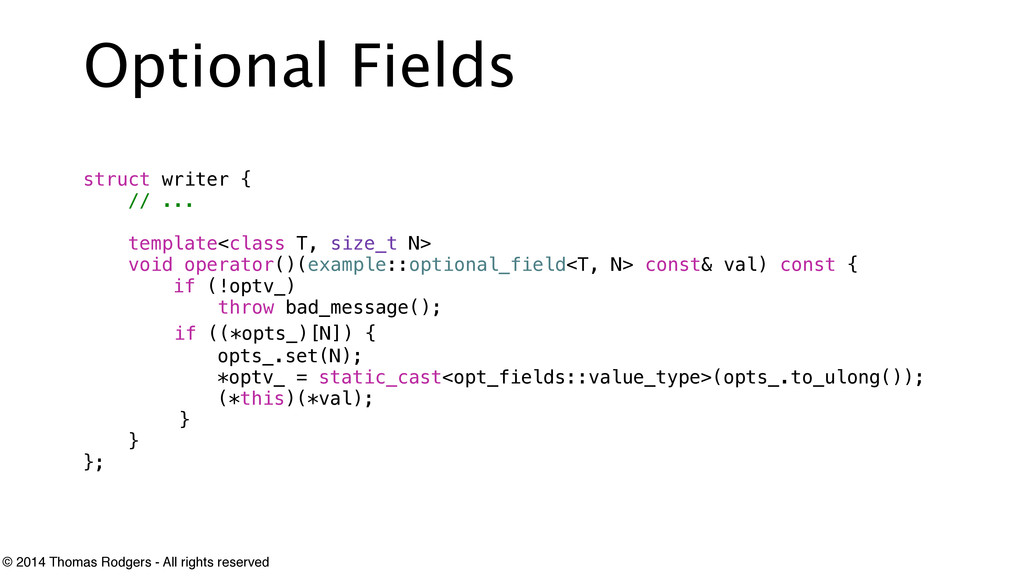
    struct writer { // ... template<class T, size_t N> void operator()(example::optional_field<T, N> const& val) const { if (!optv_) throw bad_message(); if ((*opts_)[N]) { opts_.set(N); *optv_ = static_cast<opt_fields::value_type>(opts_.to_ulong()); (*this)(*val); } } };
  67. © 2014 Thomas Rodgers - All rights reserved Lazy/View Types

    • Protocols may contain fields we may not always care about • strings, maps, vectors all perform allocation, potentially expensive
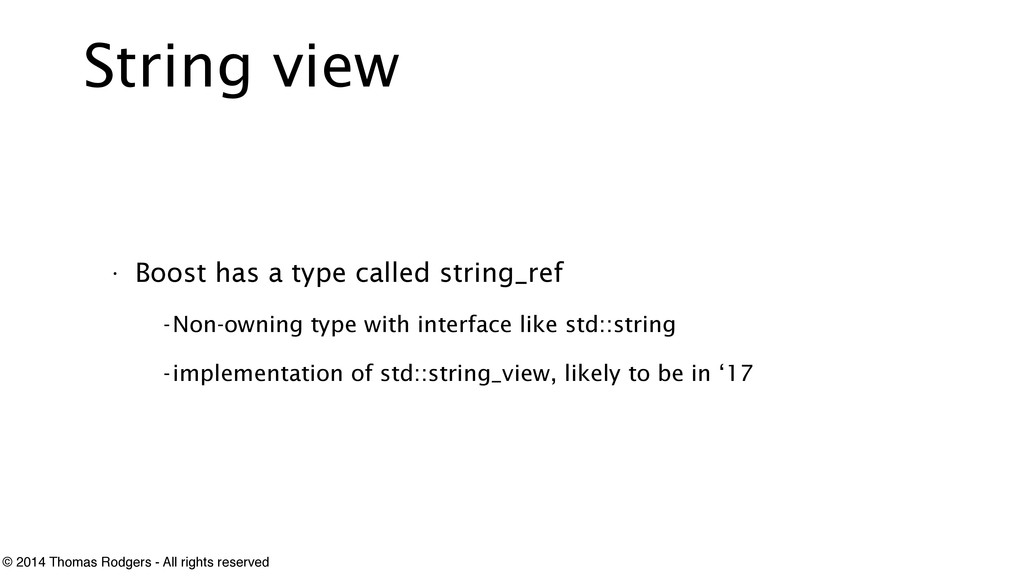
  68. © 2014 Thomas Rodgers - All rights reserved String view

    • Boost has a type called string_ref -Non-owning type with interface like std::string -implementation of std::string_view, likely to be in ‘17
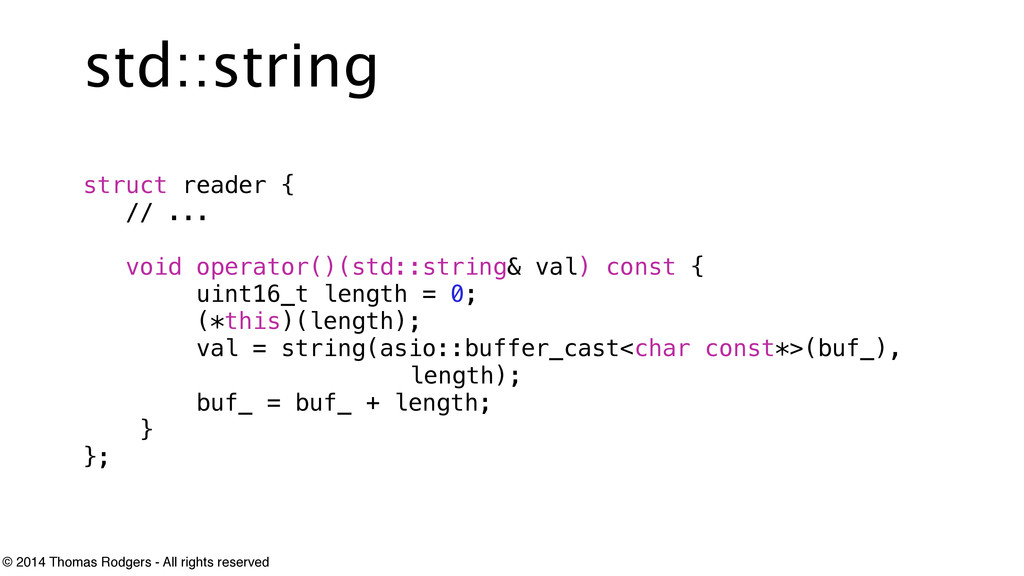
  69. © 2014 Thomas Rodgers - All rights reserved std::string struct

    reader { // ... void operator()(std::string& val) const { uint16_t length = 0; (*this)(length); val = string(asio::buffer_cast<char const*>(buf_), length); buf_ = buf_ + length; } };
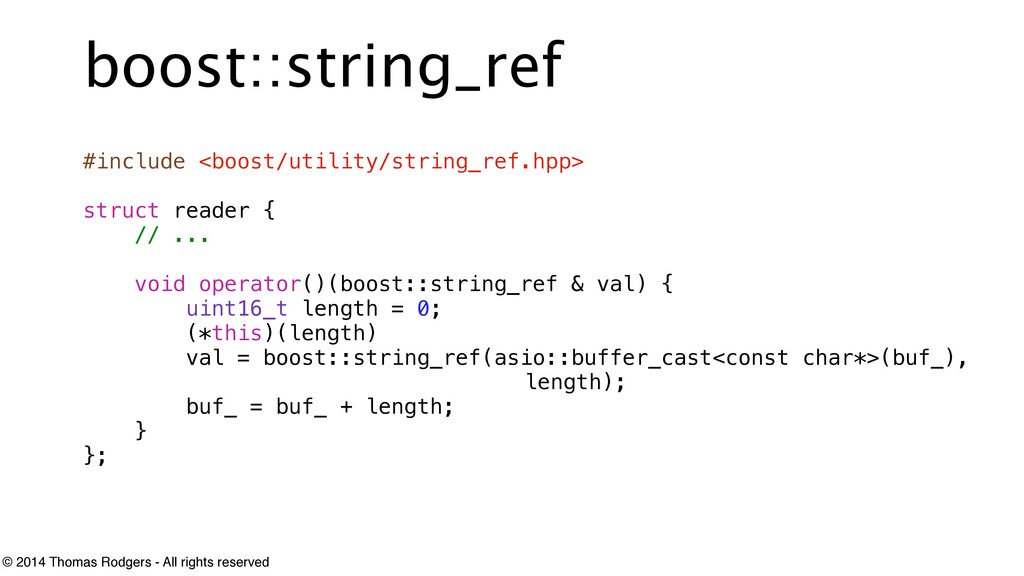
  70. © 2014 Thomas Rodgers - All rights reserved boost::string_ref #include

    <boost/utility/string_ref.hpp> ! struct reader { // ... ! void operator()(boost::string_ref & val) { uint16_t length = 0; (*this)(length) val = boost::string_ref(asio::buffer_cast<const char*>(buf_), length); buf_ = buf_ + length; } };
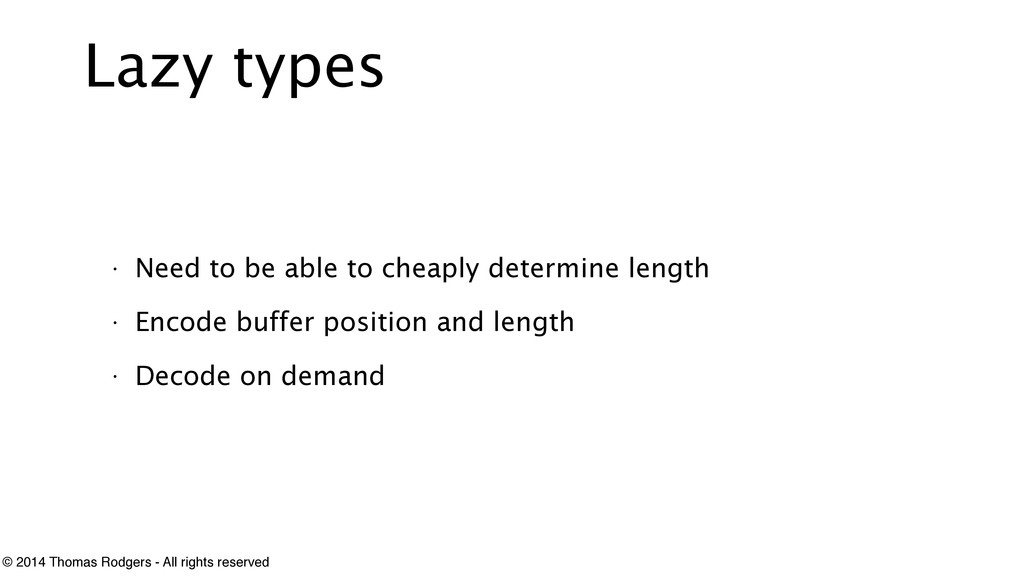
  71. © 2014 Thomas Rodgers - All rights reserved Lazy types

    • Need to be able to cheaply determine length • Encode buffer position and length • Decode on demand
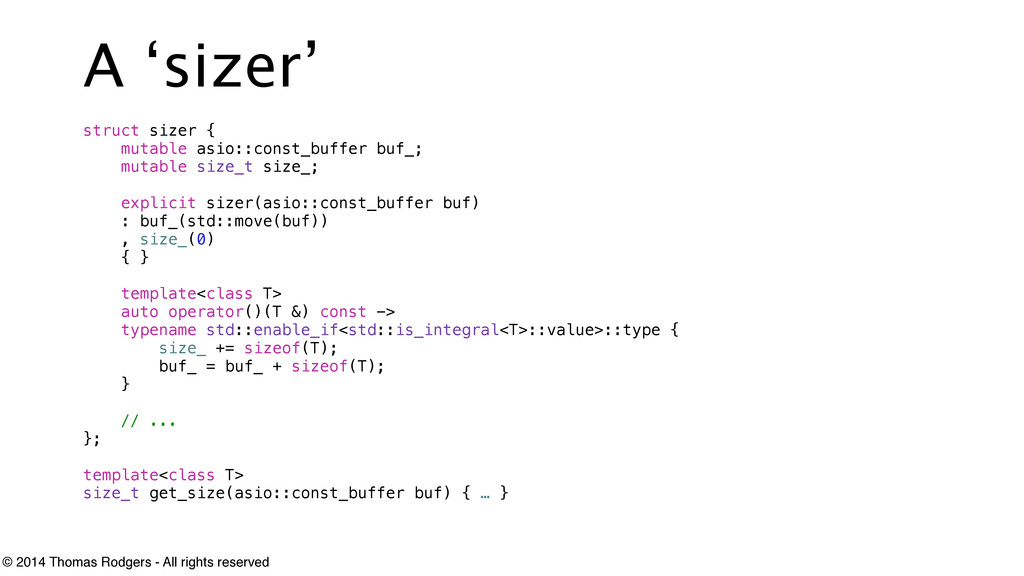
  72. © 2014 Thomas Rodgers - All rights reserved A ‘sizer’

    struct sizer { mutable asio::const_buffer buf_; mutable size_t size_; explicit sizer(asio::const_buffer buf) : buf_(std::move(buf)) , size_(0) { } ! template<class T> auto operator()(T &) const -> typename std::enable_if<std::is_integral<T>::value>::type { size_ += sizeof(T); buf_ = buf_ + sizeof(T); } ! // ... }; ! template<class T> size_t get_size(asio::const_buffer buf) { … }
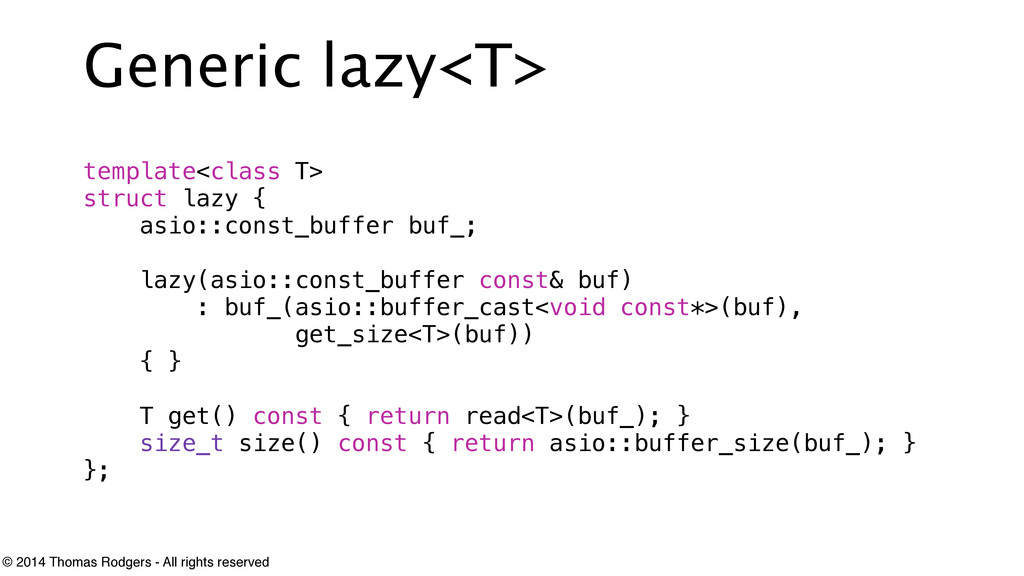
  73. © 2014 Thomas Rodgers - All rights reserved Generic lazy<T>

    template<class T> struct lazy { asio::const_buffer buf_; lazy(asio::const_buffer const& buf) : buf_(asio::buffer_cast<void const*>(buf), get_size<T>(buf)) { } T get() const { return read<T>(buf_); } size_t size() const { return asio::buffer_size(buf_); } };
  74. © 2014 Thomas Rodgers - All rights reserved Generic lazy<T>

    struct reader { // ... ! template<class T> void operator()(lazy<T> & val) const { val = lazy<T>(buf_); buf_ = buf_ + val.size(); } };
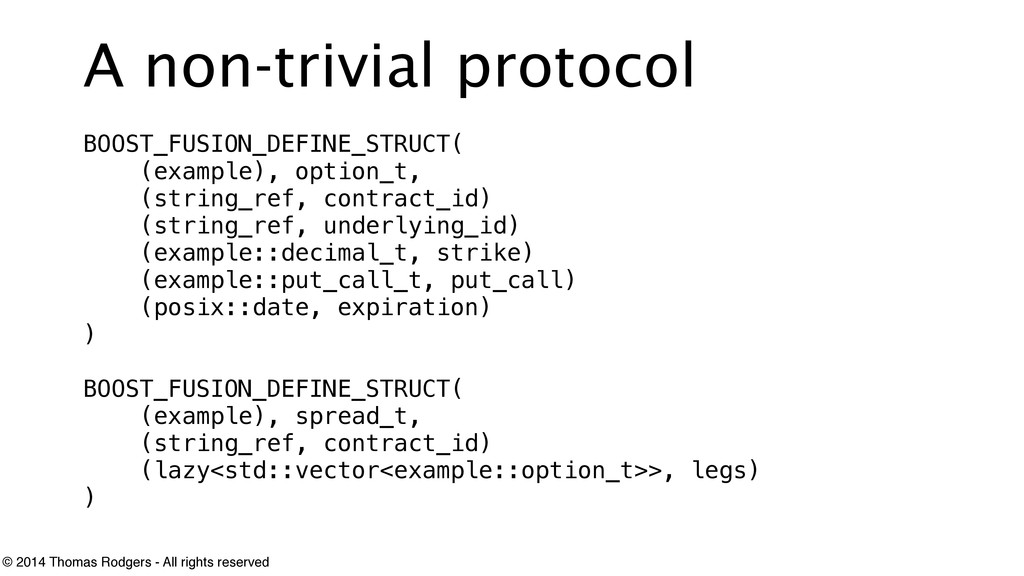
  75. © 2014 Thomas Rodgers - All rights reserved A non-trivial

    protocol BOOST_FUSION_DEFINE_STRUCT( (example), option_t, (string_ref, contract_id) (string_ref, underlying_id) (example::decimal_t, strike) (example::put_call_t, put_call) (posix::date, expiration) ) ! BOOST_FUSION_DEFINE_STRUCT( (example), spread_t, (string_ref, contract_id) (lazy<std::vector<example::option_t>>, legs) )
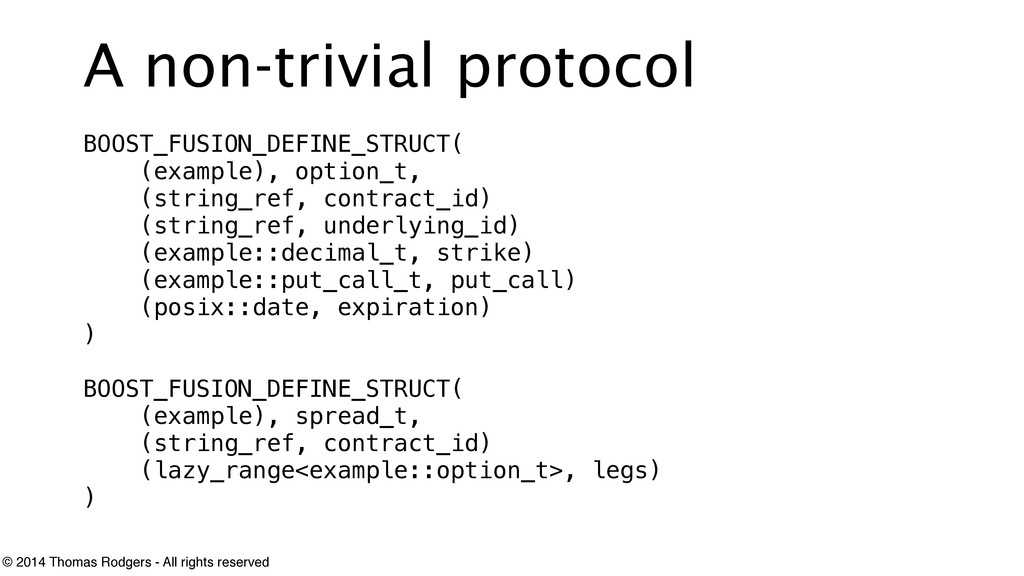
  76. © 2014 Thomas Rodgers - All rights reserved A non-trivial

    protocol BOOST_FUSION_DEFINE_STRUCT( (example), option_t, (string_ref, contract_id) (string_ref, underlying_id) (example::decimal_t, strike) (example::put_call_t, put_call) (posix::date, expiration) ) ! BOOST_FUSION_DEFINE_STRUCT( (example), spread_t, (string_ref, contract_id) (lazy_range<example::option_t>, legs) )
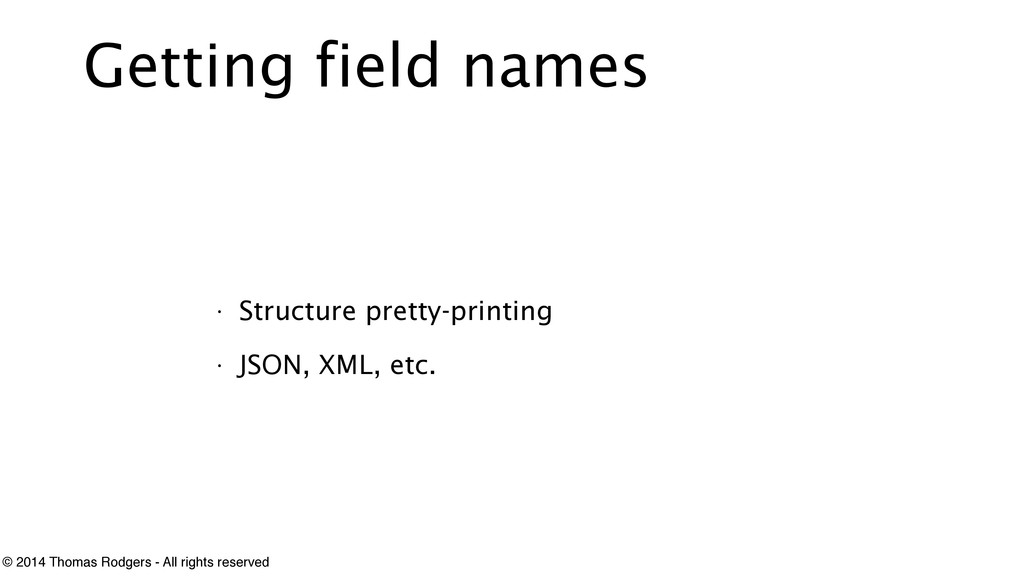
  77. © 2014 Thomas Rodgers - All rights reserved Getting field

    names • Structure pretty-printing • JSON, XML, etc.
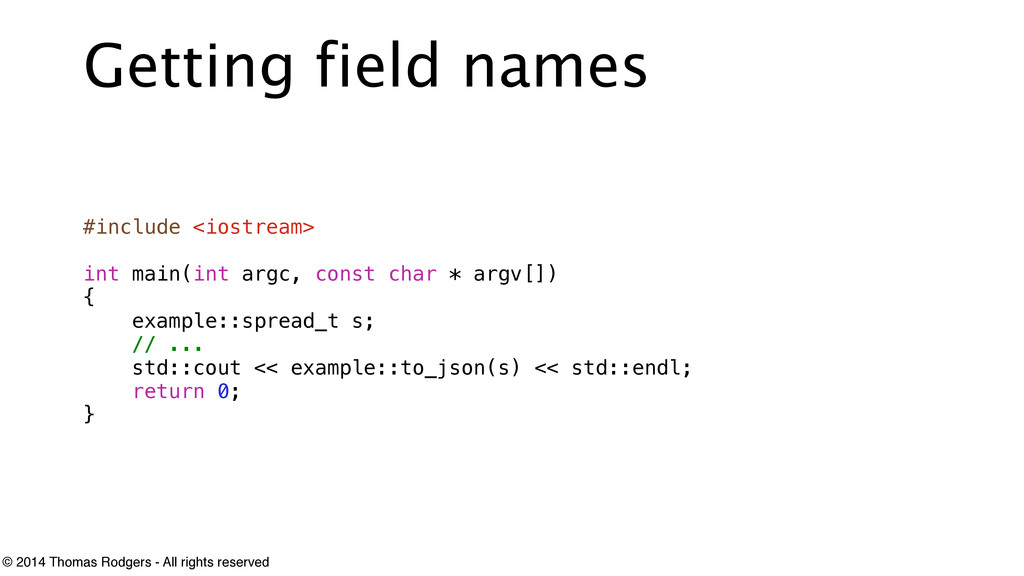
  78. © 2014 Thomas Rodgers - All rights reserved Getting field

    names #include <iostream> ! int main(int argc, const char * argv[]) { example::spread_t s; // ... std::cout << example::to_json(s) << std::endl; return 0; }
  79. © 2014 Thomas Rodgers - All rights reserved Getting field

    names #include <boost/mpl/range_c.hpp> ! template<class T> struct printer { T & msg_; template<class T> using typename range_c = mpl::range_c<int, 0, mpl::size<T>::value>; ! friend std::ostream& operator<<(std::ostream & stm, printer<T> const& v) { mpl::for_each<range_c<T>>(mpl_visitor<T>(v.msg_, stm)); return stm; } }; ! template<class T> printer<T> to_json(T const& v) { return printer<T>(v); }
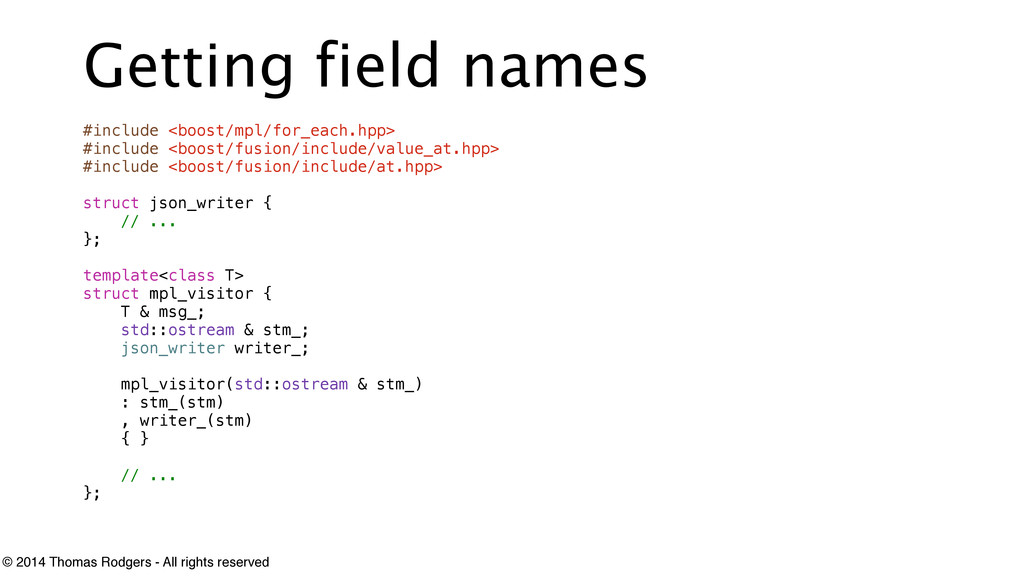
  80. © 2014 Thomas Rodgers - All rights reserved Getting field

    names #include <boost/mpl/for_each.hpp> #include <boost/fusion/include/value_at.hpp> #include <boost/fusion/include/at.hpp> ! struct json_writer { // ... }; ! template<class T> struct mpl_visitor { T & msg_; std::ostream & stm_; json_writer writer_; mpl_visitor(std::ostream & stm_) : stm_(stm) , writer_(stm) { } ! // ... };
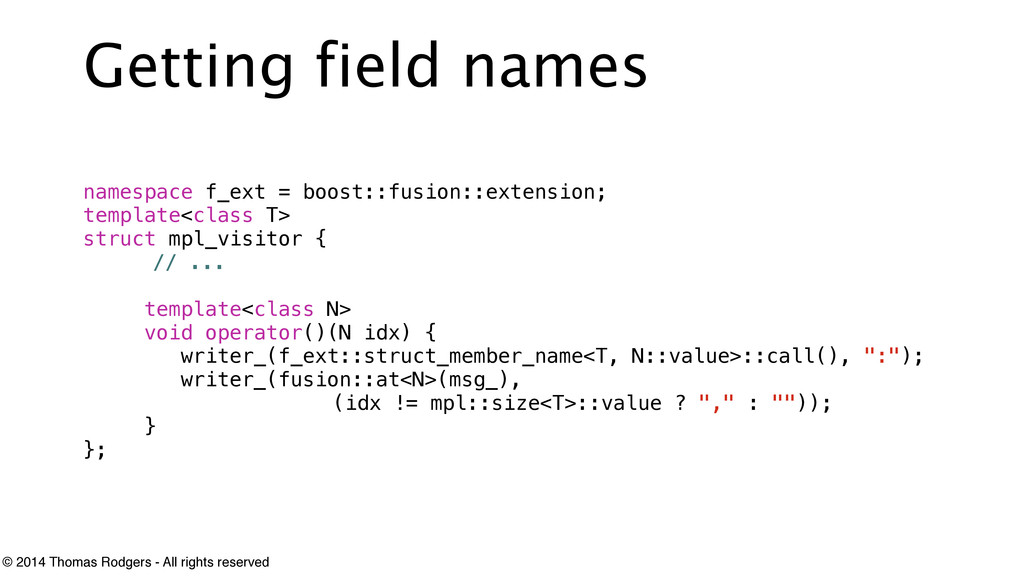
  81. © 2014 Thomas Rodgers - All rights reserved Getting field

    names namespace f_ext = boost::fusion::extension; template<class T> struct mpl_visitor { // ... template<class N> void operator()(N idx) { writer_(f_ext::struct_member_name<T, N::value>::call(), ":"); writer_(fusion::at<N>(msg_), (idx != mpl::size<T>::value ? "," : "")); } };
  82. © 2014 Thomas Rodgers - All rights reserved Questions? Sample

    code available at - https://github.com/rodgert/fusion_samples/ ! Longer form version of this content - http://rodgert.github.io/2014/09/09/type-driven-wire- protocols-with-boost-fusion-pt1/