Upgrade to Pro — share decks privately, control downloads, hide ads and more …

Going Borderless

Going Borderless

An explosion of SaaS based APIs, an increased comfort level with dependencies and market pressures on businesses to focus on their core domains has created an ideal time for a new API strategy: going borderless.

What would your business look like if you treated other people's services as your own?

Avatar for Ronnie Mitra

Ronnie Mitra

July 01, 2020

More Decks by Ronnie Mitra

Other Decks in Technology

Transcript

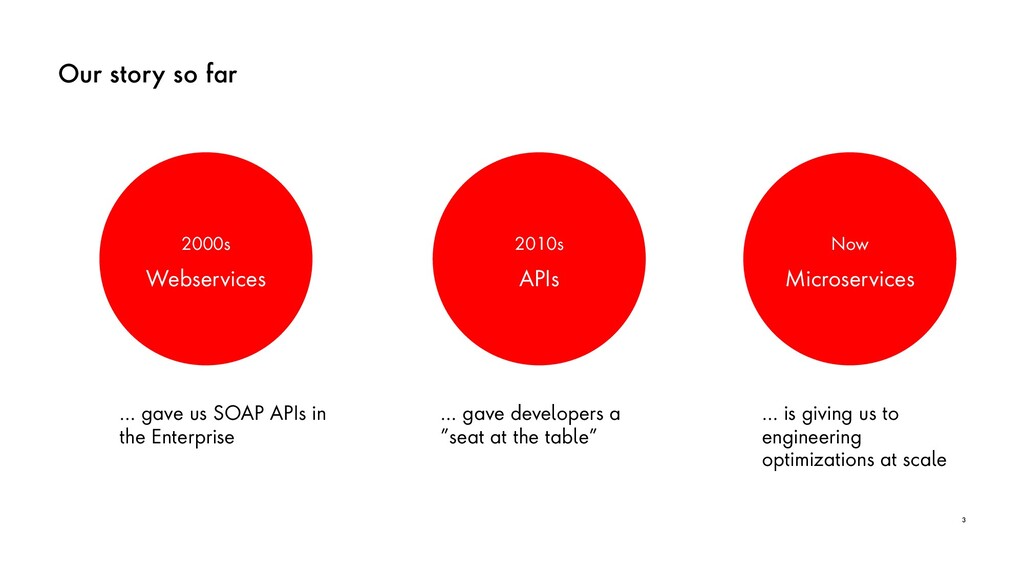
  1. Our story so far 3 … gave us SOAP APIs

    in the Enterprise 2000s Webservices 2010s APIs Now Microservices … gave developers a ”seat at the table” … is giving us to engineering optimizations at scale
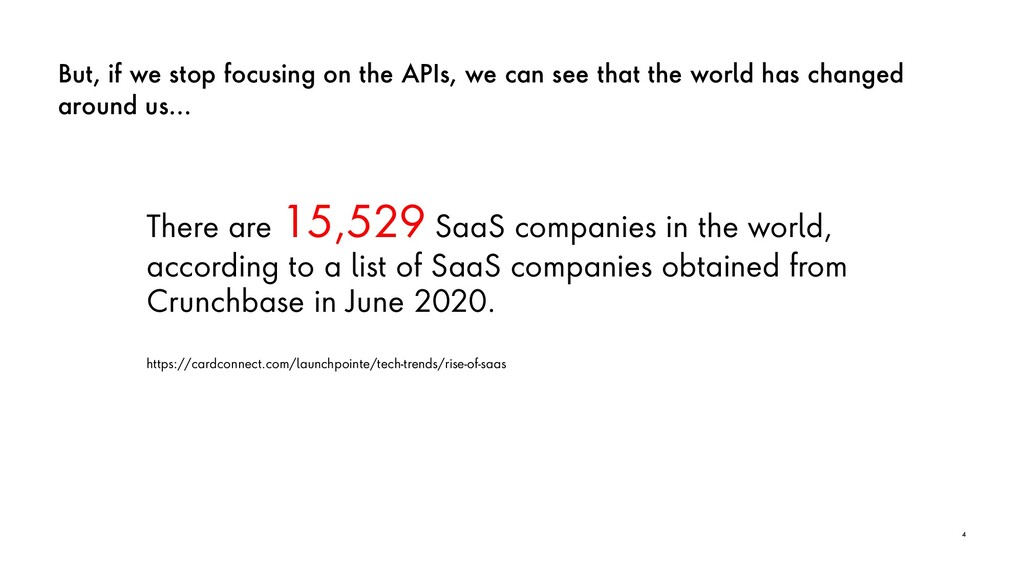
  2. But, if we stop focusing on the APIs, we can

    see that the world has changed around us… 4 https://cardconnect.com/launchpointe/tech-trends/rise-of-saas There are 15,529 SaaS companies in the world, according to a list of SaaS companies obtained from Crunchbase in June 2020.
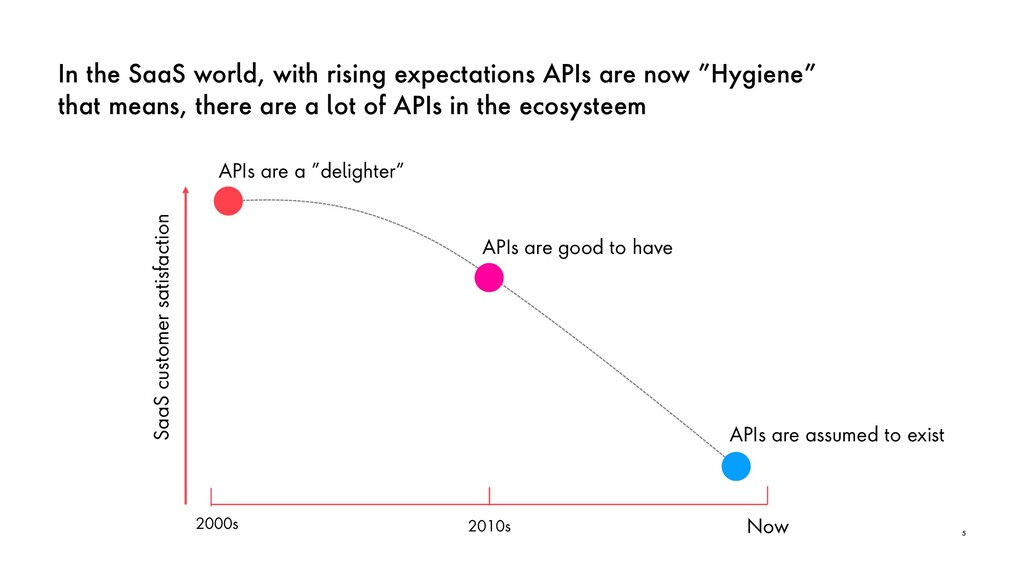
  3. 5 In the SaaS world, with rising expectations APIs are

    now ”Hygiene” that means, there are a lot of APIs in the ecosysteem Now 2000s 2010s SaaS customer satisfaction APIs are a ”delighter” APIs are good to have APIs are assumed to exist
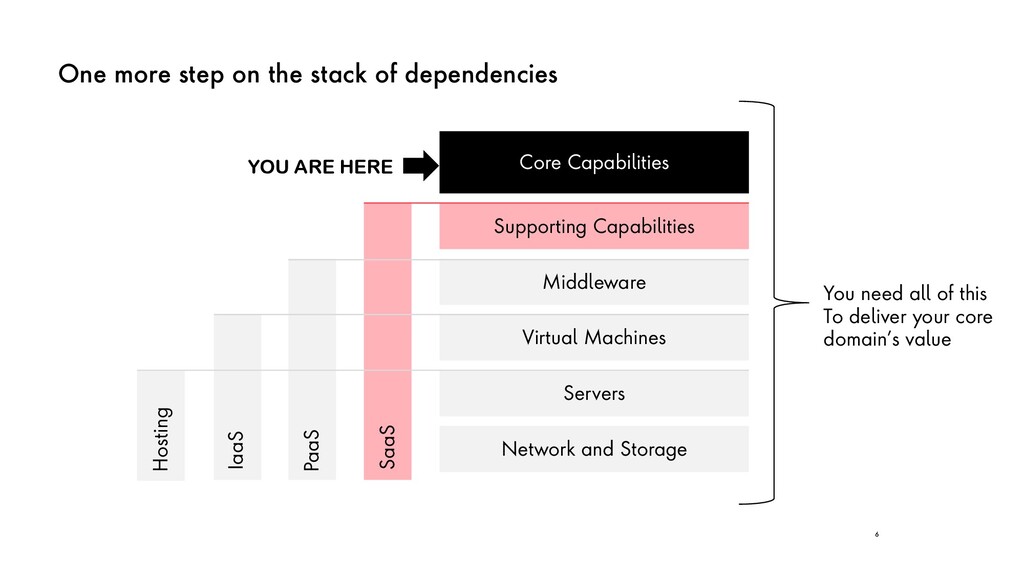
  4. One more step on the stack of dependencies 6 Network

    and Storage Servers Supporting Capabilities Core Capabilities Virtual Machines Middleware Hosting IaaS PaaS SaaS YOU ARE HERE You need all of this To deliver your core domain’s value
  5. It’s the right time to think borderless 7 what would

    your business look like if you always used other people’s services?
  6. consumption is the new competitive advantage for API strategy embrace

    a borderless mindset to become a better consumer. 8
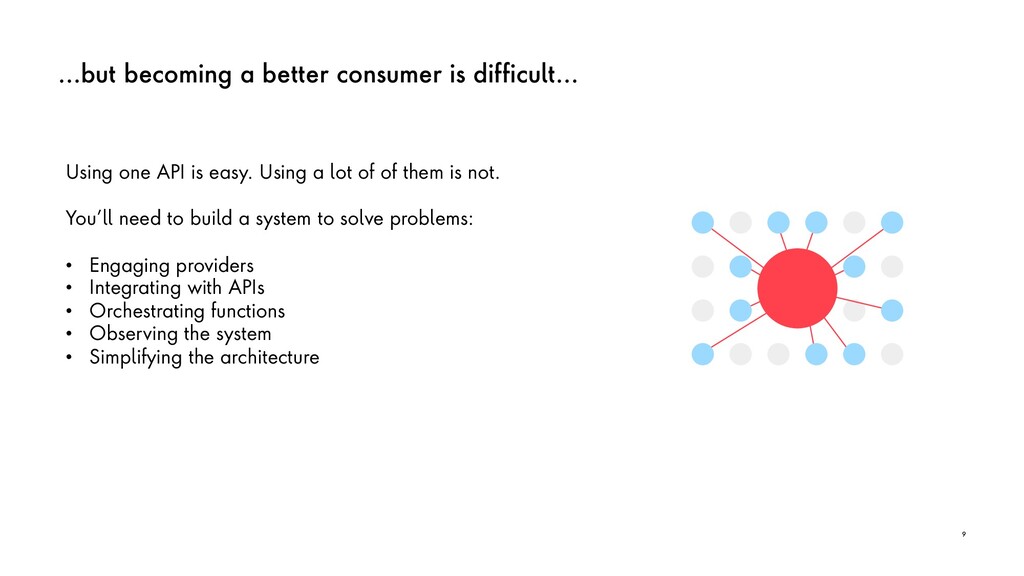
  7. …but becoming a better consumer is difficult… 9 Using one

    API is easy. Using a lot of of them is not. You’ll need to build a system to solve problems: • Engaging providers • Integrating with APIs • Orchestrating functions • Observing the system • Simplifying the architecture
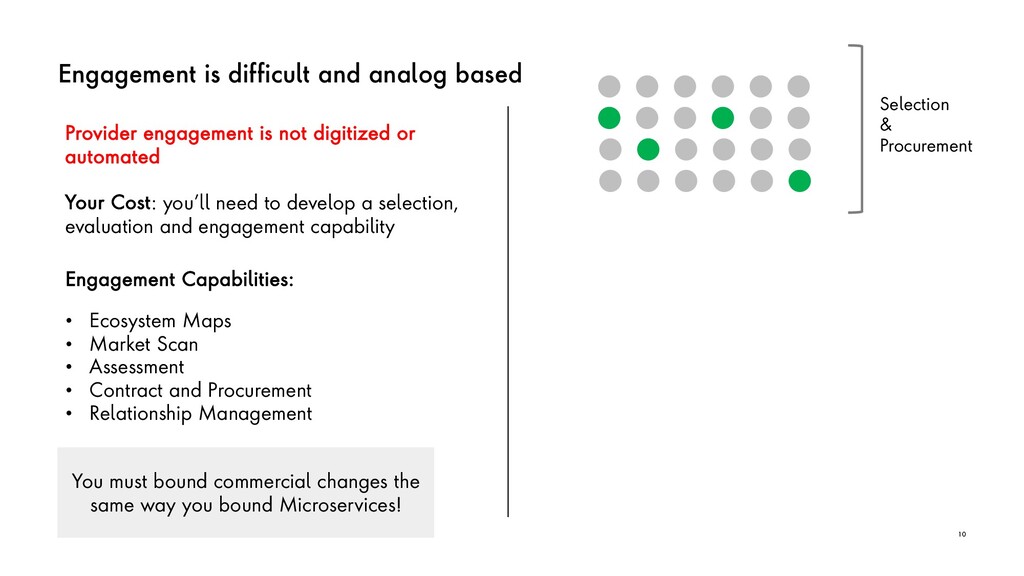
  8. Engagement is difficult and analog based 10 Selection & Procurement

    Provider engagement is not digitized or automated Your Cost: you’ll need to develop a selection, evaluation and engagement capability • Ecosystem Maps • Market Scan • Assessment • Contract and Procurement • Relationship Management Engagement Capabilities: You must bound commercial changes the same way you bound Microservices!
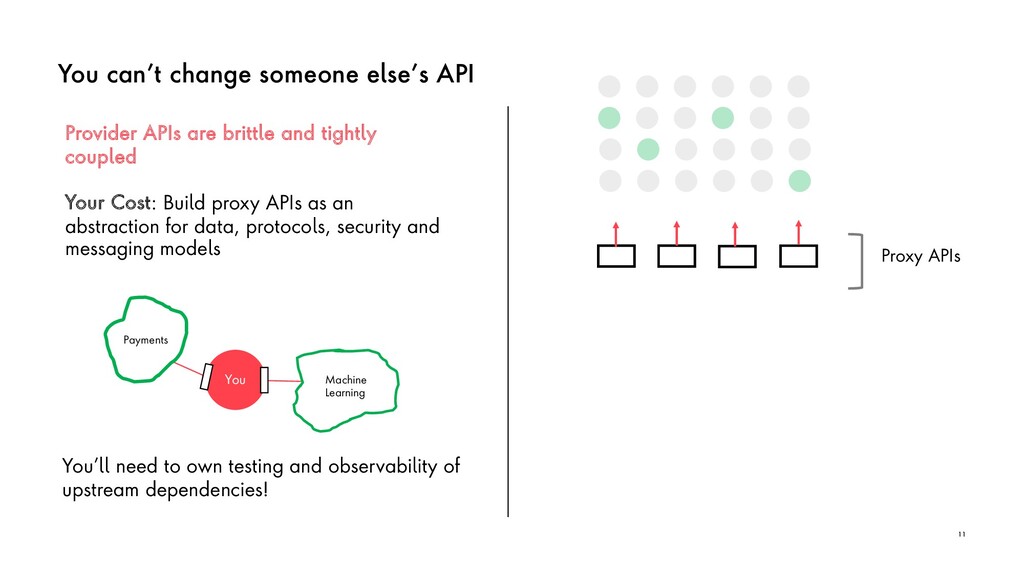
  9. You can’t change someone else’s API 11 Proxy APIs Provider

    APIs are brittle and tightly coupled Your Cost: Build proxy APIs as an abstraction for data, protocols, security and messaging models Payments Machine Learning You You’ll need to own testing and observability of upstream dependencies!
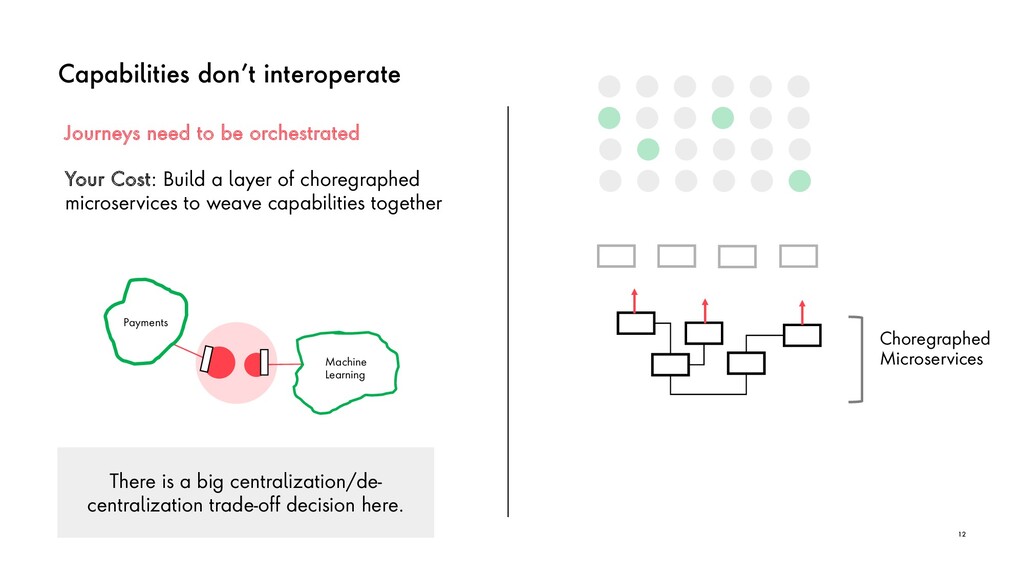
  10. Capabilities don’t interoperate 12 Choregraphed Microservices Journeys need to be

    orchestrated Your Cost: Build a layer of choregraphed microservices to weave capabilities together There is a big centralization/de- centralization trade-off decision here. Payments Machine Learning
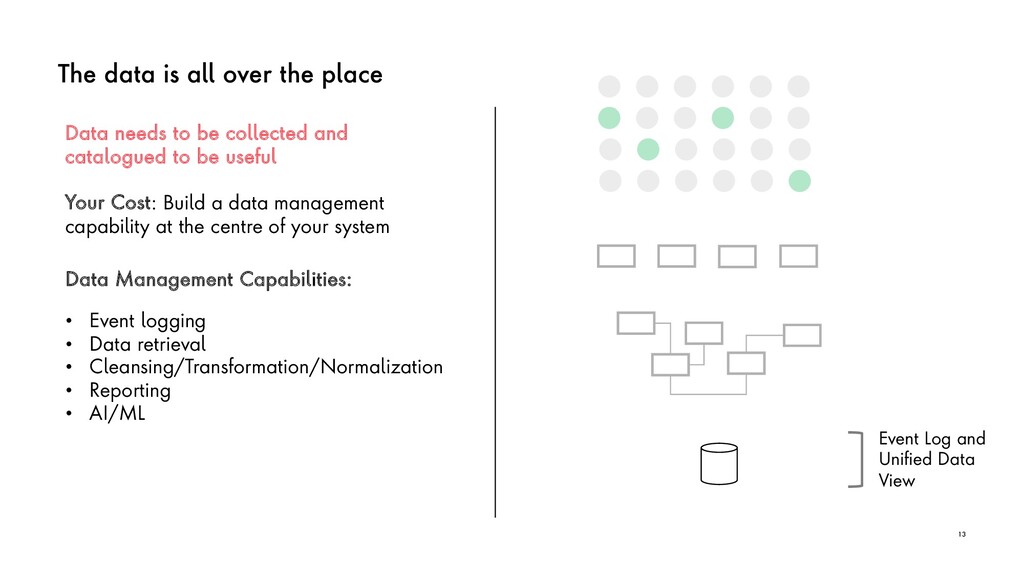
  11. The data is all over the place 13 Event Log

    and Unified Data View Data needs to be collected and catalogued to be useful Your Cost: Build a data management capability at the centre of your system • Event logging • Data retrieval • Cleansing/Transformation/Normalization • Reporting • AI/ML Data Management Capabilities:
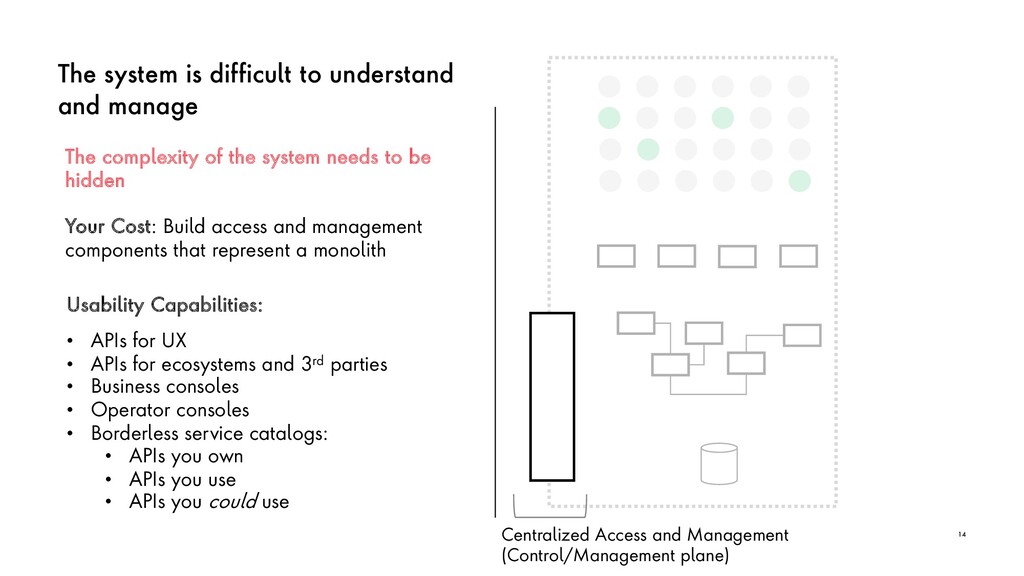
  12. The system is difficult to understand and manage 14 Centralized

    Access and Management (Control/Management plane) The complexity of the system needs to be hidden Your Cost: Build access and management components that represent a monolith • APIs for UX • APIs for ecosystems and 3 rd parties • Business consoles • Operator consoles • Borderless service catalogs: • APIs you own • APIs you use • APIs you could use Usability Capabilities:
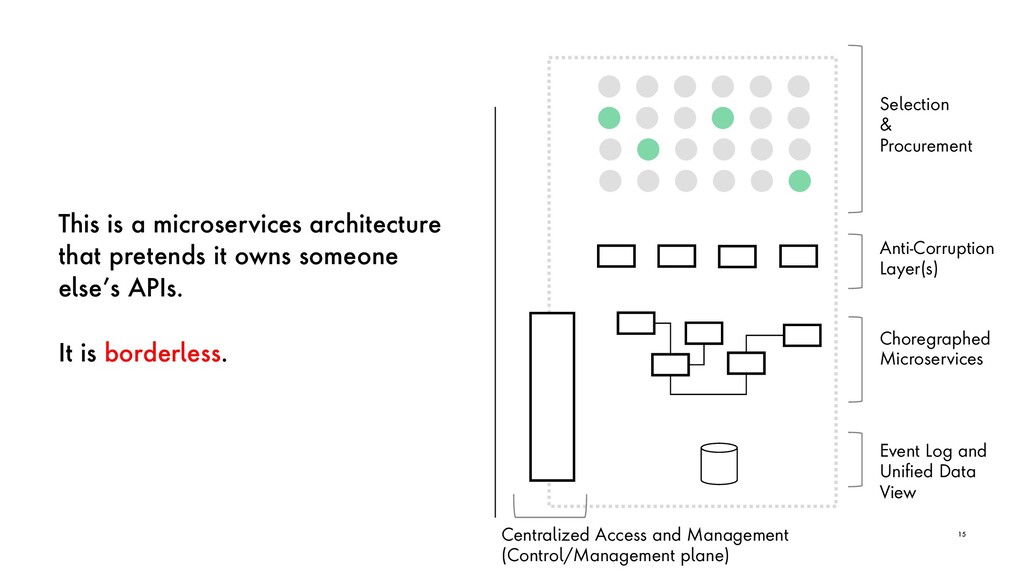
  13. This is a microservices architecture that pretends it owns someone

    else’s APIs. It is borderless. 15 Selection & Procurement Choregraphed Microservices Anti-Corruption Layer(s) Event Log and Unified Data View Centralized Access and Management (Control/Management plane)