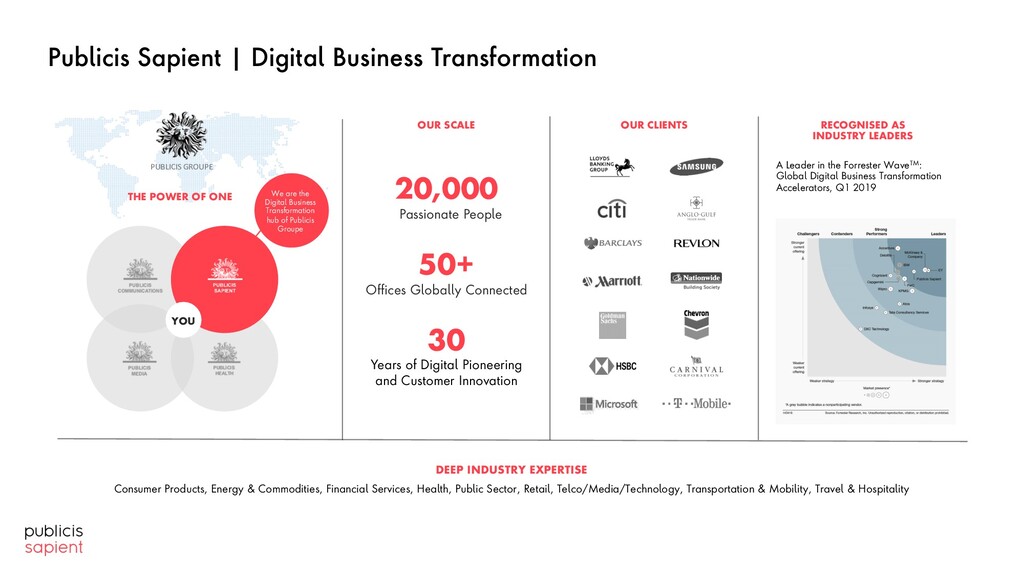
Offices Globally Connected 30 Years of Digital Pioneering and Customer Innovation YOU We are the Digital Business Transformation hub of Publicis Groupe THE POWER OF ONE RECOGNISED AS INDUSTRY LEADERS DEEP INDUSTRY EXPERTISE Consumer Products, Energy & Commodities, Financial Services, Health, Public Sector, Retail, Telco/Media/Technology, Transportation & Mobility, Travel & Hospitality A Leader in the Forrester WaveTM: Global Digital Business Transformation Accelerators, Q1 2019 Publicis Sapient | Digital Business Transformation
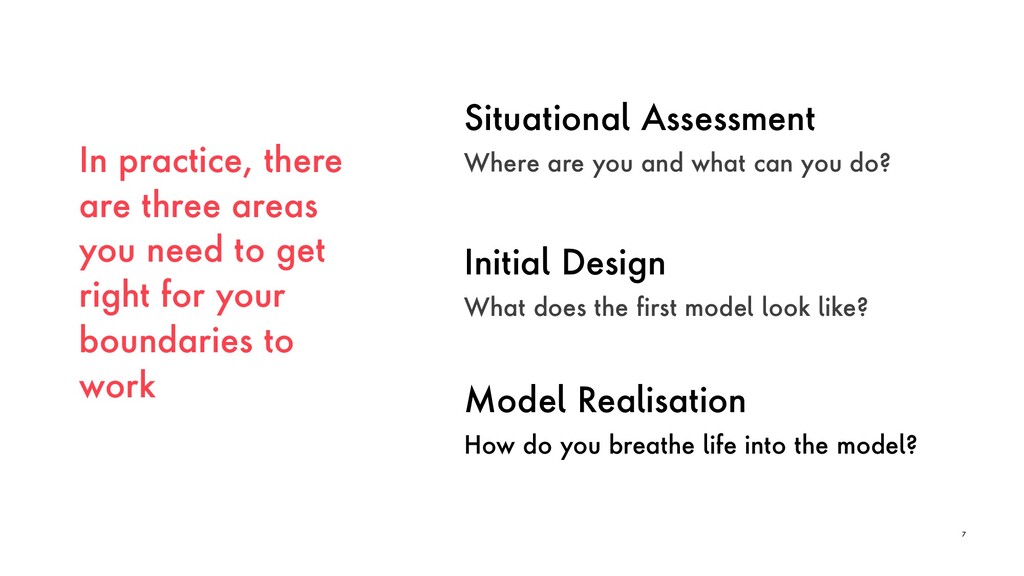
right for your boundaries to work 7 Situational Assessment Where are you and what can you do? Initial Design What does the first model look like? Model Realisation How do you breathe life into the model?
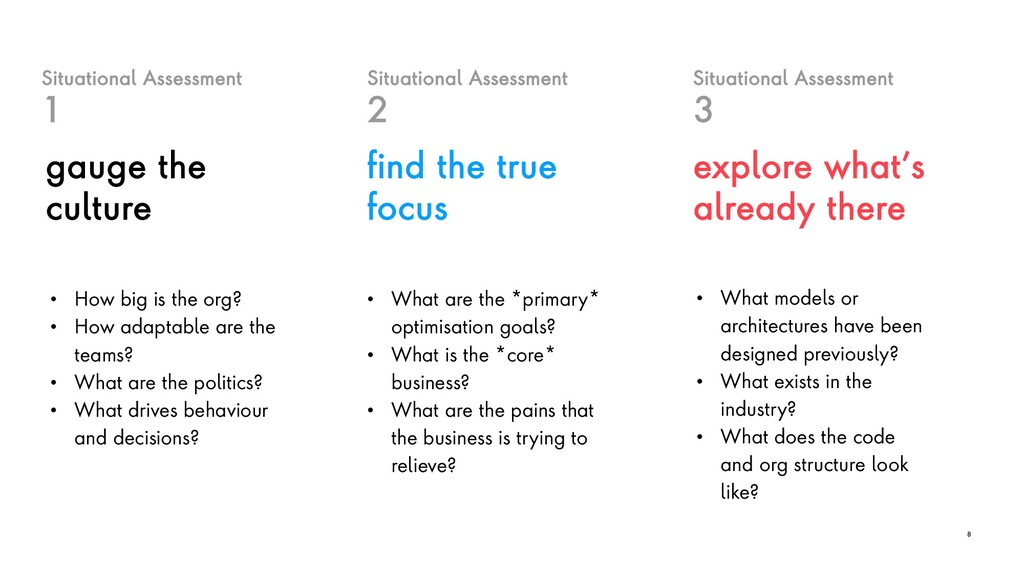
gauge the culture find the true focus explore what’s already there • How big is the org? • How adaptable are the teams? • What are the politics? • What drives behaviour and decisions? • What are the *primary* optimisation goals? • What is the *core* business? • What are the pains that the business is trying to relieve? • What models or architectures have been designed previously? • What exists in the industry? • What does the code and org structure look like?
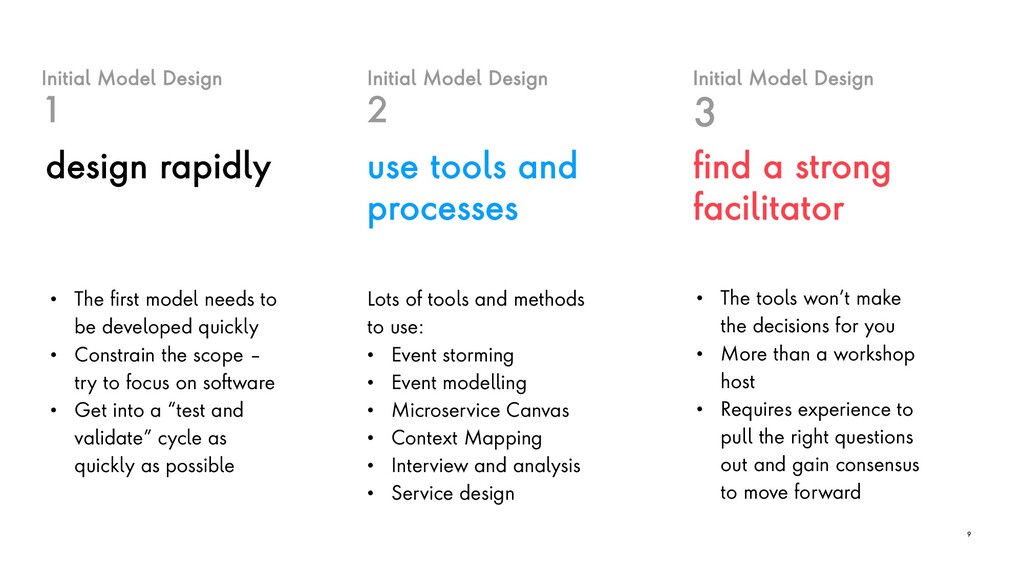
Design 3 9 design rapidly use tools and processes find a strong facilitator • The first model needs to be developed quickly • Constrain the scope – try to focus on software • Get into a “test and validate” cycle as quickly as possible Lots of tools and methods to use: • Event storming • Event modelling • Microservice Canvas • Context Mapping • Interview and analysis • Service design • The tools won’t make the decisions for you • More than a workshop host • Requires experience to pull the right questions out and gain consensus to move forward
Details Get eligible proeducts Create account (gen. iban, sort code, etc) Update Mortgage Details Send welcome pack Link an account with customer record ID&V Check ID Document submission Verify Evidence (manual) Ongoing KYC trigger check Evidence required check Update KYC check criteria Search for Customer Capture Customer Info Bereau Check (customer exists at address) Create prospect customer Customer KYC status Update Customer Prospect Status Activate customer Update address Update name Communicate with customer Link an account with customer record Update Payment Details Issue Card Issue Checkbook Request card Request chequebook Sanctions check triggered Sanctions checked Sanctions assertions validated Sanctions alerts raised Sanctions check completed Authentication process selected Payment Fraud risk detected Step-up auth need determined Fraud decision made call recording stopped call recording started Call recorded safely Verify customer (login) omnichannel Create Credentials Domain design can require intensive collaboration. This is difficult to achieve remotely. Tips: 1. Use collaboration tools if you can (e.g. Mural, Miro, etc) 2. Supplement collaborative sessions with ”pre- work”: interviews in smaller groups, analysis, homework 3. Plan for this work to take longer and put in the effort to be transparent and inclusive.
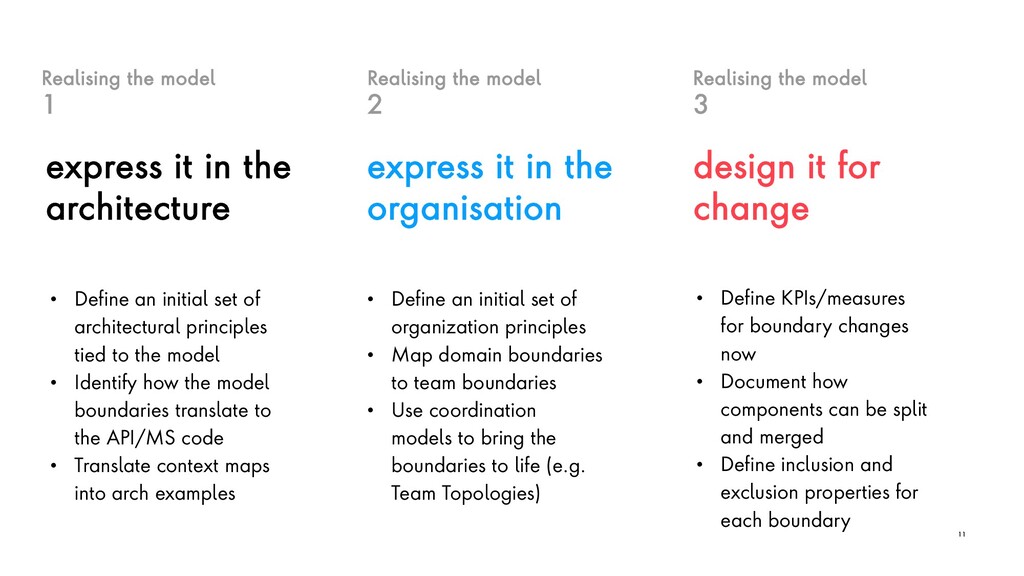
model 3 11 express it in the architecture express it in the organisation design it for change • Define an initial set of architectural principles tied to the model • Identify how the model boundaries translate to the API/MS code • Translate context maps into arch examples • Define an initial set of organization principles • Map domain boundaries to team boundaries • Use coordination models to bring the boundaries to life (e.g. Team Topologies) • Define KPIs/measures for boundary changes now • Document how components can be split and merged • Define inclusion and exclusion properties for each boundary
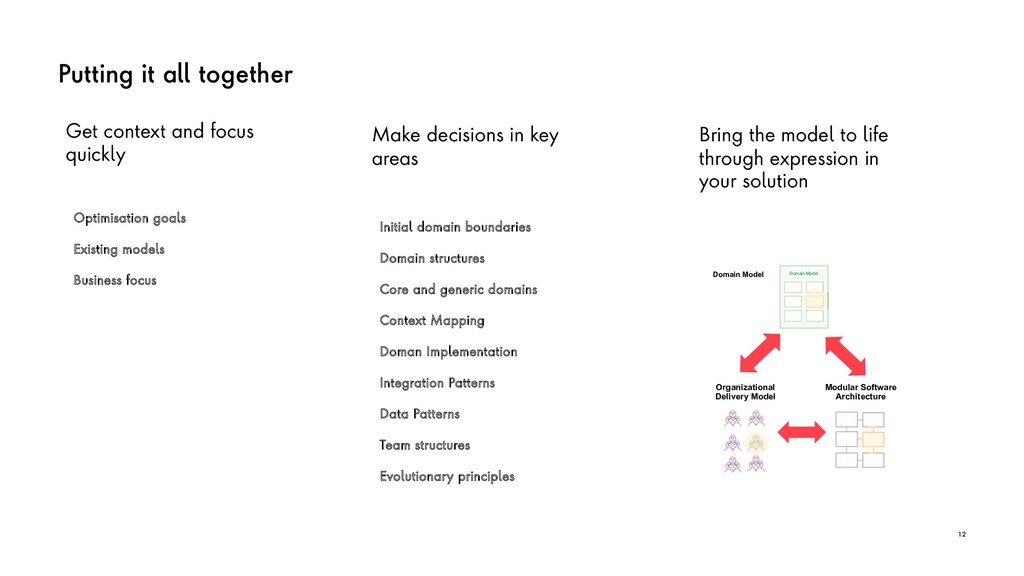
Make decisions in key areas Initial domain boundaries Domain structures Core and generic domains Context Mapping Doman Implementation Integration Patterns Data Patterns Team structures Evolutionary principles Domain Model Organizational Delivery Model Modular Software Architecture Domain Model Bring the model to life through expression in your solution Optimisation goals Existing models Business focus

 SiteGround - Reliable hosting with speed, security, and support you can count on.


 ronniemitra
 makocchi
 4o1sobblue
 genda
genda
 greenmidori
 mhrtech
 tomokusaba
 techtekt
 carta_engineering
 kzkhykw1991
 bitkey
 onk
onk
 pfn
pfn
 aleyda
 marktimemedia
 michielstock
 bkeepers
 badams
 takai
takai
 sstephenson
 tmiket
 chikuwait
 rasmusluckow
![Ronnie Mitra 2 Consultant and author @mitraman [email protected]](https://files.speakerdeck.com/presentations/39901f97dd664fb59aa8fb2f840fec7f/slide_1.jpg)


![13 Drawing the right lines Ronnie Mitra https://www.linkedin.com/in/ronniemitra/ @mitraman [email protected]](https://files.speakerdeck.com/presentations/39901f97dd664fb59aa8fb2f840fec7f/slide_12.jpg)