Upgrade to Pro — share decks privately, control downloads, hide ads and more …

Building a strong corporate culture while worki...

Building a strong corporate culture while working remotely using a social learning platform

In this document you can get an experts’ guide and checklist to how to build a strong corporate culture.

Read more about CanopyLab and Sahra-Josephine Hjorth

Avatar for Sahra-Josephine Hjorth

Sahra-Josephine Hjorth

March 30, 2022
Tweet

Other Decks in Education

Transcript

  1. Building a strong corporate culture while working remotely using a

    social learning platform An Experts’ Guide + Checklist
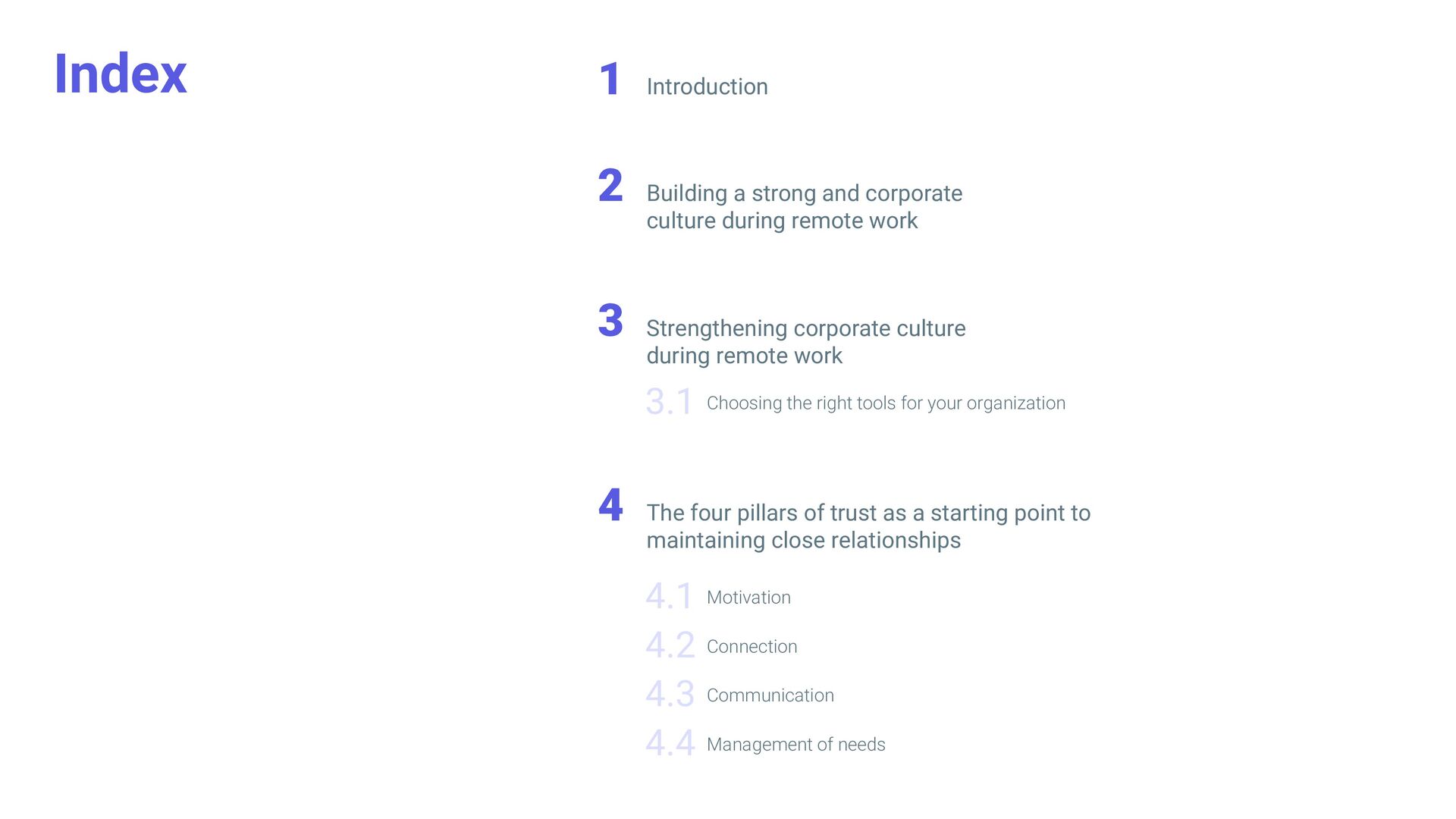
  2. Index Introduction 1 Building a strong and corporate culture during

    remote work 2 The four pillars of trust as a starting point to maintaining close relationships 4 Motivation 4.1 Communication 4.3 Connection 4.2 Management of needs 4.4 Strengthening corporate culture during remote work 3 Choosing the right tools for your organization 3.1
  3. 1 Introduction After months of uncertainty on the labor market

    due to the COVID-19 pandemic, thousands of companies around the world have moved part, or all of their operations to remote work. According to the “The State of Remote Work in Latin America 2020” study by Rankmi, more than 74% of companies in Latin America were not prepared for this unexpected change, and months after the first wave hit Latin America, the playbook aimed at optimizing remote work efficiency still needs to be improved upon. According to a new global research report conducted by computer- manufacturer LENOVO, reliance on remote work increases companies’ needs to acquire modern and customizable IT solutions and implement it at scale. Providing employees with IT infrastructure, security, increasing work flexibility, and continued training is essential to continue to perform at a high productivity level, while getting used to the “new normal” of working remotely. Larry Fink, CEO of BlackRock recently expressed a genuine concern that remote work results in decreasing productivity, less collaboration and that it erodes corporate culture. Echoing his point, JPMorgan CEO Jamie Dimon said that he sees prolonged remote work inflicting serious social and economic damage. At CanopyLAB, we believe that social learning and collaboration is crucial for maintaining trust and developing in a positive corporate culture. As such, making sure that employees have a strong connection to their colleagues and the company’ values, mission and ethos has become one of the biggest challenges during remote work. If you have moved in-person activities online we encourage you to take on the challenge of implementing social learning with the help of this guidebook that we have developed with experts in Human Resources Management, focusing on both small. medium and large multinational companies. This guide includes a checklist to support the teams who work remotely. After reading this, you will be able to: • Formulate a strategy for working remotely and promoting a sense of community from afar. • Identify the four pillars of positive corporate culture and take actions on strengthening them within your organization. • Understand how social learning platforms can be used to enhance communication, team culture and identity-building among employees.
  4. 2 Strengthening corporate culture during remote work Strong corporate cultures

    are usually linked to higher rates of productivity, higher job satisfaction and higher employee loyalty. A strong corporate culture is characterized by high employee morale, collaboration among team members and constant communication. Due to these clear benefits, most organizations were taking steps towards strengthening their corporate culture prior to the pandemic, but experienced a complete halt in their efforts when they had to shift to remote work overnight. The reason for this is simple: although the principles of a strong corporate culture are the same for remote and in-person work, the tools and strategies necessary to achieve it in each context are different. This is particularly important to bear in mind now that many employees are experiencing feelings of disillusionment, grief, anxiety, and isolation. So what can we do as managers to help foster team morale and productivity amidst a pandemic? Walt Disney famously said “The way to get started is to quit talking and begin doing.” Working remotely requires a lot of changes within the workplace such as: • New communication strategies. • Different ways of collaborating remotely. • New ways of creating connections that strengthen the organizational culture of the companies to avoid the loss of identity of the team, to maintain trust, and promote a sense of community from afar. Today, 80% of companies surveyed by Pwc Peru tackled the pandemic by only focusing their efforts on determining what employees that hold positions that require them to still come to work in-person and which employees who can work remotely. A study conducted by Digital Hub Denmark found that 89% of blue collar workers got no support from their employer in how to transition to remote work, rather they were expected to figure out how to use Zoom, Teams, Mentimeter, Dropbox etc. entirely on their own.
  5. 3 Choosing the right tools for your organization An important

    consideration throughout this process is to find tools that support and facilitate your efforts to strengthen your corporate culture during remote work. At a time of considerable change and adaptation, having to incorporate numerous softwares, apps and platforms for day-to-day operations can exacerbate feelings of stress and confusion in your team. A solution to this challenge is implementing an intuitive Social Learning Platform or Learning Management System (LMS) in your company. eLearning platforms have long been used by companies to onboard, train and upskill employees. However, Social Learning While critically reflecting on who can work from home and who is needed in person is an important first step, it should not be the only one companies take. In fact, the aforementioned Pwc study showed that the importance of promoting organizational culture was only highlighted in 54% of services companies. Platforms in particular have gained prominence during the pandemic as solutions to the challenges that remote work has posed for community building, knowledge sharing and communication. Social Learning Platforms enable one of humans’ greatest needs: socialization. The ability to socialize, collaborate, and exchange knowledge is an important source of learning in the workplace and these platforms can facilitate it. In this way, Social Learning Platforms can strengthen corporate culture, as they transfer the environment, activities and members of day-to-day interactions to a virtual environment. A Social Learning Platform like CanopyLAB’s allows employees to collaborate, communicate with each other and develop their autonomy skills. Additionally, it enables HR teams to keep track of employees’ wellbeing and equip them with the necessary skills to succeed in remote work.
  6. 4 4 pillars to develop and maintain a strong corporate

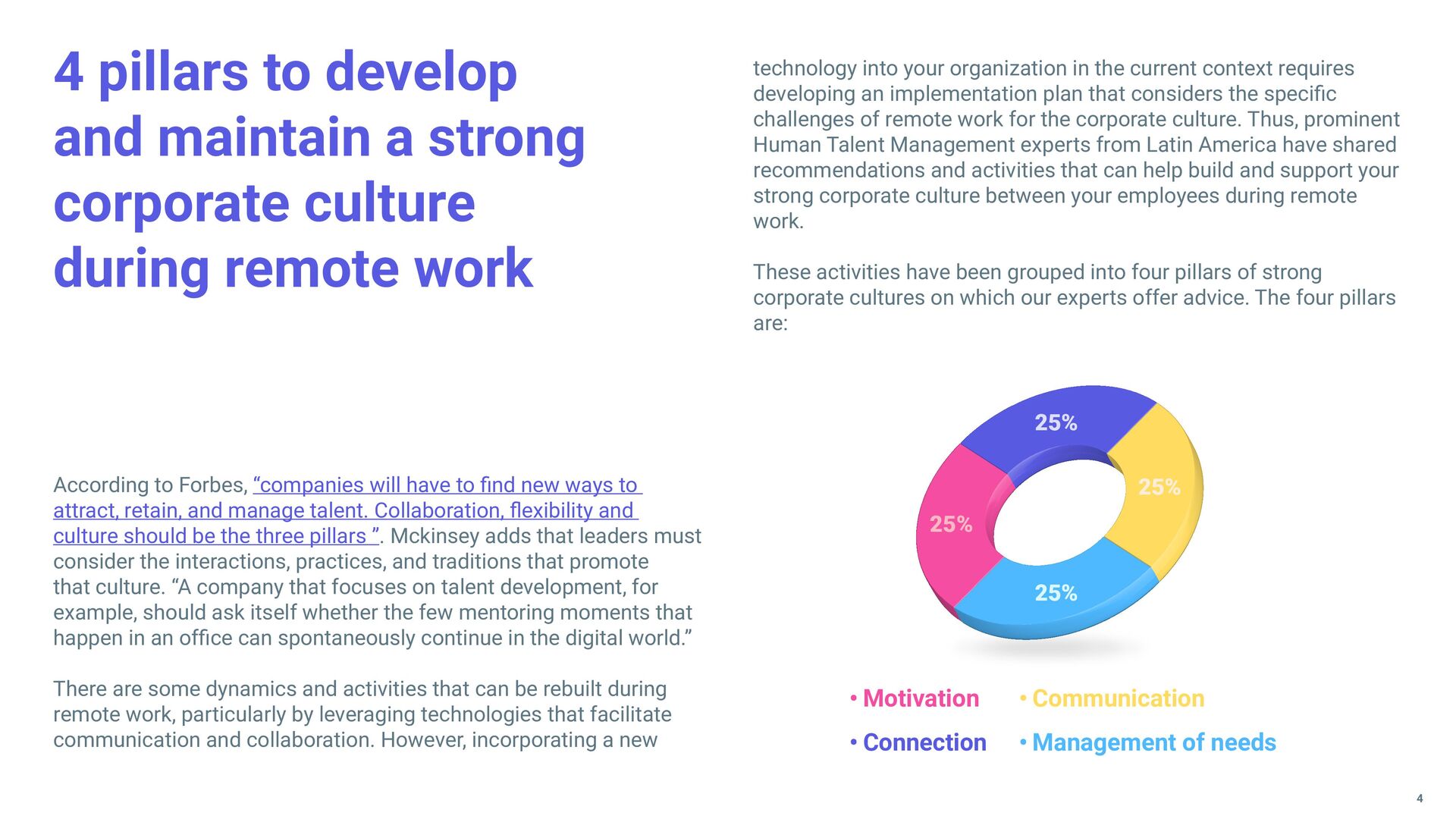
    culture during remote work According to Forbes, “companies will have to find new ways to attract, retain, and manage talent. Collaboration, flexibility and culture should be the three pillars ”. Mckinsey adds that leaders must consider the interactions, practices, and traditions that promote that culture. “A company that focuses on talent development, for example, should ask itself whether the few mentoring moments that happen in an office can spontaneously continue in the digital world.” There are some dynamics and activities that can be rebuilt during remote work, particularly by leveraging technologies that facilitate communication and collaboration. However, incorporating a new • Motivation • Connection • Communication • Management of needs 25% 25% 25% 25% technology into your organization in the current context requires developing an implementation plan that considers the specific challenges of remote work for the corporate culture. Thus, prominent Human Talent Management experts from Latin America have shared recommendations and activities that can help build and support your strong corporate culture between your employees during remote work. These activities have been grouped into four pillars of strong corporate cultures on which our experts offer advice. The four pillars are:
  7. 5 Motivation Turn the most elementary activities into games and

    fun activities, and award small prizes to employees who achieve new goals. For example: You can create an award for the first person to connect to a meeting, or an award for the person who participates the most, etc. Express your empathy towards your employees: Send a congratulations card, lunch, or even cupcakes to their homes. Carry out an online café at the end of the workday where you talk about everything but work. Share a “happy hour” with your team. Give credit where credit is due. Plan a “Welcome Party” for new members of the team. Make the work schedules more flexible for employees who need them, this may for example be parents. Organize special events to promote logging out in order to avoid social media burnout in your team. At a time when sales are scarce and everyday operations are disrupted, providing employees with alternative performance measures is crucial. An example is encouraging employees to expand their skill set by taking courses created specifically for them. If your LMS has gamification features, every time an employee completes a course, they will receive a tag or badge. This is an easy way of incentivizing team members who may be struggling to meet other targets If you are head of a department, send thank you and congratulatory emails often. If possible, send a copy to the entire team so that they can also congratulate that employee. Celebrate the employees’ personal milestones. For example: Work anniversaries, birthdays, new family members, etc. Make sure to share them on your profile!
  8. 6 Connection Organize a game of trivia in groups. In

    this way, they will be able to learn fun facts from each other. Rethink work relationships and encourage your employees to share their interests and hobbies to get to know them outside the work environment. Utilizing the social media features of your learning platform is key in order to achieve this. Encourage employees to update their profiles, share details about themselves and feel comfortable using the platform for non work-related interactions. This is the only way to replicate the “water cooler effect” virtually, which refers to the social interactions that take place at a workplace when employees gather around the office water cooler (or coffee machine) to chat. During meetings, suggest the game “Two truths, one lie” so that everyone tries to recognize their co-workers’ qualities. Along with your team, come up with “the Day of…” and encourage them to come up with fun ideas such as “Funny hats day”, “wearing pink day”, etc. Encourage your collaborators to brainstorm the most extraordinary ideas to change the world. Use the last hour of the last working day of the week to set up a video call and socialize. Set up an online wall ( E.g, Miro) so that the employees can share their concerns anonymously. Establish the “Start-Stop-Continue” methodology to give feedback to your collaborators. Arrange specific sessions aimed at getting everyone on the team to know each other. If the video call service allows you to, ask a question and create groups of three people to talk about it. Carry out exercises and games that promote interactions among the members of the entire company. Encourage employees to share content on their profile that they think other team members might enjoy or find interesting. Ask personal questions in private sessions in order to find out the employees’ motivations, wishes, and plans for their futures. During video calls, pair up the team members so they can get to know each other. Afterwards, they must introduce each other to the rest of the team.
  9. 7 Communication Begin the meetings by asking the same question

    to all the employees to make them feel present. Design a communications protocol to acknowledge difficult situations and allow your staff time and space to talk. Promote safe spaces where your collaborators feel free to share their doubts, needs, and emotions. Train your staff through the potential conflict so that they learn to feel comfortable with “not being right”. Depending on the size of the organization, the leaders must be in charge of communicating important news to avoid uncertainty. If the company has a large number of employees, choose people from different teams to help with communication. To make video calls efficient, try to have only a maximum of 15 to 20 employees present at the same time. Enable two-way communication channels for the entire staff in cases of emergency or need for assistance. Try to avoid Whatsapp and Slack for this purpose and find other types of platforms, such as CanopyLAB’s LMS, where you can have access to an insulated environment with social media features where you can send direct messages, work on projects collaboratively and upload content in a streamlined manner. This not only enables employees to keep their personal social media accounts private, but it also maintains an organized communication among team members. Create a communications protocol and share it with your team. Make it clear that these are the communication rules among workers. Allow everyone to keep their mics open so that they can participate in the meetings and share their ideas. Design new and different channels for the workers who have trouble using regular channels of communication.
  10. 8 Management of needs Conduct detailed surveys to recognize and

    measure employees’ needs. It is important to collect relevant information, including: wellness, health, nutrition plans, health insurance, psychological support, among others. You can conduct surveys of this kind and analyze the results they yield through a social learning platform like CanopyLAB’s. Come up with an action plan to retain the company’s human talent. Establish “ empathy hour”. Let everyone who can have flexible schedules, especially those with children. Adjust control management according to the personal circumstance of each employee. Reduce the duration of meetings to 5 to 10 minutes and set specific goals for them. Prepare rubrics of needs and challenges and ask the heads of each department to share them with their staff. Keep an updated list of your employees and their personal goals, plans for the future, and professional development goals. Set aside time each week to do a mental health check-up with the members of each department. You may ask the heads of the departments to help you with this.
  11. 10 A corporate social learning platform that includes a social

    network. Staff Development Boost your employees’ professional development in new areas and keep them engaged with your goals through high-quality training materials and learning experiences that will help them grow. Corporate social network Encourage interactions and assertive communication between your company’s employees. Moreover, promote productive communication and the exchange of information simply and effectively. Employee onboarding Help the new members of your team come on board smoothly through virtual training sessions that give positive results. Furthermore, reduce the time spent on training new staff members. Bring your staff together and promote trust between them and your organizational culture, with us. CanopyLAB Contact us
  12. 11 About the people who made this guide possible Human

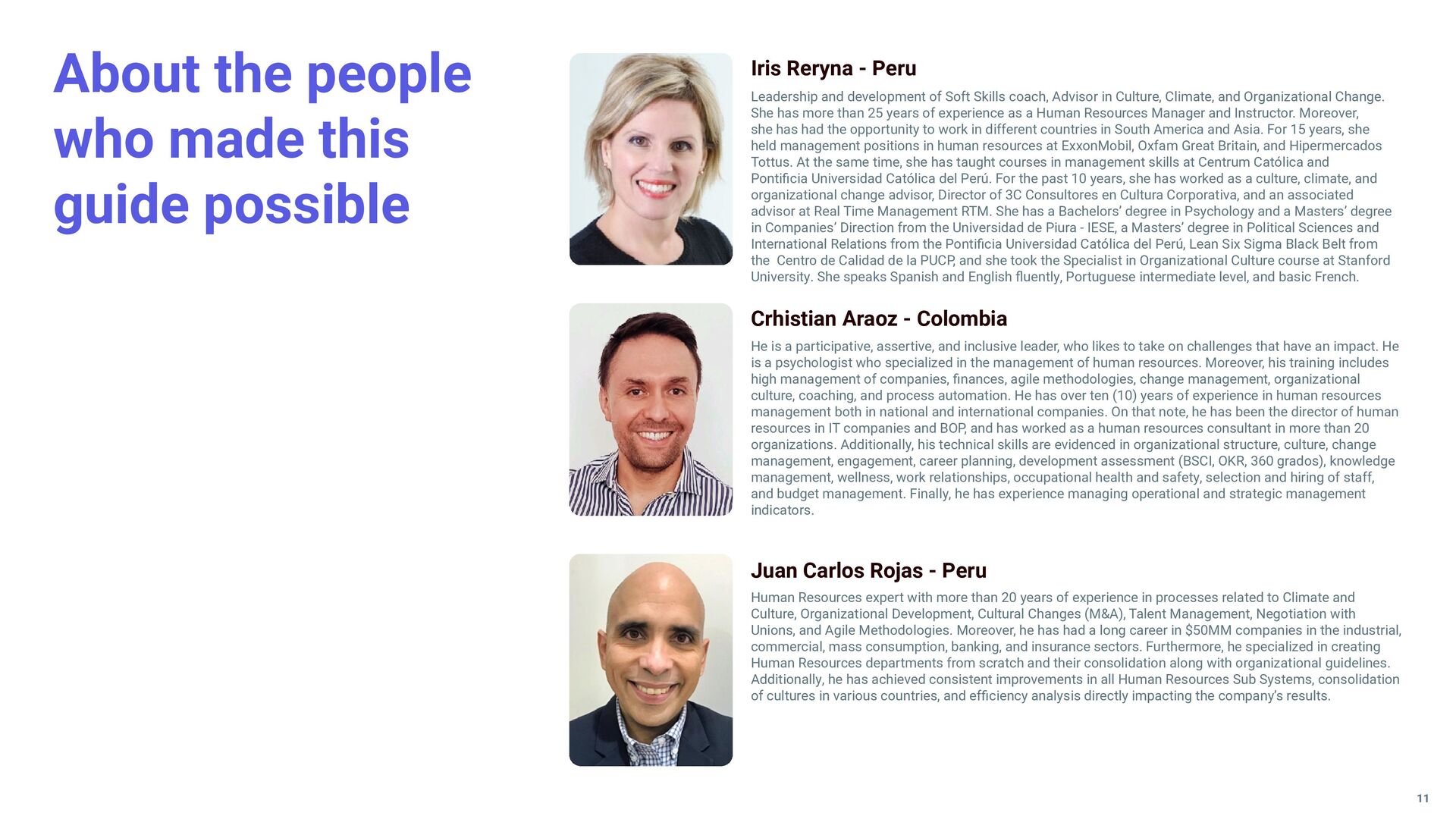
    Resources expert with more than 20 years of experience in processes related to Climate and Culture, Organizational Development, Cultural Changes (M&A), Talent Management, Negotiation with Unions, and Agile Methodologies. Moreover, he has had a long career in $50MM companies in the industrial, commercial, mass consumption, banking, and insurance sectors. Furthermore, he specialized in creating Human Resources departments from scratch and their consolidation along with organizational guidelines. Additionally, he has achieved consistent improvements in all Human Resources Sub Systems, consolidation of cultures in various countries, and efficiency analysis directly impacting the company’s results. Juan Carlos Rojas - Peru He is a participative, assertive, and inclusive leader, who likes to take on challenges that have an impact. He is a psychologist who specialized in the management of human resources. Moreover, his training includes high management of companies, finances, agile methodologies, change management, organizational culture, coaching, and process automation. He has over ten (10) years of experience in human resources management both in national and international companies. On that note, he has been the director of human resources in IT companies and BOP, and has worked as a human resources consultant in more than 20 organizations. Additionally, his technical skills are evidenced in organizational structure, culture, change management, engagement, career planning, development assessment (BSCI, OKR, 360 grados), knowledge management, wellness, work relationships, occupational health and safety, selection and hiring of staff, and budget management. Finally, he has experience managing operational and strategic management indicators. Crhistian Araoz - Colombia Leadership and development of Soft Skills coach, Advisor in Culture, Climate, and Organizational Change. She has more than 25 years of experience as a Human Resources Manager and Instructor. Moreover, she has had the opportunity to work in different countries in South America and Asia. For 15 years, she held management positions in human resources at ExxonMobil, Oxfam Great Britain, and Hipermercados Tottus. At the same time, she has taught courses in management skills at Centrum Católica and Pontificia Universidad Católica del Perú. For the past 10 years, she has worked as a culture, climate, and organizational change advisor, Director of 3C Consultores en Cultura Corporativa, and an associated advisor at Real Time Management RTM. She has a Bachelors’ degree in Psychology and a Masters’ degree in Companies’ Direction from the Universidad de Piura - IESE, a Masters’ degree in Political Sciences and International Relations from the Pontificia Universidad Católica del Perú, Lean Six Sigma Black Belt from the Centro de Calidad de la PUCP, and she took the Specialist in Organizational Culture course at Stanford University. She speaks Spanish and English fluently, Portuguese intermediate level, and basic French. Iris Reryna - Peru
  13. 12 Sources Deloitte Insights, Generar confianza en los tiempos del

    COVID-19 (Promoting trust during times of COVID) Great Place to Work, ¿Por qué es importante encuestar a tus colaboradores en tiempos de COVID-19? (Why is it important to survey your collaborators in times of COVID-19?) La Universidad en Internet, La cercanía, una habilidad estratégica para llevar a cabo un buen liderazgo (Online university, Close relationships, and strategic ability to carry out good leadership.) McKinsey & Company, Sustaining and strengthening inclusion in our new remote environment Sustaining and strengthening inclusion in our new remote environment McKinsey & Company, A blueprint for remote working: Lessons from China Forbes, Puntos clave para construir cultura organizacional en Covid-19 (Key points to create an organizational culture during Covid-19) Gillespie Associates, Why Onboarding That New Hire Will Increase Your Bottom Line Rankmi, “Estado del Trabajo Remoto en América Latina 2020”