the Nuclear-armed Countries to Not to Use Nuclear Weapons First Frank N. von Hippel Program on Science and Global Security, Princeton University Session on “Beyond Nuclear Deterrence” Hiroshima International Conference Center, Nov. 5, 2025, 5 PM
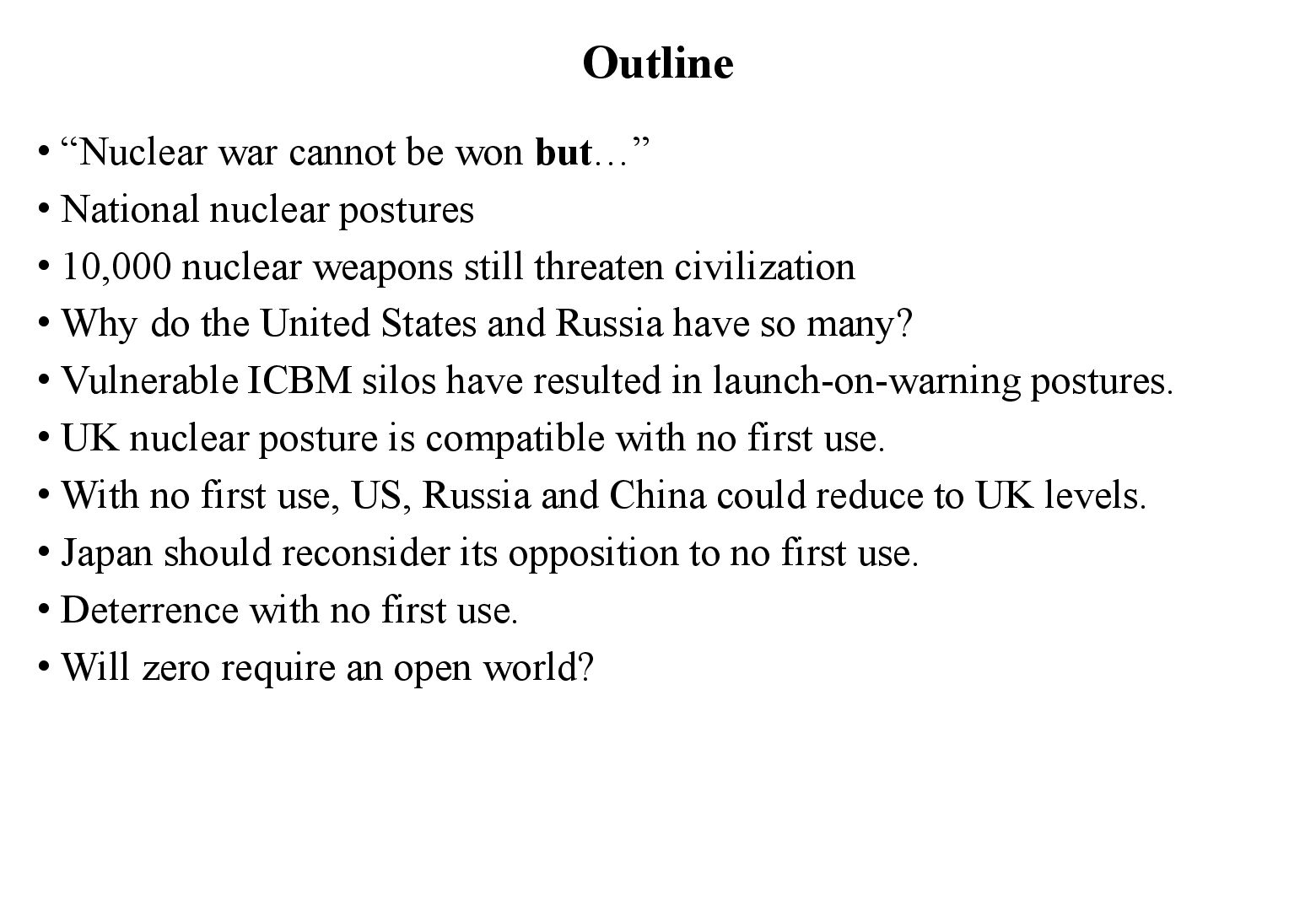
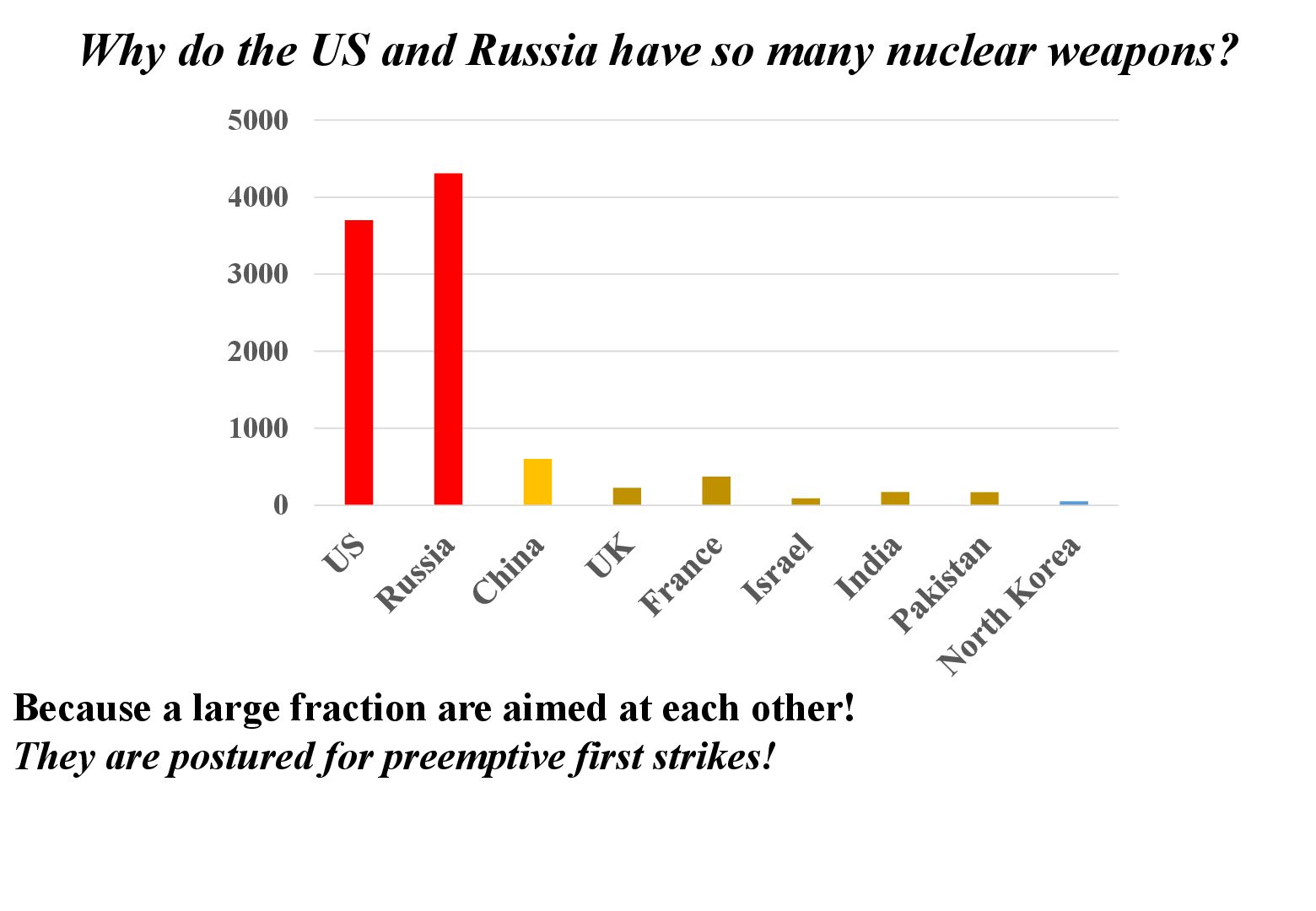
nuclear postures • 10,000 nuclear weapons still threaten civilization • Why do the United States and Russia have so many? • Vulnerable ICBM silos have resulted in launch-on-warning postures. • UK nuclear posture is compatible with no first use. • With no first use, US, Russia and China could reduce to UK levels. • Japan should reconsider its opposition to no first use. • Deterrence with no first use. • Will zero require an open world?
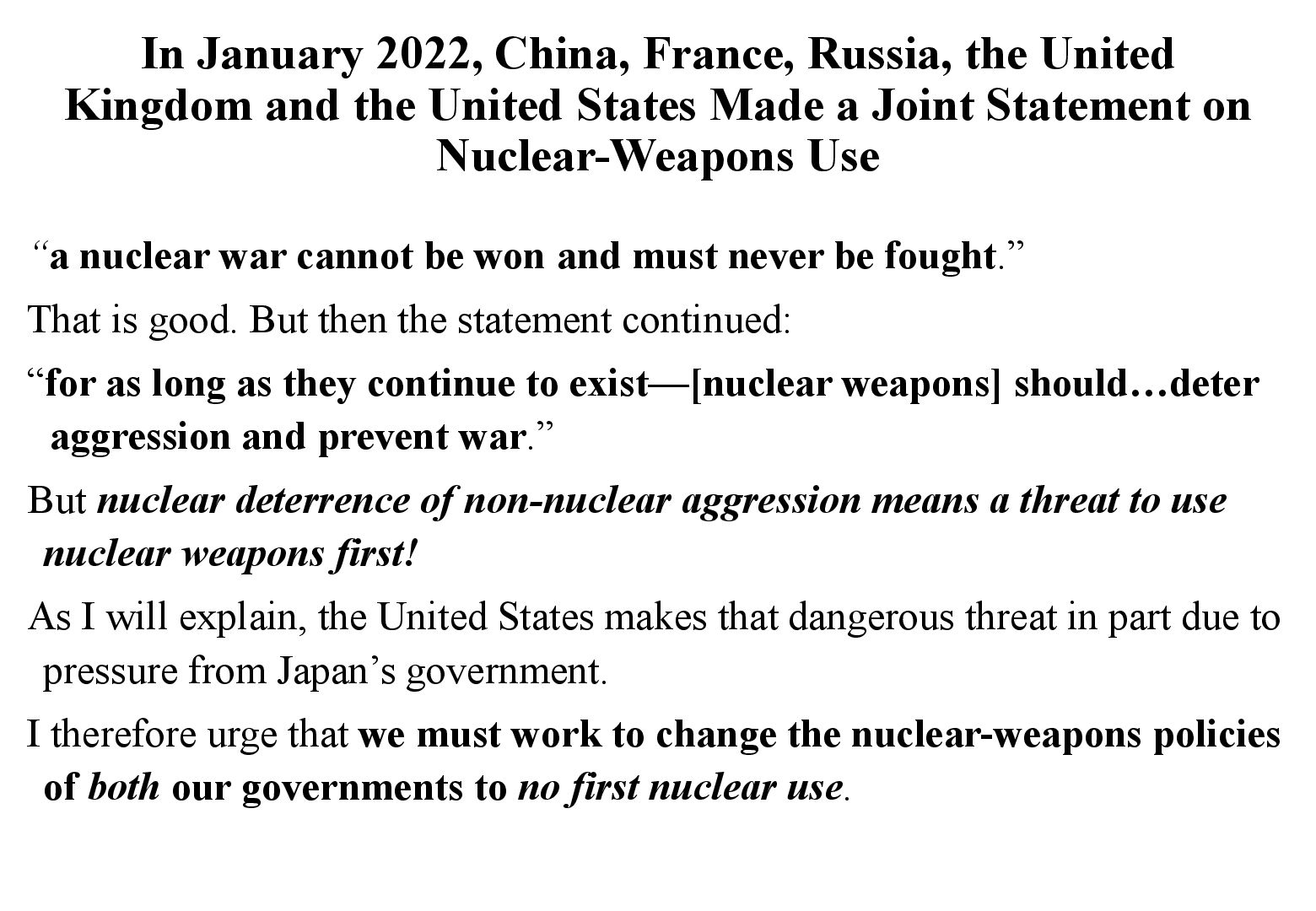
the United States Made a Joint Statement on Nuclear-Weapons Use “a nuclear war cannot be won and must never be fought.” That is good. But then the statement continued: “for as long as they continue to exist—[nuclear weapons] should…deter aggression and prevent war.” But nuclear deterrence of non-nuclear aggression means a threat to use nuclear weapons first! As I will explain, the United States makes that dangerous threat in part due to pressure from Japan’s government. I therefore urge that we must work to change the nuclear-weapons policies of both our governments to no first nuclear use.
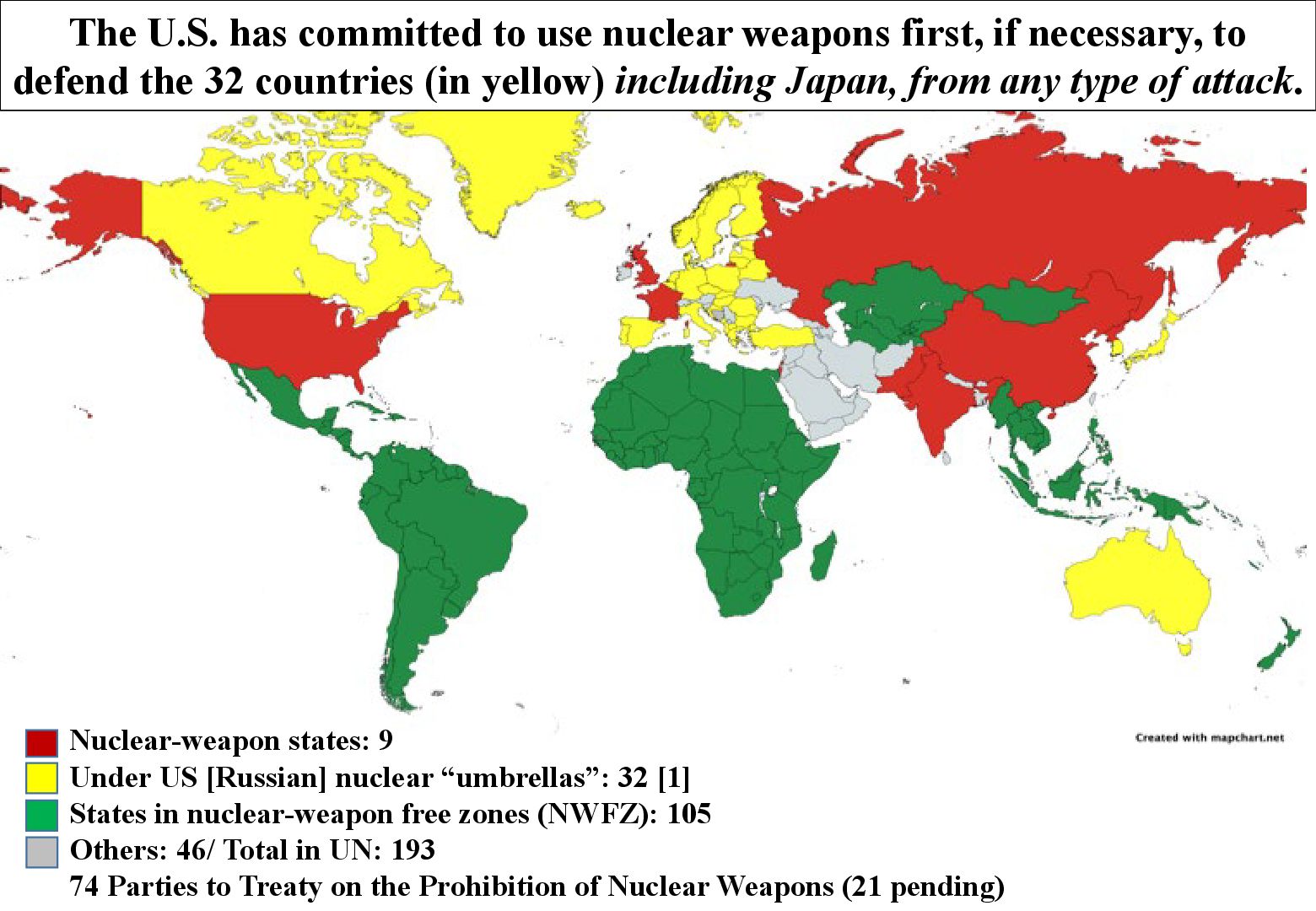
necessary, to defend the 32 countries (in yellow) including Japan, from any type of attack. Nuclear-weapon states: 9 Under US [Russian] nuclear “umbrellas”: 32 [1] States in nuclear-weapon free zones (NWFZ): 105 Others: 46/ Total in UN: 193 74 Parties to Treaty on the Prohibition of Nuclear Weapons (21 pending)
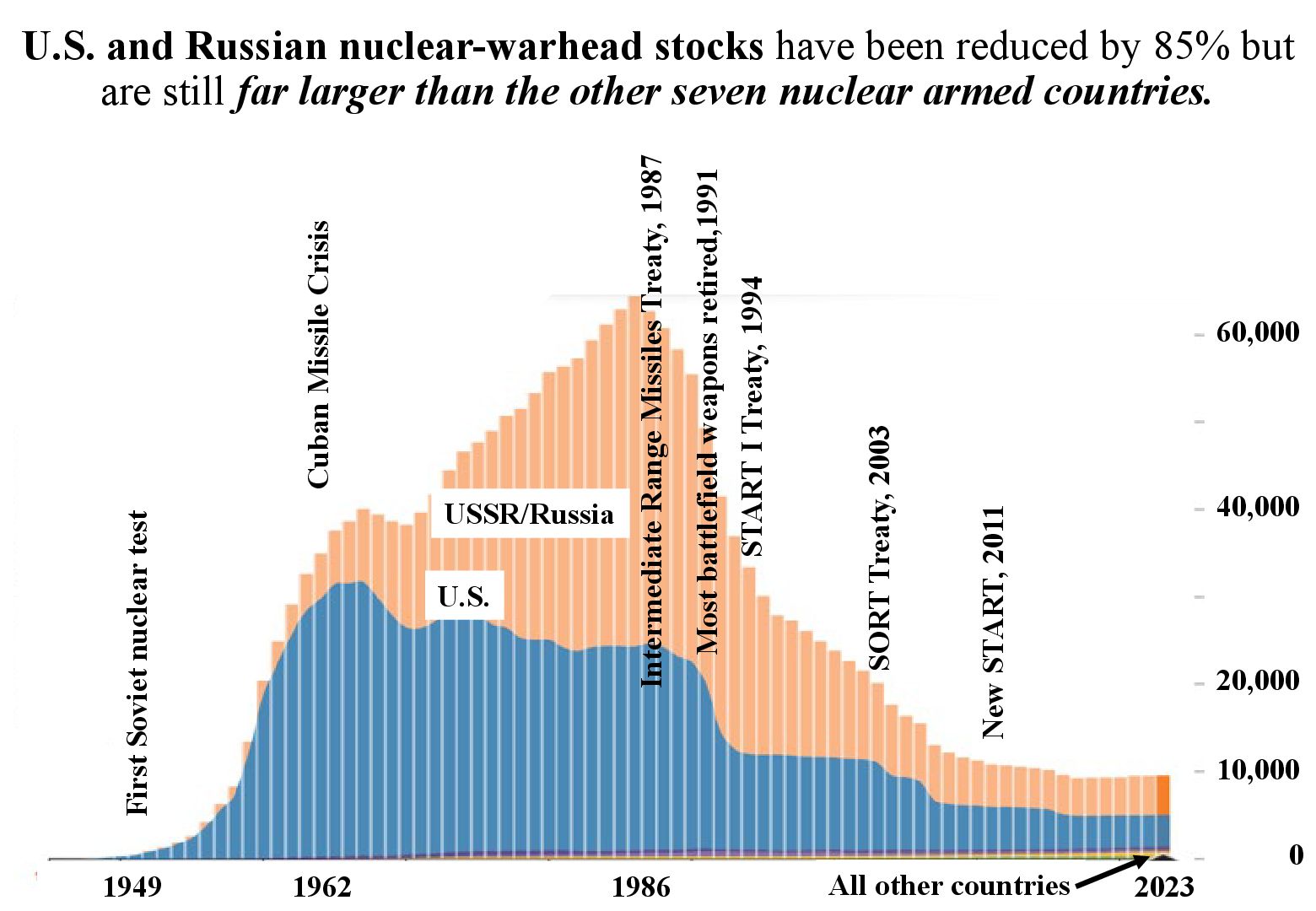
but are still far larger than the other seven nuclear armed countries. C Cuban Missile Crisis Intermediate Range Missiles Treaty, 1987 First Soviet nuclear test 60,000 40,000 20,000 10,000 0 1949 1962 1986 2023 U.S. USSR/Russia All other countries Most battlefield weapons retired,1991 START I Treaty, 1994 SORT Treaty, 2003 New START, 2011
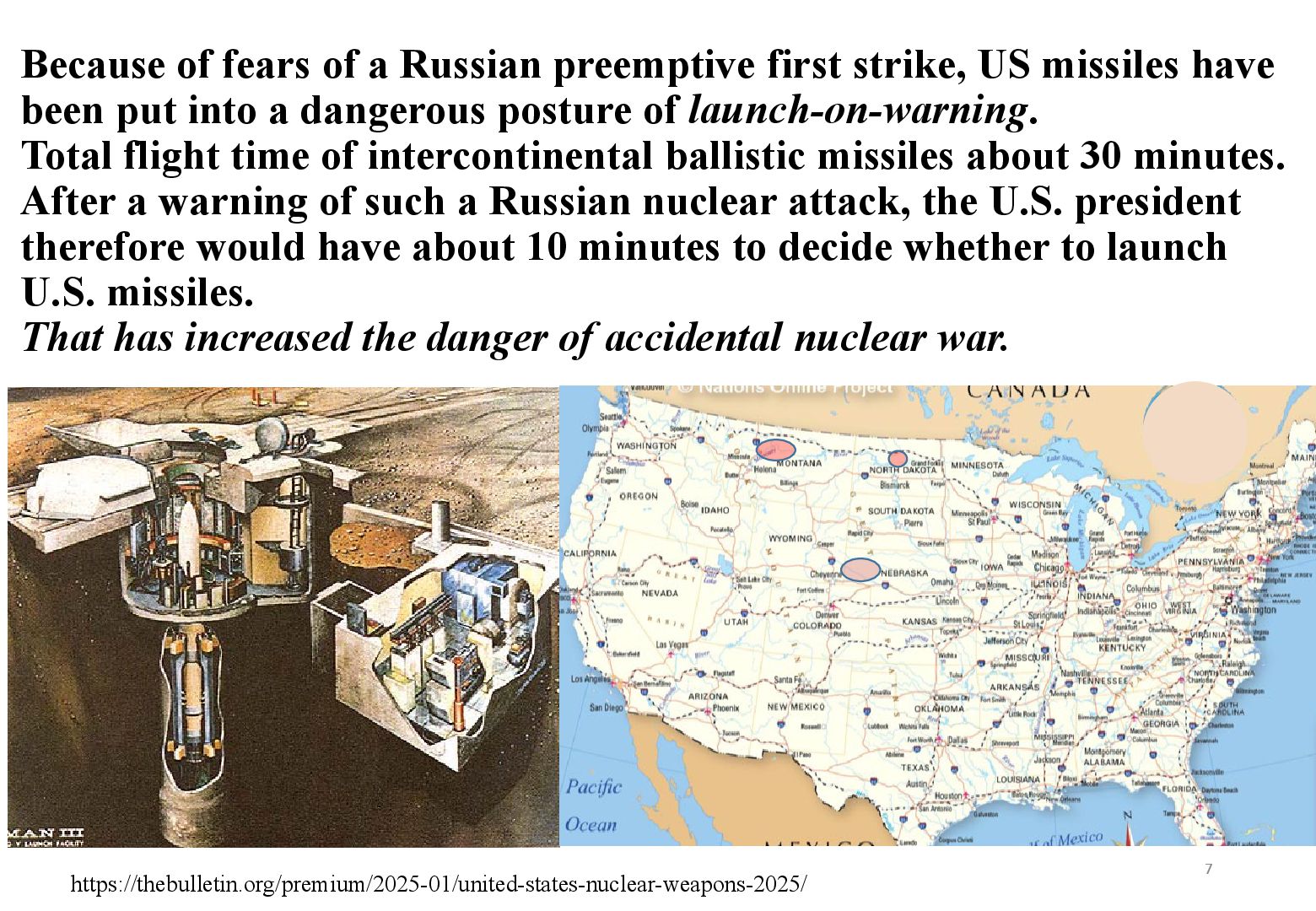
missiles have been put into a dangerous posture of launch-on-warning. Total flight time of intercontinental ballistic missiles about 30 minutes. After a warning of such a Russian nuclear attack, the U.S. president therefore would have about 10 minutes to decide whether to launch U.S. missiles. That has increased the danger of accidental nuclear war. Russia’s ballistic missiles can reach US ICBM silos with ≤ 30 min. flight time. President’s decision time less than 10 minutes. 65,000 warheads 7 https://thebulletin.org/premium/2025-01/united-states-nuclear-weapons-2025/
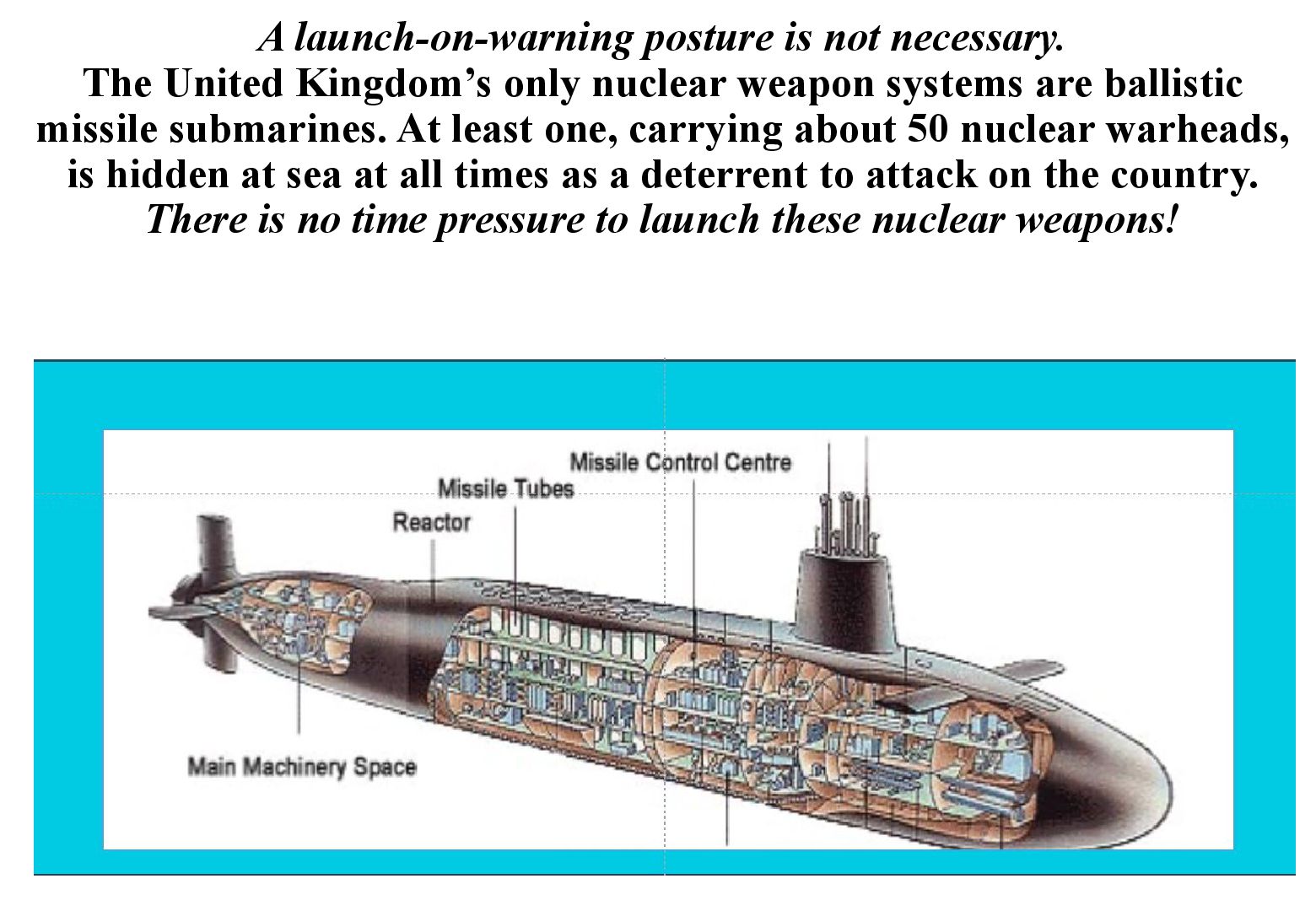
nuclear weapon systems are ballistic missile submarines. At least one, carrying about 50 nuclear warheads, is hidden at sea at all times as a deterrent to attack on the country. There is no time pressure to launch these nuclear weapons!
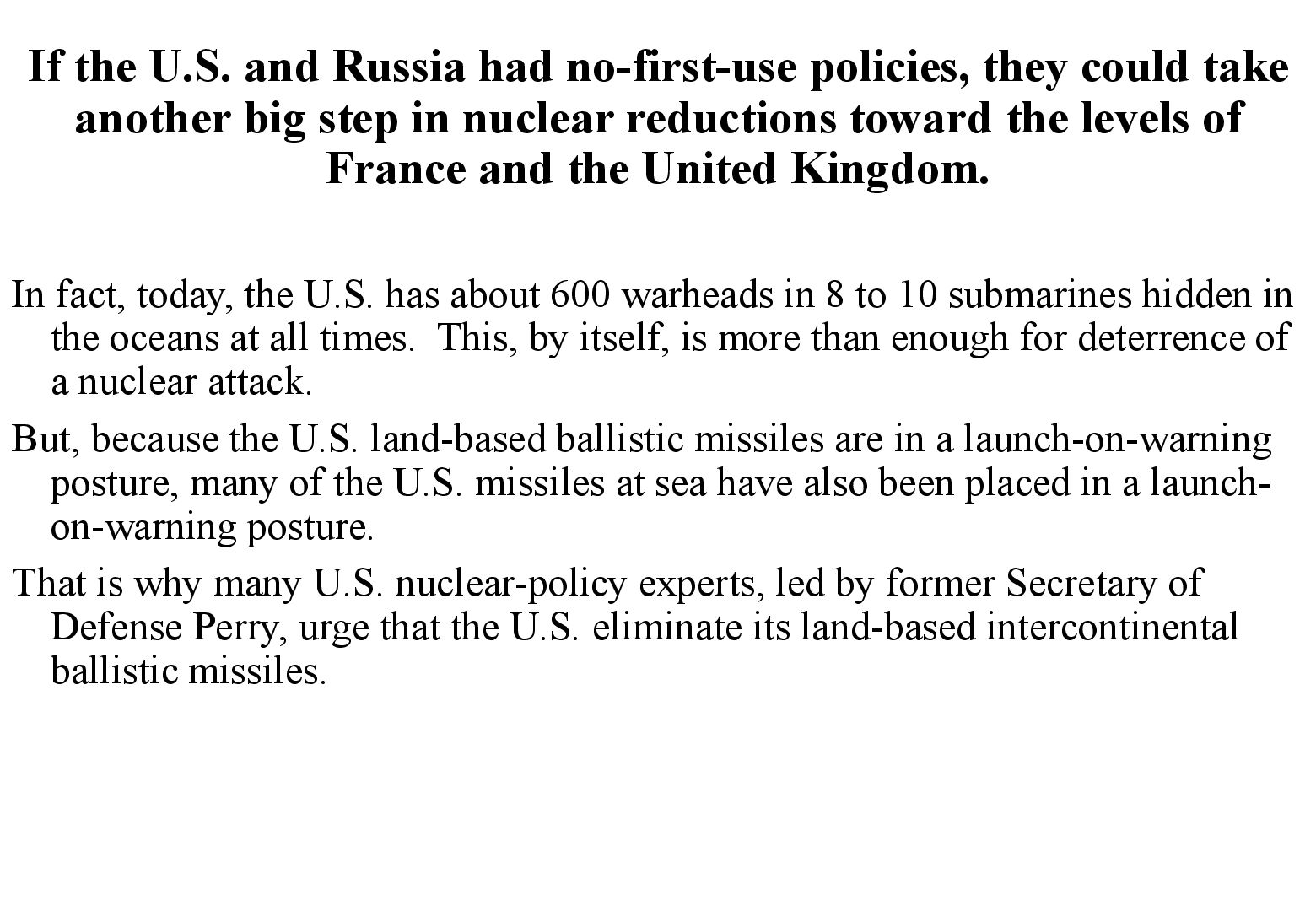
take another big step in nuclear reductions toward the levels of France and the United Kingdom. In fact, today, the U.S. has about 600 warheads in 8 to 10 submarines hidden in the oceans at all times. This, by itself, is more than enough for deterrence of a nuclear attack. But, because the U.S. land-based ballistic missiles are in a launch-on-warning posture, many of the U.S. missiles at sea have also been placed in a launch- on-warning posture. That is why many U.S. nuclear-policy experts, led by former Secretary of Defense Perry, urge that the U.S. eliminate its land-based intercontinental ballistic missiles.
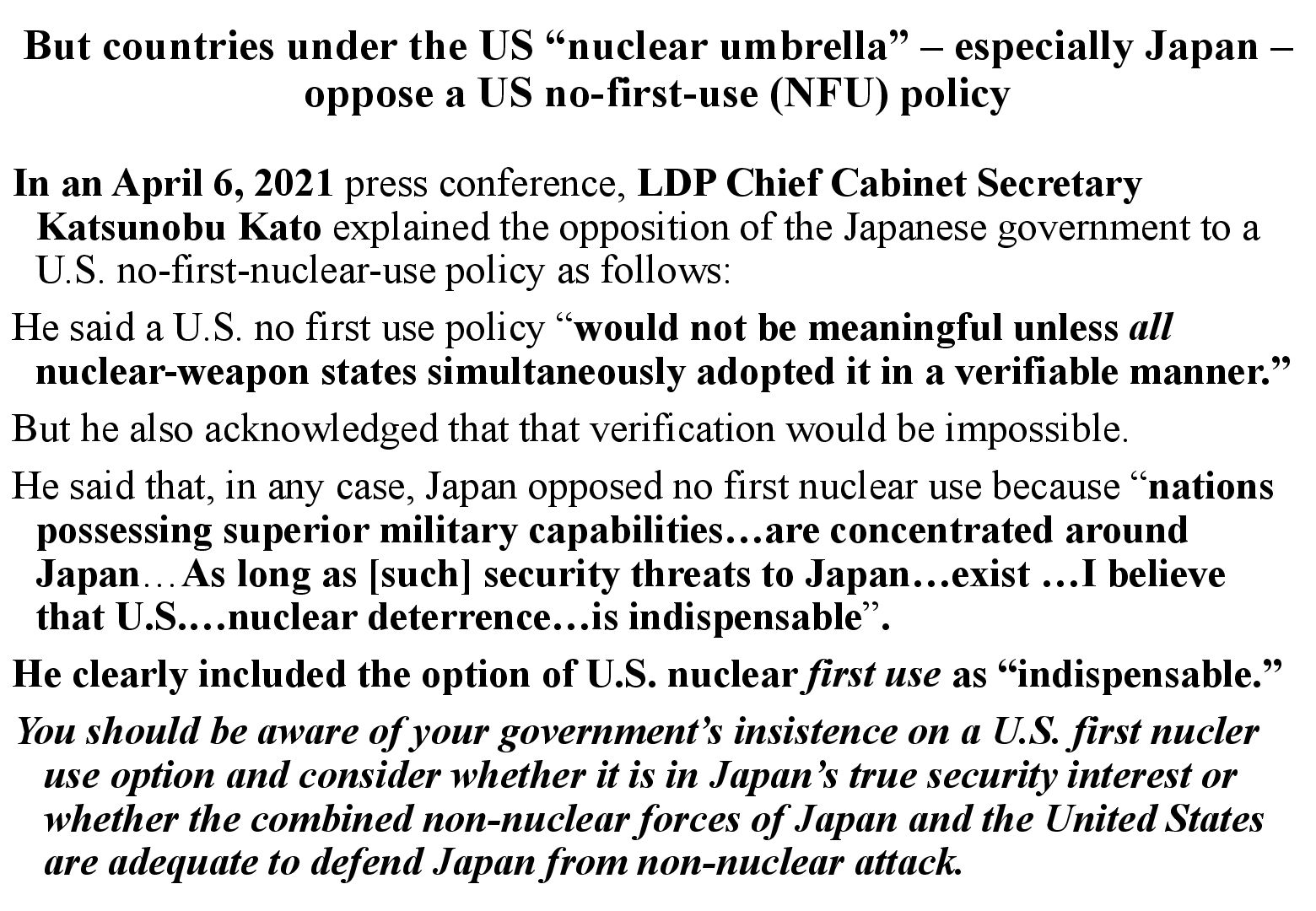
– oppose a US no-first-use (NFU) policy In an April 6, 2021 press conference, LDP Chief Cabinet Secretary Katsunobu Kato explained the opposition of the Japanese government to a U.S. no-first-nuclear-use policy as follows: He said a U.S. no first use policy “would not be meaningful unless all nuclear-weapon states simultaneously adopted it in a verifiable manner.” But he also acknowledged that that verification would be impossible. He said that, in any case, Japan opposed no first nuclear use because “nations possessing superior military capabilities…are concentrated around Japan…As long as [such] security threats to Japan…exist …I believe that U.S.…nuclear deterrence…is indispensable”. He clearly included the option of U.S. nuclear first use as “indispensable.” You should be aware of your government’s insistence on a U.S. first nucler use option and consider whether it is in Japan’s true security interest or whether the combined non-nuclear forces of Japan and the United States are adequate to defend Japan from non-nuclear attack.
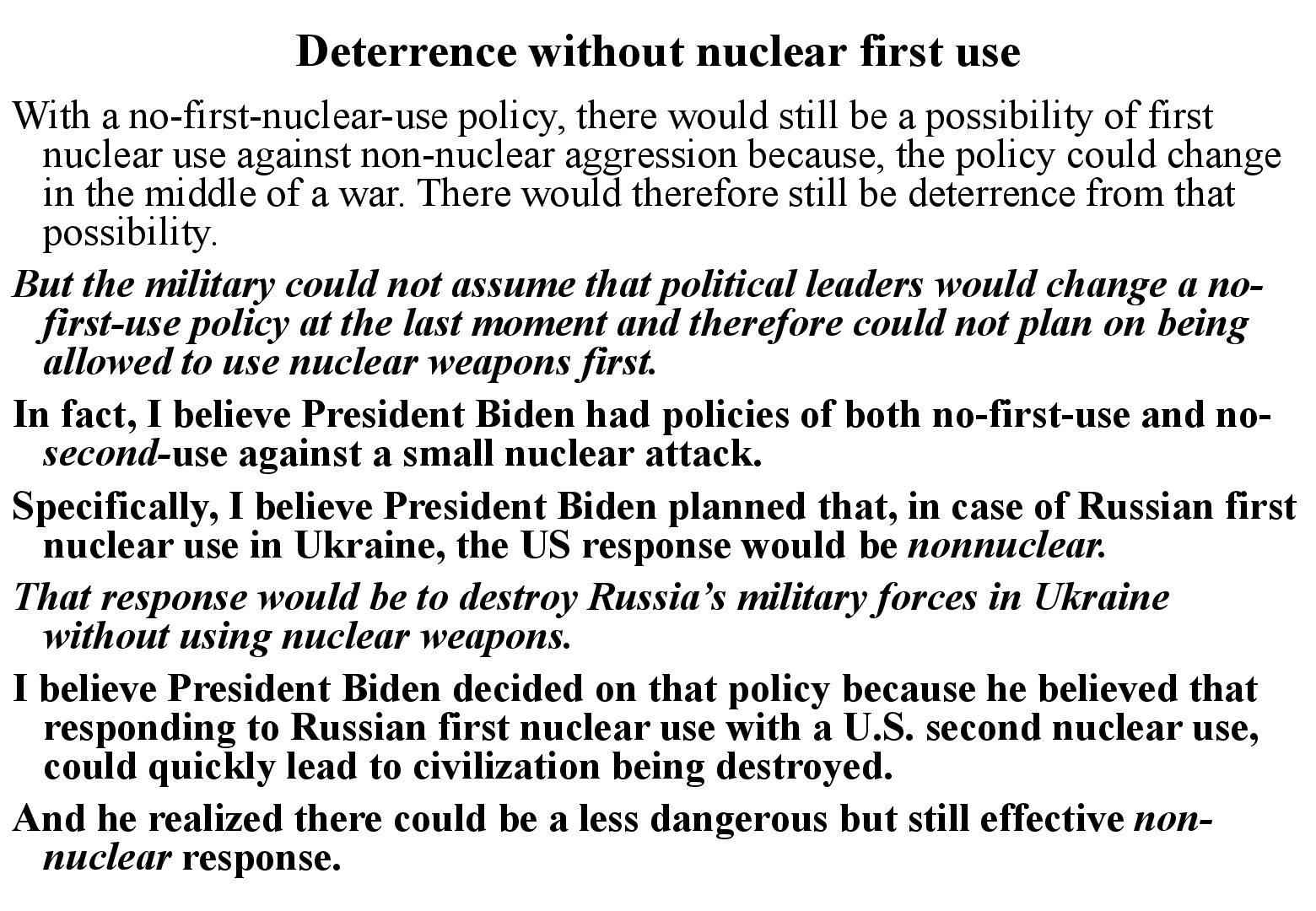
would still be a possibility of first nuclear use against non-nuclear aggression because, the policy could change in the middle of a war. There would therefore still be deterrence from that possibility. But the military could not assume that political leaders would change a no- first-use policy at the last moment and therefore could not plan on being allowed to use nuclear weapons first. In fact, I believe President Biden had policies of both no-first-use and no- second-use against a small nuclear attack. Specifically, I believe President Biden planned that, in case of Russian first nuclear use in Ukraine, the US response would be nonnuclear. That response would be to destroy Russia’s military forces in Ukraine without using nuclear weapons. I believe President Biden decided on that policy because he believed that responding to Russian first nuclear use with a U.S. second nuclear use, could quickly lead to civilization being destroyed. And he realized there could be a less dangerous but still effective non- nuclear response.
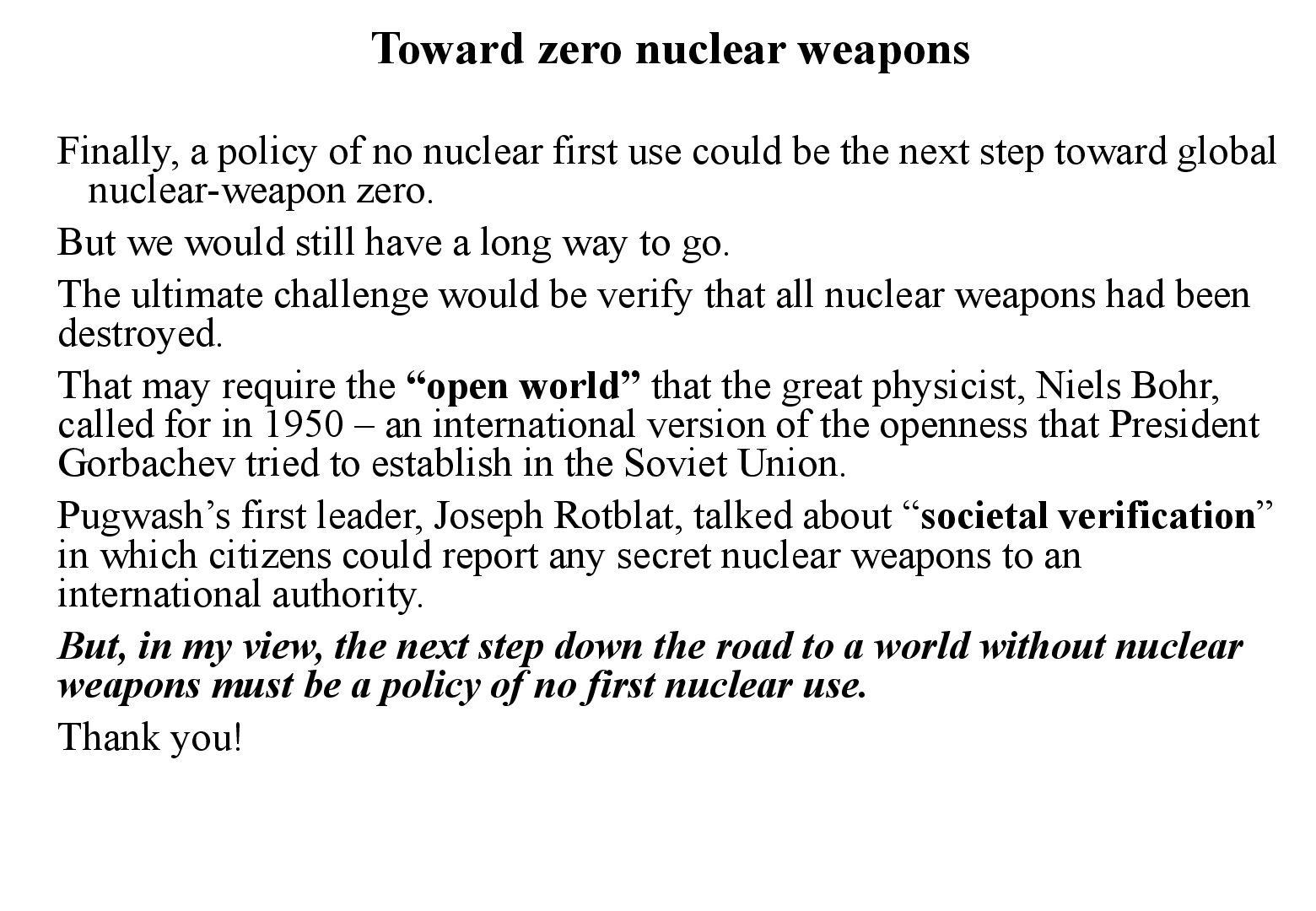
first use could be the next step toward global nuclear-weapon zero. But we would still have a long way to go. The ultimate challenge would be verify that all nuclear weapons had been destroyed. That may require the “open world” that the great physicist, Niels Bohr, called for in 1950 – an international version of the openness that President Gorbachev tried to establish in the Soviet Union. Pugwash’s first leader, Joseph Rotblat, talked about “societal verification” in which citizens could report any secret nuclear weapons to an international authority. But, in my view, the next step down the road to a world without nuclear weapons must be a policy of no first nuclear use. Thank you!

 Your Podcast. Everywhere. Effortlessly.


 hide2kano
 pawan_pharm
 juanmartin2026
 hiola
hiola
 matleenalaakso
 masakiokuda
 signer
 kekekenta
 frievea
 codingconduct
 chriscoyier
 jonoalderson
 sferik
 swwweet
 techseoconnect
 csswizardry
 soysaucechin
 sarafernandez
 baasie
 scottboms
 aleyda