Share
Embed
You Know Nothing ... or do you? (Speaker Notes)
Each and every day we encounter the knowledge of thousands of people. We read articles, blog posts, documentation and smart answers on StackOverflow. How can we compete against this well of wisdom?
You might think that you have nothing to add. You'll be surprised how much you actually know.
Sascha Wolf
January 19, 2019
Transcript
58 slides
-
Tried to make accessible: Give me feedback! (Thanks to organizers!)
Ask: Who in this room is not a dev? Talk: From a perspective of a dev; gist is applicable regardless of profession, don't feel excluded! You Know Nothing or do you? -
This is a talk about ... Hi, I'm Sascha -
Full Stack Developer / TSA - @grandcentrix in Cologne, Germany - During my career I: - wrote backend services in Java and NodeJS - created responsive websites with CSS, Vue, and Elm - shaped iOS apps with Objective-C and Swift - did some embedded development in C - built big backend systems with Elixir ! wolf4earth | saschawolf.me -
Jon Snow and how he knew nothing ... No I'm
kidding of course. You knew there would be a GoT joke. -
What is it? - Writing blog posts - Answering Questions
- Recording videos or podcasts - Speaking on conferences - Teaching your colleagues Agree that it's important We all rely on it, colleagues, or through platforms such as ... Knowledge Sharing -
Stats (2016) - 7.5 mil posts A lot of them
are free We all found a helpful article on medium -
Stats (December 2018) (https://en.wikipedia.org/wiki/ Wikipedia:SizeofWikipedia) - ~35 mil registered users
- nearly 47 mil articles (total) - nearly 6 mil english articles -
Devs here: I think we all rely on it 85%
of devs say they visit StackOverflow at least a few times a week Stats (29. December 2018) - nearly 10 mil users - 26 mil answers for nearly 17 mil questions Lots of volunteers who share their knowledge; or close your question as a duplicate -
You read these articles or answers and these people seem
so smart. What could we possibly contribute? Right? We already struggle to keep up Intimidating -
So. Much. To. Learn. Then we try to keep up
and maybe ask people questions and they tell us: -
This forms our perception of the job as a dev;
we could come to the conclusion that a great dev knows all that "You're doing it wrong!" -
At the end it's all about the output, right? So
we're thinking ... A Great Developer - Awesome tech skills - Incredible productivity - High quality code - Blazing fast learner - Some Soft skills -
So we can become great devs and at some point
have something to share When we're doing that, we're trying to avoid ... Keep learning -
All boils down to this We don't want to be
"that person" We're afraid of Embarrassment -
So we don't ... - answer that StackOverflow question -
do that talk on that meetup - offer that help to someone - prepare that workshop - record that video - write that blog post - give input during that meeting -
Which means, we're pressured to We're working in a fast
moving industry -
Both at the same time; this stresses us out So
we just don't do it. Maybe we write a blog post but never publish it Perform and Learn -
Because Buzzkill: This doesn't end! There is always something you
don't know Always absorbed knowledge as I could; I'm good at it My Story Photo by Daniel McCullough on Unsplash -
But I kept pushing; I put even more on my
plate (MCSE certification) Exhaustion Photo by Tim Gouw on Pexels -
I came home and slumped on the couch; My wife
repeatedly asked me to go into Depression Photo by Sasha Freemind on Unsplash -
For over a year now and still working on it
Today I'm here to tell you what I painfully learned, so you don't make the same mistakes See, I didn't suddenly know everything but instead I developed ... Therapy Photo by rawpixel on Unsplash -
- I changed my perspective on my work - In
the next few slides I'm gonna try to convey it - We're gonna make some small detours - Stick with me it's all gonna come back to Knowledge Sharing A New Frame of Mind -
But what does that actually tells us about a person?
See, we look at this tiny part Code Ninja & Rockstar Dev -
Based on that we come to a judgement: "This is
a great dev, he really knows his JS!" We lose sight of the other parts ... Photo by Shane Aldendorff from Pexels -
But there is more to a person than just his
ability to write JS! And only everything put together forms a whole person! Photo by Shane Aldendorff from Pexels -
And only put together they form a person greater than
the sum of their parts Prepackaged; all together Let's do a little experiment Photo by Markus Spiske from Pexels -
Can be a colleague, blogger, youtuber, etc. Ask yourself: What
exactly do you respect about them? Think of somebody you respect -
Code: Only that? Or maybe more? The point I'm trying
to make: Rarely only tech skills which we respect! Which qualities do you respect? » Writes awesome code? » Great communication skills? » Empathic and patient? » Fun to interact with? » Interested in a variety of topics? » Prompts you to learn new things? » Probably lots of other things! -
First check @GCX: Does this person fit as a person?
Tech also important, but secondary We are a small company but there is a big one who also found that out: We're more than a walking Tech Stack Photo by Eli Francis on Unsplash -
- Google had the same realization! - Teams with super-smart
people, they didn't perform - Why? Research project in 2012, asking a simple question: -
2 years of research - 200+ interviews (employees) - 180+
active teams - 250 different attributes In the end it boiled down to something called: What's the secret to a successful team? — Google (Project Aristotle) -
What does that mean? - A protected environment to exchange
ideas - Healthy culture around failure - A lot more things: article from NY Times! Great article from the NYT Not the smartest people build the best teams! But teams with strong: Psychological Safety [the] shared belief held by members of a team that the team is safe for interpersonal risk-taking. [...] A sense of confidence that the team will not embarrass, reject or punish someone for speaking up. — Amy Edmondson (Harvard Business School)1 1 https://www.nytimes.com/2016/02/28/magazine/what-google-learned-from-its-quest-to-build-the-perfect-team.html -
Not only in tech! This applies to every industry! When
these skills are so important, maybe we should call them: Soft Skills -
Pretty much everybody needs them and you need them for
pretty much everything Most projects fail due to human reasons So, Core Skills matter but ... -
Core Skills, Tech Skills, why not other skills? I'm talking
about skills aquired through things we in our freetime. For me: Why stop here? -
Played a lot of LoL: Learned to be more calm
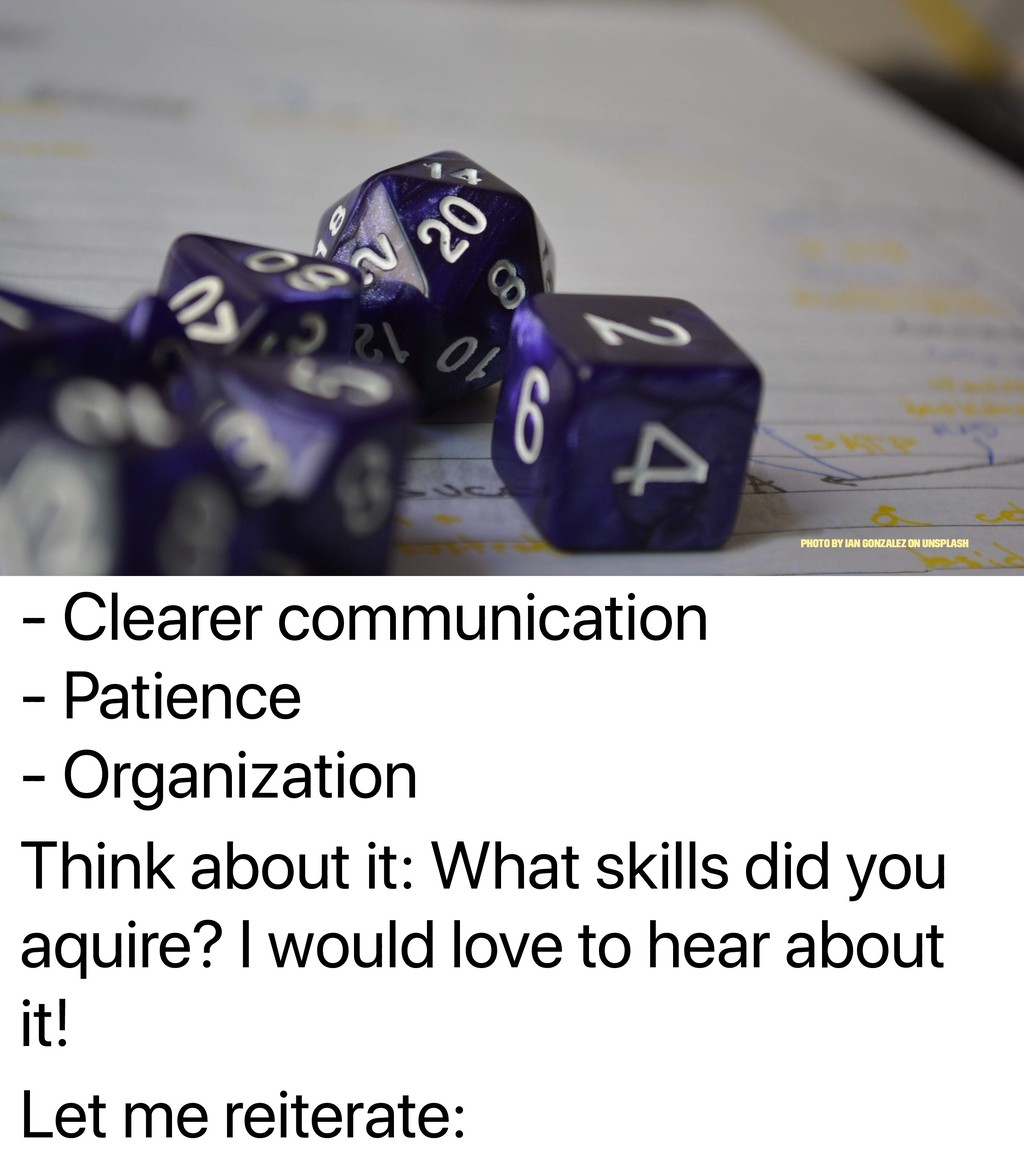
in a team and stress situations Another area: RPGs Photo by Jamie McInall from Pexels -
- Clearer communication - Patience - Organization Think about it:
What skills did you aquire? I would love to hear about it! Let me reiterate: Photo by Ian Gonzalez on Unsplash -
You definitely need some tech skills to work in this
industry BUT Tech enables us -
But they don't make you necessarily a great dev Okay,
you might now be asking yourself: Tech does not define us -
What does that have to do with knowledge sharing? During
therapy I've realized that I: Why is this guy telling me all of this? — Maybe you right now? -
I hold myself to unatainable standards Conversations with colleagues =
similar, maybe you too? There is a consequence to this: My value = My tech skills? -
Knowledge Share = Risky We put ourself out there When
we define our worth by our tech skills, every critique strongly undermines our self-confidence — My realization -
Ofc you can build a house on stilts and it
might even hold! But when we recognize = All our skills are important! Photo by Arnold Dogelis on Unsplash -
Stable foundation: It's harder to shake you! When you share,
and it's wrong, it's not so bad! I urge you: Don't try to be a "Rockstar Dev" => Be a "Wholesome Dev" -
These helped ME; maybe they'll help you Let's start with
a fun one: Tips & Tricks Photo by Guy Kawasaki on Pexels -
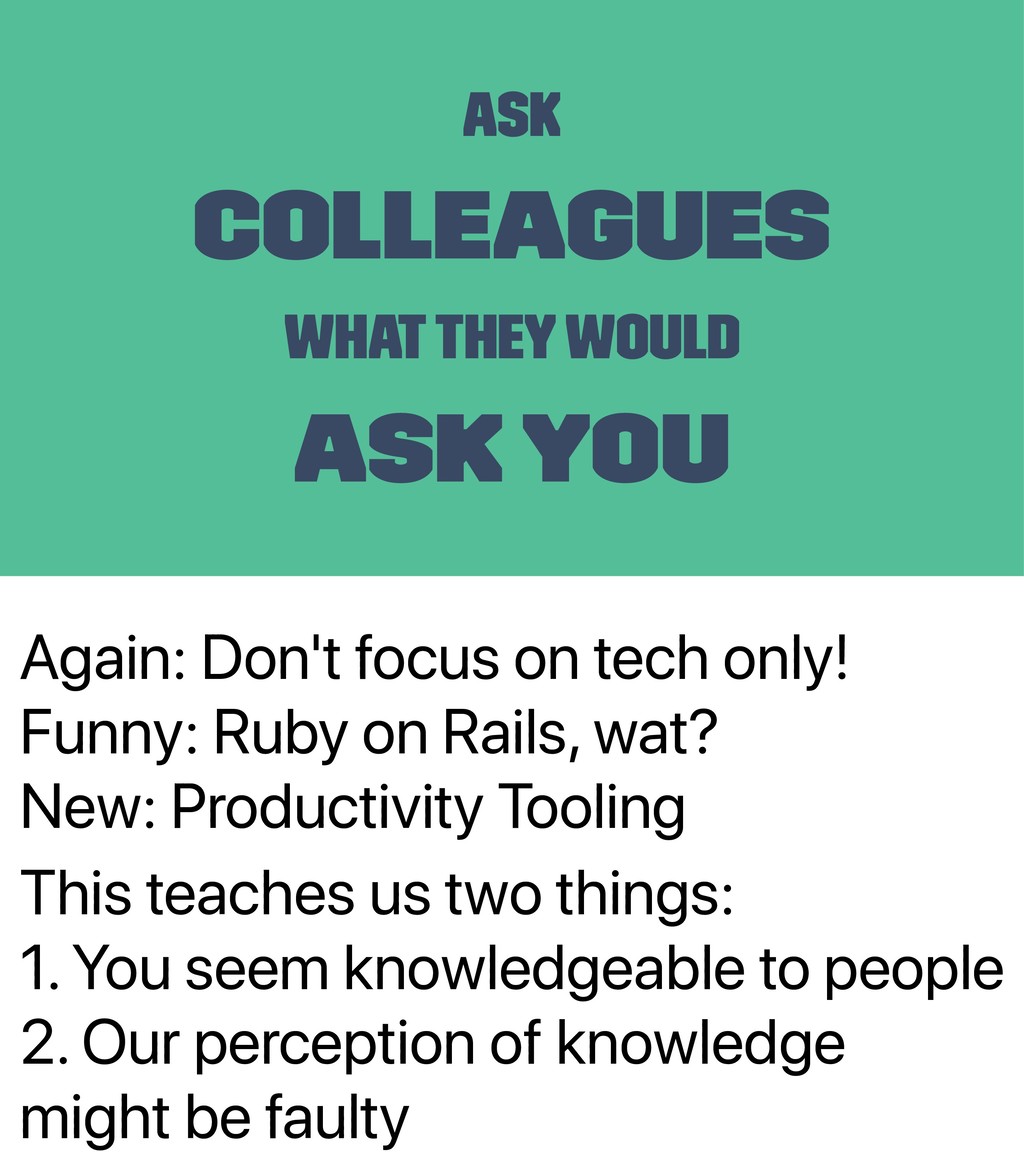
Again: Don't focus on tech only! Funny: Ruby on Rails,
wat? New: Productivity Tooling This teaches us two things: 1. You seem knowledgeable to people 2. Our perception of knowledge might be faulty Ask colleagues what they would ask you -
Not “I canʼt make mistakes” but “I learned X for
the future!” On the same note: Focus on the Learnings not the Mistakes -
... with the knowledge we had Code is distilled knowledge;
writing it is a learning process Old Code = What did I learn till then? (Maybe eben worthy of a blog post?) We did the best we could -
And do not focus on tech only! They're great seeds
for future talks, blog posts etc. Keep a TIL Record -
There is no "ultimate version"! - Mistakes & Pitfalls -
Questions you had and their answers - Reference for you Document the Journey not the Goal Photo by Sharefaith from Pexels -
To close my talk: I would like to introduce myself
again, the wholesome me Meditation Photo by Simon Migaj on Unsplash -
There is a lot more to me than being a
dev from cologne who builds stuff with elixir And I'm 100% certain: There is a lot more to all of you Hi again, I'm still Sascha » Husband / Father / Roleplayer / Developer » Vegan for nearly 6 years » Atheist, very interested in theology » Big on bringing compassion into work and life » Techy, full stack dev with a love for FP » Read a lot: SciFi, RPGs, thought-provoking stuff » Interests: game design & gaming, mindfulness, ethics, space exploration, productivity -
Please tweet me the skills you've aquired in your freetime!
Now go off and write some blog posts! Thank you for listening ! wolf4earth | saschawolf.me