Upgrade to Pro
— share decks privately, control downloads, hide ads and more …
Speaker Deck
Sign up for free
Menu
Search
Features
All features
Private URLs
Password Protection
Custom URLS
Scheduled publishing
Remove Branding
Restrict embedding
Deck Collections
Notes
Features
All features
Private URLs
Password Protection
Custom URLS
Scheduled publishing
Remove Branding
Restrict embedding
Deck Collections
Notes
Explore
Featured decks
Featured speakers
Programming
Technology
Storyboards
Explore
Featured decks
Featured speakers
Programming
Technology
Storyboards
Pricing
Search
Sign in
Sign up for free
tc39_study
Search
Sponsored
·
Your Podcast. Everywhere. Effortlessly.
Share. Educate. Inspire. Entertain. You do you. We'll handle the rest.
→
Daiki Ihara
October 09, 2019
Programming
790
1
Share
Embed
Copy iframe code
Copy JS code
Copy link
Start on current slide
tc39_study
Temporal
BinaryAST
Daiki Ihara
October 09, 2019
Transcript
15 slides
tc39_study https://github.com/sasurau4/slides
ABOUT ME { "id": "sasurau4", "name": "Daiki Ihara", "description": "Front-end engineer at CureApp, Inc.", "techs": { "work": ["React Native", "TypeScript", "JavaScript", "MongoDB"], "subwork": ["React Native", "React", "TypeScript"], "hobby": ["React", "TypeScript", "JavaScript", "Deno"] },
"homepage": "https://sasurau4.github.io/profile/" }
What is temporal? Provides standard objects and functions for working with dates and times. This proposal is currently stage 2.
Motivation Fixing JavaScript Date java.util.Date― その悲劇と歴史
Principles All temporal APIs are non-mutating. All temporal objects are effectively immutable. All date values are based on the Proleptic Gregorian Calendar. All time-of-day values are based on a standard 24-hour clock. Leap seconds are not represented.
Specification The documentation is out of date.
Try it with polyfill node --experimental-modules --no-warnings --icu-data-dir ./node_modules/full-icu/ -r ./lib/initialise.js For more details, https://github.com/tc39/proposal-temporal/tree/main/docs
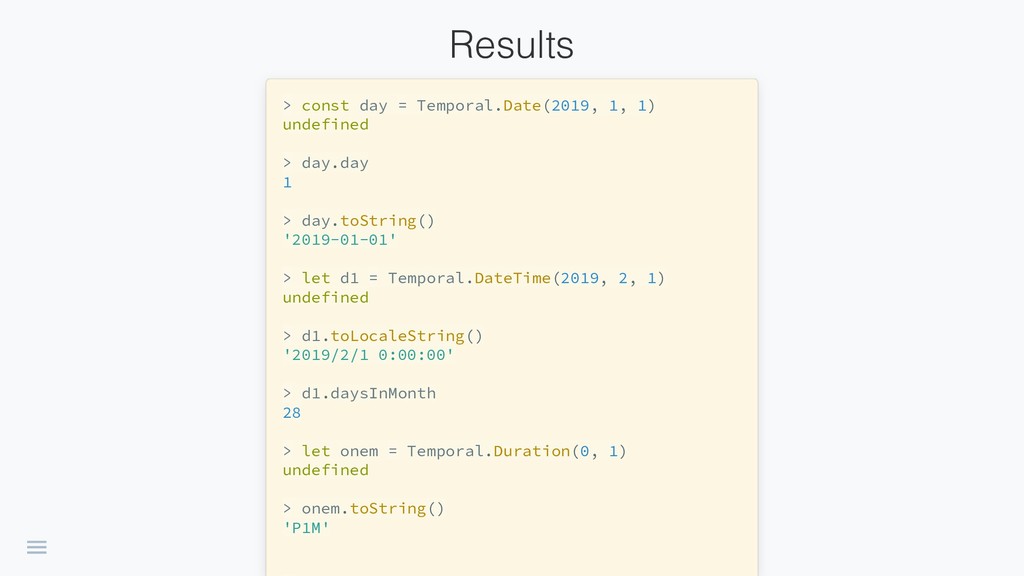
Results > const day = Temporal.Date(2019, 1, 1) undefined > day.day 1 > day.toString() '2019-01-01'
> let d1 = Temporal.DateTime(2019, 2, 1) undefined > d1.toLocaleString() '2019/2/1 0:00:00' > d1.daysInMonth 28 > let onem = Temporal.Duration(0, 1) undefined > onem.toString() 'P1M'
What is binaryAST? Startup performance degrades with larger JS payloads, even if only a fraction of the code is actually executed. Parsing time is a significant component, taking more CPU time than bytecode / initial JIT code generation. For example, on a powerful laptop, Chrome spends 10% to 15% of CPU time parsing JS while loading facebook.com. We propose a new over-the-wire format for JS that is a binary encoding of an AST. We believe this new format would allow for drastically faster parsing. Moreover, web developers are well positioned to adopt a new format as they have embraced build tooling.
Motivation from https://blog.cloudflare.com/binary-ast/
prototype of binAST from https://github.com/binast/binjs-ref As websites become more sophisticated, the amount of JavaScript source code keeps increasing. While depending upon a large JavaScript codebase won't prevent a website from working, it will cause websites to start slowly – often unacceptably slow. This is due to two bottlenecks: parsing and bytecode compiling JavaScript. Unfortunately, browsers have pretty much reached efficiency peak for both operations. We (Mozilla, Bloomberg, Facebook,
CloudFlare) are currently working on a domain-specific encoding for JavaScript, called "BinAST" (short for "JavaScript Binary AST"). The JavaScript Binary AST is designed to break the bottleneck.
Result
Details https://blog.cloudflare.com/binary-ast/
Demo Try it with Firefox nightly! https://serve-binjs.that-test.site
The End
More Decks by Daiki Ihara
See All by Daiki Ihara
ArrayBufferとBinary
sasurau4
1
670
CLIから見るAngular, React, Vue
sasurau4
1
1k
Metro Bundler in Web
sasurau4
0
1k
reading-mtc2018-web.pdf
sasurau4
1
590
Other Decks in Programming
See All in Programming
Performance Optimization With LLMs
xleitix
0
250
DroidKnights 2026 Android A2UI Jetpack Compose 기반의 안전한 AI UI 렌더링 - 박제창
itsmedreamwalker
1
220
学びを記事・スライド・Xへ高速展開する― AI-assisted Learning Loopで回すコンテンツ生成術
ochtum
0
200
선언형 햅틱 라이브러리 진동을 소개합니다
l2hyunwoo
1
310
TS 7.0 で baseUrl が使えなくなった今、パスエイリアスをどうするか
bicstone
2
600
Enforcing Your Architecture with Unit Tests in the AI Era (Swift Connection X)
steliosf
PRO
1
170
Snowflake Openflow Connector利用の勘所 / 20261024developersio2026tokyo-snowflake-openflow
kasacchiful
PRO
0
330
まずはコードより業務と向き合う:テーブル解体のためにPdMを呼んだ話
sakawe_ee
0
210
Distance field of Julia set
kinakomoti321
0
320
Apple Intelligenceとオンデバイス時代の到来
yahir0
0
240
Crash Auto Pipelines
veronikapj
1
410
baseline으로 마이그레이션, 리팩토링 안전하게 맡기기
fornewid
1
970
Featured
See All Featured
技術選定の審美眼(2025年版) / Understanding the Spiral of Technologies 2025 edition
twada
PRO
121
130k
Building Experiences: Design Systems, User Experience, and Full Site Editing
marktimemedia
1
660
Navigating Algorithm Shifts & AI Overviews - #SMXNext
aleyda
1
1.7k
Creating an realtime collaboration tool: Agile Flush - .NET Oxford
marcduiker
35
2.6k
Templates, Plugins, & Blocks: Oh My! Creating the theme that thinks of everything
marktimemedia
31
2.9k
[RailsConf 2023 Opening Keynote] The Magic of Rails
eileencodes
31
10k
Design of three-dimensional binary manipulators for pick-and-place task avoiding obstacles (IECON2024)
konakalab
0
660
I Don’t Have Time: Getting Over the Fear to Launch Your Podcast
jcasabona
35
2.9k
CSS Pre-Processors: Stylus, Less & Sass
bermonpainter
360
31k
How to Grow Your eCommerce with AI & Automation
katarinadahlin
PRO
2
350
The Art of Programming - Codeland 2020
erikaheidi
57
14k
The Art of Delivering Value - GDevCon NA Keynote
reverentgeek
16
2.2k


 sasurau4
 xleitix
 itsmedreamwalker
 ochtum
 l2hyunwoo
 bicstone
 steliosf
 kasacchiful
 sakawe_ee
 kinakomoti321
 yahir0
 veronikapj
 fornewid
 twada
 marktimemedia
 aleyda
 marcduiker
 eileencodes
 konakalab
 jcasabona
 bermonpainter
 katarinadahlin
 erikaheidi
 reverentgeek