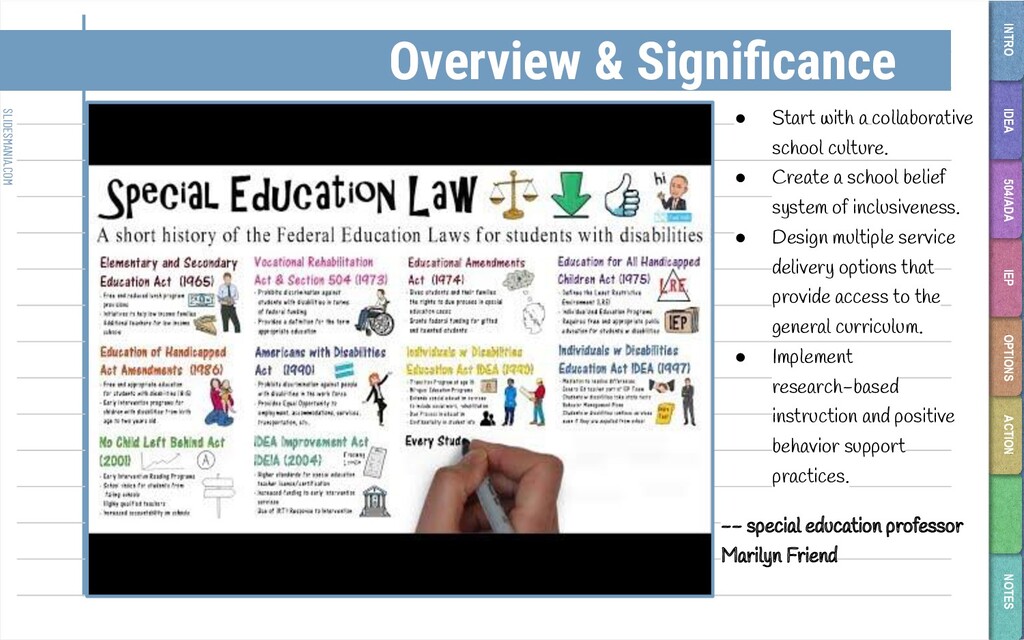
IEP OPTIONS ACTION NOTES • Start with a collaborative school culture. • Create a school belief system of inclusiveness. • Design multiple service delivery options that provide access to the general curriculum. • Implement research-based instruction and positive behavior support practices. -- special education professor Marilyn Friend
(IDEA) ensures that all children with disabilities are entitled to a free appropriate public education to meet their unique needs and prepare them for further education, employment and independent living. INTRO IDEA 504/ADA IEP OPTIONS ACTION NOTES
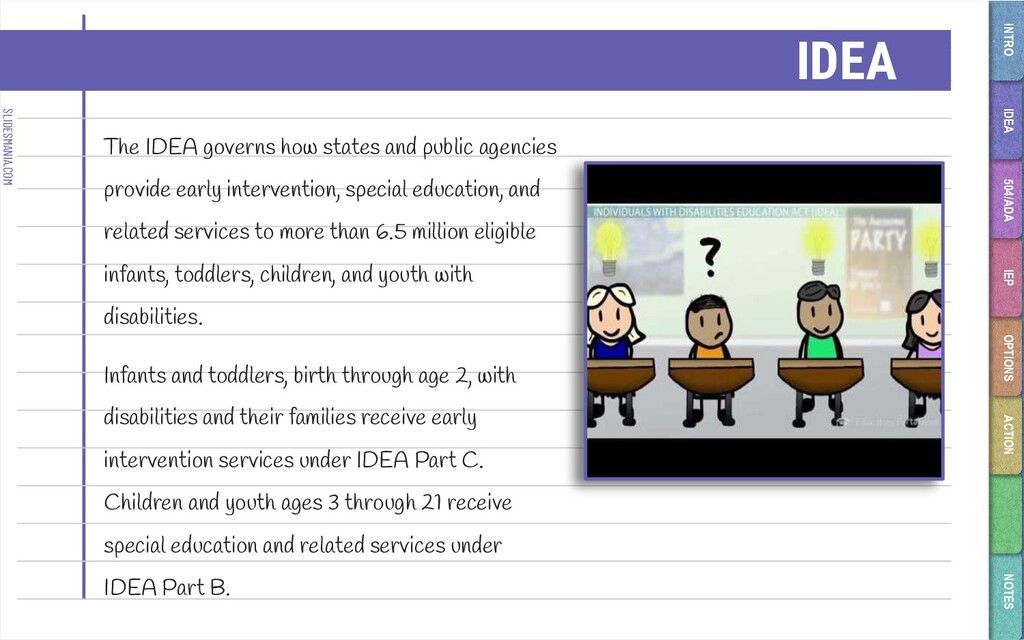
agencies provide early intervention, special education, and related services to more than 6.5 million eligible infants, toddlers, children, and youth with disabilities. Infants and toddlers, birth through age 2, with disabilities and their families receive early intervention services under IDEA Part C. Children and youth ages 3 through 21 receive special education and related services under IDEA Part B. INTRO IDEA 504/ADA IEP OPTIONS ACTION NOTES
to states to support special education and related services and early intervention services. ▪ Discretionary grants to state educational agencies, institutions of higher education, and other nonprofit organizations to support research, demonstrations, technical assistance and dissemination, technology development, personnel preparation and development, and parent-training and -information centers. INTRO IDEA 504/ADA IEP OPTIONS ACTION NOTES
1973 • Prohibits discrimination against people with disabilities and • 504 states ”No otherwise qualififed individaul with a disability...shall solely by reason of their disability, be excluded from the participation in, be denoied benefits of, or be subjected to discrimination under any program, service or activity recieveing Federal finiancil assistance or any program or activity conducted by any Executive agency or by the United States Postal Service. • Does not guarantee success but guarantees equal opportunity for success • Eligibility for people who have a physical or mental impairment and that impairment substantially limits the person’s major life activities. • Referrals can be made by anyone, but school personnel make final eligibility decisions. • Mandates that students be placed with nondisabled peers to the maximum extent possible. WELCOME MATH SCIENCE GEOGRAPHY ENGLISH HISTORY SOCIAL NOTES
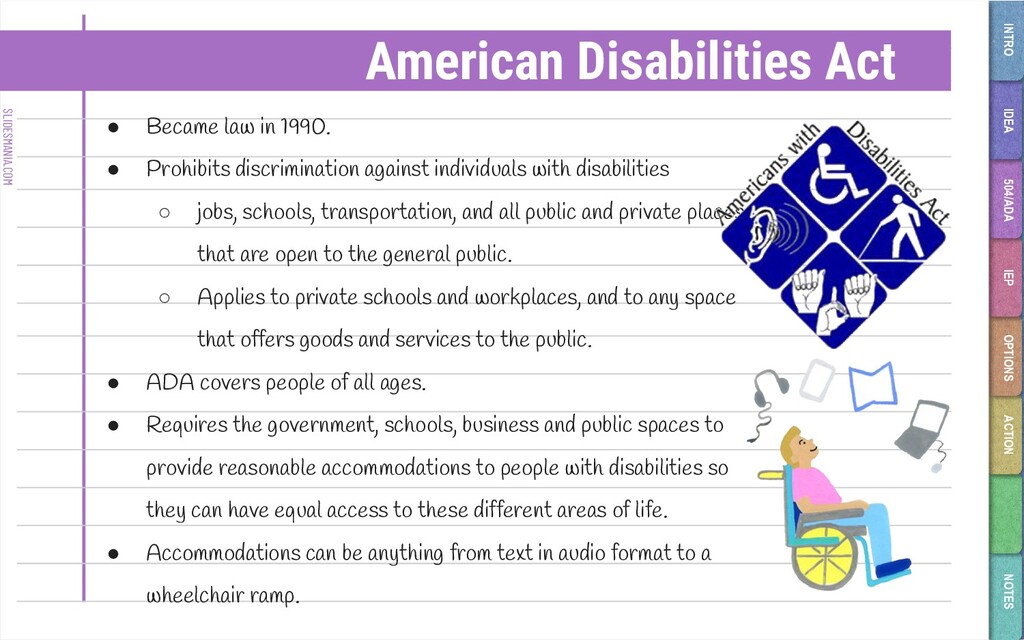
• Prohibits discrimination against individuals with disabilities ◦ jobs, schools, transportation, and all public and private places that are open to the general public. ◦ Applies to private schools and workplaces, and to any space that offers goods and services to the public. • ADA covers people of all ages. • Requires the government, schools, business and public spaces to provide reasonable accommodations to people with disabilities so they can have equal access to these different areas of life. • Accommodations can be anything from text in audio format to a wheelchair ramp. INTRO IDEA 504/ADA IEP OPTIONS ACTION NOTES
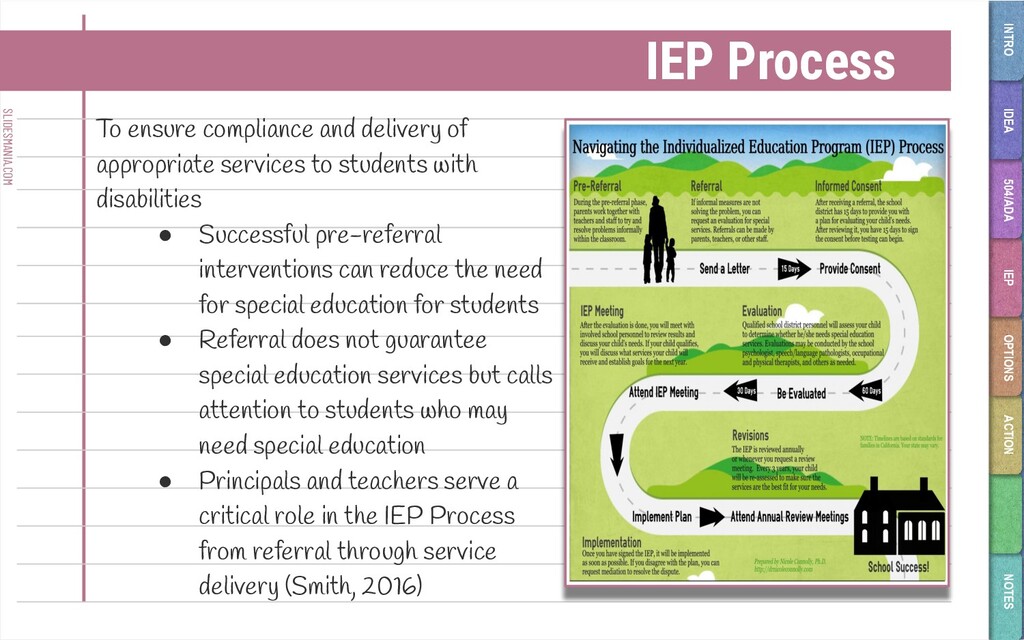
appropriate services to students with disabilities • Successful pre-referral interventions can reduce the need for special education for students • Referral does not guarantee special education services but calls attention to students who may need special education • Principals and teachers serve a critical role in the IEP Process from referral through service delivery (Smith, 2016) INTRO IDEA 504/ADA IEP OPTIONS ACTION NOTES
▪ Statement of the child's current academic achievement and functioning level ▪ Statement of measurable annual goals, both academic and functional. ▪ Description of how goals will be measured. ▪ Statement of special education and related services that will be provided and projected beginning and ending dates for those services. ▪ Explanation of the extent that student will participate with nondisabled peers. ▪ Statement of any appropriate accommodations necessary for assessments. ▪ Transition components for students over the age of 16. INTRO IDEA 504/ADA IEP OPTIONS ACTION NOTES
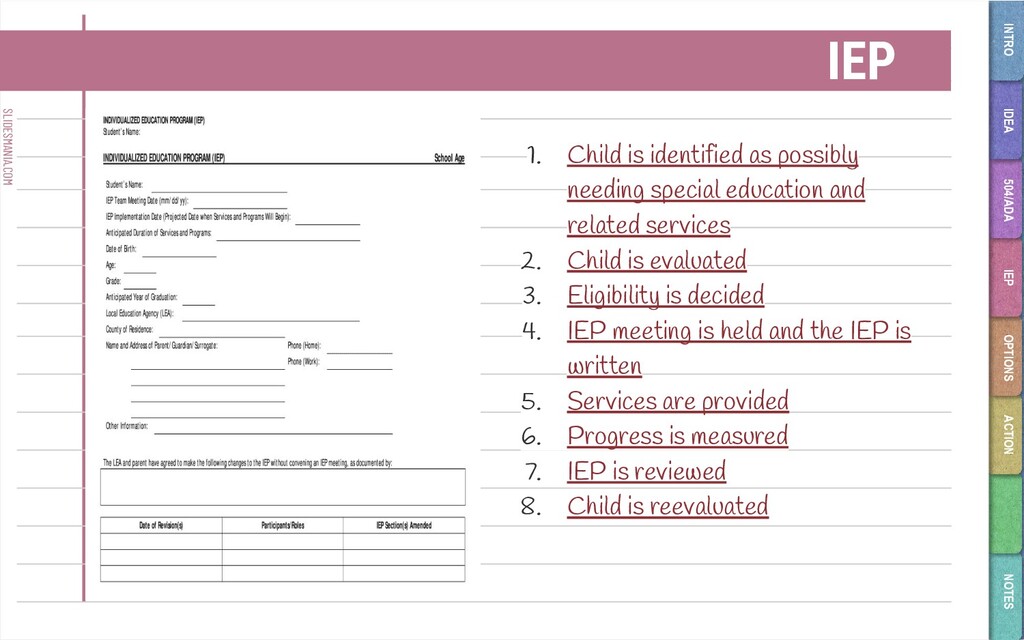
special education and related services 2. Child is evaluated 3. Eligibility is decided 4. IEP meeting is held and the IEP is written 5. Services are provided 6. Progress is measured 7. IEP is reviewed 8. Child is reevaluated INTRO IDEA 504/ADA IEP OPTIONS ACTION NOTES
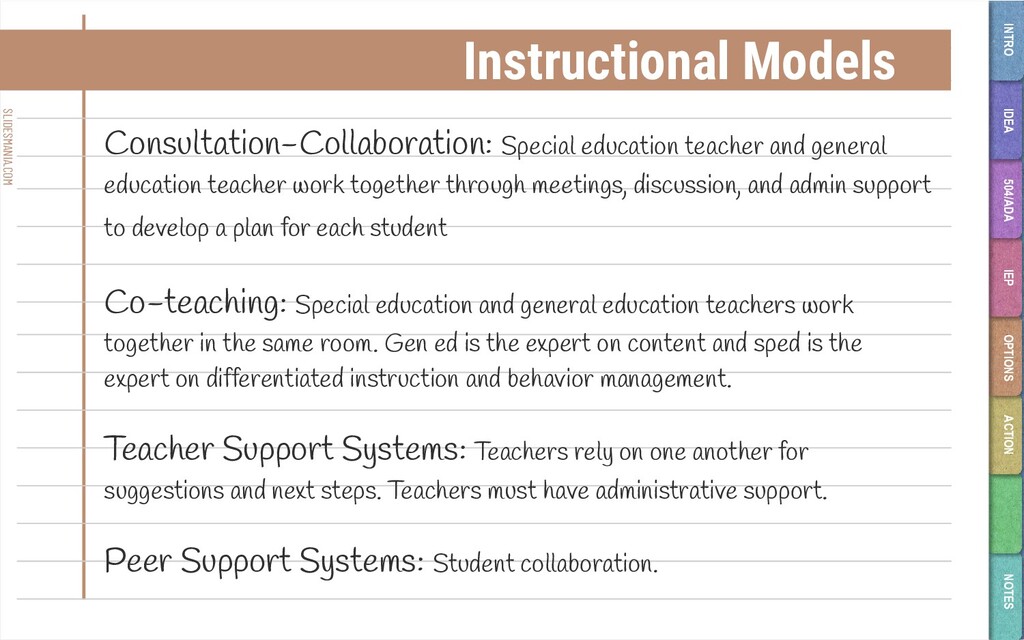
education teacher work together through meetings, discussion, and admin support to develop a plan for each student Co-teaching: Special education and general education teachers work together in the same room. Gen ed is the expert on content and sped is the expert on differentiated instruction and behavior management. Teacher Support Systems: Teachers rely on one another for suggestions and next steps. Teachers must have administrative support. Peer Support Systems: Student collaboration. INTRO IDEA 504/ADA IEP OPTIONS ACTION NOTES
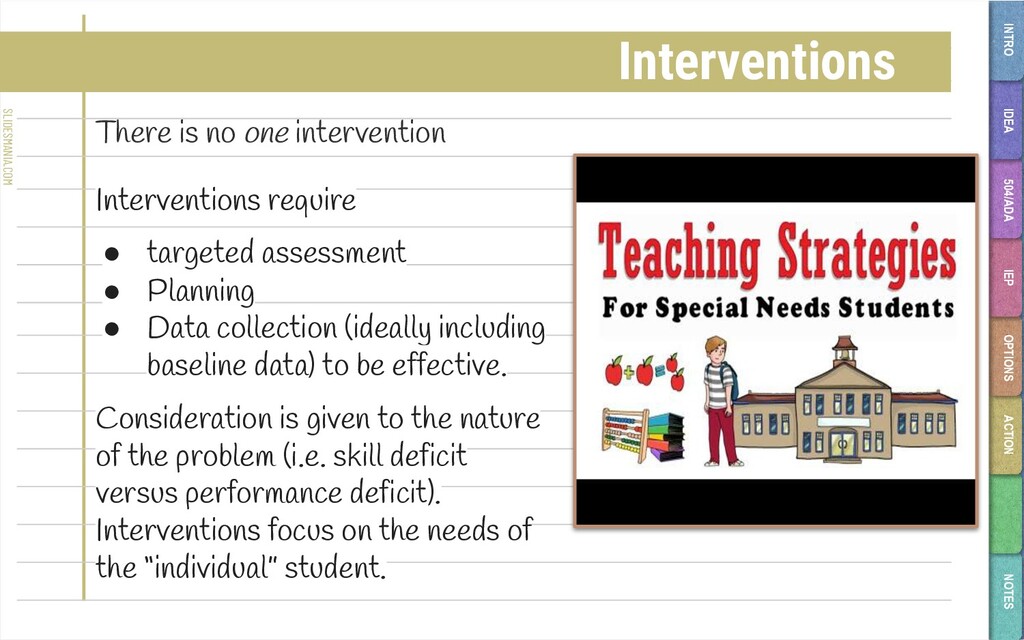
• targeted assessment • Planning • Data collection (ideally including baseline data) to be effective. Consideration is given to the nature of the problem (i.e. skill deficit versus performance deficit). Interventions focus on the needs of the “individual” student. INTRO IDEA 504/ADA IEP OPTIONS ACTION NOTES
Instruction: Addresses different learning needs 3. Universal Design for Learning: reduces barriers in instruction, provides appropriate accommodations, supports and challenges maintains high achievement expectations 4. Accommodations & Modifications: accommodation changes how a student learns the material. A modification changes what a student is taught or expected to learn. 5. Strategies Instruction: strategies instruction model teaches students to use strategies 6. Strategies to Acquire Information: reading, note-taking, decoding 7. Strategies to Store & Retrieve Information: mnemonics use visual or verbal clues created by the individual to assist with storing & retrieving information 8. MTSS: provides multiple supports to access information and learning 9. Data Driven Instruction & Progress Monitoring: teachers can determine the effectiveness of their instruction and allow for modifications INTRO IDEA 504/ADA IEP OPTIONS ACTION NOTES
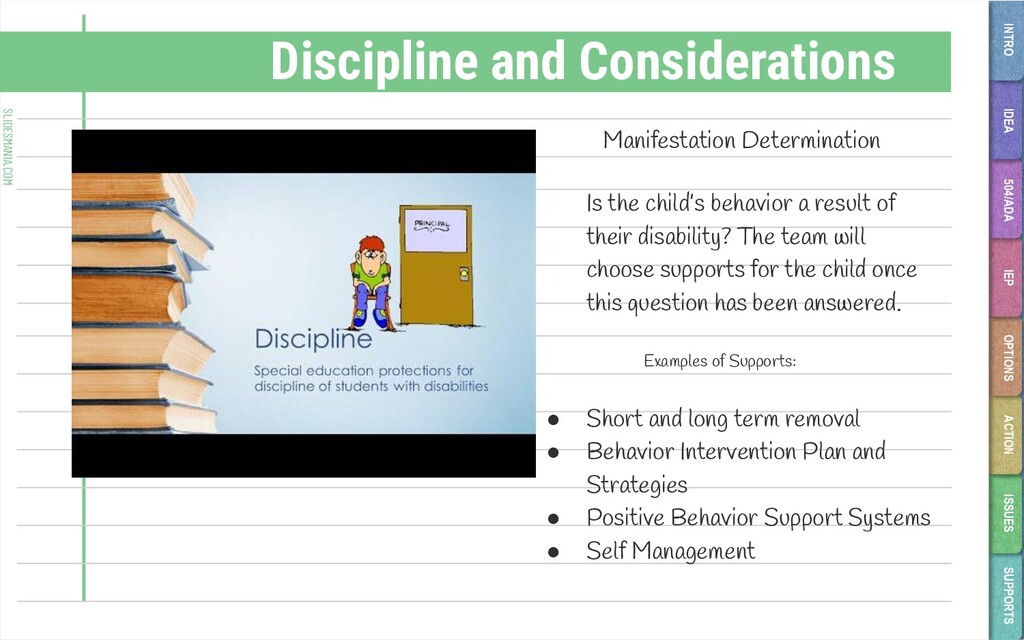
behavior a result of their disability? The team will choose supports for the child once this question has been answered. Examples of Supports: • Short and long term removal • Behavior Intervention Plan and Strategies • Positive Behavior Support Systems • Self Management INTRO IDEA 504/ADA IEP OPTIONS ACTION ISSUES SUPPORTS
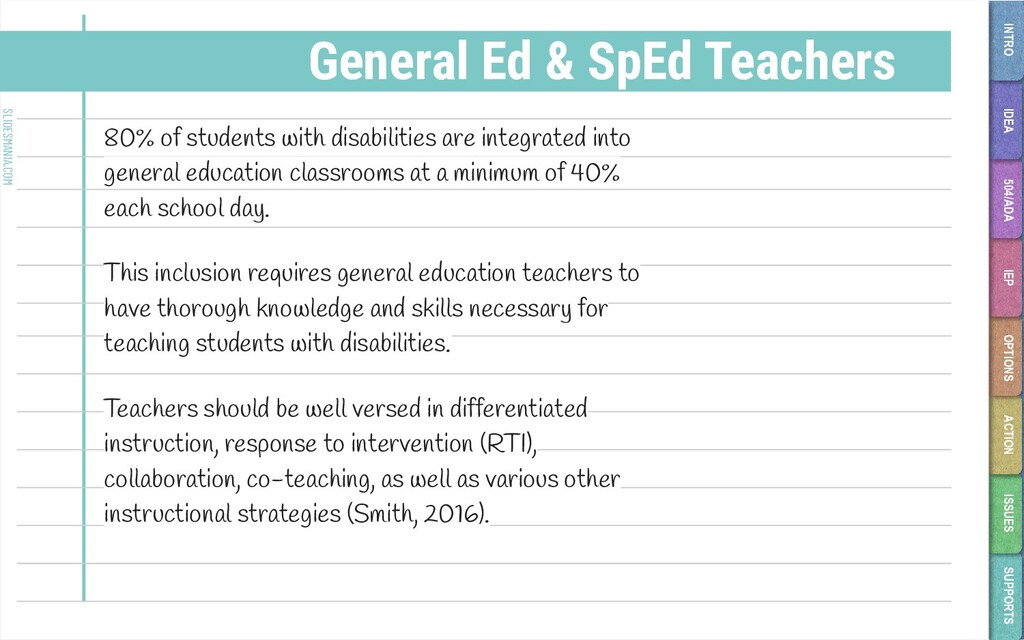
with disabilities are integrated into general education classrooms at a minimum of 40% each school day. This inclusion requires general education teachers to have thorough knowledge and skills necessary for teaching students with disabilities. Teachers should be well versed in differentiated instruction, response to intervention (RTI), collaboration, co-teaching, as well as various other instructional strategies (Smith, 2016). INTRO IDEA 504/ADA IEP OPTIONS ACTION ISSUES SUPPORTS
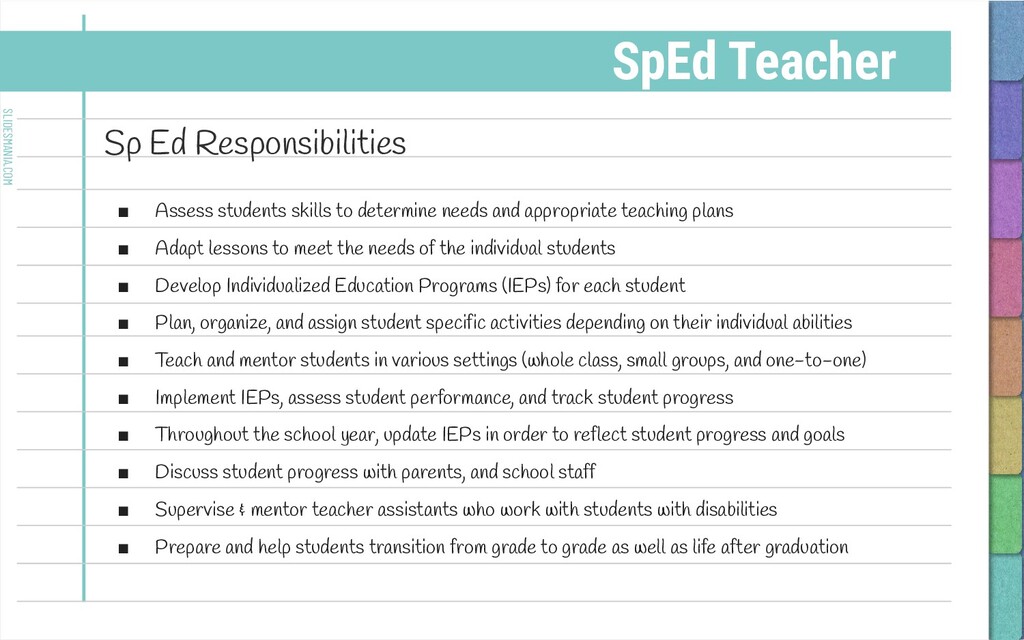
skills to determine needs and appropriate teaching plans ▪ Adapt lessons to meet the needs of the individual students ▪ Develop Individualized Education Programs (IEPs) for each student ▪ Plan, organize, and assign student specific activities depending on their individual abilities ▪ Teach and mentor students in various settings (whole class, small groups, and one-to-one) ▪ Implement IEPs, assess student performance, and track student progress ▪ Throughout the school year, update IEPs in order to reflect student progress and goals ▪ Discuss student progress with parents, and school staff ▪ Supervise & mentor teacher assistants who work with students with disabilities ▪ Prepare and help students transition from grade to grade as well as life after graduation
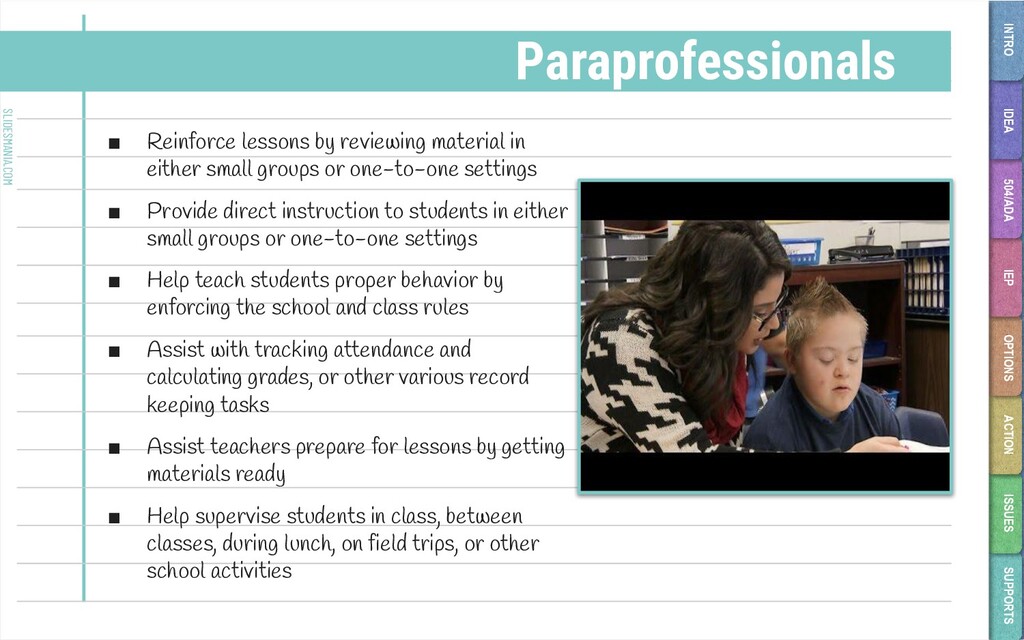
either small groups or one-to-one settings ▪ Provide direct instruction to students in either small groups or one-to-one settings ▪ Help teach students proper behavior by enforcing the school and class rules ▪ Assist with tracking attendance and calculating grades, or other various record keeping tasks ▪ Assist teachers prepare for lessons by getting materials ready ▪ Help supervise students in class, between classes, during lunch, on field trips, or other school activities INTRO IDEA 504/ADA IEP OPTIONS ACTION ISSUES SUPPORTS
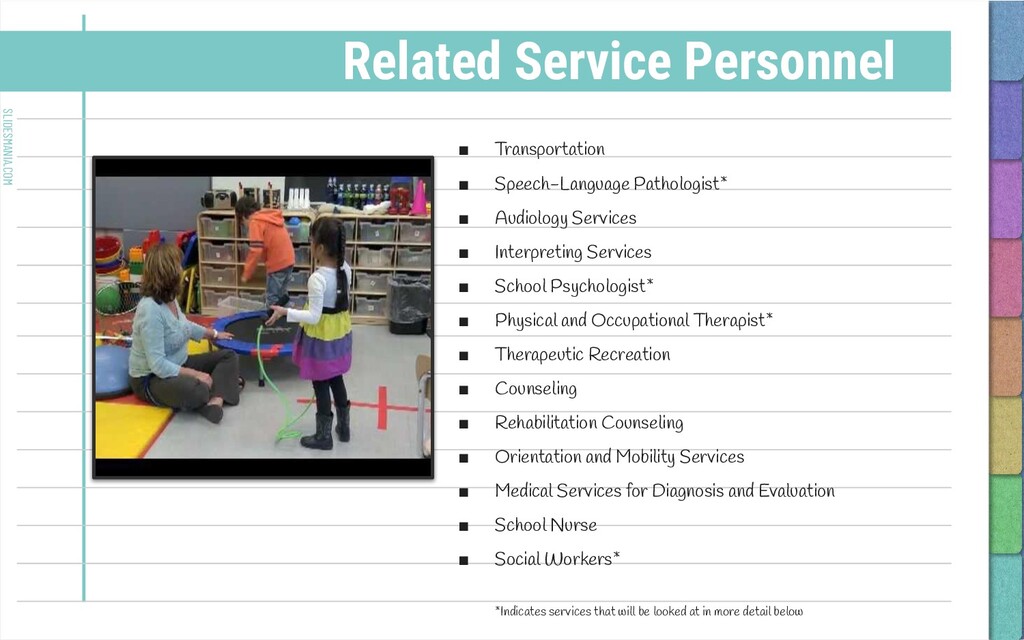
▪ Audiology Services ▪ Interpreting Services ▪ School Psychologist* ▪ Physical and Occupational Therapist* ▪ Therapeutic Recreation ▪ Counseling ▪ Rehabilitation Counseling ▪ Orientation and Mobility Services ▪ Medical Services for Diagnosis and Evaluation ▪ School Nurse ▪ Social Workers* *Indicates services that will be looked at in more detail below
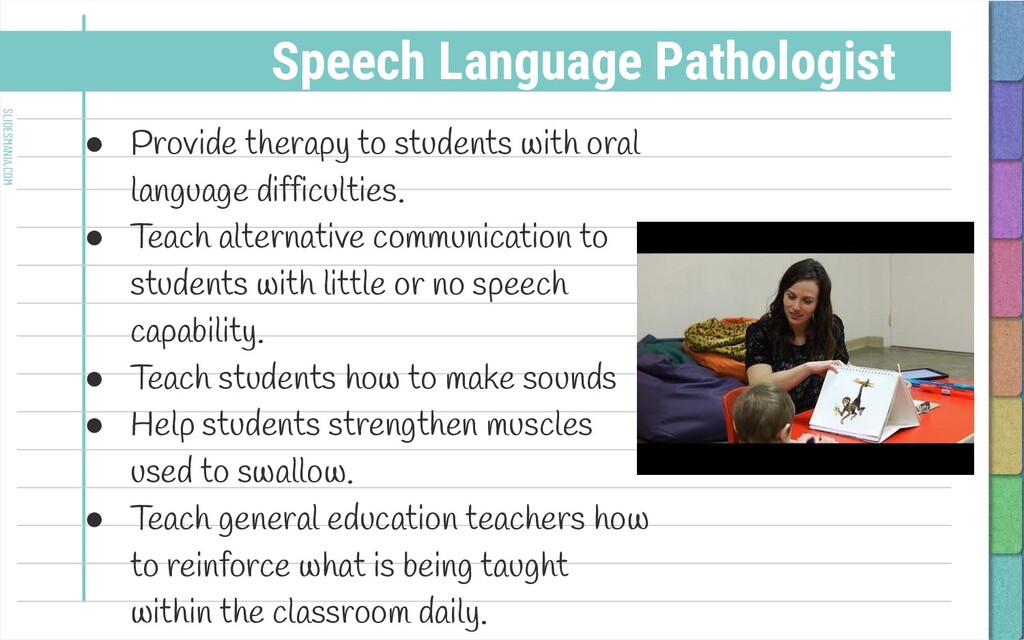
with oral language difficulties. • Teach alternative communication to students with little or no speech capability. • Teach students how to make sounds • Help students strengthen muscles used to swallow. • Teach general education teachers how to reinforce what is being taught within the classroom daily.
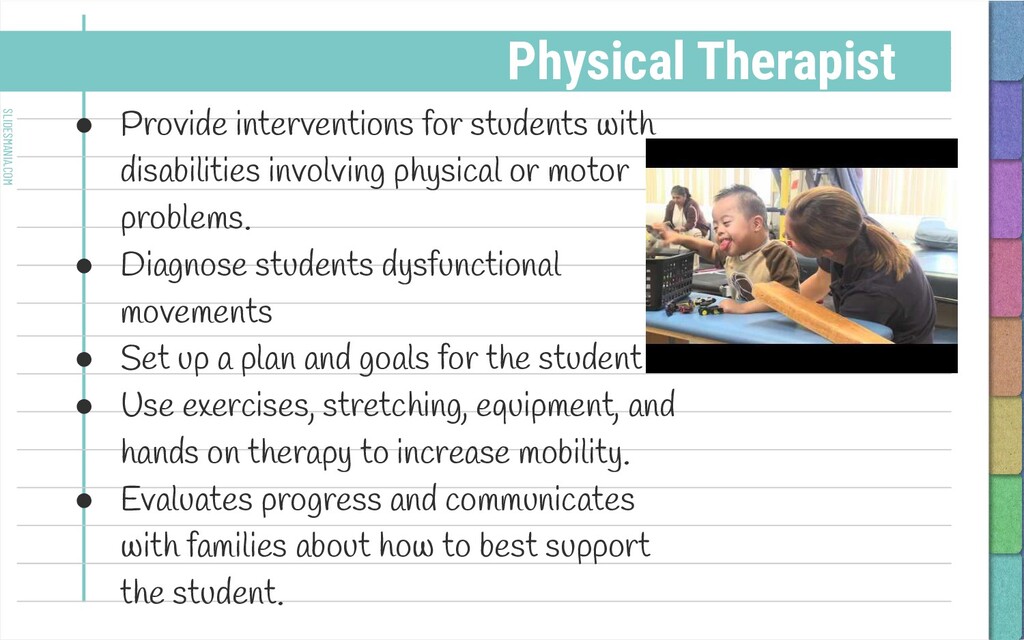
disabilities involving physical or motor problems. • Diagnose students dysfunctional movements • Set up a plan and goals for the student • Use exercises, stretching, equipment, and hands on therapy to increase mobility. • Evaluates progress and communicates with families about how to best support the student.
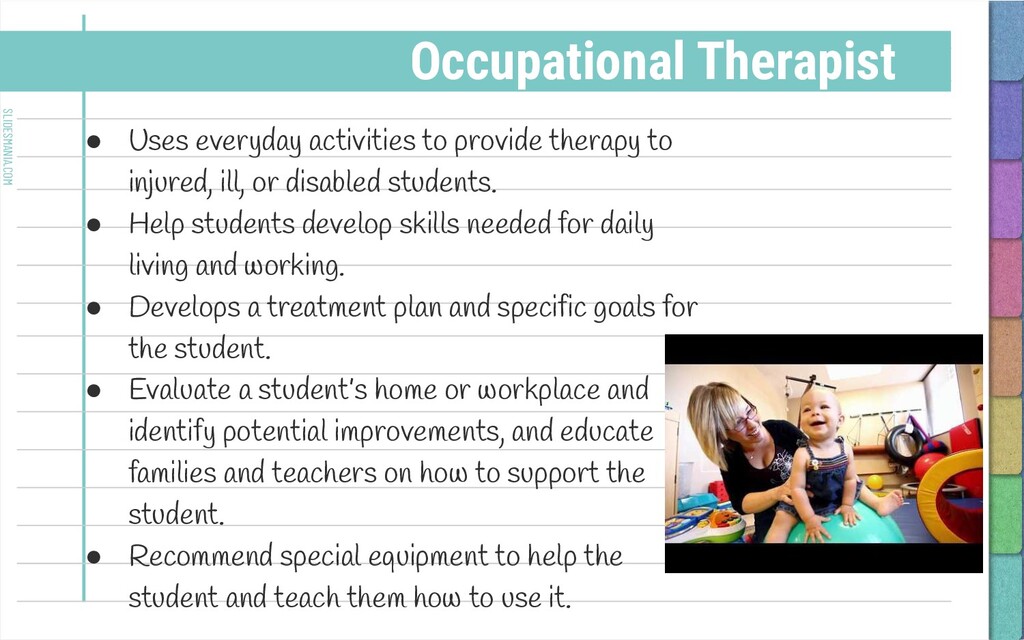
therapy to injured, ill, or disabled students. • Help students develop skills needed for daily living and working. • Develops a treatment plan and specific goals for the student. • Evaluate a student’s home or workplace and identify potential improvements, and educate families and teachers on how to support the student. • Recommend special equipment to help the student and teach them how to use it.
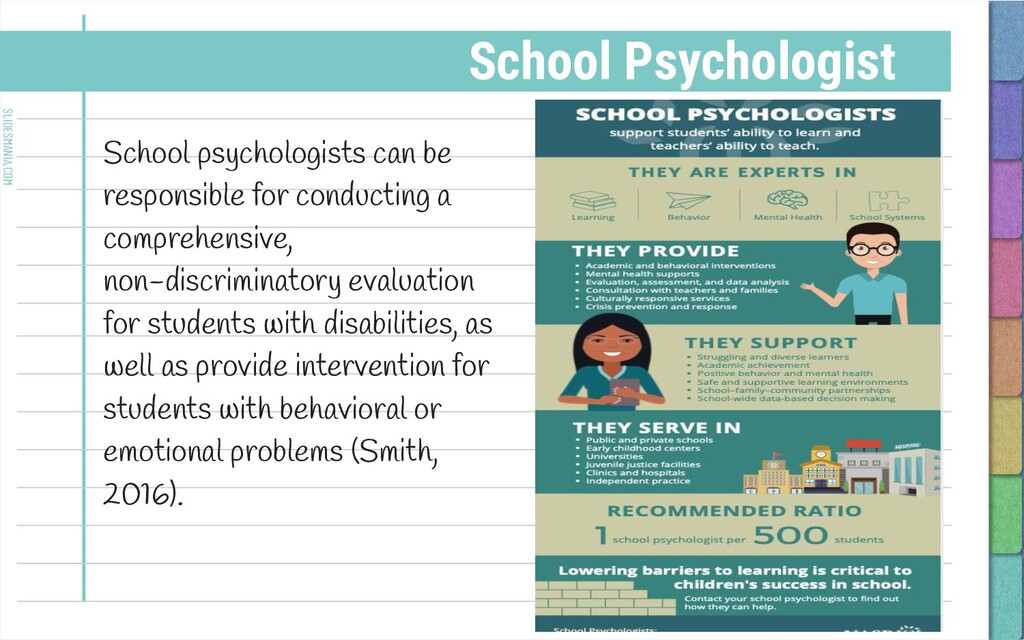
conducting a comprehensive, non-discriminatory evaluation for students with disabilities, as well as provide intervention for students with behavioral or emotional problems (Smith, 2016).
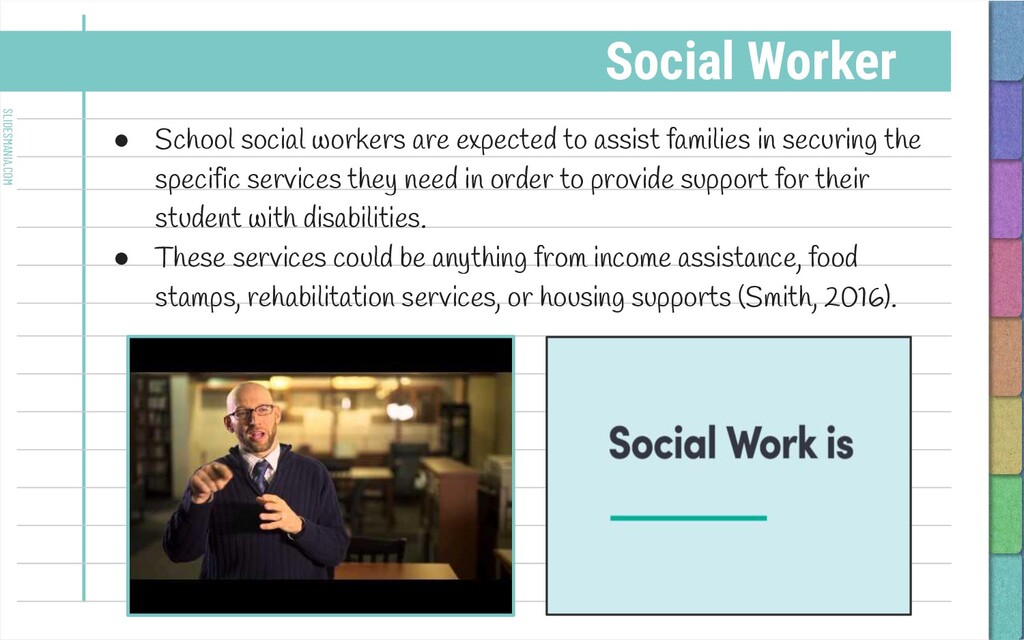
to assist families in securing the specific services they need in order to provide support for their student with disabilities. • These services could be anything from income assistance, food stamps, rehabilitation services, or housing supports (Smith, 2016).
with special needs face various stressors and it is the responsibility of the school to build a positive supportive relationship in order to ensure the best for the student. One of the first steps to building a positive, supportive, collaborative relationship with the families of students with special needs, it is important to be aware of the many stressors that families may be facing and the many reactions families may have when discovering they have a student with special needs -- (Smith, 2016).
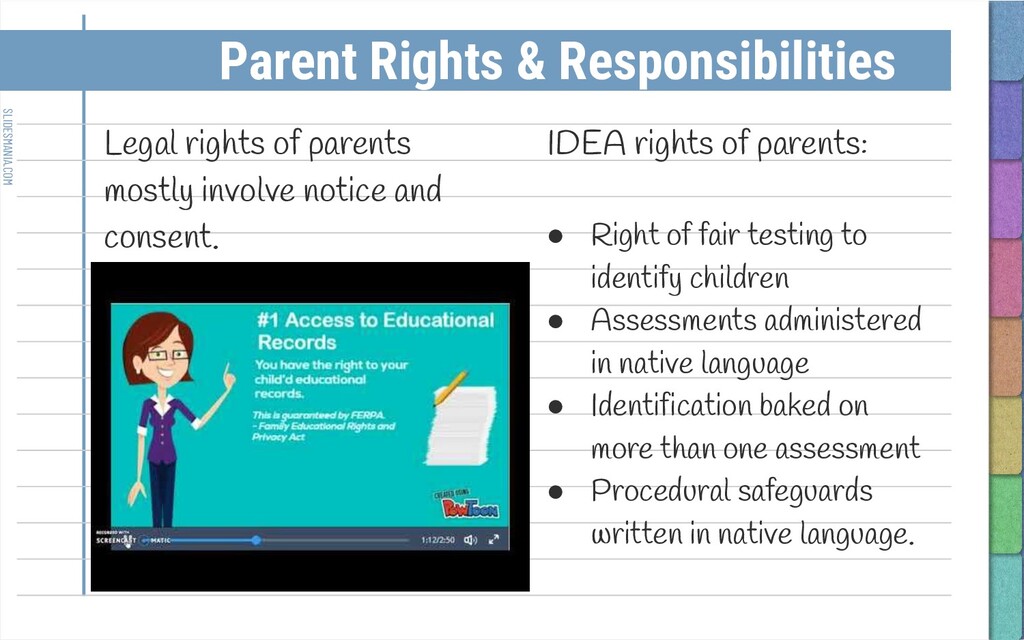
of parents mostly involve notice and consent. IDEA rights of parents: • Right of fair testing to identify children • Assessments administered in native language • Identification baked on more than one assessment • Procedural safeguards written in native language.
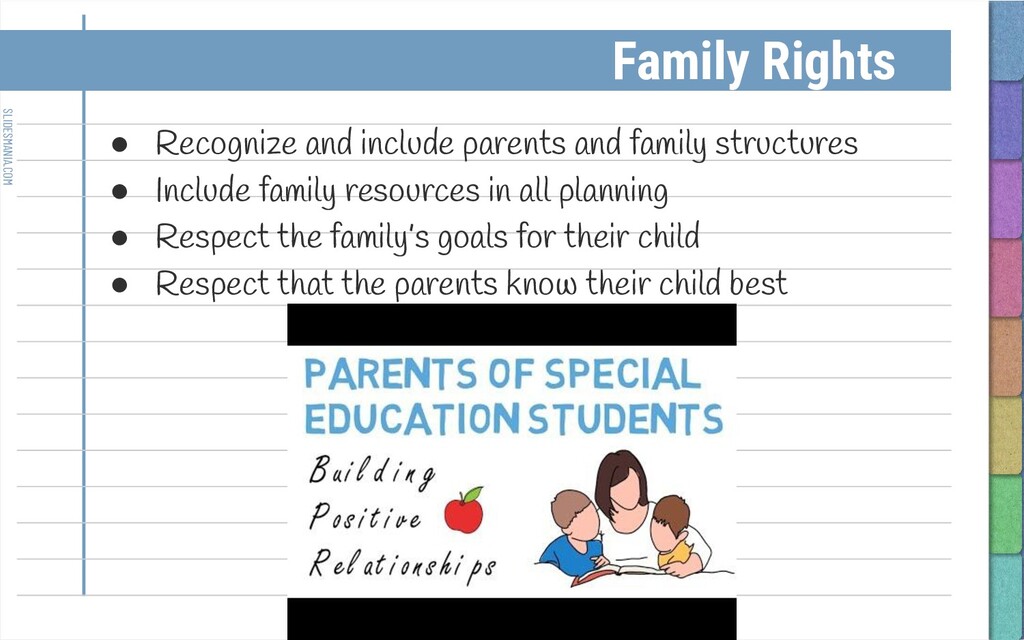
parents and family structures • Include family resources in all planning • Respect the family’s goals for their child • Respect that the parents know their child best
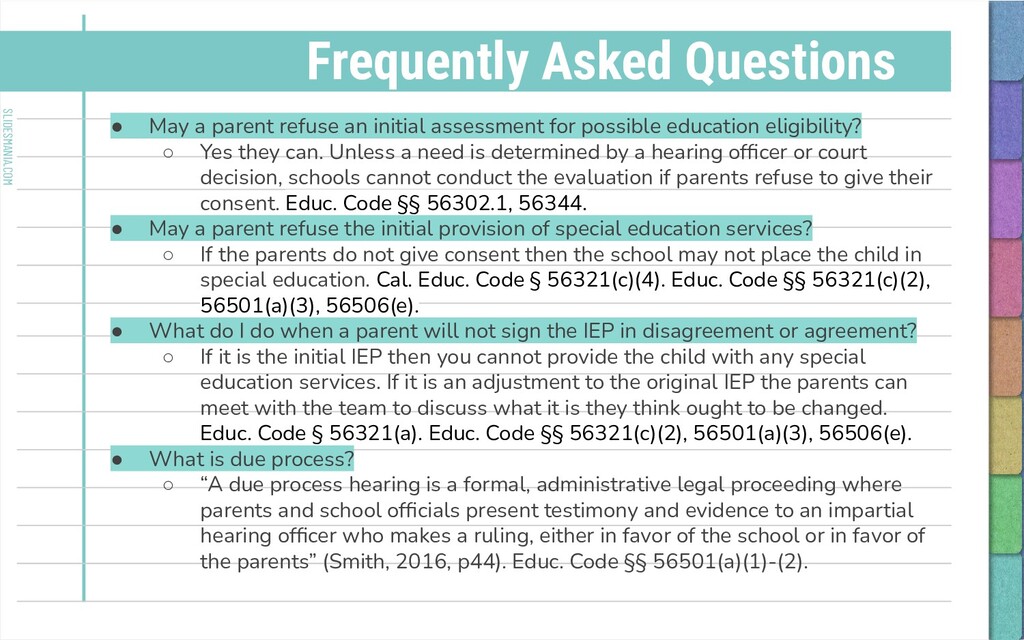
an initial assessment for possible education eligibility? ◦ Yes they can. Unless a need is determined by a hearing officer or court decision, schools cannot conduct the evaluation if parents refuse to give their consent. Educ. Code §§ 56302.1, 56344. • May a parent refuse the initial provision of special education services? ◦ If the parents do not give consent then the school may not place the child in special education. Cal. Educ. Code § 56321(c)(4). Educ. Code §§ 56321(c)(2), 56501(a)(3), 56506(e). • What do I do when a parent will not sign the IEP in disagreement or agreement? ◦ If it is the initial IEP then you cannot provide the child with any special education services. If it is an adjustment to the original IEP the parents can meet with the team to discuss what it is they think ought to be changed. Educ. Code § 56321(a). Educ. Code §§ 56321(c)(2), 56501(a)(3), 56506(e). • What is due process? ◦ “A due process hearing is a formal, administrative legal proceeding where parents and school officials present testimony and evidence to an impartial hearing officer who makes a ruling, either in favor of the school or in favor of the parents” (Smith, 2016, p44). Educ. Code §§ 56501(a)(1)-(2).
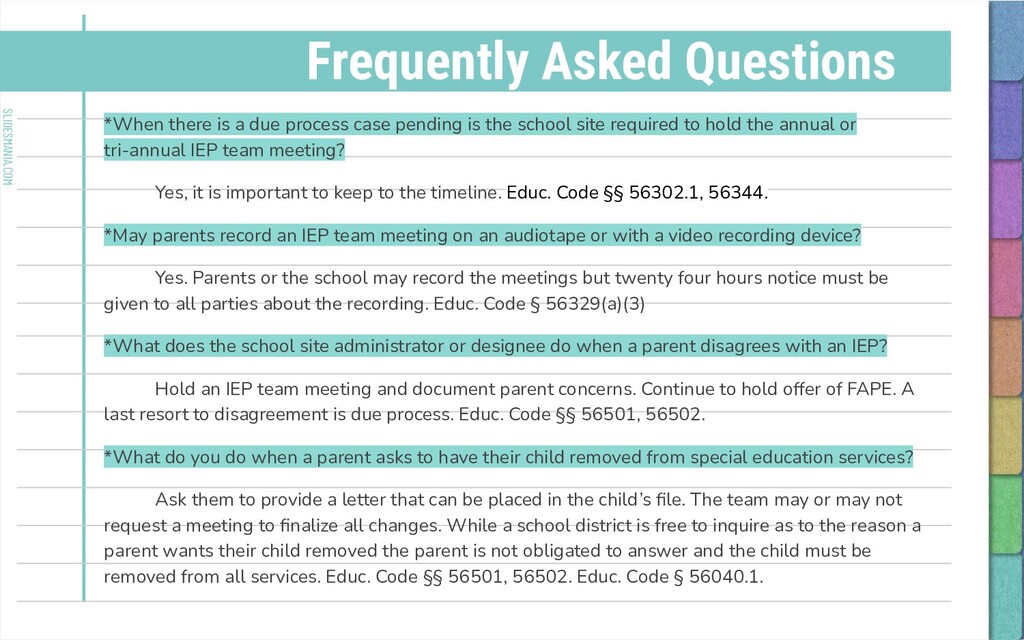
process case pending is the school site required to hold the annual or tri-annual IEP team meeting? Yes, it is important to keep to the timeline. Educ. Code §§ 56302.1, 56344. *May parents record an IEP team meeting on an audiotape or with a video recording device? Yes. Parents or the school may record the meetings but twenty four hours notice must be given to all parties about the recording. Educ. Code § 56329(a)(3) *What does the school site administrator or designee do when a parent disagrees with an IEP? Hold an IEP team meeting and document parent concerns. Continue to hold offer of FAPE. A last resort to disagreement is due process. Educ. Code §§ 56501, 56502. *What do you do when a parent asks to have their child removed from special education services? Ask them to provide a letter that can be placed in the child’s file. The team may or may not request a meeting to finalize all changes. While a school district is free to inquire as to the reason a parent wants their child removed the parent is not obligated to answer and the child must be removed from all services. Educ. Code §§ 56501, 56502. Educ. Code § 56040.1.
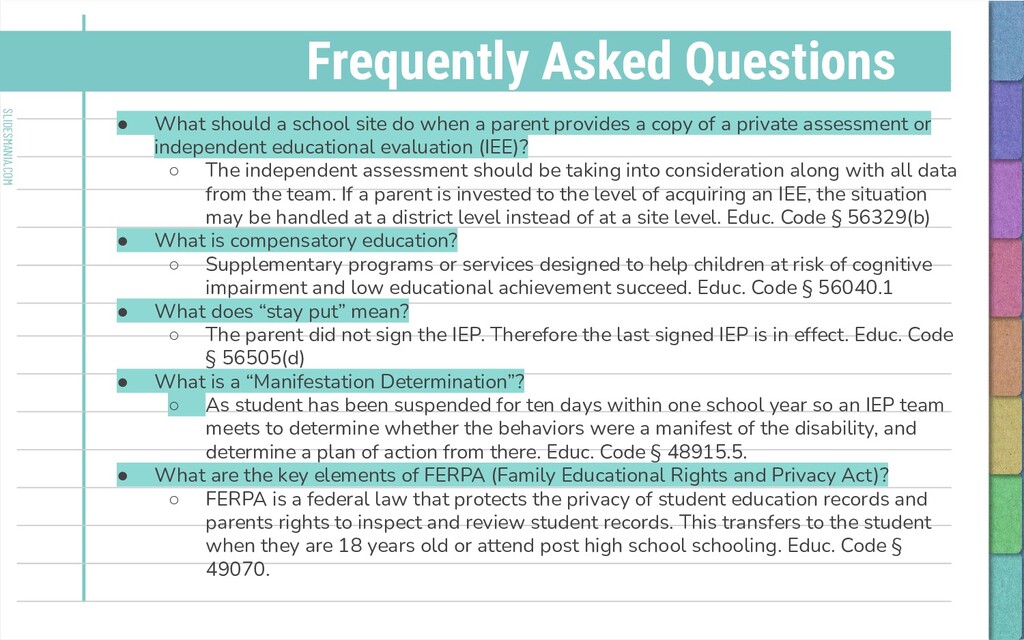
site do when a parent provides a copy of a private assessment or independent educational evaluation (IEE)? ◦ The independent assessment should be taking into consideration along with all data from the team. If a parent is invested to the level of acquiring an IEE, the situation may be handled at a district level instead of at a site level. Educ. Code § 56329(b) • What is compensatory education? ◦ Supplementary programs or services designed to help children at risk of cognitive impairment and low educational achievement succeed. Educ. Code § 56040.1 • What does “stay put” mean? ◦ The parent did not sign the IEP. Therefore the last signed IEP is in effect. Educ. Code § 56505(d) • What is a “Manifestation Determination”? ◦ As student has been suspended for ten days within one school year so an IEP team meets to determine whether the behaviors were a manifest of the disability, and determine a plan of action from there. Educ. Code § 48915.5. • What are the key elements of FERPA (Family Educational Rights and Privacy Act)? ◦ FERPA is a federal law that protects the privacy of student education records and parents rights to inspect and review student records. This transfers to the student when they are 18 years old or attend post high school schooling. Educ. Code § 49070.


 signer
 mariooc
 matleenalaakso
 juanmartin2026
 yatabe
 terasawat
 drpoonamkc
 hiragahh
 arnoknobbe
 pawan_pharm
 bunnchinn3
 camel_404
 aarron
 sugarenia
 samlambert
 honzajavorek
 rasagy
 auna
auna
 irinanazarova
 cromwellryan
 stephenakadiri
 baasie
 caitiem20
 addyosmani