Upgrade to Pro — share decks privately, control downloads, hide ads and more …

The Emerging Open Access Policy Framework in th...

Avatar for SPARC SPARC
January 03, 2016

The Emerging Open Access Policy Framework in the United States

By Heather Joseph: Executive Director, SPARC
Delivered at the Berlin 11 Open Access Conference
November 19, 2013
Licensed CC BY 4.0

Avatar for SPARC

SPARC

January 03, 2016

Other Decks in Research

Transcript

  1. The  Emerging  Open  Access  Policy   Framework  in  the  

      United  States   Heather  Joseph   Execu@ve  Director,  SPARC     Berlin  11  Open  Access  Conference   November  19,  2013  
  2. Annual  Federal  Government   investment  of  ~US$60  billion  on  

    basic  and  applied  scien@fic   research.  
  3. Expecta@on  that  new  ideas  will  be   generated,  new  discoveries

     will  be   uncovered,  and  our  collec@ve   understanding  of  the  world  and   our  interac@ons  with  it  will  be   enhanced.    
  4. This  can  only  happen  if  we  can   access  and

     use  the  results  of  this   research.    
  5.  Working  theory  is  that  policies   that  encourage  open  access

     to   the  results  of  this  research  will   accelerate  and  significantly   improve  expected  outcomes.  
  6. •  S@mulate  new  ideas   •  Accelerate  scien@fic  discovery  

    •  Improve  educa@onal  outcomes   •  Fuel  innova@on   •  Grow  the  economy/create  jobs   •  Improve  the  welfare  of  the   public    
  7. The  U.S.  increasingly  recognizes   the  need  to  create  a

     policy   framework  that  supports  all   stakeholders  in  a  transi@on  to  a   more  open  system  of  sharing   research  results.    
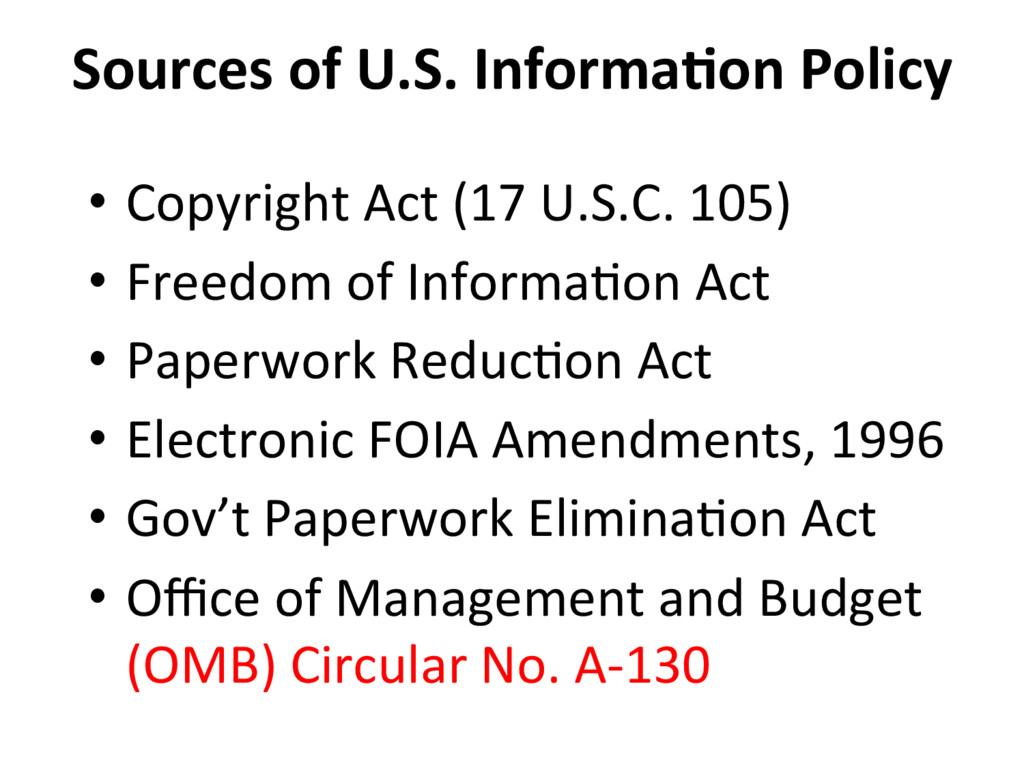
  8. Sources  of  U.S.  Informa7on  Policy   •  Copyright  Act  (17

     U.S.C.  105)   •  Freedom  of  Informa@on  Act   •  Paperwork  Reduc@on  Act   •  Electronic  FOIA  Amendments,  1996   •  Gov’t  Paperwork  Elimina@on  Act     •  Office  of  Management  and  Budget   (OMB)  Circular  No.  A-­‐130  
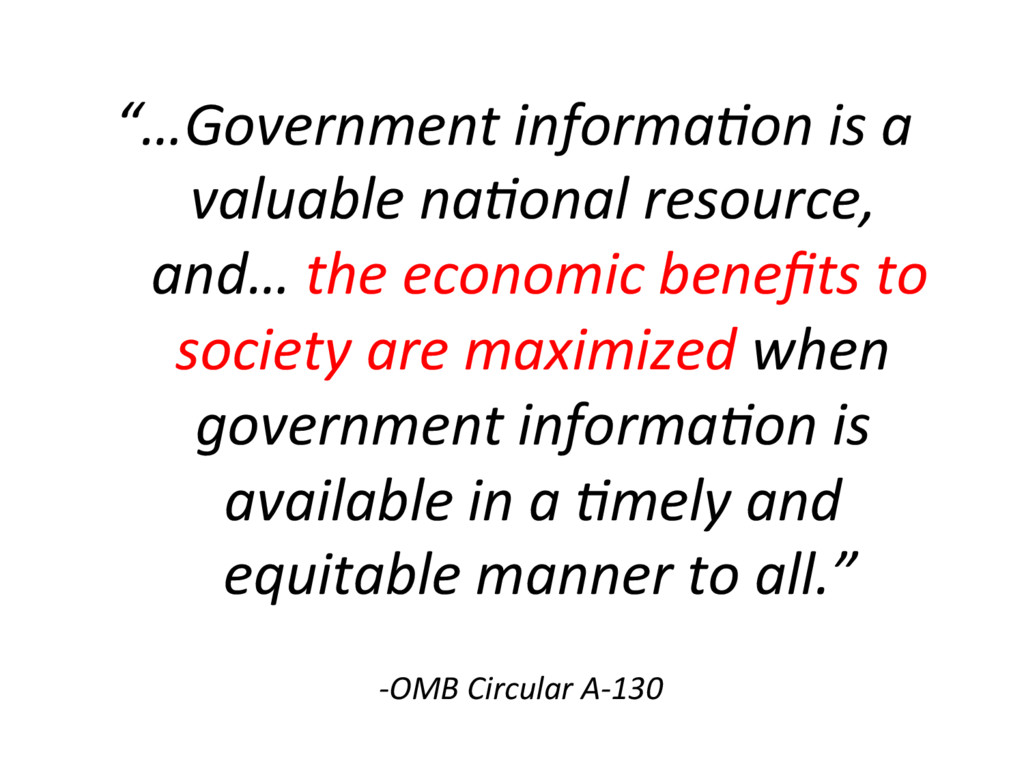
  9. “…Government  informa2on  is  a   valuable  na2onal  resource,   and…

     the  economic  benefits  to   society  are  maximized  when   government  informa2on  is   available  in  a  2mely  and   equitable  manner  to  all.”     -­‐OMB  Circular  A-­‐130      
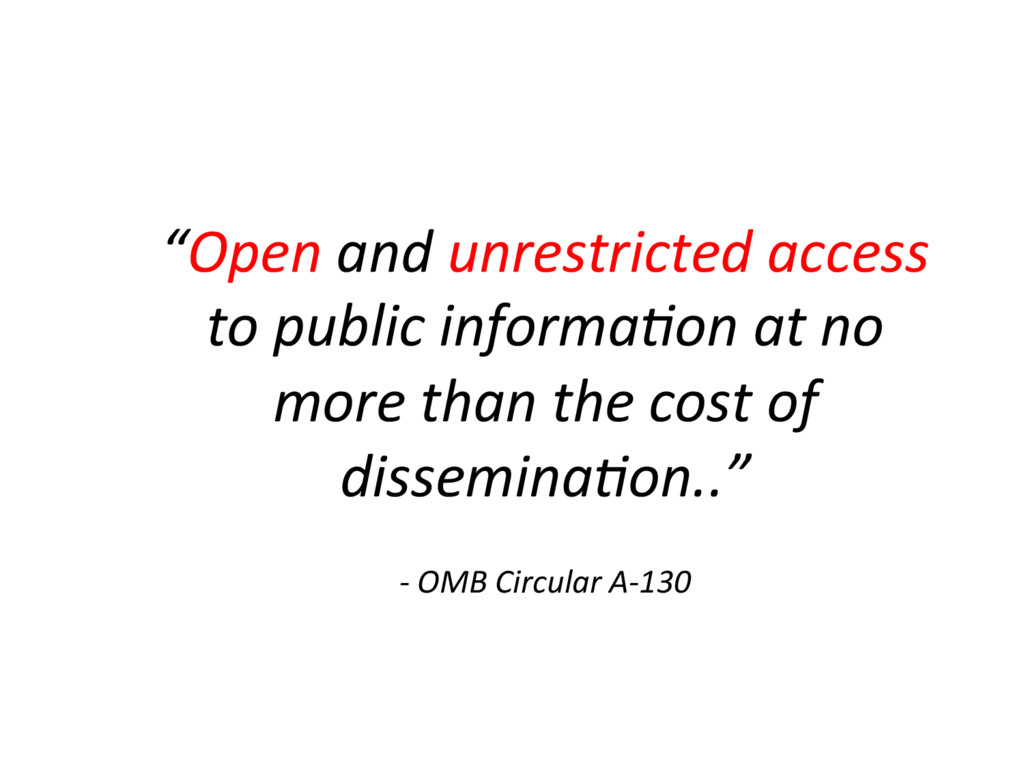
  10. “Open  and  unrestricted  access   to  public  informa2on  at  no

      more  than  the  cost  of   dissemina2on..”     -­‐  OMB  Circular  A-­‐130  
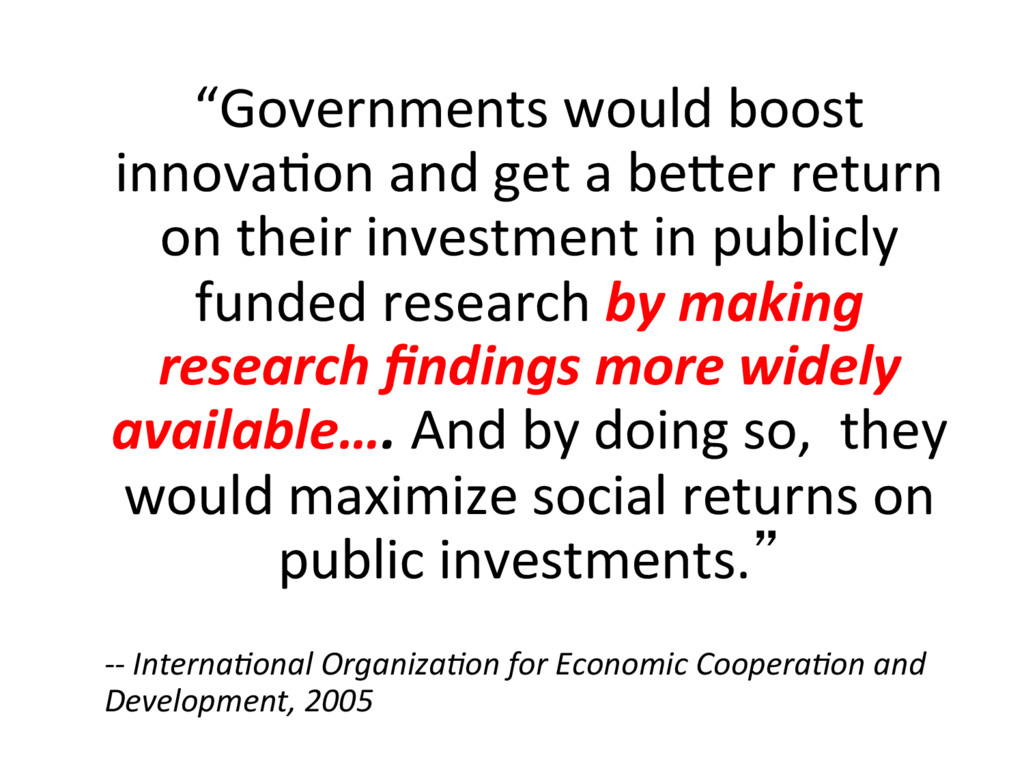
  11. “Governments  would  boost   innova@on  and  get  a  becer  return

      on  their  investment  in  publicly   funded  research  by  making   research  findings  more  widely   available….  And  by  doing  so,    they   would  maximize  social  returns  on   public  investments.”     -­‐-­‐  Interna2onal  Organiza2on  for  Economic  Coopera2on  and   Development,  2005  
  12. Public  is  en@tled  to  access  and  use   the  results

     of  research  their  tax   dollars  pay  for.    
  13. Taken  about  a  decade  for  policies   suppor@ng  this  statement

     to  be   developed,  adopted  and   implemented.  
  14. The  U.S.  Na@onal  Ins@tutes  of   Health  funds  ~US$30  billion

     in   basic  and  applied  biomedical   research  each  year  –  roughly  half   of  the  total  U.S.  annual  research   investment.        
  15. “The  Commicee  is  very  concerned   that  there  is  insufficient

     public  access   to  reports  and  data  resul@ng  from   NIH-­‐funded  research.  This  situa@on,   which  has  been  exacerbated  by  the   drama@c  rise  in  scien@fic  journal   subscrip@on  prices,  is  contrary  to  the   best  interests  of  the  U.S.  taxpayers   who  paid  for  this  research…”       -­‐U.S.  House  Appropria7ons  Commi>ee,  2004  
  16. “The  Commicee  is  aware  of  a  proposal   to  make

     ar@cles  generated  by  NIH-­‐ funded  research  available  on  PubMed   Central  (PMC).  The  Commicee   supports  this  proposal  and   recommends  that  NIH  develop  a  policy     requiring  that  an  electronic  copy  of   manuscripts  repor@ng  work  supported   by  NIH  be  provided  to  PMC.”    
  17. “The  NIH  shall  request  that  all   inves@gators  funded  by

     the  NIH  submit   to  the  Na@onal  Library  of  Medicine's   PubMed  Central  an  electronic  version   of  their  final,  peer-­‐reviewed   manuscripts  upon  acceptance  for   publica@on,  to  be  made  publicly   available  no  later  than  12  months  aner   the  official  date  of  publica@on.”          
  18. Key  Policy  Components:             • 

    “Green”  Policy  –  silent  on  “Gold”   •  Covers  Authors  final  manuscripts   •  Deposit  upon  acceptance  in   journal   •  Embargo  period  of  author’s   choice  (0-­‐12  months)   •  Largely  silent  on  reuse  right  
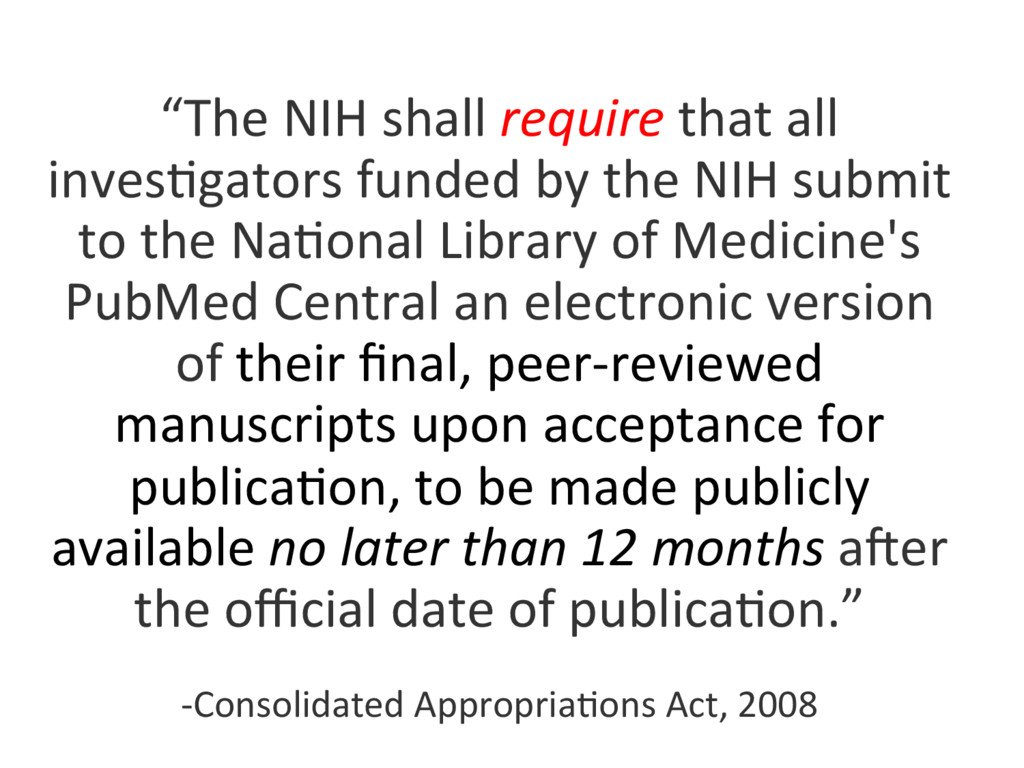
  19. “The  NIH  shall  require  that  all   inves@gators  funded  by

     the  NIH  submit   to  the  Na@onal  Library  of  Medicine's   PubMed  Central  an  electronic  version   of  their  final,  peer-­‐reviewed   manuscripts  upon  acceptance  for   publica@on,  to  be  made  publicly   available  no  later  than  12  months  aner   the  official  date  of  publica@on.”     -­‐Consolidated  Appropria@ons  Act,  2008    
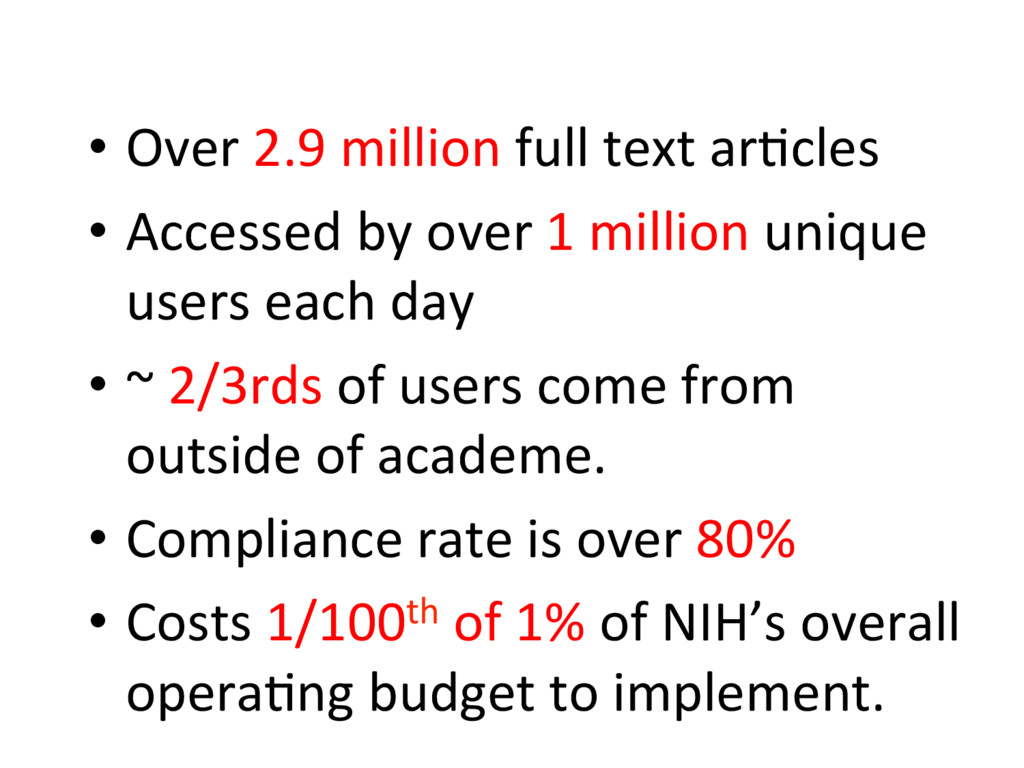
  20. •  Over  2.9  million  full  text  ar@cles   •  Accessed

     by  over  1  million  unique   users  each  day     •  ~  2/3rds  of  users  come  from   outside  of  academe.   •  Compliance  rate  is  over  80%   •  Costs  1/100th  of  1%  of  NIH’s  overall   opera@ng  budget  to  implement.  
  21. 5  Years  of  Data  from  NIH    Informed   considera@on

     of  addi@onal  Open   Access  Policies  in  the  U.S….  
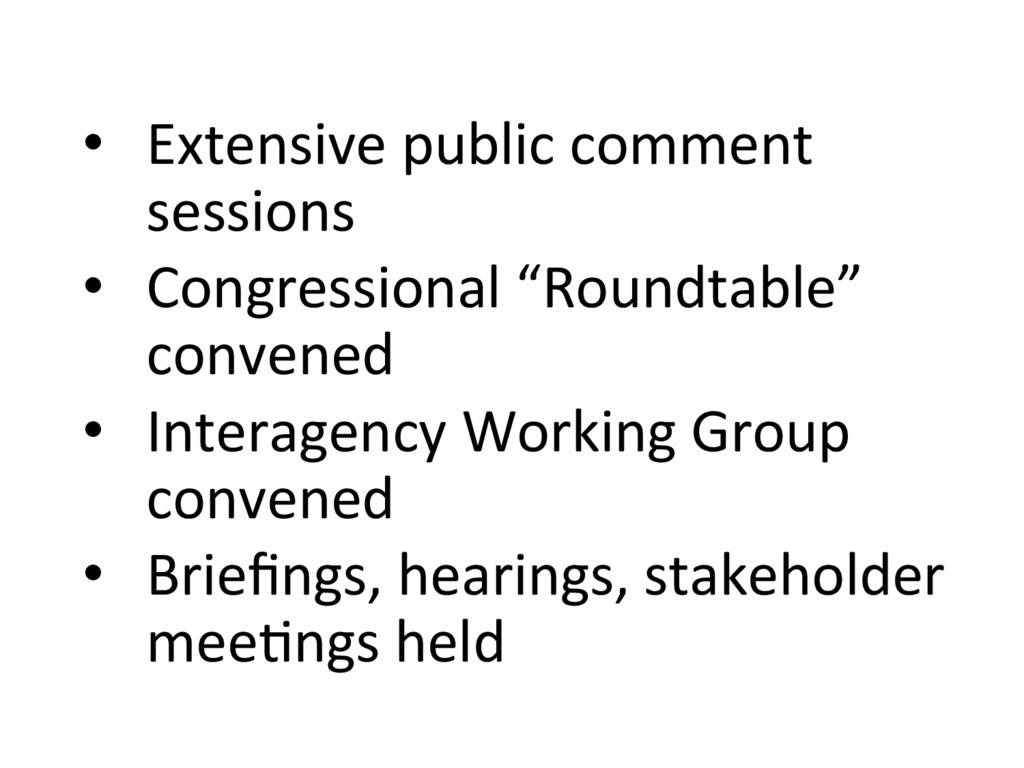
  22. •  Extensive  public  comment   sessions   •  Congressional  “Roundtable”

      convened   •  Interagency  Working  Group   convened   •  Briefings,  hearings,  stakeholder   mee@ngs  held
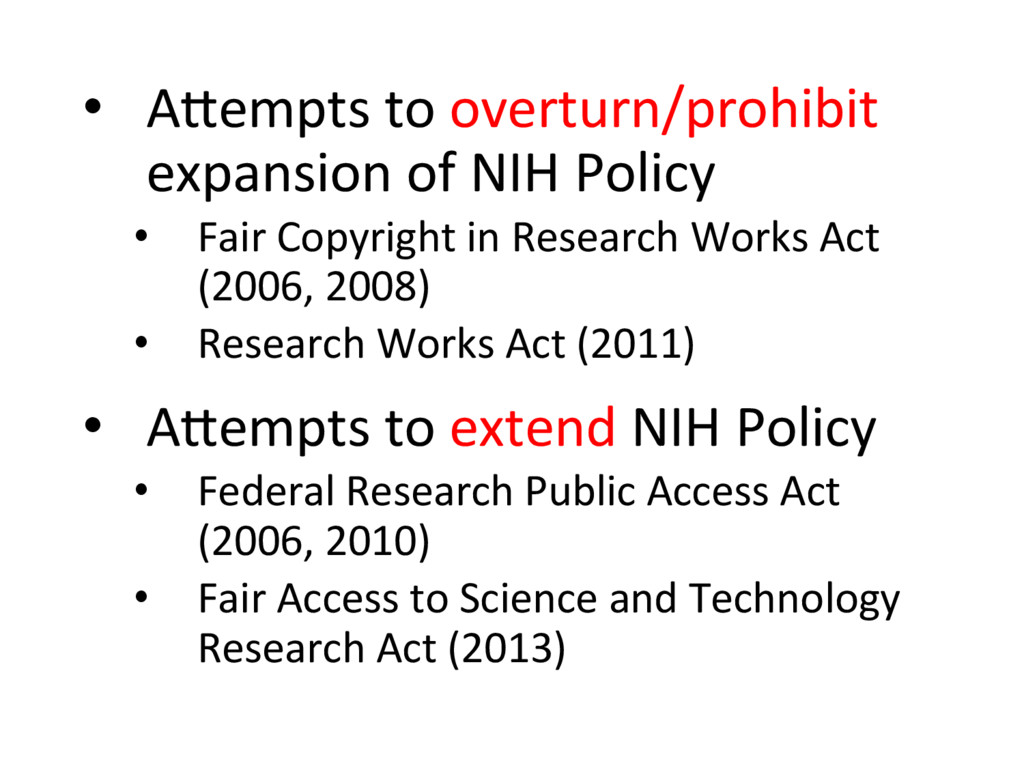
  23. •  Acempts  to  overturn/prohibit   expansion  of  NIH  Policy  

    •  Fair  Copyright  in  Research  Works  Act   (2006,  2008)   •  Research  Works  Act  (2011)   •  Acempts  to  extend  NIH  Policy   •  Federal  Research  Public  Access  Act   (2006,  2010)   •  Fair  Access  to  Science  and  Technology   Research  Act  (2013)
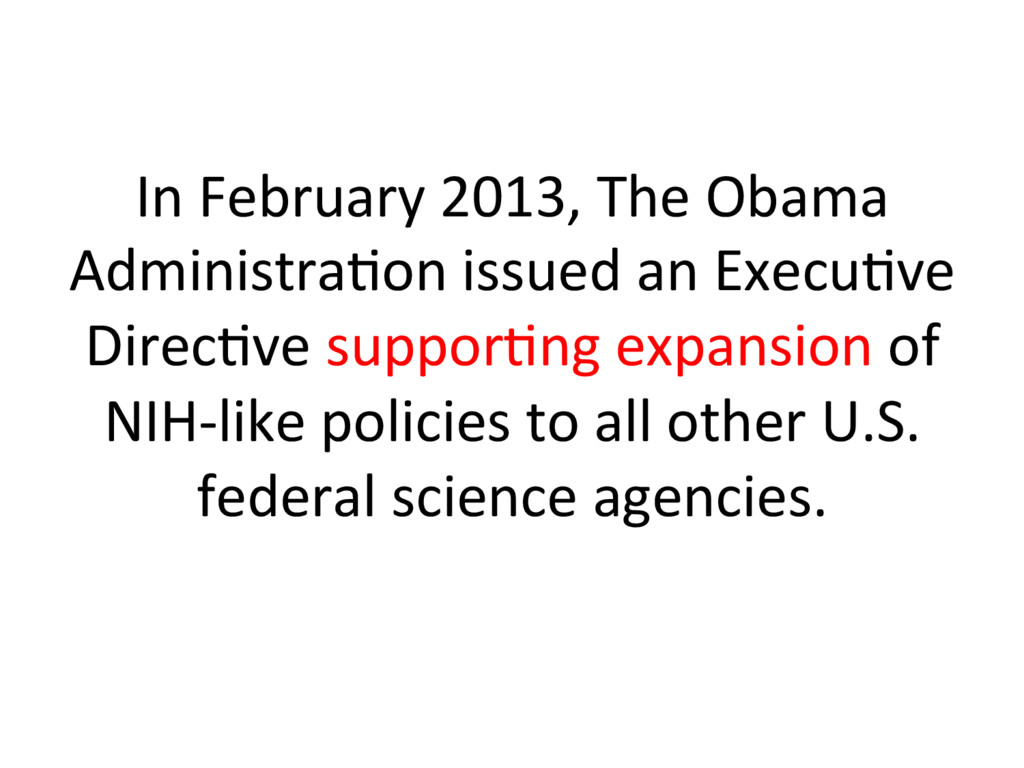
  24. In  February  2013,  The  Obama   Administra@on  issued  an  Execu@ve

      Direc@ve  suppor@ng  expansion  of   NIH-­‐like  policies  to  all  other  U.S.   federal  science  agencies.  
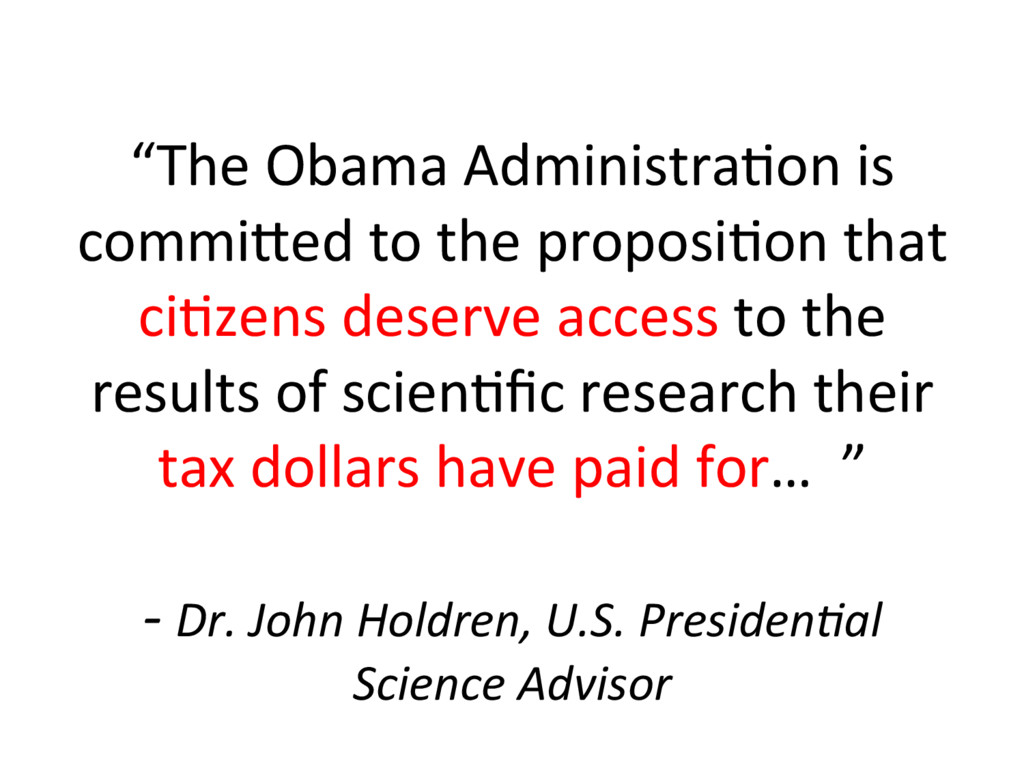
  25.   “The  Obama  Administra@on  is   commiced  to  the  proposi@on

     that   ci@zens  deserve  access  to  the   results  of  scien@fic  research  their   tax  dollars  have  paid  for…    ”     -­‐  Dr.  John  Holdren,  U.S.  Presiden2al   Science  Advisor  
  26.   “Public  access  policies  will   accelerate  scien@fic  breakthroughs  

    and  innova@on,  promote   entrepreneurship  and  enhance   economic  growth  and  job   crea@on…”     -­‐Dr.  John  Holdren,  U.S.  Presiden2al   Science  Advisor  
  27. •  “Green”  policy  –  silent  on  “Gold”   •  Repository

     can  be  maintained  or   approved  by  agency   •  Covers  final  manuscripts  *or*   published  ar@cles   •  Requires  enabling  ar@cles  to  be   read,  downloaded  and  analyzed   in  digital  form.    
  28. •  Uses  12  month  embargo  as   “guideline”   • 

    Provides  mechanism  for   stakeholders  to  change  embargo   •  Requires  metadata  standards  to   ensure  interoperability   •  Requests  supplemental  data/link   •  Requires  long  term  preserva@on   strategy  
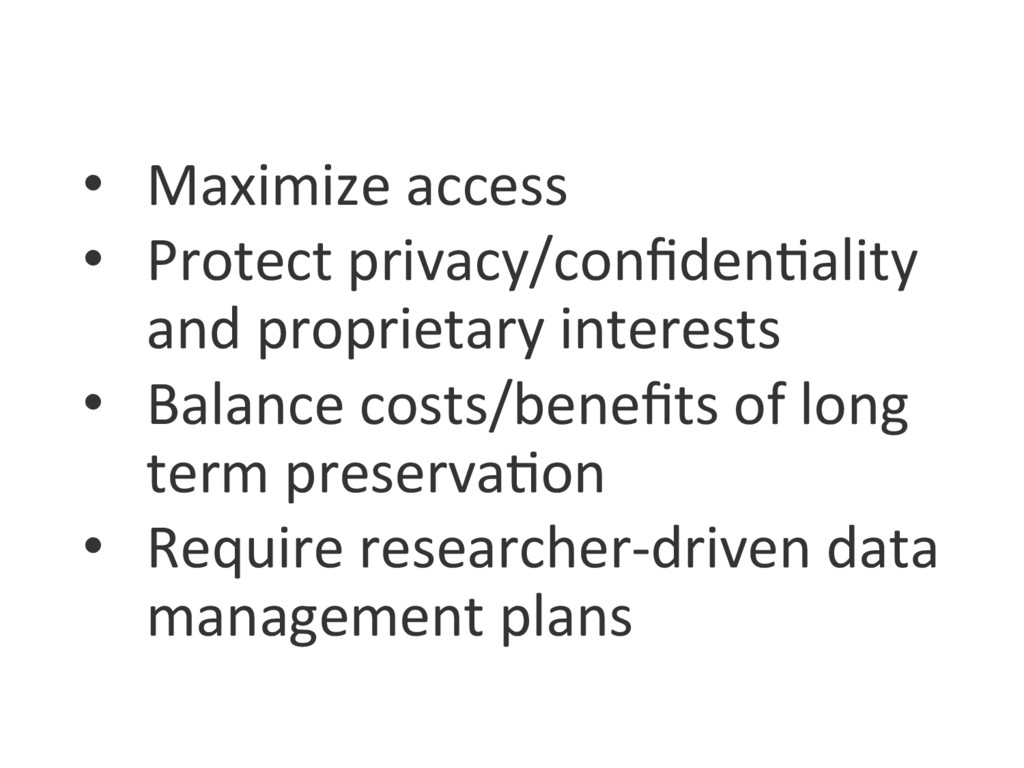
  29. •  Maximize  access     •  Protect  privacy/confiden@ality   and

     proprietary  interests     •  Balance  costs/benefits  of  long   term  preserva@on   •  Require  researcher-­‐driven  data   management  plans  
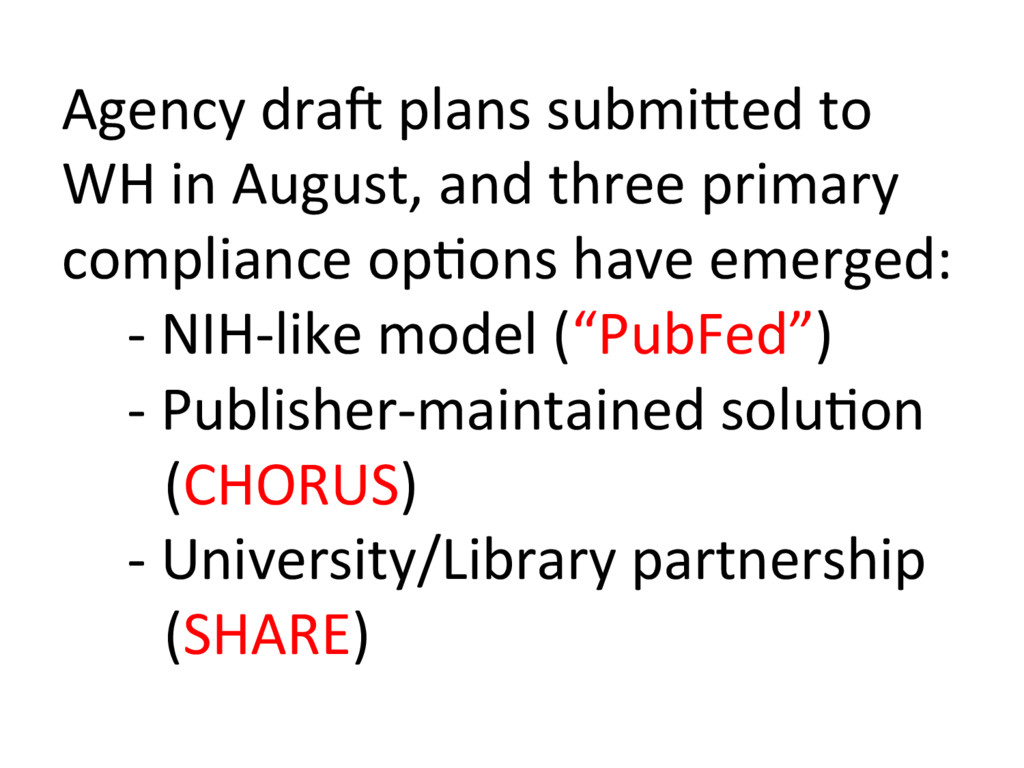
  30. Agency  dran  plans  submiced  to   WH  in  August,  and

     three  primary   compliance  op@ons  have  emerged:      -­‐  NIH-­‐like  model  (“PubFed”)      -­‐  Publisher-­‐maintained  solu@on      (CHORUS)      -­‐  University/Library  partnership      (SHARE)    
  31.   Much  of  the  ac@vity  in  U.S.  now   (and

     for  the  forseeable  future)  is   centered  around  interpreta2on,   implementa2on  and  codifica2on  of   the  White  House  Direc@ve.  
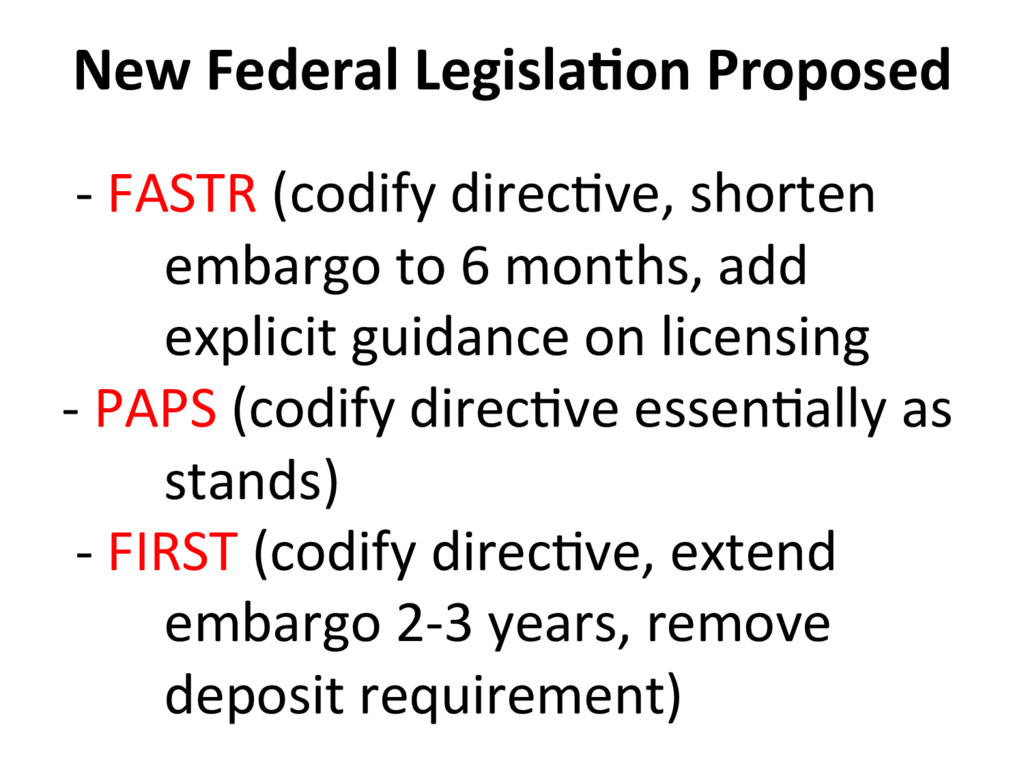
  32.      -­‐  FASTR  (codify  direc@ve,  shorten      

     embargo  to  6  months,  add            explicit  guidance  on  licensing   -­‐  PAPS  (codify  direc@ve  essen@ally  as      stands)    -­‐  FIRST  (codify  direc@ve,  extend          embargo  2-­‐3  years,  remove          deposit  requirement)   New  Federal  Legisla7on  Proposed    
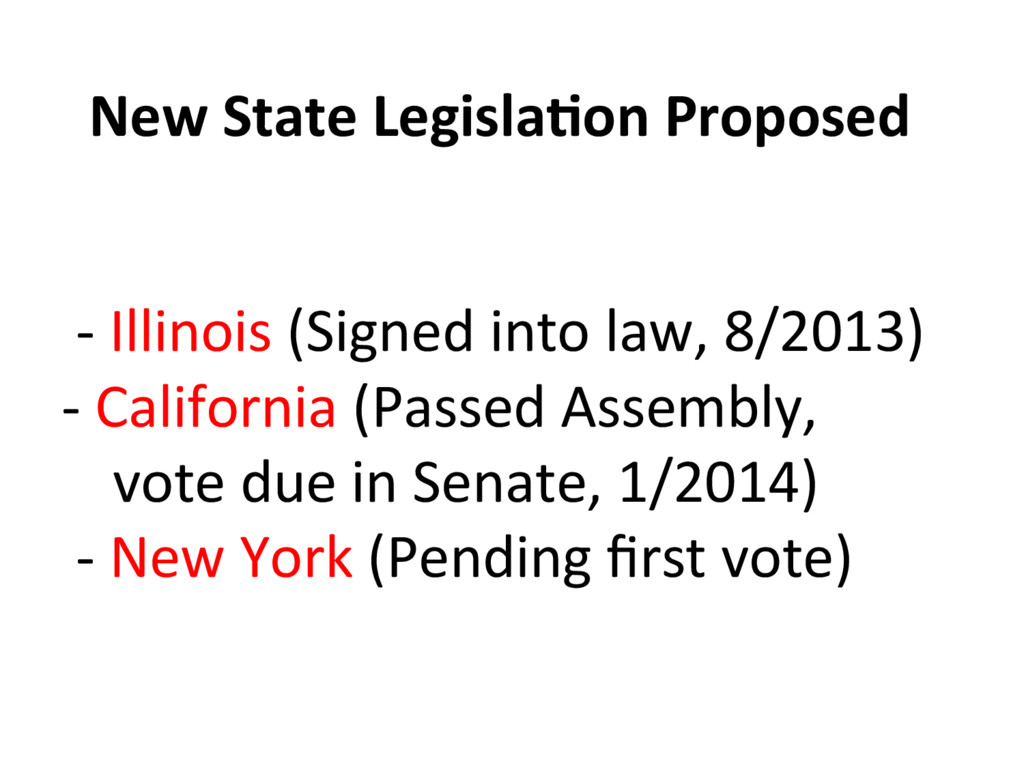
  33.      -­‐  Illinois  (Signed  into  law,  8/2013)   -­‐
     California  (Passed  Assembly,    vote  due  in  Senate,  1/2014)    -­‐  New  York  (Pending  first  vote)         New  State  Legisla7on  Proposed
  34. All  three  proposed  State  bills  are   built  on  the

     framework  employed   by  NIH  Policy  and  FASTR,  and  are   complimentary  with  the  WH   Direc@ve.  
  35. First  @me  that  the  U.S.  has  had   ac@ve,  coordinated

     Open  Access   policy  proposals  in  play  at   Execu@ve  Branch  level,  in   Congress,  and  on  States  Level...