Upgrade to Pro — share decks privately, control downloads, hide ads and more …

Steel and Stilettos Instructor Manual V3

Steel and Stilettos Instructor Manual V3

The 2015 SAS Instructor Manual

Avatar for SteelandStilettosFitness

SteelandStilettosFitness

February 15, 2015

Other Decks in Education

Transcript

  1. 2015 Instructor Training Manual V.3 Body Altitudes Health & Fitness

    LLC. 35801 US Highway 19 North Palm Harbor, Florida 34684 727-265-1656 [email protected] ©2014 Steel and Stilettos Fitness™. All Rights Reserved. Steel and Stilettos Fitness™ are registered trademark of Body Altitudes LLC. Presented by Body Altitudes Health & Fitness’ Sexy Series Steel & Stilettos Fitness™ is a fusion fitness program. The objective of this program is to uniquely blend a balance of body weight strength training, low impact cardiovascular exercises, and sexy movements; with an added emphasis on confidence building. TM
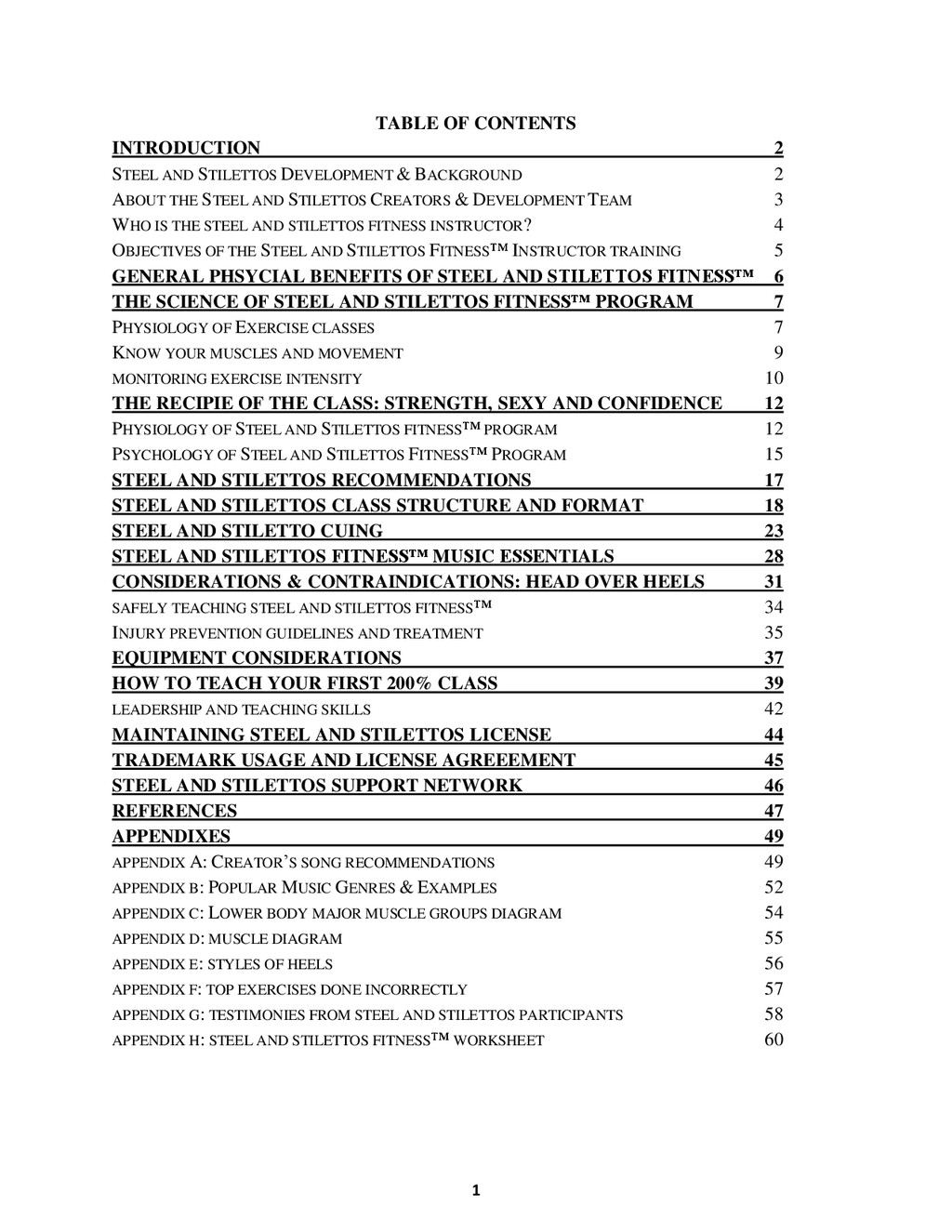
  2. 1 TABLE OF CONTENTS INTRODUCTION 2 STEEL AND STILETTOS DEVELOPMENT

    & BACKGROUND 2 ABOUT THE STEEL AND STILETTOS CREATORS & DEVELOPMENT TEAM 3 WHO IS THE STEEL AND STILETTOS FITNESS INSTRUCTOR? 4 OBJECTIVES OF THE STEEL AND STILETTOS FITNESS™ INSTRUCTOR TRAINING 5 GENERAL PHSYCIAL BENEFITS OF STEEL AND STILETTOS FITNESS™ 6 THE SCIENCE OF STEEL AND STILETTOS FITNESS™ PROGRAM 7 PHYSIOLOGY OF EXERCISE CLASSES 7 KNOW YOUR MUSCLES AND MOVEMENT 9 MONITORING EXERCISE INTENSITY 10 THE RECIPIE OF THE CLASS: STRENGTH, SEXY AND CONFIDENCE 12 PHYSIOLOGY OF STEEL AND STILETTOS FITNESS™ PROGRAM 12 PSYCHOLOGY OF STEEL AND STILETTOS FITNESS™ PROGRAM 15 STEEL AND STILETTOS RECOMMENDATIONS 17 STEEL AND STILETTOS CLASS STRUCTURE AND FORMAT 18 STEEL AND STILETTO CUING 23 STEEL AND STILETTOS FITNESS™ MUSIC ESSENTIALS 28 CONSIDERATIONS & CONTRAINDICATIONS: HEAD OVER HEELS 31 SAFELY TEACHING STEEL AND STILETTOS FITNESS™ 34 INJURY PREVENTION GUIDELINES AND TREATMENT 35 EQUIPMENT CONSIDERATIONS 37 HOW TO TEACH YOUR FIRST 200% CLASS 39 LEADERSHIP AND TEACHING SKILLS 42 MAINTAINING STEEL AND STILETTOS LICENSE 44 TRADEMARK USAGE AND LICENSE AGREEEMENT 45 STEEL AND STILETTOS SUPPORT NETWORK 46 REFERENCES 47 APPENDIXES 49 APPENDIX A: CREATOR’S SONG RECOMMENDATIONS 49 APPENDIX B: POPULAR MUSIC GENRES & EXAMPLES 52 APPENDIX C: LOWER BODY MAJOR MUSCLE GROUPS DIAGRAM 54 APPENDIX D: MUSCLE DIAGRAM 55 APPENDIX E: STYLES OF HEELS 56 APPENDIX F: TOP EXERCISES DONE INCORRECTLY 57 APPENDIX G: TESTIMONIES FROM STEEL AND STILETTOS PARTICIPANTS 58 APPENDIX H: STEEL AND STILETTOS FITNESS™ WORKSHEET 60
  3. 2 Introduction Welcome to the recipe for a one of

    a kind and quality program, The Steel and Stilettos Fitness™ Program. This manual is developed to provide essential information for Steel and Stilettos Instructors when preparing for and executing a Steel and Stilettos Class. Steel and Stilettos Development and Background What Is Steel and Stilettos Fitness™ Program? Steel & Stilettos is a fusion fitness program. The objective of this program is to uniquely blend a balance of body weight strength training, low impact cardiovascular exercises, and sexy movements; with an added emphasis on confidence building. With fitness, we encourage participants to strut their stuff, while focusing on glutes, legs, core, and abdominals. High Heels are used in the final segment of the class to allow participants to experience proprioception once targeted muscles have been stimulated. The class combines diverse music genres and tempos, along with exercises and affirmations throughout; to tone and sculpt mind and body. The Steel and Stilettos Fitness™: The Beginning In 2013, Johnson-DeCosta, Socorro, and Salaam, founded Body Altitudes Health and Fitness Studio in Clearwater, Florida. Body Altitudes was designed as The Boutique of Fitness, offering a variety of diverse and exciting classes, much like the owners! Their combined experience in health and wellness allowed for creative approaches to helping their clients meet their goals. The creators were seeking a format that would entice their members to consider strength training, given all the cardio options that were already available. They also wanted to offer a format that would replace the self-doubt and negative perceptions that members are often presented with in regards to their fitness potential. The concept of Steel and Stilettos met all of those requirements; as it is physically challenging, encourages personal interpretation of sexy and provides a mental workout. Steel and Stilettos was offered as a group fitness class only at Body Altitudes Health & Fitness Studio. Members quickly gravitated towards the concept of a workout that allowed creative expression, open and supportive dialogue between participants and instructor and a tremendous sweat from the strength training involved! Within months, the Steel and Stilettos Fitness™ format gained the attention of local media, including the Tampa Bay Times, the area’s largest periodical and a featured segment on NBC’s Daytime Show. Within weeks of airing on national television, the program was invited to several cities around the country; landing their Master class debut in New York City. After those classes, participants and fitness studio owners expressed a high interest in regularly scheduled classes at their facilities. The Body Altitudes’ owners knew that it was time to give them what they wanted, and launched the first format of the Sexy Series: Steel and Stilettos. Steel and Stilettos is presently offered as an official licensed training workshop internationally.
  4. 3 About the Steel and Stilettos Creators & Development Team:

    The Trio N. Jasmine Johnson-DeCosta is a Licensed Clinical Therapist with a Bachelors of Arts in Sociology, a Masters of Clinical Social Work and a Masters in Gerontology. Her background in Integrated Human Studies has allowed for an extensive professional career working with adult clients from a solutions-focused perspective. Jasmine values the incorporation of health and wellness in all aspects of her client's wellness plans. She is a national contributor on the issues of Intimacy, Chronic Illness and Domestic Violence. Jasmine blends her personal experience and professional background to host workshops for helping organizations such as domestic violence shelters, with an effort to redefine self-concepts and nurture healthy lifestyle behaviors. Jasmine is also a licensed Zumba Instructor and Booty Jam Fitness Instructor; both adding inspiration to the development of an alternative fitness model. “Sexy is just a way to describe confidence, something we all have and have the right to explore and express”.-N. Jasmine Johnson-DeCosta Pamela Socorro, a lifelong fitness enthusiast, is a certified personal trainer, group fitness instructor, and a lifestyle, weight management and nutrition consultant. Pamela brings her passion and personal goals to the development of the Steel and Stilettos Fitness™ Program. She strives to provide individuals motivation to remain dedicated to improving their health, appearance, mindset, and fitness levels within a supportive environment. Pamela is also a licensed Zumba Instructor and has the honor of serving as a Zumba Education Specialist for Zumba Toning. One of her goals is to help each individual create their own path to wellness by not only coaching, but rather teaching and fostering individual lifestyle changes. “I have realized that I can make a bigger impact and help as many people as possible to make a breakthrough by building relationships. It is my belief that truly dedicated fitness professionals can help more individuals reach their potential through a more holistic approach”. -Pamela Socorro Hasan Salaam, has been involved in organized sports for more than 25 years. He has incorporated training techniques from baseball, basketball, football and martial arts into his group fitness classes. Of all of his trainings, his favorite is boxing; the overall complexity and required discipline has led to lifelong personal training. He finds that both the team approach to fitness and the personal challenge with oneself to be key motivators as he introduces his participants to a variety of training styles. Whether for an Armed & Dangerous session at Body Altitudes or an outdoor boot camp, Hasan brings the Hard Body out of each workout. Hasan is also an accomplished musician; he attributes his energetic live performances to his personal commitment to health and wellness. His aptitude for music and the art of performance has enhanced the Steel and Stiletto’s Fitness program. Hasan believes that the ultimate fitness is in finding a physical activity that you are passionate about and incorporating it into your overall wellness plan. “True health is when we strengthen all aspects of self; Strong Body, Strong Mind, Strong Soul”. –Hasan Salaam Their creation is a one of a kind combination of interpretive dance, exercise and confidence building, designed to put both character and entertainment into the fitness industry. Special Thanks to Nicole Crawford, MSW, MPH, CPH, LCSW and Christina T. Indar, MSW for your valuable insight and assistance with the creation of the Steel and Stilettos™ recipe and manual contributions. Never tired in your efforts…Thank You Jessica C. Nater, CEO PlaySmart, Lovetta M. Mongomery, CPA, Dr. Chemika J. Reed, DHA, MSW, & Dee Reynolds
  5. 4 Who Is the Steel and Stilettos Instructor? The Steel

    and Stilettos Instructor (SASI) is a fitness professional with creativity, a passion for total body wellness, strength and ability to empower others. The SASI has an enthusiasm for strength and interval cardio training and a keen intuition for safety. The individual possesses confidence, outstanding performance quality, and the ability to empathize with a wide range of participants. Specific guidelines must be followed to ensure safety and effectiveness, particularly when body- weight training is combined with dance and the segment of high heels is added. The instructor must pay special attention when developing choreography, choosing rhythms, integrating fitness moves, implementing transitions and regulating the intensity of the workout. As a supplemental source of training, it is strongly recommended that SASIs be familiar with joint actions for major muscle groups and have a basic understanding of how to train utilizing body weight. SASIs are encouraged to take advanced certifications which provide additional education to ensure safety and effectiveness when teaching strength based workouts. Requirements to become a SASI (Steel and Stilettos Fitness™ Instructor):  Be 21 years of age or older, exceptions to be made by Body Altitudes Health & Fitness office only  Completion of the Steel and Stilettos Fitness™ Instructor Training  Obtain CPR/ First Aid Certification within three months of licensure and maintain the certification  Prior to training instructors must be able to walk safely in heels 3 inches or less  Own (2) sets of heels that you are comfortable walking in Requirements to maintain SASI License: Completion of the Steel and Stilettos Fitness™ Instructor training entitles you to the instructor title for one year and the use Steel and Stilettos™ in your class. To remain a SASI beyond the first year, you must participate in continuing education per the normal industry standard. You must either:  Take another Steel and Stilettos Fitness™ Instructor Training Workshop once per year OR;  Join the SASS Network (Steel And Stilettos Support Network) The SASS Network is Steel and Stilettos’ Fitness™ professional development system. SASS Network members in good standing are always considered Active Steel and Stilettos Instructors SASS Network members can access their SAS accounts online and enjoy the benefits and resources provided to SAS Network members only.
  6. 5 Objective of the Steel and Stilettos™ Fitness Instructor Training

    1. To provide a process for creating effective fitness programing into dance rhythms for the Steel and Stilettos Instructor. 2. To teach the basic principles of proprioception, body weight, interval and endurance training, which focus’ on specific exercises for the body’s lower and core muscle groups, as well as the cardiovascular system**. 3. To provide a basic understanding of injury cause and prevention; before, during and after Steel and Stilettos class. 4. To safely infuse body weight toning workout with sexy dance moves and affirmations to improve self-image. 5. To provide verbal affirmations throughout the class which view self-image obstacles as challenges to confront-not avoid. 6. To teach the basic principles of Strength-Based perspective (as it relates to empowerment); which influence participant’s ability to reach personal confidence goals. 7. To provide a fun, enjoyable and empowering experience to participants. 8. To provide easy to learn choreography and ensure participant’s success.
  7. 6 General Physical Benefits of Steel and Stilettos Fitness to

    the Participant  Provides a great workout (glutes, legs, abdominals, and core). Steel and Stilettos uses stability training, body weight training, and low impact cardio protocols. These components require a high control of the mid-sections of the body (abs and back) and have the potential to translate into tighter core, greater stability and improved posture.  Allows for a caloric expenditure through both strength training and low impact cardio. This varies from individual to individual depending on variables such as: routine performance, intensity level, etc.  Learn new sexy dance steps in an easy to follow, fun and encouraging environment.  Toning and weight loss may occur when combined with a sensible and clean nutrition program and if done on a consistent basis. Note: This benefit may vary from individual to individual.  Beneficial for alleviating depression. This is thought to be due to the effect of physical activity on neurotransmitter synthesis.  Enhances participant’s ability to safely perform functional movements with and without heels. Overall Benefits of Dance, Heels and Strength:  Improved cardiovascular endurance  Improved muscular endurance  Improved bone density, prevention of osteopenia and osteoporosis  Improved joint mobility and range of motion  Improved posture and stabilization  Improved coordination, agility and motor control  Improved cognitive function  Increased caloric expenditure- weight management  Improved ability to perform pain free activities of daily living
  8. 7 The Science of Steel and Stilettos Fitness™ The Physiology

    of Exercise Classes To best understand the physiology of the Steel and Stilettos program, it is important to be knowledgeable about the group fitness industry as a whole. Group fitness classes are often categorized in these groups: Aerobic- Generally considered as working between 60-80% of one’s estimated maximum heart rate. Since aerobic exercise, meaning with oxygen, fuels the muscles for the performance needed participants can exercise for longer periods of time then they would anaerobically meaning without oxygen. Example of Aerobic Exercise: Step Aerobics class. Muscular- Muscular strength is usually an anaerobic (without oxygen), meaning the participant is working above 85% of one’s estimated heart rate. Since anaerobic exercises do not use oxygen as the primary fuel for the muscles, they can only be performed for a short period of time before fatigue and failure occur. Example of Muscular Exercise: Weight Lifting. Interval Training- Generally includes a combination of the above two formats, with interval segments of cardio-muscular or intervals of cardio-recovery. This type of format is a good option for both beginner and advance exercisers. Example of Interval Training: High Intensity Interval Training (HIIT) - Tabatas Flexibility- These include programs that increase and improve joint mobility as well as muscle suppleness such as stretch classes, Pilates and others. Flexibility improves the elasticity of the muscle and range of motion of joints. Example of Flexibility: Yoga classes. Mind/Body- These programs place a focus on the reduction of stress, increase in focus and may involve meditation and energy flow. Examples of Mind/Body: Tai Chi and/or Kundalini Yoga. Body Toning Terminology “In Terms of Toning” The fitness term Toning means to give greater strength and or firmness to the body or a part of it. Tonicity: A state of normal firmness or functional readiness of body tissues or organs; condition of sustained partial contraction of resting or relaxed muscles. Tone: Having Tonicity- appearance of firm muscles Definition: Appearance of muscle development Sculpt: “Cut” or striated appearance of muscular development
  9. 8 Resistance Training Resistance training, also called strength training, is

    the use of resistance to muscular contractions to build the strength, anaerobic endurance and size of skeletal muscles. Steel and Stilettos Fitness™ utilizes the following resistance training techniques to produce strength, endurance and tone in participants: Reps and Sets- are the number of times you perform an exercise. A rep is the number of times you perform a specific exercise, and a set is the number of cycles of reps that you complete. The repetitive movements’ specific to a muscle or muscle group (number of both reps and sets) is dependent upon the participant’s fitness level and/or choreography. Applied Resistance- amount of tension applied to muscles through its full range of motion through both the concentric and eccentric phase of the movement. The incorporation of resistance training depends of level of physical fitness and how familiar a participant is with specific exercise movement. Steel and Stilettos Fitness™ stresses the importance of progressing resistance training to meet specific course goals. Accumulative Repetition- the collective number of reps performed to train a muscle or muscle group using a variety of exercises and ranges of motion rather than a singular motion to fatigue. Isolation- to train and strengthen muscles, muscles must be worked according to its joint action and function. Isolation exercise is any exercise in which only one major muscle group is trained by itself. Typically, the movement is done where usage of all other muscle groups is avoided, leaving the targeted muscle to do all of the work. Additional Variables- gravity, speed of contraction, range of motion, lever length, exercise selection, exercise sequencing. Use of Body Weight Training for Toning Results There is a correlation between intensity, time, and participant’s fitness level and their ability to improve and maintain muscular work for the entirety of the class.  Monitoring and modifying intensity through exercise sequencing, speed of movement, range of movement, and choreography combination.  For optimal results, utilizing larger working muscles rather than small muscle movements as a means of reaching and maintaining steady state.  Utilize moderate intensity activities combined with incremental, intermittent changes in the rhythms allows movement to be sustained for a longer class duration.  There is a relationship between speed of movement and the ability to apply and maintain muscular resistance.
  10. 9 Know Your Muscles and Movement A voluntary muscle, often

    called a skeletal muscle, is one of three types of muscle in the body. Most voluntary muscles are used to move bones, though some, such as the muscles in the face, are used to create movements below the skin. Unlike cardiac or smooth muscle, voluntary muscle can be controlled by the conscious mind. As a part of the musculoskeletal system, each voluntary muscle is used to help a person move around. Most are connected to bones by connective tissue called tendons. The muscle is attached to a bone at a location called its origin. It then runs along the length of the entire bone and is attached to a bone on the other side of the joint at the insertion. The muscle moves the bone at the insertion. Muscles contract when a part of the body is moved. It is not possible for a voluntary muscle to extend on its own, so muscles work in opposing pairs. In each opposing pair, the muscle that contracts is known as the extensor, while the muscle that expands is known as the flexor. Switching the roles of extensor and flexor in an opposing pair of muscles causes the opposite movement to happen. For example, contracting the bicep in the upper arm causes the elbow to bend, while contracting the triceps, on the opposite side of the upper arm, causes the elbow to straighten out again. Origin and Insertion- when a muscle contracts, usually just one bone moves. The other is stationary. The origin is where the muscle joins the stationary bone. The insertion is where it joins the moving bone. When a muscle contracts, the insertion moves towards the origin. Tendons- are the cords and straps that connect muscles to bones. At the bone, the fibers of the tendon are embedded in the periosteum of the bone. This anchors the tendon strongly and spreads the force of the contraction, so the tendon won’t tear away easily. Muscles Working in Pairs Muscles usually work in pairs or groups; this is called antagonistic muscle action. The working muscle is called the prime mover or agonist, the relaxing muscle is the antagonist. An example of a muscle pairing that work together is the quadriceps and hamstrings. The prime mover is helped by other muscles called synergists. These muscles contract at the same time as the prime mover. They hold the body in position so that the prime mover can work smoothly. When muscles cause a limb to move through the joint's range of motion, they usually act in the following cooperating groups: Agonists: These muscles cause the movement to occur. They create the normal range of movement in a joint by contracting. Agonists are also referred to as prime movers since they are the muscles that are primarily responsible for generating the movement. Antagonists: These muscles act in opposition to the movement generated by the agonists and are responsible for returning a limb to its initial position. Synergists: These muscles perform, or assist in performing, the same set of joint motion as the agonists. Synergists are sometimes referred to as neutralizers because they help cancel out, or
  11. 10 neutralize, extra motion from the agonists to make sure

    that the force generated works within the desired plane of motion. Fixators: These muscles provide the necessary support to assist in holding the rest of the body in place while the movement occurs. Fixators are also sometimes called stabilizers. Types of Contraction The contraction of a muscle does not necessarily imply that the muscle shortens; it only means that tension has been generated. Muscles can contract in the following ways: Isometric contraction: This is a contraction in which no movement takes place, because the load on the muscle exceeds the tension generated by the contracting muscle. This occurs when a muscle attempts to push or pull an immovable object. Isotonic contraction: This is a contraction in which movement does take place, because the tension generated by the contracting muscle exceeds the load on the muscle. This occurs when you use your muscles to successfully push or pull an object. Isotonic contractions are further divided into two types: Concentric contraction: This is a contraction in which the muscle decreases in length (shortens) against an opposing load, such as lifting a weight up. Eccentric contraction This is a contraction in which the muscle increases in length (lengthens) as it resists a load, such as lowering a weight down in a slow, controlled fashion. During a concentric contraction, the muscles that are shortening serve as the agonists and hence do all of the work. During an eccentric contraction the muscles that are lengthening serve as the agonists (and do all of the work). Monitoring Exercise Intensity Heart rate, or pulse, is the number of times the heart beats per minute. Normal heart rate varies from person to person. Knowing how to monitor exercise intensity, through heart rate, can be an important heart healthy gauge. A participant should not be working too lightly or too intensely in a group fitness class. How an instructor monitors heart rate will depend on several factors:  Does the facility require a certain method of monitoring?  Learned philosophy/experience with monitoring heart rate Industry Suggested Techniques for monitoring exercise intensity*: 1. Monitoring heart rate using pulse 2. Using a heart rate monitor 3. Monitoring using perceived exertion 4. Karvonen’s Method
  12. 11 5. Use the Talk test to monitor perceived exertion

    – this is the simplest method for evaluating exertion levels. If participants can talk comfortably while they are exercising, they are most likely in an aerobic state. If participants find it difficult to talk while exercising, they are most likely above their target heart rate. *Steel and Stilettos Program recommends instructors to review safety guidelines and heart rate tips from fitness industry leaders, such as Aerobic and Fitness Association of America (AFAA) and The American Council on Exercise (ACE)
  13. 12 The Recipe of the Class: Strength, Sexy and Confidence

    Steel and Stilettos Fitness™ is designed to add more to a standard workout regimen by targeting total wellness. Total wellness is defined as the state of being in good health. In the context of Steel and Stilettos Fitness™, this includes physical and psychological health; introduced in a fun and creative way. The ingredients to a genuine Steel and Stilettos Fitness™ class are Strength, Sexy and Confidence. “Steel is Strong, Stilettos are Sexy and Confidence Sets Us Apart” – SAS Creators. The following sections will provide instructors with the trademarked recipe to the program that stays with you long after the workout. SASIs should have a good understanding of the terms and principles, so as to incorporate them into the class and marketing of the program. The Physiology of The Steel and Stilettos™ Fitness Program: Proprioception Training The term proprioception refers to a sense of joint position. Proprioceptive exercises can improve body strength, balance and stability with effective results. A proprioceptive training program is associated with:  Muscular activity  Joint range of motion  Body posture and alignment Strength in Heels Steel and Stilettos places a unique focus on the lower body to train it for balance and stability in heels. The use of high heels in the Steel and Stilettos Fitness™ program is designed to fulfill two purposes: 1. To provide a proprioceptive challenge; this trains the participant to consciously and subconsciously contract their muscles in order to improve their stability and balance. By improving their proprioception participants can gain: - Balance skills necessary to maintain stability - Hone their agility so they can quickly change direction when necessary - Fine tune coordination skills so they can react appropriately to sudden changes in the environment - A good sense of proprioception is vital for many fitness activities, especially some of the more advanced core training classes currently attracting large number of participants (IDEA, 2014) 2. To provide participants the opportunity to use a common accessory (heels) to infuse fun while still engaging in exercise and meeting their goals of having a healthy self-image. Leaders in the fitness industry agree that proprioception is the precursor to success in advanced fitness programs; it seems that everywhere you go these days; people are talking about core stabilization or stability training. While fitness professionals and consumers are captivated by this new core craze, the main focus of this type of training is really proprioception (IDEA, 2014).
  14. 13 The Steel and Stilettos Fitness™ format utilizes proprioceptive training

    techniques to progress skills within the class itself such as, but not limited to, balance, stability and agility; which can be applied to other fitness formats and in everyday activities. Low Impact Cardio Most trainers define low-impact exercises as motions where one foot stays on the ground at all times Activities that are low impact help you exercise your body without putting too much strain on it, helping to reduce possible injuries while working out. Low impact exercises should be vigorous enough to increase the heart rate to the target zone (which is scaled to the age of the participant) and keep it elevated. Elevating the heart rate for at least 20 minutes is required to improve cardiovascular strength, burn excess calories, and make noticeable strides in fitness. Low- impact aerobics decrease the amount of pressure that is put on the joints, allowing you to get the same benefits of traditional exercise without putting stress on the body. Aerobic exercise helps to build the heart muscle. Exercise raises the heart rate, resulting in a stronger and more efficient heart. It also lowers blood pressure and cholesterol, other great benefits for the heart. Low impact exercise is for everyone. Body-Weight Training Body-Weight exercises rely on only the body as the source of resistance for muscle toning and building activities. To add significant bulk, it may be necessary to graduate from body-weight activities to weight training, however if simply seeking to get in better shape a body-weight routine can be all you need. The Steel and Stilettos program focuses on sculpting the lower body proportionally with the use of body-weight exercises. The exercises are executed through floor work, mat work and chair work. It is a low impact yet intense workout that uses small, intricate movements and targets specific muscles groups. Adopting the principles of both body-weight and proprioceptive training, Steel and Stilettos combines bouts of stability and conditioning with powerful deep lengthening recovery stretching. These specific sequences aides in developing and sculpting lean muscle mass, while increasing flexibility and range of motion. Balance Improvement Balance is the ability to maintain the body’s position over its base of support within stability limits, both statically and dynamically. “Balance is essential for all human movement and movement is necessary for all activities of daily living” (ACE, 2014). The fitness industry strongly recommends that balance is included as a foundational component in all exercise programming. Understanding (3) mechanical principles that relate to alignment of the body and balance include: center of gravity, line of gravity and base of support.  Center of Gravity- The point at which the mass of the body is considered to concentrate and where it is balanced on either side in all planes (frontal, sagittal and transverse).
  15. 14  Line of Gravity- Gravity acts on the body

    in a straight line through the Center of Gravity toward the center of the earth. The line of gravity must fall within the base of support to maintain balance without moving.  Base of Support- The area beneath the body that is encompassed when one continuous line connects all points of the body that are in contact with the ground. The body’s Center of Gravity is located within the region of the core. Core conditioning and balance training can be viewed as the same thing, so a (3) stage model for core and balance training is utilized.  Core Function- Emphasizes core activation exercise and isolated stabilization  Static Balance- Emphasizes sectional and whole-body stabilization under a fixed base of support (ground)  Dynamic Balance- Emphasizes whole body stabilization under a dynamic base of support (high heels) Designing exercise for balance, especially static balance in preparation for dynamic balance, can occur by introducing different conditions such as, but not limited to:  Narrowing the participant’s stance (moving the feet closer together)  Raising arms over head  Shifting body weight, raising arms unilaterally, leaning or rotating the trunk  Sensory removal (closing eyes)  Reduce points of contact (move from two-foot balance to one foot)  Add unstable surfaces (slider, high heel) Steel and Stilettos is an efficient, one hour, lower body workout that focuses on creating a strong, lean and tone physique. Cross conditioning in this way is a key component in allowing the body to train in aspects of postural balance, flexibility, strength, coordination and grace. Steel and Stilettos Fitness ™ Instructors are strongly encouraged to gain additional knowledge through nationally accredited Group Fitness certifications, to have the most current and advanced information on leading safe and effective group fitness classes. Advanced certifications will also allow instructors to progress and modify the fitness intensities; providing a quality class with many variations.
  16. 15 Psychology of the Steel and Stilettos™ Fitness Program Steel

    and Stilettos the program that stays with you long after the workout. While physiology and nutrition are typically the reasons behind weight loss, muscle tone and body changes; the psychology of the Steel and Stilettos™ program is a key motivator. If not for its dominating psychological and emotional benefits, participants would not obtain the physical results they are working to achieve. Most fitness programs will work, however participants may not remain committed and/or succeed because they lack motivation to adhere on a consistent basis. Steel and Stilettos, serves as a vehicle to motivate participants to gain momentum towards long- term confidence. This component of the program will leave a lasting impression, long after the workout is complete. The positive affirmations used throughout the workout are transferable to other areas of the participant’s life; creating a total mind-body wellness program. The psychological component of the Steel and Stilettos program requires the use of Strength-Based Empowerment perspectives. By applying these confidence building tenants, participants are more likely remain motivated and committed to a healthy lifestyle. Steel And Stilettos Instructors are not required to be mental health professionals, but must appreciate the importance of having a healthy mind with a non-judgmental and holistic approach to wellness. What is Strength Based Empowerment? Strength Based Empowerment is an approach towards confidence building, in which the focus is placed on minimizing the participant’s weakness and amplifying their strengths. There is a societal focus on weakness, comparisons and inadequacies; which creates a challenge for many to begin and or commit to a fitness regimen. By magnifying strengths and uniqueness; participants have a higher retention rate and success meeting goals. Infusing Empowerment in Steel and Stilettos™ Classes Empowerment comes from three things: 1. Valuing oneself 2. Having achievable goals 3. Creating a plan to reach these goals The Steel and Stilettos Instructor will accomplish these tenants in each class by:  Providing relatable examples of how strength training is transferable to overcoming everyday obstacles  Focusing on the can’s as opposed to the cant’s  Providing activities that can be modified for any skillset  Creating a safe space for participants to progress physically, mentally and emotionally  Meeting participants where they are; and helping them at their own pace
  17. 16 Confidence Building Confidence is the belief in one self

    and your ability to succeed. Steel and Stilettos places confidence building at the forefront of the program because of its direct correlation to one’s ability to take charge and command of challenges that present themselves in and out of the class. This is another component of the program that will leave a lasting impression long after the workout. The positive affirmations used throughout the workout are transferable to other areas of the participant’s life; creating a total mind-body wellness program. Sexy Psychology Sexy is an adjective to describe an appealing, exciting, desirable and stimulating person or thing. This can be interpreted as many things to both the participant and instructor; the diversity of a person’s interpretation of sexy is celebrated in this fitness program. Although participants will have a wide range of sensuality and experiences, their expression is equally valuable. Incorporating dance, movement and sexy into the format allows participants to release inhibitions while gaining physical and psychological strength. Participants have permission to express and release their inhibitions through dance themes, creating a dynamic and exciting fitness experience. Steel and Stilettos creates a safe atmosphere for participants that are defining/redefining their self-esteem and self-image. Steel and Stilettos is a hot, sexy and sultry workout designed for everyone and modified to their level of comfort and fitness. What makes Steel and Stilettos unique is the sexy component, which takes the focus away from the mundane exercise routine. Encouragement received during this class improves participant’s likelihood to adhere to the program until they get results. They keep coming back because it allows them to incorporate individuality into each class.
  18. 17 Steel and Stilettos Recommendations Steel and Stilettos Fitness™ recommends

    the SASI pays close attention to the frequency, intensity, time and specificity of each exercise incorporated into a SAS class. Frequency- 2-4 days per week, with a day off in-between depending on fitness level Intensity- Varied, maintain a healthy target heart rate range for the duration of the class. The Steel and Stilettos Fitness class includes:  Low Impact Cardio Dance  Low Impact Cardio Dance with resistance training exercises infused performed either in place or moving.  Circuit Training  Body Weight Only Training Time- 45 to 75 minutes is recommended for a Steel and Stilettos Fitness class. Specificity- Steel and Stilettos Fitness class requires easy-to-follow choreographies that are based on introducing strength exercises, sustaining balance, and accentuating participant’s physical strength. Balance- Opposing muscles groups should be worked to attain equal tension or pull on joints and connective tissue for postural balance and symmetry. Avoid overworking any one particular muscle group which may cause destabilization of joints. Posture and Alignment- Neutral Spine- refers to torso muscles working synergistically together to achieve a balanced static tension so alignment can be maintained. Prep for Stabilization- prior to performing a toning move, prepare first before moving to ensure biomechanical advantage and alignment for safety. Range of Motion and Joint Mobility- work through various ranges of motion, being aware of joint mobility and limitations. Do not use momentum or force of movement.
  19. 18 Steel and Stilettos Class Structure and Format The Warm

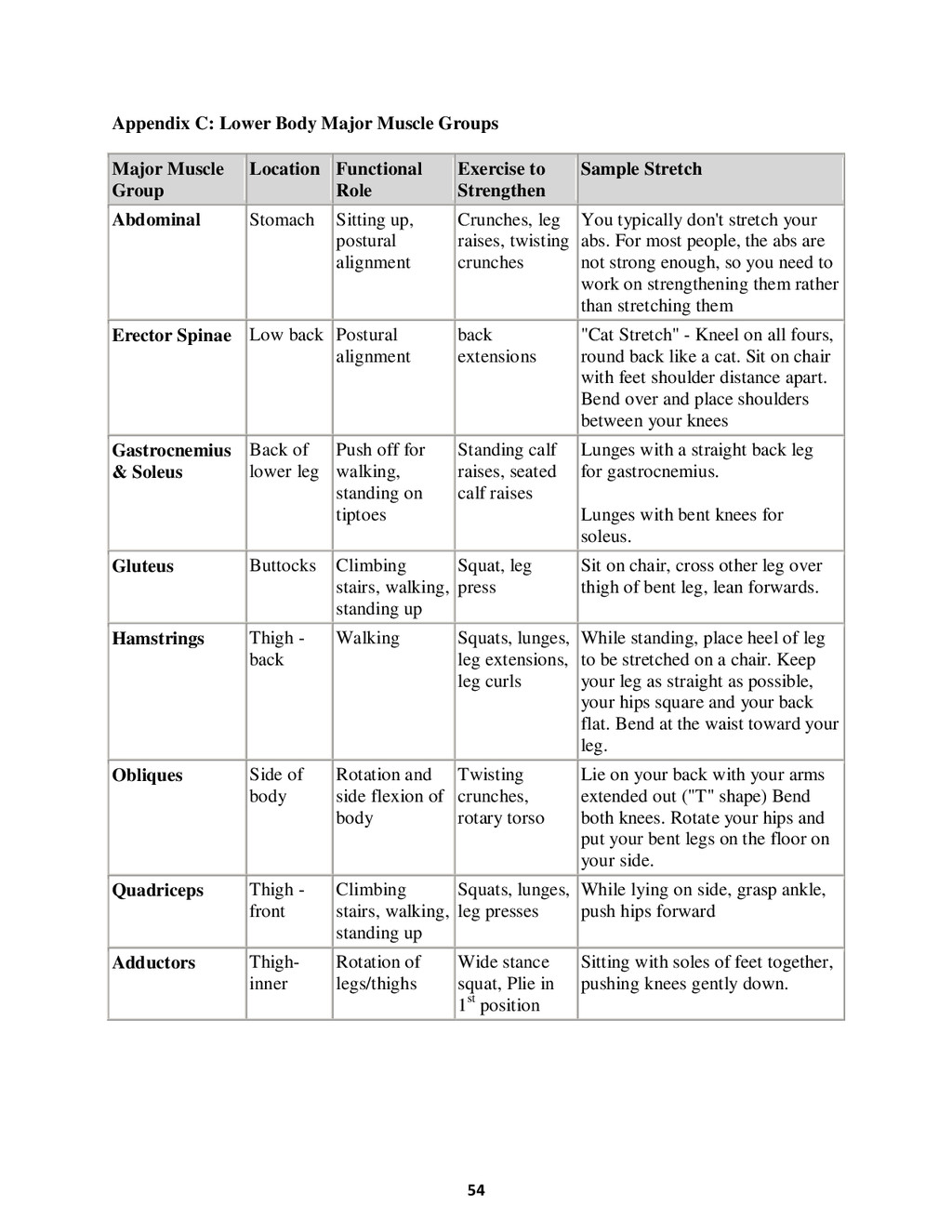
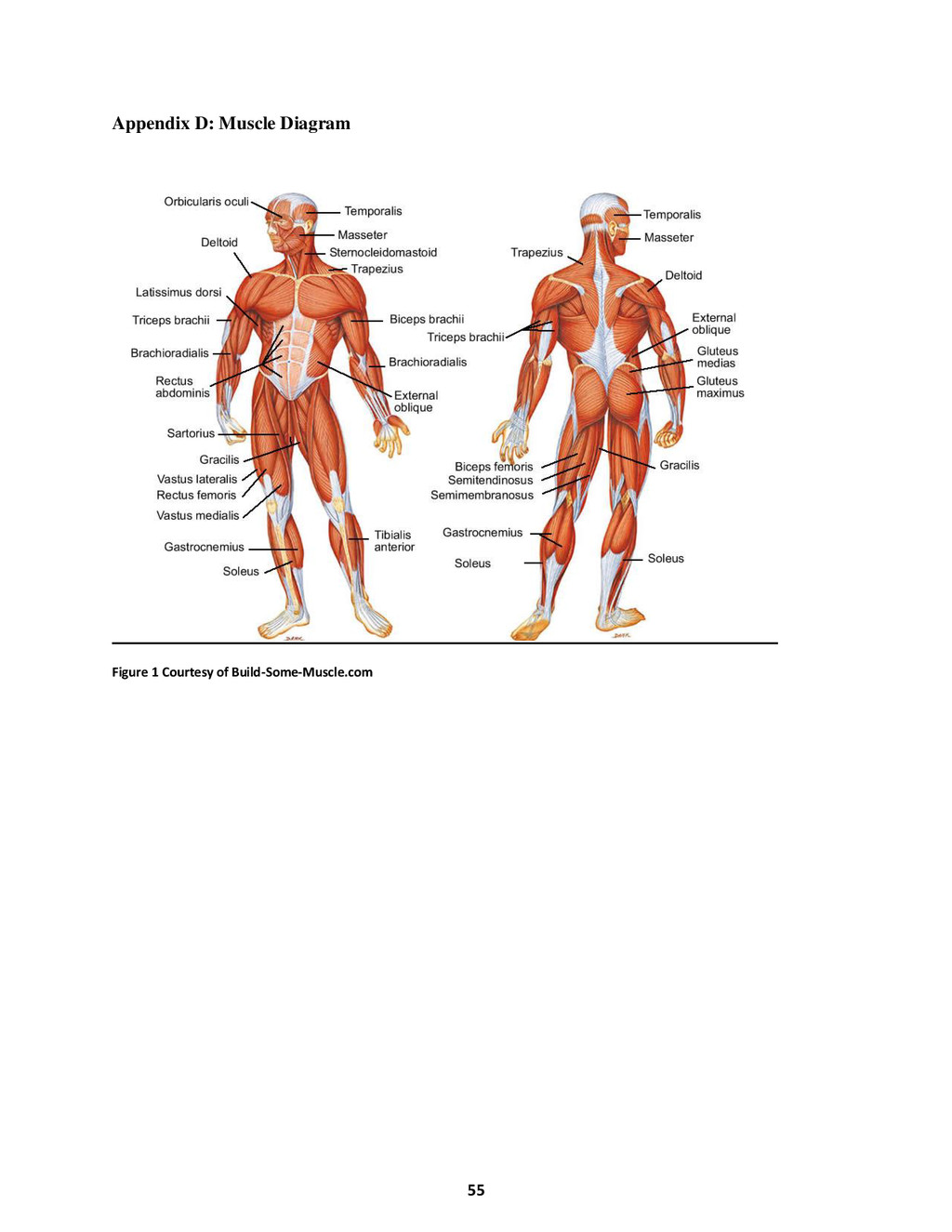
    Up The purpose of an effective warm up is to increase the heart rate, body temperature and to facilitate blood flow to the muscles to be used during the activity. The warm up prepares participants both physically and mentally for the class. A light and easy- to-follow dance is used including Rhythmic and Dynamic moving patterns—beginning with large muscle groups, and then progressing to the smaller muscle groups. Be sure to include moves for the entire body, especially including the legs (upper and lower), back and core. Prepare the joints as well—the hips, knees, and ankles. To warm up participants mentally, use phrases that remind them that they made a good decision to come; require them to let their stressors and inhibitions go for 45-75 minutes and give themselves permission to enjoy the Steel and Stilettos class. The recommended time for the warm up is 6-8 minutes. The Workout The Steel and Stilettos workout is a combination of lower-body standing moves with mat exercises for a balanced strength and mind-body experience. The Steel and Stilettos strength principles are derived from standing Pilates techniques and postmodern dance. The class format addresses major muscle groups throughout the main body workout, including Erector Spinae (Low Back), Gastrocnemius & Soleus (Back of Lower Leg), Gluteus (Buttocks), Hamstrings (Back of Thighs), Quadriceps (Front of Thighs), Abdominal (Stomach), and Oblique (Side of Body). Please see Appendix C & D for functional information and diagram. Bare/Flat Foot Following the warm up, the SASI will lead the first segment of the workout in bare or flat feet. Participants will become familiar with alignment by working with bare feet as exercises are introduced. The SASI will cue exercise in layers, modifications and progressions before and during the exercises. All exercises, in the first segment, will complement the movements and exercises to be introduced in the heel segment of the class. During this segment, the five base movements which are the foundation for standing combinations will include: squat, pliés, lunges, leg lifts and balance. The combinations are expected to be isolated to a major muscle group, creating an effective exercise for muscle fatigue, or “burn”. These combinations are paired exercises with short intervals to release accrued tension; typically the interval activates a sub-muscle. An example of this, the SASI will call for repetitive single leg squats (Quadriceps) during the verse of a song; during the chorus the participants will complete leg curls (Glutes) on the alternate leg. The SASI will also add small
  20. 19 opportunities for participants to infuse a “Sexy Style”; typically

    during the secondary movement to ensure proper format and focus during the primary exercise. The SASI must be prepared to offer alternative exercises/movement patterns to meet a wide range of fitness levels throughout the class.  Sample Standing Combination Start in lunge position, with right foot forward and left foot back. Feet are aligned with the front hip bones (anterior superior iliac spine, or ASIS); spine is neutral and vertical. Picking Flowers or Putting on a Favorite Lotion! (8-16 reps per side) Count 1: Lower into lunge, with front knee staying over ankle, spine in neutral. Count 2: Hinge forward at hip, bringing spine forward over front thigh. Arms hang under shoulders. Keep spine in neutral, and do not allow front knee to move forward. Count 3: Bring spine back into vertical position, still low in lunge. Bring arms back and engage scapular retraction; cue “picking flowers” when coming out of the forward hinge. Count 4: Come up out of lunge. Finishing move: Pulse down in lunge for 8-16 counts, then pulse 8-16 more counts in forward-hinged position. High Heels The incorporation of a sensible heel, 3- 3½ inches or less, is a very exciting segment of the class. It also requires the SASIs to make keen assessments and corrective cuing to ensure a safe and effective workout. The High Heel segment focuses on the following main components:  Set Up- The high heel set up must be arranged for keen mental focus and safety. The SASI guides the participants to a seated position. The SASI will encourage participants to exercise patience and excellent posture while carefully putting on their heels. It is imperative that participants are provided ample time to properly fasten shoes. Participants are provided with an activity to engage in while waiting: “Take this time to admire how your feet look and feel in your high heels. Use the next few minutes to play with different placements of your feet while you sit in your chair; knees together, feet pointed, sitting upright. This is your time to focus on your body posture and beautiful appearance in the mirror. We will all meet in the mirror once our shoes are properly fastened, do not rush”.  Posture & Alignment- The chair is an accessory used to address posture and to continue bringing self-awareness to the participant, as the most important person in the room/ focal
  21. 20 point. The SASI will encourage the participant to sit

    with their back straight, shoulders down and back, and maintaining head, slightly above the horizon. The SASI will guide the participants on awareness of leg positioning, keeping knees closed with one foot slightly in front of the other. The time seated in the chair is also an opportunity to pay attention to the participant’s lower back, using reverse arch stretches.  The Assessment- SASI will guide the participants to slowly stand in their heels. Using very slow and prescriptive cuing, the SASI and participant, will assess their stability on the heels and level of comfort in the heels. Participants are encouraged at any point and time in this segment to move to the side/back of classroom and remove their shoes if there is any discomfort, instability, or challenges. The SASI will then guide the participants through very easy walking patterns and natural styles. The SASI is able to determine through these walking passes if participants are safe to proceed with the class in heels and/or what level of modifications should be made throughout the heels segments.  Fitness in Heels- This segment in heels reintroduces exercises applied in the barefoot/ flat foot segment. During this segment, five base movements as the foundation for standing heel combinations will be included: squats, leg lifts, leg curls, core and balance. As in the first segment, the combinations are expected to be isolated to a major muscle group, creating an effective exercise for muscle fatigue, or “burn”. These combinations are paired exercises for separate muscle groups with short intervals to release accrued tension; typically the interval activates a sub-muscle. An example of this, the SASI will call for seated crunches (lower abdominals) during the verse of a song; during the chorus the participants will complete side crunches (obliques). The SASI will also add small opportunities for participants to infuse a “Sexy Style”; typically during the secondary movement to ensure proper format and focus during the primary exercise. In this example, a slow sexy arm combination can be incorporated during the song’s bridge, intro or outro. The SASI must be prepared to offer alternative exercises/movement patterns to meet a wide range of fitness levels and comfort in heels throughout the class.  Heel Circuit- The circuit in heels is an opportunity for participants to self-express through easy dance and fitness stations. The SASI will provide up to 3-4 stations, with instructions/examples of how participants can “work their sexy”! This includes, but is not limited, to chair dancing (stay low to activate the Quadriceps); wall sits (activates the Hamstrings, Quadriceps and Adductors); and runway walks (focus on balance). This can be an anxiety producing segment of the class, especially for new participants. It’s important that the SASI guides, provides examples and stays close to or pairs those participants who may not be as comfortable dancing and/or role playing alone. The SASI can also intermittently have the group refocus for 8-16 counts of choreography and return
  22. 21 to “free style”; however with the emphasis on staying

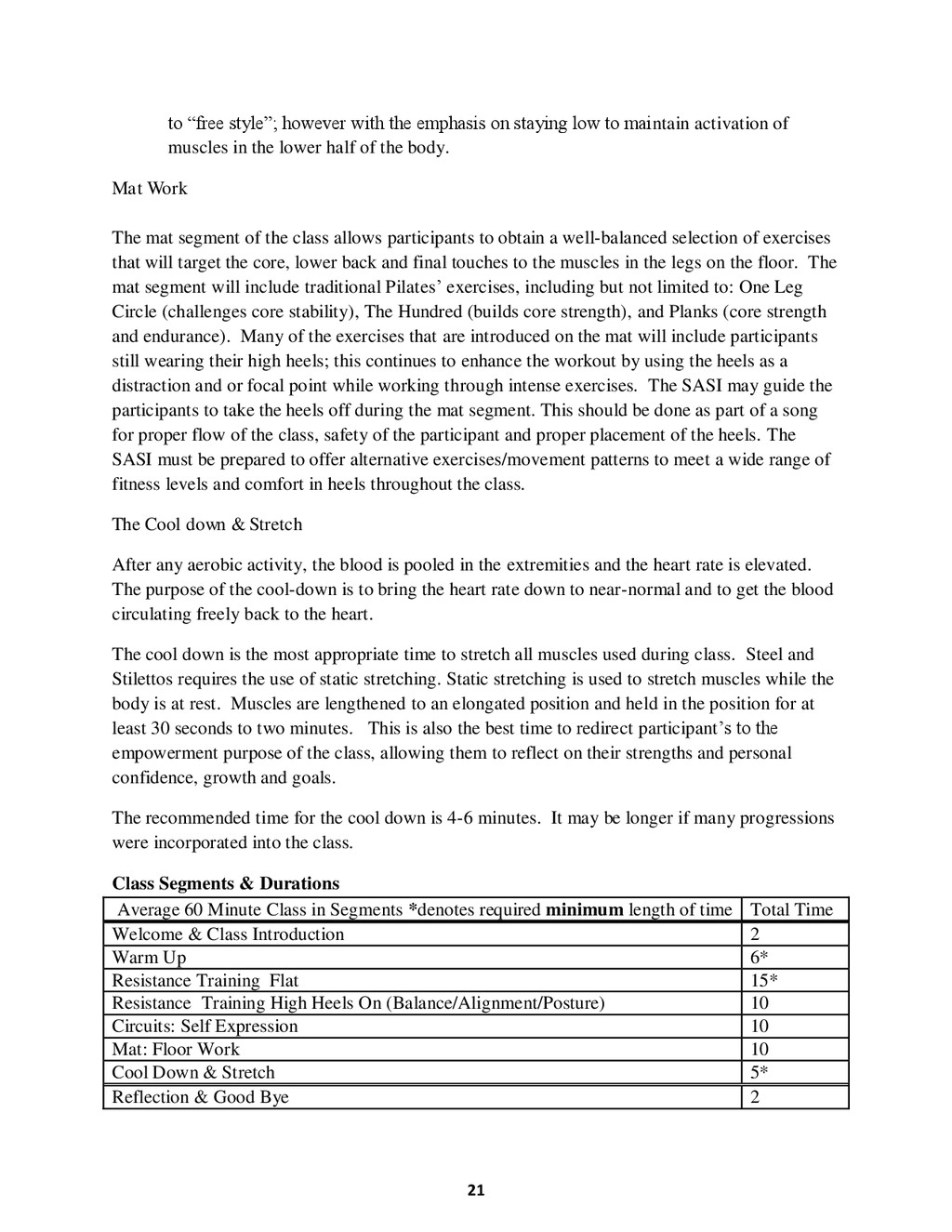
    low to maintain activation of muscles in the lower half of the body. Mat Work The mat segment of the class allows participants to obtain a well-balanced selection of exercises that will target the core, lower back and final touches to the muscles in the legs on the floor. The mat segment will include traditional Pilates’ exercises, including but not limited to: One Leg Circle (challenges core stability), The Hundred (builds core strength), and Planks (core strength and endurance). Many of the exercises that are introduced on the mat will include participants still wearing their high heels; this continues to enhance the workout by using the heels as a distraction and or focal point while working through intense exercises. The SASI may guide the participants to take the heels off during the mat segment. This should be done as part of a song for proper flow of the class, safety of the participant and proper placement of the heels. The SASI must be prepared to offer alternative exercises/movement patterns to meet a wide range of fitness levels and comfort in heels throughout the class. The Cool down & Stretch After any aerobic activity, the blood is pooled in the extremities and the heart rate is elevated. The purpose of the cool-down is to bring the heart rate down to near-normal and to get the blood circulating freely back to the heart. The cool down is the most appropriate time to stretch all muscles used during class. Steel and Stilettos requires the use of static stretching. Static stretching is used to stretch muscles while the body is at rest. Muscles are lengthened to an elongated position and held in the position for at least 30 seconds to two minutes. This is also the best time to redirect participant’s to the empowerment purpose of the class, allowing them to reflect on their strengths and personal confidence, growth and goals. The recommended time for the cool down is 4-6 minutes. It may be longer if many progressions were incorporated into the class. Class Segments & Durations Average 60 Minute Class in Segments *denotes required minimum length of time Total Time Welcome & Class Introduction 2 Warm Up 6* Resistance Training Flat 15* Resistance Training High Heels On (Balance/Alignment/Posture) 10 Circuits: Self Expression 10 Mat: Floor Work 10 Cool Down & Stretch 5* Reflection & Good Bye 2
  23. 22 Class Format Sample Body Part Time Song Main Exercise

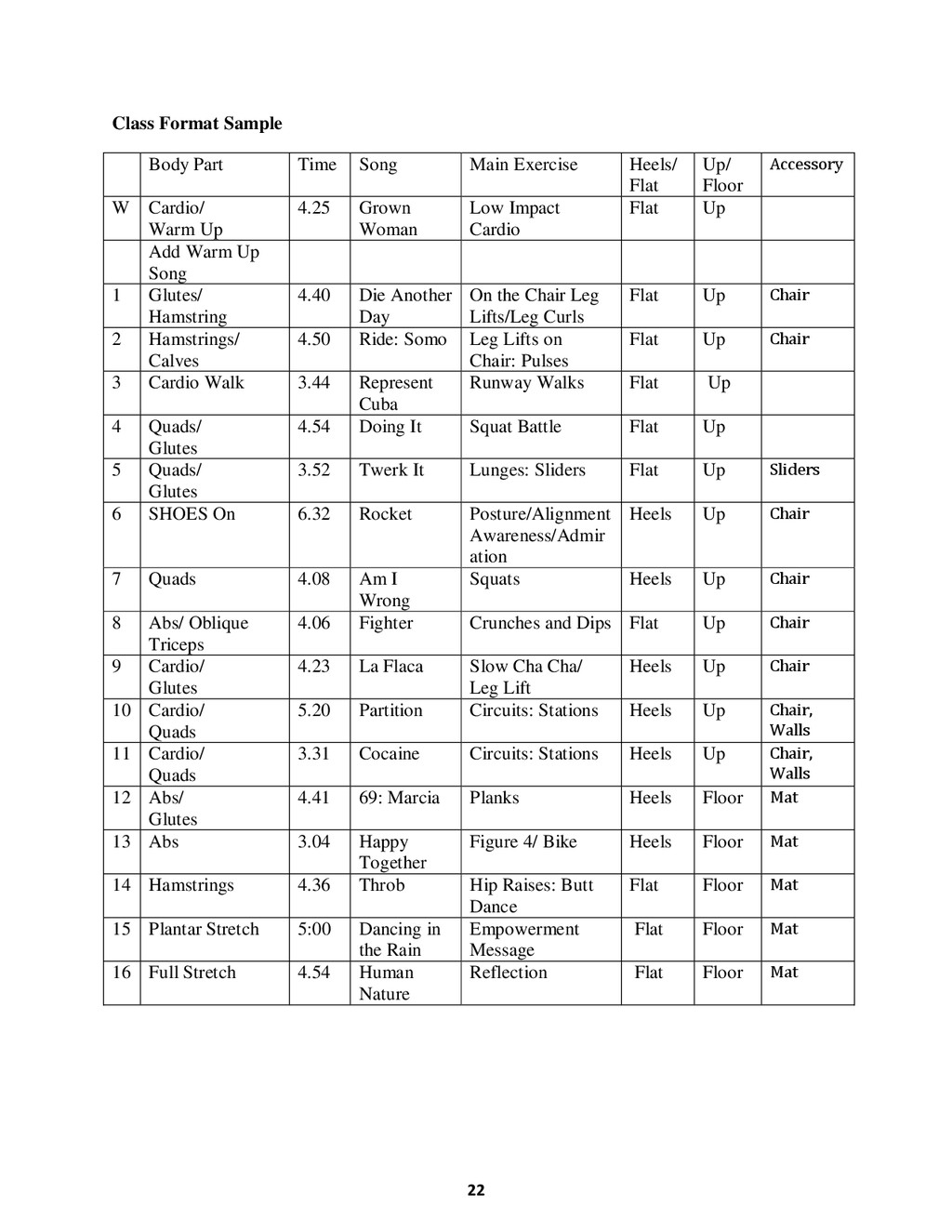
    Heels/ Flat Up/ Floor Accessory W Cardio/ Warm Up 4.25 Grown Woman Low Impact Cardio Flat Up Add Warm Up Song 1 Glutes/ Hamstring 4.40 Die Another Day On the Chair Leg Lifts/Leg Curls Flat Up Chair 2 Hamstrings/ Calves 4.50 Ride: Somo Leg Lifts on Chair: Pulses Flat Up Chair 3 Cardio Walk 3.44 Represent Cuba Runway Walks Flat Up 4 Quads/ Glutes 4.54 Doing It Squat Battle Flat Up 5 Quads/ Glutes 3.52 Twerk It Lunges: Sliders Flat Up Sliders 6 SHOES On 6.32 Rocket Posture/Alignment Awareness/Admir ation Heels Up Chair 7 Quads 4.08 Am I Wrong Squats Heels Up Chair 8 Abs/ Oblique Triceps 4.06 Fighter Crunches and Dips Flat Up Chair 9 Cardio/ Glutes 4.23 La Flaca Slow Cha Cha/ Leg Lift Heels Up Chair 10 Cardio/ Quads 5.20 Partition Circuits: Stations Heels Up Chair, Walls 11 Cardio/ Quads 3.31 Cocaine Circuits: Stations Heels Up Chair, Walls 12 Abs/ Glutes 4.41 69: Marcia Planks Heels Floor Mat 13 Abs 3.04 Happy Together Figure 4/ Bike Heels Floor Mat 14 Hamstrings 4.36 Throb Hip Raises: Butt Dance Flat Floor Mat 15 Plantar Stretch 5:00 Dancing in the Rain Empowerment Message Flat Floor Mat 16 Full Stretch 4.54 Human Nature Reflection Flat Floor Mat
  24. 23 Steel and Stilettos Cuing Cuing Fitness As a Steel

    and Stilettos Instructor, it is very important to develop the skill of communicating the exercises, modifications and progressions clearly and safely. The goal in cuing is for the participant to remain engaged in the workout session, while ensuring they do not get injured or feel lost during the class. Inadequate cuing can result in participants getting injured. If cuing is not done throughout the workout and many stops/starts are involved, the participant’s workout is compromised. Participants will receive a more enjoyable experience and effective workout when your cuing is clear and used throughout the workout. There are several ways a SASI can cue fitness. It is recommended that SASIs use visual, verbal and varying cuing. Visual Cues Instructors communicate the most powerful visual cues through facial and body expressions. The movements must be precise and controlled. SASIs have to use distinctive postures and exaggerated motions to convey direction changes and proper exercise technique. For example, if the instructor wants the class to move to the left; big, animated movements must be used to guide participants in the direction. While visual cuing is very important, the SASI cannot rely only on the “Watch Me” technique. This technique may effectively demonstrate the movement but this requires the participants to stop and watch. This can interrupt the momentum of the class and reduce fitness outcomes. Therefore when using a visual cue, the instructor should make every attempt to cue a pattern/ exercise breakdown without stopping to show the move. The SASI should use facial expressions to visually impact cuing. Participants tend to be drawn to one another’s expressions. The SASI will be able to set the emotion for the choreography, prompt a change in intensity and connect with the participants using facial expressions and eye contact. While engaging through facial expressions and eye contact, SASIs are also assessing participant’s response to choreography and or exercise sequences; allowing the instructor to adjust accordingly by using different cues or modifications of the exercise combination. Verbal Cues Steel and Stilettos Fitness™, strongly encourages the use of a microphone. This is an effective way to keep a relaxed tone to fit the format’s style, yet provide verbal cues as it is an industry safety standard for strength classes. Verbal cues should always be clear and concise; for example, “Knee up”—being short and to the point, is a better fitness cue than “Now bring the knee up toward your waist.” (Popowych, 2005; IDEA, 2005) Many instructors count out loud, while this can be helpful at establishing the rhythm for the movement, it is not encouraged in Steel and Stilettos classes due to the opportunity to create confusion, taking away from the feel of the class and reducing the opportunity for empowerment cues. It is also important that the SASI is more focused on cuing proper form and safety than the number of reps. Proper music selection and exercise sequencing can aid with cuing, and will be discussed throughout this manual. “Participants learn both visually and verbally, so it’s necessary to incorporate both cuing types in your repertoire. Whether you have been teaching for
  25. 24 1 month or many years, becoming proficient at cuing

    goes beyond counting and requires practice and experience” (Popowych, 2005). The amount of verbal cuing will greatly depend on the skill level of the participant; beginners often need more explanation of the exercises/movements and earlier cues to move into the next move. The more lead in time participants have the more prepared they will be. Verbal cuing should include counting, as well as providing instructions on format.  Examples of Count Cuing from (Popowych, 2005; IDEA, 2005): When working with less experienced participants, you may have to use 4-beat cuing. This means you explain the next move in 4 beats prior to implementing the move. Two-beat cuing is a more advanced technique because you say less. It is quick and works well with challenging choreography, up-tempo classes and advanced participants. Four-beat cuing does not mean you count 4, 3, 2 and 1 out loud. The counting is silent, and the cue itself signals the upcoming move. The same goes for 2- and 3-beat cuing. Here are some examples of 2-, 3- and 4-beat cuing:  2-beat cuing: silent count 8, 7, 6, 5, 4, 3; then say “knee up” on counts 2, 1  2-beat cuing: silent count 8, 7, 6, 5, 4, 3; then say “over” (count 2) “the top” (count 1)  3-beat cuing: silent count 8, 7, 6, 5, 4; then say “ham-string-curl” on counts 3, 2, 1  4-beat cuing: silent count 8, 7, 6, 5; then say “left-lead-turn-step” on counts 4, 3, 2, 1 Create an even stronger learning opportunity by combining visual and verbal cues. If you verbally cue “4 more,” visually use your fingers to count down from 4. The placement of your counting hand is important. Instead of holding it out to the side of your body, keep it close to your face. Because participants watch your facial expressions (specifically your mouth), they will cognitively make a stronger connection between the spoken words and the visual example when the two are close to each other. Varying Cuing Using a variety of cues throughout the Steel and Stilettos class, not only communicates upcoming transitions, moves and or fitness instructions; but it also motivates participants. Different segments of the workout may require different types of cues. It may be necessary to explain the move, describe it, and name it; all while demonstrating. SASIs can also rely on interactive cuing. Interactive cuing is a fun way to engage the participants in the process. The instructor may ask a specific question about how many moves or reps are going to be in a specific exercise. The question lends itself as a cue to the exercise coming up and calls for verbal participation from the group. There are times when over cuing can occur, especially in the SAS format. SASIs can make the mistake of talking and cuing the entire workout. It is possible that too much talking can take away from the very important cues. By varying the cuing from verbal, visual and interactive
  26. 25 participants will be able to concentrate on the exercise

    and get into the flow of the workout; while appreciating and admiring their sexy! Common Cuing Issues and Tips (Popowych, 2005) Issues:  Relying on counting out loud  Talking too much  Cuing too late Tips to Improve:  Listen to music in your car or at home.  Count in your head and practice random 2-beat cues out loud.  Eliminate out-loud counting altogether, and reintroduce it only in certain parts once you are efficient at cuing without counting out loud.  Limit talking in class to cuing and motivation only. Save long explanations for the strength or stretch segments of the workout.  Evaluate the amount of cuing you are giving.  Observe participants to get a better understanding of what’s happening when they don’t grasp a move.  Check that you are using various voice inflections to indicate that a change is coming up.  Try to implement other advance-warning cues—such as a clap or a certain vocal sound— to indicate upcoming changes.  Say less, be specific and give succinct cues, such as “Knees up!” versus “Ready, knees up now.” Useful Fitness Cues:  Think of pulling your abdominals in and up like an elevator.  Tighten your buttocks.  Be aware of the shoulder girdle and hip alignment with the spine (the rib/hip connection).  Avoid jerky and/or uncontrolled movements.  Avoid hyperextension (locking joints) and hyperflexion (bending too deeply and knees extending forward past your toes in a squat).  Be sure that any flexion (bending forward) of the spine is initiated at the hips, not rounding the back at the waist.  Control and limit the range of motion when performing overhead moves.  Focus on external rotation and exercises that open the chest, which enhances posture, alignment and breathing. Useful Posture and Alignment Cues: It is important that you provide information and cueing for proper posture and alignment. You should be familiar with the following cues when guiding your class:  Keep your head evenly centered between your shoulders.  Keep your chin parallel to the floor.
  27. 26  Shoulders are even, back and down.  Keep

    chest lifted.  Contract (pull in) your abdominals.  Keep shoulders, hips and knees even.  Hips, knees, ankles and toes should be in alignment.  Distribute bodyweight evenly on both feet. SASI instructors are encouraged to increase their knowledge on how to cue specific styles of fitness, which are incorporated in the SAS class format. For example Pilates, Kinesthetic and body awareness cues are a compliment to balance exercises. It is also strongly recommended that all Steel and Stilettos classes are taught using a wireless microphone. Cuing, motivating and ensuring safety is an integral aspect of the Steel and Stilettos format. A microphone allows the SASI to project instructions and affirmations without yelling and sacrificing the mood, tone and intimacy of the class. The SAS format allows for the instructor to occasionally face away from the participants, reducing participant’s feelings of judgment and vulnerability. The SAS may choose to walk around or glance using the mirrors to assess safety and comfort. This time facing away from the participants is also used to allow time for reflection of affirmations and creative expression without following the instructor. The use of a microphone and mirrored room, whenever possible allow for versatility in cuing, increased safety, and an overall satisfying and effective workout experience.
  28. 27 Cuing Confidence As a Steel and Stilettos Instructor, the

    idea of empowerment and building confidence means more than just telling participants you can do it. It means continuously supporting by meeting them where they are physically and emotionally, supporting their efforts, and not trying to be more for them than your role allows. In a class setting your will need to pay close attention to your participant’s abilities and comfort level; you will encourage them to not only participate in the exercises planned but also increase their positive self-thoughts. Some ways to support their efforts are to give Confidence Cues throughout the session. Examples of: Cuing Confidence  Describe props and exercises as objects of desire; let participants know that objects can represent almost anything they wish to conquer and or have more control over.  Find yourself in the mirror and focus on you  Don't deny yourself the pleasure of feeling happy, sexy, strong…  Define sexy for yourself.  No judging goes on here…let go  Look beyond your eyes and see your strength; not just here but in everything you do  Are you feeling confident?  Are you feeling strong?  Are you feeling your sexiest?  Whatever you are doubting you can overcome  Leave your baggage and everyone else’s at the door  You came here to love you  No one is going to do this for you  This is helping you create a better you  Wake up to the you, you want to be  If you don't need it leave it…  You look beautiful…look at how you are committing to your body  Go ahead touch yourself, feel what you are sculpting…  Take your time….this hour is about you  Don’t look around…you have your own sexy to admire  Pat yourself on the back…you did that very well  Wow! I want to learn how to do that move more like you just did it.  Do you feel proud? You should feel proud and you can do it again!  Remember what you have done for yourself.
  29. 28 Steel and Stilettos Fitness ™ Music Essentials SASIs will

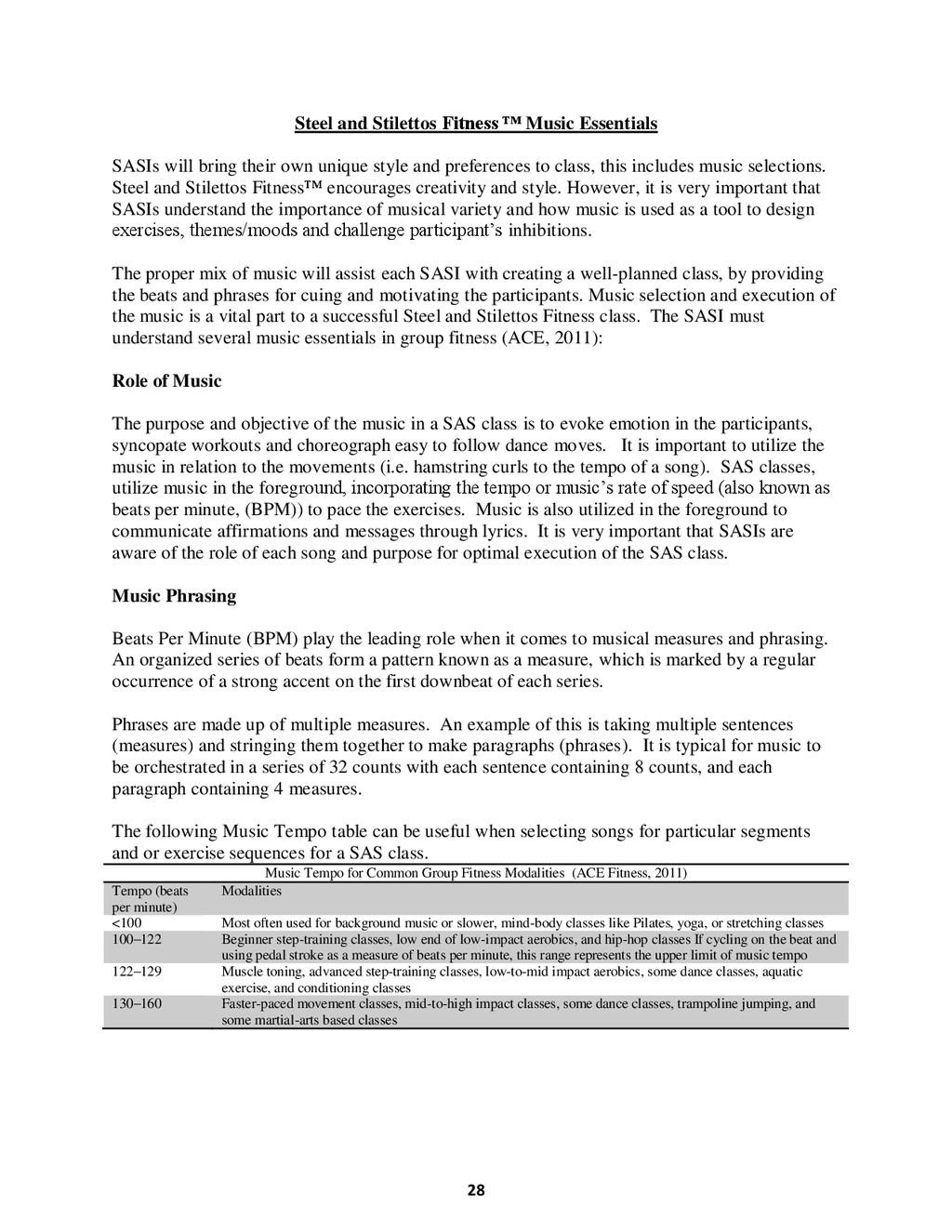
    bring their own unique style and preferences to class, this includes music selections. Steel and Stilettos Fitness™ encourages creativity and style. However, it is very important that SASIs understand the importance of musical variety and how music is used as a tool to design exercises, themes/moods and challenge participant’s inhibitions. The proper mix of music will assist each SASI with creating a well-planned class, by providing the beats and phrases for cuing and motivating the participants. Music selection and execution of the music is a vital part to a successful Steel and Stilettos Fitness class. The SASI must understand several music essentials in group fitness (ACE, 2011): Role of Music The purpose and objective of the music in a SAS class is to evoke emotion in the participants, syncopate workouts and choreograph easy to follow dance moves. It is important to utilize the music in relation to the movements (i.e. hamstring curls to the tempo of a song). SAS classes, utilize music in the foreground, incorporating the tempo or music’s rate of speed (also known as beats per minute, (BPM)) to pace the exercises. Music is also utilized in the foreground to communicate affirmations and messages through lyrics. It is very important that SASIs are aware of the role of each song and purpose for optimal execution of the SAS class. Music Phrasing Beats Per Minute (BPM) play the leading role when it comes to musical measures and phrasing. An organized series of beats form a pattern known as a measure, which is marked by a regular occurrence of a strong accent on the first downbeat of each series. Phrases are made up of multiple measures. An example of this is taking multiple sentences (measures) and stringing them together to make paragraphs (phrases). It is typical for music to be orchestrated in a series of 32 counts with each sentence containing 8 counts, and each paragraph containing 4 measures. The following Music Tempo table can be useful when selecting songs for particular segments and or exercise sequences for a SAS class. Music Tempo for Common Group Fitness Modalities (ACE Fitness, 2011) Tempo (beats per minute) Modalities <100 Most often used for background music or slower, mind-body classes like Pilates, yoga, or stretching classes 100–122 Beginner step-training classes, low end of low-impact aerobics, and hip-hop classes If cycling on the beat and using pedal stroke as a measure of beats per minute, this range represents the upper limit of music tempo 122–129 Muscle toning, advanced step-training classes, low-to-mid impact aerobics, some dance classes, aquatic exercise, and conditioning classes 130–160 Faster-paced movement classes, mid-to-high impact classes, some dance classes, trampoline jumping, and some martial-arts based classes
  30. 29 Music Selection The music selection for a SAS class

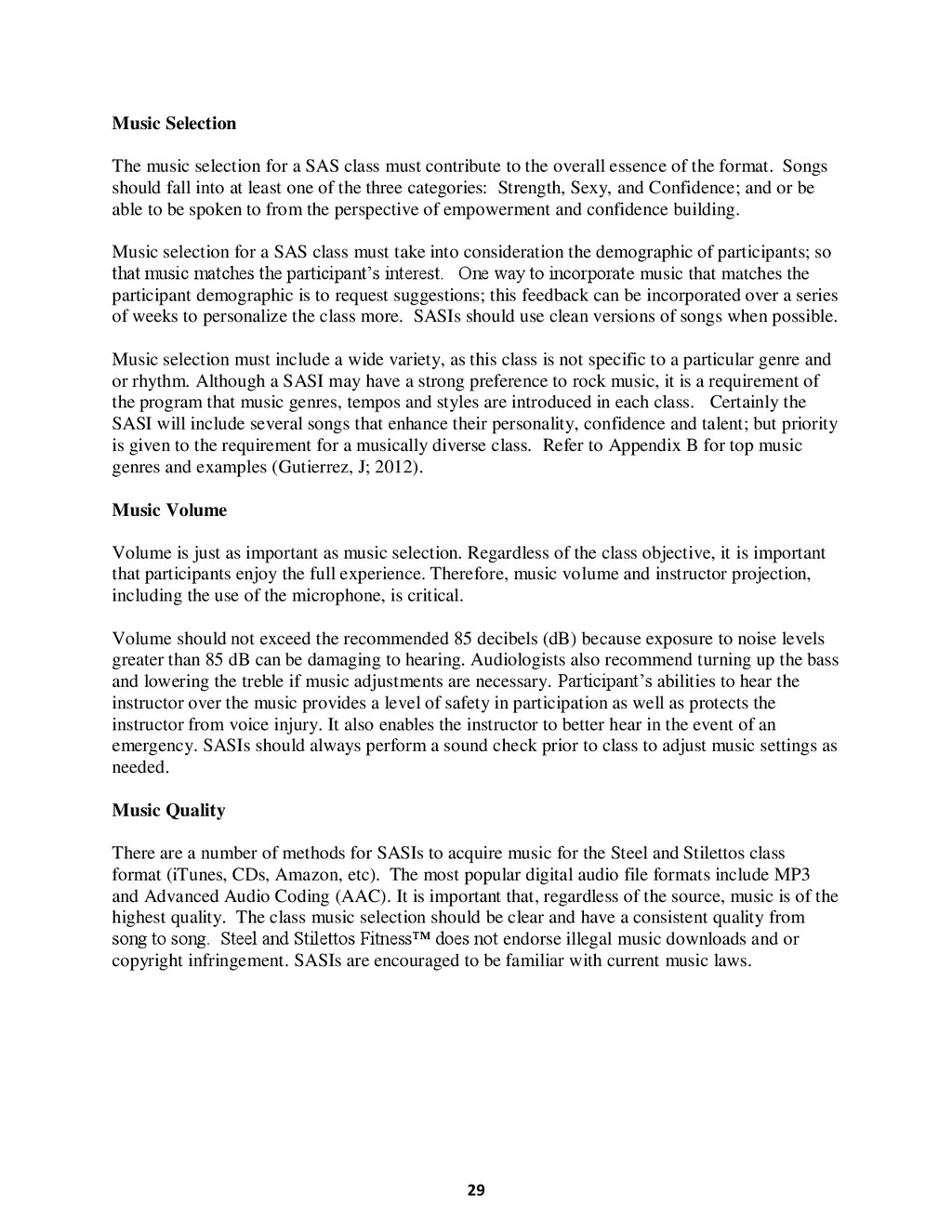
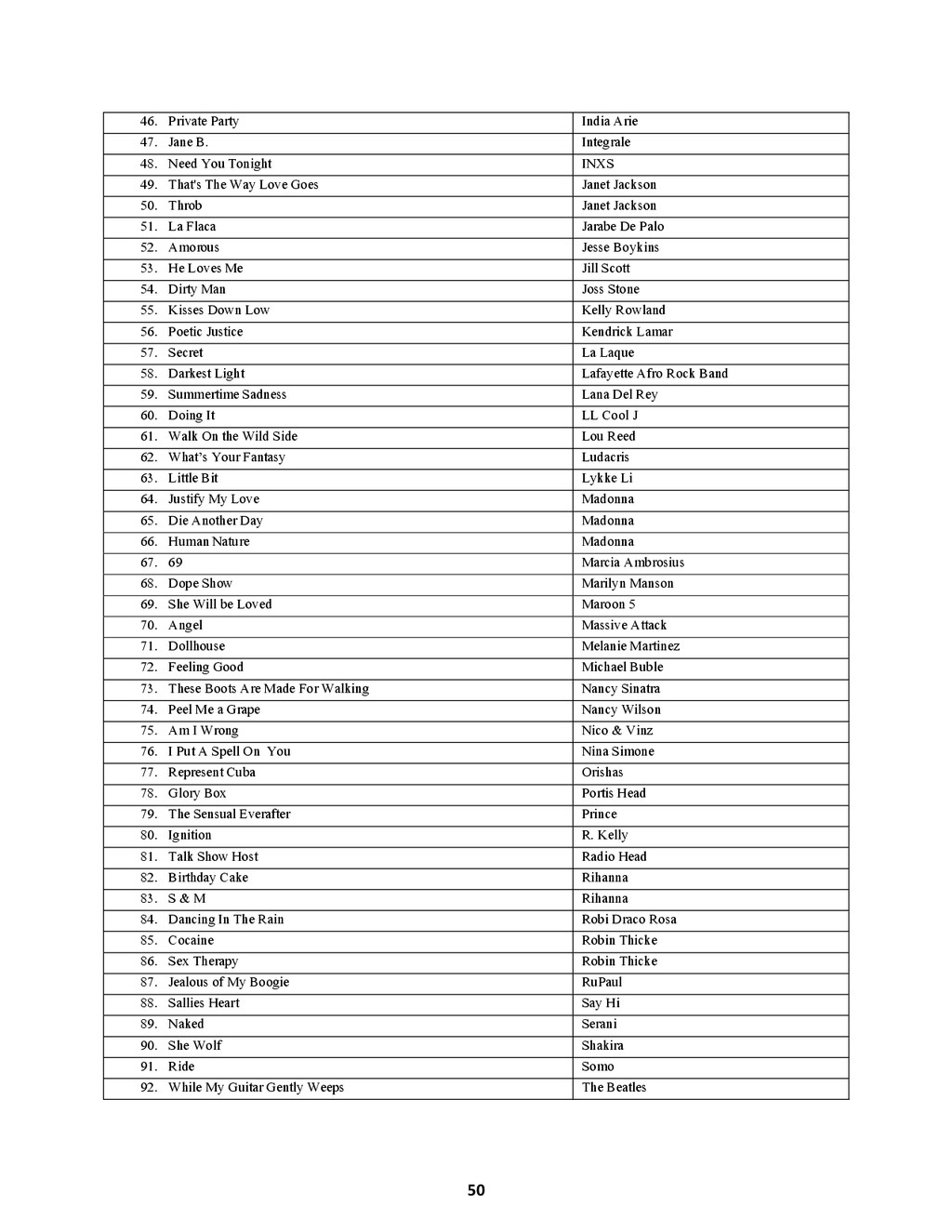
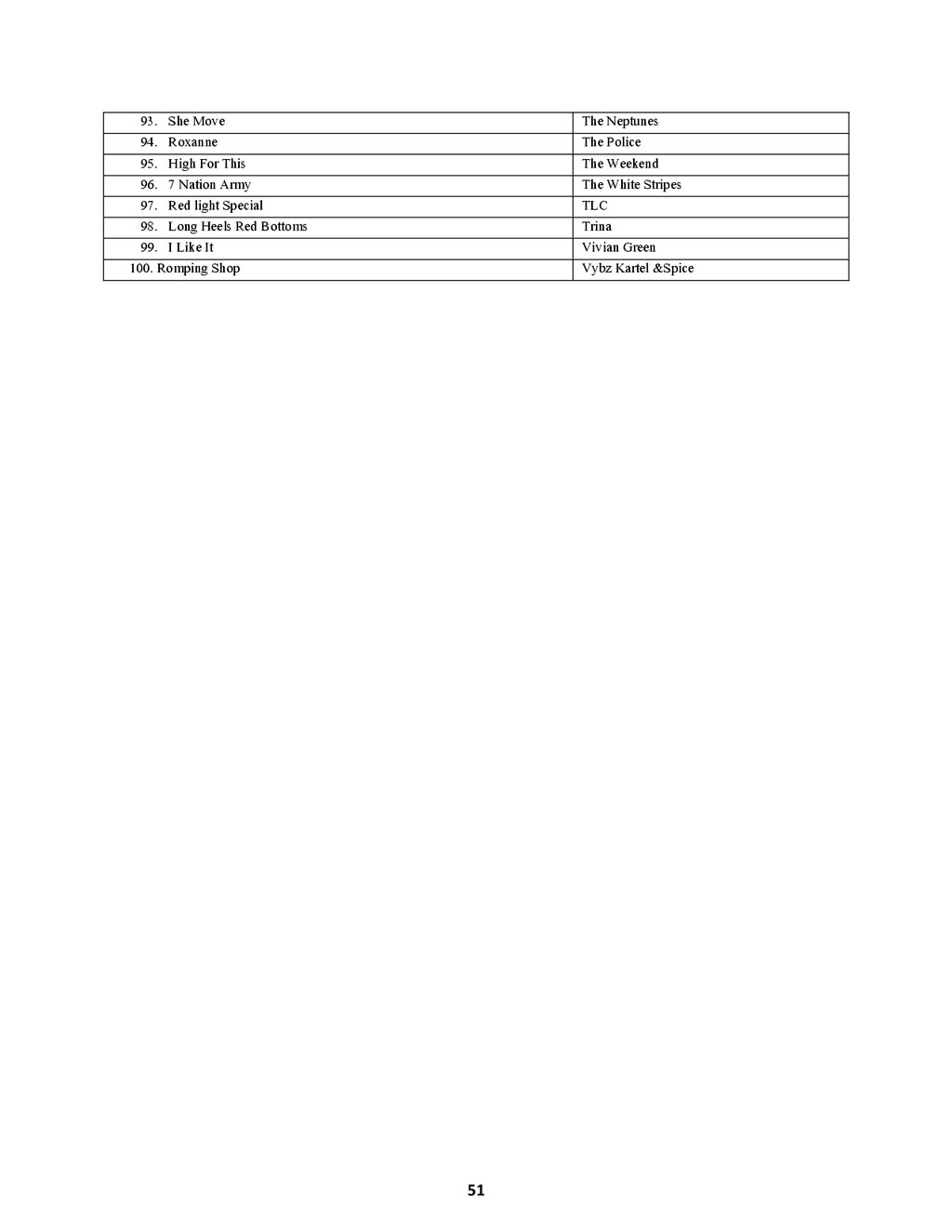
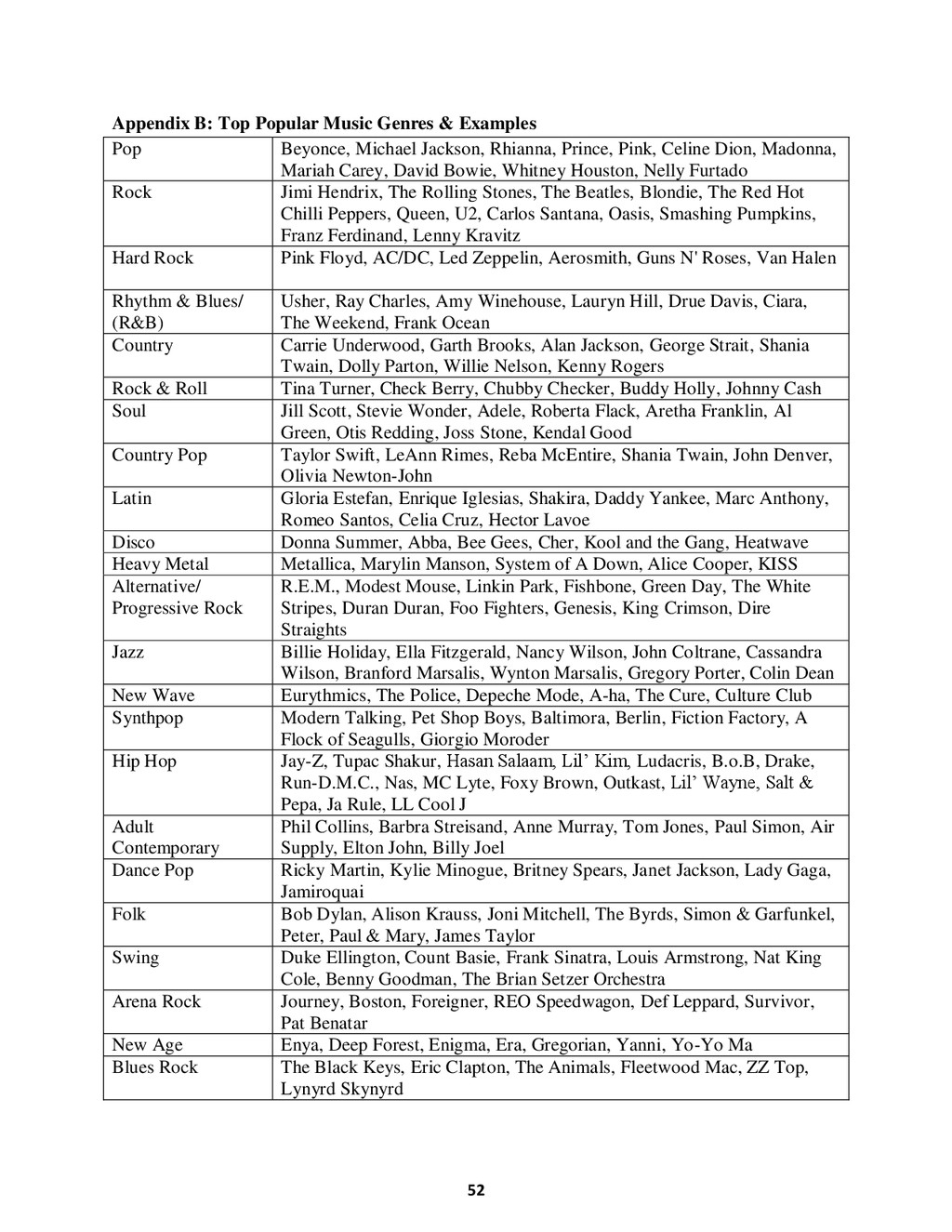
    must contribute to the overall essence of the format. Songs should fall into at least one of the three categories: Strength, Sexy, and Confidence; and or be able to be spoken to from the perspective of empowerment and confidence building. Music selection for a SAS class must take into consideration the demographic of participants; so that music matches the participant’s interest. One way to incorporate music that matches the participant demographic is to request suggestions; this feedback can be incorporated over a series of weeks to personalize the class more. SASIs should use clean versions of songs when possible. Music selection must include a wide variety, as this class is not specific to a particular genre and or rhythm. Although a SASI may have a strong preference to rock music, it is a requirement of the program that music genres, tempos and styles are introduced in each class. Certainly the SASI will include several songs that enhance their personality, confidence and talent; but priority is given to the requirement for a musically diverse class. Refer to Appendix B for top music genres and examples (Gutierrez, J; 2012). Music Volume Volume is just as important as music selection. Regardless of the class objective, it is important that participants enjoy the full experience. Therefore, music volume and instructor projection, including the use of the microphone, is critical. Volume should not exceed the recommended 85 decibels (dB) because exposure to noise levels greater than 85 dB can be damaging to hearing. Audiologists also recommend turning up the bass and lowering the treble if music adjustments are necessary. Participant’s abilities to hear the instructor over the music provides a level of safety in participation as well as protects the instructor from voice injury. It also enables the instructor to better hear in the event of an emergency. SASIs should always perform a sound check prior to class to adjust music settings as needed. Music Quality There are a number of methods for SASIs to acquire music for the Steel and Stilettos class format (iTunes, CDs, Amazon, etc). The most popular digital audio file formats include MP3 and Advanced Audio Coding (AAC). It is important that, regardless of the source, music is of the highest quality. The class music selection should be clear and have a consistent quality from song to song. Steel and Stilettos Fitness™ does not endorse illegal music downloads and or copyright infringement. SASIs are encouraged to be familiar with current music laws.
  31. 30 Anatomy of a Song Intro- the first part of

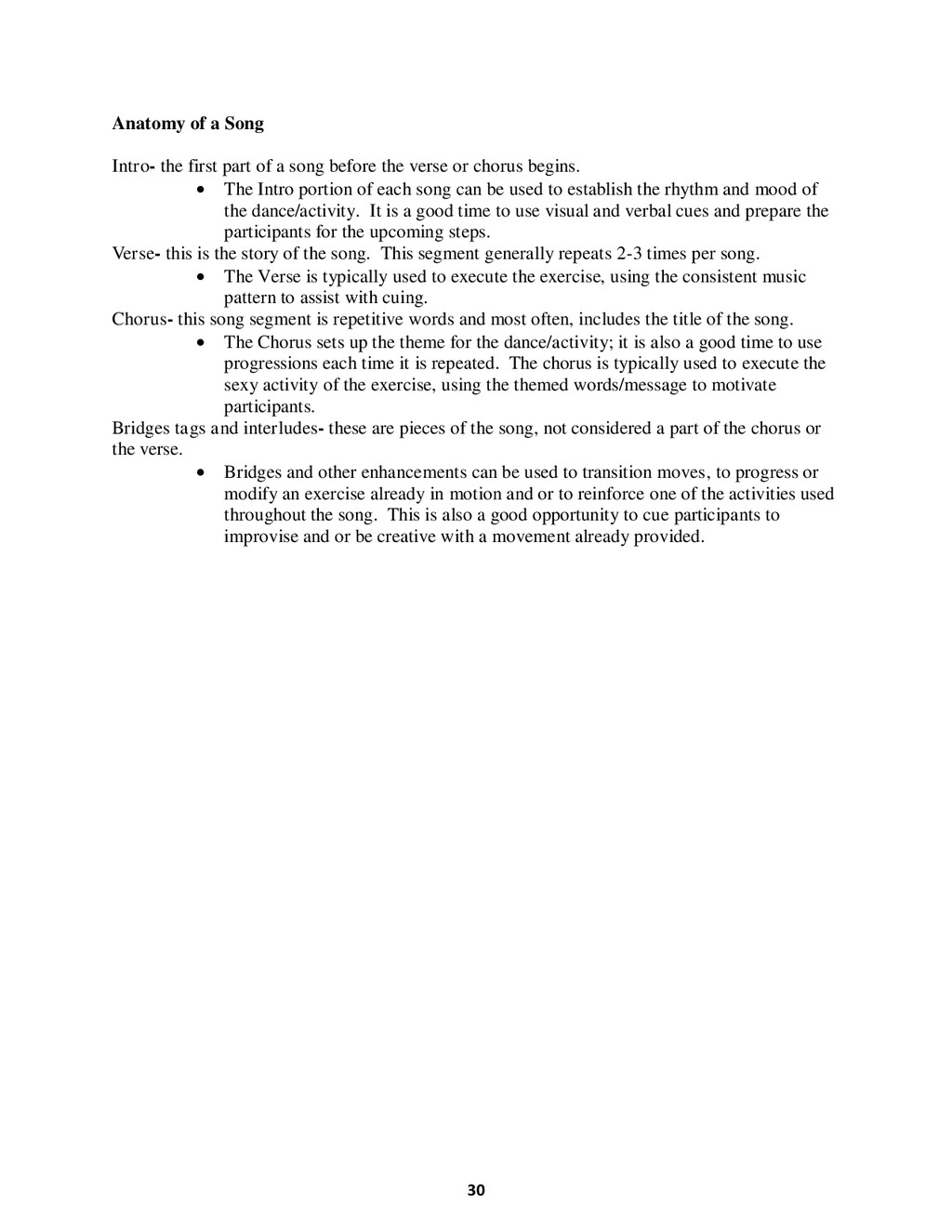
    a song before the verse or chorus begins.  The Intro portion of each song can be used to establish the rhythm and mood of the dance/activity. It is a good time to use visual and verbal cues and prepare the participants for the upcoming steps. Verse- this is the story of the song. This segment generally repeats 2-3 times per song.  The Verse is typically used to execute the exercise, using the consistent music pattern to assist with cuing. Chorus- this song segment is repetitive words and most often, includes the title of the song.  The Chorus sets up the theme for the dance/activity; it is also a good time to use progressions each time it is repeated. The chorus is typically used to execute the sexy activity of the exercise, using the themed words/message to motivate participants. Bridges tags and interludes- these are pieces of the song, not considered a part of the chorus or the verse.  Bridges and other enhancements can be used to transition moves, to progress or modify an exercise already in motion and or to reinforce one of the activities used throughout the song. This is also a good opportunity to cue participants to improvise and or be creative with a movement already provided.
  32. 31 Special Considerations and Contraindications: Head Over Heels All activity

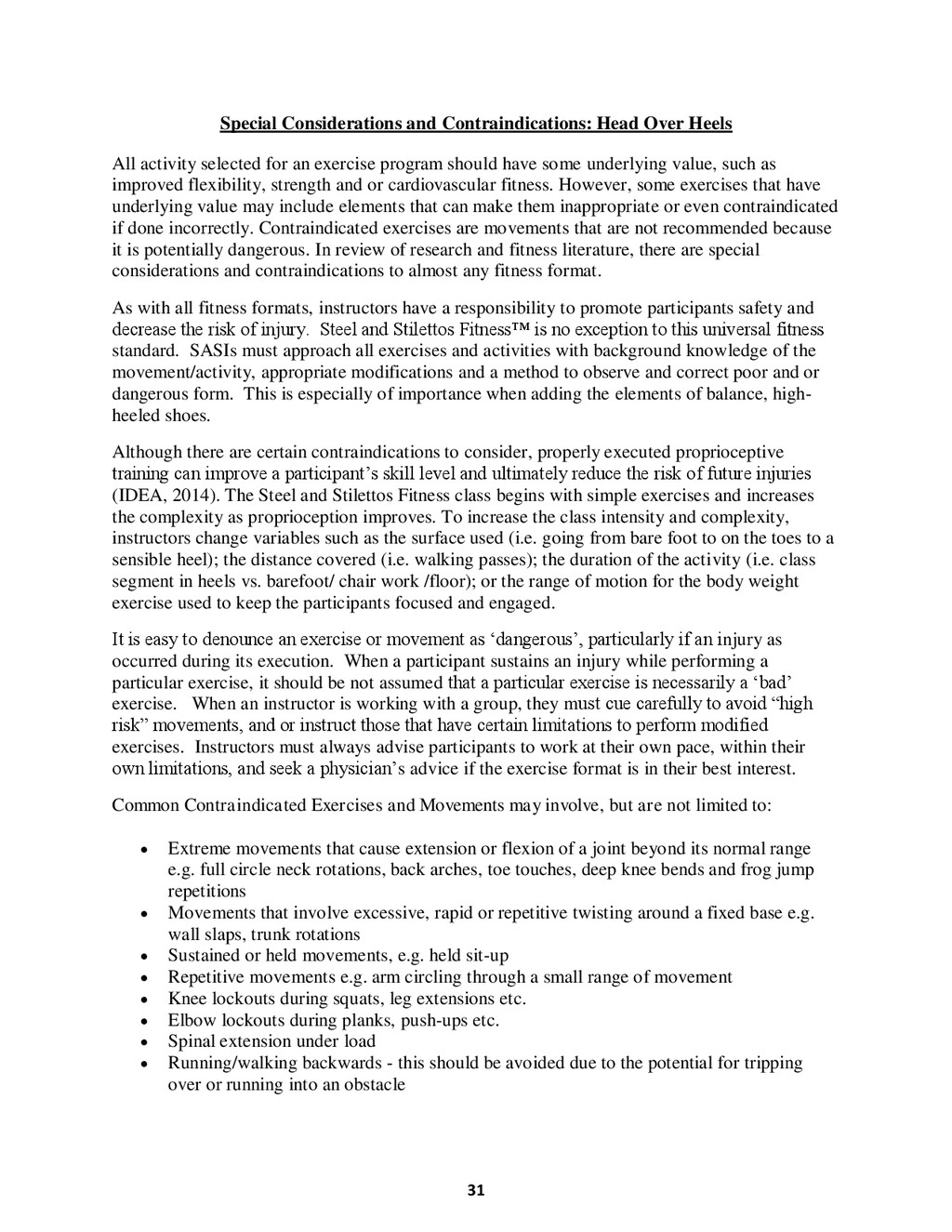
    selected for an exercise program should have some underlying value, such as improved flexibility, strength and or cardiovascular fitness. However, some exercises that have underlying value may include elements that can make them inappropriate or even contraindicated if done incorrectly. Contraindicated exercises are movements that are not recommended because it is potentially dangerous. In review of research and fitness literature, there are special considerations and contraindications to almost any fitness format. As with all fitness formats, instructors have a responsibility to promote participants safety and decrease the risk of injury. Steel and Stilettos Fitness™ is no exception to this universal fitness standard. SASIs must approach all exercises and activities with background knowledge of the movement/activity, appropriate modifications and a method to observe and correct poor and or dangerous form. This is especially of importance when adding the elements of balance, high- heeled shoes. Although there are certain contraindications to consider, properly executed proprioceptive training can improve a participant’s skill level and ultimately reduce the risk of future injuries (IDEA, 2014). The Steel and Stilettos Fitness class begins with simple exercises and increases the complexity as proprioception improves. To increase the class intensity and complexity, instructors change variables such as the surface used (i.e. going from bare foot to on the toes to a sensible heel); the distance covered (i.e. walking passes); the duration of the activity (i.e. class segment in heels vs. barefoot/ chair work /floor); or the range of motion for the body weight exercise used to keep the participants focused and engaged. It is easy to denounce an exercise or movement as ‘dangerous’, particularly if an injury as occurred during its execution. When a participant sustains an injury while performing a particular exercise, it should be not assumed that a particular exercise is necessarily a ‘bad’ exercise. When an instructor is working with a group, they must cue carefully to avoid “high risk” movements, and or instruct those that have certain limitations to perform modified exercises. Instructors must always advise participants to work at their own pace, within their own limitations, and seek a physician’s advice if the exercise format is in their best interest. Common Contraindicated Exercises and Movements may involve, but are not limited to:  Extreme movements that cause extension or flexion of a joint beyond its normal range e.g. full circle neck rotations, back arches, toe touches, deep knee bends and frog jump repetitions  Movements that involve excessive, rapid or repetitive twisting around a fixed base e.g. wall slaps, trunk rotations  Sustained or held movements, e.g. held sit-up  Repetitive movements e.g. arm circling through a small range of movement  Knee lockouts during squats, leg extensions etc.  Elbow lockouts during planks, push-ups etc.  Spinal extension under load  Running/walking backwards - this should be avoided due to the potential for tripping over or running into an obstacle
  33. 32 Special Considerations for Steel and Stilettos Fitness™ Steel and

    Stilettos introduces the concept of proprioception training, utilizing high heels in a short segment of the 60-75 minute class. Balance training programs are widely acknowledged as injury prevention and recovery method. This supports the use of proprioception training as a strategy to prevent injuries, amongst participants that may wear or desire to wear high heels; as well as a strengthening approach to those that have experienced issues with balance. The recent literature yields consensus that proprioception training outcomes include, but are not limited to: reduction of falls, reduction in ankle sprains, improved posture, improved balance, and improved reaction time. Literature reveals the risk associated with wearing high heels for an extended period of time. An extended period of time can be defined as both:  Short term: continuous use of high heels for several hours a day  Long term: continuous use of high heels for several months to years Both increase the risk of either injury or long standing foot related health issues. “Many women refuse to give up their high heels: A survey conducted by the American Podiatric Medical Association showed some 42% of women admitted they'd wear a shoe they liked even if it gave them discomfort” (Bouchez, 2014). Recognizing this attitude toward high heels along with the risk factors; Steel and Stilettos does not promote the extended use of heels, short or long term. Steel and Stilettos Fitness™ does promote the strengthening of muscles that are required to tolerate high heels for any length of time and the increase in balance to avoid injury while wearing heels. Steel and Stilettos Fitness™ also promotes the use of a commonly owned accessory in the use of a controlled training environment to elicit the outcomes described above. It is impervious that SASIs understand this philosophy and are prepared to speak to the known risk factors associated with high heels and the SAS program from the context of fitness versus fad. SASIs and participants must be aware of the risk associated with any balance training, including Steel and Stilettos; therefore making the following special considerations:  High heels that exceed two inches cause the foot to shift forward in the shoe with each step, potentially causing pain in the toes and ankle. o Instructors must model appropriate behavior and require participants to wear a sensible heel of 2-3 inches or less.  Tight Achilles tendons, joint pain in the ball of the foot (metatarsalgia), and pain in the calf muscles are often target areas when heels are worn for an extended period of time. o SASIs must follow the SAS Class Segment Recipe, to avoid extended period of time in heels.
  34. 33 o Proper stretching and foot exercises can increase blood

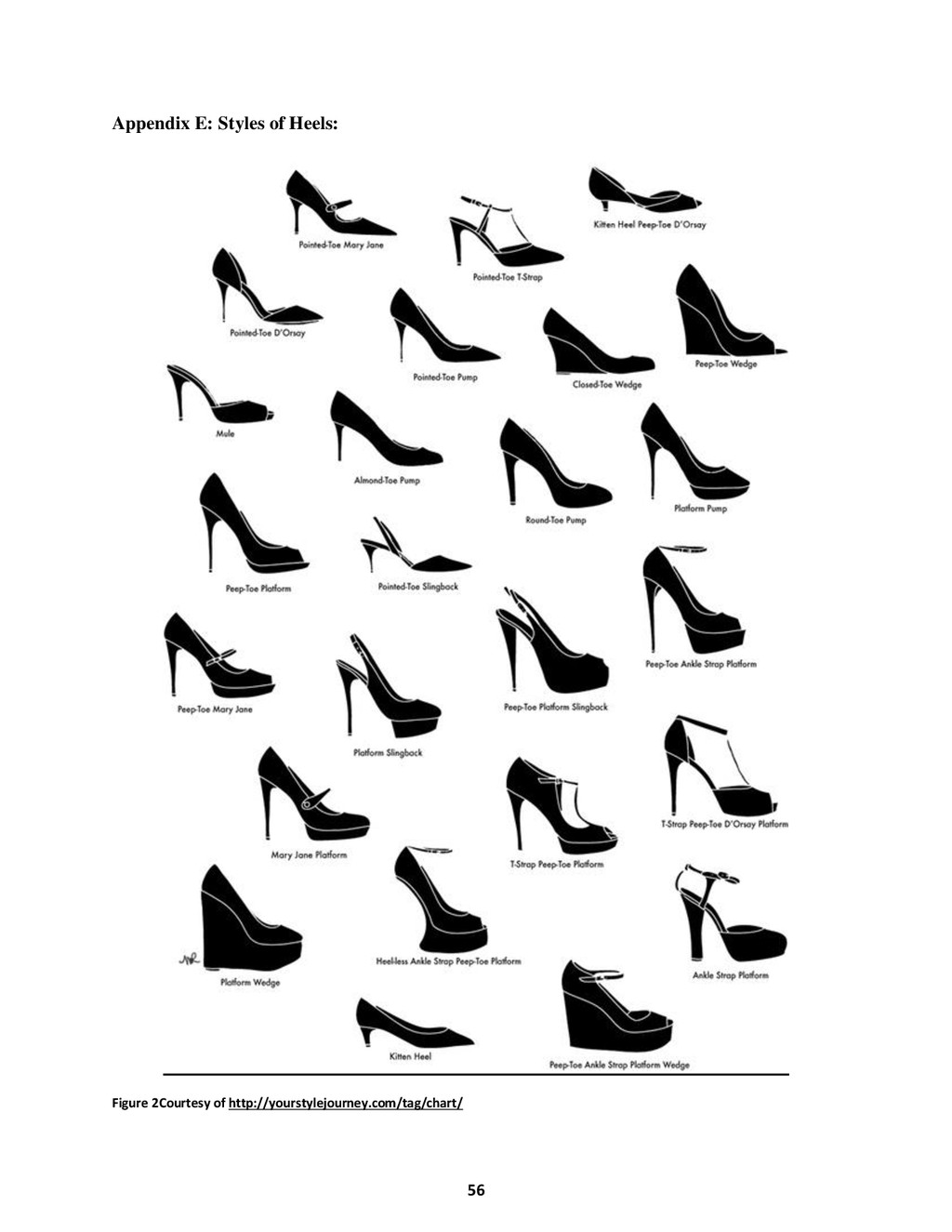
    flow to the foot and ankle. Increasing blood flow cuts down on the likelihood of metatarsalgia, stress fractures, and Achilles tendon problems. o SASIs should educate participants to use cushions to absorb shock from the balls of their feet in and out of class; also the use of a shoe with a platform can relieve pressure.  High heel shoes often have a narrow toe box that forces toes into an unnatural shape. o SASIs should educate participants on types of shoes that are practical for extended use; such as an open toe. Including using the best fitting high heel possible for in and out of class. Appendix E provides several types of shoe examples.  High heel use over time has been linked to overworked or injured leg muscles, osteoarthritis of the knee and low back pain. o SASIs are not to encourage the extended use of heels, but the use of heels as a balance and strengthening technique for the occasions when a participant is wearing heels and or in general activities of daily living. o The Steel and Stilettos Fitness format is, in fact, to strength the targeted areas which heels may have already damaged, due to overuse.  High heel wearers are at risk of ankle injuries, due to balance loss. o SASIs are to introduce both ankle strengthening exercises and balance exercise to reduce the participants risk for falls and or injuries out of class. o SASIs should encourage participants to wear a thicker heel for stability. A thicker heel will provide better balance and can provide relief of pressure by distributing the weight on your foot more evenly.
  35. 34 Safely Teaching Steel and Stilettos Fitness™  It is

    important to use a gradual progression when instructing Steel and Stilettos. Begin with low-intensity exercise and progress to more challenging exercises. When performing balance exercise (heels), it is helpful to establish a stable, non- moving focal point. This will keep the participant’s attention, focus and better stability.  Start with a stable foundation or position before progressing to a less stable foundation or position.  Start with static or stationary position (holding a position) before adding any movement (e.g. walking or stepping) or resistance. From this point you may add movement to your balance pose, such as lifting your arms/leg while still keeping your balance on one foot.  Do not extend recommended class time segment standing, dancing, balancing on heels.  Always remember the high heels are a tool used to engage participants in a confidence building fitness program and introduce balance techniques; not the entire concept of the format.  Inspect the teaching environment thoroughly before and during each class,  Clear the space of obstacles and trip hazards.  Move water bottles, bags, etc. off the fitness floor prior to class.  Provide clear instructions on the placement of chairs and mats.  Continuously assess participant’s safety in each of the exercise and segments.  Give permission for modifications, including taking off heels at any point in the class.
  36. 35 Injury Prevention Guidelines & Treatment Injury Categories Acute Injury-

    an accident without forewarning such as twisting an ankle or dislocating a shoulder, which requires immediate medical attention. Chronic Injury- an injury that never heals; continues to cause pain over time from continued use and may re-occur when not treated or preventative steps are not taken. Overuse Injury- a chronic injury to skeletal, muscles or joint systems, which vary in degree of severity as a result of repetitive trauma to a particular area caused by repeated movement patters or improper exercise technique. The most common overuse injuries occur in elbow and shoulder joints, lower back, knees, hips and ankles. Treatment  Persistent pain, unresponsive to early treatment should be seen by a physician within a week.  Most chronic injuries increase in severity if not treated. It is important to acquire a medical diagnosis and treatment options to avoid permanent damage.  Most overuse injuries take approximately 4 to 6 weeks to heal completely if participation in activity ceases until recovered. 10 Common Injuries Associated with Strength & Dance Workouts  Rapid and/or uncontrolled movements  Repetitive movement  Joint Hyperextension  Muscular imbalance  Early Muscle Fatigue (Improper Warm up)  Improper body alignment  Muscle spasm  Sprains  Tendonitis  Knee Strains Specific Potential Causes of Upper Body Injuries  Improper body mechanics, such as hyper-extension of joints, which may cause elbow or shoulder tendon strain or tendonitis.  Repeated external rotation of upper arm, which may cause tendonitis or bursitis to the shoulder joint.  Repetitive, rapid movements, with the arms over shoulder level, which may cause shoulder impingement, rotator cuff injuries to tendon and /or ligaments and bursitis. Damage may or may not involve the shoulder joint itself.
  37. 36 Specific Potential Causes of Low Back- Syndrome  Lack

    of overall strength  Muscle imbalance  Improper body mechanics or misalignment due to weak abdominal muscles and inflexible hamstring  Poor posture due to imbalance of muscles that attach and pull unevenly on the pelvic complex  General stiffness and immobility Specific Potential Causes of Lower Body Injuries  Repetitive lateral movement, affecting the medial and collateral ligament, may cause ligamentitis, ligament sprain, chondromalacia and patellar misalignment. Medial collateral ligament (MCL) injury is an injury to the ligament on the inner part of the knee. This ligament keeps your shin bone (tibia) in place.  Squatting too low can stress the anterior cruciate ligaments (ACL) and patellar tendon causing tendonitis and chondromalacia. o Cruciate ligaments are pairs of ligaments arranged like a letter X. They occur in several joints of the body, such as the knee. o Patellar tendon works with the muscles in the front of your thigh - the quadriceps - to straighten your leg.  Repetitive lunging using improper technique, in which knees overshoot toes, may cause chondromalacia, bursitis and patellar tendonitis.  Twisting, particularly on carpet and knee medially rotates, may cause ligament sprain.
  38. 37 Equipment Considerations Steel and Stilettos Fitness™ may require the

    use of some or all of the following equipment depending on the location of class, level of fitness, and class design. If a SASI is unable to secure a teaching venue without chairs and or mats; the instructor should design a class that still reduces the time participants will be actively standing in their heels. Safety must never be compromised due to equipment limitations. Chair- must be stable and sturdy. For optimal safety measures, chairs should have non slip rubber on each leg to avoid slipping. Sliders- this optional accessory can be purchased from www.steelandstilettosfitness.com or a general store. Sliders should be clean and in good repair and not cause scratches or damage to the venue floor. Mirror- this is optional but strongly encouraged given the confidence building and empowerment theme of the class. Participants should be guided to see themselves and the instructor in the mirror at all times. It is strongly suggested that SASIs teach 50-60% of the class facing the mirror to avoid feelings of judgment of instructor to participant. Mirrors should be clean. Mat- the use of floor exercises is an integral segment of the SAS class, therefore for comfort and sanitary purposes, participants are encouraged to bring a mat to each class. Instructors should design ample time in the class to retrieve mat and ample time at the end of class for participants to clean mat. Mats should be diagonally placed, allowing participants to view body placement and form in the mirror. Flooring- SASIs must inspect all venue flooring for safety. Floor must be clean of any debris, cords, dents and or obstructions. Floors should be suitable for high heel and chair workout (Example: wood or tile) Microphone- SASIs should request and or provide a portable wireless microphone with headset. This is strongly encouraged given the confidence building and empowerment theme of the class and need for continuous verbal fitness and directional cues. Sound System- A great sound system is an essential and vital component of a Steel and Stilettos class since music establishes energy and excitement of the class. If possible, make sure that the sound system has quality speakers to allow the delivery of clear sound, free from static. Facilities/Room- Make sure the room spacious, cool and well-ventilated to provide for a great class, to avoid injury and to help with thermo heat regulation.
  39. 38 Apparel- Participants should be advised to wear comfortable active

    clothing that is not restrictive and allows appropriate cooling of the body. Participants should be advised to bring a sensible pair of shoes. The term sensible is based on their personal limitations and abilities.
  40. 39 How to Teach Your First 200% Class: 50% Strength,

    50% Sexy and 100% Confidence Preparation! SASIs will know before walking into a class if it will be a 200% class or not, based on preparation. It is vital to the success of the class that the SASI is prepared. The SASI may start their class design by selecting a series of songs first and pairing them to exercises, dances and activities. Other SASIs may prefer to select an empowerment theme and build songs around the theme and then add the exercises to fit the rhythms of the songs. There is no right or wrong way; as long as all three are prepared in advance of class. Music selection, quality, timing and flow are very important and the SASI will need to sit and listen to several songs to develop just the right playlist. Below are a few quick starters to preparing your first Steel and Stilettos Class. Starting with Strength: Exercise sequencing will also determine the effectiveness of the class, as well as a safe flow. The SASI should always apply sequencing to the SAS segments provided in this training. Here are few questions a SASI must ask when designing a SAS class:  Is the music and steps appropriate for the exercise movements?  Is this exercise really working the muscle or muscle groups intended?  Are these muscle groups the SAS focal muscles? (core & lower body)  Does the music and exercise selection correspond with the activity order suggested in the SAS Recipe?  Does the exercise compliment the rhythm?  Will this exercise allow the participant to go from a seated/laying position to standing?  Does this exercise happen with or without heels?  Will the participants be warm enough to perform this exercise? (i.e. single leg squat in heels)  Will the participants’ heart rate be low enough to perform this move? (i.e. dropping head)  Has this muscles been over or under worked? Planning Empowerment: SASIs must remember that confidence building through empowerment is what sets this class apart from many other formats of fitness. Each SASI will have a style of infusing confidence building into classes; nevertheless it is a required component of the class must also be prepared. Here are a few questions a SASI must ask when designing a SAS class:  What emotion or message do I want to convey in this class?
  41. 40 Examples: Triumph, Overcoming Fear, Reflecting on Success, Self-Respect, Accentuating

    the Positive, Courage ,Overcoming Jealousy, Hope, Dedication, Redefining Sexy, Body Image, Happiness, Internal Strength, Celebration of Self )  Will the music match the theme or will there be one or two themed songs?  Will I take 2-3 minutes at the beginning and end to focus on powerful message or will it be discussed throughout the class?  What are my personal thoughts and or experience on the topic?  What do I need to be careful to say or not say to avoid offending a participant?  What key cues do I want to use throughout the class to build confidence?  Is the topic broad enough that all of the participants can take something away from it?  Will I have resources to provide a participant if they ask me about the topic after class? Setting Up for Sexy: Many participants will attend the SAS class seeking the sexy component and others will shy away thinking “sexy” cannot be taught and it is something “you have or don’t have”. The SASI will introduce sexy movements in the class choreography, but will reinforce that everyone has “sex appeal” and their very own style and idea of what sexy is. As with all other aspects of the class, the SASI should be prepared with modifications for the more conservative participant, as well as the more liberal participant. For example, introducing a sexy crawl across the room may challenge a shy participant. The SASI may want to show how stationary back arches are subtle and sexy; while allowing the more liberal participant to take lap around the dance floor. This will require preparation to show a range of sexy movements. The SASI will also need to be prepared to remove any judgment, allow the participants to work within their comfort zone, and have cues prepared that are motivating but not pushy. Example: “That is a great start right there…I really like how you are making eye contact in the mirror, that is the epitome of sexy” …. “It is so great how you are really going for it! I would like to try that move myself!” Showtime: The Steel and Stilettos Class: Before each Steel and Stilettos class it is important to set the empowerment tone. The format requires the instructor to infuse self-empowerment throughout the course; starting with a theme, message and or affirmation is a great way to center your participants. The SASI will want to introduce the expectations of Steel and Stilettos Fitness, which include a lower body workout, low impact cardio dancing and confidence building activities. Participants should also be provided with a general idea of the class flow, to reduce some anxieties that may come with trying a new and edgy format. Opening Example: Good Evening I am Jasmine your SAS Instructor tonight. Go ahead and place your heels and mat to the back of the room, next to your chair. We will slowly ease our way into our heels and onto the floor once we have warmed up our bodies without the heels. Tonight you can expect a great lower body workout, a lot of sweat and laughs, a chance to
  42. 41 challenge yourself by letting go of (guilt, fears, baggage,

    insecurities) and accepting how (strong, resilient, beautiful, fearless) you are. I’ll be here to talk you through it the entire time and help you in and out of exercises that may be new to you! If at any time you need to tone it down or kick it up a notch, remember this is your class/your workout. Take water anytime you need to and if your feet need a break, just carefully take off your shoes and rejoin us up on your toes! If you have any injuries, please work within your limits. An opening that sets the tone for a wide range of backgrounds gives everyone permission to start at his/her own level of fitness and sexy. The SASI also reassures the participants that they will be there to support them through the entire class. The use of positive reinforcements is a motivator for participants. SASIs are able to maintain their role as a fitness instructor and use their personal experiences and or acquired knowledge of the empowerment process to relate to common barriers to self-confidence. During class SASIs will use varied fitness and confidence cueing to motivate participants. SASIs should move around the class providing individual encouragement and form correction when possible. SASIs should promote participants to pace themselves through the class, taking water breaks, adjusting/removing shoes if needed, and or modifying activities needed. It is not expected that the SASI will be a counselor and/or self-disclose personal information during/before/after to participants; but provide empowering prompts that anyone can benefit from hearing and later reflect on. Cues can apply to both the effort that a participant needs to push through an exercise sequence and can be synonymous to reality-based confidence barriers. It is okay to feel a bit overwhelmed in the beginning, if you prepare the class using the SAS recipe, ensure safety at all times and pull from your personal strengths the participants will receive the full SAS experience.
  43. 42 Leadership and Teaching Skills Think about a favorite mentor,

    teacher or instructor? What made him or her so special? What are some things that you can do to bring the same experience to your own students? To start your successful career as a Steel and Stilettos Instructor, there are some guiding principles and tips towards being an outstanding instructor to your participants, fitness peers and employers. Be Prepared and Organized: This first strategy is the most obvious, but it is the foundation to success as a group fitness leader and fitness professional. Prepare your choreography and fitness activities; practice it on your own before introducing it to participants. Arrive on time with all the tools necessary to execute the class. Anticipate Bumps in the Road: Even if you map out how you want the class to proceed, it doesn’t always go as you would have hoped. So anticipate challenges and potential pitfalls. Knowing how to handle tricky situations before they arise helps eliminate worry about what to do if something doesn’t go your way. For example, always keep a back-up play list on a CD or MP3 device, just in case your iPod battery dies. Pre-plan exercise modifications in case a pregnant or injured participant shows up for your drop-in class. Develop your Leader Persona: Hone in on your teaching personality and what you are most known for as an instructor. Analyze what special experience you provide in your workouts, and then emphasize that experience in your classes. Your leader persona could be a combination of what you say (e.g., you offer a lot of fitness cuing), how you look (e.g., your style of dress or body type), what you teach (e.g., class format or style), or how you act (e.g., mellow, boisterous, funny). Stay in the Know: Trends in fitness, including contraindications, change often. Professionals remain tapped into continued education and current findings from leaders in the industry. To keep classes safe, new and exciting SASIs must keep current on SAS education and the general professional fitness community. Respect your students and teaching facility:  Be on time to class (Be early!)  Greet your students, peer instructors and guest of the facility  Give as much time as possible if you will be out and provide a substitute option whenever possible
  44. 43  Market your class using appropriate material to the

    SAS trademark guidelines and the facility you are teaching in  Clear your space before and after class  Be a good role model, stay healthy  Maintain professional boundaries with your students/participants and peer instructors  Refrain from sharing any negative personal options about the teaching facility, other instructors, and or formats with students/participants Steel and Stilettos Fitness Instructor Attire & Appearance SASIs are expected, when representing SAS to uphold the Steel and Stilettos Fitness™ brand at all times. SASIs must represent strength, sexy and confidence; therefore taking the appropriate time to be well groomed, healthy and prepared. Personal style is important to bring to class, but over styling can be a distraction. Instructors must look professional and be functional to effectively teach the class and properly market the brand.  Attire must be clean and in good repair  Attire should be well-fitting for SASI’s body type  Attire should not advertise any offensive, political, religious and or sexual message  Attire must cover instructor’s entire buttocks and breast (no undergarment, tassels, etc.)  Shoes must be clean and in good repair (heel covers intact, minimal to no scuffs)  Shoes should be sensible, fit well and comfortable; do not practice in new heels during a class  Pants/Shorts should be a dark tone, to avoid “sweat marks” in intimate areas  SASI’s hair, skin and nails should be well groomed
  45. 44 Maintaining a Steel and Stilettos License and Professional Status

    After completing the Steel and Stilettos Instructor training you will sign and agree to the terms and guidelines presented and included in this manual. Upon execution of this document and completion of training, you are will be a licensed SASI. It is important to understand that SASIs are licensed NOT certified. Completion of the Steel and Stilettos Fitness™ Instructor training entitles you to the instructor title for one year and the use Steel and Stilettos™ in your class. To remain a SASI beyond the first year, you must participate in continuing education per the normal industry standard. You must either:  Take another Steel and Stilettos Fitness™ Instructor Training Workshop once per year or;  Join the SASS Network (Steel And Stilettos Support Network) ;  SASS Network members in good standing are always considered Active Steel And Stilettos Instructors;  The SASS Network is Steel and Stilettos’ Fitness™ professional development system.  SASS Network members can access their SAS accounts online and enjoy the benefits and resources provided to SAS Network members only.  Employers will be provided with verification of instructor status; to confirm SASI has rights and privileges to teach Steel and Stilettos Fitness™  Obtain and maintain CPR/ First Aid Certification  Professional Liability Insurance – instructing as an Independent Contractor or teaching a private class, makes maintaining professional liability insurance a vital asset. Obtaining coverage is easy and affordable and allows protection for you, the facility in which you provide services. Steel and Stilettos Fitness™ and Body Altitudes Health and Fitness LLC REQUIRES all instructors providing SAS classes to be independently insured and or be covered by the teaching facility.  Group Fitness Certification- certification by a nationally recognized organization such as ACE (American Council on Exercise) or AFFA (Aerobic Fitness Association of America) is encouraged but not required.
  46. 45 Trademark Usage & License Agreement Proper use of the

    trademarked names and logos are important. Please refer to the proper use of the Steel and Stilettos Fitness™ name, logo and trademark symbol. Any instructor who has completed an authorized Steel and Stilettos Fitness™ Instructor Training Course and whose certificate is current has permission to: 1. Name his or her class “Steel and Stilettos Fitness™” 2. Use the title “Steel and Stilettos Fitness™ Instructor” 3. Use the text word Steel and Stilettos Fitness ™ on a class schedule 4. Always us the proper trademark indicators (™) at minimum the first time the mark appears in communication/ advertisement. 5. Always use the generic term after trademark (i.e. Steel and Stilettos Fitness™ class, products, etc.) 6. Always use the trademark notice on printed or digital advertising materials’ 7. Do not change the grammar or spelling of any of the words of the trademark (i.e. Steel and Heels; Stiletto Fitness etc.) 8. Never use the trademark as a noun or verb (i.e. I am doing Steel and Stilettos vs. I am taking a Steel and Stilettos Fitness™ Class) 9. Never use the trademark as a generic term 10. Never use the trademark name as or in association with another trade or company name Examples: Incorrect Correct Incorrect Use “Steel and Stilettos is my favorite class!” “My favorite classes to take are Steel and Stilettos Fitness classes!” Trademark used as a noun “Have you tried Steel and Stilettos?” “Have you tried Steel and Stilettos Fitness classes?” Trademark used as a verb “Steel and Stilettos LA Studio” “Studio LA is providing Steel and Stilettos Fitness classes” Trademark is being used as part of a trade name “Steel and Stilettos is so much fun!” “Steel and Stilettos Fitness classes are so much fun!” Trademark is used as a generic term
  47. 46 Join the Steel and Stilettos Support Network The Steel

    and Stilettos Support (SAS) Network was created as a career development system to provide instructors with the tools, resources, music recommendations, fitness activities & choreography and marketing material necessary for a professional career as a SASI . Benefits of the SASS Network (Steel and Stilettos Support Network):  SASS Network members in good standing are always considered Active Steel and Stilettos Instructors.  Low monthly cost of $20 vs. $289 training and travel fees annually to uphold license  Regularly scheduled uploads of Steel and Stilettos approved fitness activities  Regularly scheduled uploads of Steel and Stilettos music selection recommendations  Opportunity to share choreography with Steel and Stilettos Instructors globally  Deeply discounted Steel and Stilettos Shoes and Apparel for professional use and retail sales  Wholesale prices on all MOTIVES cosmetics, nail and skincare line for professional/personal use and retail sales  SASS Network members can access SAS accounts online and enjoy the benefits and resources provided to SAS Network members only.  Employers will be provided with verification of instructor status; to confirm SASI has rights and privileges to teach Steel and Stilettos Fitness™  Access to marketing material templates (i.e. Business Cards, Flyers, Posters )  Your name and class schedule listed on SteelAndStilettosFitness.com.  Business ideas and opportunities  Referrals to Masterclass opportunities  Authorization to host Steel and Stilettos Masterclass; with approved contracts and guidelines.  Ongoing peer and professional support; including Q&A with the creators  Deep discounts on additional Body Altitudes’ Sexy Series Courses and Trainings Other Body Altitudes Sexy Series Courses & Trainings Body Altitudes Health and Fitness LLC is currently in the process of developing new and exciting Sexy Series courses; be on the lookout for, including: Steel and Stilettos II: Total Body K.I.S.S. (Keep It Strong and Sexy) Whipped!
  48. 47 References American College of Sports Medicine. "ACSM's Resources for

    the Personal Trainer." N.p., 2005. Web. 1 July 2014. Banes, Sally and Carroll, Noël(2006) 'Cunningham, Balanchine, and Postmodern Dance', Dance Chronicle, 29: 1, 49 — 68 Bernardo, Lisa M. "The effectiveness of Pilates training in healthy adults: An appraisal of the research literature." Journal of Bodywork and Movement Therapies (2007): n. pag. Print. Booty Jam Fitness (2014) Booty Jam Fitness™ Instructor Manual Brooks, D., & Brooks, C.C. 2002. Integrated Balance Training. DW Fitness, LLC. Clippinger, K. (2007). Dance Anatomy and Kinesiology. Champaign, IL: Human Kinetics Crawford, Nicole O. Personal Interview. Sept. 2014. "Getting Healthy." www.heart.org. N.p., n.d. Web. 8 Oct. 2014. Houglum, P.A. 2001. Therapeutic Exercise for Athletic Injuries. Champaign, IL: Human Kinetics. Howse, J. (2000). Dance Technique and Injury Prevention. 3rd ed. London: A & C Black, 2000. Indar, Christina. Personal Interview. Sept. 2014. Kemper, Karen. "Contraindicated Exercises." Idea Fitness Journal, Sept. 2013. Web. 5 Jan. 2013. Kerrigan, D C., Mary K. Todd, and Patrick O. Riley. "Knee osteoarthritis and high-heeled shoes." Lancet (1998): n. pag. Print. Kreighbaum, E., & Barthels, K. 1996. Deep squat. In Biomechanics: A Qualitative Approach for Studying Human Movement (4th ed., pp. 203–4). Boston:Allyn and Bacon. Lee, Chang-Min, Eun-Hee Jeong, and Andris Freivalds. "Biomechanical effects of wearing high- heeled shoes." International Journal of Industrial Ergonomics (2001): n. pag. Print. McGill, S.M. 1998. Low back exercises: Evidence for improving exercise regimens. Physical Therapy, 78 (7), 754–65. McGuine TA, Keene JS. Do proprioceptive training programs reduce the risk of ankle sprains in Med, 10(5), 67-82. Mine, Mark R., Frederick P. Jr., and Carlo H. Sequin. "Moving objects in space: exploiting proprioception in virtual-environment interaction." (1997): Print. Neviaser TJ: Weight lifting: risks and injuries to the shoulder. Clin Sports Med 1991;10 (3):
  49. 48 Philadelphia: Lippincott Williams & Wilkins OPILA, KAREN A., STEPHEN

    S. WAGNER, STANLEY SCHIOWITZ, and JOHN CHEN. "Postural Alignment in Barefoot and High-Heeled Stance." Spine (1988): n. pag. Print. Poppwych, Krista (April, 2005). Cuing Beyond Counting. IDEA Fitness Journal. proprioceptive balance board training program for the prevention of ankle sprains. Am J Sports Med. 2004; 32: 1385-1393. Reed, Chemika J. Personal Interview. Sept. 2014. Ruiz, R. (2005) Functional balance training using a domed device. Strength and Conditioning Journal, 27(1):50-55. Solomon, R, J. Solomon, and SC Minton. Preventing Dance Injuries (1994). 2nd ed. Champaign, IL: Sports Injuries: Mechanisms, Prevention, Treatment. Baltimore, Williams & Wilkins, pp 515-529Sports Med 1 993;21(4):599-603 Tarrant, Michelle. "Proprioception Exercises Proprioceptive Activities." Idea Health & Fitness Sources, May 2003. Web. 8 Oct. 2014. Tarrant, Michelle. “How to Improve Proprioception.” Idea Helath & Fitness Sources,2014. Web 4 Jul. 2014 “Tips to Avoid Foot Pain From High Heels." WebMD - Better information. Better health. N.p., n.d. Web. 8 Sept. 2014. Watkins, Andrea, and Priscilla M. Clarkson. Dancing Longer Dancing Stronger: A Dancer's Guide to Improving Technique and Preventing Injury. Princeton, N.J: Princeton Book Co, 1990. Print. Watkins, Andrea, and Priscilla M. Clarkson. Dancing Longer Dancing Stronger: A Dancer's Guide to Improving Technique and Preventing Injury. Princeton, N.J: Princeton Book Co, 1990. Print. Wilkinson, Adrian. "Empowerment: theory and practice." Personnel Review (1998): n. pag. Print. Zumba® Fitness (2008) Zumba Toning Instructor Training Manual Zumba® Fitness (2010) Zumba Basic Steps Level 1 Instructor Training Manual
  50. 49 Appendix A: Creator’s Song Recommendation 1. Electric Relaxation A

    Tribe Called Quest 2. Rock The Boat Aaliyah 3. You Oughta Know Alanis Morissette 4. The Boy Does Nothing Alesha Dixon 5. Girl on Fire Alicia Keys 6. Gymnopedies Aquarelles Creator’s Song List Artist 7. Sail Awolnation 8. Sex You Bando Jonez 9. Single Ladies Beyonce 10. Grown Woman Beyonce 11. Partition Beyonce 12. Jealous Beyonce 13. Rocket Beyonce 14. Speechless Beyoncé 15. Money Make Her Smile Bruno Mars 16. Natalie Bruno Mars 17. Gorilla Bruno Mars 18. Twerk It Busta Rhymes 19. La Vida Es Un Carnaval Celia Cruz 20. Jungle Fever Chakachas 21. No Guarantee Chico DeBarge 22. Wicked Game Chris Isaak 23. There's No Way Chris Turner 24. Fighter Christina Aguilar 25. Try Colbie Caillat 26. Sparks Coldplay 27. Siboney Connie Francis 28. Fame David Bowie 29. Groove Is In The Heart Deee-Lite 30. Miserlou Dick Dale & His Del Tones 31. Spend The Night Donell Jones 32. Next to Me Emeli Sande 33. Every Part Emily King 34. I Wanna Be Loved Etta James 35. I'm In Love Evelyn Champagne King 36. Happy Together Filter 37. Shake It Out Florence & The Machine 38. Nada De Nada Frank Reyas 39. Luck Be A Lady Frank Sinatra 40. No You Girls Franz Ferdinand 41. I'll Stay Funkadelic 42. Night Nurse Gregory Isaacs 43. Live & Let Die Guns & Roses 44. Sweet Child O' Mine Guns N Roses 45. Mile High Club Hasan Salaam
  51. 50 46. Private Party India Arie 47. Jane B. Integrale

    48. Need You Tonight INXS 49. That's The Way Love Goes Janet Jackson 50. Throb Janet Jackson 51. La Flaca Jarabe De Palo 52. Amorous Jesse Boykins 53. He Loves Me Jill Scott 54. Dirty Man Joss Stone 55. Kisses Down Low Kelly Rowland 56. Poetic Justice Kendrick Lamar 57. Secret La Laque 58. Darkest Light Lafayette Afro Rock Band 59. Summertime Sadness Lana Del Rey 60. Doing It LL Cool J 61. Walk On the Wild Side Lou Reed 62. What’s Your Fantasy Ludacris 63. Little Bit Lykke Li 64. Justify My Love Madonna 65. Die Another Day Madonna 66. Human Nature Madonna 67. 69 Marcia Ambrosius 68. Dope Show Marilyn Manson 69. She Will be Loved Maroon 5 70. Angel Massive Attack 71. Dollhouse Melanie Martinez 72. Feeling Good Michael Buble 73. These Boots Are Made For Walking Nancy Sinatra 74. Peel Me a Grape Nancy Wilson 75. Am I Wrong Nico & Vinz 76. I Put A Spell On You Nina Simone 77. Represent Cuba Orishas 78. Glory Box Portis Head 79. The Sensual Everafter Prince 80. Ignition R. Kelly 81. Talk Show Host Radio Head 82. Birthday Cake Rihanna 83. S & M Rihanna 84. Dancing In The Rain Robi Draco Rosa 85. Cocaine Robin Thicke 86. Sex Therapy Robin Thicke 87. Jealous of My Boogie RuPaul 88. Sallies Heart Say Hi 89. Naked Serani 90. She Wolf Shakira 91. Ride Somo 92. While My Guitar Gently Weeps The Beatles
  52. 51 93. She Move The Neptunes 94. Roxanne The Police

    95. High For This The Weekend 96. 7 Nation Army The White Stripes 97. Red light Special TLC 98. Long Heels Red Bottoms Trina 99. I Like It Vivian Green 100. Romping Shop Vybz Kartel &Spice
  53. 52 Appendix B: Top Popular Music Genres & Examples Pop

    Beyonce, Michael Jackson, Rhianna, Prince, Pink, Celine Dion, Madonna, Mariah Carey, David Bowie, Whitney Houston, Nelly Furtado Rock Jimi Hendrix, The Rolling Stones, The Beatles, Blondie, The Red Hot Chilli Peppers, Queen, U2, Carlos Santana, Oasis, Smashing Pumpkins, Franz Ferdinand, Lenny Kravitz Hard Rock Pink Floyd, AC/DC, Led Zeppelin, Aerosmith, Guns N' Roses, Van Halen Rhythm & Blues/ (R&B) Usher, Ray Charles, Amy Winehouse, Lauryn Hill, Drue Davis, Ciara, The Weekend, Frank Ocean Country Carrie Underwood, Garth Brooks, Alan Jackson, George Strait, Shania Twain, Dolly Parton, Willie Nelson, Kenny Rogers Rock & Roll Tina Turner, Check Berry, Chubby Checker, Buddy Holly, Johnny Cash Soul Jill Scott, Stevie Wonder, Adele, Roberta Flack, Aretha Franklin, Al Green, Otis Redding, Joss Stone, Kendal Good Country Pop Taylor Swift, LeAnn Rimes, Reba McEntire, Shania Twain, John Denver, Olivia Newton-John Latin Gloria Estefan, Enrique Iglesias, Shakira, Daddy Yankee, Marc Anthony, Romeo Santos, Celia Cruz, Hector Lavoe Disco Donna Summer, Abba, Bee Gees, Cher, Kool and the Gang, Heatwave Heavy Metal Metallica, Marylin Manson, System of A Down, Alice Cooper, KISS Alternative/ Progressive Rock R.E.M., Modest Mouse, Linkin Park, Fishbone, Green Day, The White Stripes, Duran Duran, Foo Fighters, Genesis, King Crimson, Dire Straights Jazz Billie Holiday, Ella Fitzgerald, Nancy Wilson, John Coltrane, Cassandra Wilson, Branford Marsalis, Wynton Marsalis, Gregory Porter, Colin Dean New Wave Eurythmics, The Police, Depeche Mode, A-ha, The Cure, Culture Club Synthpop Modern Talking, Pet Shop Boys, Baltimora, Berlin, Fiction Factory, A Flock of Seagulls, Giorgio Moroder Hip Hop Jay-Z, Tupac Shakur, Hasan Salaam, Lil’ Kim, Ludacris, B.o.B, Drake, Run-D.M.C., Nas, MC Lyte, Foxy Brown, Outkast, Lil’ Wayne, Salt & Pepa, Ja Rule, LL Cool J Adult Contemporary Phil Collins, Barbra Streisand, Anne Murray, Tom Jones, Paul Simon, Air Supply, Elton John, Billy Joel Dance Pop Ricky Martin, Kylie Minogue, Britney Spears, Janet Jackson, Lady Gaga, Jamiroquai Folk Bob Dylan, Alison Krauss, Joni Mitchell, The Byrds, Simon & Garfunkel, Peter, Paul & Mary, James Taylor Swing Duke Ellington, Count Basie, Frank Sinatra, Louis Armstrong, Nat King Cole, Benny Goodman, The Brian Setzer Orchestra Arena Rock Journey, Boston, Foreigner, REO Speedwagon, Def Leppard, Survivor, Pat Benatar New Age Enya, Deep Forest, Enigma, Era, Gregorian, Yanni, Yo-Yo Ma Blues Rock The Black Keys, Eric Clapton, The Animals, Fleetwood Mac, ZZ Top, Lynyrd Skynyrd
  54. 53 Reggae Bob Marley & the Wailers, Supacat, Jimmy Cliff,

    Sean Paul, Lady Saw, Desmond Dekker & the Aces, Dennis Brown, UB40 Grunge Nirvana, Pearl Jam, Soundgarden, Alice in Chains, Stone Temple Pilots, Hole Glam Metal Motley Crue, Bon Jovi, Slaughter, Poison, Scorpions, Warrant Easy Listening Jim Brickman, Richard Clayderman, Nana Mouskouri, Ray Conniff, Barry Manilow, Stephen Bishop
  55. 54 Appendix C: Lower Body Major Muscle Groups Major Muscle

    Group Location Functional Role Exercise to Strengthen Sample Stretch Abdominal Stomach Sitting up, postural alignment Crunches, leg raises, twisting crunches You typically don't stretch your abs. For most people, the abs are not strong enough, so you need to work on strengthening them rather than stretching them Erector Spinae Low back Postural alignment back extensions "Cat Stretch" - Kneel on all fours, round back like a cat. Sit on chair with feet shoulder distance apart. Bend over and place shoulders between your knees Gastrocnemius & Soleus Back of lower leg Push off for walking, standing on tiptoes Standing calf raises, seated calf raises Lunges with a straight back leg for gastrocnemius. Lunges with bent knees for soleus. Gluteus Buttocks Climbing stairs, walking, standing up Squat, leg press Sit on chair, cross other leg over thigh of bent leg, lean forwards. Hamstrings Thigh - back Walking Squats, lunges, leg extensions, leg curls While standing, place heel of leg to be stretched on a chair. Keep your leg as straight as possible, your hips square and your back flat. Bend at the waist toward your leg. Obliques Side of body Rotation and side flexion of body Twisting crunches, rotary torso Lie on your back with your arms extended out ("T" shape) Bend both knees. Rotate your hips and put your bent legs on the floor on your side. Quadriceps Thigh - front Climbing stairs, walking, standing up Squats, lunges, leg presses While lying on side, grasp ankle, push hips forward Adductors Thigh- inner Rotation of legs/thighs Wide stance squat, Plie in 1st position Sitting with soles of feet together, pushing knees gently down.
  56. 57 Appendix F: Top Exercises Done Incorrectly, NHS Choices (2014)

    How to do a crunch correctly:  Curl up until your shoulders are about three inches off the floor.  Don't tuck your neck into your chest as you rise – imagine a tennis ball between your chin and chest.  Contract your abs throughout the exercise.  Don't jerk your head off the floor How to do the plank correctly:  Keep your legs straight and hips raised to create a straight and rigid line from head to toe.  Your shoulders should be directly above your elbows.  Keep your abs contracted during the exercise.  Don't allow your lower back to sink during the exercise.  Look down at the floor. How to do leg lifts correctly:  Don't flatten your lower back against the surface – maintain the lower back's natural curve.  Keep your head and shoulders pressed against the floor.  Your neck should be relaxed.  Keep your abs contracted throughout the exercise How to do a lunge correctly:  Step forward with one leg, lowering your hips until both knees are bent at about 90 degrees.  Don't let your front knee lean over the toes as you lunge.  Keep your upper body upright at all times and look straight ahead.

  57. 58 Appendix G: STEEL & STILETTOS TESTIMONIAL  “Into the

    class…I was nervous about how I would look and if I could do it. Walking out I felt empowered, sassy, strong, confident, happy and able to SEE myself.” ~ Nicole C.  “I felt like there was more to the class than just the physical exercise, but also a mental and emotional exercise similar to what I’ve experienced at yoga.” ~ Kristina  “I look at my heels in a whole new light! I’m no longer scared of them! They didn’t conquer me, I conquered them!” ~ V. Jermanowski  “I love the confidence it has given me and the fact that it’s a judgment free zone.” ~ Carla  “Walking into the class for the first time, I was curious and a little nervous because I did not really know what to expect. The instructor was extremely welcoming and understanding. She did not make you feel like you had to do anything you did not want to do. In all actuality, the verbiage used kind of tricked me into thinking I can do this very difficult exercise because I’m being sexy and cute about it! As the class went on, I became more confident in my physical self and expressed it outwardly to myself in the mirrors. I imagined I was alone with someone I cared about and just had fun with it! To be completely honest, as the class was ending, I did not feel like I worked out at all even though we did so much strength and training exercises. It was an amazing experience from day one!” ~WhyteTMovement  “The class allowed me to feel like a woman, something that doesn’t happen in a normal class. I am usually running around sweating like a man. This class allowed me to tap into my femininity while having a good workout.” ~ Chemika  “The first thing that came to mind when I heard the name Steel & Stilettos was a vision of body builder type ladies half naked with stilettos and pumping iron! Then I thought about it for a second and pictured average body ladies being sexy and pumping iron.” ~ Shawnice  “I was nervous walking in and super excited walking out! I was surprised to see how many calories I burned!” ~ Katuska  “I just wanted to say thanks again for the amazing class a few weeks ago. That little bit of elevation from the heel completely changed and intensified the workout. Muscles I thought I typically worked out felt so sore!” ~ Silvana (1st SASI)  “Yes, I have seen a difference in my body since beginning the class. My belly has started to slim down, my legs and arms have started to tone up as well. As my physical body changes, so does my emotional body, that socio-emotional body that contains my confidence has begun to resurface. The way that I walk, talk, stand and express myself through my art has changed because of the small moments in the Steel & Stilettos class.” ~ WhyteTMovement  “Originally I only expected a toning workout. Now I expect that, plus a bit of cardio, plus pushing myself to be comfortable in out-of-the-box situations (referring to the stations part of
  58. 59 the class, of course), plus learning to pay more

    attention to myself and what I am doing as opposed to following a strictly choreographed exercise routine.” ~ K. Anderson  My confidence in myself has increased and my ability to consistently exercise has increased.” ~ Nicole  “Once I started that first day, the intention became clear for me which was to find my inner sexy again and bring her out. I am a single mom with a two year old daughter so I don’t really get to see my sexy side much. It is nice to have a safe, welcoming and comfortable place to express such an intimate part of myself.” S. Edgy  “Confidence is up and I can dance the night away in heels!! I have even received compliments on my ability to walk in heels.” ~ C. Danesi  Steel and Stilettos Fitness gives me time away from all the stress and worries of daily life. It is a time to focus on me and only me. It is a positive, empowering class where I can let go of my fears and inhibitions and where I can focus on my strengths and tackle my obstacles. It is not about being perfect but about accepting yourself and finding beauty even in your flaws. The exercises are challenging but I've noticed improvement in my form and strength! I feel like I can take on the world when I leave class! It is these positive messages and experiences that motivated me to become one of the first SAS instructors and to share this positivity with the world! –Cristina (1st SASI)  You really motivated me with your words to empower women in my area. Thank you for creating such a wonderful program. –Desiree (1st SASI)
  59. 60 Appendix H: Steel And Stilettos Fitness™ Worksheet Segment Body

    Part Time Song Exercise Heels (H) Flat (F) Up (U) Floor (F) Intensity