Share
Embed
6 Inch Chef Knife vs. 8 Inch: Which Size Is Right for You?
Not sure whether to buy a 6 inch chef knife or an 8 inch? This guide breaks down hand size, control, and use cases to help you choose confidently.
Visit:- https://www.steelportknife.com/blogs/articles/6-inch-vs-8-inch-chef-knife
6 inch chef knife, 8 inch chef knife, carbon steel chef knife, forged kitchen knives, high carbon steel chef knife
Steel Port Knife
October 30, 2026
Transcript
6 slides
-
Bundle & Save: Thoughtful Gifts, Special Set Pricing 6 INCH
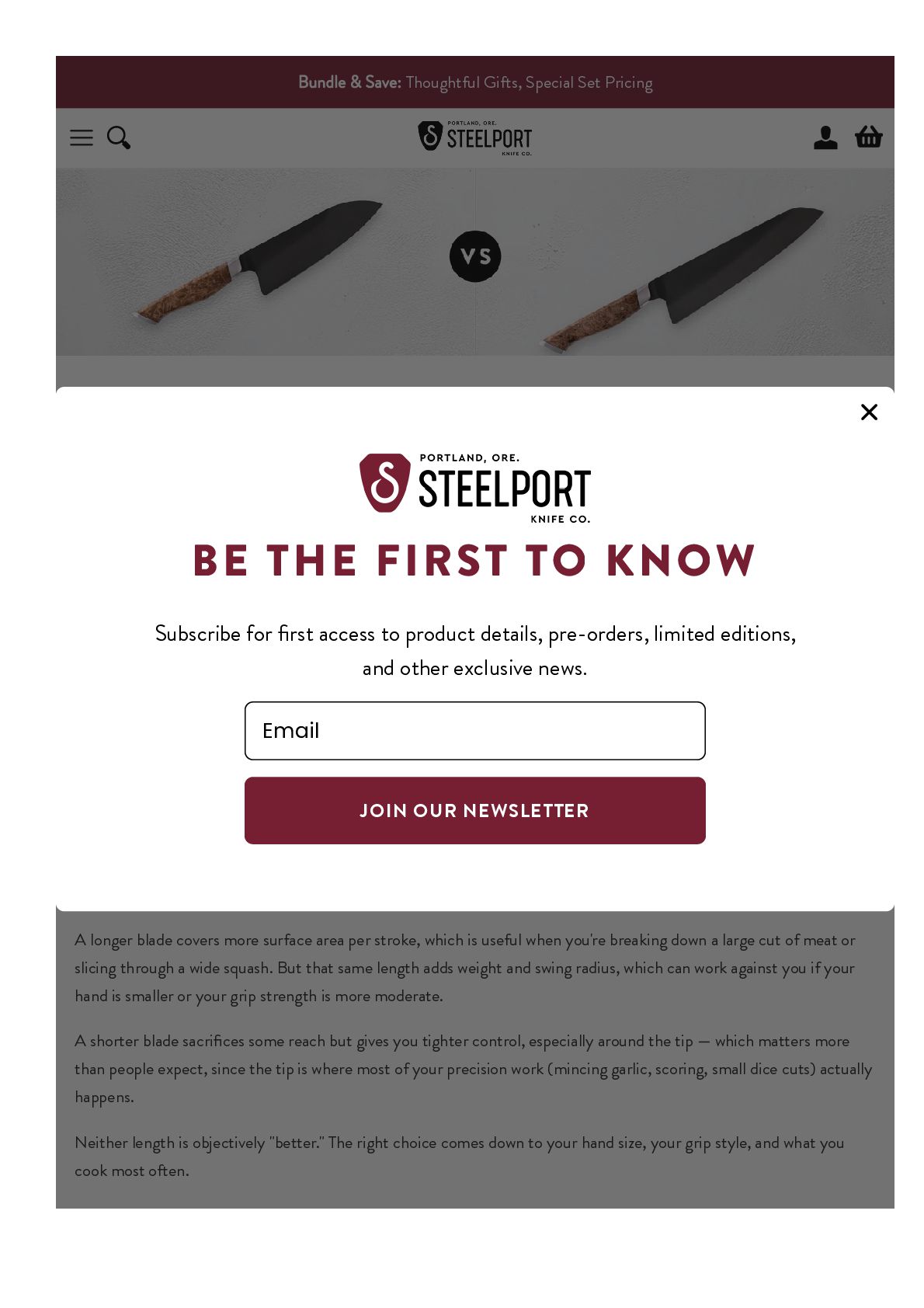
CHEF KNIFE VS. 8 INCH: WHICH SIZE IS RIGHT FOR YOUR HANDS? BE THE FIRST TO KNOW If you've ever stood in a kitchen store holding two nearly identical-looking knives, unsure which one to buy, you're not alone. The 6 inch and 8 inch chef knife are the two most common sizes sold today, and most buying guides just tell you to "get the 8 inch, it's standard" without explaining why that advice doesn't fit everyone. Subscribe for first access to product details, pre-orders, limited editions, and other exclusive much fatigue you'll feel after twenty minutes of prep work. Choosingnews. the wrong size doesn't just feel awkward — it can The truth is, blade length changes how a knife feels in your hand, how much control you have over the tip, and how genuinely make cooking harder than it needs to be. Email Here's how to actually decide. JOIN WHY BLADE LENG T HOUR MNEWSLETTER AT TERS MORE THAN PEOPLE THINK A chef knife's blade length affects three things directly: reach, leverage, and control. A longer blade covers more surface area per stroke, which is useful when you're breaking down a large cut of meat or slicing through a wide squash. But that same length adds weight and swing radius, which can work against you if your hand is smaller or your grip strength is more moderate. A shorter blade sacrifices some reach but gives you tighter control, especially around the tip — which matters more than people expect, since the tip is where most of your precision work (mincing garlic, scoring, small dice cuts) actually happens. Neither length is objectively "better." The right choice comes down to your hand size, your grip style, and what you cook most often. -
8 INCH CHEF KNIFE: THE TRADITIONAL STANDARD The 8-inch chef
knife earned its reputation as the default recommendation for a real reason — it's a genuine allrounder. Best suited for: Larger hands or a full, wraparound grip Cooks who regularly break down whole proteins (chicken, roasts, larger cuts) High-volume prep — chopping large quantities of vegetables efficiently Anyone who prefers a longer, more sweeping cutting motion Trade-offs: Can feel heavy or unwieldy for smaller hands after extended use Requires more counter clearance and a bit more caution when maneuvering around a crowded cutting board Slightly steeper learning curve for beginners still building knife confidence If most of your cooking involves larger-format prep — whole chickens, big batches of soup vegetables, larger squash and melons — the extra length of an 8-inch blade pays off in efficiency. STEELPORT's 8" Chef Knife is a forged, high carbon steel option built specifically around this balance — a full-tang, drop-forged blade with enough weight to power through larger cuts without feeling front-heavy. 6 INCH CHEF KNIFE: THE UNDERRATED A LT E R N AT I V E The 6-inch chef knife doesn't get nearly as much attention, but for a large percentage of home cooks, it's actually the more comfortable everyday knife. Best suited for: Smaller or medium hands, or a pinch grip rather than a full wraparound grip Detail-oriented prep — herbs, garlic, shallots, smaller vegetables Cooks who want more control and less wrist fatigue during long prep sessions Smaller kitchens or cutting boards where a longer blade feels cramped Trade-offs: Slightly less efficient for very large cuts (whole roasts, big squash) Fewer "sweeping stroke" cuts per pass compared to an 8-inch blade A shorter blade also tends to feel less intimidating for newer cooks — it's easier to control at the tip, which builds confidence faster than jumping straight into an 8-inch blade. STEELPORT's 6" Chef Knife uses the same forged carbon steel construction as the 8-inch version, just scaled down — -
so you're not sacrificing edge quality or durability, only length.
A Q U I C K WAY T O T E S T W H I C H S I Z E F I T S Y O U If you're not sure which size matches your hand, try this simple test before buying: 1. Measure your palm from the base of your palm to the tip of your middle finger. Under 7 inches typically pairs better with a 6-inch blade; 7.5 inches or more often suits an 8-inch blade comfortably. 2. Consider your grip style. If you naturally use a pinch grip (thumb and forefinger gripping the blade itself, just above the handle), a 6-inch knife will likely feel more balanced. A fuller, wraparound grip tends to pair better with the added weight and length of an 8-inch blade. 3. Think about your most common task. If 80% of your cooking is vegetables, herbs, and smaller proteins, lean toward 6 inches. If you regularly break down whole chickens or larger cuts, lean toward 8 inches. There's no wrong answer here — plenty of professional cooks keep both sizes on hand and reach for whichever fits the task. WHY THE STEEL AND CONSTRUCTION MAT TER AS MUCH AS THE SIZE Blade length is only part of the equation. A poorly forged 8-inch knife can feel worse in your hand than a wellbalanced 6-inch one, because balance comes from construction, not just length. Look for a forged kitchen knife — made from a single piece of steel rather than stamped from a sheet — since forged construction typically includes a proper bolster, which shifts the balance point closer to your hand and reduces fatigue regardless of blade length. Pair that with high carbon steel, which holds an edge longer than standard stainless and takes a finer, more precise point, and you get a knife that performs consistently whether you choose the 6-inch or 8inch option. Both STEELPORT sizes are built from the same American 52100 carbon steel with a differential heat treatment — hardening the edge to 65 HRC while keeping the spine at a more forgiving 30 HRC — so the size decision comes down purely to fit, not a compromise in quality. You can compare both side by side on the Chef Knives collection page STILL NOT SURE? CONSIDER OWNING BOTH If your budget allows it, having both sizes isn't overkill — it's how a lot of working kitchens operate. The 8-inch handles volume and larger cuts efficiently, while the 6-inch takes over for detail work and everyday tasks where control matters more than reach. Many cooks find themselves reaching for the smaller blade far more often than expected once they have it in rotation. STEELPORT KNIFE Address: 3602 NE Sandy Blvd, Suite B, Portland, OR 97232, United States -
Phone: (503) 498-8132 Email: [email protected] FAQS IS A 6 INCH
CHEF KNIFE BIG ENOUGH FOR E V E R Y D AY C O O K I N G ? Yes, for most home cooking tasks — vegetables, herbs, boneless proteins, and general prep — a 6 inch chef knife handles the job comfortably. It only becomes limiting for very large cuts like whole roasts or big squash, where the extra reach of an 8-inch blade helps. WHICH SIZE IS BETTER FOR BEGINNERS? A 6 inch chef knife is often easier for beginners to control, since the shorter blade is less intimidating and offers more precision at the tip while you build knife skills. Many cooks graduate to an 8-inch blade later as their technique develops. DO PROFESSIONAL CHEFS USE 6 INCH OR 8 INCH KNIVES? Both, depending on the task. Many professional kitchens keep multiple sizes on hand, using an 8-inch blade for highvolume prep and a 6-inch blade for detail work, garnishes, and smaller ingredients. DOES BLADE LENGTH AFFECT SHARPNESS OR EDGE RETENTION? No — sharpness and edge retention come down to the steel type and heat treatment, not the length. A well-forged, high carbon steel 6-inch blade will hold an edge just as well as its 8-inch counterpart. WHAT HAND SIZE IS BEST SUITED TO AN 8 INCH CHEF KNIFE? Larger hands, or cooks who use a full wraparound grip rather than a pinch grip, generally find an 8-inch blade more comfortable and better balanced during extended use. CONCLUSION There's no universal "correct" chef knife size — only the one that fits your hand, your grip, and how you actually cook. If you value reach and efficiency for larger cuts, the 8-inch chef knife is the stronger choice. If control, precision, and reduced fatigue matter more to your everyday prep, the 6-inch chef knife is likely the better fit. Whichever size you land on, prioritize the construction behind it. A forged, high carbon steel blade will outperform a -
mass-produced knife regardless of length. Explore both options — along
with the full lineup of forged, American made kitchen knives — on STEELPORT's Chef Knives collection page Share Tagged: 6 inch chef knife, 8 inch chef knife, American made kitchen knives, best small kitchen knife, carbon steel chef knife, carbon steel kitchen knives, forged kitchen knives, high carbon steel chef knife, high carbon steel kitchen knives, small kitchen knife Older articles Back to Articles SITE Our Story My Account Care & Use Events Newsletter Press Product RegistrationCareers Retailer Map Reviews CONTACT PROMISE General Inquiries We hold every product we make [email protected] 3602 NE Sandy Blvd Suite B Portland, OR 97232 Personalized to unwavering high quality standards. Every STEELPORT knife comes with a Lifetime Warranty, which includes our SharpForever™ free sharpening for life service Learn More Group Gifting STEELPORTKNIFE.COM 4.9 (442) Factory Store Open To The Public Mon - Sat • 9am - 5pm 503.498.8132