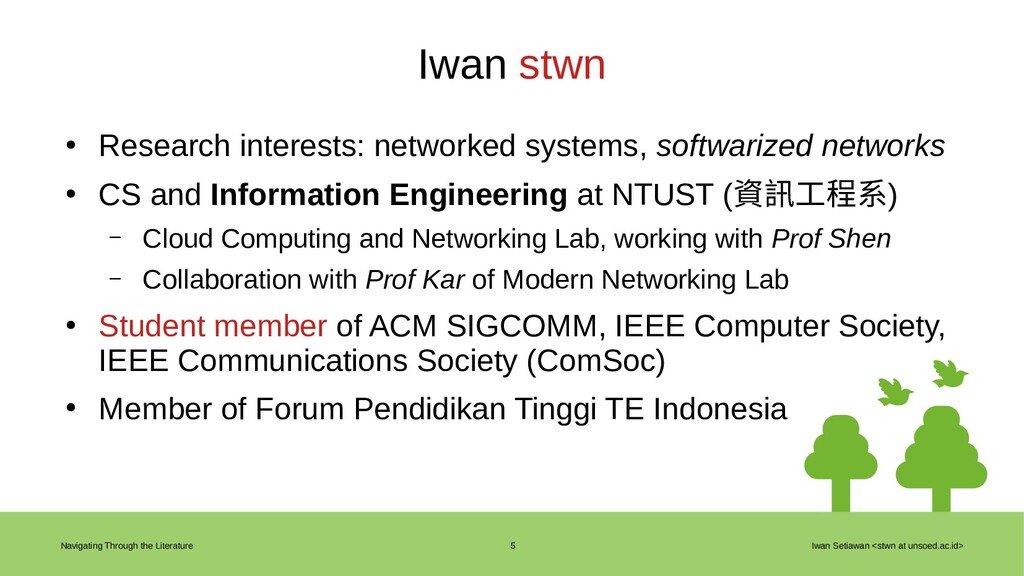
Iwan stwn • Research interests: networked systems, softwarized networks • CS and Information Engineering at NTUST (資訊工程系) – Cloud Computing and Networking Lab, working with Prof Shen – Collaboration with Prof Kar of Modern Networking Lab • Student member of ACM SIGCOMM, IEEE Computer Society, IEEE Communications Society (ComSoc) • Member of Forum Pendidikan Tinggi TE Indonesia
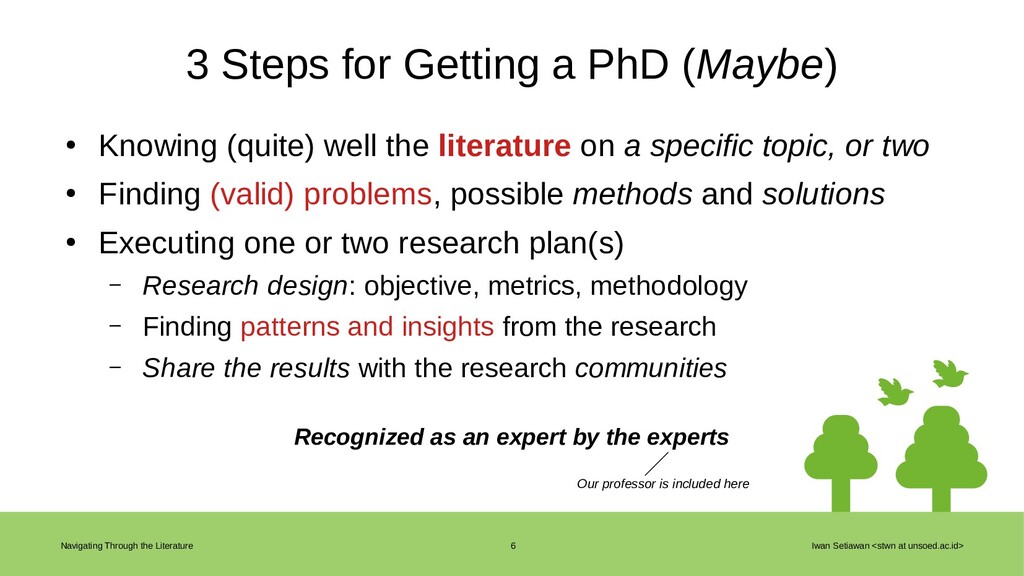
3 Steps for Getting a PhD (Maybe) • Knowing (quite) well the literature on a specific topic, or two • Finding (valid) problems, possible methods and solutions • Executing one or two research plan(s) – Research design: objective, metrics, methodology – Finding patterns and insights from the research – Share the results with the research communities Recognized as an expert by the experts Our professor is included here
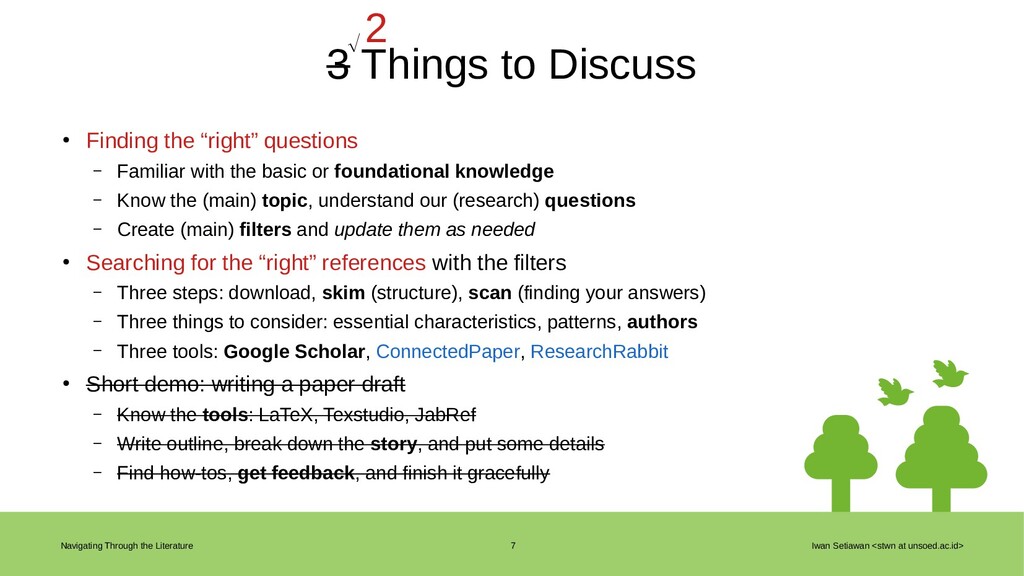
3 Things to Discuss • Finding the “right” questions – Familiar with the basic or foundational knowledge – Know the (main) topic, understand our (research) questions – Create (main) filters and update them as needed • Searching for the “right” references with the filters – Three steps: download, skim (structure), scan (finding your answers) – Three things to consider: essential characteristics, patterns, authors – Three tools: Google Scholar, ConnectedPaper, ResearchRabbit • Short demo: writing a paper draft – Know the tools: LaTeX, Texstudio, JabRef – Write outline, break down the story, and put some details – Find how-tos, get feedback, and finish it gracefully 2 √
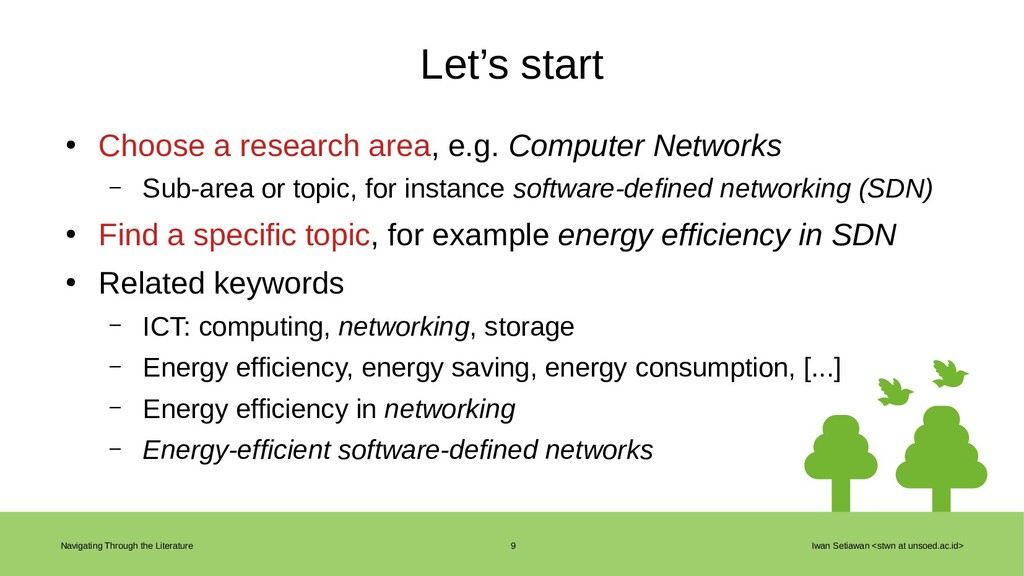
Let’s start • Choose a research area, e.g. Computer Networks – Sub-area or topic, for instance software-defined networking (SDN) • Find a specific topic, for example energy efficiency in SDN • Related keywords – ICT: computing, networking, storage – Energy efficiency, energy saving, energy consumption, [...] – Energy efficiency in networking – Energy-efficient software-defined networks
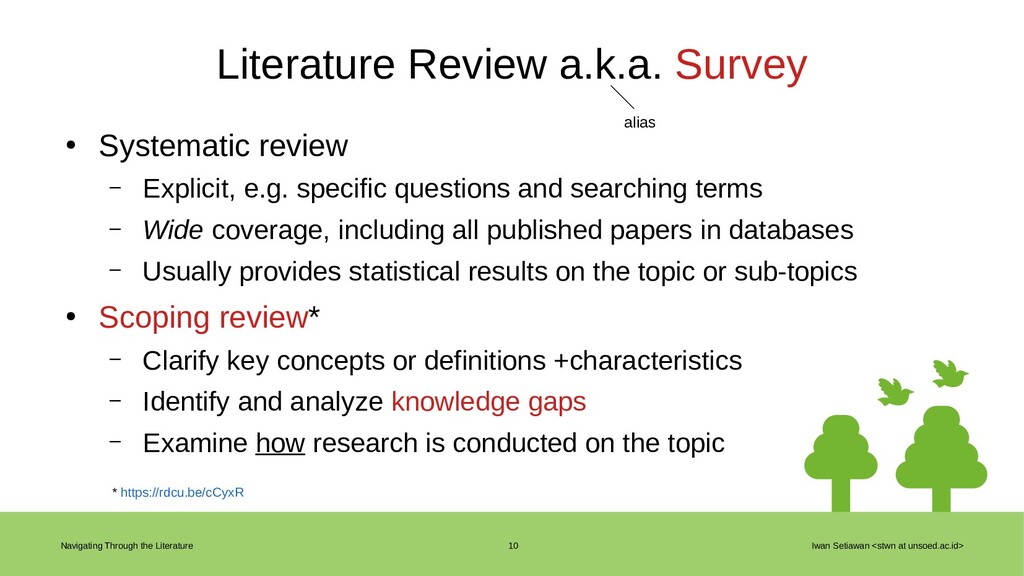
Literature Review a.k.a. Survey • Systematic review – Explicit, e.g. specific questions and searching terms – Wide coverage, including all published papers in databases – Usually provides statistical results on the topic or sub-topics • Scoping review* – Clarify key concepts or definitions +characteristics – Identify and analyze knowledge gaps – Examine how research is conducted on the topic alias * https://rdcu.be/cCyxR
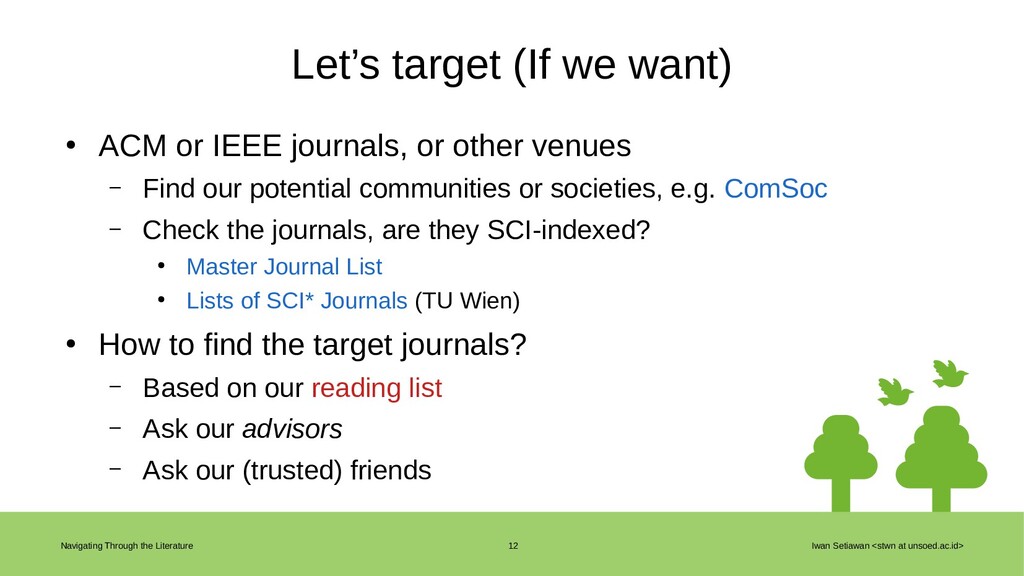
Let’s target (If we want) • ACM or IEEE journals, or other venues – Find our potential communities or societies, e.g. ComSoc – Check the journals, are they SCI-indexed? • Master Journal List • Lists of SCI* Journals (TU Wien) • How to find the target journals? – Based on our reading list – Ask our advisors – Ask our (trusted) friends
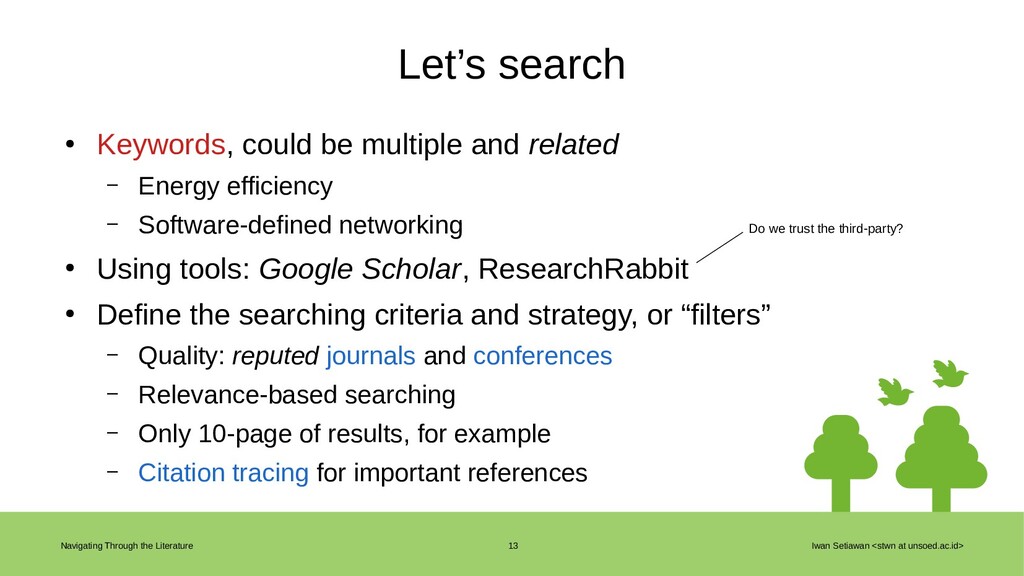
Let’s search • Keywords, could be multiple and related – Energy efficiency – Software-defined networking • Using tools: Google Scholar, ResearchRabbit • Define the searching criteria and strategy, or “filters” – Quality: reputed journals and conferences – Relevance-based searching – Only 10-page of results, for example – Citation tracing for important references Do we trust the third-party?
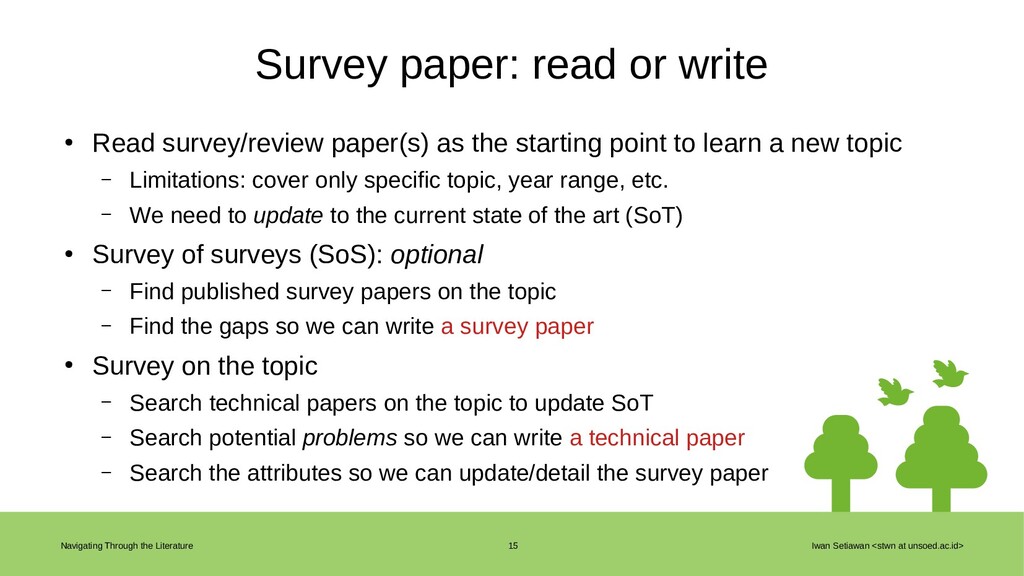
Survey paper: read or write • Read survey/review paper(s) as the starting point to learn a new topic – Limitations: cover only specific topic, year range, etc. – We need to update to the current state of the art (SoT) • Survey of surveys (SoS): optional – Find published survey papers on the topic – Find the gaps so we can write a survey paper • Survey on the topic – Search technical papers on the topic to update SoT – Search potential problems so we can write a technical paper – Search the attributes so we can update/detail the survey paper
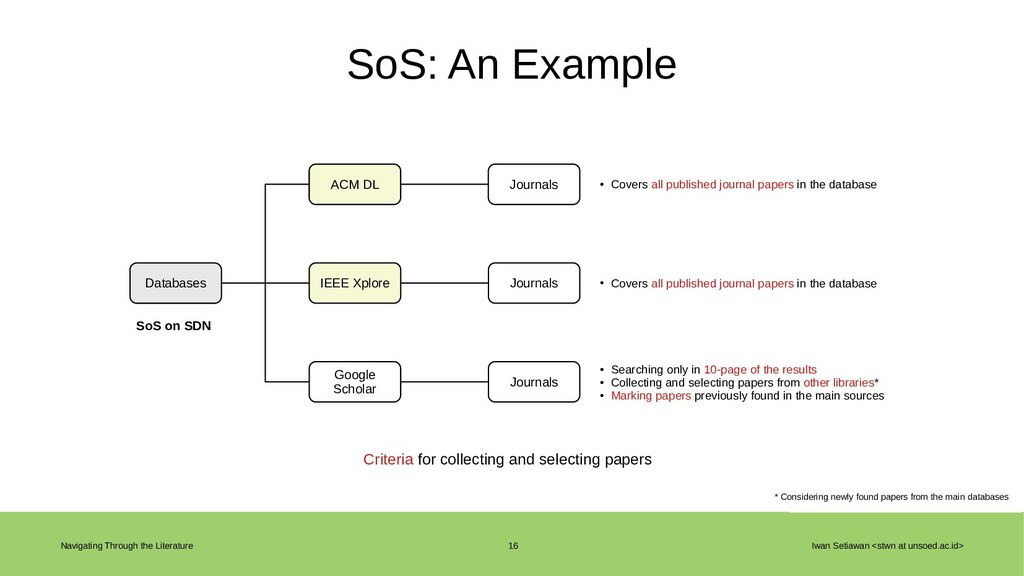
SoS: An Example Databases ACM DL IEEE Xplore Google Scholar Journals Journals Journals • Covers all published journal papers in the database • Covers all published journal papers in the database Criteria for collecting and selecting papers SoS on SDN * Considering newly found papers from the main databases • Searching only in 10-page of the results • Collecting and selecting papers from other libraries* • Marking papers previously found in the main sources
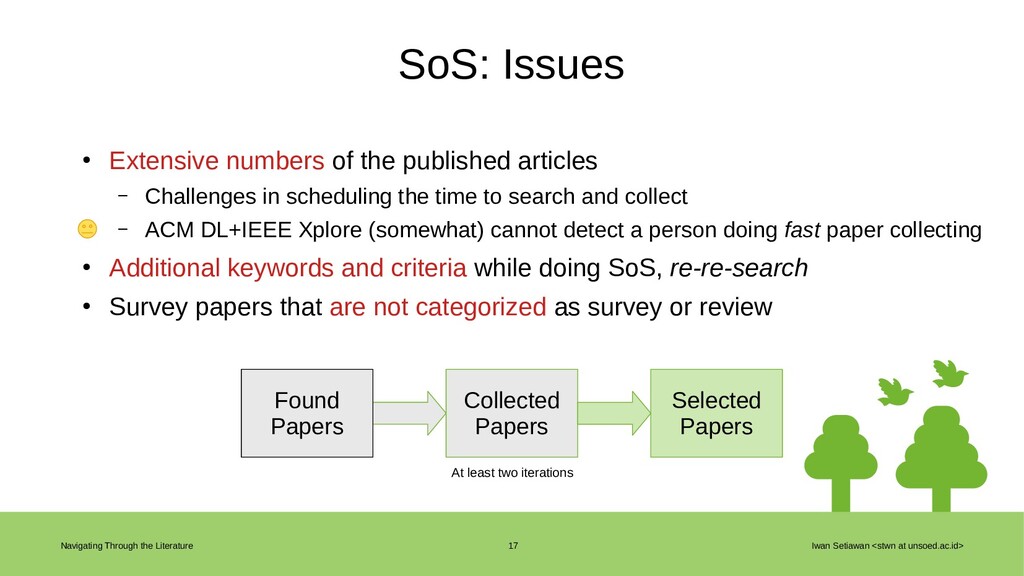
SoS: Issues • Extensive numbers of the published articles – Challenges in scheduling the time to search and collect – ACM DL+IEEE Xplore (somewhat) cannot detect a person doing fast paper collecting • Additional keywords and criteria while doing SoS, re-re-search • Survey papers that are not categorized as survey or review Collected Papers Selected Papers Found Papers At least two iterations
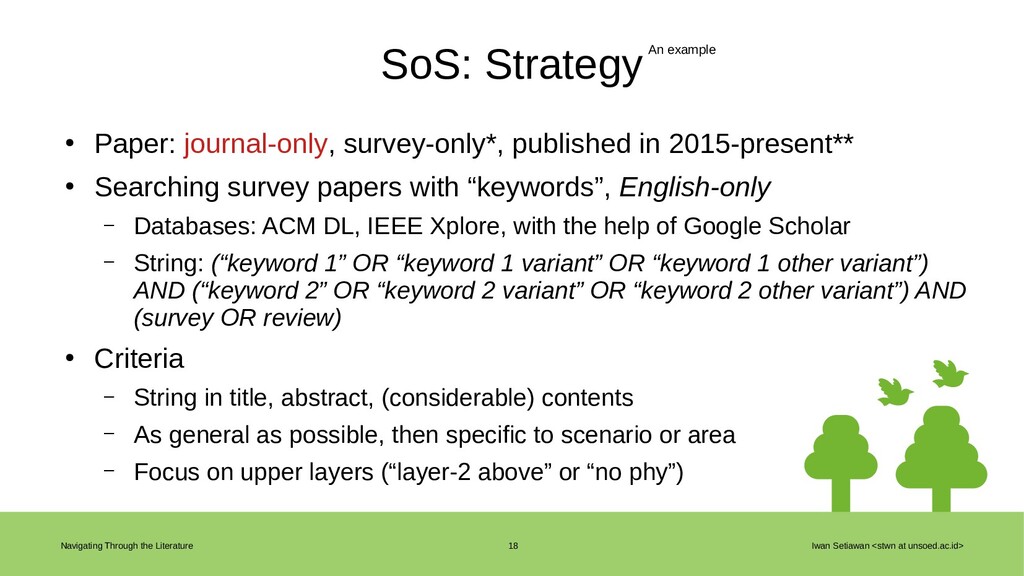
SoS: Strategy • Paper: journal-only, survey-only*, published in 2015-present** • Searching survey papers with “keywords”, English-only – Databases: ACM DL, IEEE Xplore, with the help of Google Scholar – String: (“keyword 1” OR “keyword 1 variant” OR “keyword 1 other variant”) AND (“keyword 2” OR “keyword 2 variant” OR “keyword 2 other variant”) AND (survey OR review) • Criteria – String in title, abstract, (considerable) contents – As general as possible, then specific to scenario or area – Focus on upper layers (“layer-2 above” or “no phy”) An example
Let’s read and collect! • Fast-reading techniques – S&S, print the paper if necessary • Skimming to find the paper structure • Scanning for searching the answers – AIC: Abstract, Introduction, Conclusions • Take notes or map with tools, e.g. table to compare • Read for the i-th times to get the required details – Selected papers
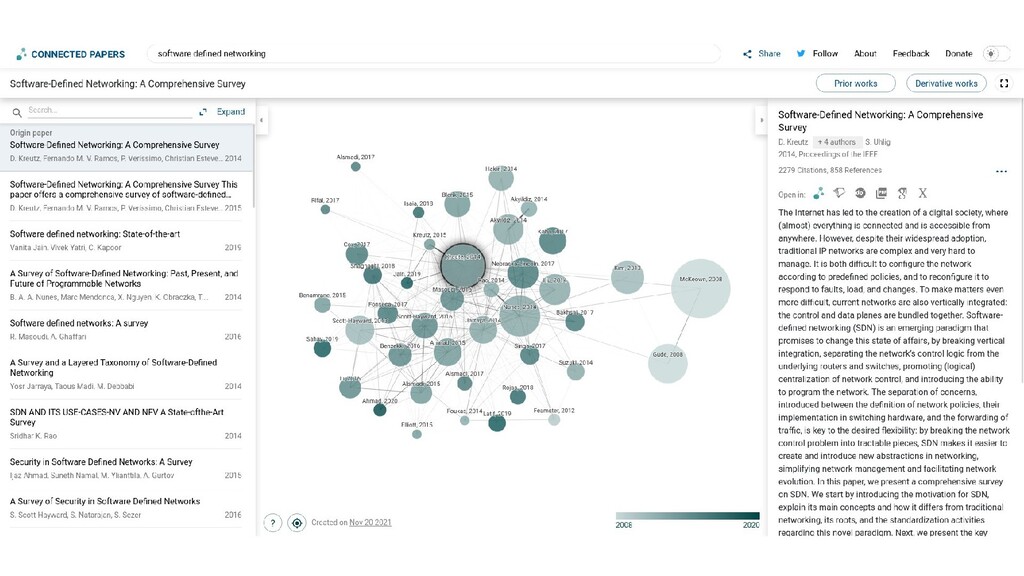
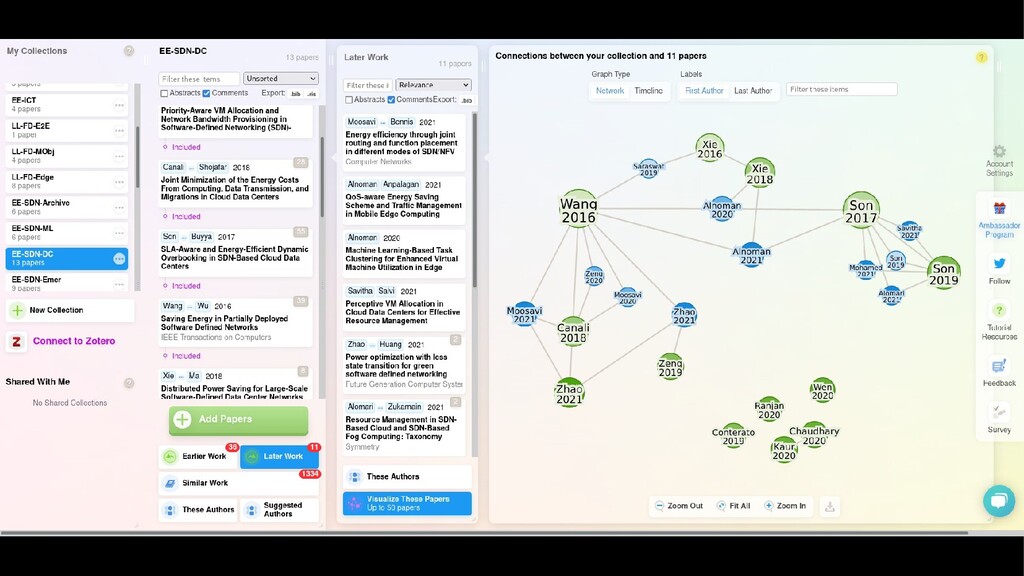
Mapping the Results • Essential characteristics: definitions, architectures, frameworks • Patterns: other characteristics related to the topic (emerging) – SDN control plane design: centralized vs distributed – SDN multi-domain: single- vs multi-controller • Authors – Consider to track highly cited references in reputed journals – View the interconnection graph, e.g. via ReseachRabbit Tools: table, mindmap, visualization, ...
Where is the endpoint? • Concept saturation (PachecoVega, 2016) – Seeing the same citations or concepts repeated in the (selected) references – Tools: comparison table, mindmap, interconnected graph visualization, ... • Generate results – Structure and classification – Lessons learned and future work • Outputs, depend on our goal(s) – Related work section – Survey paper – Chapter 2
Everyone has their own journey • Some people learn the hard (and long) way • Pick the easier path and use tools, if they are available • There is no guarantee whichever path we choose
Fundamental knowledge, tools, skills • Know the reasons: anything that push us towards the goals – Recognize our problems, e.g. reading, writing – Find possible solutions, or friends • Take our time to play, pray, and try (multiple times) learn especially myself Navigating Through the Literature 23 Iwan Setiawan <stwn at unsoed.ac.id>

 Your Podcast. Everywhere. Effortlessly.


 stwn
stwn
 frievea
 pawan_pharm
 akiraasano
 yatabe
 spring_aki
 signer
 rashwhitman
 suisan
 naochim2026
 matleenalaakso
 szymonslowik
 addyosmani
 tammyeverts
 oripsolob
 lara
lara
 frankvandijk
 letsgokoyo
 nmsamuel
 varn
varn
 trishagee