Upgrade to Pro — share decks privately, control downloads, hide ads and more …

test

Sponsored · Your Podcast. Everywhere. Effortlessly. Share. Educate. Inspire. Entertain. You do you. We'll handle the rest.

 test

test

Avatar for Tam Francais

Tam Francais

May 11, 2014
Tweet

Other Decks in Education

Transcript

  1. Excerpts  from  the  Roman  Missal  ©  1973  and  2006,  2008

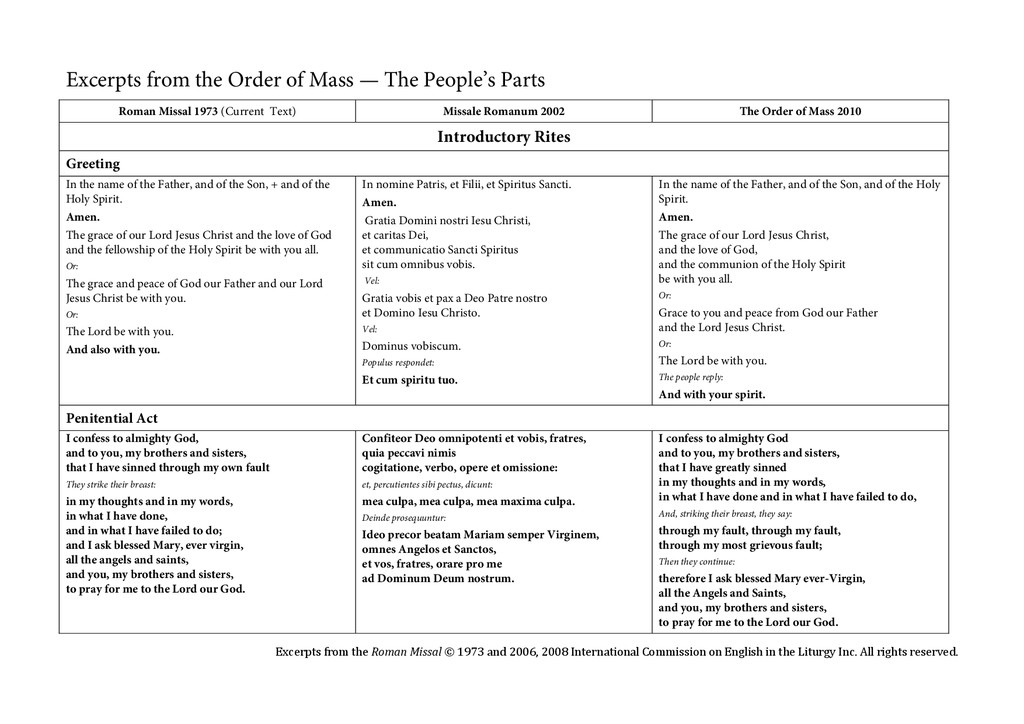
     International  Commission  on  English  in  the  Liturgy  Inc.  All  rights  reserved.   Excerpts from the Order of Mass — The People’s Parts Roman Missal 1973 (Current Text) Missale Romanum 2002 The Order of Mass 2010 Introductory Rites Greeting In the name of the Father, and of the Son, + and of the Holy Spirit. Amen. The grace of our Lord Jesus Christ and the love of God and the fellowship of the Holy Spirit be with you all. Or: The grace and peace of God our Father and our Lord Jesus Christ be with you. Or: The Lord be with you. And also with you. In nomine Patris, et Filii, et Spiritus Sancti. Amen. Gratia Domini nostri Iesu Christi, et caritas Dei, et communicatio Sancti Spiritus sit cum omnibus vobis. Vel: Gratia vobis et pax a Deo Patre nostro et Domino Iesu Christo. Vel: Dominus vobiscum. Populus respondet: Et cum spiritu tuo. In the name of the Father, and of the Son, and of the Holy Spirit. Amen. The grace of our Lord Jesus Christ, and the love of God, and the communion of the Holy Spirit be with you all. Or: Grace to you and peace from God our Father and the Lord Jesus Christ. Or: The Lord be with you. The people reply: And with your spirit. Penitential Act I confess to almighty God, and to you, my brothers and sisters, that I have sinned through my own fault They strike their breast: in my thoughts and in my words, in what I have done, and in what I have failed to do; and I ask blessed Mary, ever virgin, all the angels and saints, and you, my brothers and sisters, to pray for me to the Lord our God. Confiteor Deo omnipotenti et vobis, fratres, quia peccavi nimis cogitatione, verbo, opere et omissione: et, percutientes sibi pectus, dicunt: mea culpa, mea culpa, mea maxima culpa. Deinde prosequuntur: Ideo precor beatam Mariam semper Virginem, omnes Angelos et Sanctos, et vos, fratres, orare pro me ad Dominum Deum nostrum. I confess to almighty God and to you, my brothers and sisters, that I have greatly sinned in my thoughts and in my words, in what I have done and in what I have failed to do, And, striking their breast, they say: through my fault, through my fault, through my most grievous fault; Then they continue: therefore I ask blessed Mary ever-Virgin, all the Angels and Saints, and you, my brothers and sisters, to pray for me to the Lord our God.
  2. Page  2  of  12   Excerpts  from  the  Roman  Missal

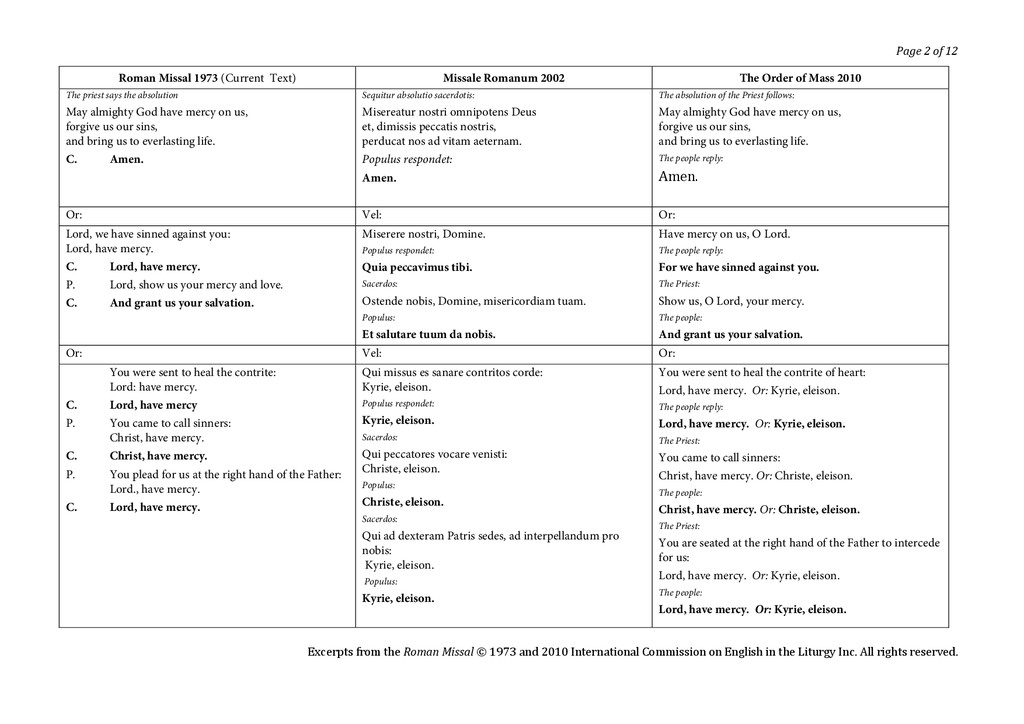
     ©  1973  and  2010  International  Commission  on  English  in  the  Liturgy  Inc.  All  rights  reserved.   Roman Missal 1973 (Current Text) Missale Romanum 2002 The Order of Mass 2010 The priest says the absolution May almighty God have mercy on us, forgive us our sins, and bring us to everlasting life. C. Amen. Sequitur absolutio sacerdotis: Misereatur nostri omnipotens Deus et, dimissis peccatis nostris, perducat nos ad vitam aeternam. Populus respondet: Amen. The absolution of the Priest follows: May almighty God have mercy on us, forgive us our sins, and bring us to everlasting life. The people reply: Amen. Or: Vel: Or: Lord, we have sinned against you: Lord, have mercy. C. Lord, have mercy. P. Lord, show us your mercy and love. C. And grant us your salvation. Miserere nostri, Domine. Populus respondet: Quia peccavimus tibi. Sacerdos: Ostende nobis, Domine, misericordiam tuam. Populus: Et salutare tuum da nobis. Have mercy on us, O Lord. The people reply: For we have sinned against you. The Priest: Show us, O Lord, your mercy. The people: And grant us your salvation. Or: Vel: Or: You were sent to heal the contrite: Lord: have mercy. C. Lord, have mercy P. You came to call sinners: Christ, have mercy. C. Christ, have mercy. P. You plead for us at the right hand of the Father: Lord., have mercy. C. Lord, have mercy. Qui missus es sanare contritos corde: Kyrie, eleison. Populus respondet: Kyrie, eleison. Sacerdos: Qui peccatores vocare venisti: Christe, eleison. Populus: Christe, eleison. Sacerdos: Qui ad dexteram Patris sedes, ad interpellandum pro nobis: Kyrie, eleison. Populus: Kyrie, eleison. You were sent to heal the contrite of heart: Lord, have mercy. Or: Kyrie, eleison. The people reply: Lord, have mercy. Or: Kyrie, eleison. The Priest: You came to call sinners: Christ, have mercy. Or: Christe, eleison. The people: Christ, have mercy. Or: Christe, eleison. The Priest: You are seated at the right hand of the Father to intercede for us: Lord, have mercy. Or: Kyrie, eleison. The people: Lord, have mercy. Or: Kyrie, eleison.
  3. Page  3  of  12   Excerpts  from  the  Roman  Missal

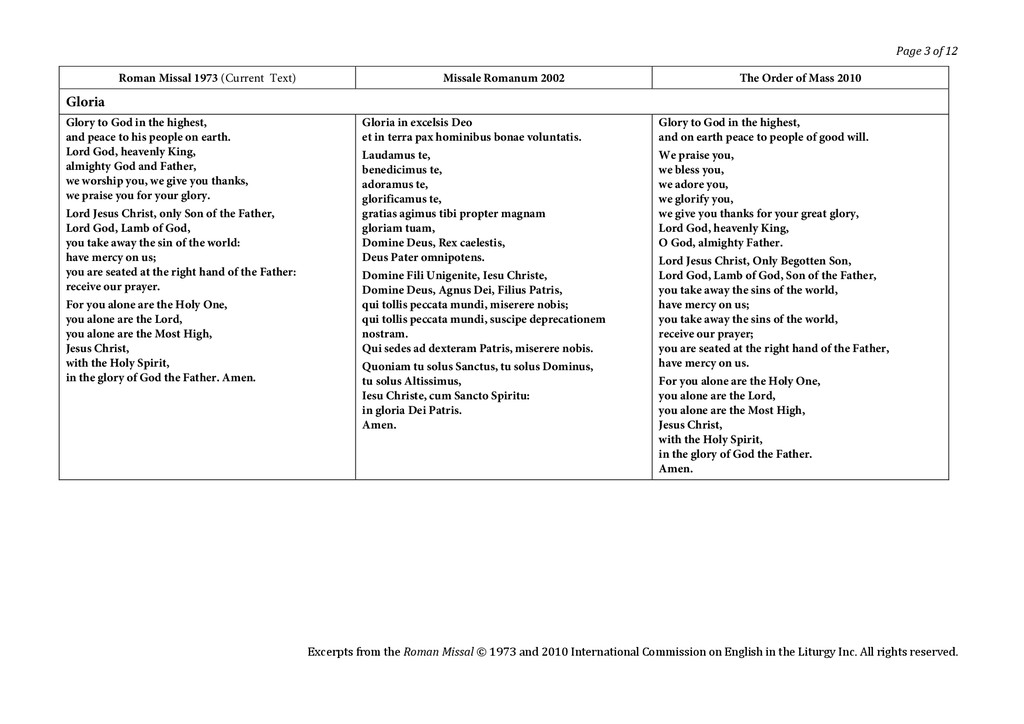
     ©  1973  and  2010  International  Commission  on  English  in  the  Liturgy  Inc.  All  rights  reserved.   Roman Missal 1973 (Current Text) Missale Romanum 2002 The Order of Mass 2010 Gloria Glory to God in the highest, and peace to his people on earth. Lord God, heavenly King, almighty God and Father, we worship you, we give you thanks, we praise you for your glory. Lord Jesus Christ, only Son of the Father, Lord God, Lamb of God, you take away the sin of the world: have mercy on us; you are seated at the right hand of the Father: receive our prayer. For you alone are the Holy One, you alone are the Lord, you alone are the Most High, Jesus Christ, with the Holy Spirit, in the glory of God the Father. Amen. Gloria in excelsis Deo et in terra pax hominibus bonae voluntatis. Laudamus te, benedicimus te, adoramus te, glorificamus te, gratias agimus tibi propter magnam gloriam tuam, Domine Deus, Rex caelestis, Deus Pater omnipotens. Domine Fili Unigenite, Iesu Christe, Domine Deus, Agnus Dei, Filius Patris, qui tollis peccata mundi, miserere nobis; qui tollis peccata mundi, suscipe deprecationem nostram. Qui sedes ad dexteram Patris, miserere nobis. Quoniam tu solus Sanctus, tu solus Dominus, tu solus Altissimus, Iesu Christe, cum Sancto Spiritu: in gloria Dei Patris. Amen. Glory to God in the highest, and on earth peace to people of good will. We praise you, we bless you, we adore you, we glorify you, we give you thanks for your great glory, Lord God, heavenly King, O God, almighty Father. Lord Jesus Christ, Only Begotten Son, Lord God, Lamb of God, Son of the Father, you take away the sins of the world, have mercy on us; you take away the sins of the world, receive our prayer; you are seated at the right hand of the Father, have mercy on us. For you alone are the Holy One, you alone are the Lord, you alone are the Most High, Jesus Christ, with the Holy Spirit, in the glory of God the Father. Amen.
  4. Page  4  of  12   Excerpts  from  the  Roman  Missal

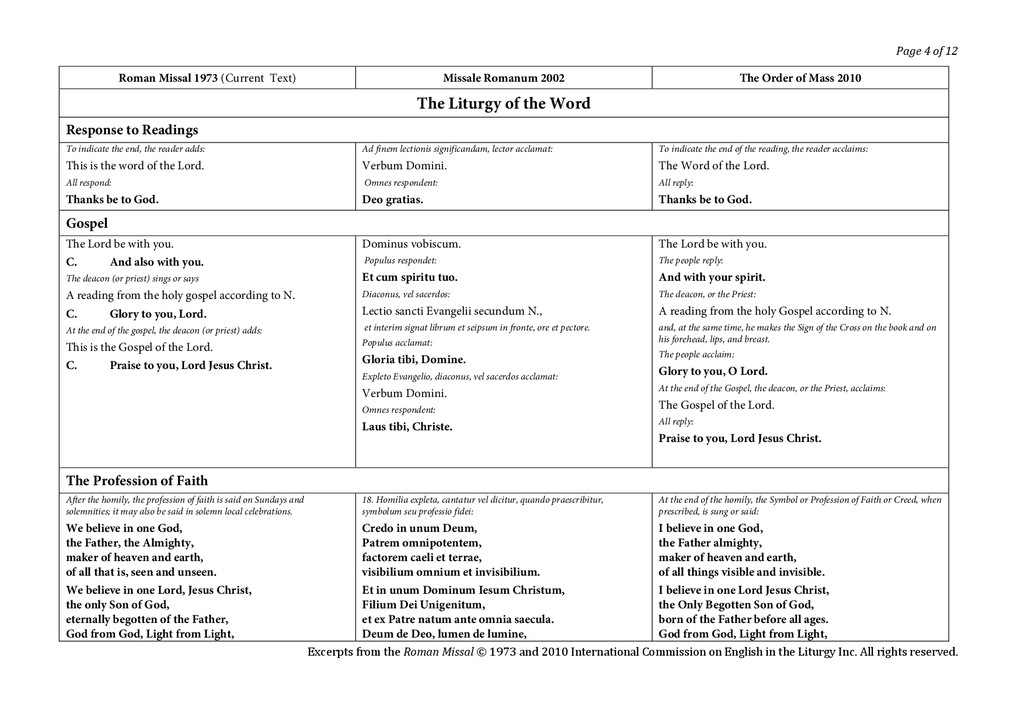
     ©  1973  and  2010  International  Commission  on  English  in  the  Liturgy  Inc.  All  rights  reserved.   Roman Missal 1973 (Current Text) Missale Romanum 2002 The Order of Mass 2010 The Liturgy of the Word Response to Readings To indicate the end, the reader adds: This is the word of the Lord. All respond: Thanks be to God. Ad finem lectionis significandam, lector acclamat: Verbum Domini. Omnes respondent: Deo gratias. To indicate the end of the reading, the reader acclaims: The Word of the Lord. All reply: Thanks be to God. Gospel The Lord be with you. C. And also with you. The deacon (or priest) sings or says A reading from the holy gospel according to N. C. Glory to you, Lord. At the end of the gospel, the deacon (or priest) adds: This is the Gospel of the Lord. C. Praise to you, Lord Jesus Christ. Dominus vobiscum. Populus respondet: Et cum spiritu tuo. Diaconus, vel sacerdos: Lectio sancti Evangelii secundum N., et interim signat librum et seipsum in fronte, ore et pectore. Populus acclamat: Gloria tibi, Domine. Expleto Evangelio, diaconus, vel sacerdos acclamat: Verbum Domini. Omnes respondent: Laus tibi, Christe. The Lord be with you. The people reply: And with your spirit. The deacon, or the Priest: A reading from the holy Gospel according to N. and, at the same time, he makes the Sign of the Cross on the book and on his forehead, lips, and breast. The people acclaim: Glory to you, O Lord. At the end of the Gospel, the deacon, or the Priest, acclaims: The Gospel of the Lord. All reply: Praise to you, Lord Jesus Christ. The Profession of Faith After the homily, the profession of faith is said on Sundays and solemnities; it may also be said in solemn local celebrations. We believe in one God, the Father, the Almighty, maker of heaven and earth, of all that is, seen and unseen. We believe in one Lord, Jesus Christ, the only Son of God, eternally begotten of the Father, God from God, Light from Light, 18. Homilia expleta, cantatur vel dicitur, quando praescribitur, symbolum seu professio fidei: Credo in unum Deum, Patrem omnipotentem, factorem caeli et terrae, visibilium omnium et invisibilium. Et in unum Dominum Iesum Christum, Filium Dei Unigenitum, et ex Patre natum ante omnia saecula. Deum de Deo, lumen de lumine, At the end of the homily, the Symbol or Profession of Faith or Creed, when prescribed, is sung or said: I believe in one God, the Father almighty, maker of heaven and earth, of all things visible and invisible. I believe in one Lord Jesus Christ, the Only Begotten Son of God, born of the Father before all ages. God from God, Light from Light,
  5. Page  5  of  12   Excerpts  from  the  Roman  Missal

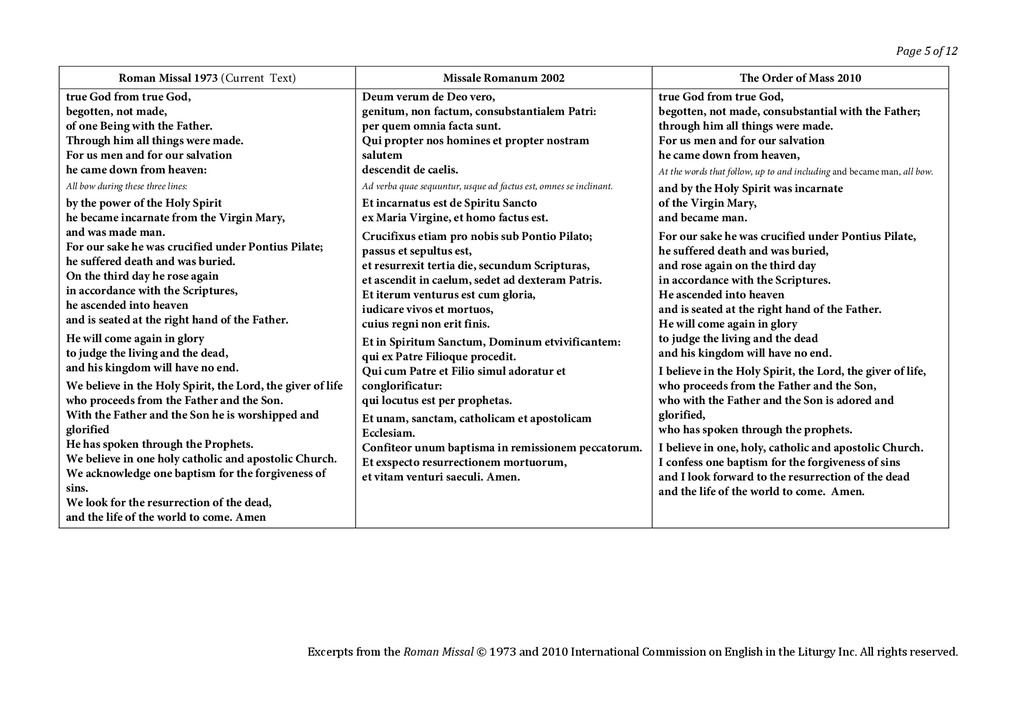
     ©  1973  and  2010  International  Commission  on  English  in  the  Liturgy  Inc.  All  rights  reserved.   Roman Missal 1973 (Current Text) Missale Romanum 2002 The Order of Mass 2010 true God from true God, begotten, not made, of one Being with the Father. Through him all things were made. For us men and for our salvation he came down from heaven: All bow during these three lines: by the power of the Holy Spirit he became incarnate from the Virgin Mary, and was made man. For our sake he was crucified under Pontius Pilate; he suffered death and was buried. On the third day he rose again in accordance with the Scriptures, he ascended into heaven and is seated at the right hand of the Father. He will come again in glory to judge the living and the dead, and his kingdom will have no end. We believe in the Holy Spirit, the Lord, the giver of life who proceeds from the Father and the Son. With the Father and the Son he is worshipped and glorified He has spoken through the Prophets. We believe in one holy catholic and apostolic Church. We acknowledge one baptism for the forgiveness of sins. We look for the resurrection of the dead, and the life of the world to come. Amen Deum verum de Deo vero, genitum, non factum, consubstantialem Patri: per quem omnia facta sunt. Qui propter nos homines et propter nostram salutem descendit de caelis. Ad verba quae sequuntur, usque ad factus est, omnes se inclinant. Et incarnatus est de Spiritu Sancto ex Maria Virgine, et homo factus est. Crucifixus etiam pro nobis sub Pontio Pilato; passus et sepultus est, et resurrexit tertia die, secundum Scripturas, et ascendit in caelum, sedet ad dexteram Patris. Et iterum venturus est cum gloria, iudicare vivos et mortuos, cuius regni non erit finis. Et in Spiritum Sanctum, Dominum etvivificantem: qui ex Patre Filioque procedit. Qui cum Patre et Filio simul adoratur et conglorificatur: qui locutus est per prophetas. Et unam, sanctam, catholicam et apostolicam Ecclesiam. Confiteor unum baptisma in remissionem peccatorum. Et exspecto resurrectionem mortuorum, et vitam venturi saeculi. Amen.   true God from true God, begotten, not made, consubstantial with the Father; through him all things were made. For us men and for our salvation he came down from heaven, At the words that follow, up to and including and became man, all bow. and by the Holy Spirit was incarnate of the Virgin Mary, and became man. For our sake he was crucified under Pontius Pilate, he suffered death and was buried, and rose again on the third day in accordance with the Scriptures. He ascended into heaven and is seated at the right hand of the Father. He will come again in glory to judge the living and the dead and his kingdom will have no end. I believe in the Holy Spirit, the Lord, the giver of life, who proceeds from the Father and the Son, who with the Father and the Son is adored and glorified, who has spoken through the prophets. I believe in one, holy, catholic and apostolic Church. I confess one baptism for the forgiveness of sins and I look forward to the resurrection of the dead and the life of the world to come. Amen.
  6. Page  6  of  12   Excerpts  from  the  Roman  Missal

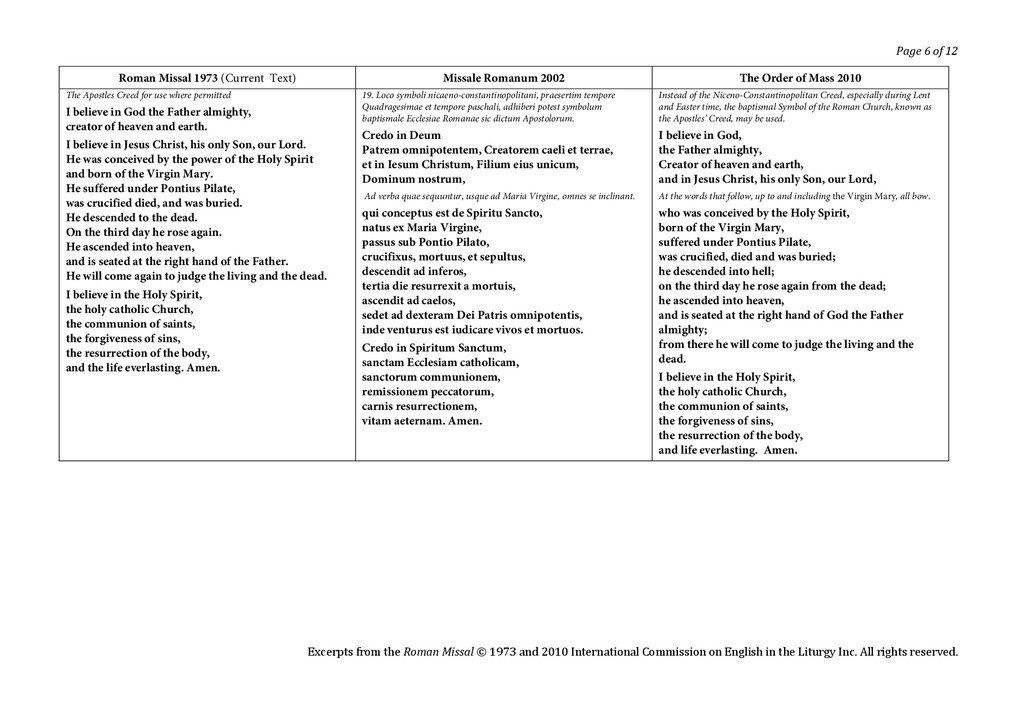
     ©  1973  and  2010  International  Commission  on  English  in  the  Liturgy  Inc.  All  rights  reserved.   Roman Missal 1973 (Current Text) Missale Romanum 2002 The Order of Mass 2010 The Apostles Creed for use where permitted I believe in God the Father almighty, creator of heaven and earth. I believe in Jesus Christ, his only Son, our Lord. He was conceived by the power of the Holy Spirit and born of the Virgin Mary. He suffered under Pontius Pilate, was crucified died, and was buried. He descended to the dead. On the third day he rose again. He ascended into heaven, and is seated at the right hand of the Father. He will come again to judge the living and the dead. I believe in the Holy Spirit, the holy catholic Church, the communion of saints, the forgiveness of sins, the resurrection of the body, and the life everlasting. Amen. 19. Loco symboli nicaeno-constantinopolitani, praesertim tempore Quadragesimae et tempore paschali, adhiberi potest symbolum baptismale Ecclesiae Romanae sic dictum Apostolorum. Credo in Deum Patrem omnipotentem, Creatorem caeli et terrae, et in Iesum Christum, Filium eius unicum, Dominum nostrum, Ad verba quae sequuntur, usque ad Maria Virgine, omnes se inclinant. qui conceptus est de Spiritu Sancto, natus ex Maria Virgine, passus sub Pontio Pilato, crucifixus, mortuus, et sepultus, descendit ad inferos, tertia die resurrexit a mortuis, ascendit ad caelos, sedet ad dexteram Dei Patris omnipotentis, inde venturus est iudicare vivos et mortuos. Credo in Spiritum Sanctum, sanctam Ecclesiam catholicam, sanctorum communionem, remissionem peccatorum, carnis resurrectionem, vitam aeternam. Amen. Instead of the Niceno-Constantinopolitan Creed, especially during Lent and Easter time, the baptismal Symbol of the Roman Church, known as the Apostles’ Creed, may be used. I believe in God, the Father almighty, Creator of heaven and earth, and in Jesus Christ, his only Son, our Lord, At the words that follow, up to and including the Virgin Mary, all bow. who was conceived by the Holy Spirit, born of the Virgin Mary, suffered under Pontius Pilate, was crucified, died and was buried; he descended into hell; on the third day he rose again from the dead; he ascended into heaven, and is seated at the right hand of God the Father almighty; from there he will come to judge the living and the dead. I believe in the Holy Spirit, the holy catholic Church, the communion of saints, the forgiveness of sins, the resurrection of the body, and life everlasting. Amen.
  7. Page  7  of  12   Excerpts  from  the  Roman  Missal

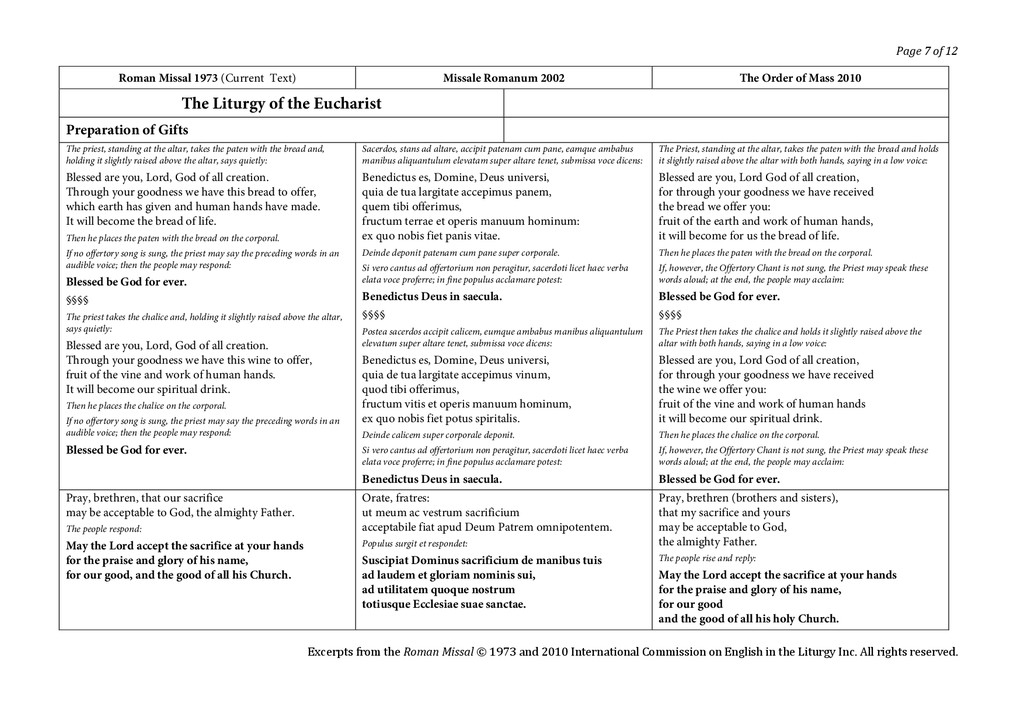
     ©  1973  and  2010  International  Commission  on  English  in  the  Liturgy  Inc.  All  rights  reserved.   Roman Missal 1973 (Current Text) Missale Romanum 2002 The Order of Mass 2010 The Liturgy of the Eucharist Preparation of Gifts The priest, standing at the altar, takes the paten with the bread and, holding it slightly raised above the altar, says quietly: Blessed are you, Lord, God of all creation. Through your goodness we have this bread to offer, which earth has given and human hands have made. It will become the bread of life. Then he places the paten with the bread on the corporal. If no offertory song is sung, the priest may say the preceding words in an audible voice; then the people may respond: Blessed be God for ever. §§§§ The priest takes the chalice and, holding it slightly raised above the altar, says quietly: Blessed are you, Lord, God of all creation. Through your goodness we have this wine to offer, fruit of the vine and work of human hands. It will become our spiritual drink. Then he places the chalice on the corporal. If no offertory song is sung, the priest may say the preceding words in an audible voice; then the people may respond: Blessed be God for ever. Sacerdos, stans ad altare, accipit patenam cum pane, eamque ambabus manibus aliquantulum elevatam super altare tenet, submissa voce dicens: Benedictus es, Domine, Deus universi, quia de tua largitate accepimus panem, quem tibi offerimus, fructum terrae et operis manuum hominum: ex quo nobis fiet panis vitae. Deinde deponit patenam cum pane super corporale. Si vero cantus ad offertorium non peragitur, sacerdoti licet haec verba elata voce proferre; in fine populus acclamare potest: Benedictus Deus in saecula. §§§§ Postea sacerdos accipit calicem, eumque ambabus manibus aliquantulum elevatum super altare tenet, submissa voce dicens: Benedictus es, Domine, Deus universi, quia de tua largitate accepimus vinum, quod tibi offerimus, fructum vitis et operis manuum hominum, ex quo nobis fiet potus spiritalis. Deinde calicem super corporale deponit. Si vero cantus ad offertorium non peragitur, sacerdoti licet haec verba elata voce proferre; in fine populus acclamare potest: Benedictus Deus in saecula. The Priest, standing at the altar, takes the paten with the bread and holds it slightly raised above the altar with both hands, saying in a low voice: Blessed are you, Lord God of all creation, for through your goodness we have received the bread we offer you: fruit of the earth and work of human hands, it will become for us the bread of life. Then he places the paten with the bread on the corporal. If, however, the Offertory Chant is not sung, the Priest may speak these words aloud; at the end, the people may acclaim: Blessed be God for ever. §§§§ The Priest then takes the chalice and holds it slightly raised above the altar with both hands, saying in a low voice: Blessed are you, Lord God of all creation, for through your goodness we have received the wine we offer you: fruit of the vine and work of human hands it will become our spiritual drink. Then he places the chalice on the corporal. If, however, the Offertory Chant is not sung, the Priest may speak these words aloud; at the end, the people may acclaim: Blessed be God for ever. Pray, brethren, that our sacrifice may be acceptable to God, the almighty Father. The people respond: May the Lord accept the sacrifice at your hands for the praise and glory of his name, for our good, and the good of all his Church. Orate, fratres: ut meum ac vestrum sacrificium acceptabile fiat apud Deum Patrem omnipotentem. Populus surgit et respondet: Suscipiat Dominus sacrificium de manibus tuis ad laudem et gloriam nominis sui, ad utilitatem quoque nostrum totiusque Ecclesiae suae sanctae. Pray, brethren (brothers and sisters), that my sacrifice and yours may be acceptable to God, the almighty Father. The people rise and reply: May the Lord accept the sacrifice at your hands for the praise and glory of his name, for our good and the good of all his holy Church.
  8. Page  8  of  12   Excerpts  from  the  Roman  Missal

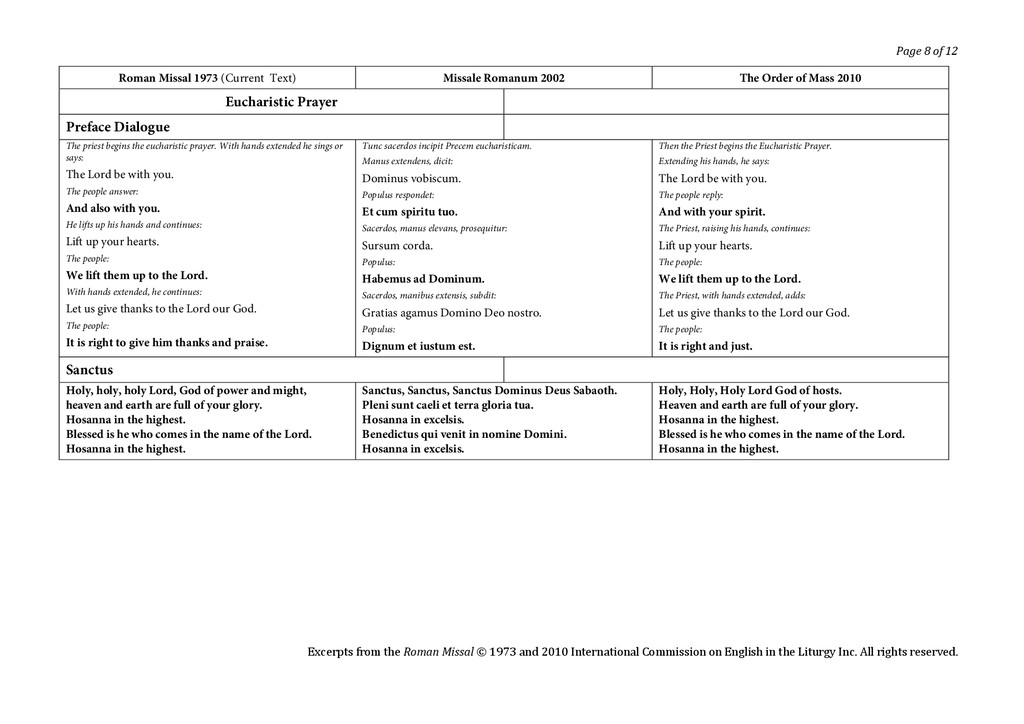
     ©  1973  and  2010  International  Commission  on  English  in  the  Liturgy  Inc.  All  rights  reserved.   Roman Missal 1973 (Current Text) Missale Romanum 2002 The Order of Mass 2010 Eucharistic Prayer Preface Dialogue The priest begins the eucharistic prayer. With hands extended he sings or says: The Lord be with you. The people answer: And also with you. He lifts up his hands and continues: Lift up your hearts. The people: We lift them up to the Lord. With hands extended, he continues: Let us give thanks to the Lord our God. The people: It is right to give him thanks and praise. Tunc sacerdos incipit Precem eucharisticam. Manus extendens, dicit: Dominus vobiscum. Populus respondet: Et cum spiritu tuo. Sacerdos, manus elevans, prosequitur: Sursum corda. Populus: Habemus ad Dominum. Sacerdos, manibus extensis, subdit: Gratias agamus Domino Deo nostro. Populus: Dignum et iustum est. Then the Priest begins the Eucharistic Prayer. Extending his hands, he says: The Lord be with you. The people reply: And with your spirit. The Priest, raising his hands, continues: Lift up your hearts. The people: We lift them up to the Lord. The Priest, with hands extended, adds: Let us give thanks to the Lord our God. The people: It is right and just. Sanctus Holy, holy, holy Lord, God of power and might, heaven and earth are full of your glory. Hosanna in the highest. Blessed is he who comes in the name of the Lord. Hosanna in the highest. Sanctus, Sanctus, Sanctus Dominus Deus Sabaoth. Pleni sunt caeli et terra gloria tua. Hosanna in excelsis. Benedictus qui venit in nomine Domini. Hosanna in excelsis. Holy, Holy, Holy Lord God of hosts. Heaven and earth are full of your glory. Hosanna in the highest. Blessed is he who comes in the name of the Lord. Hosanna in the highest.
  9. Page  9  of  12   Excerpts  from  the  Roman  Missal

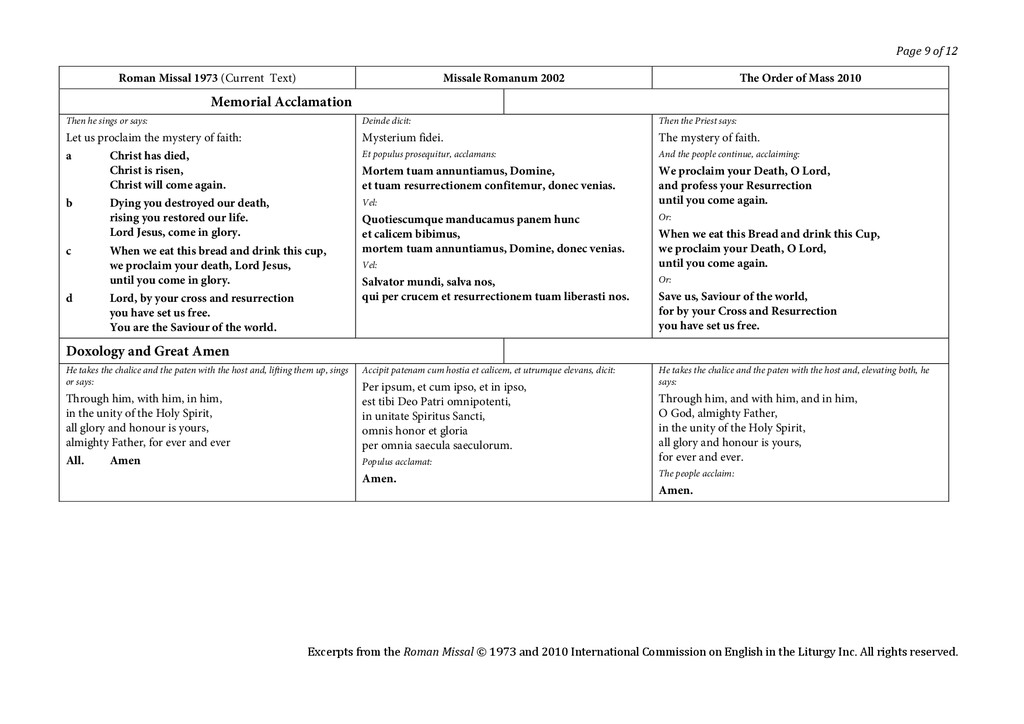
     ©  1973  and  2010  International  Commission  on  English  in  the  Liturgy  Inc.  All  rights  reserved.   Roman Missal 1973 (Current Text) Missale Romanum 2002 The Order of Mass 2010 Memorial Acclamation Then he sings or says: Let us proclaim the mystery of faith: a Christ has died, Christ is risen, Christ will come again. b Dying you destroyed our death, rising you restored our life. Lord Jesus, come in glory. c When we eat this bread and drink this cup, we proclaim your death, Lord Jesus, until you come in glory. d Lord, by your cross and resurrection you have set us free. You are the Saviour of the world. Deinde dicit: Mysterium fidei. Et populus prosequitur, acclamans: Mortem tuam annuntiamus, Domine, et tuam resurrectionem confitemur, donec venias. Vel: Quotiescumque manducamus panem hunc et calicem bibimus, mortem tuam annuntiamus, Domine, donec venias. Vel: Salvator mundi, salva nos, qui per crucem et resurrectionem tuam liberasti nos. Then the Priest says: The mystery of faith. And the people continue, acclaiming: We proclaim your Death, O Lord, and profess your Resurrection until you come again. Or: When we eat this Bread and drink this Cup, we proclaim your Death, O Lord, until you come again. Or: Save us, Saviour of the world, for by your Cross and Resurrection you have set us free. Doxology and Great Amen He takes the chalice and the paten with the host and, lifting them up, sings or says: Through him, with him, in him, in the unity of the Holy Spirit, all glory and honour is yours, almighty Father, for ever and ever All. Amen Accipit patenam cum hostia et calicem, et utrumque elevans, dicit: Per ipsum, et cum ipso, et in ipso, est tibi Deo Patri omnipotenti, in unitate Spiritus Sancti, omnis honor et gloria per omnia saecula saeculorum. Populus acclamat: Amen. He takes the chalice and the paten with the host and, elevating both, he says: Through him, and with him, and in him, O God, almighty Father, in the unity of the Holy Spirit, all glory and honour is yours, for ever and ever. The people acclaim: Amen.
  10. Page  10  of  12   Excerpts  from  the  Roman  Missal

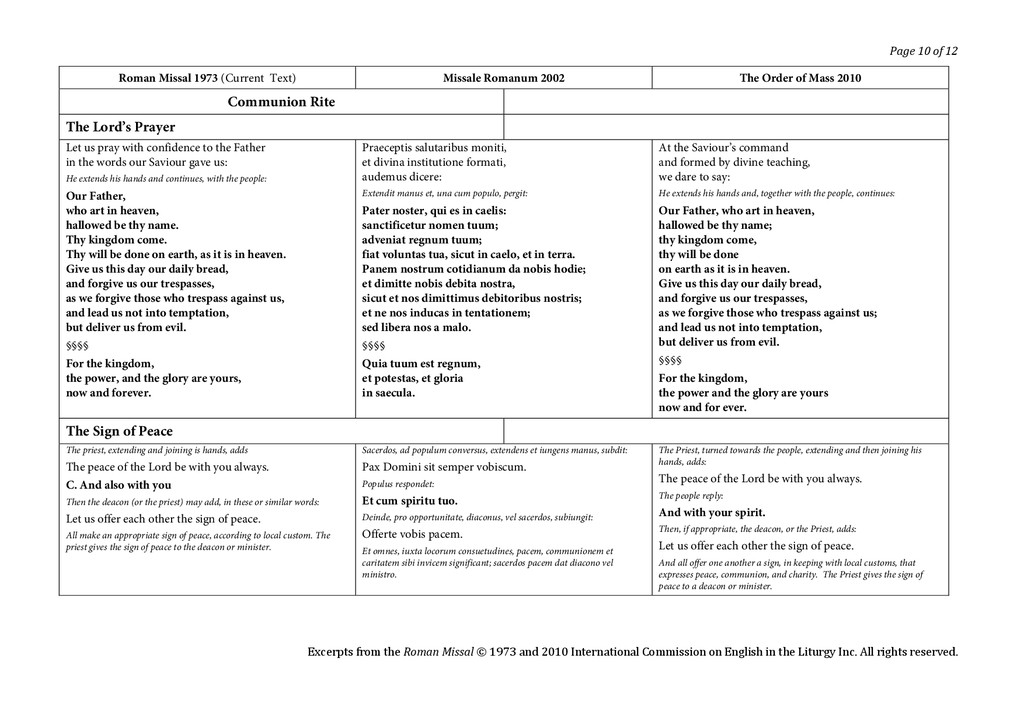
     ©  1973  and  2010  International  Commission  on  English  in  the  Liturgy  Inc.  All  rights  reserved.   Roman Missal 1973 (Current Text) Missale Romanum 2002 The Order of Mass 2010 Communion Rite The Lord’s Prayer Let us pray with confidence to the Father in the words our Saviour gave us: He extends his hands and continues, with the people: Our Father, who art in heaven, hallowed be thy name. Thy kingdom come. Thy will be done on earth, as it is in heaven. Give us this day our daily bread, and forgive us our trespasses, as we forgive those who trespass against us, and lead us not into temptation, but deliver us from evil. §§§§ For the kingdom, the power, and the glory are yours, now and forever. Praeceptis salutaribus moniti, et divina institutione formati, audemus dicere: Extendit manus et, una cum populo, pergit: Pater noster, qui es in caelis: sanctificetur nomen tuum; adveniat regnum tuum; fiat voluntas tua, sicut in caelo, et in terra. Panem nostrum cotidianum da nobis hodie; et dimitte nobis debita nostra, sicut et nos dimittimus debitoribus nostris; et ne nos inducas in tentationem; sed libera nos a malo. §§§§ Quia tuum est regnum, et potestas, et gloria in saecula. At the Saviour’s command and formed by divine teaching, we dare to say: He extends his hands and, together with the people, continues: Our Father, who art in heaven, hallowed be thy name; thy kingdom come, thy will be done on earth as it is in heaven. Give us this day our daily bread, and forgive us our trespasses, as we forgive those who trespass against us; and lead us not into temptation, but deliver us from evil. §§§§ For the kingdom, the power and the glory are yours now and for ever. The Sign of Peace The priest, extending and joining is hands, adds The peace of the Lord be with you always. C. And also with you Then the deacon (or the priest) may add, in these or similar words: Let us offer each other the sign of peace. All make an appropriate sign of peace, according to local custom. The priest gives the sign of peace to the deacon or minister. Sacerdos, ad populum conversus, extendens et iungens manus, subdit: Pax Domini sit semper vobiscum. Populus respondet: Et cum spiritu tuo. Deinde, pro opportunitate, diaconus, vel sacerdos, subiungit: Offerte vobis pacem. Et omnes, iuxta locorum consuetudines, pacem, communionem et caritatem sibi invicem significant; sacerdos pacem dat diacono vel ministro. The Priest, turned towards the people, extending and then joining his hands, adds: The peace of the Lord be with you always. The people reply: And with your spirit. Then, if appropriate, the deacon, or the Priest, adds: Let us offer each other the sign of peace. And all offer one another a sign, in keeping with local customs, that expresses peace, communion, and charity. The Priest gives the sign of peace to a deacon or minister.
  11. Page  11  of  12   Excerpts  from  the  Roman  Missal

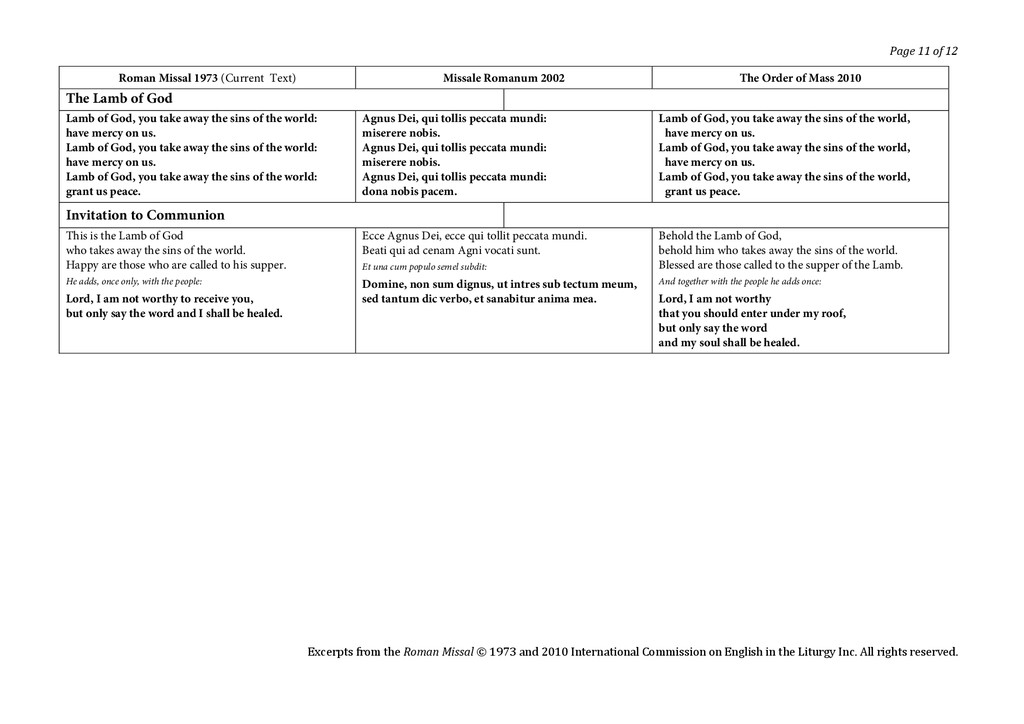
     ©  1973  and  2010  International  Commission  on  English  in  the  Liturgy  Inc.  All  rights  reserved.   Roman Missal 1973 (Current Text) Missale Romanum 2002 The Order of Mass 2010 The Lamb of God Lamb of God, you take away the sins of the world: have mercy on us. Lamb of God, you take away the sins of the world: have mercy on us. Lamb of God, you take away the sins of the world: grant us peace. Agnus Dei, qui tollis peccata mundi: miserere nobis. Agnus Dei, qui tollis peccata mundi: miserere nobis. Agnus Dei, qui tollis peccata mundi: dona nobis pacem. Lamb of God, you take away the sins of the world, have mercy on us. Lamb of God, you take away the sins of the world, have mercy on us. Lamb of God, you take away the sins of the world, grant us peace. Invitation to Communion This is the Lamb of God who takes away the sins of the world. Happy are those who are called to his supper. He adds, once only, with the people: Lord, I am not worthy to receive you, but only say the word and I shall be healed. Ecce Agnus Dei, ecce qui tollit peccata mundi. Beati qui ad cenam Agni vocati sunt. Et una cum populo semel subdit: Domine, non sum dignus, ut intres sub tectum meum, sed tantum dic verbo, et sanabitur anima mea. Behold the Lamb of God, behold him who takes away the sins of the world. Blessed are those called to the supper of the Lamb. And together with the people he adds once: Lord, I am not worthy that you should enter under my roof, but only say the word and my soul shall be healed.
  12. Page  12  of  12   Excerpts  from  the  Roman  Missal

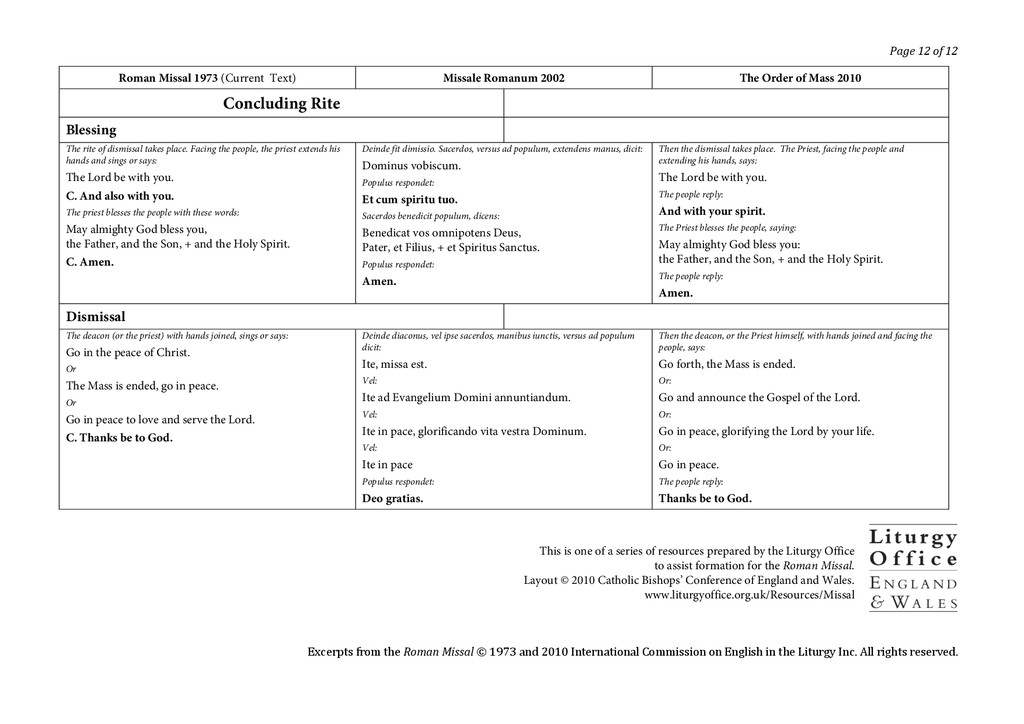
     ©  1973  and  2010  International  Commission  on  English  in  the  Liturgy  Inc.  All  rights  reserved.   Roman Missal 1973 (Current Text) Missale Romanum 2002 The Order of Mass 2010 Concluding Rite Blessing The rite of dismissal takes place. Facing the people, the priest extends his hands and sings or says: The Lord be with you. C. And also with you. The priest blesses the people with these words: May almighty God bless you, the Father, and the Son, + and the Holy Spirit. C. Amen. Deinde fit dimissio. Sacerdos, versus ad populum, extendens manus, dicit: Dominus vobiscum. Populus respondet: Et cum spiritu tuo. Sacerdos benedicit populum, dicens: Benedicat vos omnipotens Deus, Pater, et Filius, + et Spiritus Sanctus. Populus respondet: Amen. Then the dismissal takes place. The Priest, facing the people and extending his hands, says: The Lord be with you. The people reply: And with your spirit. The Priest blesses the people, saying: May almighty God bless you: the Father, and the Son, + and the Holy Spirit. The people reply: Amen. Dismissal The deacon (or the priest) with hands joined, sings or says: Go in the peace of Christ. Or The Mass is ended, go in peace. Or Go in peace to love and serve the Lord. C. Thanks be to God. Deinde diaconus, vel ipse sacerdos, manibus iunctis, versus ad populum dicit: Ite, missa est. Vel: Ite ad Evangelium Domini annuntiandum. Vel: Ite in pace, glorificando vita vestra Dominum. Vel: Ite in pace Populus respondet: Deo gratias. Then the deacon, or the Priest himself, with hands joined and facing the people, says: Go forth, the Mass is ended. Or: Go and announce the Gospel of the Lord. Or: Go in peace, glorifying the Lord by your life. Or: Go in peace. The people reply: Thanks be to God. This is one of a series of resources prepared by the Liturgy Office to assist formation for the Roman Missal. Layout © 2010 Catholic Bishops’ Conference of England and Wales. www.liturgyoffice.org.uk/Resources/Missal