Upgrade to Pro — share decks privately, control downloads, hide ads and more …

iOS Testing mit XCTest & Co.- Mobile Testing Da...

iOS Testing mit XCTest & Co.- Mobile Testing Days 2015

Talk gehalten auf den Mobile Testing Days in Berlin am 28. Mai 2015.

Avatar for Thimo

Thimo

May 28, 2015

Other Decks in Technology

Transcript

  1. zu meiner Person • Thimo Bess • Software-Engineer bei arconsis

    IT-Solutions GmbH in Karlsruhe • iOS-Entwicklung • Webanwendungen
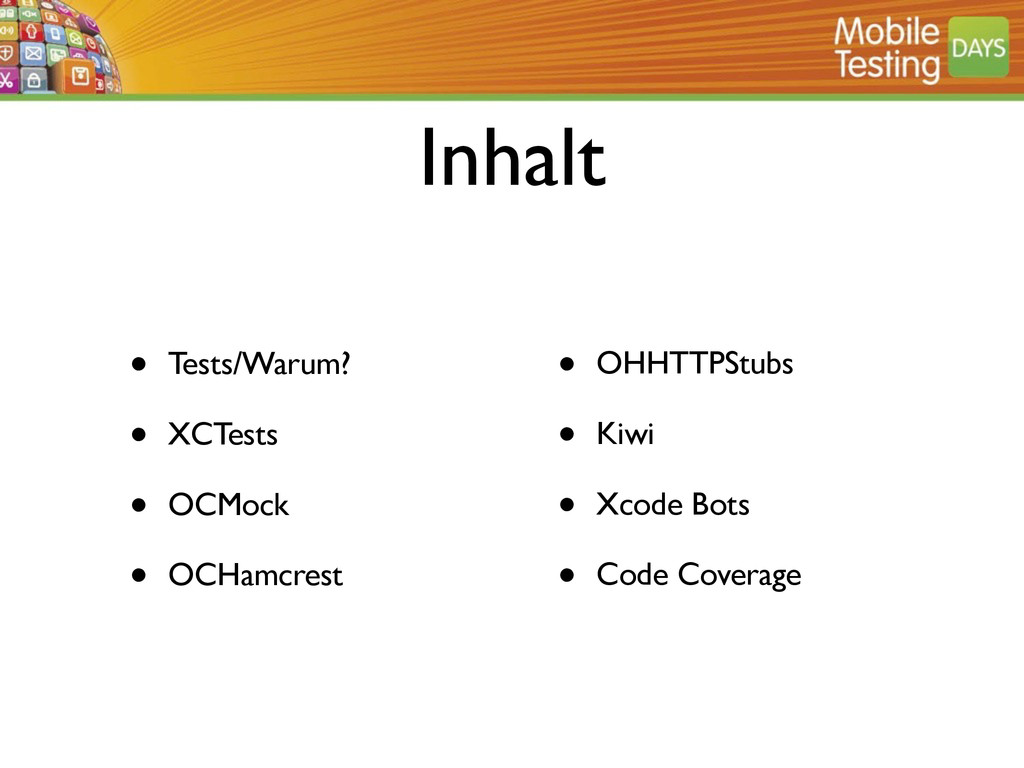
  2. Inhalt • Tests/Warum? • XCTests • OCMock • OCHamcrest •

    OHHTTPStubs • Kiwi • Xcode Bots • Code Coverage
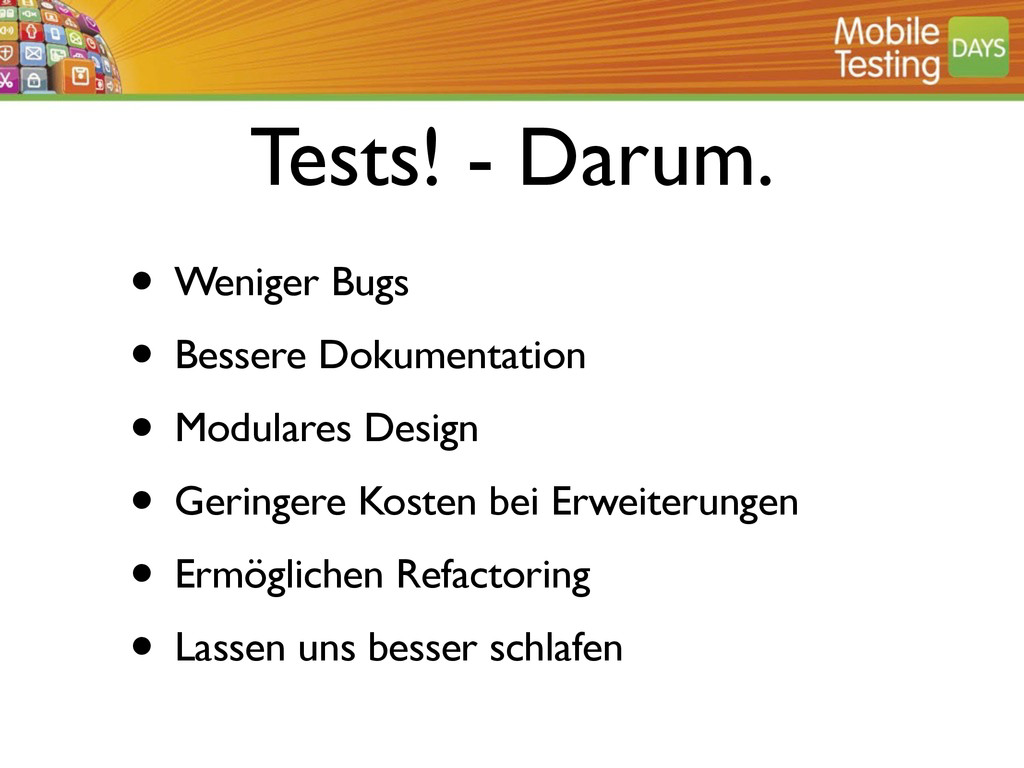
  3. Tests! - Darum. • Weniger Bugs • Bessere Dokumentation •

    Modulares Design • Geringere Kosten bei Erweiterungen • Ermöglichen Refactoring • Lassen uns besser schlafen
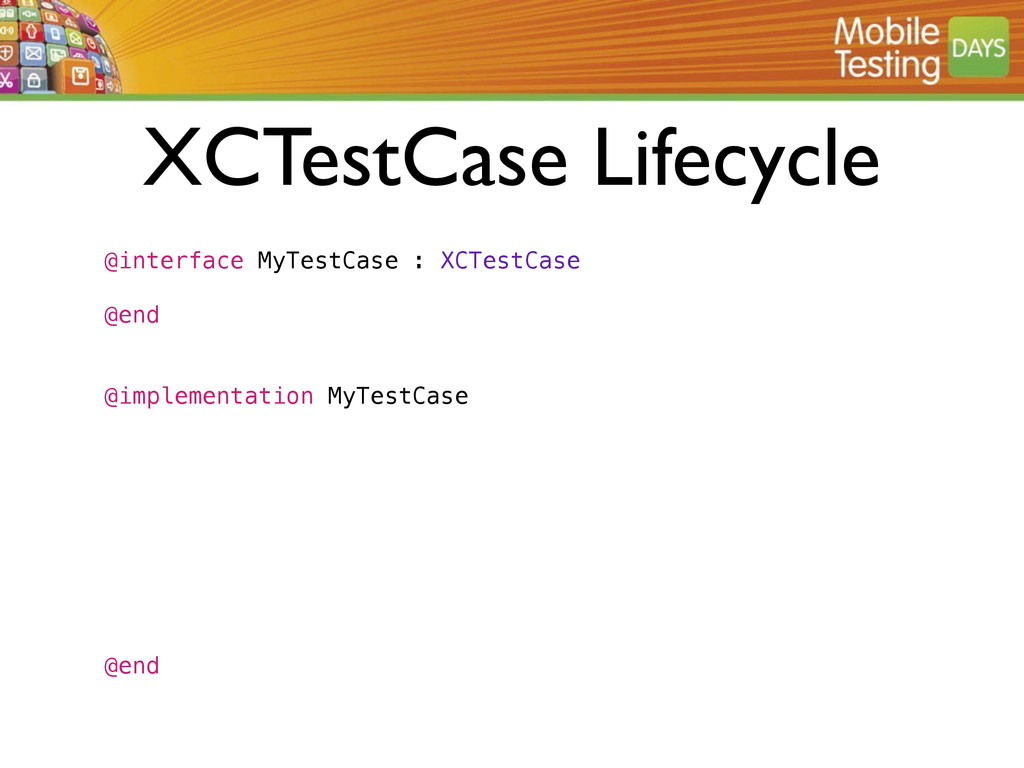
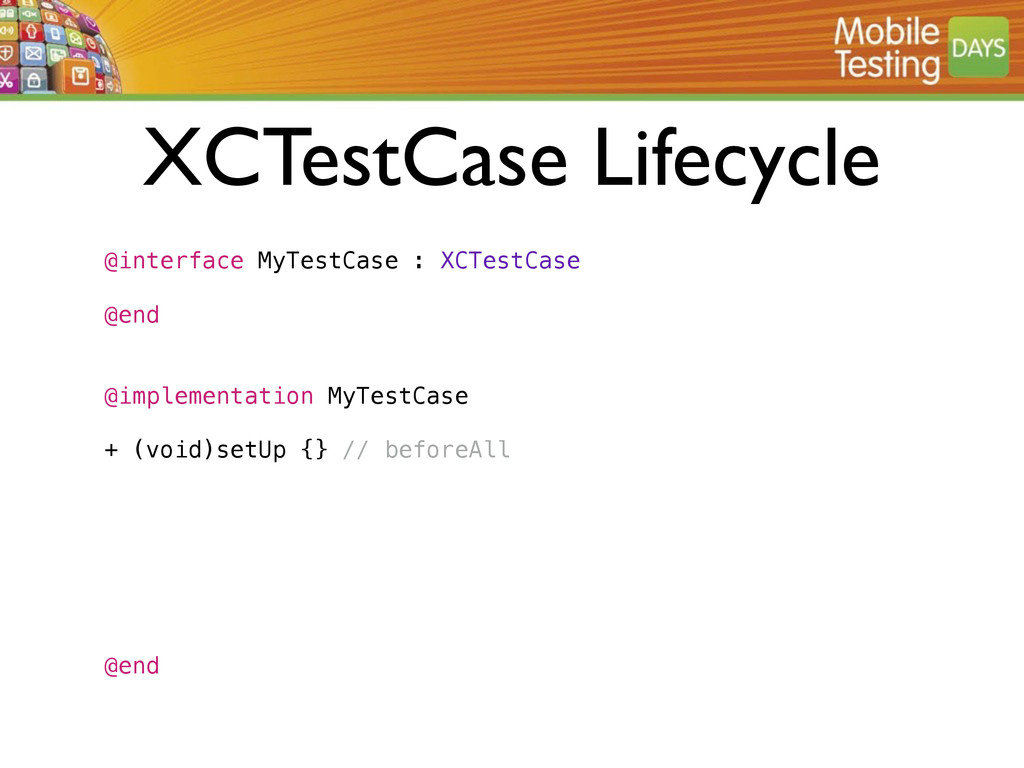
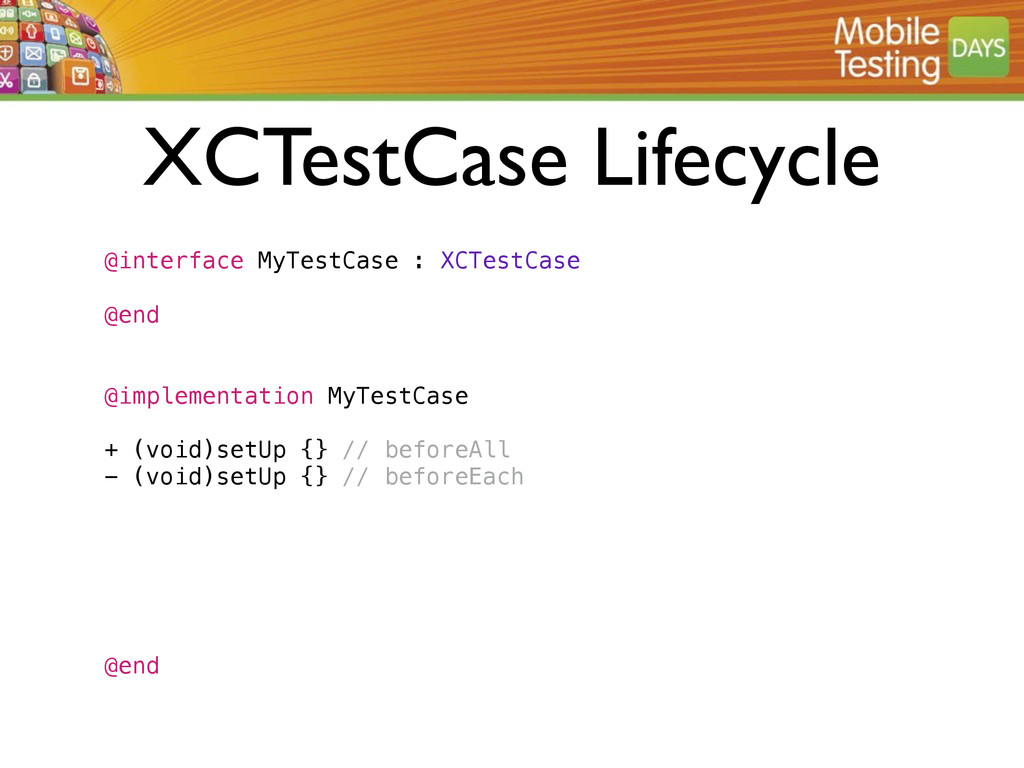
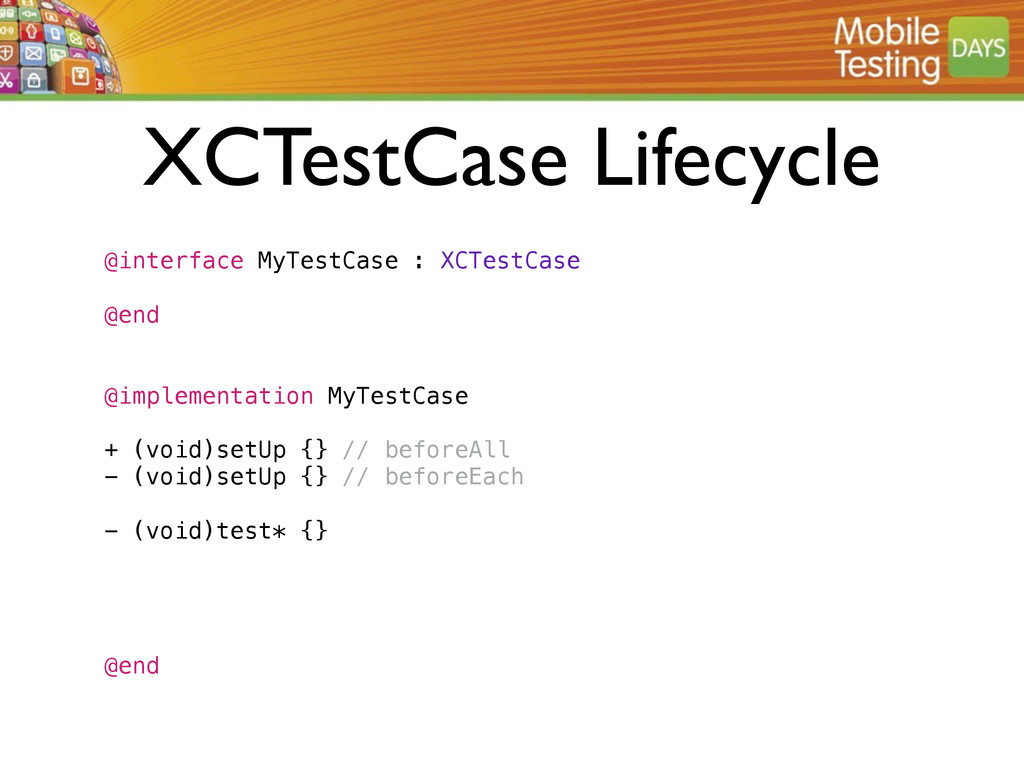
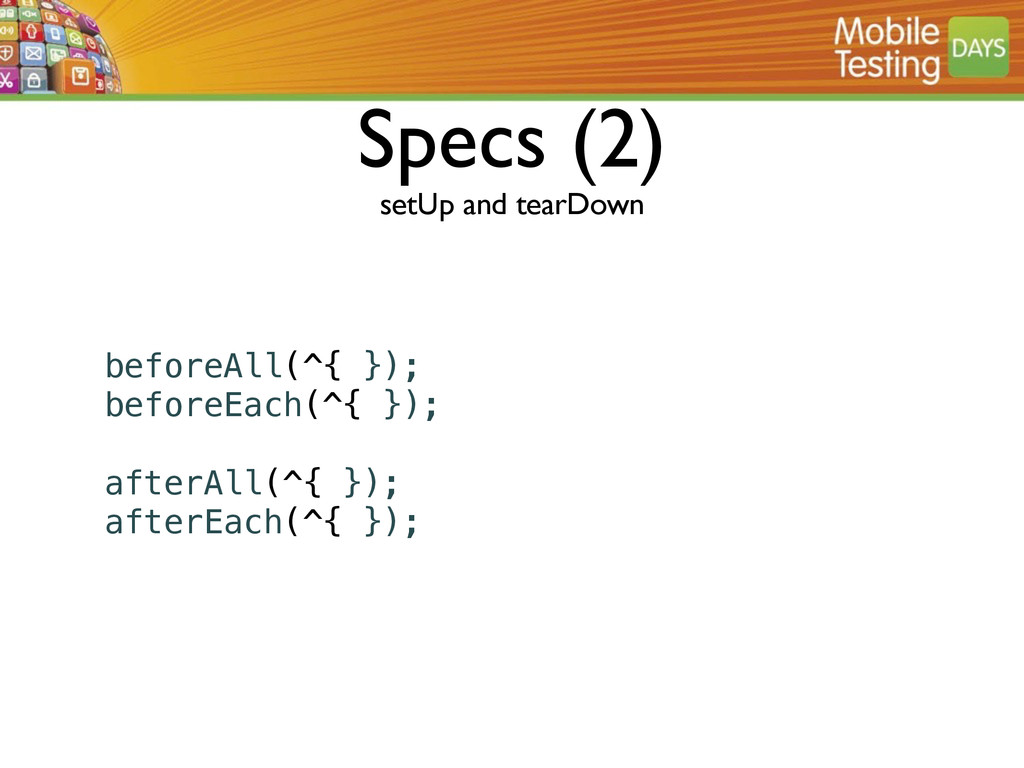
  4. XCTestCase Lifecycle @interface MyTestCase : XCTestCase @end @implementation MyTestCase +

    (void)setUp {} // beforeAll - (void)setUp {} // beforeEach - (void)test* {} + (void)tearDown {} // afterAll - (void)tearDown {} // afterEach @end
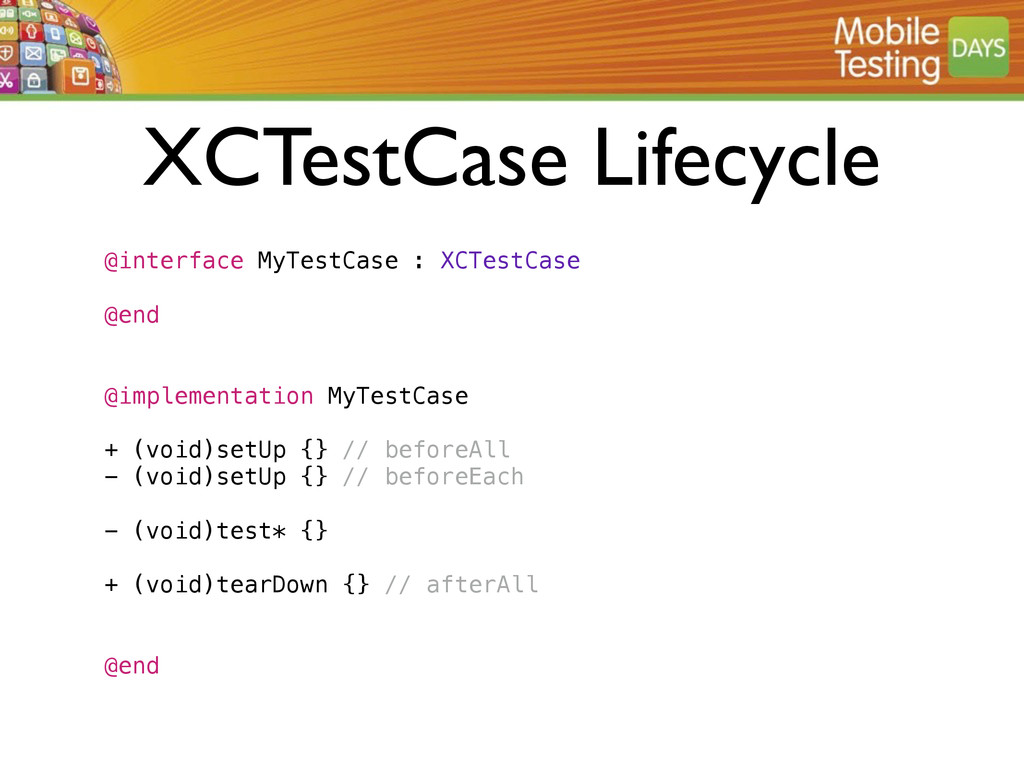
  5. XCTestCase Lifecycle @interface MyTestCase : XCTestCase @end @implementation MyTestCase +

    (void)setUp {} // beforeAll - (void)setUp {} // beforeEach - (void)test* {} + (void)tearDown {} // afterAll - (void)tearDown {} // afterEach @end
  6. XCTestCase Lifecycle @interface MyTestCase : XCTestCase @end @implementation MyTestCase +

    (void)setUp {} // beforeAll - (void)setUp {} // beforeEach - (void)test* {} + (void)tearDown {} // afterAll - (void)tearDown {} // afterEach @end
  7. XCTestCase Lifecycle @interface MyTestCase : XCTestCase @end @implementation MyTestCase +

    (void)setUp {} // beforeAll - (void)setUp {} // beforeEach - (void)test* {} + (void)tearDown {} // afterAll - (void)tearDown {} // afterEach @end
  8. XCTestCase Lifecycle @interface MyTestCase : XCTestCase @end @implementation MyTestCase +

    (void)setUp {} // beforeAll - (void)setUp {} // beforeEach - (void)test* {} + (void)tearDown {} // afterAll - (void)tearDown {} // afterEach @end
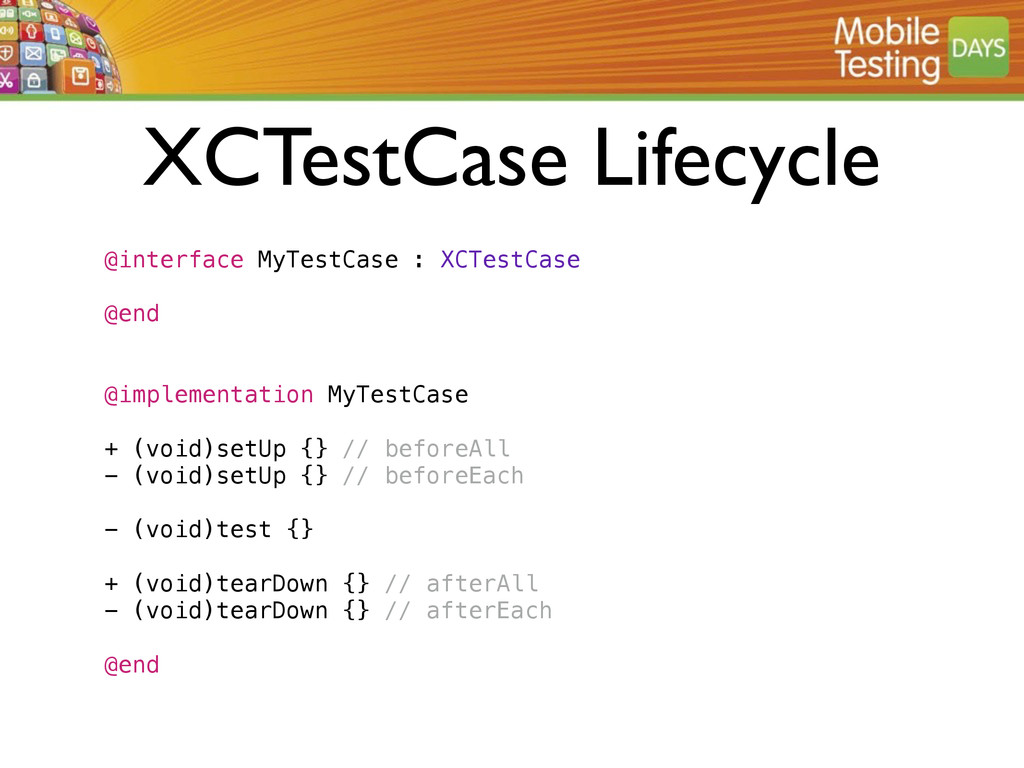
  9. XCTestCase Lifecycle @interface MyTestCase : XCTestCase @end @implementation MyTestCase +

    (void)setUp {} // beforeAll - (void)setUp {} // beforeEach - (void)test {} + (void)tearDown {} // afterAll - (void)tearDown {} // afterEach @end
  10. XCTestCase Example - (void) testLoginWithUserAndPassword_shouldReturnValidUser { // Given: Arrange all

    the things needed to exercise // the code // When: Act on the code you want to verify // Then: Assert that the code worked as expected }
  11. XCTestCase Example - (void) testLoginWithUserAndPassword_shouldReturnValidUser { // Given: Arrange all

    the things needed to exercise the code UserManager *sut = [UserManager new]; NSString *username = @"Peter"; NSString *password = @"secret"; // When: Act on the code you want to verify User *user = [sut loginUser:username withPassword:password]; // Then: Assert that the code worked as expected XCTAssertNotNil(user, "User should not be nil"); XCTAssertEqualObjects(@"Peter", user.username, @"Expected username"); XCTAssertNotNil(user.sessionId, "SessionId should not be nil"); XCTAssertTrue(user.sessionId.length >= 5); }
  12. XCTestCase Example - (void) testLoginWithUserAndPassword_shouldReturnValidUser { // Given: Arrange all

    the things needed to exercise the code UserManager *sut = [UserManager new]; NSString *username = @"Peter"; NSString *password = @"secret"; // When: Act on the code you want to verify User *user = [sut loginUser:username withPassword:password]; // Then: Assert that the code worked as expected XCTAssertNotNil(user, "User should not be nil"); XCTAssertEqualObjects(@"Peter", user.username, @"Expected username"); XCTAssertNotNil(user.sessionId, "SessionId should not be nil"); XCTAssertTrue(user.sessionId.length >= 5); }
  13. XCTestCase Example - (void) testLoginWithUserAndPassword_shouldReturnValidUser { // Given: Arrange all

    the things needed to exercise the code UserManager *sut = [UserManager new]; NSString *username = @"Peter"; NSString *password = @"secret"; // When: Act on the code you want to verify User *user = [sut loginUser:username withPassword:password]; // Then: Assert that the code worked as expected XCTAssertNotNil(user, "User should not be nil"); XCTAssertEqualObjects(@"Peter", user.username, @"Expected username"); XCTAssertNotNil(user.sessionId, "SessionId should not be nil"); XCTAssertTrue(user.sessionId.length >= 5); }
  14. XCTestCase Example - (void) testLoginWithUserAndPassword_shouldReturnValidUser { // Given: Arrange all

    the things needed to exercise the code UserManager *sut = [UserManager new]; NSString *username = @"Peter"; NSString *password = @"secret"; // When: Act on the code you want to verify User *user = [sut loginUser:username withPassword:password]; // Then: Assert that the code worked as expected XCTAssertNotNil(user, "User should not be nil"); XCTAssertEqualObjects(@"Peter", user.username, @"Expected username"); XCTAssertNotNil(user.sessionId, "SessionId should not be nil"); XCTAssertTrue(user.sessionId.length >= 5); }
  15. XCTestCase Example - (void) testLoginWithUserAndPassword_shouldReturnValidUser { // Given: Arrange all

    the things needed to exercise the code UserManager *sut = [UserManager new]; NSString *username = @"Peter"; NSString *password = @"secret"; // When: Act on the code you want to verify User *user = [sut loginUser:username withPassword:password]; // Then: Assert that the code worked as expected XCTAssertNotNil(user, "User should not be nil"); XCTAssertEqualObjects(@"Peter", user.username, @"Expected username"); XCTAssertNotNil(user.sessionId, "SessionId should not be nil"); XCTAssertTrue(user.sessionId.length >= 5); }
  16. XCTestCase Example - (void) testLoginWithUserAndPassword_shouldReturnValidUser { // Given: Arrange all

    the things needed to exercise the code UserManager *sut = [UserManager new]; NSString *username = @"Peter"; NSString *password = @"secret"; // When: Act on the code you want to verify User *user = [sut loginUser:username withPassword:password]; // Then: Assert that the code worked as expected XCTAssertNotNil(user, "User should not be nil"); XCTAssertEqualObjects(@"Peter", user.username, @"Expected username"); XCTAssertNotNil(user.sessionId, "SessionId should not be nil"); XCTAssertTrue(user.sessionId.length >= 5); }
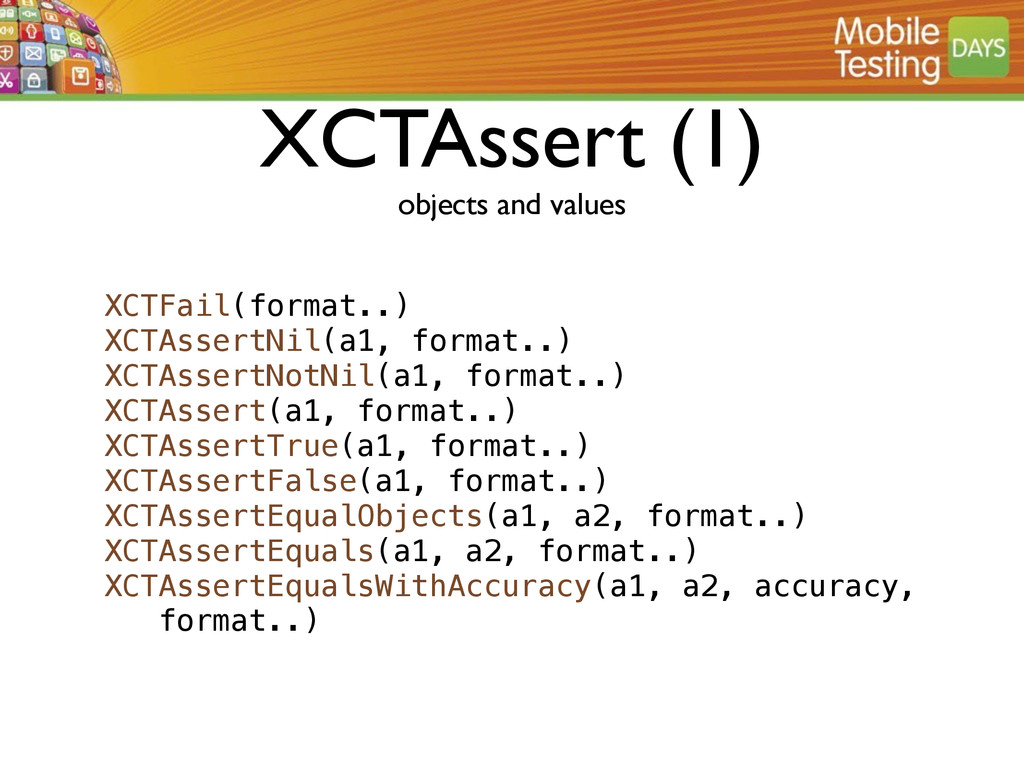
  17. XCTAssert (1) objects and values XCTFail(format..)
 XCTAssertNil(a1, format..)
 XCTAssertNotNil(a1, format..)


    XCTAssert(a1, format..)
 XCTAssertTrue(a1, format..)
 XCTAssertFalse(a1, format..)
 XCTAssertEqualObjects(a1, a2, format..)
 XCTAssertEquals(a1, a2, format..)
 XCTAssertEqualsWithAccuracy(a1, a2, accuracy, format..)

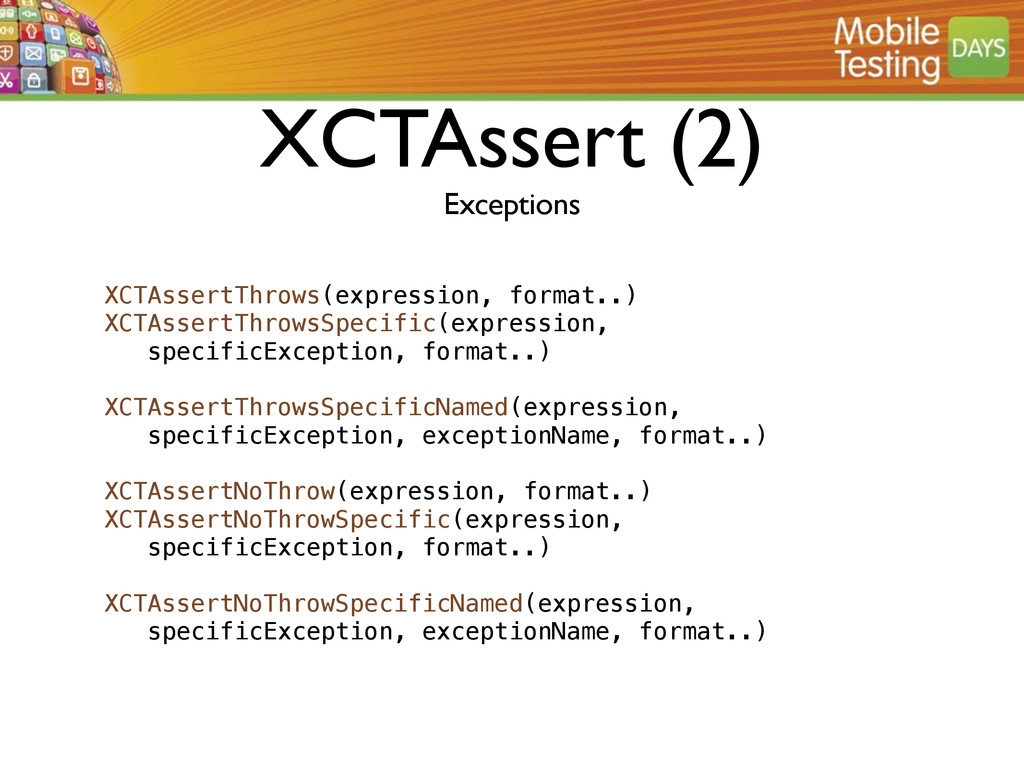
  18. XCTAssert (2) Exceptions XCTAssertThrows(expression, format..)
 XCTAssertThrowsSpecific(expression, specificException, format..) XCTAssertThrowsSpecificNamed(expression, specificException,

    exceptionName, format..) 
 XCTAssertNoThrow(expression, format..) XCTAssertNoThrowSpecific(expression, specificException, format..) XCTAssertNoThrowSpecificNamed(expression, specificException, exceptionName, format..)
  19. XCTestCase: Exceptions - (void)testLoginWithNullCredentials_ShouldThrowException { // Default SUT already configured

    in setUp XCTAssertThrowsSpecificNamed([self.sut loginUser:nil withPassword:nil], NSException, NSInvalidArgumentException, @"should throw NSInvalidArgumentException"); }
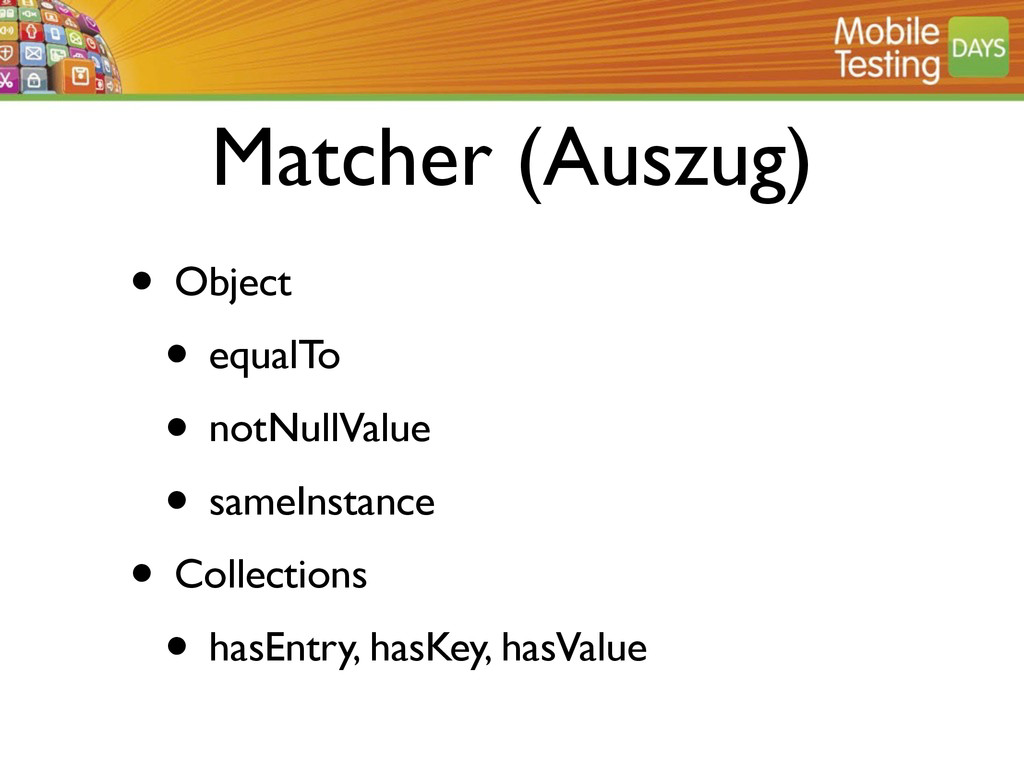
  20. Matcher (Auszug) • Object • equalTo • notNullValue • sameInstance

    • Collections • hasEntry, hasKey, hasValue
  21. Beispiel - (void) testEquals { Biscuit* theBiscuit = [[Biscuit alloc]

    initWithName:@"Ginger"]; Biscuit* myBiscuit = [[Biscuit alloc] initWithName:@"Ginger"]; assertThat(theBiscuit, equalTo(myBiscuit)); assertThat(theBiscuit, is(equalTo(myBiscuit))); }
  22. Beispiel - (void) testEquals { Biscuit* theBiscuit = [[Biscuit alloc]

    initWithName:@"Ginger"]; Biscuit* myBiscuit = [[Biscuit alloc] initWithName:@"Ginger"]; assertThat(theBiscuit, equalTo(myBiscuit)); assertThat(theBiscuit, is(equalTo(myBiscuit))); }
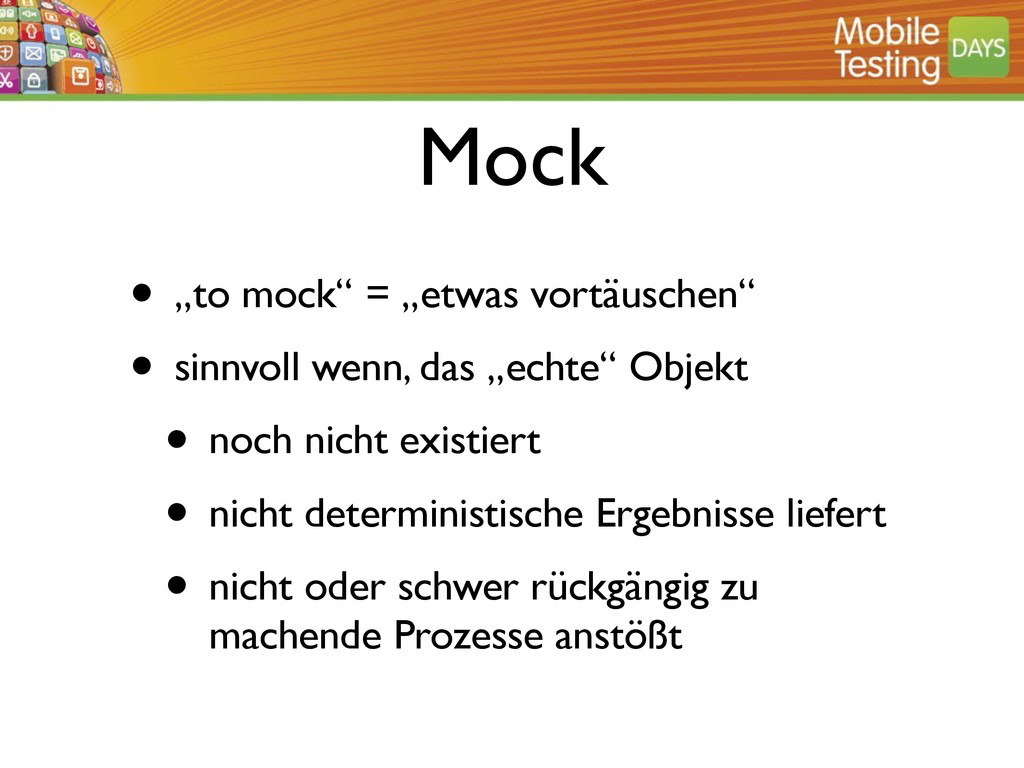
  23. Mock • „to mock“ = „etwas vortäuschen“ • sinnvoll wenn,

    das „echte“ Objekt • noch nicht existiert • nicht deterministische Ergebnisse liefert • nicht oder schwer rückgängig zu machende Prozesse anstößt
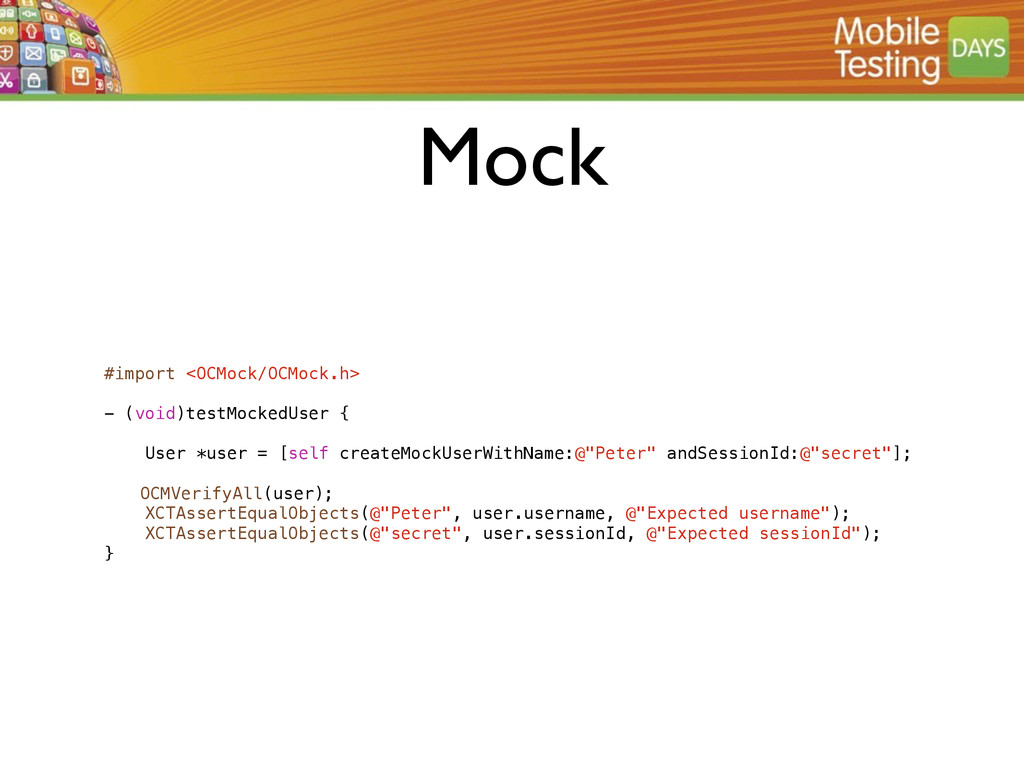
  24. Mock #import <OCMock/OCMock.h> - (void)testMockedUser { User *user = [self

    createMockUserWithName:@"Peter" andSessionId:@"secret"]; OCMVerifyAll(user); XCTAssertEqualObjects(@"Peter", user.username, @"Expected username"); XCTAssertEqualObjects(@"secret", user.sessionId, @"Expected sessionId"); }
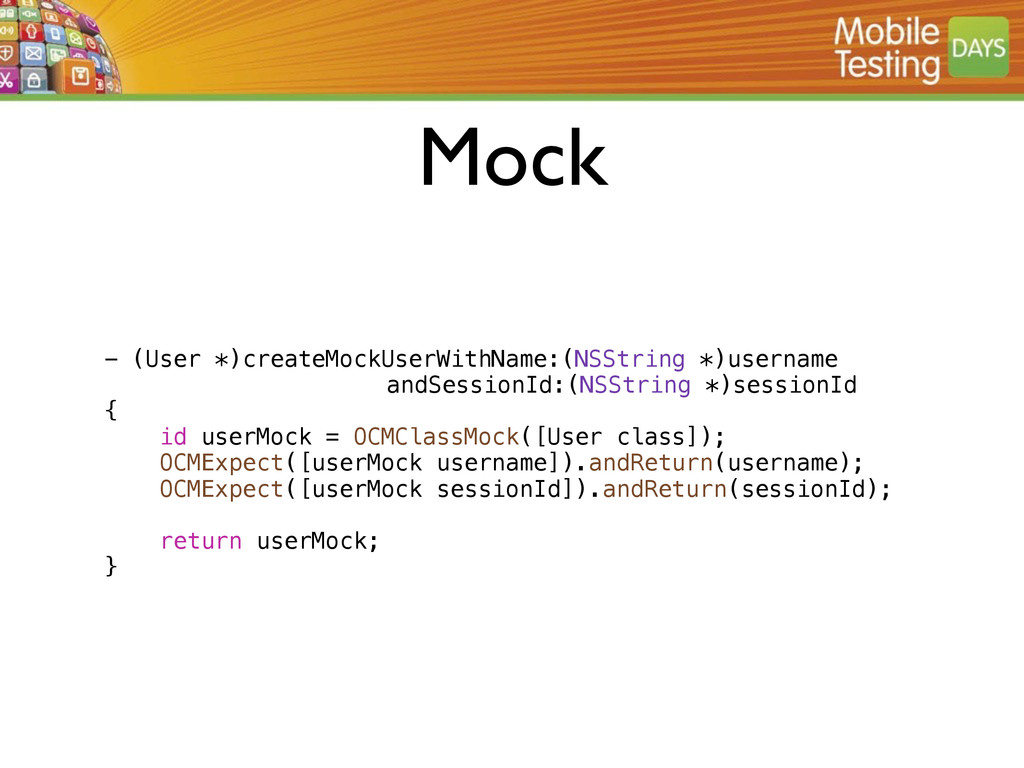
  25. Mock - (User *)createMockUserWithName:(NSString *)username andSessionId:(NSString *)sessionId { id userMock

    = OCMClassMock([User class]); OCMExpect([userMock username]).andReturn(username); OCMExpect([userMock sessionId]).andReturn(sessionId); return userMock; }
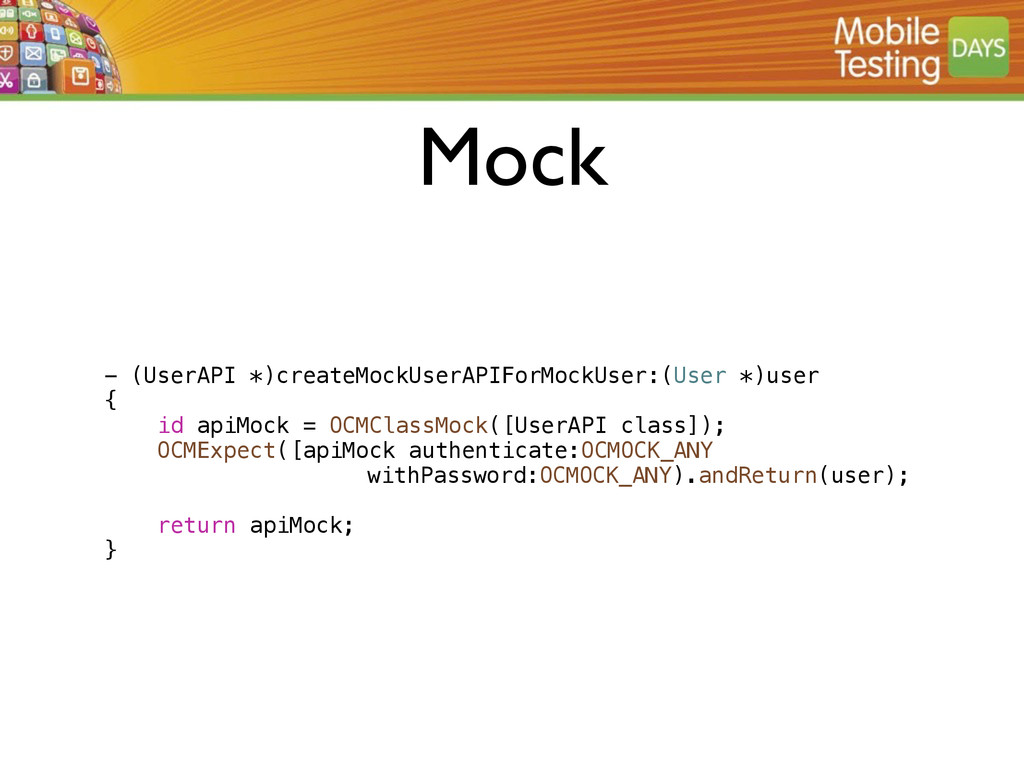
  26. Mock - (UserAPI *)createMockUserAPIForMockUser:(User *)user { id apiMock = OCMClassMock([UserAPI

    class]); OCMExpect([apiMock authenticate:OCMOCK_ANY withPassword:OCMOCK_ANY).andReturn(user); return apiMock; }
  27. Mock - (void)testLoginWithUserAndPassword_shouldReturnValidUser { // Given: Arrange all the things

    needed to exercise the code User *mockUser = [self createMockUserWithName:@"Peter" andSessionId:@"123456789"]; UserAPI *mockApi = [self createMockUserAPIForMockUser:mockUser]; self.sut = [[UserManager alloc] initWithApi:mockApi]; // When: Act on the code you want to verify User *user = [self.sut loginUser:@"Peter" withPassword:@"123456789"]; // Then: Assert that the code worked as expected OCMVerifyAll(user); XCTAssertEqualObjects(@"Peter", user.username, @"Expected username"); XCTAssertEqualObjects(@"123456789", user.sessionId, @"Expected sessionId"); }
  28. Mock - (void)testLoginWithUserAndPassword_shouldReturnValidUser { // Given: Arrange all the things

    needed to exercise the code User *mockUser = [self createMockUserWithName:@"Peter" andSessionId:@"123456789"]; UserAPI *mockApi = [self createMockUserAPIForMockUser:mockUser]; self.sut = [[UserManager alloc] initWithApi:mockApi]; // When: Act on the code you want to verify User *user = [self.sut loginUser:@"Peter" withPassword:@"123456789"]; // Then: Assert that the code worked as expected OCMVerifyAll(user); XCTAssertEqualObjects(@"Peter", user.username, @"Expected username"); XCTAssertEqualObjects(@"123456789", user.sessionId, @"Expected sessionId"); }
  29. Mock - (void)testLoginWithUserAndPassword_shouldReturnValidUser { // Given: Arrange all the things

    needed to exercise the code User *mockUser = [self createMockUserWithName:@"Peter" andSessionId:@"123456789"]; UserAPI *mockApi = [self createMockUserAPIForMockUser:mockUser]; self.sut = [[UserManager alloc] initWithApi:mockApi]; // When: Act on the code you want to verify User *user = [self.sut loginUser:@"Peter" withPassword:@"123456789"]; // Then: Assert that the code worked as expected OCMVerifyAll(user); XCTAssertEqualObjects(@"Peter", user.username, @"Expected username"); XCTAssertEqualObjects(@"123456789", user.sessionId, @"Expected sessionId"); }
  30. Mock - (void)testLoginWithUserAndPassword_shouldReturnValidUser { // Given: Arrange all the things

    needed to exercise the code User *mockUser = [self createMockUserWithName:@"Peter" andSessionId:@"123456789"]; UserAPI *mockApi = [self createMockUserAPIForMockUser:mockUser]; self.sut = [[UserManager alloc] initWithApi:mockApi]; // When: Act on the code you want to verify User *user = [self.sut loginUser:@"Peter" withPassword:@"123456789"]; // Then: Assert that the code worked as expected OCMVerifyAll(mockUser); OCMVerifyAll(mockApi); XCTAssertEqualObjects(@"Peter", user.username, @"Expected username"); XCTAssertEqualObjects(@"123456789", user.sessionId, @"Expected sessionId"); }
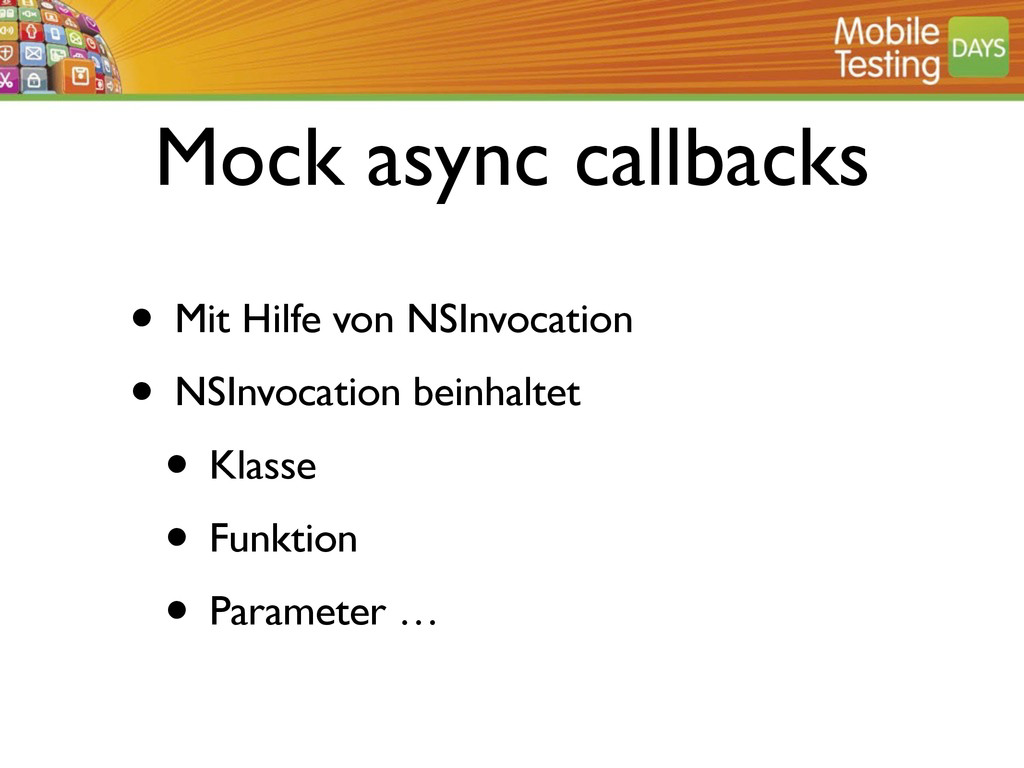
  31. Mock async callbacks • Mit Hilfe von NSInvocation • NSInvocation

    beinhaltet • Klasse • Funktion • Parameter …
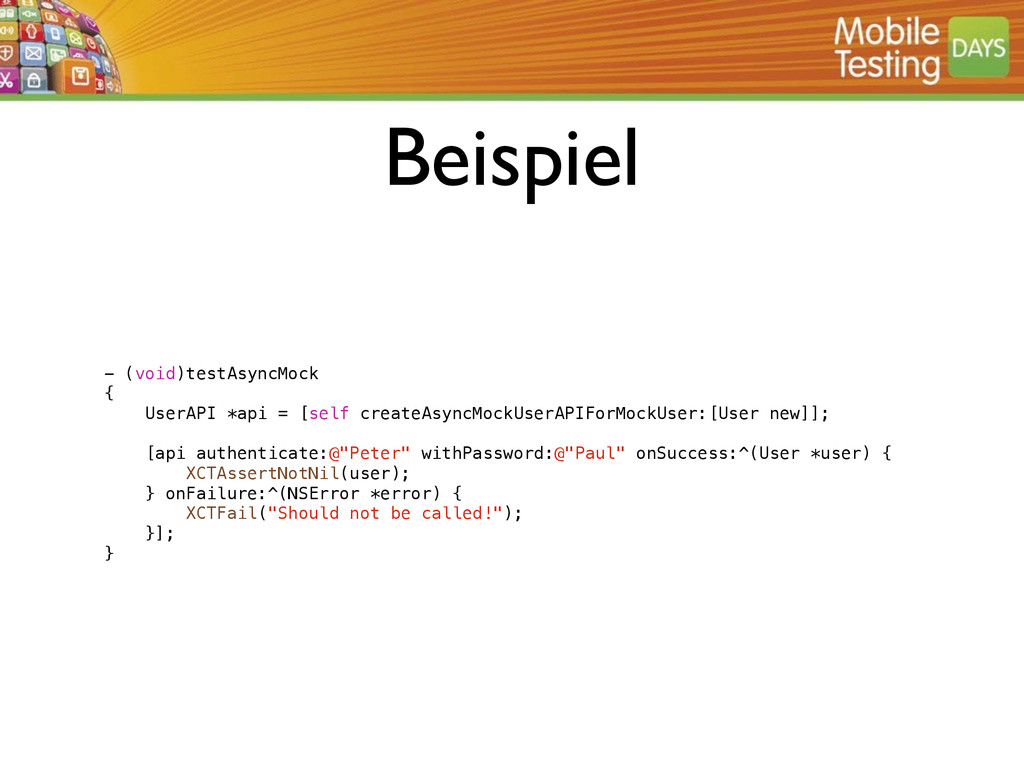
  32. Beispiel - (void)testAsyncMock { UserAPI *api = [self createAsyncMockUserAPIForMockUser:[User new]];

    [api authenticate:@"Peter" withPassword:@"Paul" onSuccess:^(User *user) { XCTAssertNotNil(user); } onFailure:^(NSError *error) { XCTFail("Should not be called!"); }]; }
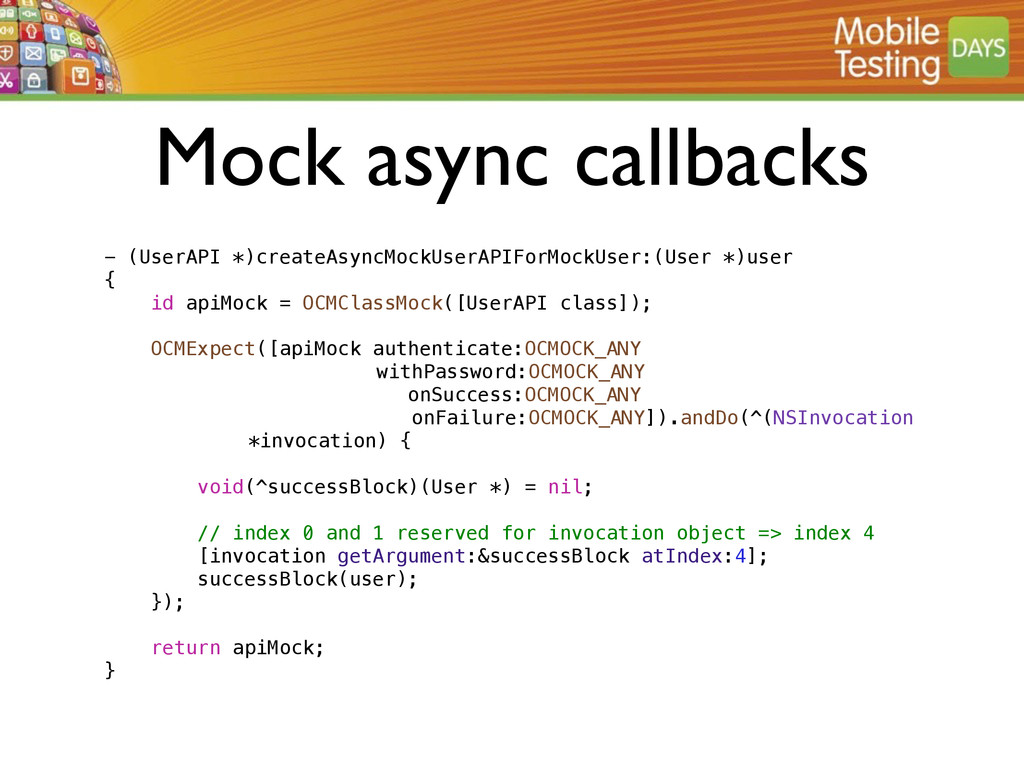
  33. Mock async callbacks - (UserAPI *)createAsyncMockUserAPIForMockUser:(User *)user { id apiMock

    = OCMClassMock([UserAPI class]); OCMExpect([apiMock authenticate:OCMOCK_ANY withPassword:OCMOCK_ANY onSuccess:OCMOCK_ANY onFailure:OCMOCK_ANY]).andDo(^(NSInvocation *invocation) { void(^successBlock)(User *) = nil; // index 0 and 1 reserved for invocation object => index 4 [invocation getArgument:&successBlock atIndex:4]; successBlock(user); }); return apiMock; }
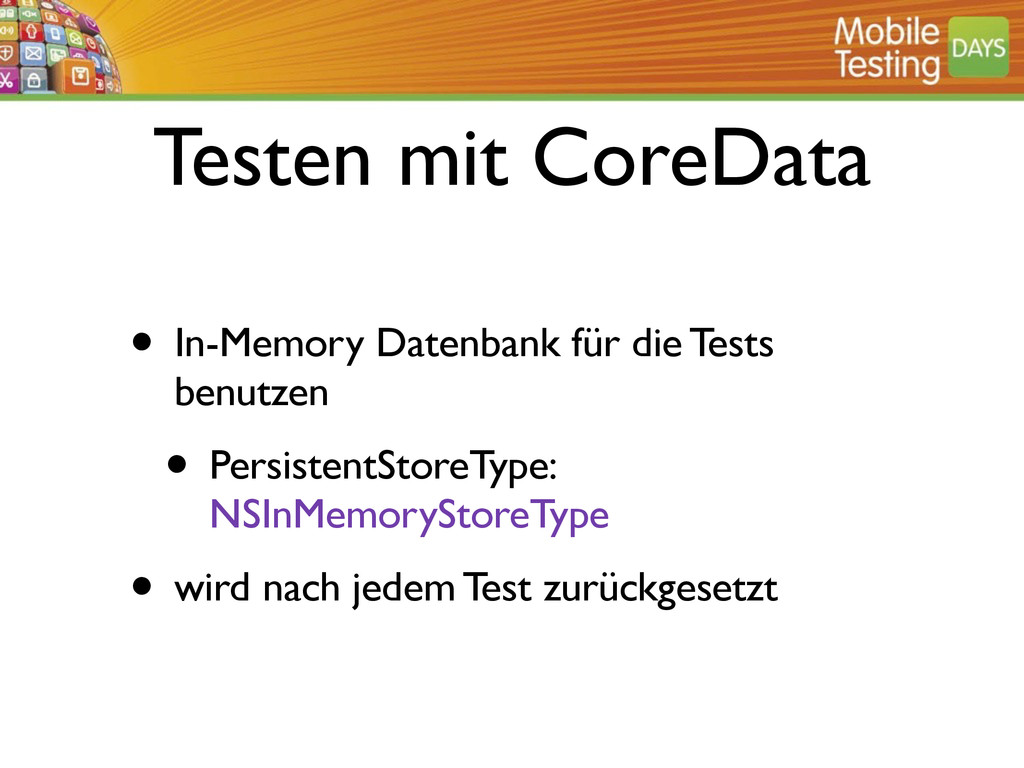
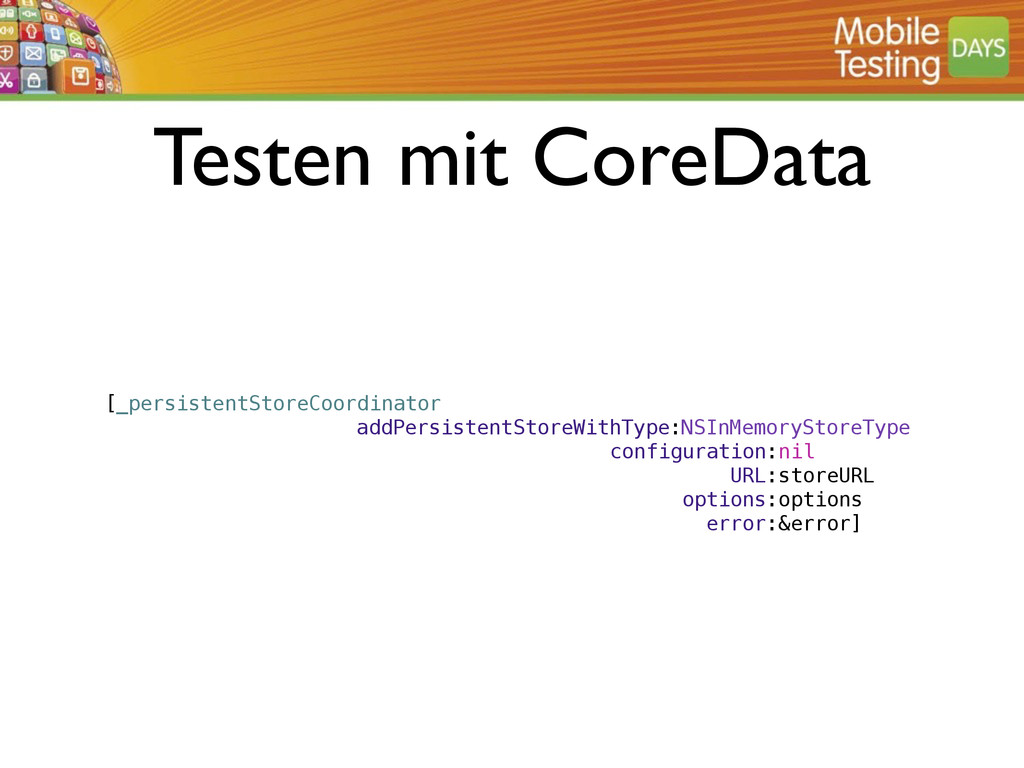
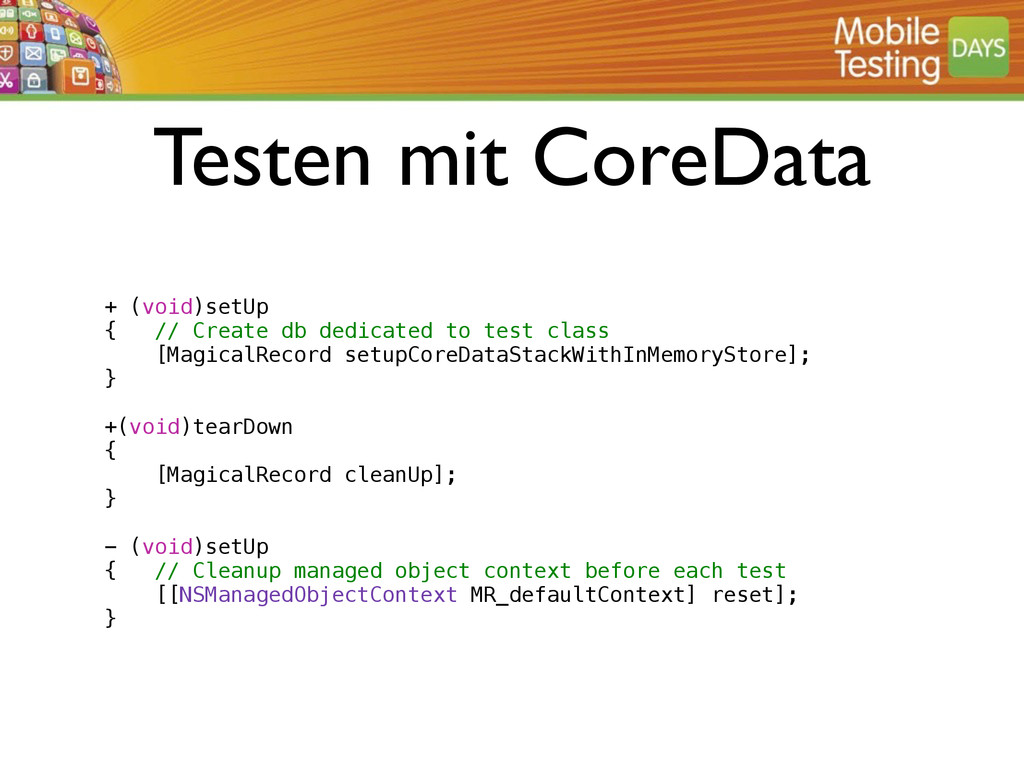
  34. Testen mit CoreData • In-Memory Datenbank für die Tests benutzen

    • PersistentStoreType: NSInMemoryStoreType • wird nach jedem Test zurückgesetzt
  35. Testen mit CoreData + (void)setUp { // Create db dedicated

    to test class [MagicalRecord setupCoreDataStackWithInMemoryStore]; } +(void)tearDown { [MagicalRecord cleanUp]; } - (void)setUp { // Cleanup managed object context before each test [[NSManagedObjectContext MR_defaultContext] reset]; }
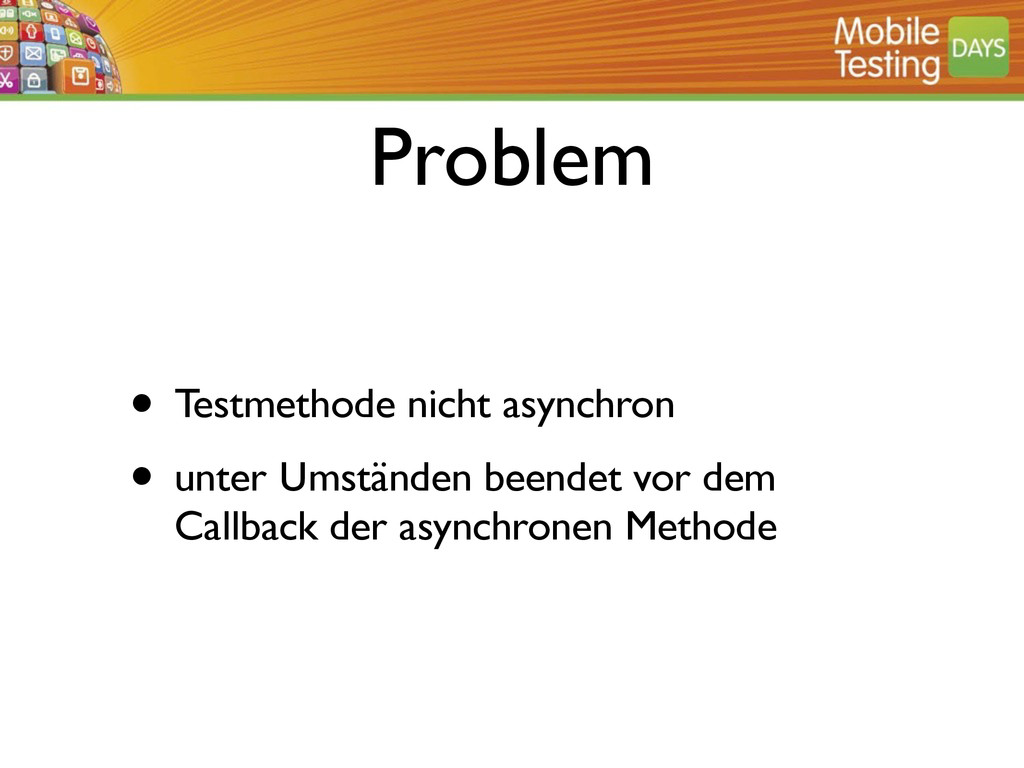
  36. Beispiel - (void)testLoginWithWrongCredentials_ShouldReturnFailure { sut.api = [self createMockApiWithInvalidUser]; [self.sut loginUser:@"Paul"

    withPassword:@"secret" onSuccess:^(User *user) { XCTFail(@"Should not be called!"); } onFailure:^(NSError *e) { XCTAssertTrue(e.code == 401); // Unauthorized }]; }
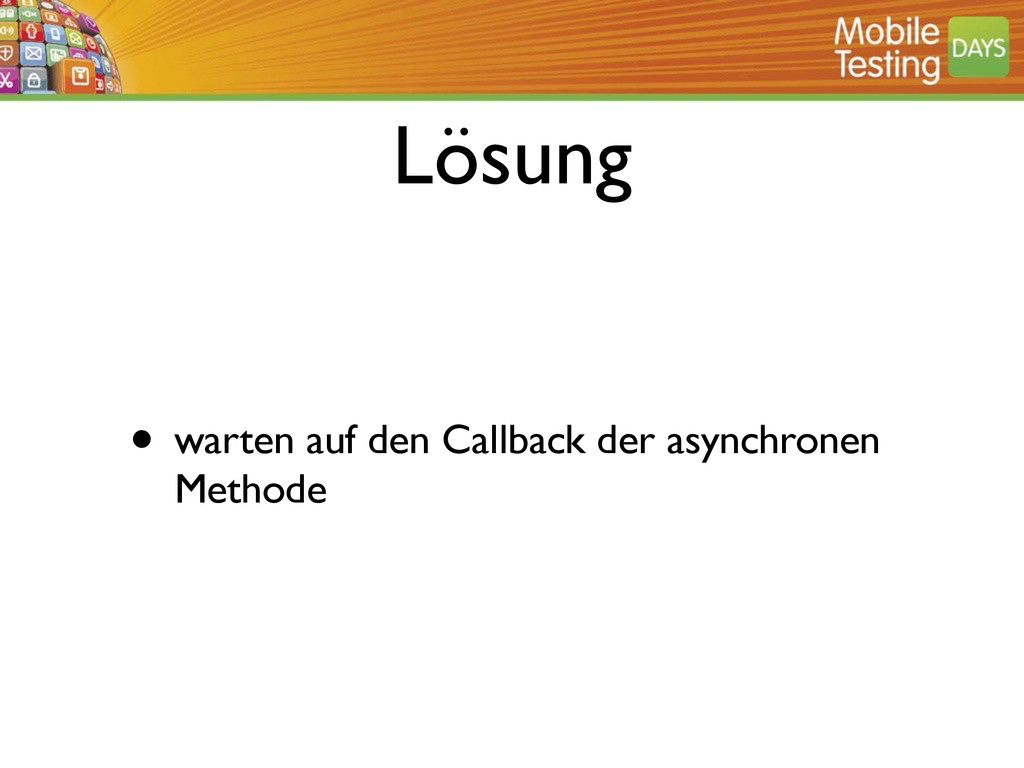
  37. Beispiel - (void)testLoginWithWrongCredentials_ShouldReturnFailure { sut.api = [self createMockApiWithInvalidUser]; XCTestExpectation *expectation

    = [self expectationWithDescription:@"methodCalled"]; [self.sut loginUser:@"Paul" withPassword:@"secret" onSuccess:^(User *user) { XCTFail(@"Should not be called!"); } onFailure:^(NSError *e) { XCTAssertTrue(e.code == 401); // Unauthenticated [expectation fulfill]; }]; [self waitForExpectationsWithTimeout:5 handler:nil]; }
  38. Beispiel - (void)testLoginWithWrongCredentials_ShouldReturnFailure { sut.api = [self createMockApiWithInvalidUser]; XCTestExpectation *expectation

    = [self expectationWithDescription:@"methodCalled"]; [self.sut loginUser:@"Paul" withPassword:@"secret" onSuccess:^(User *user) { XCTFail(@"Should not be called!"); } onFailure:^(NSError *e) { XCTAssertTrue(e.code == 401); // Unauthenticated [expectation fulfill]; }]; [self waitForExpectationsWithTimeout:5 handler:nil]; }
  39. Beispiel - (void)testLoginWithWrongCredentials_ShouldReturnFailure { sut.api = [self createMockApiWithInvalidUser]; XCTestExpectation *expectation

    = [self expectationWithDescription:@"methodCalled"]; [self.sut loginUser:@"Paul" withPassword:@"secret" onSuccess:^(User *user) { XCTFail(@"Should not be called!"); } onFailure:^(NSError *e) { XCTAssertTrue(e.code == 401); // Unauthenticated [expectation fulfill]; }]; [self waitForExpectationsWithTimeout:5 handler:nil]; }
  40. Beispiel - (void)testLoginWithWrongCredentials_ShouldReturnFailure { sut.api = [self createMockApiWithInvalidUser]; XCTestExpectation *expectation

    = [self expectationWithDescription:@"methodCalled"]; [self.sut loginUser:@"Paul" withPassword:@"secret" onSuccess:^(User *user) { XCTFail(@"Should not be called!"); } onFailure:^(NSError *e) { XCTAssertTrue(e.code == 401); // Unauthenticated [expectation fulfill]; }]; [self waitForExpectationsWithTimeout:5 handler:nil]; }
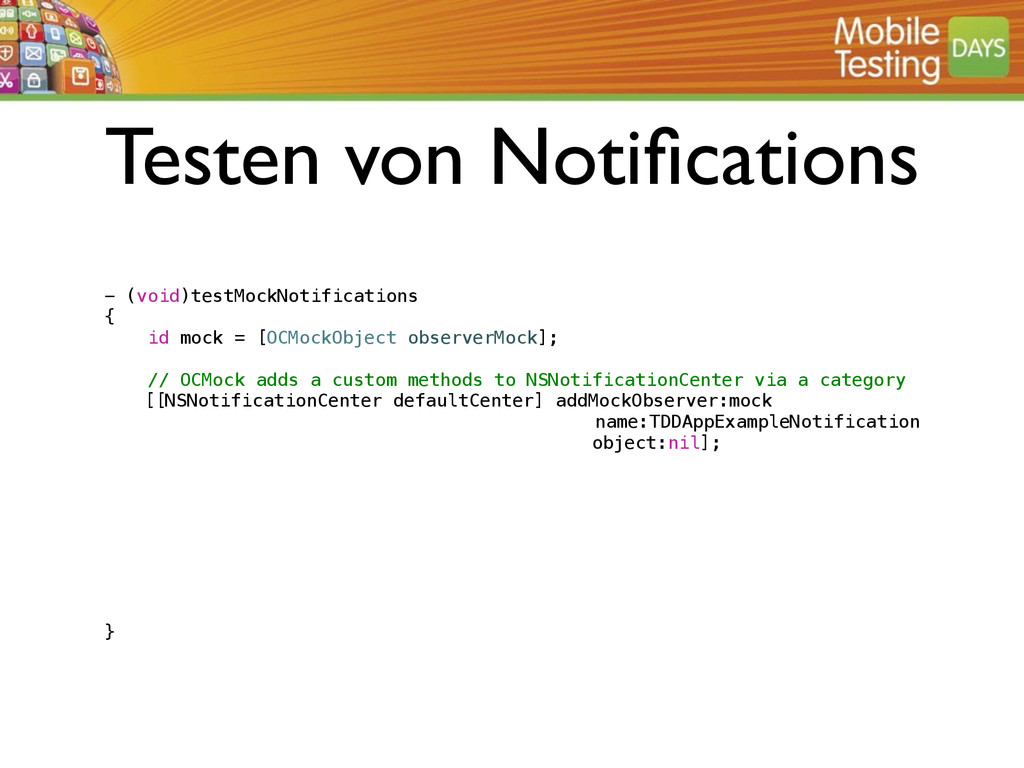
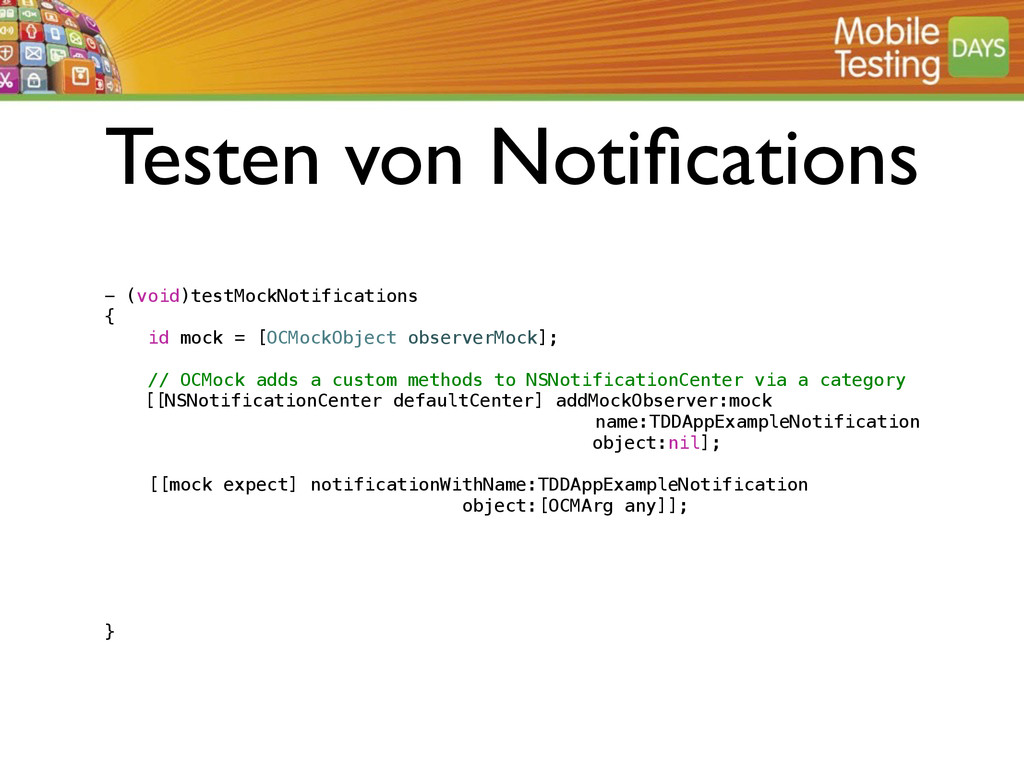
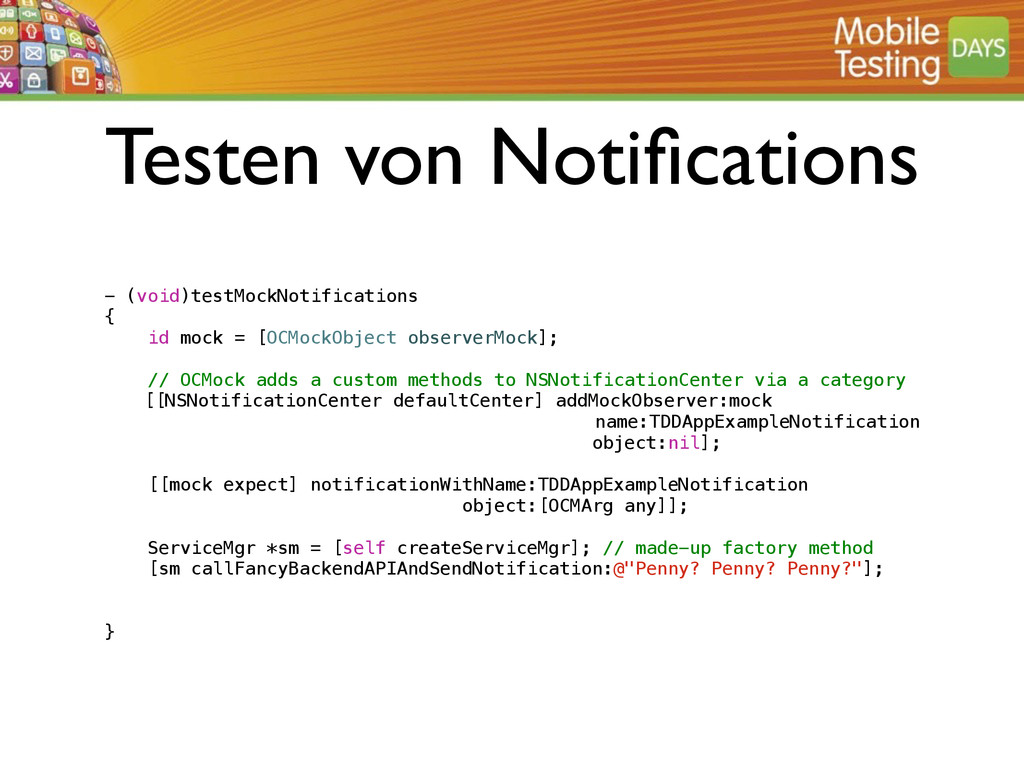
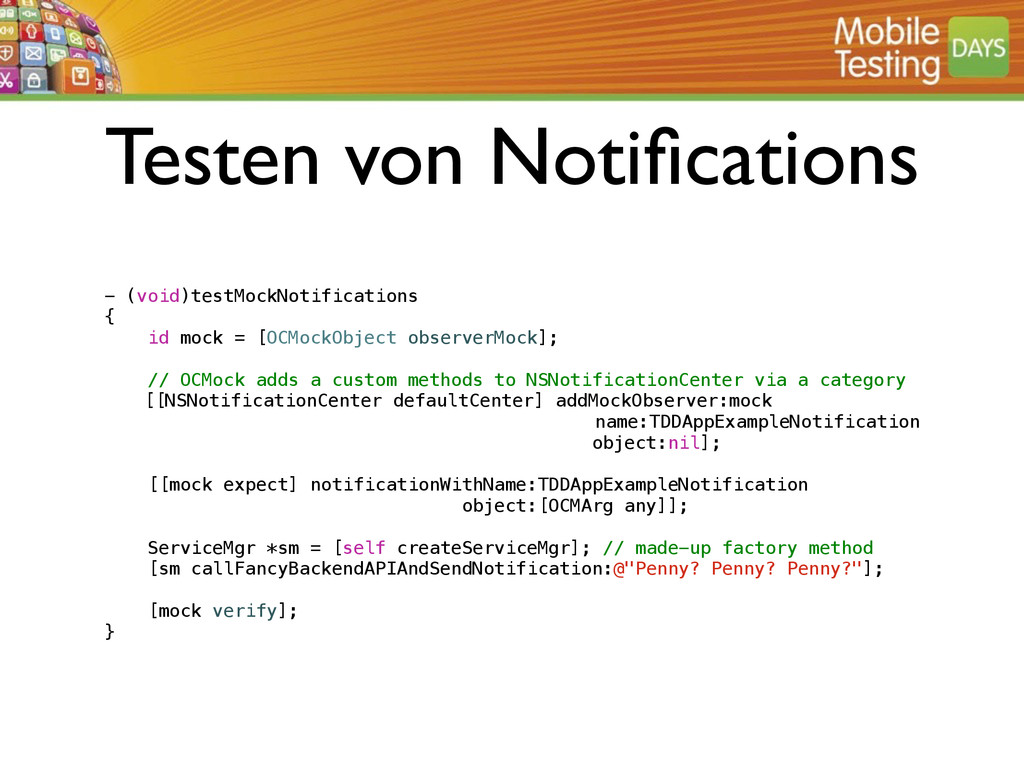
  41. Testen von Notifications - (void)testMockNotifications { id mock = [OCMockObject

    observerMock]; // OCMock adds a custom methods to NSNotificationCenter via a category [[NSNotificationCenter defaultCenter] addMockObserver:mock name:TDDAppExampleNotification object:nil]; [[mock expect] notificationWithName:TDDAppExampleNotification object:[OCMArg any]]; ServiceMgr *sm = [self createServiceMgr]; // made-up factory method [sm callFancyBackendAPIAndSendNotification:@"Penny? Penny? Penny?"]; [mock verify]; }
  42. Testen von Notifications - (void)testMockNotifications { id mock = [OCMockObject

    observerMock]; // OCMock adds a custom methods to NSNotificationCenter via a category [[NSNotificationCenter defaultCenter] addMockObserver:mock name:TDDAppExampleNotification object:nil]; [[mock expect] notificationWithName:TDDAppExampleNotification object:[OCMArg any]]; ServiceMgr *sm = [self createServiceMgr]; // made-up factory method [sm callFancyBackendAPIAndSendNotification:@"Penny? Penny? Penny?"]; [mock verify]; }
  43. Testen von Notifications - (void)testMockNotifications { id mock = [OCMockObject

    observerMock]; // OCMock adds a custom methods to NSNotificationCenter via a category [[NSNotificationCenter defaultCenter] addMockObserver:mock name:TDDAppExampleNotification object:nil]; [[mock expect] notificationWithName:TDDAppExampleNotification object:[OCMArg any]]; ServiceMgr *sm = [self createServiceMgr]; // made-up factory method [sm callFancyBackendAPIAndSendNotification:@"Penny? Penny? Penny?"]; [mock verify]; }
  44. Testen von Notifications - (void)testMockNotifications { id mock = [OCMockObject

    observerMock]; // OCMock adds a custom methods to NSNotificationCenter via a category [[NSNotificationCenter defaultCenter] addMockObserver:mock name:TDDAppExampleNotification object:nil]; [[mock expect] notificationWithName:TDDAppExampleNotification object:[OCMArg any]]; ServiceMgr *sm = [self createServiceMgr]; // made-up factory method [sm callFancyBackendAPIAndSendNotification:@"Penny? Penny? Penny?"]; [mock verify]; }
  45. Stub • „stub“ = Stummel, Stumpf • ersetzt Programmcode, •

    der noch nicht entwickelt ist oder • auf einem entfernten System läuft
  46. OHHTTPStubs • Netzwerk stubs • Entkopplung unterhalb des Clients •

    Tests ohne Abhängigkeiten zu externen Systemen • Reproduzierbare Ergebnisse
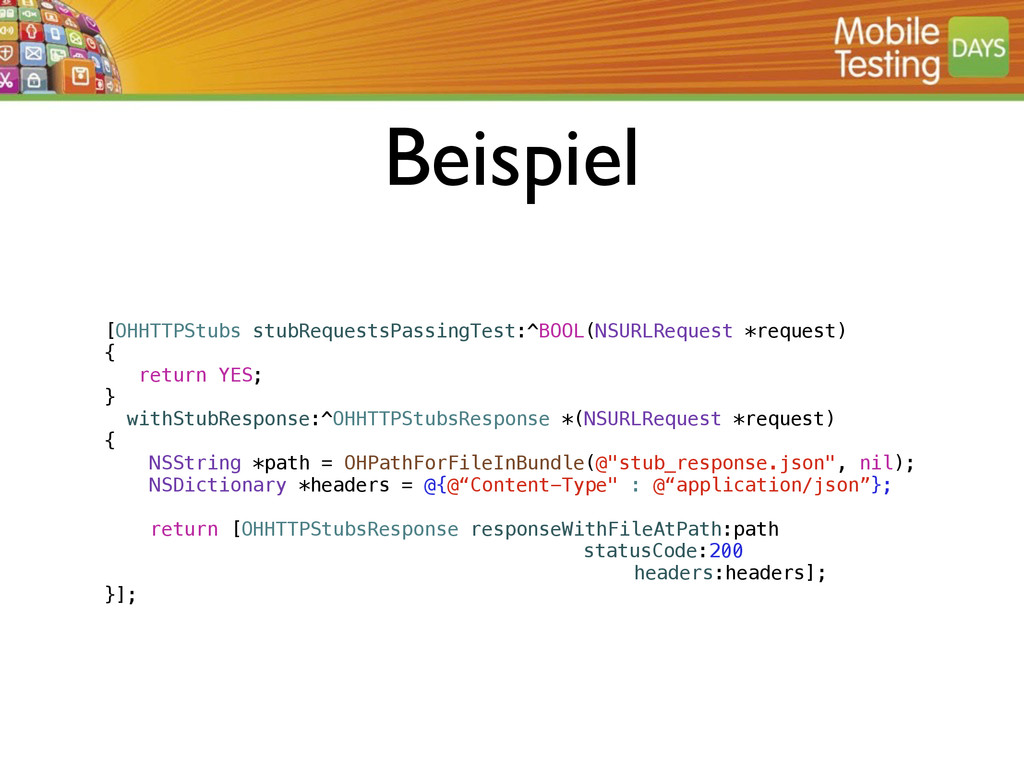
  47. Beispiel [OHHTTPStubs stubRequestsPassingTest:^BOOL(NSURLRequest *request) { return YES; } withStubResponse:^OHHTTPStubsResponse *(NSURLRequest

    *request) { NSString *path = OHPathForFileInBundle(@"stub_response.json", nil); NSDictionary *headers = @{@“Content-Type" : @“application/json”}; return [OHHTTPStubsResponse responseWithFileAtPath:path statusCode:200 headers:headers]; }];
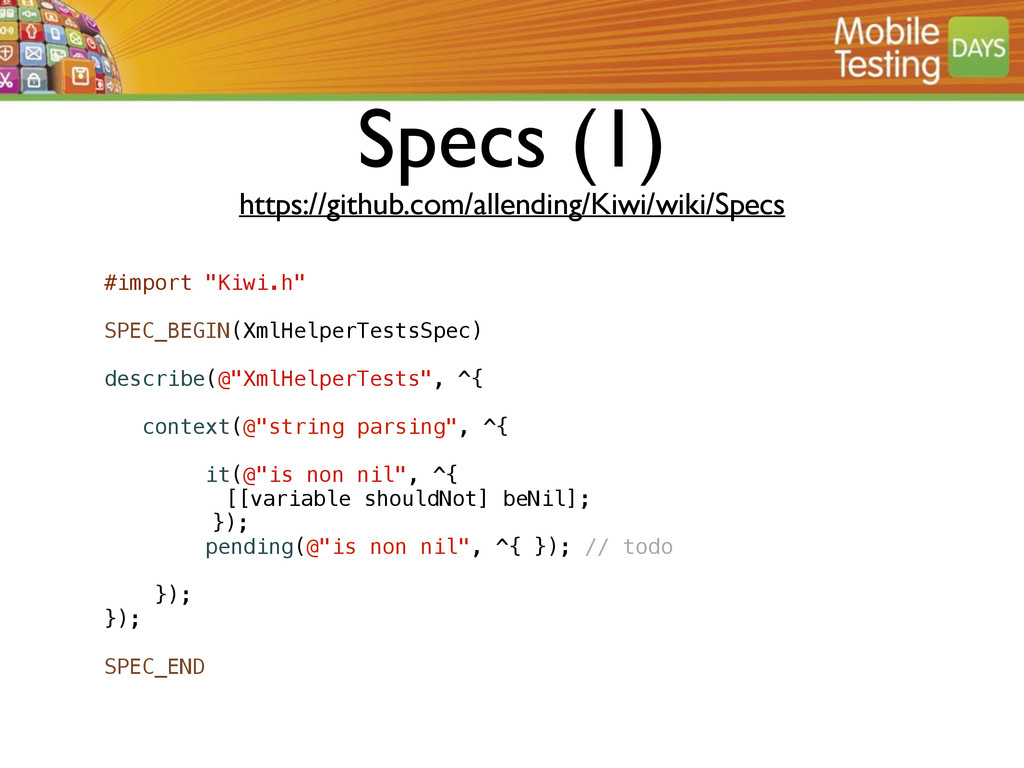
  48. Specs (1) https://github.com/allending/Kiwi/wiki/Specs #import "Kiwi.h" SPEC_BEGIN(XmlHelperTestsSpec) describe(@"XmlHelperTests", ^{ context(@"string parsing",

    ^{ it(@"is non nil", ^{ [[variable shouldNot] beNil]; }); pending(@"is non nil", ^{ }); // todo }); }); SPEC_END
  49. Expectations https://github.com/allending/Kiwi/wiki/Expectations // Examples: id car = [Car car]; [[car

    shouldNot] beNil]; [[car should] beKindOfClass:[Car class]]; [[car shouldNot] conformToProtocol:@protocol(FlyingMachine)]; [[[car should] have:4] wheels]; [[theValue(car.speed) should] equal:theValue(42.0f)]; [[[car should] receive] changeToGear:3];
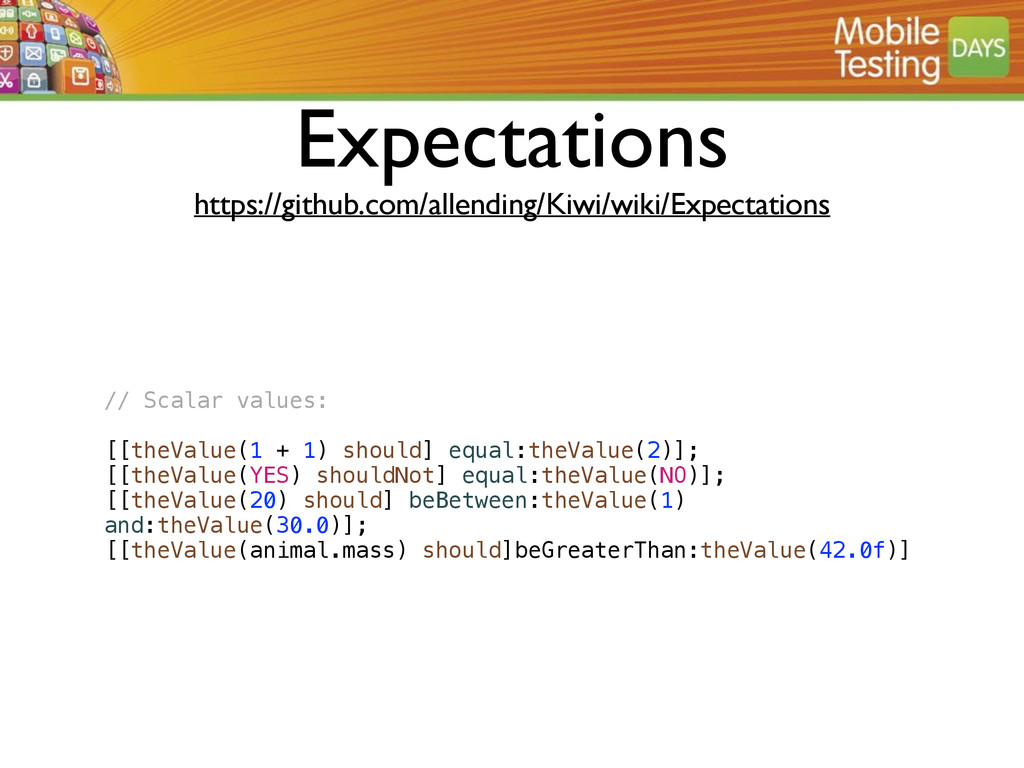
  50. Expectations https://github.com/allending/Kiwi/wiki/Expectations // Scalar values: [[theValue(1 + 1) should] equal:theValue(2)];

    [[theValue(YES) shouldNot] equal:theValue(NO)]; [[theValue(20) should] beBetween:theValue(1) and:theValue(30.0)]; [[theValue(animal.mass) should]beGreaterThan:theValue(42.0f)]
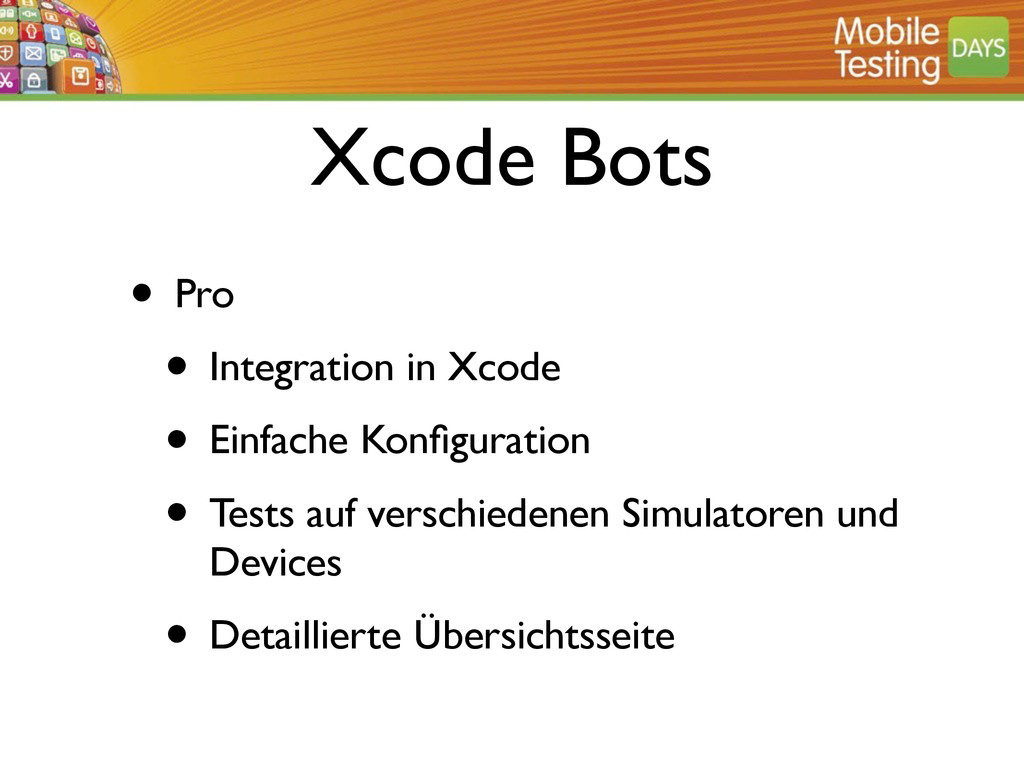
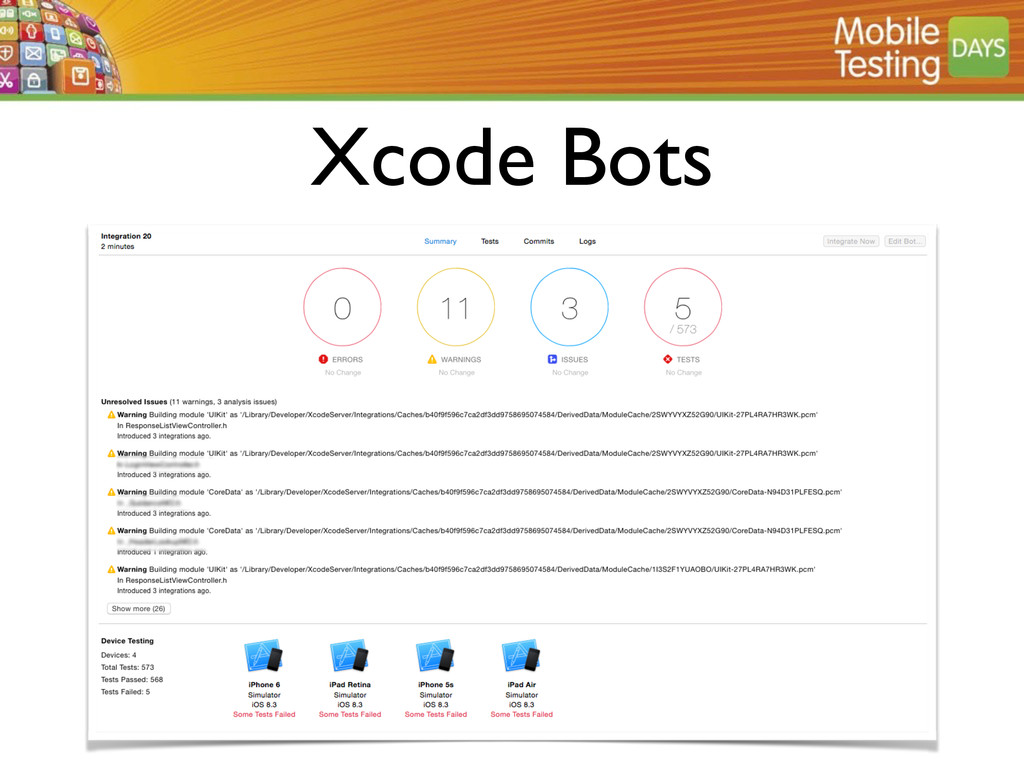
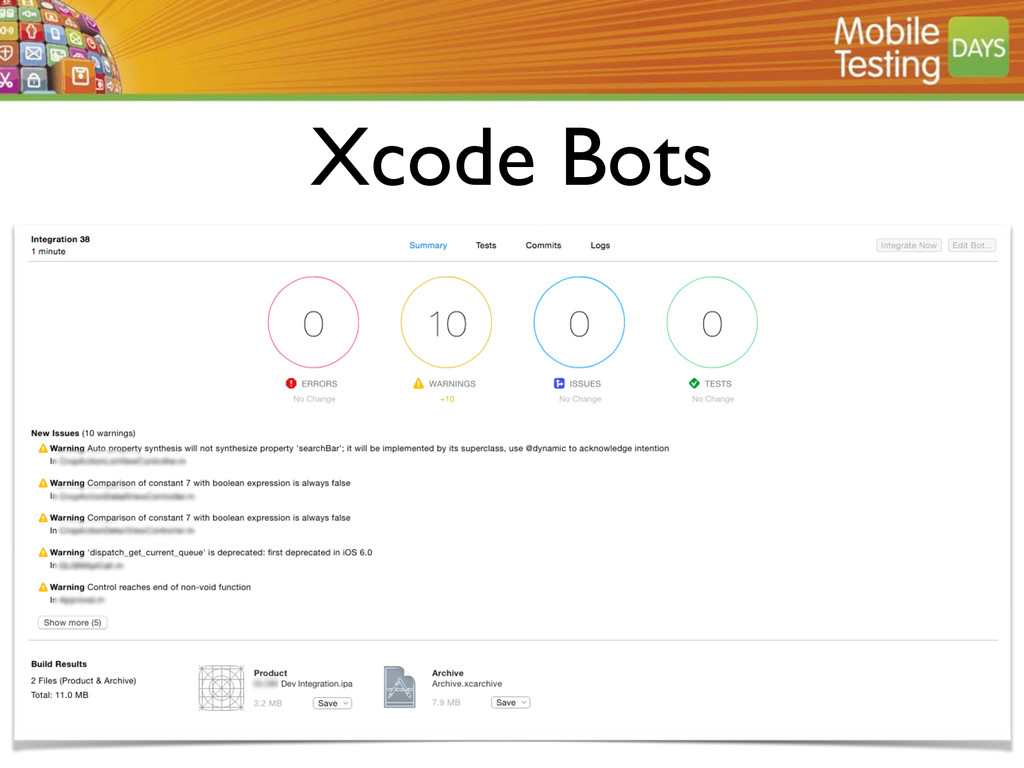
  51. Xcode Bots • Pro • Integration in Xcode • Einfache

    Konfiguration • Tests auf verschiedenen Simulatoren und Devices • Detaillierte Übersichtsseite
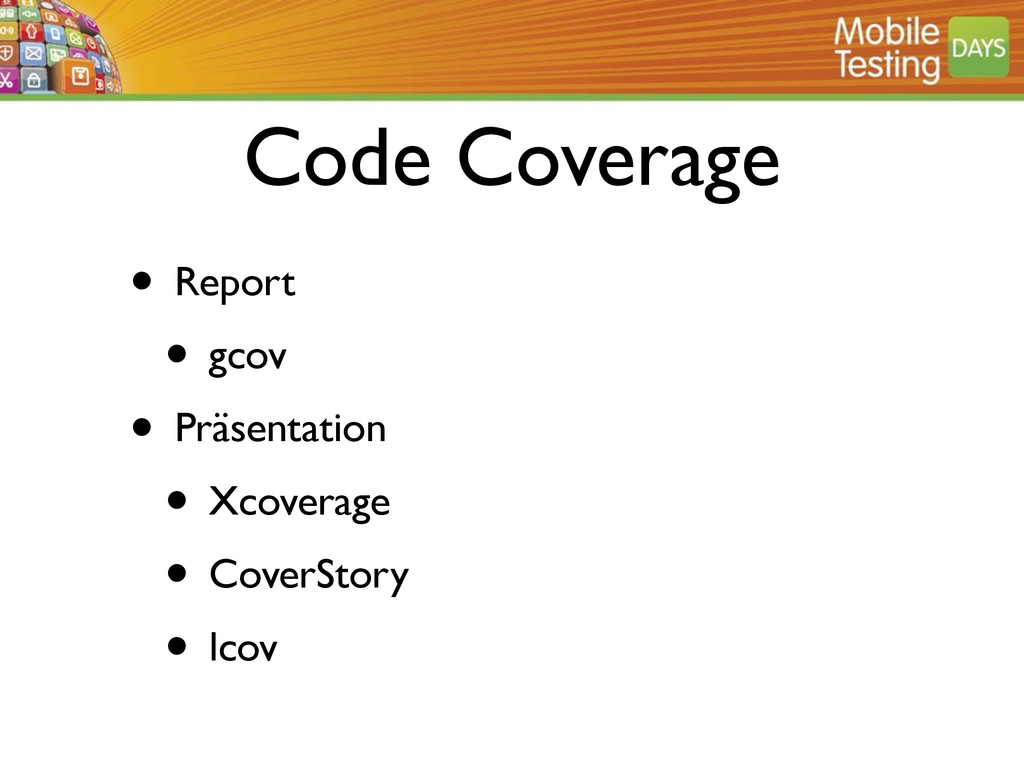
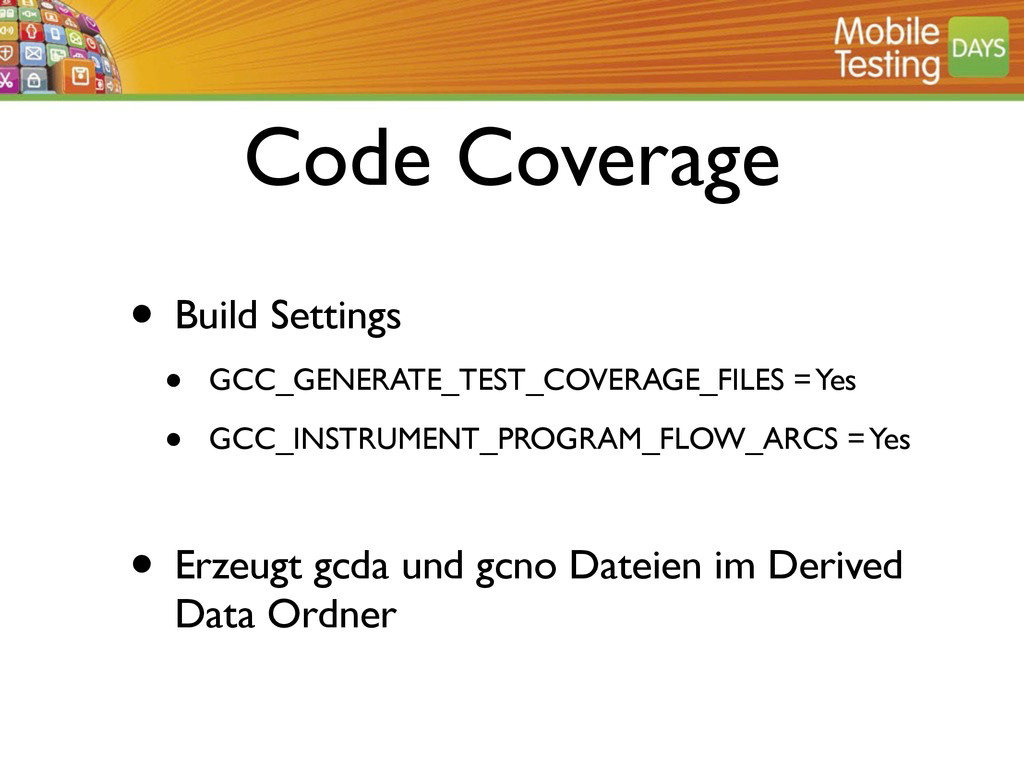
  52. Code Coverage • Build Settings • GCC_GENERATE_TEST_COVERAGE_FILES = Yes •

    GCC_INSTRUMENT_PROGRAM_FLOW_ARCS = Yes • Erzeugt gcda und gcno Dateien im Derived Data Ordner
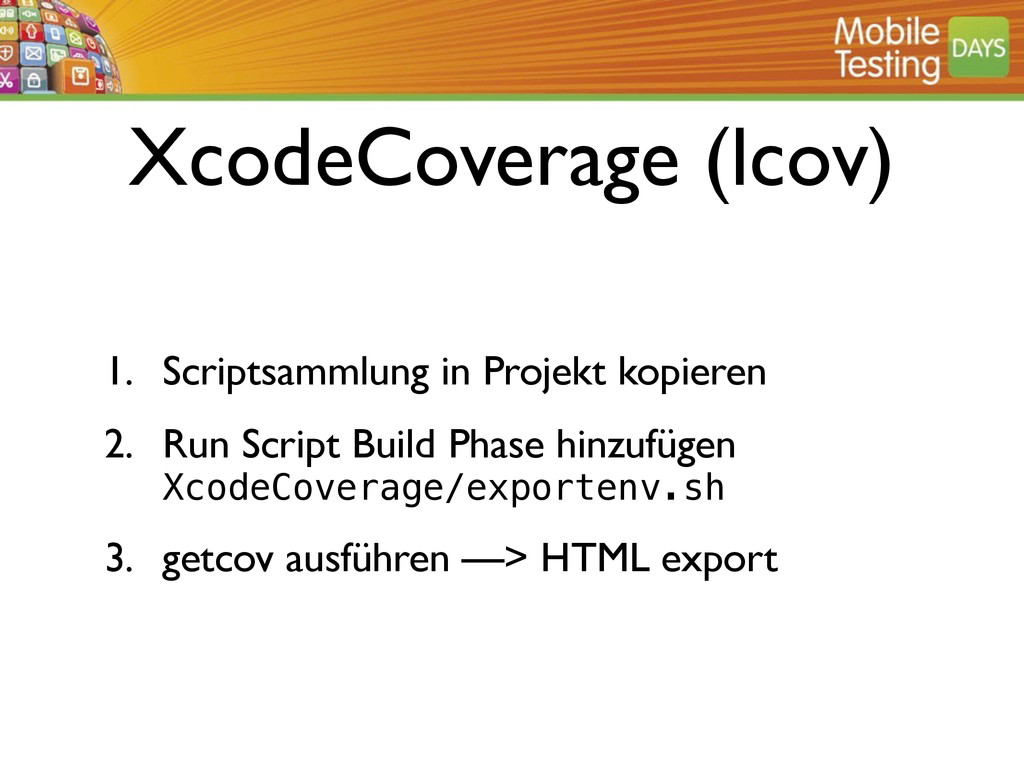
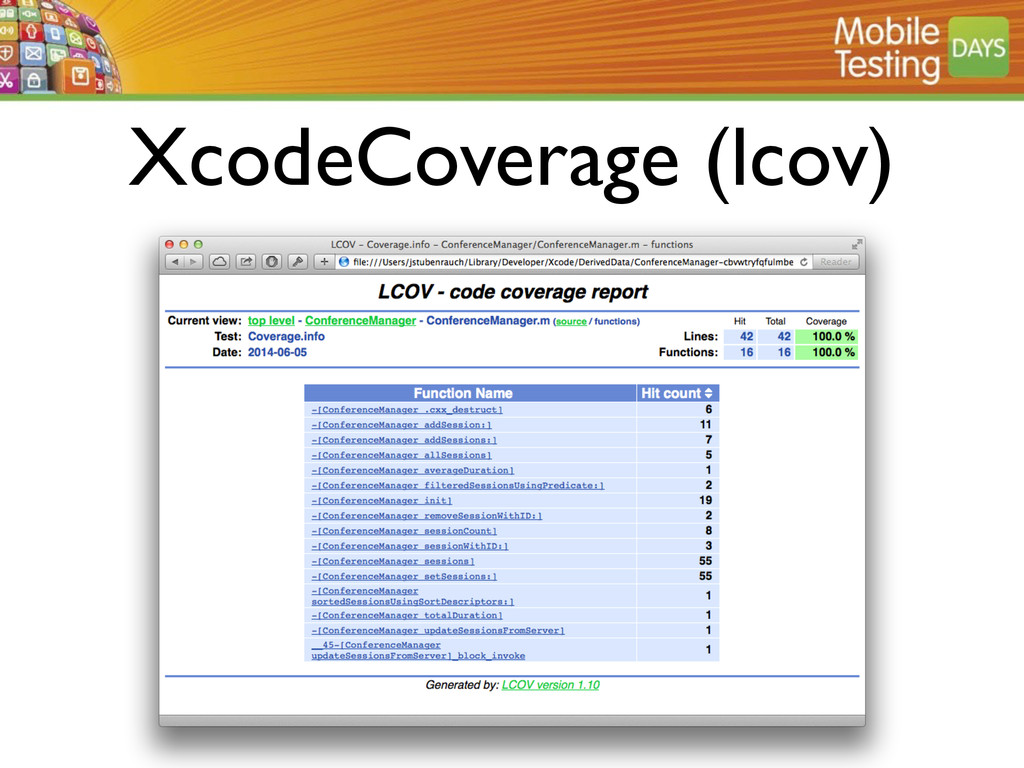
  53. XcodeCoverage (lcov) 1. Scriptsammlung in Projekt kopieren 2. Run Script

    Build Phase hinzufügen
 XcodeCoverage/exportenv.sh 3. getcov ausführen —> HTML export
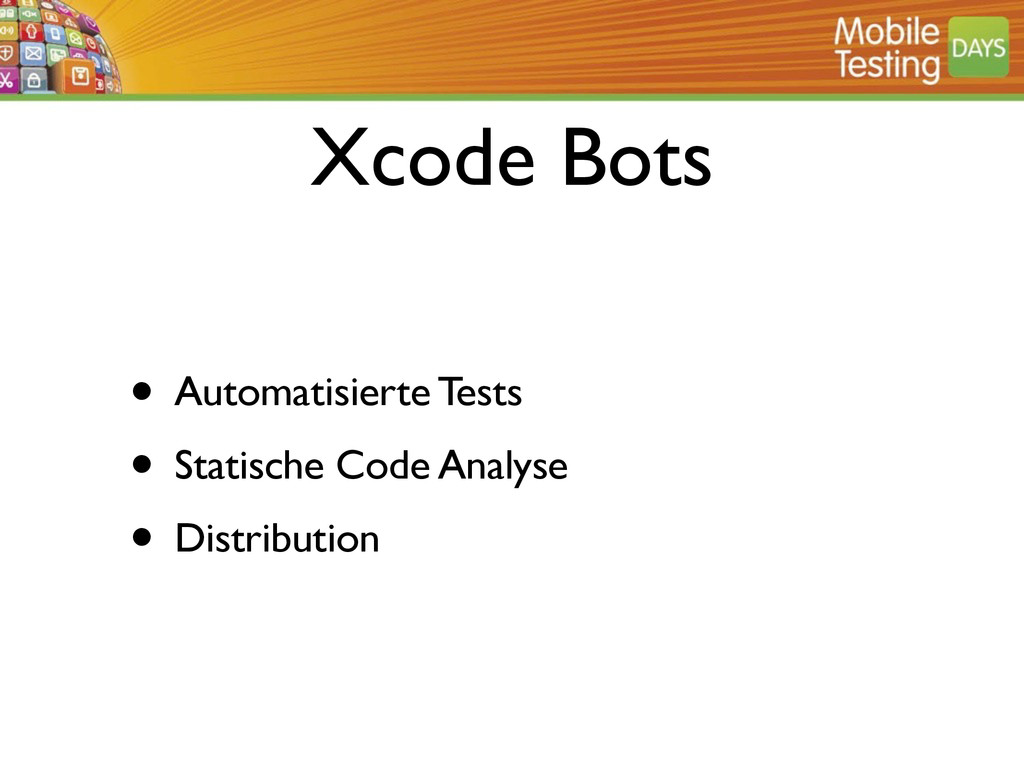
  54. Recap • Tests/Warum? • XCTests • OCMock • OCHamcrest •

    OHHTTPStubs • Kiwi • Xcode Bots • Code Coverage
  55. Quellen • OCMock (http://ocmock.org) • OCHamcrest (https://github.com/hamcrest/ OCHamcrest) • OHHTTPStubs

    (https://github.com/AliSoftware/ OHHTTPStubs) • Kiwi (https://github.com/kiwi-bdd/Kiwi/wiki/Getting- Started-with-Kiwi-2.0) • Xcoverage (http://www.xcoverageapp.com) • LCOV (http://ltp.sourceforge.net/coverage/lcov.php)