Upgrade to Pro — share decks privately, control downloads, hide ads and more …

Racial and Ethnic Inclusion in the Spanish Clas...

Racial and Ethnic Inclusion in the Spanish Classroom: Incorporating Afro-Latino Content in Curriculum & Assessment

Spanish curricula and assessments rarely reflect the presence and contributions of Afro-descendants in Latin America and Spain. This presentation addresses how to incorporate content that brings visibility to the historical, geographical, social, and cultural significance of Black peoples in the Spanish-speaking world.
Culturally Relevant Pedagogy (CRP) is a lens through which language teachers are invited to examine curriculum, instruction, and assessment to ensure diversity and inclusion in the teaching of world languages. CRP in the Spanish classroom means going beyond learning about the many Spanish-speaking countries and taking a deeper dive into the multi-layered racial and ethnic fabric that makes up the Spanish-speaking world. Typically, Spanish teachers, textbooks, and assessments have not incorporated the African heritage that forms one of the foundational cultures of Latin America and Spain. Culturally Relevant Pedagogy (CRP) is a lens through which language teachers are invited to examine curriculum, instruction, and assessment to ensure diversity and inclusion in the teaching of world languages. CRP in the Spanish classroom means going beyond learning about the many Spanish-speaking countries and taking a deeper dive into the multi-layered racial and ethnic fabric that makes up the Spanish-speaking world. Typically, Spanish teachers, textbooks, and assessments have not incorporated the African heritage that forms one of the foundational cultures of Latin America and Spain. This presentation offers participants examples and models for writing diverse, equitable, and inclusive (DEI) Spanish curricula and Spanish proficiency assessments. Content is applicable to other languages.

Avatar for Trina Montano

Trina Montano

January 11, 2023

Other Decks in Education

Transcript

  1. Toward Greater Racial and Ethnic Inclusion in the Spanish Classroom:

    Incorporating Afro-Latino Content Trina Philpot-Montaño and Sari Chávez Silverman 8/23/21 © 2021 DLIFLC
  2. DISCLAIMER • This presentation has been approved for public release

    by the Defense Language Institute Foreign Language Center’s Public Affairs Office. For verification please e-mail: [email protected] • Contents of this presentation are not necessarily the official views of the Defense Language Institute Foreign Language Center, nor are they endorsed by the Department of the Army, the Department of Defense, or the U.S. Government. • All third-party products / materials featured in the presentation remain the intellectual property of their respective authors / originators. Use of outside materials is done under the fair use copyright principle, for educational purposes only. • The content of this presentation is the sole responsibility of the author(s). © 2021 DLIFLC 1
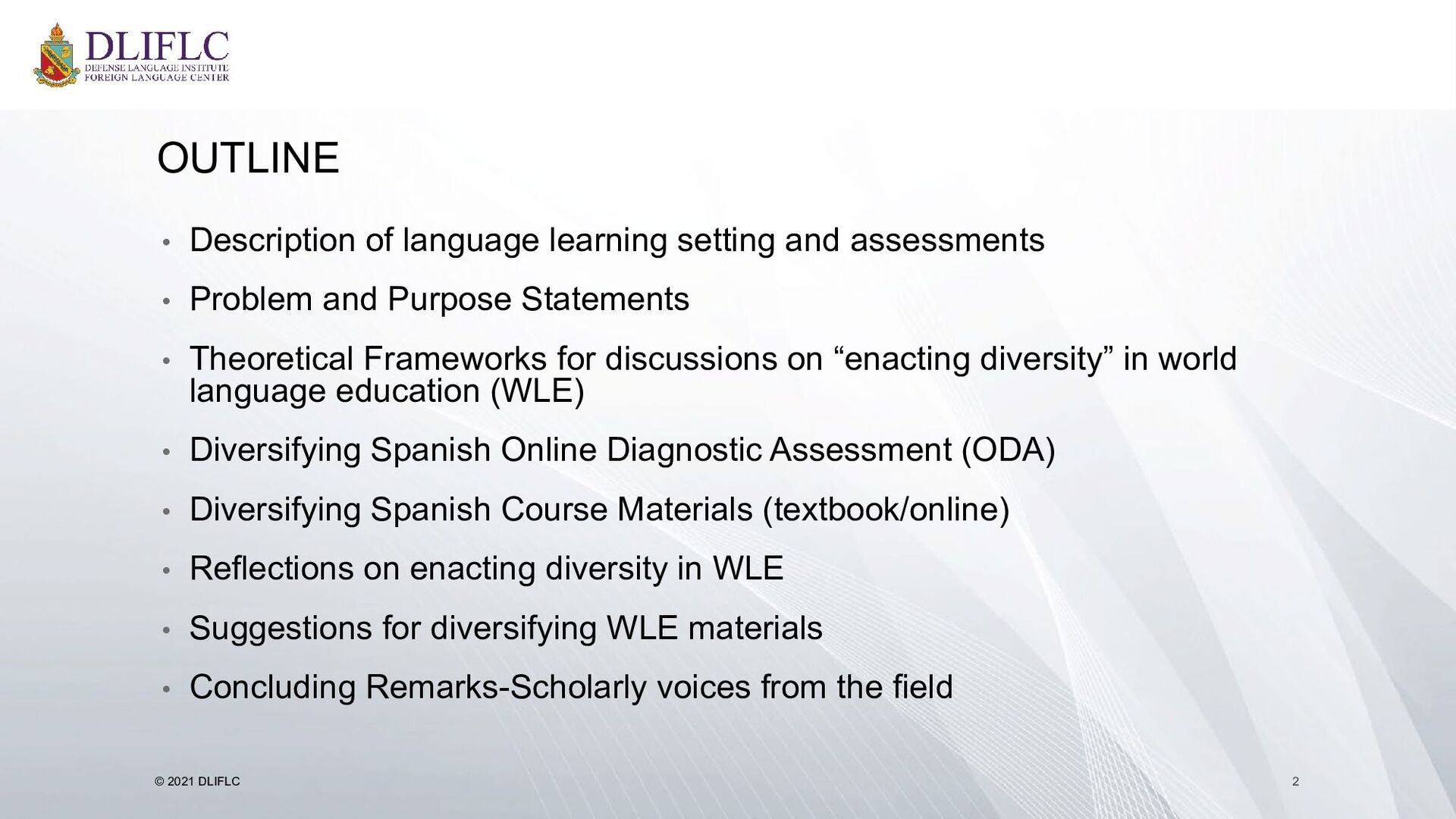
  3. OUTLINE • Description of language learning setting and assessments •

    Problem and Purpose Statements • Theoretical Frameworks for discussions on “enacting diversity” in world language education (WLE) • Diversifying Spanish Online Diagnostic Assessment (ODA) • Diversifying Spanish Course Materials (textbook/online) • Reflections on enacting diversity in WLE • Suggestions for diversifying WLE materials • Concluding Remarks-Scholarly voices from the field © 2021 DLIFLC 2
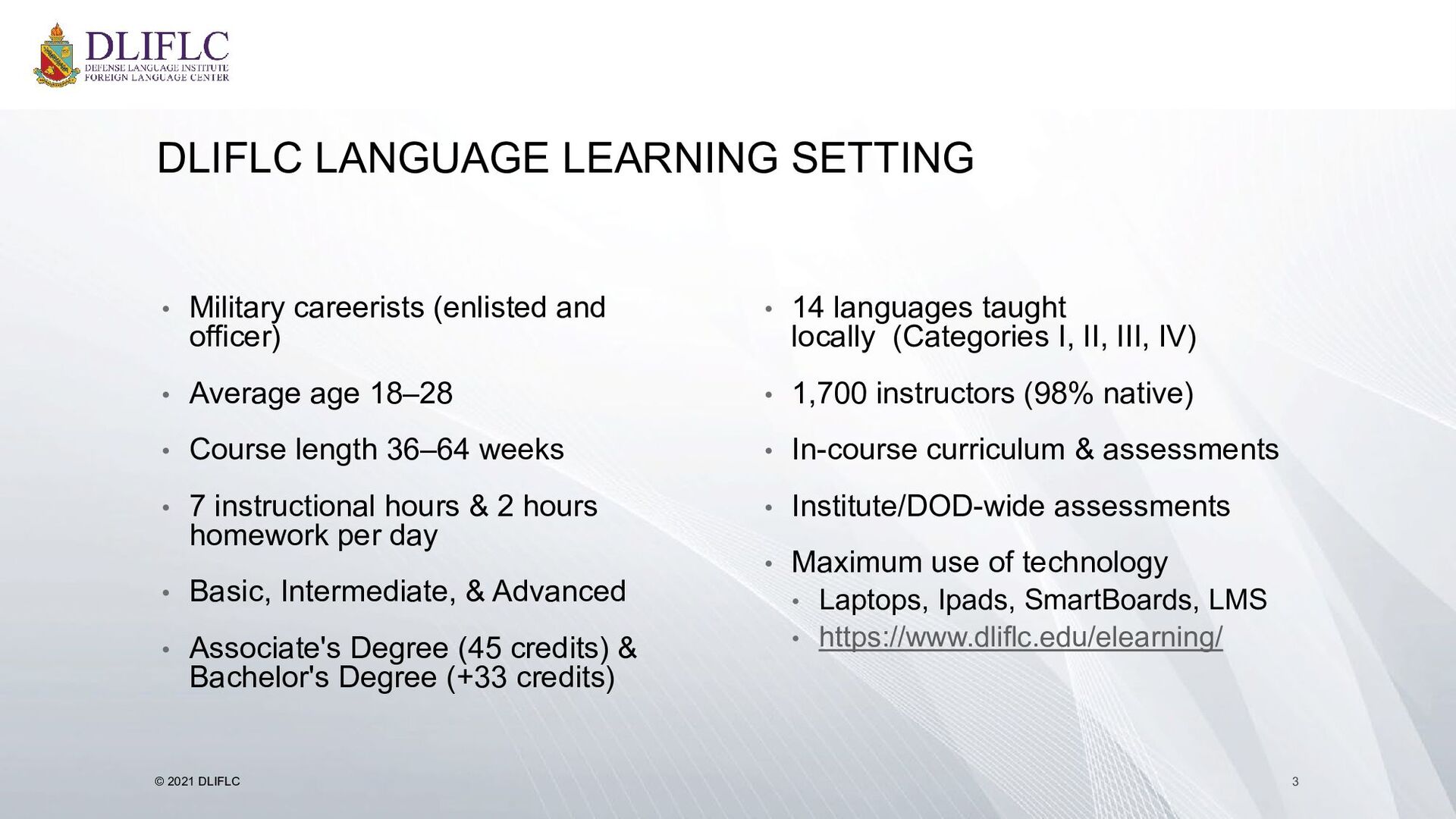
  4. DLIFLC LANGUAGE LEARNING SETTING • Military careerists (enlisted and officer)

    • Average age 18–28 • Course length 36–64 weeks • 7 instructional hours & 2 hours homework per day • Basic, Intermediate, & Advanced • Associate's Degree (45 credits) & Bachelor's Degree (+33 credits) • 14 languages taught locally (Categories I, II, III, IV) • 1,700 instructors (98% native) • In-course curriculum & assessments • Institute/DOD-wide assessments • Maximum use of technology • Laptops, Ipads, SmartBoards, LMS • https://www.dliflc.edu/elearning/ © 2021 DLIFLC 3
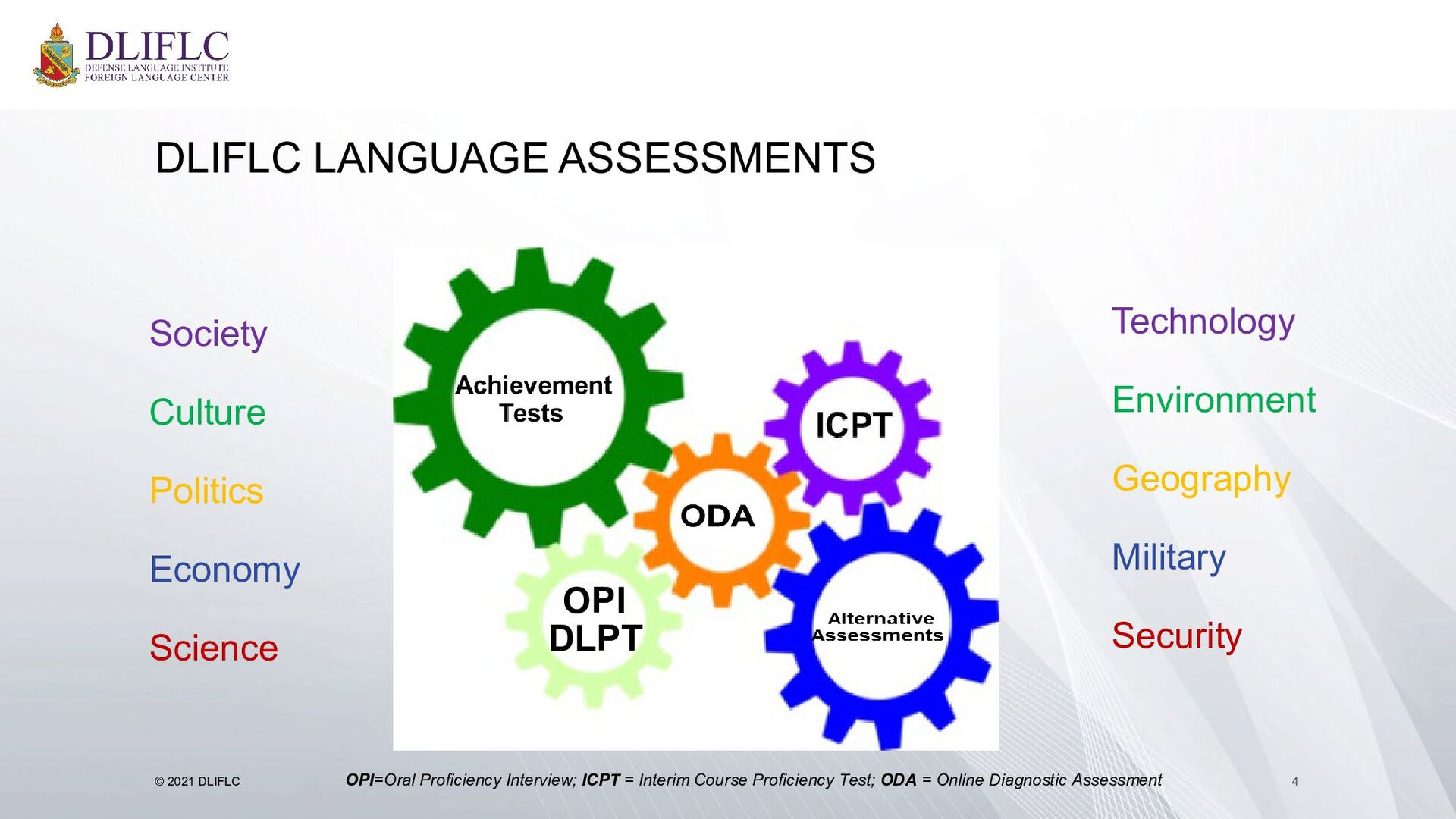
  5. DLIFLC LANGUAGE ASSESSMENTS © 2021 DLIFLC 4 Click to add

    text OPI Society Culture Politics Economy Science OPI=Oral Proficiency Interview; ICPT = Interim Course Proficiency Test; ODA = Online Diagnostic Assessment Technology Environment Geography Military Security DLPT
  6. PROBLEM & PURPOSE OF PRESENTATION • Problem: The existence and

    contributions of Afro-descendants are frequently invisible, or minimized, in the teaching and learning of Spanish language, culture, and history. © 2021 DLIFLC 5 • Purpose: To increase the representation of Afro-Latinos in Spanish curriculum and assessment materials and to provide learners with a more comprehensive understanding of Spanish-speaking peoples, cultures, and histories.
  7. ENACTING DIVERSITY  Diversifying our curriculum  Diversifying our knowledge

     Diversifying our networks  Diversifying our outreach 6 © 2021 DLIFLC (Anya & Randolph, 2019)
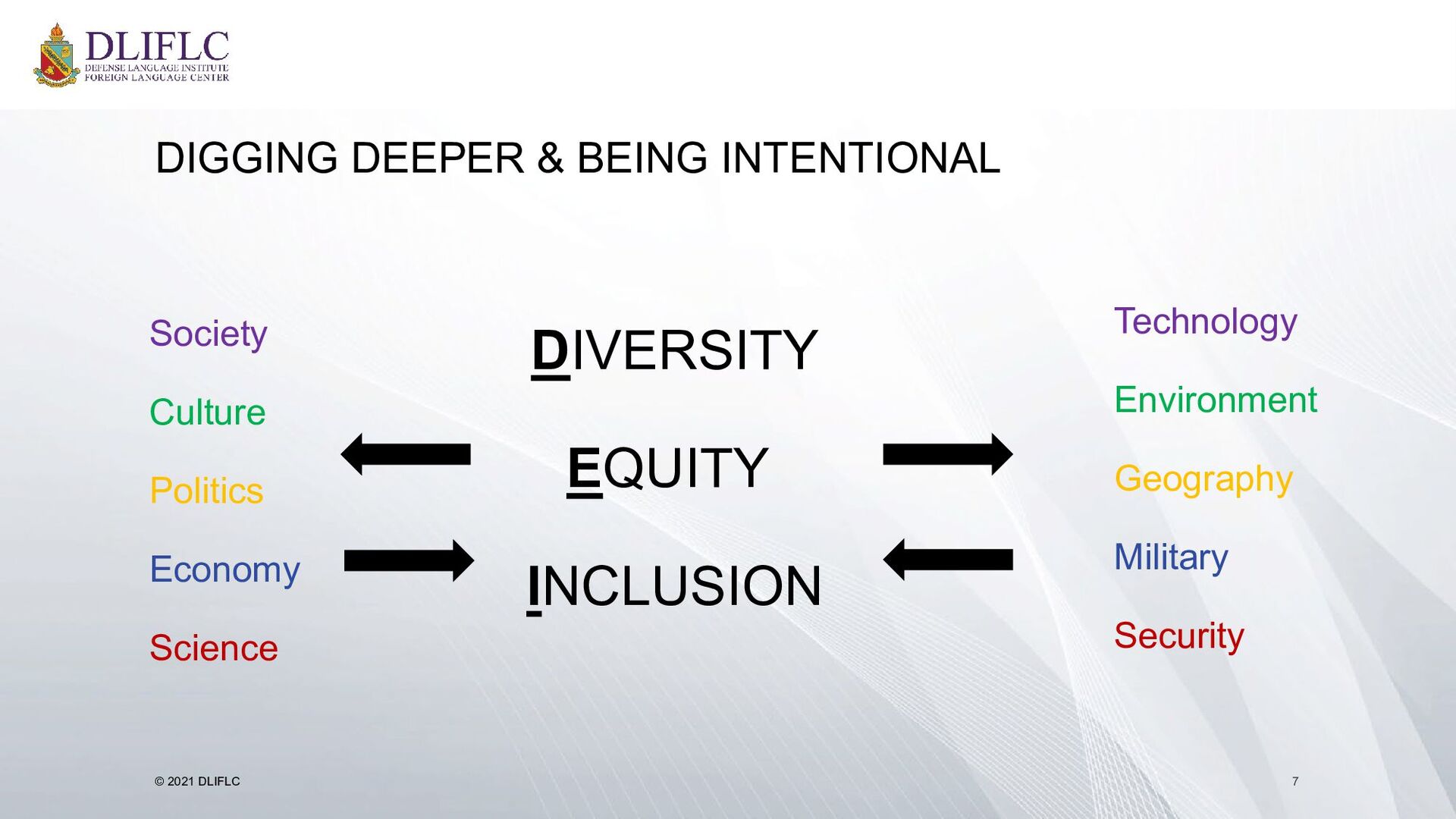
  8. DIGGING DEEPER & BEING INTENTIONAL © 2021 DLIFLC 7 DIVERSITY

    EQUITY INCLUSION Society Culture Politics Economy Science Technology Environment Geography Military Security
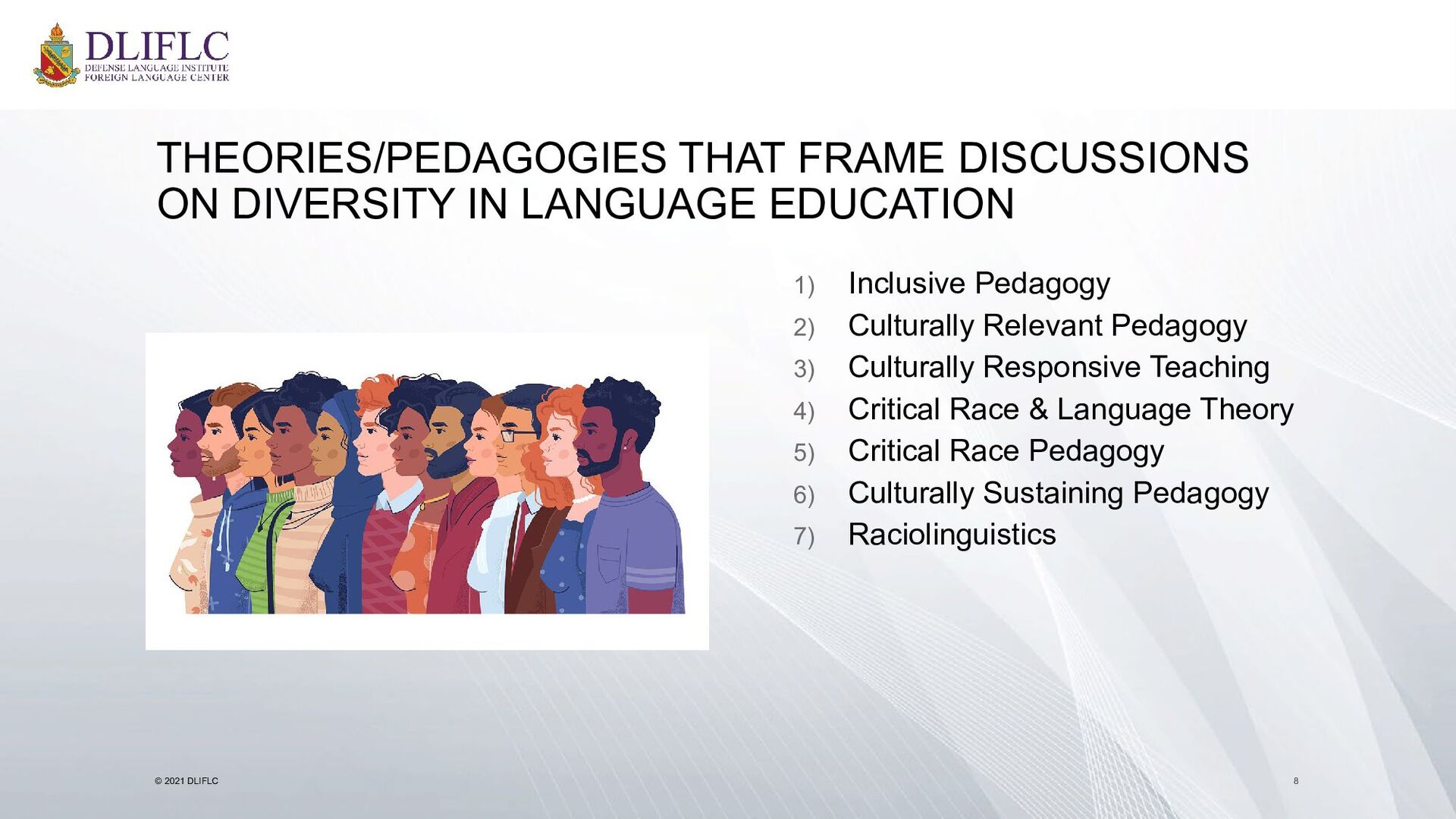
  9. THEORIES/PEDAGOGIES THAT FRAME DISCUSSIONS ON DIVERSITY IN LANGUAGE EDUCATION 1)

    Inclusive Pedagogy 2) Culturally Relevant Pedagogy 3) Culturally Responsive Teaching 4) Critical Race & Language Theory 5) Critical Race Pedagogy 6) Culturally Sustaining Pedagogy 7) Raciolinguistics © 2021 DLIFLC 8
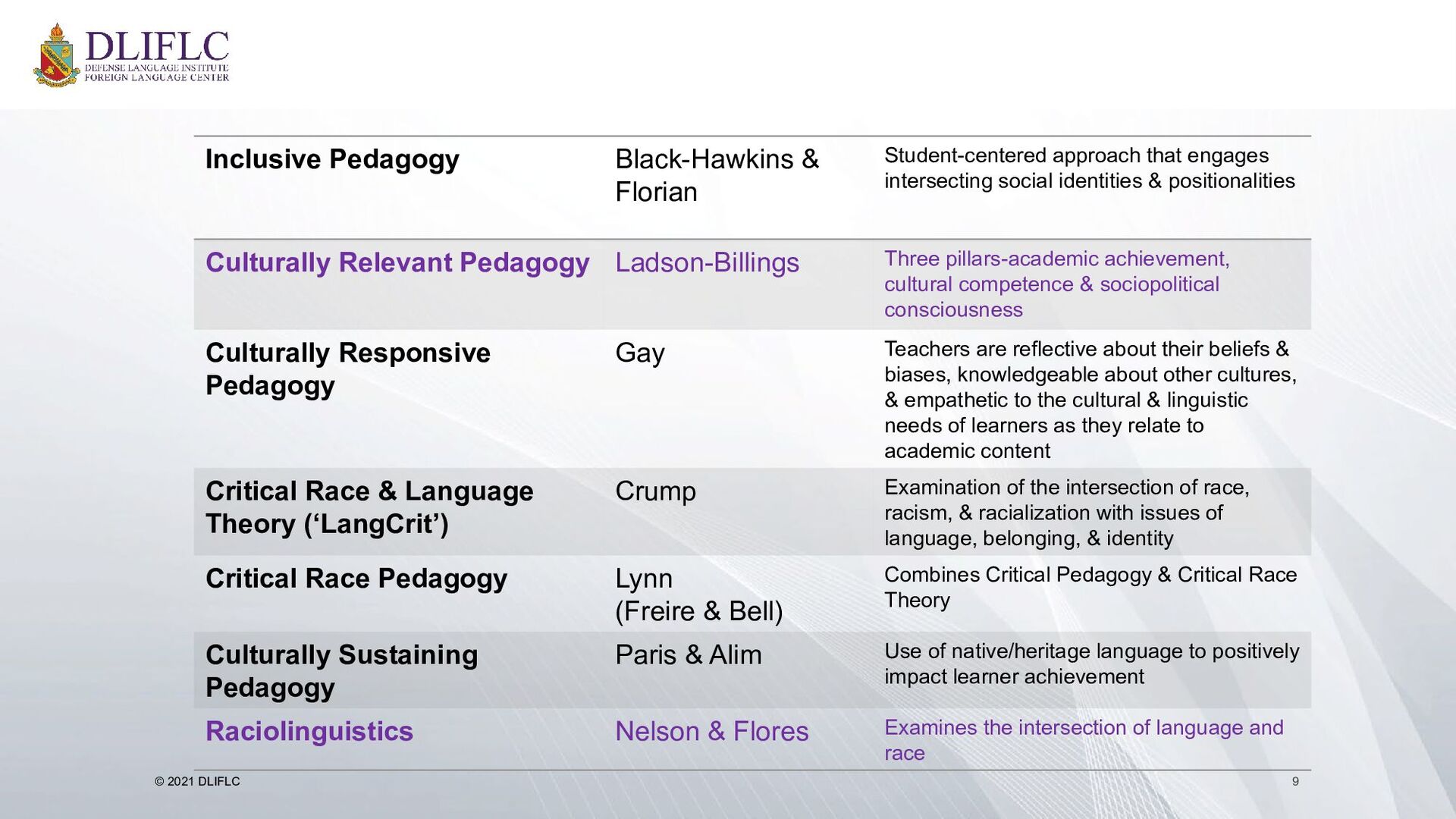
  10. © 2021 DLIFLC 9 Inclusive Pedagogy Black-Hawkins & Florian Student-centered

    approach that engages intersecting social identities & positionalities Culturally Relevant Pedagogy Ladson-Billings Three pillars-academic achievement, cultural competence & sociopolitical consciousness Culturally Responsive Pedagogy Gay Teachers are reflective about their beliefs & biases, knowledgeable about other cultures, & empathetic to the cultural & linguistic needs of learners as they relate to academic content Critical Race & Language Theory (‘LangCrit’) Crump Examination of the intersection of race, racism, & racialization with issues of language, belonging, & identity Critical Race Pedagogy Lynn (Freire & Bell) Combines Critical Pedagogy & Critical Race Theory Culturally Sustaining Pedagogy Paris & Alim Use of native/heritage language to positively impact learner achievement Raciolinguistics Nelson & Flores Examines the intersection of language and race
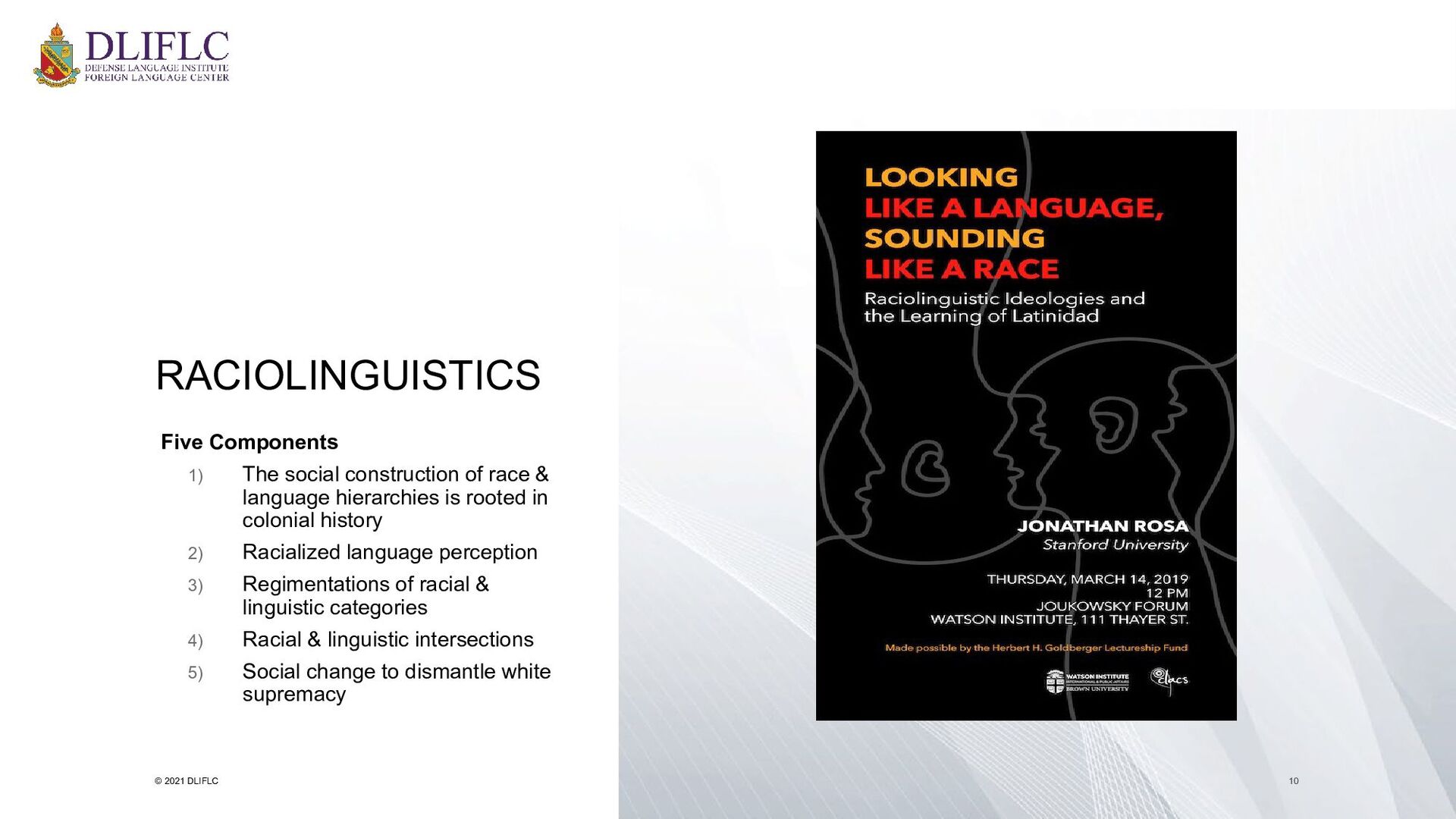
  11. RACIOLINGUISTICS Five Components 1) The social construction of race &

    language hierarchies is rooted in colonial history 2) Racialized language perception 3) Regimentations of racial & linguistic categories 4) Racial & linguistic intersections 5) Social change to dismantle white supremacy 10 © 2021 DLIFLC
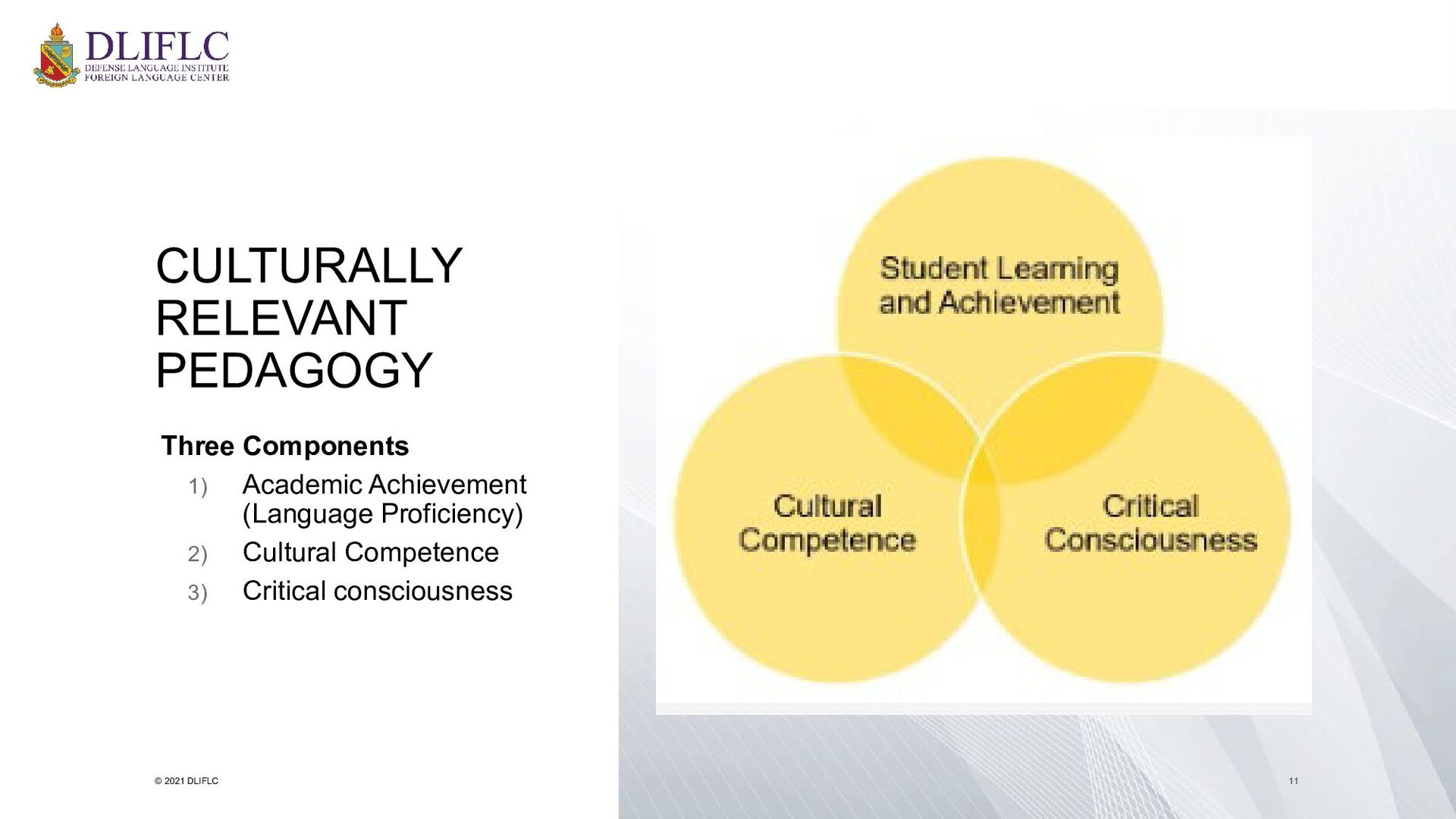
  12. CULTURALLY RELEVANT PEDAGOGY Three Components 1) Academic Achievement (Language Proficiency)

    2) Cultural Competence 3) Critical consciousness 11 © 2021 DLIFLC
  13. DLIFLC MISSION • DLIFLC provides culturally-based foreign language education, training,

    evaluation, and degrees for the Department of Defense globally, to afford a comprehensive understanding of the joint operational environment, a competitive edge to our warfighters, and safeguard the national security of the United States. © 2021 DLIFLC 12
  14. TECHNOLOGY INTEGRATION VISION STATEMENT • Our vision is to deliver

    the world's best culturally-based foreign language education and training – at the point of need. Moreover, to promote and ensure learner autonomy, extend opportunities for language acquisition and support the DLIFLC learning community in pursuit of higher second language proficiency. © 2021 DLIFLC 13
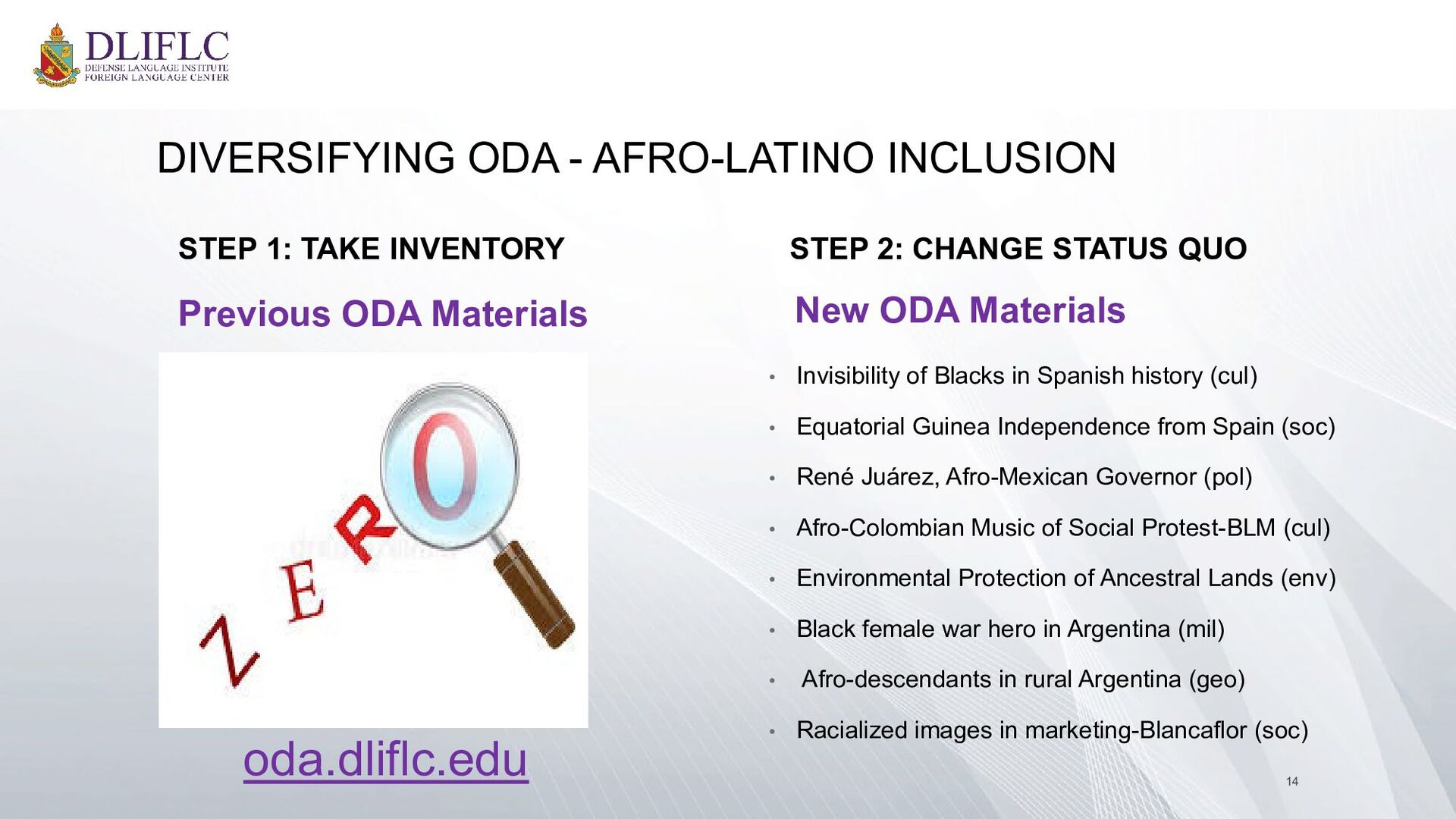
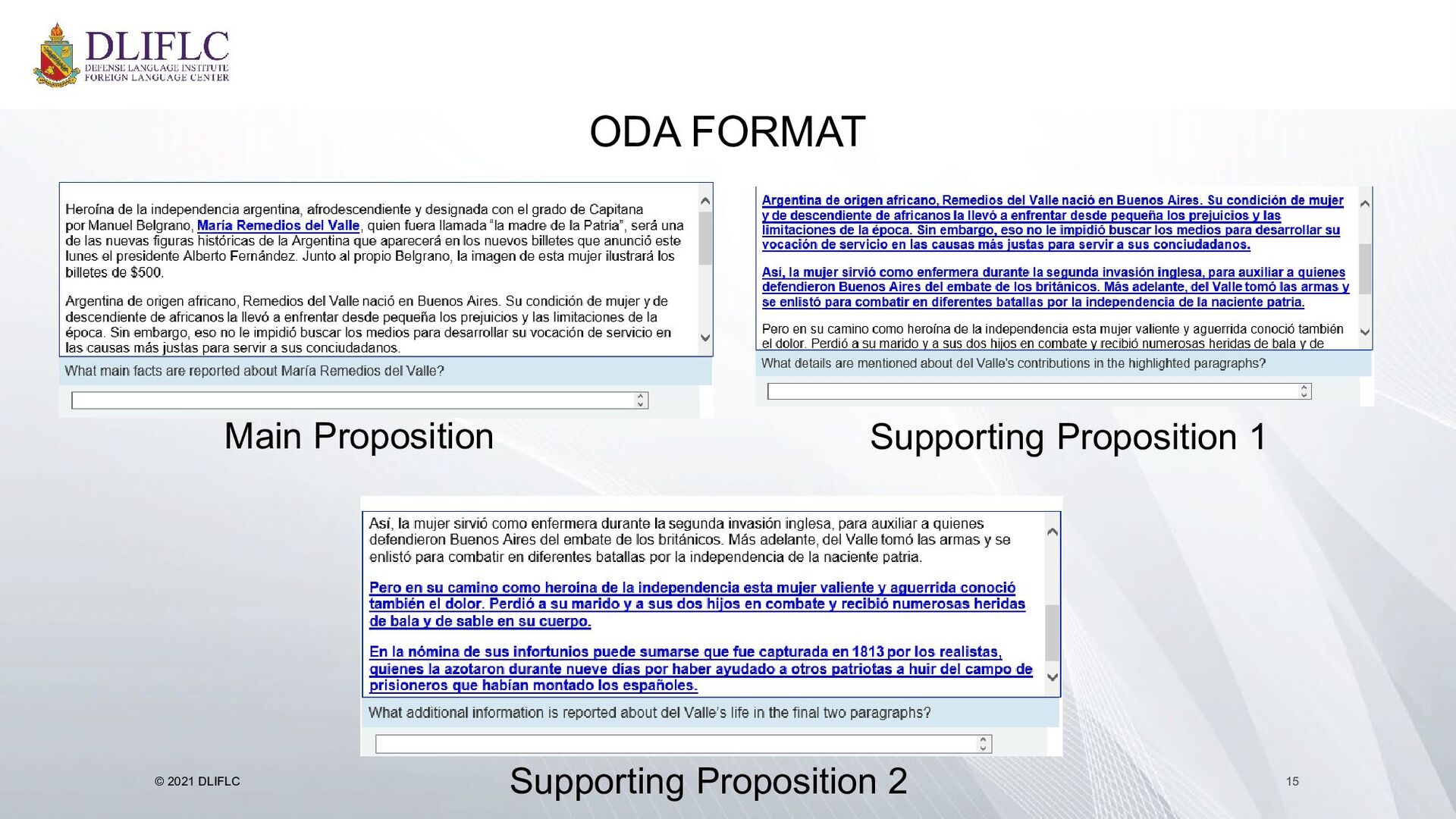
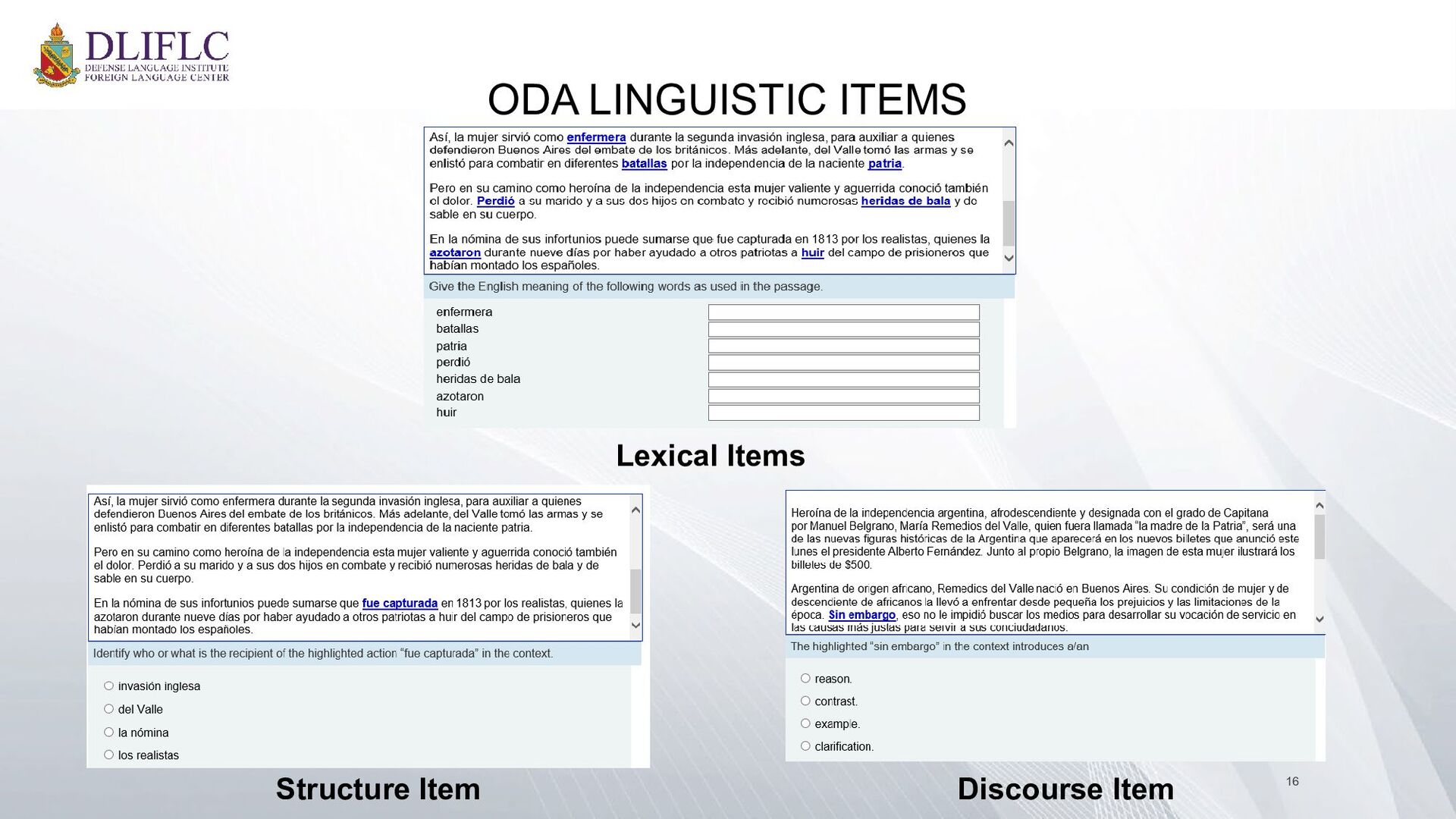
  15. DIVERSIFYING ODA - AFRO-LATINO INCLUSION Previous ODA Materials New ODA

    Materials • Invisibility of Blacks in Spanish history (cul) • Equatorial Guinea Independence from Spain (soc) • René Juárez, Afro-Mexican Governor (pol) • Afro-Colombian Music of Social Protest-BLM (cul) • Environmental Protection of Ancestral Lands (env) • Black female war hero in Argentina (mil) • Afro-descendants in rural Argentina (geo) • Racialized images in marketing-Blancaflor (soc) 14 STEP 1: TAKE INVENTORY STEP 2: CHANGE STATUS QUO oda.dliflc.edu
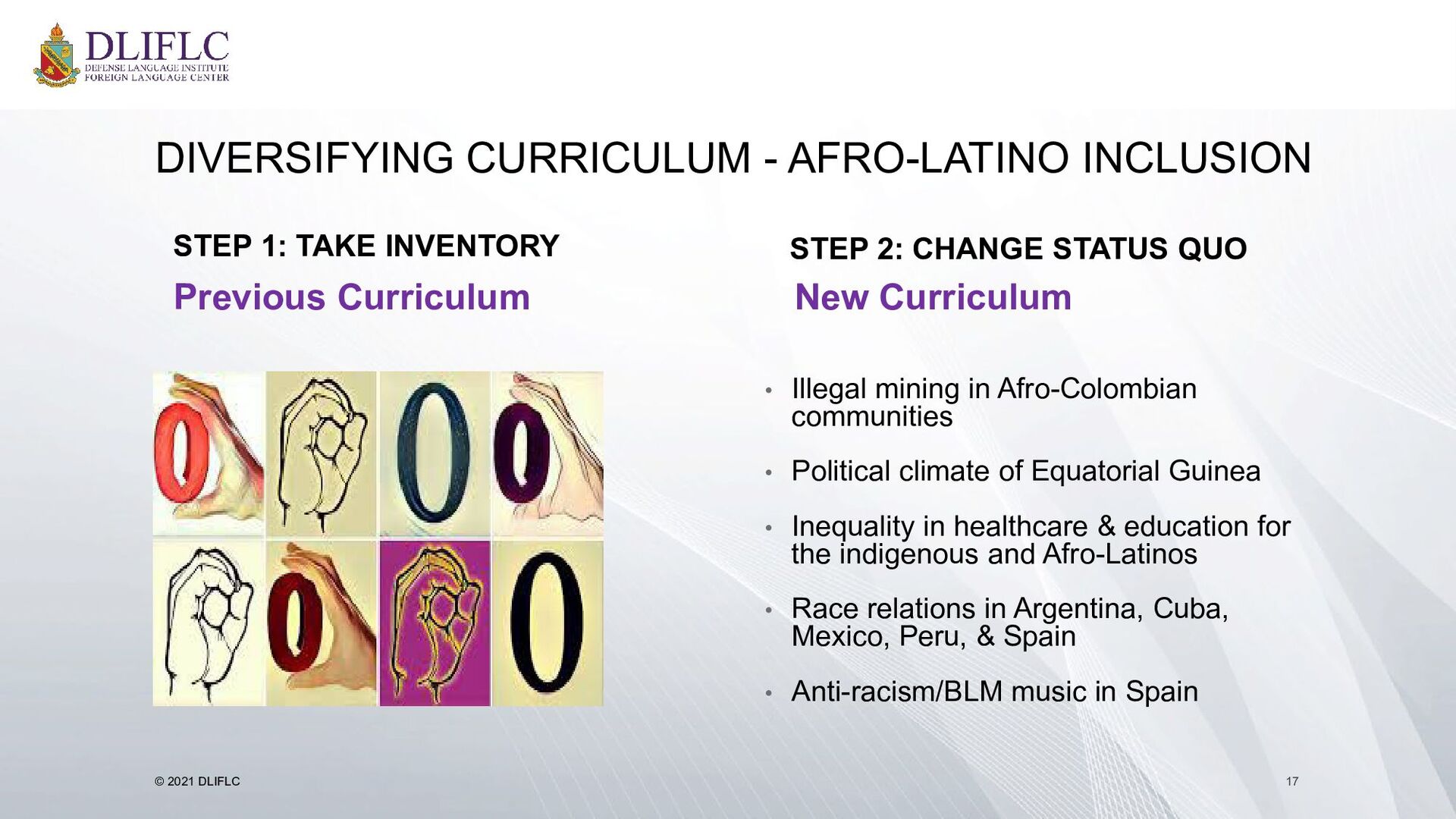
  16. DIVERSIFYING CURRICULUM - AFRO-LATINO INCLUSION Previous Curriculum New Curriculum •

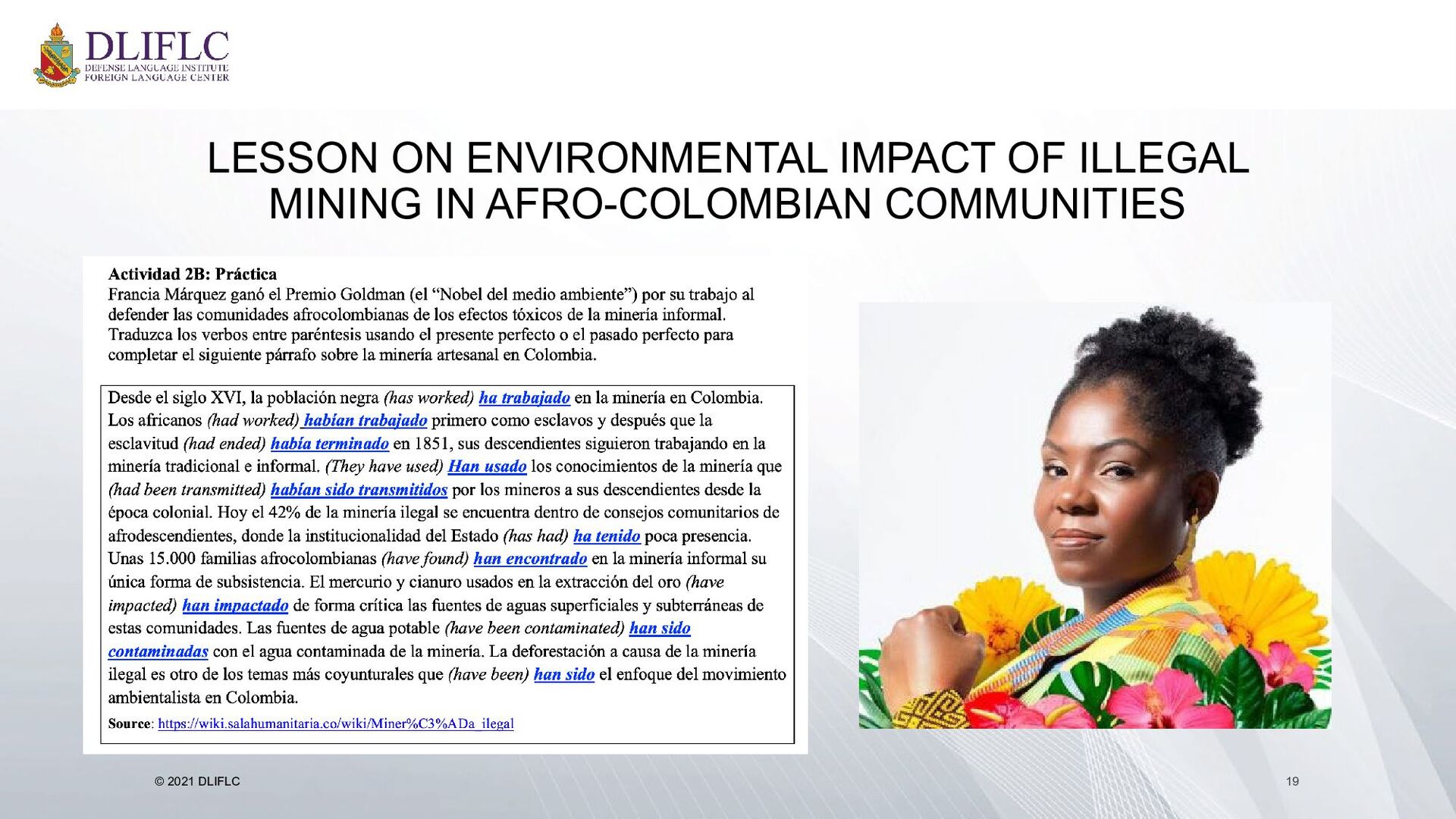
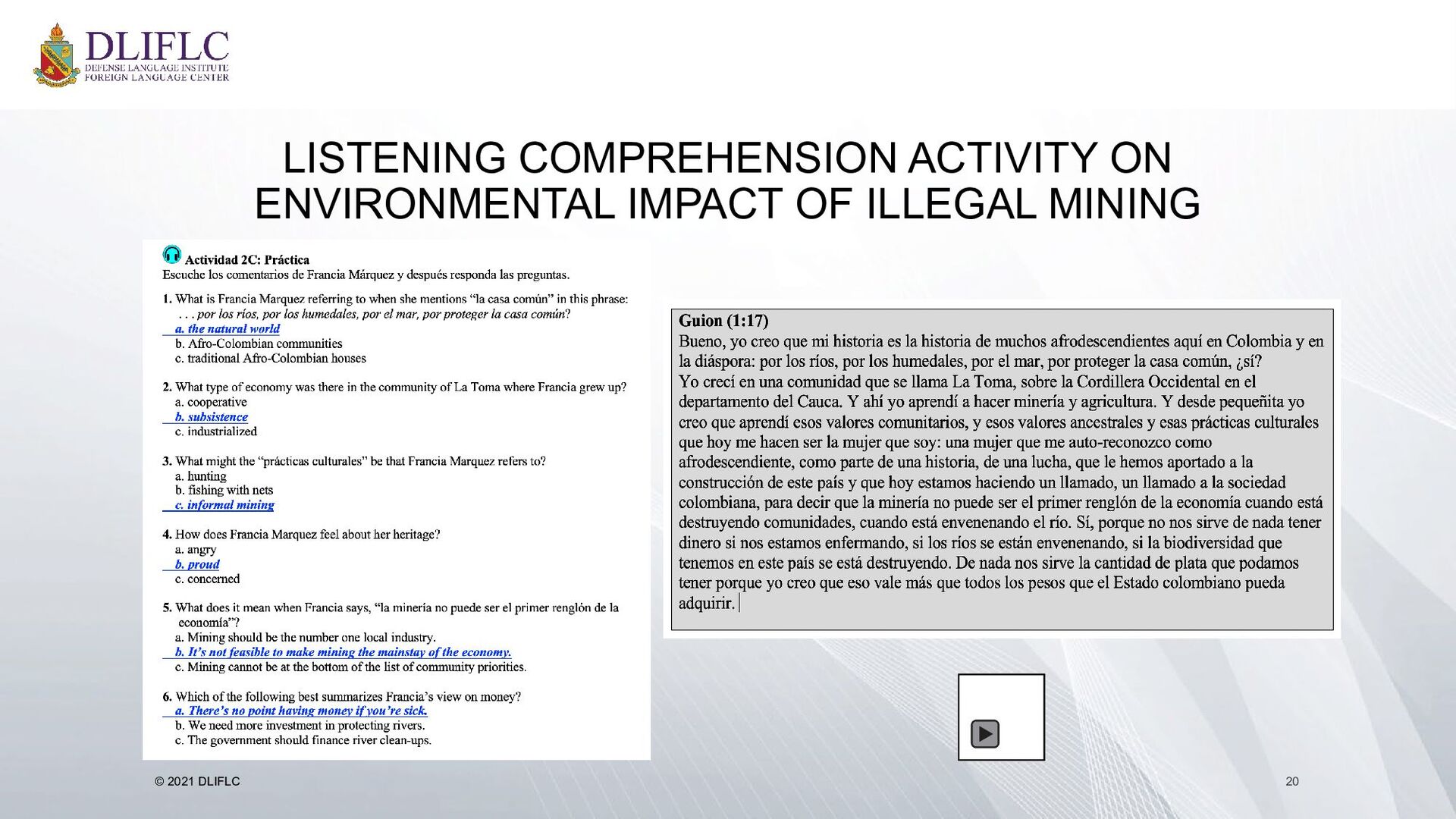
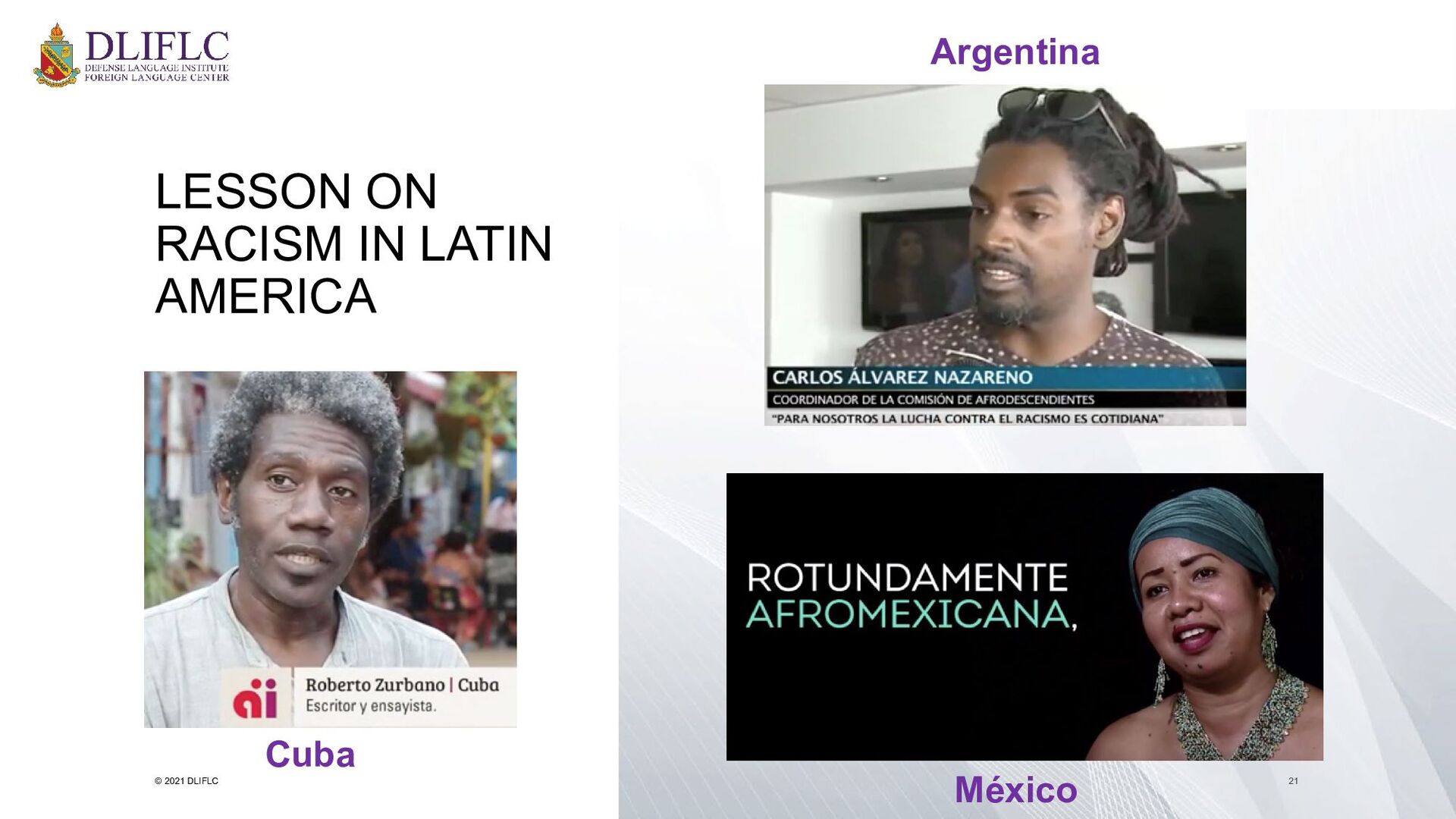
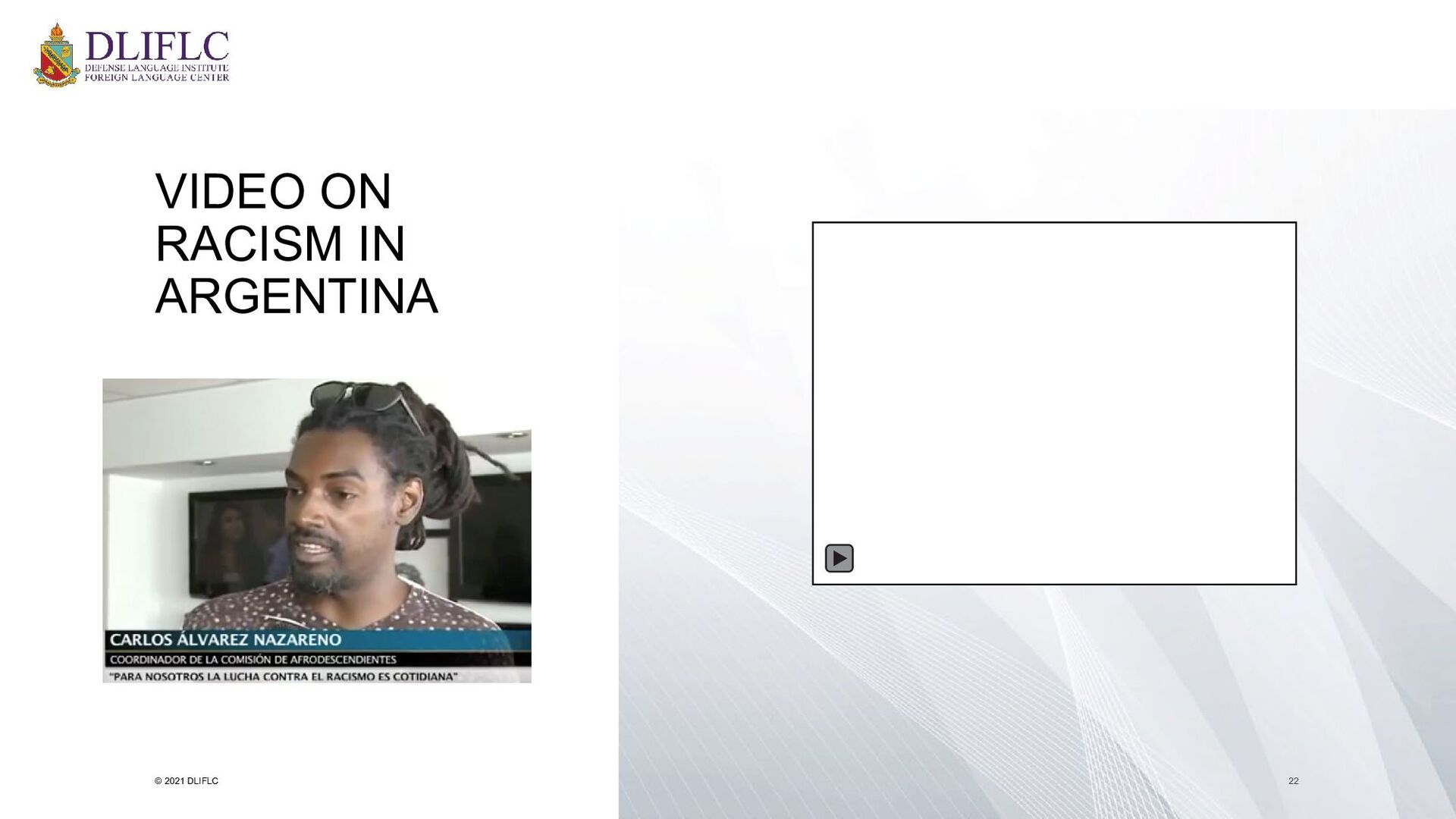
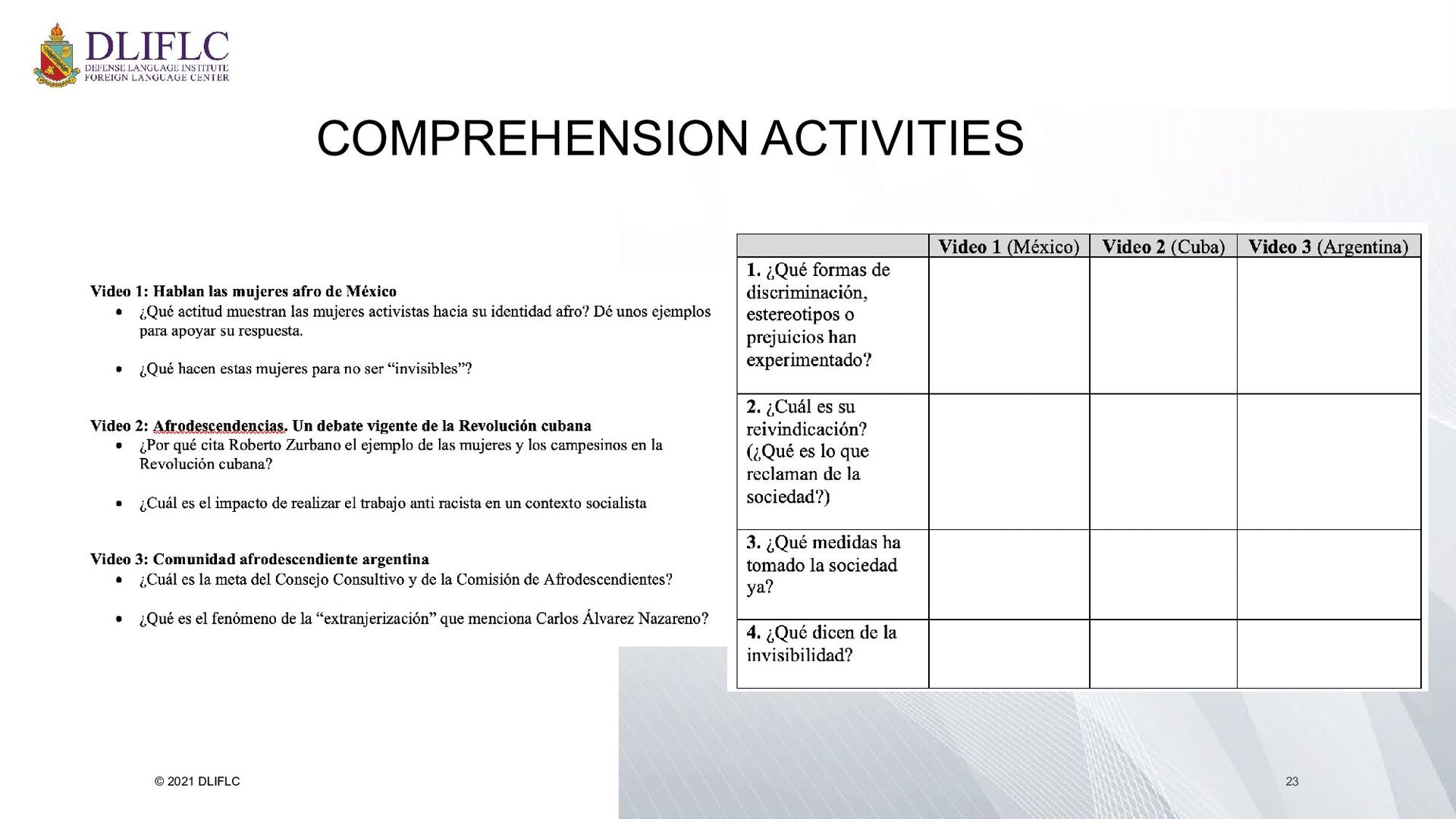
    Illegal mining in Afro-Colombian communities • Political climate of Equatorial Guinea • Inequality in healthcare & education for the indigenous and Afro-Latinos • Race relations in Argentina, Cuba, Mexico, Peru, & Spain • Anti-racism/BLM music in Spain © 2021 DLIFLC 17 STEP 1: TAKE INVENTORY STEP 2: CHANGE STATUS QUO
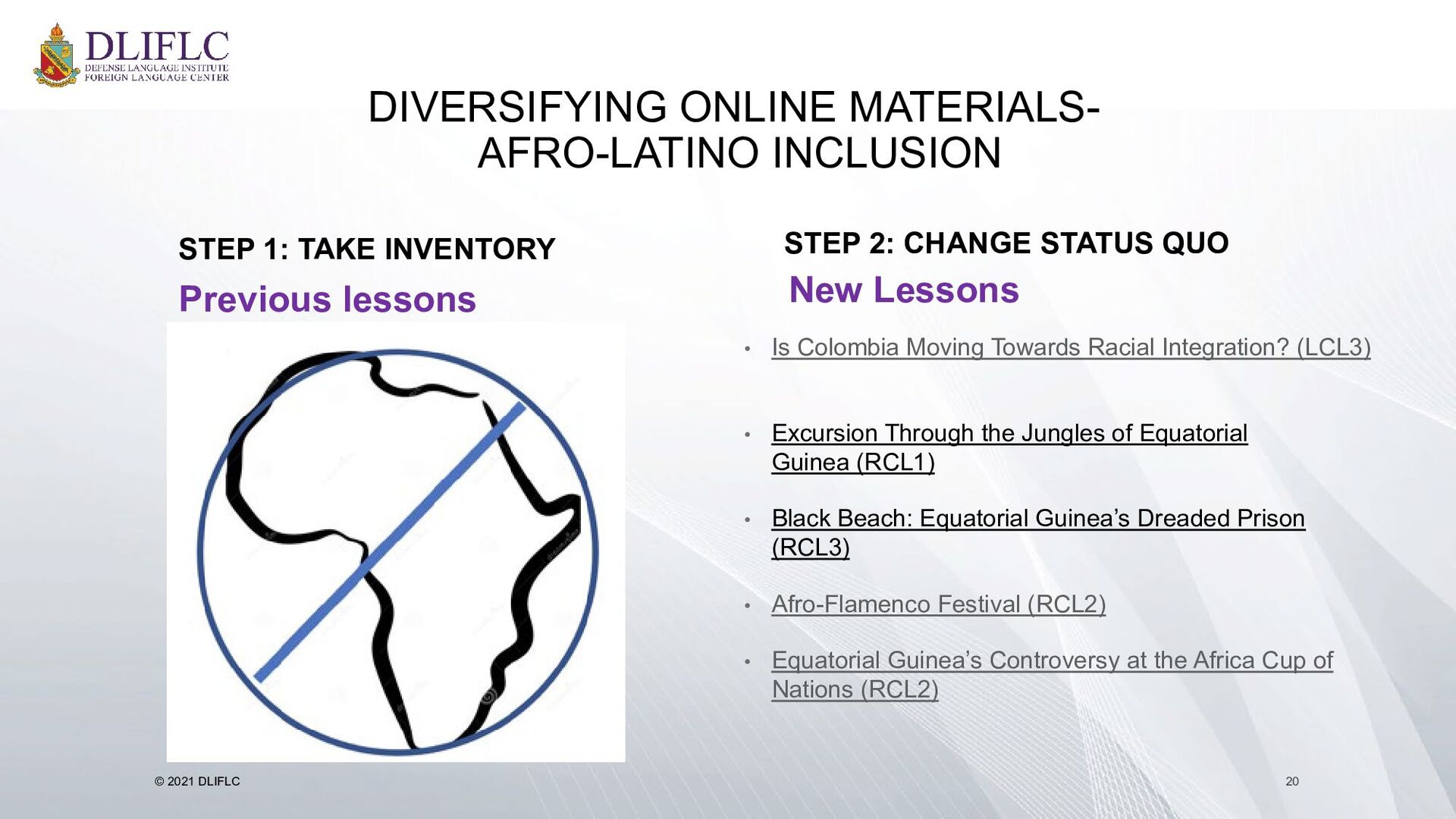
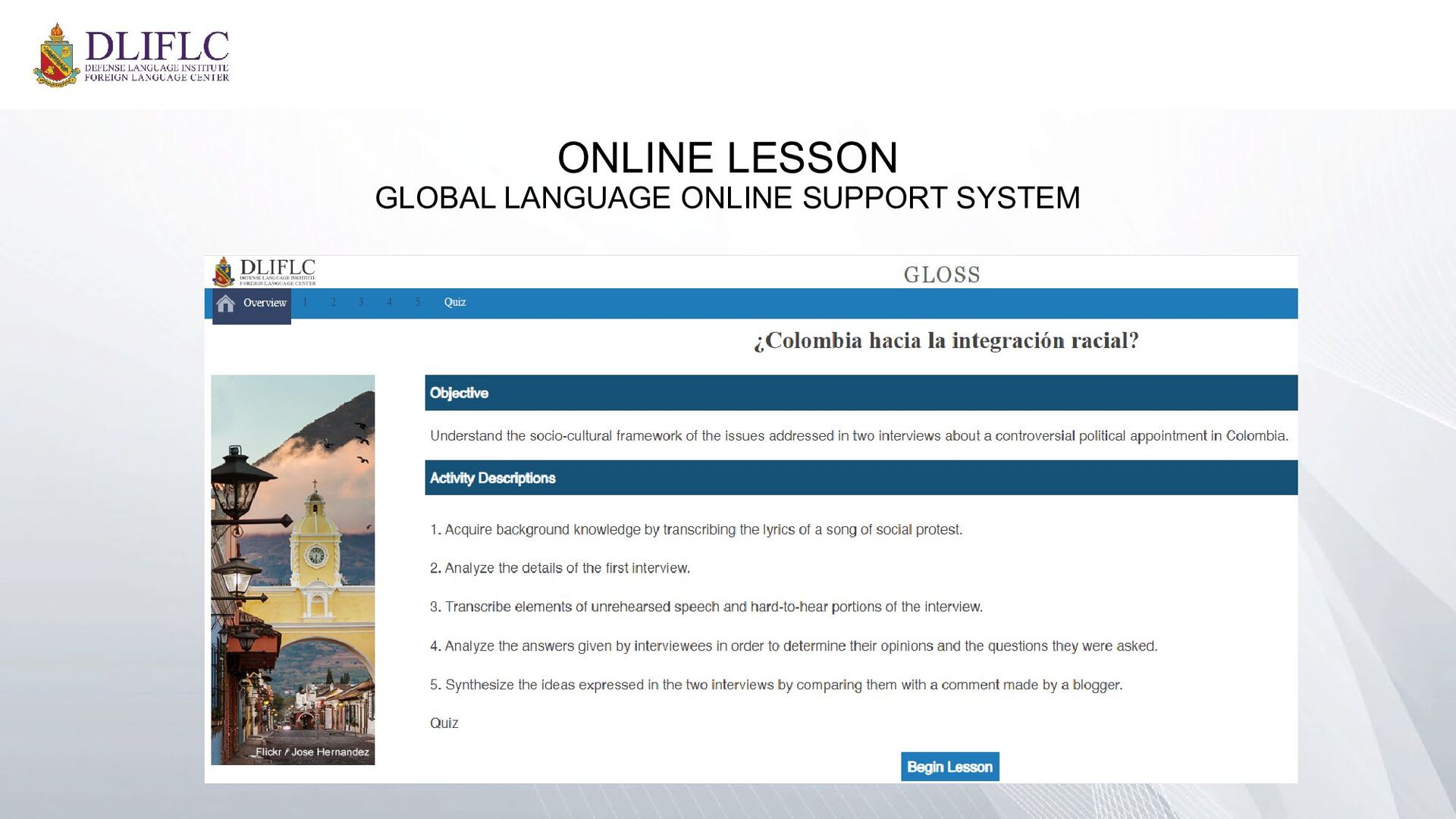
  17. DIVERSIFYING ONLINE MATERIALS- AFRO-LATINO INCLUSION • Is Colombia Moving Towards

    Racial Integration? (LCL3) • Excursion Through the Jungles of Equatorial Guinea (RCL1) • Black Beach: Equatorial Guinea’s Dreaded Prison (RCL3) • Afro-Flamenco Festival (RCL2) • Equatorial Guinea’s Controversy at the Africa Cup of Nations (RCL2) © 2021 DLIFLC 20 STEP 1: TAKE INVENTORY STEP 2: CHANGE STATUS QUO Previous lessons New Lessons
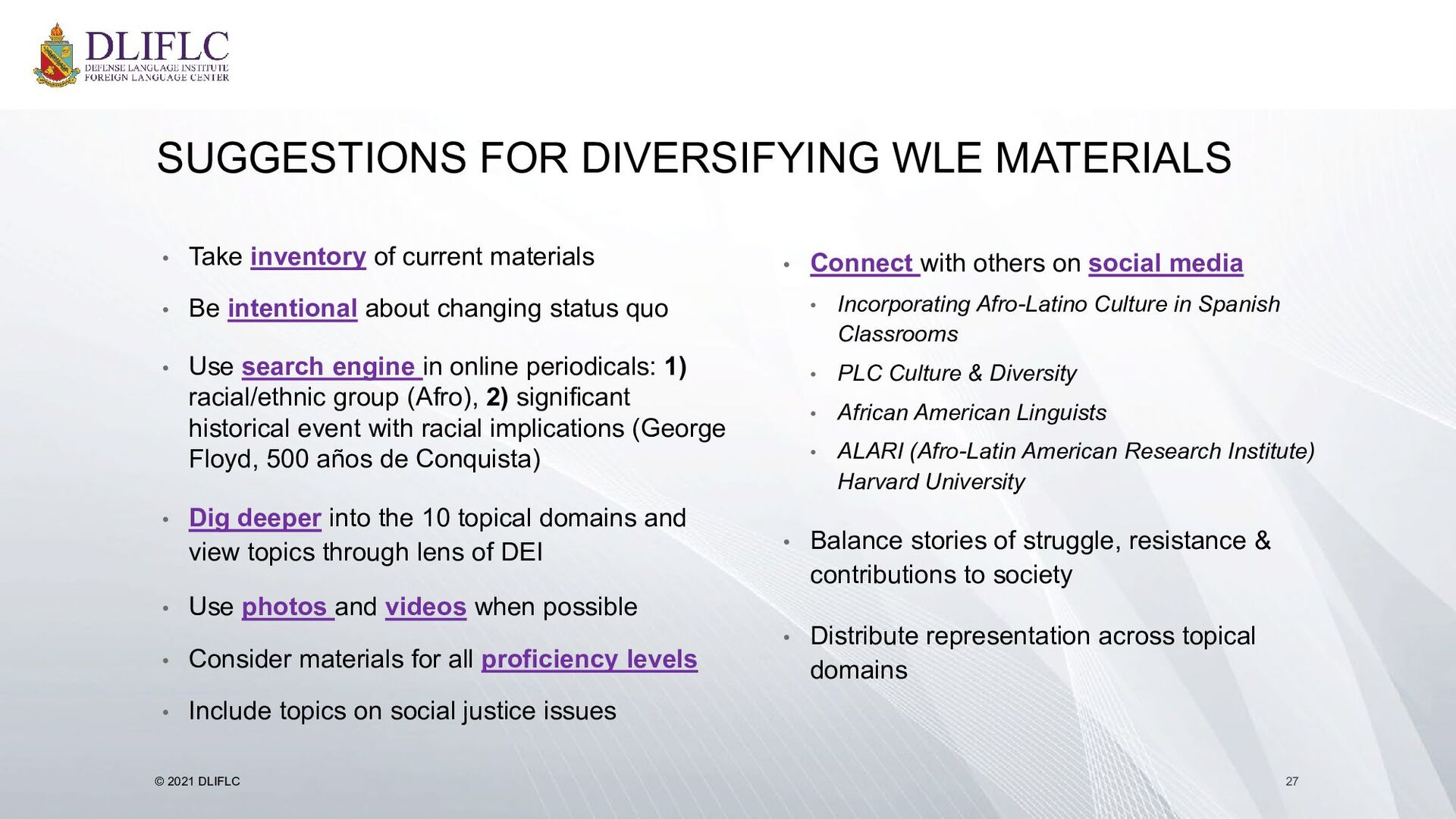
  18. SUGGESTIONS FOR DIVERSIFYING WLE MATERIALS • Take inventory of current

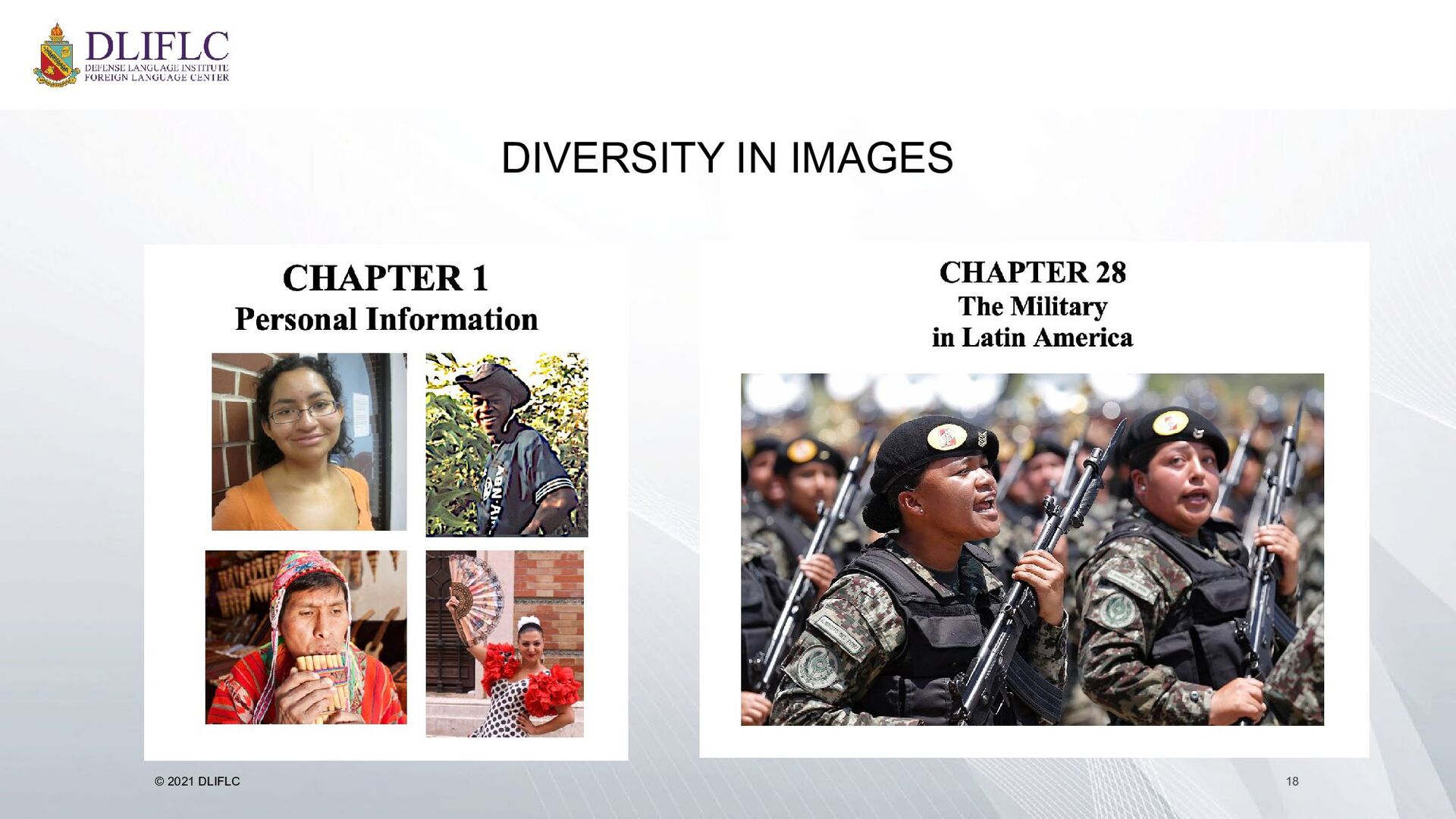
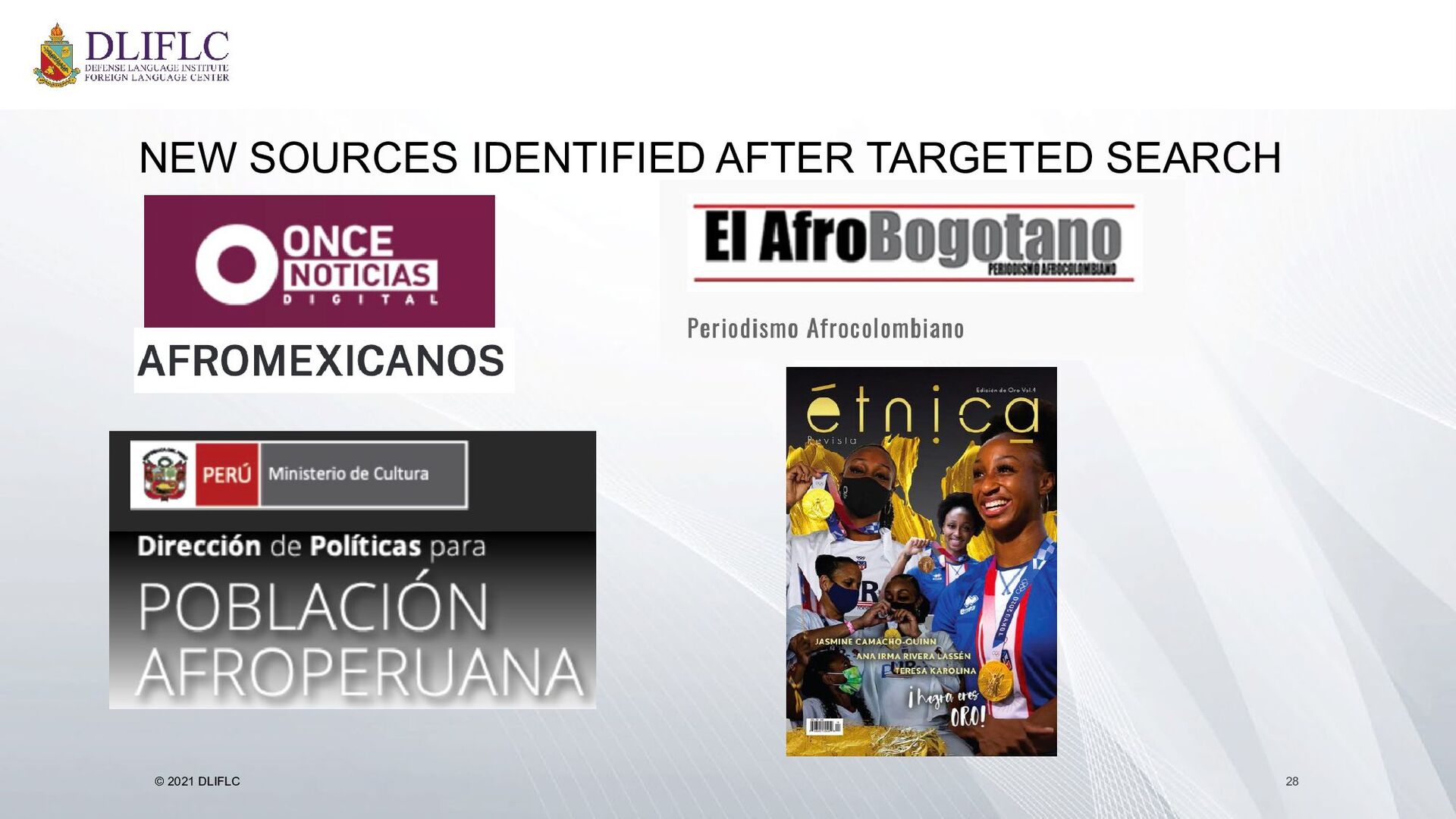
    materials • Be intentional about changing status quo • Use search engine in online periodicals: 1) racial/ethnic group (Afro), 2) significant historical event with racial implications (George Floyd, 500 años de Conquista) • Dig deeper into the 10 topical domains and view topics through lens of DEI • Use photos and videos when possible • Consider materials for all proficiency levels • Include topics on social justice issues • Connect with others on social media • Incorporating Afro-Latino Culture in Spanish Classrooms • PLC Culture & Diversity • African American Linguists • ALARI (Afro-Latin American Research Institute) Harvard University • Balance stories of struggle, resistance & contributions to society • Distribute representation across topical domains © 2021 DLIFLC 27
  19. CONCLUDING THOUGHTS  "Lo que no se nombra, no existe"

    (Yepez, 2021). (What is not named does not exist.)  Racial representation in the teaching and learning of world languages matters. We must be intentional and take steps to promote diversity, equity, and inclusion. (Anya & Randolph, 2019; Hines-Gaither & Accilien, 2022).  Language educators must adopt critical perspectives and consciously examine their own beliefs to not perpetuate stereotypes and untruths or reproduce inequities in their teaching (Abreu, 2016; Glynn & Wassell, 2018; Hines-Gaither & Accilien, 2022).  "To ignore diversity is to reinforce legacies of inequity and exclusion upon which our educational institutions were built" (Anya & Randolph, 2019). © 2021 DLIFLC 29
  20. CONCLUDING THOUGHTS  "We must openly address race and racism

    in language education policies, instructional practices, and curriculum.... Language educators and learners cannot leave racial differences and the social impact of these identities outside the classroom" (Anya & Randolph, 2019).  "We should question our assumptions, attitudes, and beliefs that contribute to the inequitable status quo and adopt perspectives of equity-mindedness and inclusivity, which are key to making positive change" (Anya & Randolph, 2019).  The images in instructional materials do matter and influence learners' perception of self and of the TL peoples and cultures (Anderson, 2022; Glynn & Wassell, 2018; Hines-Gaither & Accilien, 2022; Whitacker, 2021).  "Educators need to acknowledge that the majority of our textbooks and curricula have thrived on racist practices that silenced the voices and omitted the experiences of people of color and were not written by BIPOC scholars" (Hines-Gaither & Accilien, 2022). [10th Principle of Antiracism in the WLE] © 2021 DLIFLC 30
  21. REFERENCES Abreu, L. (2016). Awareness of racial diversity in the

    Spanish-speaking world among L2 Spanish speakers. Foreign Language Annals, 49(1), 180-190. https://doi.org/10.1111/flan.12179 Anderson, R. (2022). The diverse Arabic voices project: Widening the lens for novice learners within an HBCU. The Language Educator, 17(1), 48-51 Anya, U. (2021). Critical race pedagogy for more effective and inclusive world language teaching. Applied Linguistics, 42(6), 1055- 1069. https://doi.org/10.1093/applin/amab068 Anya, U. (2011). Connecting with communities of learners and speakers: Integrative ideals, experiences, and motivations of successful Black second language learners. Foreign Language Annals, 44(3), 441-466. Anya, U. & Randolph, L. J. (2019). Diversifying language educators and learners. The Language Educator, Oct/Nov, 23-27. https://www.actfl.org/sites/default/files/tle/TLE_OctNov19_Article.pdf Flores, N. & Rosa, J. (2019). Bringing race into second language acquisition. The Modern Language Journal, 103(1), 145-151. https://doi.org/10.1111/modl.12523 Glynn, C., Hines-Gaither, K., Jenkins, T. (2022). Increasing black Glynn, C. & Wassell, B. (2018). Who Gets to Play? Issues of access and social justice in world language study in the U.S. Dimension: Journal of the Southern Conference on Language Teaching, Spring, 18-32. https://rdw.rowan.edu/education_facpub/11/ © 2021 DLIFLC 31
  22. REFERENCES Hines-Gaither, K., & Accilien, C. (2022). Antiracism in the

    world language classroom. The Language Educator, 17(1), 18-21. Masson, M., Sharina, R., Cloutier, A., Treichel, M. (2022). Mobilizing French as second language teachers to disrupt the curriculum in Canadian classrooms. The Language Educator, 17(1), 32-35. Rosa, J. & Flores, N. (2021). Unsettling race and language: Toward a raciolinguistic perspective. Language in Society, 46(1), 621- 647. https://doi.org/10.1017/ Yepez, D. (2021, August 9). Ser mujer y negra en Ecuador: Un oso panda sobre los hombros. El pais. https://elpais.com/opinion/2021-08- 09/ser-mujer-y-negra-en-ecuador-un-oso-panda-sobre-los-hombros.html?rel=buscador_noticias Whitaker, S. (2021, December 21). Critical race theory versus culturally responsive pedagogy. Whitaker Educational Consulting. https://sonyawhitaker.com/2021/12/critical-race-theory-vs-culturally-responsive-pedagogy/ © 2021 DLIFLC 32