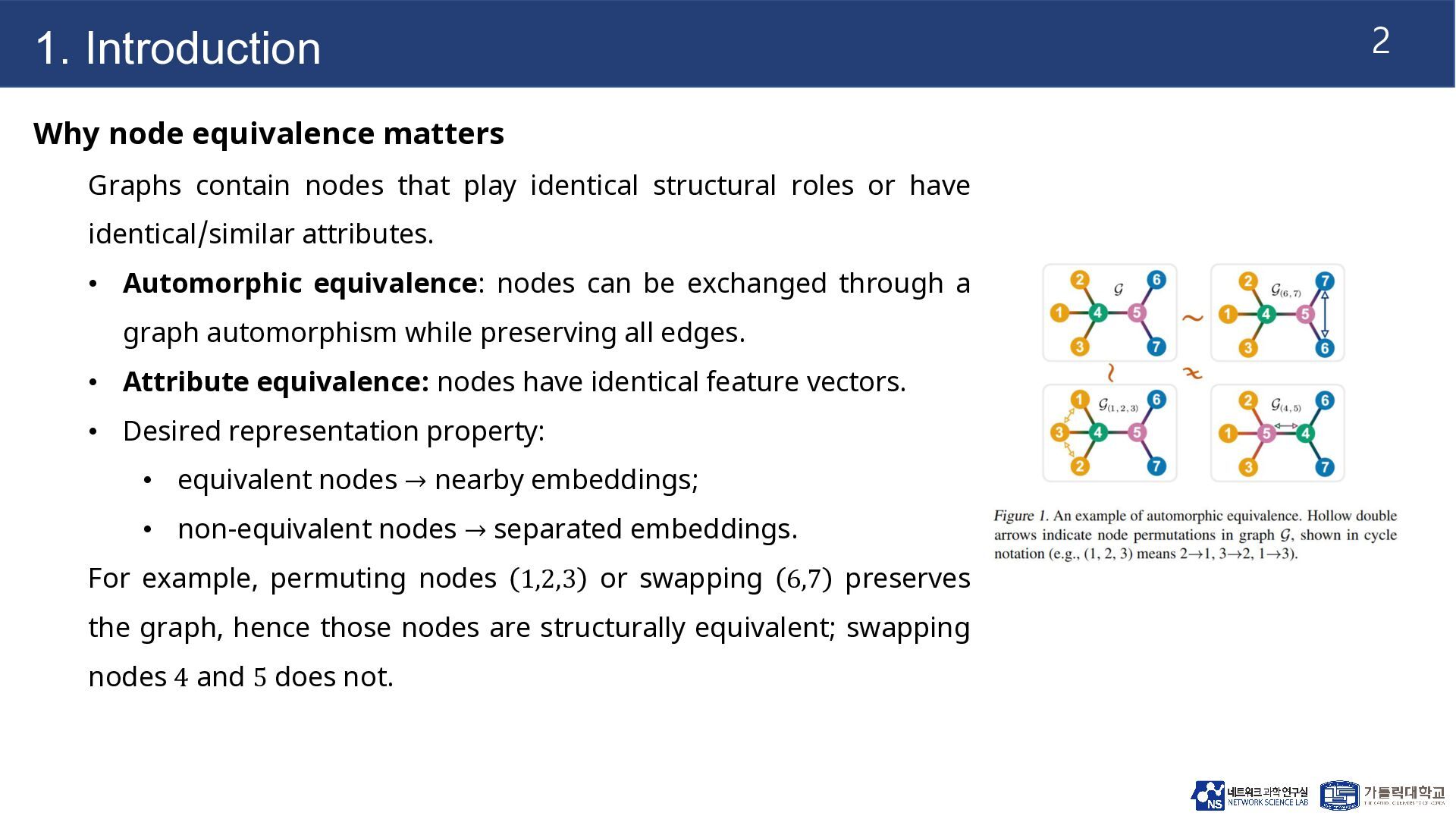
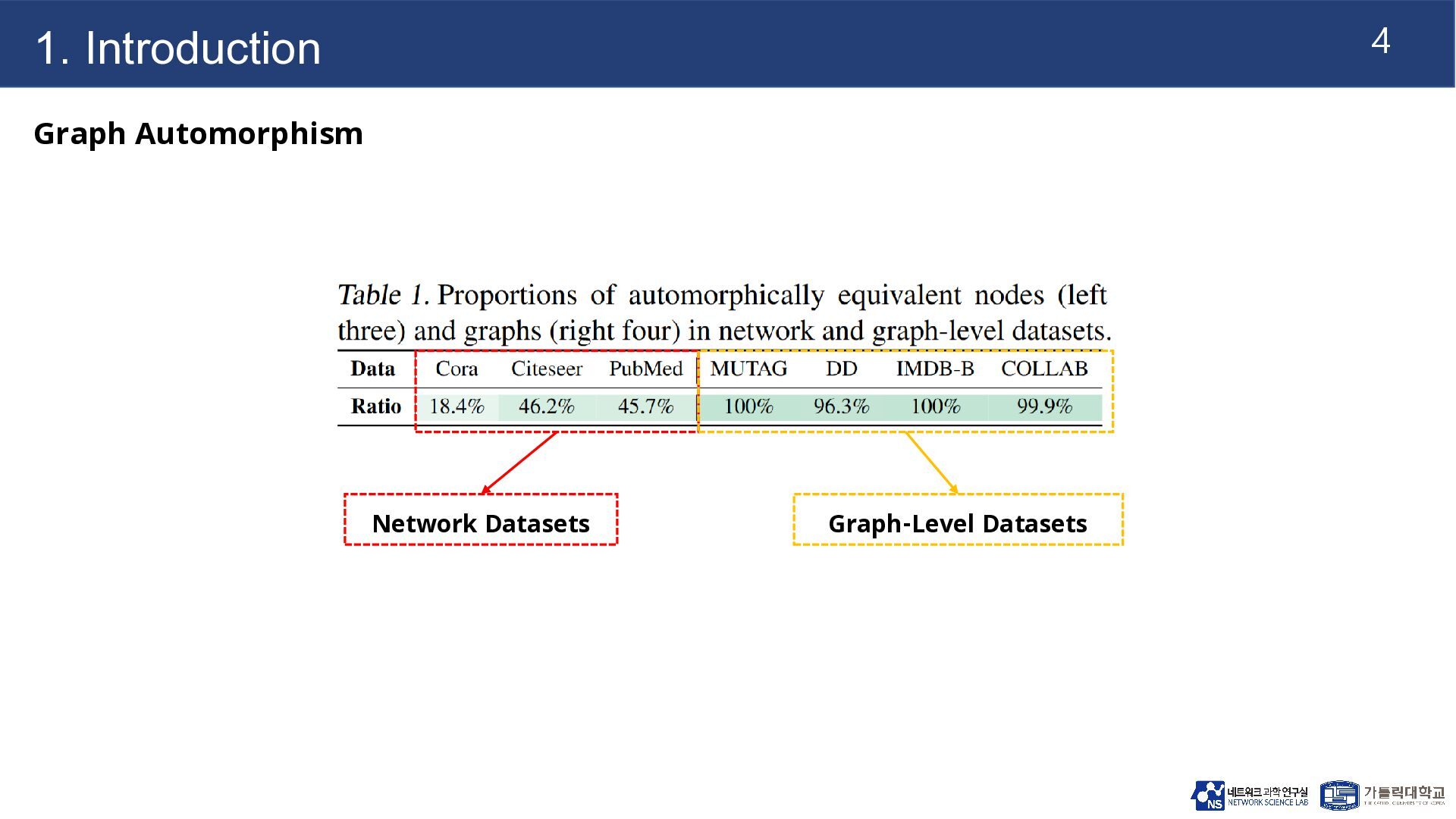
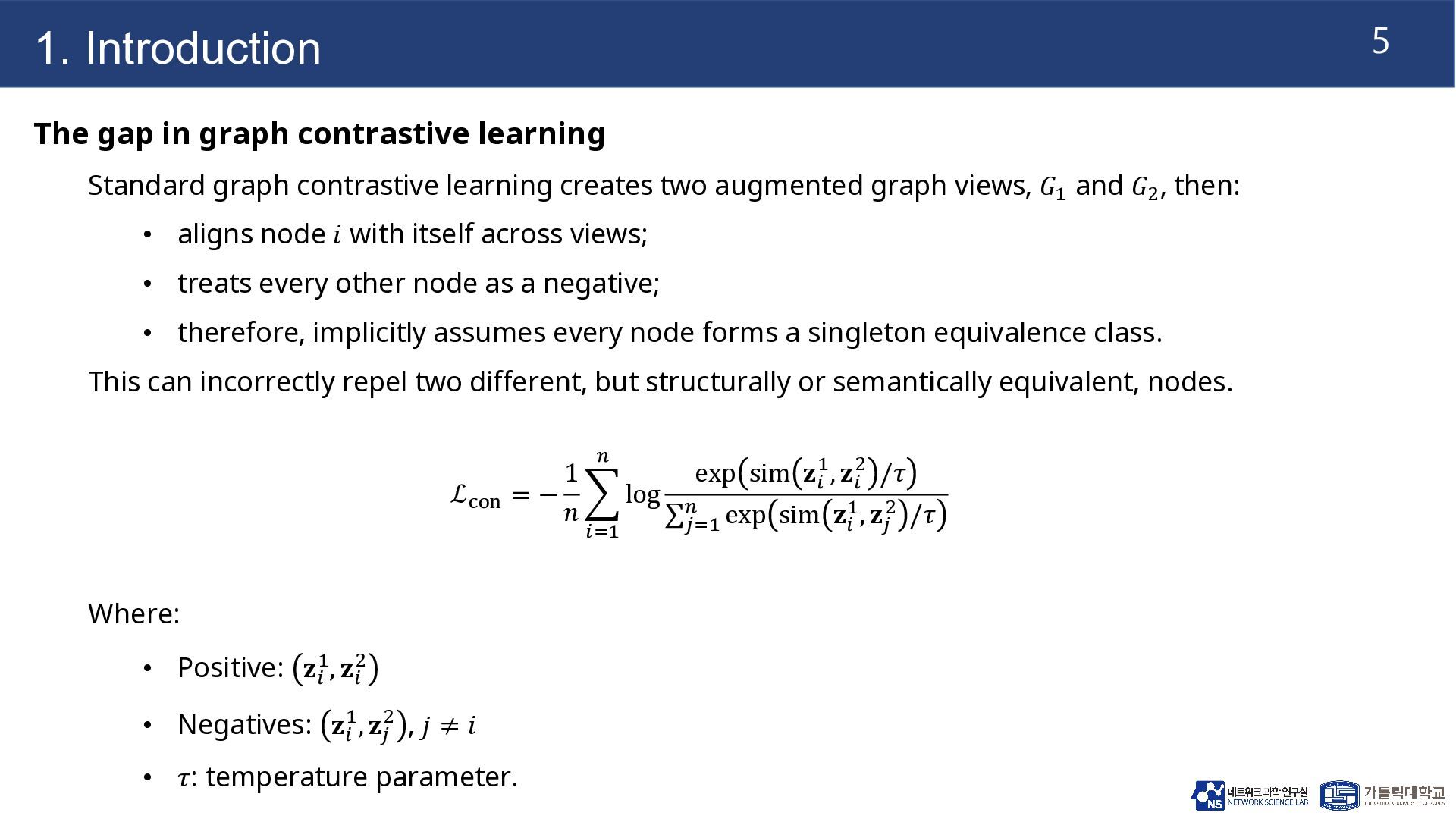
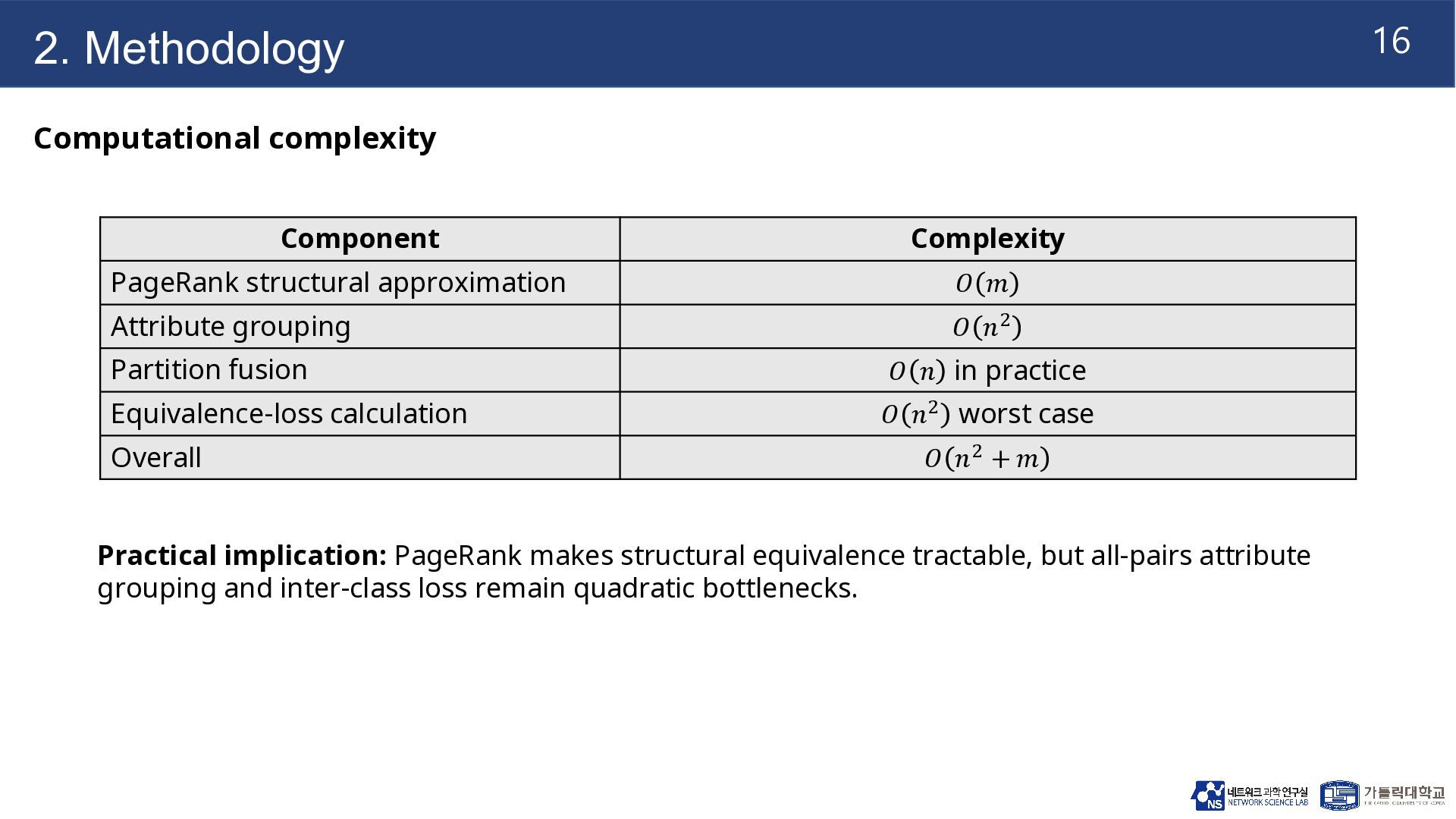
play identical structural roles or have identical/similar attributes. • Automorphic equivalence: nodes can be exchanged through a graph automorphism while preserving all edges. • Attribute equivalence: nodes have identical feature vectors. • Desired representation property: • equivalent nodes → nearby embeddings; • non-equivalent nodes → separated embeddings. For example, permuting nodes 1,2,3 or swapping 6,7 preserves the graph, hence those nodes are structurally equivalent; swapping nodes 4 and 5 does not. 2
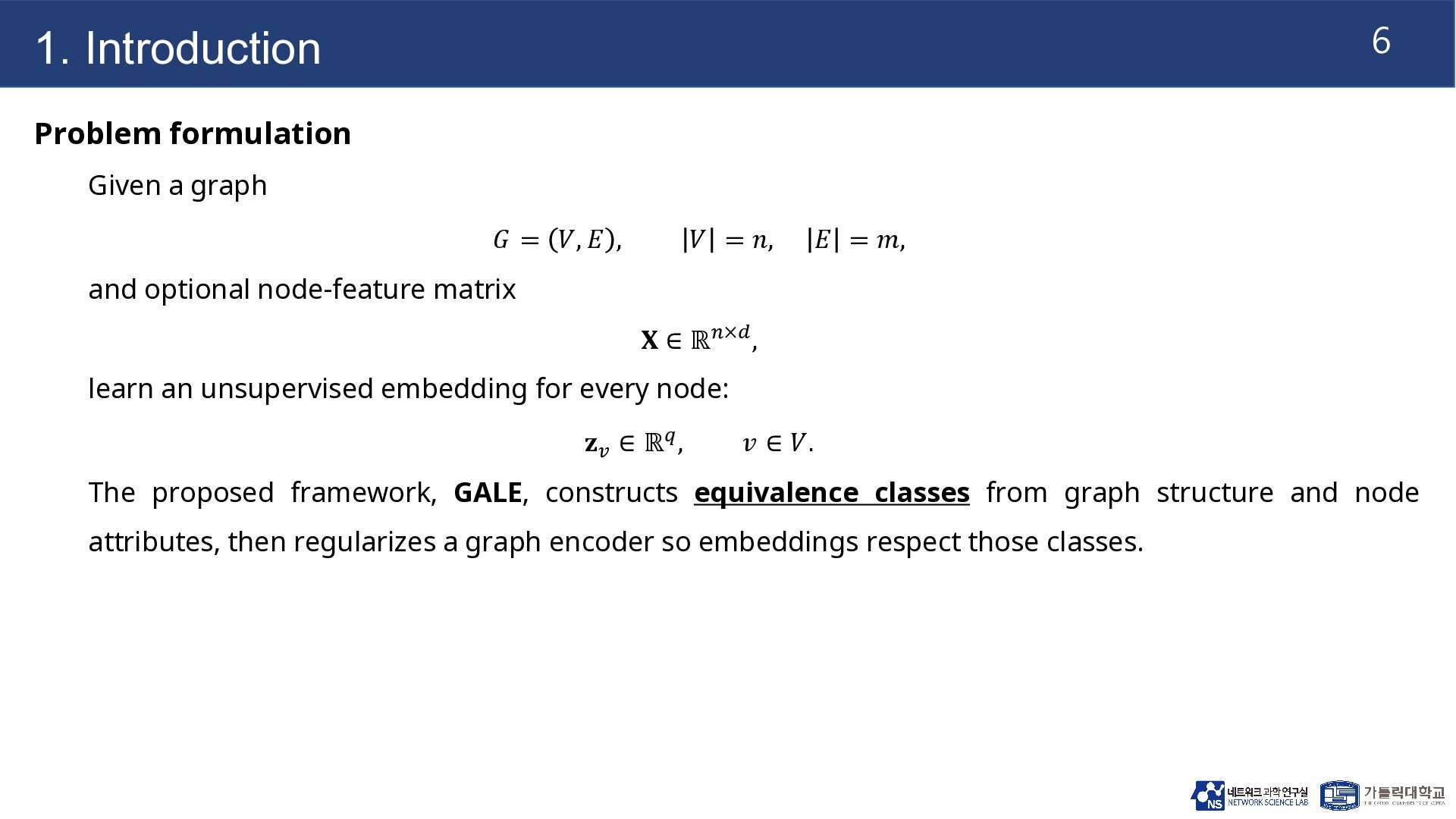
𝑉, 𝐸 , 𝑉 = 𝑛, 𝐸 = 𝑚, and optional node-feature matrix 𝐗 ∈ ℝ𝑛×𝑑 , learn an unsupervised embedding for every node: 𝐳𝑣 ∈ ℝ𝑞 , 𝑣 ∈ 𝑉. The proposed framework, GALE, constructs equivalence classes from graph structure and node attributes, then regularizes a graph encoder so embeddings respect those classes.
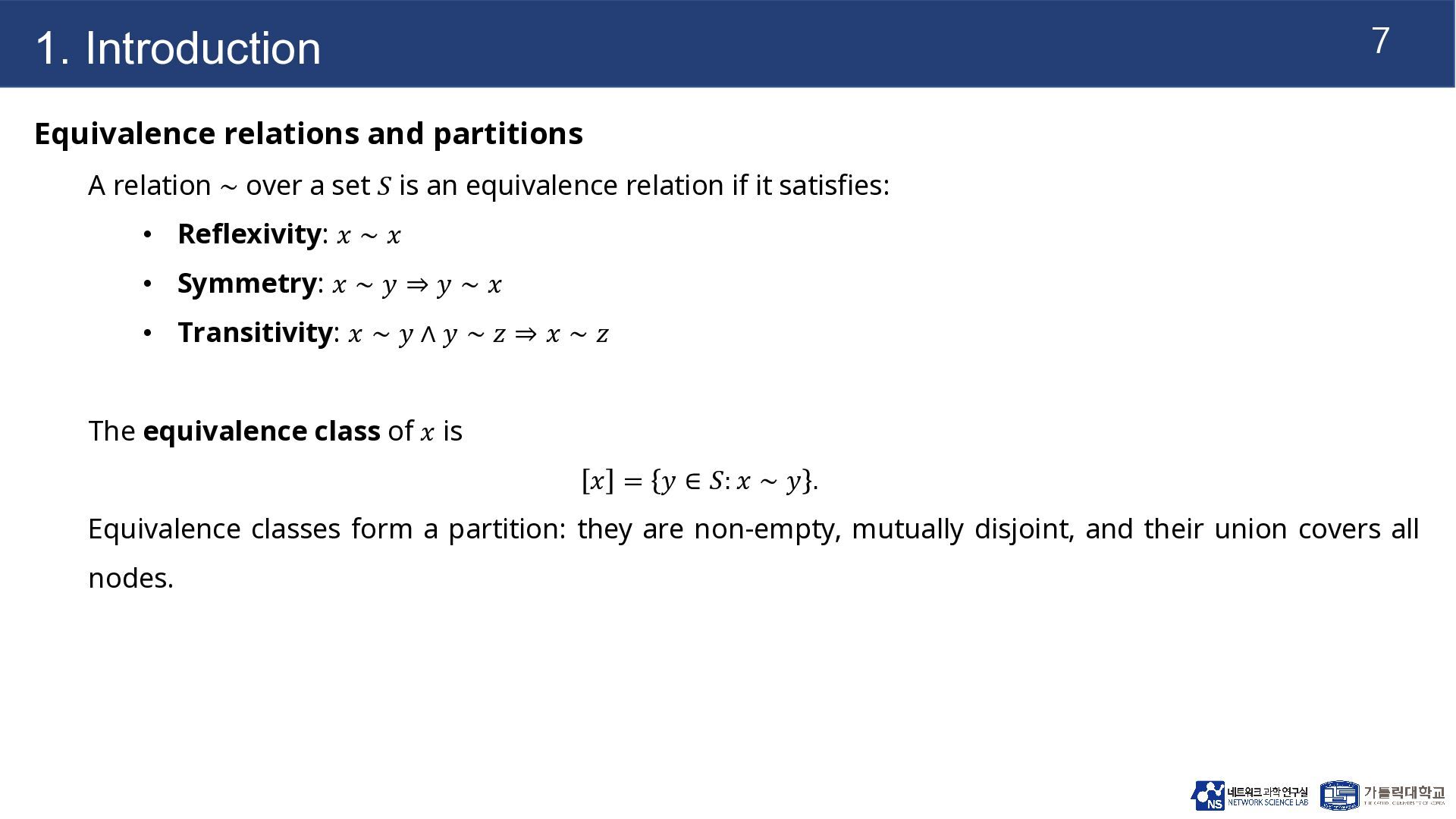
over a set 𝑆 is an equivalence relation if it satisfies: • Reflexivity: 𝑥 ∼ 𝑥 • Symmetry: 𝑥 ∼ 𝑦 ⇒ 𝑦 ∼ 𝑥 • Transitivity: 𝑥 ∼ 𝑦 ∧ 𝑦 ∼ 𝑧 ⇒ 𝑥 ∼ 𝑧 The equivalence class of 𝑥 is 𝑥 = 𝑦 ∈ 𝑆: 𝑥 ∼ 𝑦 . Equivalence classes form a partition: they are non-empty, mutually disjoint, and their union covers all nodes.
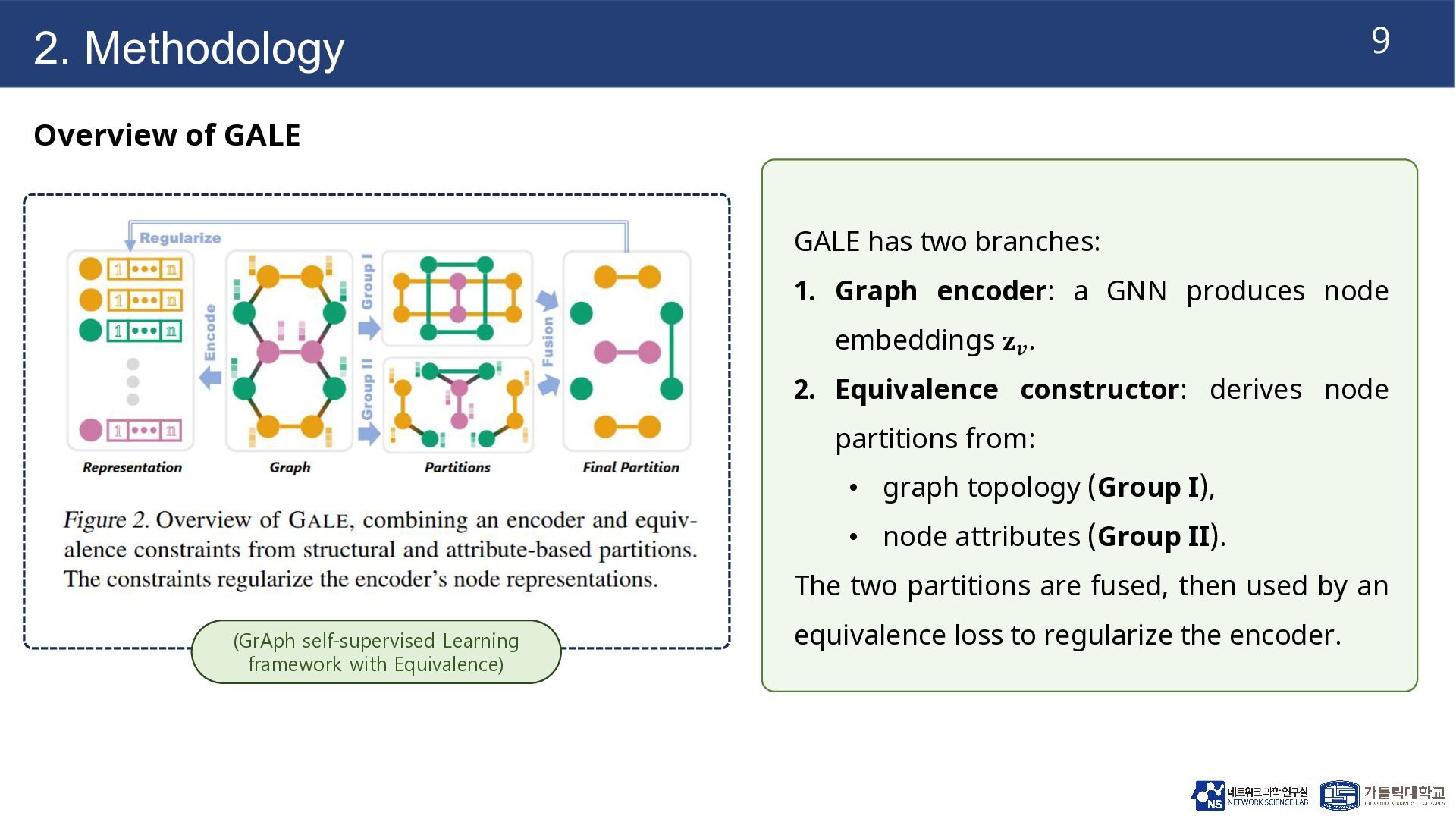
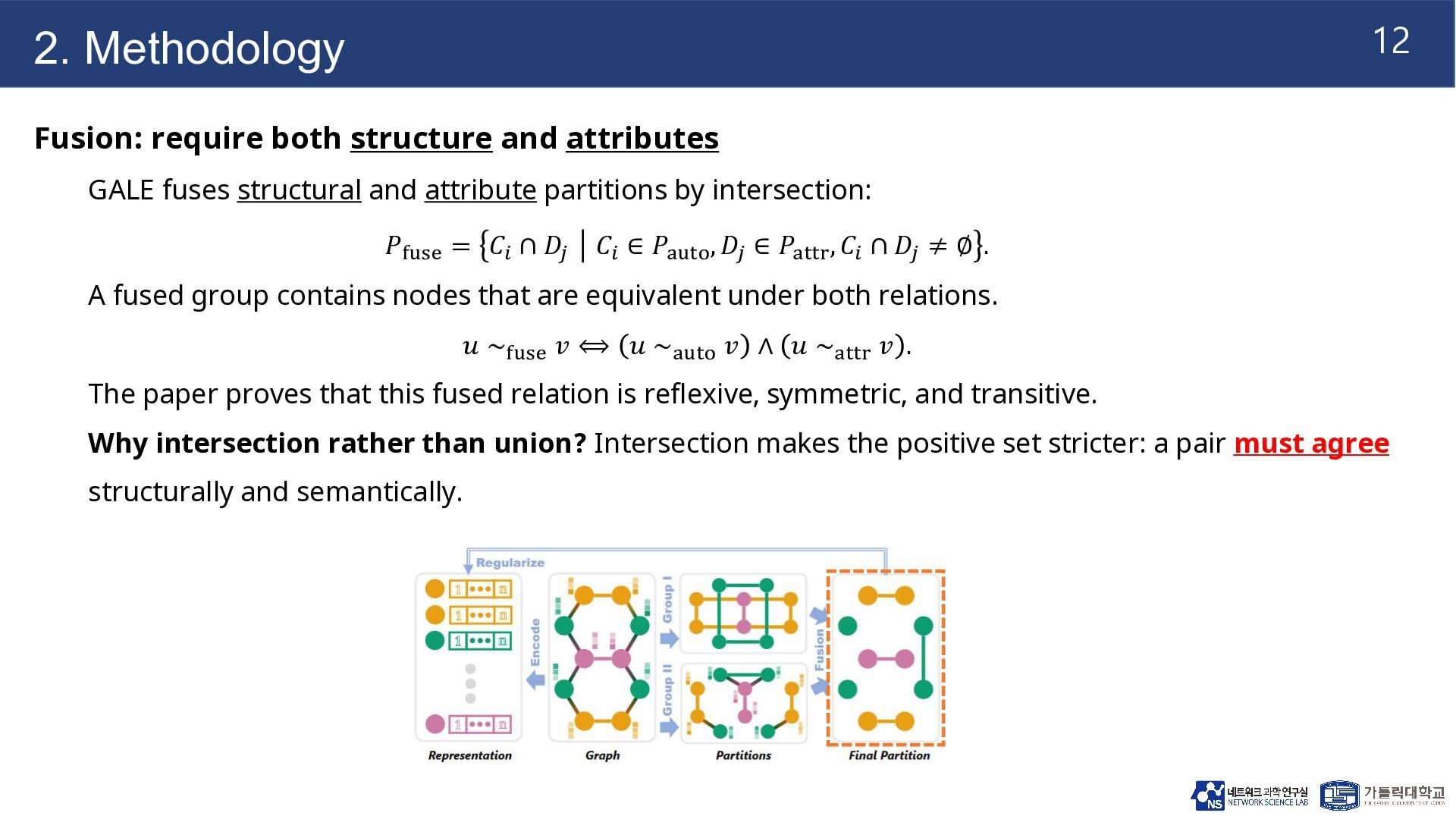
1. Graph encoder: a GNN produces node embeddings 𝐳𝑣 . 2. Equivalence constructor: derives node partitions from: • graph topology (Group I), • node attributes (Group II). The two partitions are fused, then used by an (GrAph self-supervised Learning framework with Equivalence) equivalence loss to regularize the encoder.
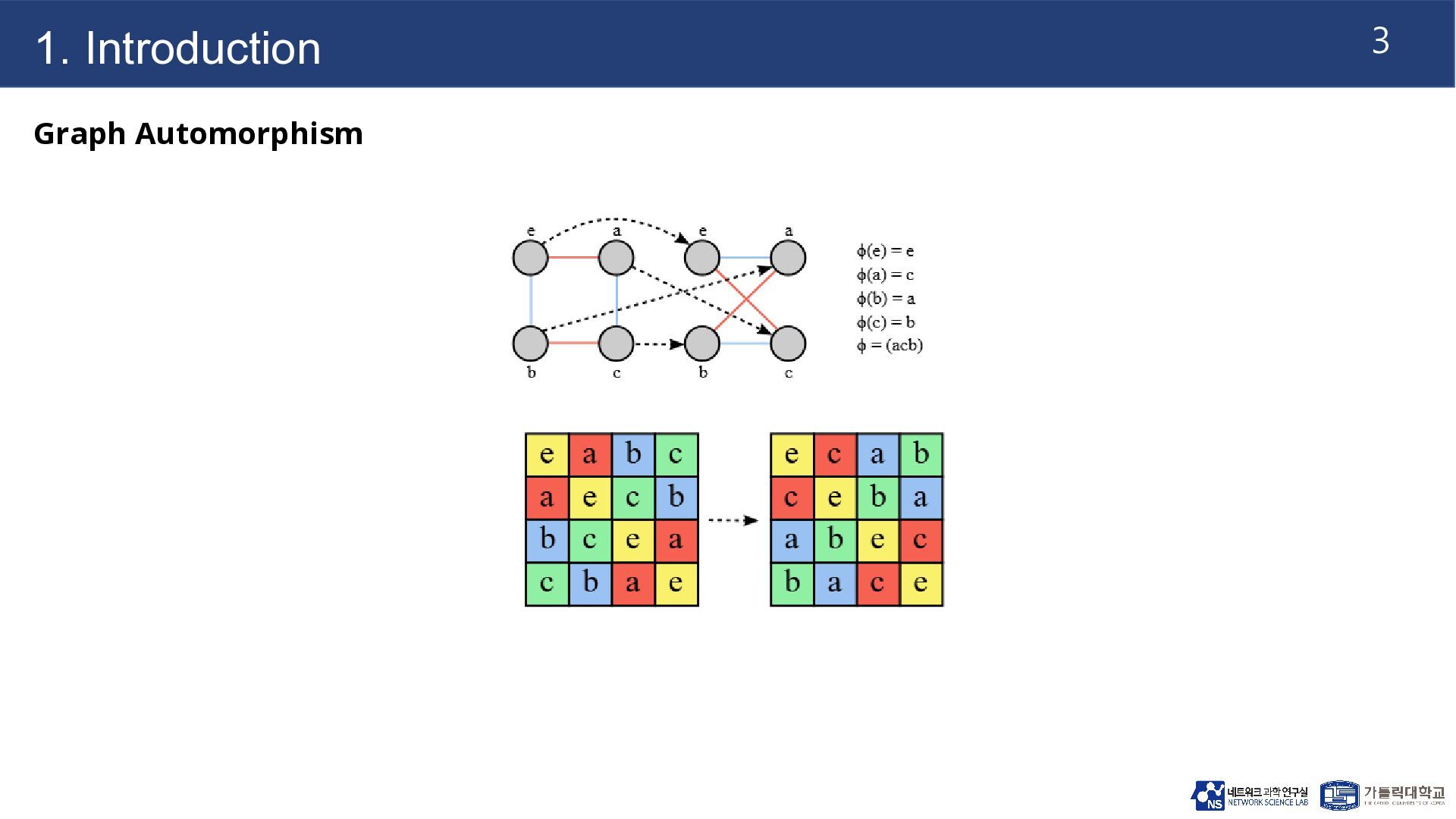
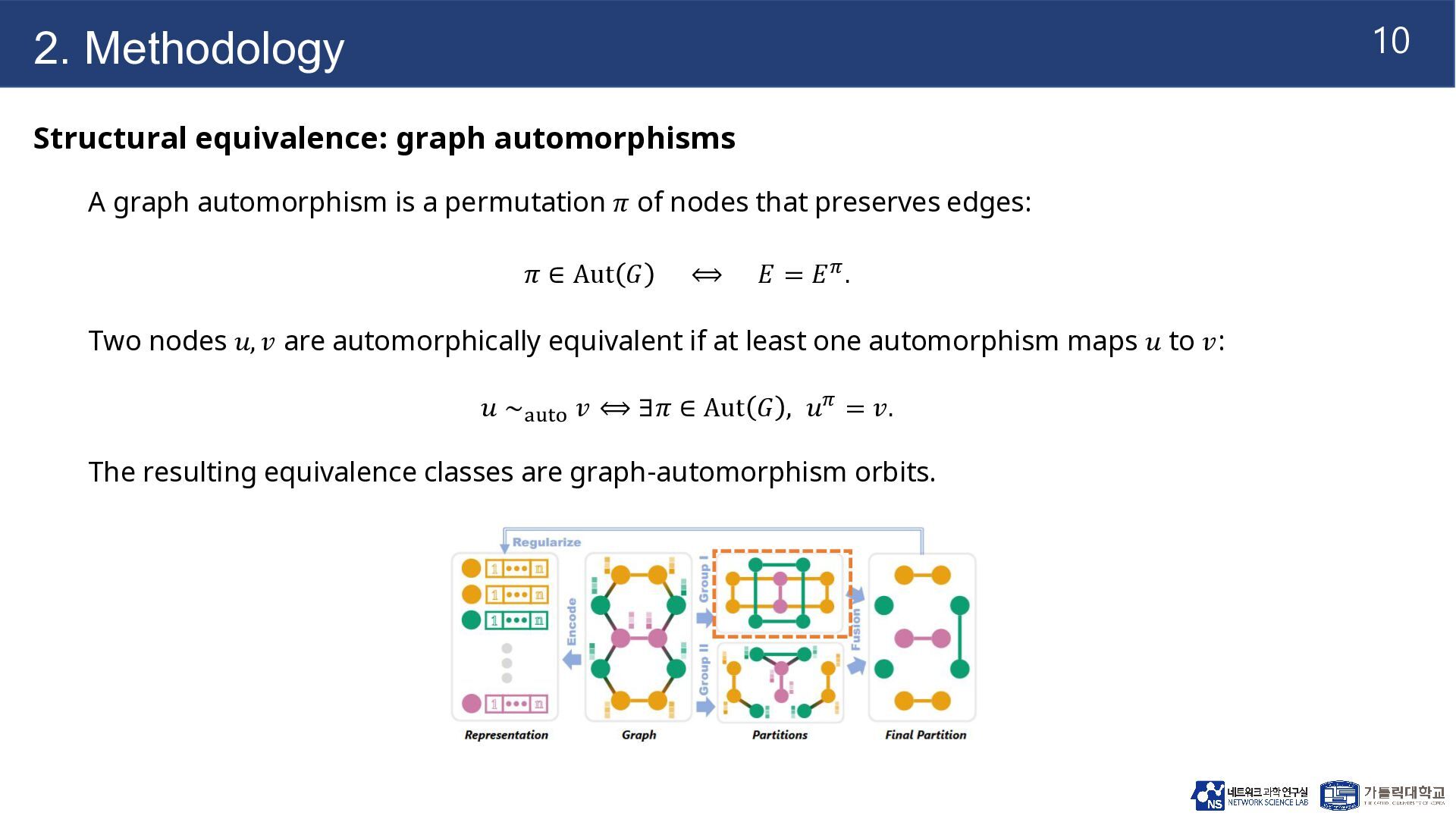
is a permutation 𝜋 of nodes that preserves edges: 𝜋 ∈ Aut 𝐺 ⟺ 𝐸 = 𝐸𝜋. Two nodes 𝑢, 𝑣 are automorphically equivalent if at least one automorphism maps 𝑢 to 𝑣: 𝑢 ∼auto 𝑣 ⟺ ∃𝜋 ∈ Aut 𝐺 , 𝑢𝜋 = 𝑣. The resulting equivalence classes are graph-automorphism orbits.
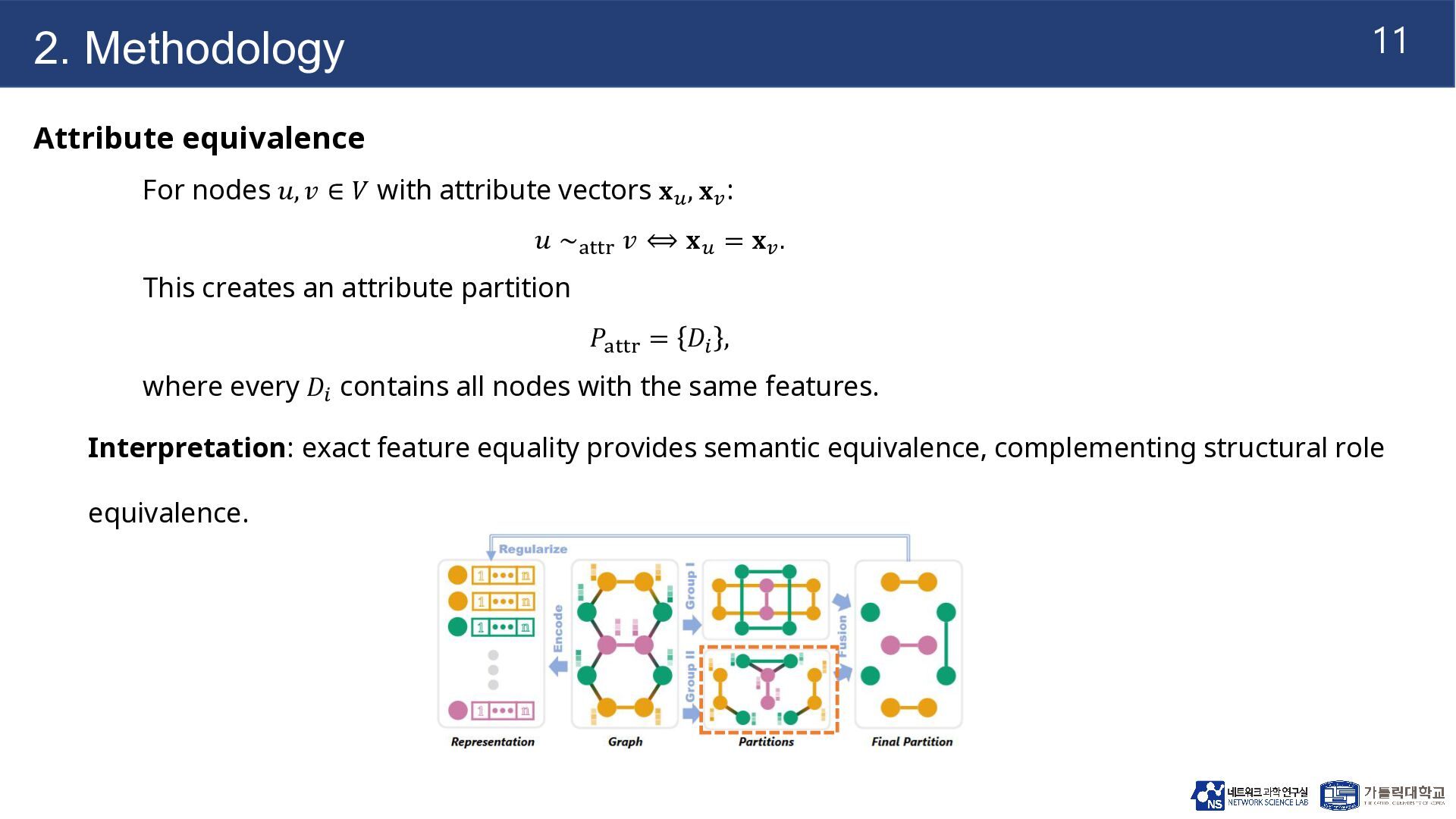
𝑉 with attribute vectors 𝐱 𝑢 , 𝐱 𝑣 : 𝑢 ∼attr 𝑣 ⟺ 𝐱 𝑢 = 𝐱 𝑣 . This creates an attribute partition 𝑃attr = 𝐷𝑖 , where every 𝐷𝑖 contains all nodes with the same features. Interpretation: exact feature equality provides semantic equivalence, complementing structural role equivalence.
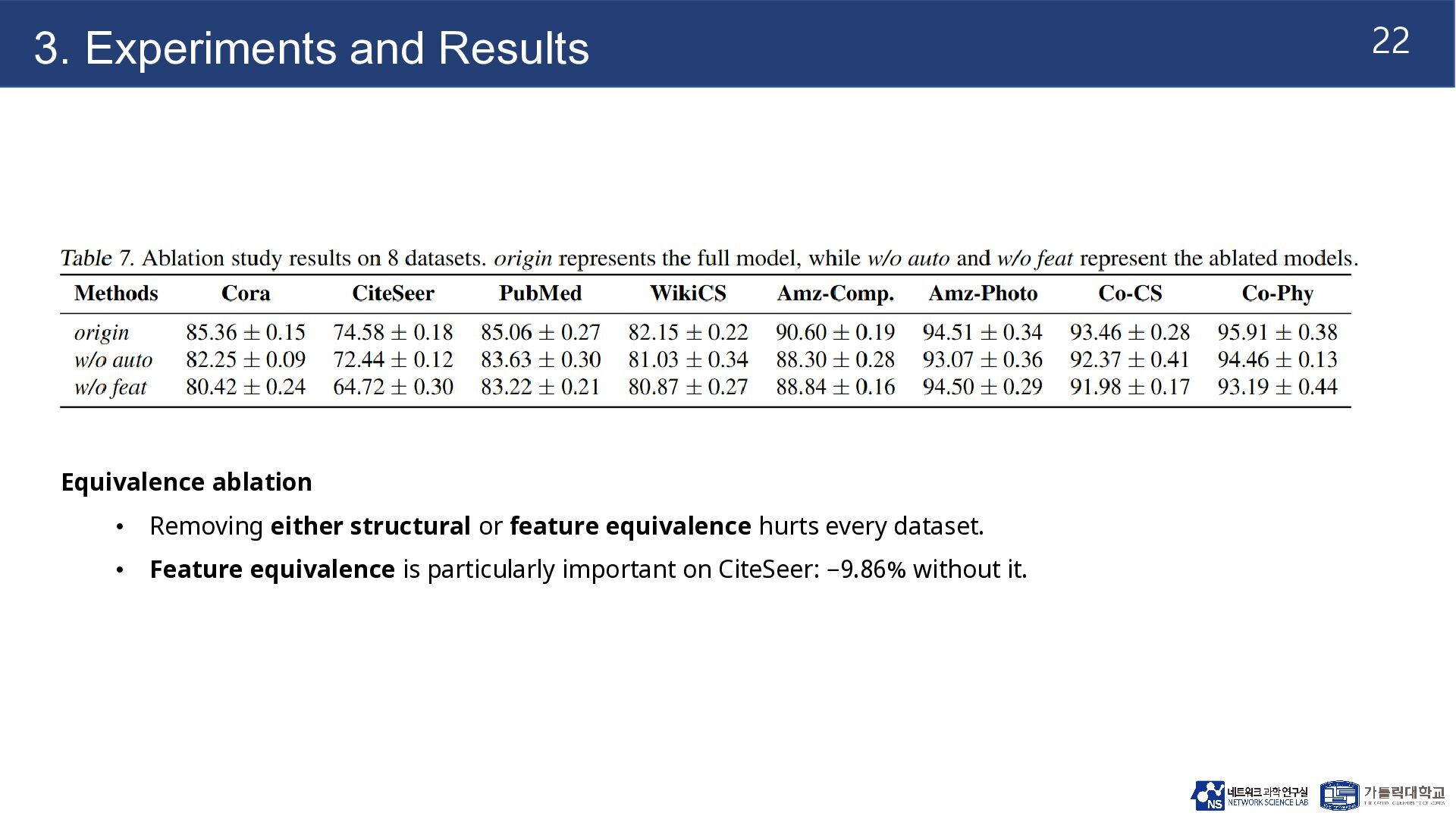
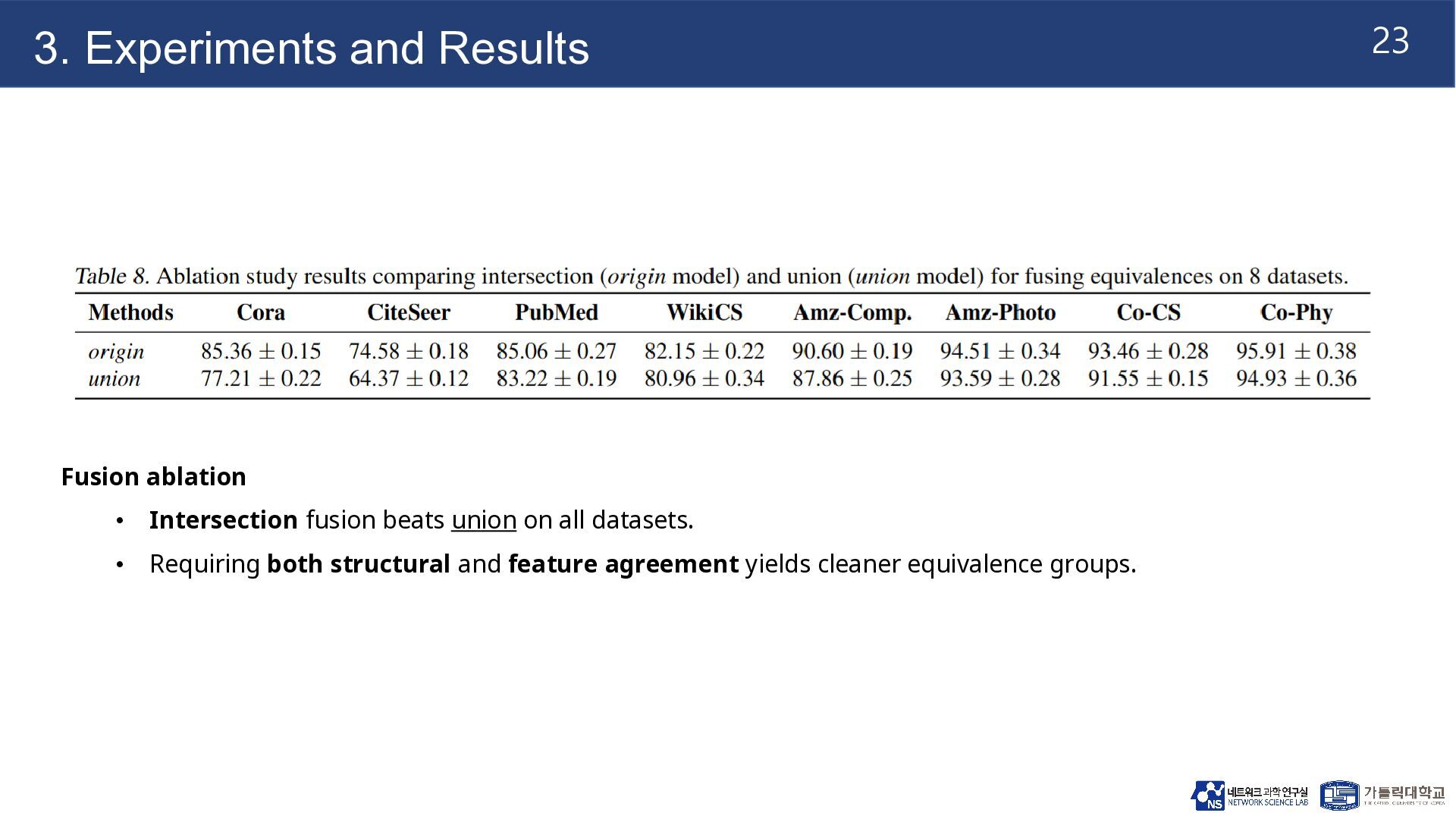
fuses structural and attribute partitions by intersection: 𝑃fuse = 𝐶𝑖 ∩ 𝐷𝑗 𝐶𝑖 ∈ 𝑃auto , 𝐷𝑗 ∈ 𝑃attr , 𝐶𝑖 ∩ 𝐷𝑗 ≠ ∅ . A fused group contains nodes that are equivalent under both relations. 𝑢 ∼fuse 𝑣 ⟺ 𝑢 ∼auto 𝑣 ∧ 𝑢 ∼attr 𝑣 . The paper proves that this fused relation is reflexive, symmetric, and transitive. Why intersection rather than union? Intersection makes the positive set stricter: a pair must agree structurally and semantically.
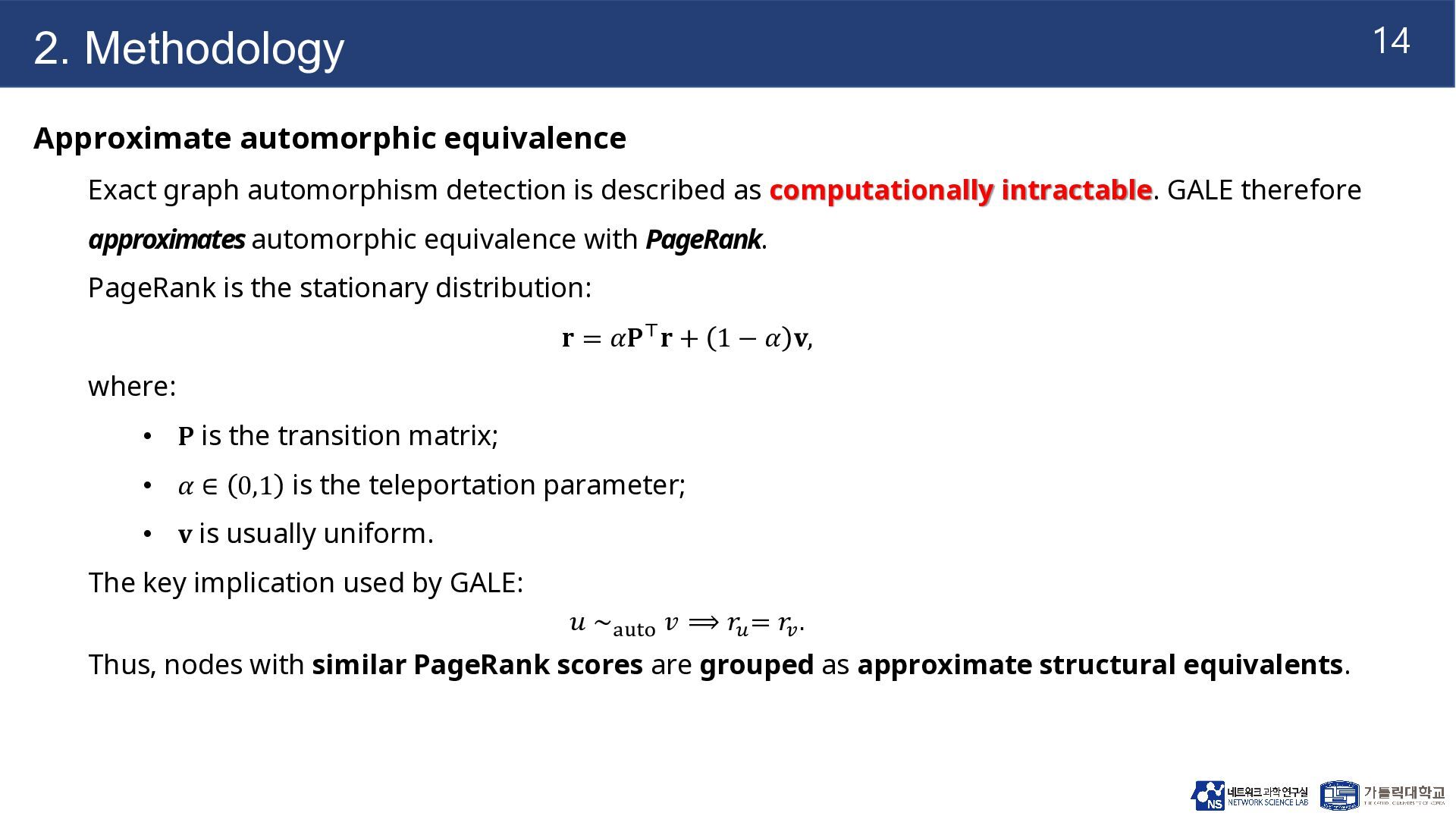
is described as computationally intractable. GALE therefore approximates automorphic equivalence with PageRank. PageRank is the stationary distribution: 𝐫 = 𝛼𝐏 ⊤ 𝐫 + 1 − 𝛼 𝐯, where: • 𝐏 is the transition matrix; • 𝛼 ∈ 0,1 is the teleportation parameter; • 𝐯 is usually uniform. The key implication used by GALE: 𝑢 ∼auto 𝑣 ⟹ 𝑟𝑢 = 𝑟𝑣 . Thus, nodes with similar PageRank scores are grouped as approximate structural equivalents.
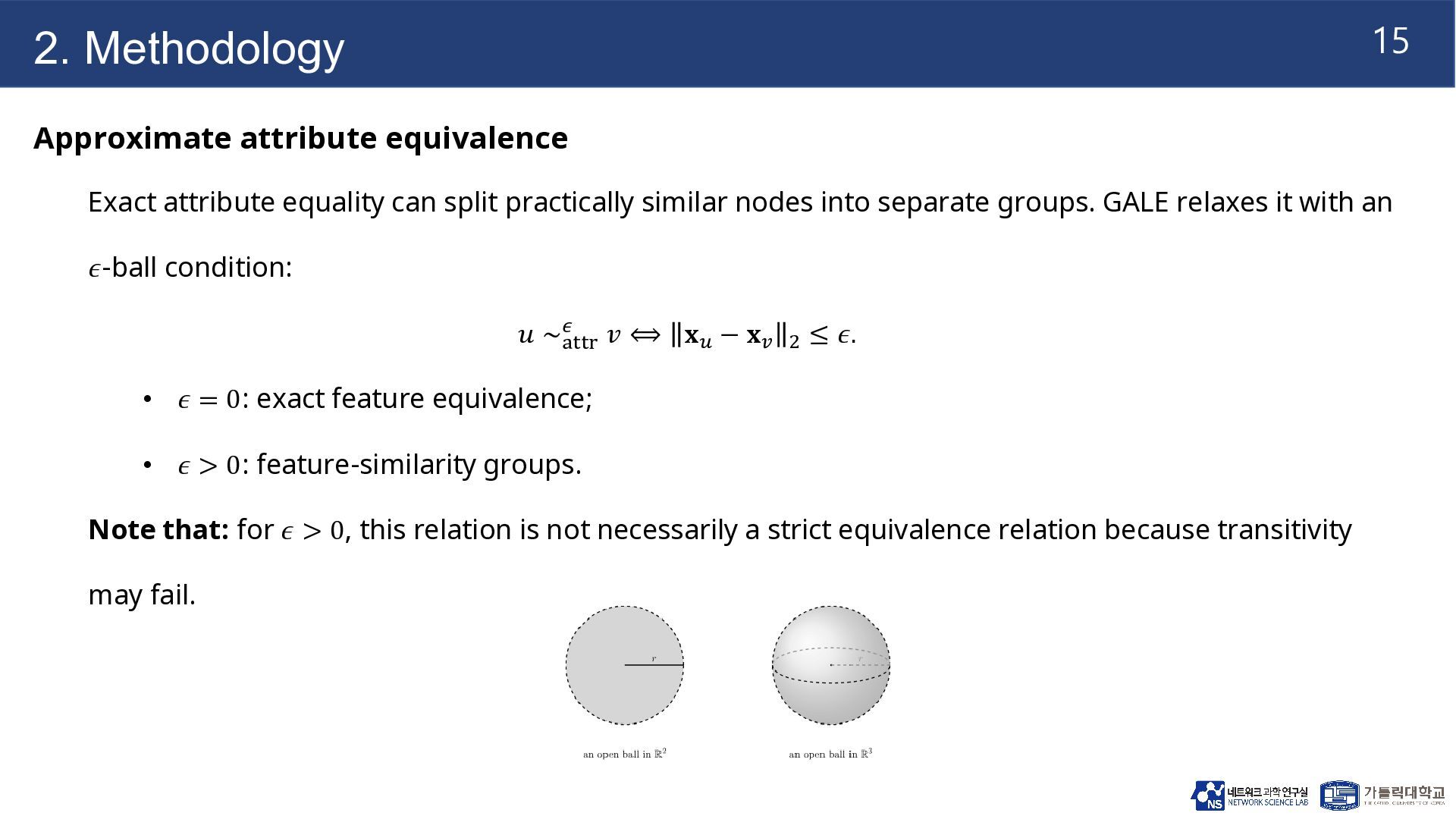
split practically similar nodes into separate groups. GALE relaxes it with an 𝜖-ball condition: 𝑢 ∼𝜖attr 𝑣 ⟺ 𝐱 𝑢 − 𝐱 𝑣 2 ≤ 𝜖. • 𝜖 = 0: exact feature equivalence; • 𝜖 > 0: feature-similarity groups. Note that: for 𝜖 > 0, this relation is not necessarily a strict equivalence relation because transitivity may fail.
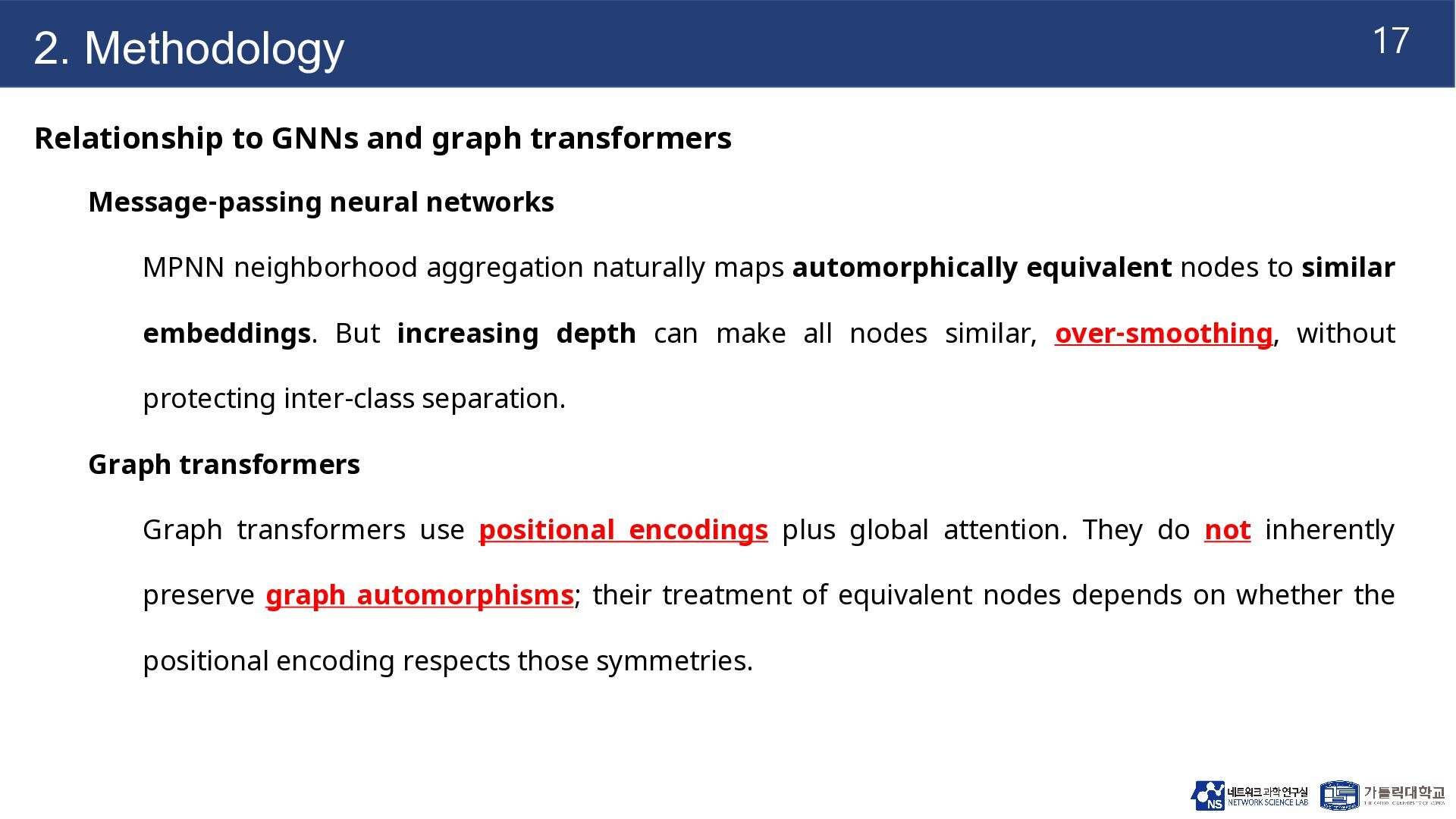
neural networks MPNN neighborhood aggregation naturally maps automorphically equivalent nodes to similar embeddings. But increasing depth can make all nodes similar, over-smoothing, without protecting inter-class separation. Graph transformers Graph transformers use positional encodings plus global attention. They do not inherently preserve graph automorphisms; their treatment of equivalent nodes depends on whether the positional encoding respects those symmetries.
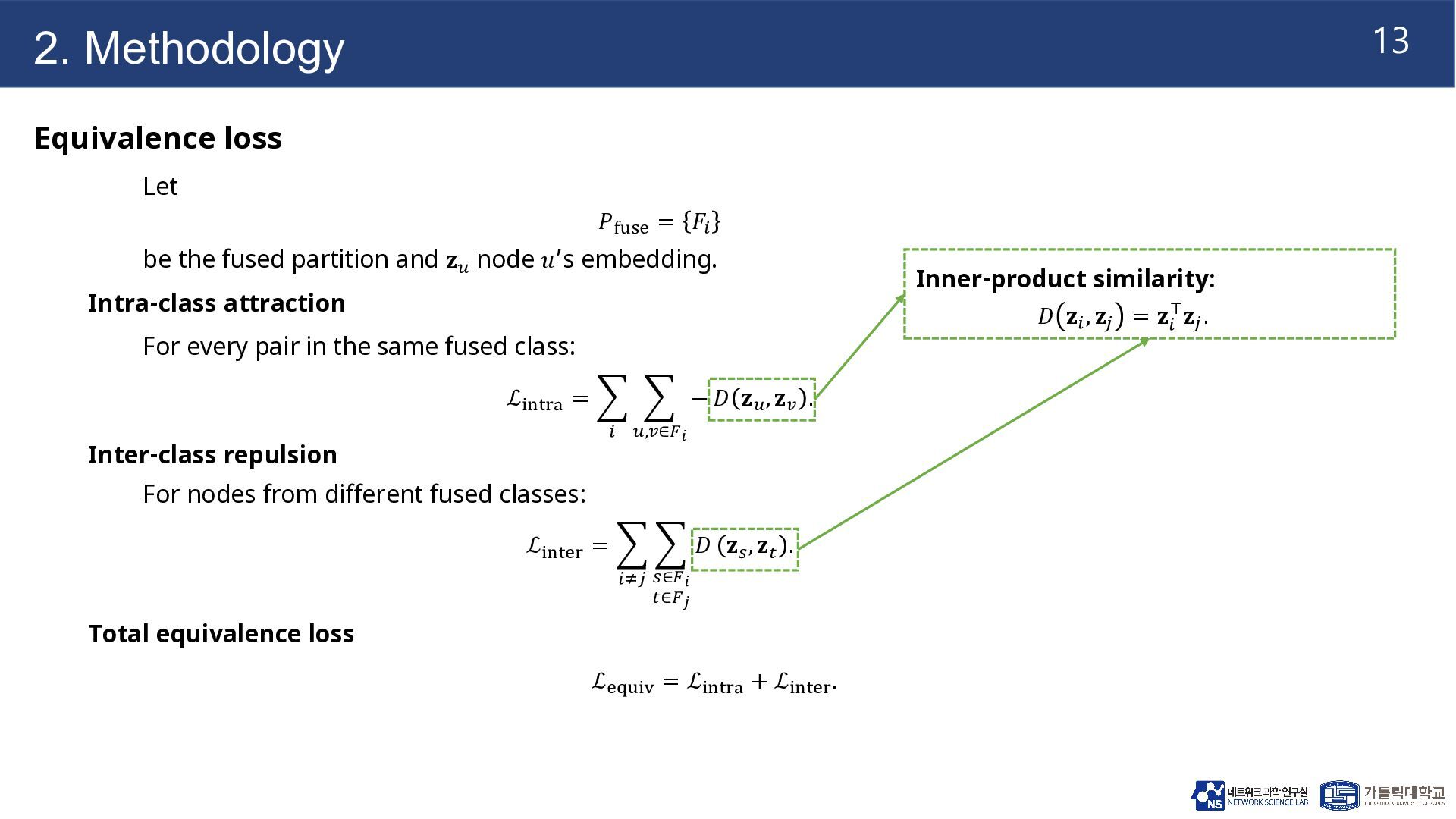
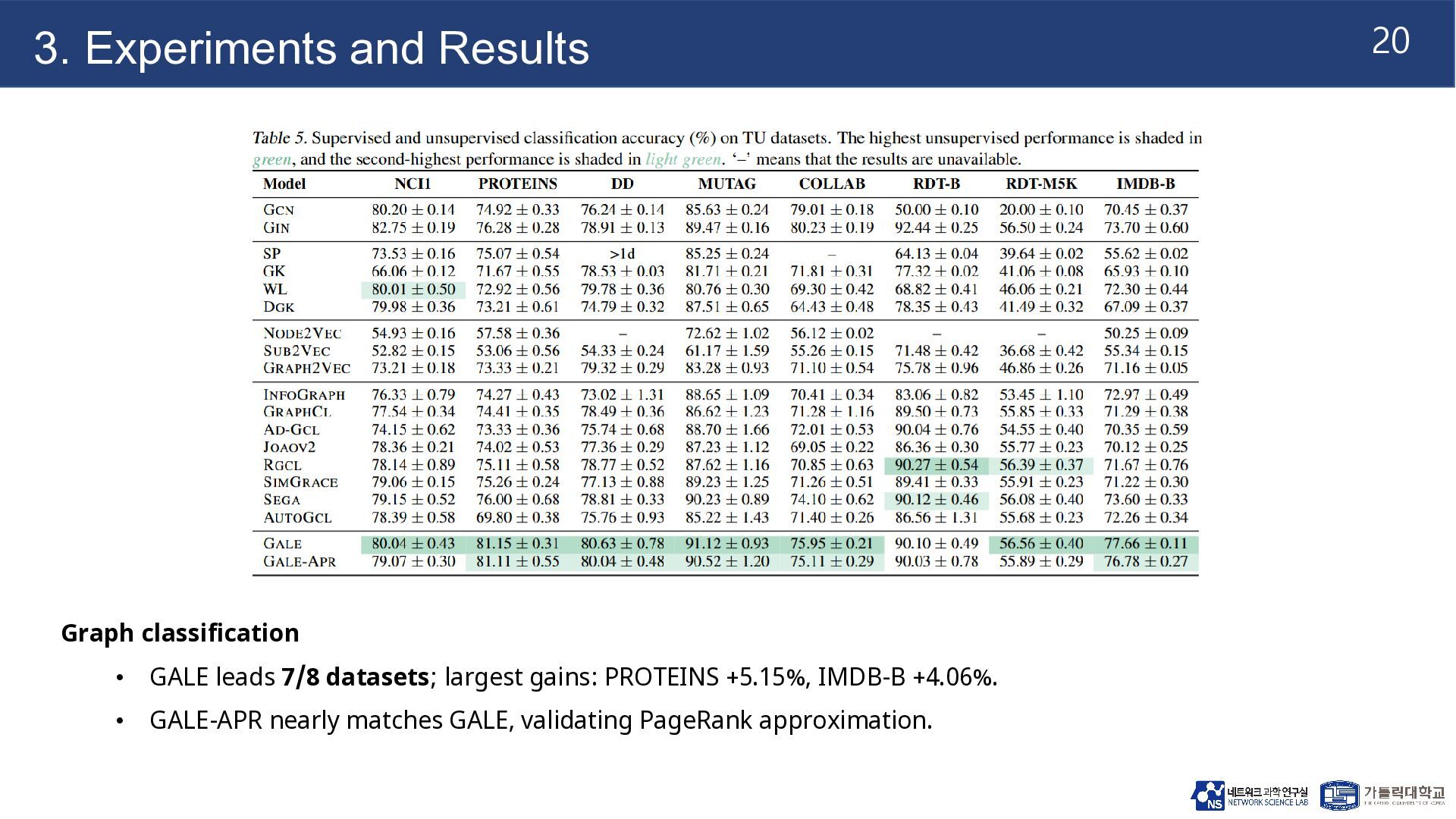
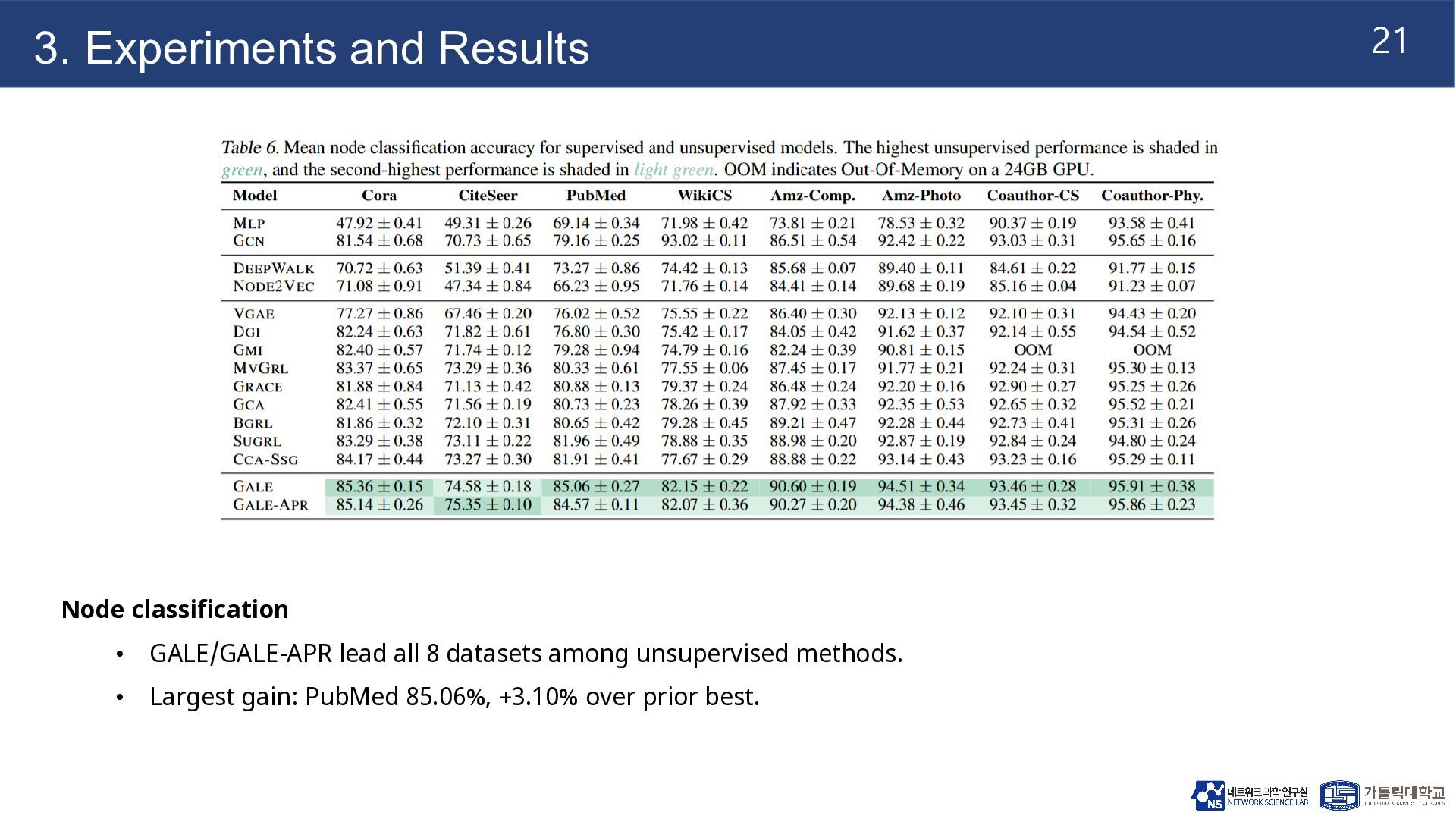
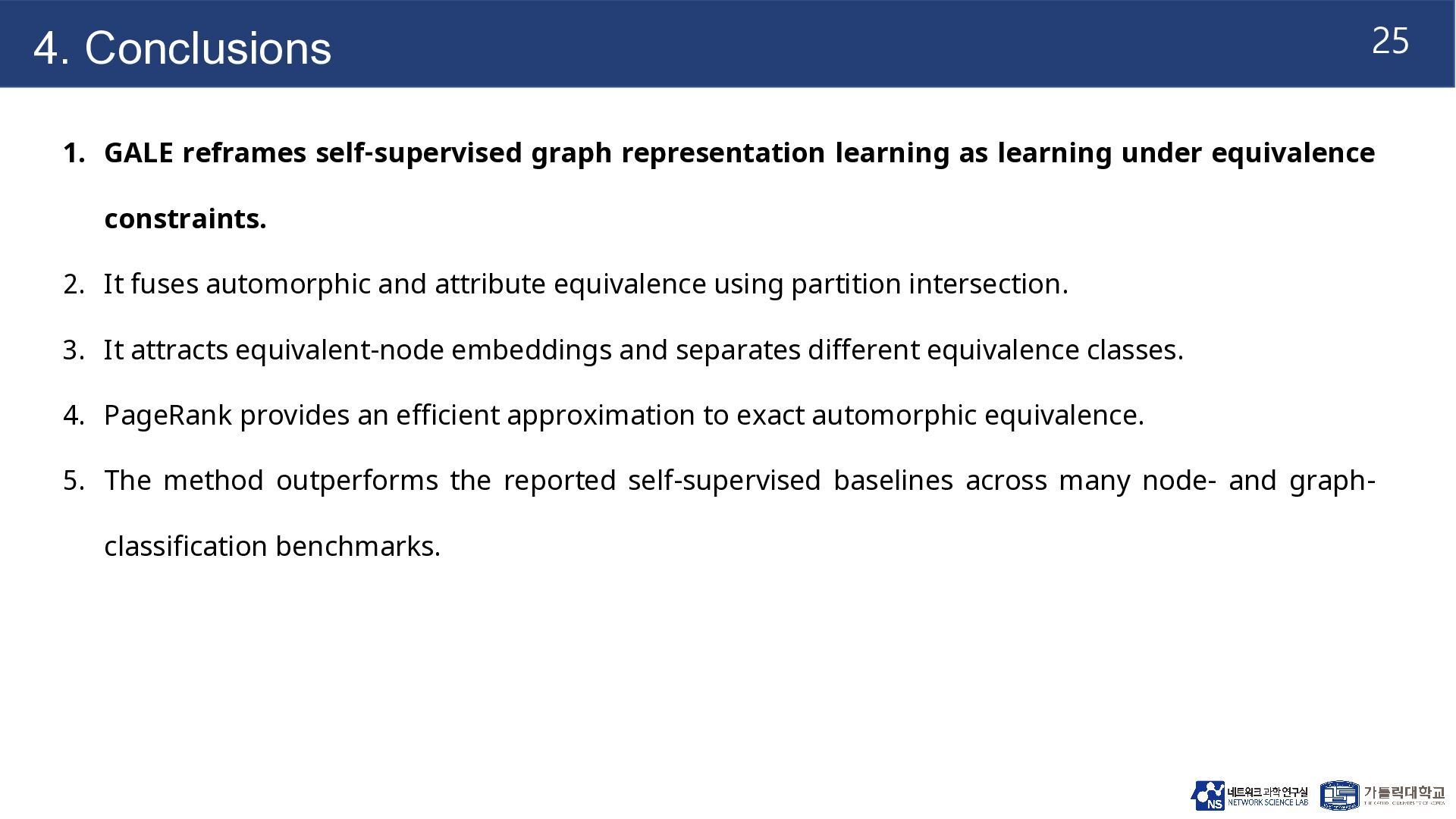
as learning under equivalence constraints. 2. It fuses automorphic and attribute equivalence using partition intersection. 3. It attracts equivalent-node embeddings and separates different equivalence classes. 4. PageRank provides an efficient approximation to exact automorphic equivalence. 5. The method outperforms the reported self-supervised baselines across many node- and graphclassification benchmarks.
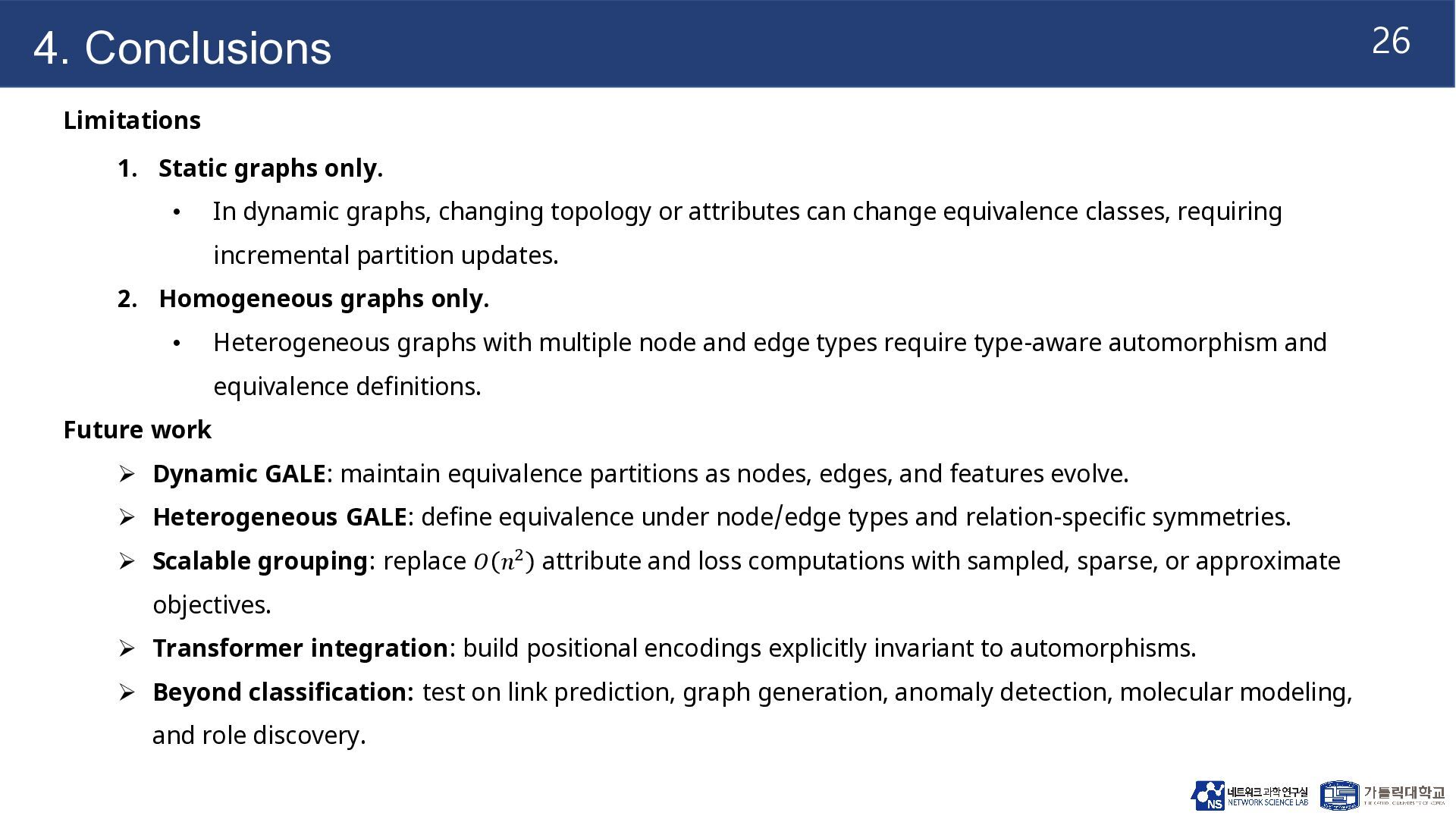
graphs, changing topology or attributes can change equivalence classes, requiring incremental partition updates. 2. Homogeneous graphs only. • Heterogeneous graphs with multiple node and edge types require type-aware automorphism and equivalence definitions. Future work ➢ Dynamic GALE: maintain equivalence partitions as nodes, edges, and features evolve. ➢ Heterogeneous GALE: define equivalence under node/edge types and relation-specific symmetries. ➢ Scalable grouping: replace 𝑂 𝑛2 attribute and loss computations with sampled, sparse, or approximate objectives. ➢ Transformer integration: build positional encodings explicitly invariant to automorphisms. ➢ Beyond classification: test on link prediction, graph generation, anomaly detection, molecular modeling, and role discovery. 26


 imai448
 sazimai
 yukiar
 nnchiba
 rikkabotan7
 mikimhk
 dk999
 satai
 yukako_nakano
 takasehideki
 stktu
 cromwellryan
 orderedlist
 yeseniaperezcruz
 jonoalderson
 tammyeverts
 signer
 thekraken
 mfonobong
 greggifford
 stuffmc
 axbom
 irinanazarova