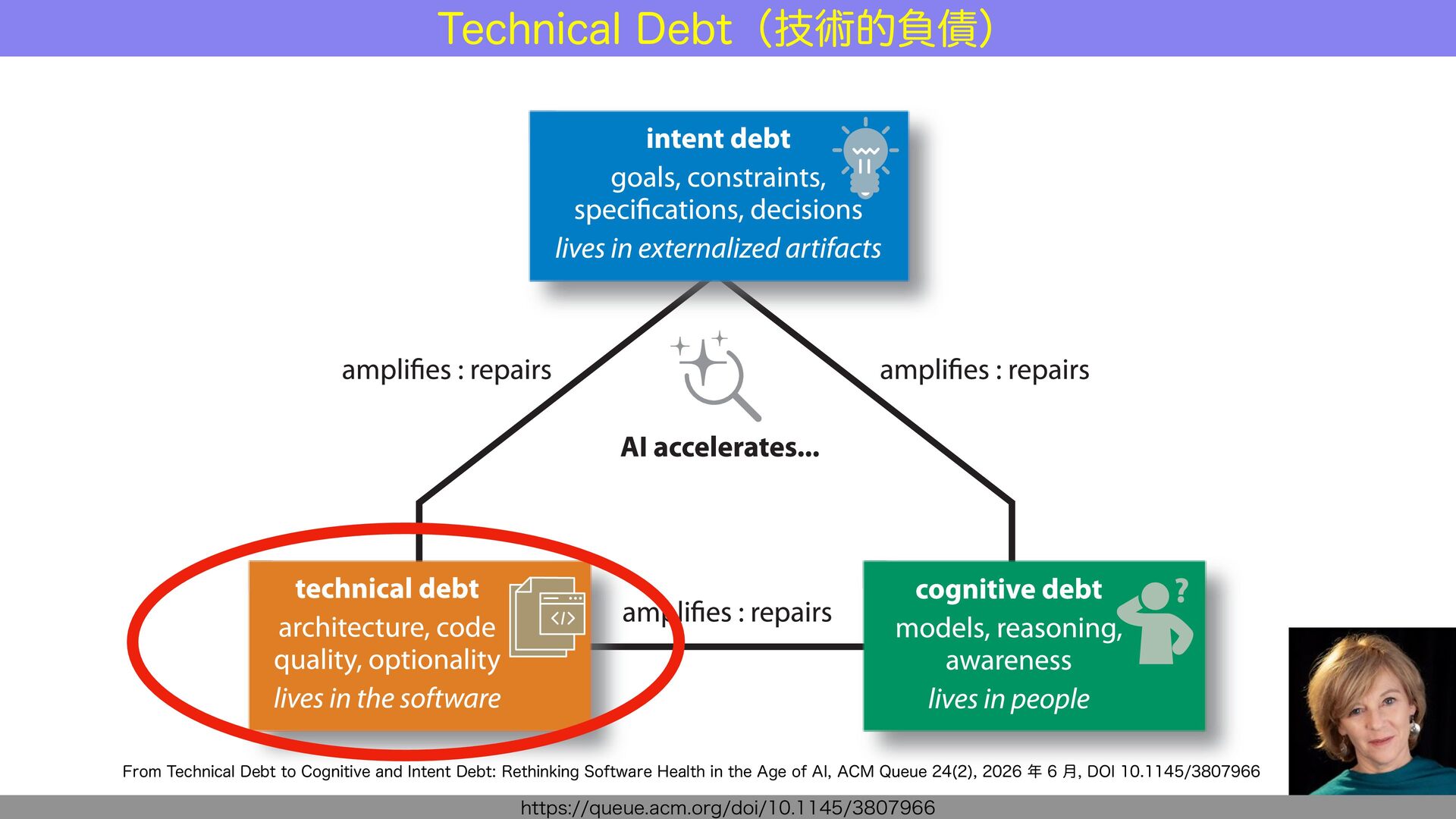
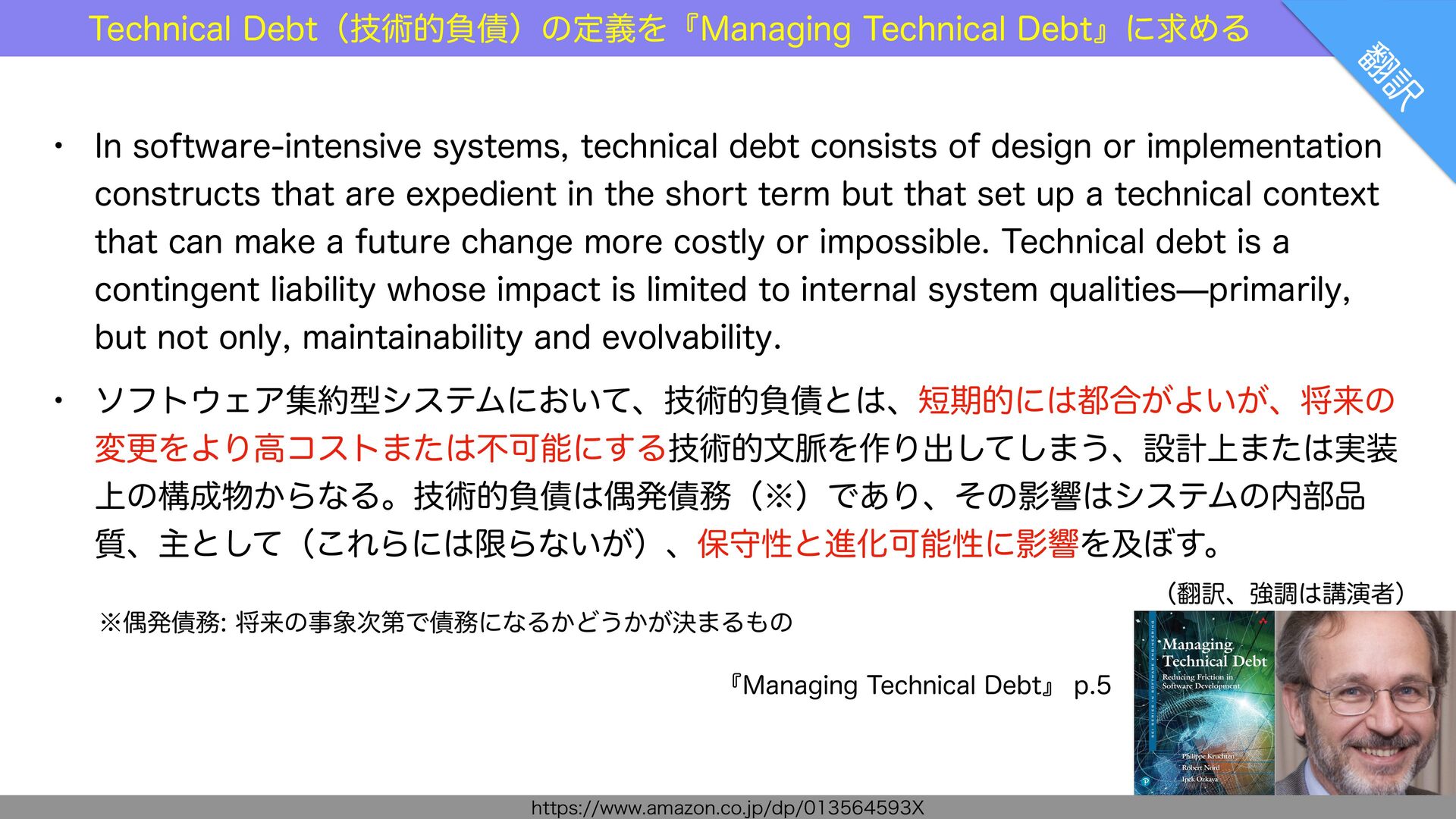
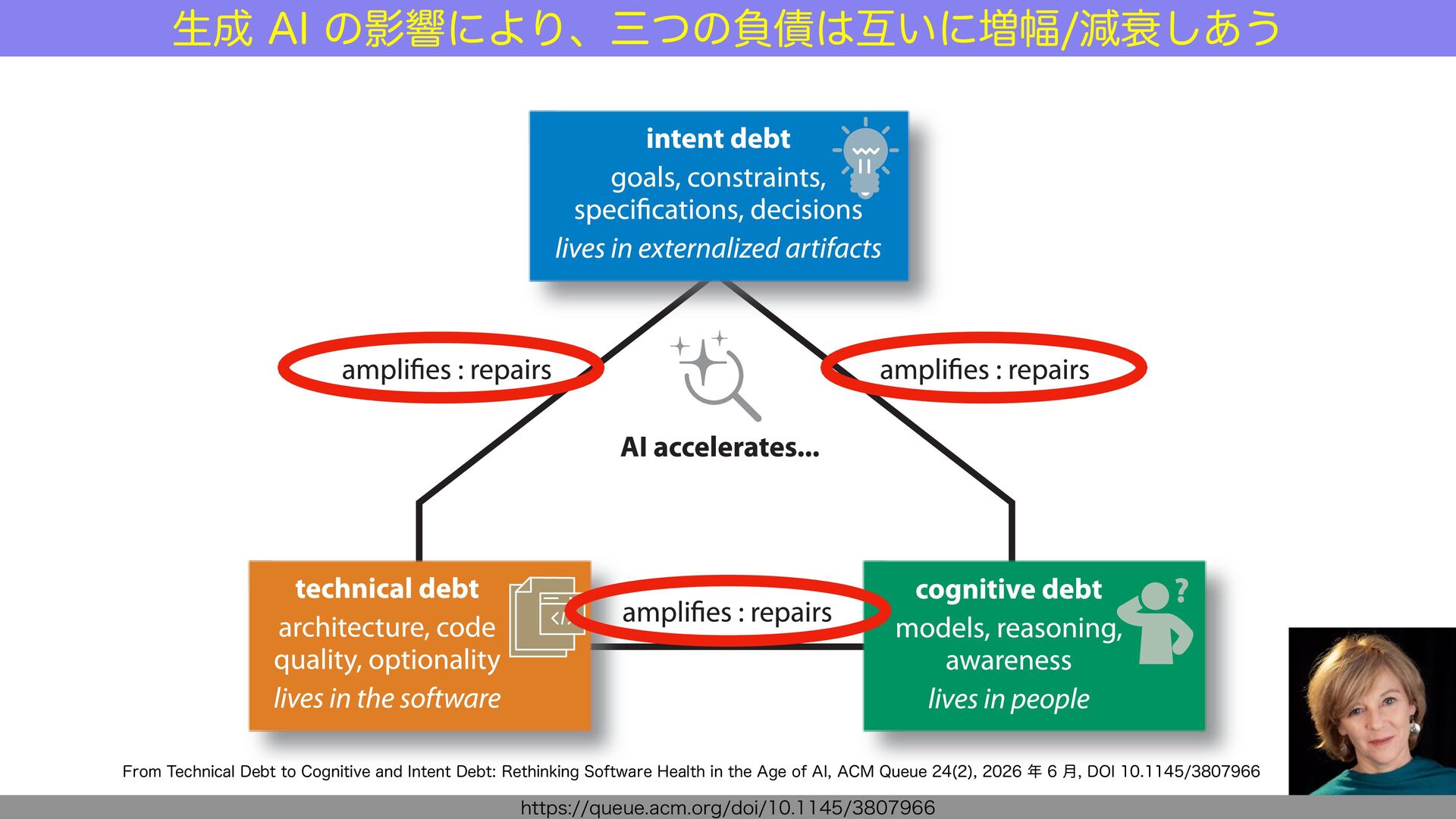
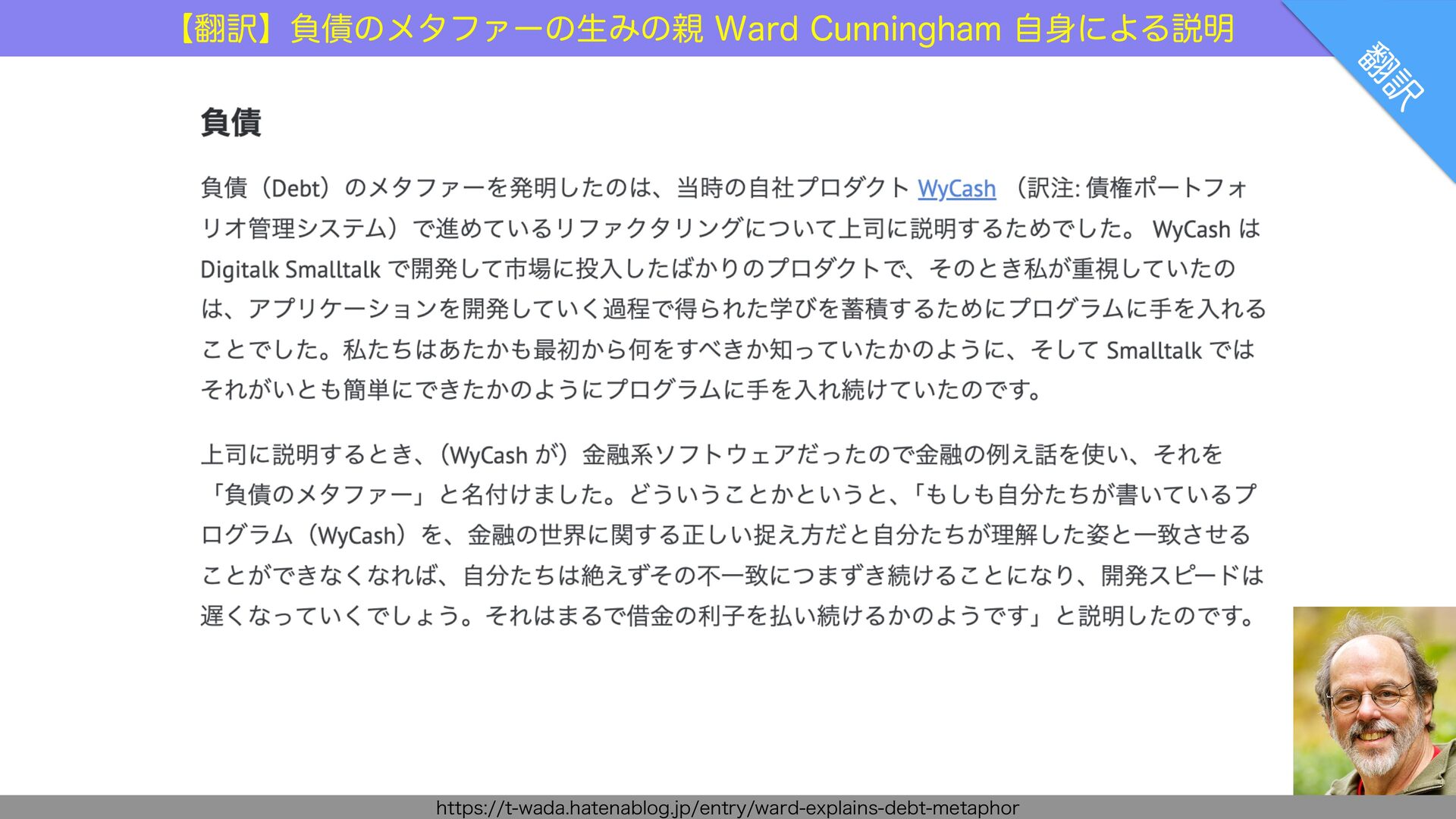
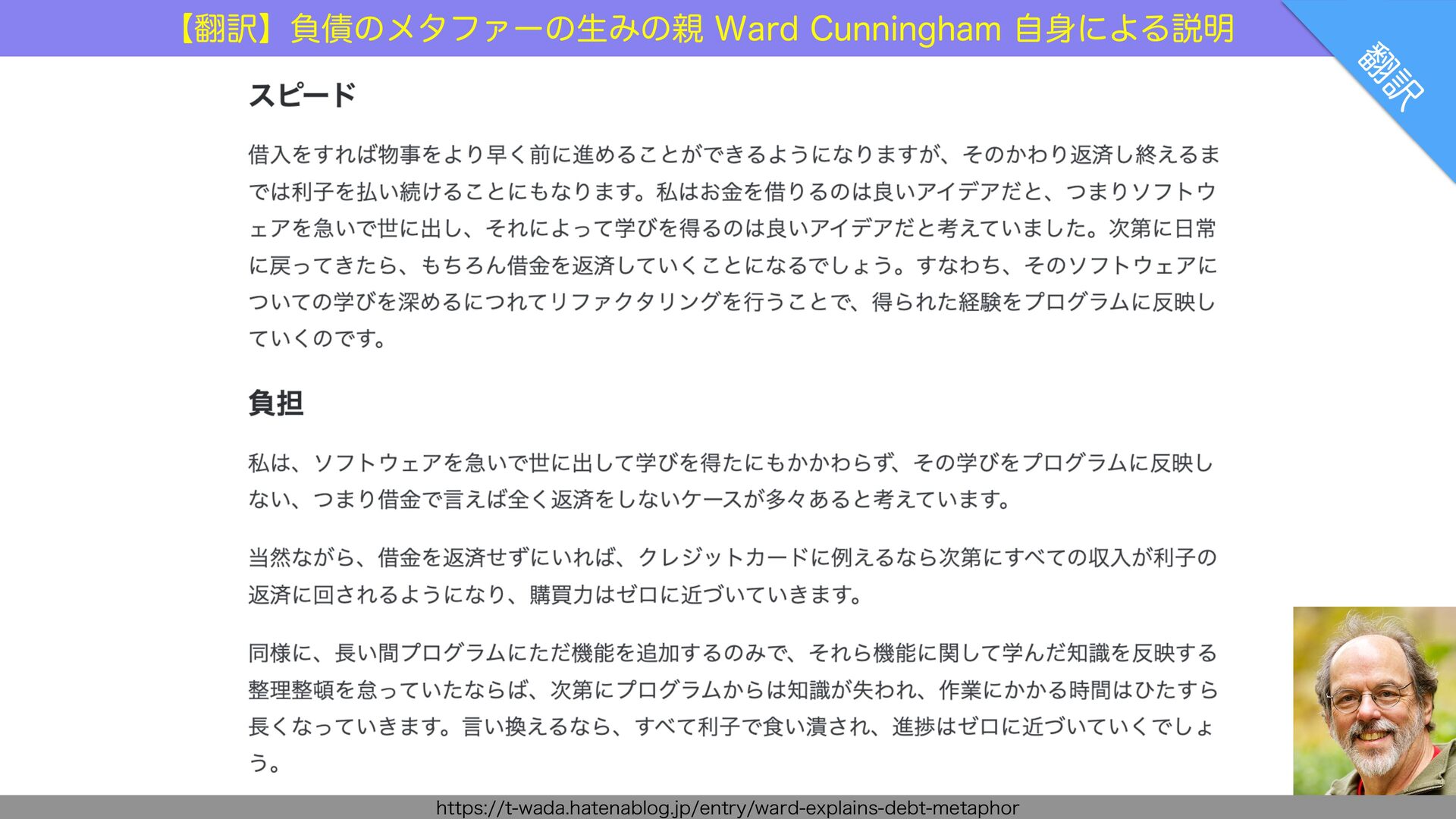
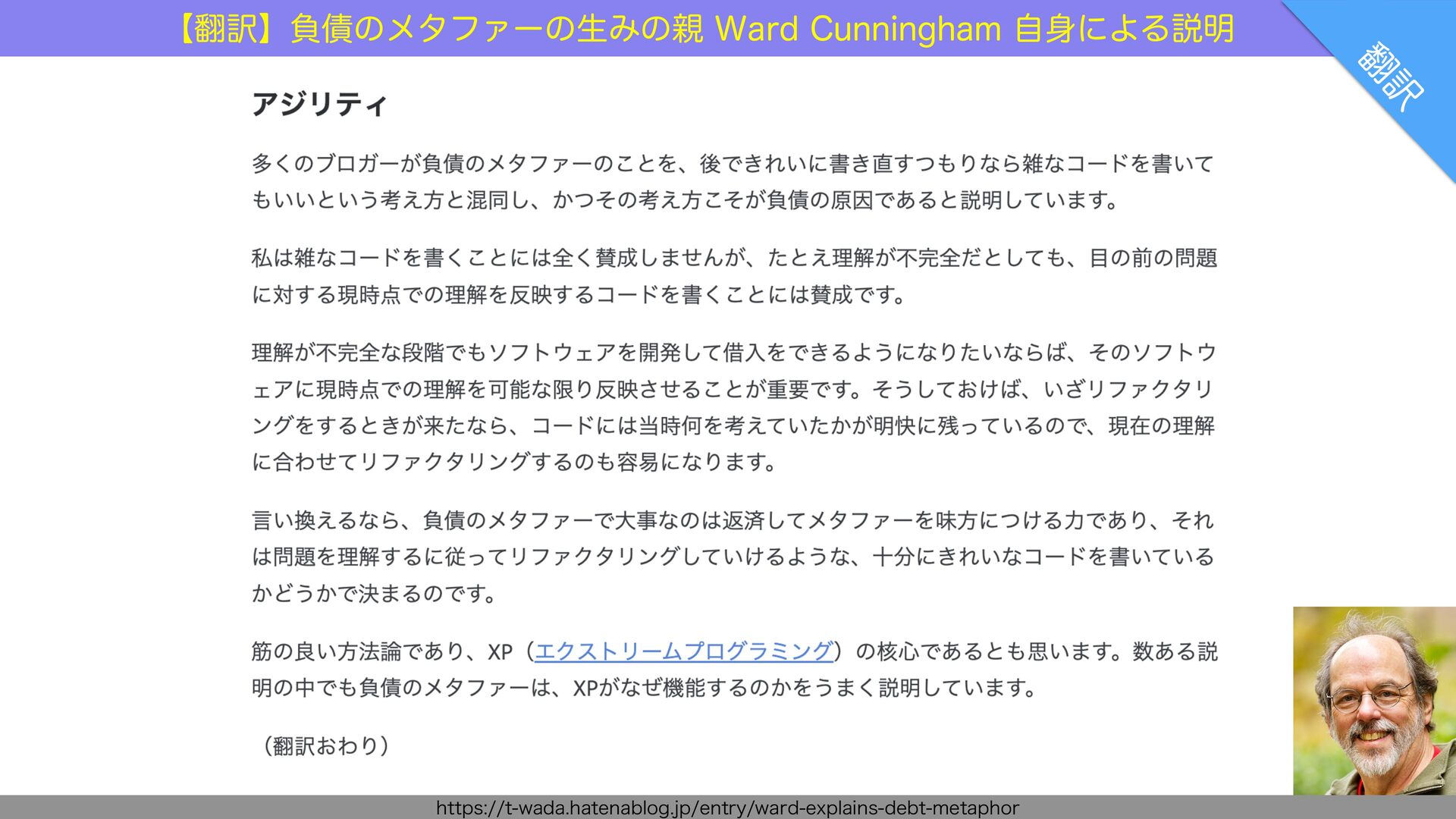
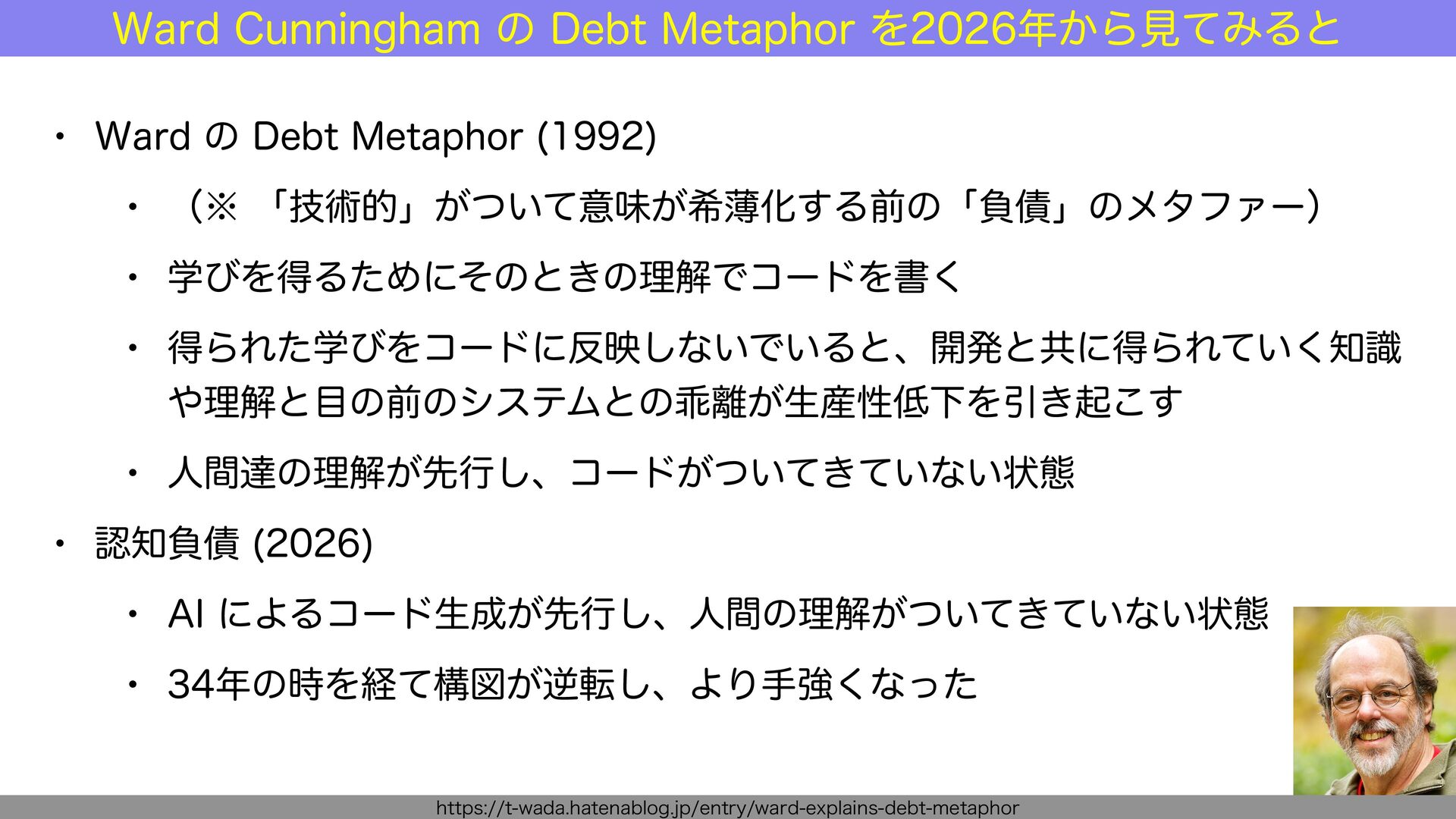
technical debt consists of design or implementation constructs that are expedient in the short term but that set up a technical context that can make a future change more costly or impossible. Technical debt is a contingent liability whose impact is limited to internal system qualities primarily, but not only, maintainability and evolvability. • ソフトウェア集約型システムにおいて、技術的負債とは、短期的には都合がよいが、将来の 変更をより高コストまたは不可能にする技術的文脈を作り出してしまう、設計上または実装 上の構成物からなる。技術的負債は偶発債務(※)であり、その影響はシステムの内部品 質、主として(これらには限らないが)、保守性と進化可能性に影響を及ぼす。 (翻訳、強調は講演者) ※偶発債務: 将来の事象次第で債務になるかどうかが決まるもの 『Managing Technical Debt』 p.5 — https://www.amazon.co.jp/dp/013564593X
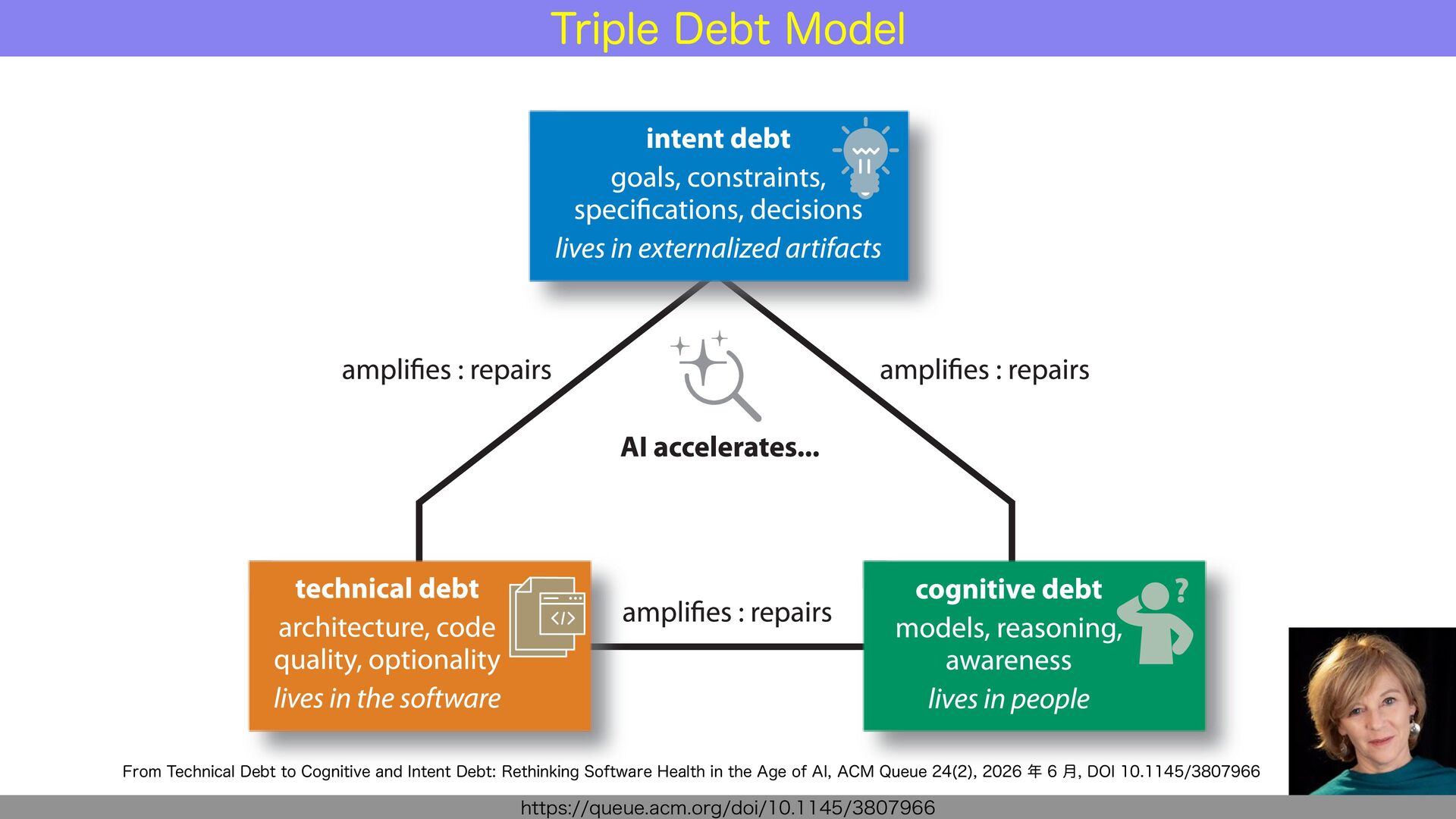
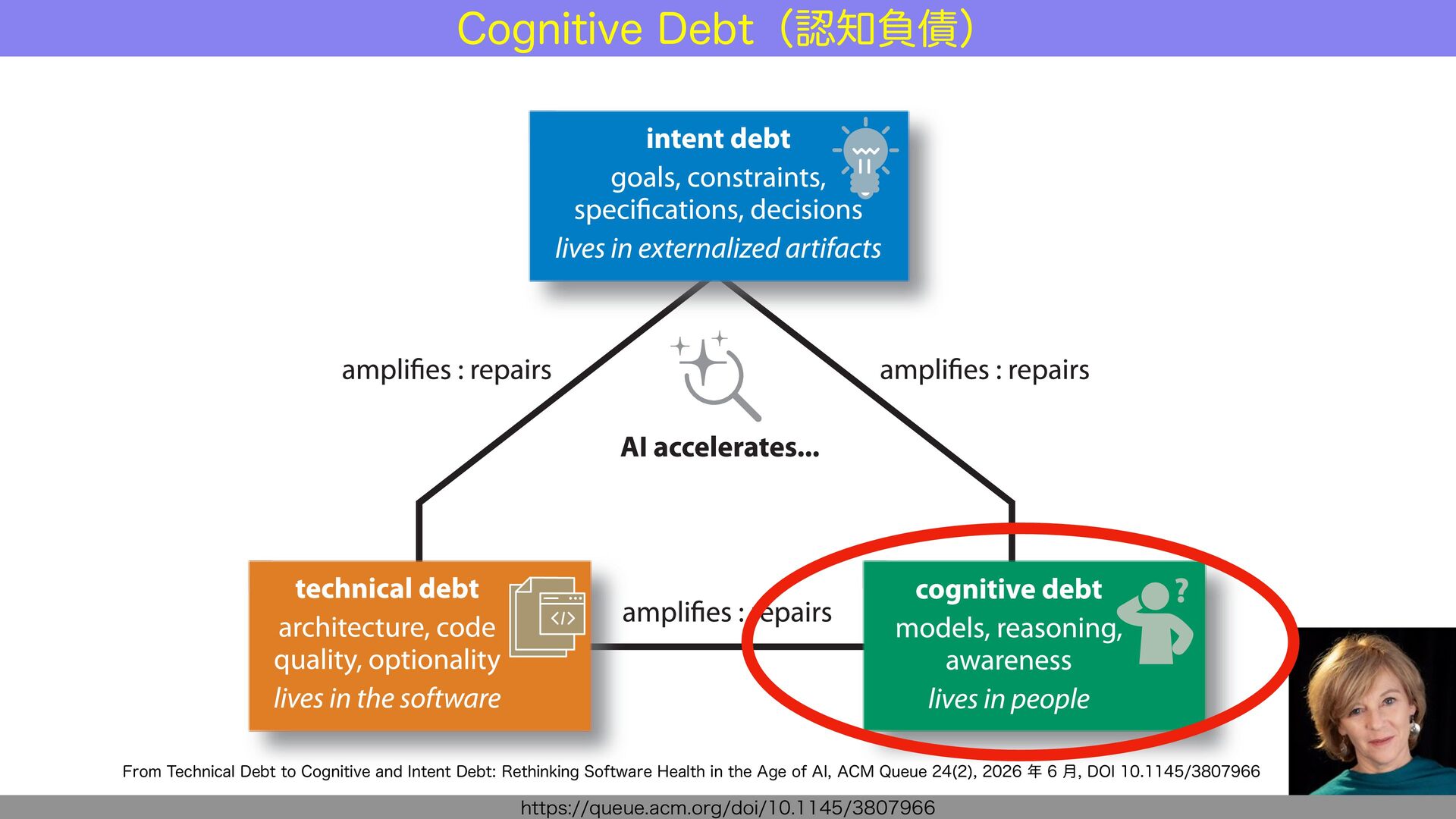
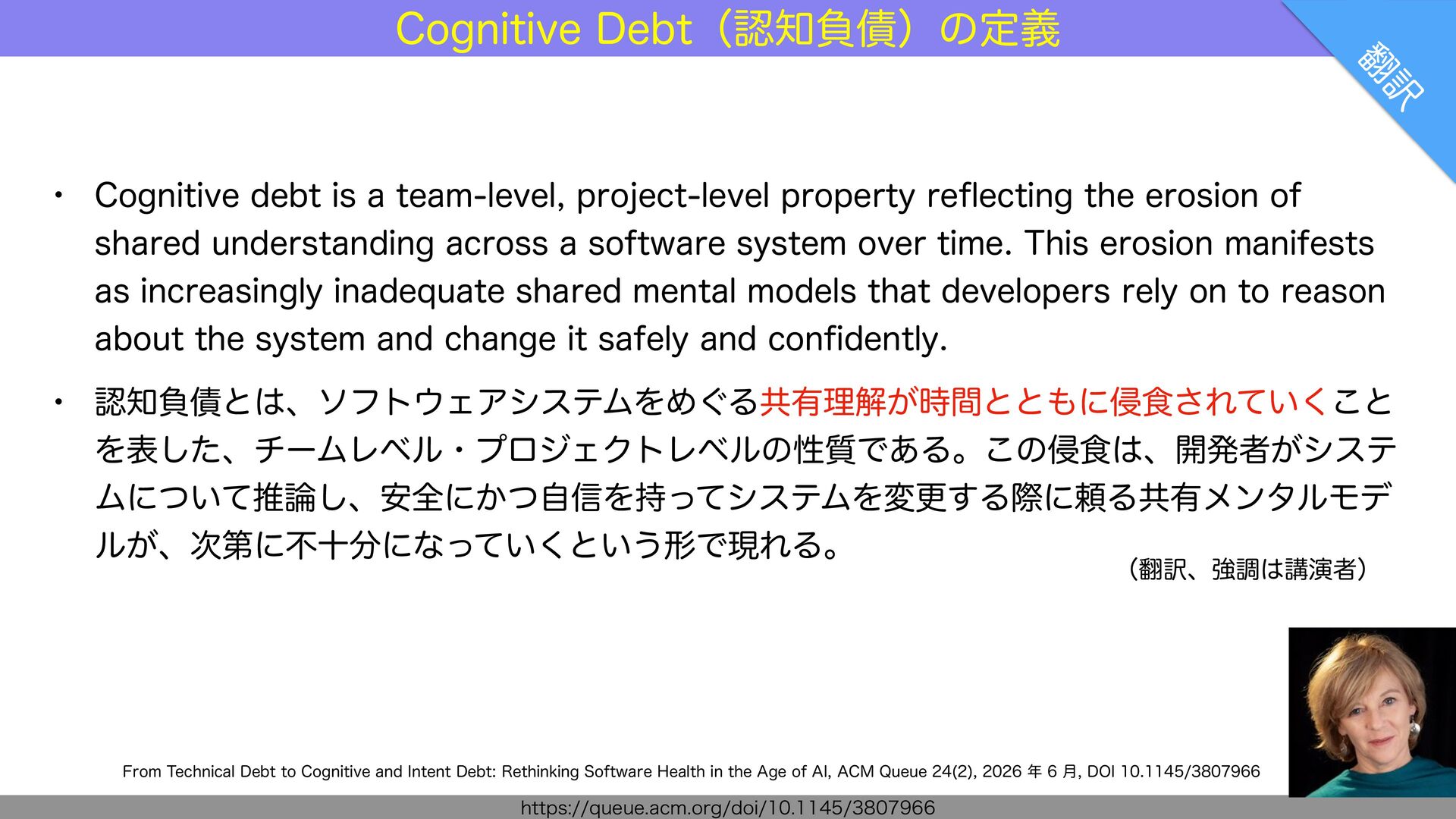
project-level property re ecting the erosion of shared understanding across a software system over time. This erosion manifests as increasingly inadequate shared mental models that developers rely on to reason about the system and change it safely and con dently. • 認知負債とは、ソフトウェアシステムをめぐる共有理解が時間とともに侵食されていくこと を表した、チームレベル・プロジェクトレベルの性質である。この侵食は、開発者がシステ ムについて推論し、安全にかつ自信を持ってシステムを変更する際に頼る共有メンタルモデ ルが、次第に不十分になっていくという形で現れる。 (翻訳、強調は講演者) From Technical Debt to Cognitive and Intent Debt: Rethinking Software Health in the Age of AI, ACM Queue 24(2), 2026 年 6 月, DOI 10.1145/3807966 fl fi https://queue.acm.org/doi/10.1145/3807966
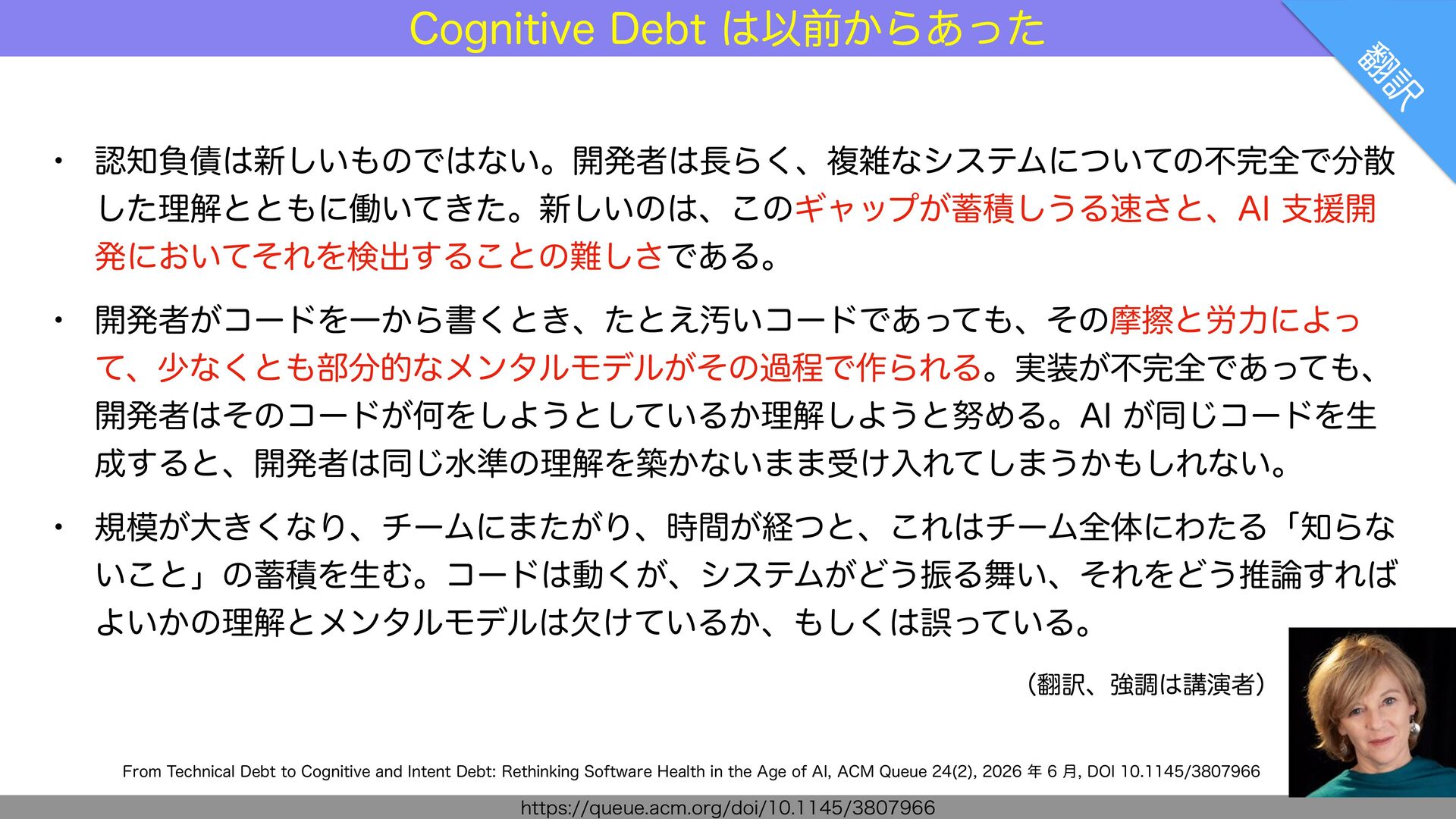
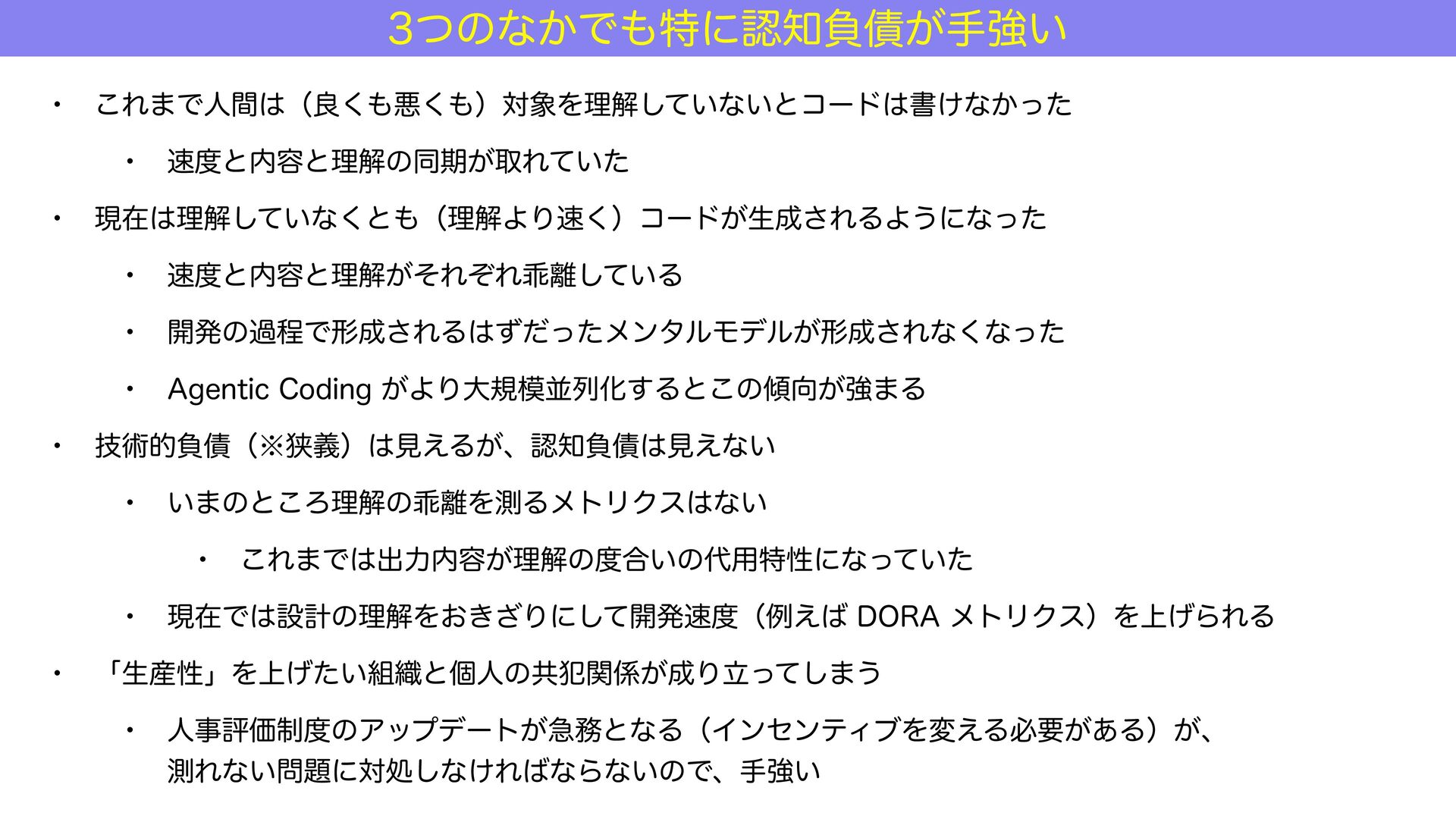
• 開発者がコードを一から書くとき、たとえ汚いコードであっても、その摩擦と労力によっ て、少なくとも部分的なメンタルモデルがその過程で作られる。実装が不完全であっても、 開発者はそのコードが何をしようとしているか理解しようと努める。AI が同じコードを生 成すると、開発者は同じ水準の理解を築かないまま受け入れてしまうかもしれない。 • 規模が大きくなり、チームにまたがり、時間が経つと、これはチーム全体にわたる「知らな いこと」の蓄積を生む。コードは動くが、システムがどう振る舞い、それをどう推論すれば よいかの理解とメンタルモデルは欠けているか、もしくは誤っている。 (翻訳、強調は講演者) From Technical Debt to Cognitive and Intent Debt: Rethinking Software Health in the Age of AI, ACM Queue 24(2), 2026 年 6 月, DOI 10.1145/3807966 https://queue.acm.org/doi/10.1145/3807966
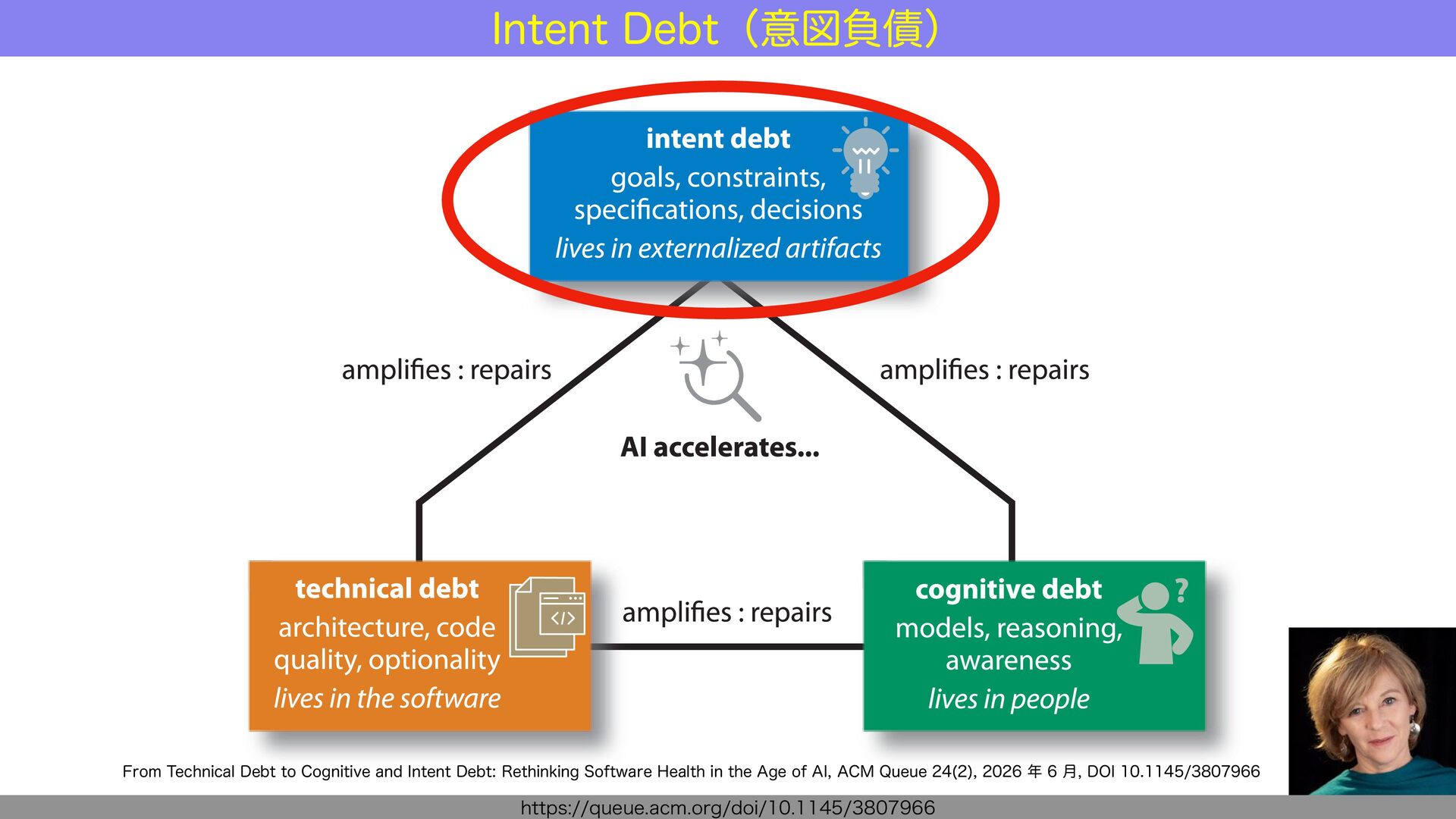
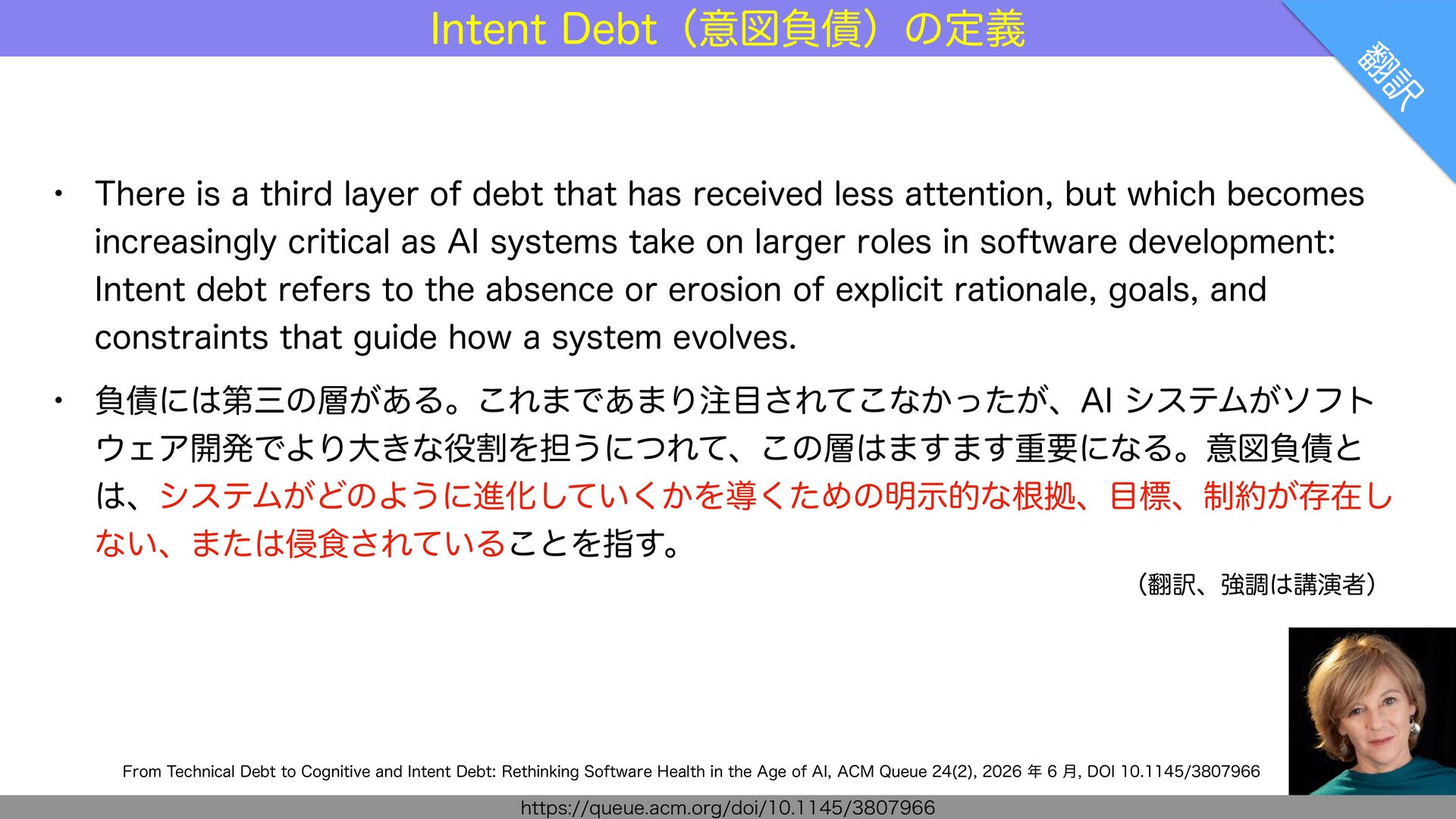
of debt that has received less attention, but which becomes increasingly critical as AI systems take on larger roles in software development: Intent debt refers to the absence or erosion of explicit rationale, goals, and constraints that guide how a system evolves. • 負債には第三の層がある。これまであまり注目されてこなかったが、AI システムがソフト ウェア開発でより大きな役割を担うにつれて、この層はますます重要になる。意図負債と は、システムがどのように進化していくかを導くための明示的な根拠、目標、制約が存在し ない、または侵食されていることを指す。 (翻訳、強調は講演者) From Technical Debt to Cognitive and Intent Debt: Rethinking Software Health in the Age of AI, ACM Queue 24(2), 2026 年 6 月, DOI 10.1145/3807966 https://queue.acm.org/doi/10.1145/3807966
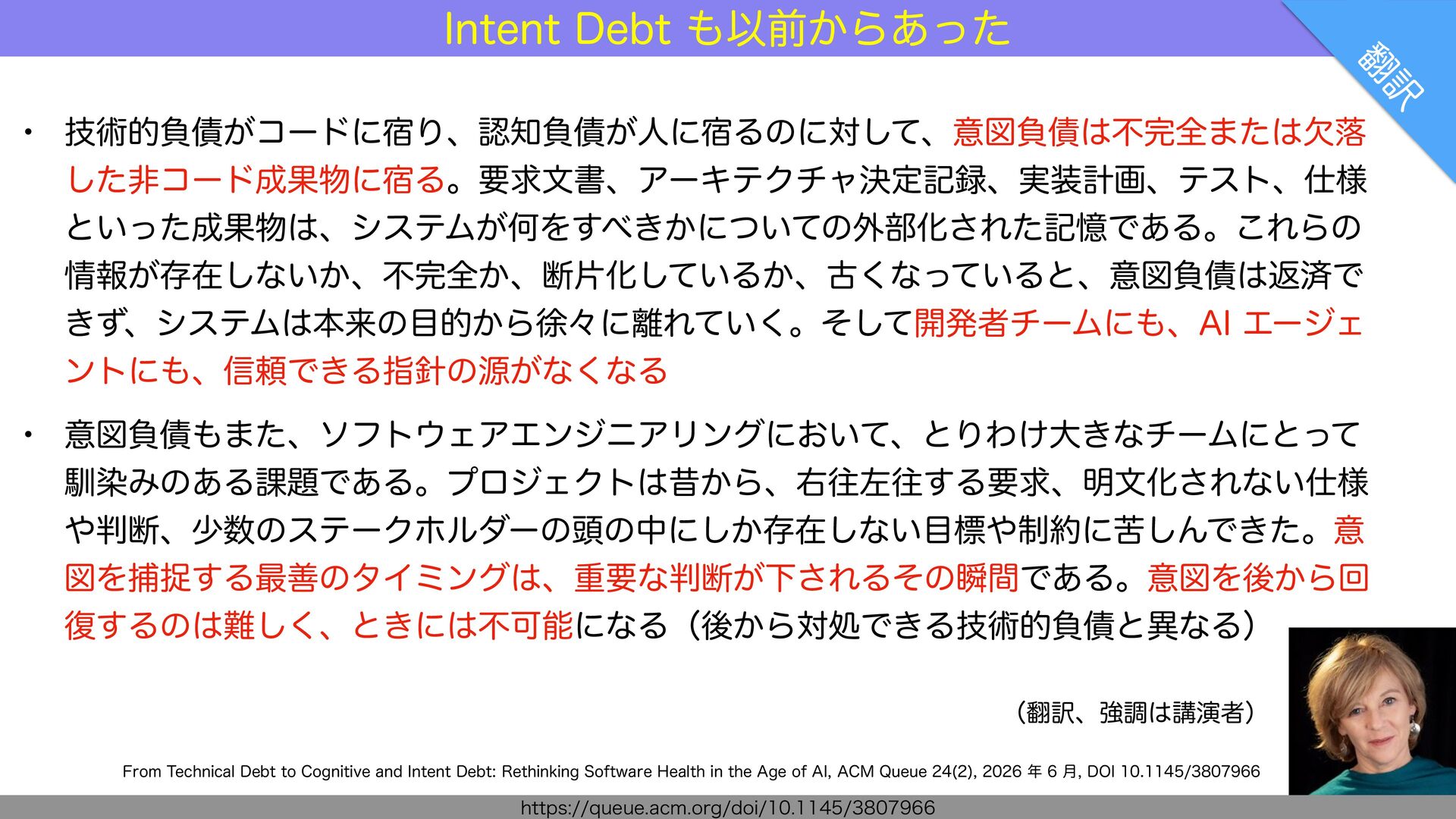
意図負債もまた、ソフトウェアエンジニアリングにおいて、とりわけ大きなチームにとって 馴染みのある課題である。プロジェクトは昔から、右往左往する要求、明文化されない仕様 や判断、少数のステークホルダーの頭の中にしか存在しない目標や制約に苦しんできた。意 図を捕捉する最善のタイミングは、重要な判断が下されるその瞬間である。意図を後から回 復するのは難しく、ときには不可能になる(後から対処できる技術的負債と異なる) (翻訳、強調は講演者) From Technical Debt to Cognitive and Intent Debt: Rethinking Software Health in the Age of AI, ACM Queue 24(2), 2026 年 6 月, DOI 10.1145/3807966 https://queue.acm.org/doi/10.1145/3807966 訳 翻 • 技術的負債がコードに宿り、認知負債が人に宿るのに対して、意図負債は不完全または欠落
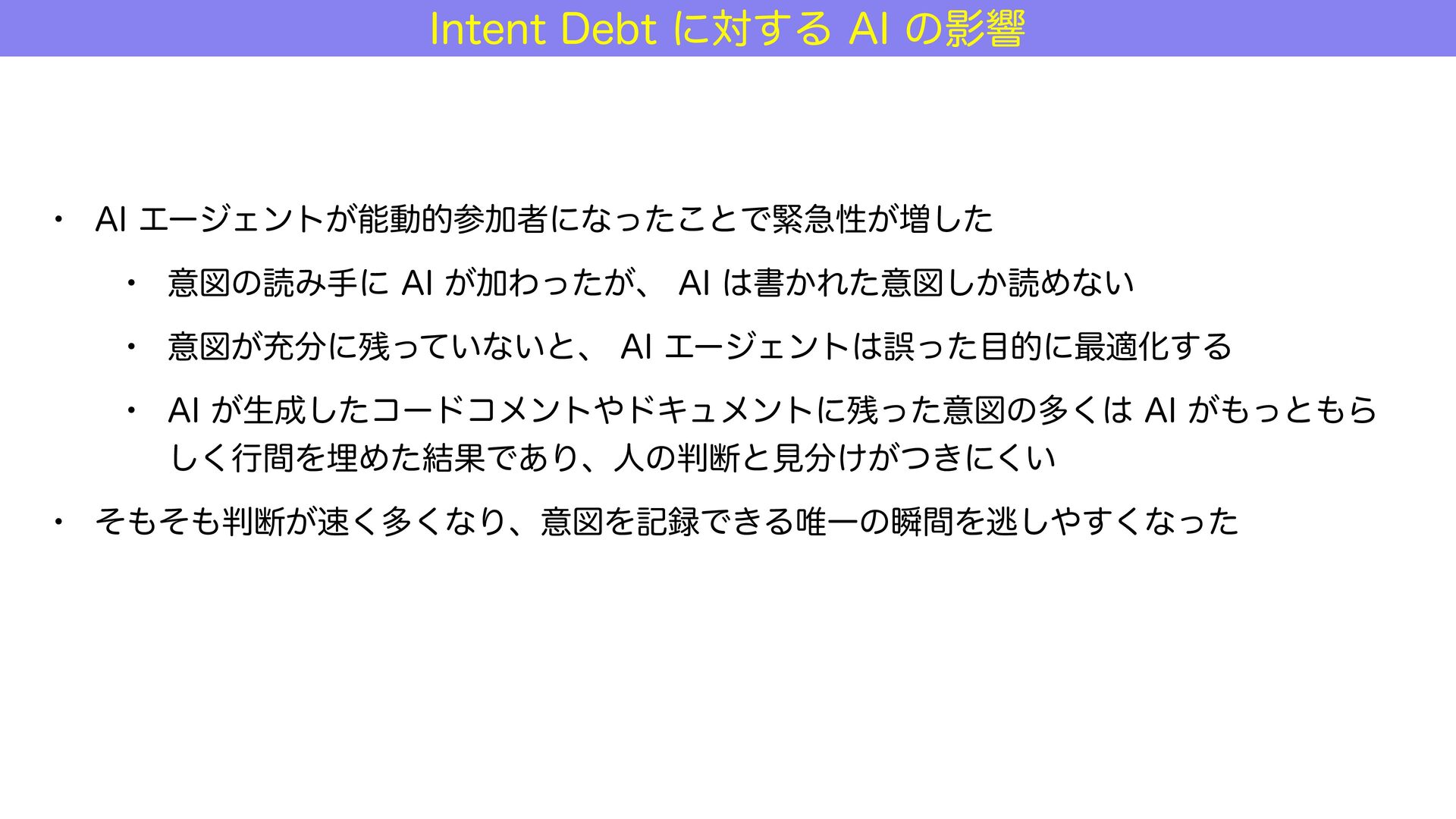
AI が加わったが、 AI は書かれた意図しか読めない • 意図が充分に残っていないと、 AI エージェントは誤った目的に最適化する • AI が生成したコードコメントやドキュメントに残った意図の多くは AI がもっともら しく行間を埋めた結果であり、人の判断と見分けがつきにくい • そもそも判断が速く多くなり、意図を記録できる唯一の瞬間を逃しやすくなった
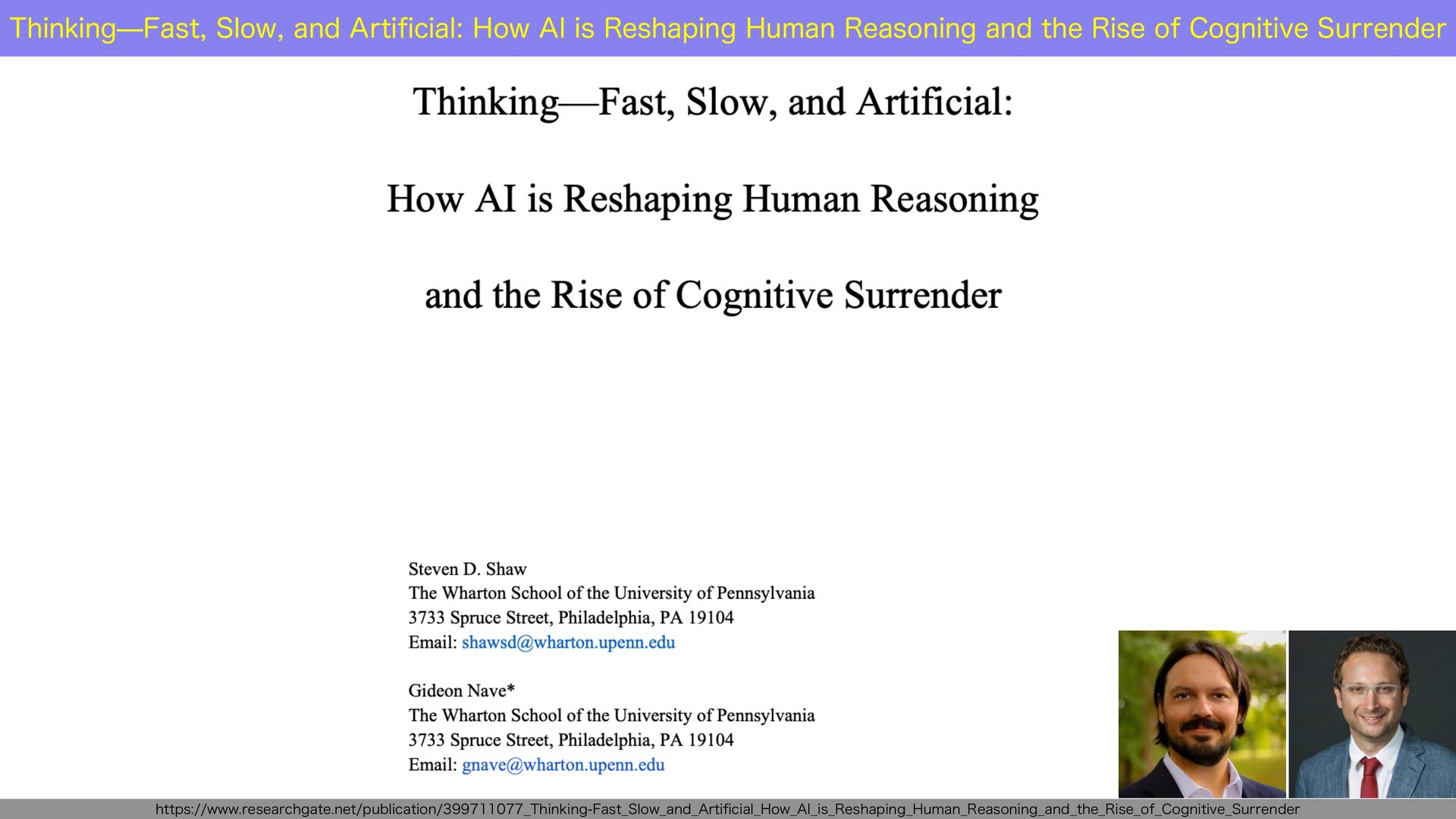
Reasoning and the Rise of Cognitive Surrender fi fi https://www.researchgate.net/publication/399711077̲Thinking-Fast̲Slow̲and̲Arti cial̲How̲AI̲is̲Reshaping̲Human̲Reasoning̲and̲the̲Rise̲of̲Cognitive̲Surrender
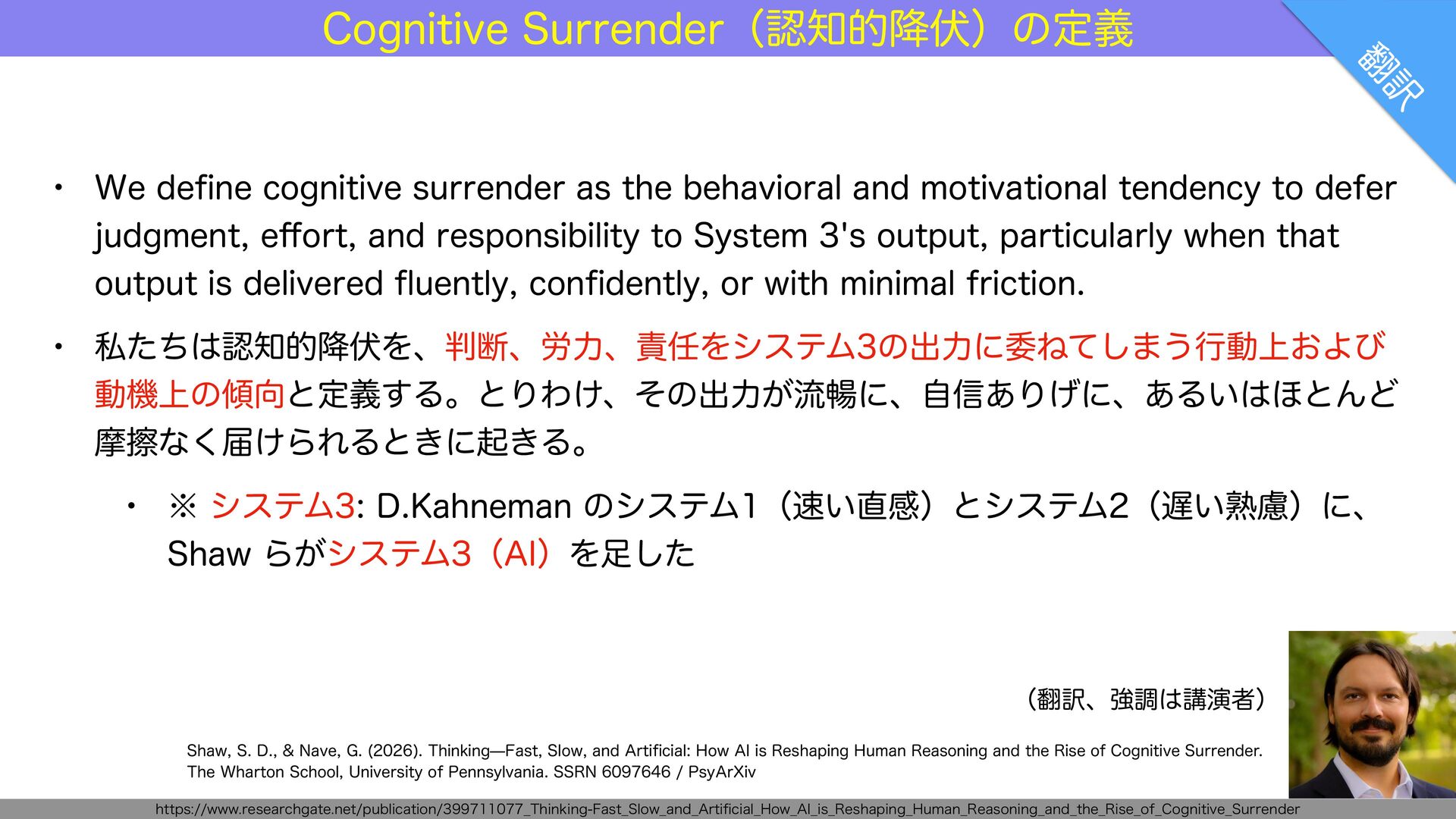
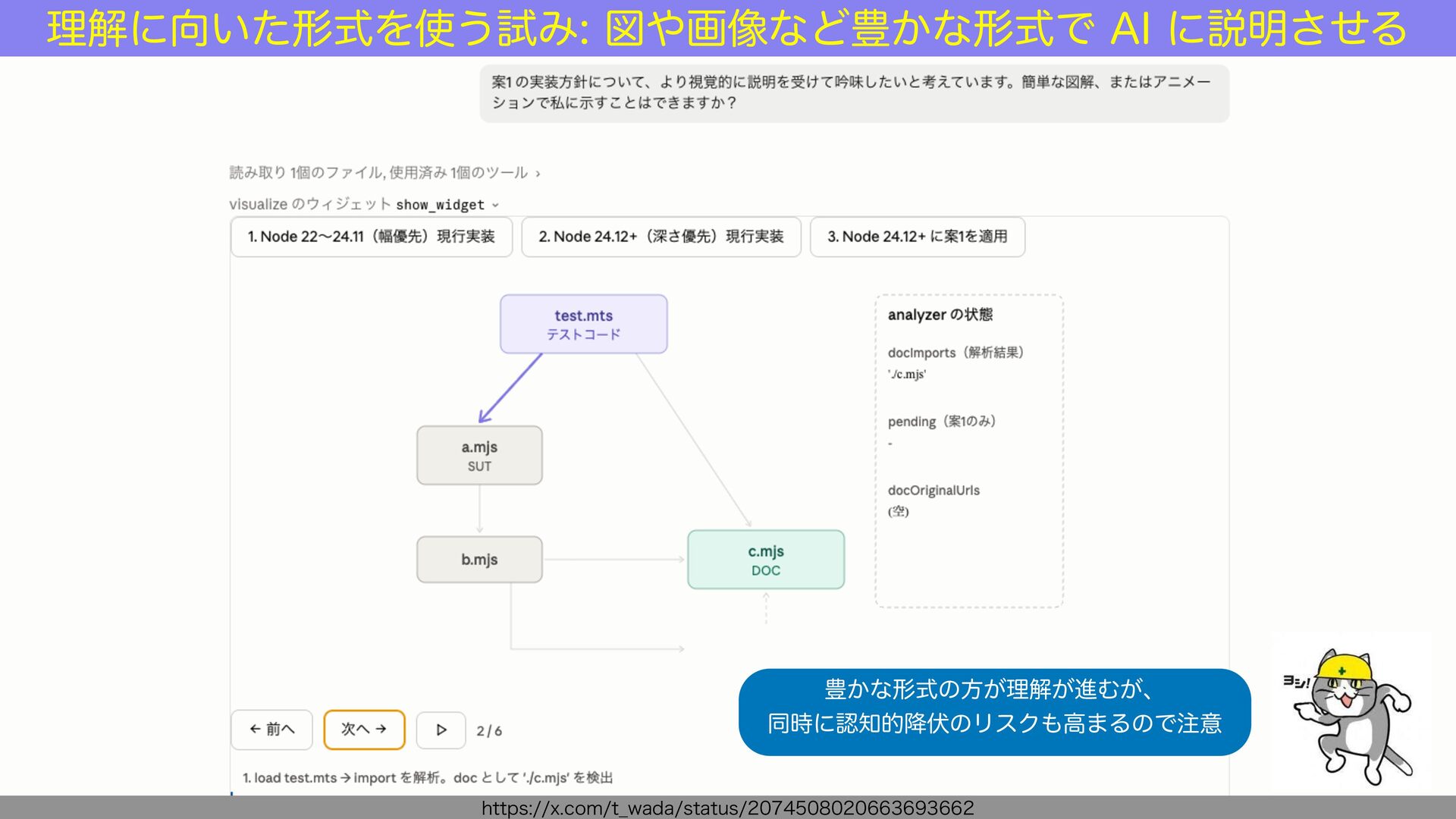
as the behavioral and motivational tendency to defer judgment, e ort, and responsibility to System 3's output, particularly when that output is delivered uently, con dently, or with minimal friction. • 私たちは認知的降伏を、判断、労力、責任をシステム3の出力に委ねてしまう行動上および 動機上の傾向と定義する。とりわけ、その出力が流暢に、自信ありげに、あるいはほとんど 摩擦なく届けられるときに起きる。 • ※ システム3: D.Kahneman のシステム1(速い直感)とシステム2(遅い熟慮)に、 Shaw らがシステム3(AI)を足した (翻訳、強調は講演者) Shaw, S. D., & Nave, G. (2026). Thinking̶Fast, Slow, and Arti cial: How AI is Reshaping Human Reasoning and the Rise of Cognitive Surrender. The Wharton School, University of Pennsylvania. SSRN 6097646 / PsyArXiv fi fi fi fl ff fi https://www.researchgate.net/publication/399711077̲Thinking-Fast̲Slow̲and̲Arti cial̲How̲AI̲is̲Reshaping̲Human̲Reasoning̲and̲the̲Rise̲of̲Cognitive̲Surrender
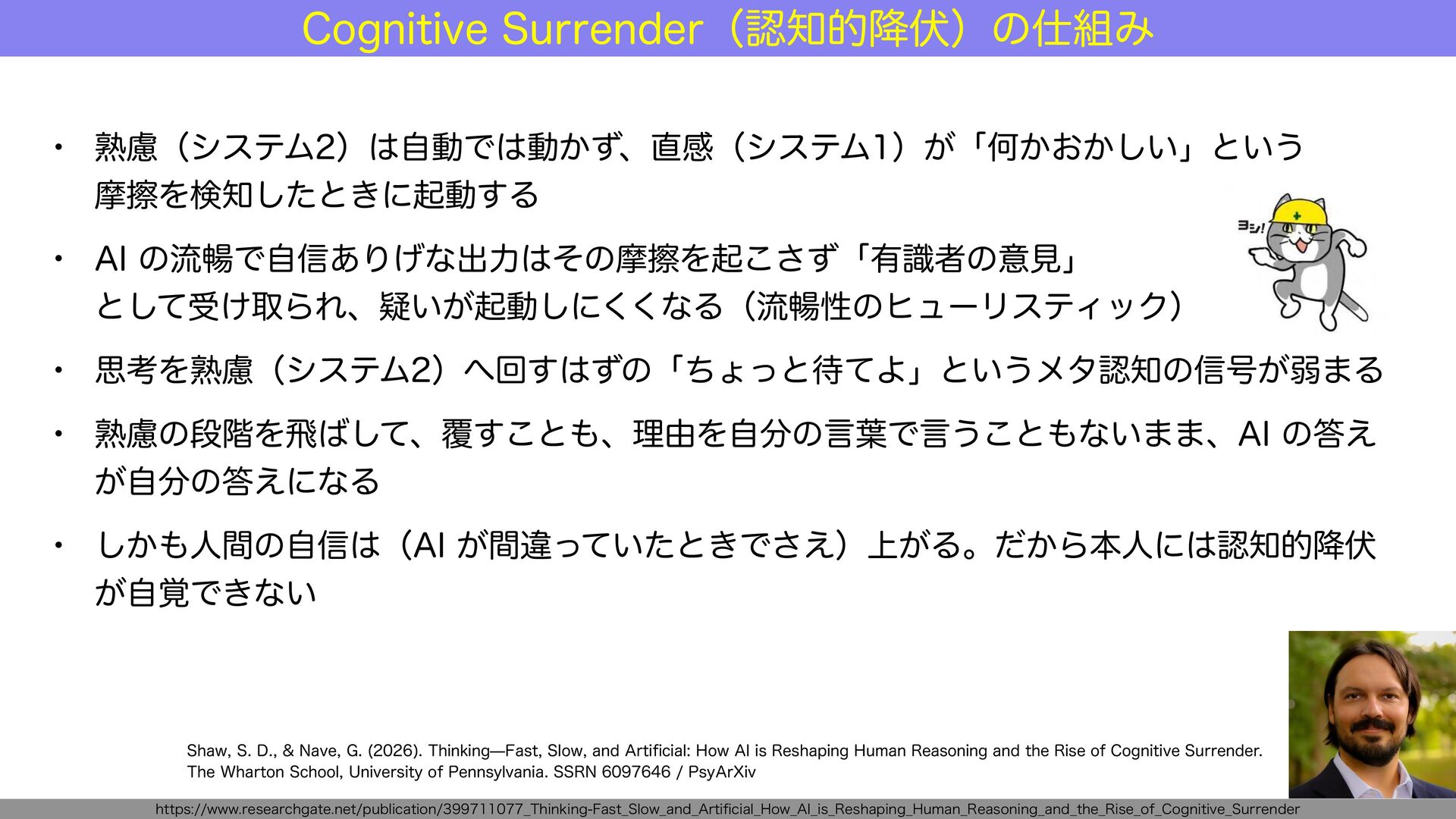
思考を熟慮(システム2)へ回すはずの「ちょっと待てよ」というメタ認知の信号が弱まる • 熟慮の段階を飛ばして、覆すことも、理由を自分の言葉で言うこともないまま、AI の答え が自分の答えになる • しかも人間の自信は(AI が間違っていたときでさえ)上がる。だから本人には認知的降伏 が自覚できない Shaw, S. D., & Nave, G. (2026). Thinking̶Fast, Slow, and Arti cial: How AI is Reshaping Human Reasoning and the Rise of Cognitive Surrender. The Wharton School, University of Pennsylvania. SSRN 6097646 / PsyArXiv fi fi https://www.researchgate.net/publication/399711077̲Thinking-Fast̲Slow̲and̲Arti cial̲How̲AI̲is̲Reshaping̲Human̲Reasoning̲and̲the̲Rise̲of̲Cognitive̲Surrender
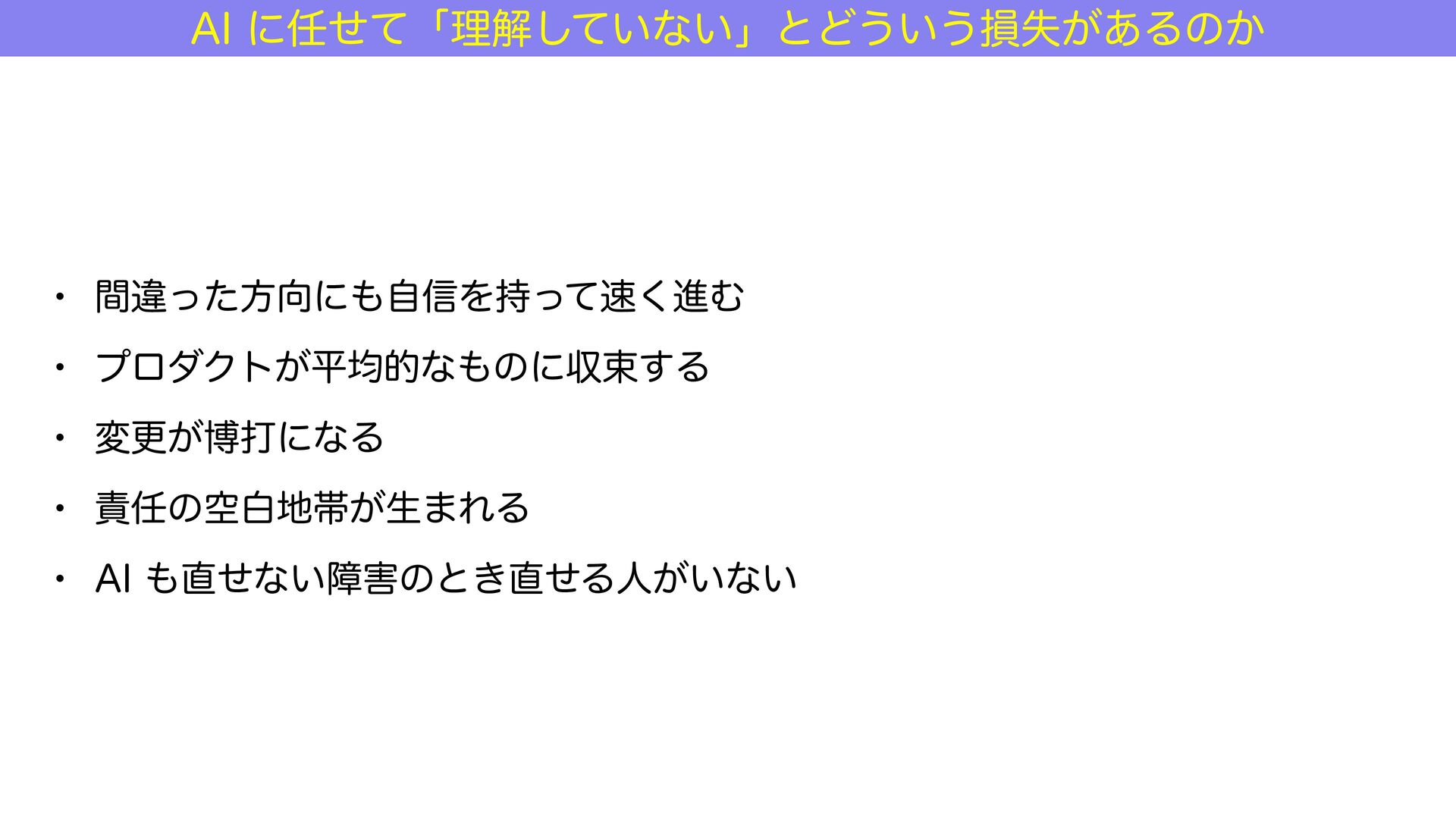
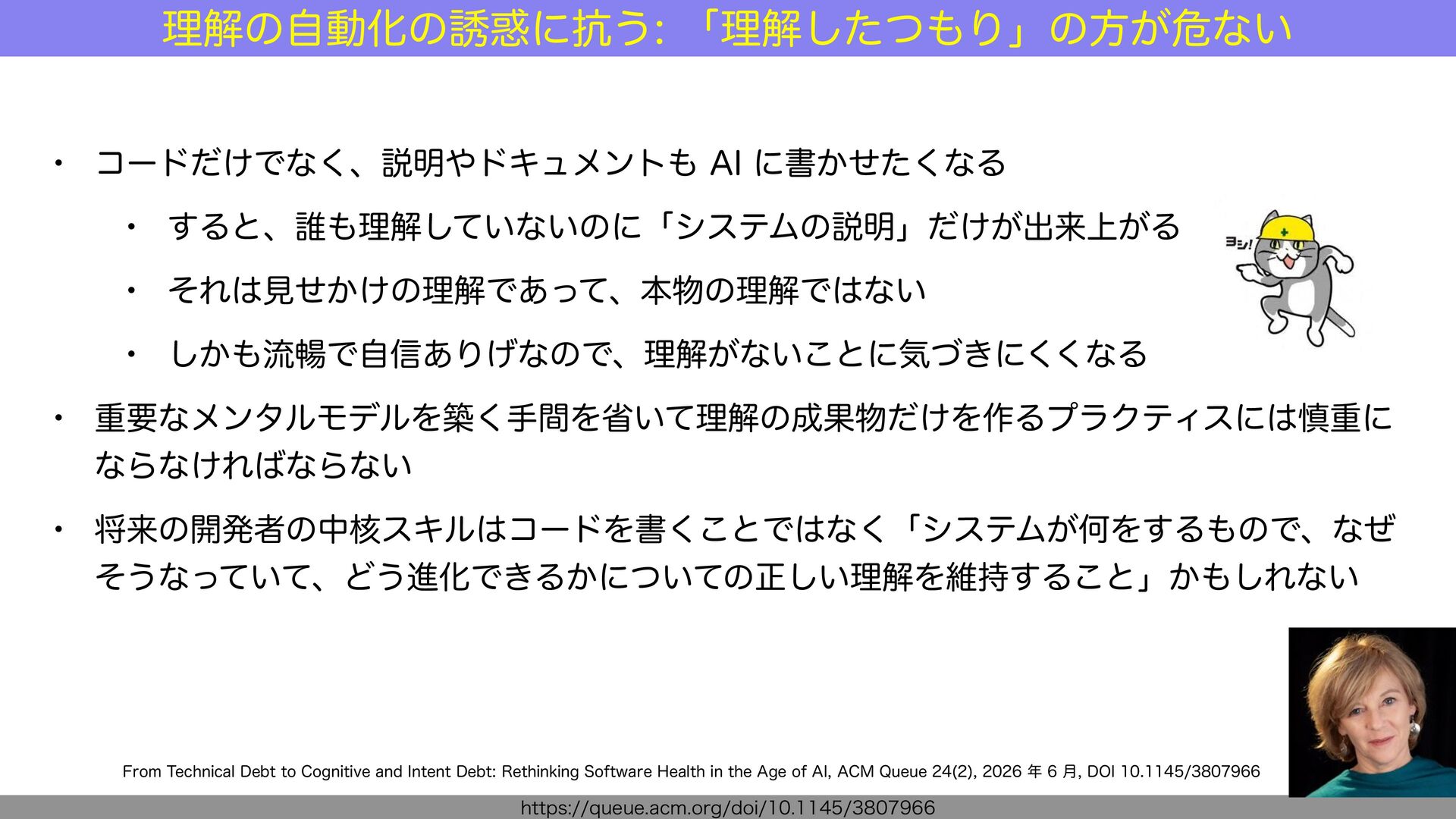
• しかも流暢で自信ありげなので、理解がないことに気づきにくくなる • 重要なメンタルモデルを築く手間を省いて理解の成果物だけを作るプラクティスには慎重に ならなければならない • 将来の開発者の中核スキルはコードを書くことではなく「システムが何をするもので、なぜ そうなっていて、どう進化できるかについての正しい理解を維持すること」かもしれない From Technical Debt to Cognitive and Intent Debt: Rethinking Software Health in the Age of AI, ACM Queue 24(2), 2026 年 6 月, DOI 10.1145/3807966 https://queue.acm.org/doi/10.1145/3807966

 SiteGround - Reliable hosting with speed, security, and support you can count on.


 twada
twada
 mewuto
 yokawasa
 junkifurukawa
 mochizuki875
 ishiirikie
 sony
sony
 shichijoyuhi
 mkdev10
 yakumo
 hacobu
 ennael
 taka_aki
 hatefulcrawdad
 moore
moore
 dugsong
 destraynor
 tapps
tapps
 lara
lara
 mongodb
 akademiya2063
 tammyeverts
 csswizardry
 aleyda
 ianozsvald