Share
Why Our Code Smells
Odors are communication devices. They exist for a reason and are usually trying to tell us something.
Our code smells and it is trying to tell us what is wrong. Does a test case require an abundance of setup? Maybe the code being tested is doing too much, or it is not isolated enough for the test? Does an object have an abundance of instance variables? Maybe it should be split into multiple objects? Is a view brittle? Maybe it is too tightly coupled to a model, or maybe the logic needs abstracted into an object that can be tested?
In this talk, I will walk through code from projects that I work on every day, looking for smells that indicate problems, understanding why it smells, what the smell is trying to tell us, and how to refactor it.

Brandon Keepers PRO
Transcript
130 slides
-
Kent Beck Smalltalk Best Practice Patterns “Code doesn’t lie. If
you’re not listening, you won’t hear the truths it tells.” -
CODE SMELLS ARE HEURISTICS TO SUGGEST WHEN TO REFACTOR AND
WHAT TECHNIQUES TO USE. -
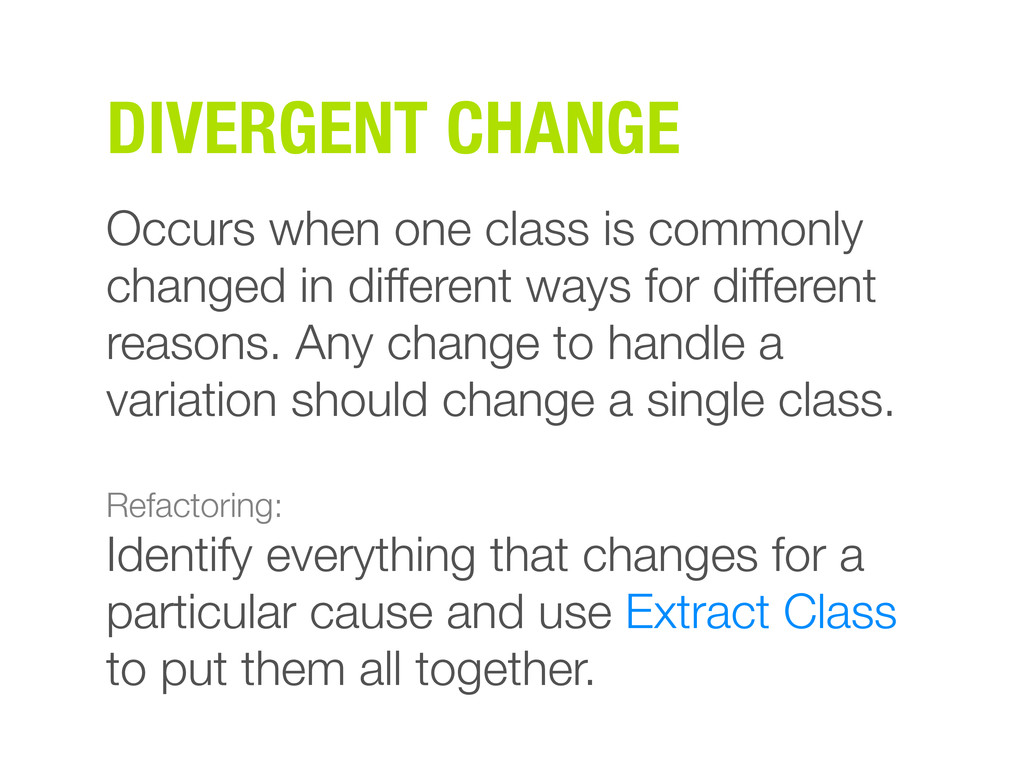
DIVERGENT CHANGE Occurs when one class is commonly changed in
different ways for different reasons. Any change to handle a variation should change a single class. -
DIVERGENT CHANGE Occurs when one class is commonly changed in
different ways for different reasons. Any change to handle a variation should change a single class. Refactoring: Identify everything that changes for a particular cause and use Extract Class to put them all together. -
OUR CODE SMELLS IN THE 21 WAYS THAT BECK AND
FOWLER DESCRIBE, BUT… -
our code smells when UNIT TESTS ARE COMPLEX & SLOW.
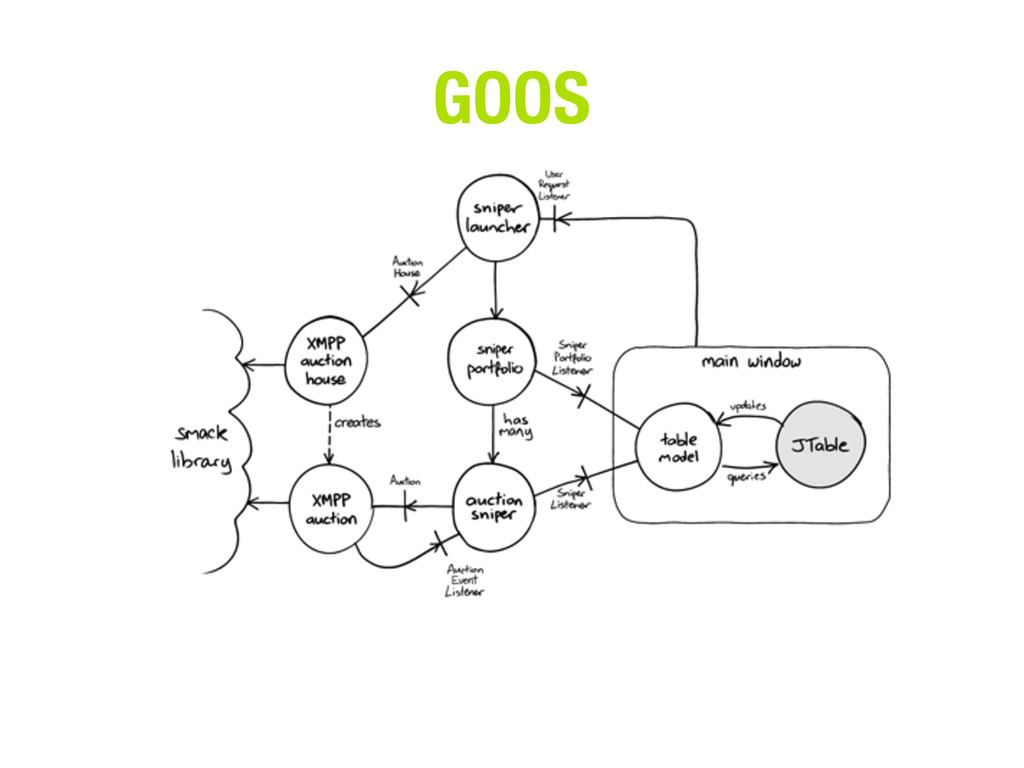
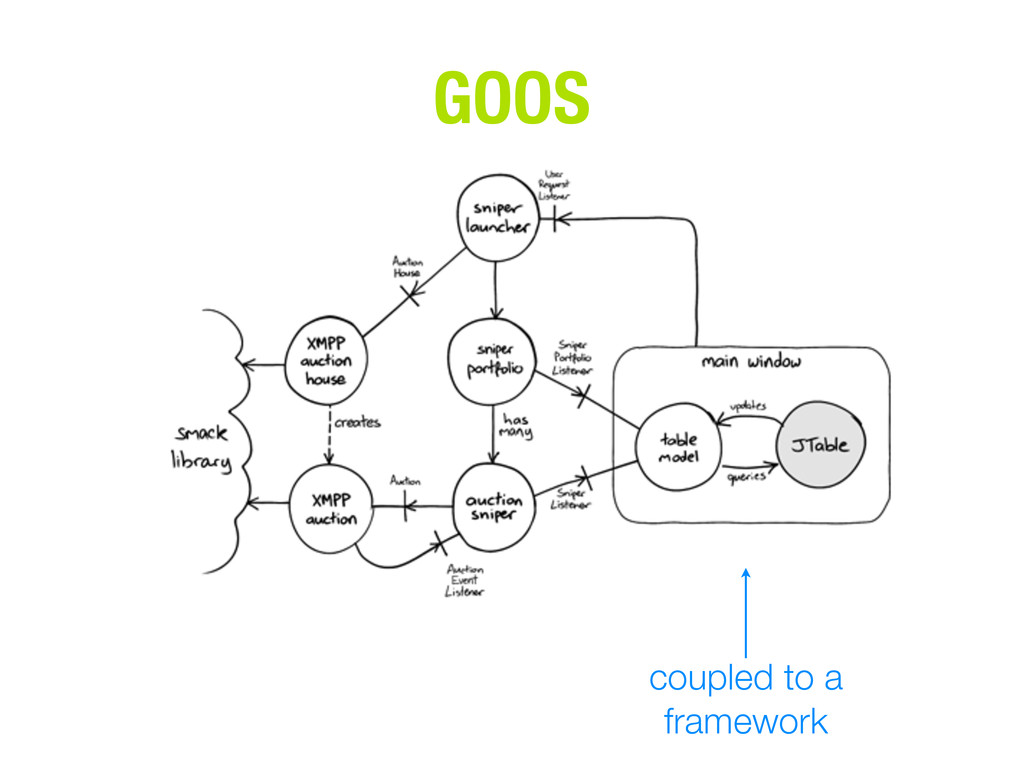
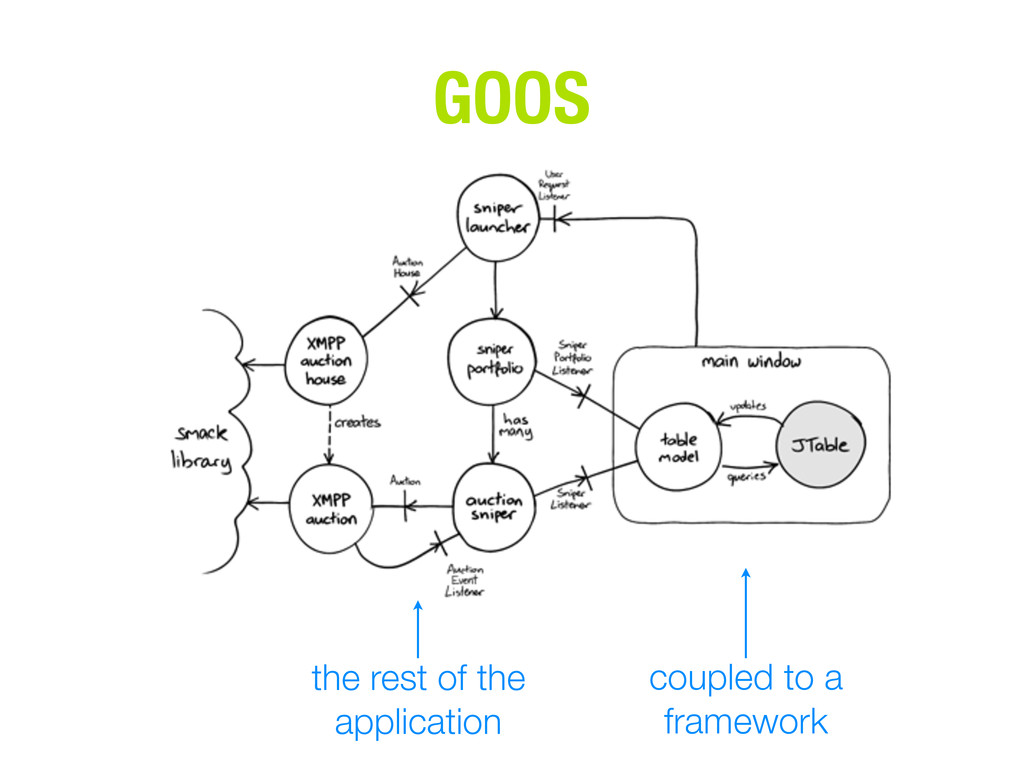
IT IS TIGHTLY COUPLED TO A FRAMEWORK. -
WHY DO WE WRITE TESTS? 1.Guard against regressions 2.Gain confidence
to change 3.Discover better designs -
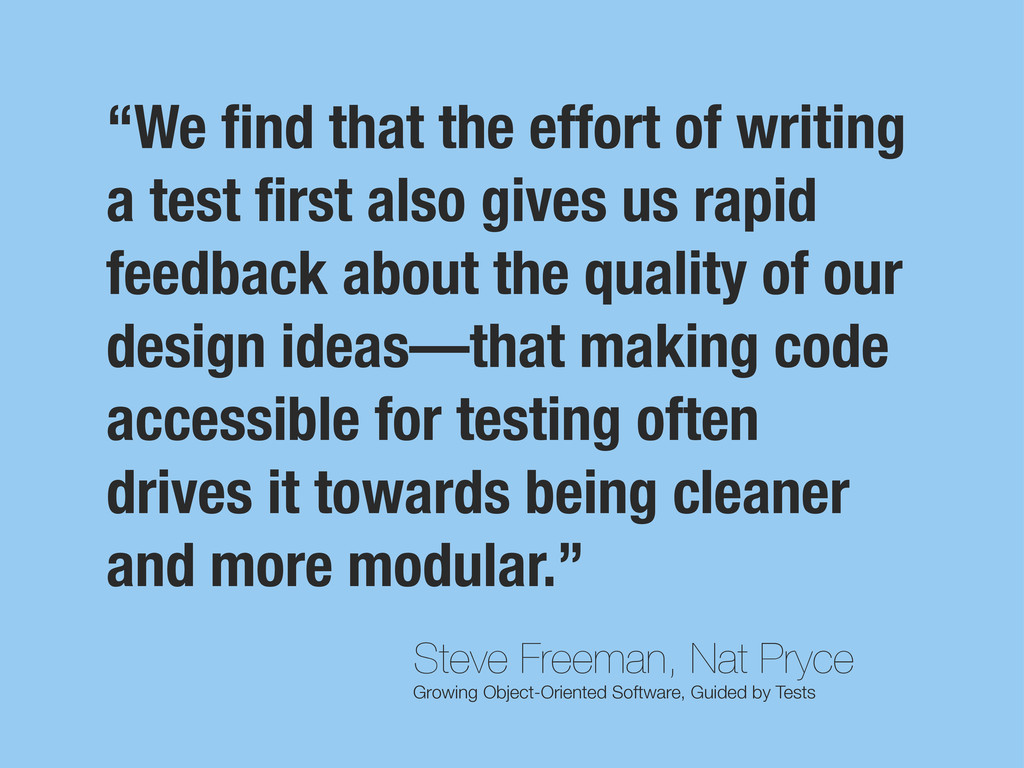
Steve Freeman, Nat Pryce Growing Object-Oriented Software, Guided by Tests
“We find that the effort of writing a test first also gives us rapid feedback about the quality of our design ideas—that making code accessible for testing often drives it towards being cleaner and more modular.” -
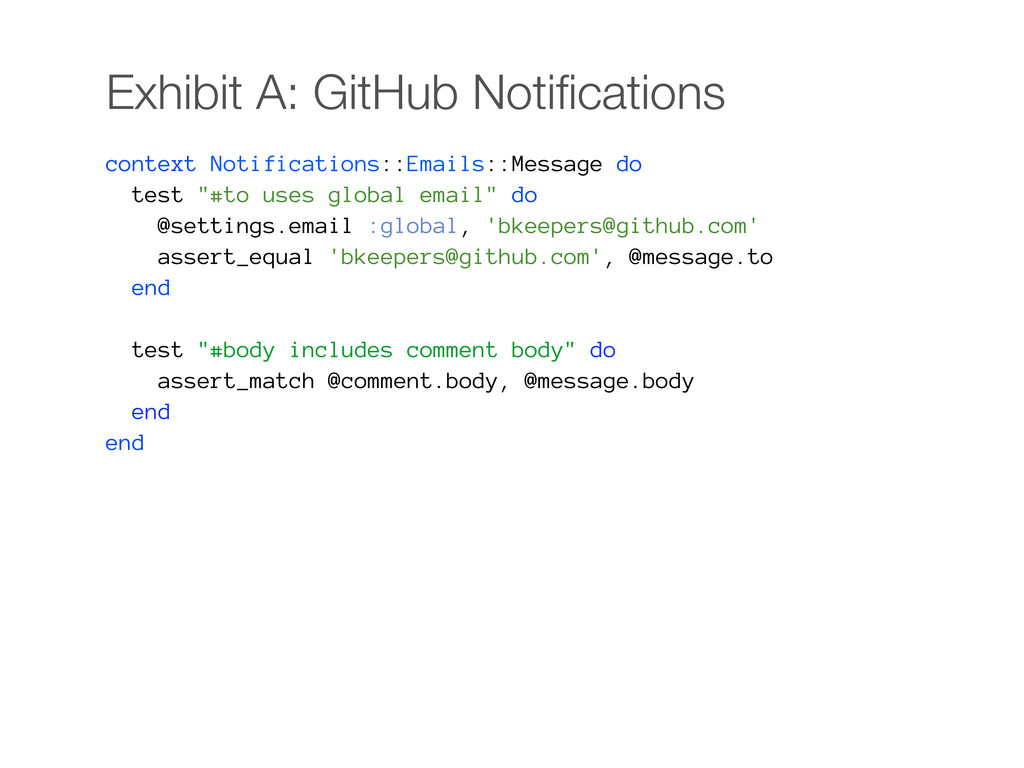
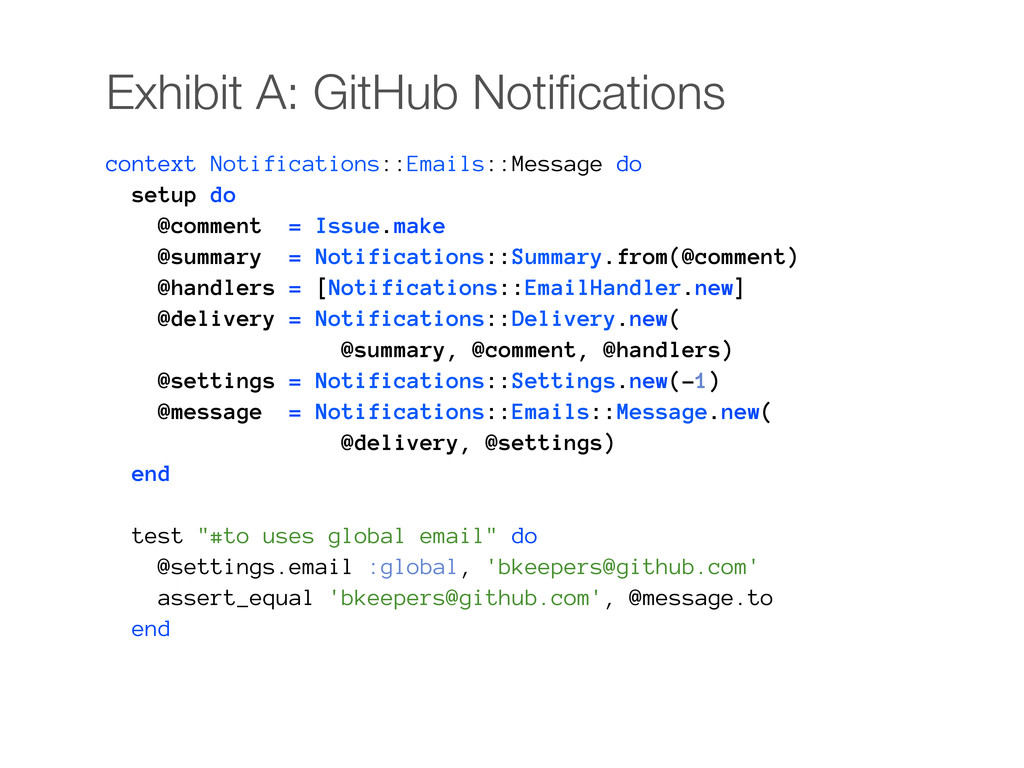
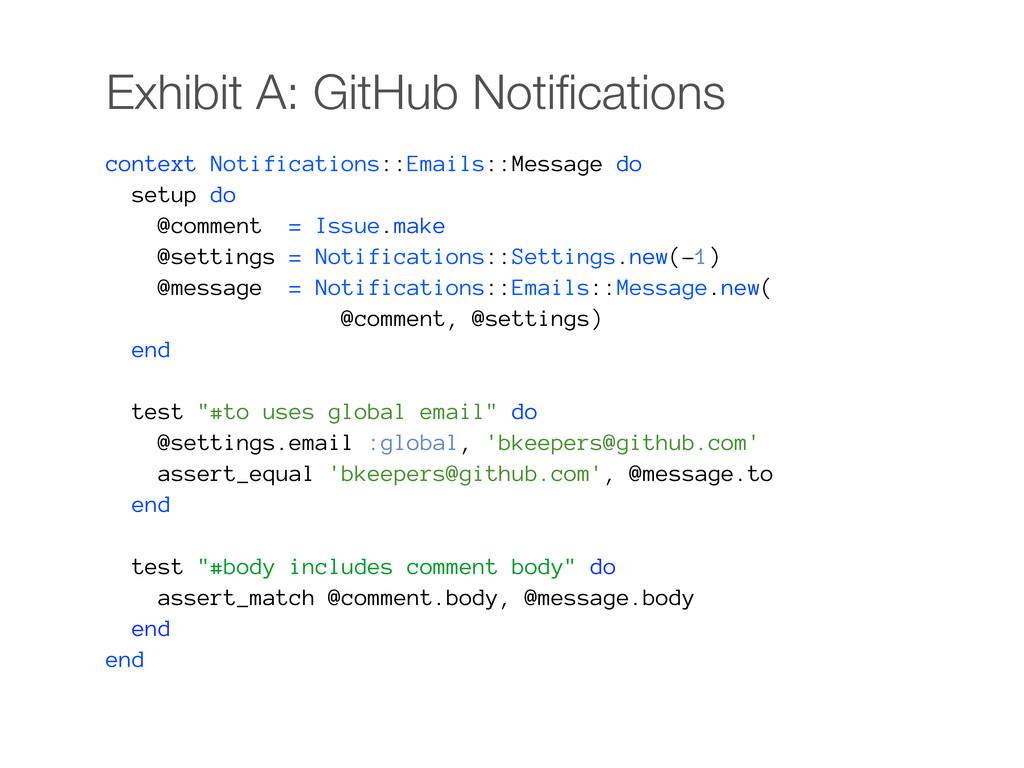
Exhibit A: GitHub Notifications context Notifications::Emails::Message do test "#to uses
global email" do @settings.email :global, '[email protected]' assert_equal '[email protected]', @message.to end test "#body includes comment body" do assert_match @comment.body, @message.body end end -
Exhibit A: GitHub Notifications context Notifications::Emails::Message do setup do @comment
= Issue.make @summary = Notifications::Summary.from(@comment) @handlers = [Notifications::EmailHandler.new] @delivery = Notifications::Delivery.new( @summary, @comment, @handlers) @settings = Notifications::Settings.new(-1) @message = Notifications::Emails::Message.new( @delivery, @settings) end test "#to uses global email" do @settings.email :global, '[email protected]' assert_equal '[email protected]', @message.to end -
Steve Freeman, Nat Pryce Growing Object-Oriented Software, Guided by Tests
“When we find a feature that’s difficult to test, we don’t just ask ourselves how to test it, but also why is it difficult to test.” -
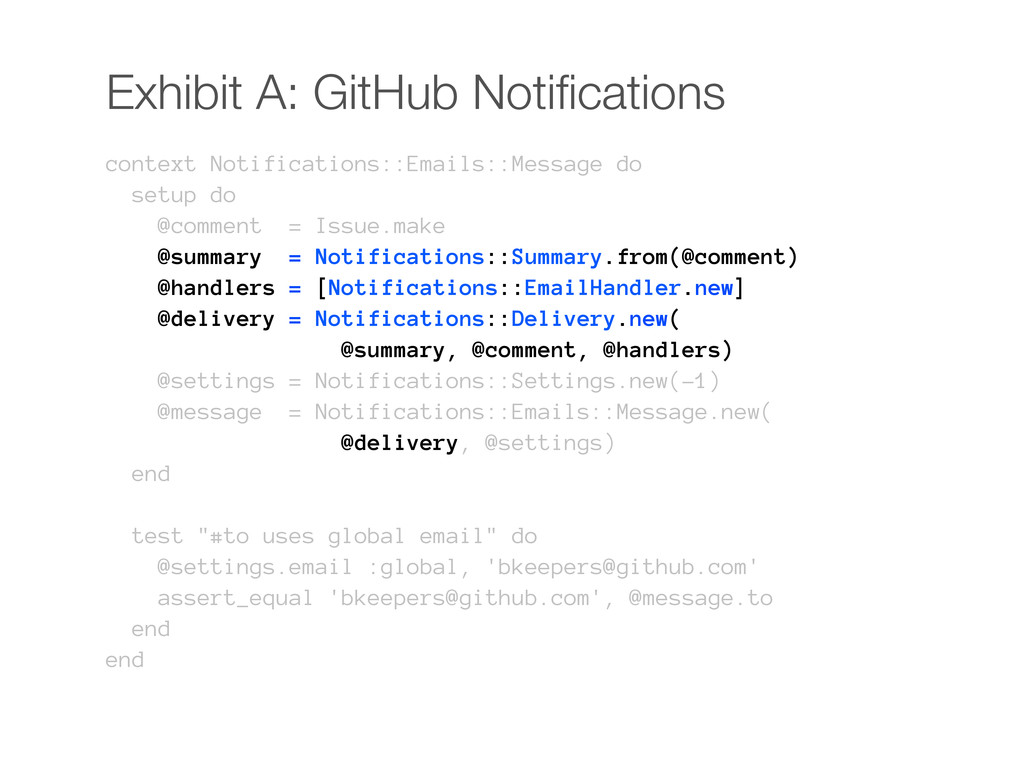
Exhibit A: GitHub Notifications context Notifications::Emails::Message do setup do @comment
= Issue.make @summary = Notifications::Summary.from(@comment) @handlers = [Notifications::EmailHandler.new] @delivery = Notifications::Delivery.new( @summary, @comment, @handlers) @settings = Notifications::Settings.new(-1) @message = Notifications::Emails::Message.new( @delivery, @settings) end test "#to uses global email" do @settings.email :global, '[email protected]' assert_equal '[email protected]', @message.to end end -
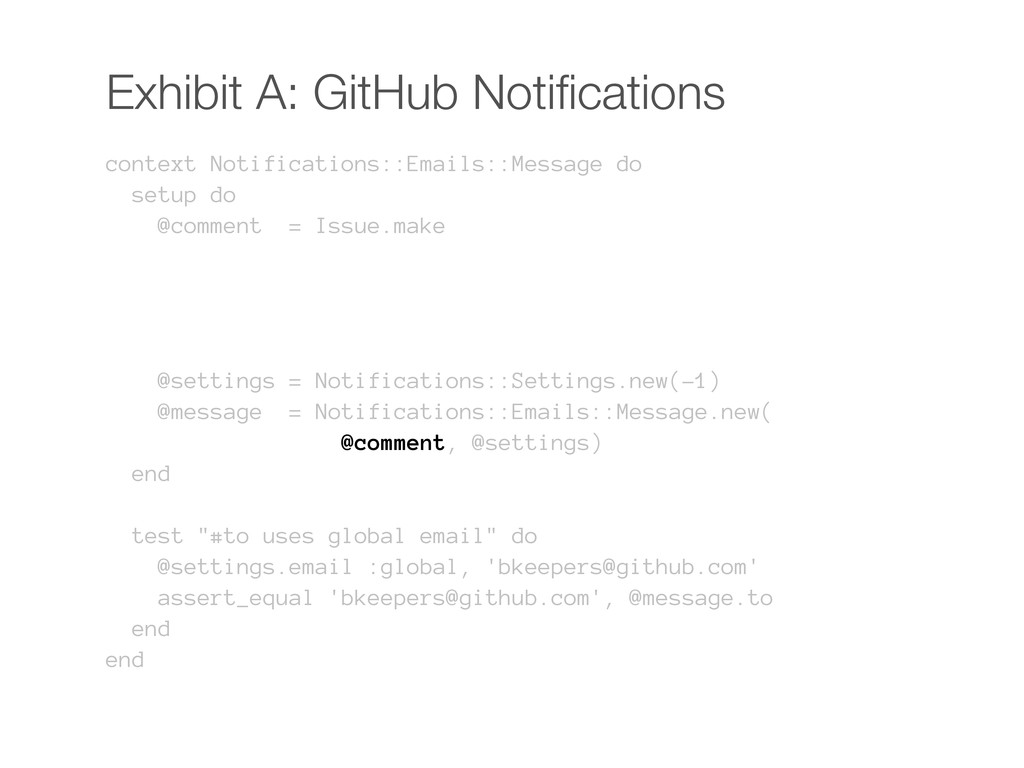
Exhibit A: GitHub Notifications context Notifications::Emails::Message do setup do @comment
= Issue.make @settings = Notifications::Settings.new(-1) @message = Notifications::Emails::Message.new( @comment, @settings) end test "#to uses global email" do @settings.email :global, '[email protected]' assert_equal '[email protected]', @message.to end end -
Exhibit A: GitHub Notifications context Notifications::Emails::Message do setup do @comment
= Issue.make @settings = Notifications::Settings.new(-1) @message = Notifications::Emails::Message.new( @comment, @settings) end test "#to uses global email" do @settings.email :global, '[email protected]' assert_equal '[email protected]', @message.to end test "#body includes comment body" do assert_match @comment.body, @message.body end end -
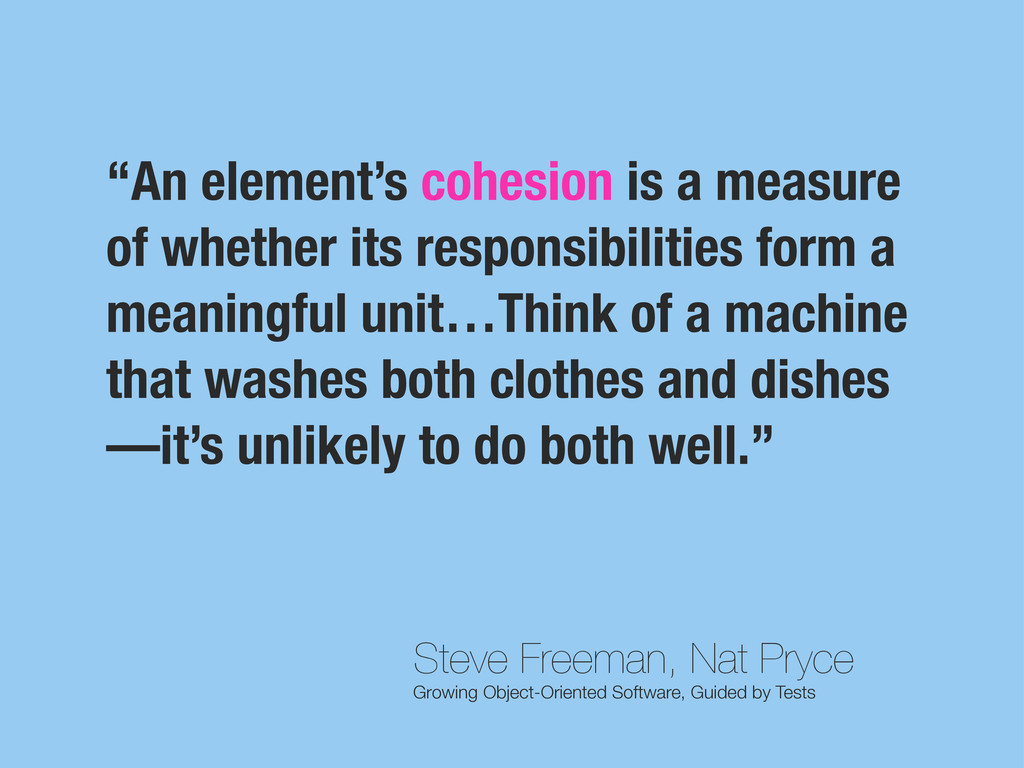
Steve Freeman, Nat Pryce Growing Object-Oriented Software, Guided by Tests
“An element’s cohesion is a measure of whether its responsibilities form a meaningful unit…Think of a machine that washes both clothes and dishes —it’s unlikely to do both well.” -
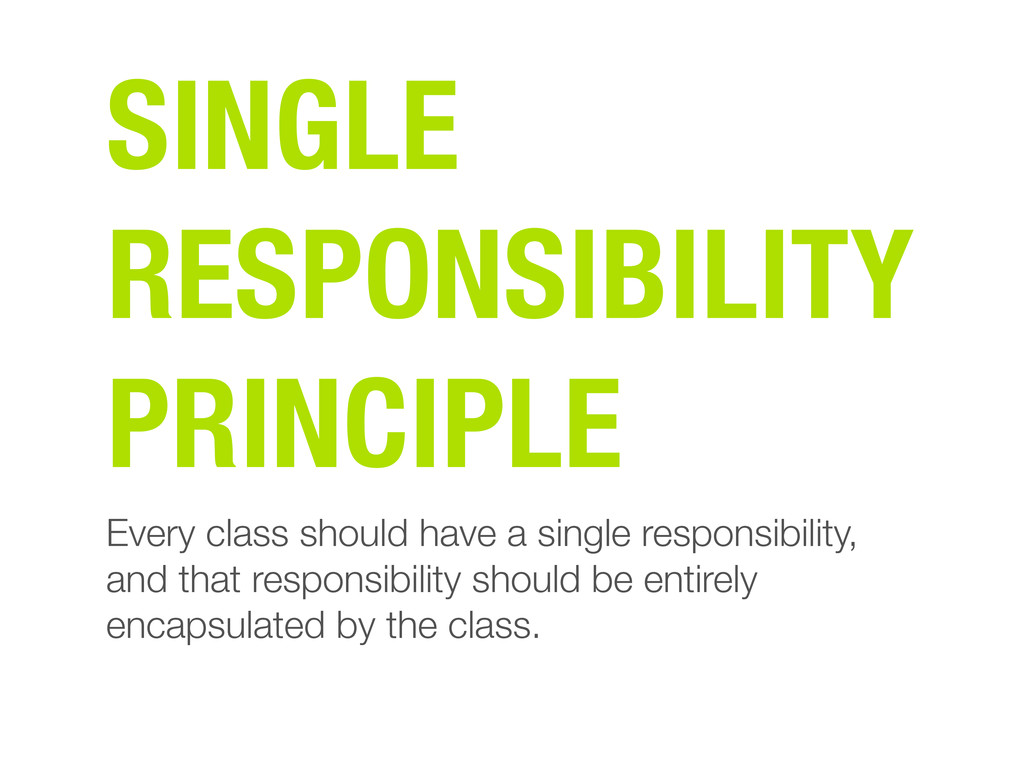
Every class should have a single responsibility, and that responsibility
should be entirely encapsulated by the class. SINGLE RESPONSIBILITY PRINCIPLE -
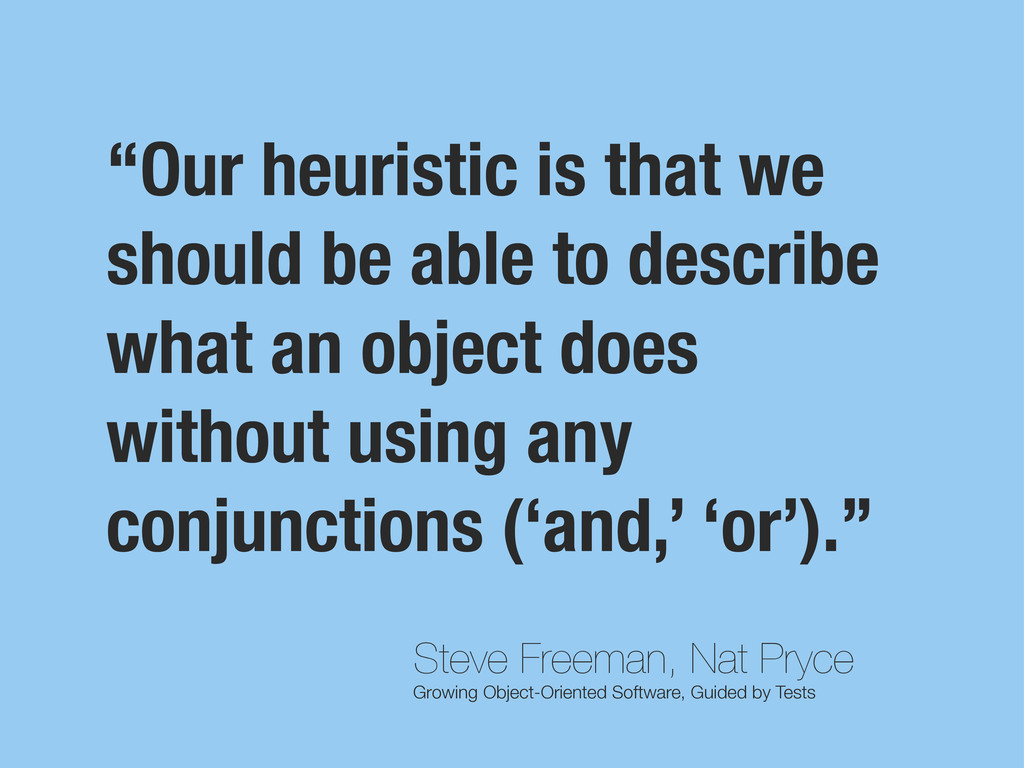
Steve Freeman, Nat Pryce Growing Object-Oriented Software, Guided by Tests
“Our heuristic is that we should be able to describe what an object does without using any conjunctions (‘and,’ ‘or’).” -
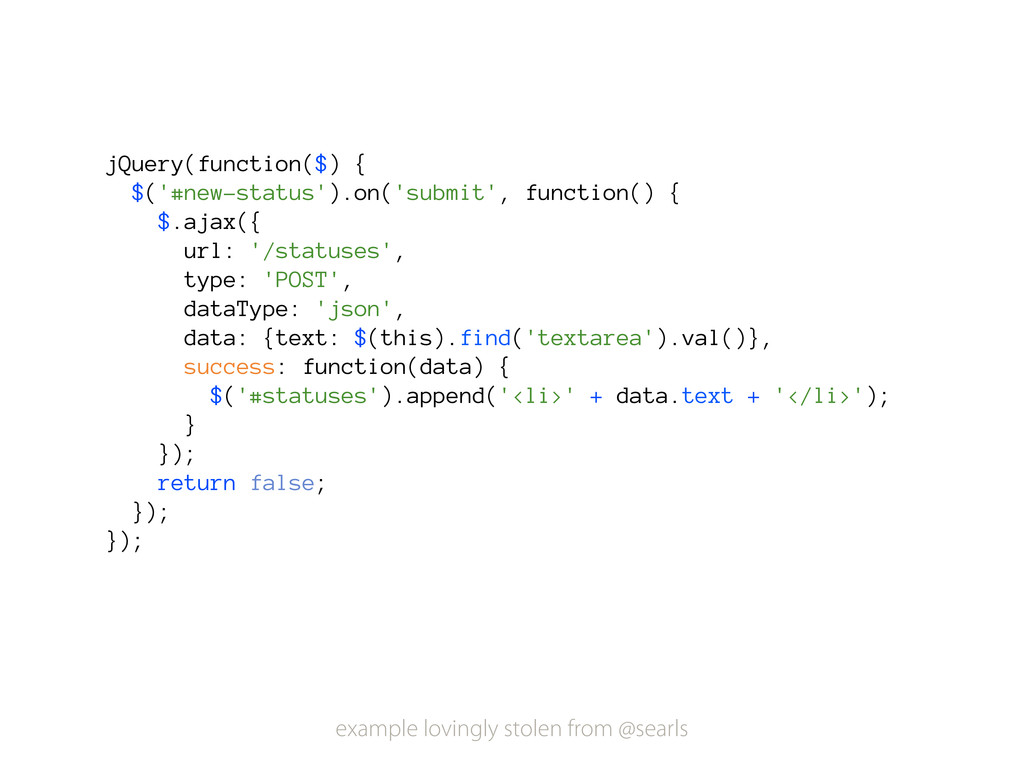
jQuery(function($) { $('#new-status').on('submit', function() { $.ajax({ url: '/statuses', type: 'POST',
dataType: 'json', data: {text: $(this).find('textarea').val()}, success: function(data) { $('#statuses').append('<li>' + data.text + '</li>'); } }); return false; }); }); example lovingly stolen from @searls -
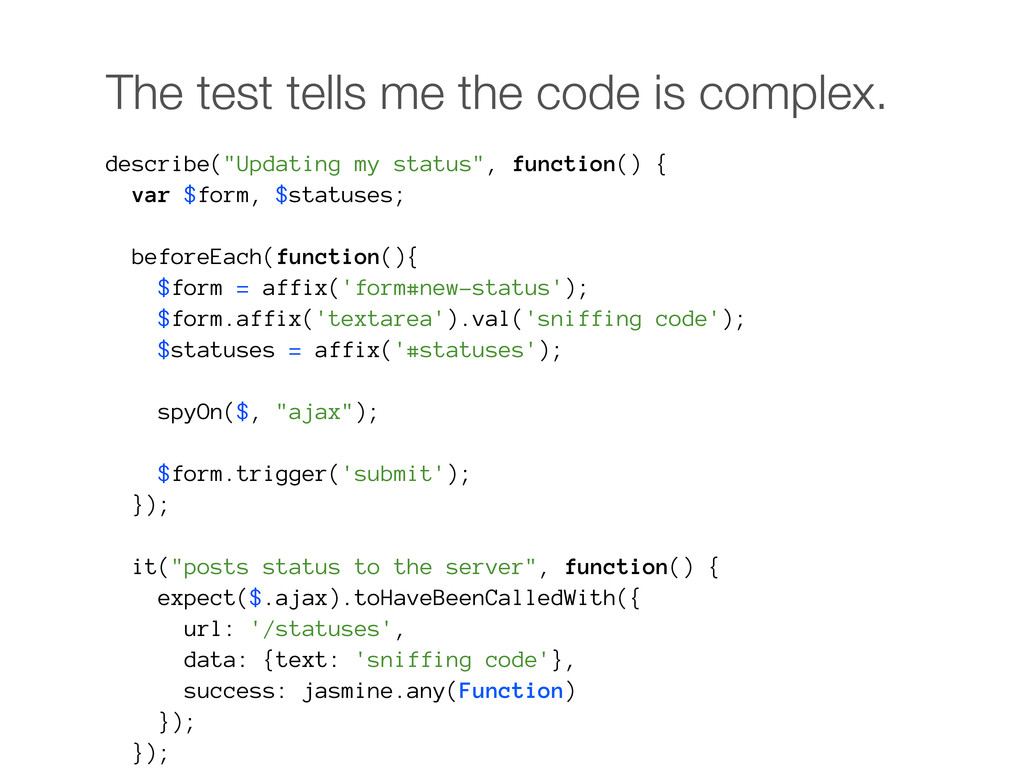
The test tells me the code is complex. describe("Updating my
status", function() { var $form, $statuses; beforeEach(function(){ $form = affix('form#new-status'); $form.affix('textarea').val('sniffing code'); $statuses = affix('#statuses'); spyOn($, "ajax"); $form.trigger('submit'); }); it("posts status to the server", function() { expect($.ajax).toHaveBeenCalledWith({ url: '/statuses', data: {text: 'sniffing code'}, success: jasmine.any(Function) }); }); -
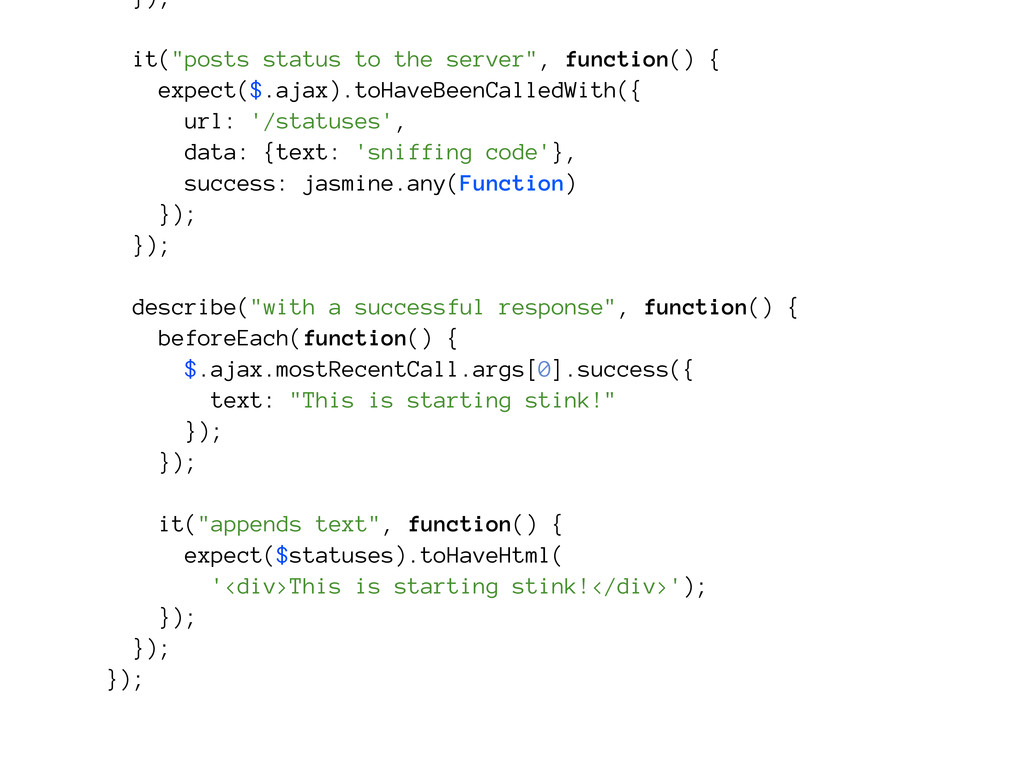
The test tells me the code is complex. }); it("posts
status to the server", function() { expect($.ajax).toHaveBeenCalledWith({ url: '/statuses', data: {text: 'sniffing code'}, success: jasmine.any(Function) }); }); describe("with a successful response", function() { beforeEach(function() { $.ajax.mostRecentCall.args[0].success({ text: "This is starting stink!" }); }); it("appends text", function() { expect($statuses).toHaveHtml( '<div>This is starting stink!</div>'); }); }); }); -
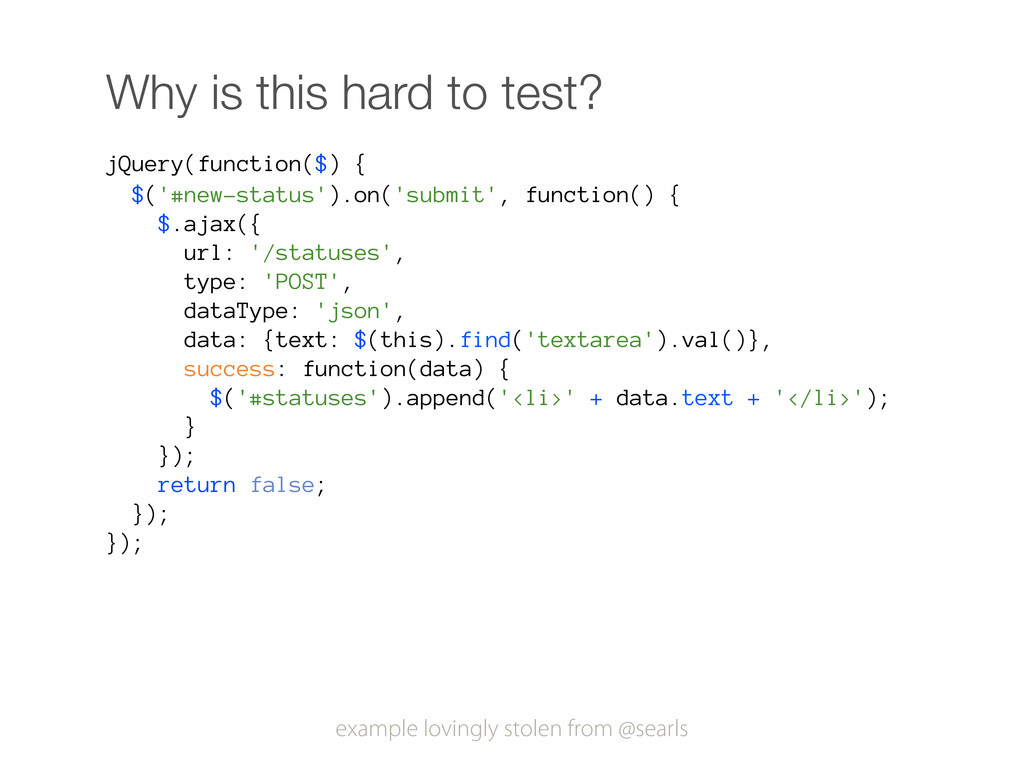
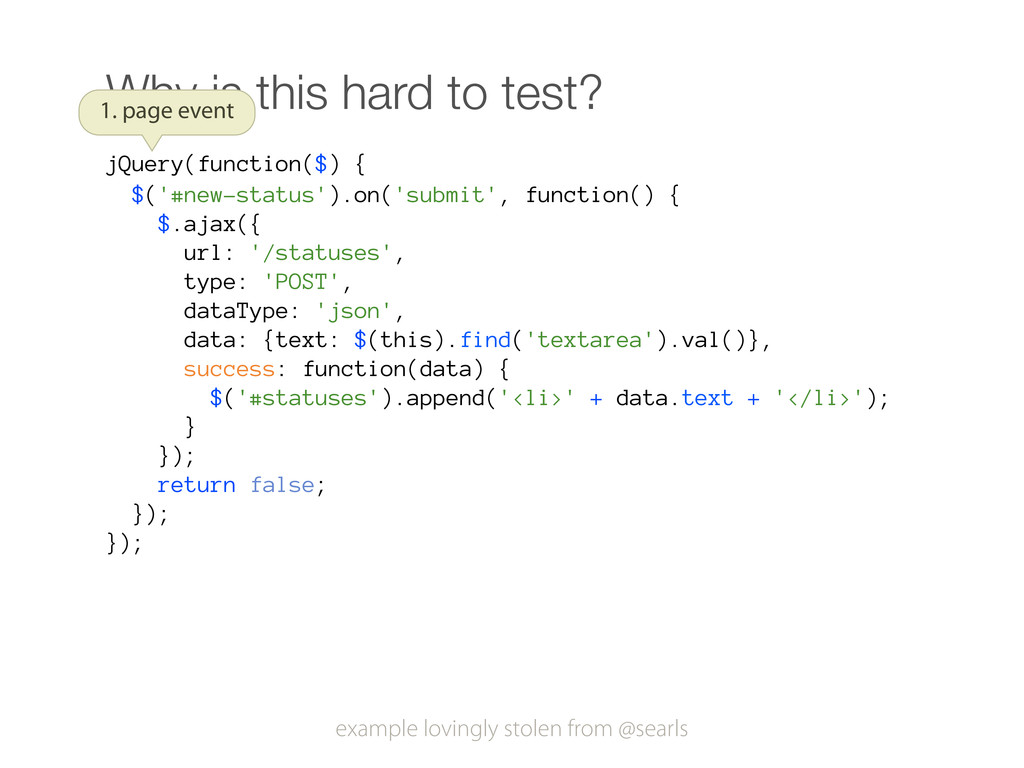
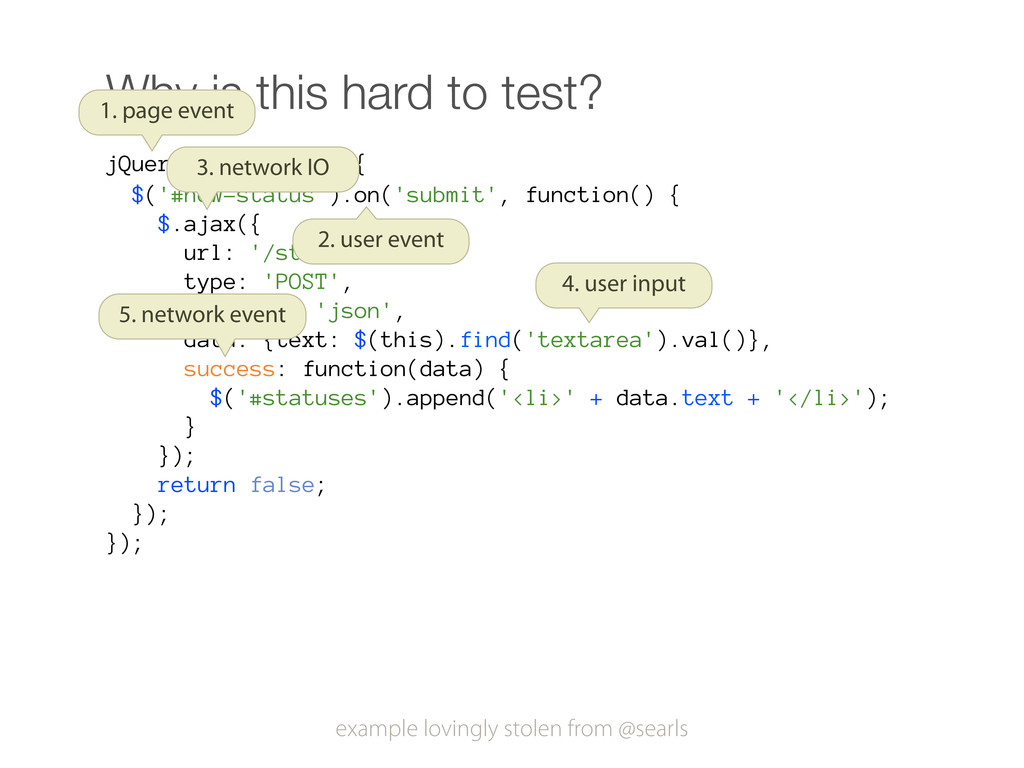
Why is this hard to test? jQuery(function($) { $('#new-status').on('submit', function()
{ $.ajax({ url: '/statuses', type: 'POST', dataType: 'json', data: {text: $(this).find('textarea').val()}, success: function(data) { $('#statuses').append('<li>' + data.text + '</li>'); } }); return false; }); }); example lovingly stolen from @searls -
Why is this hard to test? jQuery(function($) { $('#new-status').on('submit', function()
{ $.ajax({ url: '/statuses', type: 'POST', dataType: 'json', data: {text: $(this).find('textarea').val()}, success: function(data) { $('#statuses').append('<li>' + data.text + '</li>'); } }); return false; }); }); 1. page event example lovingly stolen from @searls -
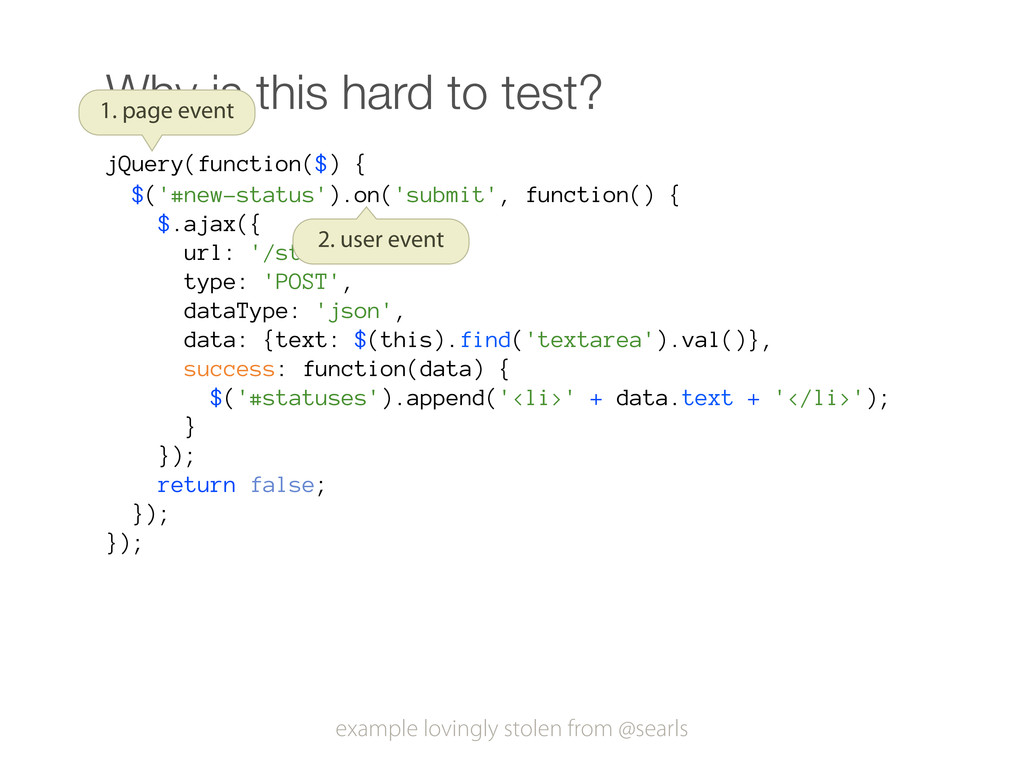
Why is this hard to test? jQuery(function($) { $('#new-status').on('submit', function()
{ $.ajax({ url: '/statuses', type: 'POST', dataType: 'json', data: {text: $(this).find('textarea').val()}, success: function(data) { $('#statuses').append('<li>' + data.text + '</li>'); } }); return false; }); }); 1. page event 2. user event example lovingly stolen from @searls -
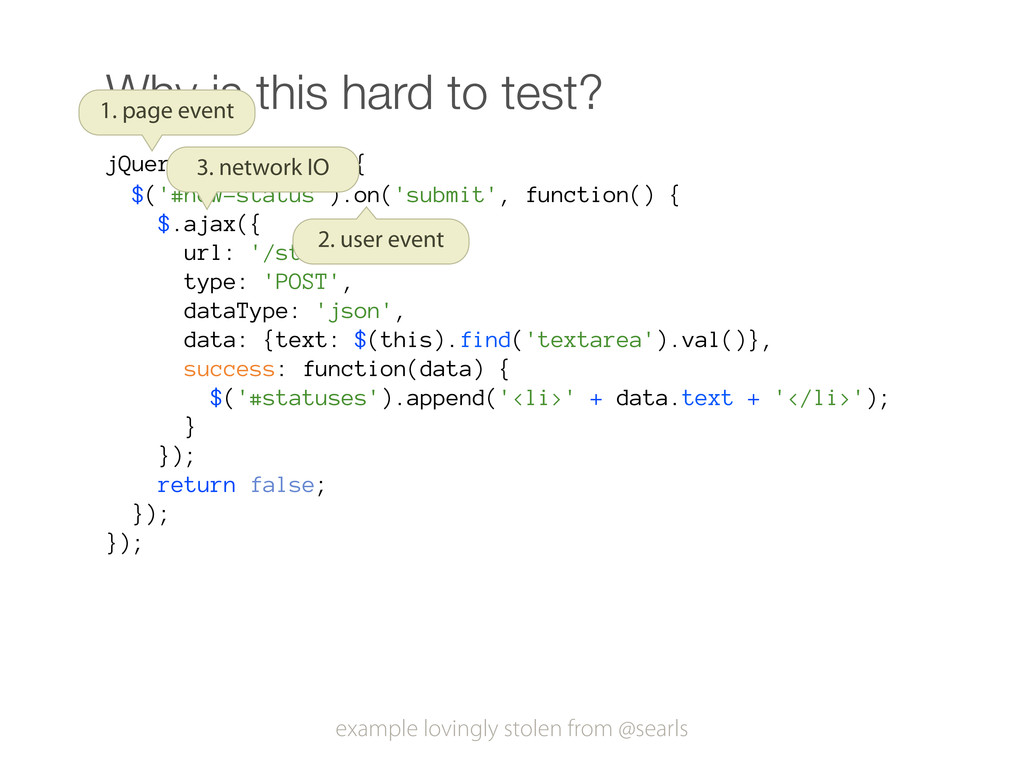
Why is this hard to test? jQuery(function($) { $('#new-status').on('submit', function()
{ $.ajax({ url: '/statuses', type: 'POST', dataType: 'json', data: {text: $(this).find('textarea').val()}, success: function(data) { $('#statuses').append('<li>' + data.text + '</li>'); } }); return false; }); }); 1. page event 2. user event 3. network IO example lovingly stolen from @searls -
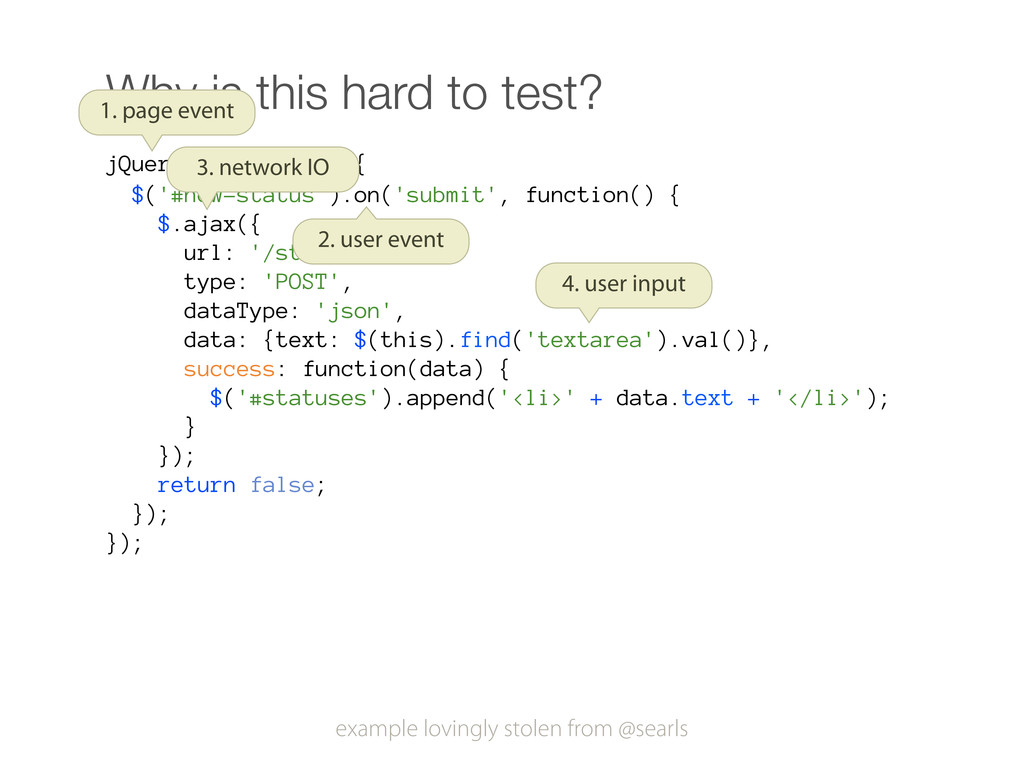
Why is this hard to test? jQuery(function($) { $('#new-status').on('submit', function()
{ $.ajax({ url: '/statuses', type: 'POST', dataType: 'json', data: {text: $(this).find('textarea').val()}, success: function(data) { $('#statuses').append('<li>' + data.text + '</li>'); } }); return false; }); }); 1. page event 2. user event 3. network IO 4. user input example lovingly stolen from @searls -
Why is this hard to test? jQuery(function($) { $('#new-status').on('submit', function()
{ $.ajax({ url: '/statuses', type: 'POST', dataType: 'json', data: {text: $(this).find('textarea').val()}, success: function(data) { $('#statuses').append('<li>' + data.text + '</li>'); } }); return false; }); }); 1. page event 2. user event 3. network IO 4. user input 5. network event example lovingly stolen from @searls -
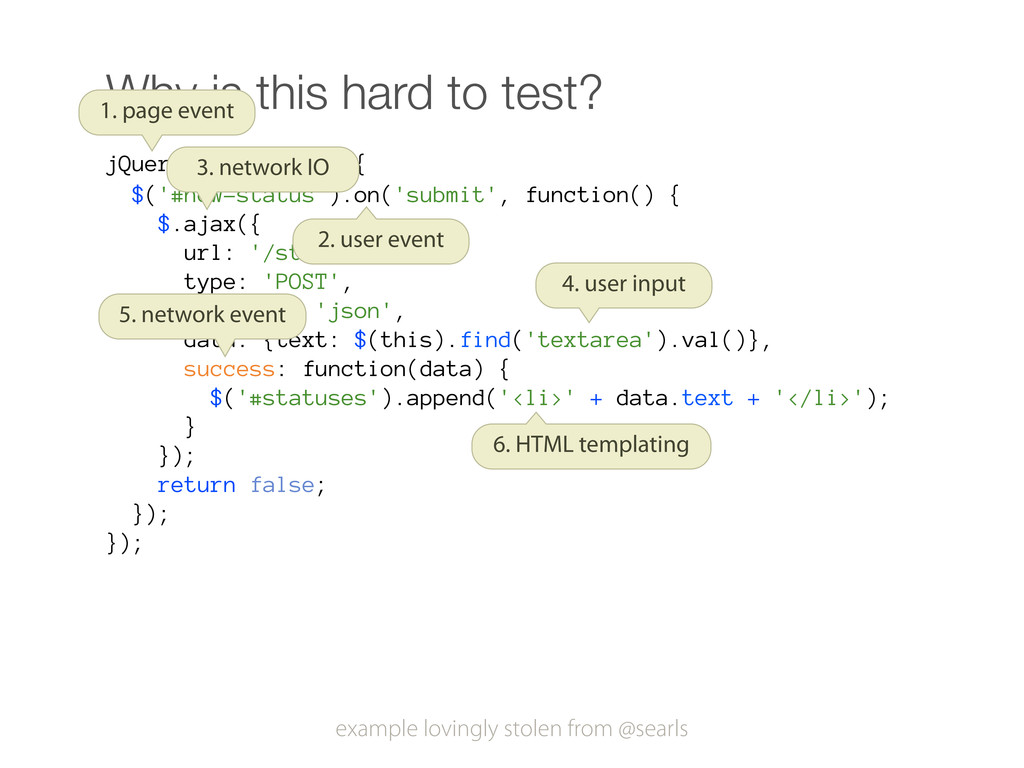
Why is this hard to test? jQuery(function($) { $('#new-status').on('submit', function()
{ $.ajax({ url: '/statuses', type: 'POST', dataType: 'json', data: {text: $(this).find('textarea').val()}, success: function(data) { $('#statuses').append('<li>' + data.text + '</li>'); } }); return false; }); }); 1. page event 2. user event 3. network IO 4. user input 5. network event 6. HTML templating example lovingly stolen from @searls -
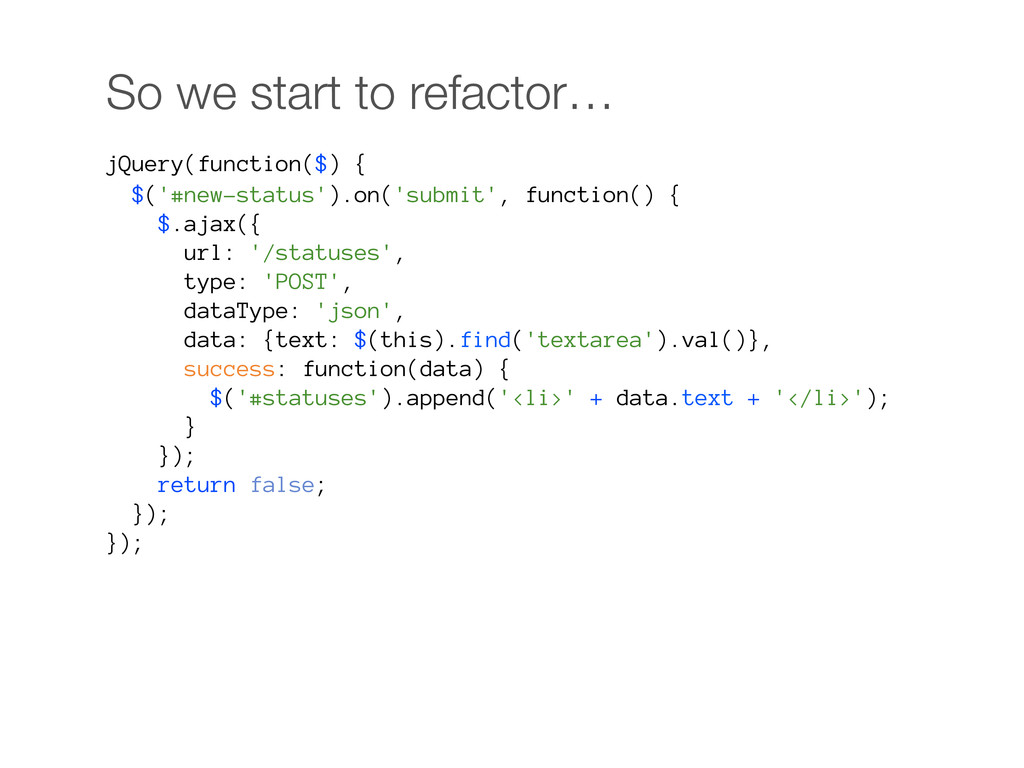
jQuery(function($) { $('#new-status').on('submit', function() { $.ajax({ url: '/statuses', type: 'POST',
dataType: 'json', data: {text: $(this).find('textarea').val()}, success: function(data) { $('#statuses').append('<li>' + data.text + '</li>'); } }); return false; }); }); So we start to refactor… -
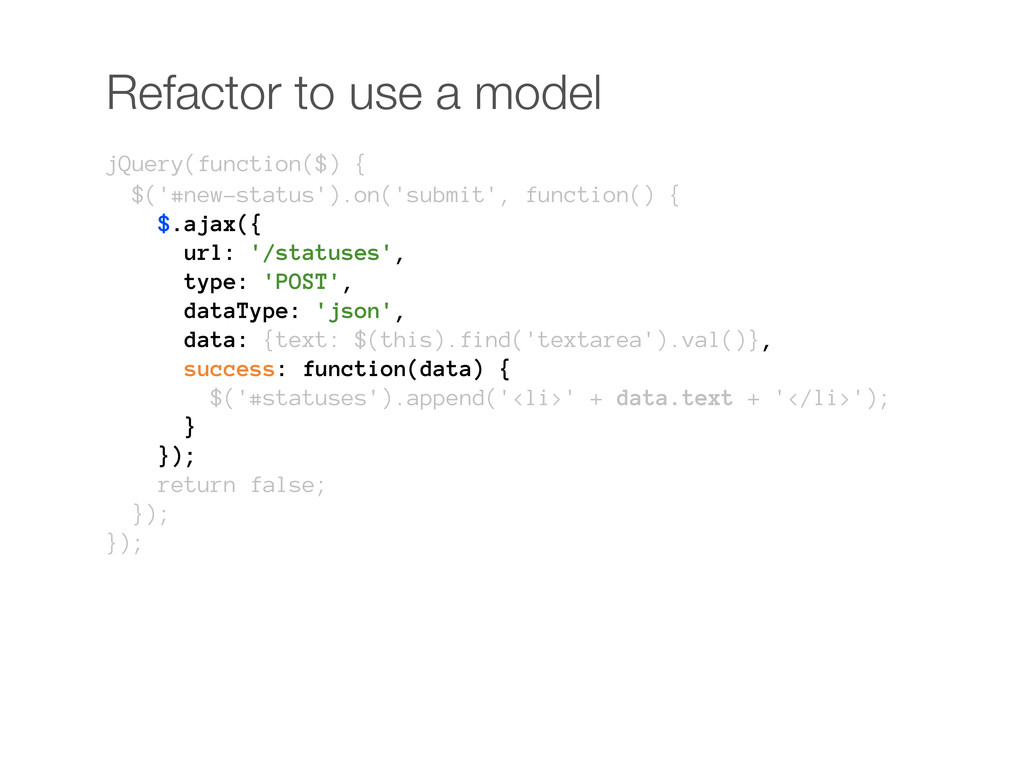
jQuery(function($) { $('#new-status').on('submit', function() { $.ajax({ url: '/statuses', type: 'POST',
dataType: 'json', data: {text: $(this).find('textarea').val()}, success: function(data) { $('#statuses').append('<li>' + data.text + '</li>'); } }); return false; }); }); Refactor to use a model -
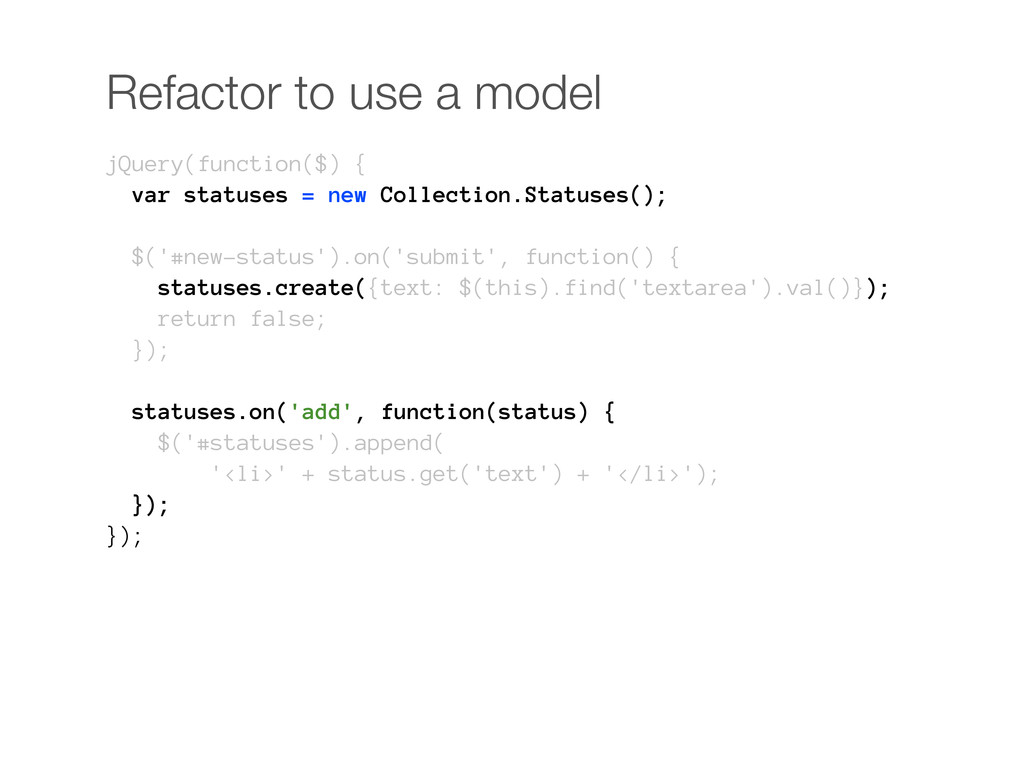
Refactor to use a model jQuery(function($) { var statuses =
new Collection.Statuses(); $('#new-status').on('submit', function() { statuses.create({text: $(this).find('textarea').val()}); return false; }); statuses.on('add', function(status) { $('#statuses').append( '<li>' + status.get('text') + '</li>'); }); }); -
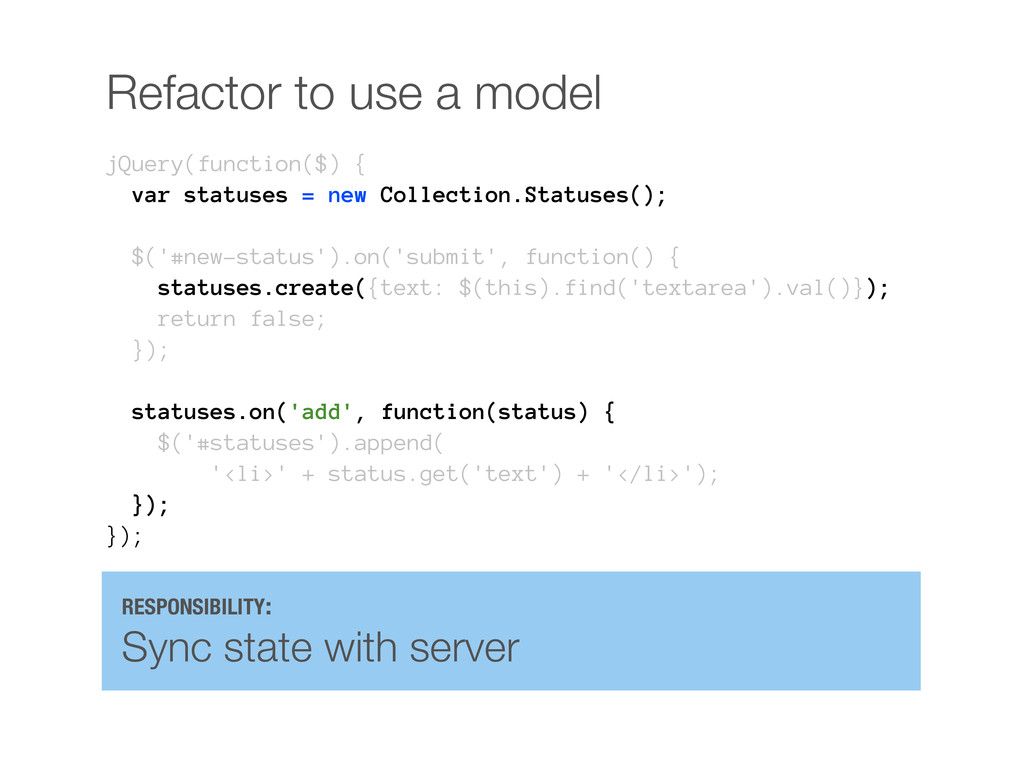
Refactor to use a model jQuery(function($) { var statuses =
new Collection.Statuses(); $('#new-status').on('submit', function() { statuses.create({text: $(this).find('textarea').val()}); return false; }); statuses.on('add', function(status) { $('#statuses').append( '<li>' + status.get('text') + '</li>'); }); }); RESPONSIBILITY: Sync state with server -
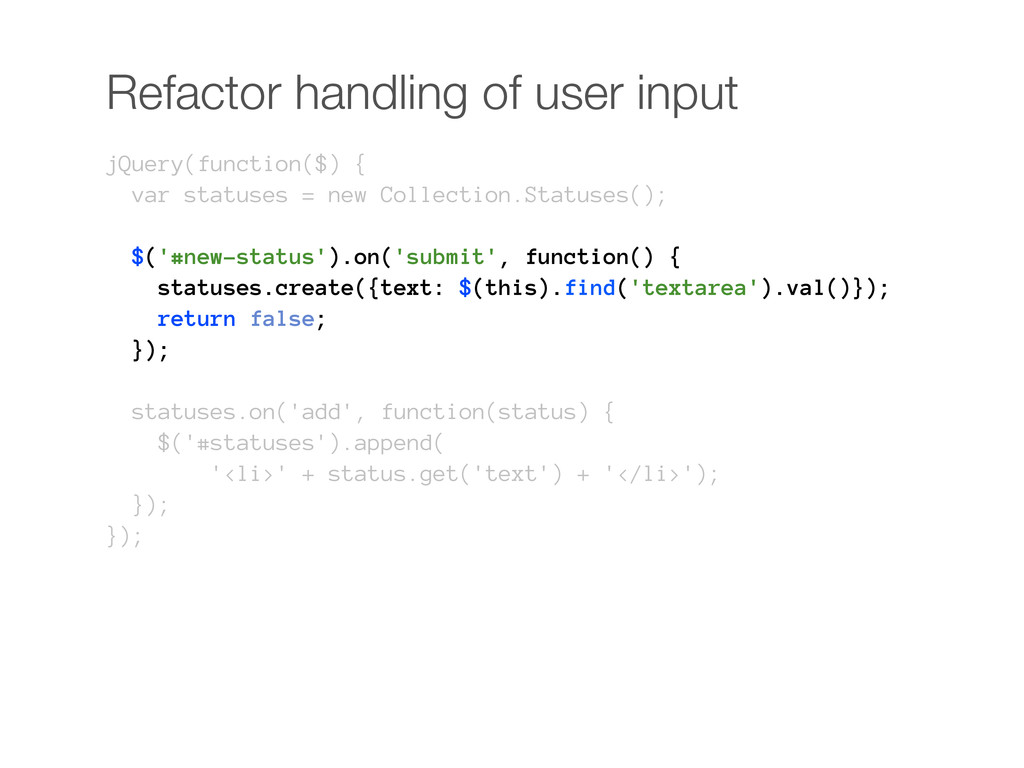
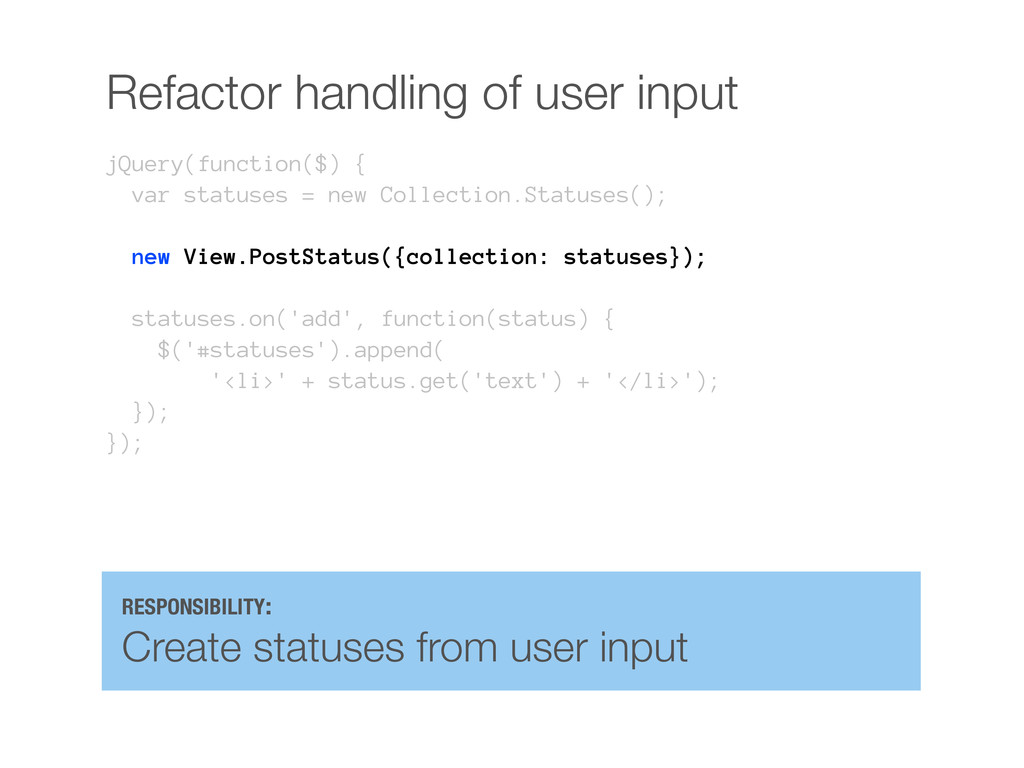
Refactor handling of user input jQuery(function($) { var statuses =
new Collection.Statuses(); $('#new-status').on('submit', function() { statuses.create({text: $(this).find('textarea').val()}); return false; }); statuses.on('add', function(status) { $('#statuses').append( '<li>' + status.get('text') + '</li>'); }); }); -
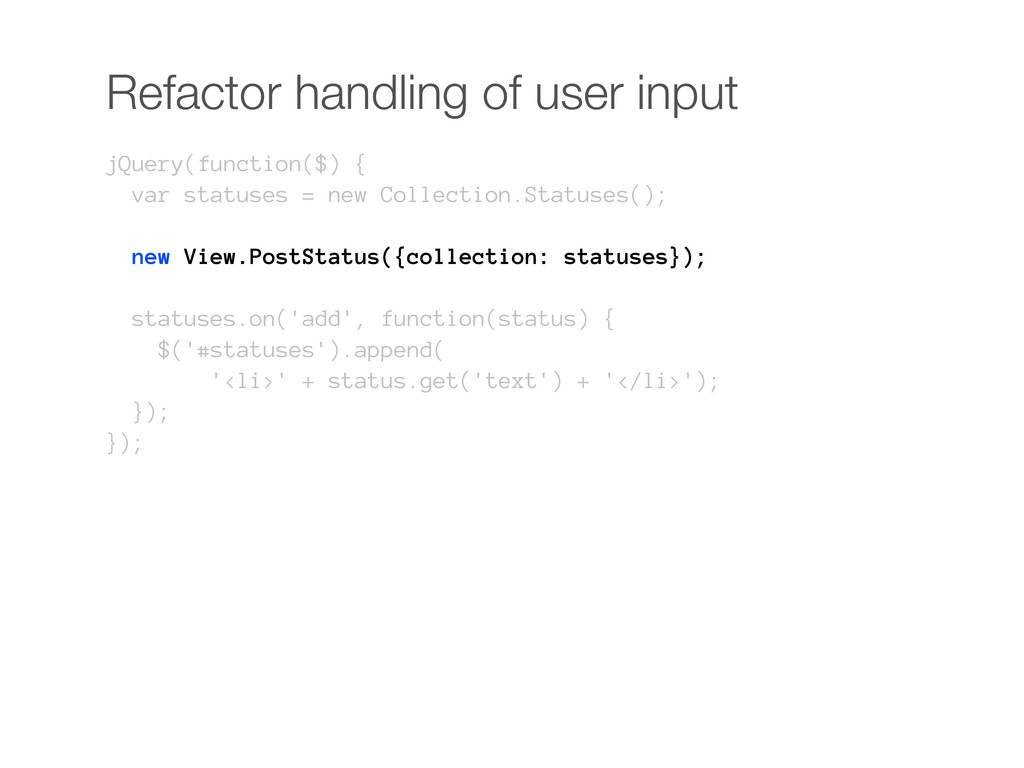
Refactor handling of user input jQuery(function($) { var statuses =
new Collection.Statuses(); new View.PostStatus({collection: statuses}); statuses.on('add', function(status) { $('#statuses').append( '<li>' + status.get('text') + '</li>'); }); }); -
Refactor handling of user input jQuery(function($) { var statuses =
new Collection.Statuses(); new View.PostStatus({collection: statuses}); statuses.on('add', function(status) { $('#statuses').append( '<li>' + status.get('text') + '</li>'); }); }); RESPONSIBILITY: Create statuses from user input -
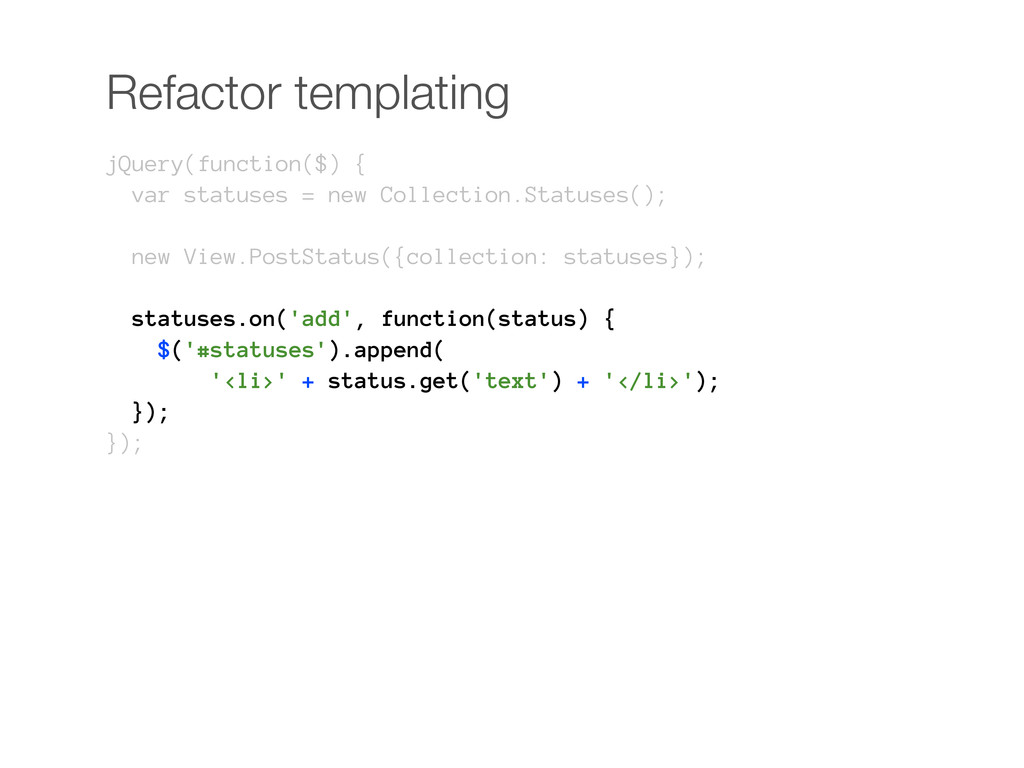
jQuery(function($) { var statuses = new Collection.Statuses(); new View.PostStatus({collection: statuses});
statuses.on('add', function(status) { $('#statuses').append( '<li>' + status.get('text') + '</li>'); }); }); Refactor templating -
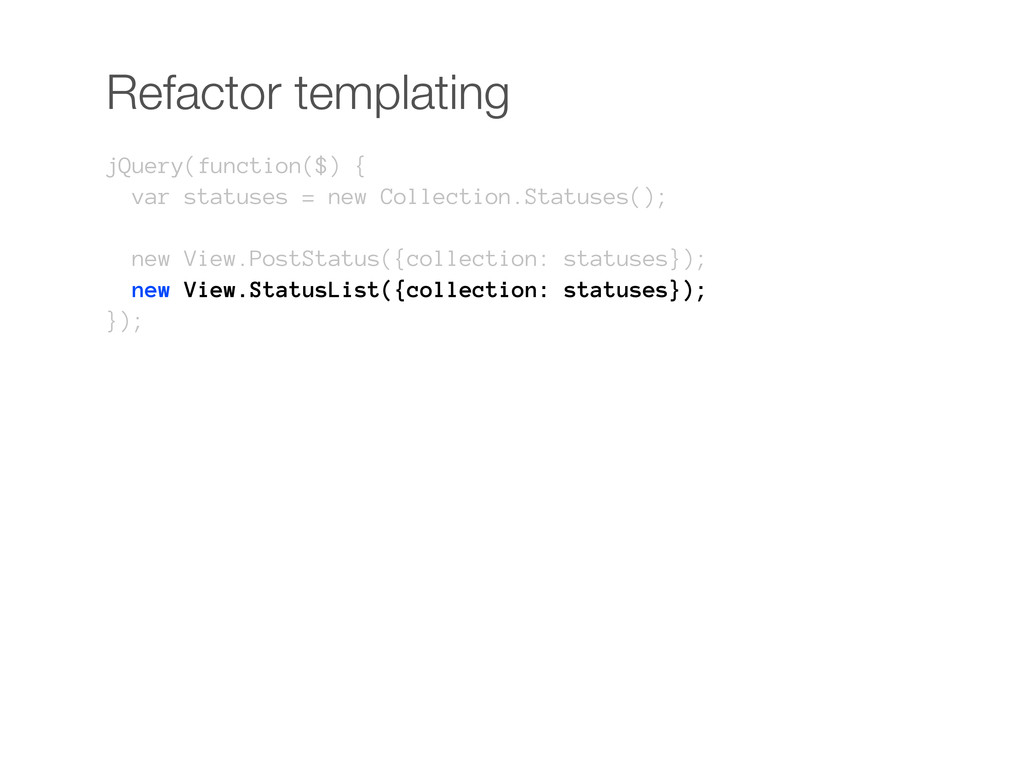
Refactor templating jQuery(function($) { var statuses = new Collection.Statuses(); new
View.PostStatus({collection: statuses}); new View.StatusList({collection: statuses}); }); -
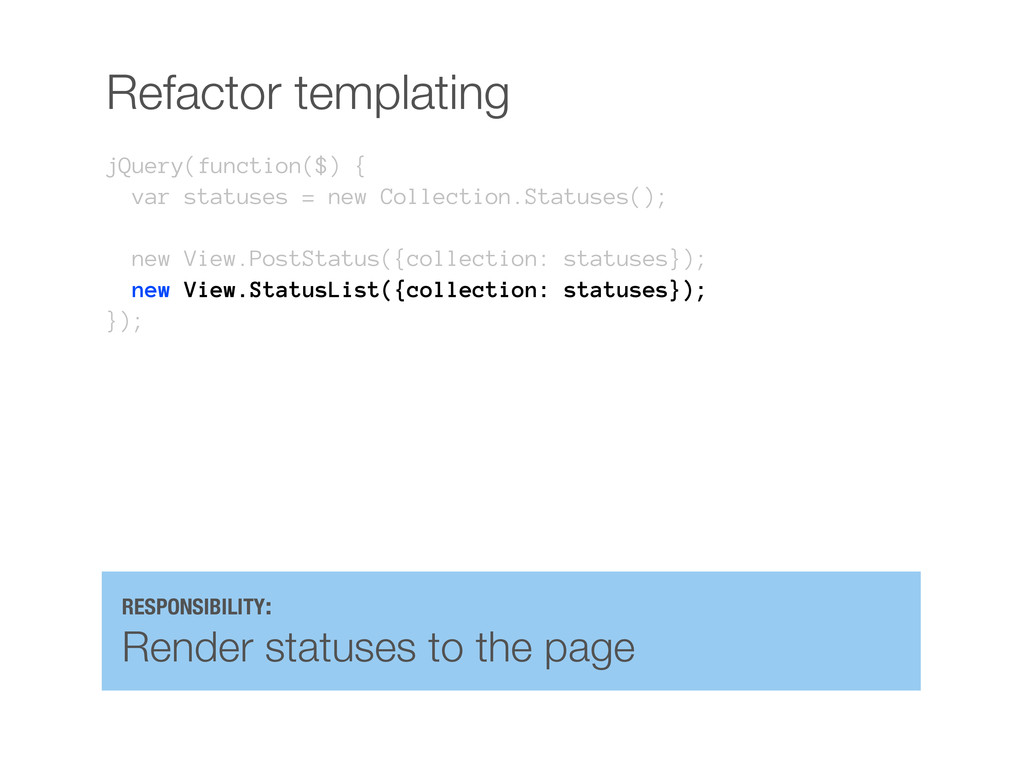
Refactor templating jQuery(function($) { var statuses = new Collection.Statuses(); new
View.PostStatus({collection: statuses}); new View.StatusList({collection: statuses}); }); RESPONSIBILITY: Render statuses to the page -
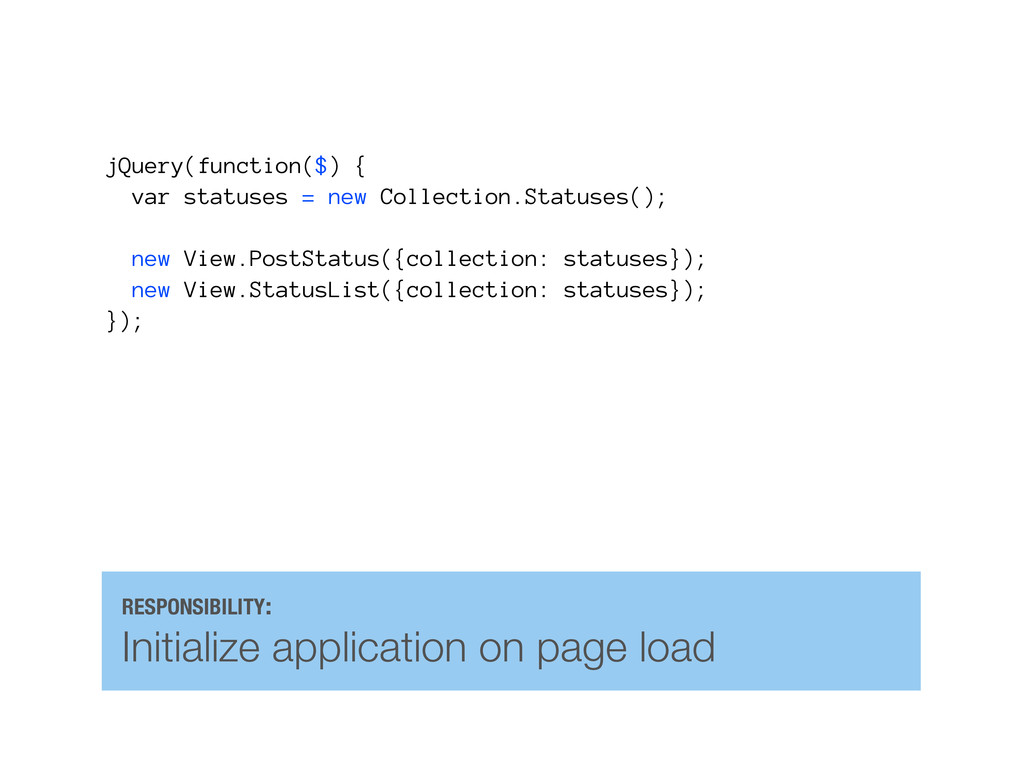
jQuery(function($) { var statuses = new Collection.Statuses(); new View.PostStatus({collection: statuses});
new View.StatusList({collection: statuses}); }); RESPONSIBILITY: Initialize application on page load -
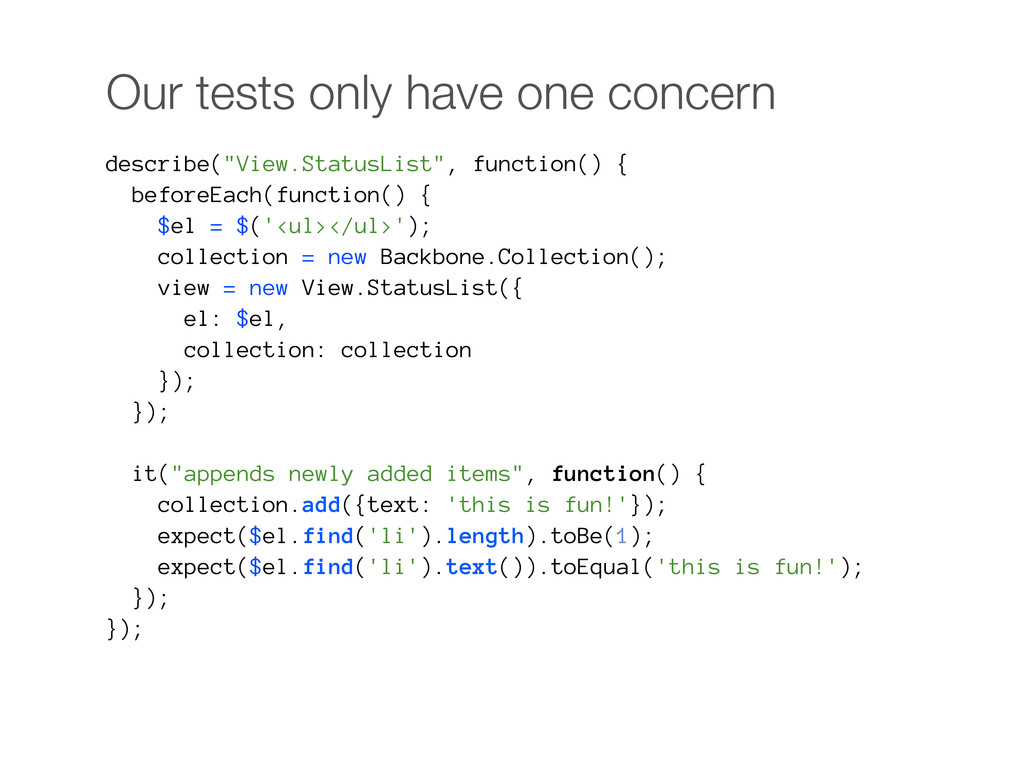
Our tests only have one concern describe("View.StatusList", function() { beforeEach(function()
{ $el = $('<ul></ul>'); collection = new Backbone.Collection(); view = new View.StatusList({ el: $el, collection: collection }); }); it("appends newly added items", function() { collection.add({text: 'this is fun!'}); expect($el.find('li').length).toBe(1); expect($el.find('li').text()).toEqual('this is fun!'); }); }); -
Steve Freeman, Nat Pryce Growing Object-Oriented Software, Guided by Tests
Poor quality tests can slow development to a crawl, and poor internal quality of the system being tested will result in poor quality tests. -
Christian Johansen Test-Driven JavaScript Development “If you write bad unit
tests, you might find that you gain none of the benefits, and instead are stuck with a bunch of tests that are time-consuming and hard to maintain.” -
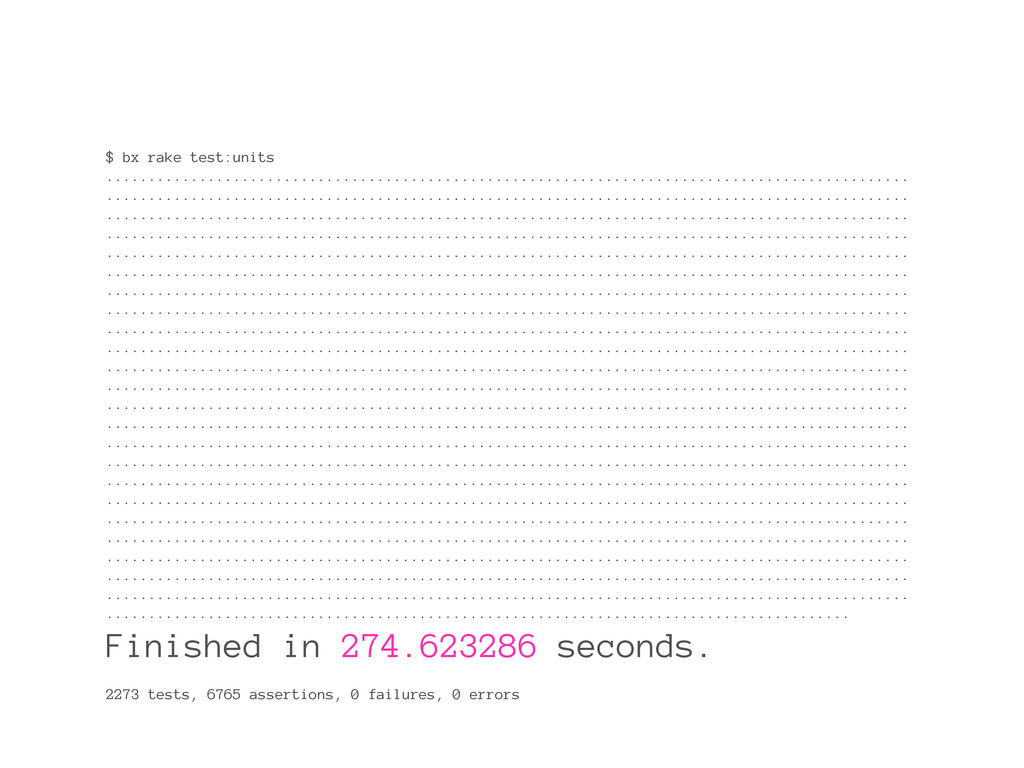
$ bx rake test:units ............................................................................................... ............................................................................................... ............................................................................................... ............................................................................................... ............................................................................................... ...............................................................................................
............................................................................................... ............................................................................................... ............................................................................................... ............................................................................................... ............................................................................................... ............................................................................................... ............................................................................................... ............................................................................................... ............................................................................................... ............................................................................................... ............................................................................................... ............................................................................................... ............................................................................................... ............................................................................................... ............................................................................................... ............................................................................................... ............................................................................................... ........................................................................................ Finished in 274.623286 seconds. 2273 tests, 6765 assertions, 0 failures, 0 errors -
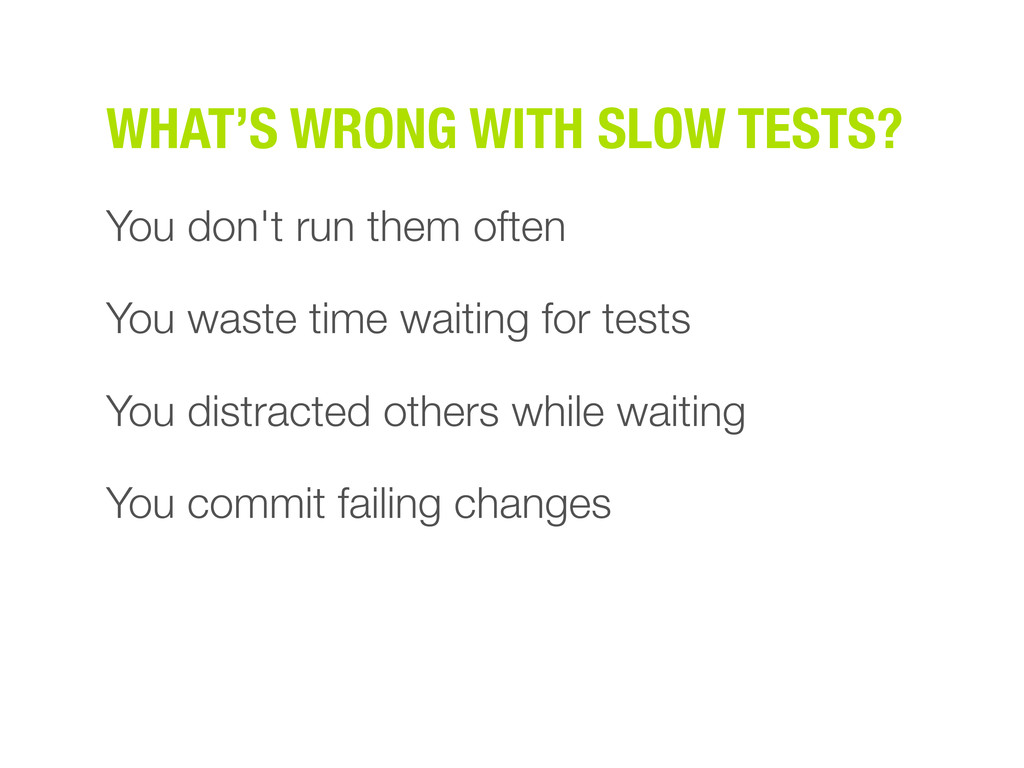
You don't run them often You waste time waiting for
tests WHAT’S WRONG WITH SLOW TESTS? -
You don't run them often You waste time waiting for
tests You distracted others while waiting WHAT’S WRONG WITH SLOW TESTS? -
You don't run them often You waste time waiting for
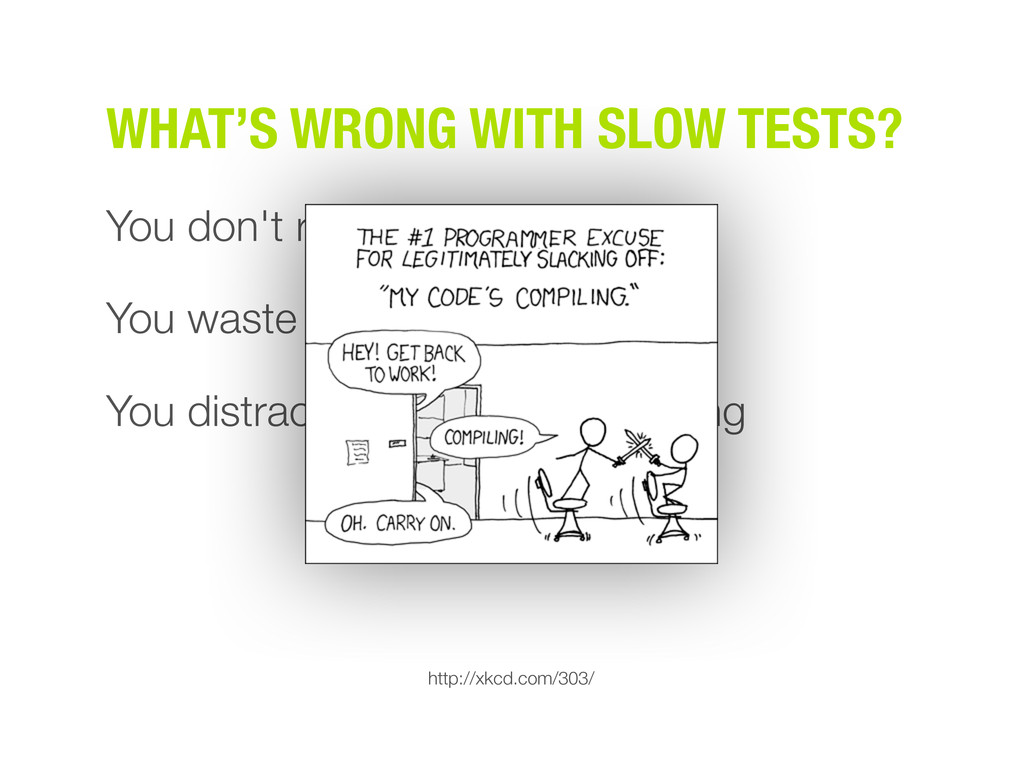
tests You distracted others while waiting WHAT’S WRONG WITH SLOW TESTS? http://xkcd.com/303/ -
You don't run them often You waste time waiting for
tests You distracted others while waiting You commit failing changes WHAT’S WRONG WITH SLOW TESTS? -
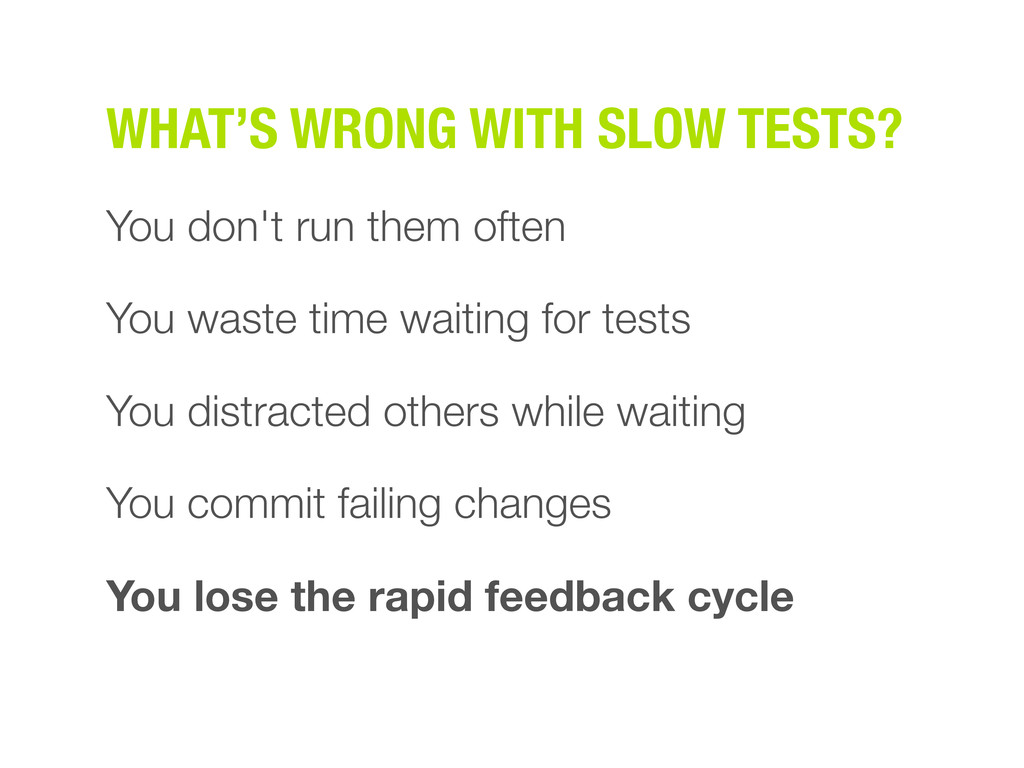
You don't run them often You waste time waiting for
tests You distracted others while waiting You commit failing changes You lose the rapid feedback cycle WHAT’S WRONG WITH SLOW TESTS? -
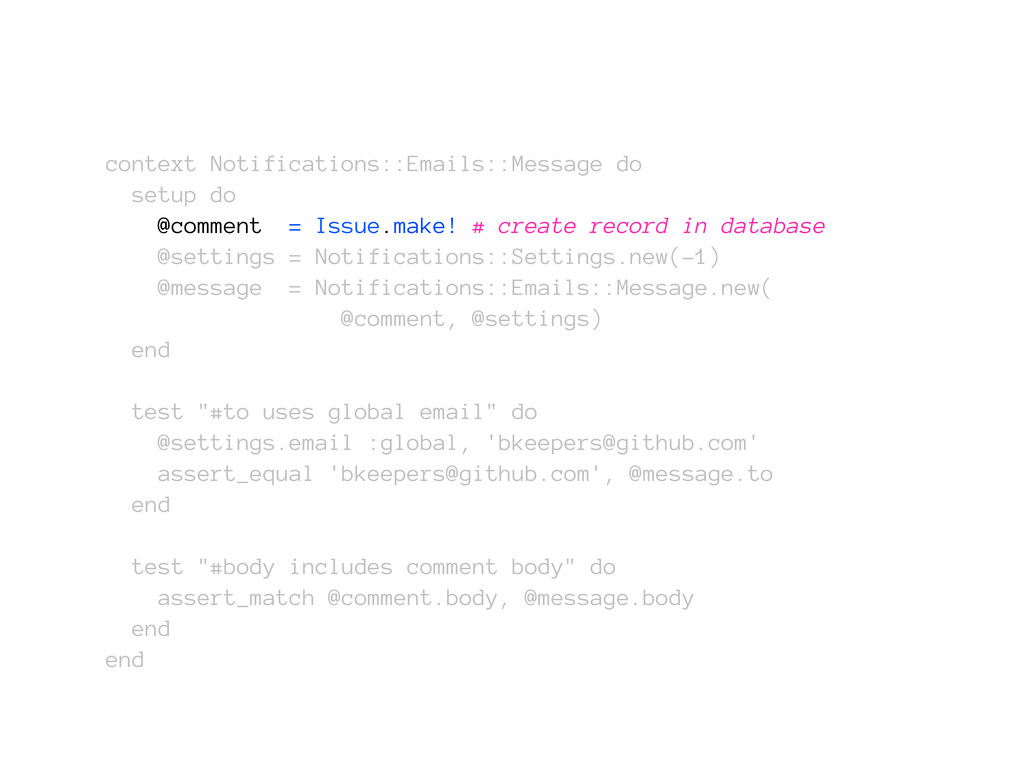
context Notifications::Emails::Message do setup do @comment = Issue.make! # create
record in database @settings = Notifications::Settings.new(-1) @message = Notifications::Emails::Message.new( @comment, @settings) end test "#to uses global email" do @settings.email :global, '[email protected]' assert_equal '[email protected]', @message.to end test "#body includes comment body" do assert_match @comment.body, @message.body end end -
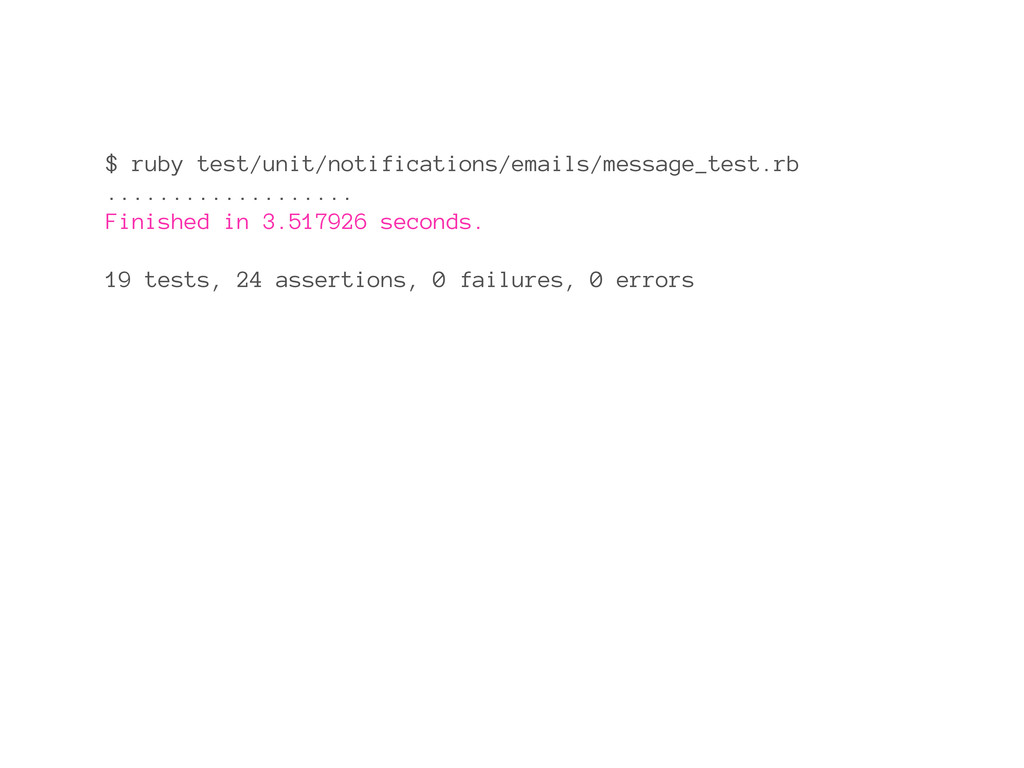
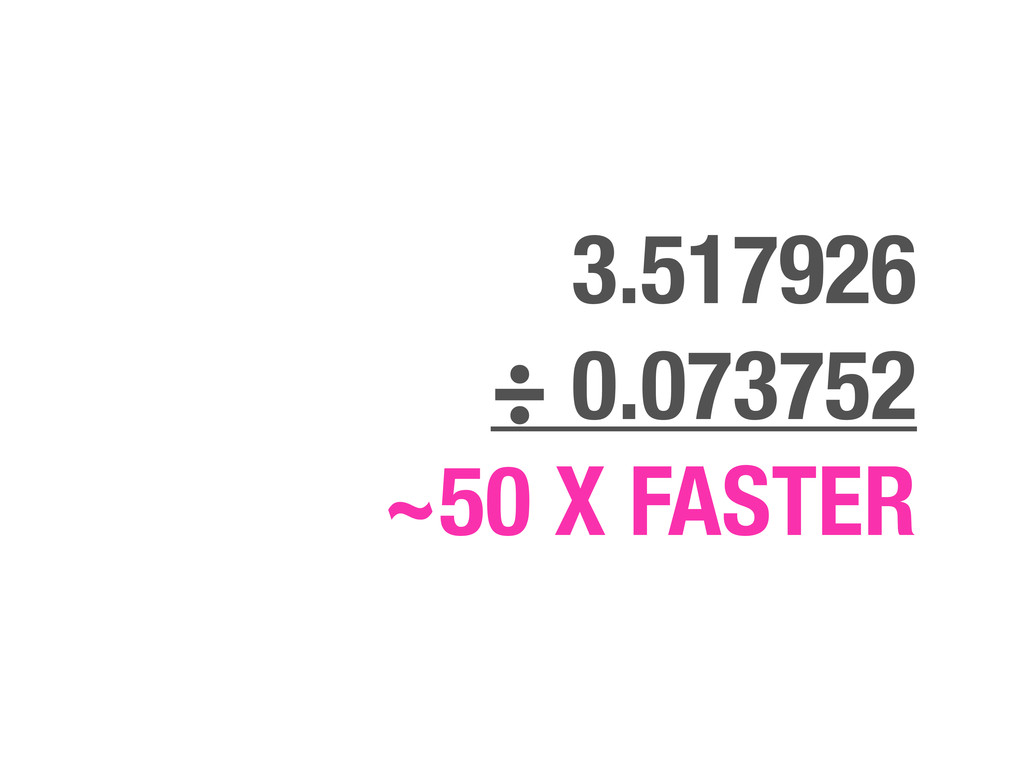
$ ruby test/unit/notifications/emails/message_test.rb ................... Finished in 3.517926 seconds. 19 tests,
24 assertions, 0 failures, 0 errors -
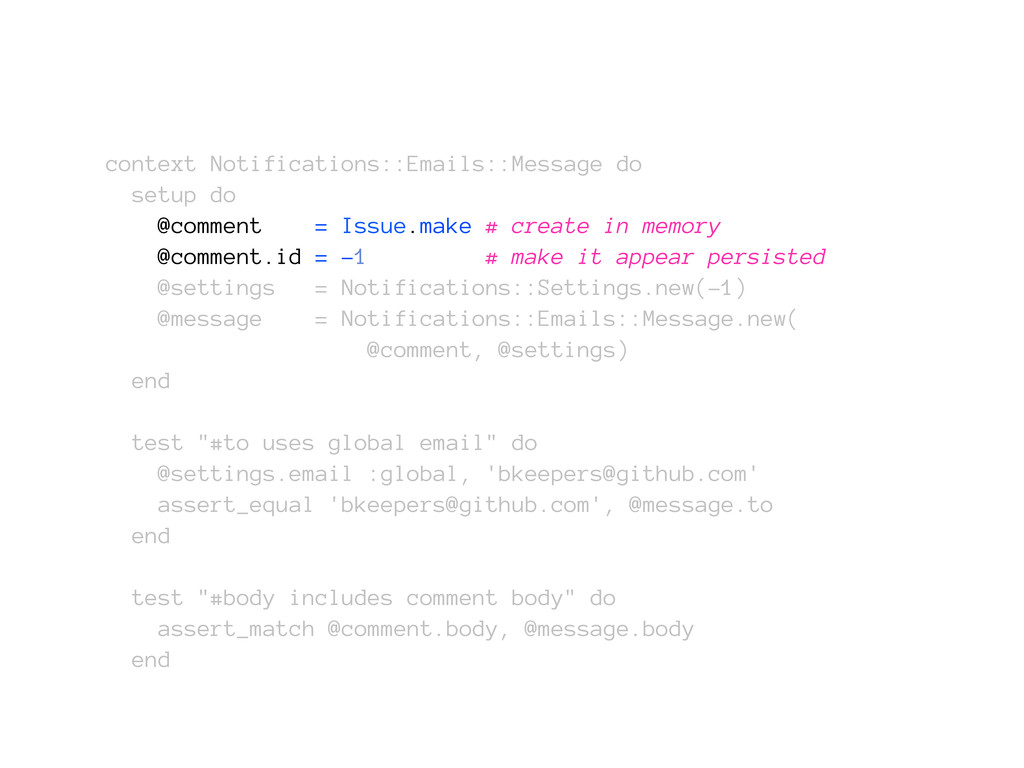
context Notifications::Emails::Message do setup do @comment = Issue.make # create
in memory @comment.id = -1 # make it appear persisted @settings = Notifications::Settings.new(-1) @message = Notifications::Emails::Message.new( @comment, @settings) end test "#to uses global email" do @settings.email :global, '[email protected]' assert_equal '[email protected]', @message.to end test "#body includes comment body" do assert_match @comment.body, @message.body end -
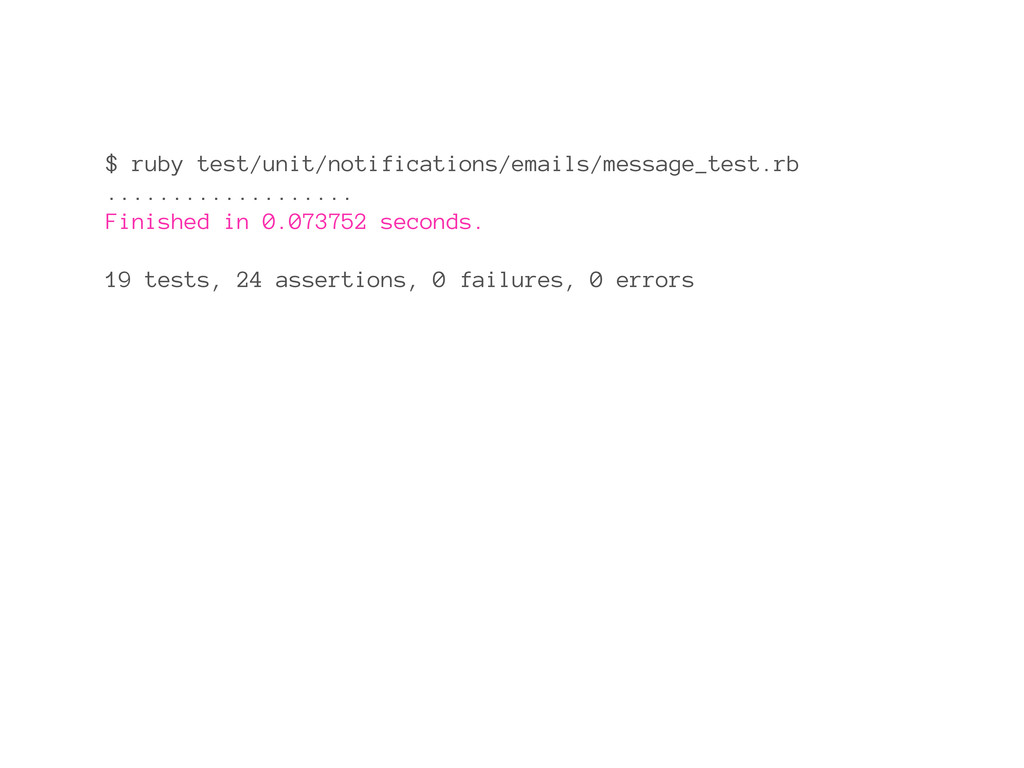
$ ruby test/unit/notifications/emails/message_test.rb ................... Finished in 0.073752 seconds. 19 tests,
24 assertions, 0 failures, 0 errors -
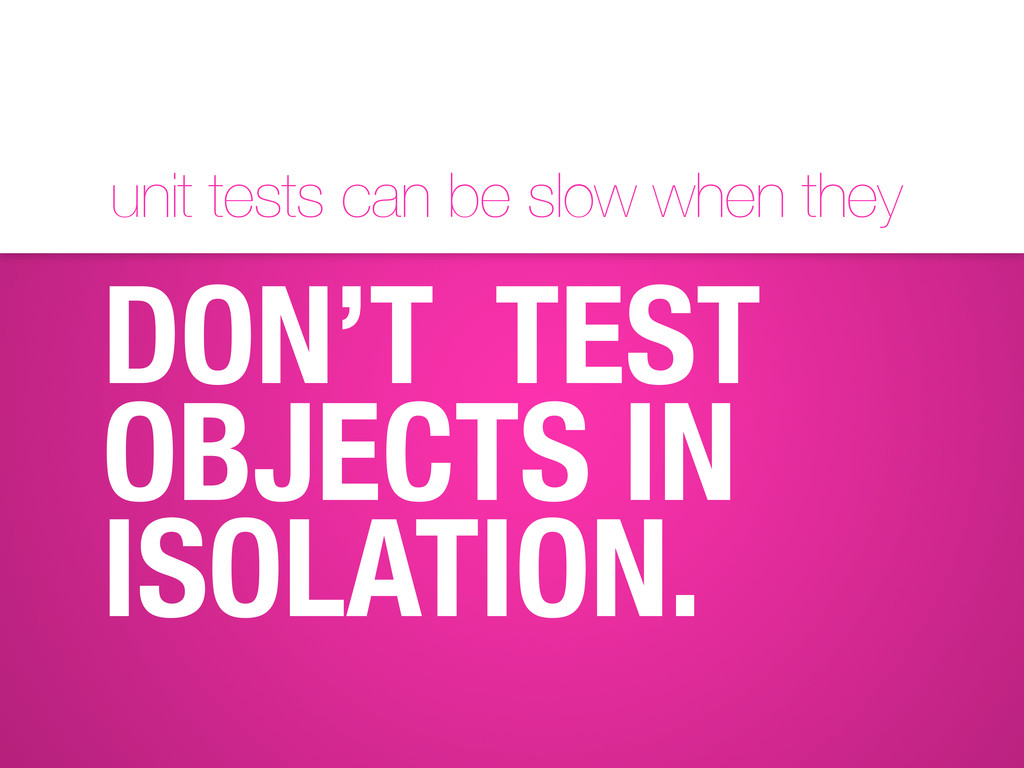
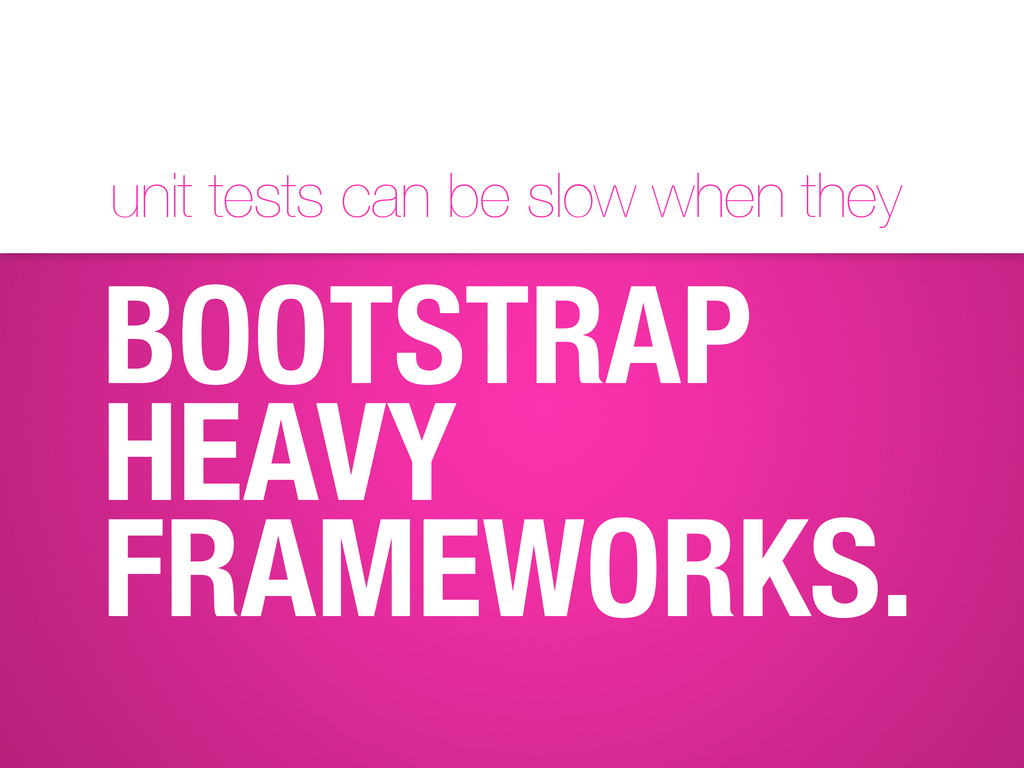
unit tests can be slow when they DON’T TEST OBJECTS
IN ISOLATION. -
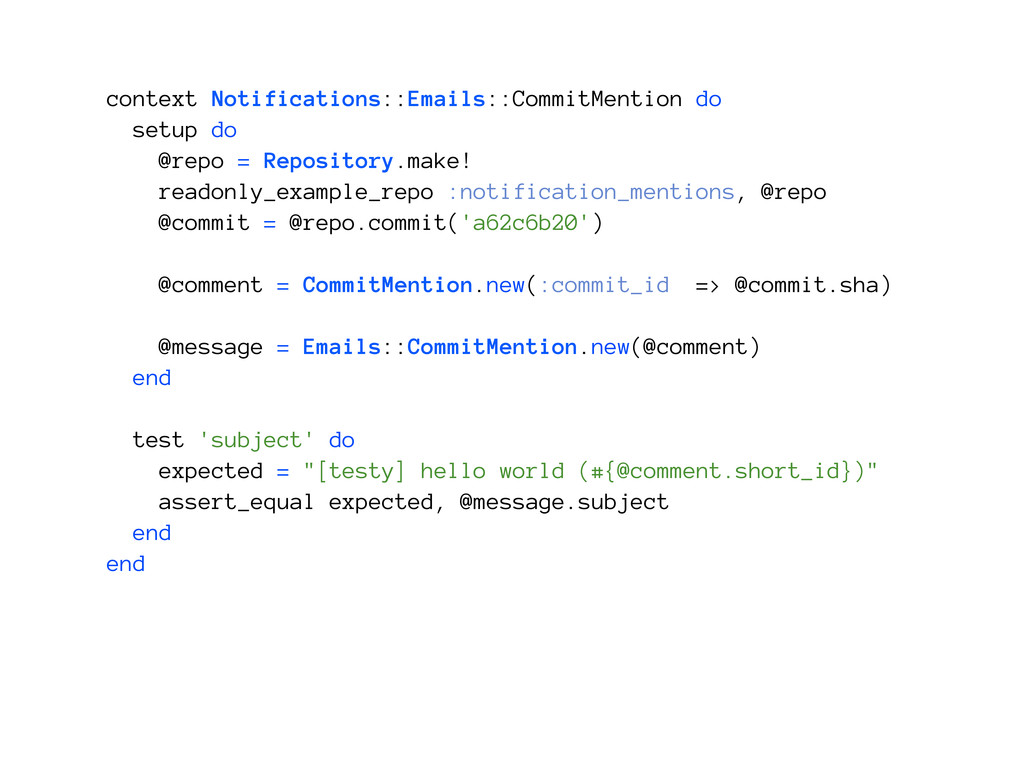
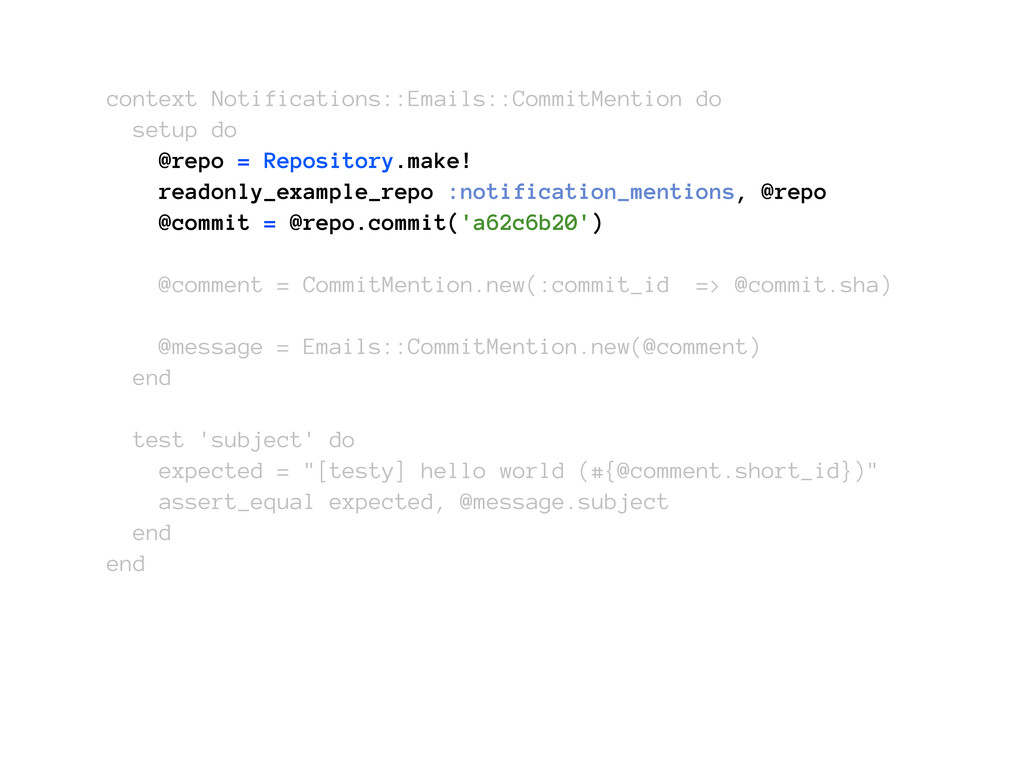
context Notifications::Emails::CommitMention do setup do @repo = Repository.make! readonly_example_repo :notification_mentions,
@repo @commit = @repo.commit('a62c6b20') @comment = CommitMention.new(:commit_id => @commit.sha) @message = Emails::CommitMention.new(@comment) end test 'subject' do expected = "[testy] hello world (#{@comment.short_id})" assert_equal expected, @message.subject end end -
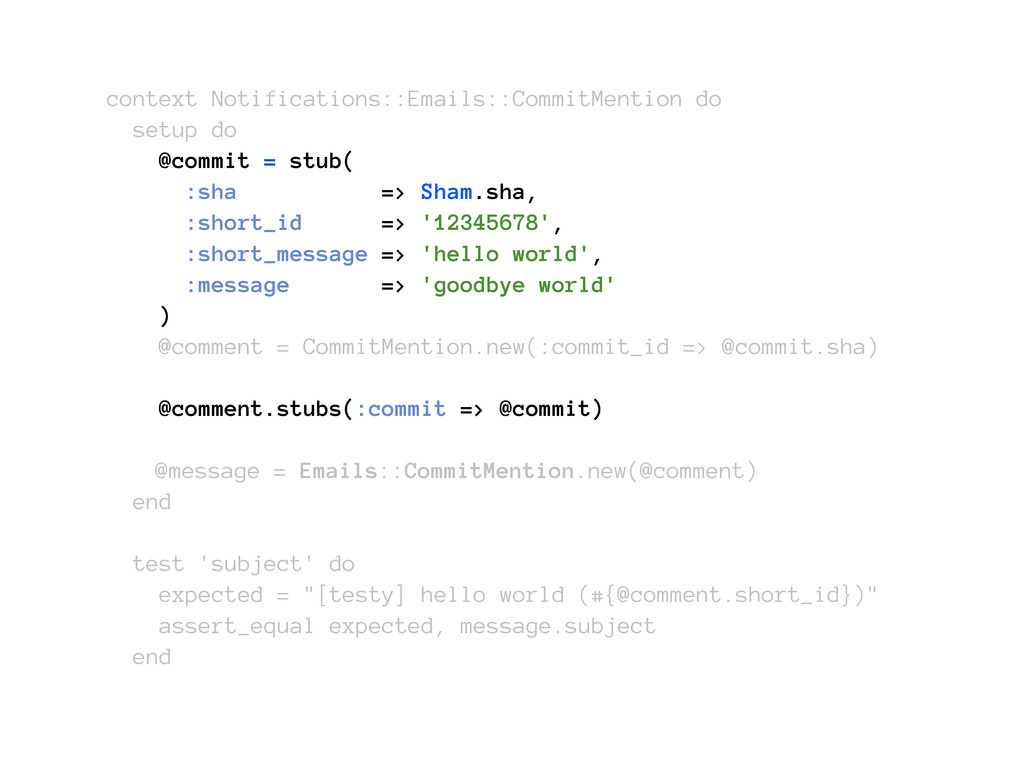
context Notifications::Emails::CommitMention do setup do @commit = stub( :sha =>
Sham.sha, :short_id => '12345678', :short_message => 'hello world', :message => 'goodbye world' ) @comment = CommitMention.new(:commit_id => @commit.sha) @comment.stubs(:commit => @commit) @message = Emails::CommitMention.new(@comment) end test 'subject' do expected = "[testy] hello world (#{@comment.short_id})" assert_equal expected, message.subject end -
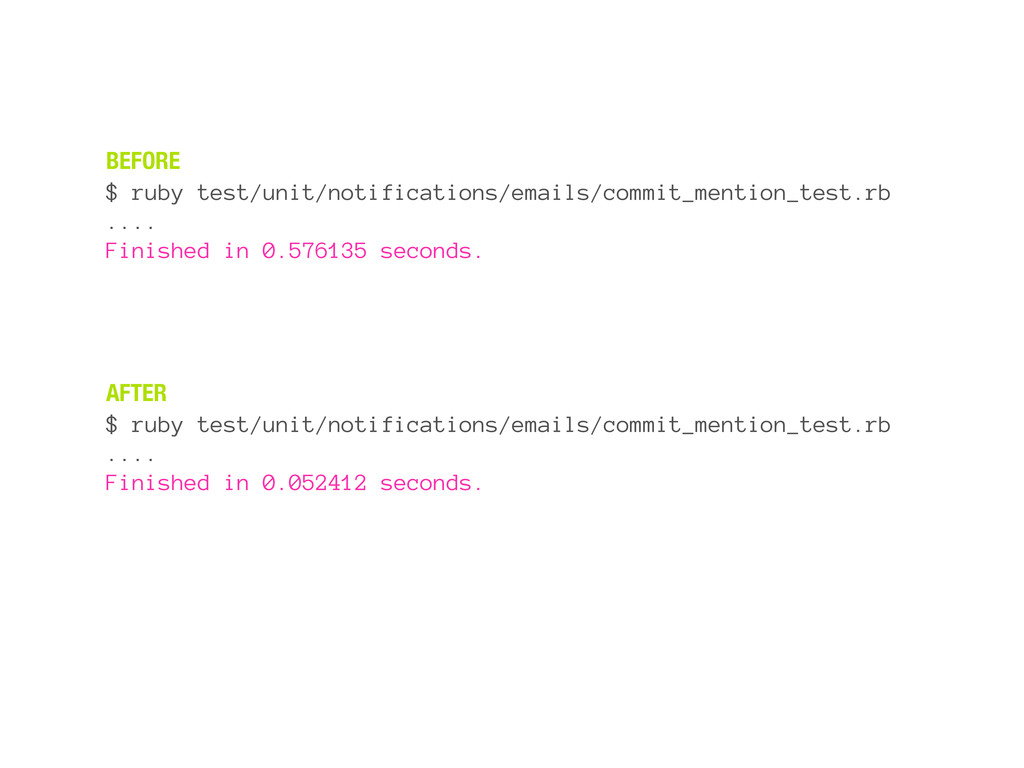
BEFORE $ ruby test/unit/notifications/emails/commit_mention_test.rb .... Finished in 0.576135 seconds. AFTER
$ ruby test/unit/notifications/emails/commit_mention_test.rb .... Finished in 0.052412 seconds. -
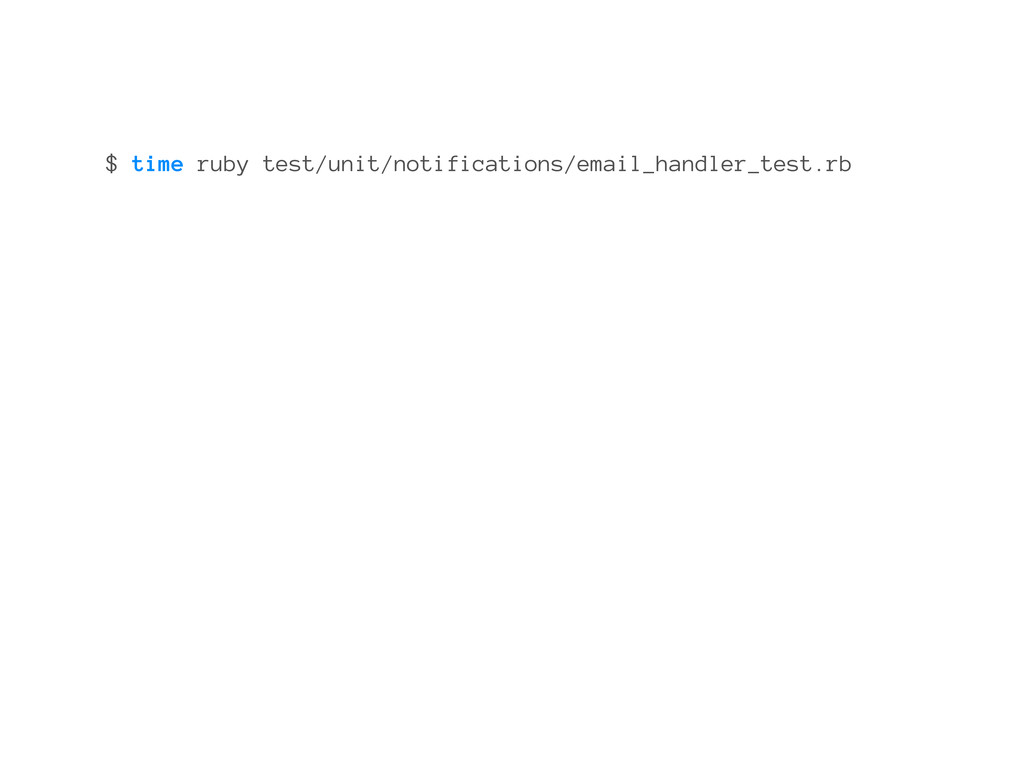
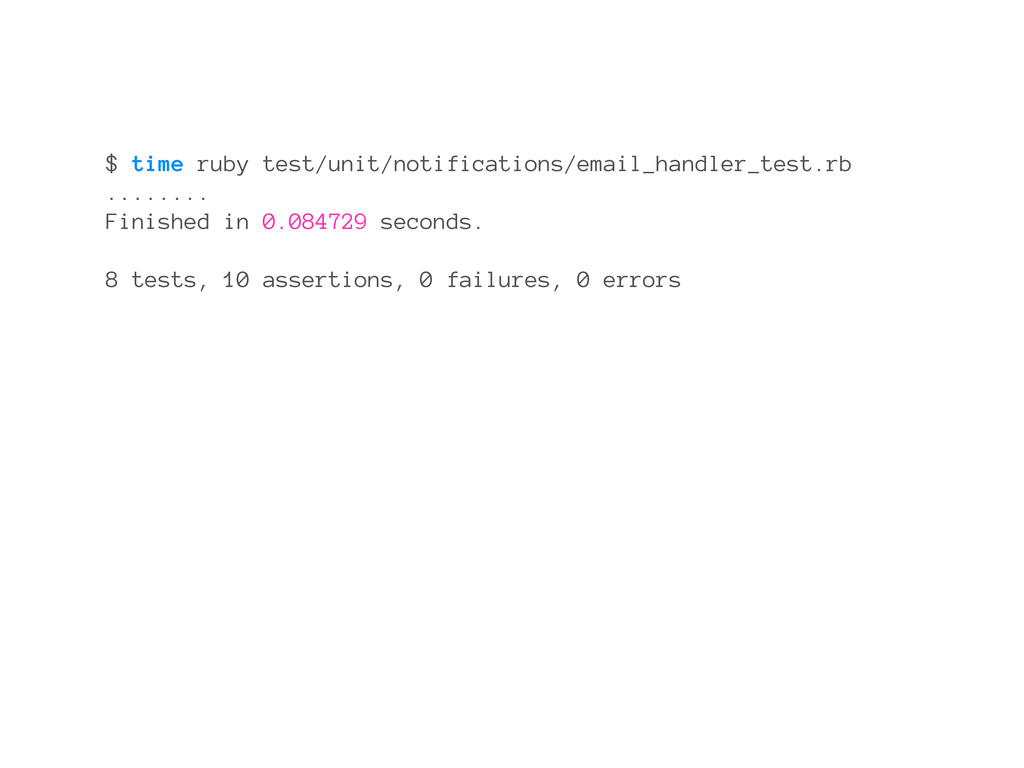
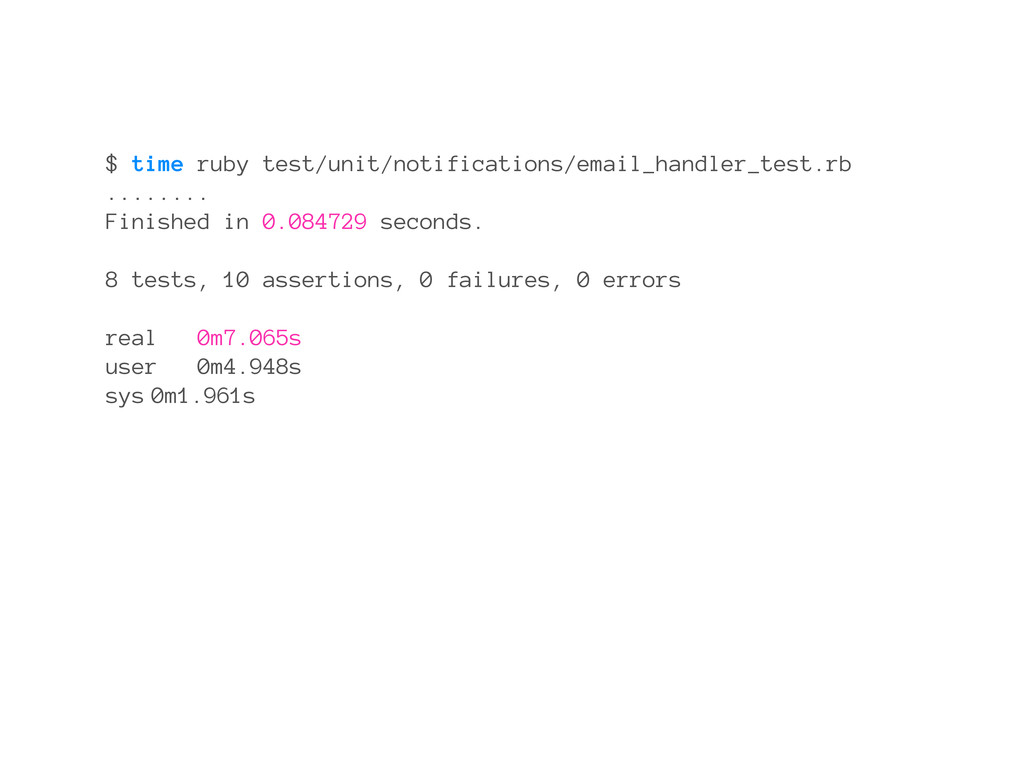
$ time ruby test/unit/notifications/email_handler_test.rb ........ Finished in 0.084729 seconds. 8
tests, 10 assertions, 0 failures, 0 errors -
$ time ruby test/unit/notifications/email_handler_test.rb ........ Finished in 0.084729 seconds. 8
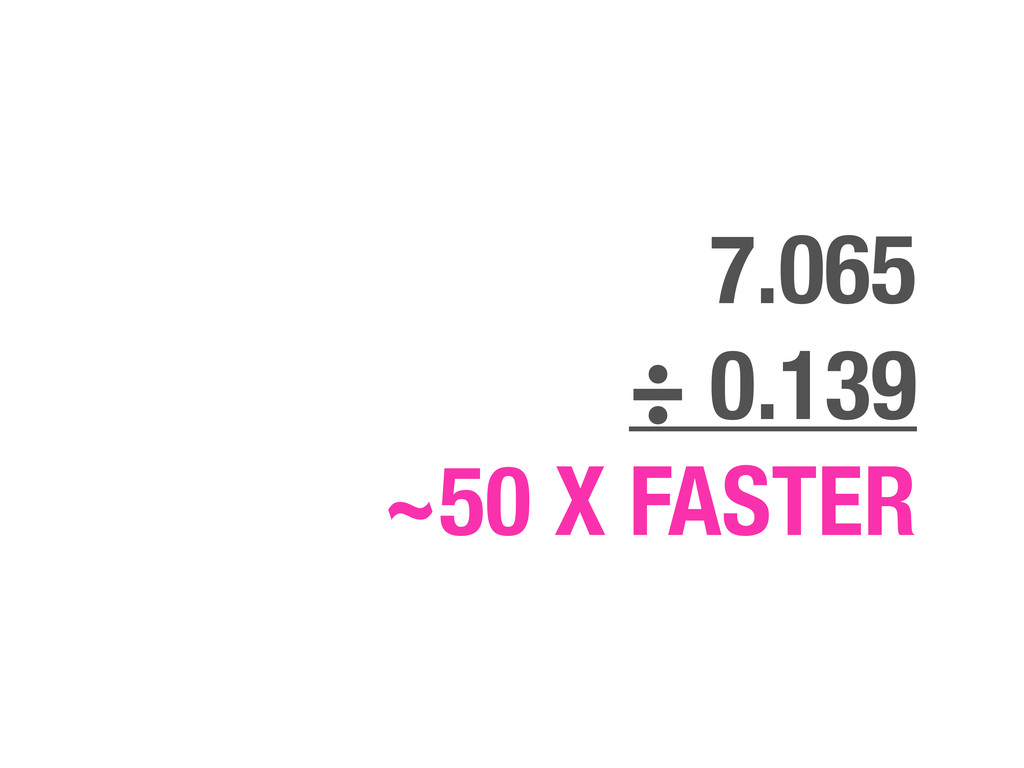
tests, 10 assertions, 0 failures, 0 errors real 0m7.065s user 0m4.948s sys 0m1.961s -
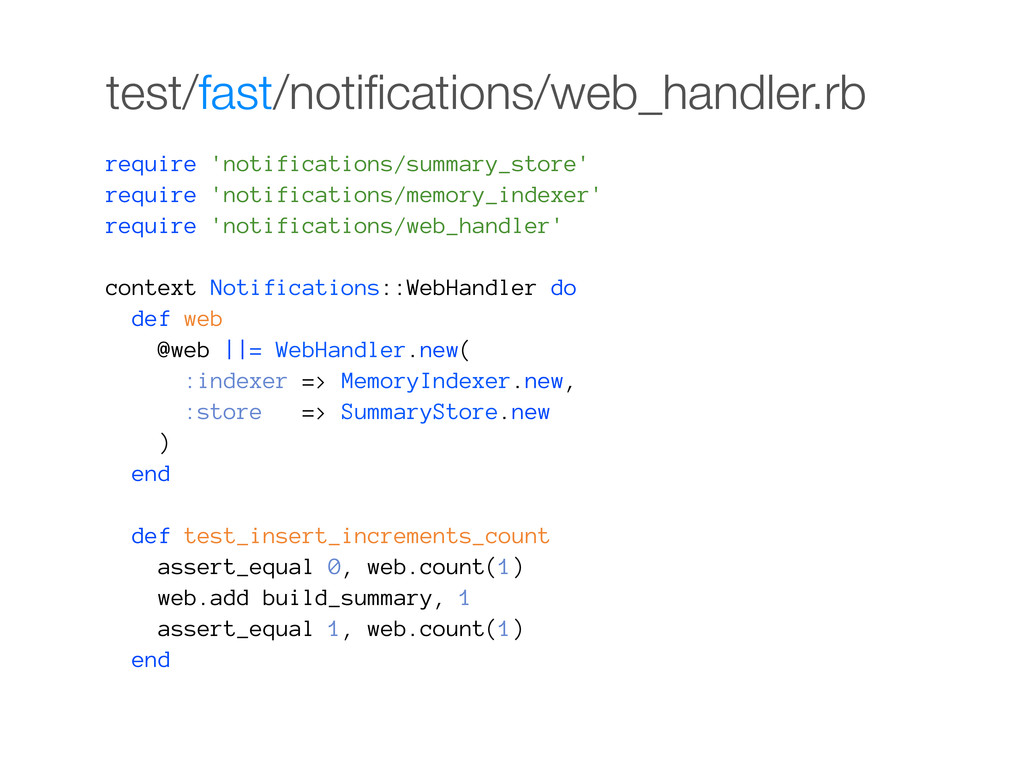
test/fast/notifications/web_handler.rb require 'notifications/summary_store' require 'notifications/memory_indexer' require 'notifications/web_handler' context Notifications::WebHandler do
def web @web ||= WebHandler.new( :indexer => MemoryIndexer.new, :store => SummaryStore.new ) end def test_insert_increments_count assert_equal 0, web.count(1) web.add build_summary, 1 assert_equal 1, web.count(1) end -
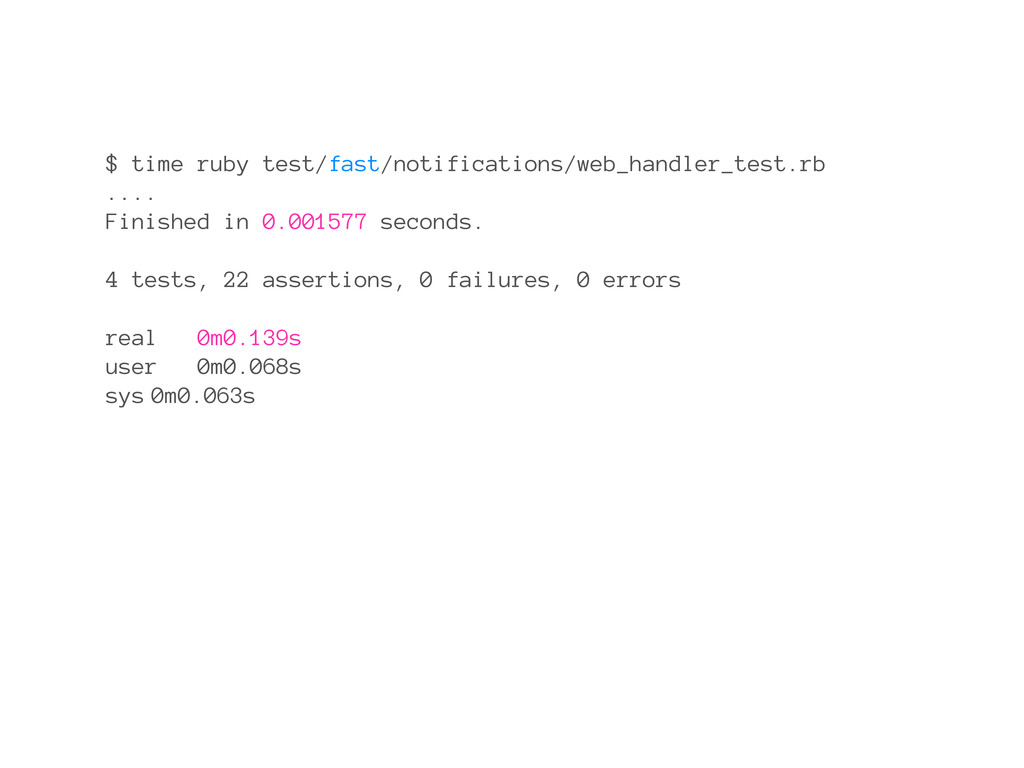
$ time ruby test/fast/notifications/web_handler_test.rb .... Finished in 0.001577 seconds. 4
tests, 22 assertions, 0 failures, 0 errors real 0m0.139s user 0m0.068s sys 0m0.063s -
SLOW TEST MYTHS “Our tests are slow because we have
too many of them.” -
SLOW TEST MYTHS “Our tests are slow because we have
too many of them.” “To speed up our tests, we just need to parallelize them.” -
SLOW TEST MYTHS “Our tests are slow because we have
too many of them.” “To speed up our tests, we just need to parallelize them.” “We can’t use test doubles because we’ll loose confidence that it still works.” -
PAY ATTENTION TO THE SPEED OF YOUR TESTS AS YOU
WRITE THEM. -
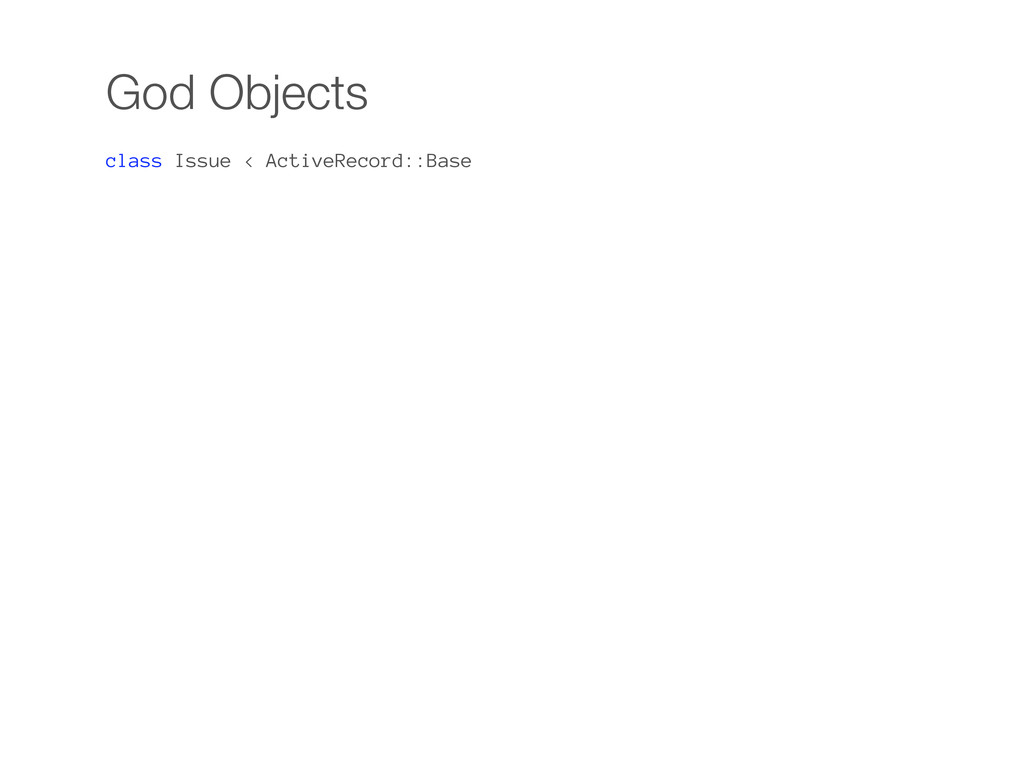
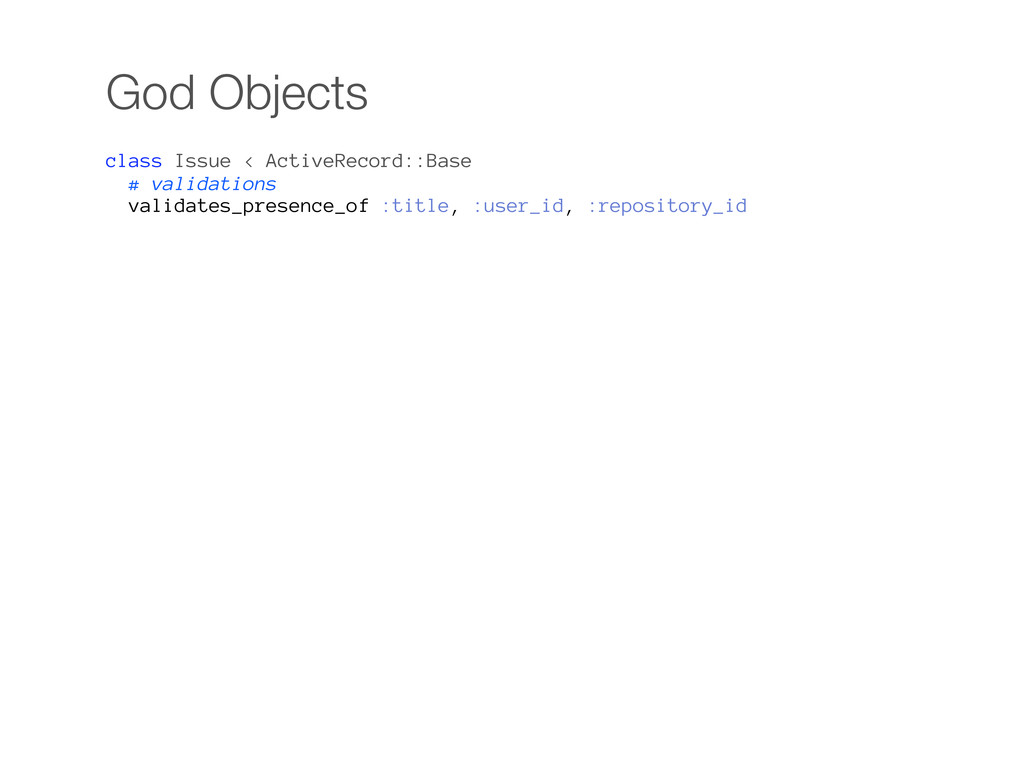
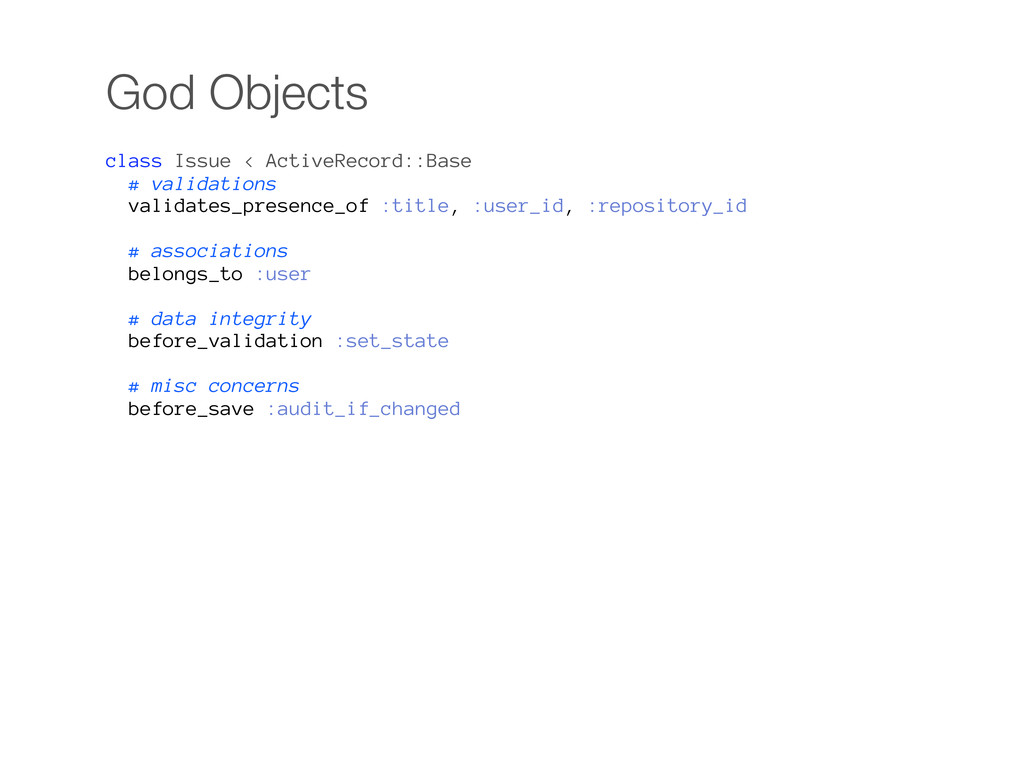
God Objects class Issue < ActiveRecord::Base # validations validates_presence_of :title,
:user_id, :repository_id -
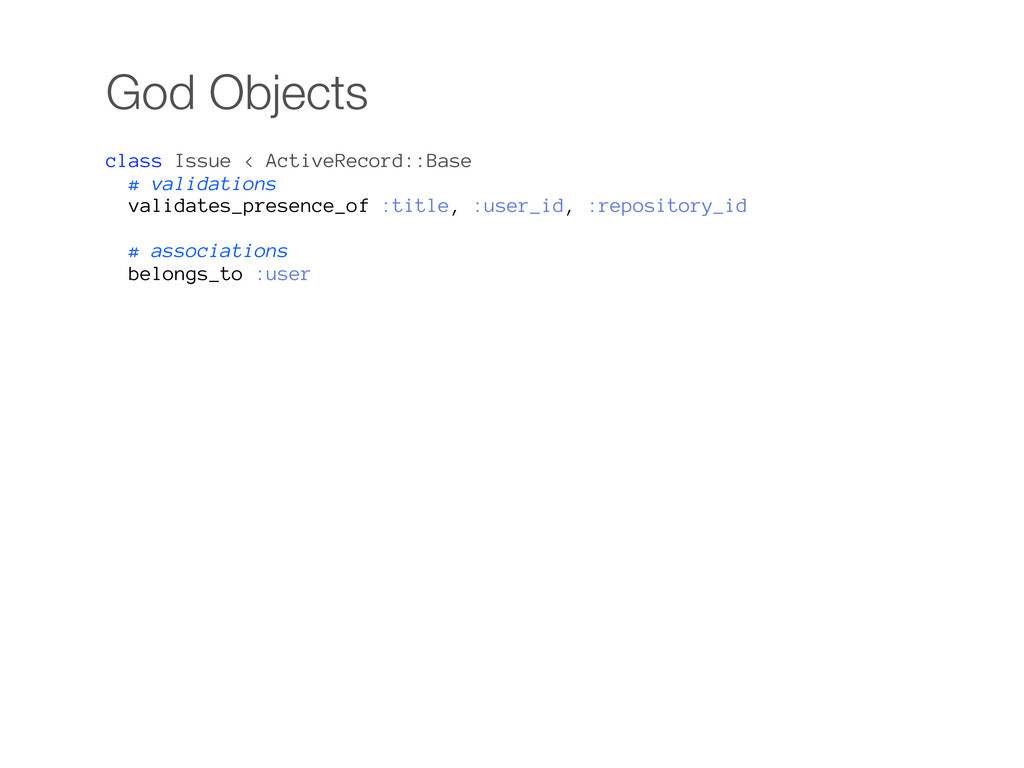
God Objects class Issue < ActiveRecord::Base # validations validates_presence_of :title,
:user_id, :repository_id # associations belongs_to :user -
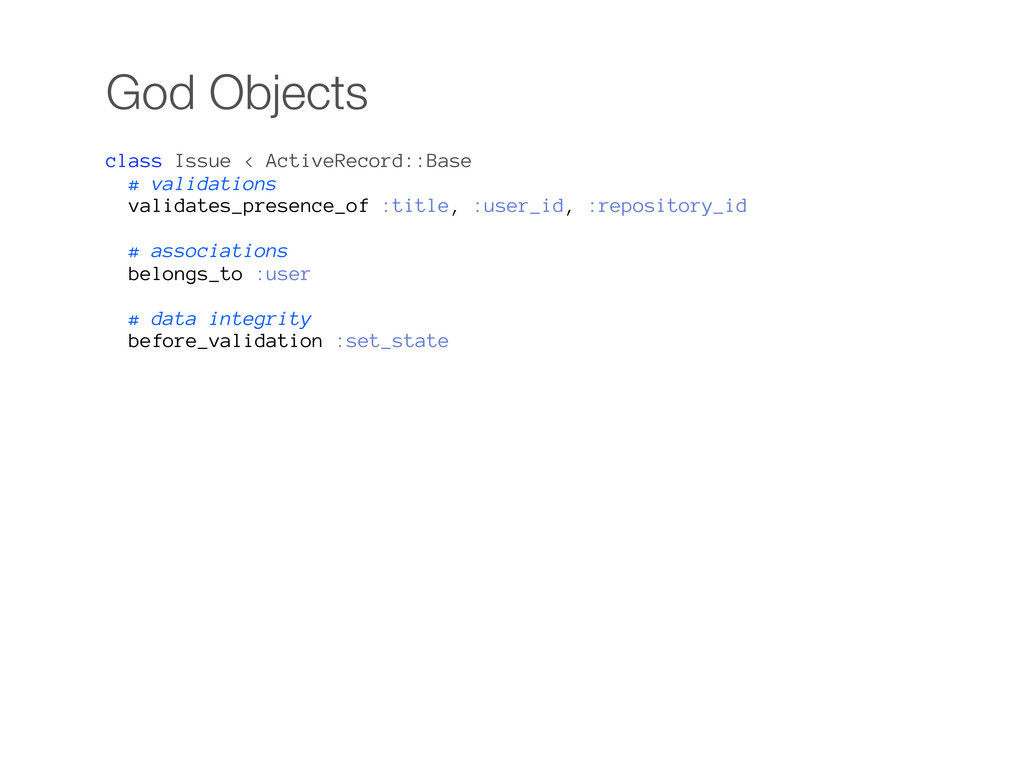
God Objects class Issue < ActiveRecord::Base # validations validates_presence_of :title,
:user_id, :repository_id # associations belongs_to :user # data integrity before_validation :set_state -
God Objects class Issue < ActiveRecord::Base # validations validates_presence_of :title,
:user_id, :repository_id # associations belongs_to :user # data integrity before_validation :set_state # misc concerns before_save :audit_if_changed -
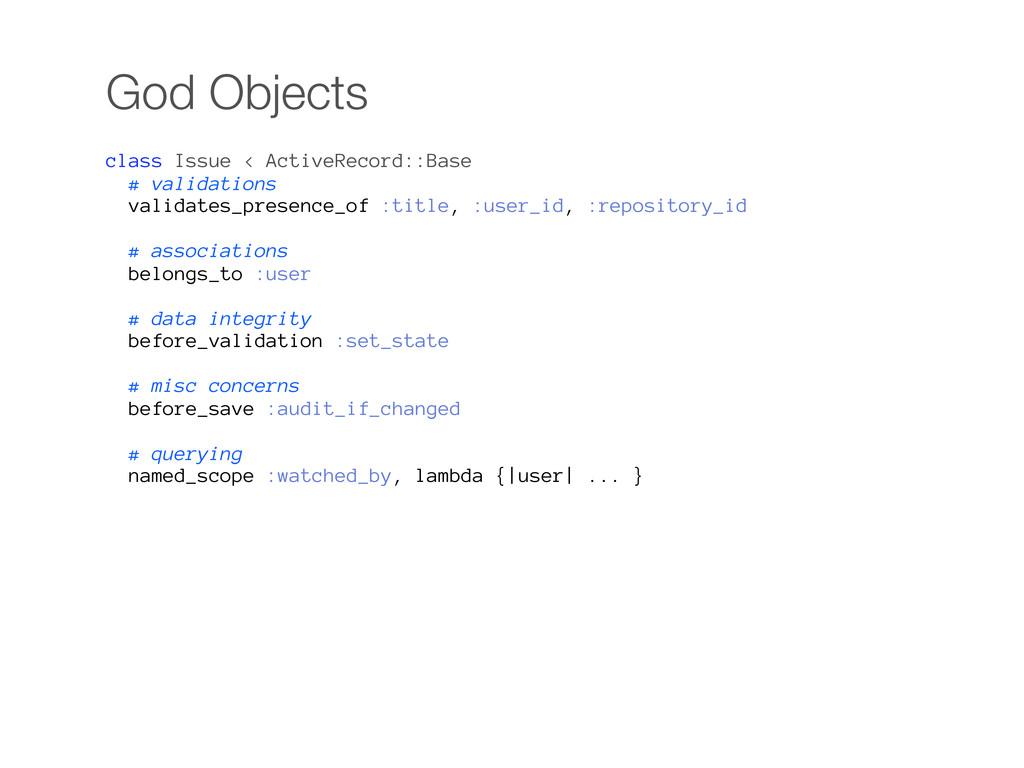
God Objects class Issue < ActiveRecord::Base # validations validates_presence_of :title,
:user_id, :repository_id # associations belongs_to :user # data integrity before_validation :set_state # misc concerns before_save :audit_if_changed # querying named_scope :watched_by, lambda {|user| ... } -
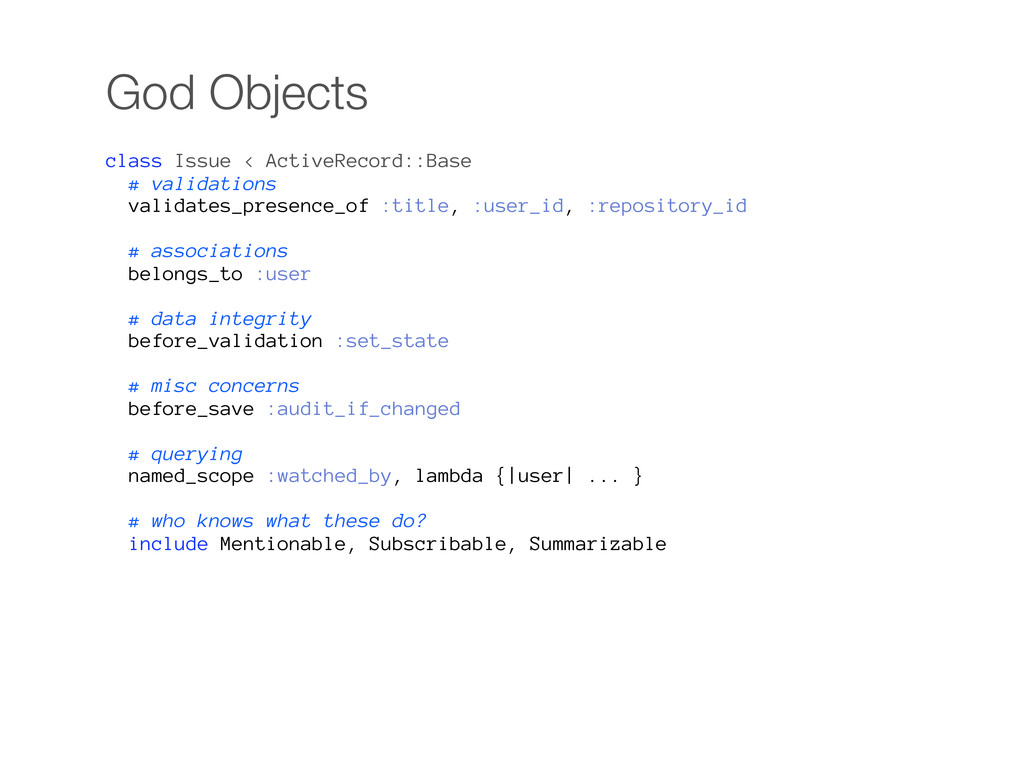
God Objects class Issue < ActiveRecord::Base # validations validates_presence_of :title,
:user_id, :repository_id # associations belongs_to :user # data integrity before_validation :set_state # misc concerns before_save :audit_if_changed # querying named_scope :watched_by, lambda {|user| ... } # who knows what these do? include Mentionable, Subscribable, Summarizable -
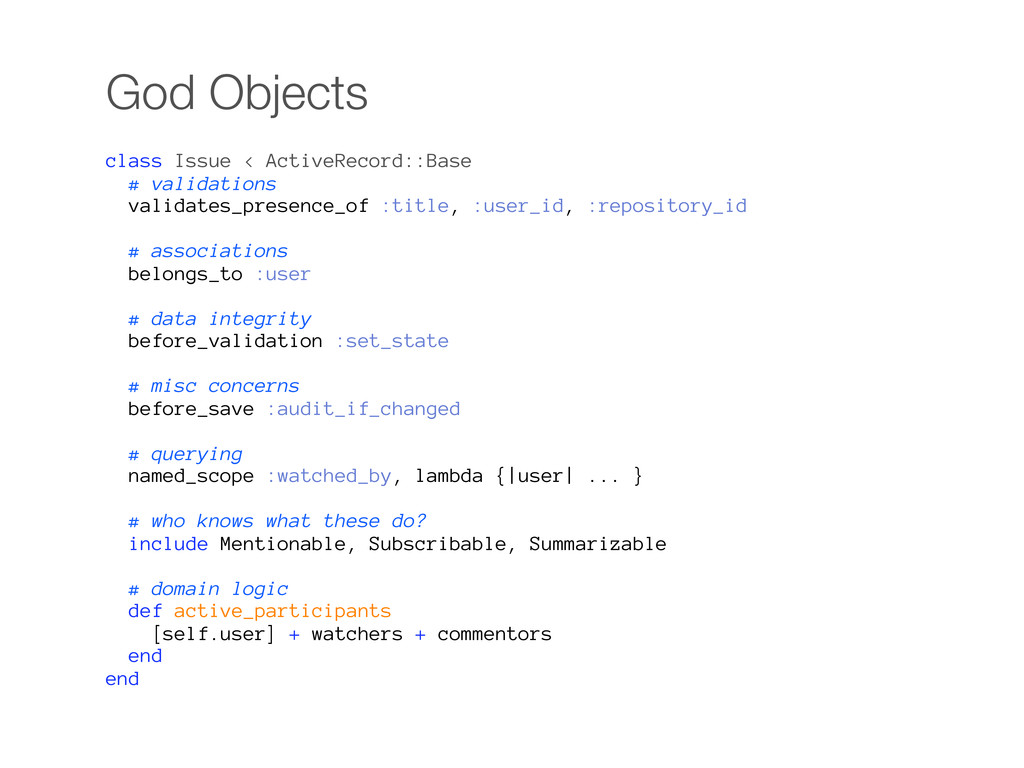
God Objects class Issue < ActiveRecord::Base # validations validates_presence_of :title,
:user_id, :repository_id # associations belongs_to :user # data integrity before_validation :set_state # misc concerns before_save :audit_if_changed # querying named_scope :watched_by, lambda {|user| ... } # who knows what these do? include Mentionable, Subscribable, Summarizable # domain logic def active_participants [self.user] + watchers + commentors end end -
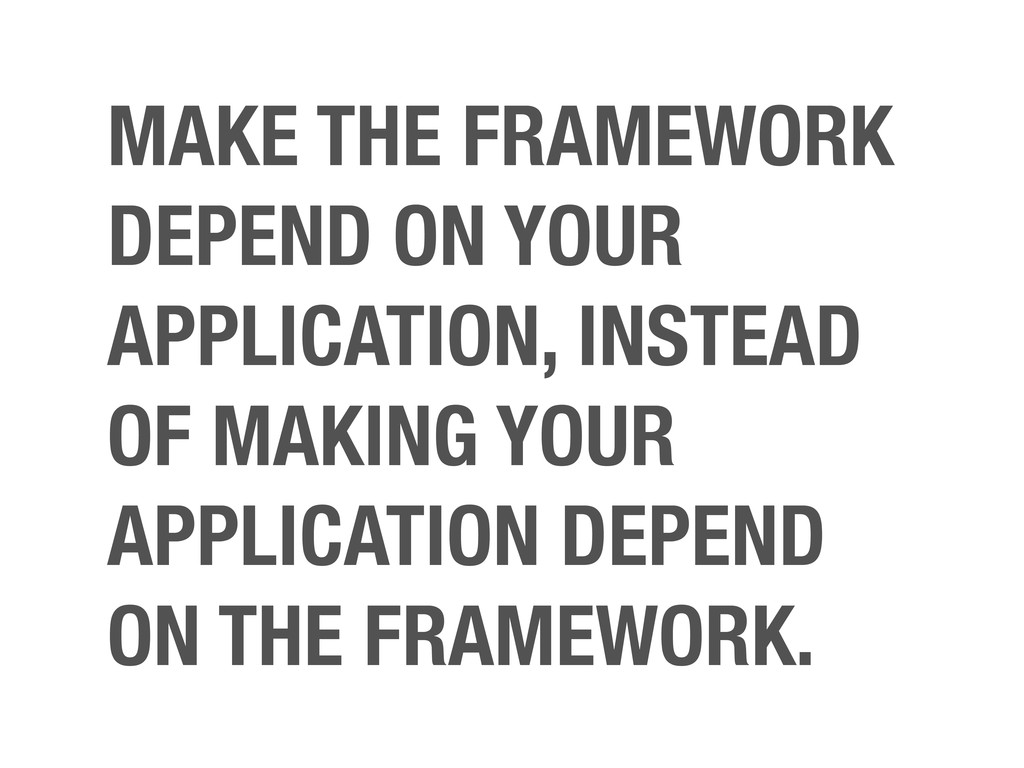
MAKE THE FRAMEWORK DEPEND ON YOUR APPLICATION, INSTEAD OF MAKING
YOUR APPLICATION DEPEND ON THE FRAMEWORK. -
A typical Rails controller… class SessionsController < ApplicationController def create
user = User.authenticate(params[:username], params[:password]) if user self.current_user = user redirect_to root_path, success: 'You are signed in!' else render :new, warning: 'Wrong username or password.' end end end -
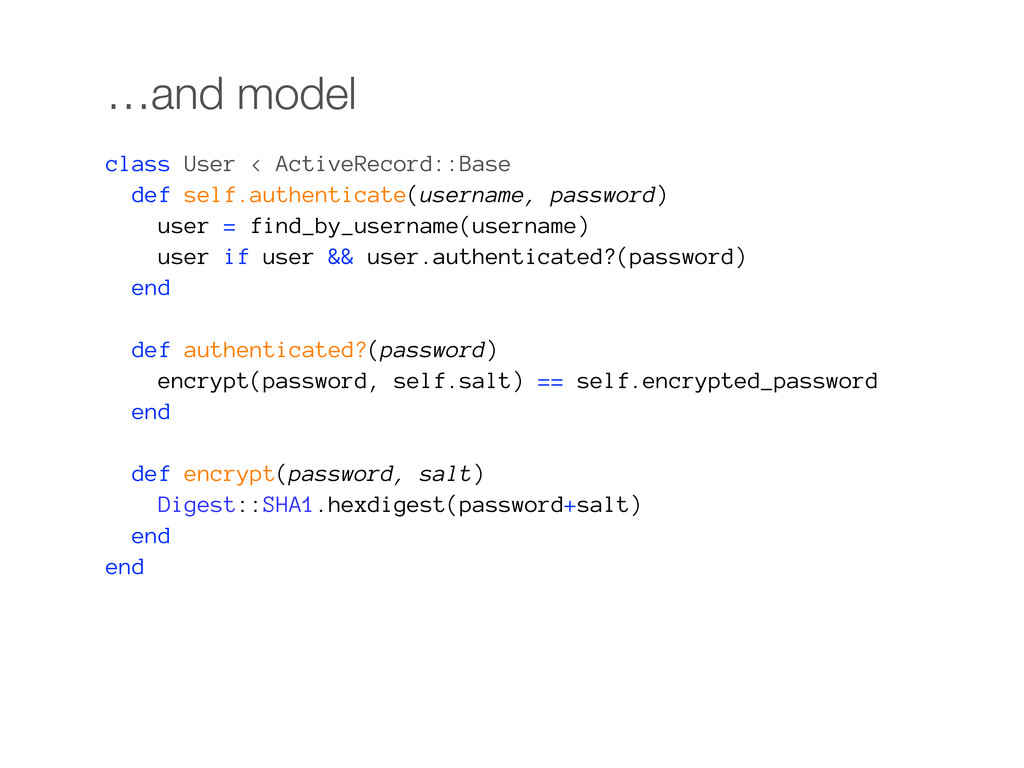
…and model class User < ActiveRecord::Base def self.authenticate(username, password) user
= find_by_username(username) user if user && user.authenticated?(password) end def authenticated?(password) encrypt(password, self.salt) == self.encrypted_password end def encrypt(password, salt) Digest::SHA1.hexdigest(password+salt) end end -
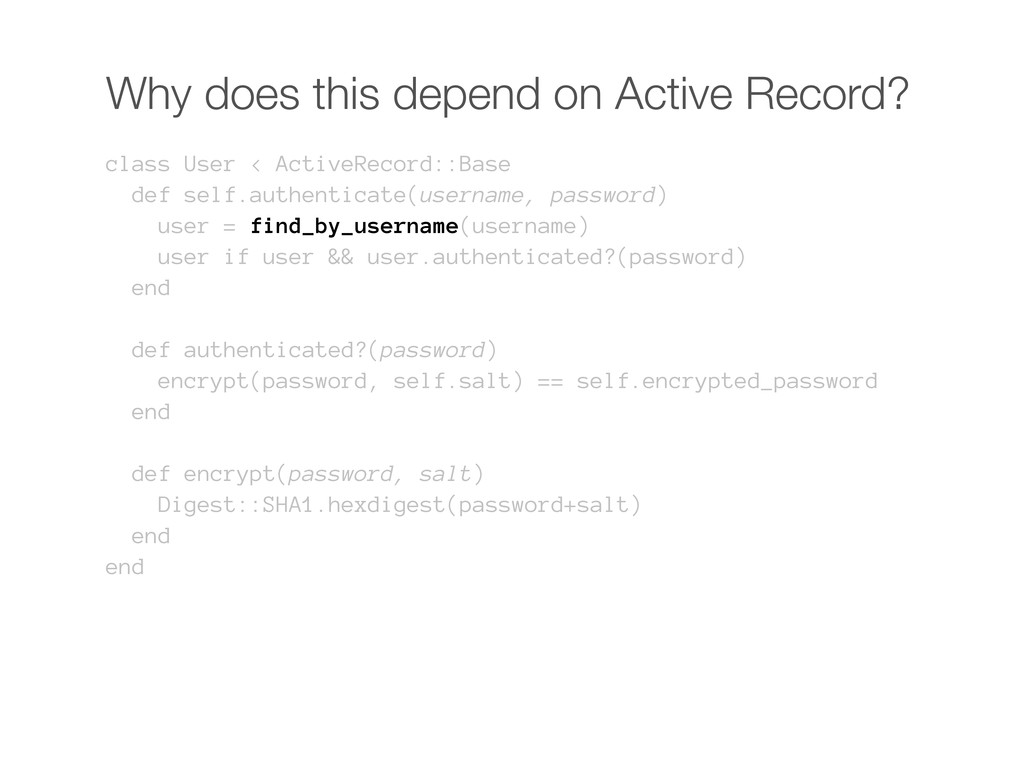
Why does this depend on Active Record? class User <
ActiveRecord::Base def self.authenticate(username, password) user = find_by_username(username) user if user && user.authenticated?(password) end def authenticated?(password) encrypt(password, self.salt) == self.encrypted_password end def encrypt(password, salt) Digest::SHA1.hexdigest(password+salt) end end -
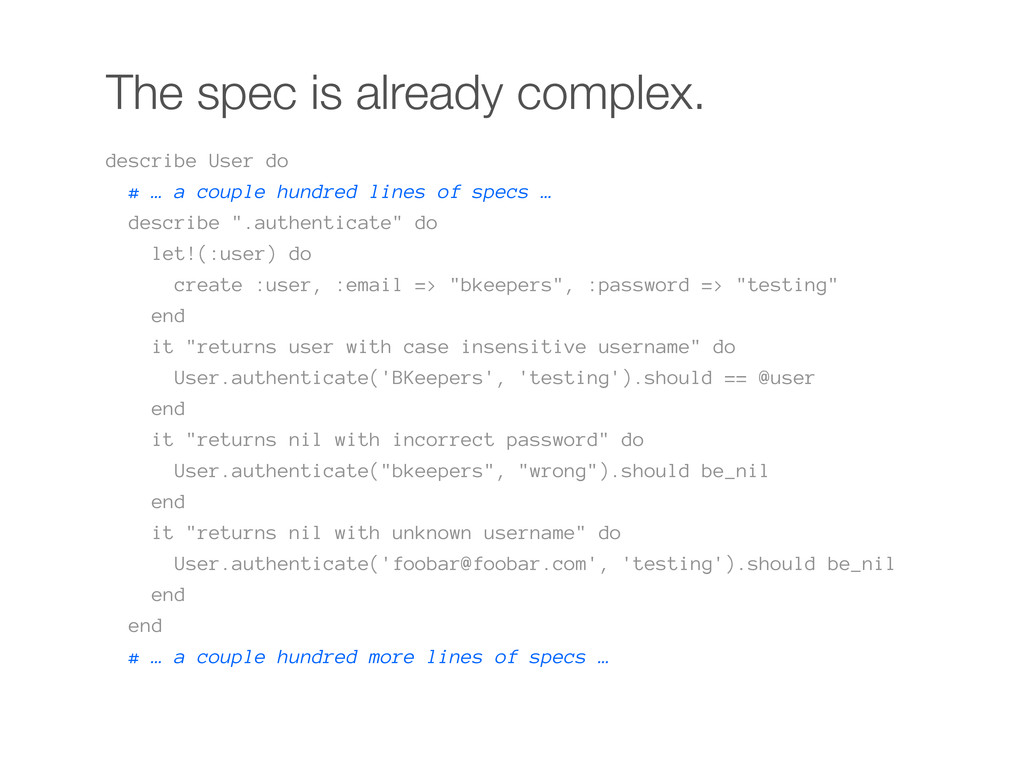
The spec is already complex. describe User do # …
a couple hundred lines of specs … describe ".authenticate" do let!(:user) do create :user, :email => "bkeepers", :password => "testing" end it "returns user with case insensitive username" do User.authenticate('BKeepers', 'testing').should == @user end it "returns nil with incorrect password" do User.authenticate("bkeepers", "wrong").should be_nil end it "returns nil with unknown username" do User.authenticate('[email protected]', 'testing').should be_nil end end # … a couple hundred more lines of specs … -
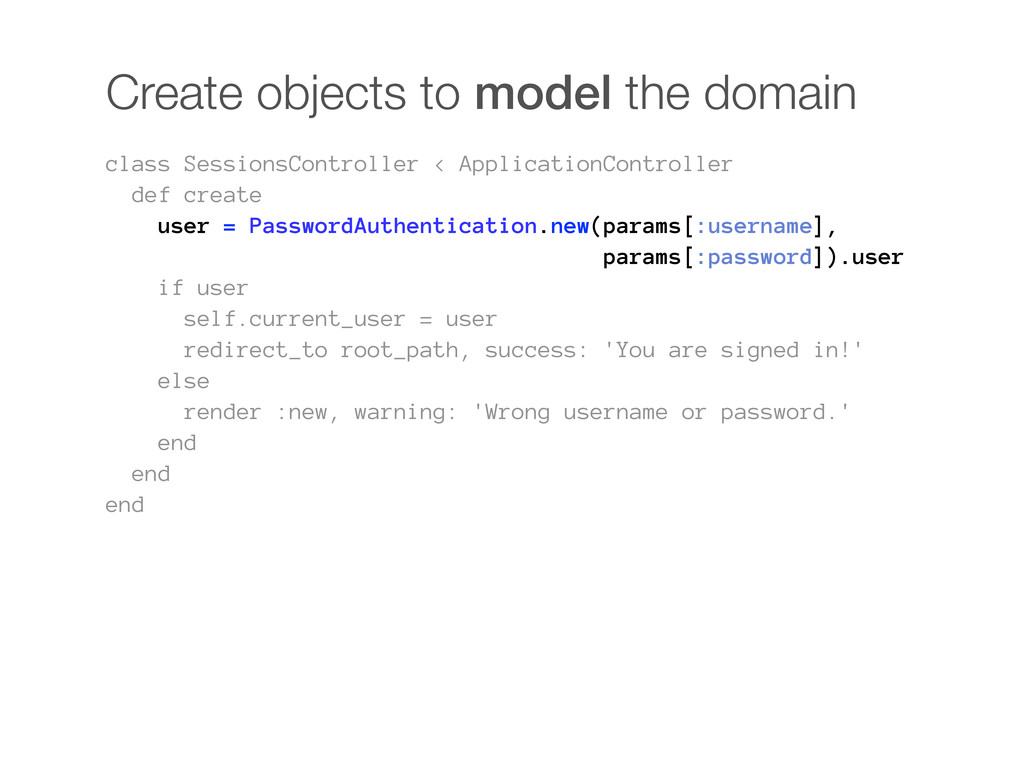
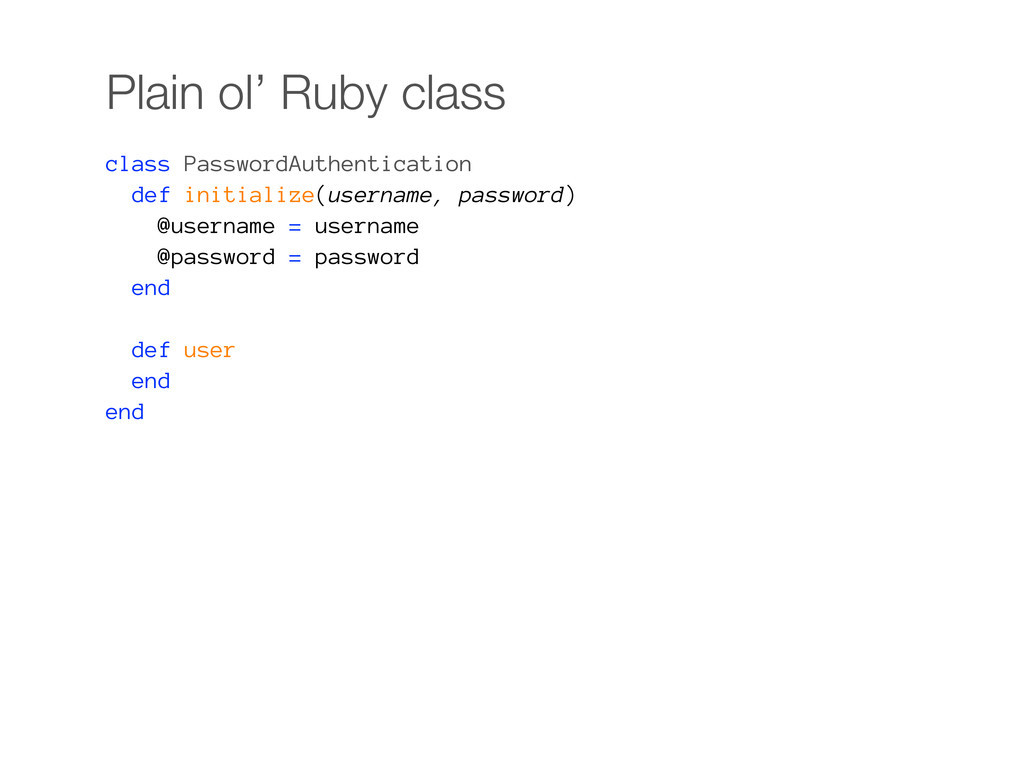
Create objects to model the domain class SessionsController < ApplicationController
def create user = PasswordAuthentication.new(params[:username], params[:password]).user if user self.current_user = user redirect_to root_path, success: 'You are signed in!' else render :new, warning: 'Wrong username or password.' end end end -
Plain ol’ Ruby class class PasswordAuthentication def initialize(username, password) @username
= username @password = password end def user end end -
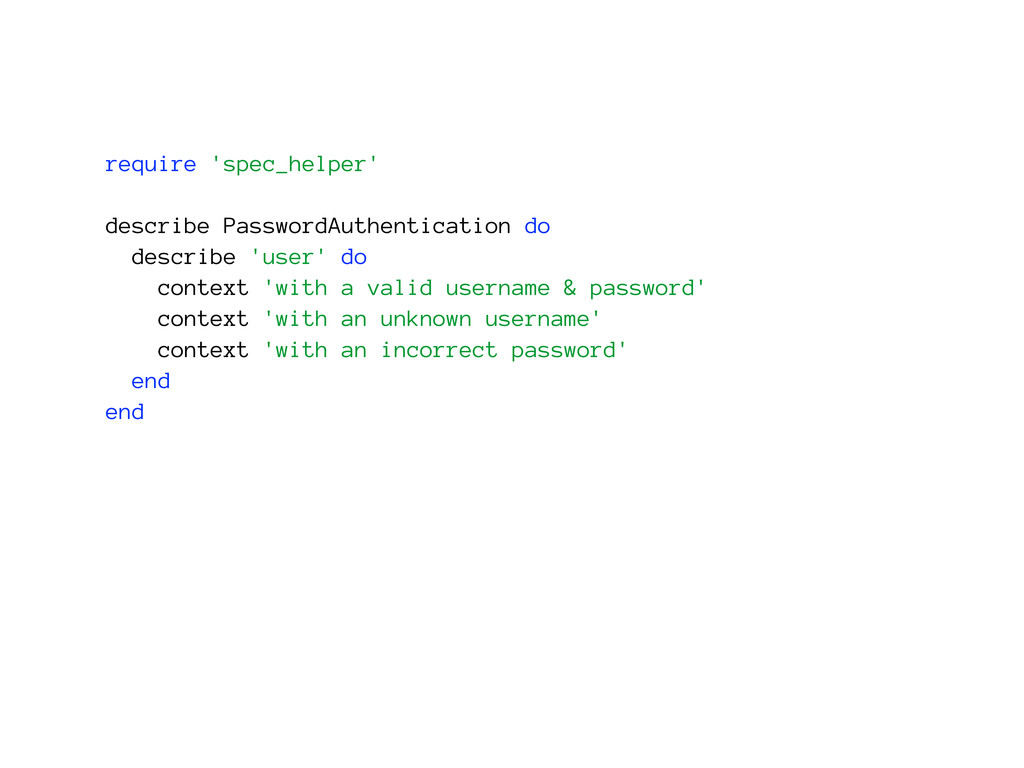
require 'spec_helper' describe PasswordAuthentication do describe 'user' do context 'with
a valid username & password' context 'with an unknown username' context 'with an incorrect password' end end -
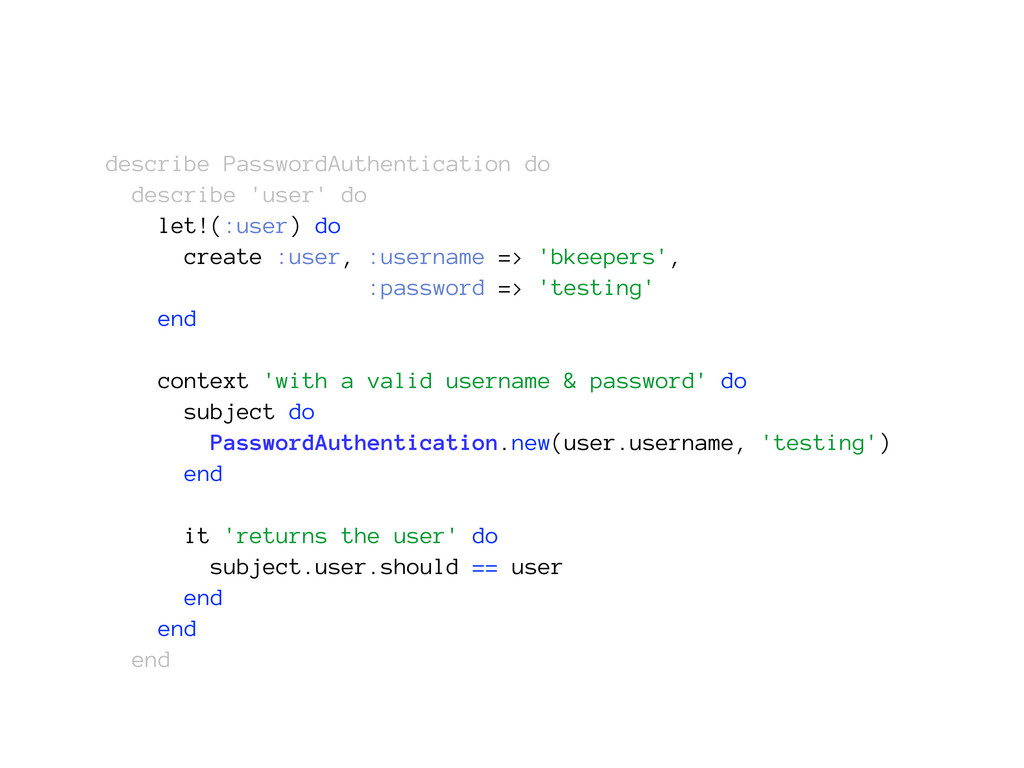
describe PasswordAuthentication do describe 'user' do let!(:user) do create :user,
:username => 'bkeepers', :password => 'testing' end context 'with a valid username & password' do subject do PasswordAuthentication.new(user.username, 'testing') end it 'returns the user' do subject.user.should == user end end end -
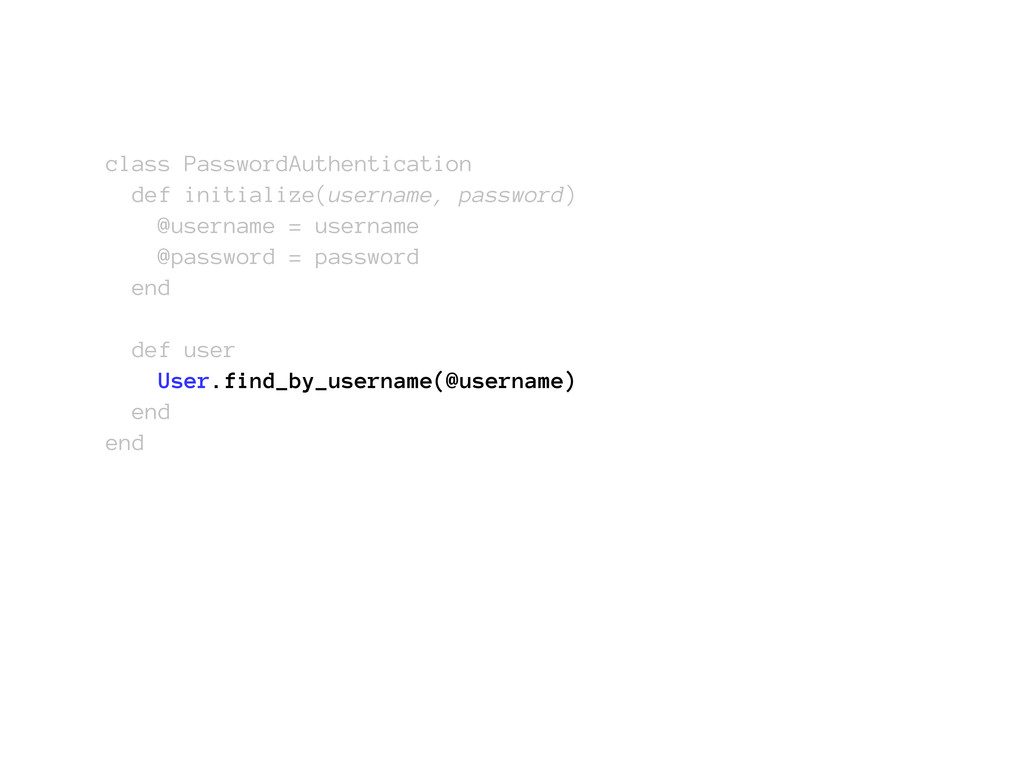
class PasswordAuthentication def initialize(username, password) @username = username @password =
password end def user User.find_by_username(@username) end end -
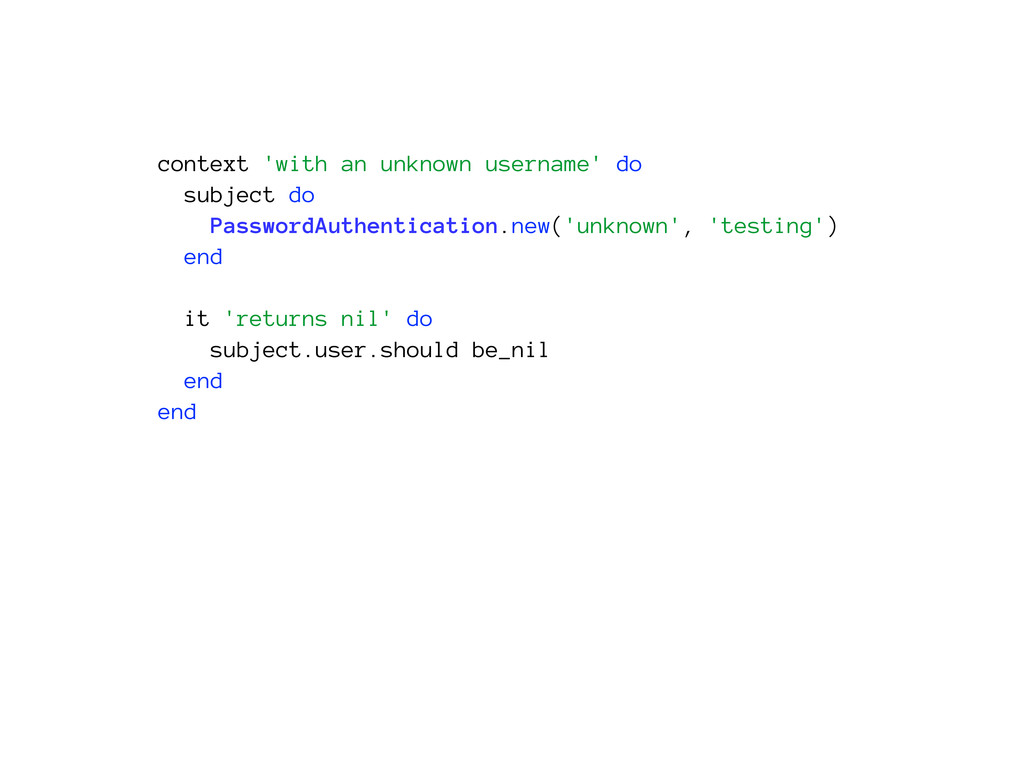
context 'with an unknown username' do subject do PasswordAuthentication.new('unknown', 'testing')
end it 'returns nil' do subject.user.should be_nil end end -
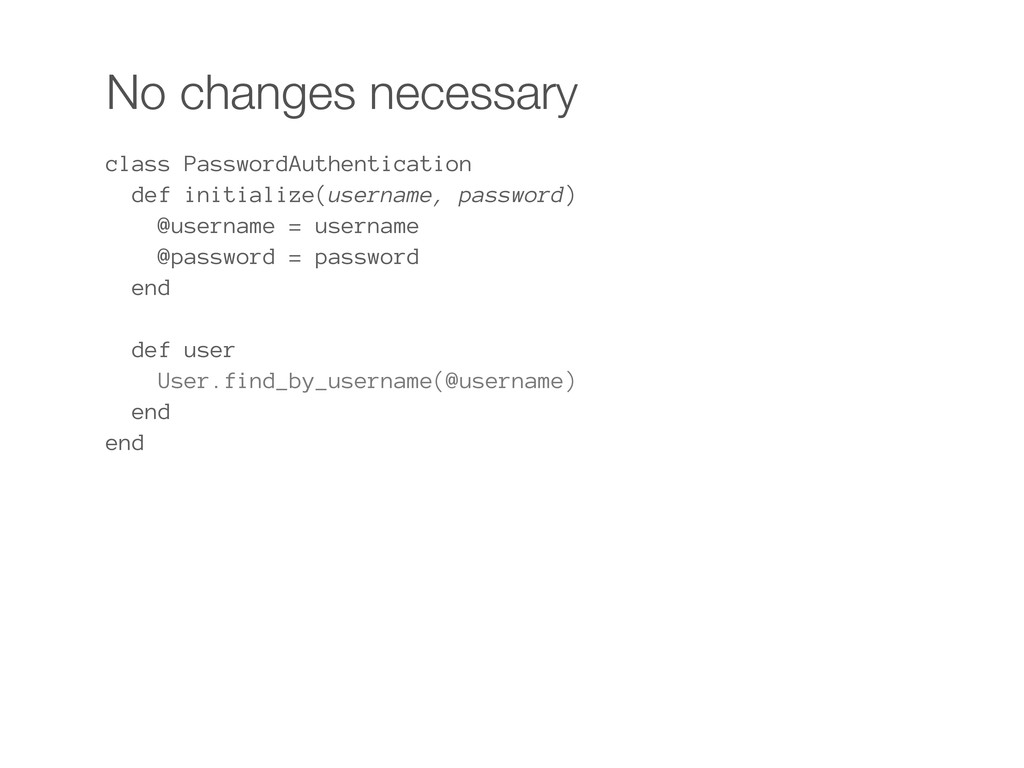
No changes necessary class PasswordAuthentication def initialize(username, password) @username =
username @password = password end def user User.find_by_username(@username) end end -
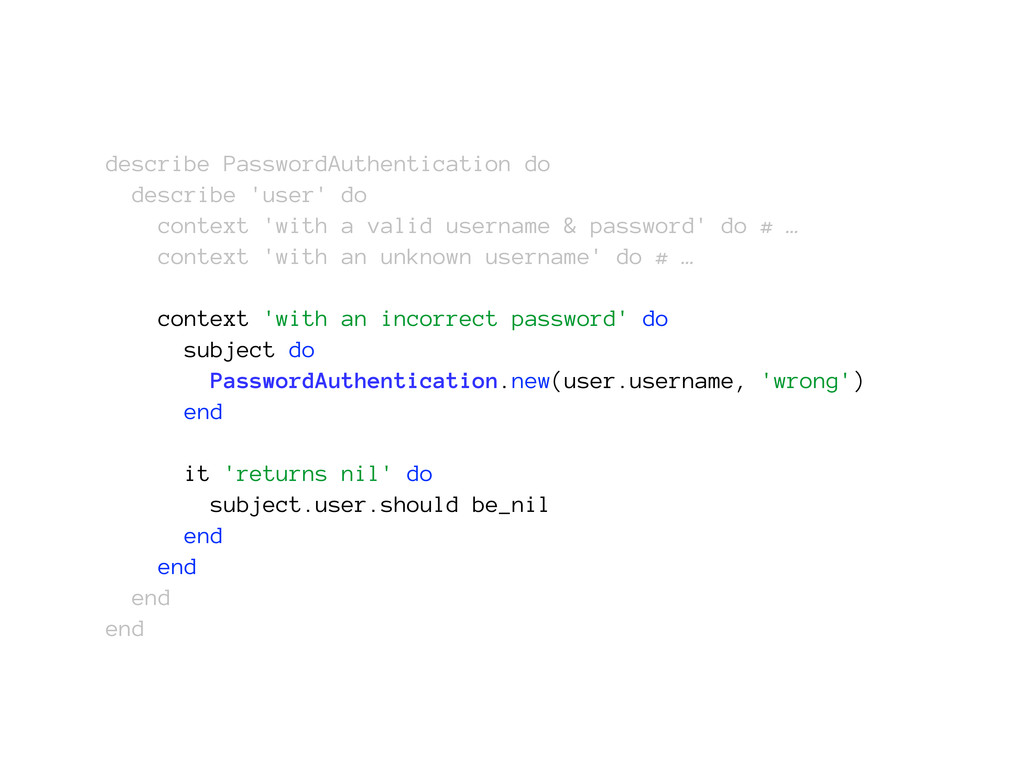
describe PasswordAuthentication do describe 'user' do context 'with a valid
username & password' do # … context 'with an unknown username' do # … context 'with an incorrect password' do subject do PasswordAuthentication.new(user.username, 'wrong') end it 'returns nil' do subject.user.should be_nil end end end end -
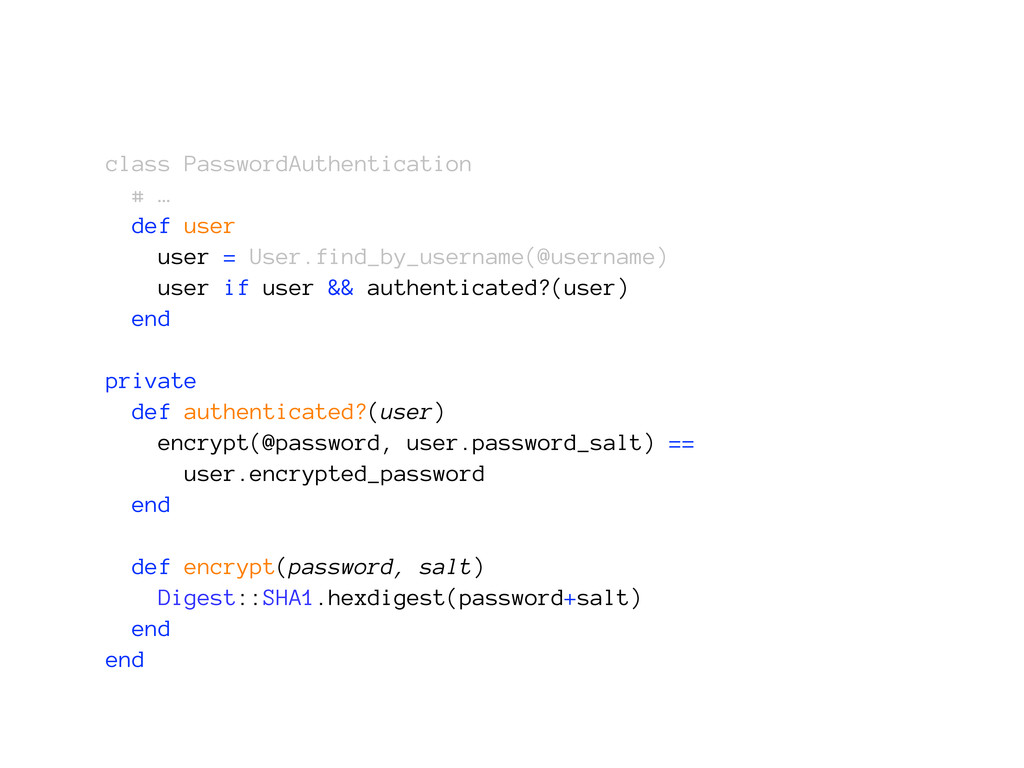
class PasswordAuthentication # … def user user = User.find_by_username(@username) user
if user && authenticated?(user) end private def authenticated?(user) encrypt(@password, user.password_salt) == user.encrypted_password end def encrypt(password, salt) Digest::SHA1.hexdigest(password+salt) end end -
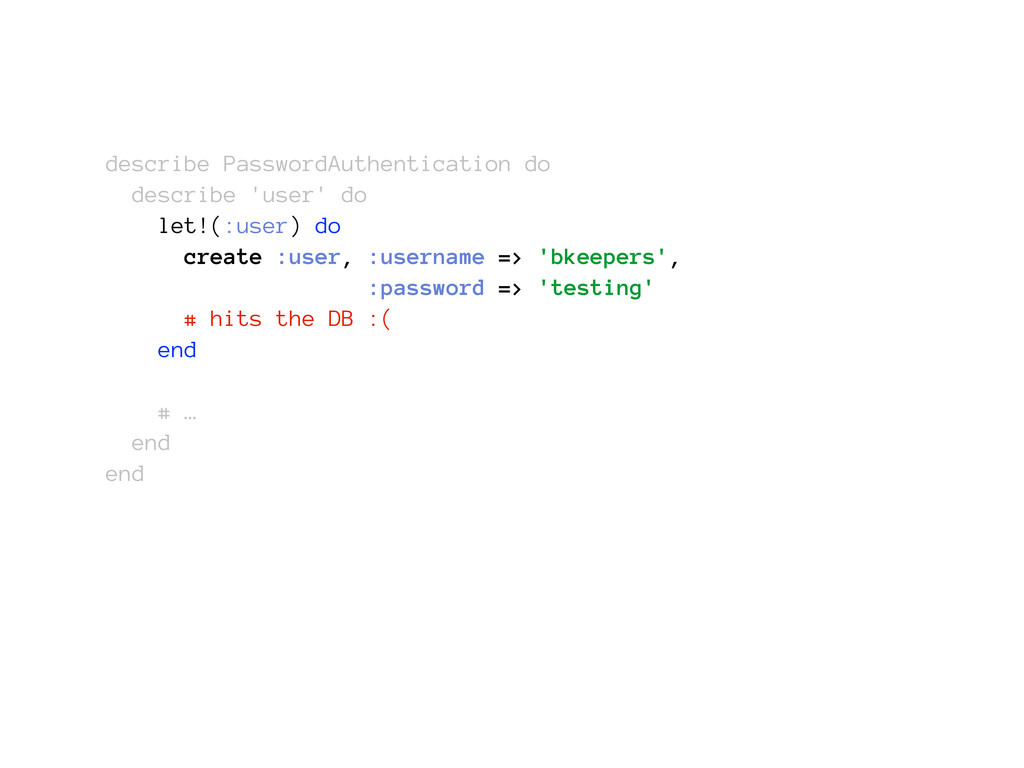
describe PasswordAuthentication do describe 'user' do let!(:user) do create :user,
:username => 'bkeepers', :password => 'testing' # hits the DB :( end # … end end -
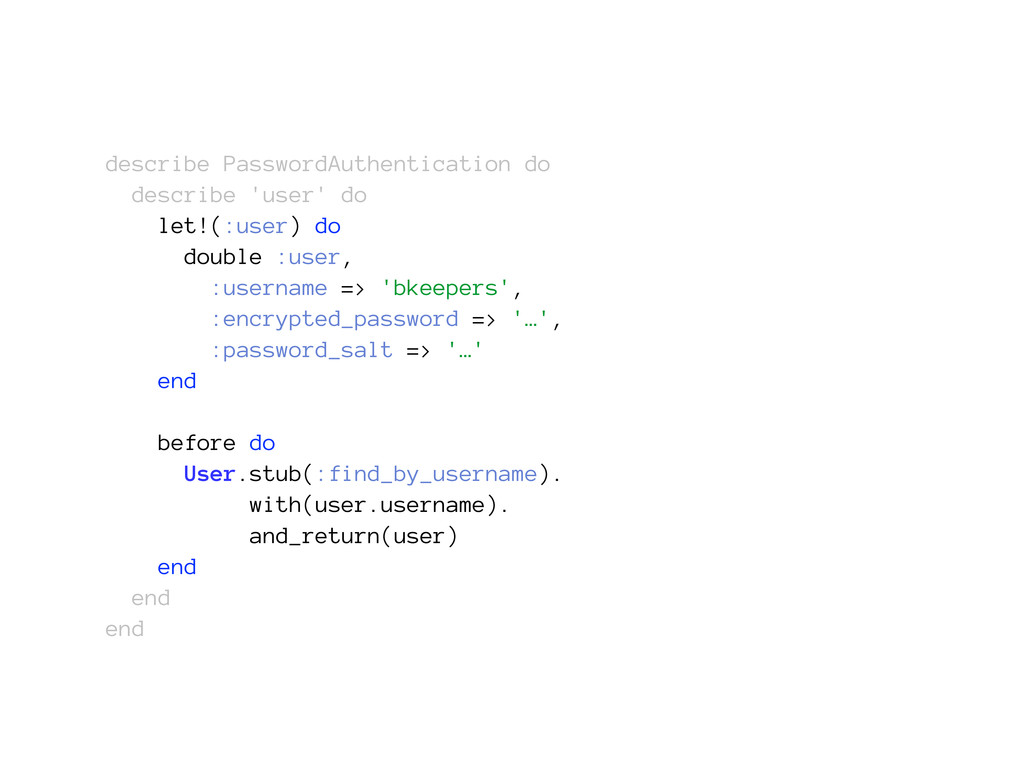
describe PasswordAuthentication do describe 'user' do let!(:user) do double :user,
:username => 'bkeepers', :encrypted_password => '…', :password_salt => '…' end before do User.stub(:find_by_username). with(user.username). and_return(user) end end end -
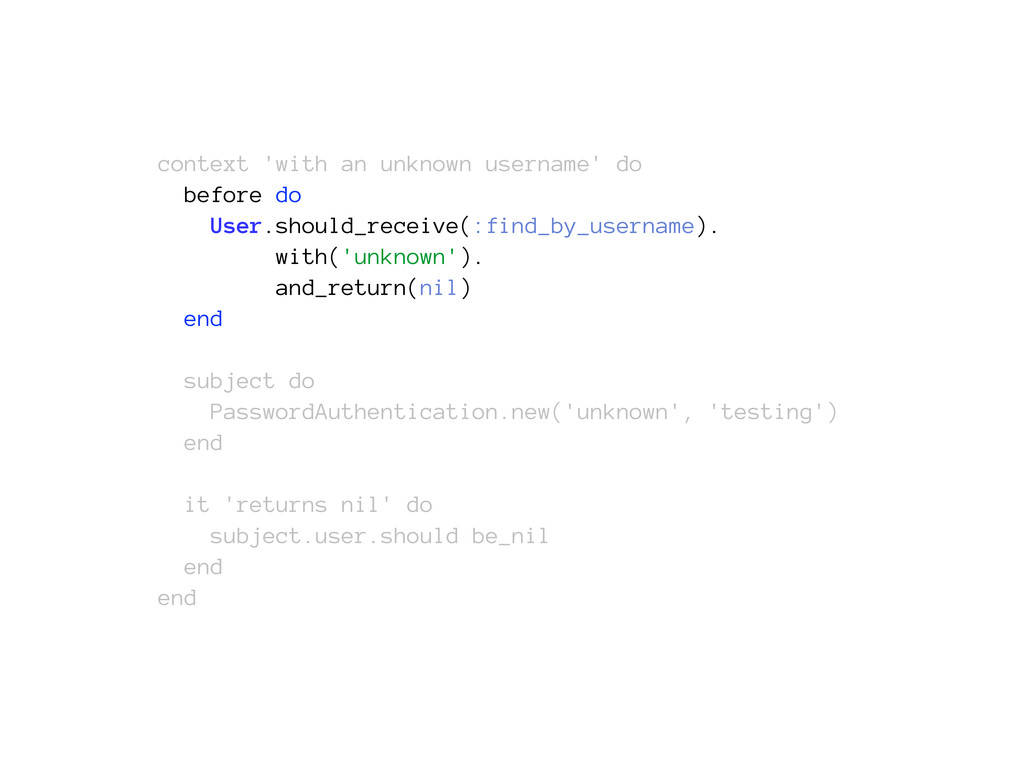
context 'with an unknown username' do before do User.should_receive(:find_by_username). with('unknown').
and_return(nil) end subject do PasswordAuthentication.new('unknown', 'testing') end it 'returns nil' do subject.user.should be_nil end end -
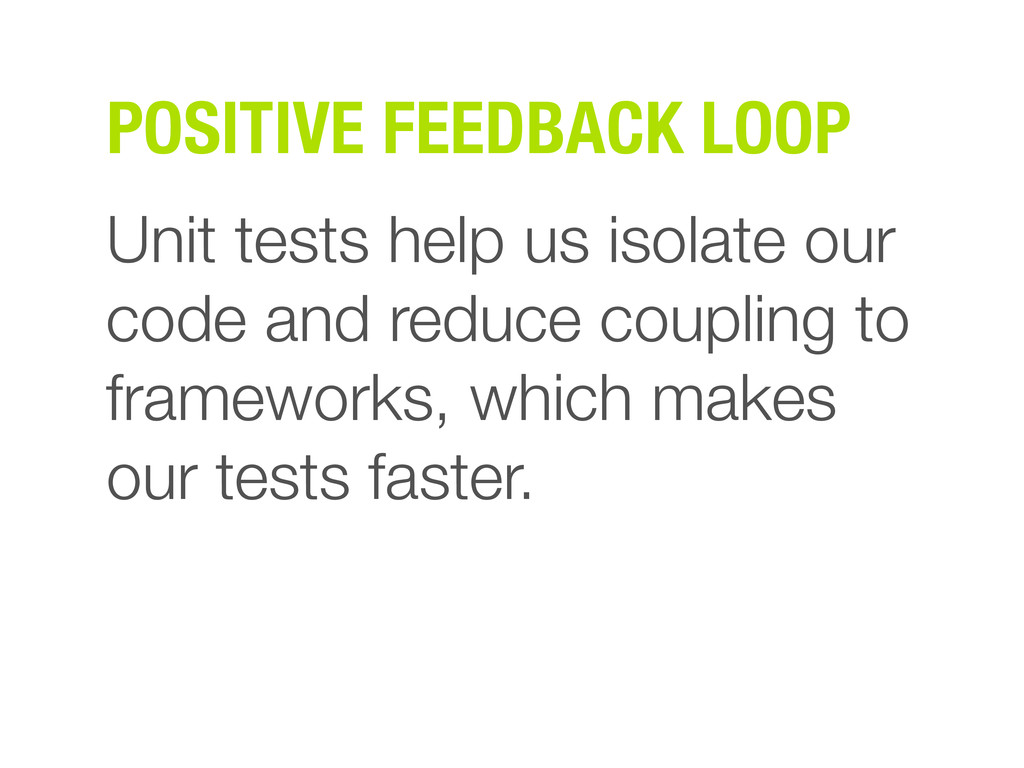
POSITIVE FEEDBACK LOOP Unit tests help us isolate our code
and reduce coupling to frameworks, which makes our tests faster. -
Robert C. Martin Clean Code “Writing clean code requires the
disciplined use of a myriad little techniques applied through a painstakingly acquired sense of ‘cleanliness.’” -
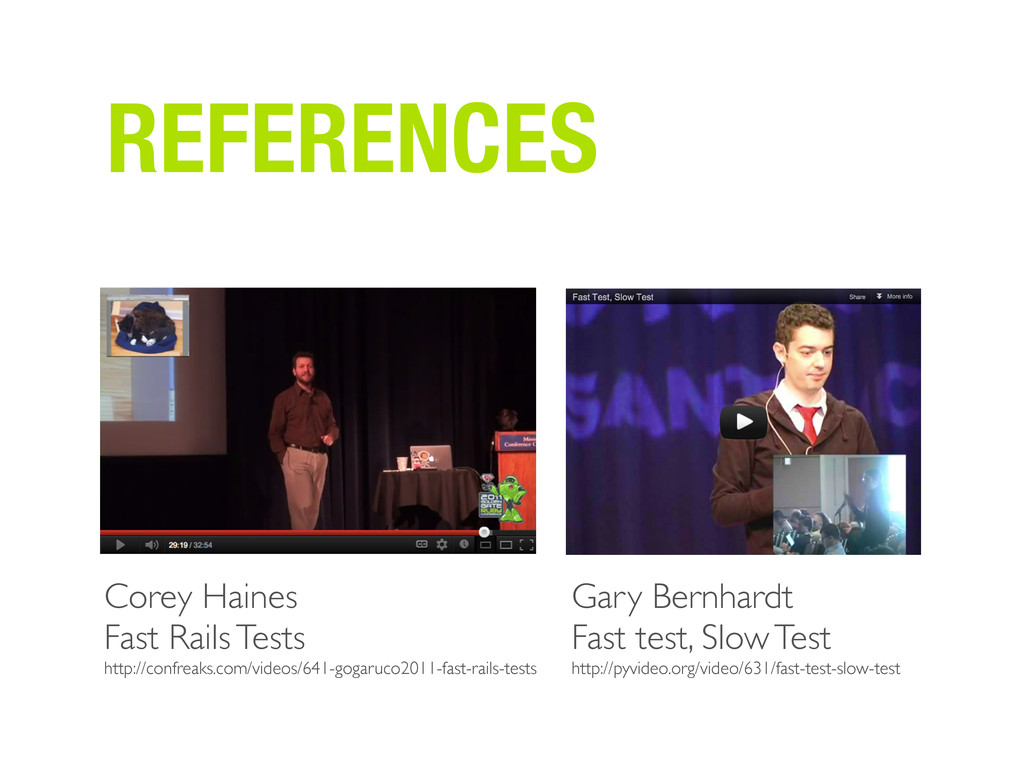
REFERENCES Gary Bernhardt Fast test, Slow Test http://pyvideo.org/video/631/fast-test-slow-test Corey Haines
Fast Rails Tests http://confreaks.com/videos/641-gogaruco2011-fast-rails-tests
 bkeepers
 seosoft
 inariku
 yuuu
 xleitix
 cclai999
 guaca
 hasutosasaki
 chigichan24
 itsmedreamwalker
 naruogram
 ivargrimstad
 aoshi
 eileencodes
 lara
 frankvandijk
 kastner
 tonyrice
 helmedeiros
 scottboms
 tammyeverts
 codingconduct
 palkan