Share
Embed
node-rpi-ws281x
slides from my talk at #hhjs about driving WS2812 LED-Strips with node.js.
Martin Schuhfuss
November 17, 2014
Transcript
48 slides
-
ws2812 (image from 5mm ‣ SMD5050 Package ‣ ws2811 controller
‣ three separate LEDs red green blue HARDWARE controller -
3.75µs 1.25µs ws2811 one-wire serial data-signal 0V +5V t wavelength
λ pulsewidth frequency 800kHz wavelength 1.25µs 0 2.5µs 5µs 1 0 1 1 -
ws2811 one-wire serial data-signal 0V +5V λ = 1.25µs (±600ns)
(f = 800kHz) 350ns (±150ns) 800ns (±150ns) 0 t -
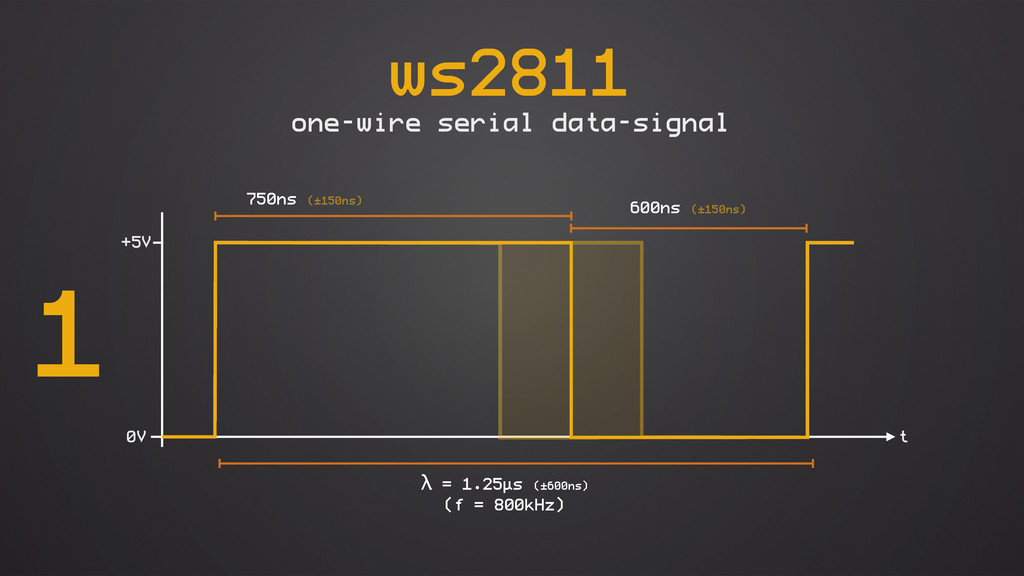
ws2811 one-wire serial data-signal 0V +5V λ = 1.25µs (±600ns)
(f = 800kHz) 750ns (±150ns) 600ns (±150ns) 1 t -
ws2811 one-wire serial data-signal 1 0 1 1 0 0
1 0 1 0 0 0 0 0 0 0 1 1 1 1 0 1 0 0 0 8 2 b f 4 #80b2f4 in HTML-Notation -
ws2811 one-wire serial data-signal LED 01 DIN DOUT Register #000000
LED 02 DIN DOUT Register #000000 LED 03 DIN DOUT Register #000000 +5V GND +5V GND +5V GND +5V GND -
ws2811 one-wire serial data-signal LED 01 DIN DOUT Register #ff8800
#ff8800 1 LED 02 DIN DOUT Register #000000 LED 03 DIN DOUT Register #000000 — — +5V GND +5V GND +5V GND +5V GND -
ws2811 one-wire serial data-signal LED 01 DIN DOUT Register #ff8800
#00ffff 2 LED 02 DIN DOUT Register #00ffff LED 03 DIN DOUT Register #000000 #00ffff — +5V GND +5V GND +5V GND +5V GND -
ws2811 one-wire serial data-signal LED 01 DIN DOUT Register #ff8800
#0000ff 3 LED 02 DIN DOUT Register #ffff00 LED 03 DIN DOUT Register #0000ff #0000ff #0000ff +5V GND +5V GND +5V GND +5V GND -
ws2811 one-wire serial data-signal LED 01 DIN DOUT Register #000000
reset 4 LED 02 DIN DOUT Register #000000 LED 03 DIN DOUT Register #000000 reset reset +5V GND +5V GND +5V GND +5V GND -
neopixel etc. where to get your ws2812 http://www.watterott.com/index.php?page=search&keywords=ws2812 http://www.adafruit.com/category/168 USA
https://www.sparkfun.com/search/results?term=ws2812 GERMANY OTHER INTERNATIONAL ebay, amazon (search "ws2812") direct from china: banggood.com, www.dx.com, alibaba.com -
Raspberry Pi ‣ Broadcom BCM2xxx SoC ‣ 700MHz ARM CPU
/ 512MB RAM ‣ SD-Card as Harddrive ‣ 100MBit LAN / HDMI / USB / Audio ‣ raspbian OS Ethernet HDMI micro-USB (power supply) SD-Card GPIO Digital-Audio Analog-Audio USB Status-LEDs -
Raspberry Pi ‣ interface to external hardware ‣ sensors, motors,
anything ‣ SPI / UART / I2C ‣ controllable logic-pins GPIO -
(image from http://www.electrobob.com/ws2812-level-translator/) the signal-level needs to be changed 1.6
Million times per second. problem -
Arduino: no problem* ‣ CPU running at 16MHz ‣ 62
nanoseconds per instruction ‣ lots of time™ in between level changes… * assembler-programming required :( -
awesomeness solutions programming it with arduino sleep solution awesomeness #hhjs
(based on a totally representative study with 1 participant) -
Raspbian: problem ‣ because multitasking. ‣ when the process runs
depends on lots of factors we can’t control -
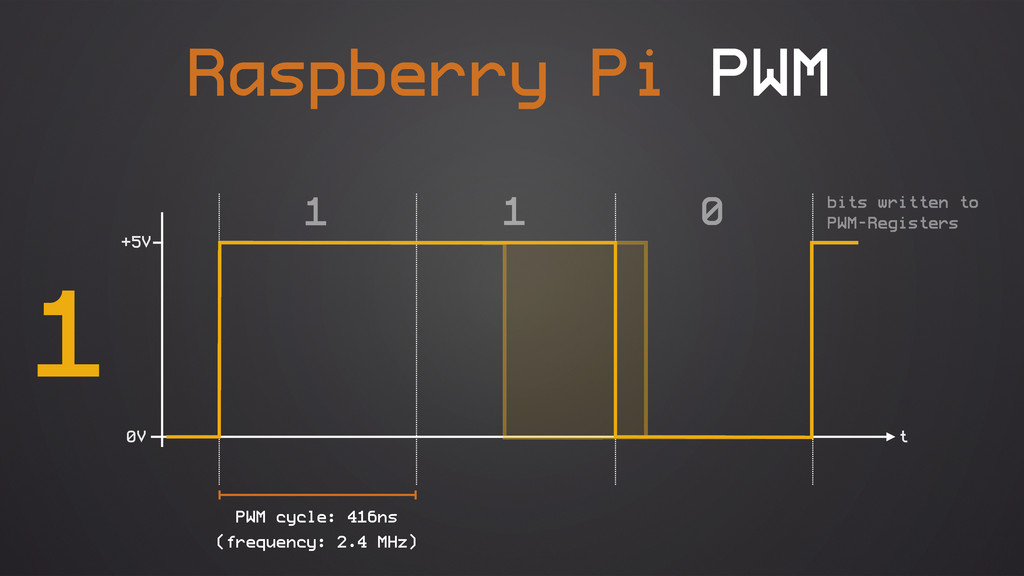
Raspberry Pi PWM ‣ „serializer“-mode ‣ bits in data-registers represent
signal-level per PWM-cycle ‣ only a few bytes in registers ‣ needs DMA to transport data -
Raspberry Pi PWM 0V +5V (frequency: 2.4 MHz) 0 t
PWM cycle: 416ns 1 0 0 bits written to PWM-Registers -
Raspberry Pi PWM 0V +5V (frequency: 2.4 MHz) 1 t
PWM cycle: 416ns 1 1 0 bits written to PWM-Registers -
Raspbian: problem ‣ store prepared pixel-data in memory ‣ let
the DMA-Controller transfer data to PWM-Module ‣ CPU or OS are not involved! -
awesomeness solutions arduino sleep solution awesomeness #hhjs program it in
C on raspberry build a server in C and control with node write a node-addon. -
‣ based on a C-Library by Jeremy Garff ‣ wrapper
handles only type-checking and conversions between V8-types and C ‣ simple JS-interface: ws281x = { init: function(numLeds, options) { … }, /** @param ledData {Uint32Array} */ render: function(ledData) { … }, reset: function() { … } }; node-rpi-ws281x C-Library source: -
‣ first challenge: get it to compile. ‣ hard to
find documentation ‣ solution was actually pretty simple // binding.gyp (some stuff left out) { targets: [{ target_name: "rpi_ws281x", sources: ["./src/rpi-ws281x.cc"], dependencies: ["libws2811"] }, { target_name: "libws2811", type: "static_library", sources: [ … ], } ] } writing node-addons (required reading: http://nethack4.org/blog/building-c.html) -
writing node-addons // rpi_ws281x.cc #include <node.h> #include <v8.h> using namespace
v8; Handle<Value> Reset(const Arguments& args) { HandleScope scope; // ... binding-code here ... return scope.Close(Undefined()); } void initialize(Handle<Object> exports) { // exports.reset = function Reset() {}; exports->Set(String::NewSymbol("reset"), FunctionTemplate::New(Reset)->GetFunction()); } NODE_MODULE(rpi_ws281x, initialize) no arguments / return undefined -
writing node-addons // rpi_ws281x.cc Handle<Value> Init(const Arguments& args) { HandleScope
scope; if(args.Length() < 1 || !args[0]->IsNumber()) { ThrowException(Exception::TypeError( String::New("init(): argument 0 is not a number"))); return scope.Close(Undefined()); } int numLEDs = args[0]->Int32Value(); // ... the actual binding-code ... return scope.Close(Undefined()); } accepting arguments/ throwing exceptions -
writing node-addons ‣ writing a simple node addon is not
as complicated as it seems ‣ i should write more C++ ‣ most of the code to deal with arguments and type-checking ‣ better understanding how V8 works lessons learned… -
hello ws281x-native var ws281x = require('../lib/binding/ws281x-native'); var NUM_LEDS =
100, data = new Uint32Array(NUM_LEDS); ws281x.init(NUM_LEDS); data[42] = 0xff0000; ws281x.render(data); setTimeout(function() { ws281x.reset(); }, 2000); the javascript-side -
hello ws281x-native ‣ API feels a bit too low-level ‣
numbers as colors are complicated ‣ need to manually manage the data-array of course it didn't end there -
matrix-API var ws281x = require('../lib/ws281x'), m = ws281x.createMatrix(10,10) Color =
ws281x.Color; var offset = 0, c1 = new Color('red'), c2 = new Color('blue'); setInterval(function() { m.clear(); for(var i=0; i<10; i++) { var color = Color.mix(c1, c2, ((i % 10) / 10)); m.set(i%10, (i+offset)%10, color); } offset++; m.render(); }, 1000 / 30); the javascript-side -
awesomeness solutions arduino sleep solution awesomeness #hhjs program it in
C on raspberry build a server in C and control with node write a node-addon. ✔ -
awesomeness solutions sleep solution awesomeness #hhjs program it in C
on raspberry build a server in C and control with node write a node-addon. use <canvas> -
canvas-API ‣ web-technology FTW! ‣ has more stuff than we
need. ‣ can be rendered server-side with node-canvas ‣ also works in the browser -
canvas-API var ws281x = require('../lib/ws281x'), canvas = ws281x.createCanvas(10,10), ctx =
canvas.ctx, Color = ws281x.Color; var c1 = new Color('red'), c2 = new Color('blue'); function rnd(max) { return (max || 1) * Math.random(); } function rndi(max) { return Math.round(rnd(max)); } setInterval(function() { var c = Color.mix(c1,c2, rnd()); ctx.clearRect(0,0,10,10); ctx.fillStyle = 'rgb(' + c.rgb.join(',') + ')'; ctx.fillRect(rndi(10)-2, rndi(10)-2, rndi(10), rndi(10)); canvas.render(); }, 1000/5); the javascript-side -
more to come… ‣ open-source everything [really soon] ‣ browser-based
IDE on the raspberry [in progress] ‣ integrate with other hardware [planning] ‣ improved 3d-printed casing [some day…] -
final thoughts ‣ do something you love. just for the
fun. ‣ understand how stuff works. ‣ learn something new. ‣ no deadlines (well, except you do a talk about it) why would you want to do that? -
thank you! come to me if you have any questions…
<3 Martin Schuhfuss – @usefulthink