Upgrade to Pro — share decks privately, control downloads, hide ads and more …

AI Search: Are We Building Strategy on the Righ...

AI Search: Are We Building Strategy on the Right Foundations?

In this talk, Cosmin will use real data to challenge the AI Search visibility metrics the industry is adopting. He'll show where prompt volume numbers break down, demonstrate how AI Search answers converge around intent rather than individual prompts, and present a measurement framework where leading metrics actually predict business outcomes.

Avatar for Vadim Dolgin

Vadim Dolgin

May 04, 2026

Other Decks in Marketing & SEO

Transcript

  1. B E F O R E W E S TA

    R T AI Search visibility? (reported on it lately?)
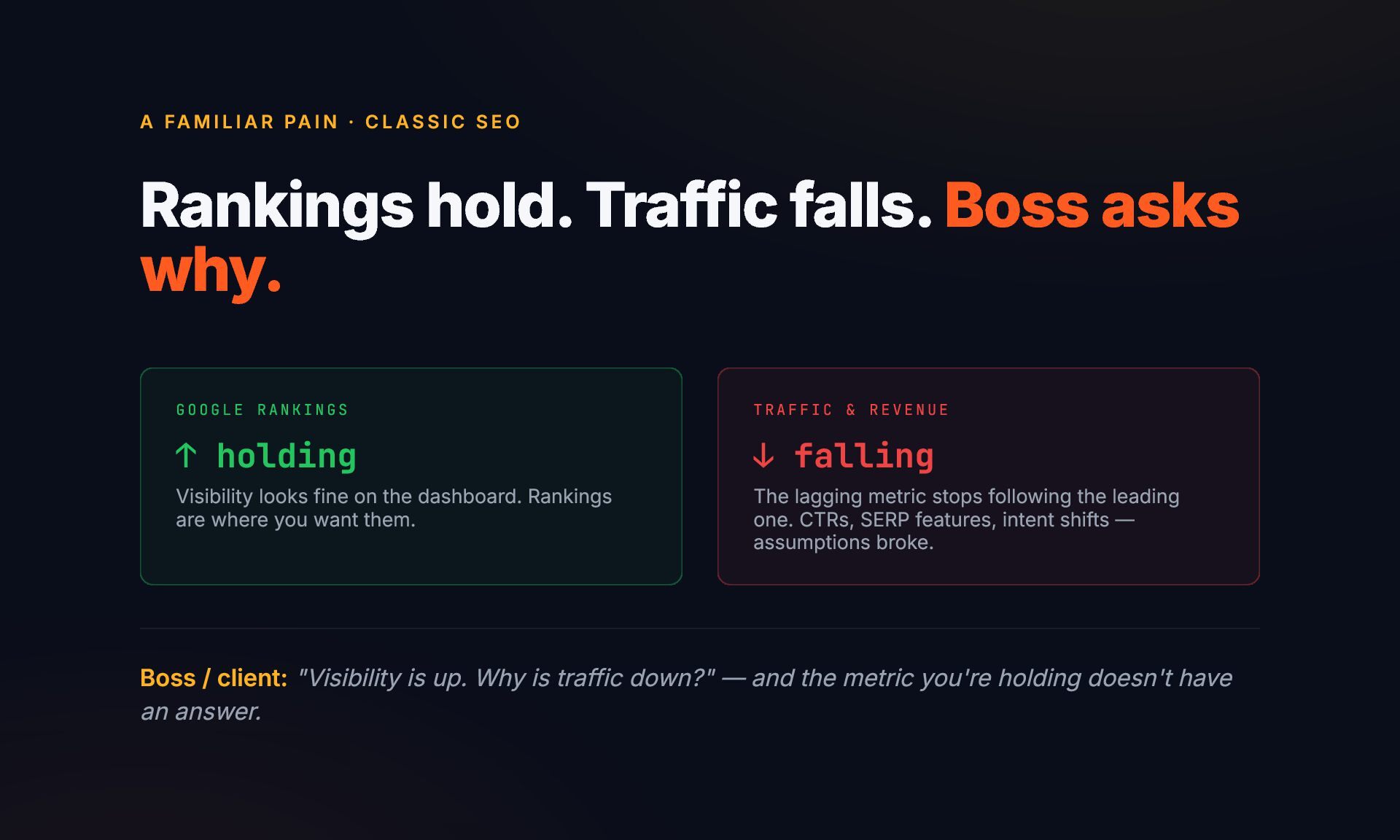
  2. A FAMILIAR PAIN · CLASSIC SEO Rankings hold. Traffic falls.

    Boss asks why. GOOGLE RANKINGS ↑ holding Visibility looks fine on the dashboard. Rankings are where you want them. TRAFFIC & REVENUE ↓ falling The lagging metric stops following the leading one. CTRs, SERP features, intent shifts — assumptions broke. Boss / client: "Visibility is up. Why is traffic down?" — and the metric you're holding doesn't have an answer.
  3. B E H O N E S T Traffic down,

    rankings healthy? (asked to explain it lately?)
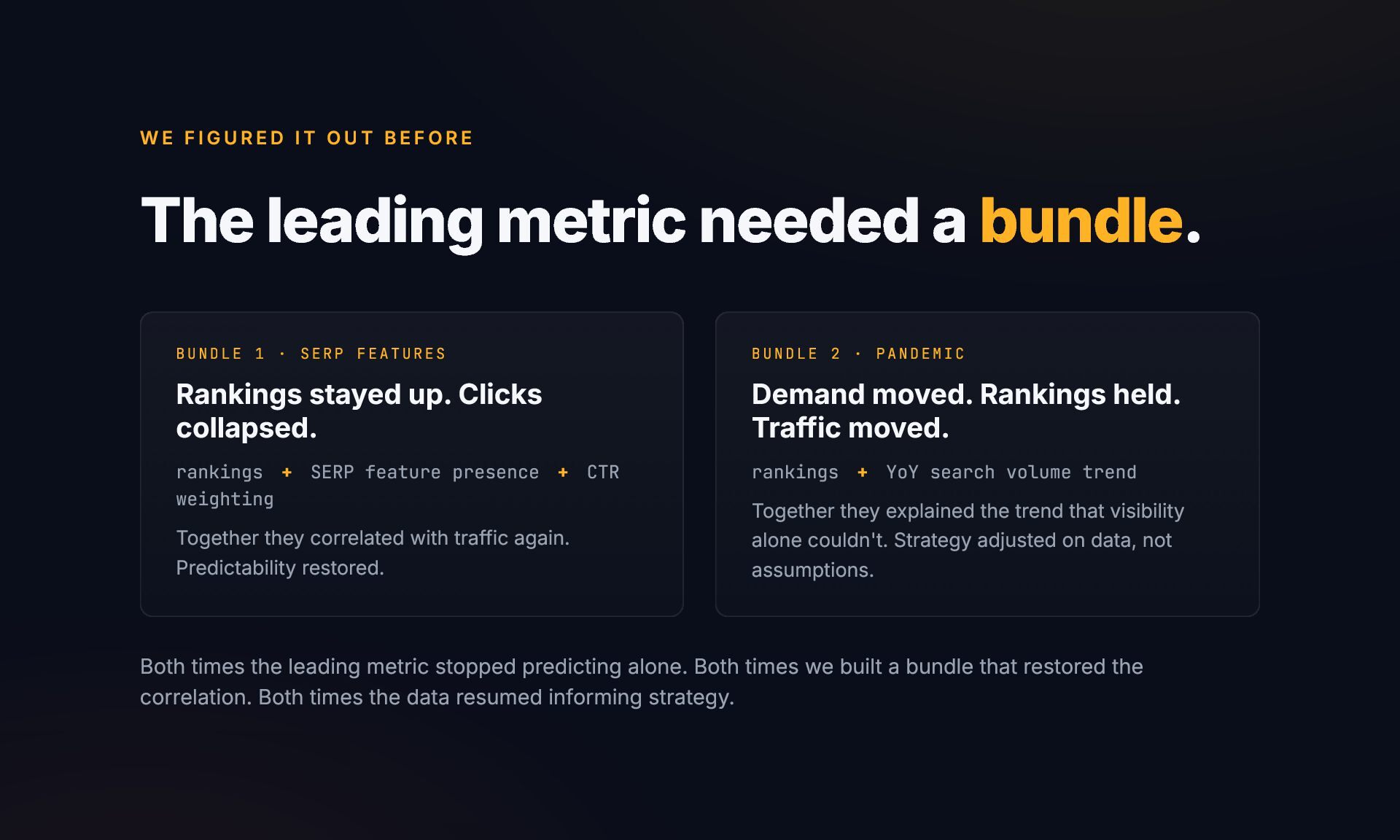
  4. WE FIGURED IT OUT BEFORE The leading metric needed a

    bundle. BUNDLE 1 · SERP FEATURES Rankings stayed up. Clicks collapsed. rankings + SERP feature presence + CTR weighting Together they correlated with traffic again. Predictability restored. BUNDLE 2 · PANDEMIC Demand moved. Rankings held. Traffic moved. rankings + YoY search volume trend Together they explained the trend that visibility alone couldn't. Strategy adjusted on data, not assumptions. Both times the leading metric stopped predicting alone. Both times we built a bundle that restored the correlation. Both times the data resumed informing strategy.
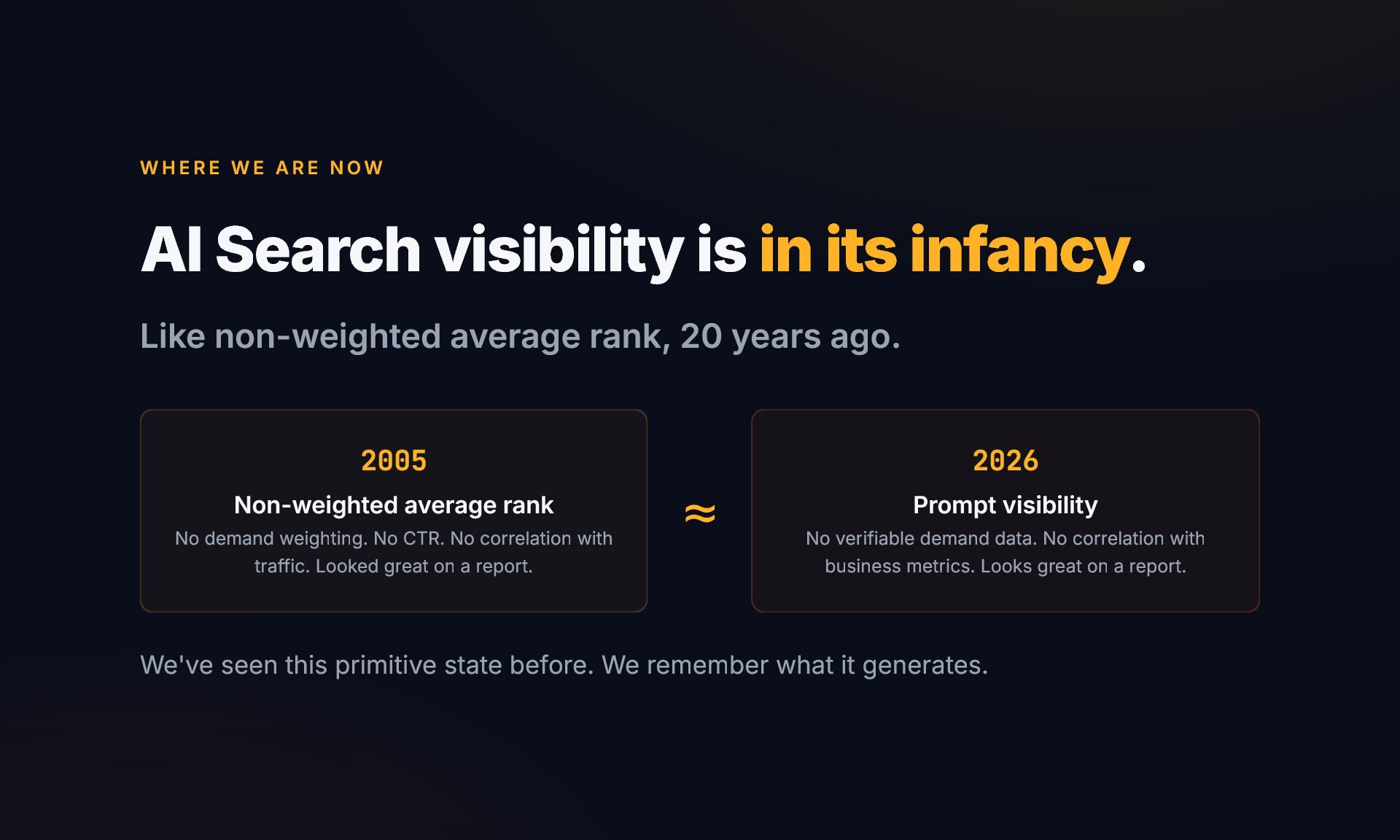
  5. WHERE WE ARE NOW AI Search visibility is in its

    infancy. Like non-weighted average rank, 20 years ago. 2005 Non-weighted average rank No demand weighting. No CTR. No correlation with traffic. Looked great on a report. ≈ 2026 Prompt visibility No verifiable demand data. No correlation with business metrics. Looks great on a report. We've seen this primitive state before. We remember what it generates.
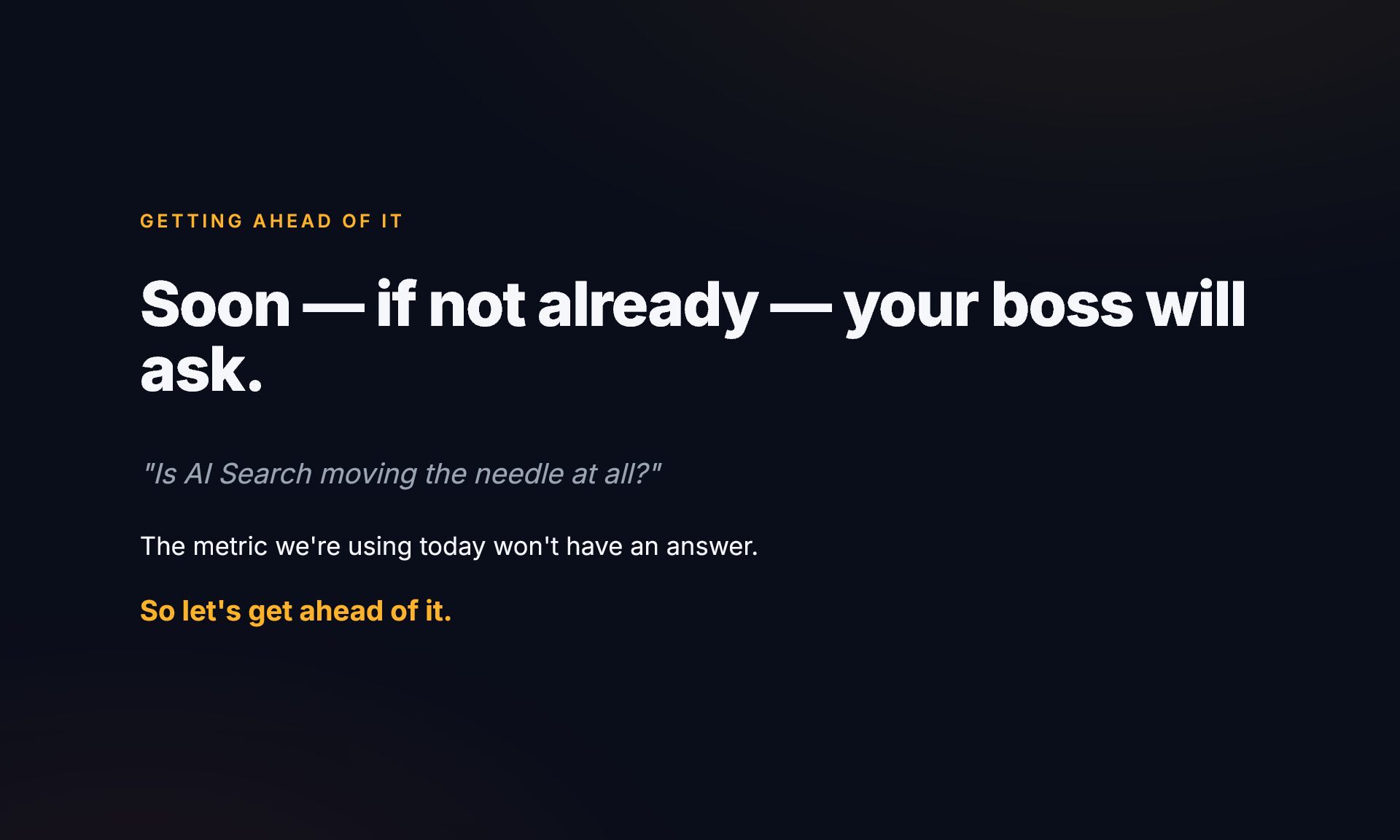
  6. GETTING AHEAD OF IT Soon — if not already —

    your boss will ask. "Is AI Search moving the needle at all?" The metric we're using today won't have an answer. So let's get ahead of it.
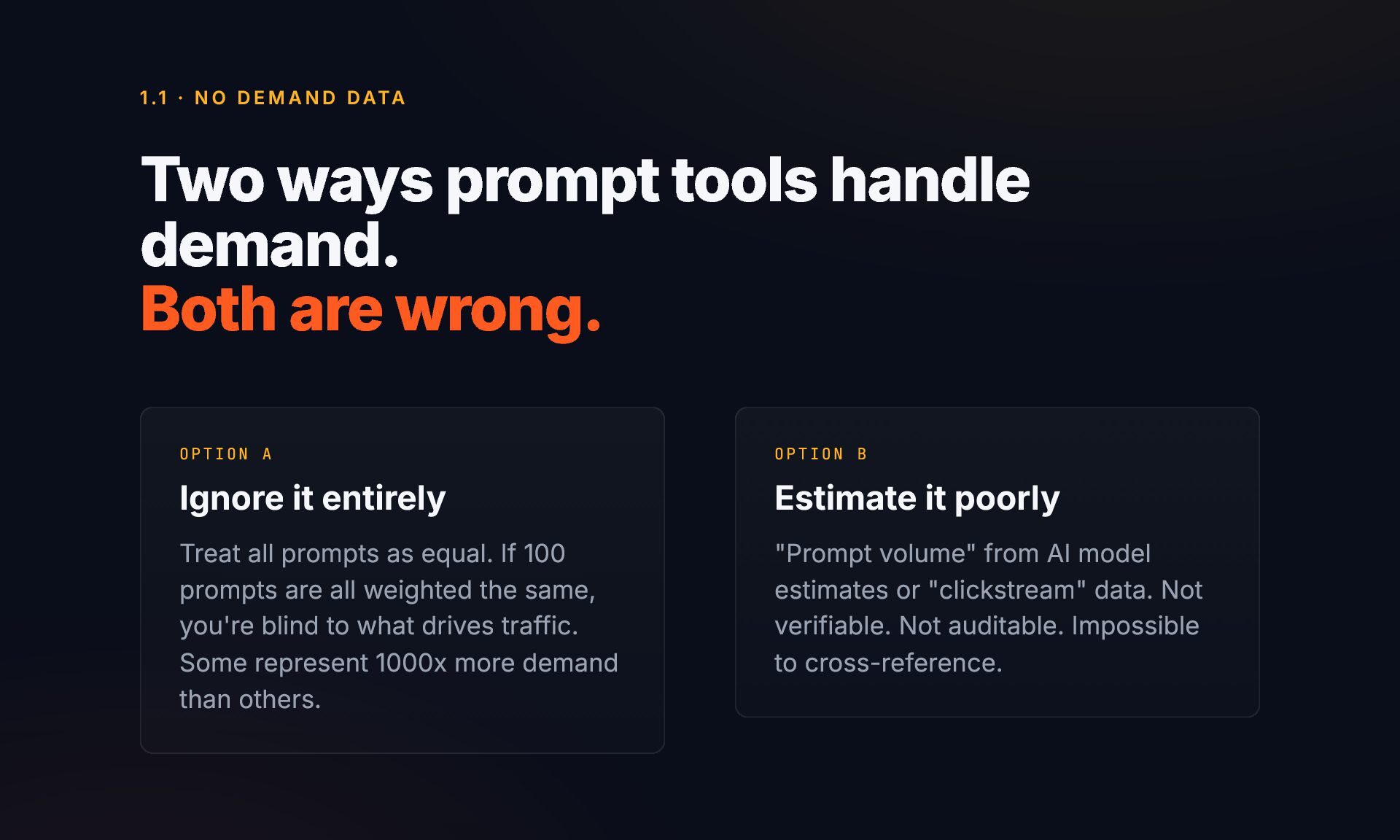
  7. 1.1 · NO DEMAND DATA Two ways prompt tools handle

    demand. Both are wrong. OPTION A Ignore it entirely Treat all prompts as equal. If 100 prompts are all weighted the same, you're blind to what drives traffic. Some represent 1000x more demand than others. OPTION B Estimate it poorly "Prompt volume" from AI model estimates or "clickstream" data. Not verifiable. Not auditable. Impossible to cross-reference.
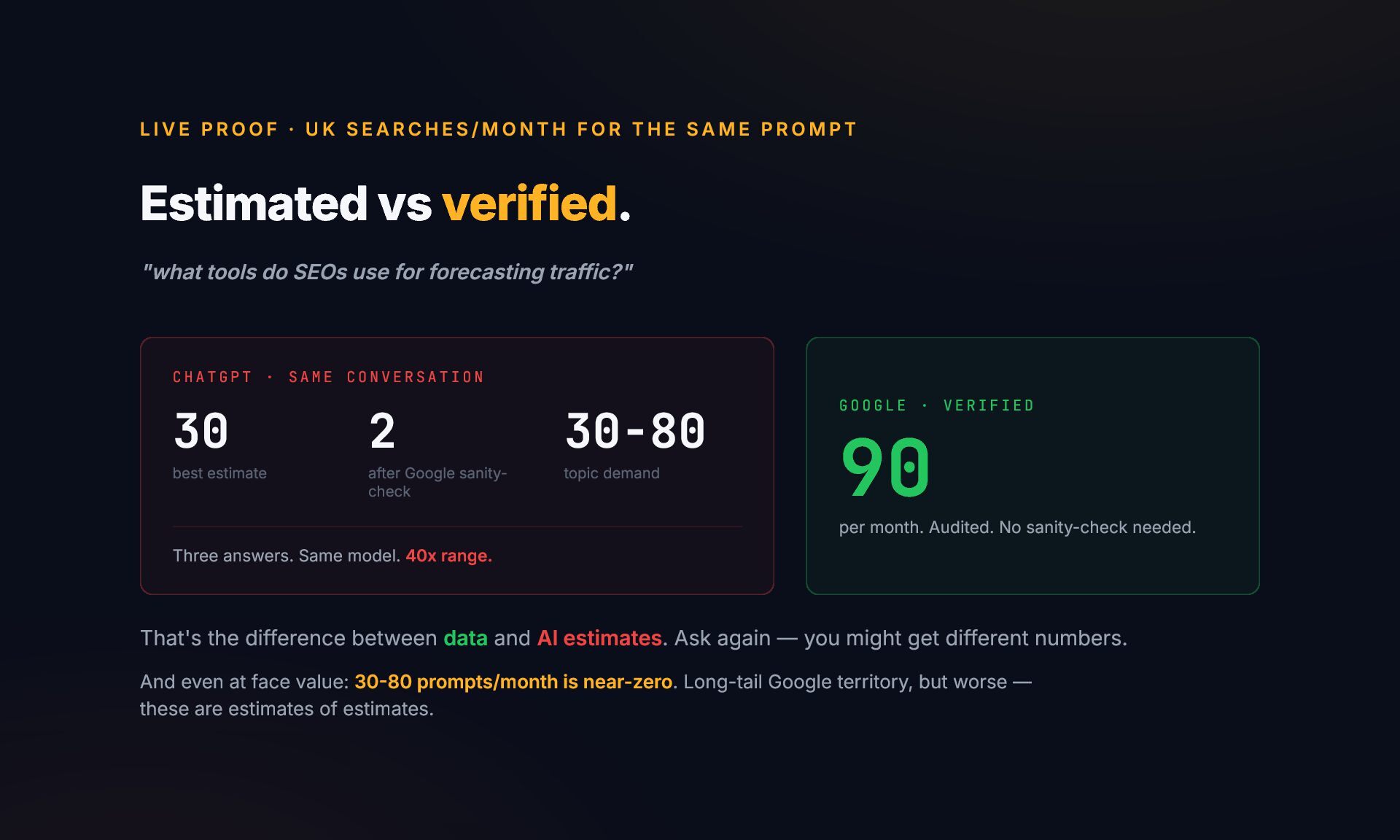
  8. LIVE PROOF · UK SEARCHES/MONTH FOR THE SAME PROMPT Estimated

    vs verified. "what tools do SEOs use for forecasting traffic?" CHATGPT · SAME CONVERSATIO N 30 best estimate 2 after Google sanity- check 30-80 topic demand Three answers. Same model. 40x range. GOOGLE · VERIFIED 90 per month. Audited. No sanity-check needed. That's the difference between data and AI estimates. Ask again — you might get different numbers. And even at face value: 30-80 prompts/month is near-zero. Long-tail Google territory, but worse — these are estimates of estimates.
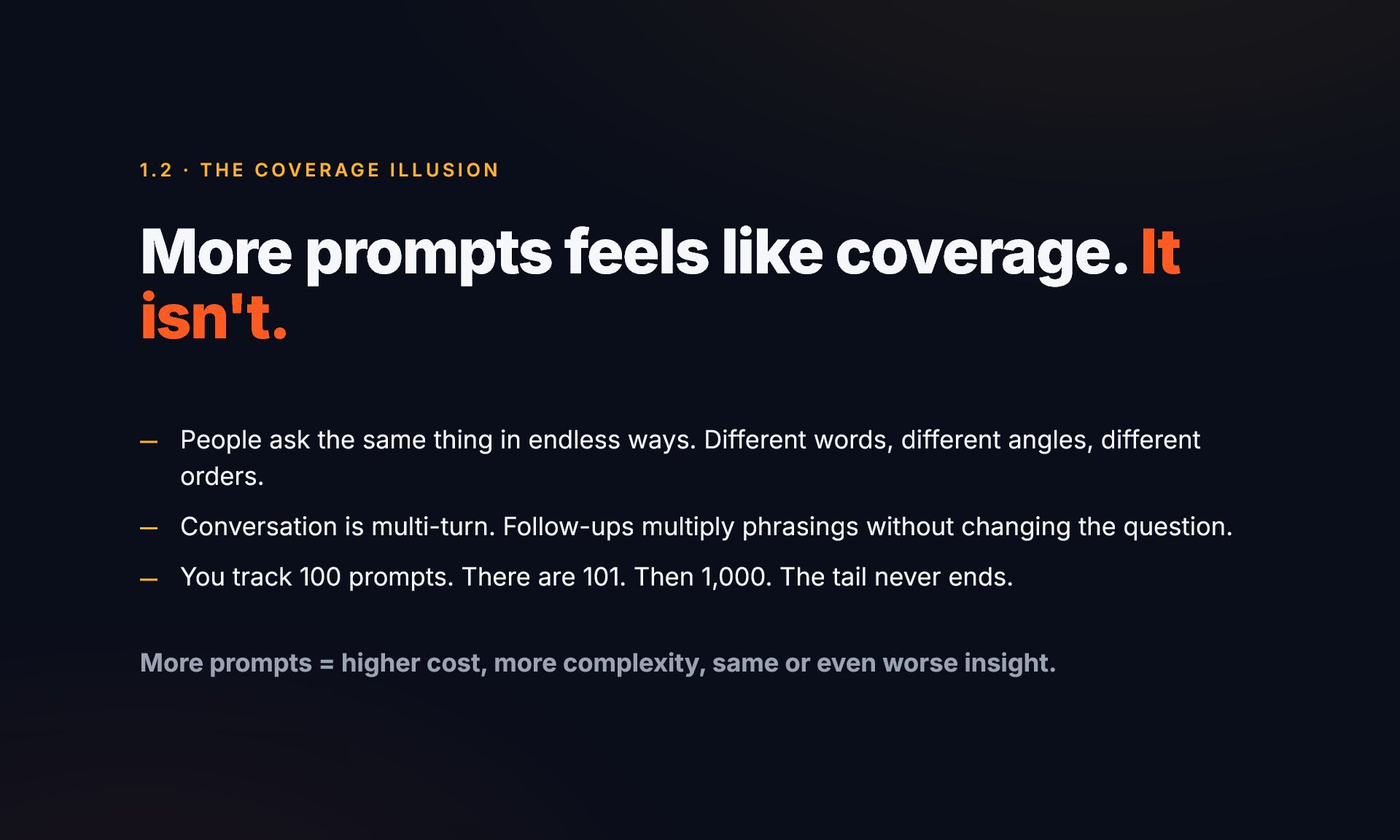
  9. 1.2 · THE COVERAGE ILLUSION More prompts feels like coverage.

    It isn't. More prompts = higher cost, more complexity, same or even worse insight. People ask the same thing in endless ways. Different words, different angles, different orders. Conversation is multi-turn. Follow-ups multiply phrasings without changing the question. You track 100 prompts. There are 101. Then 1,000. The tail never ends.
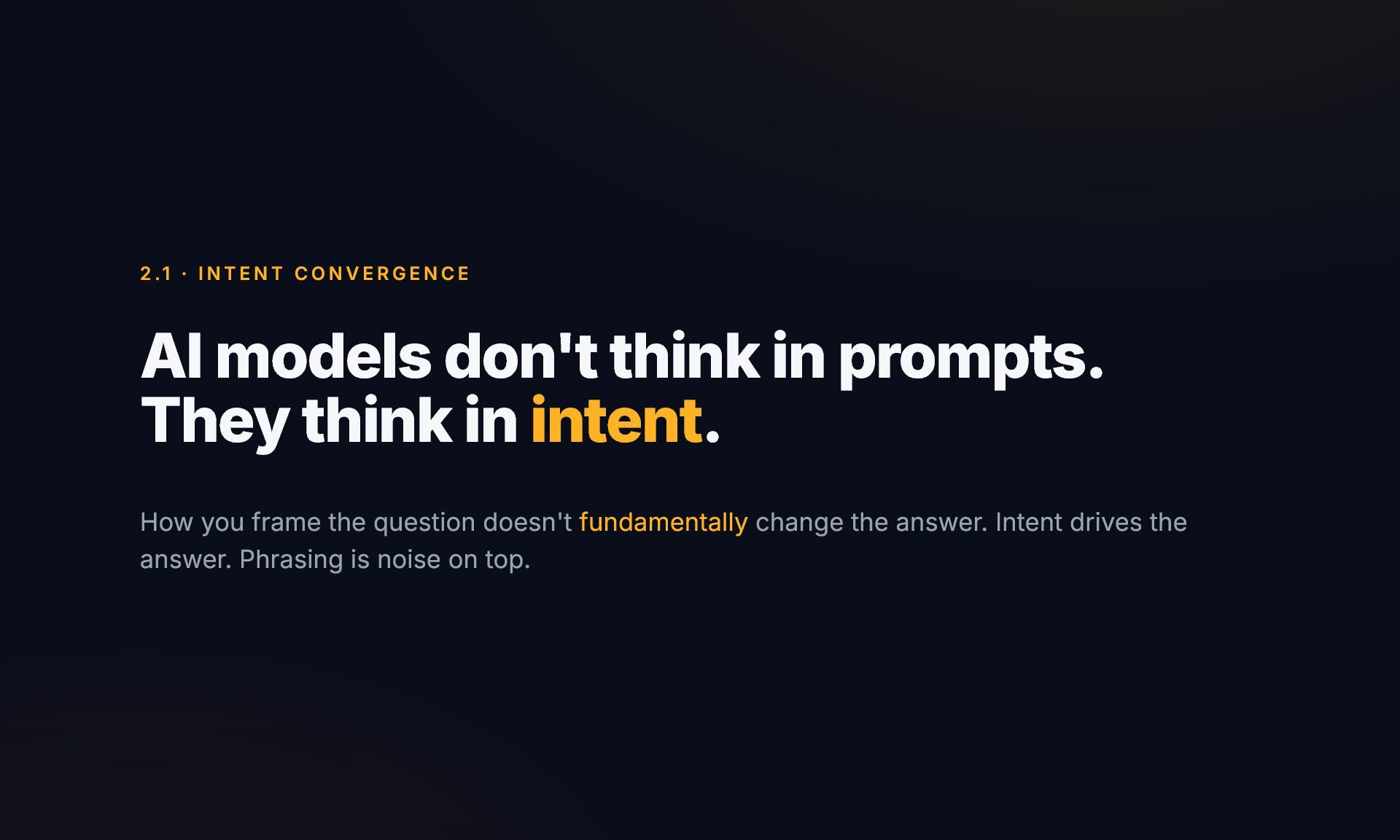
  10. 2.1 · INTENT CONVERGENCE AI models don't think in prompts.

    They think in intent. How you frame the question doesn't fundamentally change the answer. Intent drives the answer. Phrasing is noise on top.
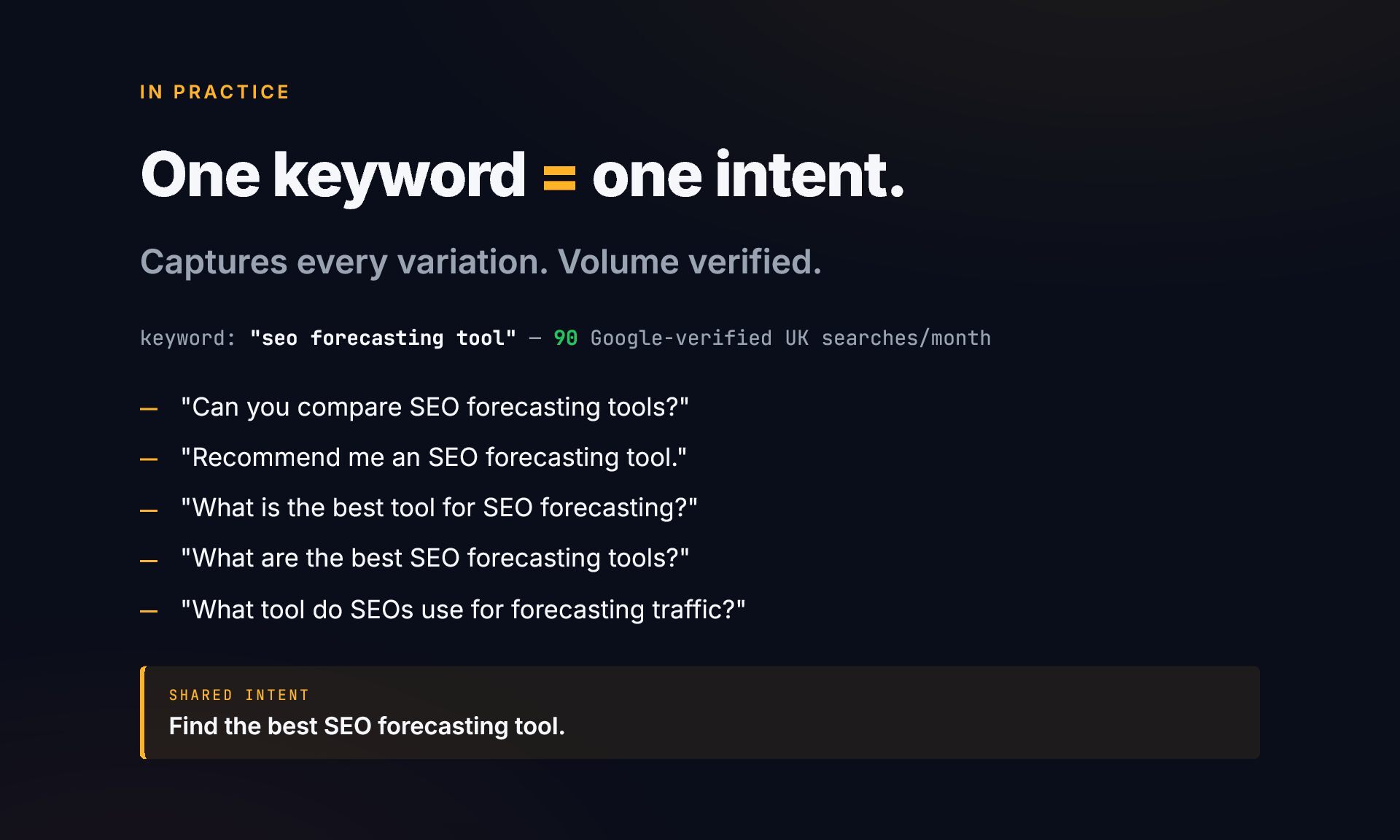
  11. IN PRACTICE One keyword = one intent. Captures every variation.

    Volume verified. keyword: "seo forecasting tool" — 90 Google-verified UK searches/month SHARED INTENT Find the best SEO forecasting tool. "Can you compare SEO forecasting tools?" "Recommend me an SEO forecasting tool." "What is the best tool for SEO forecasting?" "What are the best SEO forecasting tools?" "What tool do SEOs use for forecasting traffic?"
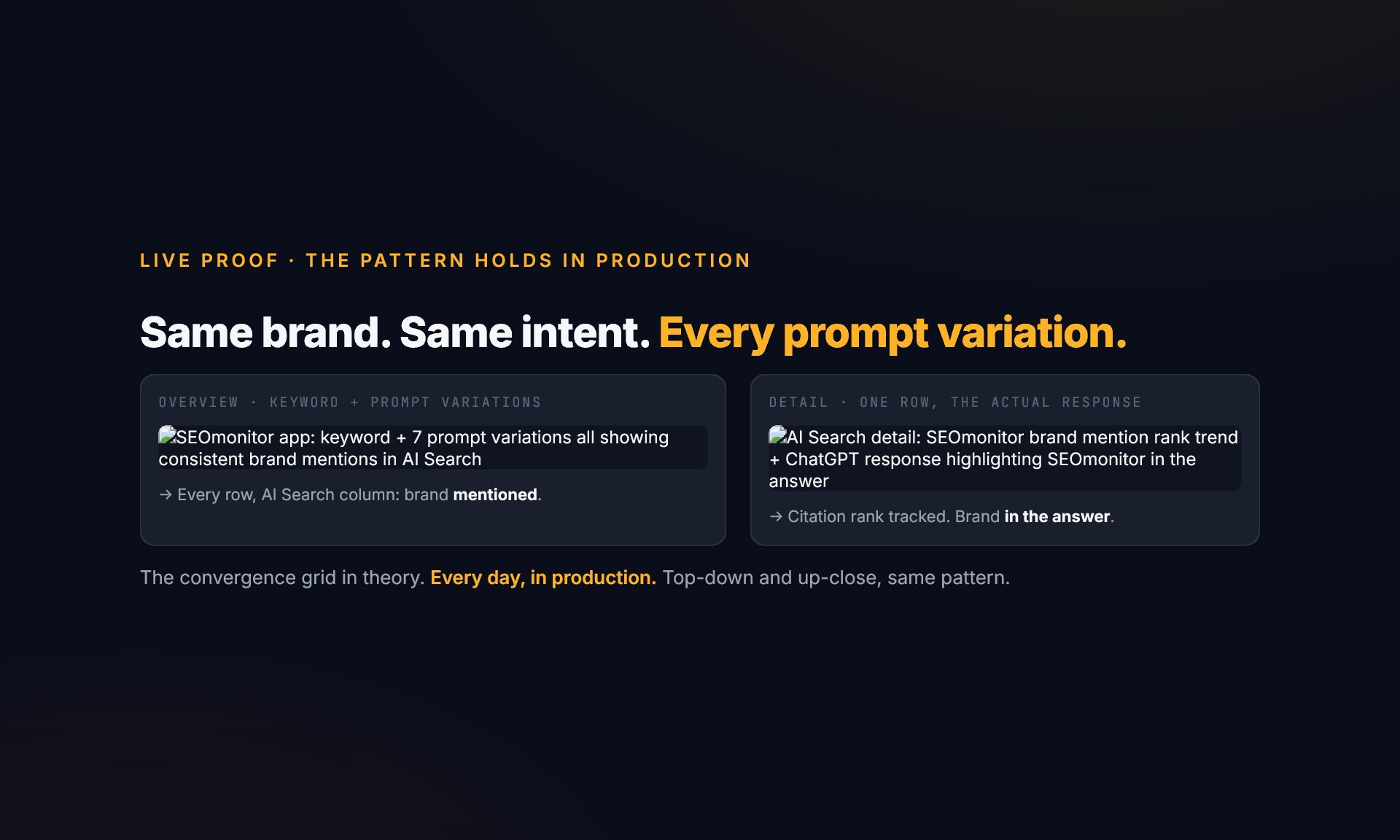
  12. LIVE PROOF · THE PATTERN HOLDS IN PRODUCTION Same brand.

    Same intent. Every prompt variation. OVERVIEW · KEYWORD + PROMPT VARIATIONS SEOmonitor app: keyword + 7 prompt variations all showing consistent brand mentions in AI Search → Every row, AI Search column: brand mentioned. DETAIL · ONE ROW, THE ACTUAL RESPONSE AI Search detail: SEOmonitor brand mention rank trend + ChatGPT response highlighting SEOmonitor in the answer → Citation rank tracked. Brand in the answer. The convergence grid in theory. Every day, in production. Top-down and up-close, same pattern.
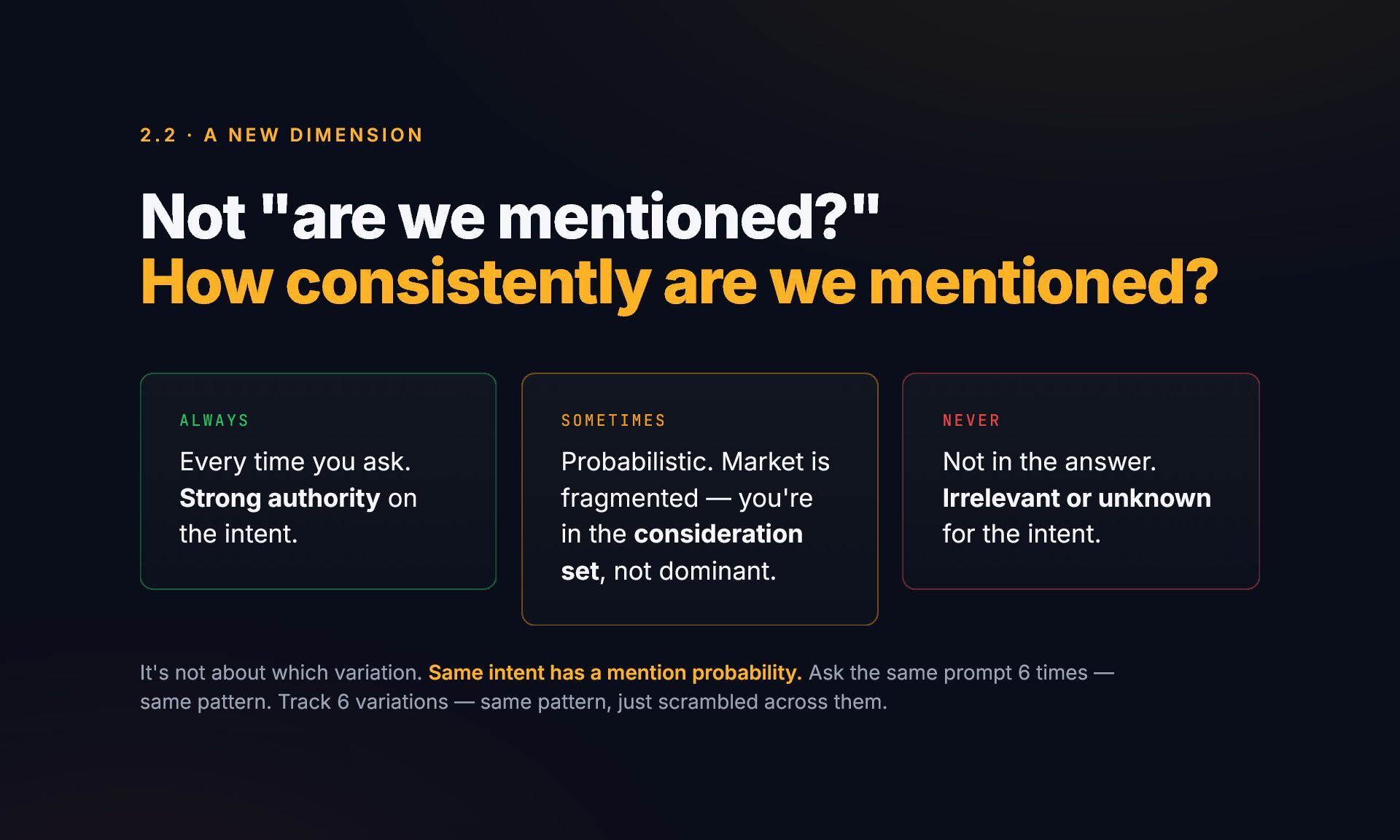
  13. 2.2 · A NEW DIMENSION Not "are we mentioned?" How

    consistently are we mentioned? ALWAYS Every time you ask. Strong authority on the intent. SOMETIMES Probabilistic. Market is fragmented — you're in the consideration set, not dominant. NEVER Not in the answer. Irrelevant or unknown for the intent. It's not about which variation. Same intent has a mention probability. Ask the same prompt 6 times — same pattern. Track 6 variations — same pattern, just scrambled across them.
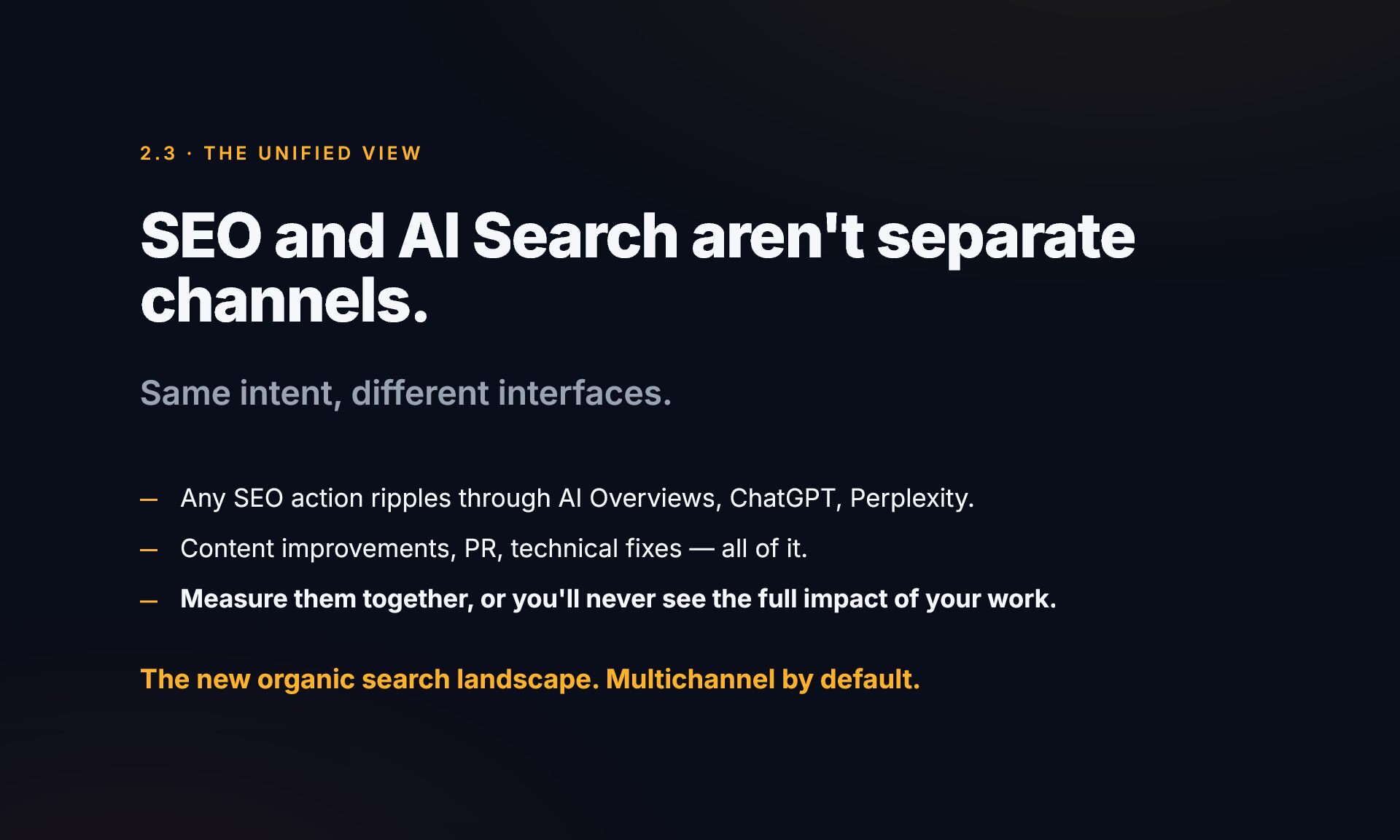
  14. 2.3 · THE UNIFIED VIEW SEO and AI Search aren't

    separate channels. Same intent, different interfaces. The new organic search landscape. Multichannel by default. Any SEO action ripples through AI Overviews, ChatGPT, Perplexity. Content improvements, PR, technical fixes — all of it. Measure them together, or you'll never see the full impact of your work.
  15. Keywords with search volume as the base unit. The abstraction

    that lets you weight performance of the same keyword (intent) strategy across every channel. Keywords map to intent. Intent maps to demand. Same chain across Google, AI Overviews, ChatGPT, Perplexity. One strategy, every channel.
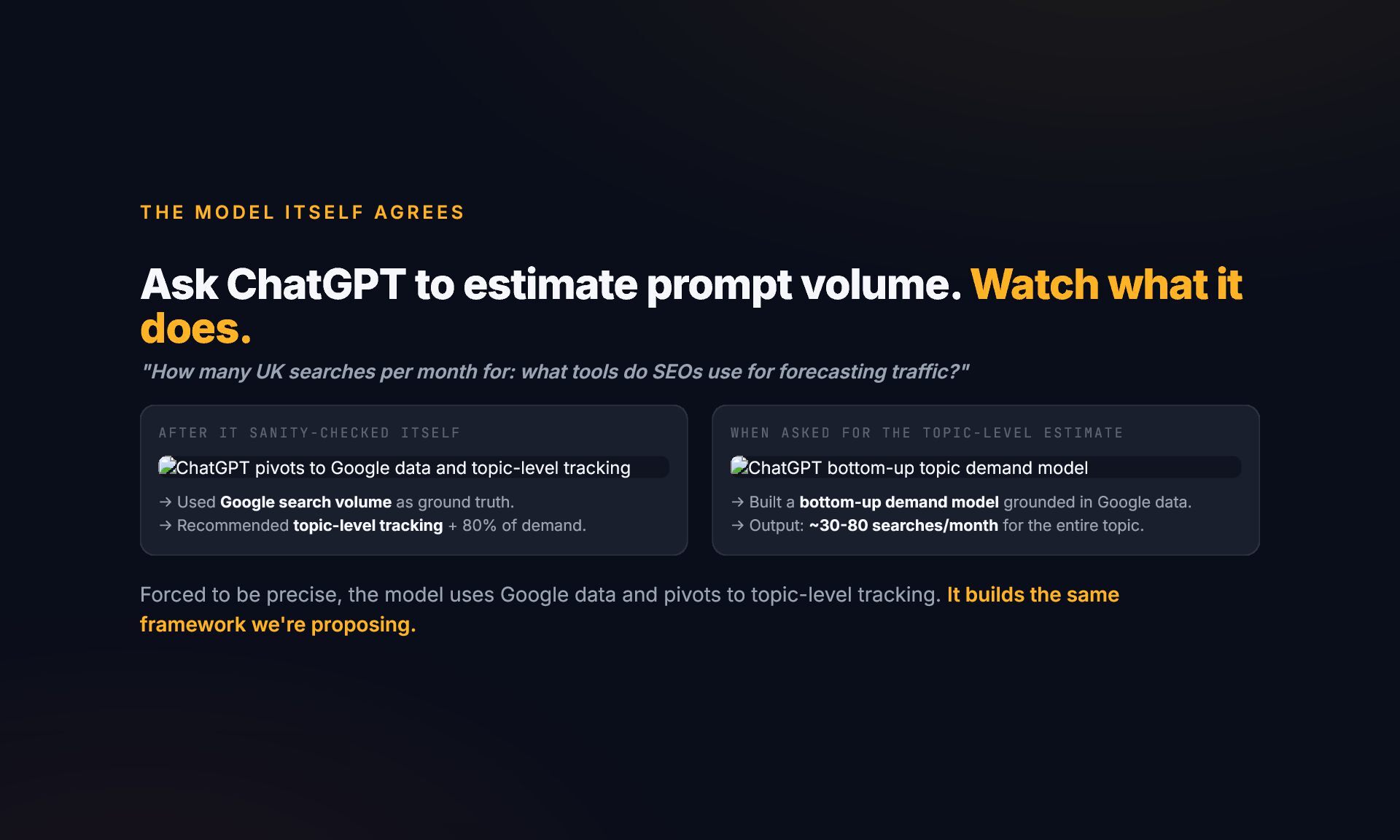
  16. THE MODEL ITSELF AGREES Ask ChatGPT to estimate prompt volume.

    Watch what it does. "How many UK searches per month for: what tools do SEOs use for forecasting traffic?" AFTER IT SANITY-CHECKED ITSELF ChatGPT pivots to Google data and topic-level tracking → Used Google search volume as ground truth. → Recommended topic-level tracking + 80% of demand. WHEN ASKED FOR THE TOPIC-LEVEL ESTIMATE ChatGPT bottom-up topic demand model → Built a bottom-up demand model grounded in Google data. → Output: ~30-80 searches/month for the entire topic. Forced to be precise, the model uses Google data and pivots to topic-level tracking. It builds the same framework we're proposing.
  17. 3.1 · THE PRINCIPLE Leading metrics must predict lagging metrics.

    If your visibility metric doesn't correlate with traffic and revenue, it's not a metric. It's a decoration.
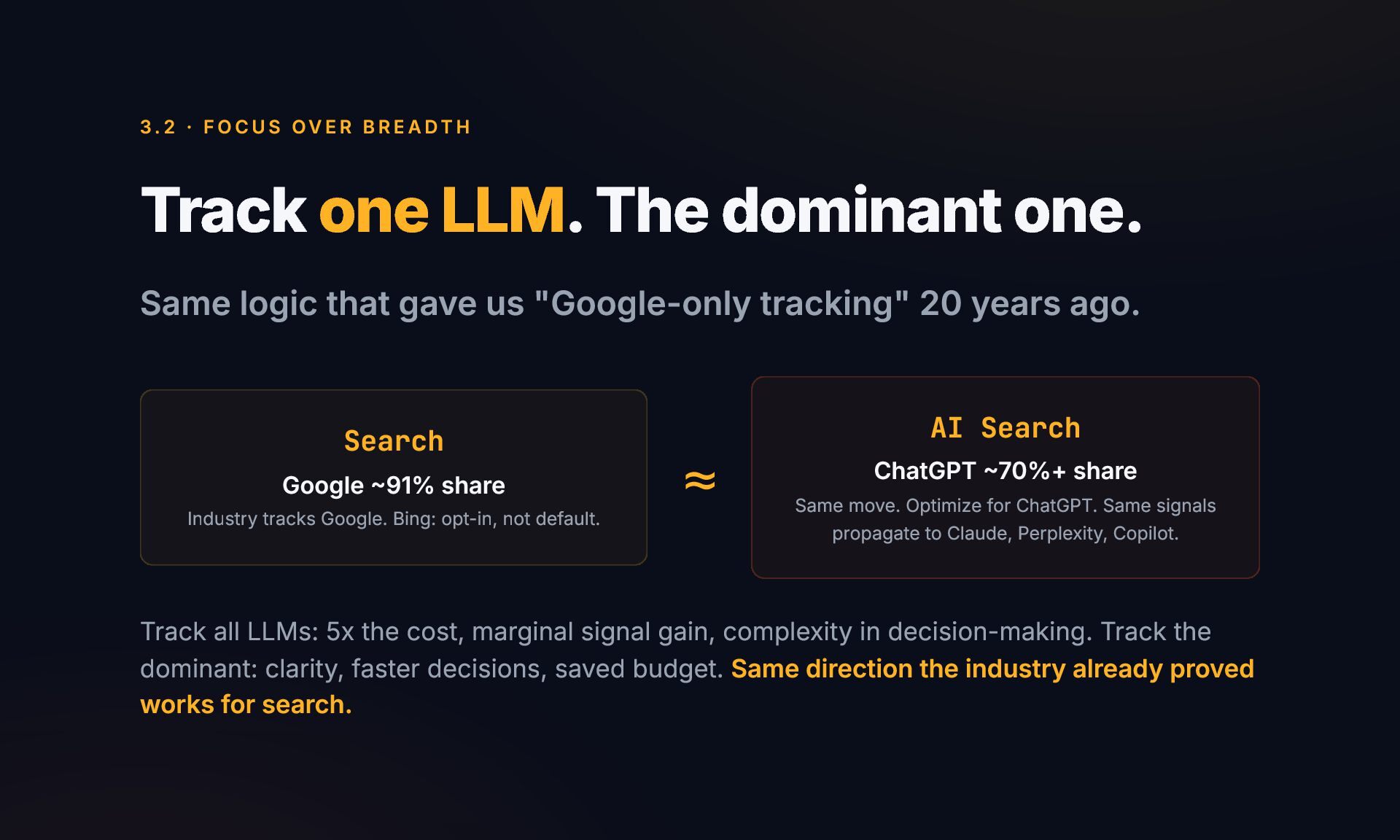
  18. 3.2 · FOCUS OVER BREADTH Track one LLM. The dominant

    one. Same logic that gave us "Google-only tracking" 20 years ago. Search Google ~91% share Industry tracks Google. Bing: opt-in, not default. ≈ AI Search ChatGPT ~70%+ share Same move. Optimize for ChatGPT. Same signals propagate to Claude, Perplexity, Copilot. Track all LLMs: 5x the cost, marginal signal gain, complexity in decision-making. Track the dominant: clarity, faster decisions, saved budget. Same direction the industry already proved works for search.
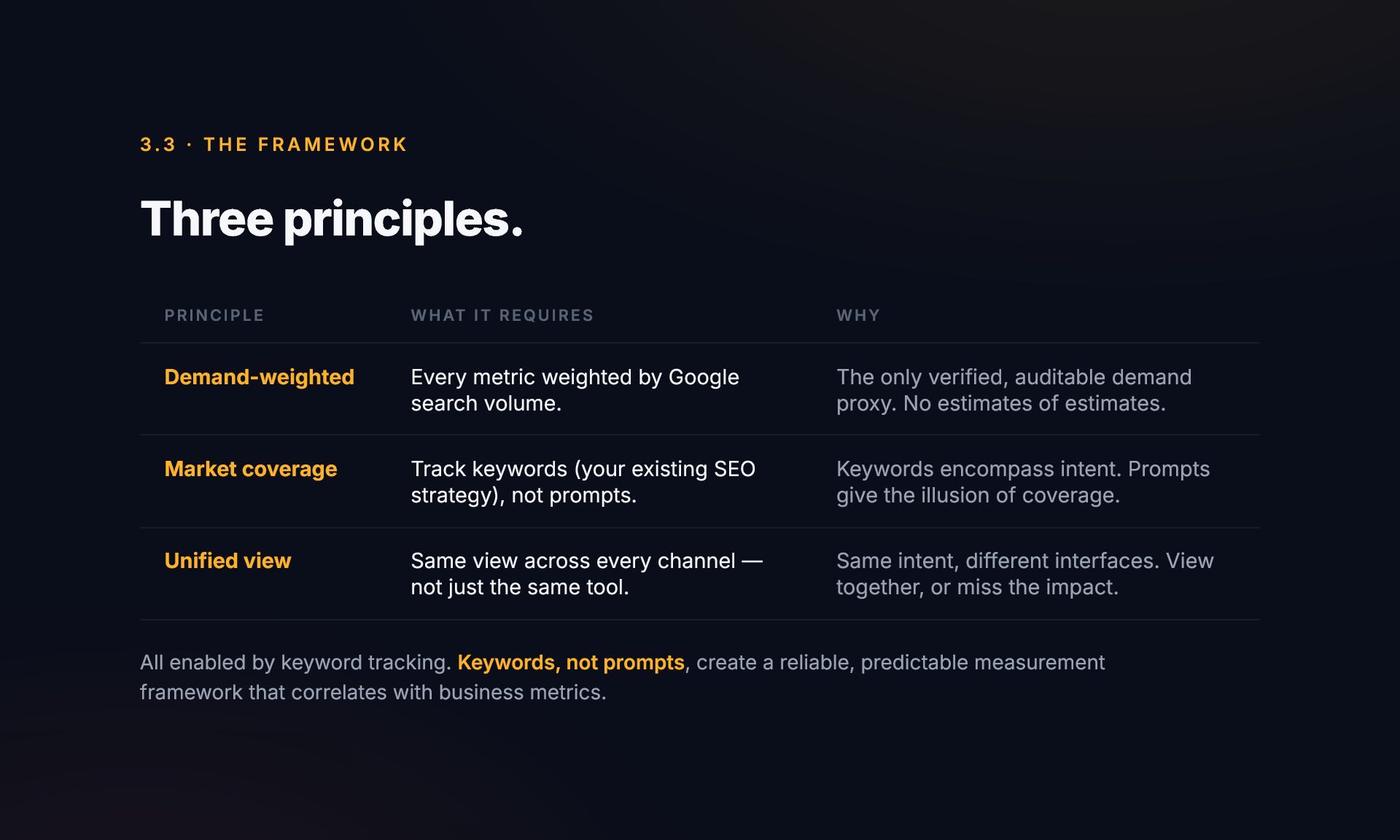
  19. 3.3 · THE FRAMEWORK Three principles. PRINCIPLE WHAT IT REQUIRES

    WHY Demand-weighted Every metric weighted by Google search volume. The only verified, auditable demand proxy. No estimates of estimates. Market coverage Track keywords (your existing SEO strategy), not prompts. Keywords encompass intent. Prompts give the illusion of coverage. Unified view Same view across every channel — not just the same tool. Same intent, different interfaces. View together, or miss the impact. All enabled by keyword tracking. Keywords, not prompts, create a reliable, predictable measurement framework that correlates with business metrics.
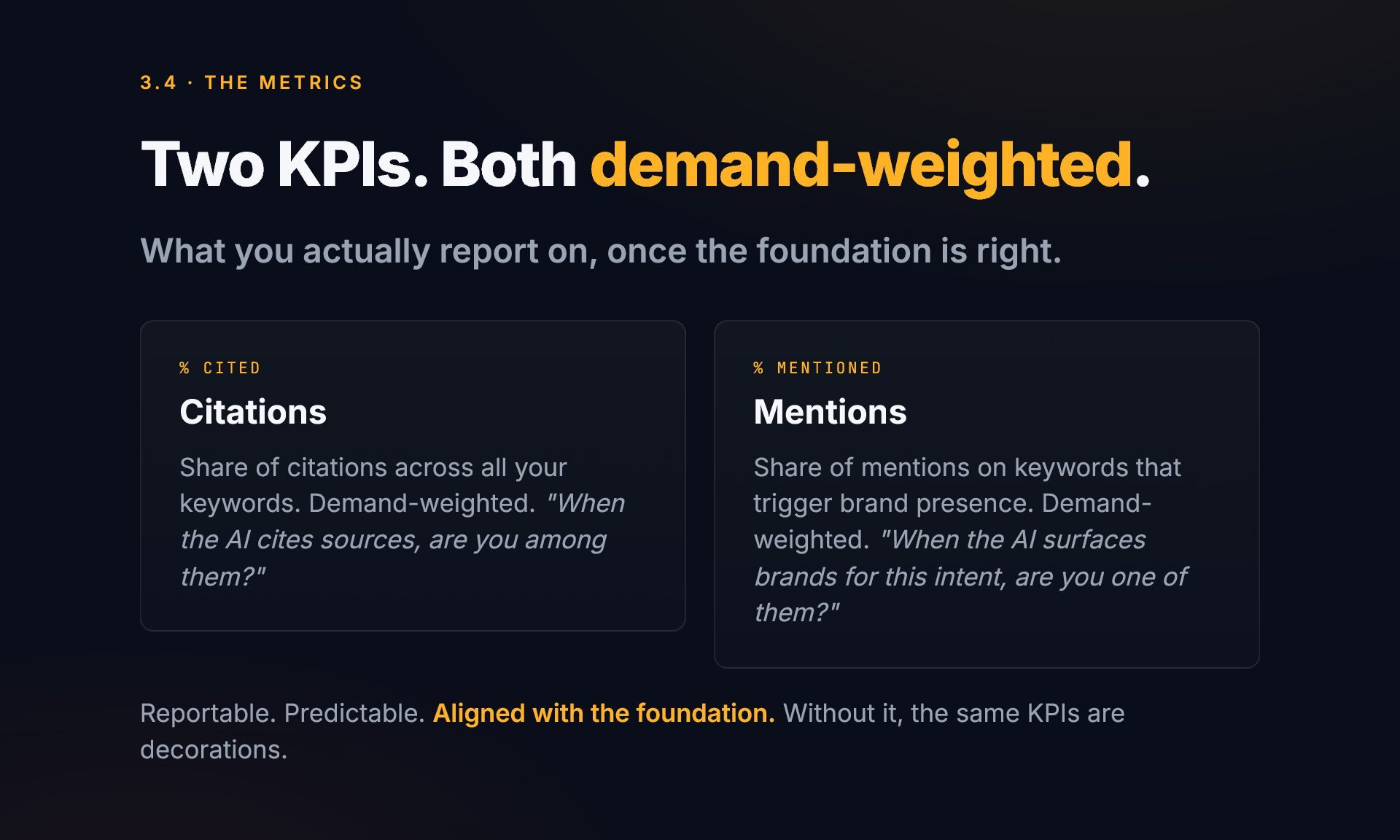
  20. 3.4 · THE METRICS Two KPIs. Both demand-weighted. What you

    actually report on, once the foundation is right. % CITED Citations Share of citations across all your keywords. Demand-weighted. "When the AI cites sources, are you among them?" % MENTIONED Mentions Share of mentions on keywords that trigger brand presence. Demand- weighted. "When the AI surfaces brands for this intent, are you one of them?" Reportable. Predictable. Aligned with the foundation. Without it, the same KPIs are decorations.
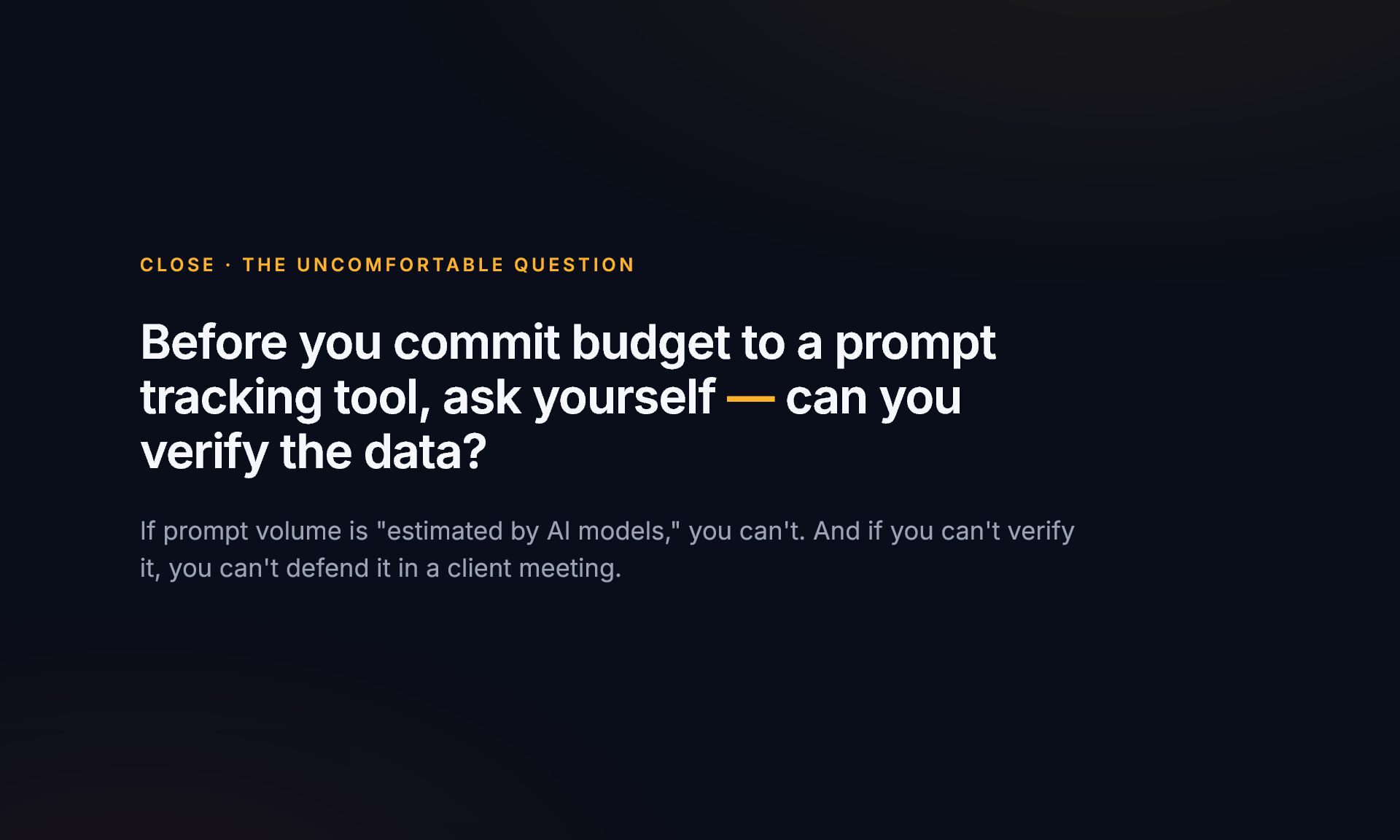
  21. CLOSE · THE UNCOMFORTABLE QUESTION Before you commit budget to

    a prompt tracking tool, ask yourself — can you verify the data? If prompt volume is "estimated by AI models," you can't. And if you can't verify it, you can't defend it in a client meeting.
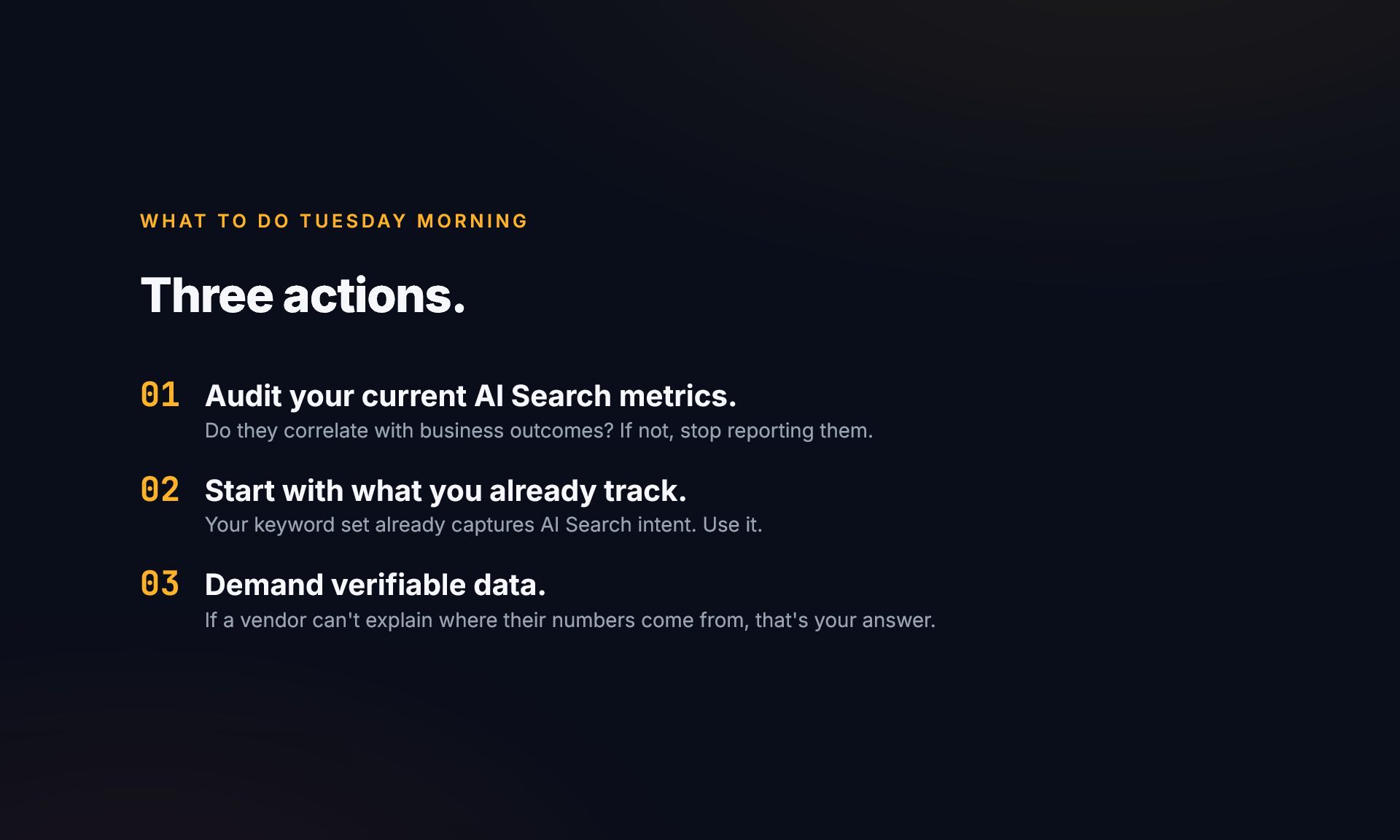
  22. WHAT TO DO TUESDAY MORNING Three actions. 01 Audit your

    current AI Search metrics. Do they correlate with business outcomes? If not, stop reporting them. 02 Start with what you already track. Your keyword set already captures AI Search intent. Use it. 03 Demand verifiable data. If a vendor can't explain where their numbers come from, that's your answer.
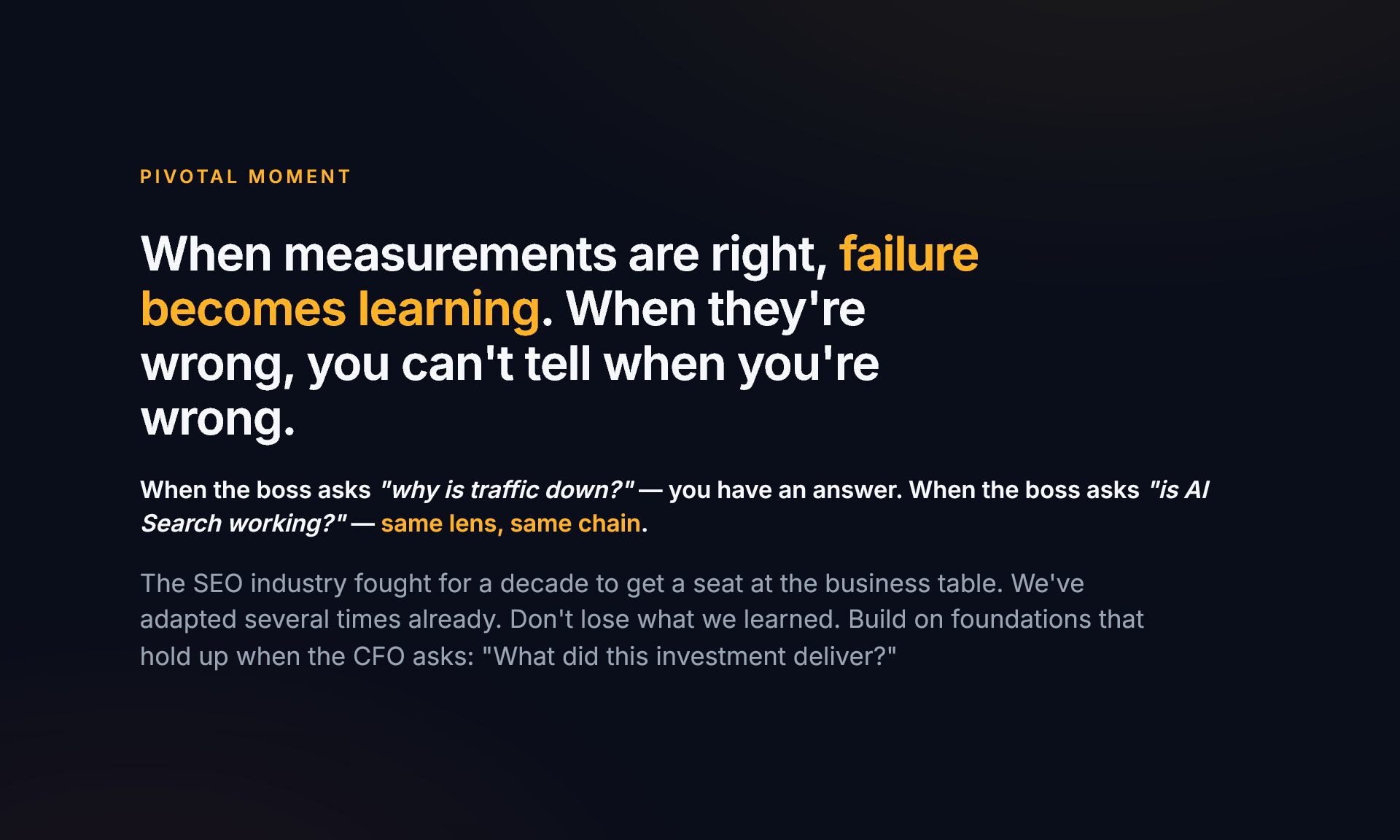
  23. PIVOTAL MOMENT When measurements are right, failure becomes learning. When

    they're wrong, you can't tell when you're wrong. When the boss asks "why is traffic down?" — you have an answer. When the boss asks "is AI Search working?" — same lens, same chain. The SEO industry fought for a decade to get a seat at the business table. We've adapted several times already. Don't lose what we learned. Build on foundations that hold up when the CFO asks: "What did this investment deliver?"
  24. Thank you. 30-DAY TRIAL Test the methodology. Compare with your

    current data. Ask the critical questions. Cosmin Negrescu · linkedin.com/in/ncosmin · [email protected] Come find me after. Happy to argue about keywords vs prompts over coffee.