Upgrade to Pro — share decks privately, control downloads, hide ads and more …

Zero to Hero in UI testing

Sponsored · SiteGround - Reliable hosting with speed, security, and support you can count on. →
Avatar for Vesko Iliev Vesko Iliev
October 21, 2017

Zero to Hero in UI testing

In this talk we'll discuss the problems around UI testing - why is it hard to write such tests, how to get started, how to make them part of your CI system. We'll present a recipe for building a scalable framework that makes writing UI tests a pleasure. Most of the common "gotcha-s" will be solved along the way, as well as giving a few best practices. Once the foundations are laid out, a whole new set of scaling problems arises, so we'll talk about possible solutions for them.

Whether you still don't have any UI tests in your project, or you already have a good suite built, this talk will give you some useful tips & ideas.

=====
Presented on 21st Oct as part of Mobilization 2017

Avatar for Vesko Iliev

Vesko Iliev

October 21, 2017

More Decks by Vesko Iliev

Other Decks in Technology

Transcript

  1. Europe 2017 ZERO TO HERO IN UI TESTING VESSELIN ILIEV,

    ANDROID DEVELOPER @ ASOS (OR HOW TO CREATE A SCALABLE TEST SUITE)
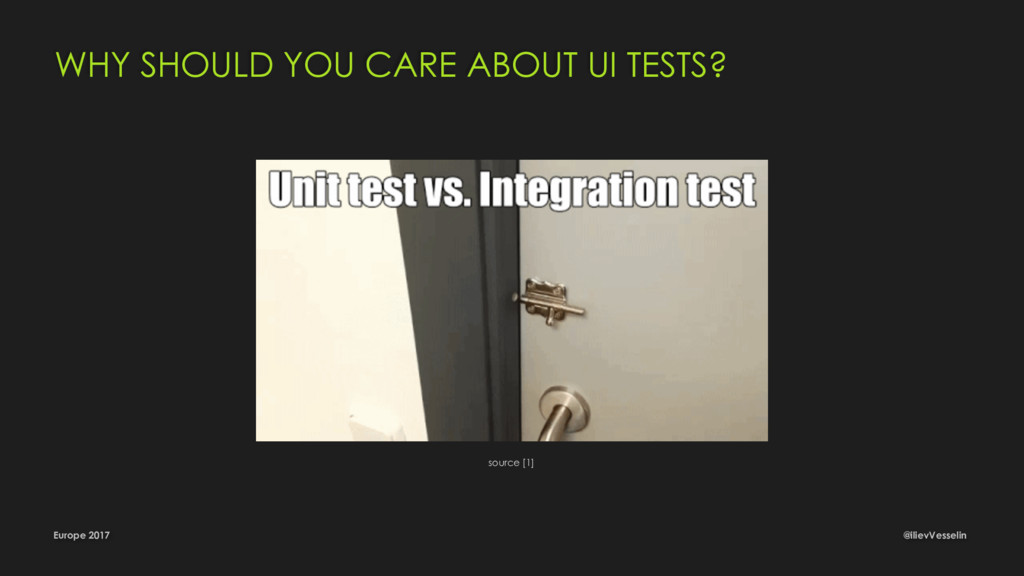
  2. @ilievVesselin Europe 2017 WHY SHOULD YOU CARE ABOUT UI TESTS?

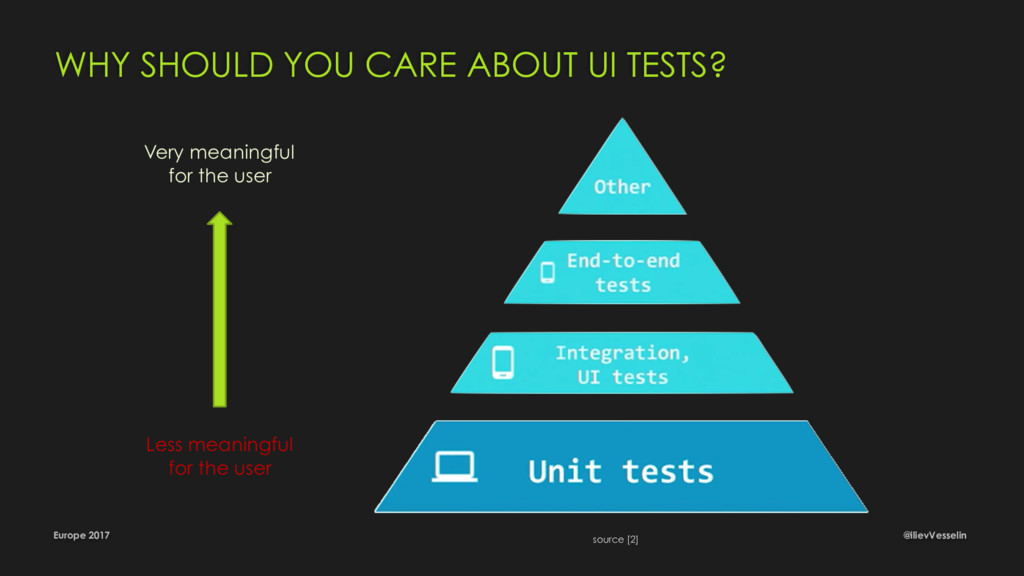
    source [2] Less meaningful
 for the user Very meaningful
 for the user
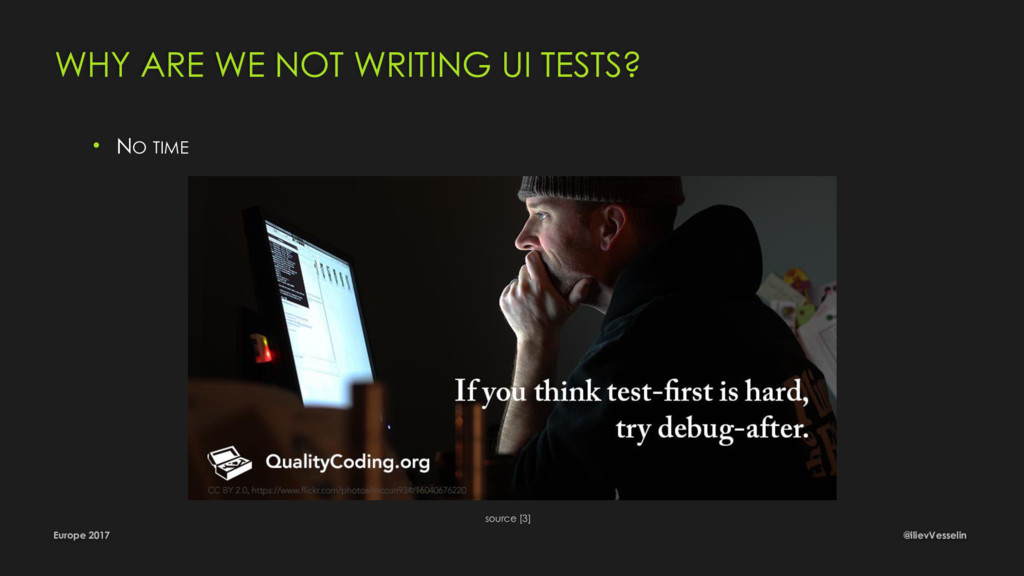
  3. @ilievVesselin Europe 2017 WHY ARE WE NOT WRITING UI TESTS?

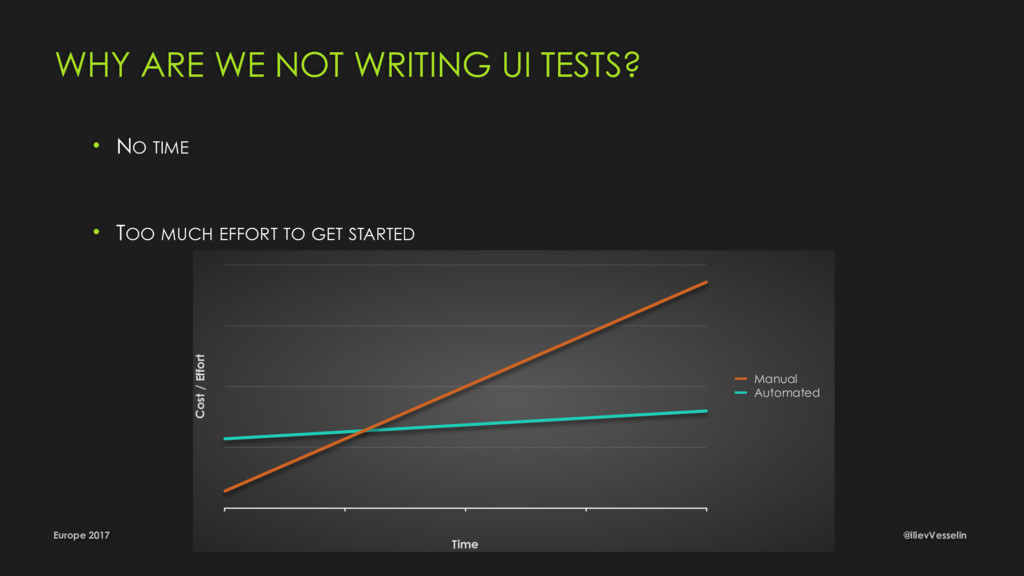
    • NO TIME Cost / Effort Time Manual Automated • TOO MUCH EFFORT TO GET STARTED
  4. @ilievVesselin Europe 2017 WHY ARE WE NOT WRITING UI TESTS?

    • NO TIME • TOO MUCH EFFORT TO GET STARTED • THIS IS QAS JOB
  5. @ilievVesselin Europe 2017 WHY ARE WE NOT WRITING UI TESTS?

    • NO TIME • TESTS ARE UNSTABLE (FLAKY) • TOO MUCH EFFORT TO GET STARTED • THIS IS QAS JOB
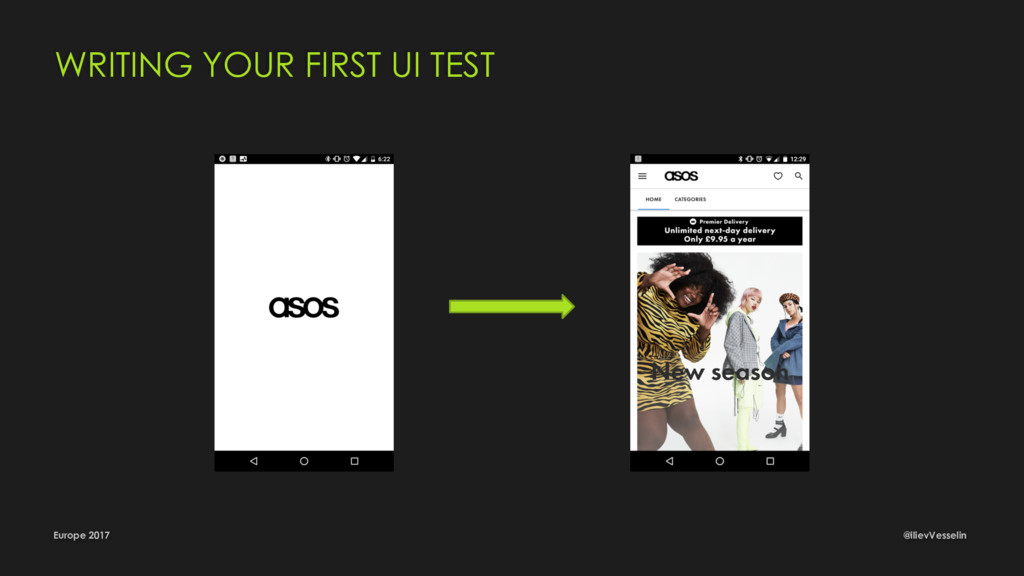
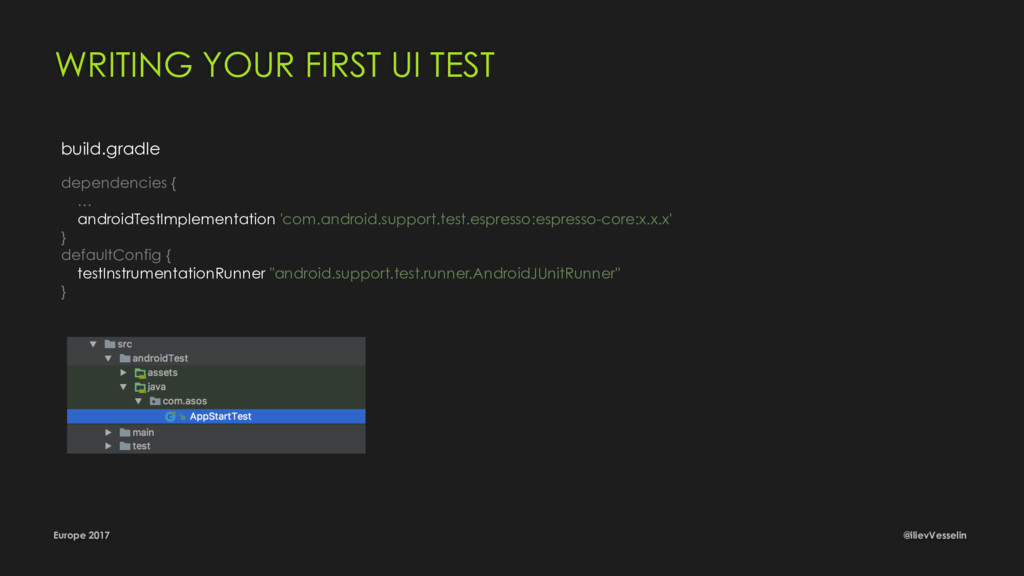
  6. @ilievVesselin Europe 2017 WRITING YOUR FIRST UI TEST dependencies {

    … androidTestImplementation 'com.android.support.test.espresso:espresso-core:x.x.x' } defaultConfig { testInstrumentationRunner "android.support.test.runner.AndroidJUnitRunner" } build.gradle
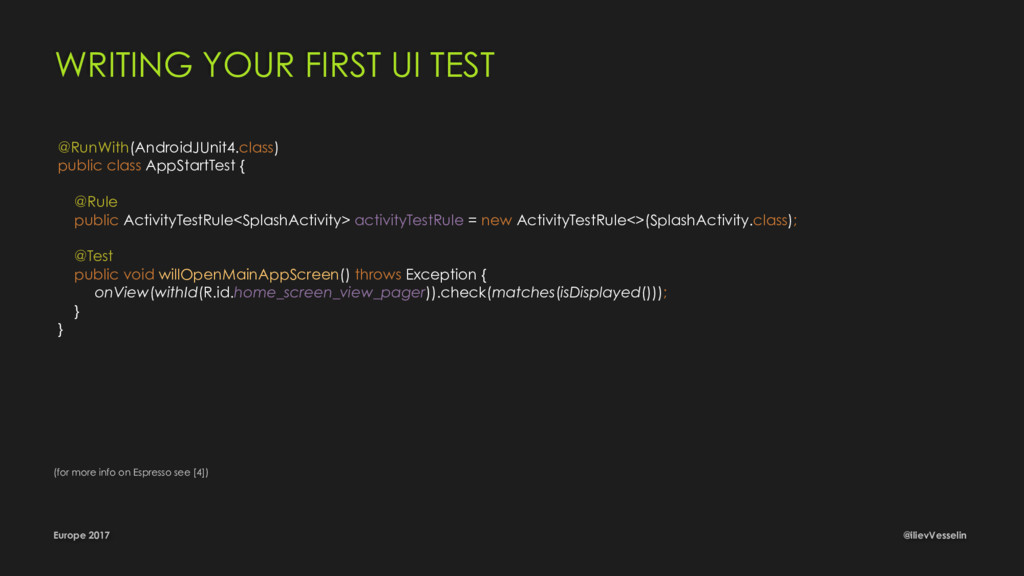
  7. @ilievVesselin Europe 2017 WRITING YOUR FIRST UI TEST @RunWith(AndroidJUnit4.class)
 public

    class AppStartTest {
 
 @Rule
 public ActivityTestRule<SplashActivity> activityTestRule = new ActivityTestRule<>(SplashActivity.class);
 
 @Test
 public void willOpenMainAppScreen() throws Exception { onView(withId(R.id.home_screen_view_pager)).check(matches(isDisplayed())); } } (for more info on Espresso see [4])
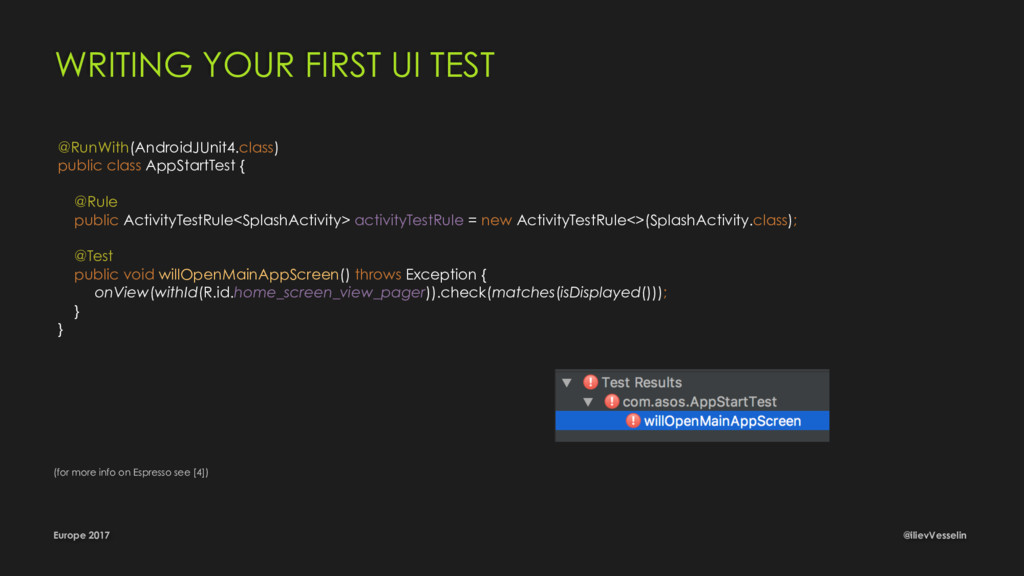
  8. @ilievVesselin Europe 2017 WRITING YOUR FIRST UI TEST @RunWith(AndroidJUnit4.class)
 public

    class AppStartTest {
 
 @Rule
 public ActivityTestRule<SplashActivity> activityTestRule = new ActivityTestRule<>(SplashActivity.class);
 
 @Test
 public void willOpenMainAppScreen() throws Exception { onView(withId(R.id.home_screen_view_pager)).check(matches(isDisplayed())); } } (for more info on Espresso see [4])
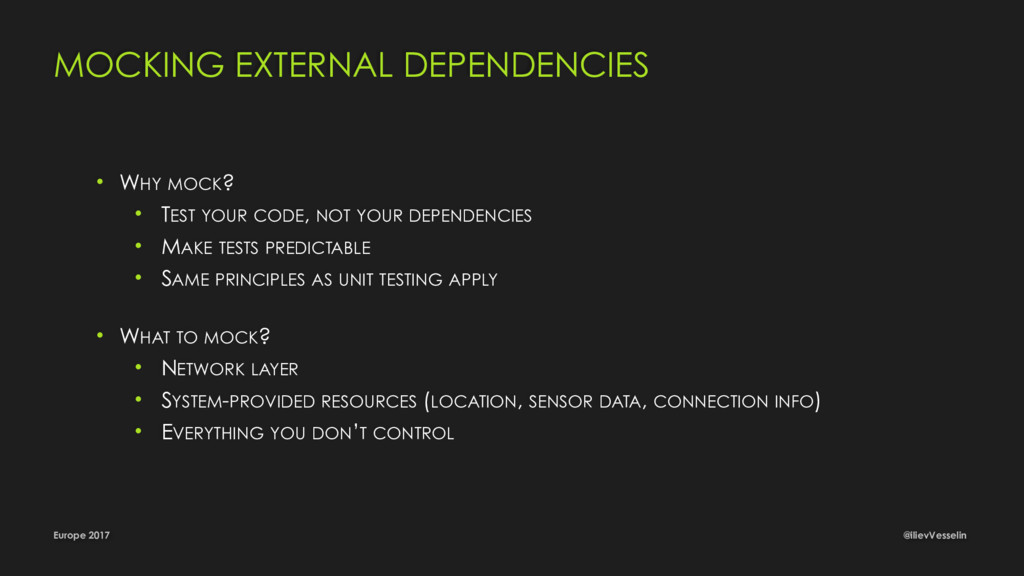
  9. @ilievVesselin Europe 2017 • WHY MOCK? • TEST YOUR CODE,

    NOT YOUR DEPENDENCIES • MAKE TESTS PREDICTABLE • SAME PRINCIPLES AS UNIT TESTING APPLY
 • WHAT TO MOCK? • NETWORK LAYER • SYSTEM-PROVIDED RESOURCES (LOCATION, SENSOR DATA, CONNECTION INFO) • EVERYTHING YOU DON’T CONTROL MOCKING EXTERNAL DEPENDENCIES
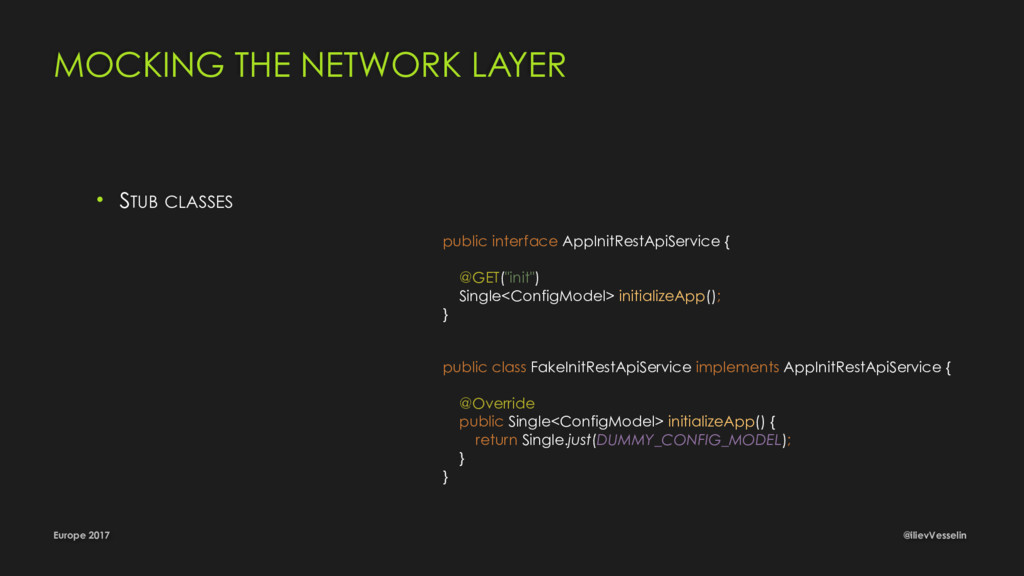
  10. @ilievVesselin Europe 2017 • STUB CLASSES MOCKING THE NETWORK LAYER

    public interface AppInitRestApiService {
 
 @GET("init")
 Single<ConfigModel> initializeApp();
 } public class FakeInitRestApiService implements AppInitRestApiService {
 
 @Override
 public Single<ConfigModel> initializeApp() {
 return Single.just(DUMMY_CONFIG_MODEL);
 }
 }
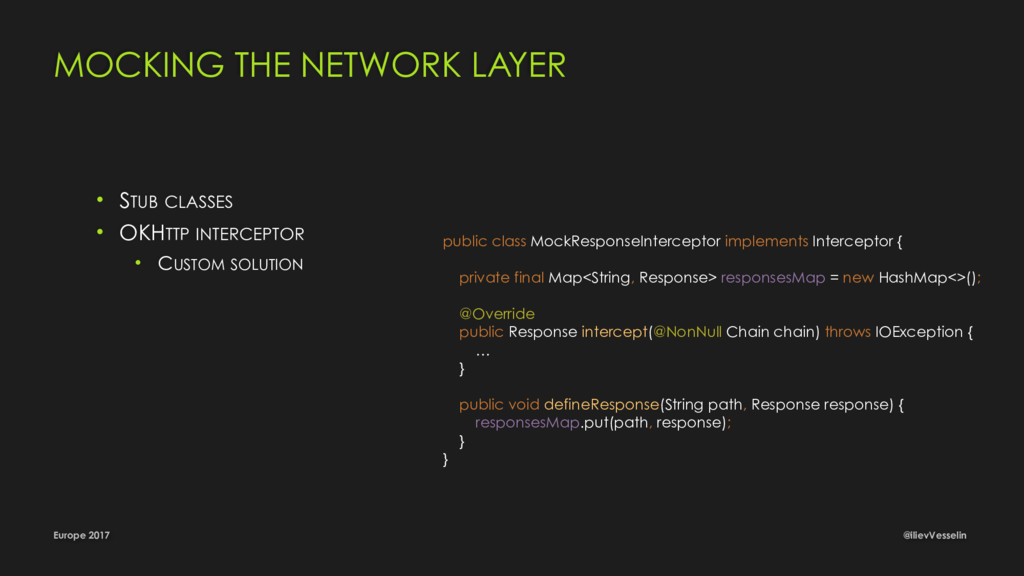
  11. @ilievVesselin Europe 2017 • STUB CLASSES • OKHTTP INTERCEPTOR •

    CUSTOM SOLUTION MOCKING THE NETWORK LAYER public class MockResponseInterceptor implements Interceptor {
 
 private final Map<String, Response> responsesMap = new HashMap<>();
 
 @Override
 public Response intercept(@NonNull Chain chain) throws IOException {
 …
 }
 
 public void defineResponse(String path, Response response) {
 responsesMap.put(path, response);
 }
 }
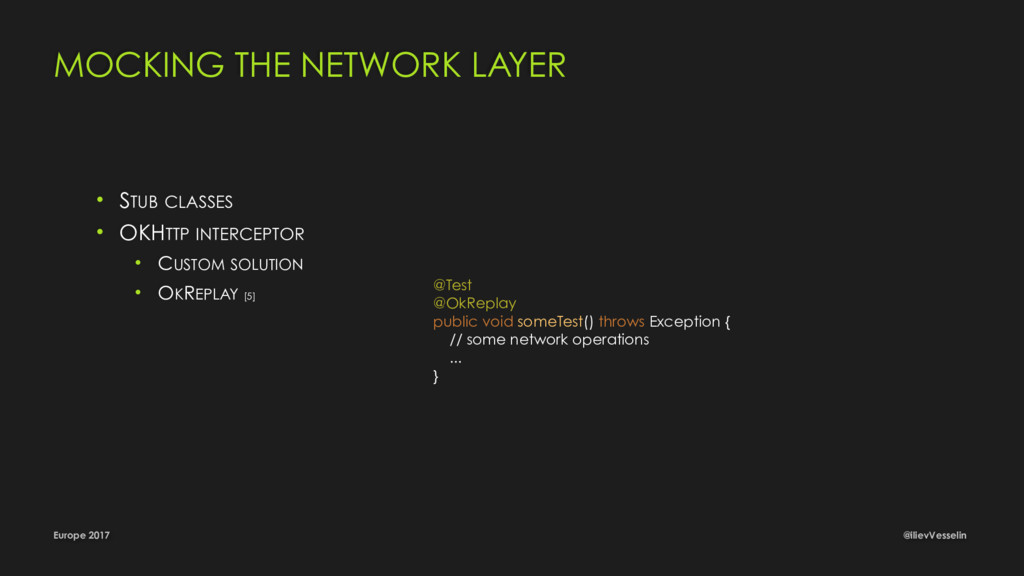
  12. @ilievVesselin Europe 2017 • STUB CLASSES • OKHTTP INTERCEPTOR •

    CUSTOM SOLUTION • OKREPLAY [5] MOCKING THE NETWORK LAYER @Test @OkReplay
 public void someTest() throws Exception {
 // some network operations ... }
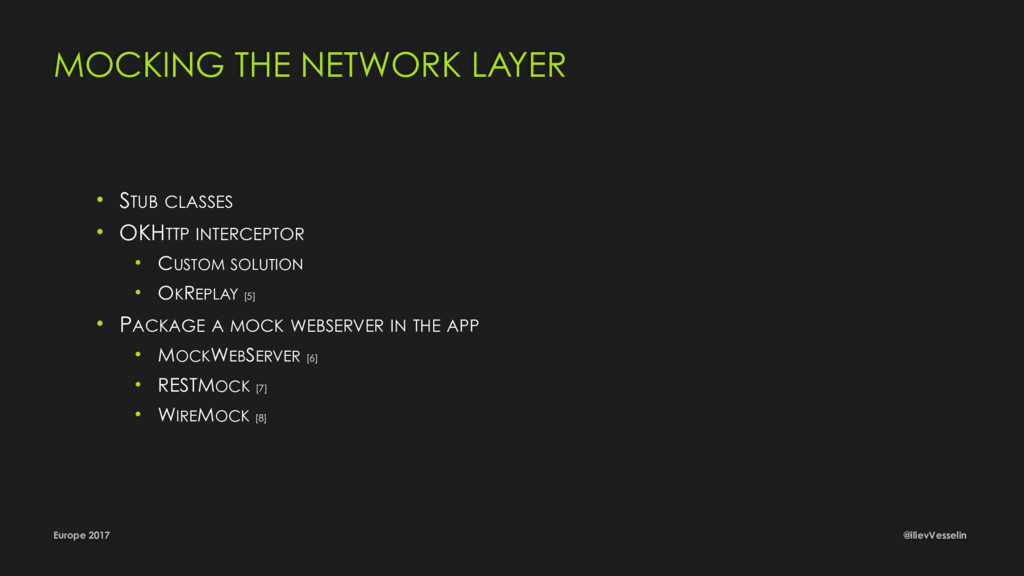
  13. @ilievVesselin Europe 2017 • STUB CLASSES • OKHTTP INTERCEPTOR •

    CUSTOM SOLUTION • OKREPLAY [5] • PACKAGE A MOCK WEBSERVER IN THE APP • MOCKWEBSERVER [6] • RESTMOCK [7] • WIREMOCK [8] MOCKING THE NETWORK LAYER
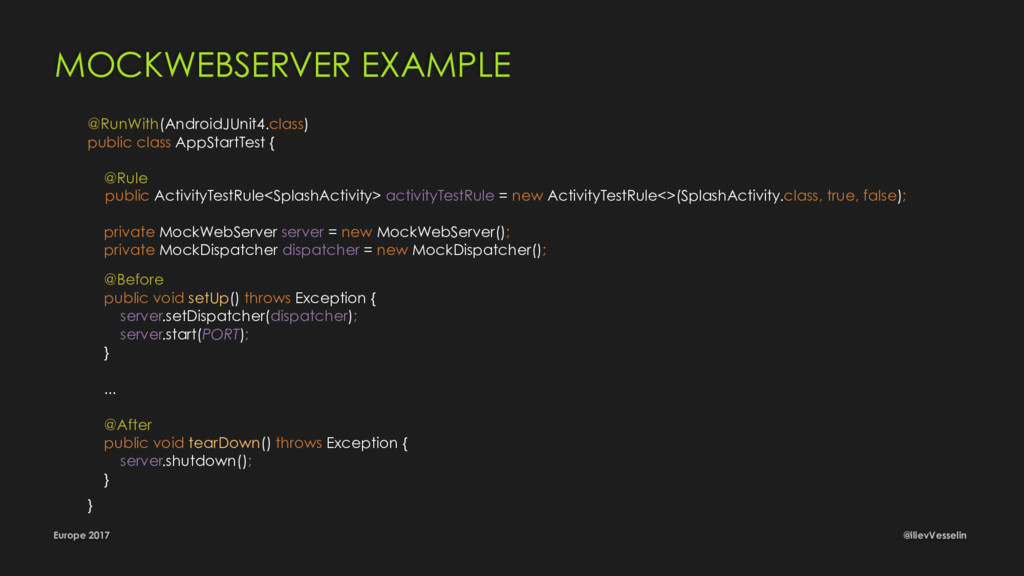
  14. @ilievVesselin Europe 2017 MOCKWEBSERVER EXAMPLE @RunWith(AndroidJUnit4.class)
 public class AppStartTest {


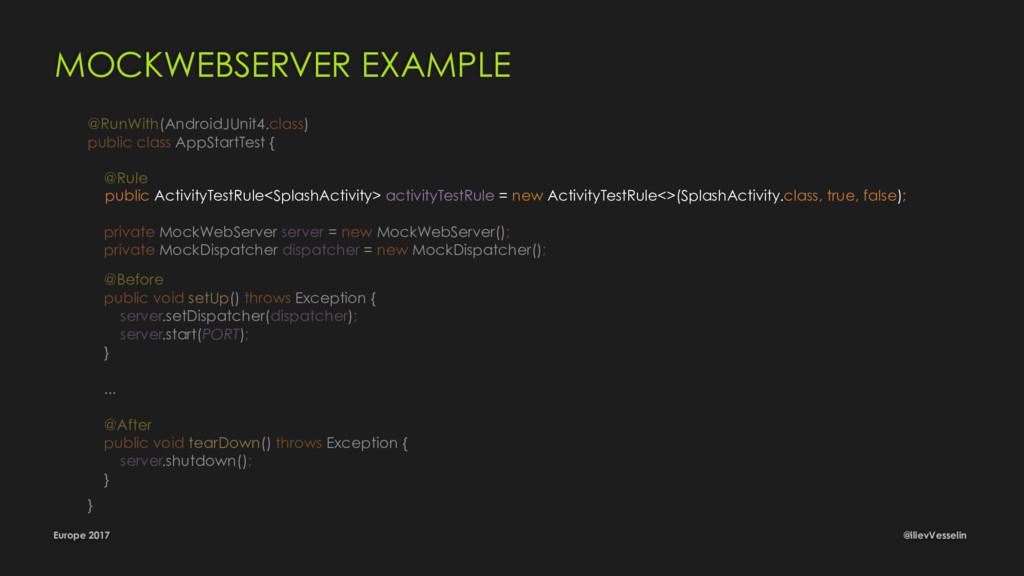
 @Rule
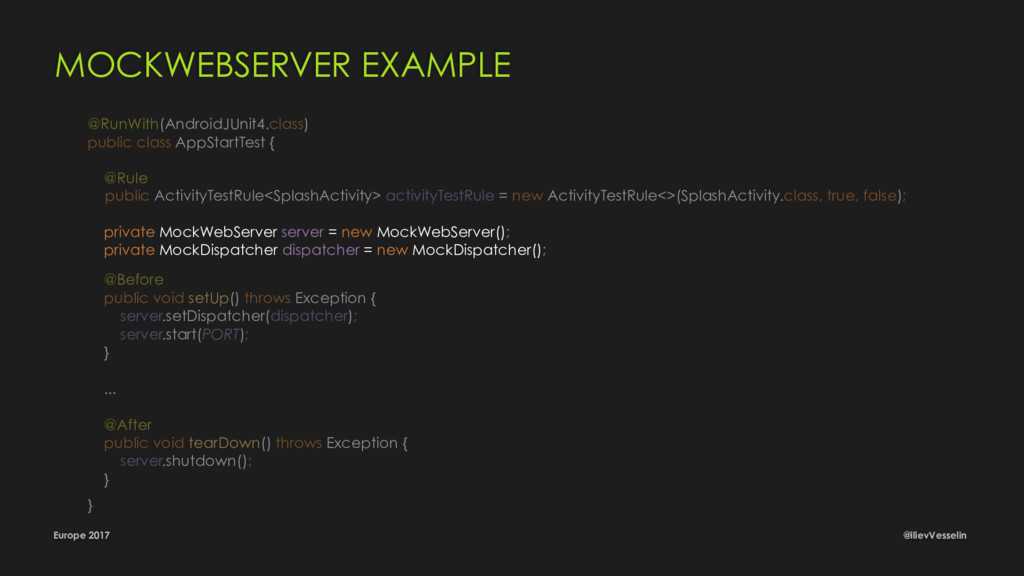
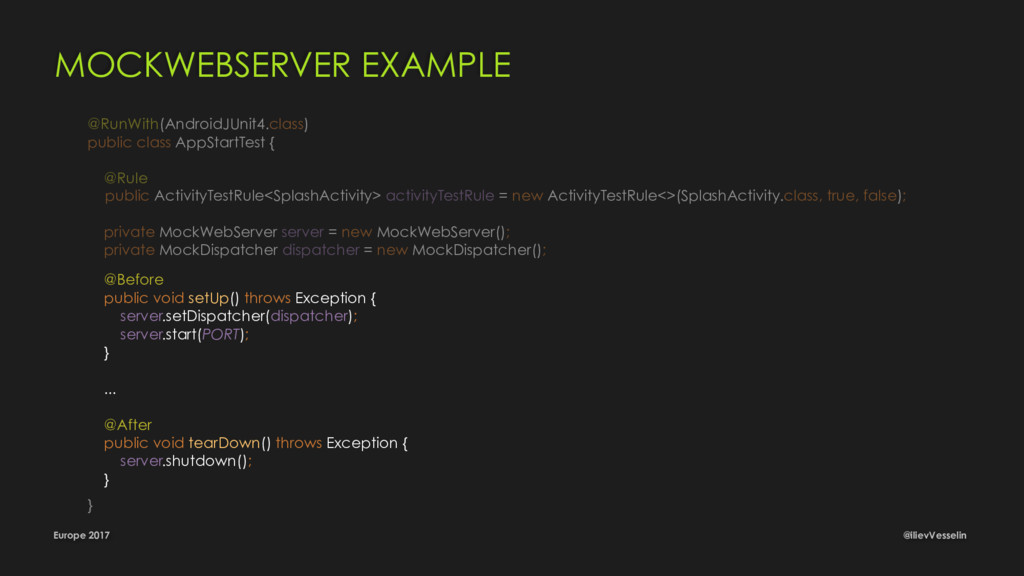
 } public ActivityTestRule<SplashActivity> activityTestRule = new ActivityTestRule<>(SplashActivity.class, true, false); private MockWebServer server = new MockWebServer(); private MockDispatcher dispatcher = new MockDispatcher(); @Before
 public void setUp() throws Exception {
 server.setDispatcher(dispatcher); server.start(PORT);
 }
 
 ... 
 @After
 public void tearDown() throws Exception {
 server.shutdown();
 }
  15. @ilievVesselin Europe 2017 MOCKWEBSERVER EXAMPLE @RunWith(AndroidJUnit4.class)
 public class AppStartTest {


 @Rule
 } public ActivityTestRule<SplashActivity> activityTestRule = new ActivityTestRule<>(SplashActivity.class, true, false); private MockWebServer server = new MockWebServer(); private MockDispatcher dispatcher = new MockDispatcher(); @Before
 public void setUp() throws Exception {
 server.setDispatcher(dispatcher); server.start(PORT);
 }
 
 ... 
 @After
 public void tearDown() throws Exception {
 server.shutdown();
 }
  16. @ilievVesselin Europe 2017 MOCKWEBSERVER EXAMPLE @RunWith(AndroidJUnit4.class)
 public class AppStartTest {


 @Rule
 } public ActivityTestRule<SplashActivity> activityTestRule = new ActivityTestRule<>(SplashActivity.class, true, false); private MockWebServer server = new MockWebServer(); private MockDispatcher dispatcher = new MockDispatcher(); @Before
 public void setUp() throws Exception {
 server.setDispatcher(dispatcher); server.start(PORT);
 }
 
 ... 
 @After
 public void tearDown() throws Exception {
 server.shutdown();
 }
  17. @ilievVesselin Europe 2017 MOCKWEBSERVER EXAMPLE @RunWith(AndroidJUnit4.class)
 public class AppStartTest {


 @Rule
 } public ActivityTestRule<SplashActivity> activityTestRule = new ActivityTestRule<>(SplashActivity.class, true, false); private MockWebServer server = new MockWebServer(); private MockDispatcher dispatcher = new MockDispatcher(); @Before
 public void setUp() throws Exception {
 server.setDispatcher(dispatcher); server.start(PORT);
 }
 
 ... 
 @After
 public void tearDown() throws Exception {
 server.shutdown();
 }
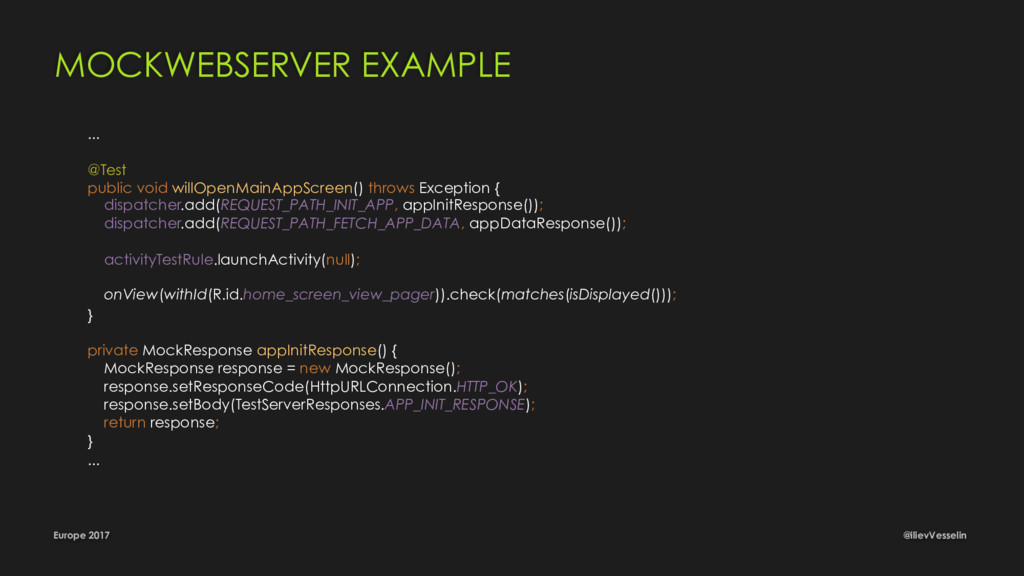
  18. @ilievVesselin Europe 2017 MOCKWEBSERVER EXAMPLE ... 
 @Test
 public void

    willOpenMainAppScreen() throws Exception { 
 
 }
 
 ... dispatcher.add(REQUEST_PATH_INIT_APP, appInitResponse());
 dispatcher.add(REQUEST_PATH_FETCH_APP_DATA, appDataResponse()); 
 private MockResponse appInitResponse() {
 MockResponse response = new MockResponse();
 response.setResponseCode(HttpURLConnection.HTTP_OK);
 response.setBody(TestServerResponses.APP_INIT_RESPONSE);
 return response;
 } activityTestRule.launchActivity(null); onView(withId(R.id.home_screen_view_pager)).check(matches(isDisplayed()));
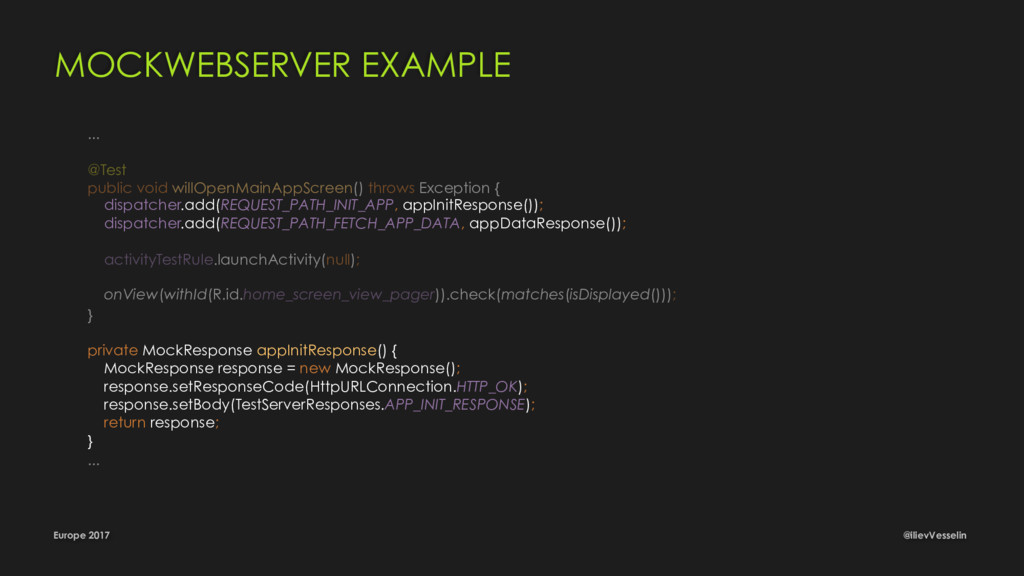
  19. @ilievVesselin Europe 2017 MOCKWEBSERVER EXAMPLE ... 
 @Test
 public void

    willOpenMainAppScreen() throws Exception { 
 
 }
 
 ... dispatcher.add(REQUEST_PATH_INIT_APP, appInitResponse());
 dispatcher.add(REQUEST_PATH_FETCH_APP_DATA, appDataResponse()); 
 private MockResponse appInitResponse() {
 MockResponse response = new MockResponse();
 response.setResponseCode(HttpURLConnection.HTTP_OK);
 response.setBody(TestServerResponses.APP_INIT_RESPONSE);
 return response;
 } activityTestRule.launchActivity(null); onView(withId(R.id.home_screen_view_pager)).check(matches(isDisplayed()));
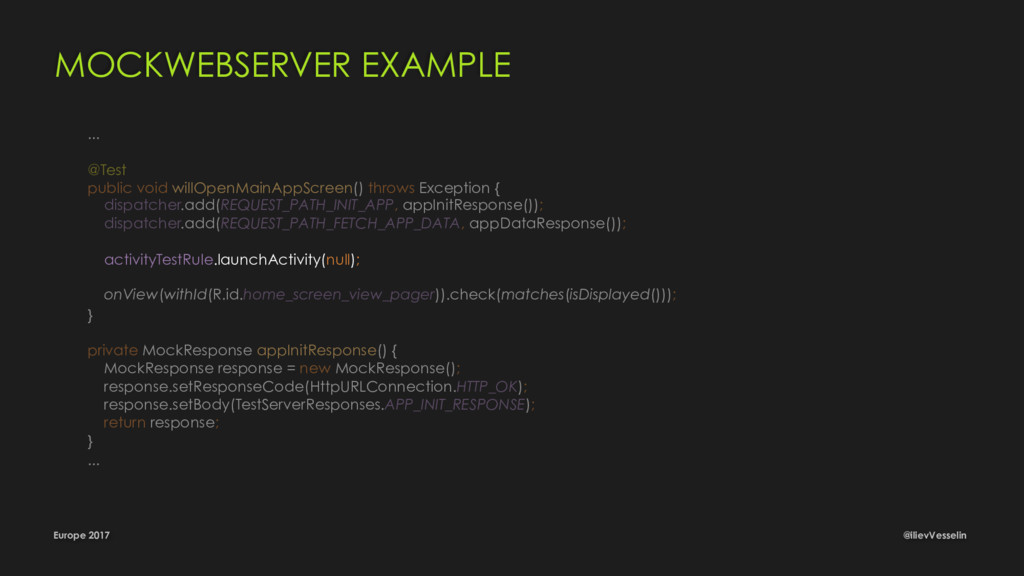
  20. @ilievVesselin Europe 2017 MOCKWEBSERVER EXAMPLE ... 
 @Test
 public void

    willOpenMainAppScreen() throws Exception { 
 
 }
 
 ... dispatcher.add(REQUEST_PATH_INIT_APP, appInitResponse());
 dispatcher.add(REQUEST_PATH_FETCH_APP_DATA, appDataResponse()); 
 private MockResponse appInitResponse() {
 MockResponse response = new MockResponse();
 response.setResponseCode(HttpURLConnection.HTTP_OK);
 response.setBody(TestServerResponses.APP_INIT_RESPONSE);
 return response;
 } activityTestRule.launchActivity(null); onView(withId(R.id.home_screen_view_pager)).check(matches(isDisplayed()));
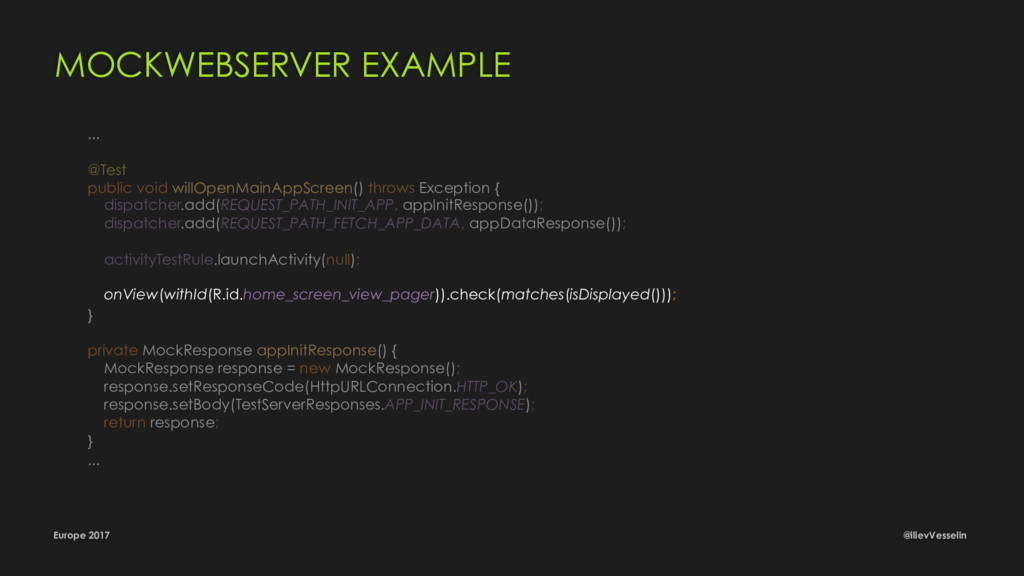
  21. @ilievVesselin Europe 2017 MOCKWEBSERVER EXAMPLE ... 
 @Test
 public void

    willOpenMainAppScreen() throws Exception { 
 
 }
 
 ... dispatcher.add(REQUEST_PATH_INIT_APP, appInitResponse());
 dispatcher.add(REQUEST_PATH_FETCH_APP_DATA, appDataResponse()); 
 private MockResponse appInitResponse() {
 MockResponse response = new MockResponse();
 response.setResponseCode(HttpURLConnection.HTTP_OK);
 response.setBody(TestServerResponses.APP_INIT_RESPONSE);
 return response;
 } activityTestRule.launchActivity(null); onView(withId(R.id.home_screen_view_pager)).check(matches(isDisplayed()));
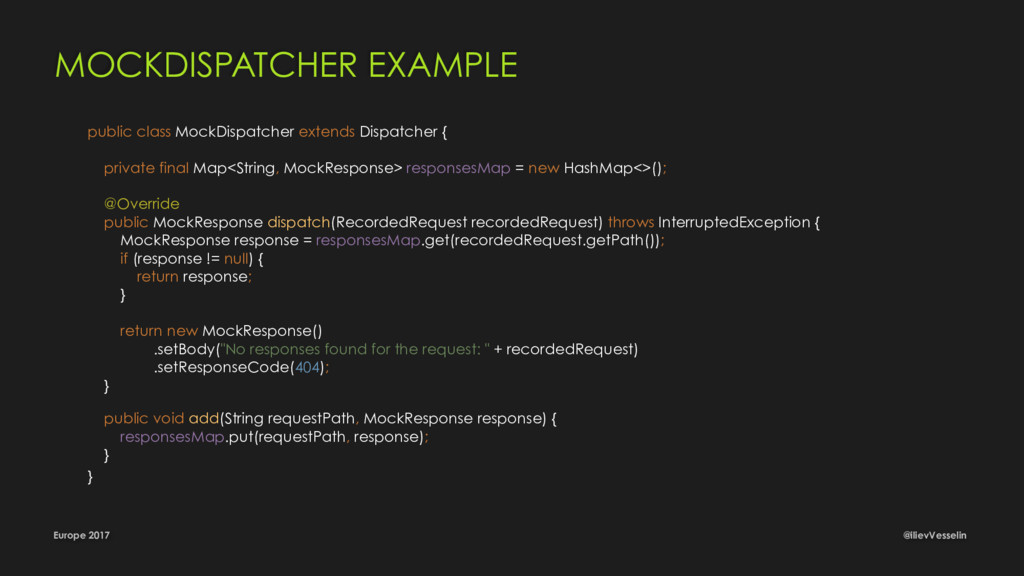
  22. @ilievVesselin Europe 2017 MOCKDISPATCHER EXAMPLE private final Map<String, MockResponse> responsesMap

    = new HashMap<>(); public class MockDispatcher extends Dispatcher { } @Override
 public MockResponse dispatch(RecordedRequest recordedRequest) throws InterruptedException {
 MockResponse response = responsesMap.get(recordedRequest.getPath());
 if (response != null) {
 return response;
 }
 
 return new MockResponse()
 .setBody("No responses found for the request: " + recordedRequest)
 .setResponseCode(404);
 } 
 public void add(String requestPath, MockResponse response) {
 responsesMap.put(requestPath, response);
 }
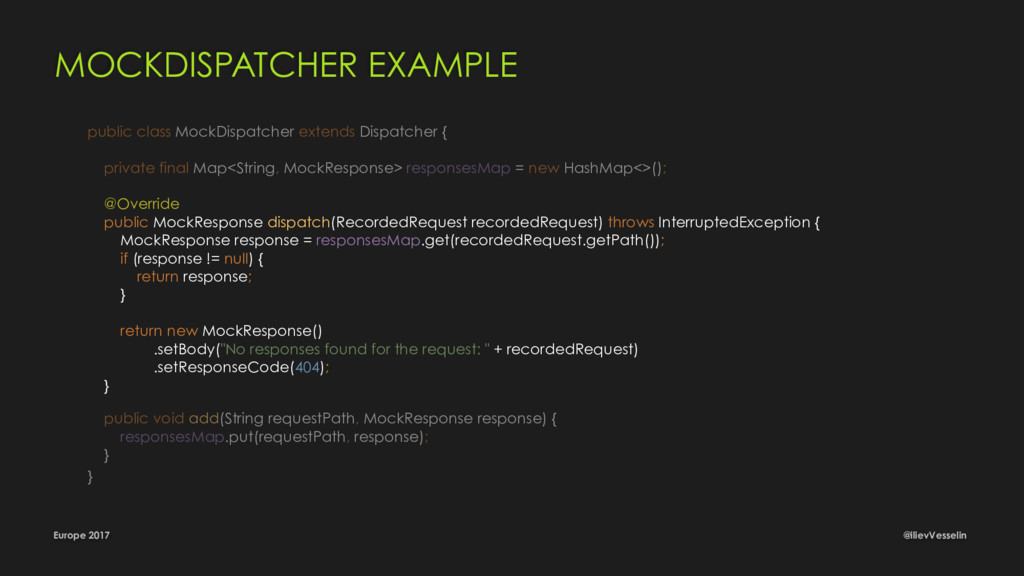
  23. @ilievVesselin Europe 2017 MOCKDISPATCHER EXAMPLE private final Map<String, MockResponse> responsesMap

    = new HashMap<>(); public class MockDispatcher extends Dispatcher { } @Override
 public MockResponse dispatch(RecordedRequest recordedRequest) throws InterruptedException {
 MockResponse response = responsesMap.get(recordedRequest.getPath());
 if (response != null) {
 return response;
 }
 
 return new MockResponse()
 .setBody("No responses found for the request: " + recordedRequest)
 .setResponseCode(404);
 } 
 public void add(String requestPath, MockResponse response) {
 responsesMap.put(requestPath, response);
 }
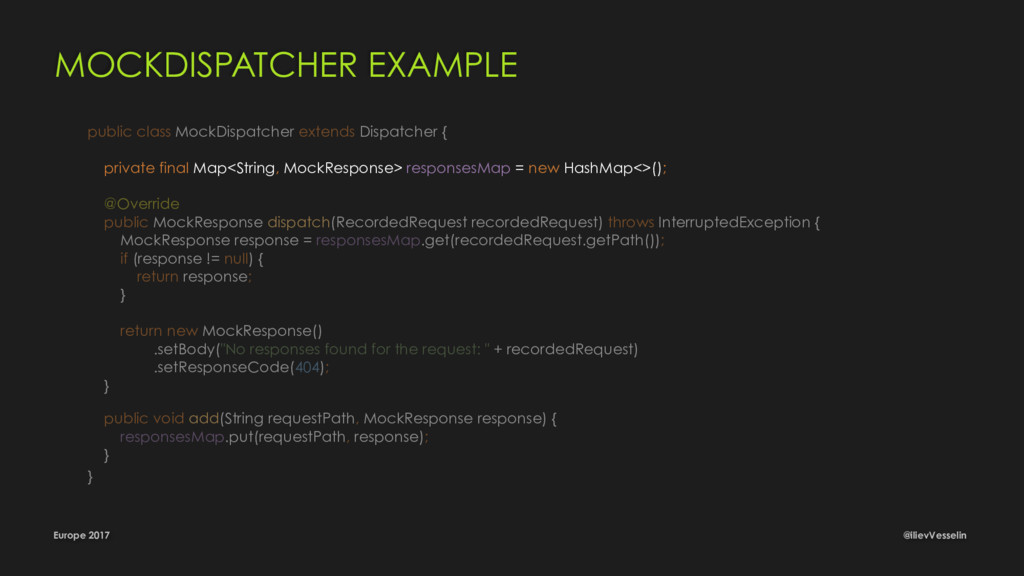
  24. @ilievVesselin Europe 2017 MOCKDISPATCHER EXAMPLE private final Map<String, MockResponse> responsesMap

    = new HashMap<>(); public class MockDispatcher extends Dispatcher { } @Override
 public MockResponse dispatch(RecordedRequest recordedRequest) throws InterruptedException {
 MockResponse response = responsesMap.get(recordedRequest.getPath());
 if (response != null) {
 return response;
 }
 
 return new MockResponse()
 .setBody("No responses found for the request: " + recordedRequest)
 .setResponseCode(404);
 } 
 public void add(String requestPath, MockResponse response) {
 responsesMap.put(requestPath, response);
 }
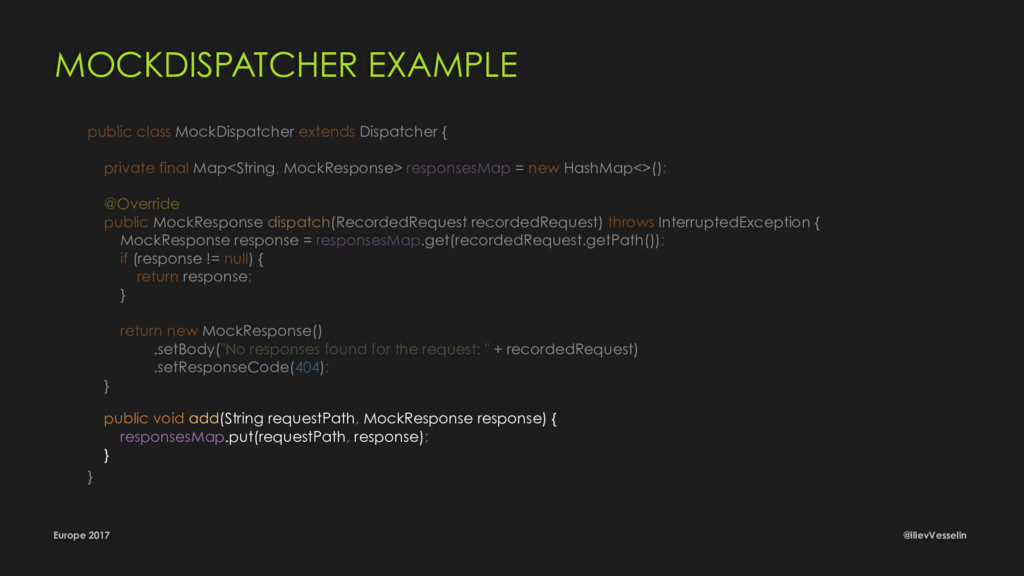
  25. @ilievVesselin Europe 2017 MOCKDISPATCHER EXAMPLE private final Map<String, MockResponse> responsesMap

    = new HashMap<>(); public class MockDispatcher extends Dispatcher { } @Override
 public MockResponse dispatch(RecordedRequest recordedRequest) throws InterruptedException {
 MockResponse response = responsesMap.get(recordedRequest.getPath());
 if (response != null) {
 return response;
 }
 
 return new MockResponse()
 .setBody("No responses found for the request: " + recordedRequest)
 .setResponseCode(404);
 } 
 public void add(String requestPath, MockResponse response) {
 responsesMap.put(requestPath, response);
 }
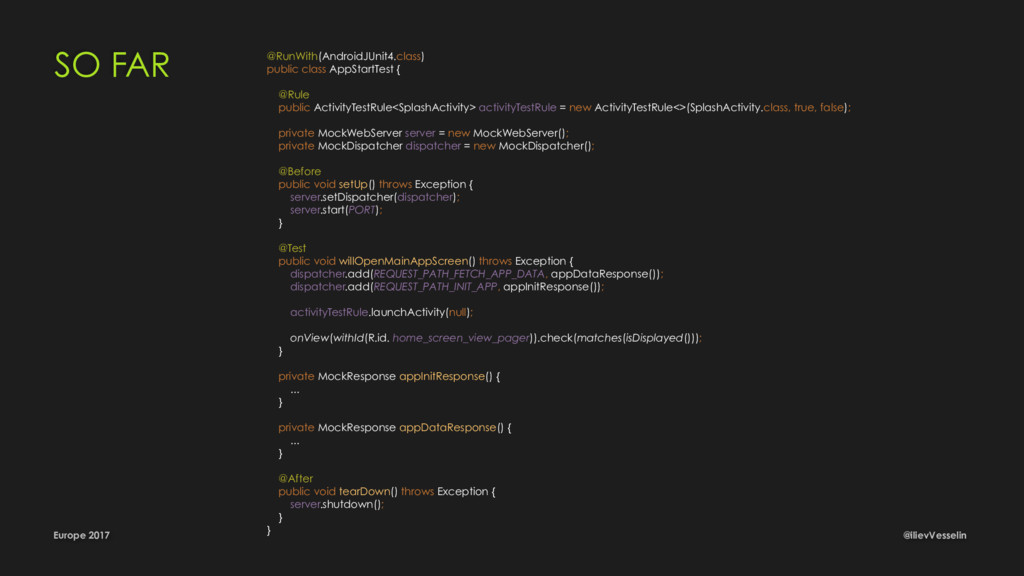
  26. @ilievVesselin Europe 2017 SO FAR @RunWith(AndroidJUnit4.class)
 public class AppStartTest {


 @Rule
 public ActivityTestRule<SplashActivity> activityTestRule = new ActivityTestRule<>(SplashActivity.class, true, false);
 
 private MockWebServer server = new MockWebServer(); private MockDispatcher dispatcher = new MockDispatcher(); 
 @Before
 public void setUp() throws Exception {
 server.setDispatcher(dispatcher);
 server.start(PORT);
 }
 
 @Test
 public void willOpenMainAppScreen() throws Exception {
 dispatcher.add(REQUEST_PATH_FETCH_APP_DATA, appDataResponse());
 dispatcher.add(REQUEST_PATH_INIT_APP, appInitResponse());
 
 activityTestRule.launchActivity(null);
 
 onView(withId(R.id. home_screen_view_pager)).check(matches(isDisplayed()));
 }
 
 private MockResponse appInitResponse() {
 ...
 }
 
 private MockResponse appDataResponse() {
 ...
 }
 
 @After
 public void tearDown() throws Exception {
 server.shutdown();
 }
 }
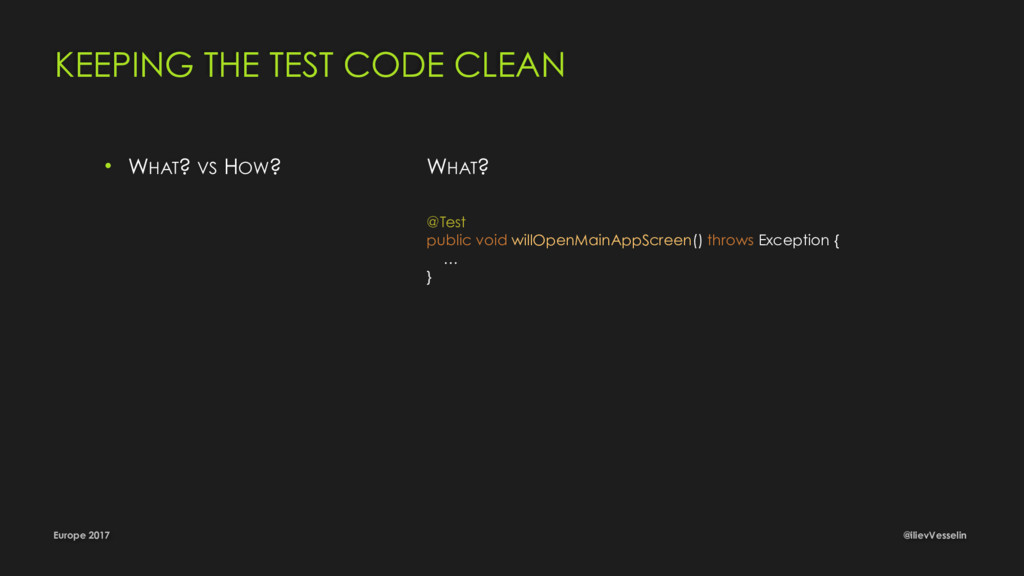
  27. @ilievVesselin Europe 2017 KEEPING THE TEST CODE CLEAN • WHAT?

    VS HOW? @Test
 public void willOpenMainAppScreen() throws Exception { … } WHAT?
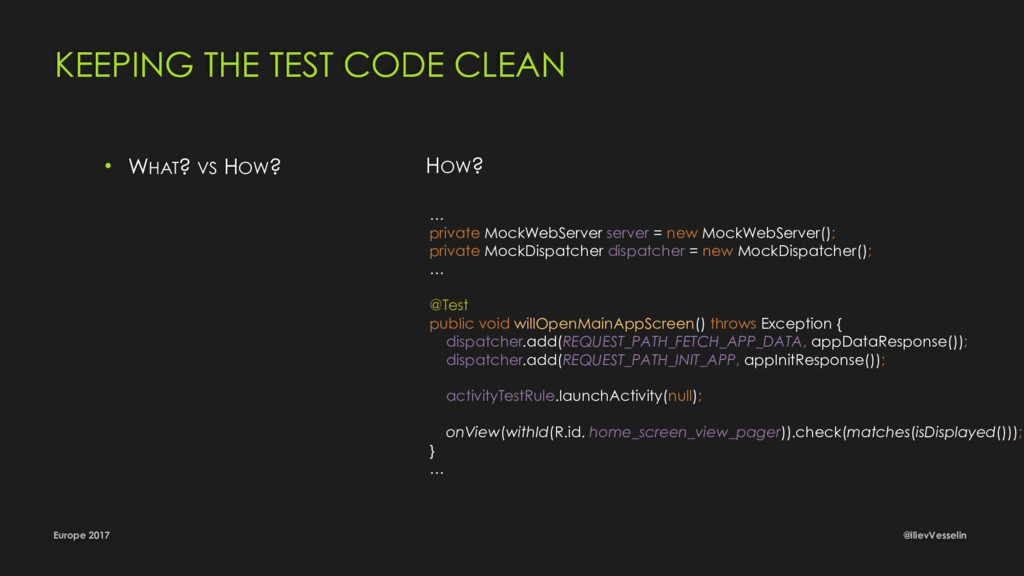
  28. @ilievVesselin Europe 2017 KEEPING THE TEST CODE CLEAN • WHAT?

    VS HOW? … private MockWebServer server = new MockWebServer(); private MockDispatcher dispatcher = new MockDispatcher(); …
 
 @Test
 public void willOpenMainAppScreen() throws Exception {
 dispatcher.add(REQUEST_PATH_FETCH_APP_DATA, appDataResponse());
 dispatcher.add(REQUEST_PATH_INIT_APP, appInitResponse());
 
 activityTestRule.launchActivity(null);
 
 onView(withId(R.id. home_screen_view_pager)).check(matches(isDisplayed()));
 } … HOW?
  29. @ilievVesselin Europe 2017 KEEPING THE TEST CODE CLEAN • WHAT?

    VS HOW? • EXPRESS BEHAVIOR IN THE TESTS
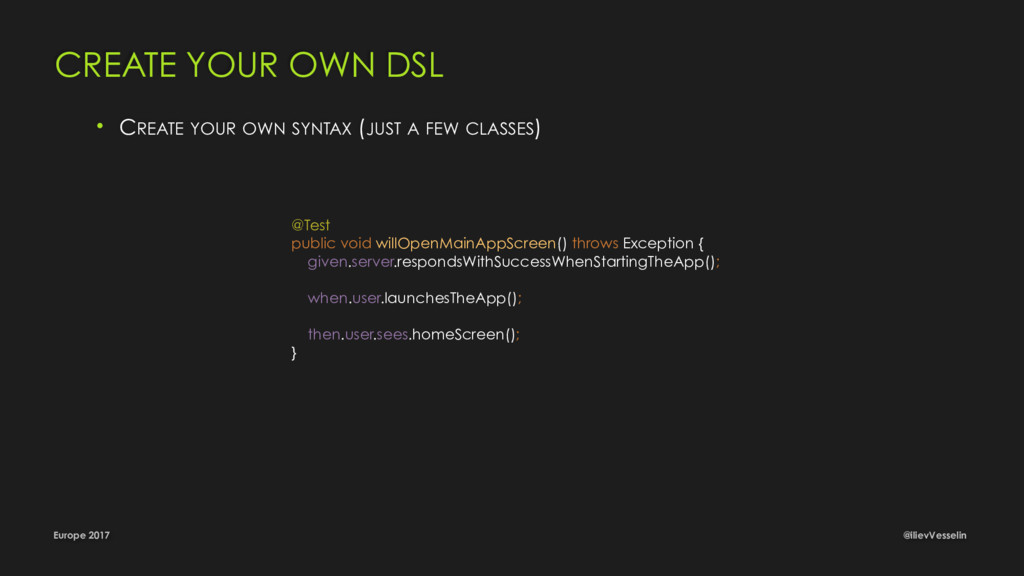
  30. @ilievVesselin Europe 2017 CREATE YOUR OWN DSL • CREATE YOUR

    OWN SYNTAX (JUST A FEW CLASSES) @Test
 public void willOpenMainAppScreen() throws Exception {
 given.server.respondsWithSuccessWhenStartingTheApp();
 
 when.user.launchesTheApp();
 
 then.user.sees.homeScreen();
 }
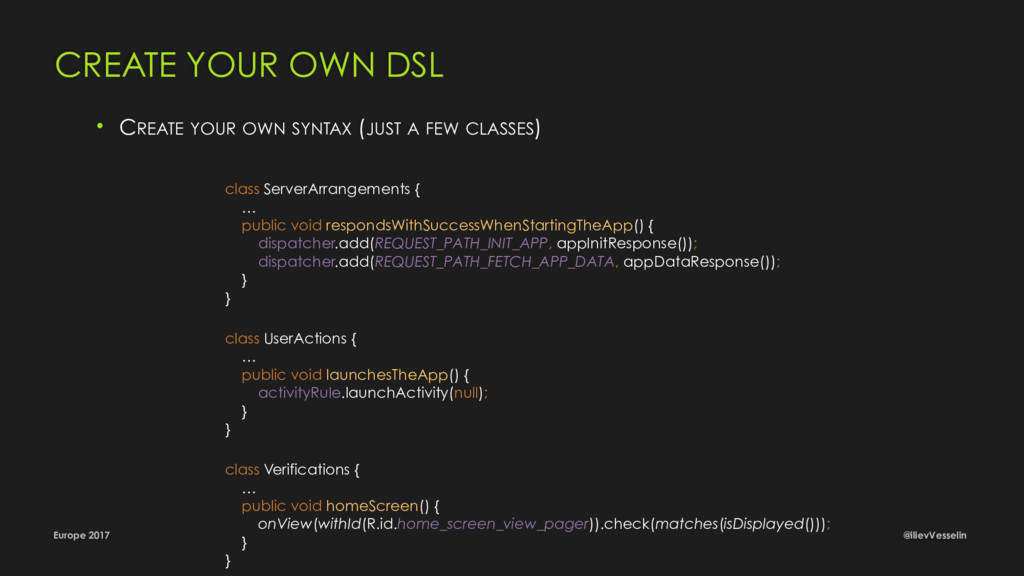
  31. @ilievVesselin Europe 2017 CREATE YOUR OWN DSL • CREATE YOUR

    OWN SYNTAX (JUST A FEW CLASSES) class ServerArrangements { … public void respondsWithSuccessWhenStartingTheApp() {
 dispatcher.add(REQUEST_PATH_INIT_APP, appInitResponse());
 dispatcher.add(REQUEST_PATH_FETCH_APP_DATA, appDataResponse()); } } class UserActions { … public void launchesTheApp() {
 activityRule.launchActivity(null);
 } } class Verifications { … public void homeScreen() {
 onView(withId(R.id.home_screen_view_pager)).check(matches(isDisplayed())); } }
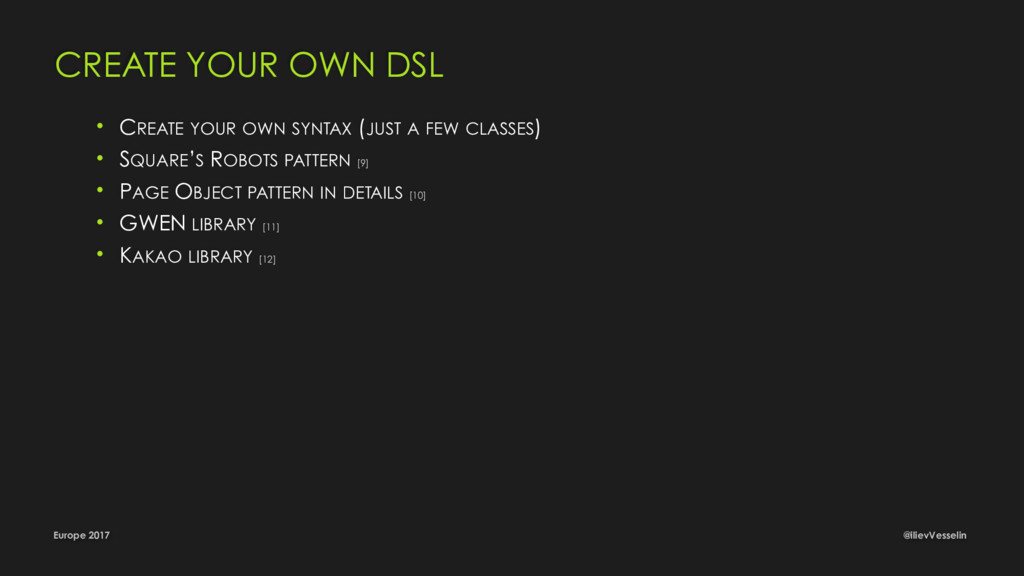
  32. @ilievVesselin Europe 2017 CREATE YOUR OWN DSL • CREATE YOUR

    OWN SYNTAX (JUST A FEW CLASSES) • SQUARE’S ROBOTS PATTERN [9] • PAGE OBJECT PATTERN IN DETAILS [10] • GWEN LIBRARY [11] • KAKAO LIBRARY [12]
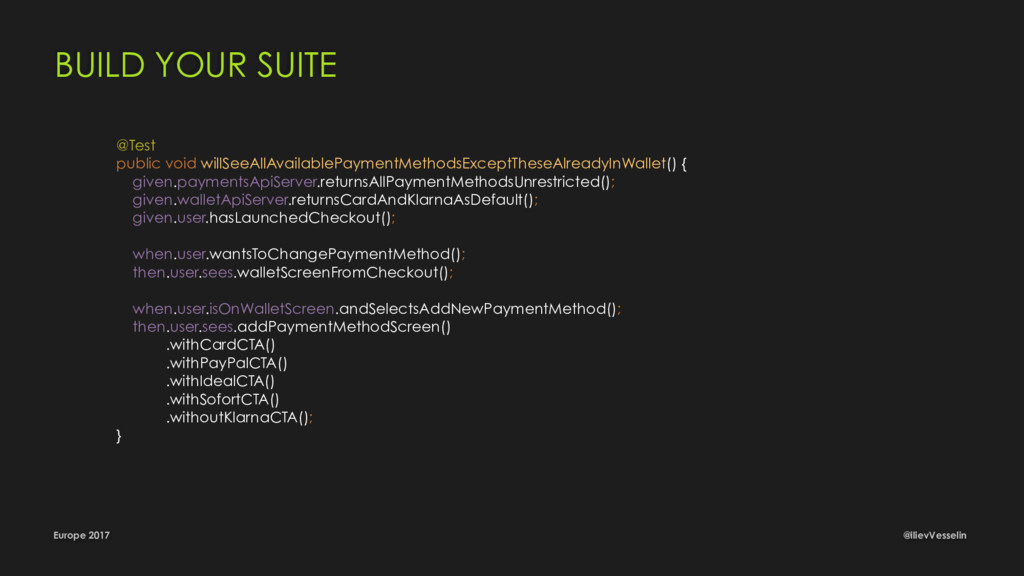
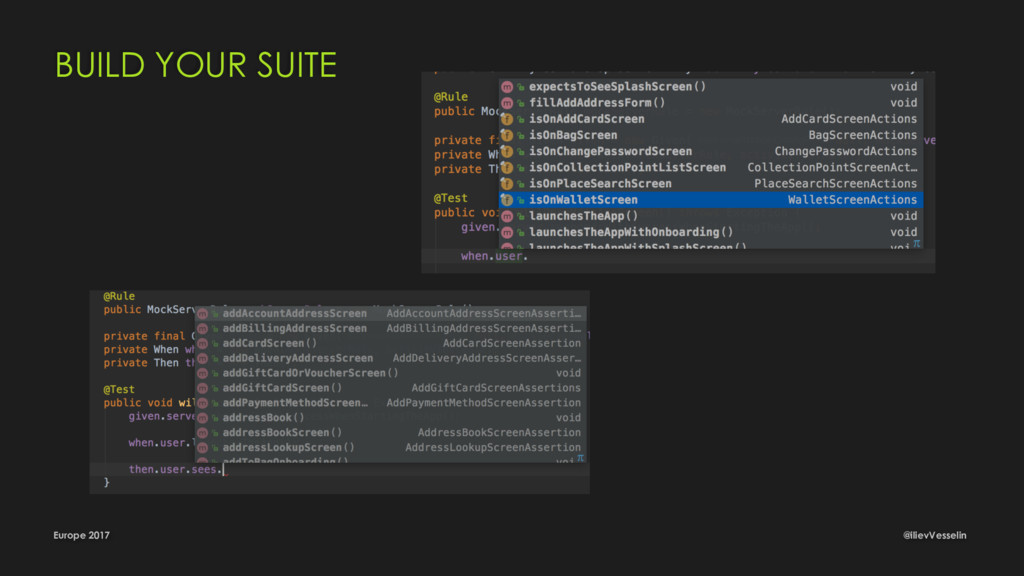
  33. @ilievVesselin Europe 2017 BUILD YOUR SUITE @Test
 public void willSeeAllAvailablePaymentMethodsExceptTheseAlreadyInWallet()

    {
 given.paymentsApiServer.returnsAllPaymentMethodsUnrestricted();
 given.walletApiServer.returnsCardAndKlarnaAsDefault();
 given.user.hasLaunchedCheckout();
 
 when.user.wantsToChangePaymentMethod();
 then.user.sees.walletScreenFromCheckout();
 
 when.user.isOnWalletScreen.andSelectsAddNewPaymentMethod();
 then.user.sees.addPaymentMethodScreen()
 .withCardCTA()
 .withPayPalCTA()
 .withIdealCTA()
 .withSofortCTA()
 .withoutKlarnaCTA();
 }
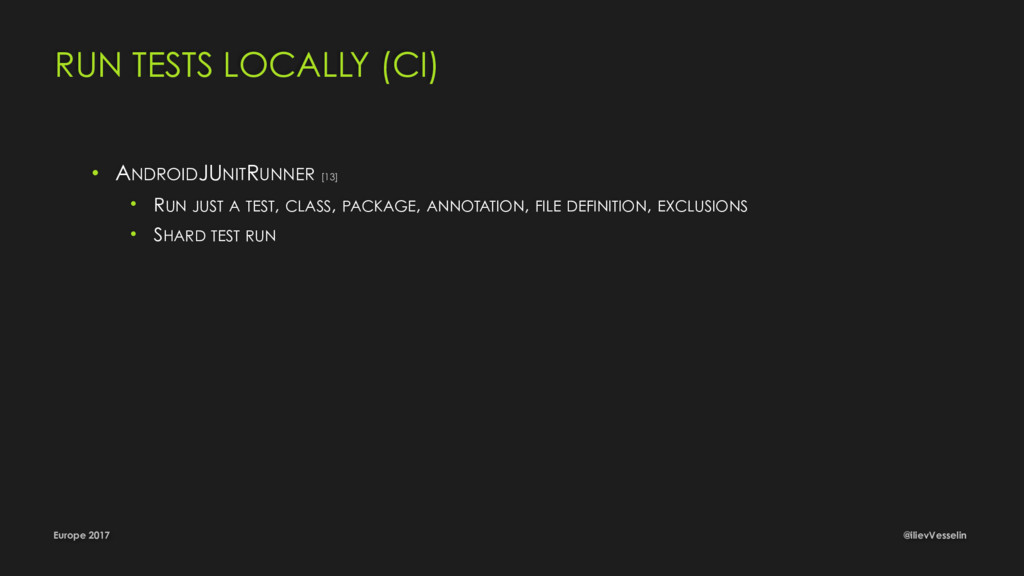
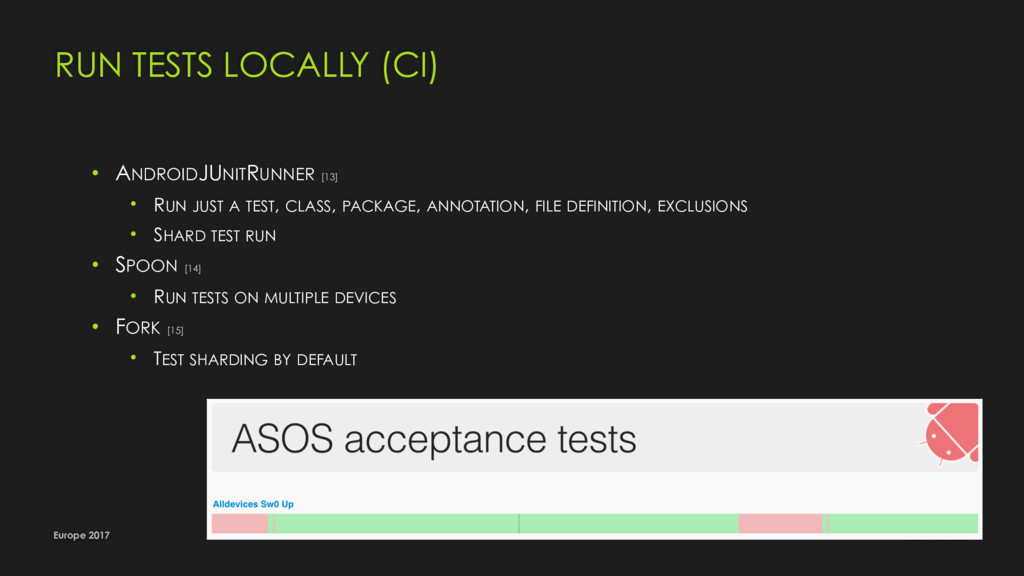
  34. @ilievVesselin Europe 2017 RUN TESTS LOCALLY (CI) • ANDROIDJUNITRUNNER [13]

    • RUN JUST A TEST, CLASS, PACKAGE, ANNOTATION, FILE DEFINITION, EXCLUSIONS • SHARD TEST RUN
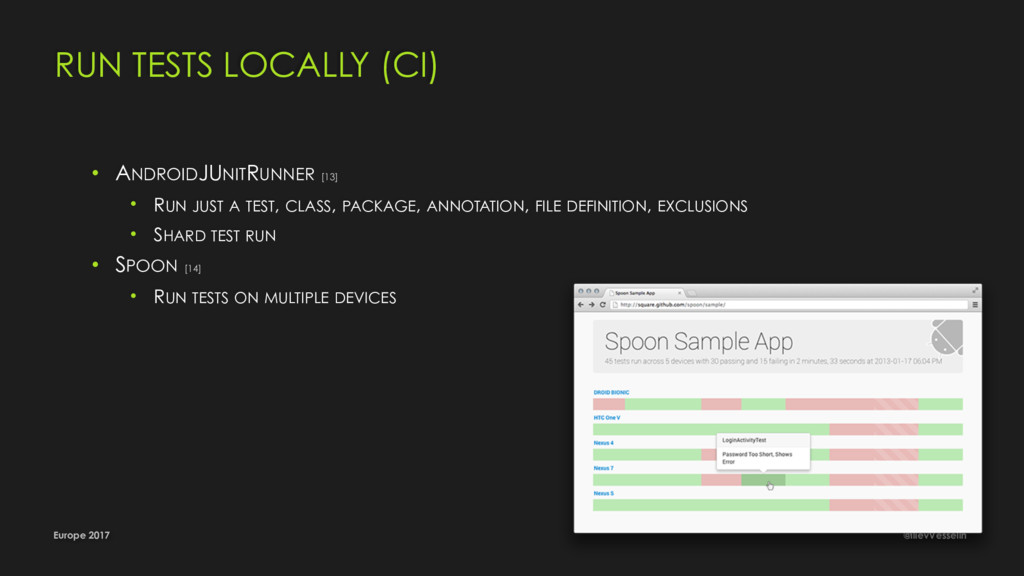
  35. @ilievVesselin Europe 2017 RUN TESTS LOCALLY (CI) • ANDROIDJUNITRUNNER [13]

    • RUN JUST A TEST, CLASS, PACKAGE, ANNOTATION, FILE DEFINITION, EXCLUSIONS • SHARD TEST RUN • SPOON [14] • RUN TESTS ON MULTIPLE DEVICES
  36. @ilievVesselin Europe 2017 RUN TESTS LOCALLY (CI) • ANDROIDJUNITRUNNER [13]

    • RUN JUST A TEST, CLASS, PACKAGE, ANNOTATION, FILE DEFINITION, EXCLUSIONS • SHARD TEST RUN • SPOON [14] • RUN TESTS ON MULTIPLE DEVICES • FORK [15] • TEST SHARDING BY DEFAULT
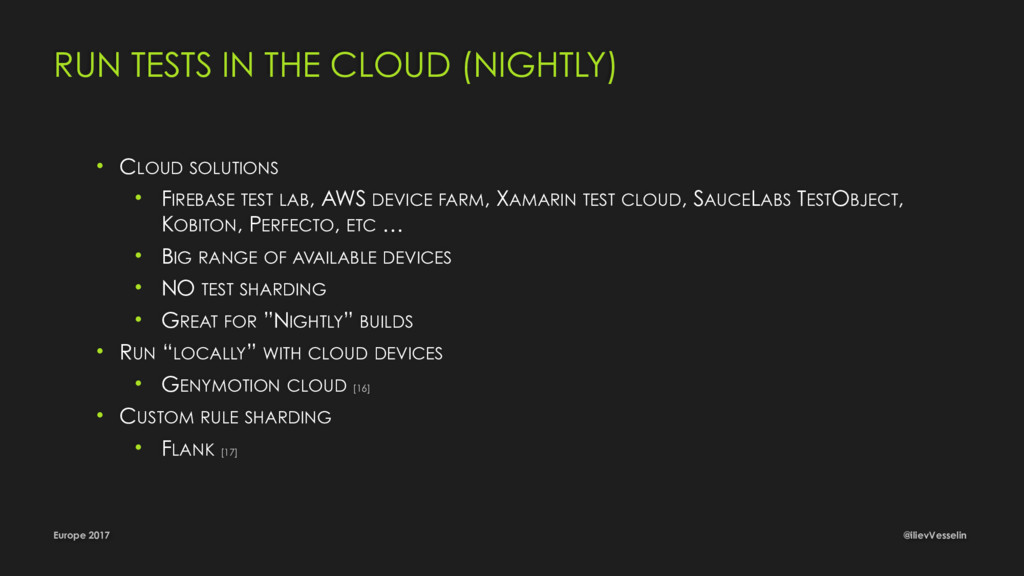
  37. @ilievVesselin Europe 2017 • CLOUD SOLUTIONS • FIREBASE TEST LAB,

    AWS DEVICE FARM, XAMARIN TEST CLOUD, SAUCELABS TESTOBJECT, KOBITON, PERFECTO, ETC … • BIG RANGE OF AVAILABLE DEVICES • NO TEST SHARDING • GREAT FOR ”NIGHTLY” BUILDS • RUN “LOCALLY” WITH CLOUD DEVICES • GENYMOTION CLOUD [16] • CUSTOM RULE SHARDING • FLANK [17] RUN TESTS IN THE CLOUD (NIGHTLY)
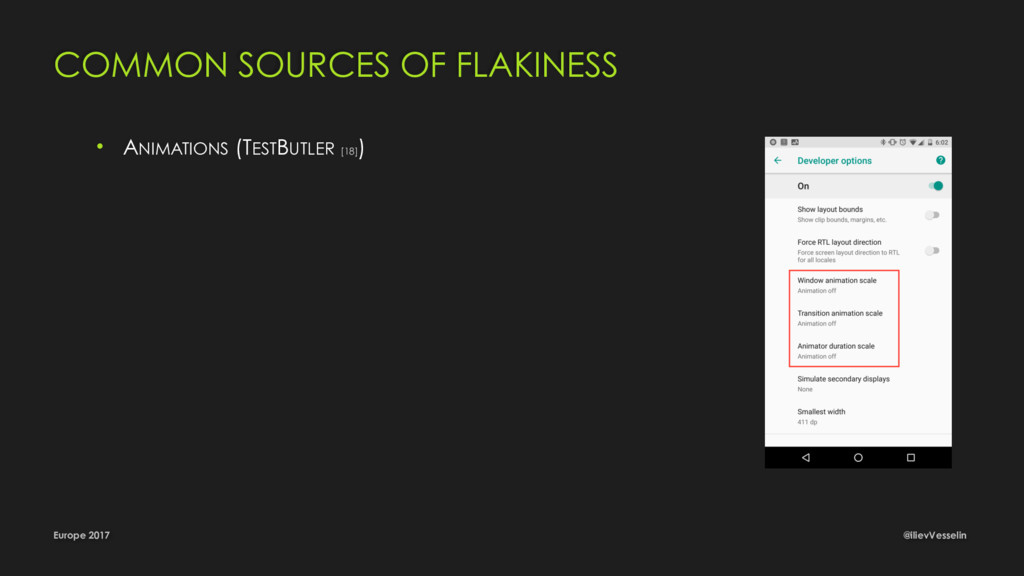
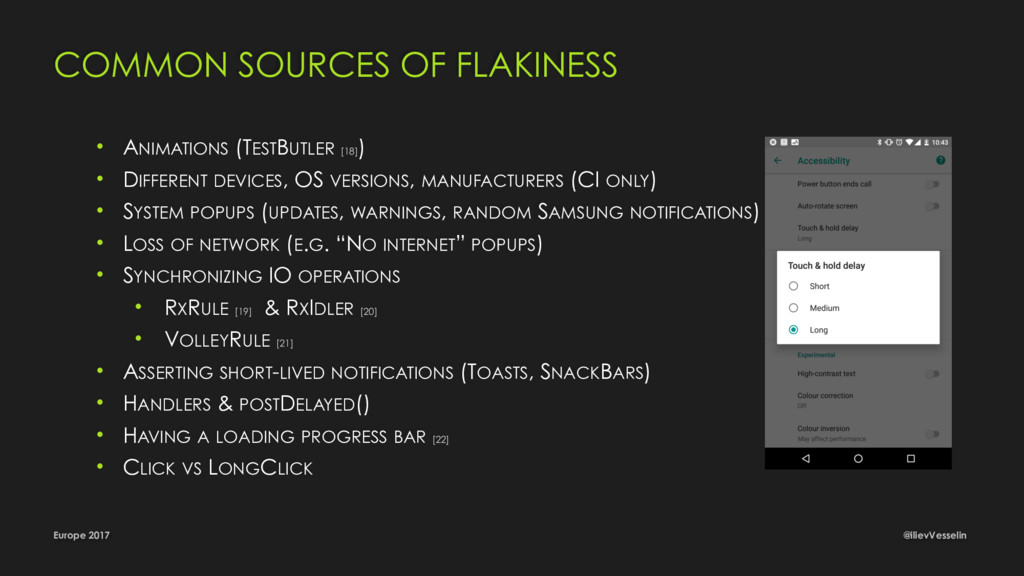
  38. @ilievVesselin Europe 2017 • ANIMATIONS (TESTBUTLER [18] ) • DIFFERENT

    DEVICES, OS VERSIONS, MANUFACTURERS (CI ONLY) • SYSTEM POPUPS (UPDATES, WARNINGS, RANDOM SAMSUNG NOTIFICATIONS) • LOSS OF NETWORK (E.G. “NO INTERNET” POPUPS) • SYNCHRONIZING IO OPERATIONS • RXRULE [19] & RXIDLER [20] • VOLLEYRULE [21] • ASSERTING SHORT-LIVED NOTIFICATIONS (TOASTS, SNACKBARS) • HANDLERS & POSTDELAYED() • HAVING A LOADING PROGRESS BAR [22] COMMON SOURCES OF FLAKINESS
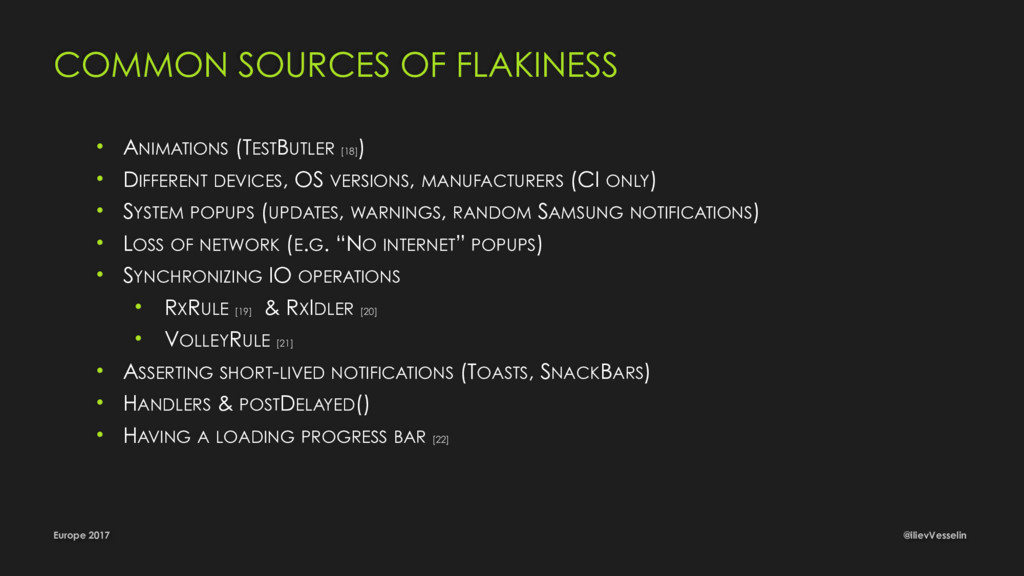
  39. @ilievVesselin Europe 2017 • ANIMATIONS (TESTBUTLER [18] ) • DIFFERENT

    DEVICES, OS VERSIONS, MANUFACTURERS (CI ONLY) • SYSTEM POPUPS (UPDATES, WARNINGS, RANDOM SAMSUNG NOTIFICATIONS) • LOSS OF NETWORK (E.G. “NO INTERNET” POPUPS) • SYNCHRONIZING IO OPERATIONS • RXRULE [19] & RXIDLER [20] • VOLLEYRULE [21] • ASSERTING SHORT-LIVED NOTIFICATIONS (TOASTS, SNACKBARS) • HANDLERS & POSTDELAYED() • HAVING A LOADING PROGRESS BAR [22] • CLICK VS LONGCLICK COMMON SOURCES OF FLAKINESS
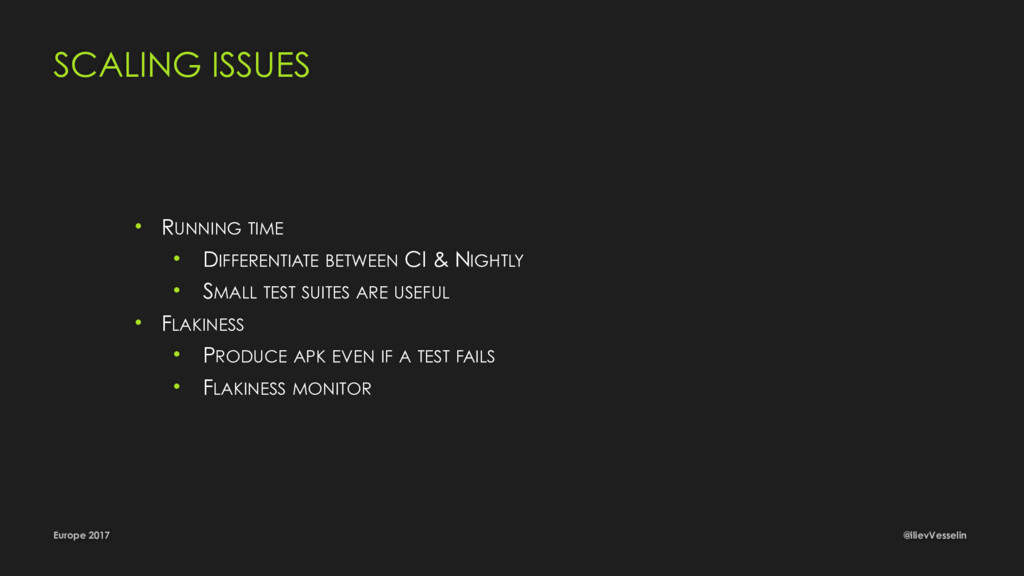
  40. @ilievVesselin Europe 2017 • RUNNING TIME • DIFFERENTIATE BETWEEN CI

    & NIGHTLY • SMALL TEST SUITES ARE USEFUL • FLAKINESS • PRODUCE APK EVEN IF A TEST FAILS • FLAKINESS MONITOR SCALING ISSUES
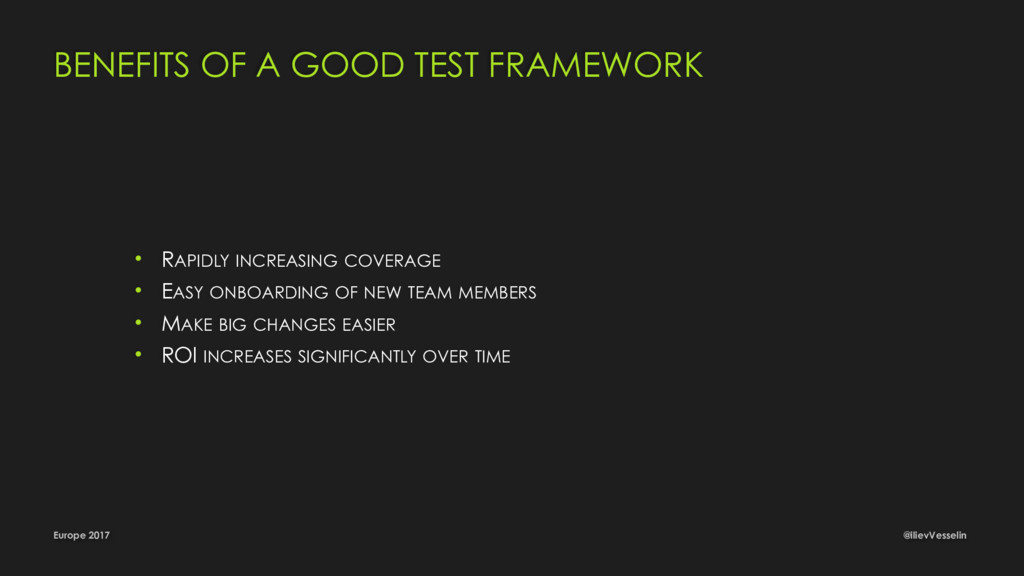
  41. @ilievVesselin Europe 2017 • RAPIDLY INCREASING COVERAGE • EASY ONBOARDING

    OF NEW TEAM MEMBERS • MAKE BIG CHANGES EASIER • ROI INCREASES SIGNIFICANTLY OVER TIME BENEFITS OF A GOOD TEST FRAMEWORK
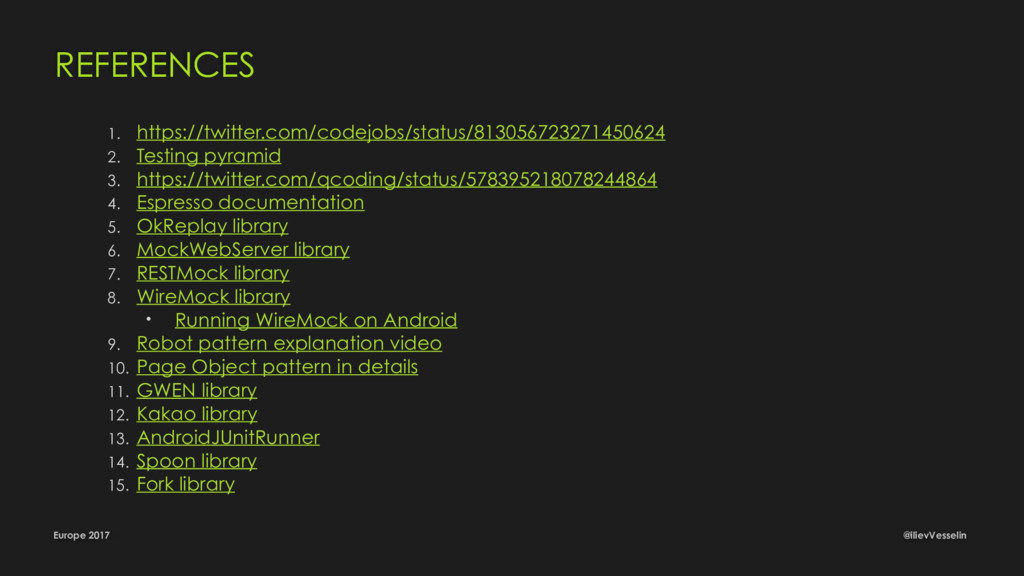
  42. @ilievVesselin Europe 2017 REFERENCES 1. https://twitter.com/codejobs/status/813056723271450624 2. Testing pyramid 3.

    https://twitter.com/qcoding/status/578395218078244864 4. Espresso documentation 5. OkReplay library 6. MockWebServer library 7. RESTMock library 8. WireMock library • Running WireMock on Android 9. Robot pattern explanation video 10. Page Object pattern in details 11. GWEN library 12. Kakao library 13. AndroidJUnitRunner 14. Spoon library 15. Fork library
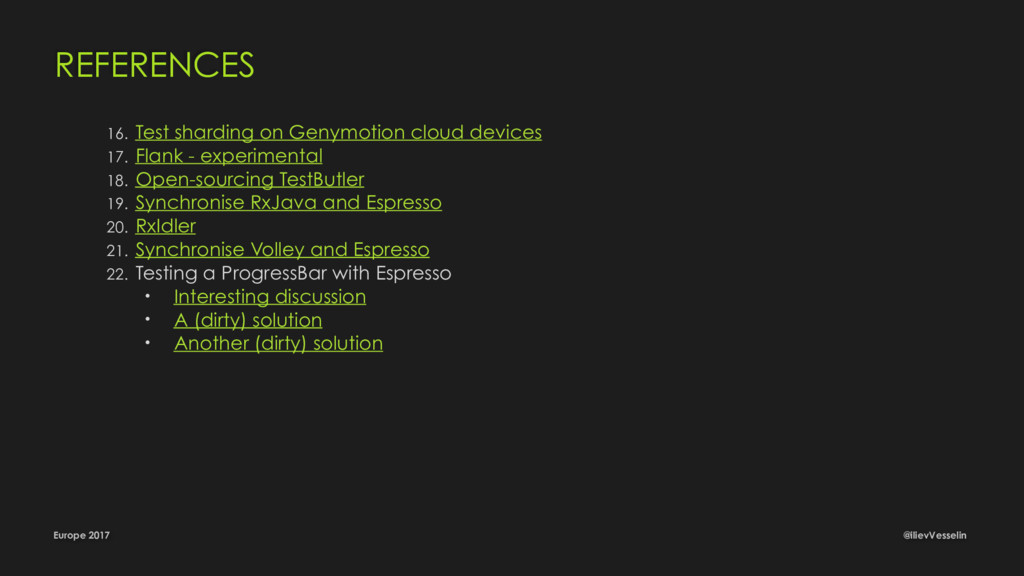
  43. @ilievVesselin Europe 2017 REFERENCES 16. Test sharding on Genymotion cloud

    devices 17. Flank - experimental 18. Open-sourcing TestButler 19. Synchronise RxJava and Espresso 20. RxIdler 21. Synchronise Volley and Espresso 22. Testing a ProgressBar with Espresso • Interesting discussion • A (dirty) solution • Another (dirty) solution