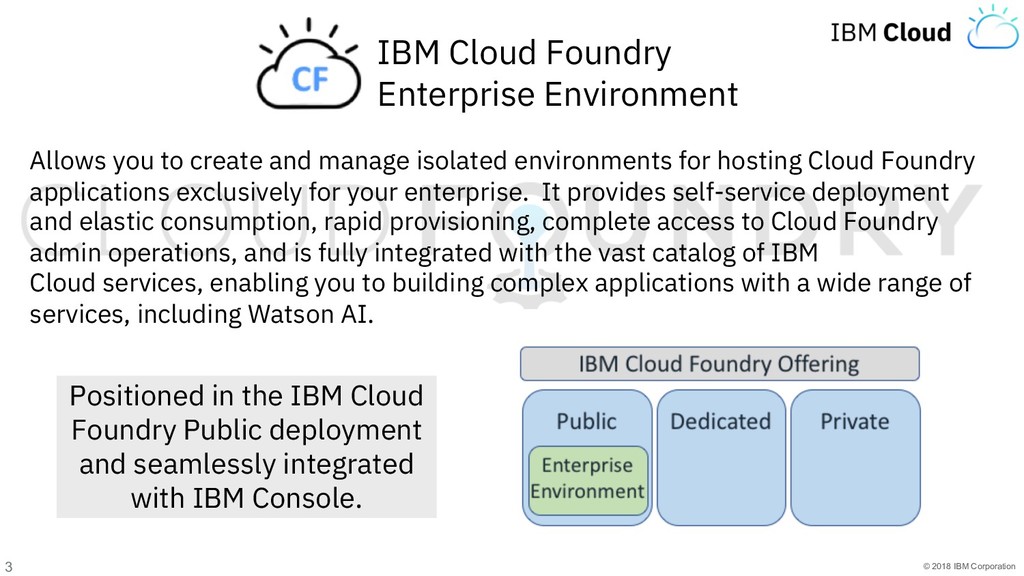
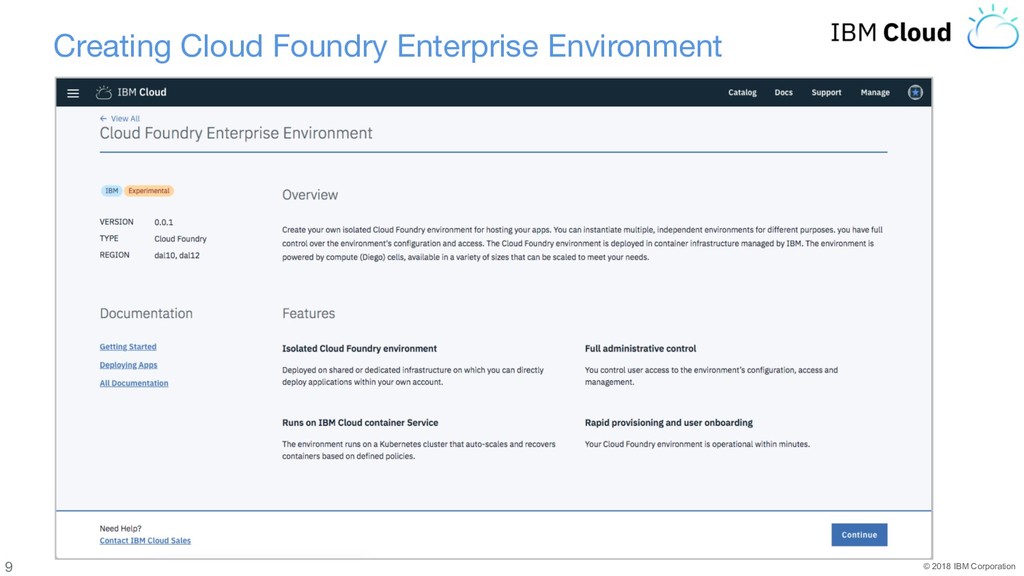
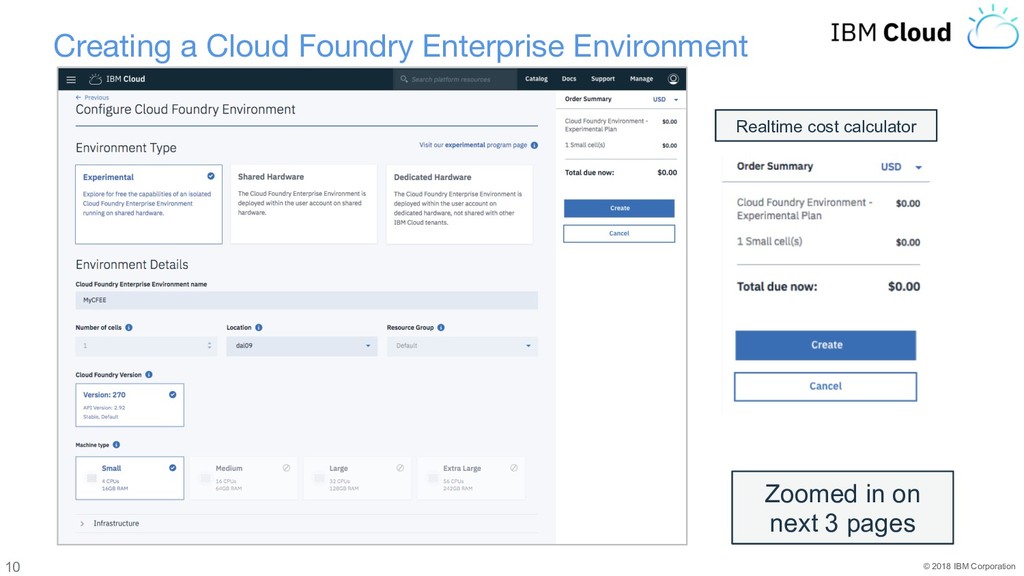
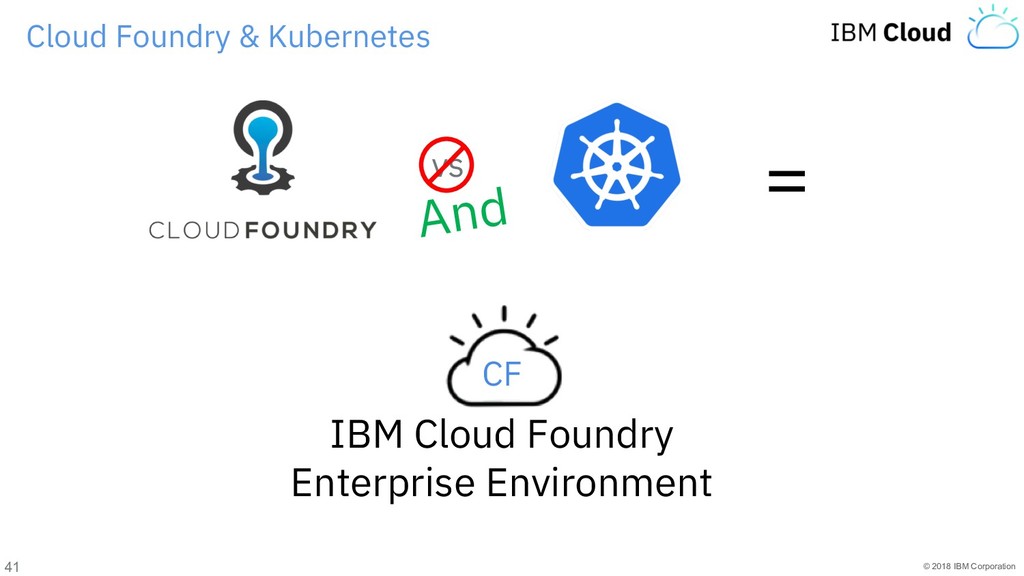
Allows you to create and manage isolated environments for hosting Cloud Foundry applications exclusively for your enterprise. It provides self-service deployment and elastic consumption, rapid provisioning, complete access to Cloud Foundry admin operations, and is fully integrated with the vast catalog of IBM Cloud services, enabling you to building complex applications with a wide range of services, including Watson AI. Positioned in the IBM Cloud Foundry Public deployment and seamlessly integrated with IBM Console.
of offering dedicated Cloud Foundry • Provide a tenant-specific Cloud Foundry environment with optional hardware isolation • Deployable through self-service and rapidly available • Provide complete administrative control over Cloud Foundry • Provision and scale on-demand • Instances are deployed on Kubernetes clusters in an infrastructure account • Simplified and consistent user experience with the IBM Cloud platform IBM Cloud Foundry Enterprise Environment Built on IBM Kubernetes Service
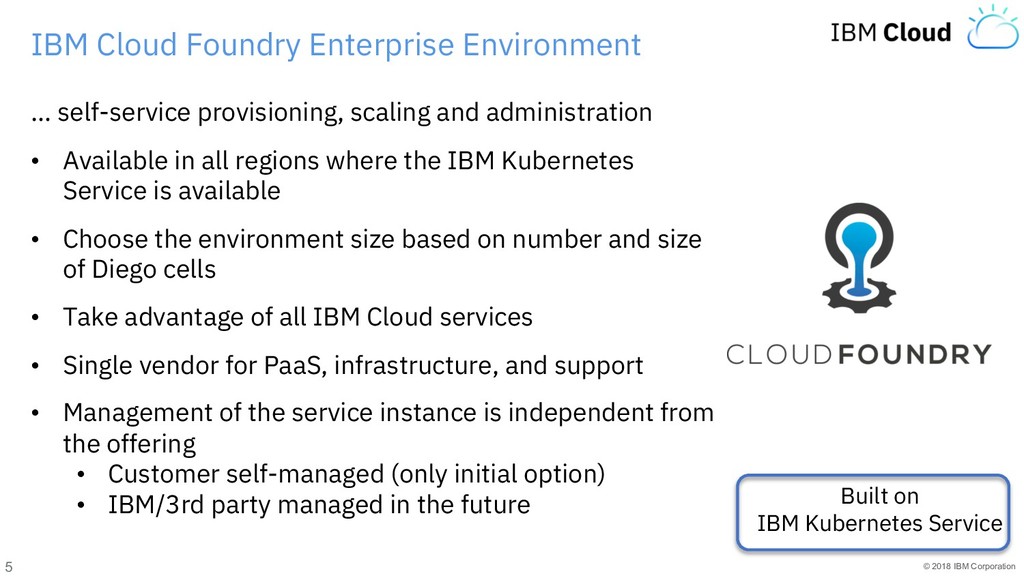
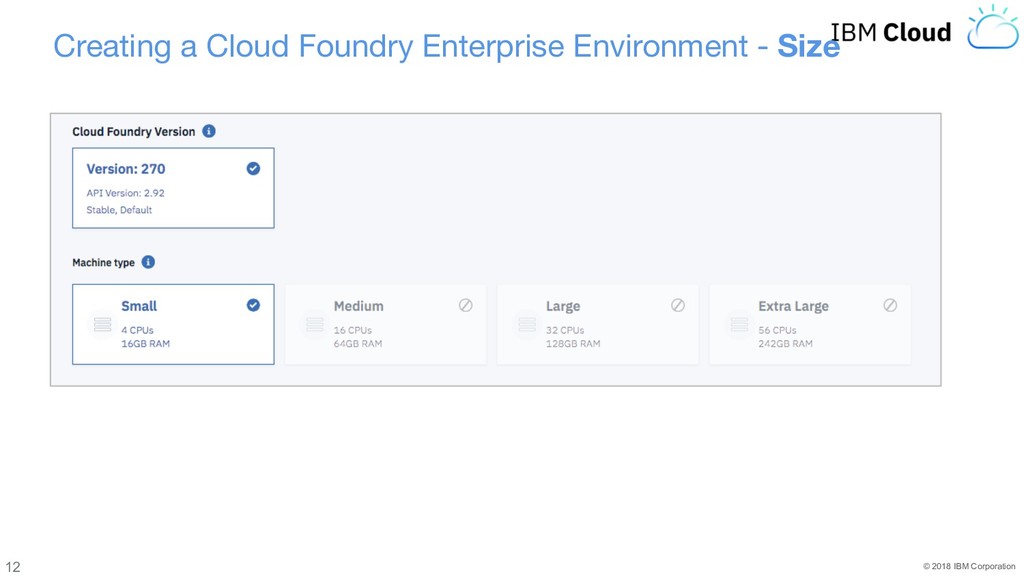
administration • Available in all regions where the IBM Kubernetes Service is available • Choose the environment size based on number and size of Diego cells • Take advantage of all IBM Cloud services • Single vendor for PaaS, infrastructure, and support • Management of the service instance is independent from the offering • Customer self-managed (only initial option) • IBM/3rd party managed in the future IBM Cloud Foundry Enterprise Environment Built on IBM Kubernetes Service
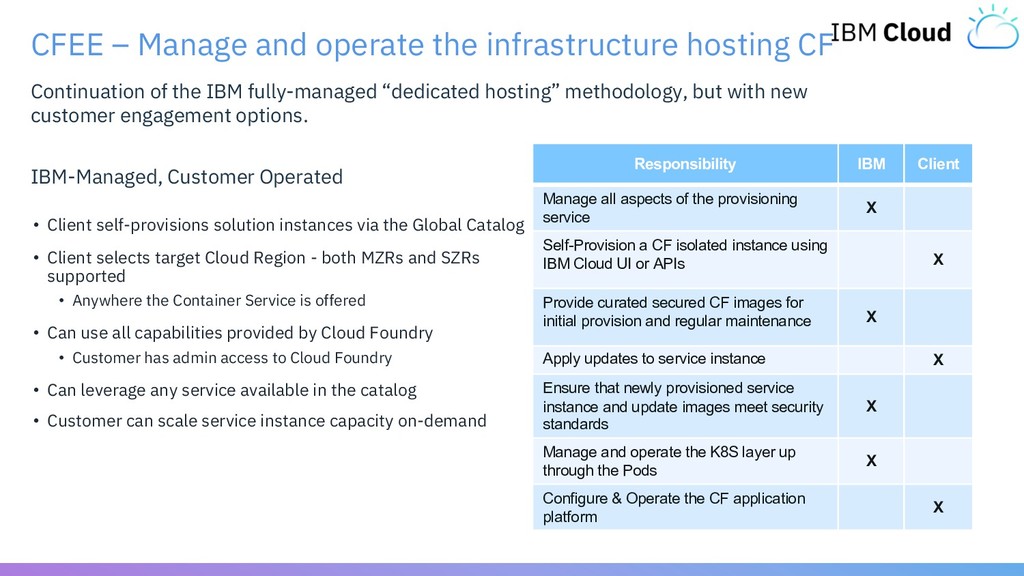
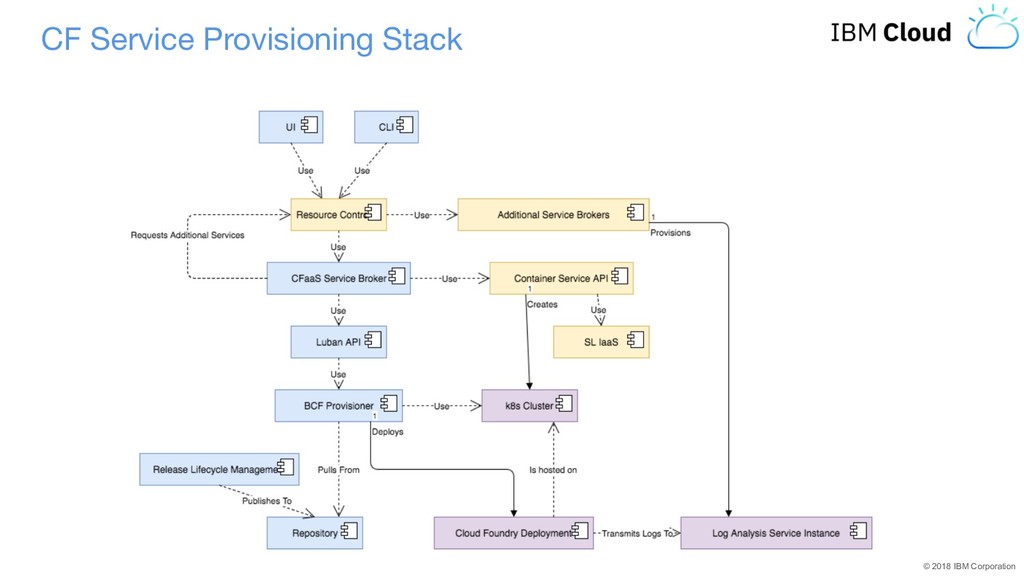
infrastructure hosting CF IBM-Managed, Customer Operated Responsibility IBM Client Manage all aspects of the provisioning service X Self-Provision a CF isolated instance using IBM Cloud UI or APIs X Provide curated secured CF images for initial provision and regular maintenance X Apply updates to service instance X Ensure that newly provisioned service instance and update images meet security standards X Manage and operate the K8S layer up through the Pods X Configure & Operate the CF application platform X • Client self-provisions solution instances via the Global Catalog • Client selects target Cloud Region - both MZRs and SZRs supported • Anywhere the Container Service is offered • Can use all capabilities provided by Cloud Foundry • Customer has admin access to Cloud Foundry • Can leverage any service available in the catalog • Customer can scale service instance capacity on-demand Continuation of the IBM fully-managed “dedicated hosting” methodology, but with new customer engagement options.
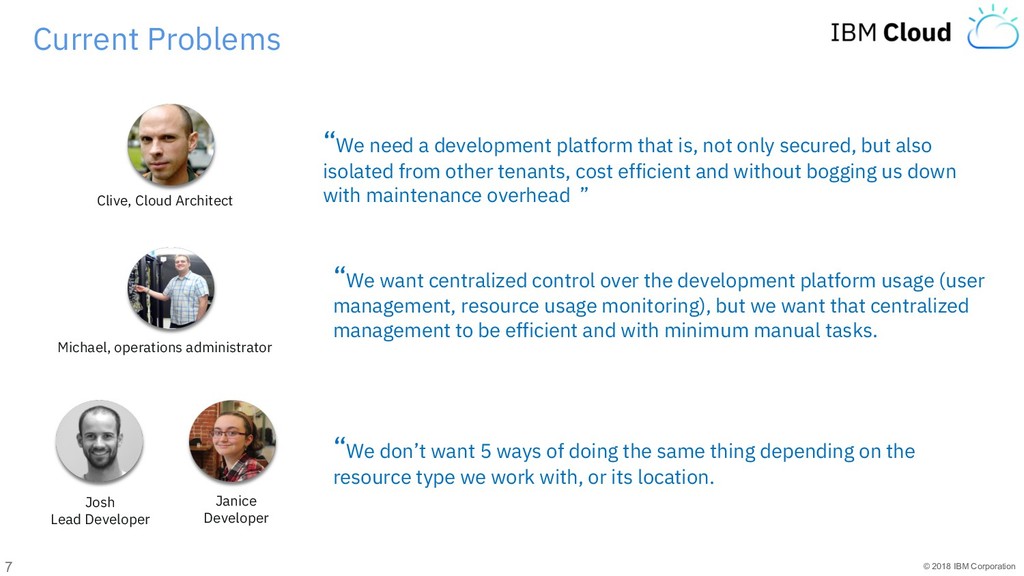
that is, not only secured, but also isolated from other tenants, cost efficient and without bogging us down with maintenance overhead ” Clive, Cloud Architect Michael, operations administrator “We want centralized control over the development platform usage (user management, resource usage monitoring), but we want that centralized management to be efficient and with minimum manual tasks. Josh Lead Developer Janice Developer “We don’t want 5 ways of doing the same thing depending on the resource type we work with, or its location. Current Problems
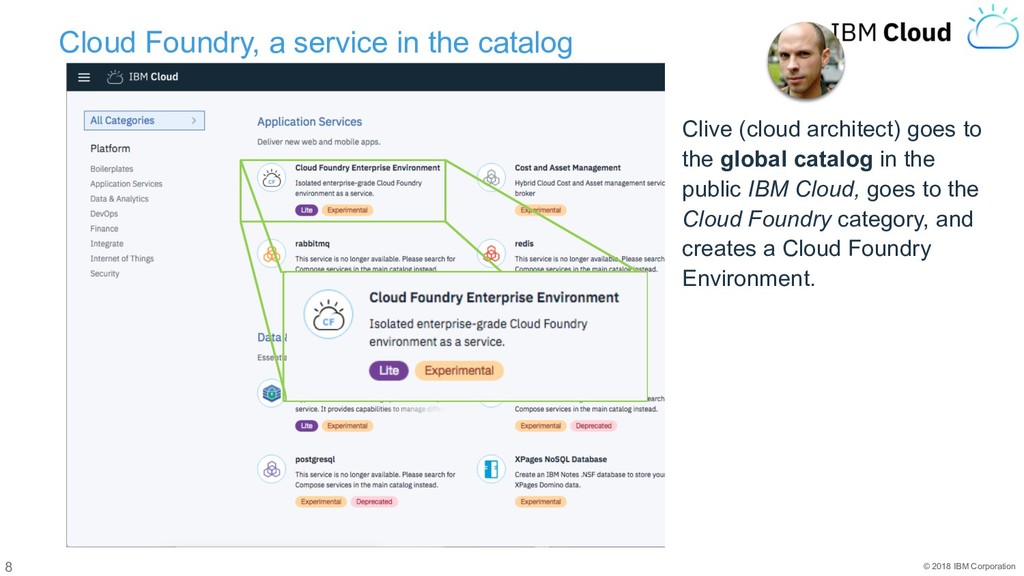
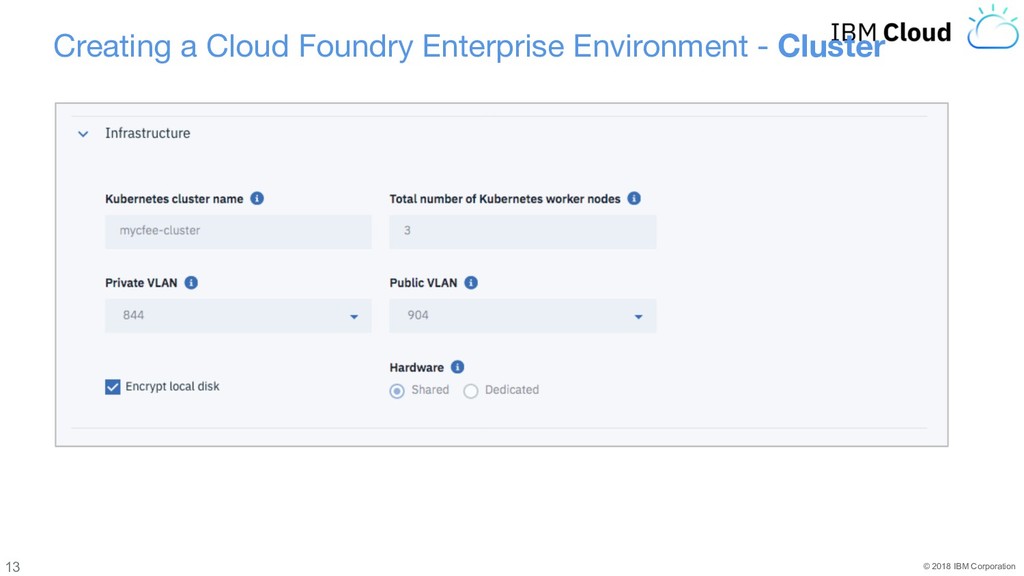
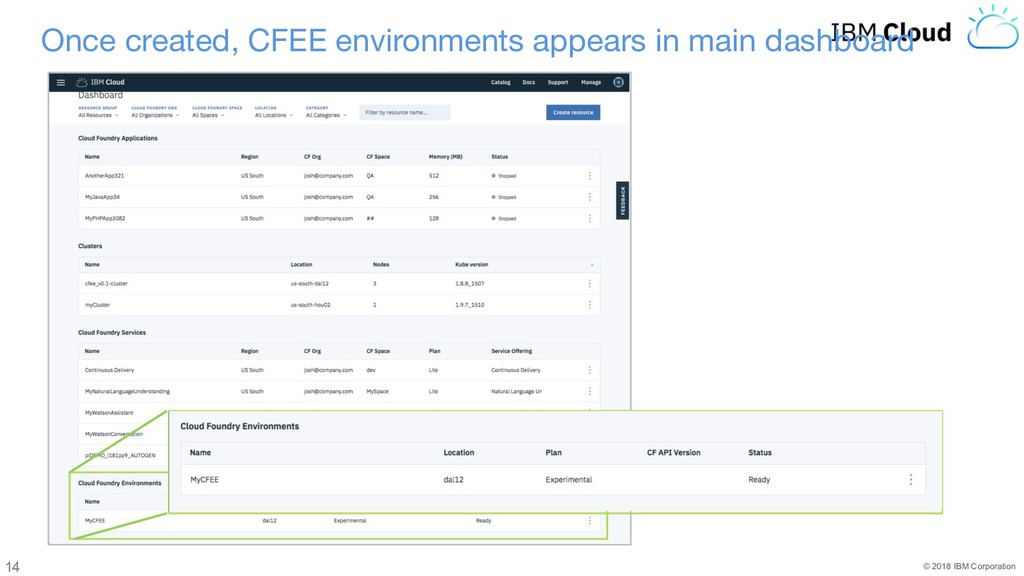
the global catalog in the public IBM Cloud, goes to the Cloud Foundry category, and creates a Cloud Foundry Environment. Cloud Foundry, a service in the catalog
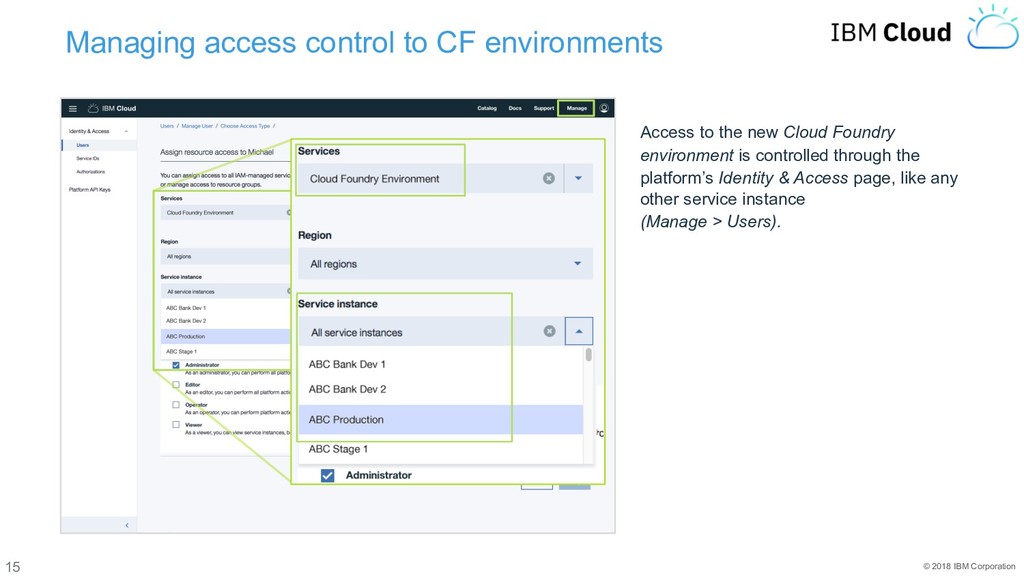
Foundry environment is controlled through the platform’s Identity & Access page, like any other service instance (Manage > Users). Managing access control to CF environments
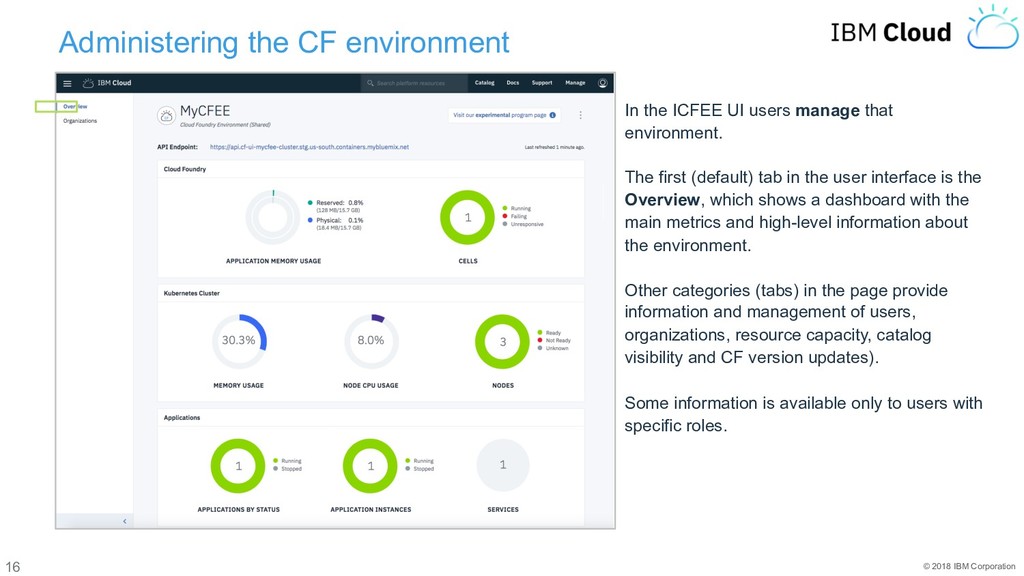
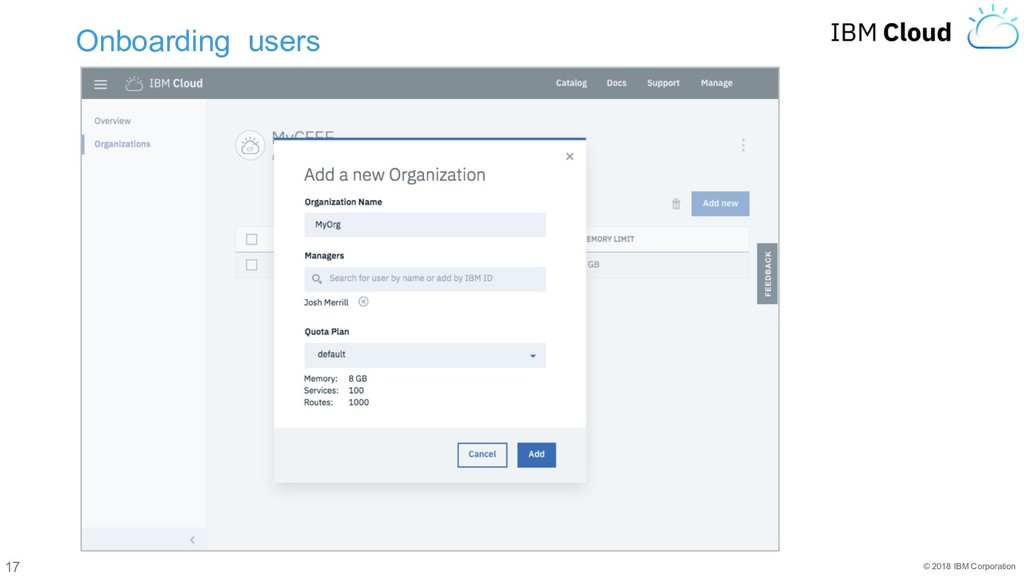
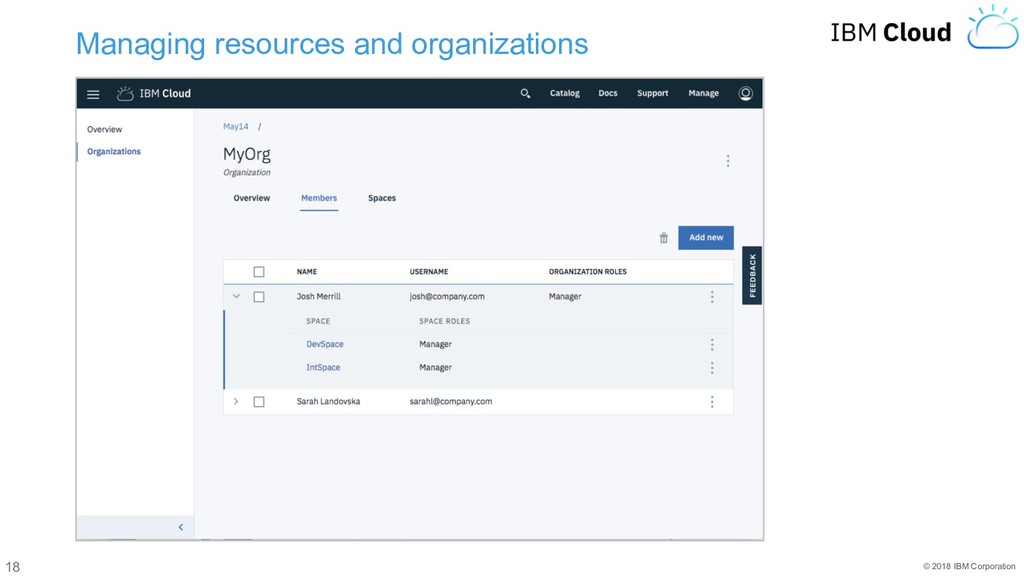
manage that environment. The first (default) tab in the user interface is the Overview, which shows a dashboard with the main metrics and high-level information about the environment. Other categories (tabs) in the page provide information and management of users, organizations, resource capacity, catalog visibility and CF version updates). Some information is available only to users with specific roles. Administering the CF environment
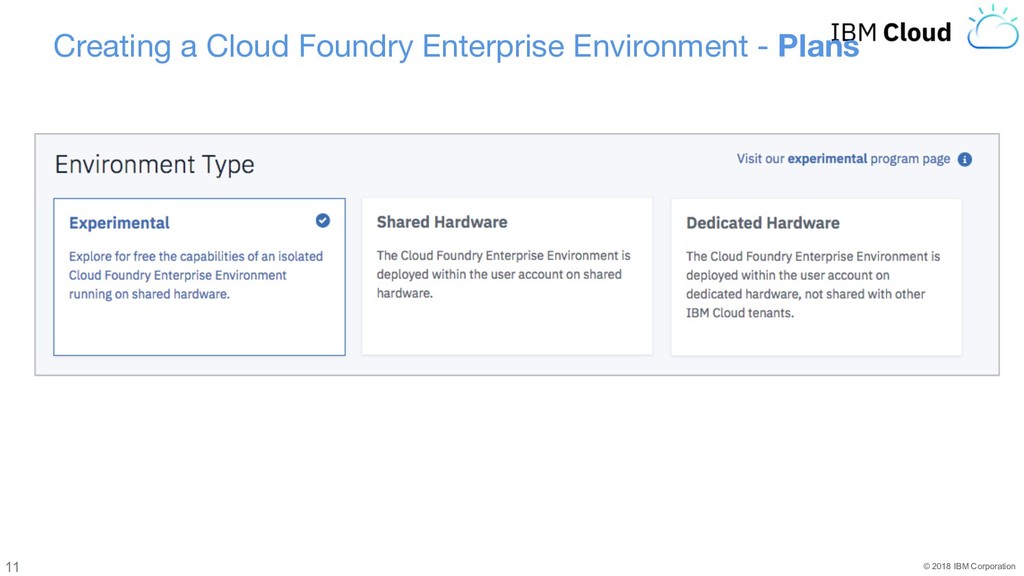
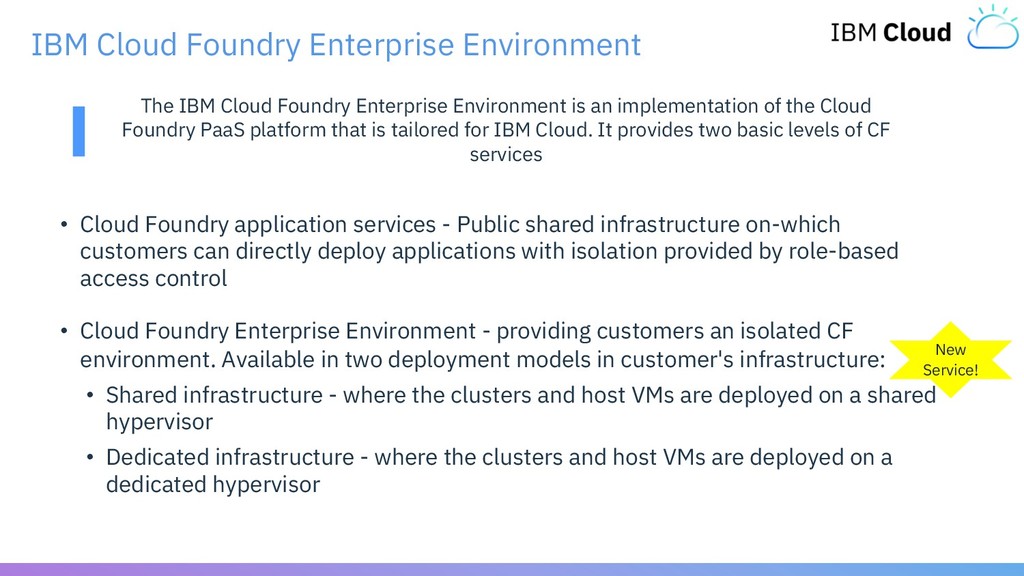
Cloud Foundry application services - Public shared infrastructure on-which customers can directly deploy applications with isolation provided by role-based access control • Cloud Foundry Enterprise Environment - providing customers an isolated CF environment. Available in two deployment models in customer's infrastructure: • Shared infrastructure - where the clusters and host VMs are deployed on a shared hypervisor • Dedicated infrastructure - where the clusters and host VMs are deployed on a dedicated hypervisor New Service! The IBM Cloud Foundry Enterprise Environment is an implementation of the Cloud Foundry PaaS platform that is tailored for IBM Cloud. It provides two basic levels of CF services
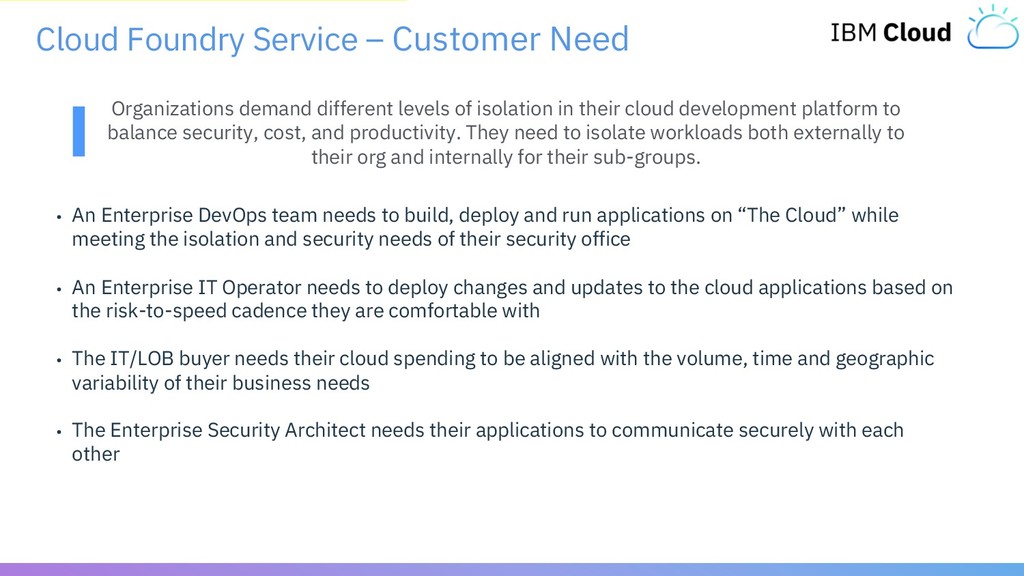
• An Enterprise DevOps team needs to build, deploy and run applications on “The Cloud” while meeting the isolation and security needs of their security office • An Enterprise IT Operator needs to deploy changes and updates to the cloud applications based on the risk-to-speed cadence they are comfortable with • The IT/LOB buyer needs their cloud spending to be aligned with the volume, time and geographic variability of their business needs • The Enterprise Security Architect needs their applications to communicate securely with each other Organizations demand different levels of isolation in their cloud development platform to balance security, cost, and productivity. They need to isolate workloads both externally to their org and internally for their sub-groups.
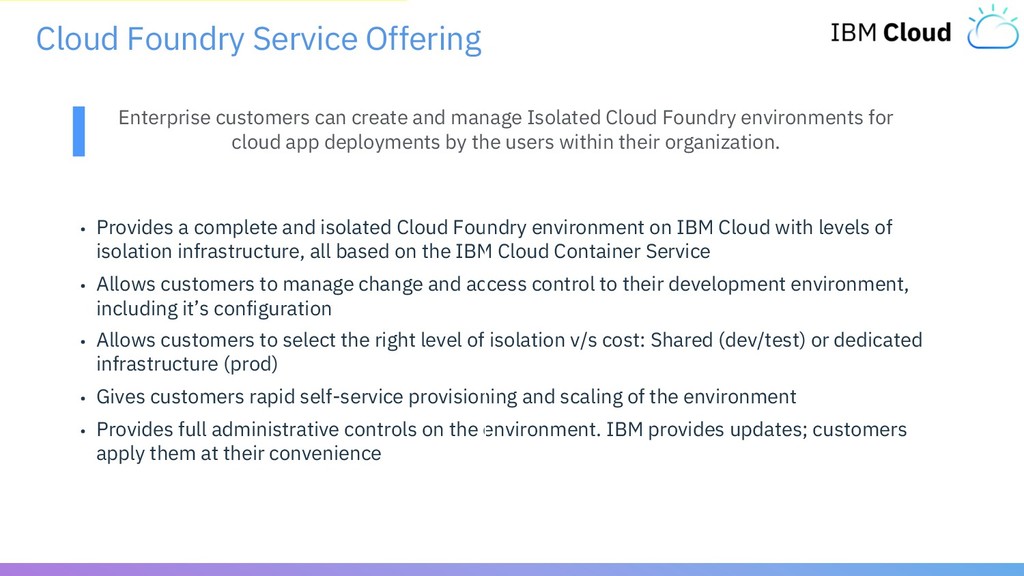
Cloud Foundry environment on IBM Cloud with levels of isolation infrastructure, all based on the IBM Cloud Container Service • Allows customers to manage change and access control to their development environment, including it’s configuration • Allows customers to select the right level of isolation v/s cost: Shared (dev/test) or dedicated infrastructure (prod) • Gives customers rapid self-service provisioning and scaling of the environment • Provides full administrative controls on the environment. IBM provides updates; customers apply them at their convenience Enterprise customers can create and manage Isolated Cloud Foundry environments for cloud app deployments by the users within their organization. Cloud Foundry Service Offering
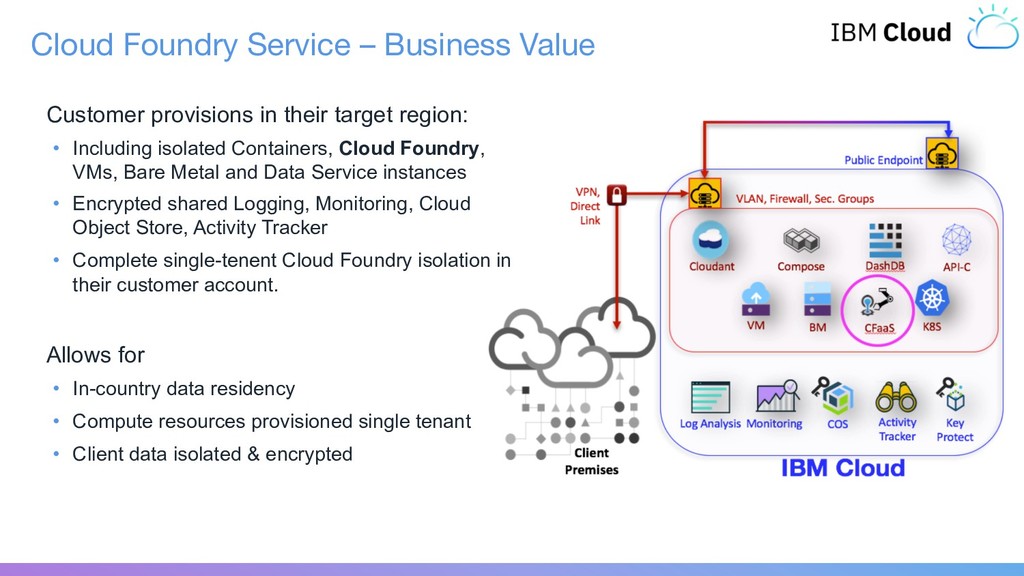
Customer provisions in their target region: • Including isolated Containers, Cloud Foundry, VMs, Bare Metal and Data Service instances • Encrypted shared Logging, Monitoring, Cloud Object Store, Activity Tracker • Complete single-tenent Cloud Foundry isolation in their customer account. Allows for • In-country data residency • Compute resources provisioned single tenant • Client data isolated & encrypted
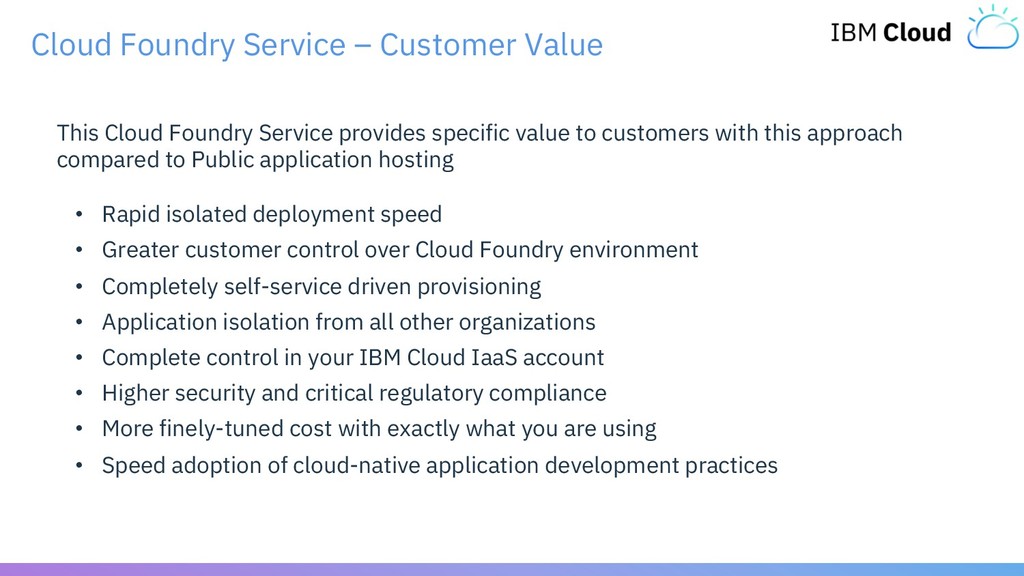
This Cloud Foundry Service provides specific value to customers with this approach compared to Public application hosting • Rapid isolated deployment speed • Greater customer control over Cloud Foundry environment • Completely self-service driven provisioning • Application isolation from all other organizations • Complete control in your IBM Cloud IaaS account • Higher security and critical regulatory compliance • More finely-tuned cost with exactly what you are using • Speed adoption of cloud-native application development practices
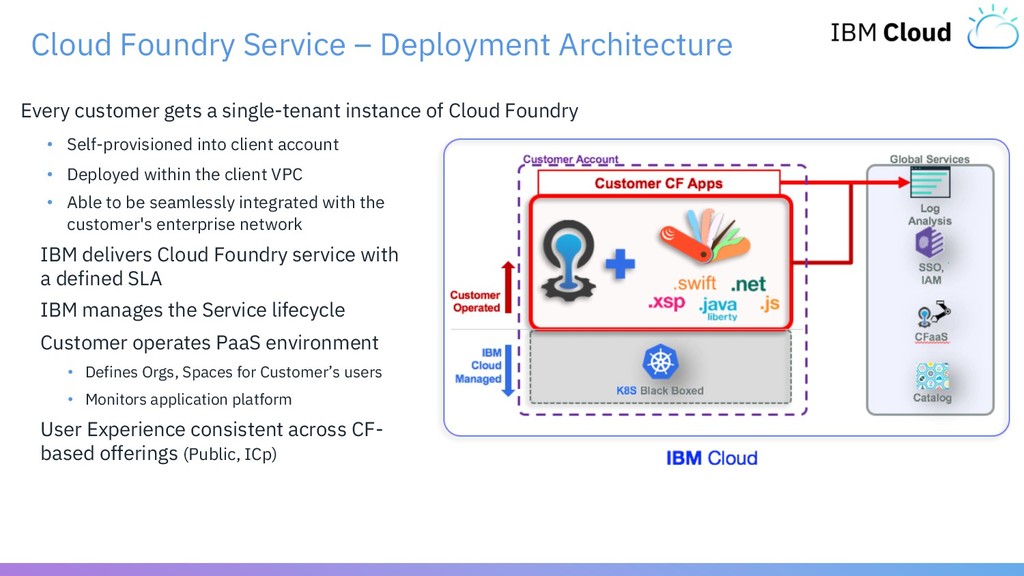
Every customer gets a single-tenant instance of Cloud Foundry • Self-provisioned into client account • Deployed within the client VPC • Able to be seamlessly integrated with the customer's enterprise network IBM delivers Cloud Foundry service with a defined SLA IBM manages the Service lifecycle Customer operates PaaS environment • Defines Orgs, Spaces for Customer’s users • Monitors application platform User Experience consistent across CF- based offerings (Public, ICp)
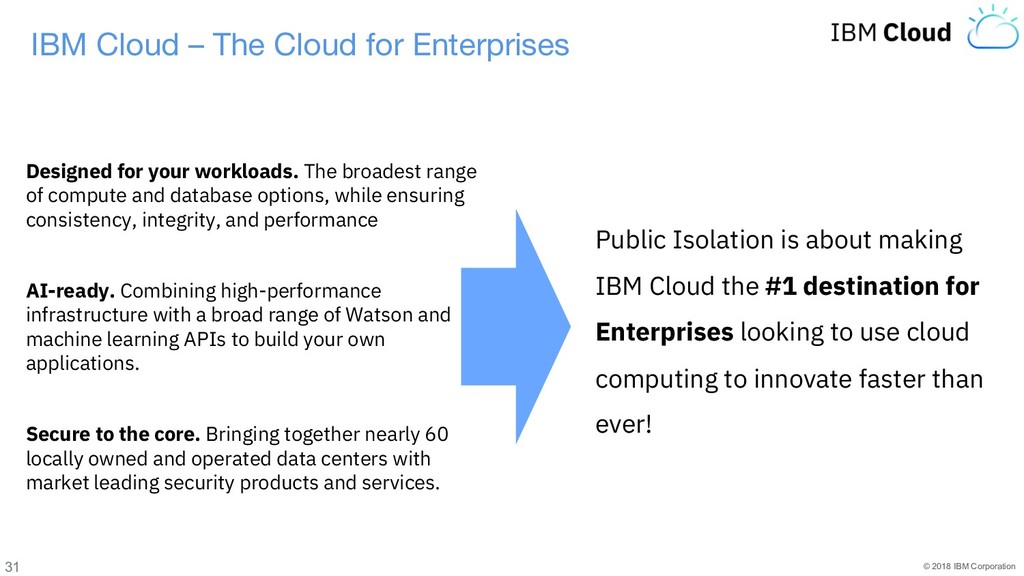
for Enterprises Designed for your workloads. The broadest range of compute and database options, while ensuring consistency, integrity, and performance AI-ready. Combining high-performance infrastructure with a broad range of Watson and machine learning APIs to build your own applications. Secure to the core. Bringing together nearly 60 locally owned and operated data centers with market leading security products and services. Public Isolation is about making IBM Cloud the #1 destination for Enterprises looking to use cloud computing to innovate faster than ever!
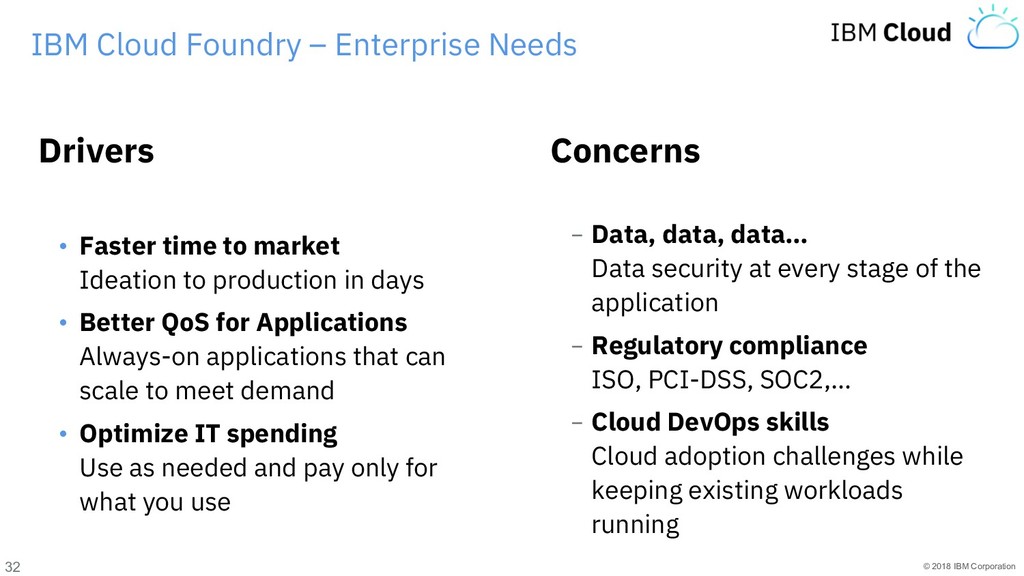
Needs Drivers • Faster time to market Ideation to production in days • Better QoS for Applications Always-on applications that can scale to meet demand • Optimize IT spending Use as needed and pay only for what you use Concerns – Data, data, data… Data security at every stage of the application – Regulatory compliance ISO, PCI-DSS, SOC2,… – Cloud DevOps skills Cloud adoption challenges while keeping existing workloads running
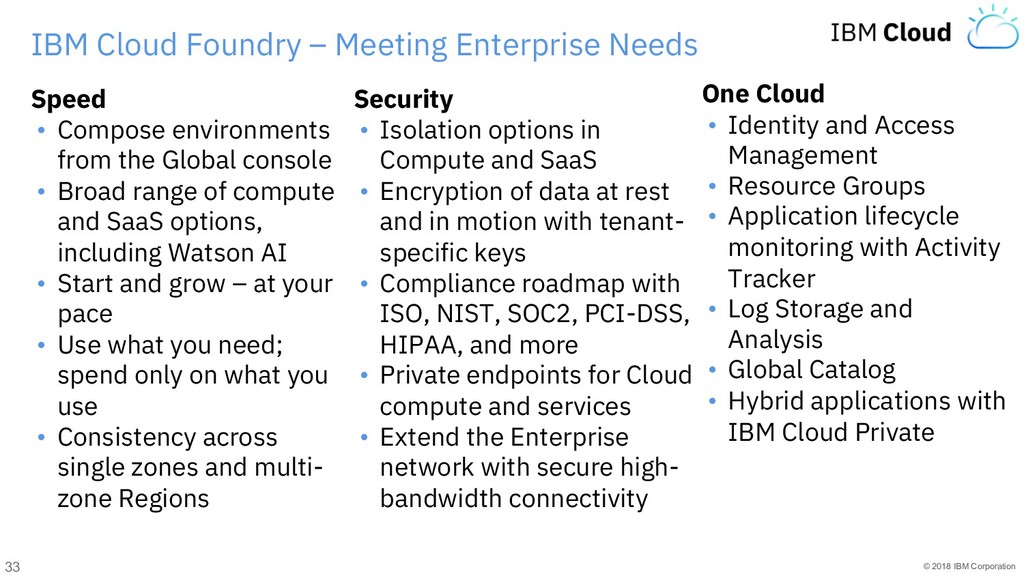
Enterprise Needs Speed • Compose environments from the Global console • Broad range of compute and SaaS options, including Watson AI • Start and grow – at your pace • Use what you need; spend only on what you use • Consistency across single zones and multi- zone Regions Security • Isolation options in Compute and SaaS • Encryption of data at rest and in motion with tenant- specific keys • Compliance roadmap with ISO, NIST, SOC2, PCI-DSS, HIPAA, and more • Private endpoints for Cloud compute and services • Extend the Enterprise network with secure high- bandwidth connectivity One Cloud • Identity and Access Management • Resource Groups • Application lifecycle monitoring with Activity Tracker • Log Storage and Analysis • Global Catalog • Hybrid applications with IBM Cloud Private
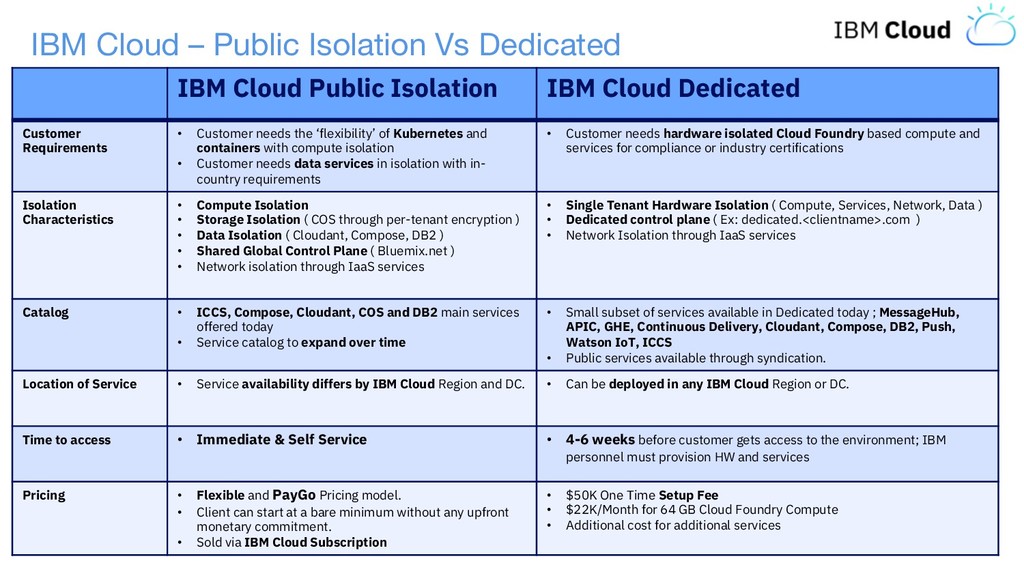
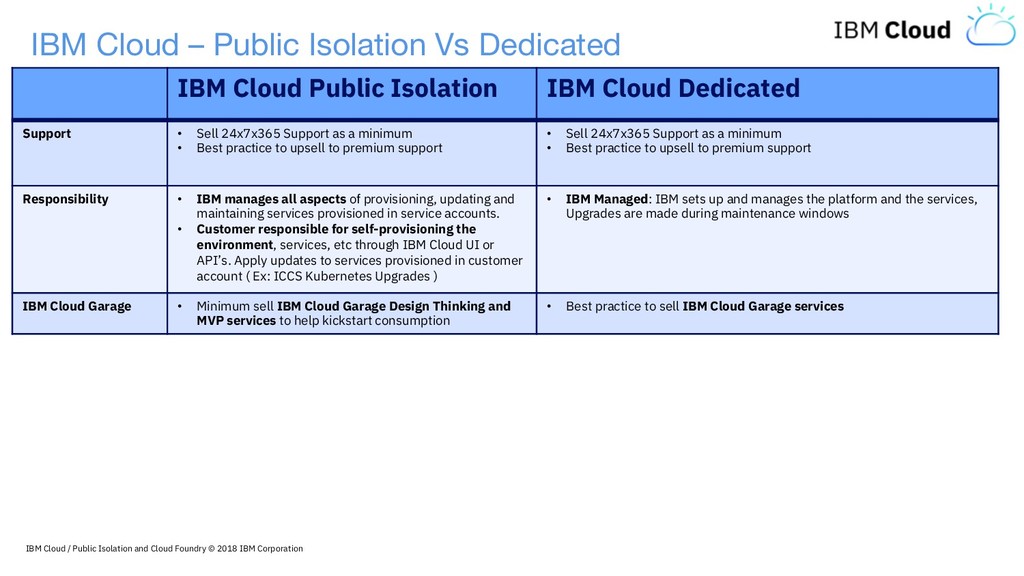
Customer needs the ‘flexibility’ of Kubernetes and containers with compute isolation • Customer needs data services in isolation with in- country requirements • Customer needs hardware isolated Cloud Foundry based compute and services for compliance or industry certifications Isolation Characteristics • Compute Isolation • Storage Isolation ( COS through per-tenant encryption ) • Data Isolation ( Cloudant, Compose, DB2 ) • Shared Global Control Plane ( Bluemix.net ) • Network isolation through IaaS services • Single Tenant Hardware Isolation ( Compute, Services, Network, Data ) • Dedicated control plane ( Ex: dedicated.<clientname>.com ) • Network Isolation through IaaS services Catalog • ICCS, Compose, Cloudant, COS and DB2 main services offered today • Service catalog to expand over time • Small subset of services available in Dedicated today ; MessageHub, APIC, GHE, Continuous Delivery, Cloudant, Compose, DB2, Push, Watson IoT, ICCS • Public services available through syndication. Location of Service • Service availability differs by IBM Cloud Region and DC. • Can be deployed in any IBM Cloud Region or DC. Time to access • Immediate & Self Service • 4-6 weeks before customer gets access to the environment; IBM personnel must provision HW and services Pricing • Flexible and PayGo Pricing model. • Client can start at a bare minimum without any upfront monetary commitment. • Sold via IBM Cloud Subscription • $50K One Time Setup Fee • $22K/Month for 64 GB Cloud Foundry Compute • Additional cost for additional services IBM Cloud – Public Isolation Vs Dedicated
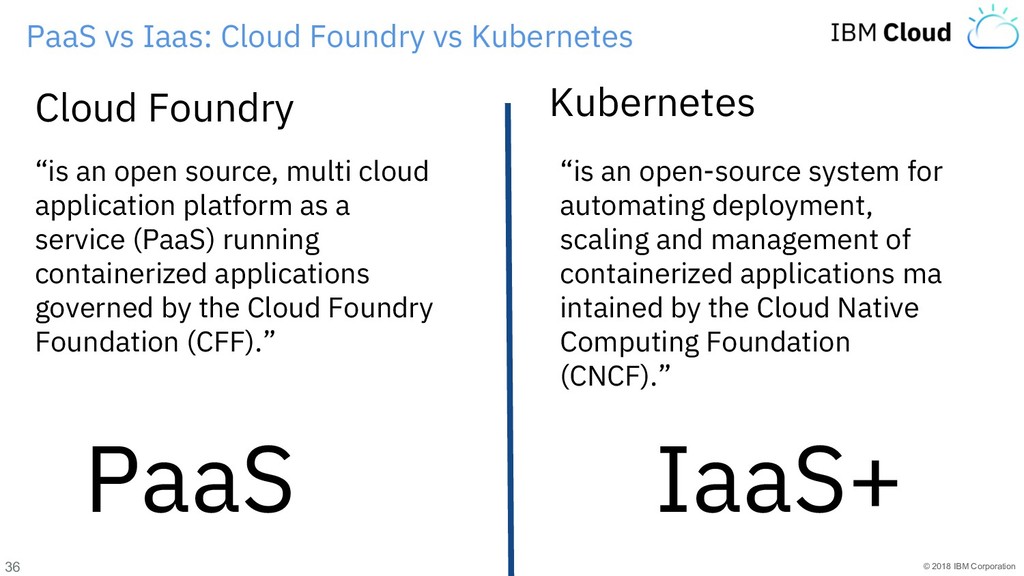
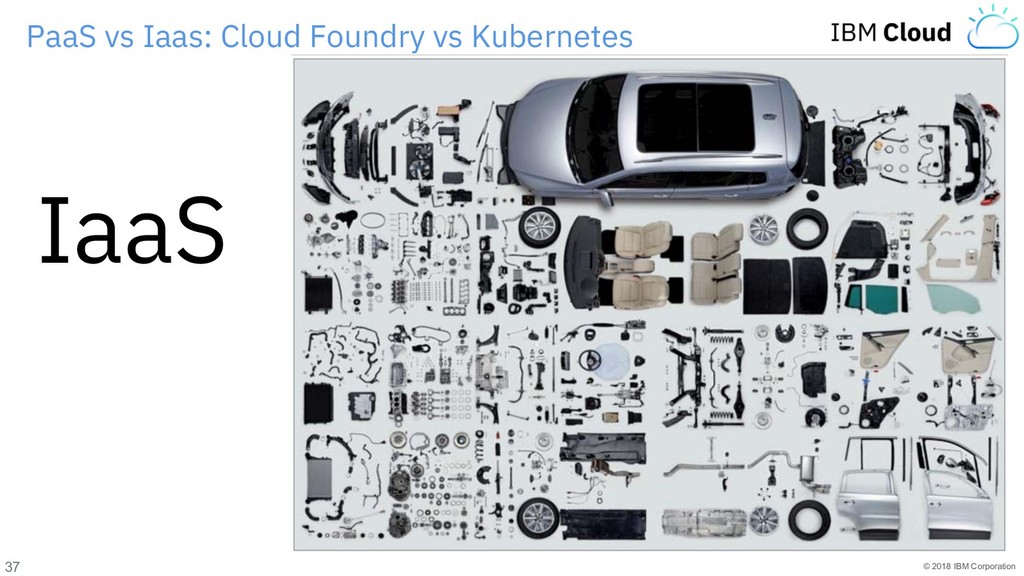
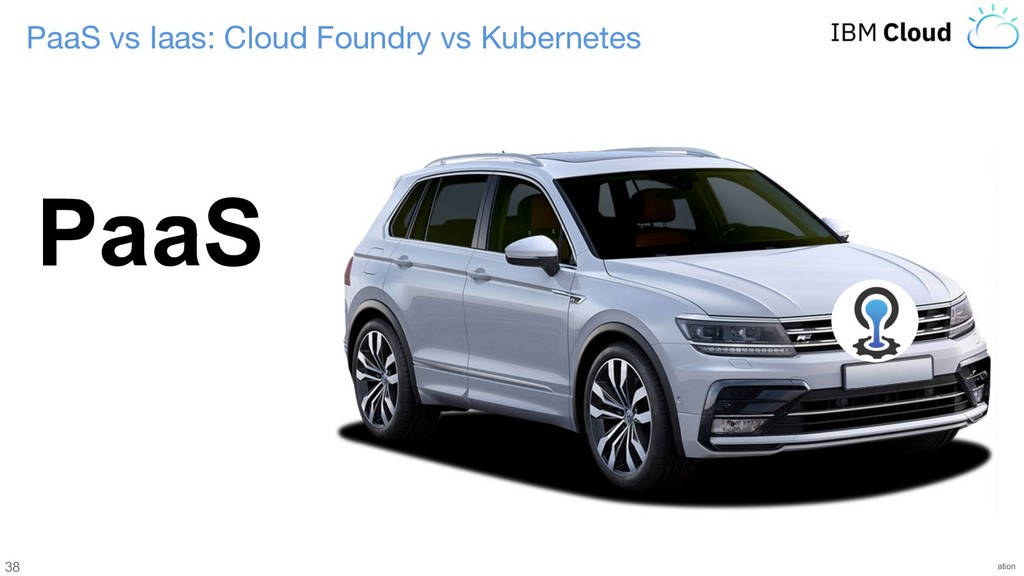
vs Kubernetes Cloud Foundry “is an open source, multi cloud application platform as a service (PaaS) running containerized applications governed by the Cloud Foundry Foundation (CFF).” “is an open-source system for automating deployment, scaling and management of containerized applications ma intained by the Cloud Native Computing Foundation (CNCF).” Kubernetes PaaS IaaS+
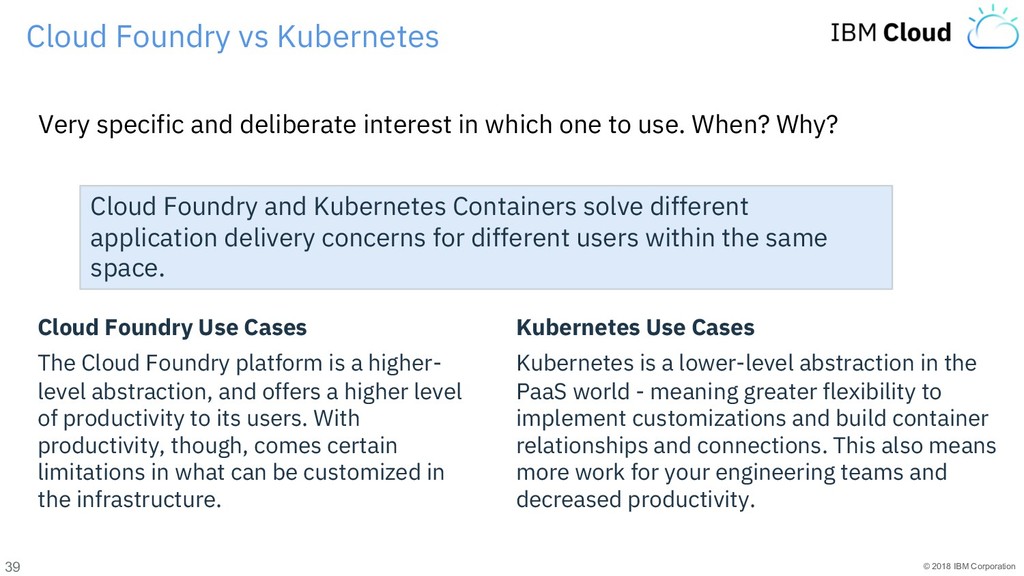
specific and deliberate interest in which one to use. When? Why? Cloud Foundry Use Cases The Cloud Foundry platform is a higher- level abstraction, and offers a higher level of productivity to its users. With productivity, though, comes certain limitations in what can be customized in the infrastructure. Kubernetes Use Cases Kubernetes is a lower-level abstraction in the PaaS world - meaning greater flexibility to implement customizations and build container relationships and connections. This also means more work for your engineering teams and decreased productivity. Cloud Foundry and Kubernetes Containers solve different application delivery concerns for different users within the same space.
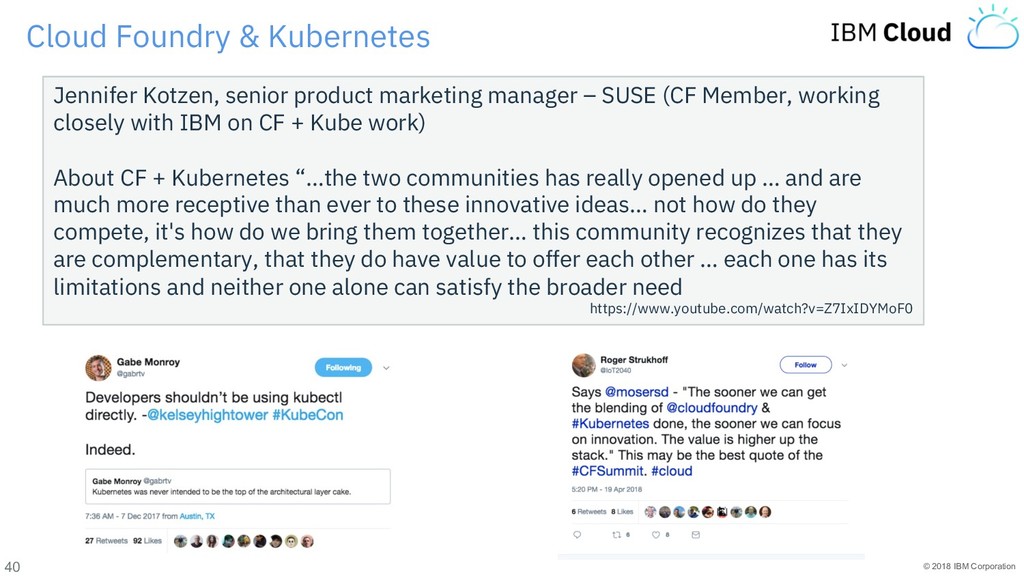
manager – SUSE (CF Member, working closely with IBM on CF + Kube work) About CF + Kubernetes “…the two communities has really opened up … and are much more receptive than ever to these innovative ideas… not how do they compete, it's how do we bring them together… this community recognizes that they are complementary, that they do have value to offer each other … each one has its limitations and neither one alone can satisfy the broader need https://www.youtube.com/watch?v=Z7IxIDYMoF0 Cloud Foundry & Kubernetes


 vidyasagarmsc
 philipz
 mkdev10
 tomzoh
 yut0naga1_fa
 pauli
pauli
 ueponx
 yama3133
 mtpooh
 sansantech
 mot_techtalk
 codmoninc
 kmiya84377
 dugsong
 techseoconnect
 chrisshort
 orderedlist
 trallard
 baasie
 katarinadahlin
 tammyeverts
 cassininazir
 lara
lara
 katiecoart
 frankvandijk