Share
[2025 DDDEU] Modeling Stories of the Beautiful Mess
In the world of modern software design, we are confronted with multidimensional complexity—an entangled interplay between business needs, organizational constraints, and technical intricacies. We tend to see this complexity as a problem to be solved, rather than a beautiful mess to be navigated and draw deep learning from.
Jacob Needleman once remarked: “Our culture has generally tended to solve its problems without experiencing its questions.” Can we practice modeling and design in a way, so it is less about defining a target architecture or making a decision, and more about fostering spaces for deep inquiries about the why, the what, the for whom, and the with whom? Sociotechnical paradoxes - stability vs. emergence, order vs. chaos, and getting stuck to get unstuck - are not contradictions to be eliminated but opportunities to be engaged with.
In this talk, we delve into how collaborative working sessions, enriched with meaningful inquiry, storytelling and sense making, can become part of our modeling and design toolbox. They might get us closer toward both social and technical coherence through lived experiences of parts connecting with the whole. We explore how to practice inquiry-driven architecture to catalyze shared understanding and aspirations, build rich relations while profiting from diversity, uncertainty and ambiguity.
To co-create innovative products and sophisticated software, we must compose it like a dynamic music performance — balancing the clarity of written notes with the raw, transformative power of our collective listening and improvisations. Success depends on blending clear, disciplined plans with the creative energy of real-time collaboration. Only by embracing uncertainty, pain, and the beauty of our messy, shared reality can we unleash our collective imagination, co-create products and software that can brave our time’s unique challenges.
xinyao
Transcript
70 slides
-
Modeling Stories of the Beautiful Mess John Cutler and Xin
Yao DDD Europe 2025, Antwerp -
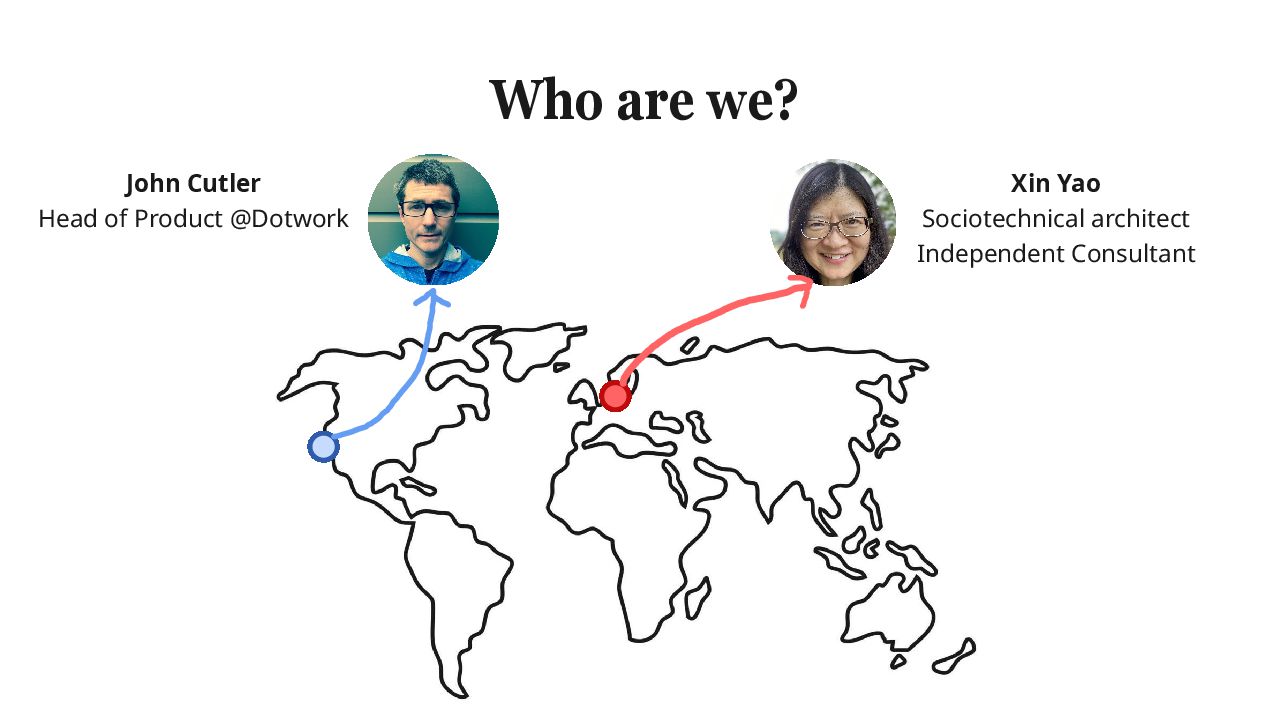
Who are we? Xin Yao Sociotechnical architect Independent Consultant John
Cutler Head of Product @Dotwork -
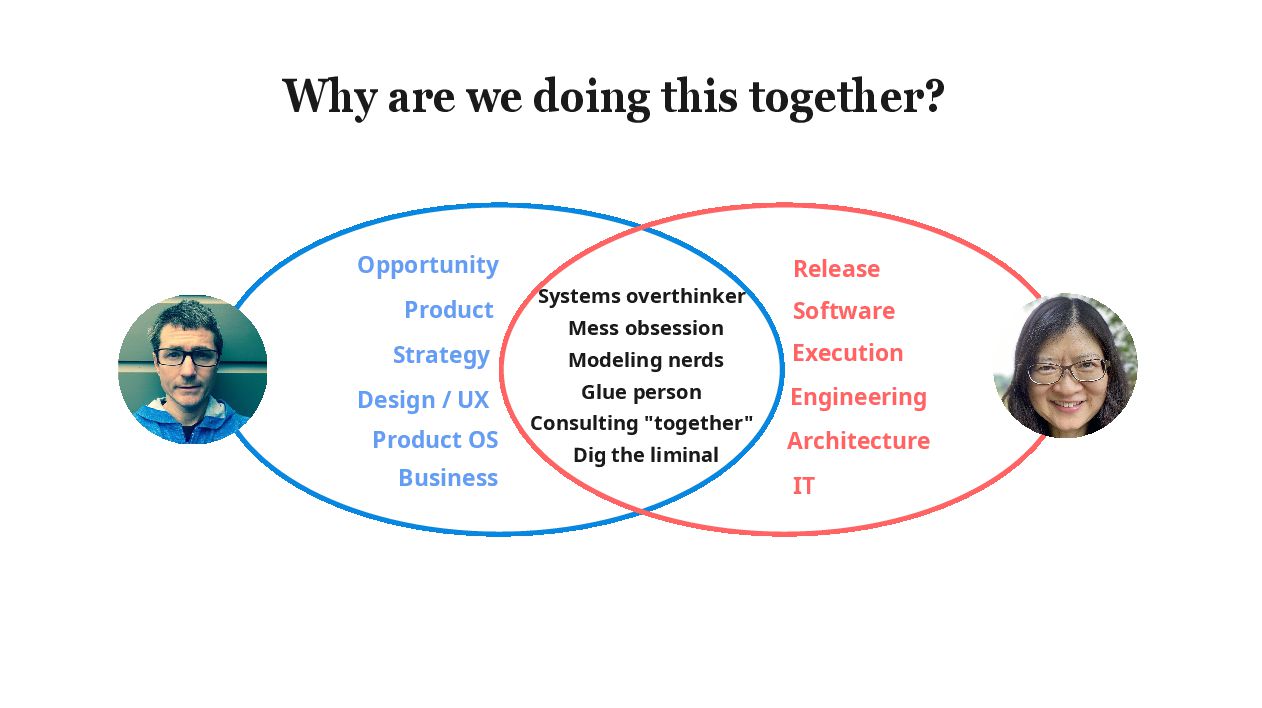
Why are we doing this together? Systems overthinker Glue person
Consulting "together" Mess obsession Engineering Software Architecture Release Opportunity Product Strategy Design / UX IT Execution Product OS Business Modeling nerds Dig the liminal -
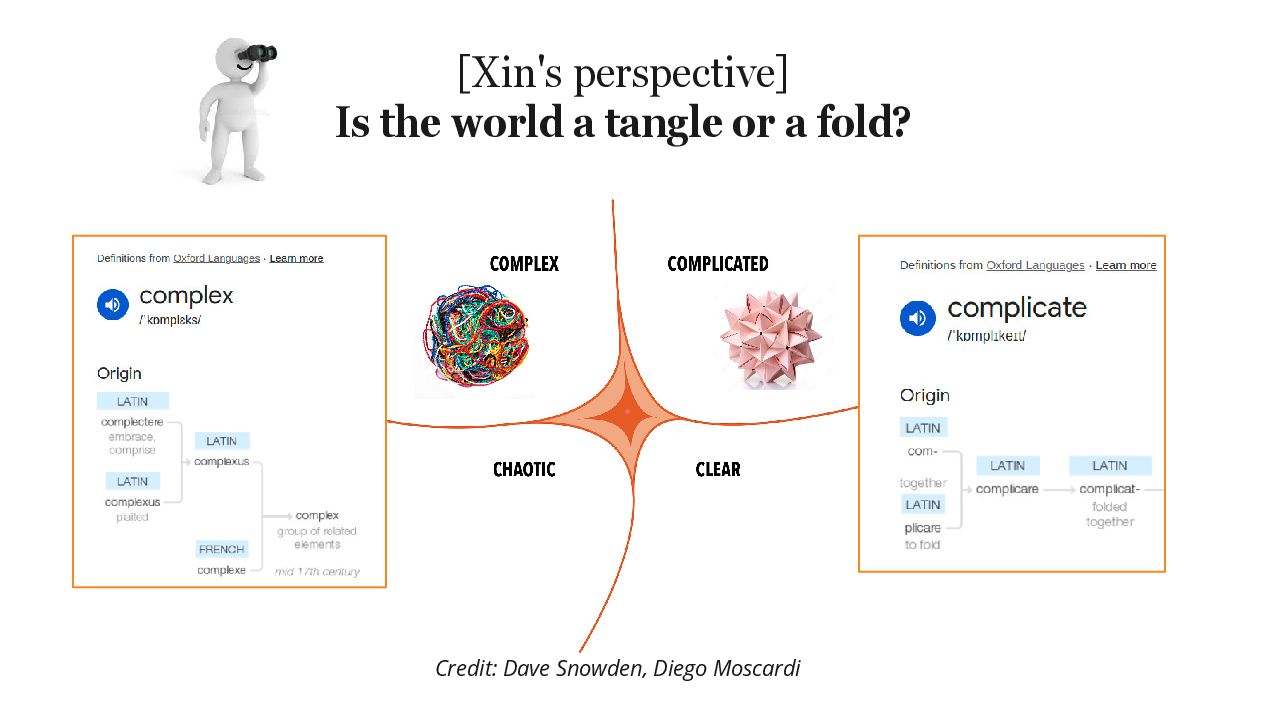
[Xin's perspective] Is the world a tangle or a fold?
Credit: Dave Snowden, Diego Moscardi -
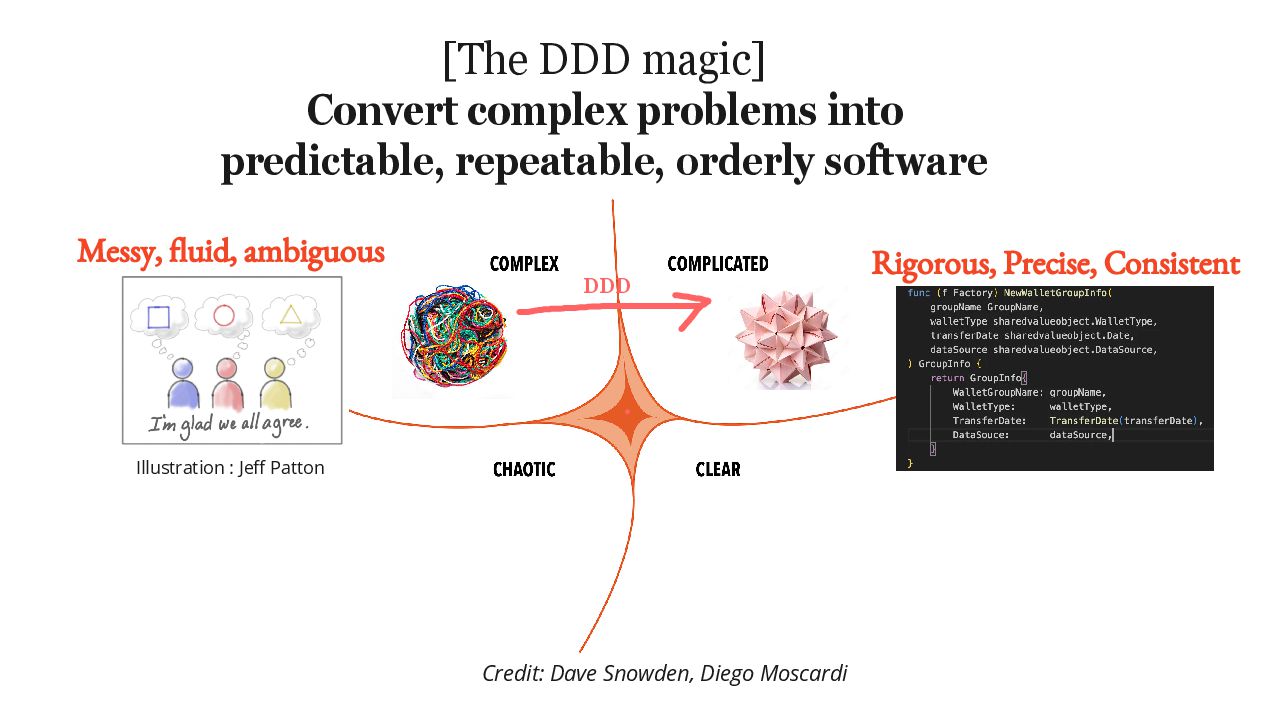
[The DDD magic] Convert complex problems into predictable, repeatable, orderly
software Credit: Dave Snowden, Diego Moscardi DDD Illustration : Jeff Patton Messy, fluid, ambiguous Rigorous, Precise, Consistent -
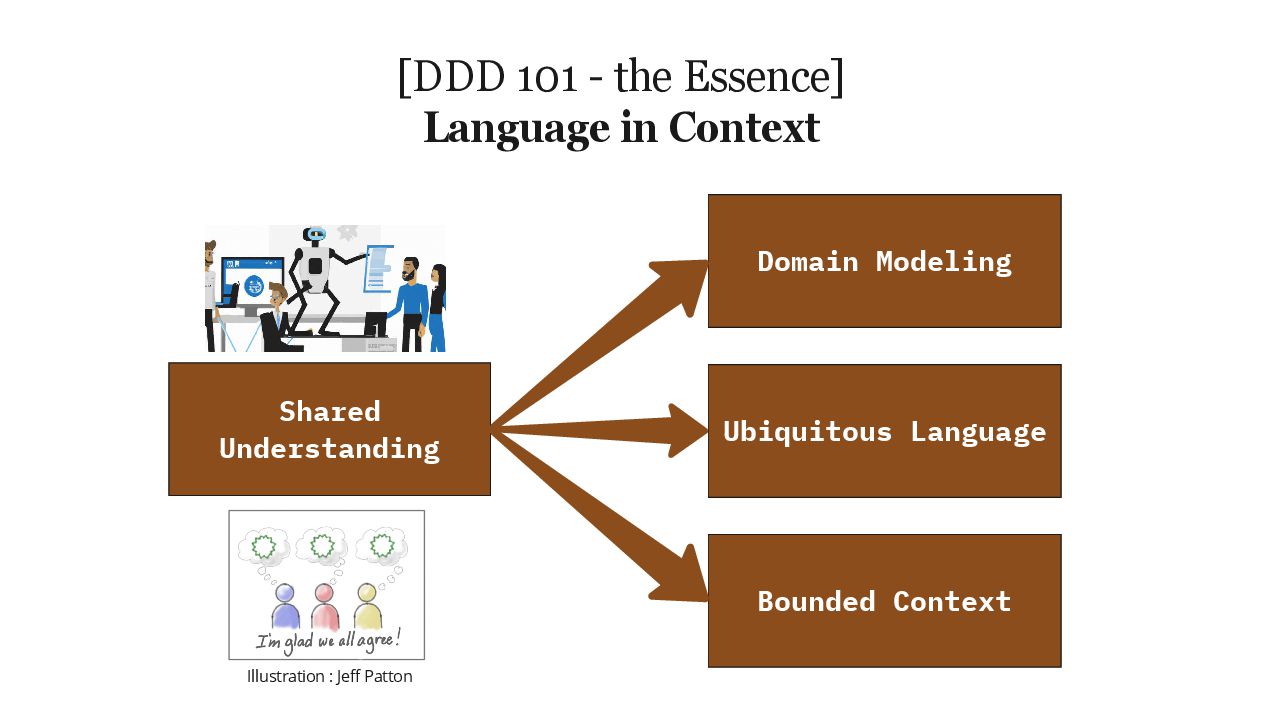
Shared Understanding [DDD 101 - the Essence] Language in Context
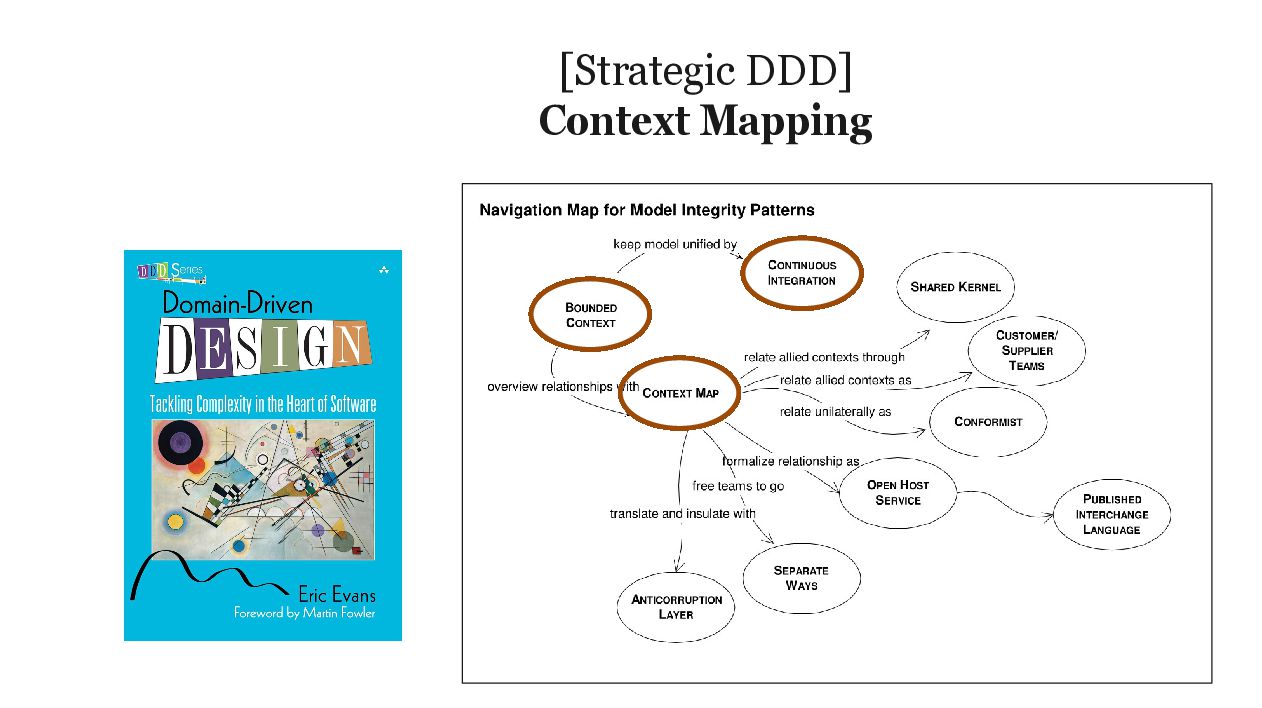
Bounded Context Domain Modeling Ubiquitous Language Illustration : Jeff Patton -
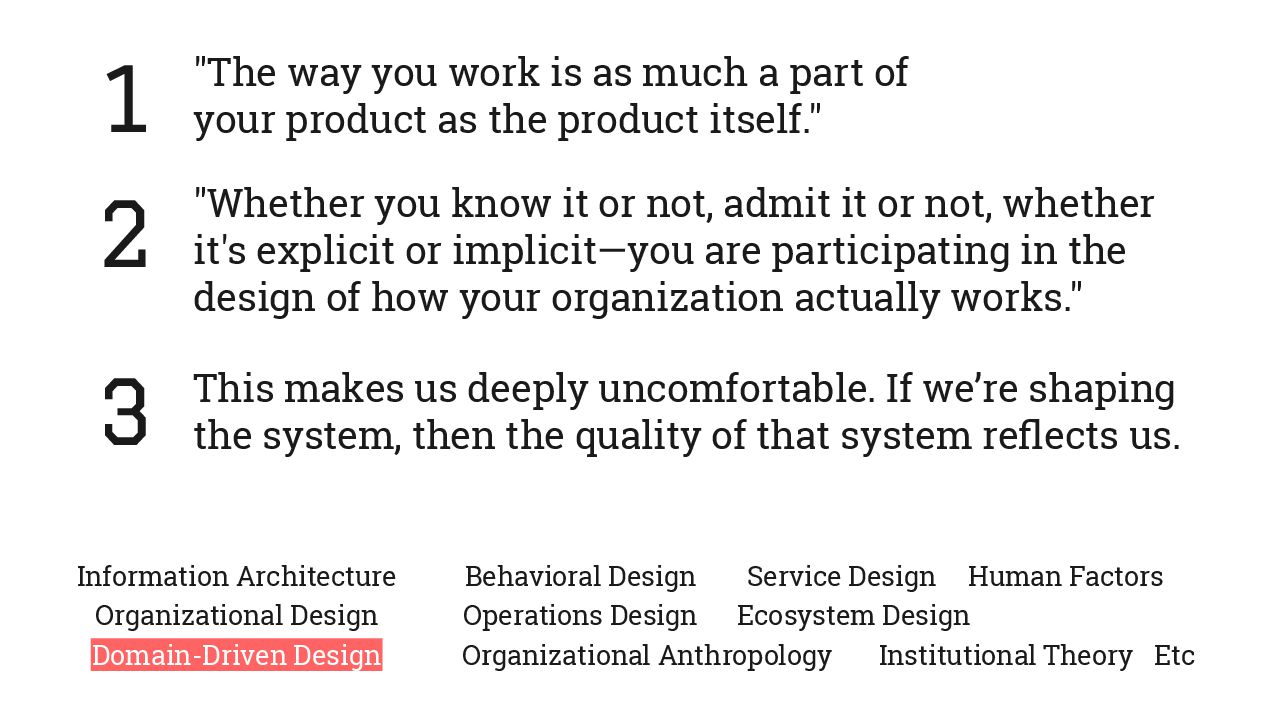
"The way you work is as much a part of
your product as the product itself." Information Architecture Behavioral Design Organizational Design Operations Design Service Design "Whether you know it or not, admit it or not, whether it's explicit or implicit— you are participating in the design of how your organization actually works." Ecosystem Design Domain- Driven Design Human Factors Organizational Anthropology Institutional Theory Etc This makes us deeply uncomfortable. If we’re shaping the system, then the quality of that system reflects us. 1 2 3 -
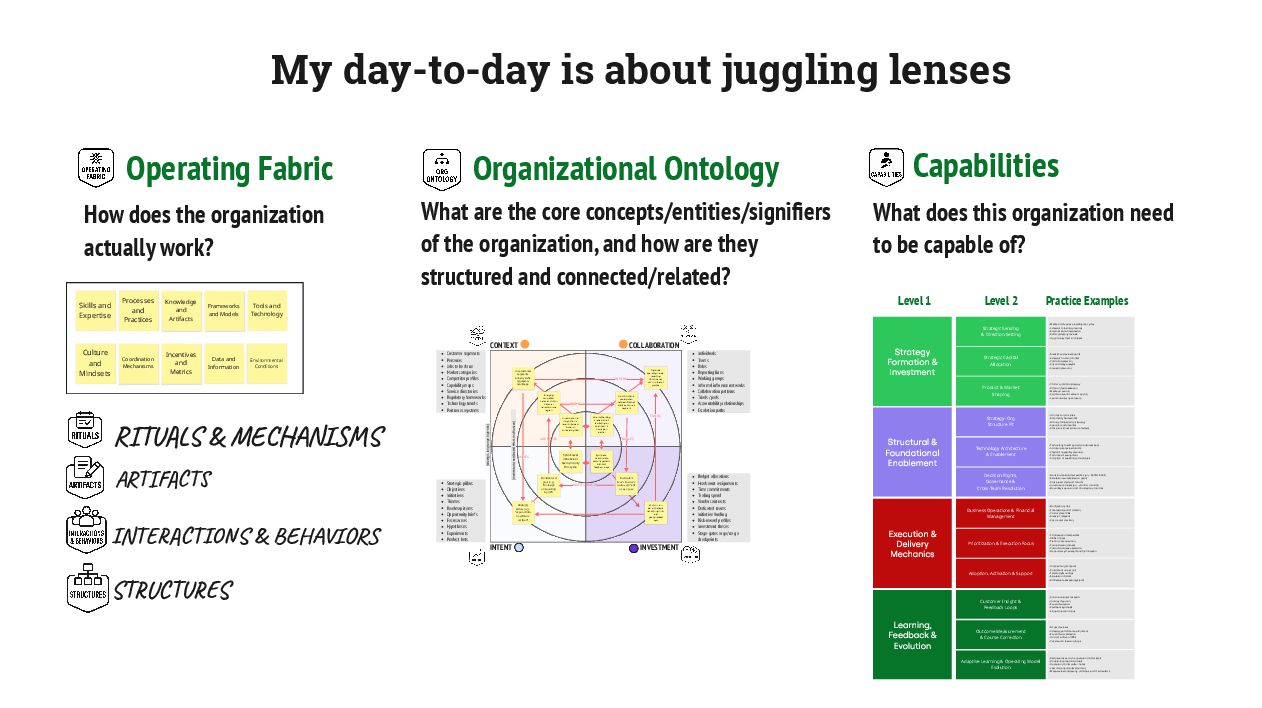
Operating Fabric How does the organization actually work? Data and
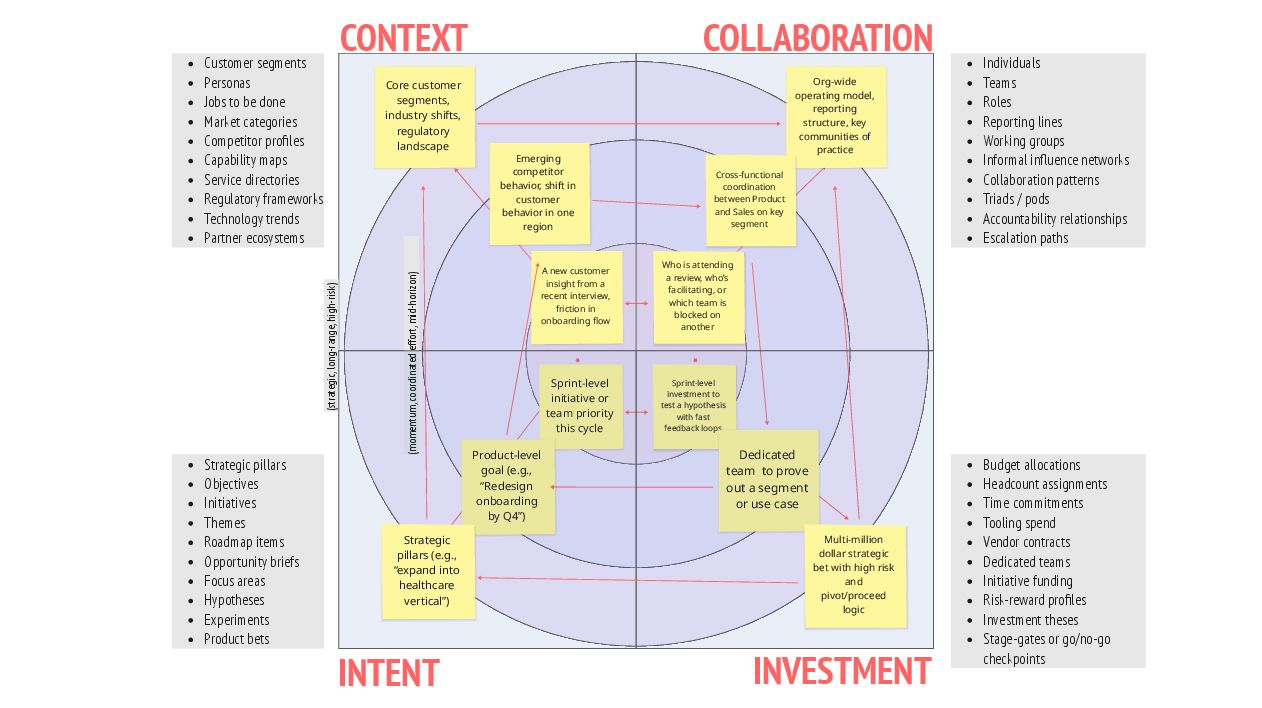
Information Coordination Mechanisms Tools and Technology Processes and Practices Skills and Expertise Incentives and Metrics Culture and Mindsets Frameworks and Models Knowledge and Artifacts Environmental Conditions RITUALS & MECHANISMS ARTIFACTS INTERACTIONS & BEHAVIORS STRUCTURES Organizational Ontology What are the core concepts/entities/signifiers of the organization, and how are they structured and connected/related? CONTEXT COLLABORATION INTENT INVESTMENT Core customer segments, industry shifts, regulatory landscape Emerging competitor behavior, shift in customer behavior in one region A new customer insight from a recent interview, friction in onboarding flow Org- wide operating model, reporting structure, key communities of practice Cross- functional coordination between Product and Sales on key segment Who is attending a review, who’s facilitating, or which team is blocked on another Strategic pillars (e.g., “expand into healthcare vertical”) Sprint- level initiative or team priority this cycle Product- level goal (e.g., “Redesign onboarding by Q4”) Multi- million dollar strategic bet with high risk and pivot/proceed logic Sprint- level investment to test a hypothesis with fast feedback loops Dedicated team to prove out a segment or use case INVESTS TIME IN ENABLES FUNDS ADDRESSES SHAPES GUIDE INFORM (strategic, long- range, high- risk) (momentum, coordinated effort, mid- horizon) Customer segments Personas Jobs to be done Market categories Competitor profiles Capability maps Service directories Regulatory frameworks Technology trends Partner ecosystems Strategic pillars Objectives Initiatives Themes Roadmap items Opportunity briefs Focus areas Hypotheses Experiments Product bets Budget allocations Headcount assignments Time commitments Tooling spend Vendor contracts Dedicated teams Initiative funding Risk- reward profiles Investment theses Stage- gates or go/no- go checkpoints Individuals Teams Roles Reporting lines Working groups Informal influence networks Collaboration patterns Triads / pods Accountability relationships Escalation paths Capabilities What does this organization need to be capable of? Strategy Formation & Investment Structural & Foundational Enablement Strategic Sensing & Direction Setting Strategic Capital Allocation Product & Market Shaping Strategy–Org Structure Fit Technology Architecture & Enablement Decision Rights, Governance & Cross- Team Resolution Business Operations & Financial Management Prioritization & Execution Focus Adoption, Activation & Support Adaptive Learning & Operating Model Evolution Outcome Measurement & Course Correction Customer Insight & Feedback Loops Execution & Delivery Mechanics Learning, Feedback & Evolution - Market/competitive intelligence cycles - Strategic foresight practices - External signal integration - Rolling strategy reviews - Opportunity framing rituals - Investment review boards - Strategic funding models - Portfolio balancing - Cost- of- delay analysis - Scenario planning - Product portfolio strategy - Offering rationalization - Market scanning - Segment- specific value mapping - Launch/sunset governance - Org design principles - Role clarity frameworks - Hiring profiles tied to strategy - Span- of- control audits - Cross- functional structure reviews - Technology roadmap tied to business bets - Architecture review forums - Platform capability planning - Tech debt management - Adoption of enabling technologies - Decision- making frameworks (e.g., RAPID, RACI) - Escalation and arbitration paths - Cross- team trade- off forums - Governance rituals (e.g., product councils) - Boundary- spanning communication protocols - Budgeting cycles - Forecasting and modeling - Product- level P&L - Investor relations - Cost center tracking - Prioritization frameworks - OKRs or bets - Tiering or sequencing - Focus- shaping rituals - Portfolio/initiative selection - Dependency management/coordination - Onboarding programs - Customer success ops - Telemetry & nudges - Escalation models - ROI/value realization systems - Continuous user research - Journey mapping - Experimentation - Feedback synthesis - Signal- to- action loops - Impact reviews - Strategy- performance alignment - Experiment validation - Outcome- driven OKRs - Post- launch learning loops - Retrospectives on the operating model itself - Double- loop learning rituals - Operating model pulse checks - Learning agenda development - Meta- review of strategy, priorities, and mechanisms Level 1 Level 2 Practice Examples My day- to- day is about juggling lenses -
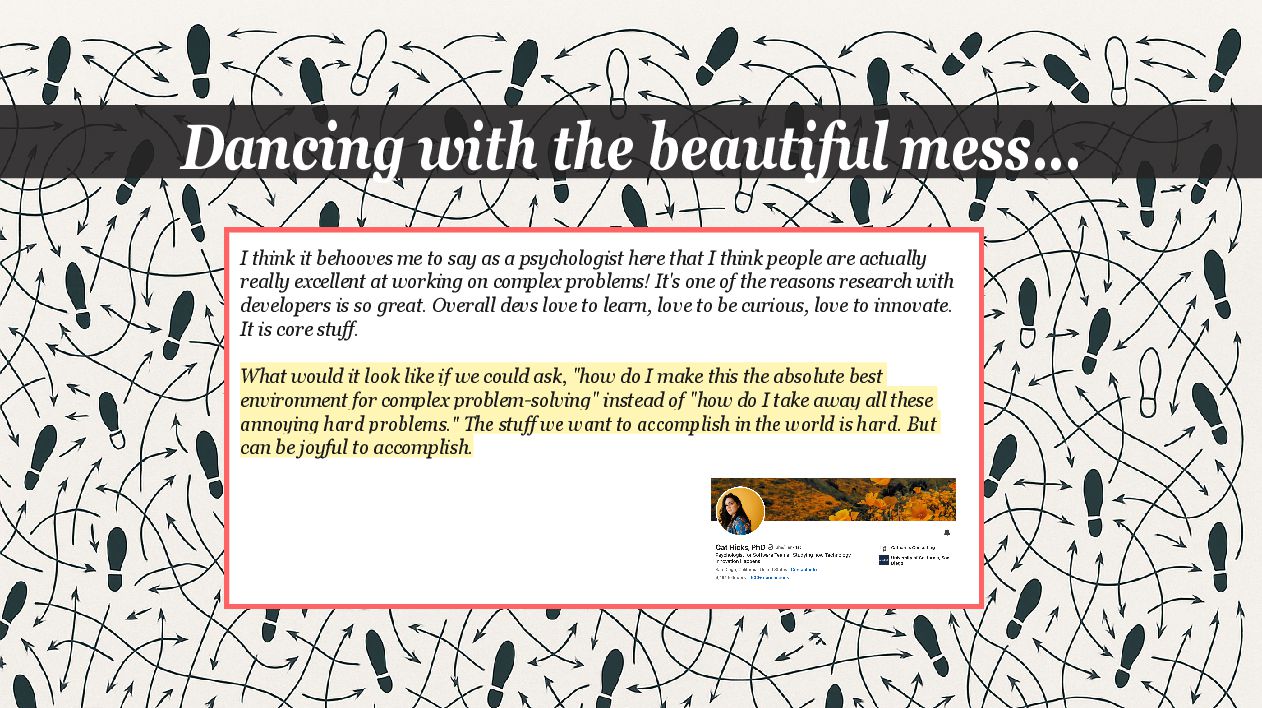
Dancing with the beautiful mess... I think it behooves me
to say as a psychologist here that I think people are actually really excellent at working on complex problems! It's one of the reasons research with developers is so great. Overall devs love to learn, love to be curious, love to innovate. It is core stuff. What would it look like if we could ask, "how do I make this the absolute best environment for complex problem- solving" instead of "how do I take away all these annoying hard problems." The stuff we want to accomplish in the world is hard. But can be joyful to accomplish. -
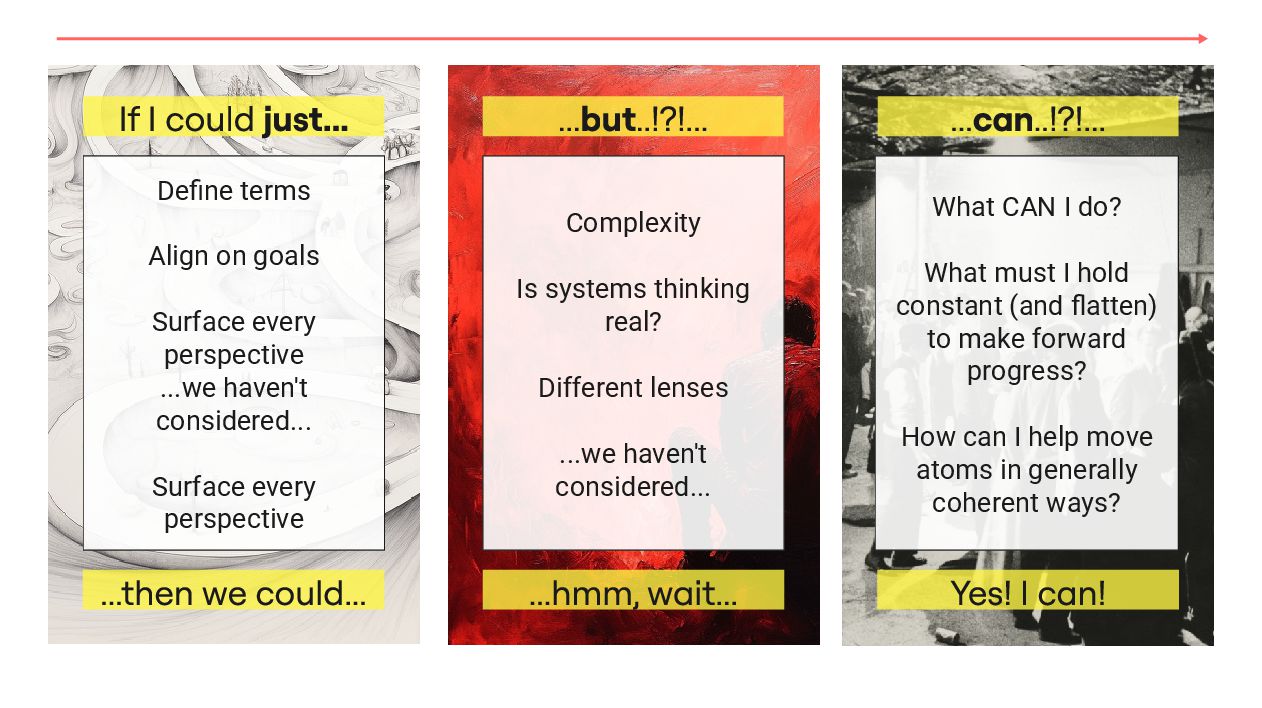
If I could just... ...then we could... ...but..!?!... ...can..!?!... ...hmm,
wait... What CAN I do? What must I hold constant (and flatten) to make forward progress? How can I help move atoms in generally coherent ways? Complexity Is systems thinking real? Different lenses ...we haven't considered... Define terms Align on goals Surface every perspective ...we haven't considered... Surface every perspective Yes! I can! -
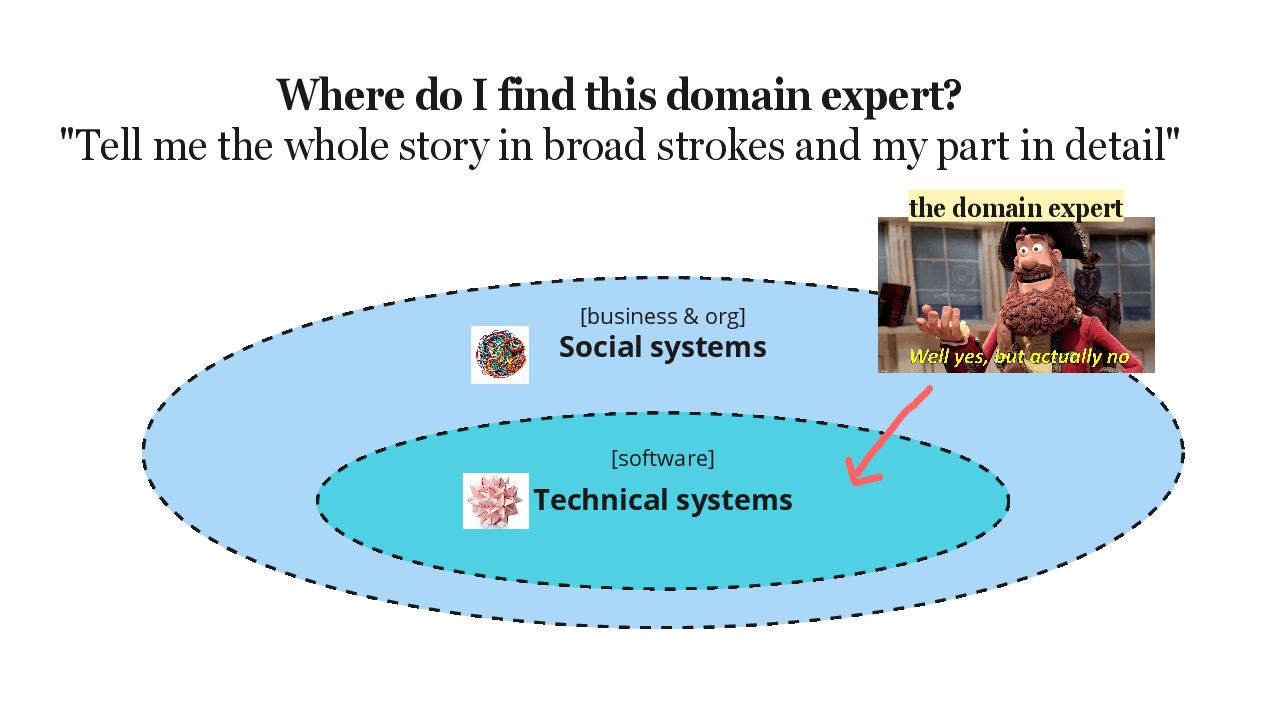
Where do I find this domain expert? "Tell me the
whole story in broad strokes and my part in detail" Social systems Technical systems [software] [business & org] the domain expert -
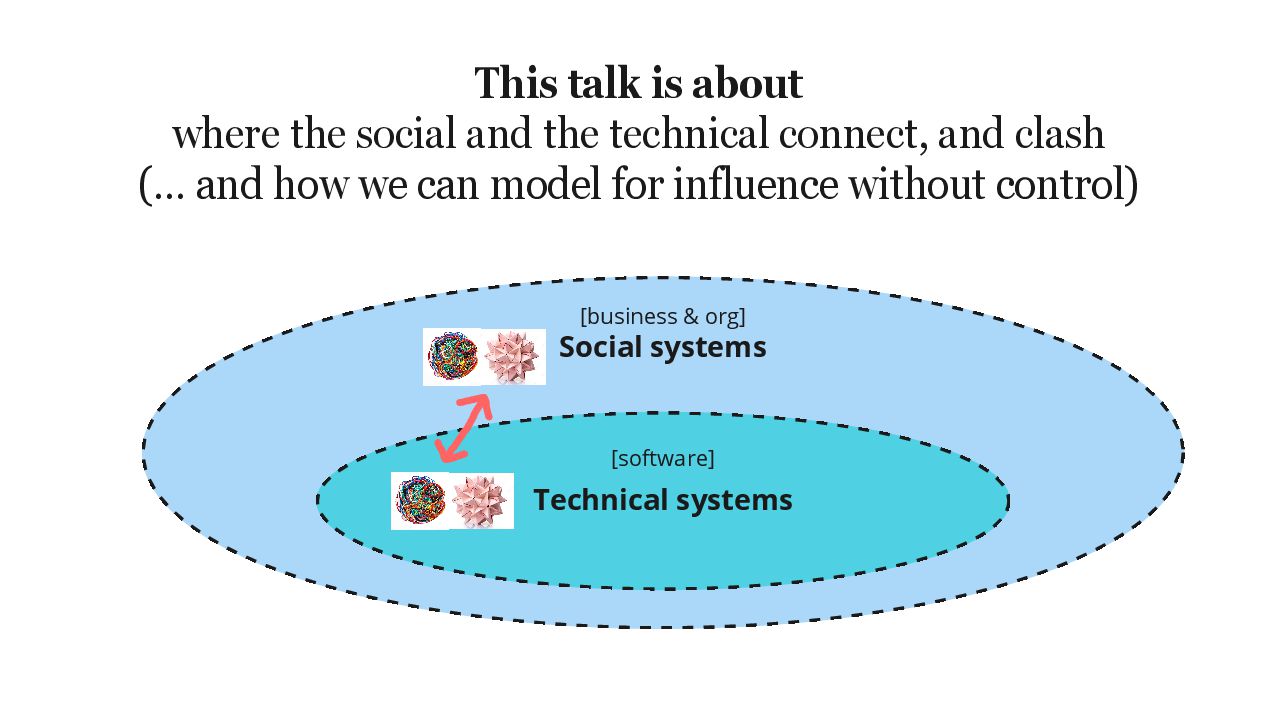
Social systems Technical systems [software] [business & org] This talk
is about where the social and the technical connect, and clash (... and how we can model for influence without control) -
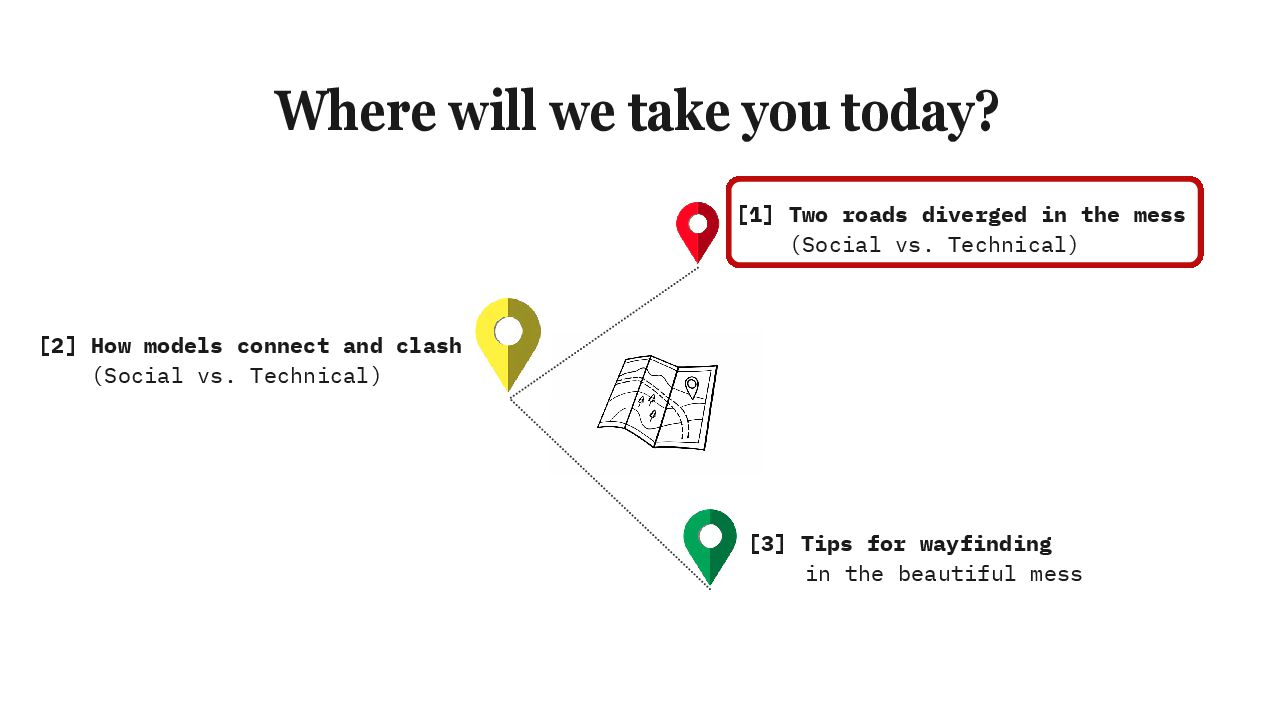
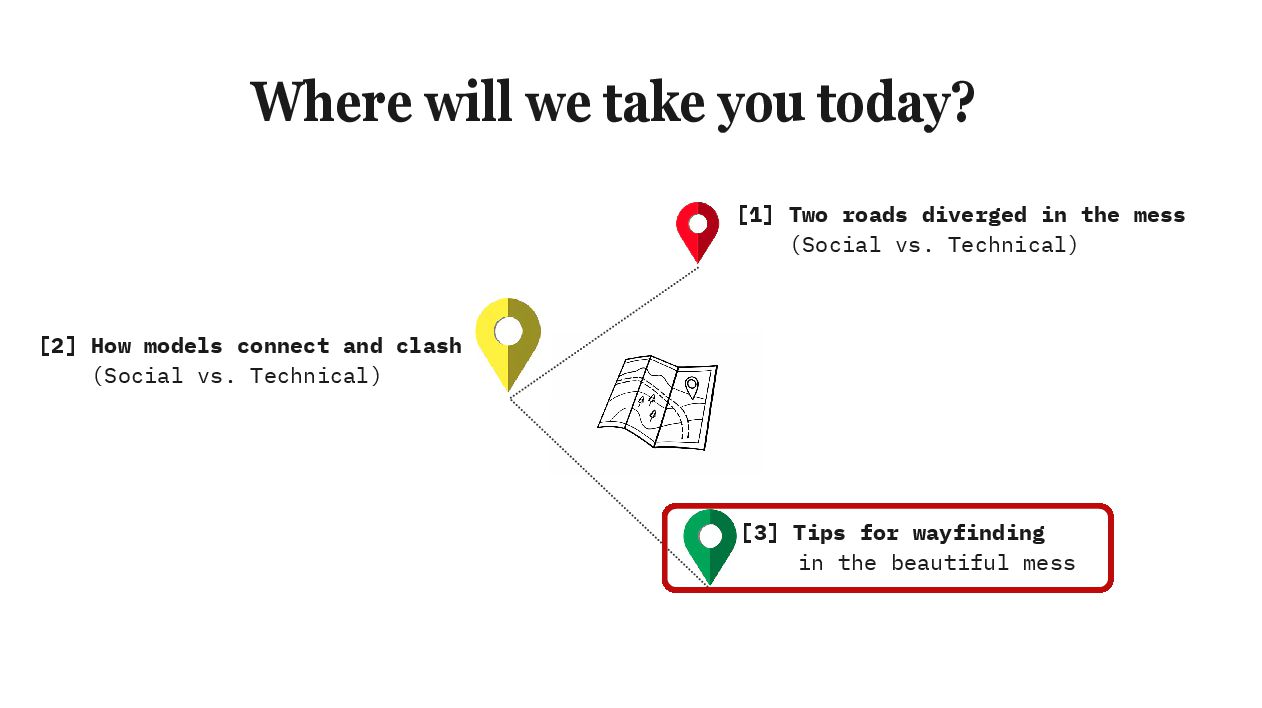
[1] Two roads diverged in the mess (Social vs. Technical)
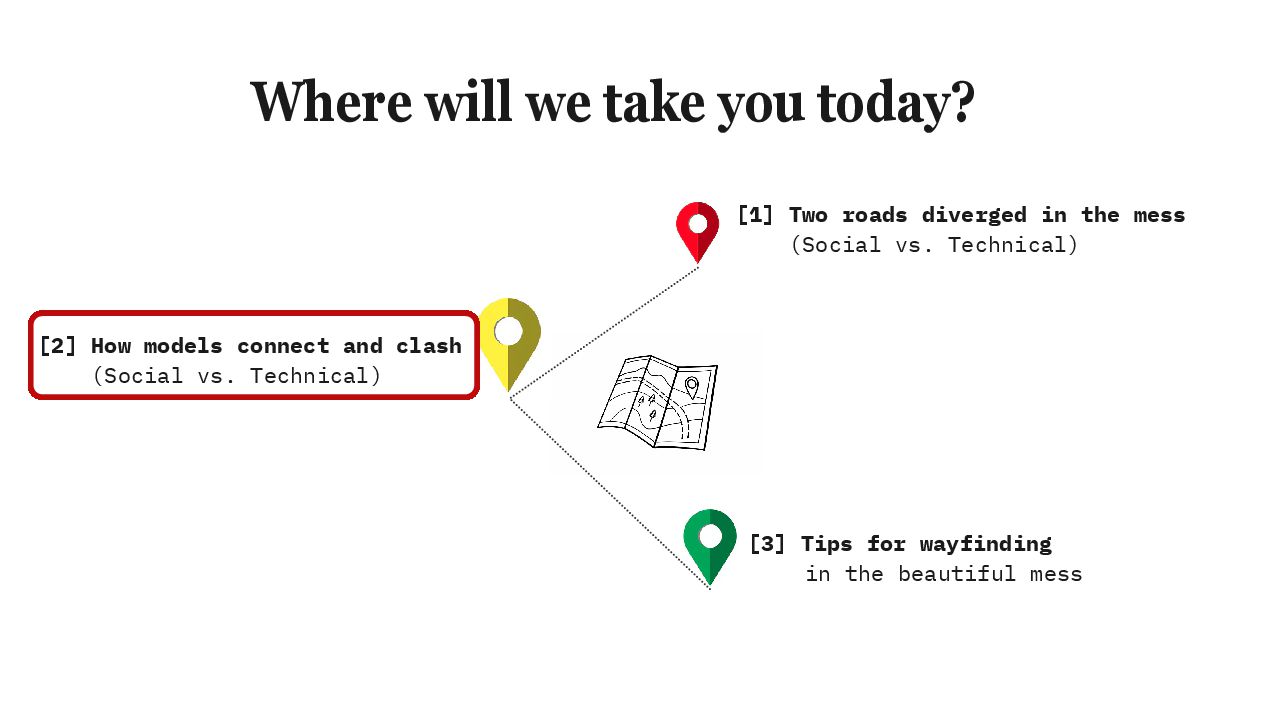
[2] How models connect and clash (Social vs. Technical) [3] Tips for wayfinding in the beautiful mess Where will we take you today? -
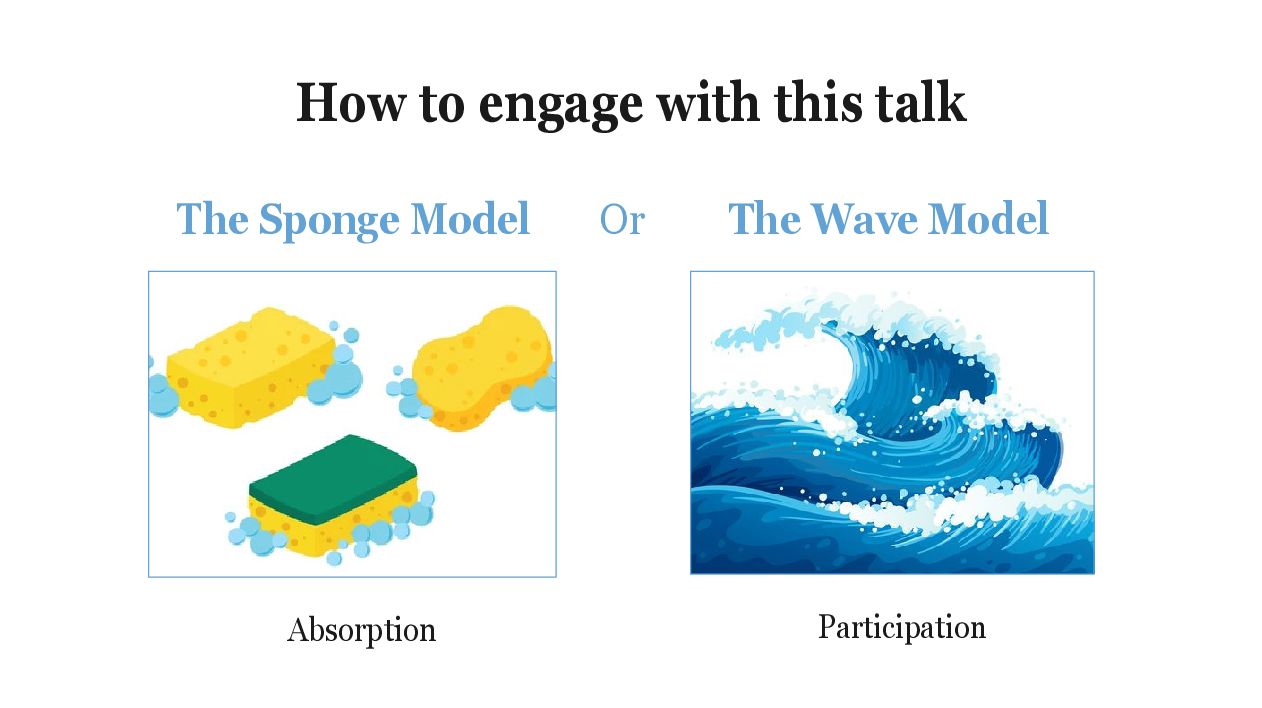
How to engage with this talk The Sponge Model The
Wave Model Or Absorption Participation -
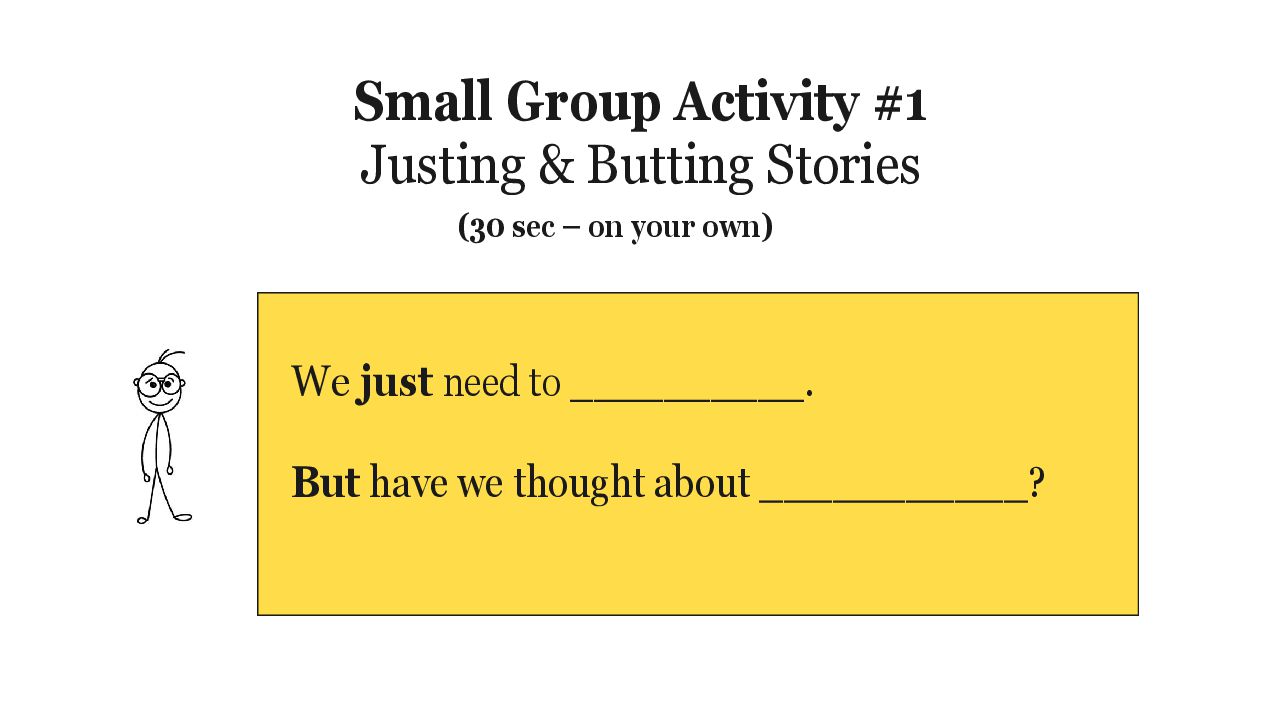
Small Group Activity #1 Justing & Butting Stories We just
need to __________. But have we thought about ___________? (30 sec – on your own) -
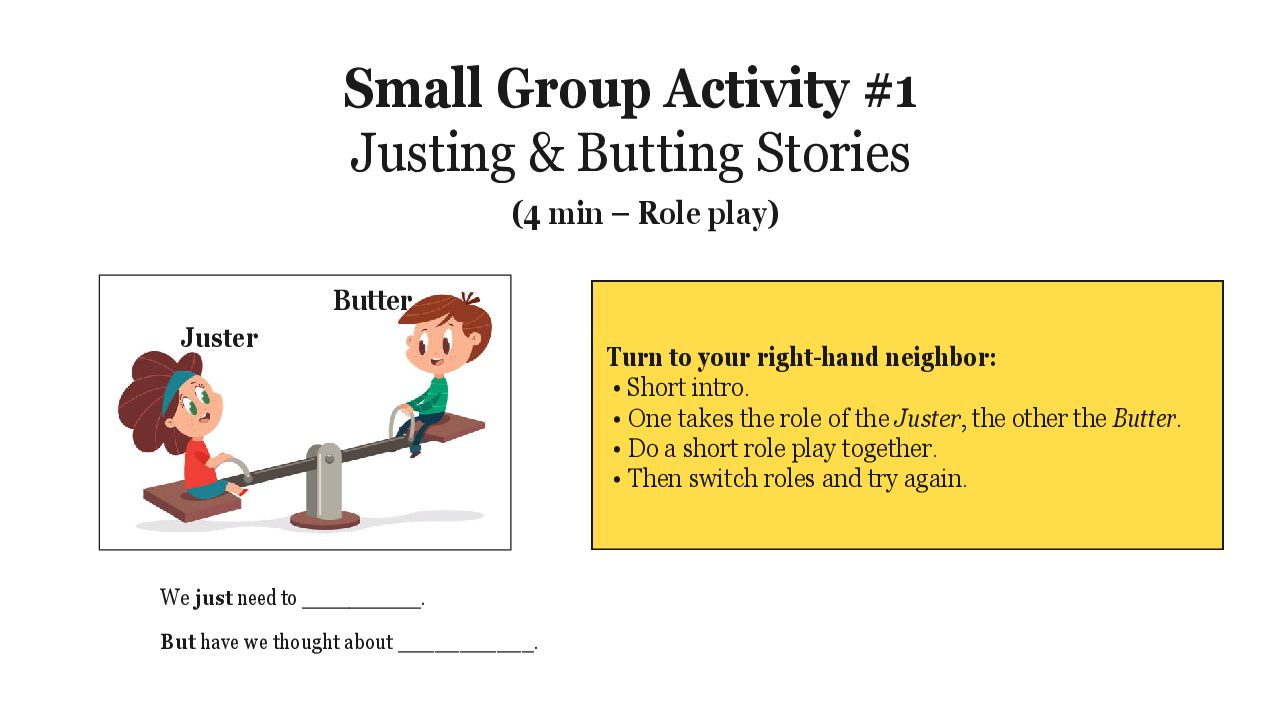
Small Group Activity #1 Justing & Butting Stories Juster Butter
(4 min – Role play) We just need to __________. But have we thought about ___________. Turn to your right- hand neighbor: • Short intro. • One takes the role of the Juster, the other the Butter. • Do a short role play together. • Then switch roles and try again. -
Where will we take you today? [1] Two roads diverged
in the mess (Social vs. Technical) [2] How models connect and clash (Social vs. Technical) [3] Tips for wayfinding in the beautiful mess -
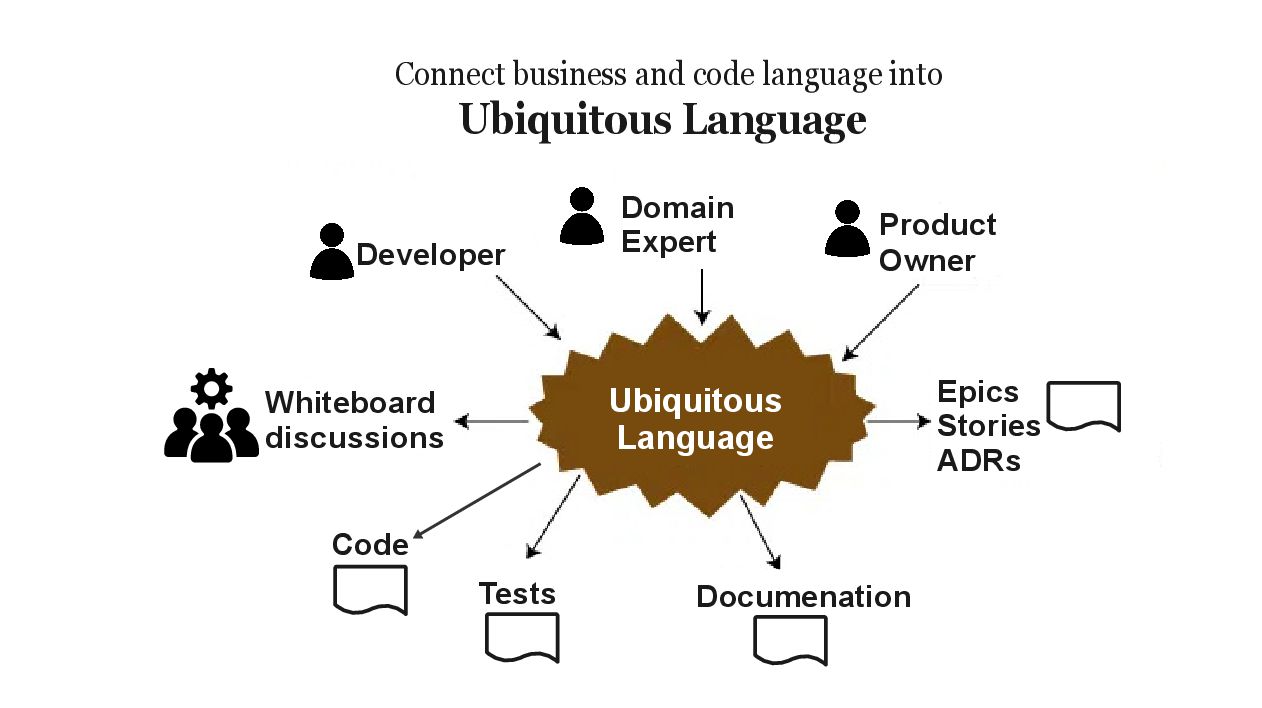
Ubiquitous Language Connect business and code language into Test Product
Owner Developer Domain Expert Epics Stories ADRs Documenation Tests Code Whiteboard discussions Ubiquitous Language -
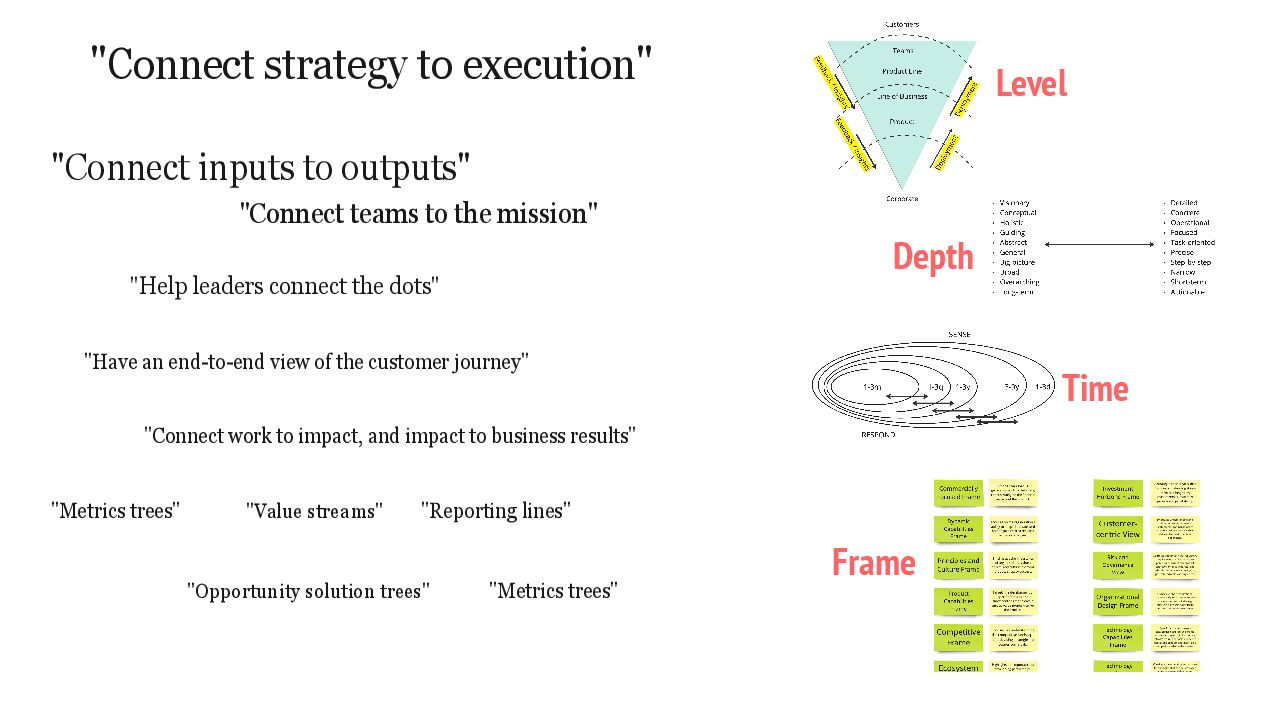
"Connect strategy to execution" "Connect inputs to outputs" "Have an
end- to- end view of the customer journey" "Connect work to impact, and impact to business results" "Metrics trees" "Value streams" "Reporting lines" "Connect teams to the mission" "Help leaders connect the dots" "Opportunity solution trees" "Metrics trees" Level Depth Time Frame -
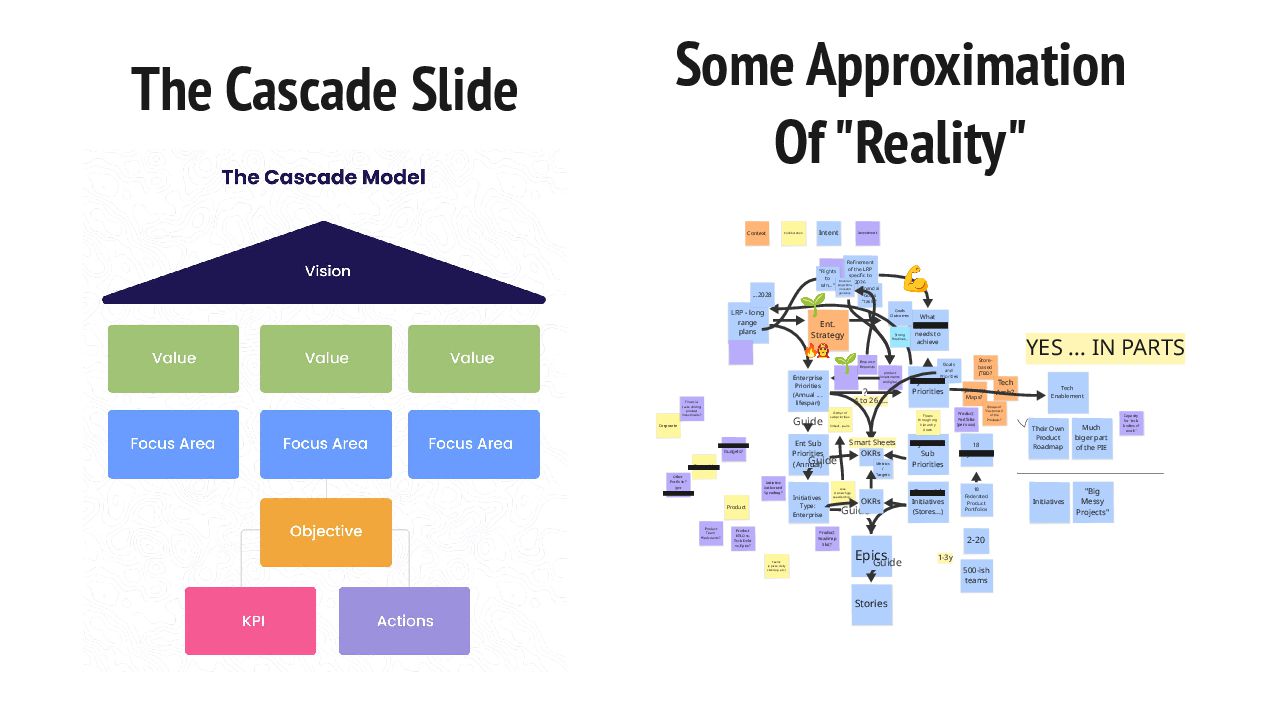
The Cascade Slide Some Approximation Of "Reality" Context Collaboration Intent
Investment LRP - long range plans Enterprise Priorities (Annual .. . lifespan) Ent Sub Priorities (Annual) Guide Initiatives Type: Enterprise Guide 1-3y Pyramid Corporate Epics Product Stories Guide Guide Teams (2- pizza, daily standup, etc.) Pyramid Initiatives (Stores...) Pyramid Budgets? Pyramid Sub Priorities Product Team Hedcounts? Initiative Authorized Spending? Pyramid Priorities Product Roadmap Slot? ? Journey Maps? Store- based JTBD? Tech Arch? Owner of sub priorities ... linked....pairs Flows through org hierarchy down Lose Ownershgip Leeadership.... What pyramid needs to achieve Product KTLO vs. Tech Debt vs. Epics? Ent. Strategy Product Portfolio (per xxxx) Goals Outcomes Groups of "Customers" of the Products? YES ... IN PARTS Tech Enablement Their Own Product Roadmap Much biger part of the PIE Initiatives "Big Messy Projects" Capacity for "tech bodies of work" Refinement of the LRP specific to 2026 ...2028 Other Portfolio? (per pyramid?) Financial Goals "tasks" Strong Routines... "Rights to win..." Financial projections / investor guidance product investments w/digital Financial tasks driving product investments? 4 to 26 .... OKRs Goals and Priorities Smart Sheets Metrics / Targets OKRs 18 Federated Product Portfolios 18 Pyramids 500- ish teams 2-20 Resource Requests -
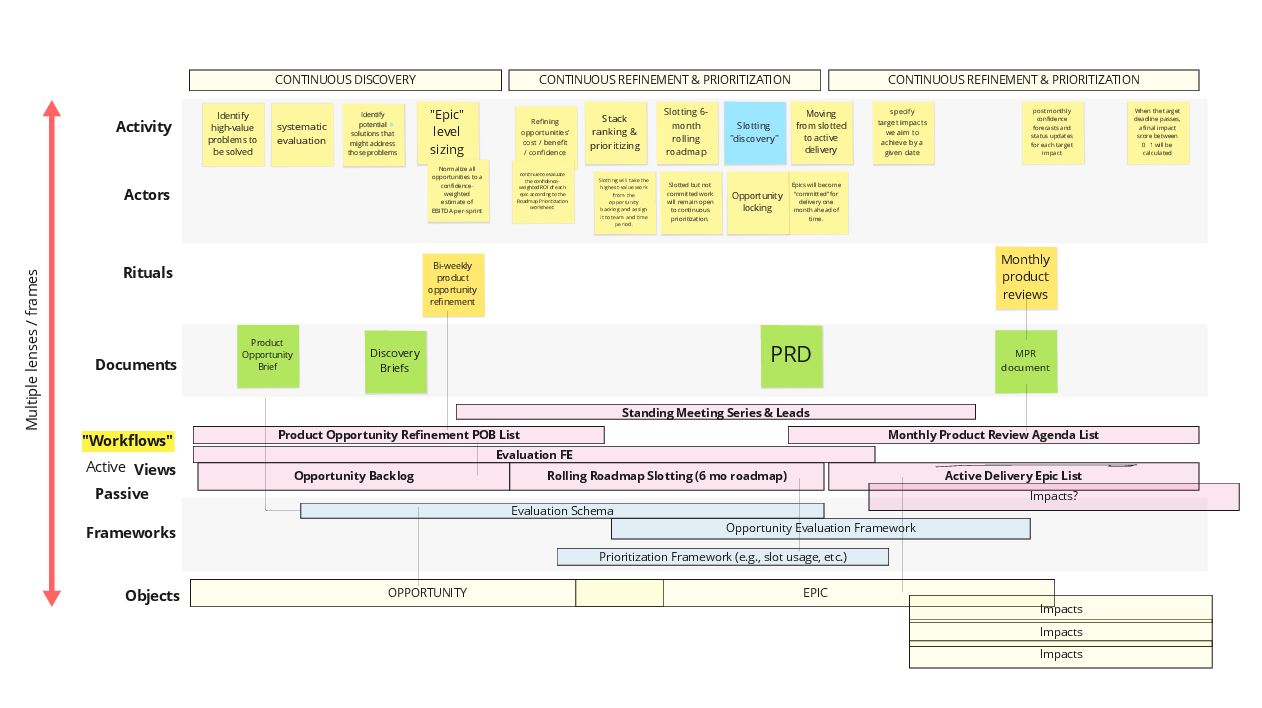
OPPORTUNITY EPIC "Epic" level sizing Refining opportunitiesʼ cost / benefit
/ confidence Stack ranking & prioritizing Slotting 6- month rolling roadmap Moving from slotted to active delivery post monthly confidence forecasts and status updates for each target impact specify target impacts we aim to achieve by a given date Product Opportunity Brief Discovery Briefs Documents Activity CONTINUOUS DISCOVERY CONTINUOUS REFINEMENT & PRIORITIZATION CONTINUOUS REFINEMENT & PRIORITIZATION Identify high- value problems to be solved Identify potential solutions that might address those problems systematic evaluation continue to evaluate the confidence- weighted ROI of each epic according to the Roadmap Prioritization worksheet. Slotting will take the highest- value work from the opportunity backlog and assign it to team and time period. Epics will become “committedˮ for delivery one month ahead of time. Objects Slotted but not committed work will remain open to continuous prioritization. Views Rolling Roadmap Slotting (6 mo roadmap) Bi- weekly product opportunity refinement Rituals When the target deadline passes, a final impact score between 01 will be calculated Monthly product reviews Opportunity Evaluation Framework Normalize all opportunities to a confidence- weighted estimate of EBITDA- per- sprint Opportunity locking Active Delivery Epic List Opportunity Backlog Evaluation Schema Standing Meeting Series & Leads Frameworks Product Opportunity Refinement POB List Monthly Product Review Agenda List MPR document Prioritization Framework (e.g., slot usage, etc.) PRD Slotting "discovery" Evaluation FE Impacts Impacts Impacts Impacts? "Workflows" Active Passive Actors Multiple lenses / frames -
CONTEXT COLLABORATION Core customer segments, industry shifts, regulatory landscape Emerging
competitor behavior, shift in customer behavior in one region A new customer insight from a recent interview, friction in onboarding flow Org- wide operating model, reporting structure, key communities of practice Cross- functional coordination between Product and Sales on key segment Who is attending a review, who’s facilitating, or which team is blocked on another Sprint- level initiative or team priority this cycle Product- level goal (e.g., “Redesign onboarding by Q4”) Sprint- level investment to test a hypothesis with fast feedback loops Dedicated team to prove out a segment or use case (strategic, long- range, high- risk) (momentum, coordinated effort, mid- horizon) Customer segments Personas Jobs to be done Market categories Competitor profiles Capability maps Service directories Regulatory frameworks Technology trends Partner ecosystems Individuals Teams Roles Reporting lines Working groups Informal influence networks Collaboration patterns Triads / pods Accountability relationships Escalation paths Strategic pillars Objectives Initiatives Themes Roadmap items Opportunity briefs Focus areas Hypotheses Experiments Product bets Strategic pillars (e.g., “expand into healthcare vertical”) INTENT Multi- million dollar strategic bet with high risk and pivot/proceed logic Budget allocations Headcount assignments Time commitments Tooling spend Vendor contracts Dedicated teams Initiative funding Risk- reward profiles Investment theses Stage- gates or go/no- go checkpoints INVESTMENT -
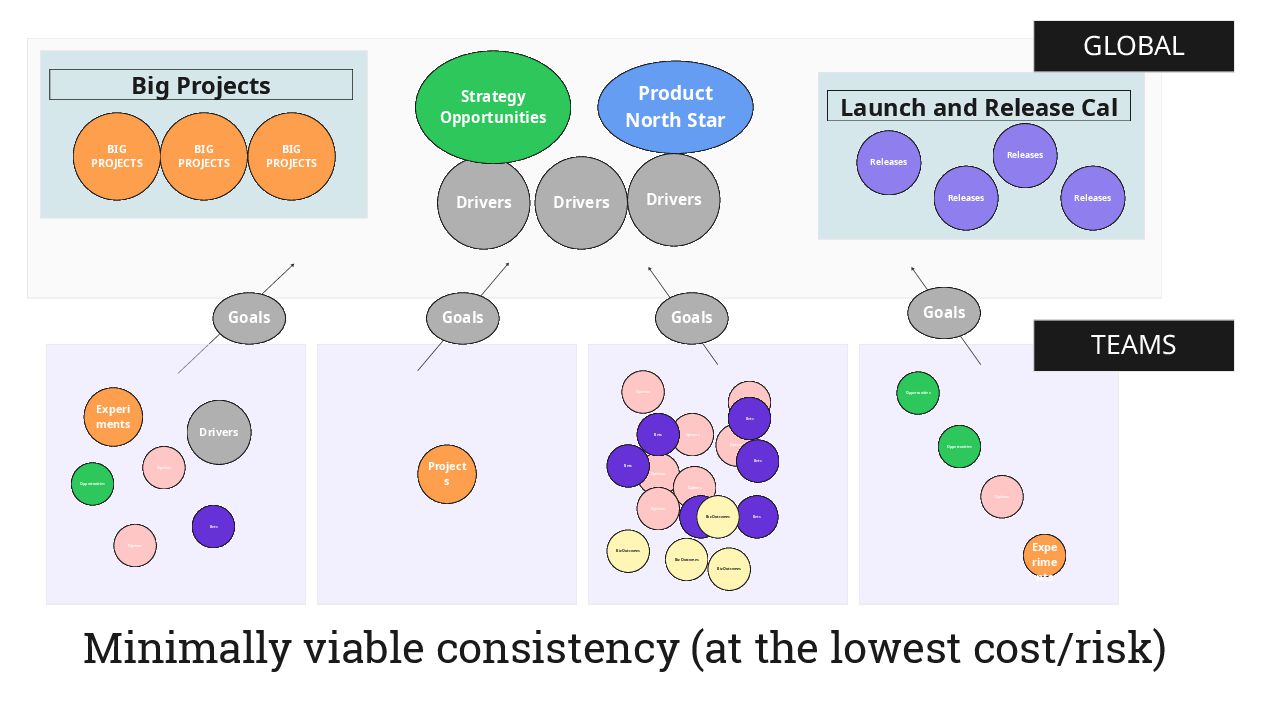
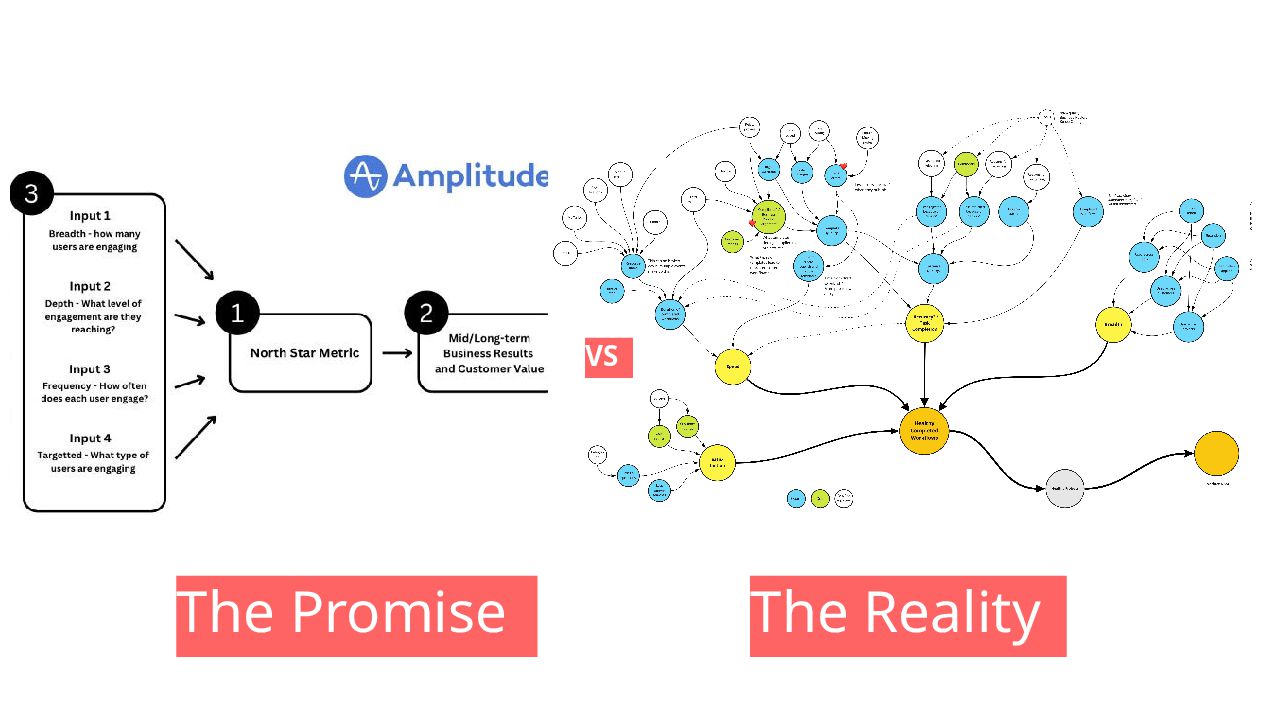
Minimally viable consistency (at the lowest cost/risk) Opportunities Options Drivers
Experi ments Options Bets Project s Product North Star Drivers Drivers Drivers Options Options Options Options Options Options Options Bets Bets Bets Bets Bets Bets Biz Outcomes Biz Outcomes Biz Outcomes Biz Outcomes Opportunities Opportunities Options Expe rime nts Launch and Release Cal Big Projects Releases Releases Releases Releases BIG PROJECTS BIG PROJECTS BIG PROJECTS Goals Goals Goals Goals Strategy Opportunities GLOBAL TEAMS -
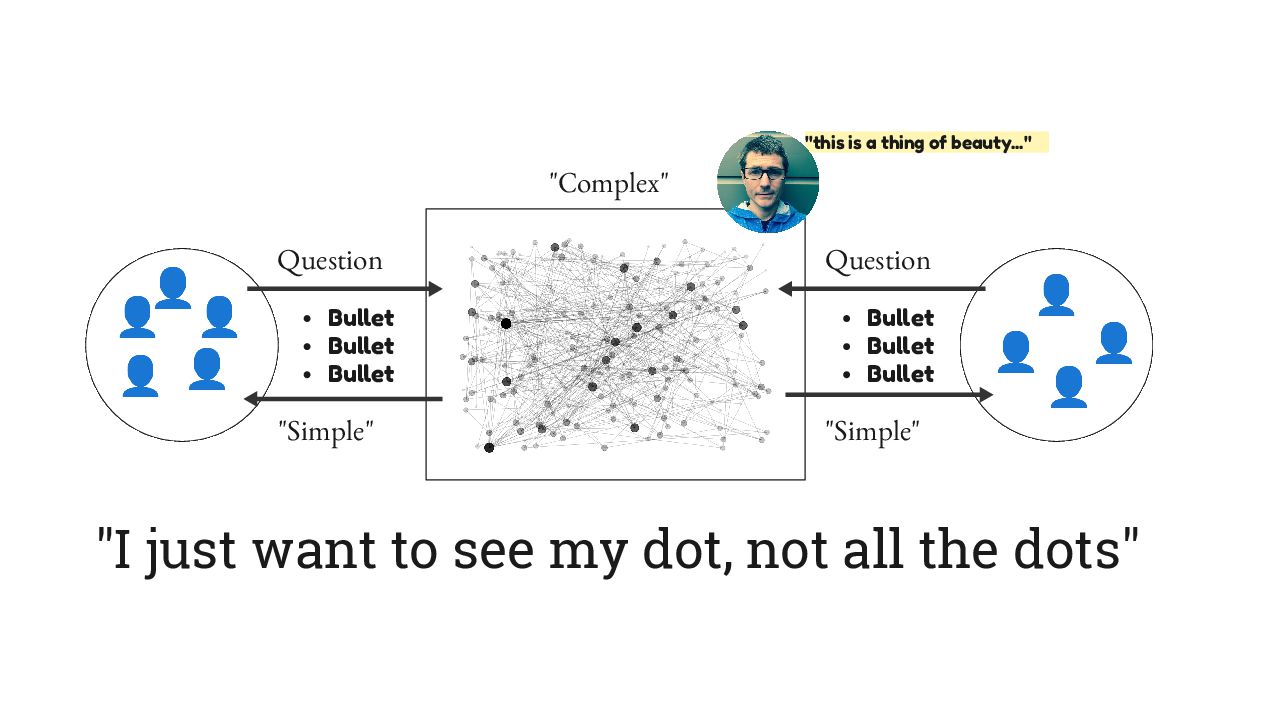
"I just want to see my dot, not all the
dots" Bullet Bullet Bullet Bullet Bullet Bullet "Simple" Question "Complex" "Simple" Question "this is a thing of beauty..." -
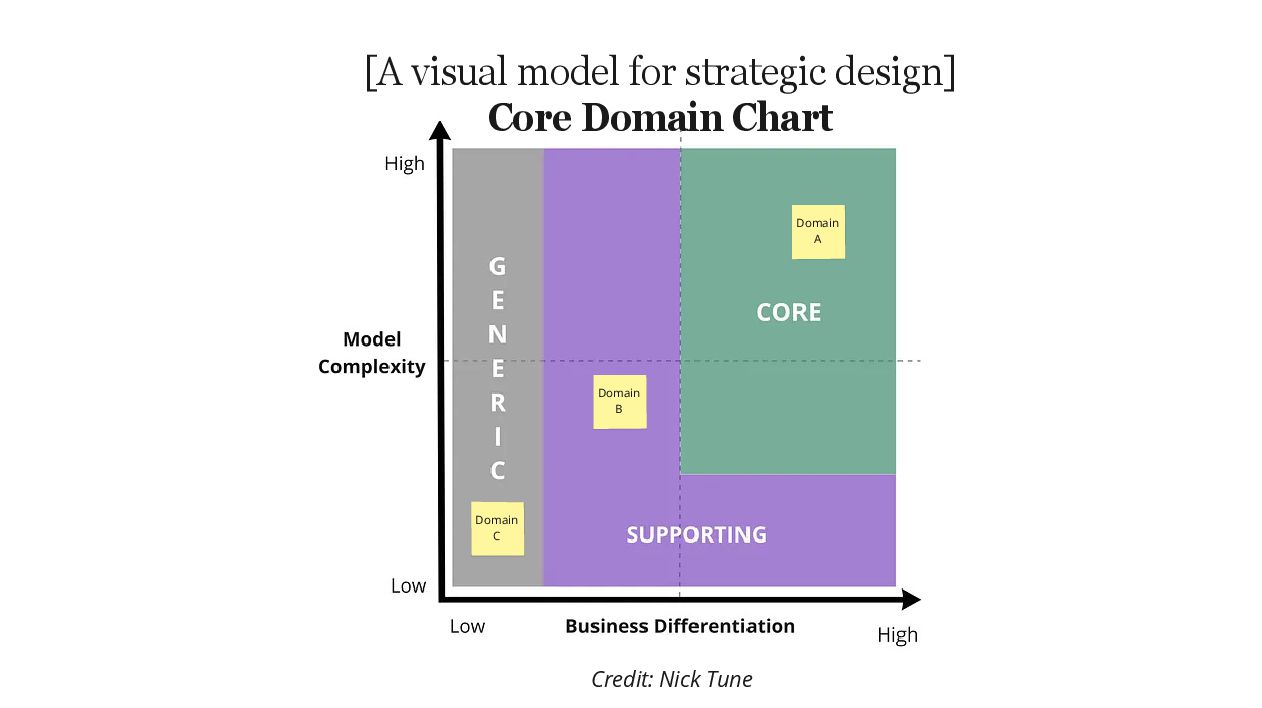
Credit: Nick Tune Domain A Domain B Domain C [A
visual model for strategic design] Core Domain Chart -
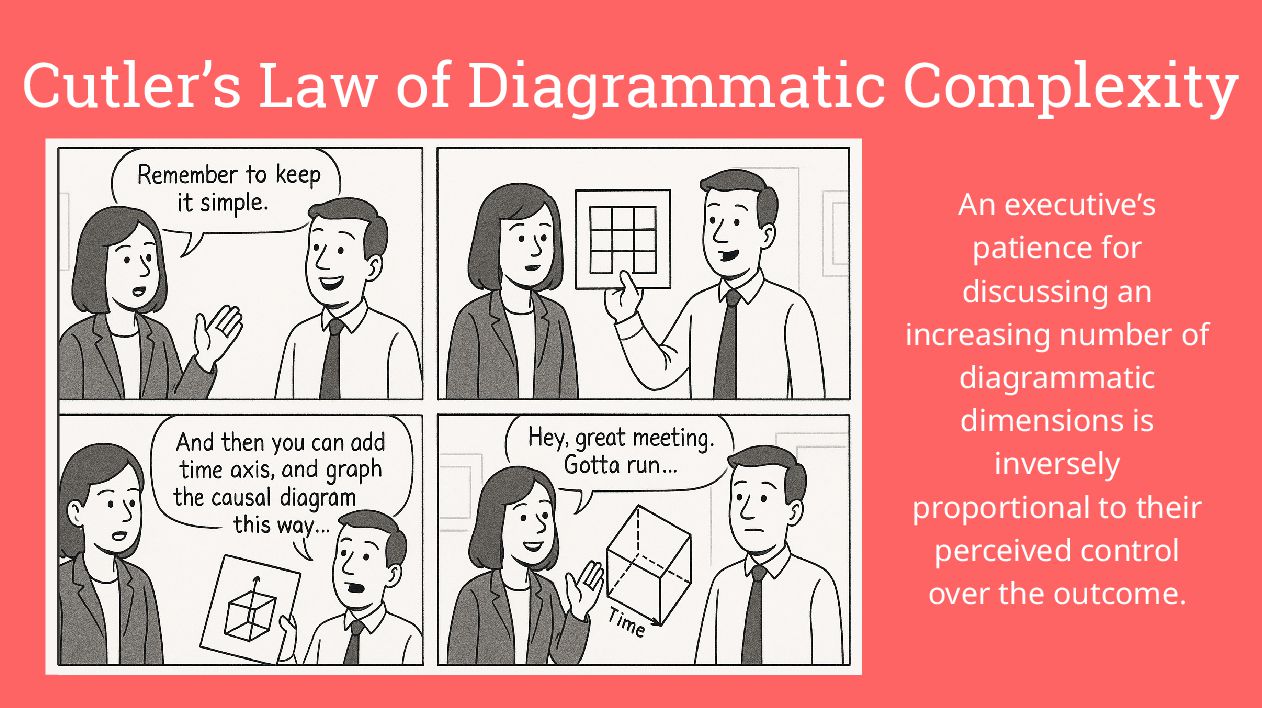
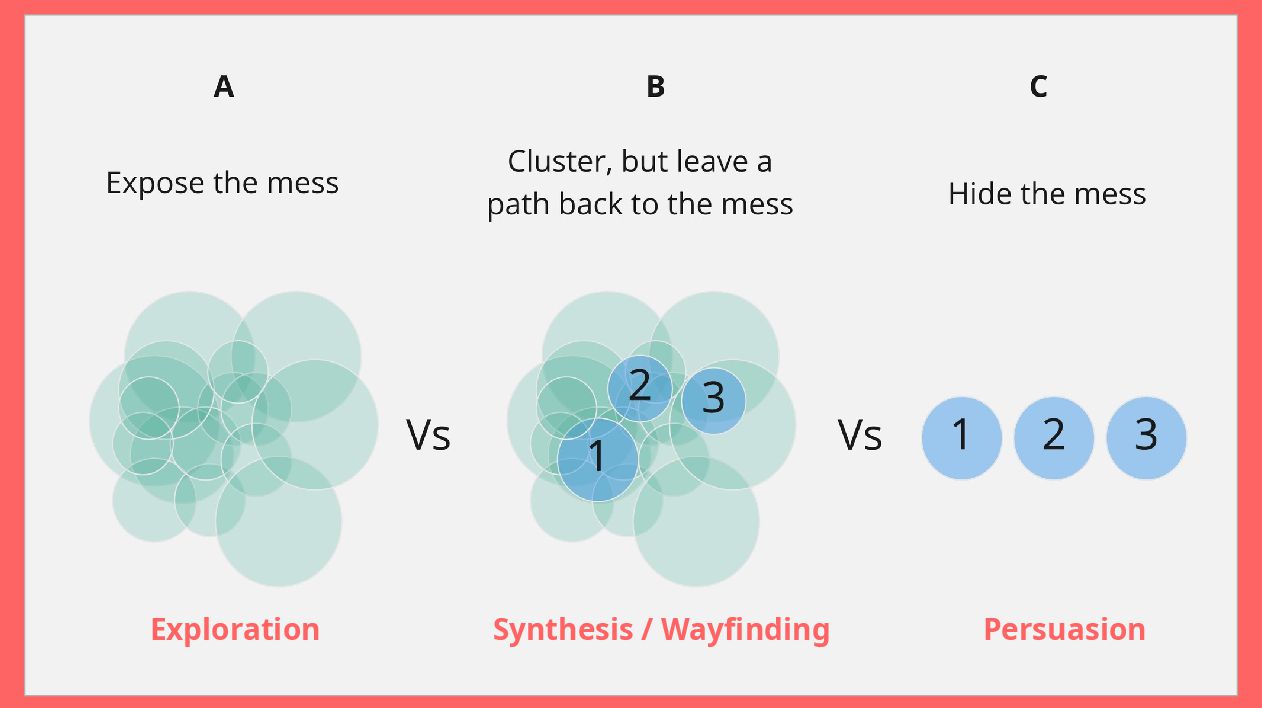
Persuasion Synthesis / Wayfinding An executive’s patience for discussing an
increasing number of diagrammatic dimensions is inversely proportional to their perceived control over the outcome. Cutler’s Law of Diagrammatic Complexity -
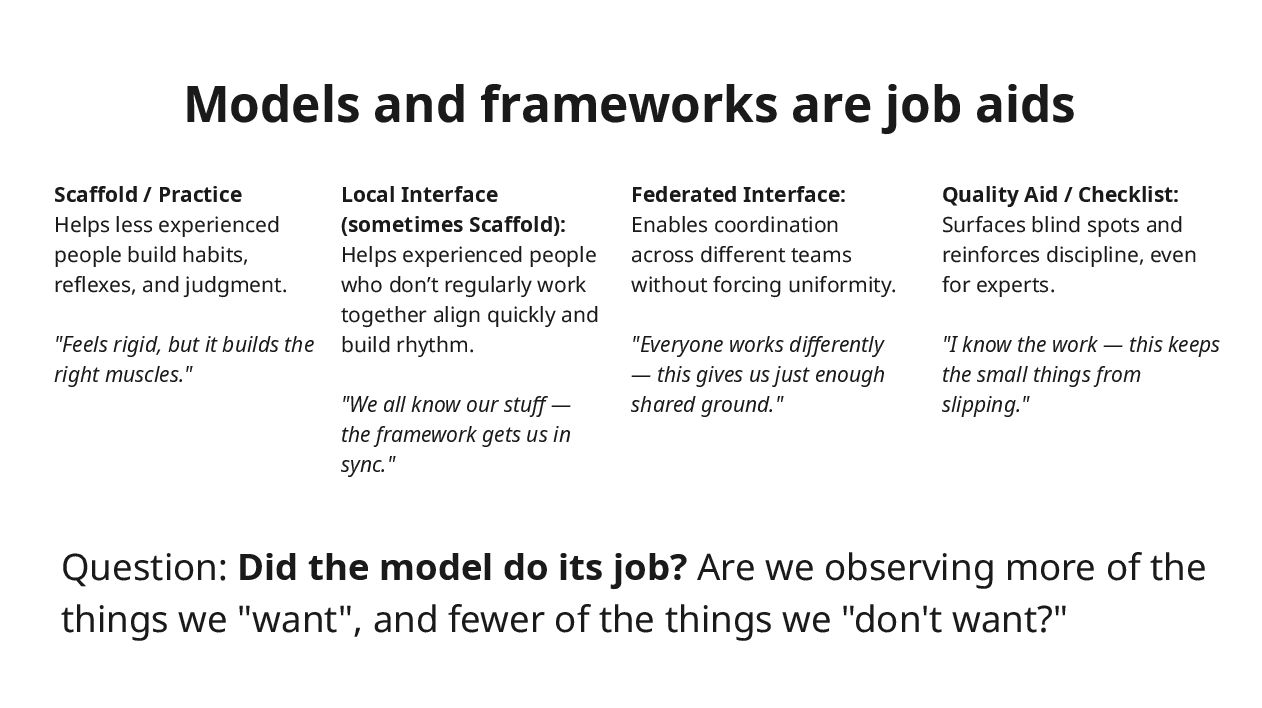
Models and frameworks are job aids Scaffold / Practice Helps
less experienced people build habits, reflexes, and judgment. "Feels rigid, but it builds the right muscles." Local Interface (sometimes Scaffold): Helps experienced people who don’t regularly work together align quickly and build rhythm. "We all know our stuff — the framework gets us in sync." Federated Interface: Enables coordination across different teams without forcing uniformity. "Everyone works differently — this gives us just enough shared ground." Quality Aid / Checklist: Surfaces blind spots and reinforces discipline, even for experts. "I know the work — this keeps the small things from slipping." Question: Did the model do its job? Are we observing more of the things we "want", and fewer of the things we "don't want?" -
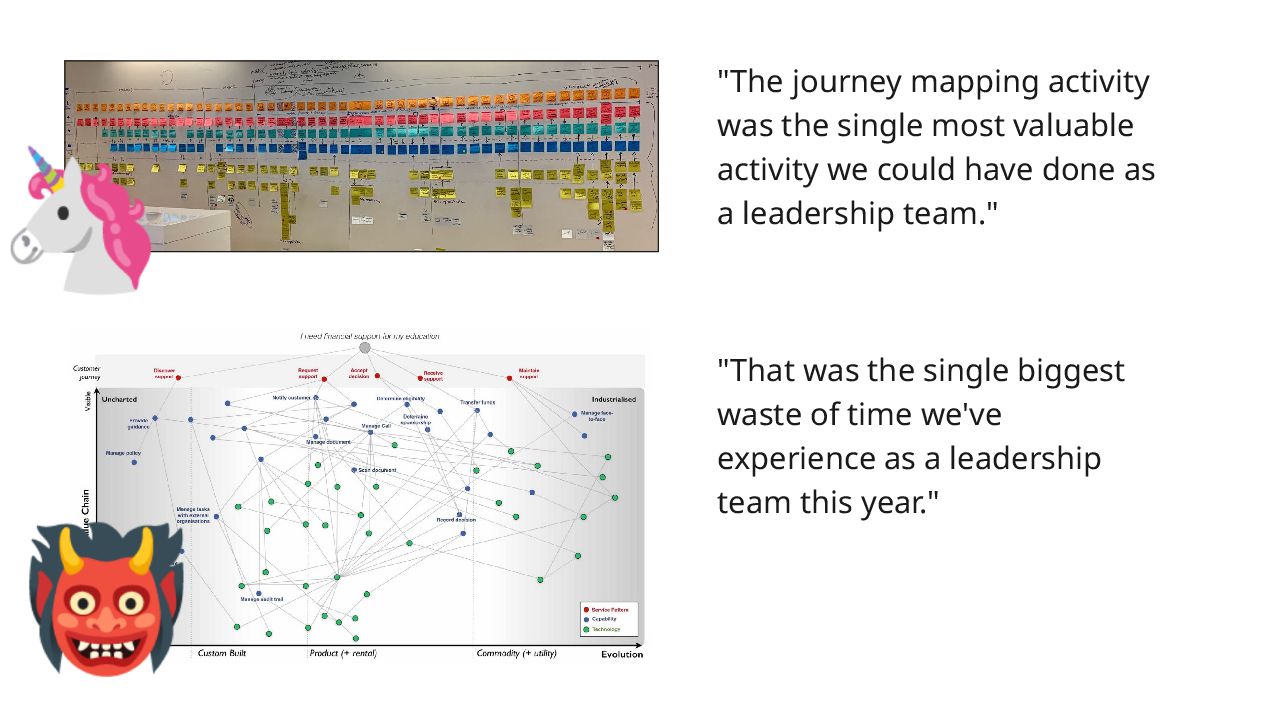
"The journey mapping activity was the single most valuable activity
we could have done as a leadership team." "That was the single biggest waste of time we've experience as a leadership team this year." -
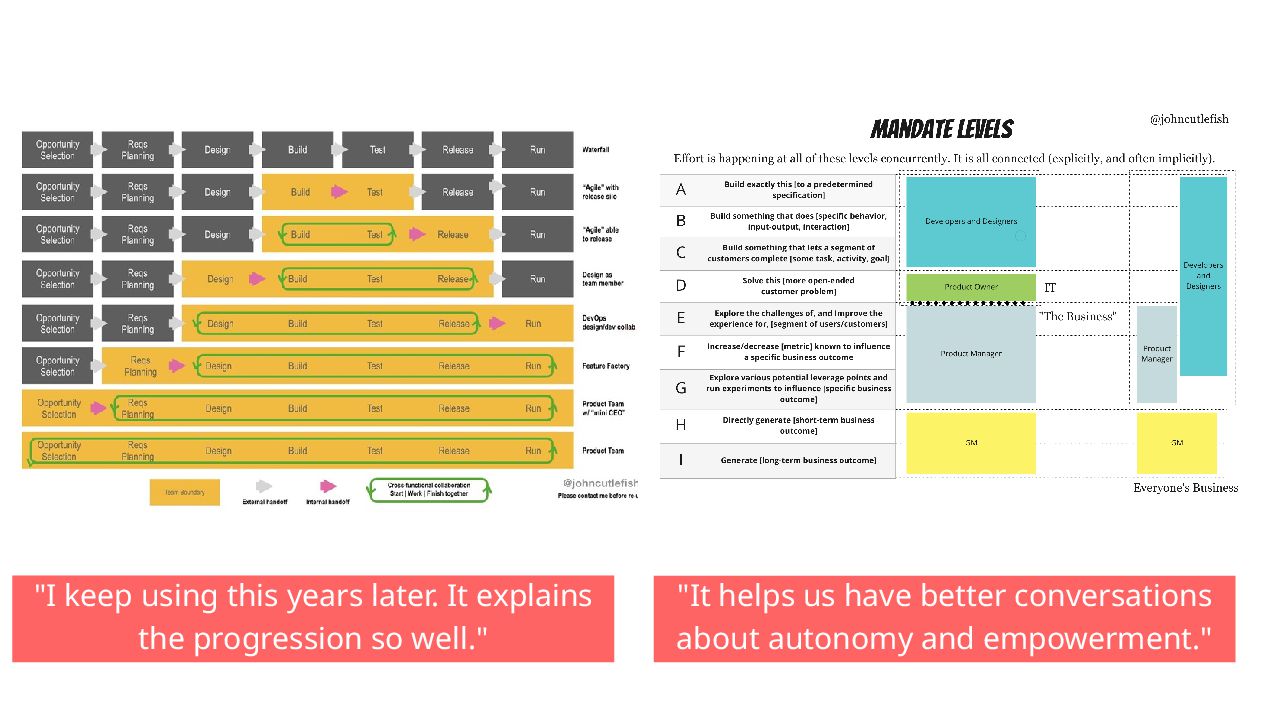
"I keep using this years later. It explains the progression
so well." "It helps us have better conversations about autonomy and empowerment." -
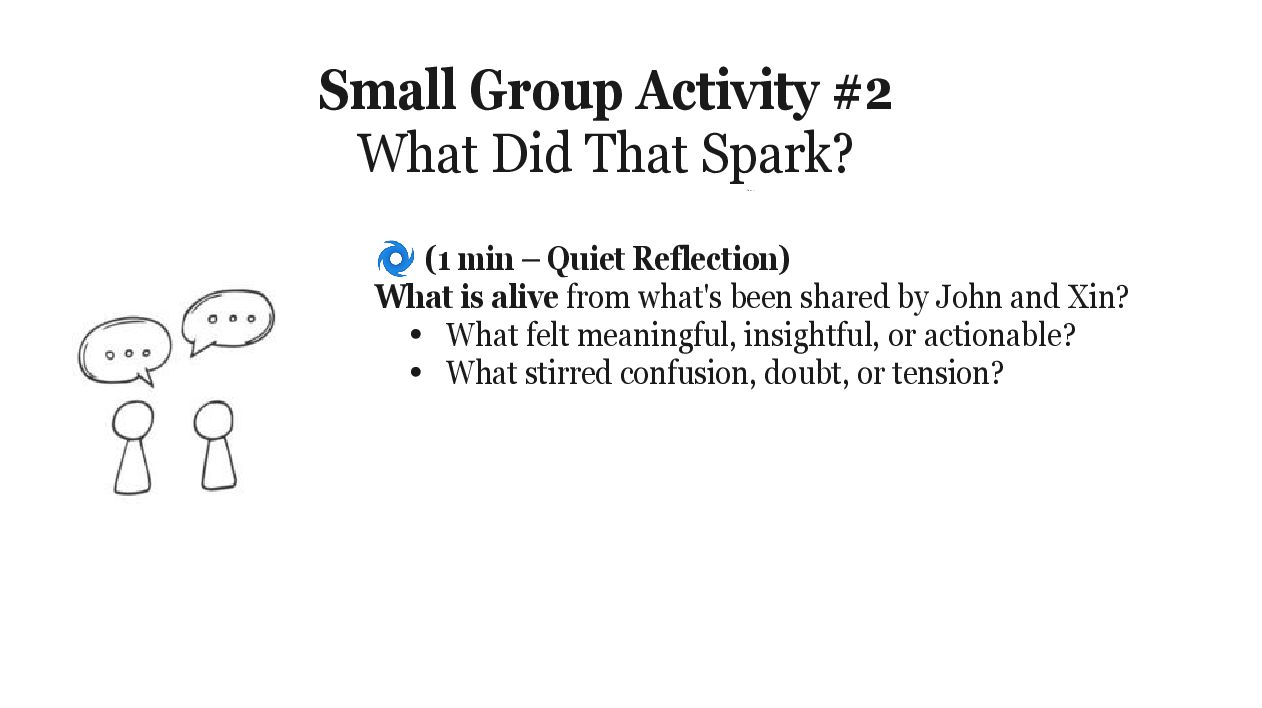
Small Group Activity #2 What Did That Spark? 🌀 (1
min – Quiet Reflection) What is alive from what's been shared by John and Xin? What felt meaningful, insightful, or actionable? What stirred confusion, doubt, or tension? Gaps ... -
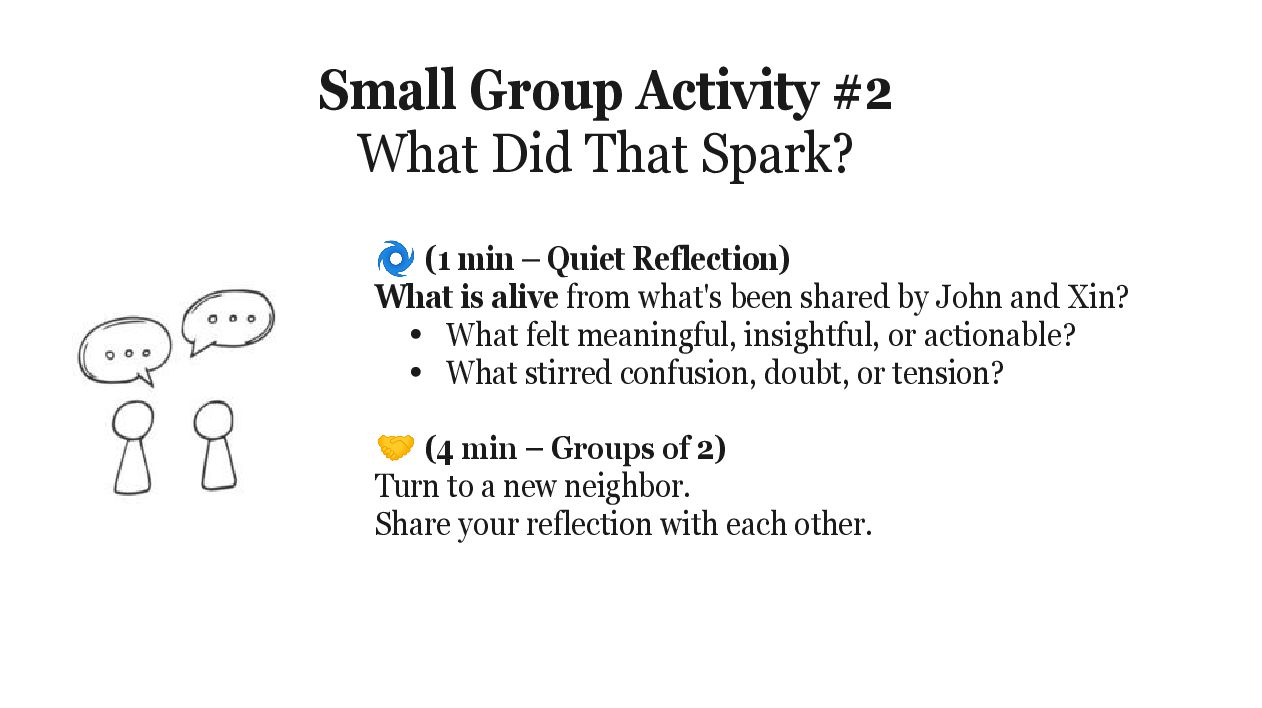
Small Group Activity #2 What Did That Spark? 🌀 (1
min – Quiet Reflection) What is alive from what's been shared by John and Xin? What felt meaningful, insightful, or actionable? What stirred confusion, doubt, or tension? 🤝 (4 min – Groups of 2) Turn to a new neighbor. Share your reflection with each other. -
Where will we take you today? [1] Two roads diverged
in the mess (Social vs. Technical) [2] How models connect and clash (Social vs. Technical) [3] Tips for wayfinding in the beautiful mess -
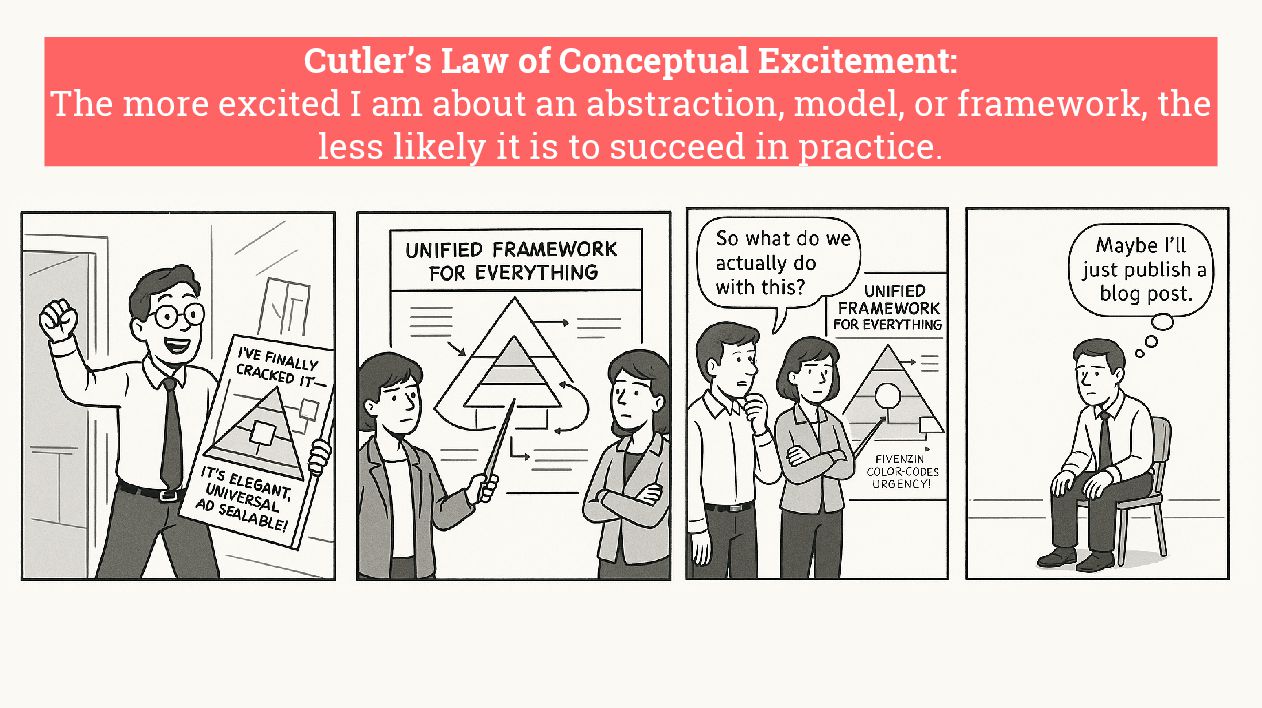
Cutler’s Law of Conceptual Excitement: The more excited I am
about an abstraction, model, or framework, the less likely it is to succeed in practice. -
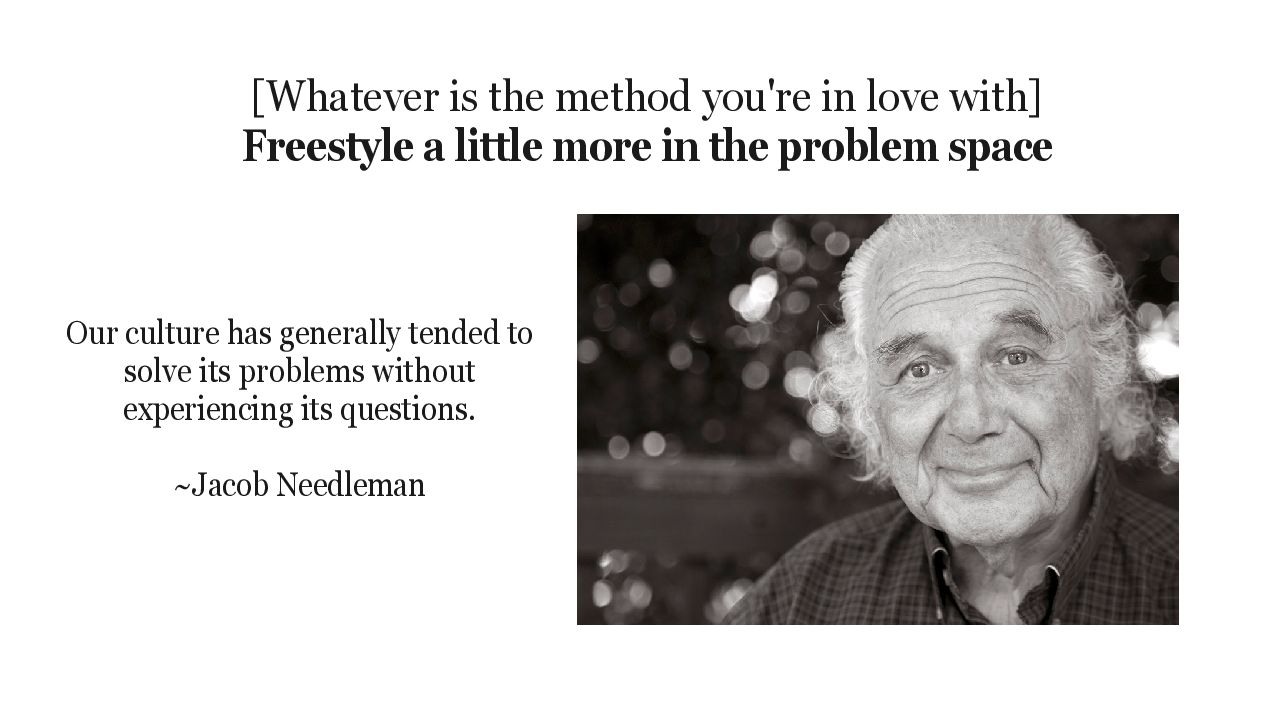
Our culture has generally tended to solve its problems without
experiencing its questions. ~Jacob Needleman [Whatever is the method you're in love with] Freestyle a little more in the problem space -
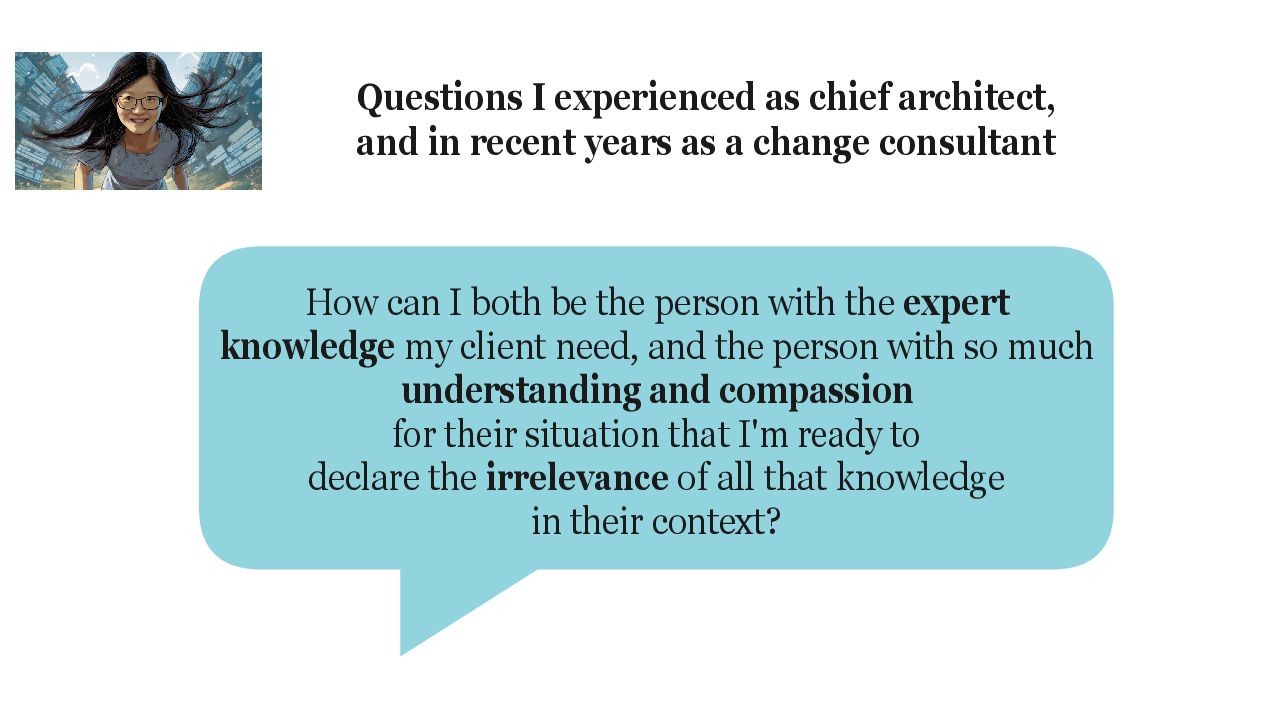
How can I both be the person with the expert
knowledge my client need, and the person with so much understanding and compassion for their situation that I'm ready to declare the irrelevance of all that knowledge in their context? Questions I experienced as chief architect, and in recent years as a change consultant -
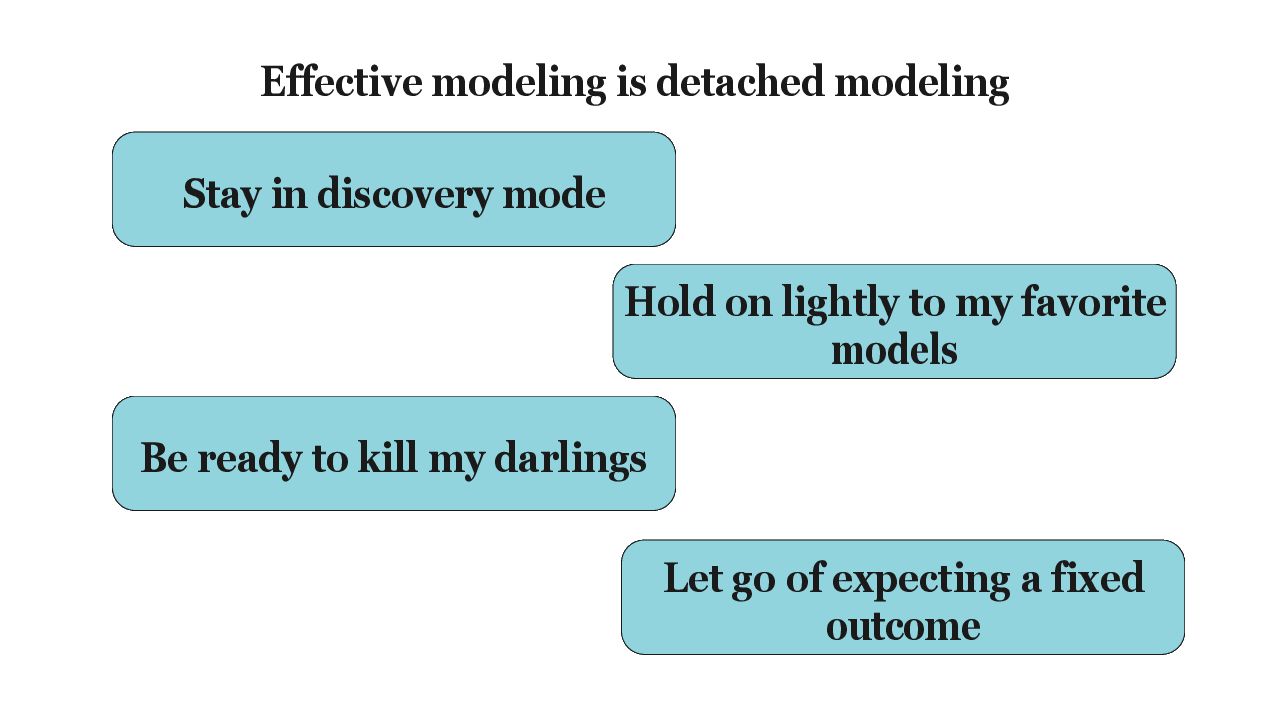
Stay in discovery mode Hold on lightly to my favorite
models Be ready to kill my darlings Effective modeling is detached modeling Let go of expecting a fixed outcome -
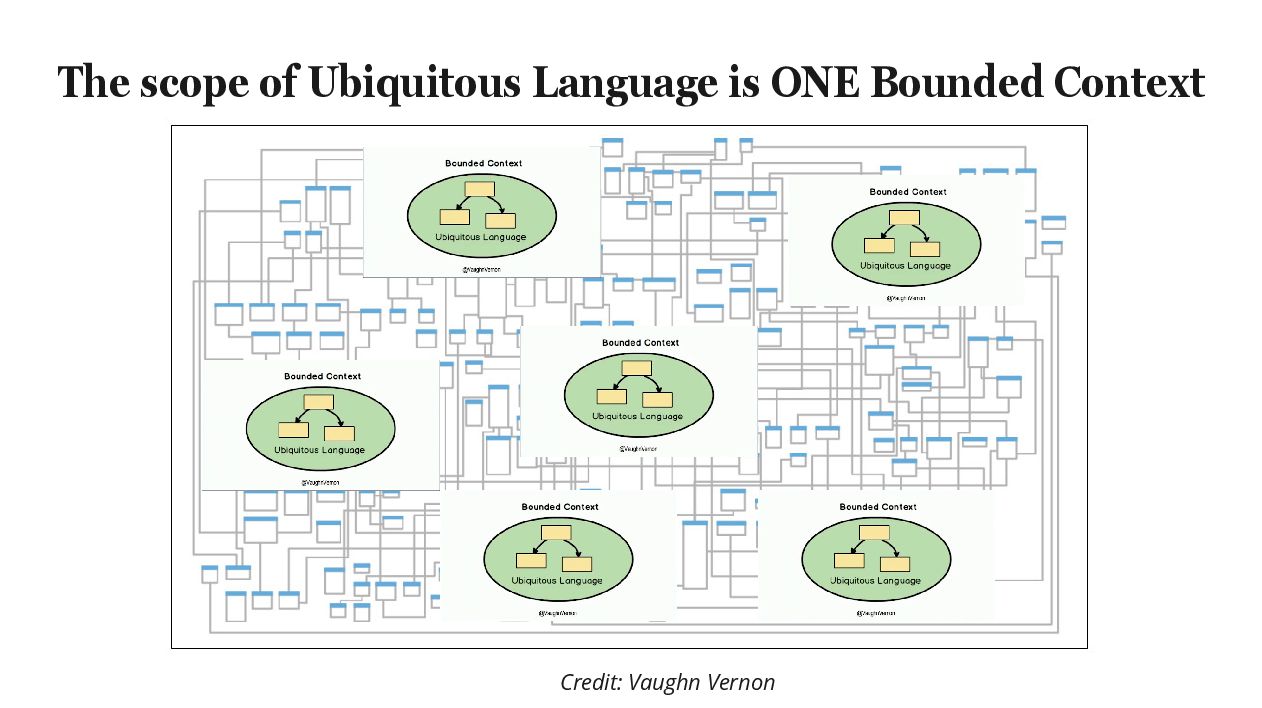
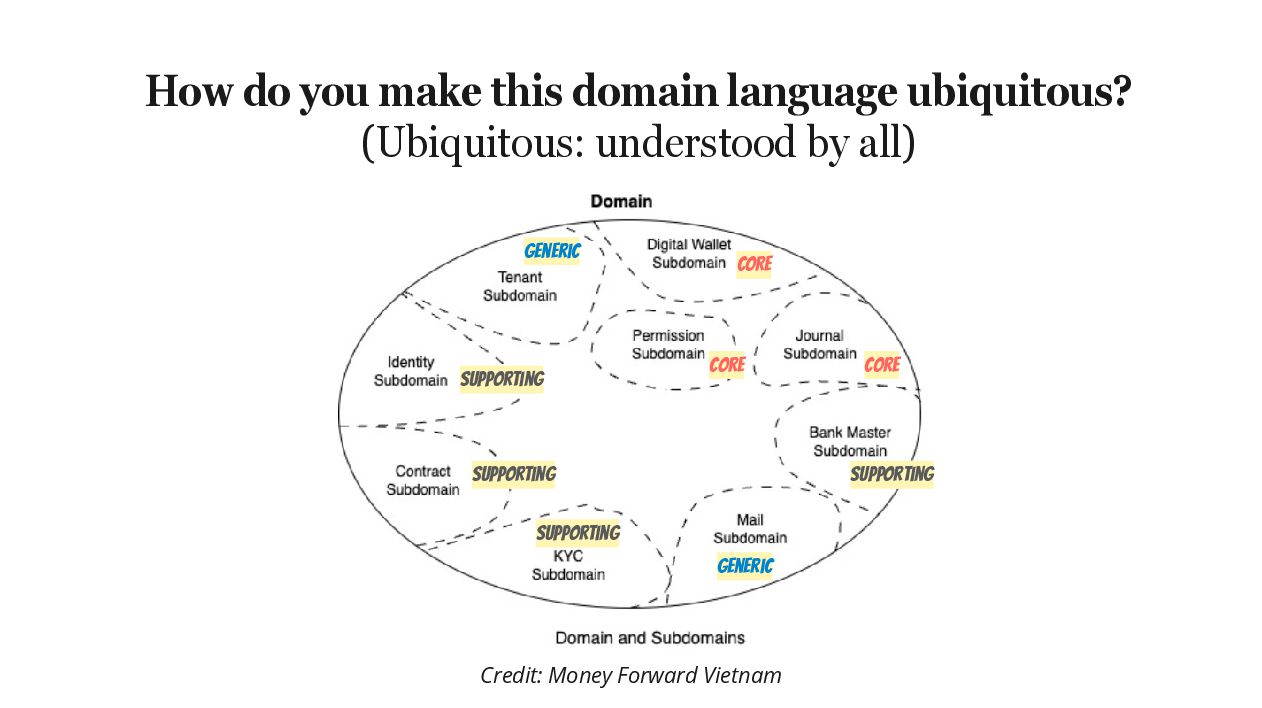
Credit: Money Forward Vietnam How do you make this domain
language ubiquitous? (Ubiquitous: understood by all) core core generic supporting core supporting generic supporting supporting -
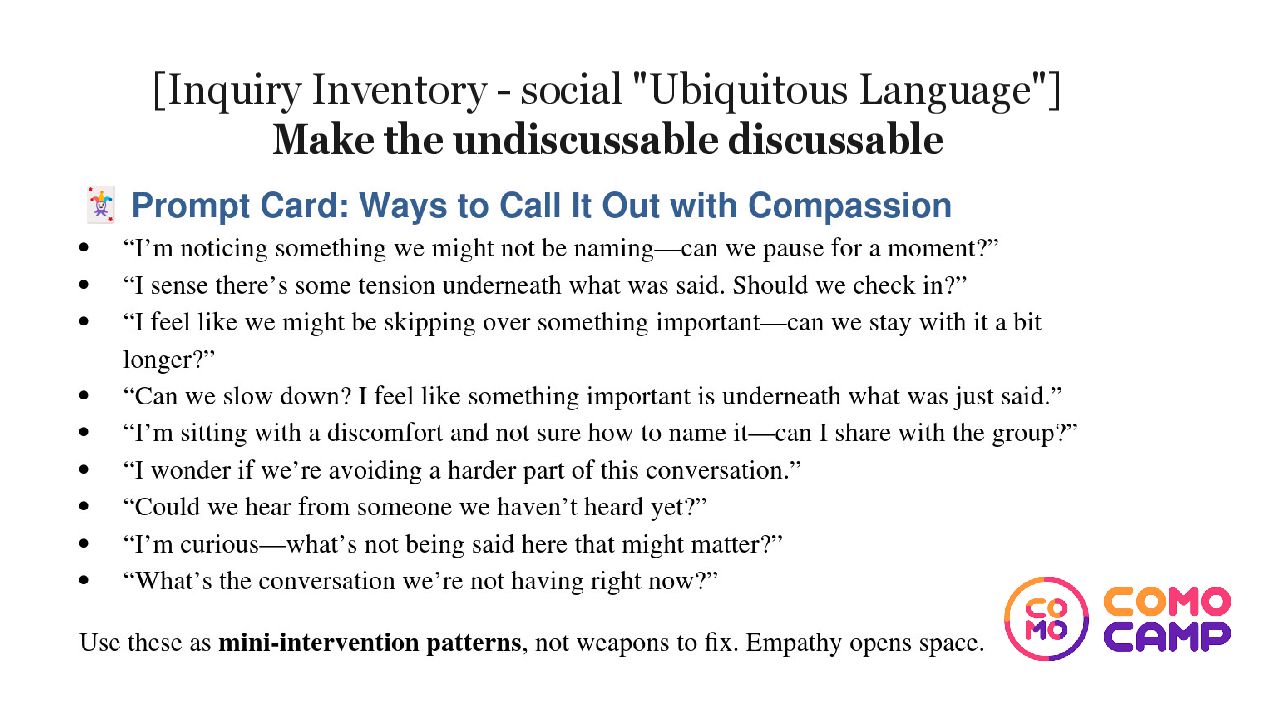
Make the implicit explicit [technical design pattern] Make the undiscussable
discussable [social design pattern] Collaborative Modeling --> Reflective Conversations -
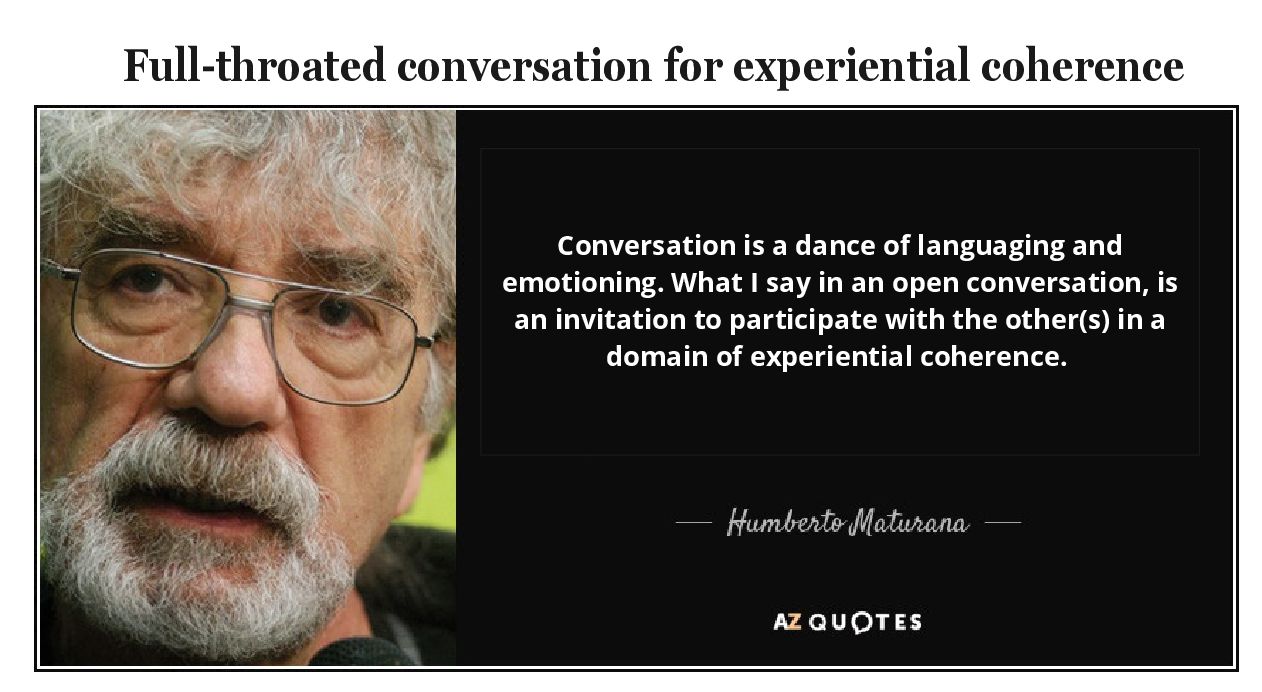
Full- throated conversation for experiential coherence Conversation is a dance
of languaging and emotioning. What I say in an open conversation, is an invitation to participate with the other(s) in a domain of experiential coherence. -
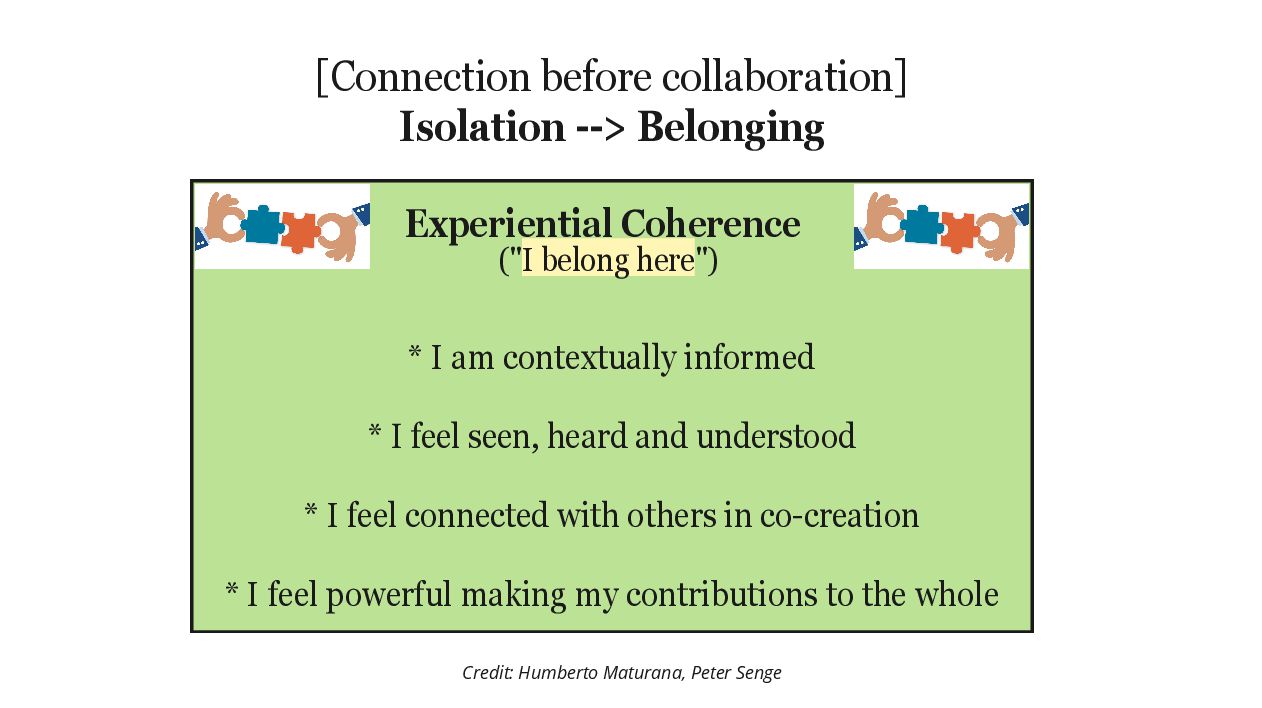
* I am contextually informed * I feel seen, heard
and understood * I feel connected with others in co- creation * I feel powerful making my contributions to the whole Experiential Coherence ("I belong here") Credit: Humberto Maturana, Peter Senge [Connection before collaboration] Isolation --> Belonging -
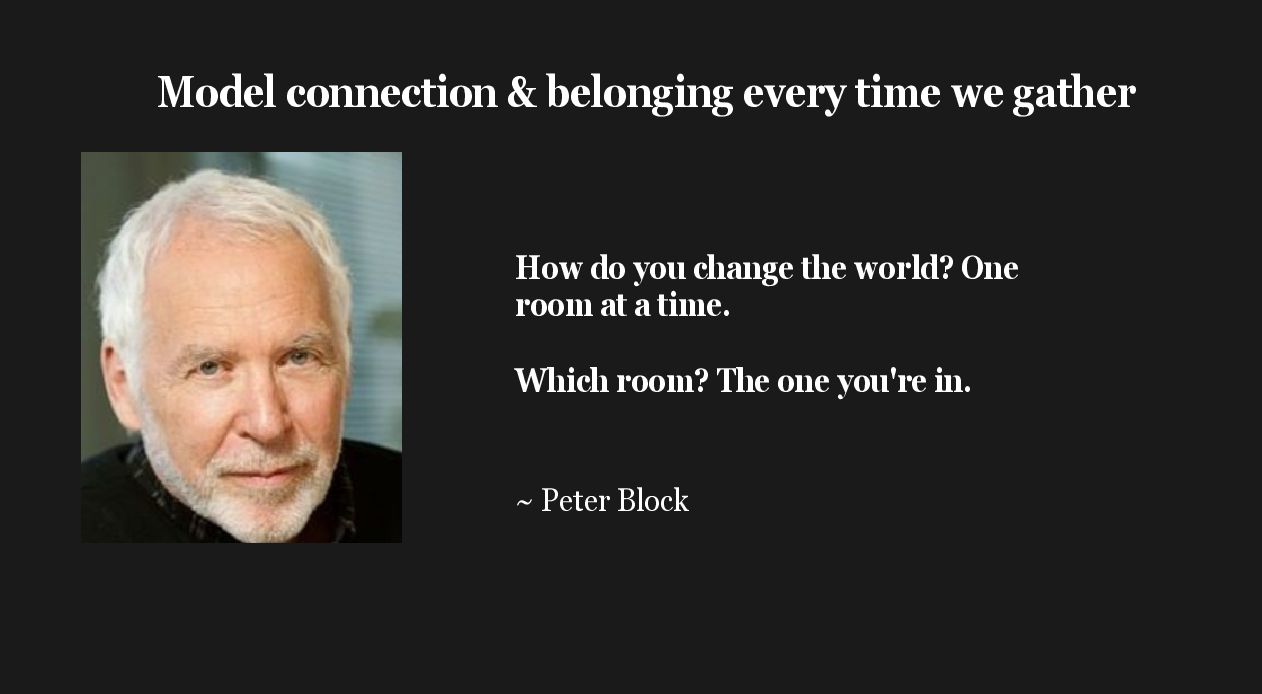
How do you change the world? One room at a
time. Which room? The one you're in. ~ Peter Block Model connection & belonging every time we gather -
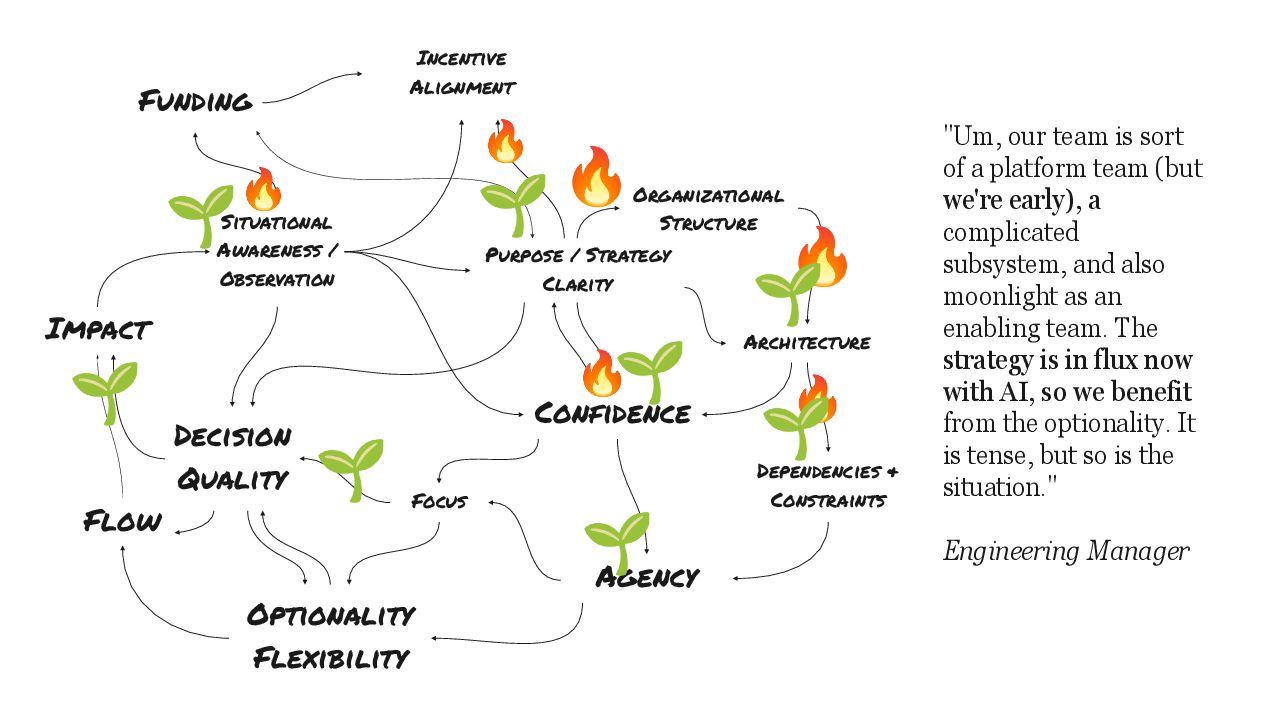
Funding Incentive Alignment Architecture Dependencies & Constraints Agency Optionality Flexibility
Decision Quality Flow Impact Purpose / Strategy Clarity Confidence Situational Awareness / Observation Focus Organizational Structure "Um, our team is sort of a platform team (but we're early), a complicated subsystem, and also moonlight as an enabling team. The strategy is in flux now with AI, so we benefit from the optionality. It is tense, but so is the situation." Engineering Manager -
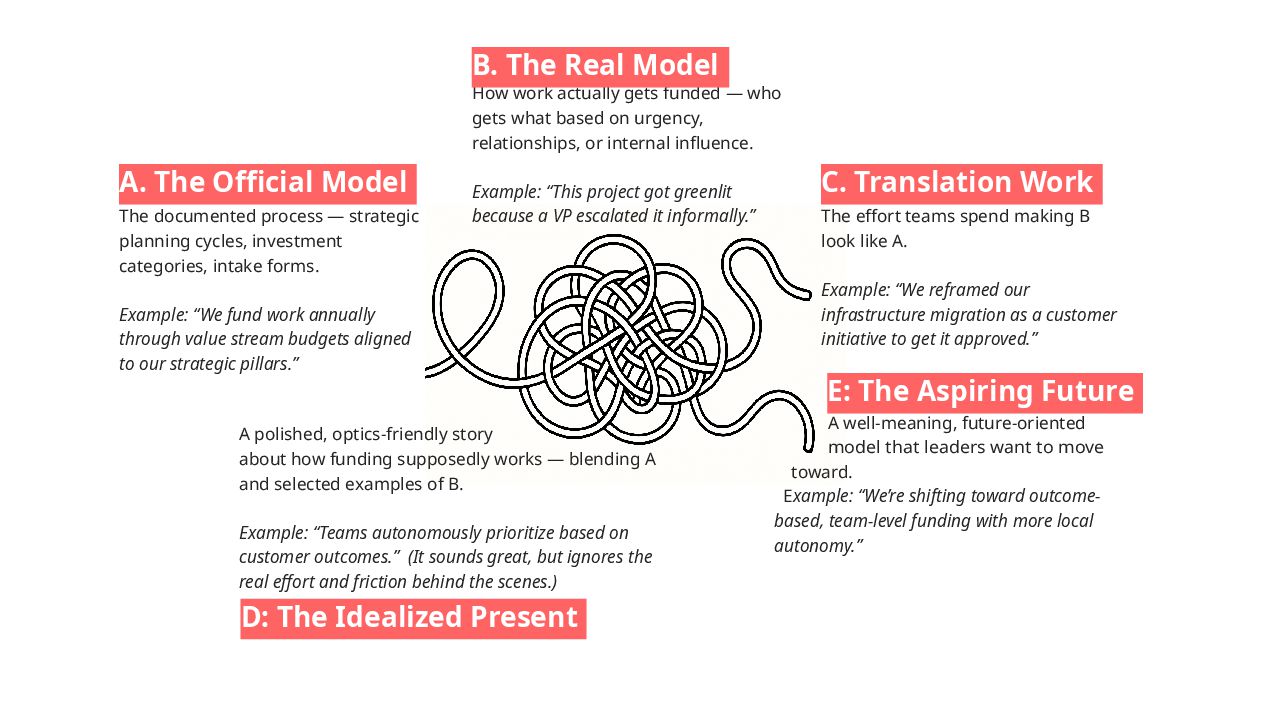
The documented process — strategic planning cycles, investment categories, intake
forms. Example: “We fund work annually through value stream budgets aligned to our strategic pillars.” How work actually gets funded — who gets what based on urgency, relationships, or internal influence. Example: “This project got greenlit because a VP escalated it informally.” The effort teams spend making B look like A. Example: “We reframed our infrastructure migration as a customer initiative to get it approved.” A polished, optics- friendly story about how funding supposedly works — blending A and selected examples of B. Example: “Teams autonomously prioritize based on customer outcomes.” (It sounds great, but ignores the real effort and friction behind the scenes.) A well- meaning, future- oriented model that leaders want to move toward. Example: “We’re shifting toward outcome- based, team- level funding with more local autonomy.” E: The Aspiring Future C. Translation Work B. The Real Model A. The Official Model D: The Idealized Present -
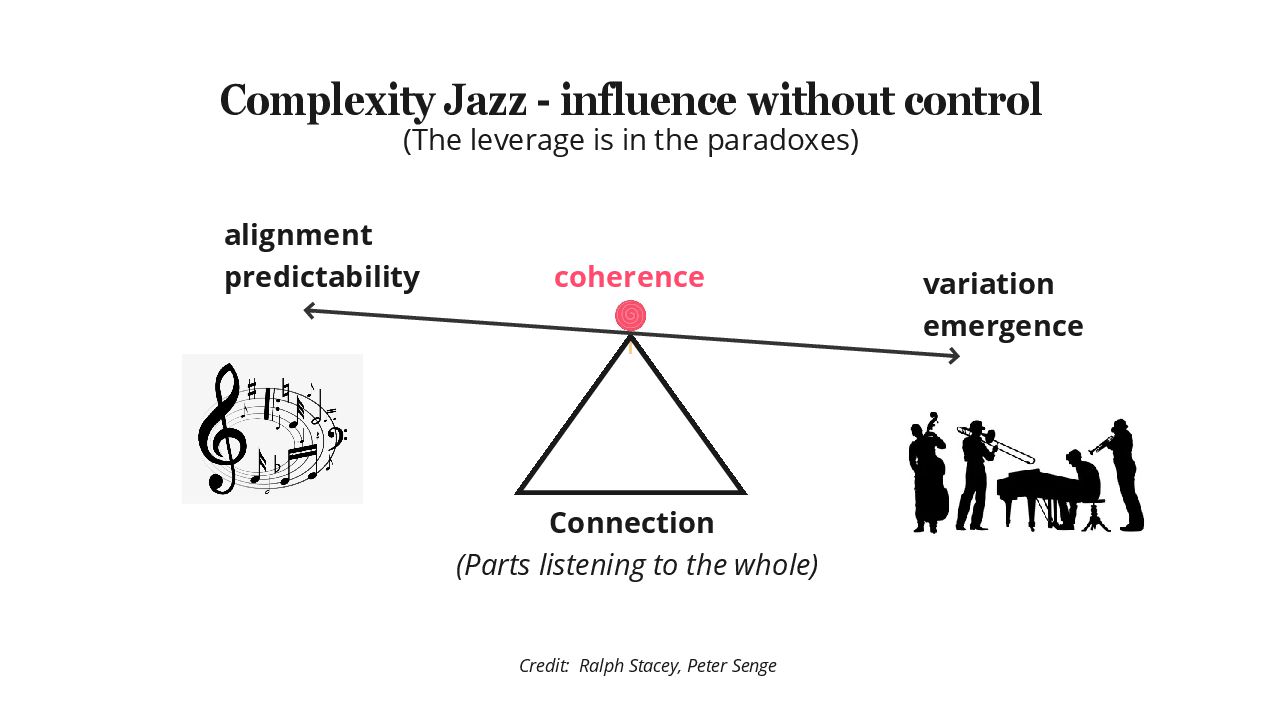
variation emergence alignment predictability Complexity Jazz - influence without control
(The leverage is in the paradoxes) Credit: Ralph Stacey, Peter Senge coherence Connection (Parts listening to the whole) -
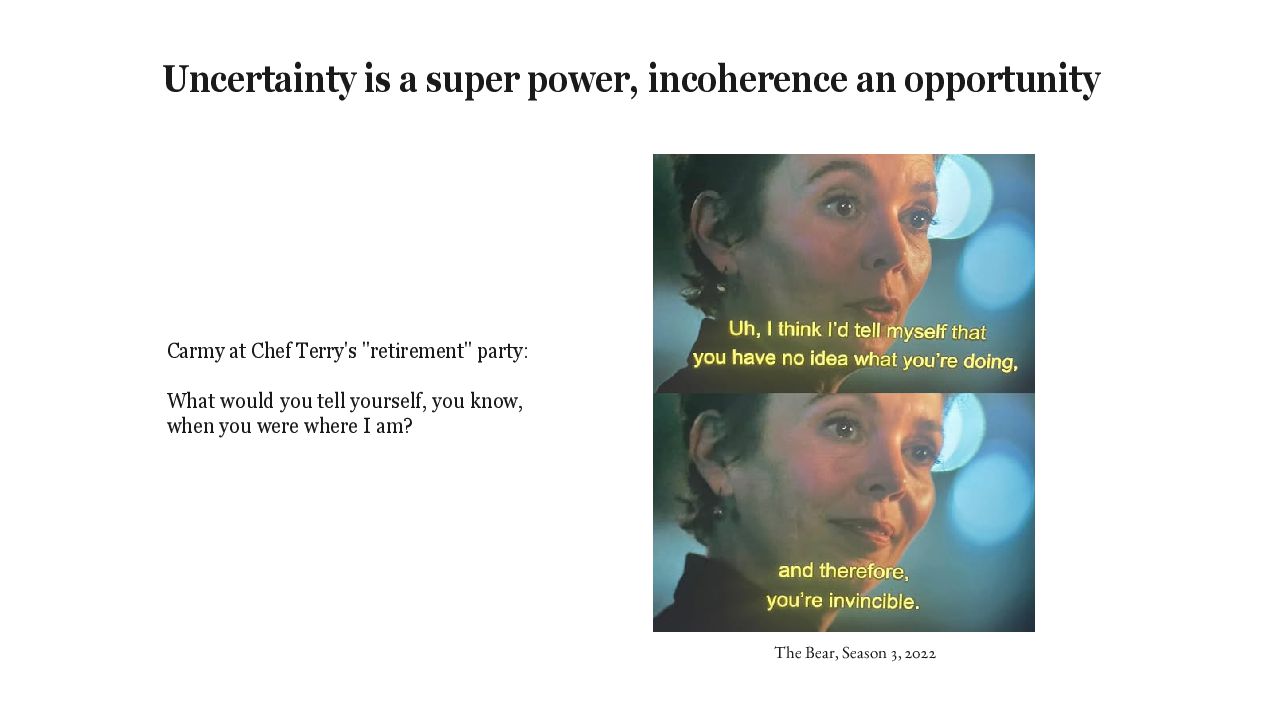
Uncertainty is a super power, incoherence an opportunity The Bear,
Season 3, 2022 Carmy at Chef Terry's "retirement" party: What would you tell yourself, you know, when you were where I am? -
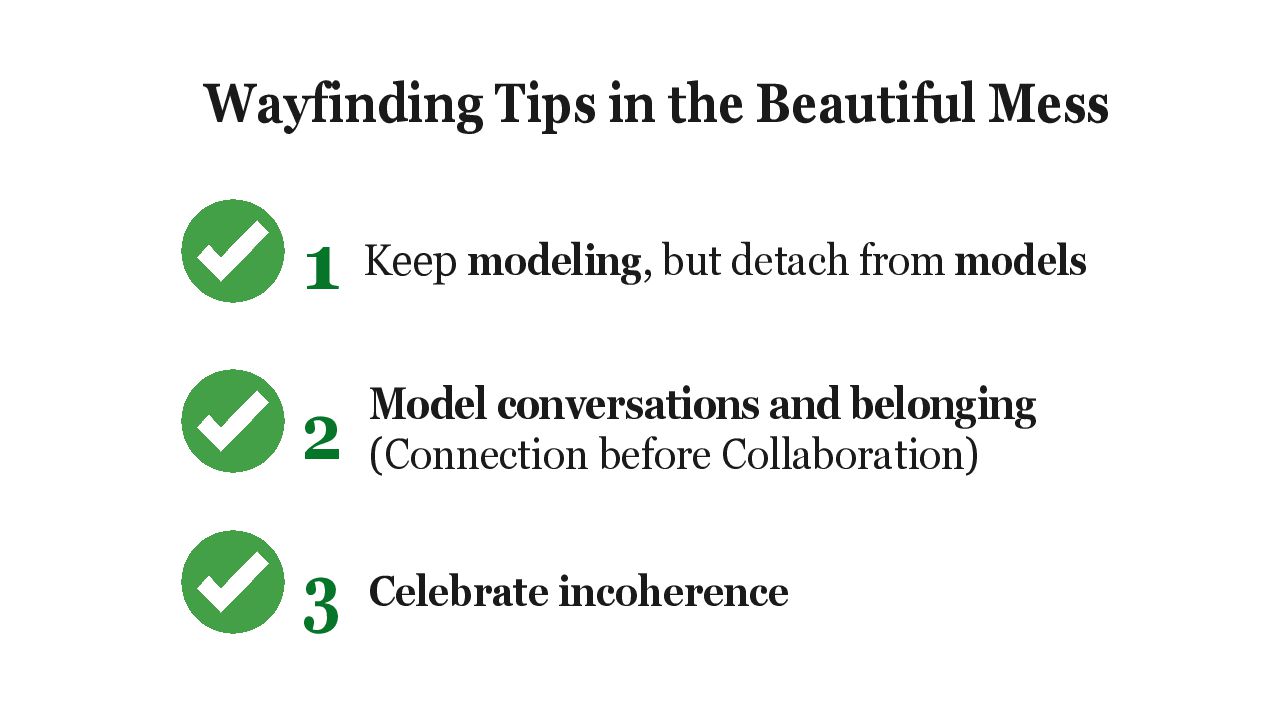
Keep modeling, but detach from models Model conversations and belonging
(Connection before Collaboration) Celebrate incoherence Wayfinding Tips in the Beautiful Mess 1 2 3 -
The path we've taken today [1] Two roads diverged in
the mess (Social vs. Technical) [2] How models connect and clash (Social vs. Technical) [3] Tips for wayfinding in the beautiful mess -
🌀 (1 min – Quiet Reflection) What’s one idea from
this talk you could integrate into your work? What’s one question you’d love to explore further in a hallway conversation ? Small Group Activity #3 What will you carry forward? -
🌀 (1 min – Quiet Reflection) What’s one idea from
this talk you could integrate into your work? What’s one question you’d love to explore further in a hallway conversation? 🤝 (4 min – Groups of 3) Turn to two neighbors. Share your reflections with each other. Small Group Activity #3 What will you carry forward? -
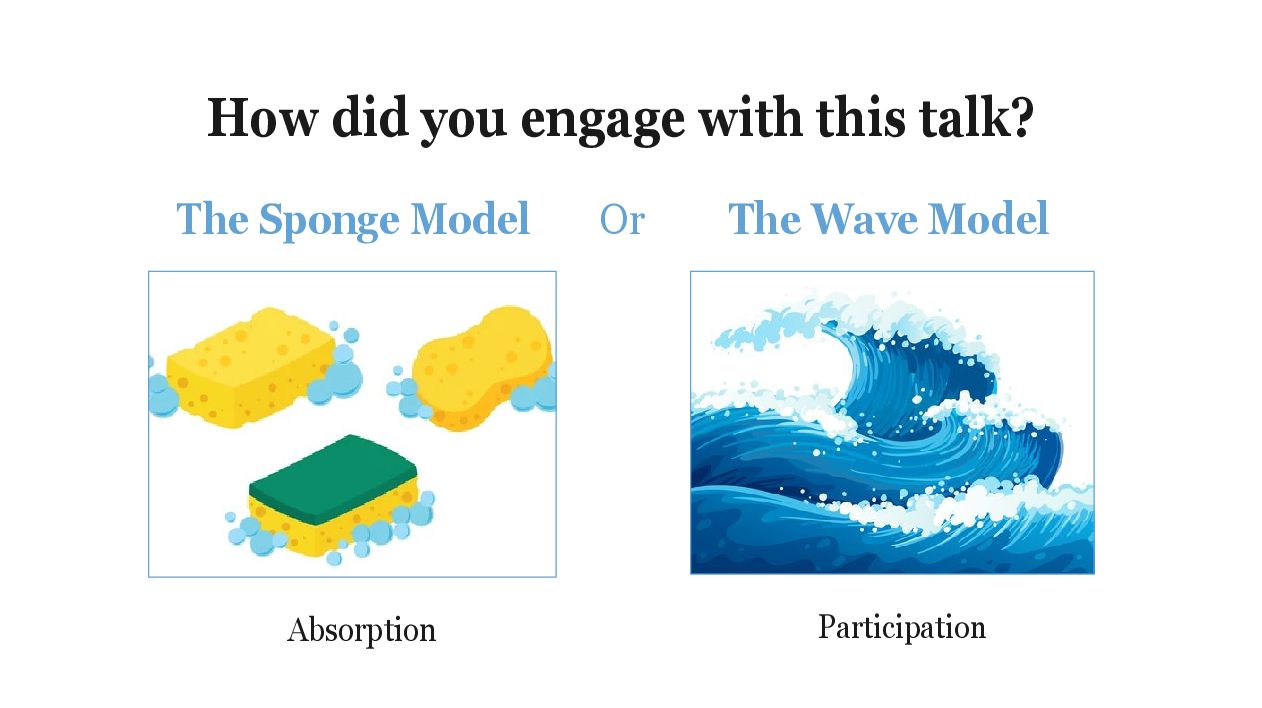
How did you engage with this talk? The Sponge Model
The Wave Model Or Absorption Participation -
Thank you @[email protected] @settling- mud.bsky.social Xin Yao Sociotechnical architect Independent
Consultant John Cutler Head of Product @Dotwork https://www.linkedin.com/in/johnpcutler/ @johncutle.fish https://mastodon.social/@johncutlefish https://www.linkedin.com/in/xinxin