Share
Embed
MockK, the idiomatic mocking framework for Kotlin - Devoxx FR 2019 - Yannick De Turck
If you've developed in Java, you will most likely have used the mocking framework Mockito. While it is a superb framework for mocking in Java, it doesn't really seem to suit Kotlin that well and there are certain limitations or annoyances which you need to get around such as mocking final classes due to the way that Mockito creates its mocks.
MockK is a mocking framework specifically for Kotlin developed by Oleksiy Pylypenko. MockK’s main philosophy is offering first-class support for Kotlin features and being able to write idiomatic Kotlin code when using it.
This Devoxx session will serve as an introduction to MockK, showcase its features and how to use it in your unit tests.
Yannick De Turck
April 18, 2019
Transcript
58 slides
-
#DevoxxFR @YannickDeTurck MockK, the idiomatic mocking framework for Kotlin Yannick
De Turck https://ordina-jworks.github.io 1 -
#DevoxxFR @YannickDeTurck About me Yannick De Turck Senior Java Consultant
@ Ordina Belgium @YannickDeTurck github.com/YannickDeTurck ordina-jworks.github.io -
#DevoxxFR @YannickDeTurck Who writes unit tests? Who uses Kotlin? Who
has heard about MockK? Who actually uses MockK? Some questions -
#DevoxxFR @YannickDeTurck Java and Mockito @RunWith(MockitoJUnitRunner.class) public class UserServiceTest {
@Mock private UserRepository userRepository; private UserService userService; @Before public void setUp() { userService = new UserService(userRepository); } @Test public void user_service_when_valid_id_specified_should_return_user() { given(this.userRepository.findUser(1L)).willReturn(new User(1L, "John")); final User user = this.userService.lookupUser(1L); assertThat(user.getId()).isEqualTo(1L); assertThat(user.getName()).isEqualTo("John"); } } -
#DevoxxFR @YannickDeTurck Writing some cool classes class Generator { fun
generate(): String = "Foo" } class Dao { fun insert(record: String) = println("""Inserting "$record"""") } class Service(private val generator: Generator, private val dao: Dao) { fun calculate() { val record = generator.generate() dao.insert(record) } } -
#DevoxxFR @YannickDeTurck Adding our unit test val generator = Mockito.mock(Generator::class.java)
val dao = Mockito.mock(Dao::class.java) val service = Service(generator, dao) @Test fun `calculate should generate and insert a record`() { val mockedRecord = "mocked String" Mockito.`when`(generator.generate()).thenReturn(mockedRecord) service.calculate() Mockito.verify(generator).generate() Mockito.verify(dao).insert(mockedRecord) Mockito.verifyNoMoreInteractions(generator, dao) } -
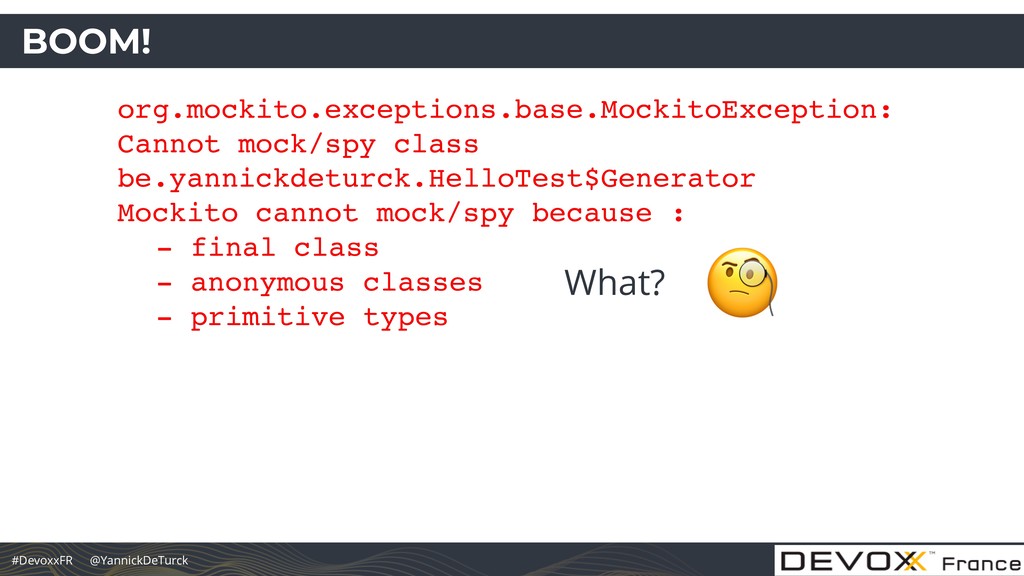
#DevoxxFR @YannickDeTurck BOOM! org.mockito.exceptions.base.MockitoException: Cannot mock/spy class be.yannickdeturck.HelloTest$Generator Mockito cannot
mock/spy because : - final class - anonymous classes - primitive types ! What? -
#DevoxxFR @YannickDeTurck Classes and functions are final by default in
Kotlin This doesn’t bode too well with how Mockito creates its mocks as it relies on subclassing So… now what? -
#DevoxxFR @YannickDeTurck Add open to everything?! Define an interface for
everything? ! What are our options then? -
#DevoxxFR @YannickDeTurck "Add a certain file with a certain content
in a certain location for it to work" A programmatic way of using this feature is foreseen later on ! Enable incubating, opt-in feature -
#DevoxxFR @YannickDeTurck First-class support for Kotlin features Offer a pure
Kotlin mocking DSL for writing clean and idiomatic code Mock support for final classes and functions MockK’s main philosophy -
#DevoxxFR @YannickDeTurck MockK builds proxies for mocked classes Code of
existing methods is transformed the way it includes calls to a mocking library Small trade-off to performance Mocking final classes and functions -
#DevoxxFR @YannickDeTurck Meet the Car class class Car { fun
drive(direction: Direction, speed: Long = 30): String { return "Driving $direction at $speed km/h" } } -
#DevoxxFR @YannickDeTurck Syntax // Create mock/spy val car = mockk<Car>()
// Stub calls every { car.drive(Direction.NORTH) } returns "Driving north!” // Execute code to test car.drive(Direction.NORTH) // Verify verify { car.drive(Direction.NORTH) } -
#DevoxxFR @YannickDeTurck Syntax @Test fun `car should be able to
drive in a direction`() { every { car.drive(Direction.NORTH) } returns "Driving north!" car.drive(Direction.NORTH) verify { car.drive(Direction.NORTH) } } -
#DevoxxFR @YannickDeTurck Strict mocking By default mocks are strict, so
you need to define some behavior // every { car.drive(Direction.NORTH) } returns "Driving north!” car.drive(Direction.NORTH) io.mockk.MockKException: no answer found for: Car(#2).drive(north) Relaxed mock val car = mockk<Car>(relaxed = true) MockK will provide a dummy stub ! Tip: Stick to strict mocking for nice and clear tests -
#DevoxxFR @YannickDeTurck Object mocks object Math { fun add(a: Int,
b: Int) = a + b } mockkObject(Math) assertEquals(3, Math.add(1, 2)) every { Math.add(1, 2) } returns 4 assertEquals(4, Math.add(1, 2)) -
#DevoxxFR @YannickDeTurck Hierarchical mocking Mix mocks and real objects interface
AddressBook { val contacts: List<Contact> } interface Contact { val name: String val telephone: String val address: Address } interface Address { val city: String val zip: String } -
#DevoxxFR @YannickDeTurck Hierarchical mocking val addressBook = mockk<AddressBook> { every
{ contacts } returns listOf( mockk { every { name } returns "John" every { telephone } returns "123-456-789” every { address.city } returns "New-York” every { address.zip } returns "123-45” }, mockk { every { name } returns "Alex” every { telephone } returns "789-456-123” every { address } returns mockk { every { city } returns "Wroclaw” every { zip } returns "543-21” } } ) } -
#DevoxxFR @YannickDeTurck Spy Mix mocks and real objects val car
= spyk(Car()) car.drive(Direction.NORTH) verify { car.drive(Direction.NORTH) } -
#DevoxxFR @YannickDeTurck Annotations @MockK lateinit var car1: Car @RelaxedMockK lateinit
var car2: Car @MockK(relaxUnitFun = true) lateinit var car3: Car @SpyK var car4 = Car() @InjectMockKs var trafficSystem = TrafficSystem() @Before fun setUp() = MockKAnnotations.init(this) -
#DevoxxFR @YannickDeTurck Verify Verify whether call has happened verify {
car.drive(any()) } verify(atLeast = 1) { car.drive(any()) } verify(atMost = 3) { car.drive(any()) } verify(exactly = 2) { car.drive(any()) } verify(timeout = 1000L) { car.drive(any()) } -
#DevoxxFR @YannickDeTurck Group verifications car.drive(Direction.NORTH) car.drive(Direction.EAST) car.drive(Direction.SOUTH) verifySequence { car.drive(Direction.NORTH)
car.drive(Direction.EAST) car.drive(Direction.SOUTH) } -
#DevoxxFR @YannickDeTurck Confirming verifications Check whether all calls were covered
by verify statements val cat = mockk<Cat>() every { cat.makeSound() } returns ”Meow" cat.makeSound() // verify { cat.makeSound() } confirmVerified(cat) Similar to Mockito’s verifyNoMoreInteractions -
#DevoxxFR @YannickDeTurck Confirming verifications Option to exclude less significant calls
excludeRecords { cat.makeSound() } -
#DevoxxFR @YannickDeTurck By default simple arguments are matched using eq()
Lots of matchers available! Matcher expressions -
#DevoxxFR @YannickDeTurck Combine them! Combine them as you see fit
every { car.drive( direction = or(Direction.EAST, Direction.WEST), speed = range(10L, 50L, fromInclusive = true, toInclusive = true)) } returns "Driving!" -
#DevoxxFR @YannickDeTurck Capturing arguments Single value captured val car =
mockk<Car>() val slot = slot<Long>() every { car.drive(any(), capture(slot)) } returns "Driving!" car.drive(Direction.EAST, 55) assert(slot.captured).isEqualTo(55L) -
#DevoxxFR @YannickDeTurck Capturing arguments Multiple values captured val car =
mockk<Car>() val list = mutableListOf<Long>() every { car.drive(any(), capture(list)) } returns "Driving...” car.drive(Direction.EAST, 55) car.drive(Direction.EAST, 80) assert(list).containsAll(55L, 80L) -
#DevoxxFR @YannickDeTurck Constructor mocks Mock newly created objects mockkConstructor(Car::class) every
{ anyConstructed<Car>().drive(any()) } returns "Driving!" Car().drive(Direction.EAST) verify { anyConstructed<Car>().drive(Direction.EAST) } -
#DevoxxFR @YannickDeTurck Private function mocking class Car { fun drive(direction:
Direction, speed: Long = 30): String { return accelerate() } private fun accelerate() = "going fast" } -
#DevoxxFR @YannickDeTurck Private function mocking val car = spyk<Car>(recordPrivateCalls =
true) every { car["accelerate"]() } returns "going not so fast” car.drive(Direction.EAST) verifySequence { car.drive(Direction.EAST) car["accelerate"]() } -
#DevoxxFR @YannickDeTurck Private function mocking every { car getProperty "speed"
} returns 33 every { car setProperty "acceleration" value less(5) } just Runs every { car invokeNoArgs "accelerate" } returns ”going slowly” every { car invoke "accelerate" withArguments listOf("foo", "bar") } returns "going slowly" -
#DevoxxFR @YannickDeTurck Coroutines mocking Requires an additional dependency <dependency> <groupId>org.jetbrains.kotlinx</groupId>
<artifactId>kotlinx-coroutines-core</artifactId> <version>${kotlinx-coroutines-core.version}</version> <scope>test</scope> </dependency> -
#DevoxxFR @YannickDeTurck Coroutines mocking Usual functions with prefox “co “
val car = mockk<Car>() coEvery { car.drive(Direction.NORTH) } returns "Driving...” car.drive(Direction.NORTH) coVerify { car.drive(Direction.NORTH) } -
#DevoxxFR @YannickDeTurck Clear, informative error messages val car = mockk<Car>()
car.drive(Direction.EAST) verify { car.drive(Direction.EAST) } io.mockk.MockKException: no answer found for: Car(#3).drive(east, 30) -
#DevoxxFR @YannickDeTurck Clear, informative error messages java.lang.AssertionError: Verification failed: number
of calls happened not matching exact number of verification sequence Matchers: Car(#2).drive(eq(north), eq(30))) Car(#2).drive(eq(south), eq(30))) Calls: 1) Car(#2).drive(north, 30) 2) Car(#2).drive(east, 30) 3) Car(#2).drive(south, 30) -
#DevoxxFR @YannickDeTurck Clear, informative error messages java.lang.AssertionError: Verification failed: call
1 of 1: Car(#2).drive(any(), eq(30))). 3 matching calls found, but needs at least 2 and at most 2 calls Calls: 1) Car(#2).drive(north, 30) 2) Car(#2).drive(east, 30) 3) Car(#2).drive(south, 30) -
#DevoxxFR @YannickDeTurck Comparing both val generator = Mockito.mock(Generator::class.java) val dao
= Mockito.mock(Dao::class.java) val service = Service(generator, dao) @Test fun `my test`() { val mockedRecord = "mocked String" Mockito.`when`(generator.generate()) .thenReturn(mockedRecord) service.calculate() Mockito.verify(generator).generate() Mockito.verify(dao).insert(mockedRecord) Mockito.verifyNoMoreInteractions( generator, dao) } val generator = mockk<Generator>() val dao = mockk<Dao>() val service = Service(generator, dao) @Test fun `my test` () { every { generator.generate() } returns "something" every { dao.insert("something") } just Runs service.calculate() verify { generator.generate() dao.insert("something") } } ! " -
#DevoxxFR @YannickDeTurck A very promising library Very pleasant to use
Suits the Kotlin language Author is very approachable on Gitter and GitHub My own experiences -
#DevoxxFR @YannickDeTurck mockk.io Mocking is not Rocket Science: Part 1,
Part 2, Part 3, Advanced Mocking in Kotlin with MockK - Yannick De Turck KotlinConf 2018 - Best Practices for Unit Testing in Kotlin by Philipp Hauer SpringMockK #MockKDevoxxMA @YannickDeTurck Extra resources