Upgrade to Pro — share decks privately, control downloads, hide ads and more …

From Policy to Production - Implementing ISO270...

Sponsored · Ship Features Fearlessly Turn features on and off without deploys. Used by thousands of Ruby developers.

From Policy to Production - Implementing ISO27001/BSI IT-Grundschutz in Kubernetes with Kyverno

Avatar for Marcus Ross

Marcus Ross

May 06, 2026

More Decks by Marcus Ross

Other Decks in Technology

Transcript

  1. From Policy to Production Implementing ISO27001/BSI IT-Grundschutz in Kubernetes with

    Kyverno Version: 1.7.2 Marcus Ross From Policy to Production
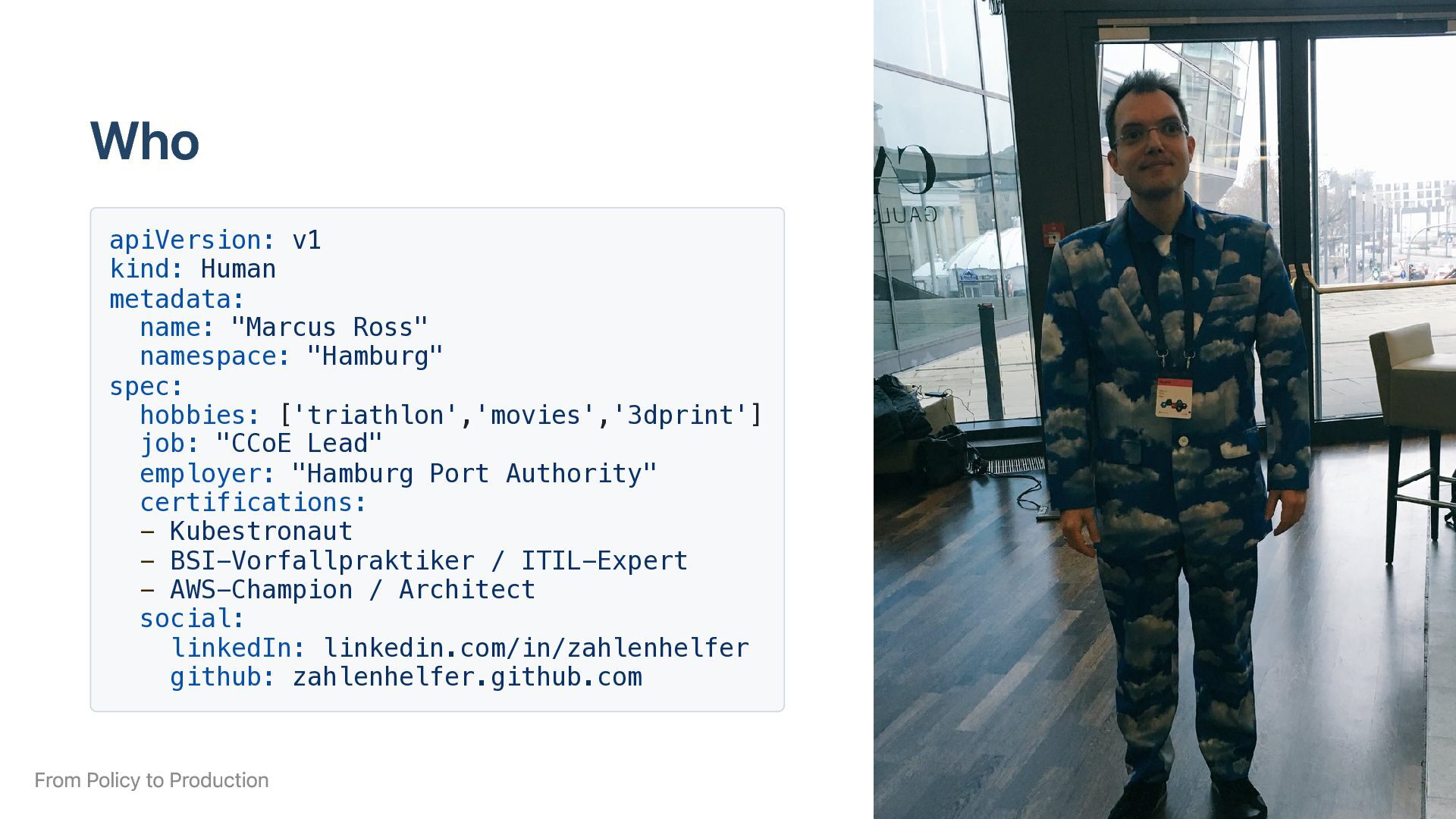
  2. Who apiVersion: v1 kind: Human metadata: name: "Marcus Ross" namespace:

    "Hamburg" spec: hobbies: ['triathlon','movies','3dprint'] job: "CCoE Lead" employer: "Hamburg Port Authority" certifications: - Kubestronaut - BSI-Vorfallpraktiker / ITIL-Expert - AWS-Champion / Architect social: linkedIn: linkedin.com/in/zahlenhelfer github: zahlenhelfer.github.com From Policy to Production 3
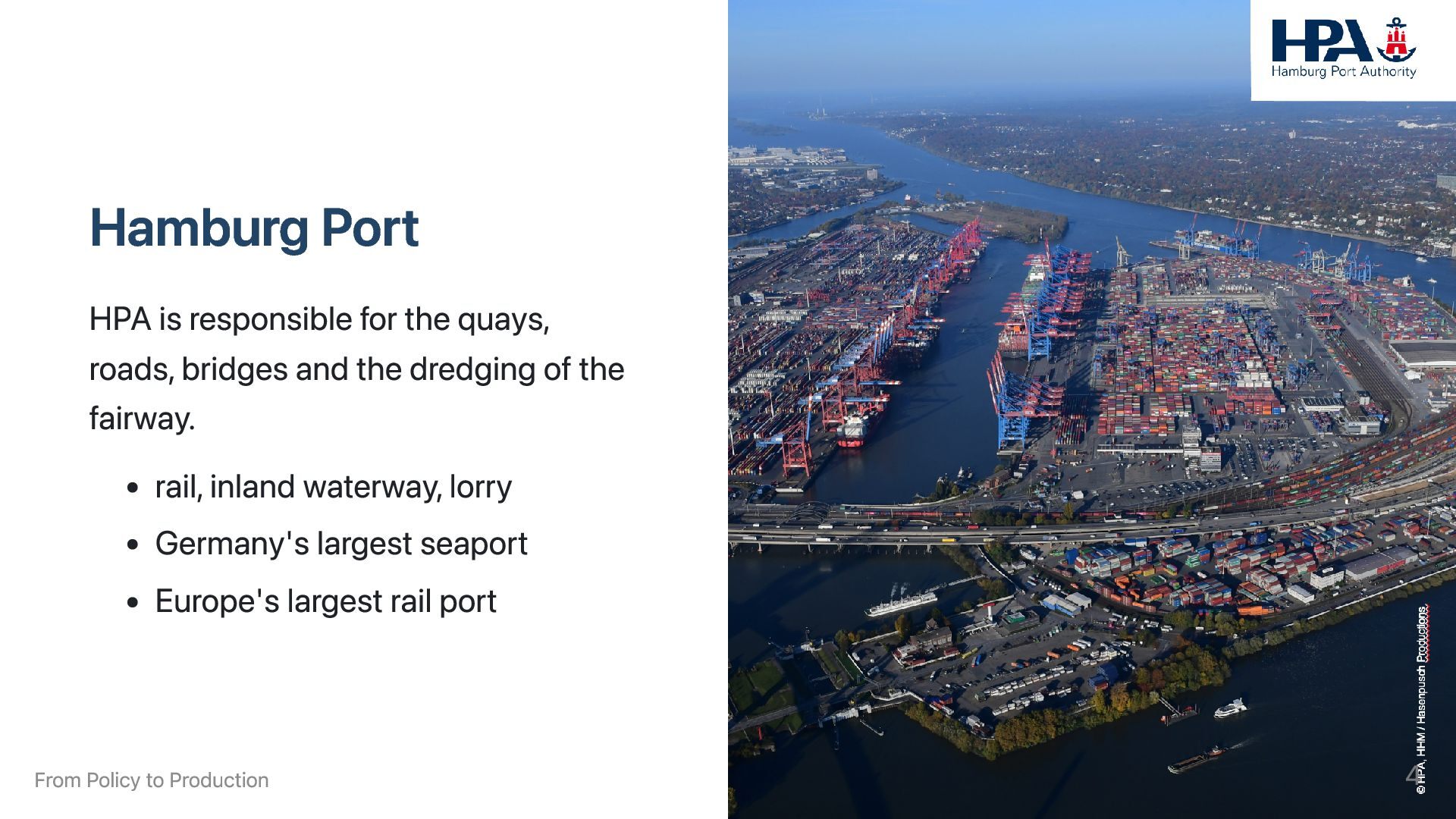
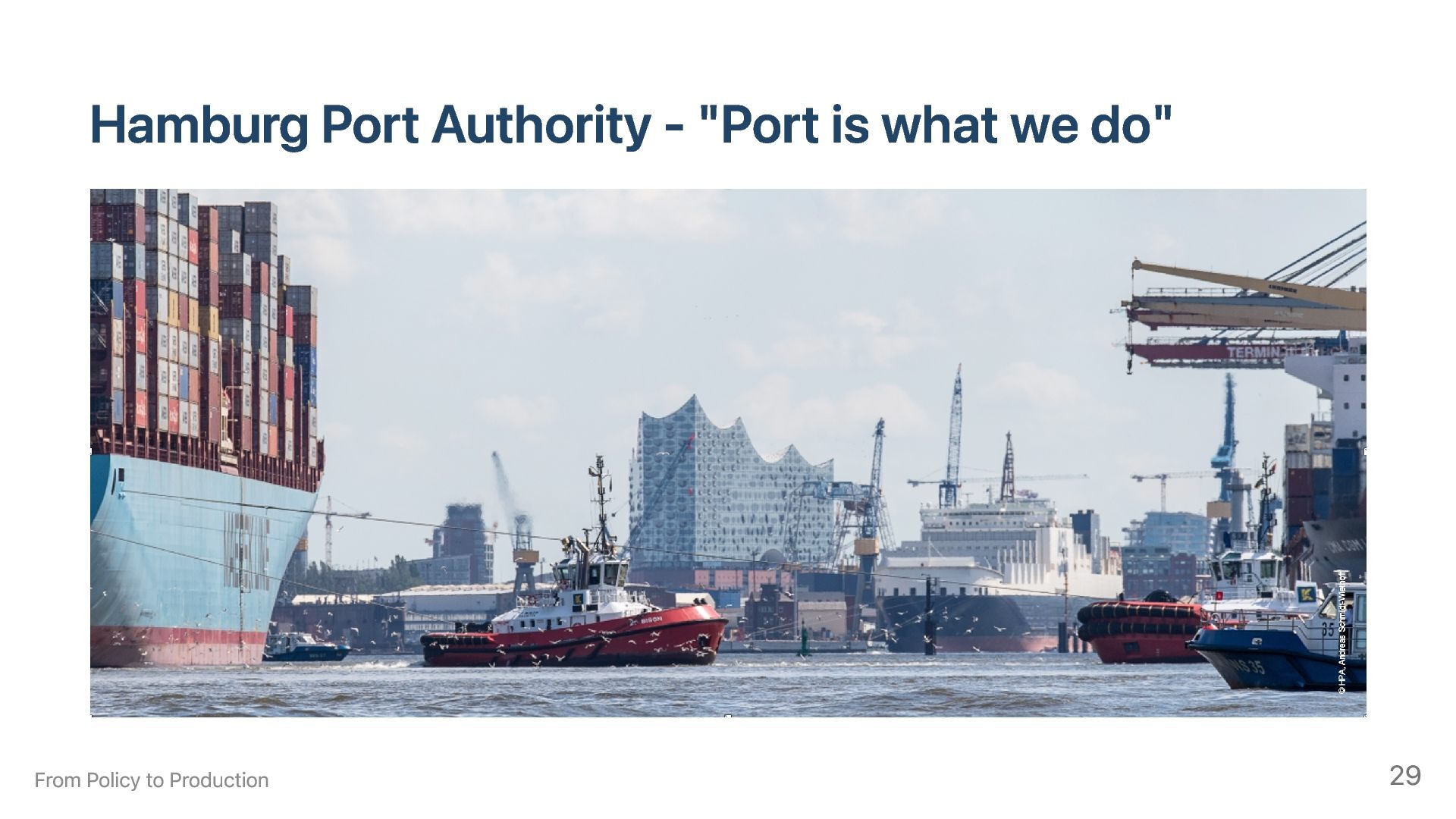
  3. Hamburg Port HPA is responsible for the quays, roads, bridges

    and the dredging of the fairway. rail, inland waterway, lorry Germany's largest seaport Europe's largest rail port From Policy to Production 4
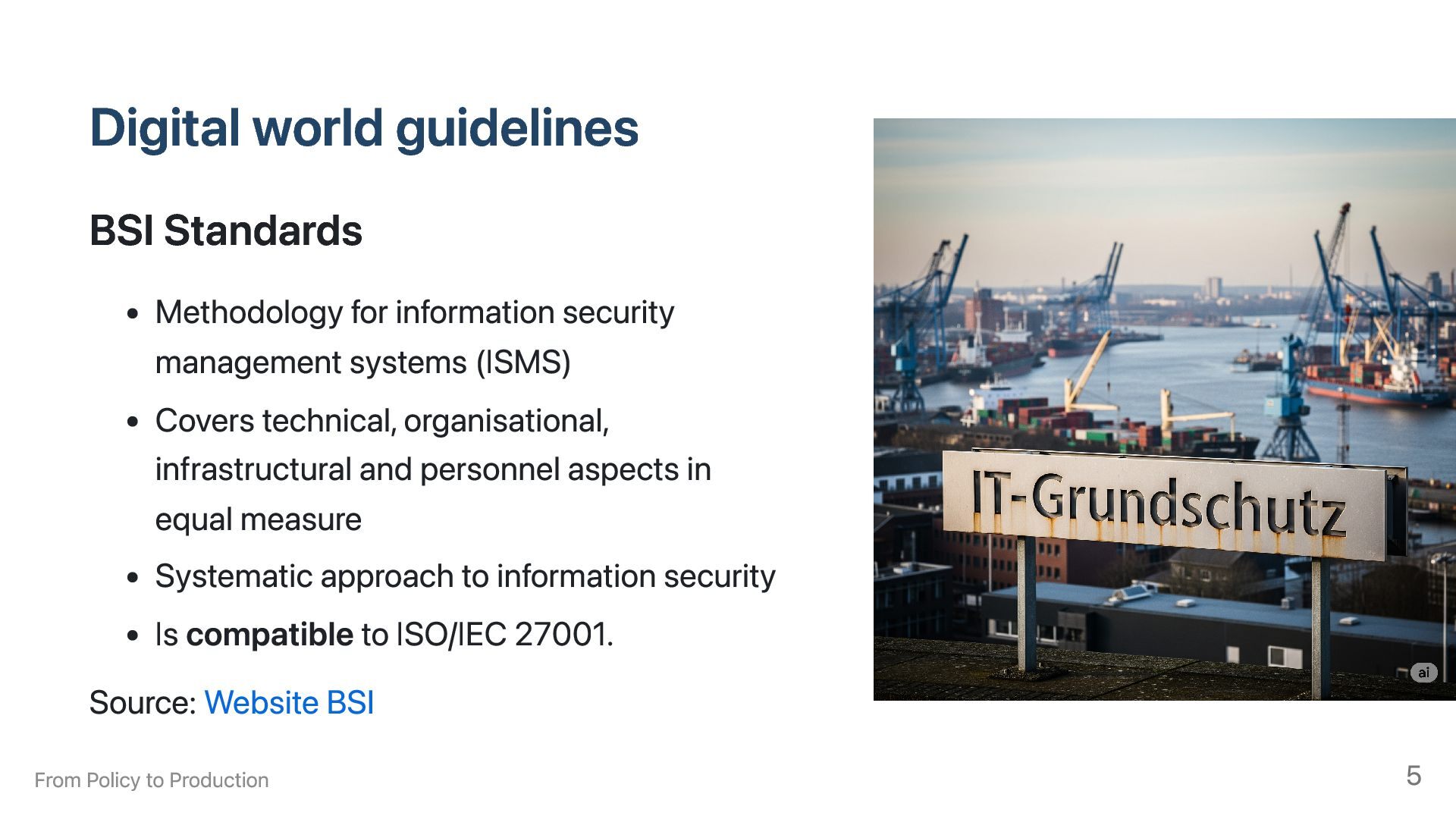
  4. Digital world guidelines BSI Standards Methodology for information security management

    systems (ISMS) Covers technical, organisational, infrastructural and personnel aspects in equal measure Systematic approach to information security Is compatible to ISO/IEC 27001. Source: Website BSI From Policy to Production 5
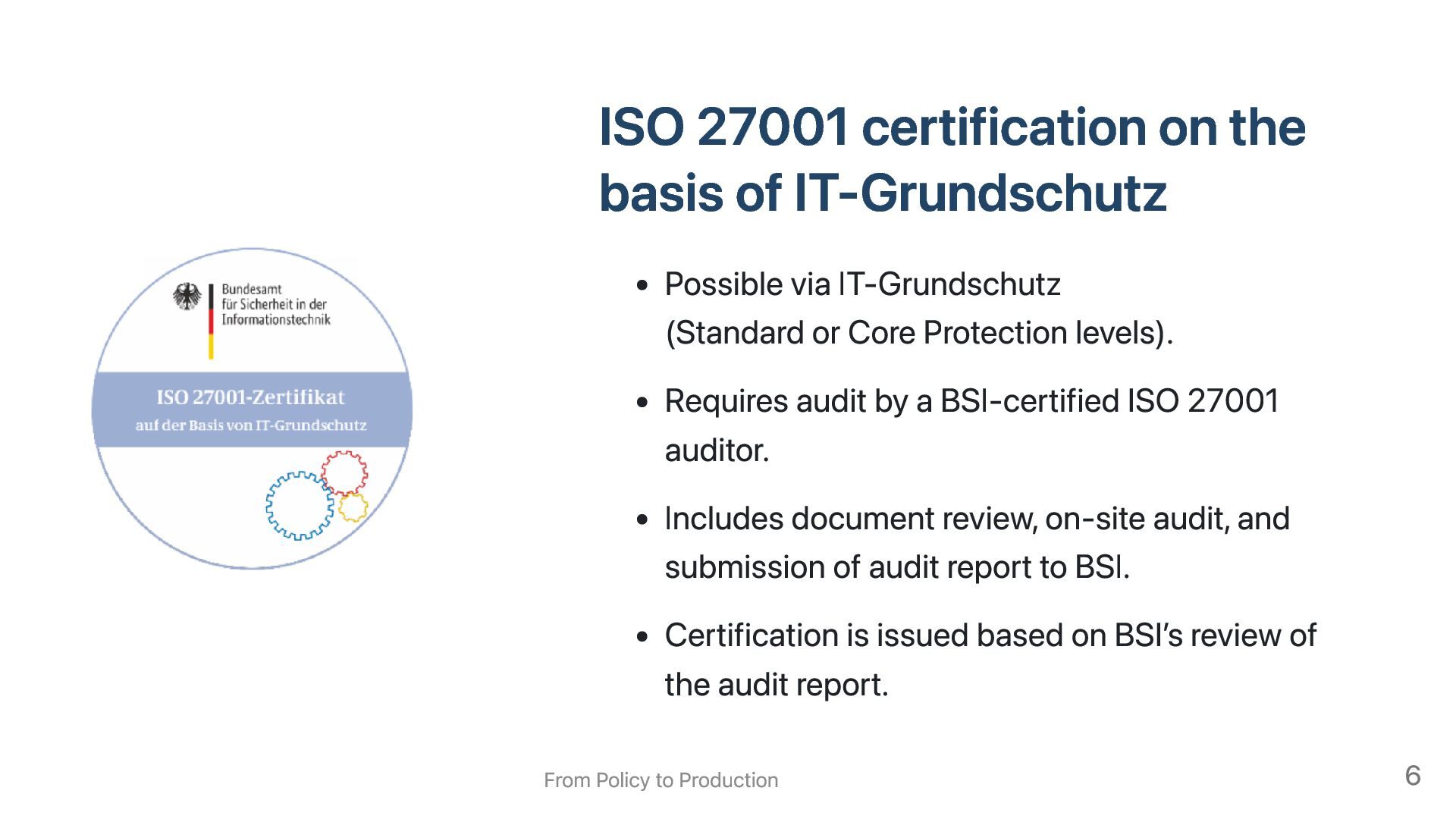
  5. ISO 27001 certification on the basis of IT-Grundschutz Possible via

    IT-Grundschutz (Standard or Core Protection levels). Requires audit by a BSI-certified ISO 27001 auditor. Includes document review, on-site audit, and submission of audit report to BSI. Certification is issued based on BSI’s review of the audit report. From Policy to Production 6
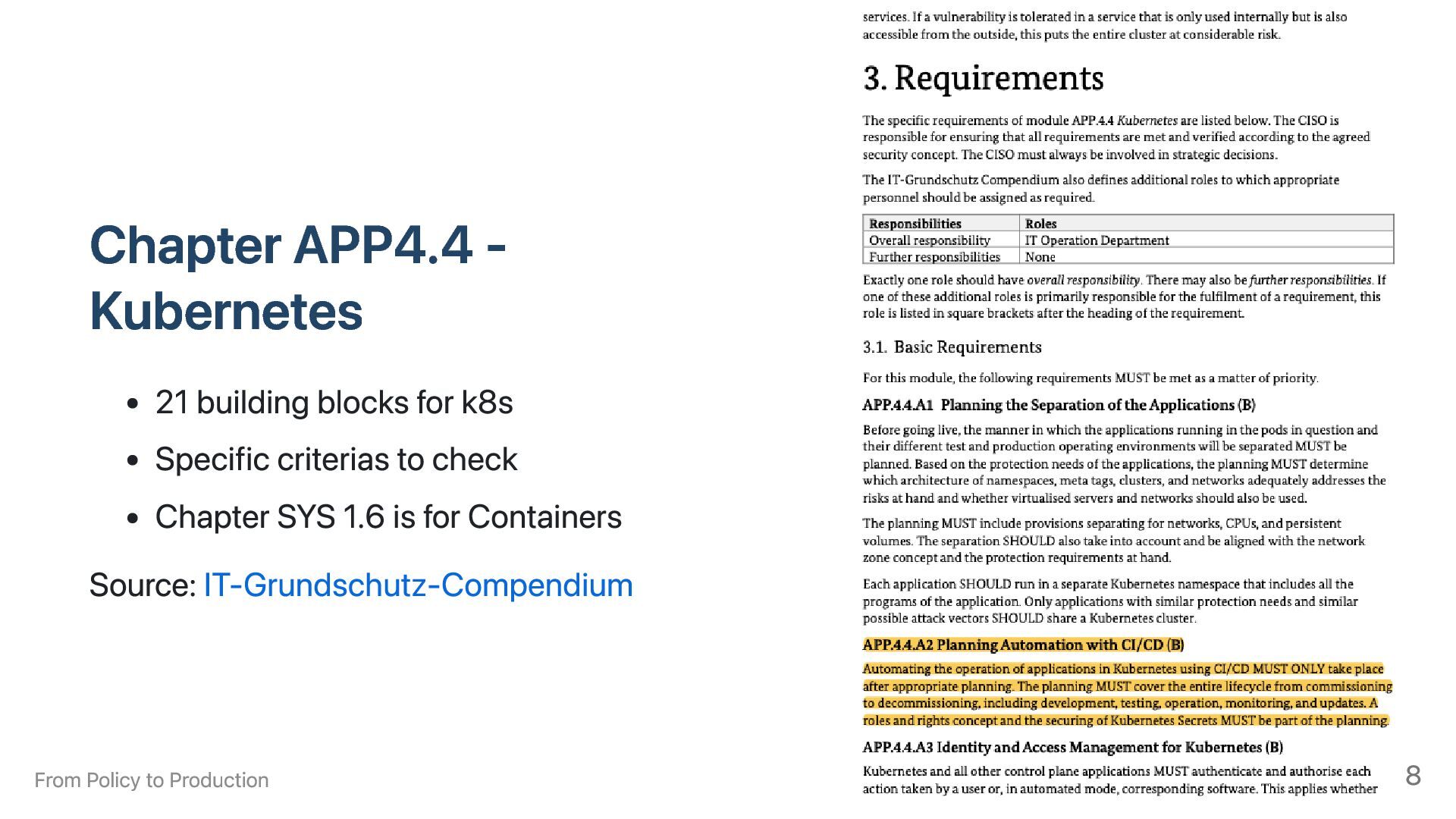
  6. Chapter APP4.4 - Kubernetes 21 building blocks for k8s Specific

    criterias to check Chapter SYS 1.6 is for Containers Source: IT-Grundschutz-Compendium From Policy to Production 8
  7. Three examples - Quick & Powerful APP.4.4.A7 - Separation of

    Networks for Kubernetes APP.4.4.A13 - Automated Configuration Auditing APP.4.4.A21 - Regular Restart of Pods From Policy to Production 9
  8. APP.4.4.A7 - Separation of Networks for Kubernetes Networks for the

    administration of nodes, the control plane, and the individual networks of application services SHOULD be separated. Only the network ports of the pods necessary for operation SHOULD be released into the designated networks. If a Kubernetes cluster contains multiple applications, all the network connections between the Kubernetes namespaces SHOULD first be prohibited and only required network connections permitted (whitelisting). The network ports necessary for the administration of the nodes, the runtime, and Kubernetes (including its extensions) SHOULD ONLY be accessible from the corresponding administration network and from pods that need them. Only selected administrators SHOULD be authorised in Kubernetes to manage the CNI and create or change rules for the network. From Policy to Production 10
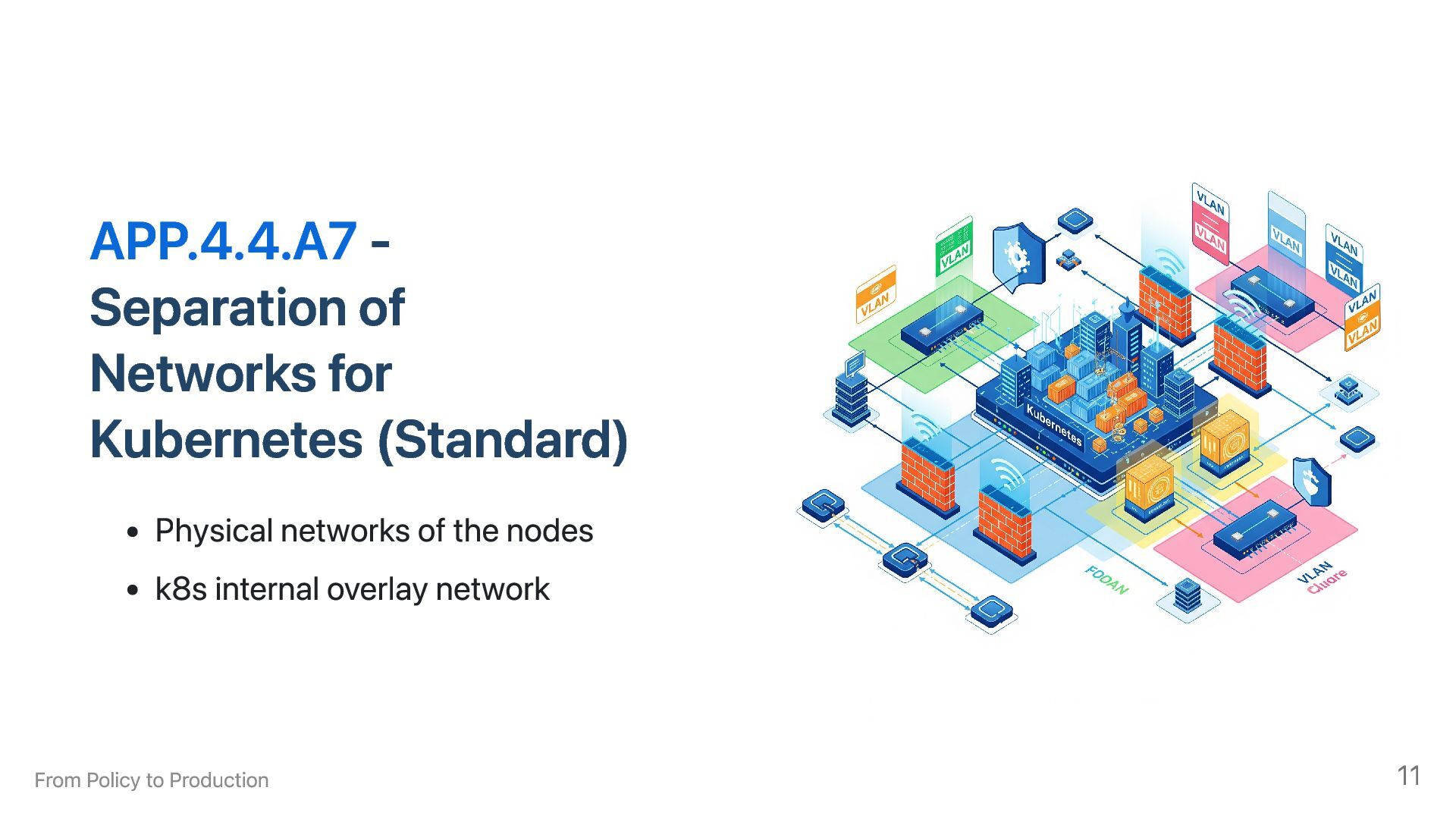
  9. APP.4.4.A7 - Separation of Networks for Kubernetes (Standard) Physical networks

    of the nodes k8s internal overlay network From Policy to Production 11
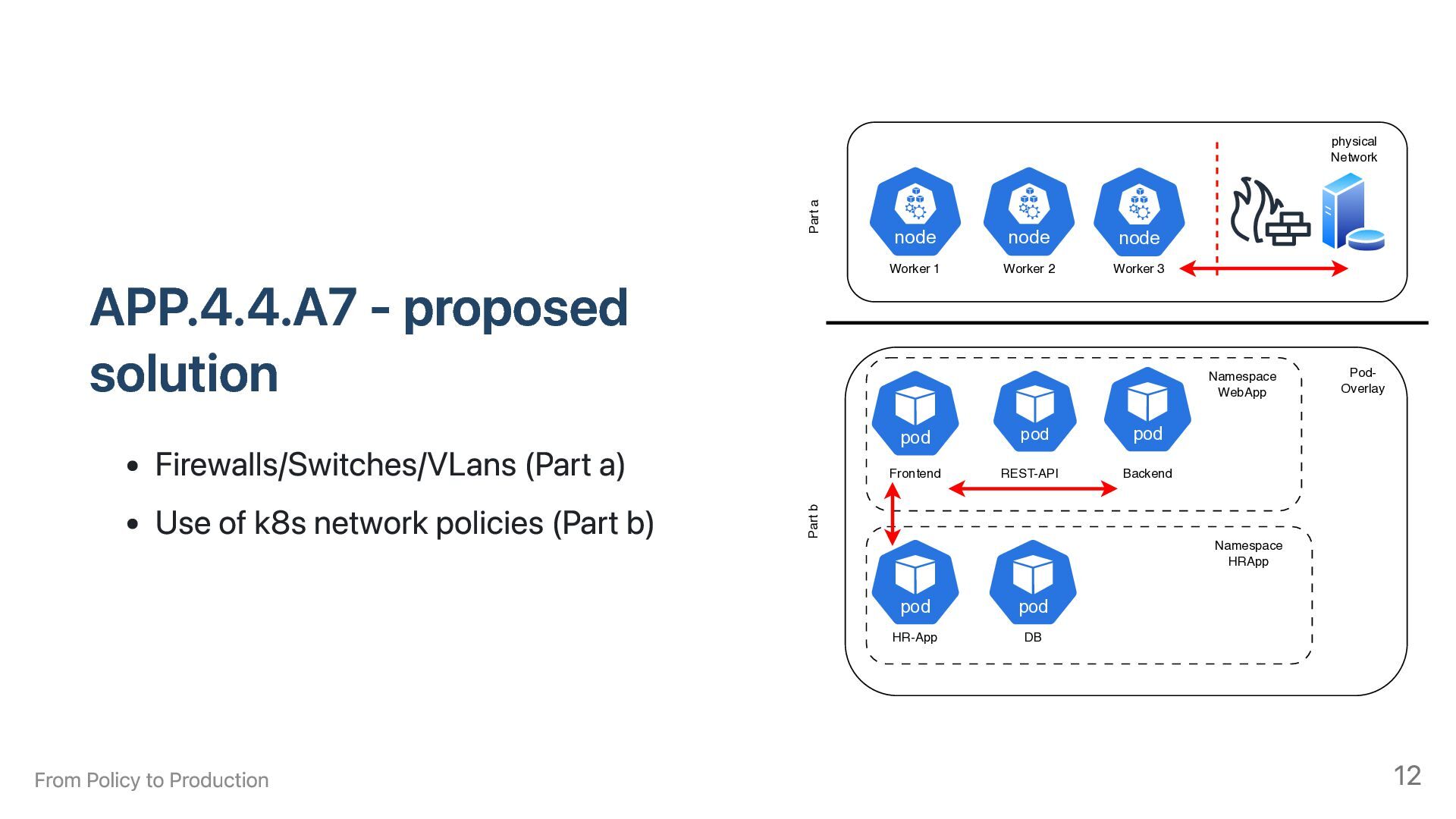
  10. physical Network Pod- Overlay node pod Frontend pod Backend pod

    REST-API pod HR-App pod DB Worker 1 node node Worker 2 Worker 3 Namespace WebApp Namespace HRApp Part a Part b APP.4.4.A7 - proposed solution Firewalls/Switches/VLans (Part a) Use of k8s network policies (Part b) From Policy to Production 12
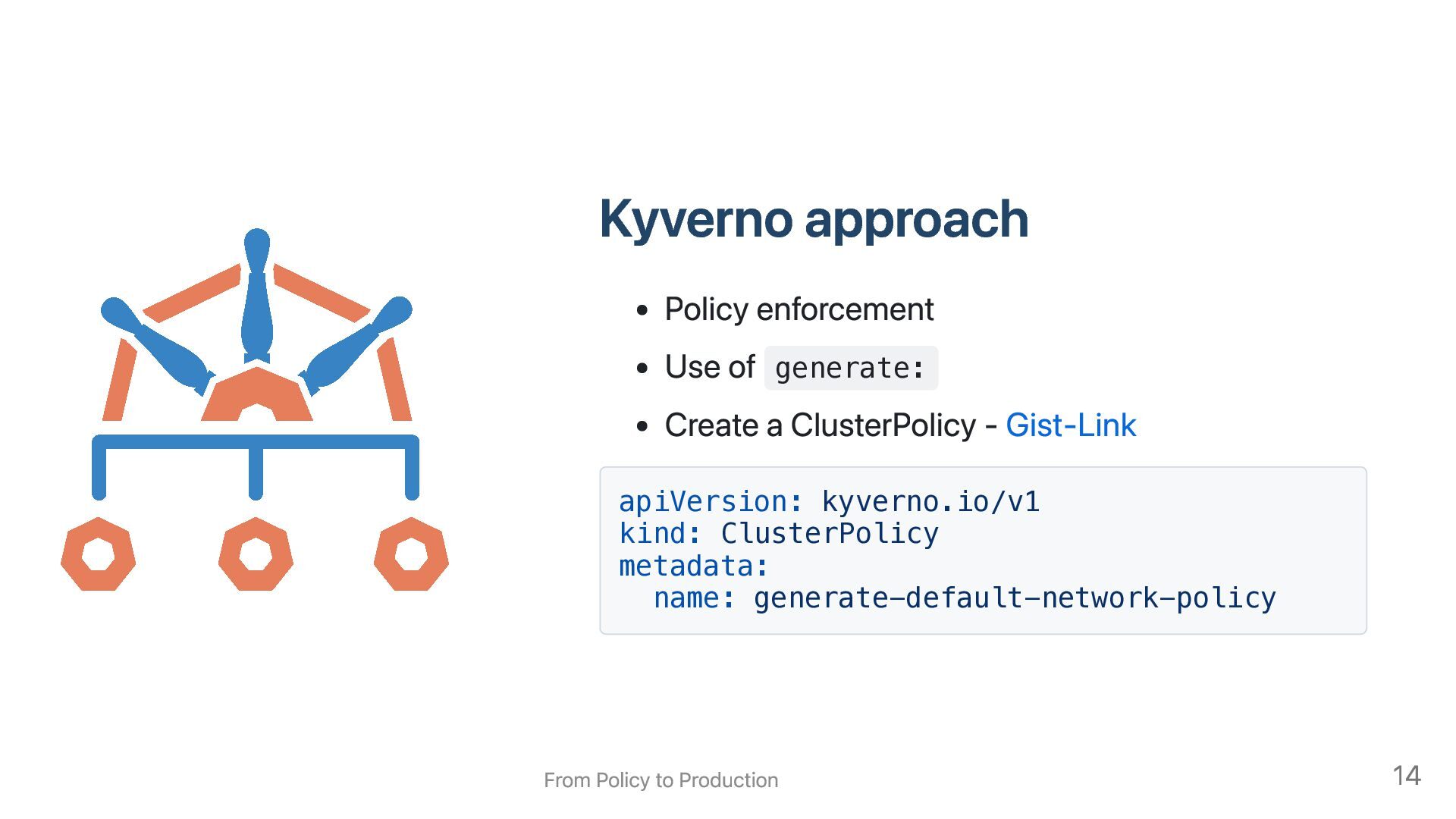
  11. Kyverno approach Policy enforcement Use of generate: Create a ClusterPolicy

    - Gist-Link apiVersion: kyverno.io/v1 kind: ClusterPolicy metadata: name: generate-default-network-policy From Policy to Production 14
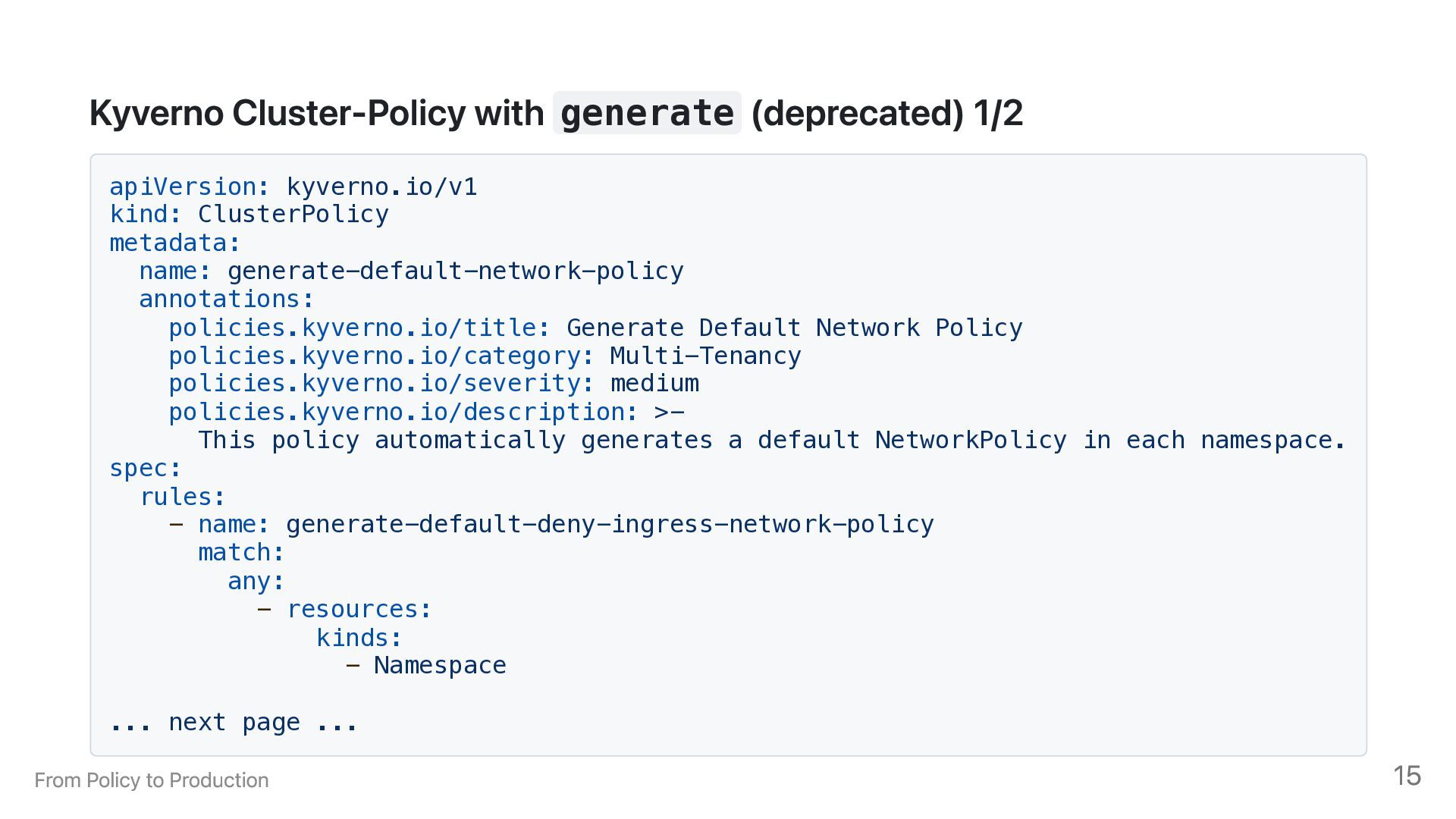
  12. Kyverno Cluster-Policy with generate (deprecated) 1/2 apiVersion: kyverno.io/v1 kind: ClusterPolicy

    metadata: name: generate-default-network-policy annotations: policies.kyverno.io/title: Generate Default Network Policy policies.kyverno.io/category: Multi-Tenancy policies.kyverno.io/severity: medium policies.kyverno.io/description: >- This policy automatically generates a default NetworkPolicy in each namespace. spec: rules: - name: generate-default-deny-ingress-network-policy match: any: - resources: kinds: - Namespace ... next page ... From Policy to Production 15
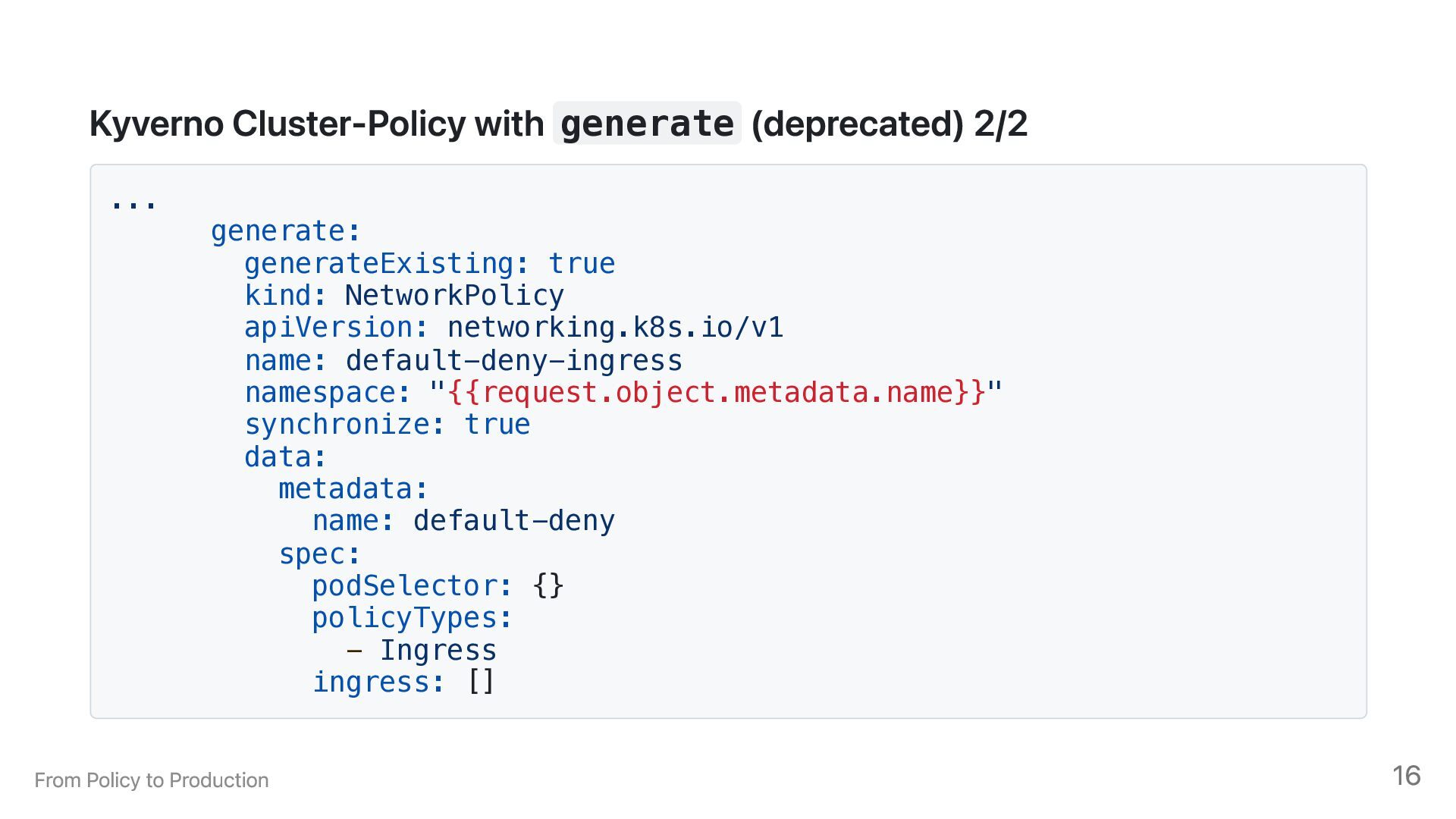
  13. Kyverno Cluster-Policy with generate (deprecated) 2/2 ... generate: generateExisting: true

    kind: NetworkPolicy apiVersion: networking.k8s.io/v1 name: default-deny-ingress namespace: "{{request.object.metadata.name}}" synchronize: true data: metadata: name: default-deny spec: podSelector: {} policyTypes: - Ingress ingress: [] From Policy to Production 16
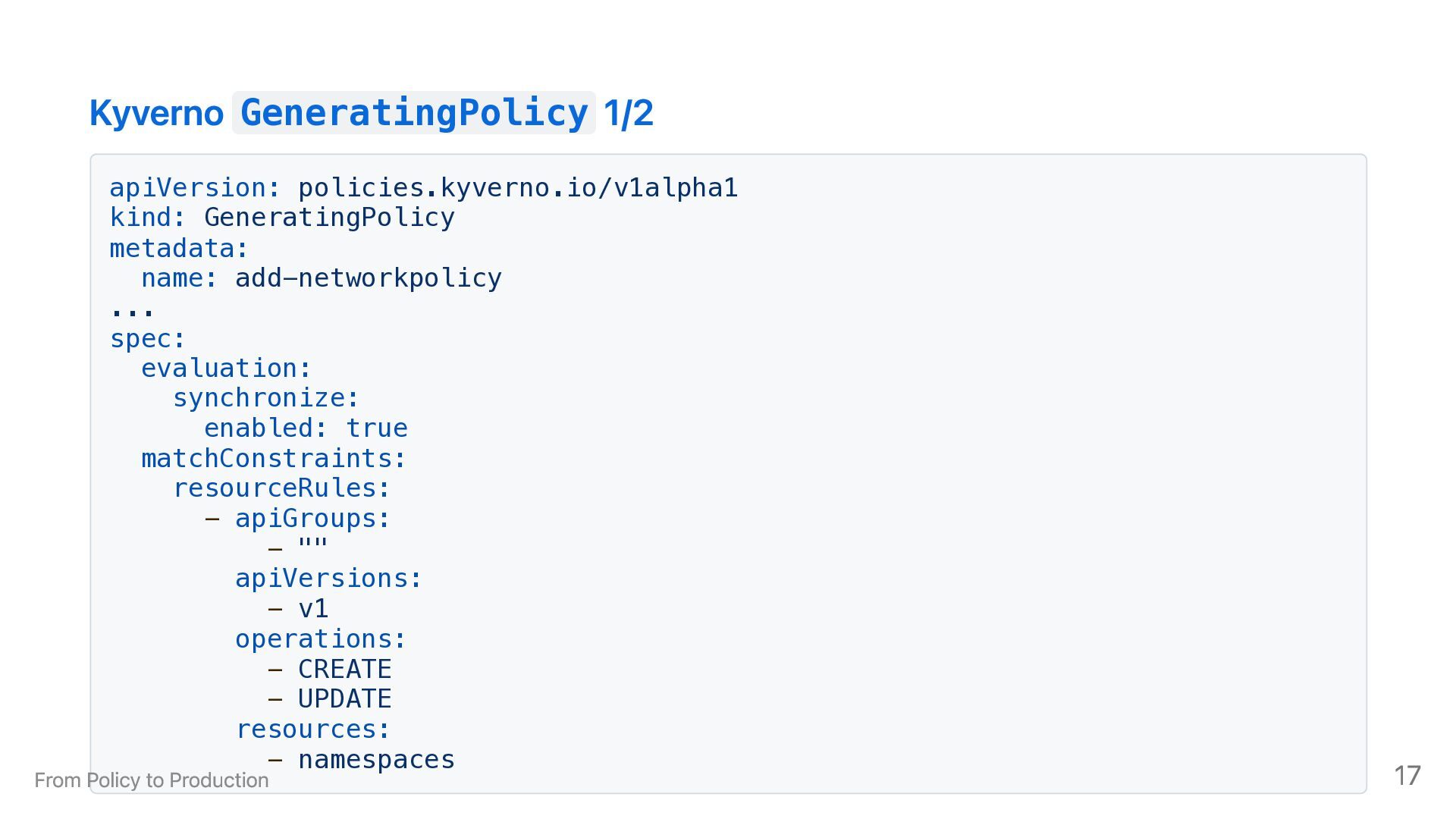
  14. Kyverno GeneratingPolicy 1/2 apiVersion: policies.kyverno.io/v1alpha1 kind: GeneratingPolicy metadata: name: add-networkpolicy

    ... spec: evaluation: synchronize: enabled: true matchConstraints: resourceRules: - apiGroups: - "" apiVersions: - v1 operations: - CREATE - UPDATE resources: - namespaces From Policy to Production 17
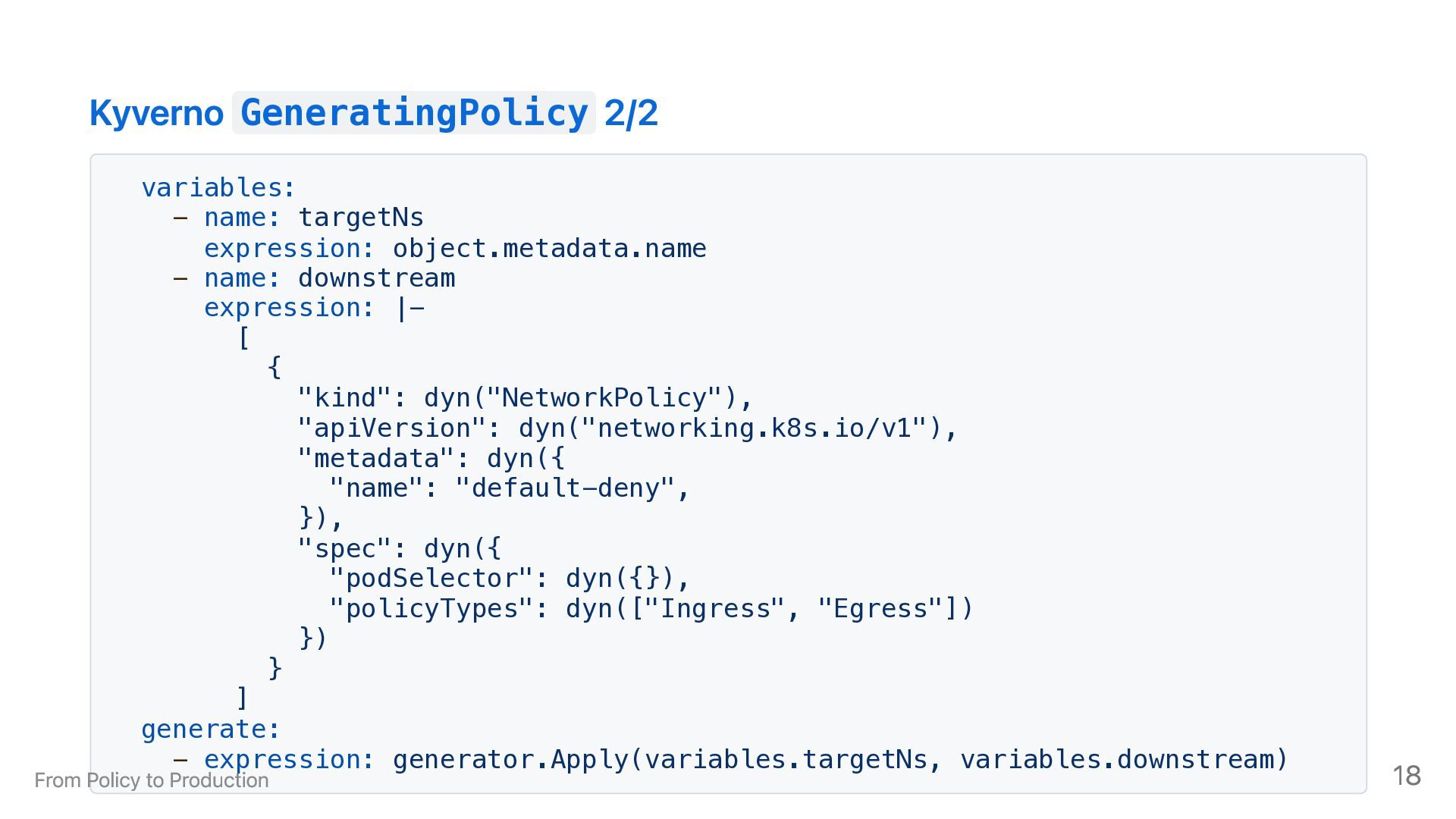
  15. Kyverno GeneratingPolicy 2/2 variables: - name: targetNs expression: object.metadata.name -

    name: downstream expression: |- [ { "kind": dyn("NetworkPolicy"), "apiVersion": dyn("networking.k8s.io/v1"), "metadata": dyn({ "name": "default-deny", }), "spec": dyn({ "podSelector": dyn({}), "policyTypes": dyn(["Ingress", "Egress"]) }) } ] generate: - expression: generator.Apply(variables.targetNs, variables.downstream) From Policy to Production 18
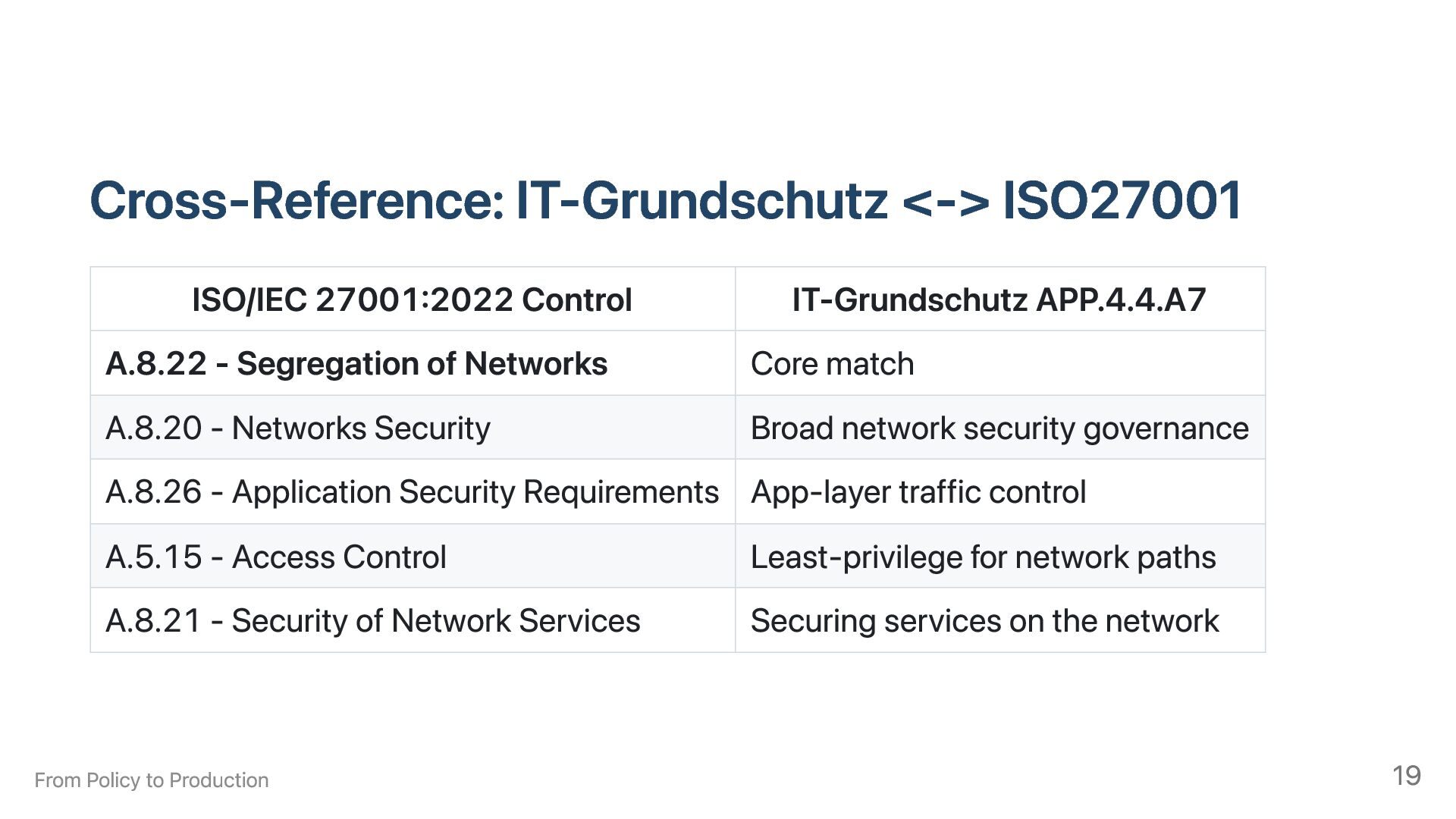
  16. Cross-Reference: IT-Grundschutz <-> ISO27001 ISO/IEC 27001:2022 Control IT-Grundschutz APP.4.4.A7 A.8.22

    - Segregation of Networks Core match A.8.20 - Networks Security Broad network security governance A.8.26 - Application Security Requirements App-layer traffic control A.5.15 - Access Control Least-privilege for network paths A.8.21 - Security of Network Services Securing services on the network From Policy to Production 19
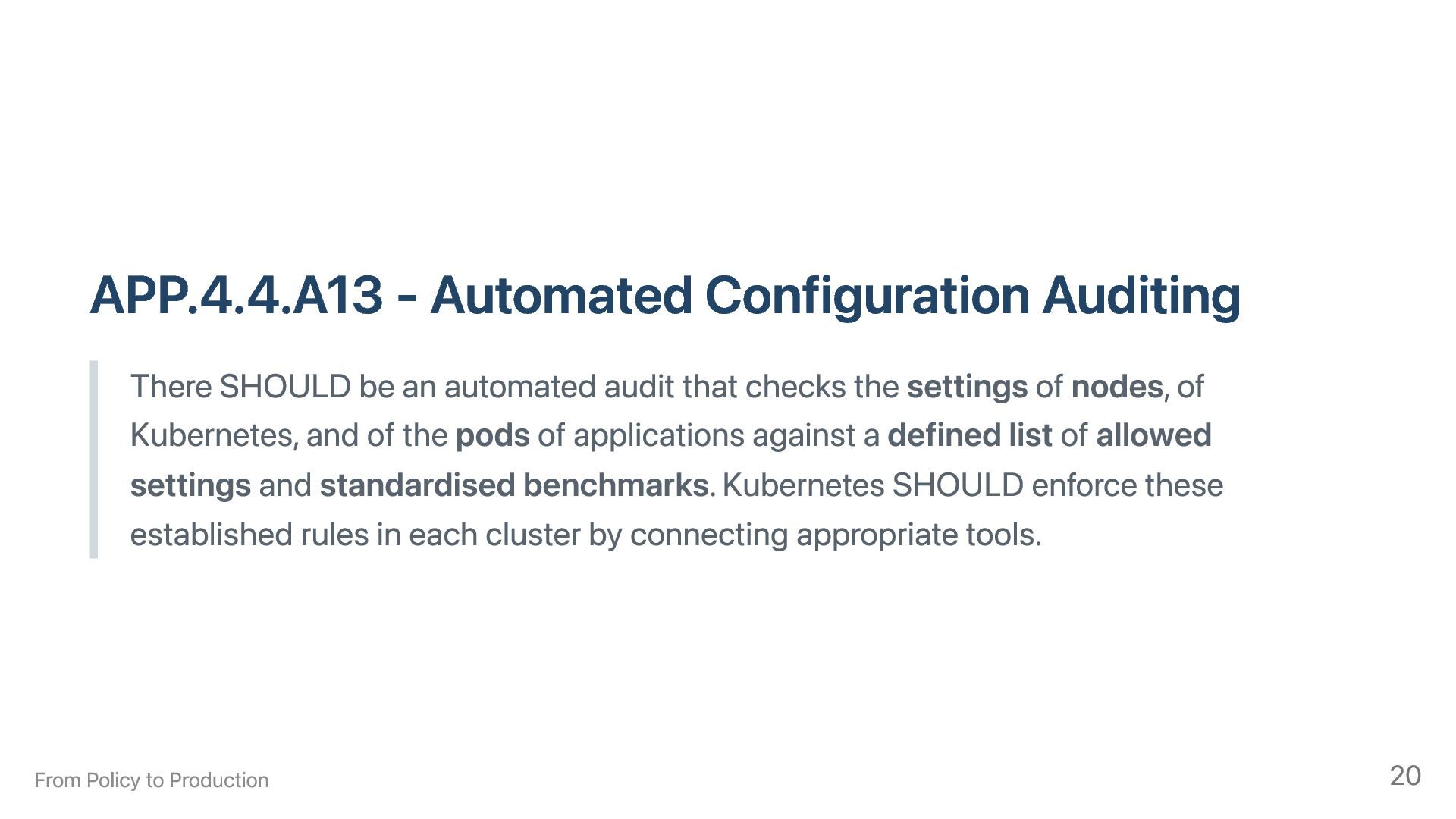
  17. APP.4.4.A13 - Automated Configuration Auditing There SHOULD be an automated

    audit that checks the settings of nodes, of Kubernetes, and of the pods of applications against a defined list of allowed settings and standardised benchmarks. Kubernetes SHOULD enforce these established rules in each cluster by connecting appropriate tools. From Policy to Production 20
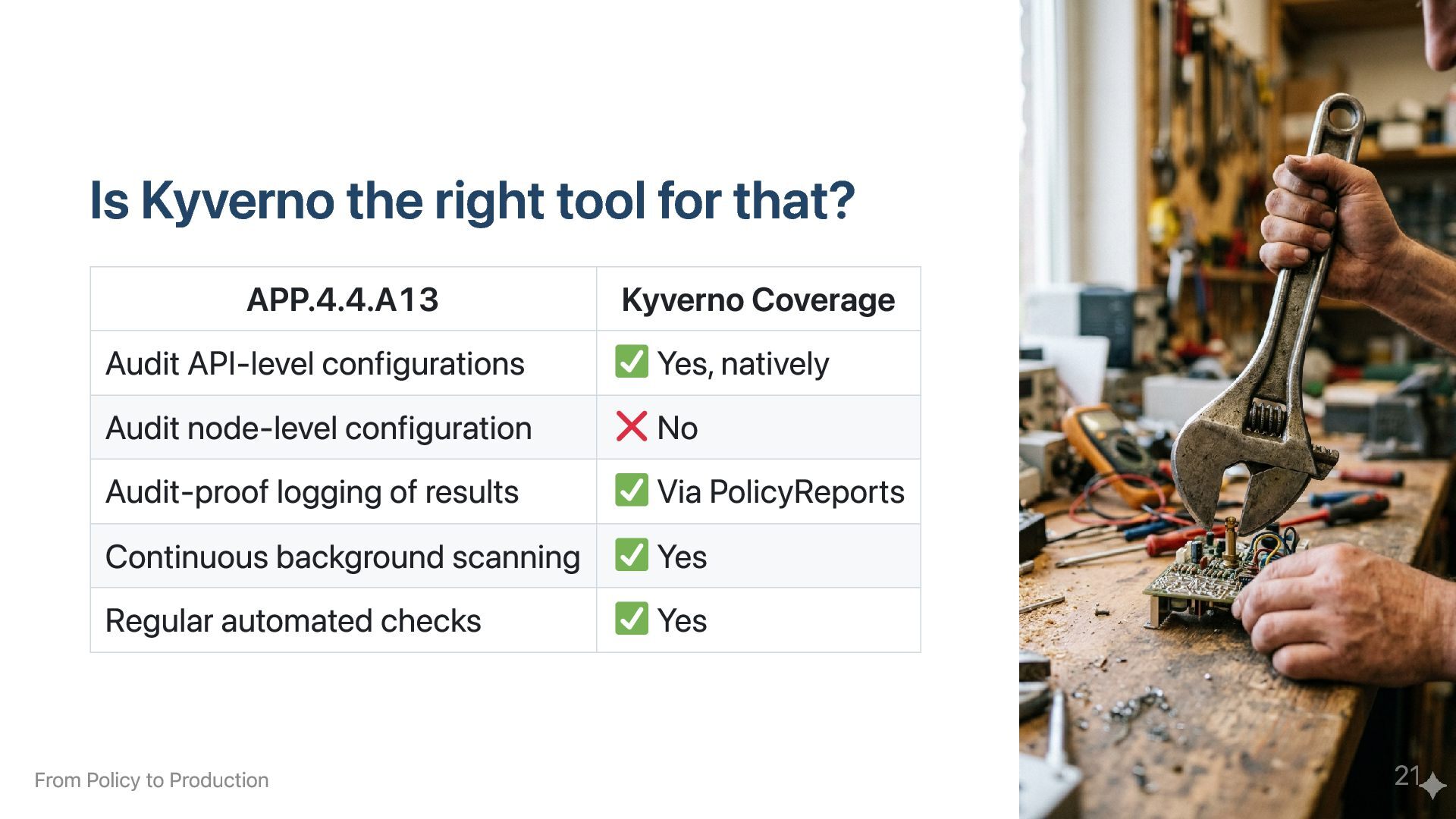
  18. Is Kyverno the right tool for that? APP.4.4.A13 Kyverno Coverage

    Audit API-level configurations Yes, natively Audit node-level configuration No Audit-proof logging of results Via PolicyReports Continuous background scanning Yes Regular automated checks Yes From Policy to Production 21
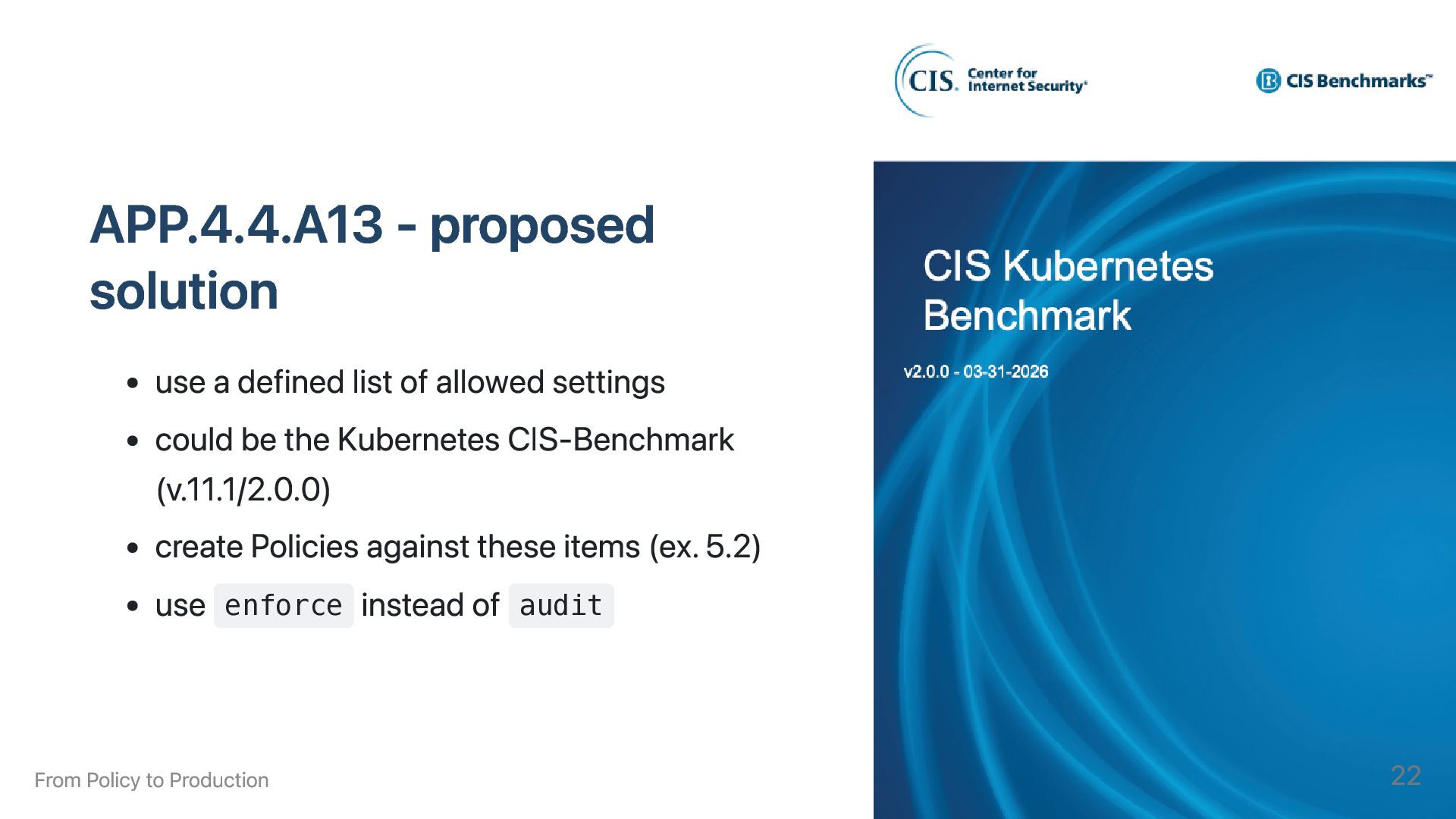
  19. APP.4.4.A13 - proposed solution use a defined list of allowed

    settings could be the Kubernetes CIS-Benchmark (v.11.1/2.0.0) create Policies against these items (ex. 5.2) use enforce instead of audit From Policy to Production 22
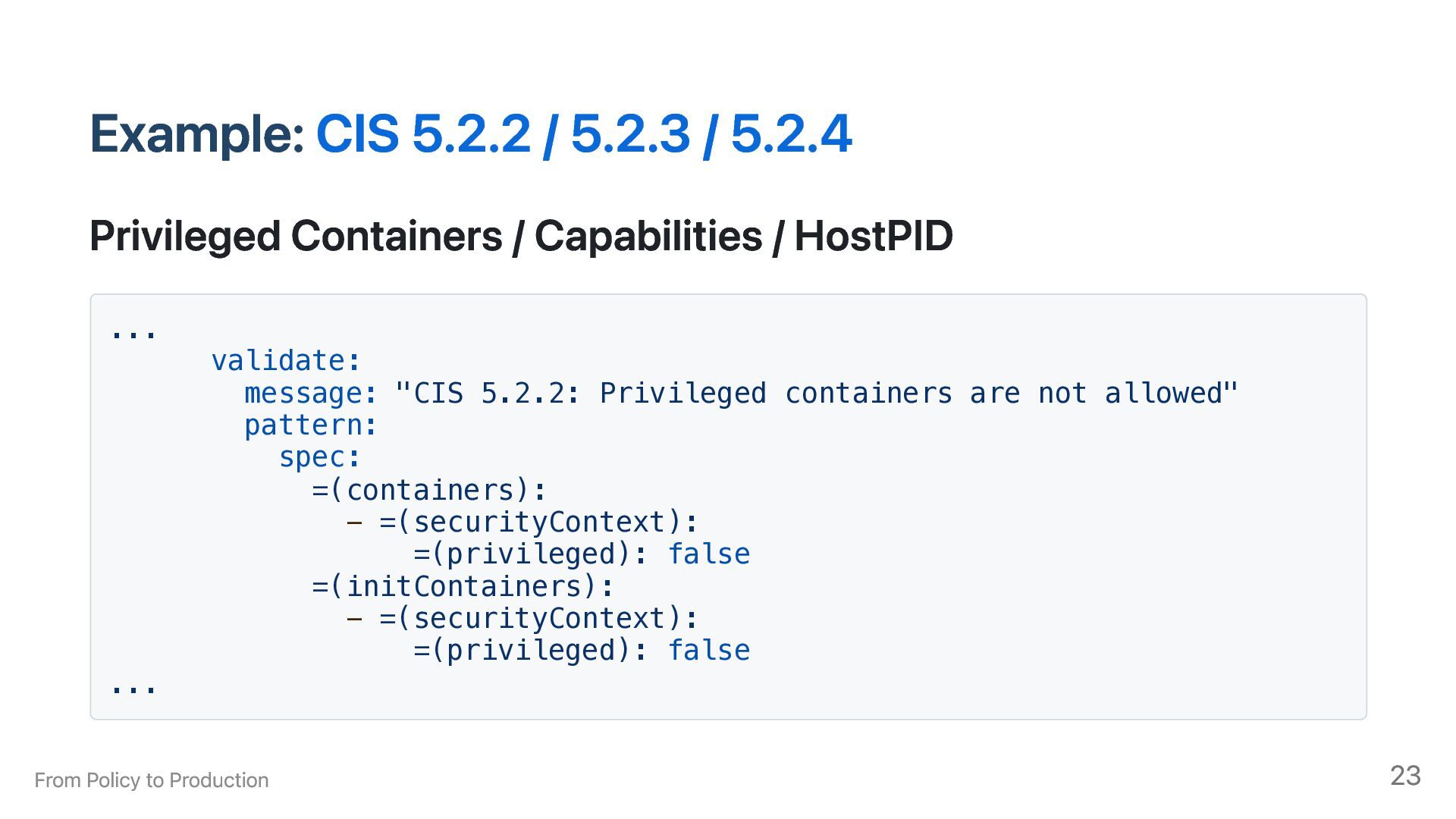
  20. Example: CIS 5.2.2 / 5.2.3 / 5.2.4 Privileged Containers /

    Capabilities / HostPID ... validate: message: "CIS 5.2.2: Privileged containers are not allowed" pattern: spec: =(containers): - =(securityContext): =(privileged): false =(initContainers): - =(securityContext): =(privileged): false ... From Policy to Production 23
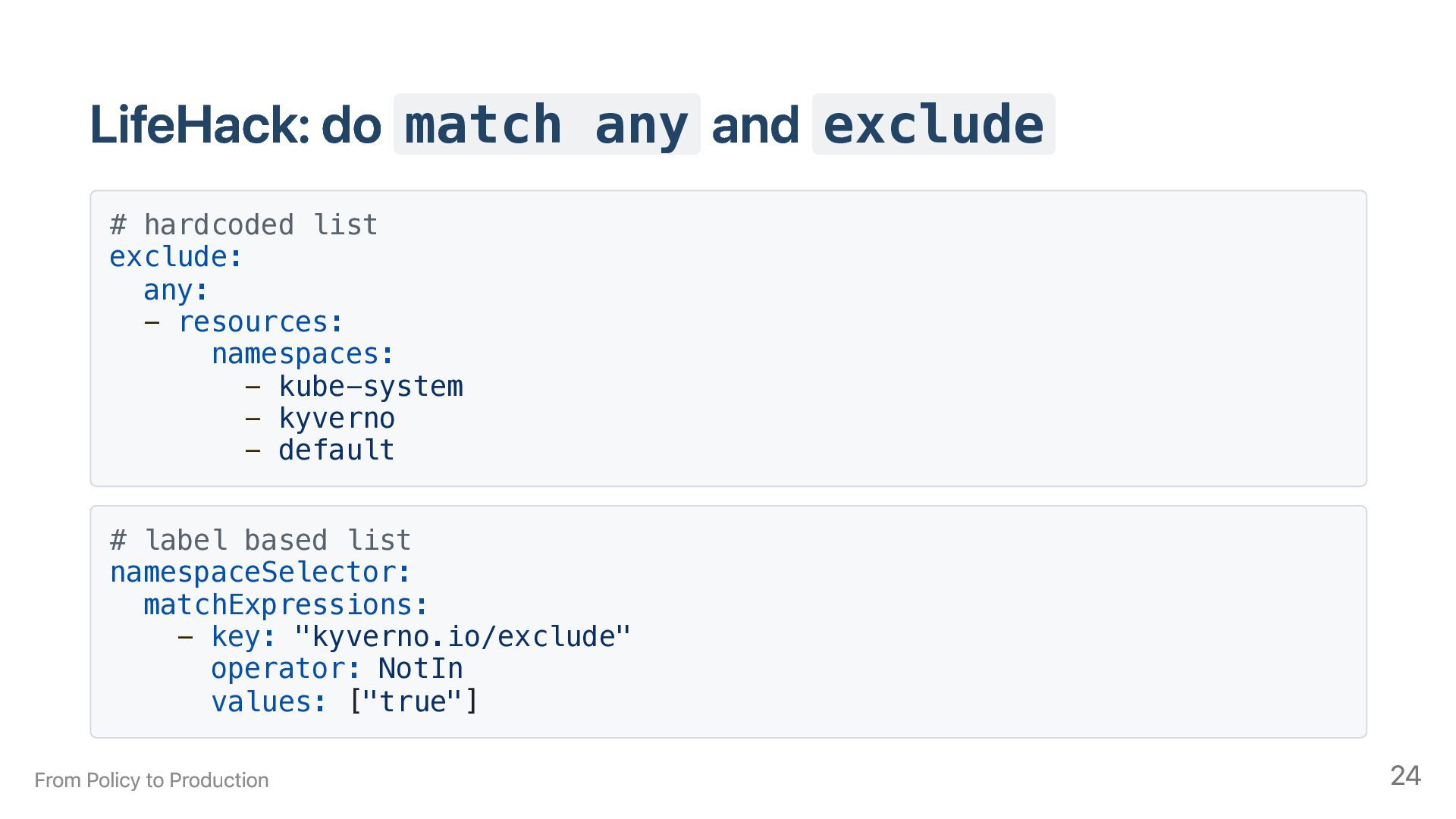
  21. LifeHack: do match any and exclude # hardcoded list exclude:

    any: - resources: namespaces: - kube-system - kyverno - default # label based list namespaceSelector: matchExpressions: - key: "kyverno.io/exclude" operator: NotIn values: ["true"] From Policy to Production 24
  22. APP.4.4.A21 - Regular Restart of Pods (High) No pod SHOULD

    run longer than 24 hours. Availability of the applications in a pod SHOULD be ensured From Policy to Production 25
  23. APP.4.4.A21 - proposed solution Google search yielded nothing! Own development

    in Golang - Operator or CronJob? ... and then there was the KCA-Exam From Policy to Production 26
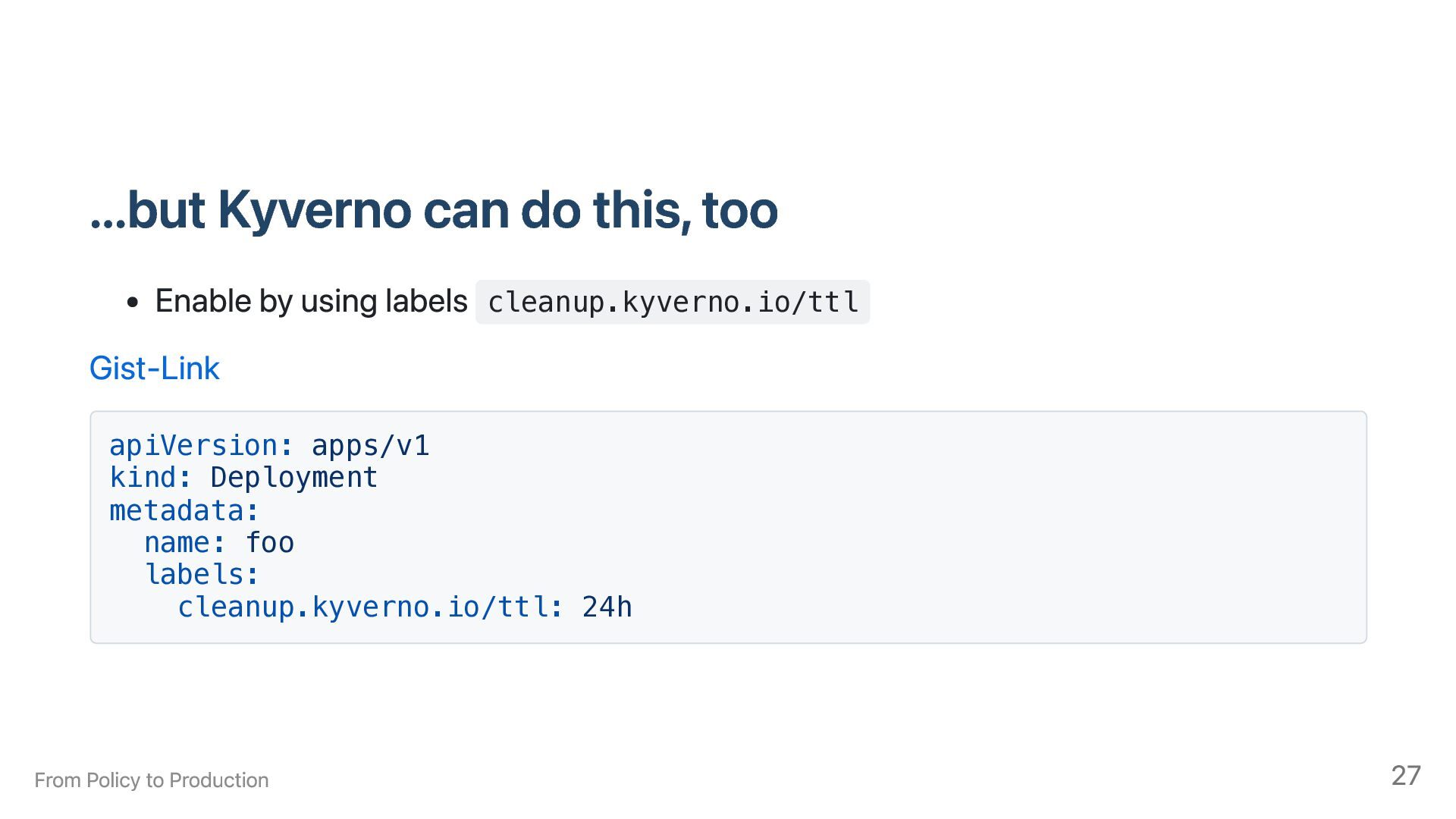
  24. ...but Kyverno can do this, too Enable by using labels

    cleanup.kyverno.io/ttl Gist-Link apiVersion: apps/v1 kind: Deployment metadata: name: foo labels: cleanup.kyverno.io/ttl: 24h From Policy to Production 27
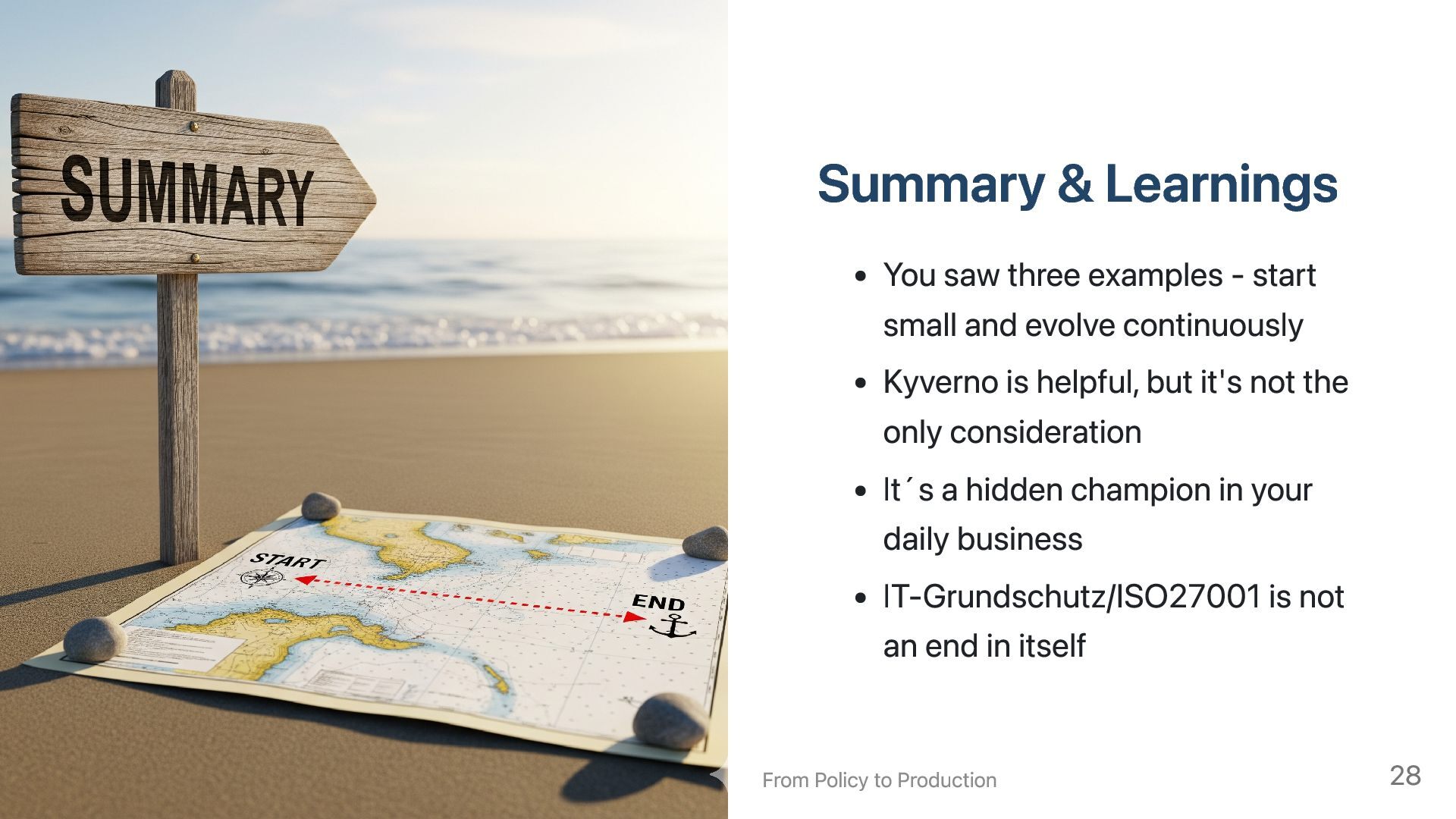
  25. Summary & Learnings You saw three examples - start small

    and evolve continuously Kyverno is helpful, but it's not the only consideration It´s a hidden champion in your daily business IT-Grundschutz/ISO27001 is not an end in itself From Policy to Production 28